GE Governance


The rise of resident action groups across Melbourne

Allison Worrall Jan 21, 2019

 

The genteel streets of Elsternwick are not usually the scenes of a protest but on Saturday, more than 150 disgruntled residents, many with children in tow, marched with placards.

The rally was to highlight the community’s opposition to two apartment towers of 10 and 14 storeys proposed after supermarket giant Woolworths bought the site of the former ABC studios.

The resident action group behind the march is in its infancy; members banded together just weeks ago. “I’m a complete novice,” said organiser and veterinarian Karen Boyd-Jones. “I didn’t realise it was going to be all day, every day – lucky I’ve just retired.”

While resident action groups are not new, their prevalence, profile and role in Melbourne has grown as the city’s population has boomed. Social media has been harnessed to raise awareness, attract new members, co-ordinate campaigns and share information.

In Brunswick in the inner north, an established and well-organised action group with more than 1000 members is gearing up for the eighth day of hearings at the state’s planning tribunal.

Protect Park Street Precinct formed two years ago in response to the proposed 13-storey development of 333 apartments overlooking Princes Park. The application has since been revised to 14 storeys, 255 apartments and 12 townhouses.

To date, the group has raised more than $100,000 to mount a comprehensive legal case against the large legal team hired by developer JW Land Group, which paid $32 million for the site.

Members include former La Trobe University chancellor Professor Adrienne E Clarke, who said the group wanted to see “an appropriate building, respectful of heritage values” on the site.

The rise of resident groups has seen thousands of Melburnians, many with little or no experience in politics or lobbying, become resolute activists in recent years.

“I don’t think it’s any secret that the way the planning scheme operates at the moment tends to be quite pro-development and favours the big end of town,” says Glen McCallum, the president of Protect Fitzroy North, a powerful group that campaigned against a sprawling 16-storey apartment complex on Queens Parade proposed by developer Tim Gurner.

In that case, planning minister Richard Wynne controversially intervened to place a 10-storey limit on the site, which ultimately led to the project being greatly scaled back. Mr Gurner defended the project at the state’s planning tribunal and welcomed the approval when it was granted.

Since then, Mr McCallum’s organisation has offered assistance and fielded enquiries from resident groups in Collingwood, Alphington, Ivanhoe, Heidelberg and Brunswick.

“The pace of development has stepped up,” Mr McCallum says, “and the regime the councils operate under hasn’t changed since way back in the ’90s.”

With or without the support of councils – many of which have been inundated with development applications and are simultaneously juggling dozens of proposals and appeals – resident action groups are regularly taking on multi-millionaire developers in the Victorian Civil and Administrative Tribunal.

When a case reaches the tribunal, developers will often hire high-flying legal teams consisting of a QC, a junior barrister, several solicitors and a stream of other consultants and experts.

Meanwhile, residents may not have any legal representation or, if they have successfully fundraised, may hire a planning barrister like Daniel Epstein, who charges community groups a reduced fee.

“It’s absolutely a David and Goliath battle,” Mr Epstein admitted but added that resident groups had repeatedly proven effective. “It might be that the development goes through but is much more considered and restricted because of what the community did.”

Most resident groups vehemently reject the NIMBY label, and Mr Epstein agreed it was not the right description. He stressed that the dozen groups he had worked with were not anti-development, but against developments that were ill-considered or too large.

Those involved in planning disputes say it is arduous work entailing countless hours of research.  “Our little structure plan for Elsternwick had approximately 19 documents, over 1000 pages,” said research scientist Jacinta Smith, who attended Saturday’s march.

“How do people cope with that? Only ridiculous people like me think ‘I’m going to read this with my highlighter’.”

Ms Smith said she had never stepped foot inside a council meeting until 18 months ago when her land was rezoned. “I, like many people, was ignorant and apathetic on local council issues,” she said. “We assume the professionals and experts will handle this for us.”

Glen Eira council will hand down its decision regarding the Woolworths development next month.

Source: https://www.domain.com.au/news/the-rise-of-resident-action-groups-across-melbourne/?utm_campaign=strap-masthead&utm_source=the-age&utm_medium=link&utm_content=pos2&ref=pos1

PS – From today’s Caulfield Leader

tw

In the 2016 Planning Scheme Review, residents made it clear that high on their list of priorities for council action was the introduction of an ESD (Environmentally Sustainable Development) policy, plus a WSUD (Water Sensitive Urban Design) policy.  The formal Review submitted to government went on to state (page 26):

ESD, loss of water, permeability, underground car parking  

Feedback revealed a greater desire for environmentally sustainable developments. 

It is recommended:

Σ That a town planning sustainability policy be developed together with ESD objectives in the MSS.

Σ Investigate possible incentives encouraging ESD for developments.

Σ Increase opportunities for planting

Σ Develop a Water Sensitive Urban Design Policy.

Σ Continue advocacy for a Statewide ESD Policy.

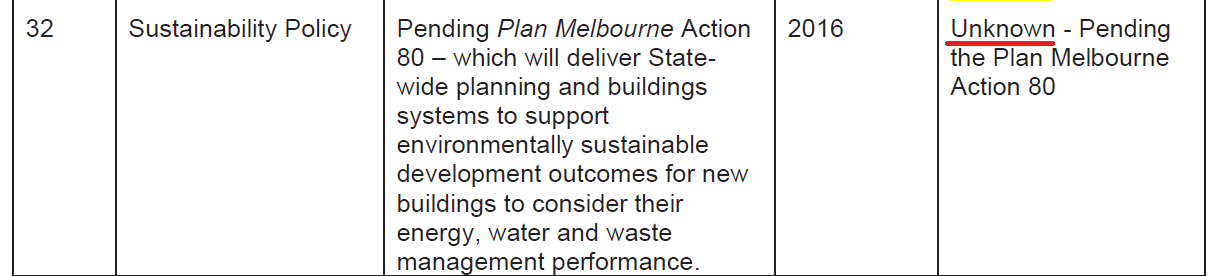
In the October 2018 review these ‘recommendations’ somehow went out the window with council resorting to its time honoured practice of ‘let’s wait for the state government to do something’ as evidenced here:

Even the WSUD idea morphed into the single issue of the Elster Creek Catchment project rather than seeing this as an issue for each individual development application.

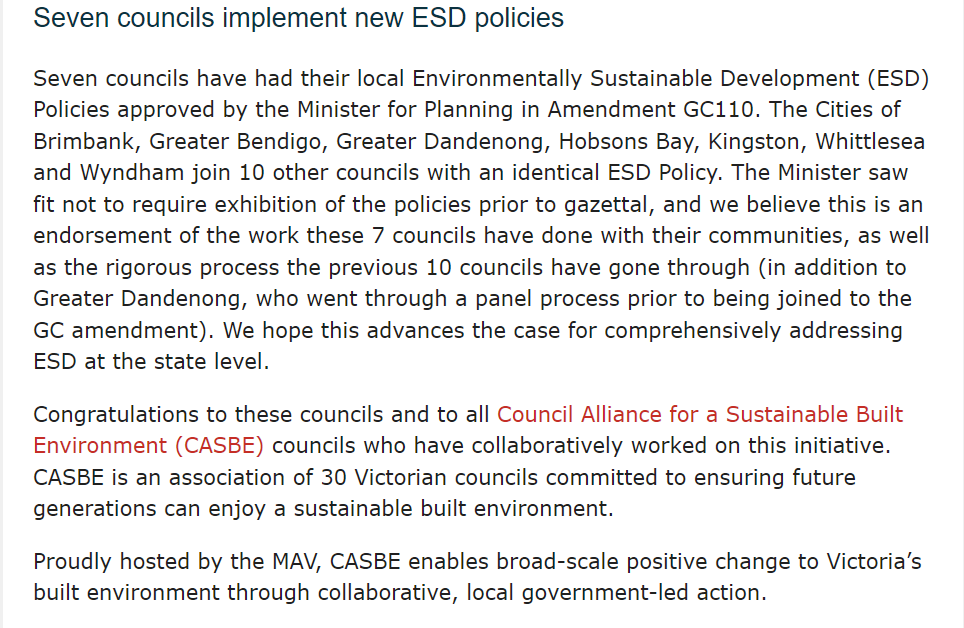
For 30 other Victorian Councils, waiting around is not an option. Here’s a recent announcement from the MAV – the peak body of all councils.

Glen Eira isn’t even a member of the above listed alliance! Why not? Why is this council so averse to working collaboratively with other councils to ensure positive outcomes for the community? Is it really so hard to devise a policy that is now firmly entrenched in countless other planning schemes? Or is it that any impediment to developers goes against the grain?

Here is a list, taken from the CASBE website of all councils forming this alliance.

Banyule

Bass coast

Bayside

Benalla

Brimbank

Darebin

Greater Bendigo

Greater Dandenong

Geelong

Hobson’s Bay

Hume

Kingston

Knox

Manningham

Maribyrnong

Maroondah

Melbourne

Monash

Moonee Valley

Moreland

Port Phillip

Stonnington

Strathbogie

Whitehorse

Whittlesea

Wodonga

Wyndham

Yarra

Yarra Ranges

The Australian Bureau of Statistics has today released its data for building approvals for the July to November 2018 period. Glen Eira remains well and truly above target to meet its housing needs for population growth.

The chart below features all building approvals since the 2011/12 financial year. Please note that these figures also include building approvals for single house replacements. Thus, whilst the chart indicates that Monash has 300+ more building approvals, once the number of permits for single houses are removed, Glen Eira is streaking it in. For example: during this period Monash has had 4432 single house permits granted. Glen Eira has had 2232 – ie Monash has had double the number. Boroondara is another example where the rate of single house replacement is very high – 3547. Further exacerbating this data is the size of these municipalities. When 80 square km (Monash) is compared to the 38.9 km of Glen Eira, questions of density, open space become critical. Something our council is ignoring completely!

Given this data, it remains unbelievable that council is still committed to doubling the size of our activity centres and facilitating apartment blocks of 12 storeys and more.

PS – in order to put some of these stats into perspective we are adding the following – a list of all municipalities that had more building permits granted than Glen Eira’s for the period July to November 2018. Glen Eira had 853 permits of which only 132 were for single house replacements. The following list includes the total number of permits, plus the number of single house permits following the bracket(/).

Casey – 1983/ 1794

Greater Geelong – 1416/1246

Hume – 1615/1395

Manningham – 1109/170

Melton – 1216/1199

Monash – 1201/291

Whittlesea – 1266/890

Wyndham – 2557/2296


To begin with, wishing all our readers a safe and healthy festive season, with thanks for your input throughout the year.

2018 has in many ways been pretty momentous. There have been some governance advances but overall majority resident views continue to be ignored. Here is a summary:

THE POSITIVES

  • Telecasting of council meetings and ‘public participation’ section a continued winner
  • Heritage action(s), whilst far from complete, has at least got off the ground
  • Reform of permit time extension applications and council’s admission that it stuffed up badly on one application

THE NEGATIVES

  • Structure planning ‘consultations’ that are ‘tokenistic’ given the continued changes that have not gone out for proper consultation and when no justification is provided for the changes – ie setbacks, heights.
  • Continued delays on the introduction of parking plans, heritage overlays, open space levies
  • Local Law review still well over a year away – ie removing the ridiculous clause that those asking public questions have to sit through up to 3 hours of items before their questions can be addressed. If not present then no record of the question or response exists in the minutes.
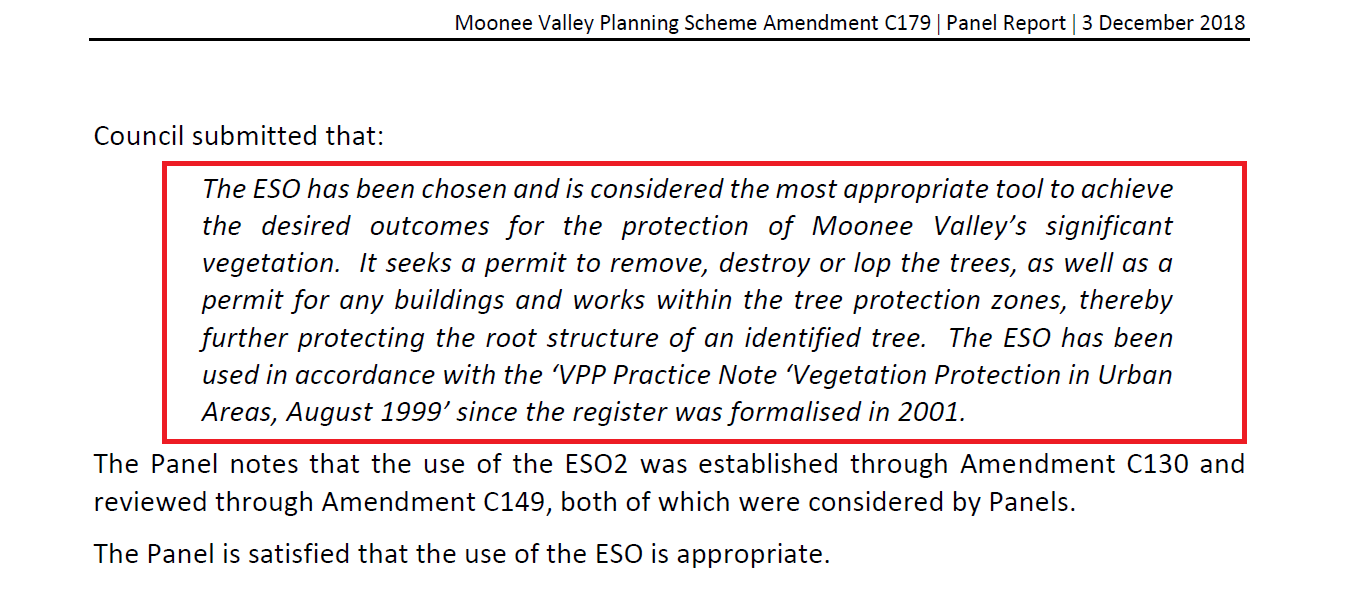
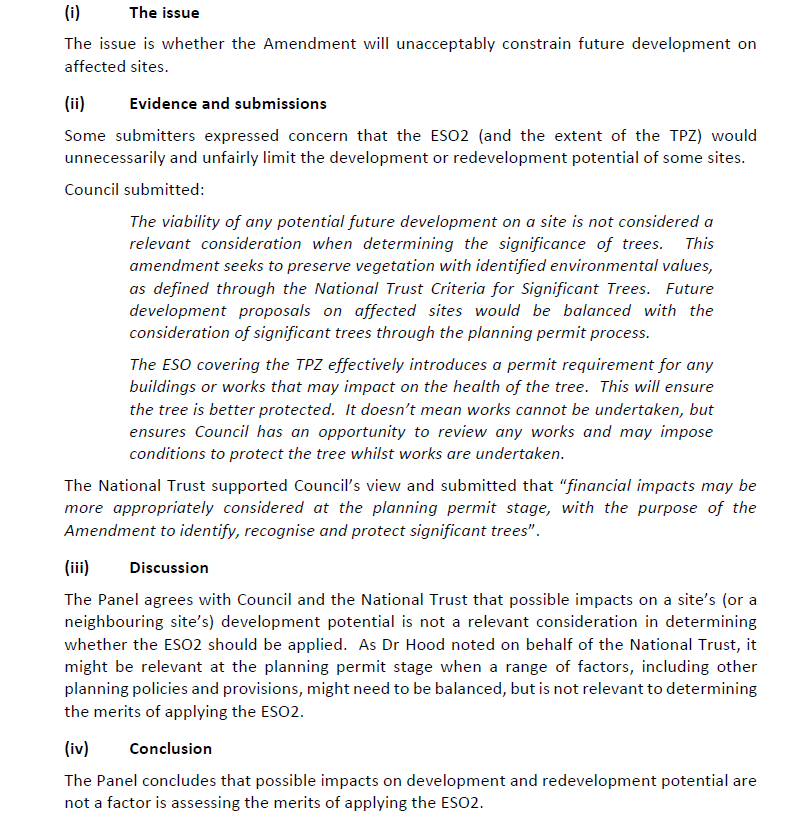
  • Tree register still belonging in some unspecified never-never land.
  • When the city is well and truly meeting its housing needs for population growth, no justification has been provided for why so much more development is required.
  • No firm commitment to introduce structure plans for neighbourhood centres – merely ‘urban design guidelines’ that are non-mandatory. Timelines also a mystery. Yet we have seen up to 8 storeys in these centres.
  • Officers granted more power via the recent delegation resolution – ie need now for over 15 objections to a planning permit in order for it to be considered as ‘suitable’ for a full council decision – otherwise decided by the Delegated Planning Committee which consists entirely of officers. One concession – councilors now have ‘call in’ rights. How often will this be used we wonder and no guidelines/policies have been published to inform residents as to how this will work.

There are plenty of other issues we might highlight. The take home message is that planning and traffic remain residents’ major concern and this council has done very little to ameliorate the continuing damage. When the vast majority of residents are opposed to 12 storeys in Carnegie & Elsternwick, and the majority were also in favour of only 4 storeys for Bentleigh, council has shown time and time again that it is intent on ramming its agenda through despite community opposition. Until we have a group of councilors determined to listen to its residents then nothing will change.


UPDATE ON DECISIONS: Councillors voted unanimously to reject the Egan Street application last night. (Davey was absent and Taylor has resigned). The Snowden Avenue application was another rejection! Both will undoubtedly end up at VCAT and we envisage permits for both.

Once again we have two applications up for decision where the officer recommendations appear to have no correlation with the current planning scheme. The applications are:

  • 8 Egan Street, Carnegie for an 8 storey mixed use development containing 84 apartments of 40 one bedroom. 38 two bedroom and 6 one bedroom plus study. Parking shortfall is 8 spaces. A permit is recommended.
  • 57 Snowden Avenue, Caulfield for a two storey building containing 4 dwellings of three bedrooms each in a Neighbourhood Residential Zone (NRZ). The site is 857 square metres. Officer recommendation is a refusal of permit.

The first application received one objection whilst the Snowden Avenue one had 12 objections.

What is staggering about the officer recommendations plus the overall assessment of these two applications is the inconsistency, plus the complete disavowal of council’s planning scheme.

EGAN STREET APPLICATION

The site has a long history of applications. Initially there was a 16 storey attempt which both council and VCAT refused. This current application is an amendment to what was originally a 12 storey plan and as a result of the interim height amendment of August 2018, the developer has opted for an 8 storey version. In this instance the introduction of the DDO has resulted in a reduction of height. That’s a positive outcome. What is not so ‘positive’ is the evaluation by the planning department of this current attempt and the explicit acknowledgement how council has stuffed up in the past.

An important element in the decision is the interpretation of ‘community benefit’. Council admits that currently there is no clear definition or criteria to adjudicate on what ‘community benefit’ means. This does not stop the report however from claiming that pedestrian access from Egan Street to the rear of 1062-1064 Dandenong Road  equates to ‘community benefit’!!!!!! This is further endorsed with the following  –

The proposal also contains a diverse mix of housing, as one (some with study’s) and two bedroom dwellings with various layouts and sizes are proposed. While this, in the context of community benefit is low, it does add to the broader community benefit that is achieved through the securing of a publicly accessible laneway 

Thus, housing diversity is satisfied by a 8 storey building containing primarily single and two bedroom apartments! That is seen as a ‘community benefit’!

We then have the biggest backflip of all time when it comes to overshadowing of public open space. Council admits that the degree of overshadowing is excessive and inappropriate’, but this is okay since the language of the amendment is so poorly constructed  –

When considering the wording of the DDO control being to minimise overshadowing impacts on existing and future open spaces … , it is considered that the Urban Design advice in this instance goes beyond what the control seeks to achieve. In this respect, Council must be satisfied that the proposal has minimised overshadowing impacts. It is considered that the extent of shadow is limited to the northern section of the park directly opposite the site. The shadow largely avoids the walking and cycling path and the building’s side setback will also provide filtered light through to the open space when shadow is cast by the building. Overall, the proposal is considered to have minimised the impact of overshadowing onto this new park. 

There are plenty of other issues with this application that have basically been ignored in the report, or failed to be addressed with clear and irrefutable ‘evidence’. In the end, a narrow laneway becomes a ‘community benefit’ and dubious employment potential another benefit. Overshadowing is okay because the authors of the amendment got it so wrong!

SNOWDEN AVENUE APPLICATION 

This application well and truly meets all requirements of the planning scheme in terms of height, site coverage, permeability, garden area, setbacks etc. Yet it is refused on the most tenuous and ‘subjective’ reasons. The major reason for the refusal is that the application is for an ‘apartment’ style building in the NRZ, rather than detached housing/townhouses. The hypocrisy of such a stance is unbelievable given that:

  • Council is now proposing to allow 3 storey townhouses/apartments in NRZ areas as per its latest structure planning proposals
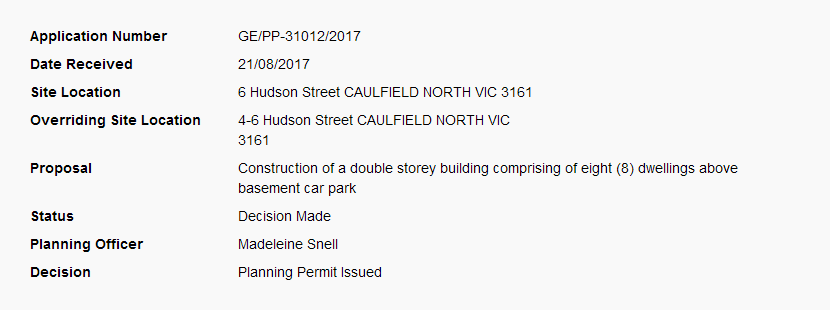
  • Council has already granted permits for apartment style buildings in its NRZ – ie Hudson Street (below)

The planning scheme verbage has not changed in the intervening period. Why this current application which meets all criteria is refused when council previously issued a permit for exactly the same kind of structure is bewildering to say the least. Does the answer lie in the number of objections perhaps?

The greatest blooper in this officer’s report however is the questioning of why the applicant chose to provide on site car parking that goes beyond what is required!

It is unclear as to why a total of 10 resident spaces are proposed along with an additional visitor space (total – 11 spaces) have been proposed for a 4-dwelling development which would generate a requirement of 8 spaces.

We are not endorsing the granting of a permit. What we are questioning is the consistency and validity of council’s decision making and the ‘influences’ that might be at work. When the planning scheme is ignored then planning is indeed in an almighty mess. That is Glen Eira!

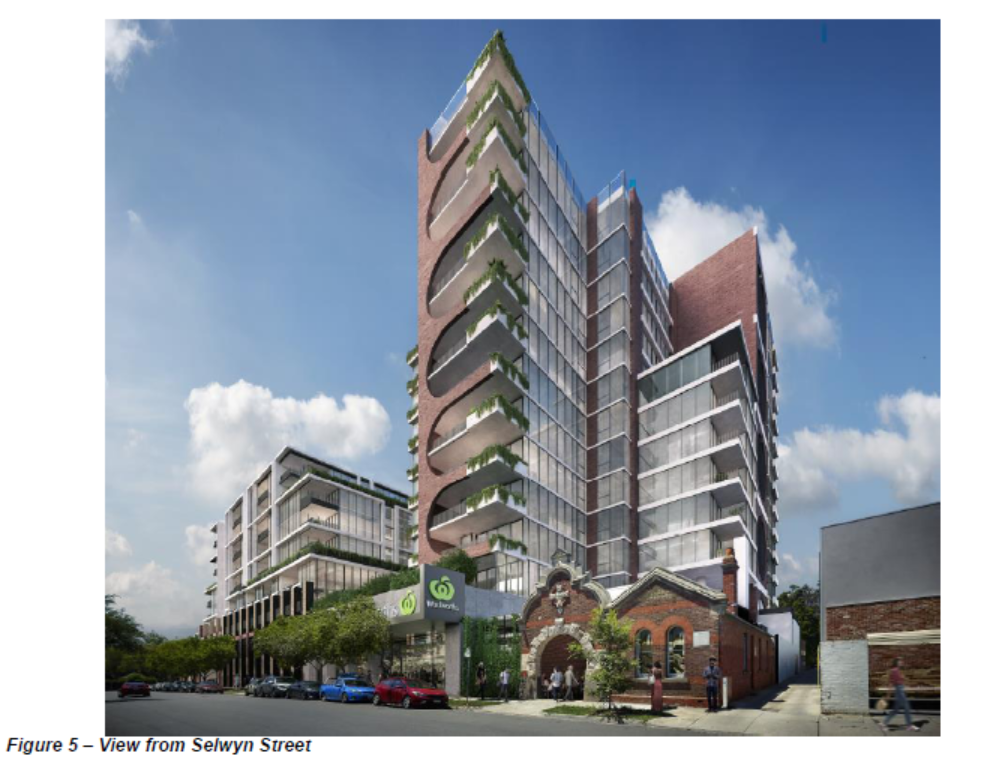
Elsternwick is quickly emerging as Glen Eira’s high rise capital with another 14 storey application for the former Daily Planet site. Adding salt to the wounds of residents, this application:

  • Abuts the 4 storey mandatory height limit of Ross Street – where many dwellings are single storey
  • The discretionary height limit is 12 storeys but developers regard this as nothing more than a ‘minimum’.

Possibly the biggest joke in this application is the developer’s claims to ‘community benefit’. Readers should remember that council decided that development could go from 8 to 12 storeys if there was ‘community benefit’. Of course there is very little definition of what this term actually means and certainly nothing worth a cracker in the eventual interim amendment. For those applications wishing to exceed the preferred height, all they have to show is (quote) – that the development includes the provision of significant community benefit. Not a single of word of definition exists; no decision criteria exist. Council should congratulate itself on producing the perfect example of waffle par excellence!

How does the developer respond to this clause then? Here’s what is claimed as ‘community benefit’ –

We get a paragraph on office space and ’employment’, then more of the same. Please note the reference to the former brothel!

And the result will look like this:

There’s another aspect to this application worth considering. As recently as the last council meeting a resolution was passed to grant this site a permit for a drug rehabilitation unit. It had apparently been operating for some time without a permit. The current application allegedly arrived at council on the 2nd November.  Discussions prior to this date would undoubtedly have taken place with council planners. Thus, given that developers operated without a permit, did council issue any fines, or merely turn a blind eye knowing this was in the works?

Many other aspects of the application are contentious – ie overshadowing; traffic, open space. What is becoming clearer and clearer is that Elsternwick has always been seen as Glen Eira’s high rise capital and every effort has been made to further this agenda by a council that steadfastly refuses to listen to its residents!

Common sense is a very scarce commodity in Glen Eira council. Why on earth would you close off three quarters of a family park on December 3rd when kids and families are about to go on holidays and would enjoy spending some time in a public park? Why now, and for a stretch of 6 months, when the decision to spend a squillion on Harleston park was made just on 18 months ago?

Here’s the breakdown of events:

  • The first inkling that council had decided to spend $650,000 on a new playground, and $350,000 on toilets came in the 2017/18 budget papers. That’s 18 months ago!
  • Next came the pretty drawings and public consultation where the vast majority of responses were opposed to the expense and the decision to create a full size basketball court. Countless comments wanted the park to remain the same.
  • With this fierce opposition, we then had another round of ‘consultation’ with the majority of residents still opposed. This time councilors voted to proceed but with a half court instead. How much these rounds of ‘consultation’ cost has never been disclosed, nor has the ‘design’ drawings as far as we know.
  • The 2018/19 budget papers included another $155,000 for an ‘all purpose court’ – is this in addition to the $650,000?
  • The tender finally went out with closing dates of October 2018 – a year of doing nothing despite what the budget stated.
  • On November 7th, council awarded the contract as shown below –


It is unclear whether this successful tender includes the toilet costs or is simply for the playground and landscaping. Please note that the stated amount is EXCLUSIVE of GST – meaning that this project will cost well over a million dollars.

This exercise raises plenty of issues, such as:

  • When will this council finally start listening to its residents? If the majority didn’t want this ‘redevelopment’ then how can the expenditure of over one million be justified?
  • Why does it take so long for budget items to get off the ground? Is it that council doesn’t have the requisite cash available at the time?
  • Couldn’t the restructure have been started earlier, well before XMAS and the holiday season? Should it really take 6 months for completion?
  • And the over-riding question – why must each park look the same? What’s wrong with one area that is specifically suited to toddlers as the majority of responses indicated?

The photo (below) shows the removal of rubber matting that has only recently been installed and is probably still in very good condition. Again, how much did this cost?

Whilst there is cause for ‘congratulations’ that council is now responding to resident requests regarding the zoning of various areas within Glen Eira, we also find that the actions proposed fall far short of what is required.

At last council meeting the application for Weeroona Road was refused by councillors. Much was made of the fact that there existed a Neighbourhood Character Overlay on the other side of the street and not on the side that included the application site. Hence we now get the following Request for a Report –

Instead of a total review of all NCO’s, the report only wishes to look at those areas on opposite sides of the street. It is also possible to see this as an explicit admission of how woeful Glen Eira’s planning has been. If planning was done properly to begin with we would now not be in the situation where it takes a huge resident outcry to get some responses underway. The incompetence of council’s planning is fully illustrated in the following screen dumps. Please note that these Neighbourhood Character Overlays also incorporate areas zoned as GRZ and RGZ. If the objective is to protect streets via the NCO, then it is really incomprehensible how these places could have been assigned the GRZ and RGZ zoning – which still stand. Thus, the issue isn’t simply about NCOs on the opposite side of the street, but the overall zoning embedded within existing NCOs – plus how many more streets and properties deserve to be granted an NCO. Thus we now have had 5 years of zoning and any amendment will likely take another 18 to 24 months – making this a 7 year issue where nothing has been done to correct previous glaring errors!

For all the spin that the Urban Design Guidelines will ensure the right buildings in the right places, recent events reveal how ineffectual such ‘guidelines’ really are. Here’s why:

  • They are ‘discretionary’ and NOT mandatory
  • They are Reference documents only and NOT part of any specific clause of the planning scheme
  • There is nothing in the recently gazetted structure plans which mandate developers to abide by the aspirations of this ‘reference’ document

Best illustrating how council’s spin does not equate with reality, we have the example of 100-104 Mimosa Road, Carnegie. Originally an application came in for a 4 storey apartment block of 49 apartments. With the introduction of the structure plans we now have a ‘revised’ application for 3 storeys and 41 apartments. Height is the only aspect of the structure plans which are mandatory (only for Bentleigh & Carnegie), hence the removal of one storey. All well and good people might say. Except that Mimosa Road is, according to the structure plan, located in Precinct 2. And Precinct 2 is supposedly designated as ‘Garden Townhouse’ of up to 3 storeys, 11 metres. In other words, NOT an apartment block.  Yet this is what is now proposed – definitely NOT ‘townhouses’!

On the 28th February 2018, council minutes contained the following in regard to the Urban Design Guidelines –

The Quality Design Guidelines were produced to:

Respond to the aspirations of the Glen Eira community regarding neighbourhood character and to deliver on the vision for our neighbourhoods.

Encourage a high level of architectural design in new developments.

Provide clarity and certainty about Council’s expectations for new developments.

Support and supplement existing design guidance provided by the Glen Eira Planning Scheme and relevant State Government initiatives.

AND

Beyond ensuring better design outcomes are achieved across Glen Eira, implementation of the Quality Design Guidelines will deliver four significant benefits:

  1. Clarity and certainty for everyone
  2. Garden townhouses in residential streets
  3. Protection of character and human scale of shopping streets
  4. Maximising community benefit on strategic and urban renewal sites

Another ‘advantage’ of the Garden Townhouse aspiration was that –

  • Ground floor living reduces the impact of overlooking onto neighbouring backyards
  • Less dwelling density in residential streets address concerns of parking and traffic

The developer’s ‘revised’ application puts pay to all of this spin. We quote directly from the Urbis report:

…it is noted that the setback, landscaping, building design, landscaping and all other objectives are considered to be discretionary, whilst the specified height is considered to be mandatory. 

The built form currently proposed is an ‘apartment’ style building. It is considered that although a ‘town house character’ is encouraged by Amendment C157, it is noted that an apartment style character is a common characteristic within this neighbourhood setting 

It is noted that the proposed development does not provide the number of canopy trees required to be planted on the entire site and deep soil planting is restricted along the rear of the boundary and partly along the side boundaries. However, the street trees are proposed to be retained as part of this proposal and additional planting can be provided within the front setback of the development 

There are plenty of other problems with this application. For example:

Site coverage is 68%. Supposed to be 60%

Permeability is cited as 20% the required amount, but one has to query the following phrase attached to this number – ie deep soil area is 13% remains unchanged. What does this say about permeability per se, or the extent of the basement car park? Please remember that council’s ‘promise’ was to ensure that basement car parks did not cover practically the entire site!

What happens with this application will be instructive to say the least. More than anything it highlights once again the failure of this council to produce results that have real effect.

Finally a comment on governance and the continued monkey business that occurs with council’s online register. The application for 4 storeys came in months and months ago. It then disappeared entirely from the online register. Nothing such as ‘withdrawn’ was noted. It then made a reappearance as an entirely new application but still contained the SAME DATE as the original application for 4 storeys.

Online registers are required to contain information about every single application – their amendments, dates, decisions, etc. Far too often in Glen Eira inaccuracy and obfuscation replaces legal requirements!

Here are the two different applications and please note the dates:


Two successive items from Wednesday night’s council meeting produced 2 staggering decisions. We can speculate as to the reasons why these councillors decided as they did however, one thing is clear. When it comes to that holy of holies (ie planning law) this council and its crop of councilors have basically no interest in applying the law as it is written. So please, no more chest thumping and statements such as ‘we have to apply planning law’ when we make decisions!

The two items were:

7 apartments at 31 Weeroona Road, and

12 storeys in a heritage precinct at Derby Crescent, Caulfield East.

Councillors voted unanimously to REFUSE the Weeroona Road application and to grant a permit for the Derby Crescent application. Only Delahunty and Davey voted against this second application. In both instances planning law was totally ignored in our view. Could it possibly be that the reason the Weeroona road was refused was that there were 14 objections versus only 3 objections for the Derby Crescent application – this latter fact neatly pointed out by Magee and Strajt!

Please note that we are not discussing the merits of either application or whether they add to the overall housing ‘improvement’ in Glen Eira. What we are suggesting is that when time and time again councilors get up  on their hind legs and argue that their hands are tied by what the planning scheme says and therefore permits are granted, that the same should have happened with these two applications. Namely, that Weeroona should have got its permit and Derby Crescent should have been refused if there was to be consistency (and may we say integrity) in this councillor group. Sadly, these two cases are just another example of behind the scenes manipulation, vested interests, and a pro-development agenda that does not give a stuff about heritage in this municipality.

Here are some facts (as outlined by the officer report and Hyams for the Weeroona application –

  • It is zoned GRZ1 – ie an allowed height limit of 3 storeys (10.5 metres). The building is 9.4 metres.
  • Site coverage is 41%. The schedule allows up to 60%
  • Garden area is 37.61%. Requirement is 35%
  • Site area is 1024 square metres – council has granted other land subdivisions of barely 100 square metres!
  • Car parking requirements are met
  • Permeability is 42.371%. The requirement is 20%
  • Overshadowing meets the standards
  • Dwellings are 3 and 4 bedroom – meeting needs of ‘family’ living.

Thus on every major criterion upon which decisions should be based these councilors decided to REFUSE the application. Their reasons? – didn’t fit ‘neighbourhood character’ and there is a Neighbourhood Character Overlay on the other side of the street – in the NRZ zoned area. If council was so concerned about ‘neighbourhood character’ then why was this street zoned as GRZ in the first place?  Why hasn’t council got off its backside and rezoned these areas or at least provided a ‘preferred character statement’ that would have some bite at VCAT? Of course, nothing has been done! We would like to be as assured of winning lotto as this application will meet with success when it goes to VCAT. Council’s planning scheme is all the developer has to point to in order to win his case! More of our money down the drain ‘defending’ the indefensible!

Next there was the Derby Crescent application for a monstrous development of 12 storeys (outlined in one of our earlier posts) plus the total demolition of one of the two ‘contributory’ heritage listed buildings.  Although part of the Phoenix Precinct, and yes there are tall and taller buildings in the vicinity, this should not be seen as over-riding heritage constraints in this area. The arguments of Magee, Silver, Strajt, Taylor, Hyams and Esakoff, were lamentable and had nothing whatsoever to do with planning law as it applied to this specific site. Which makes us wonder what decisions have already been cooked up between council and the VPA for this entire area?

To her credit, and also Davey, Delahunty launched what must be the first ‘analysis’ of what the planning scheme actually has to say about heritage and the demolition of contributory buildings. Torres finally had to admit (through clenched teeth we assume) that ‘on balance’ heritage comes a poor second to development and that the planning report could have been better and more expansive in its commentary.

This is the first time in ages that any councillor has come close to challenging an officer’s report. She established that:

  • Council’s ‘expert’ heritage advisor’s recommendations were ignored
  • That demolition of a contributory building should only happen when it is not fit to be lived in – according to the planning scheme

Disappointingly, no one seemed to have too many qualms about sticking a straight up 10 storeys onto the top of a heritage 2 storey building so that it will literally protrude like a sore thumb – despite the fact that the planning scheme for this area is replete with statement after statement about preserving the height and ‘ambience’ of this area.

We ask that readers listen carefully to the audio on this item and to ask themselves the most crucial question – why has planning law been so flagrantly ignored in these two instances?

Finally, another reminder of what the majority of councillors believe is acceptable in a heritage precinct!


« Previous PageNext Page »