GE Governance


CLICK TO ENLARGE

Untitled

COMMENT

Residents should be outraged at the processes involved with the development of this project. At last council meeting a public question was asked in relation to a Practice Day hearing held at VCAT on this application. The response was far from satisfactory. Be that as it may, plenty of questions need answering, and all have to do with due process and sound governance.

  • When did council first receive this second stage Development Plan?
  • Who made the decision to ‘refuse’ and why wasn’t this done via a formal council resolution given the magnitude of the plans and the contentious nature of the entire project?
  • What was the purpose of the Practice Day hearing and what were the grounds for someone’s (not Council’s) refusal? What is the outcome of this hearing?
  • If decisions by VCAT are already pending as potentially indicated by the response to the public question, what is the use of calling for submissions after the fact?
  • Time for submissions is 16 days. Whilst this does meet the conditions set by the relevant Schedule it is far from satisfactory, given that council also had the option of 28 days – ie “Display the development plan for public comment for at least 14 days, but no longer than 28 days”
  • And how does the VCAT involvement meet this stated requirement from the Schedule – “The responsible authority must decide whether to approve a development plan or amendment to a development plan within 60 days after the display of the development plan is completed.”

In short, we maintain that every single aspect of planning for this site, has been abysmal with council and especially Hyams, Lipshutz, Esakoff and Pilling, falling over backwards to accommodate the MRC!

PS: the link to view the plans is – http://www.gleneira.vic.gov.au/Planning-and-business/Planning/Large-scale-developments/Caulfield-Village-Development-Plans/Development-Plan-2

Not on this topic, but worth a read – http://www.danielbowen.com/2016/06/20/use-other-footpath/

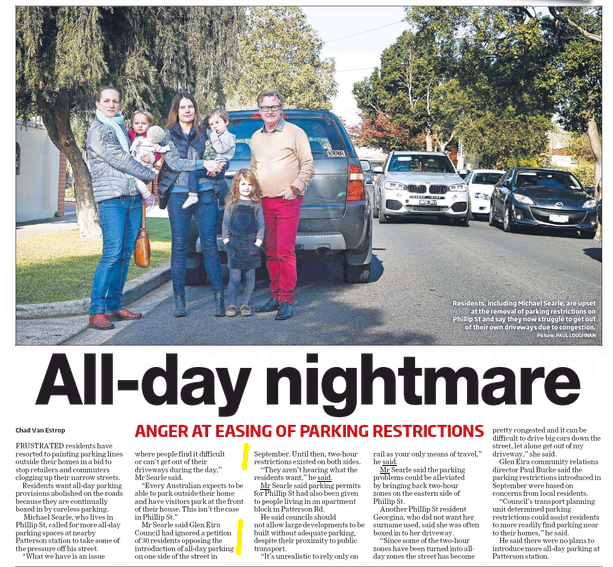
RESIDENT #5 – stated that he ‘lived directly behind the town hall’ and that council talks about ‘community planning’ but they got a letter ‘yesterday’ telling them that their 2 hour parking on their street would now become all day parking. Believed that this change was to ‘facilitate council employee’ parking and not residents.  Facilitator again interrupted and said that the resident is basically asking about the amount of information and ‘why’ this is happening. Resident answered that he is talking about ‘prior consultation’.  Facilitator then rephrased again to include ‘consultation’.

TORRES: started saying about a ‘review’ of parking in the municipality, but was interrupted by the resident saying that he isn’t concerned with the entire municipality just why this happened to his street. Torres then continued and said that some ‘underutilised parking areas’ had been identified and having one side of the street as two hours and the opposite as unrestricted is ‘consistent’ with other streets in Glen Eira. Also said that parking is ‘dynamic’ and changes happen ‘over time’ so ‘it’s not a permanent situation’.  The letter also said that the new conditions would  be ‘reviewed early next year’.

Resident then explained how he already can’t get out of his drive. Facilitator again suggested that the resident speak with Torres and to provide him with details about the ‘process that took place’ and how the resident might ‘make an objection’.  Resident claimed that this situation is exactly the same as happened to the other speaker’s question on Phillip’s Street changes. Facilitator summed up by saying ‘parking is a huge issue’ and therefore there needs to be the opportunity for this to be ‘examined’.  Resident then went on with issue about trees and breaking branches and that ‘nothing’ ever happens about their concerns.

COMMENT

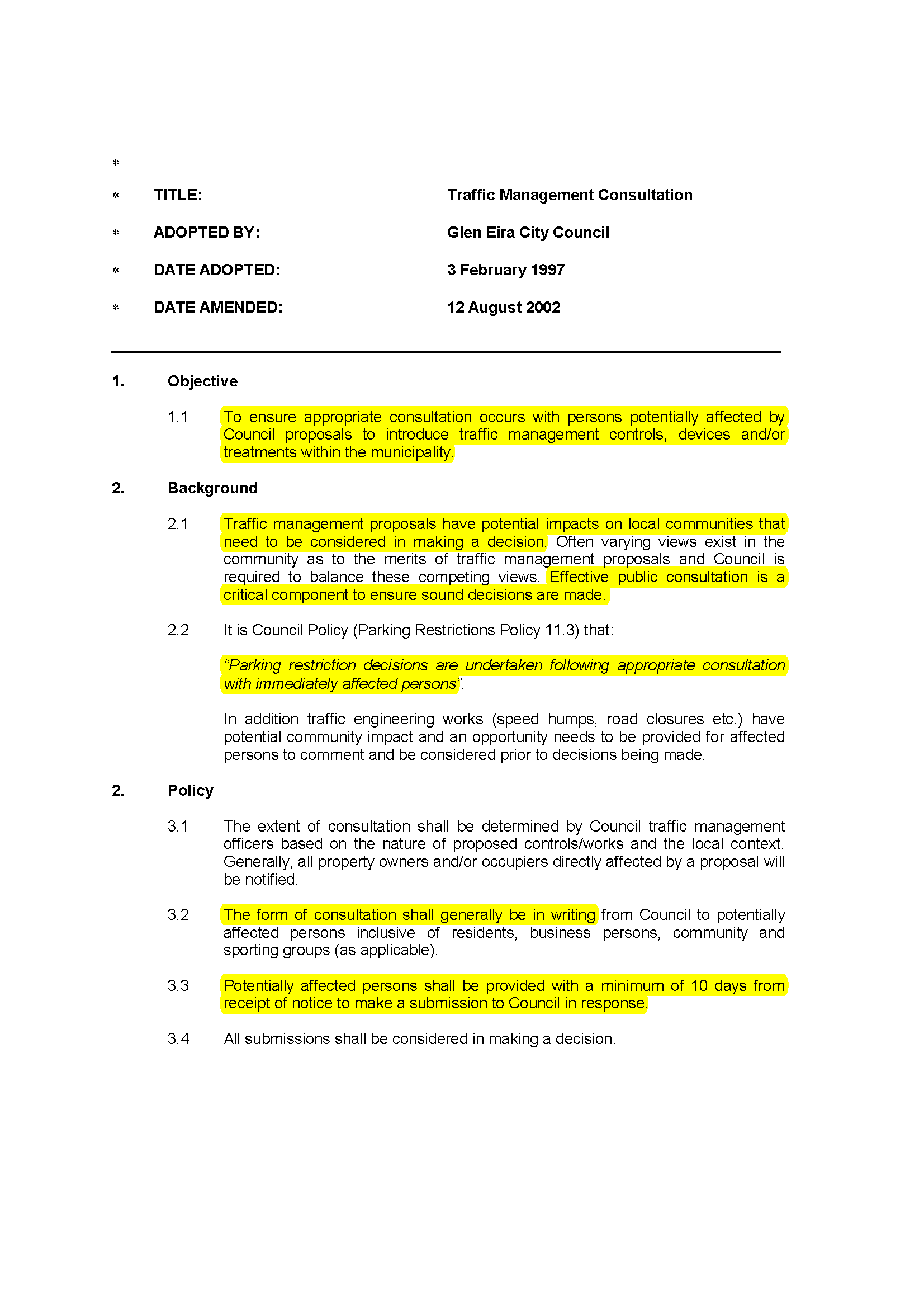
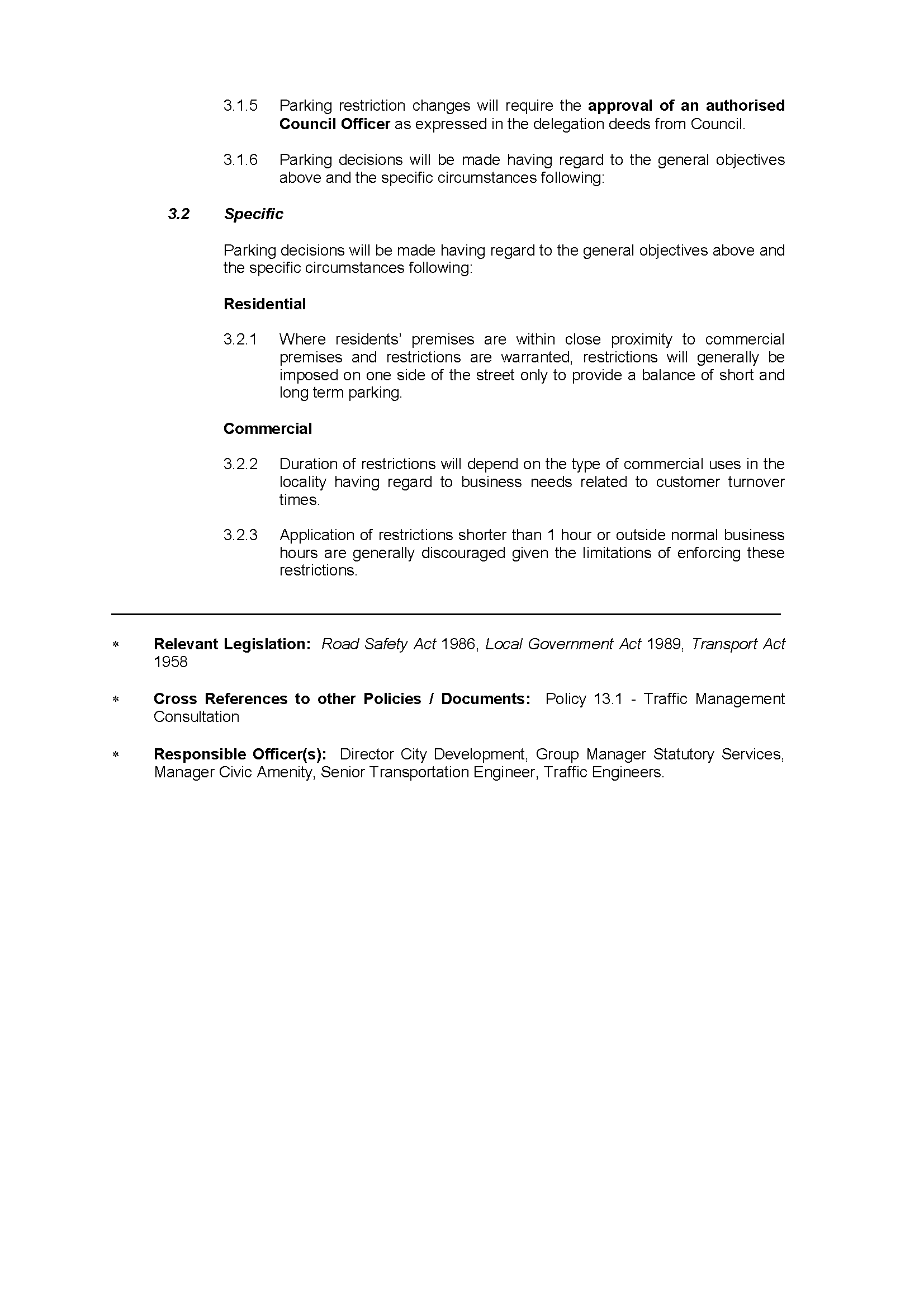
The resident’s question of ‘consultation’ has again been neatly sidestepped as has justification for the changes.  In light of these actions, readers need to consider council’s ‘policy’ on traffic management changes. To the best of our knowledge this policy is still extant and is available online. Only 2002 this time!Traffic_Management_Consultation-1_Page_1Traffic_Management_Consultation-1_Page_2 AND

13.3_Parking_Restrictions_Page_113.3_Parking_Restrictions_Page_2

As part of his ‘feedback’, Ron Torres told last night’s audience the following –

TORRES: Said that the ‘work plan’ will ‘recommend’ structure plans. Stated that structure plans ‘contain a shared vision’  of’ how our activity centres should develop and evolve’.  Said that council has in the past discussed structure plans but ‘things have changed today’. Now they ‘believe there is a strong need to further develop structure plans in our activity centres’. Claimed that this was because ‘the planning landscape is very different to what it was in the past’. Said ‘in the past our policies were defensible’ at VCAT. But ‘today it is a very different storey’. ‘VCAT is brazenly over-riding or ignoring our policies’ and ‘VCAT is expressing to us where they believe our policies fall short’.  This makes things very difficult when council’s policies ‘can be challenged and over-ridden’.

The other thing that is different from the past is population growth and ‘Melbourne’s development boom’.  Also Plan Melbourne Refresh has ‘clearly suggested’ that municipalities like Glen Eira will have to accommodate ‘the majority of Melbourne’s increasing population’. So all of this combined has lead for a clear ‘call to better manage’ growth in ‘our activity centres’.  There’s a ‘call for greater clarity, greater certainty’. The tools used could ‘take the form of height controls’; ‘development contributions’; ‘perhaps car parking precinct plans’ and ‘perhaps a mix of different zones’.  In order to ‘achieve’ all of this they need the ‘foundation’ of structure plans in order to deliver all of these tools.  It’s not a case of one size fits all because ‘not every shopping centre is the same’. Bentleigh residents were strongly represented in the feedback and they put in a ‘strong call’ for lower height limits in ‘that shopping centre’.  Said other shopping centres also called for height limits but these were of a ‘different flavour coming from those shopping centres’.  Thus ‘we believe that structure plans can deliver that shared vision’ and the necessary ‘controls’.

COMMENT

We challenge the repeated propaganda that is now par for the course that VCAT is the major villain in all our woes. We challenge even more vigorously the total untruth that ‘in the past our policies were defensible at VCAT’.  Council’s ‘policies’ have never been ‘defensible’ at VCAT!  The following table provides clear evidence of this. We have gone through every published VCAT DECISION from 2003 until the present day. We have tabulated all those decisions which either overturned council’s decision, varied them, or confirmed them. These figures do NOT INCLUDE permits granted as a result of Practice Day hearings or Mediation, since VCAT does not publish these. Thus we have no record of how many times council may have caved in to developer demands at such meetings and the application never went to a full hearing. Further, on variations, this overwhelmingly involved the developer objecting to conditions that council had imposed. In well over 90% of cases, the conditions were thrown out or greatly modified. Another ‘victory’ for the developer! And as further ‘proof’ to our claims we present extracts from VCAT member decisions dating as far back as 2001 and 2006. The arguments that the developers used then are still being used today and the gaps in the planning scheme have remained since these earlier cases. That is inexcusable. Council’s task should be to analyse every single VCAT decision and to attempt to plug the holes. The holes have been there for eons and nothing has been done. It is high time that this council admitted the truth – their total unwillingness and/or ineptitude in dealing with planning issues! Unless this Planning Scheme Review includes a full and comprehensive analysis of all VCAT decisions and makes definitive recommendations on how to address the policy failings, then nothing will change in Glen Eira.

Here is the said table and the percentages refer to council’s success rate in having VCAT confirm their decisions. This is followed by the extracts from earlier VCAT decisions. Thus for a council which can’t even come close to having at least half of their determinations ratified by VCAT, then something is drastically wrong – either with the planning scheme itself, or with those who are duty bound to enforce it.

UntitledWhile it formed no basis for discussion in the officer report and while the grounds of refusal are silent on the issue, Council now claim that the proposal offends the “character” of this area. Council submitted that “..the combined mass, height and scale of the building do not provide an acceptable degree of change in the neighbourhood context.” Council believe that the proposal is not of a high standard design although I note that at no stage in the planning scheme has Council indicated what it wants McKinnon to look like.
(Domus Design Pty Ltd v Glen Eira City Council) 2001/50797:

The Tribunal therefore thinks it is misleading to “piggyback” the residential urban character ambitions of Council on to this commercial centre. Reliance on “character” as a basis for a decision must have its limits. It simply cannot be used as a reason for every modification or rejection especially when the MSS is silent on its relevance in specific areas.

Secondly, there is no suggestion anywhere from Council as to what the character of the McKinnon shopping centre is anyway. There is no relevant study; as noted already, there is no MSS position; there is no Design and Development Overlay to refer to, and there was no attempt in either the Council report or the Council submission to define what makes up the character of this area. On the Tribunal’s observations, the centre appears as an attractive local neighbourhood centre which hosts a variety of uses and building styles with interwar double storey shops being the dominant built form. There is already evidence of change taking place with newer buildings being constructed or permitted.

But the third and more important reason is that in many cases, it will be a futile exercise to demand respect of a “character” in an area that you are hoping will change. If, as is the case here, Council is contemplating the rejuvenation of a small activity centre with shop top housing and higher density development, then of course the “character” that is there today will be different to the character that will be there if Council’s strategy comes to fruition. (Decision: 27th March, 2006 – 156 McKinnon Road)

Source: http://www.austlii.edu.au/au/cases/vic/VCAT/2006/452.html

Notwithstanding that increased housing diversity in the Housing Diversity Areas will be associated with increased development intensity, Council has not adopted any statements of preferred neighbourhood character for these areas that recognise such likely change. The only direction that is provided is from one objective and related policy of Clause 22.07 that have been highlighted above, that is:

n To ensure that the density, mass and scale of residential development is [sic] appropriate to the location, role and neighbourhood character of the specific housing diversity area

36 However, and in contradiction to its clear purpose of facilitating change, this objective appears to refer to “existing” neighbourhood character as a criterion, as that is the only neighbourhood character that can be referred to. This seems to me to involve an inherent contradiction: how is one to assess the degree of change that is appropriate in the context of existing neighbourhood character which is historic and is expected to change as a result of the new development that is being assessed? (3rd May, 2006 – 225-9 Koornang Road, Carnegie)

Source: http://www.austlii.edu.au/au/cases/vic/VCAT/2006/778.html

Tonight’s meeting drew a big crowd. Over 100 people in attendance. Missing in action were – Lipshutz, Esakoff, Ho, Delahunty. Ms McKenzie (CEO) was present as were Lobo, Hyams, Magee, Pilling and Sounness.

The evening started with the facilitator introducing the format and then Ms McKenzie providing the ‘context’. Acknowledgement was given as to the criticism levelled at council and the amount of work that was required. This was followed by Torres providing feedback on the results of the community consultation and then Russell Smith (acting manager Strategic Planning) providing a synopsis of the planning tools available which could address the issues raised by residents. Residents were then invited to ask questions of planners.

The Positives

Despite years and years of refusing to undertake various initiatives, tonight possibly, maybe, perhaps, signalled a change in direction. Here is a brief list of what council proposes to do according to their stated ‘draft work plan’.

  • Structure planning
  • Water Sensitive Urban Design
  • Vegetation Protection
  • Environmental Sustainable Design
  • Preferred Neighbourhood Character Statements
  • Heritage Review
  • Development Contributions Levy for drainage
  • SBO – overlays to mitigate flooding
  • Update the Municipal Strategic Statement and Local Policies

Without unduly blowing our own trumpet, we wish to point out that these initiatives are what we, and countless residents, have been demanding for years and years and which council has steadfastly refused to implement! Whether this represents a real change in culture, attitude, and listening to residents remains to be seen.

The Negatives

Council’s ‘draft work plan’ was stated as:

3 structure plans to be carried out over first 5 years with a view to continue developing structure plans or Urban Design Frameworks over all activity centres after this period of 10 years……

Residents were also asked to ‘prioritise’ the list provided at the start of this post. Torres explained in response to a question that the 3 structure plans does not automatically mean that this will be the 3 major activity centres of Bentleigh, Elsternwick and Carnegie. People were free to suggest that the initial structure plans should involve such neighbourhood centres as Glen Huntly for example.

We do not deny the amount of work involved in preparing sound and competent structure plans. Nor do we deny the costs involved. Our concerns are as follows:

  • If only 3 are to be completed within 5 years and the rest subject to council’s budgets/finances and a time span of ten or more years, then the reality is that of the 10 neighbourhood centres, most will remain untouched for the next decade.
  • No ‘official’ reference was made to reviewing the zones, or the associated schedules. What this means is that if structure plans are developed for the major activity centres, then the neighbourhood centres and their surrounding residential areas, will continue to allow three and four storey overdevelopments for the next decade. Only at question time from the audience was the completely lame response given that the neighbourhood character policy review would safeguard these centres. We beg to differ! If the mandatory height limit remains at 3 and 4 storeys for large swathes of McKinnon, Ormond, Glen Huntly, Murrumbeena, Bentleigh East, Caulfield North, then no local policy will prevent this overdevelopment of local residential streets. Without reviewing the extent of the zones, then structure plans alone will not safeguard residents from overdevelopment!

Our next post will focus on the questions asked by residents and the often unsatisfactory responses received. Overall, whilst this planning scheme review has seen changes that are positive, and explicitly acknowledged by the new CEO of council’s failure to address planning issues over the past decade, there is still room for major scepticism as the answers to the questions revealed. More on this in the days ahead.

Not for the first time has Hyams had the gall to get up in chamber and tell bare faced porkies. Not once has he been cautioned by the chair and not once has council decided to take any disciplinary action against him. Not only is telling lies a breach of the Councillor Code of Conduct, but it is a breach of the Local Government Act and yet Pilling and his cronies do nothing except attempt to gag any other councillor who may be ‘aggrieved’ by the falsehoods and inanities that emanate from Hyams’ mouth.

In May this year there was an important event taking place – a citizenship ceremony in front of 200 people at which Hyams called Lobo a ‘fuckwit’. Here is part of the Leader, May 27th   article (see: https://gleneira.wordpress.com/2016/05/27/what-a-surprise-3/)

Hyams has confirmed he called Cr Lobo a “f**kwit” at the ceremony. He refused to go into details about the incident, but said the insult was levelled at Cr Lobo after he was “severely provoked”. It is believed Cr Lobo and Cr Hyams were almost involved in a physical altercation at the citizenship ceremony when the argument spilt into the town hall foyer. Cr Hyams apologised to his colleagues for the outburst in a late-night email following the incident.

At Tuesday night’s council meeting, many public questions were about this incident. One which Hyams did answer was –

“Dear Cr Hyams, This question relates to when you insulted Cr Lobo by calling him a “f**kwit” at a public ceremony. a) If Cr Lobo insulted you in public by calling you a “f**kwit, what action would you take? b) Considering Cr Lobo’s censure for inappropriate comments, and with regards to transparency, fairness & equity, would you agree you have left your fellow Councillors with no alternative but to censure you for inappropriate comments?”

Cr Hyams responded to your question. He said:

“(a) It would depend on all the circumstances including whether members of the public heard the comment. In the case you mentioned they did not.

(b) No.”

The sheer front of this response is unbelievable!

  • In the first place, whether or not anyone heard the insult is irrelevant! The Councillor Code of Conduct demands ‘respect’ between colleagues, officers, and members of the public. Calling another councillor a ‘fuckwit’ whether in public or privately breaches this code.
  • Secondly, how does Hyams know that those sitting close to the stage, or even up on the stage did not hear his insult? We have it on good authority that the insult occurred in the middle of the Southwick speech and that it was so loud and so pronounced that Southwick had trouble continuing with his talk. He was embarrassed by the episode. We also know that audience members heard the language and were equally shocked.
  • If this was a quiet little altercation, then why the need to apologise to fellow councillors that very same night?

Telling lies is not new to Hyams. There has been the ‘whining bitch’ episode and his denial – only to have this true behaviour disclosed by a recording.

Nor has Pilling covered himself in glory either. His continual gagging of Delahunty is reprehensible and another good reason why the Meeting Procedures of the Local Law needs to be redrafted completely. In our view, neither of these individuals deserve to serve as councillors and their actions only drag the reputation of Glen Eira City Council further into the sewer! Nor can the other councillors escape equal criticism- they sit there like dummies and thus are equally culpable since silence may be interpreted as consent to this kind of behaviour.

CLICK TO ENLARGE

Untitled

We remind readers of the following:

  • Changes to parking arrangements according to council ‘policy’ is to undertake a survey of all residents and requires a vast majority of responses in support. Was a survey undertaken?
  • What has happened to council ‘policy’ that new developments will not be eligible for residential parking permits?
  • What rationale could support the removal of 2 hour parking? Were residents informed, warned? Where is the data to support this?
  • Is council monitoring this street and fining drivers if they break the law?

VCAT has once more pronounced ‘judgement’  on council’s Planning  Scheme and shown its inadequacies to prevent overdevelopment. One of the latest decisions comes from the same developer who gained a permit for the 8 storey proposal in Centre Road, Bentleigh. This time it is for a 3 storey, 21 apartment  venture in Prince Edward Avenue, McKinnon.  Below are some extracts from the decision. If Council is ‘fair dinkum’ about shoring up its defences against inappropriate development, then each and every VCAT decision must be considered and amendments drawn up to plug the countless loopholes that developers have so successfully exploited. Anything less is unacceptable.

In principle, I consider that the zone, the absence of overlays, the consideration of relevant planning policies and the locational attributes all lend support to a more intensive development on the review site. Although residents may prefer medium density developments of not more than two or three double storey townhouses, that intensity of development is inconsistent with the extent of built form expected within a neighbourhood centre and in a housing diversity area.

However I make the point that more intensive development does not necessarily mean that individual lots along Prince Edward Avenue will be capable of accommodating three storey apartment style buildings containing ten dwellings. It may be, for example, that individual lots are unable to comfortably accommodate such development and that lot consolidation will provide a means whereby such buildings can be comfortably accommodated in this area. It is certainly the case that policy at Clause 22.07-3 encourages lot consolidation to promote development opportunities.

In contrast with the residential areas which lie outside the Housing Diversity Areas (within the Minimal Change Areas), there is no neighbourhood character policy to articulate the expected outcomes here. Nor are there any built-form overlays, such as a Design and Development Overlay, to establish the parameters which would apply to new development. Beyond the policies which have been detailed above, the only guidance which can be gained from the Planning Scheme is essentially from the purpose of the GRZ1, the 10.5 metre height limit specified in the schedule to the GRZ1, and the provisions of Clause 55.

The extracts from Tribunal decisions provided earlier confirm that the new buildings within Housing Diversity Areas are not expected to respect the existing character. To do so would detract from the policy direction that these areas are to evolve over time into locations where there is a predominance of higher density housing. This view is supported by the fact that the Planning Scheme does not include a neighbourhood character policy for the Housing Diversity Areas. They are expected to change in quite a substantial way, and this involves a very obvious departure from the traditional dwelling forms and styles which presently characterise streets like Prince Edward Avenue.

Having regard to the maximum 10.5 metre building height provided for in the Schedule to the zone, submissions that development should not be greater than two-storeys cannot be substantiated, as this specified height allows for three-storey development. The inclusion of Prince Edward Avenue in GRZ1 is an indicator that, at a point in time, a conscious decision was made that three-storey development in this street would represent an acceptable outcome. The provisions of the GRZ1 as they currently stand reflect an expectation that, over time, three-storey buildings will be constructed not only in Prince Edward Avenue, but also in the nearby residential streets contained within this zone. Indeed, approvals for such buildings are in place for sites in Station Avenue and Penang Street, both of which are within the residential area of the Neighbourhood Centre.

Within the zoning and policy context where these forms of development are anticipated, it is inevitable that new buildings of this type will affect neighbouring properties. The resultant impact on the occupants of those properties will, undeniably, be significant. It will represent a significant change from what they have become accustomed to and will, of course, affect their amenity. This is particularly so for the properties at 27 & 33 Prince Edward Avenue and at 30 & 32 Station Avenue, all of which I have inspected. The residents’ opposition to the development is entirely understandable.

However, as explained in earlier Tribunal decisions, the Council has identified this neighbourhood as one which will undergo a much greater level of change than other residential locations which are situated in Minimal Change Areas and where the Neighbourhood Residential Zone (NRZ) applies. In those other areas, new development is restricted by the zone provisions to a maximum of two dwellings on a lot and the height is restricted to 8.0 metres (equivalent to two storeys). That is not the Council’s vision for this neighbourhood, as articulated in the Planning Scheme. If it were, then it would have sought to apply the NRZ here. It has not. Rather, a strategic decision has been made based on the location within a Neighbourhood Activity Centre to apply the GRZ1 and to allow higher and more intensive development. This is not without its consequences for the amenity of adjoining properties

I acknowledge the residents’ opposition to the proposed overlooking on the basis that views beyond 9.0 metres into their secluded private open space areas will be possible. While this may be true, the Objective is to limit views, not to prevent them altogether, and the Standard only requires views within 9.0 metres to be screened. The Planning Scheme’s provisions do not address views beyond this distance

The residents expressed concerns regarding the capacity of local services to absorb the demand generated by developments such as this. Although these concerns may be understandable, I have no evidence before me to lead me to conclude that the capacity of local infrastructure will be exceeded as a consequence of this development.

Source: http://www.austlii.edu.au/au/cases/vic/VCAT/2016/823.html

The agenda for Tuesday night’s council meeting is interesting not merely for what it contains, but more so, for what is not included. A few examples:

  • No mention in any of the records of assembly of council’s ‘discussion’ on the appointment of Ms Fiona O’Brien to investigate allegations of bullying. Pilling has been quoted as stating that council ‘engaged’ Ms O’Brien to undertake this work. Hence, we wonder when and where this decision was made. Even if ‘confidential’, our reading of the Local Government Act would still require a note that some item of a confidential matter was being discussed. No such notation exists.
  • On the 26th April (that is two council meetings ago) there was a request for a report on the potential for an increased open space levy. The report has not yet materialised – meaning that if it does appear for the next council meeting, it will have taken 2 months for a document to be tabled. In our view, not good enough!
  • The records of assembly meeting of 24th May include this item – (a) CFO – outcome of loan re-structuring negotiations. No item in the agenda to inform residents of what this will mean in terms of late payments, the new interest rate, or in fact any information whatsoever. We assume that ratepayers will be required to plough through the new Strategic Resource Plan (when it appears) and try and figure out what is really happening! Surely some media release or official statement would not go astray at this point in time?

Councillor camps out at Caulfield Racecourse to campaign on public space

Date: May 30, 2016
Councillor Jim Magee at his Caulfield Racecourse camp site.Councillor Jim Magee at his Caulfield Racecourse camp site. Photo: Jason South

Jim Magee is camping out. Conservative by nature, the Glen Eira councillor is not the type to conduct a sit-in, or break his own council’s by-laws banning camping on public land.

But he was worried his long-running campaign to draw attention to the little-used public space inside Caulfield Racecourse might end up going nowhere with the state’s new environment minister, Lily D’Ambrosio.

So last week he dug the family tent out of the garden shed. “Finally in my old age, I’ve become an activist,” says Cr Magee, sitting by a fire, outside the five-person tent he pitched on Saturday by the racecourse.

Jim Magee at his Caulfield Racecourse camp sit-in.Jim Magee at his Caulfield Racecourse camp sit-in. Photo: Jason South

There are local laws against camping on public land, which Glen Eira is usually quick to enforce.

“But this is a political sit-in,” says Cr Magee, who has been told by council officers that unless there are complaints from residents, they are unlikely to issue him with a notice to vacate.

Cr Magee will stay put until Saturday afternoon, by which time he hopes to have met Ms D’Ambrosio to discuss the fate of the 54 hectares of land in the centre of Caulfield Racetrack.

The reserve, set aside for the public more than a century ago, is hard to get to, because of the racing infrastructure that must be navigated. It’s open from 9.30am each morning until sundown, and many locals don’t even know it’s there.

Cr Magee was concerned that, with Ms D’Ambrosio only recently taking over environmental matters, she might not pay enough attention to a review under way by the Andrews government.

There’s little chance of that now, with the land at the centre of a fight that has led to much debate – and a scathing Auditor-General’s report. It found the public land was being used almost exclusively to serve the interests of the Melbourne Racing Club.

Cr Magee has five more nights ahead of him before his hoped-for meeting with the minister, and a rally of sporting clubs who want ovals built on the land, which equates to 15 MCG playing surfaces.

“I’ve been here through two very cold nights so far – I’ve made friends with a couple of foxes,” says a slightly blurry Cr Magee, who says he is waking every 90 minutes or so. “I’m doing more sitting than sleeping – I’m actually right next to a very busy roundabout.”

The Andrews government is reviewing the status of how the land is governed and controlled, and Cr Magee – who was once a member of the trust that controls the land – says it must change.

He wants Ms D’Ambrosio to step in as minister and take control of the land and help Glen Eira council turn it into sporting fields and parklands for use at all times.

Ms Lily D’Ambrosio said she understood the high level of community interest in the public land at the racecourse and that the government had set up a bi-partisan working group to consider the issue.

“I’m expecting to receive this report next month and look forward to working with the community to reach a resolution,” she said.

Investigation launched into bullying accusations at Glen Eira Council

May 27, 2016 6:11pm

A CULTURE of bullying and intimidation among Glen Eira councillors is under investigation by eminent barrister Frances O’Brien QC, an insider alleges.

Ms O’Brien, whose report led to the sacking of Geelong Council in April, has been appointed by mayor Neil Pilling, as rumblings between councillors increasingly spill into the public domain.

Her appointment as an independent arbiter follows a tumultuous four-year term at Glen Eira, which came to a head at a citizenship ceremony in March.

The sordid history of infighting among councillors saw the council sacked in 2005.

The Herald Sun understands all councillors have met with Ms O’Brien at the Glen Eira town hall as she seeks to unravel the increasingly “toxic” culture.

A number of councillors have confirmed they are to be interviewed by Ms O’Brien.

Some of the incidents which may come under investigation include:— Cr Jamie Hyams calling Cr Oscar Lobo a “f**kwit” at a ceremony attended by 200 people at the Glen Eira town hall.

— Cr Oscar Lobo’s allegedly anti-Semitic slur at a December council meeting.

— A 2010 email councillor Michael Lipshutz sent to Cr Lobo asking him if he had worked for a bank linked to terrorists.

Cr Hyams has confirmed he called Cr Lobo a “f**kwit” at the ceremony.

He refused to go into details about the incident, but said the insult was levelled at Cr Lobo after he was “severely provoked”.

It is believed Cr Lobo and Cr Hyams were almost involved in a physical altercation at the citizenship ceremony when the argument spilt into the town hall foyer.

Cr Hyams apologised to his colleagues for the outburst in a late-night email following the incident.

Councillors unanimously voted to censure Cr Lobo earlier this year for the allegedly anti-semitic slur.

“Ever since Cr Lobo made his disgustingly racist comments in the council meeting of December 15 he has treated myself and other councillors with complete contempt,” Cr Hyams said.

Cr Lobo has claimed to be the subject of bullying and racism for seven years.

“The council is trying to find out what these internal issues are and it has been given to an independent person to judge the gravity of the situation,” Cr Lobo said.

Cr Lobo denied he provoked Cr Hyams at the citizenship ceremony.

“He got up and said you’re a f**kwit and that’s when I lost my cool after that because he has done all these insults in the past and no one knows about it.”

“He wanted to provoke me to hit him because that’s an easy way to get rid of me.”

Cr Lobo called for Cr Hyams to resign in light of his behaviour.

The incident follows a failed bid by councillors to reprimand Cr Lobo in 2013 at a conduct panel, which cost ratepayers $27,000.

Ms O’Brien will prepare a report following her meetings with councillors, which may be referred to the ombudsman or Independent Broad-based Anti-corruption Commission.

Glen Eira mayor Neil Pilling confirmed Ms O’Brien had been “engaged” to provide advice on councillor conduct.

“As the confidential matter is currently in progress and subject to legal privilege, we are unable to make further comment at this time,” he said.

Ms O’Brien would not comment on the investigation when contacted by the Herald Sun.

chad.vanestrop@news.com.au

« Previous Page — Next Page »