GE Governance


PS OFF TOPIC – BUT, ‘BELIEVE IT OR NOT’! – http://www.heraldsun.com.au/leader/inner-south/developer-irate-after-glen-eira-phone-survey-goes-horribly-wrong/story-fngnvli9-1227442664907

PPS: Here’s The Age’s version of the latest events – http://www.theage.com.au/victoria/developer-faces-public-relations-disaster-after-misleading-telephone-poll-20150715-gid64n.html

The outcry over inappropriate development is gathering voice and momentum. Residents in all suburbs are now experiencing the results of Glen Eira Council’s lack of timely, competent, and justifiable strategic planning.

Two amendments (C11 and C25) are the cause of what is now happening throughout Glen Eira. The former established what is known as the ‘urban villages’ (ie major activity centres of Bentleigh, Elsternwick and Carnegie) and the latter set up the inequitable ‘minimal change’ versus ‘housing diversity’ areas incorporating what are known as ‘neighbourhood centres’. Murrumbeena, Ormond, McKinnon, Bentleigh East for example are all ‘neighbourhood centres’ and not major activity centres.

Each of the above amendments went off to a Planning Panel. The Panel’s recommendations and comments are worth a revisit since they clearly state what Council was required to do in order to fully justify its proposals. Needless to say, after 14 years since the Planning Panel report on C11 was handed down, absolutely NOTHING HAS BEEN DONE. The introduction of the new zones merely reinforced all the already existing inequities and shortcomings without undertaking the required strategic work.

Here are some extracts from the two Panel Reports. The bolded sections are our emphases and pinpoint the tasks that were demanded but which Council has not completed.

Amendment C11 – Setting up the Major Activity Centres

Traffic/parking studies and urban design/built form frameworks are to be undertaken/developed to address traffic/parking issues and to ensure that design outcomes are appropriate.

The Panel recommends that, after approval, Council develop building design guidelines for all three centres

Council believe that “Urban Villages” provide many benefits for the immediate and wider community including:

• More energy efficient housing, environmentally sensitive development, pedestrian activity and social interaction;

• Improved amenity, quality open spaces and more accessible services and facilities;

• More vibrant town centres by increasing population in their catchments and by enhancing their attractiveness through improvements in amenity;

The Panel believes that proper “urban village” planning must address the following issues at the very least:

• Land use planning

• Built form

• Urban design

• Capital works spending based on the strategic allocation of developer contributions, open space contributions or other public funds.

• Car parking

• Traffic analysis

• Community facilities and services

• Public realm and the provision of spaces conducive to the needs of the resident, consumer and visiting population

• Public transport improvements and integration

• Open space connections

• Interfaces and transition with surrounding areas

• Promotion of aspects of the valued cultural attributes of the village such as unique ethnic or activity strengths


Amendment C25 – ‘Minimal Change/Housing Diversity’

The most damning comments in this Panel Report relate to the interim’ nature of the Amendment and the amount of work that Council still had to undertake. What was declared as ‘interim’ morphed into ‘permanent’ and was further ‘cemented’ with the new zones. The ‘neighbourhood centres’ in particular received much comment as did their arbitrary lines on a map.

The Panel concludes that boundary issues are something that are best addressed through detailed assessment of each centre, as indicated in the amendment as future strategic work. The boundaries identified in this amendment should only be seen as interim arrangements until structure planning exercises are undertaken.

The boundaries of the neighbourhood centres identified in this amendment are considered by the panel as interim at best. They will require review as part of detailed assessment of each centre.

The Panel does not agree with the concept that all activity centres categorised as neighbourhood centres in C25 are automatically suited for higher density residential development.

The Ormond Neighbourhood Centre is an example of an activity centre that, while obviously having a strong commercial base and a railway station, may not necessarily have the character or form to make it automatically attractive as a focus for intensified residential development. It is located around a wide, heavily trafficked road (North Road), it is not compact, easy to circulate through or have a distinctive urban form. Furthermore, the uses in this centre are dominated by office uses and the type of specialty shops the (sic) serve a regional rather than a local catchment. There are few shops providing the type of goods (especially food) that would service a purely local population

The Panel considers that rear boundaries should be preferred as boundaries rather than street frontages, to overcome problems where one side of a street is treated differently from the other side of the street.

A stated objective of C25 is to assist the vitality and economic basis of Glen Eira’s activity centres. This is an admiral objective but one that the Panel considers will not be addressed simply through residential initiatives. Further, the pursuit of residential initiatives in isolation from other economic, traffic, access and business development initiatives may actually be detrimental to the overall well-being of the centres.

At best C25 provides a holding mechanism until more specific and effective policies are developed for each of the neighbourhood centres individually. This issue is a serious one that must be addressed directly in the development of the Structure Pans for individual centres.

Traffic and parking issues should be addressed in the structure plans Council proposes to develop for its neighbourhood centres. Provided the structure plans take into account, and cater adequately for, increased demand, the impact on local streets need not become a significant issue. The Panel recommends that the structure plans to be prepared by Council for each neighbourhood centre address issues of parking and traffic generated by both residents and shoppers

The other significant issues noted by the Panel are the need for the further work identified by Council to be undertaken as soon as possible. This applies especially to the preparation of a Structure Plan for each neighbourhood centre that reflect both its current and future role as an activity centre and its potential

And then of course there is the Planning Scheme itself – full of broken promises that the following quotes reveal.

Clause 21.04 – Developing local structure plans / urban design frameworks to guide development in the neighbourhood centres

Developing “suburb” plans for each suburb which integrate land use and development planning, with planning for infrastructure, capital works, recreation, parks and gardens, street trees and business development.

Developing local area traffic management plans and parking precinct plans to control the effects of parking and traffic intrusion in residential areas.

Implementing local area traffic management changes in existing areas in consultation with communities to improve safety and amenity and discourage use by inappropriate traffic.

Investigating mechanisms which require developers to undertake street tree planting.

Investigating the development of additional development contribution mechanisms based on accepted principles of need, equity, nexus, accountability and timing.

Investigating urban design improvements to the public domain surrounding major public transport hubs in consultation with public transport service providers


Preparing Parking Precinct Policies for the following neighbourhood centres:

􀂂 Alma Village, Caulfield Park, Caulfield South, Bentleigh East, Glen Huntly, Ormond.

􀂃 Investigating the need for a cash-in-lieu policy to fund new car parks in various commercial centres.

Implementing a program of Local Area Traffic Management Plans in order to minimise disruption and increase safety of residential areas.

CONCLUSIONS

  • The basis and strategic justification for the introduction of the new residential zones is entirely suspect given that Amendment C25 was clearly seen as an ‘interim’ measure.
  • None of the required work has been undertaken by Council
  • The new zones fly in the face of many of the recommendations by the Panels
  • It is inexcusable that so much of the Planning Scheme is nothing more than words on a page and the promised ‘further strategic work’ is allowed to lie dormant and untouched to the detriment of all residents
  • The lack of consultation, review, and action needs to stay firmly in the minds of all residents when they next vote in 2016. Residents have literally been duped, deceived and dudded!
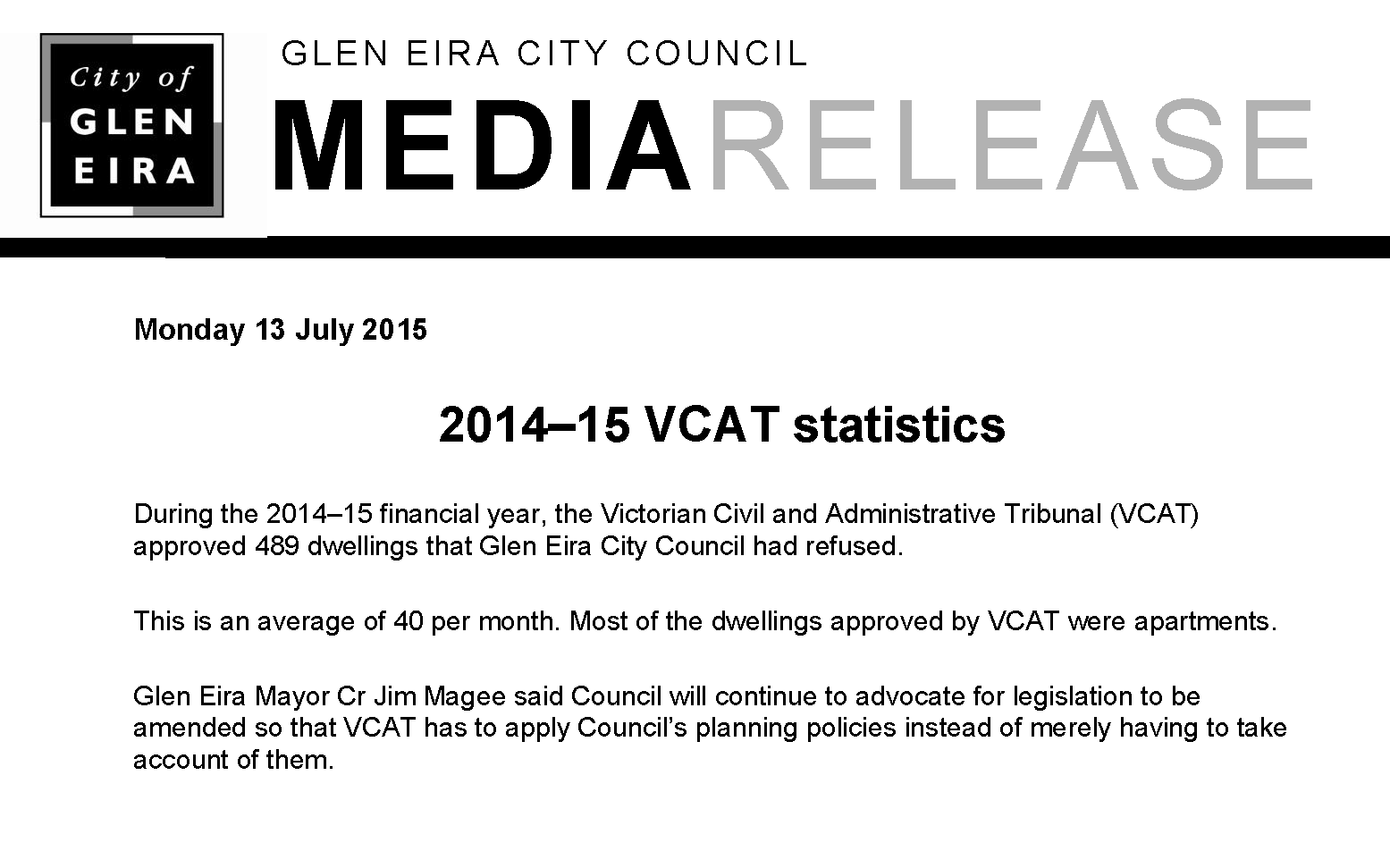
VCAT_Statistics130715c

We have repeatedly stated that VCAT is no angel and that its powers are extraordinary. However, this does not excuse council from repeatedly passing the buck as the above media release obviously intends to do. Reform starts at home – with the planning scheme and with the quality of Glen Eira’s representation at VCAT hearings and the substantiated grounds for their refusals.

Below we feature some extracts from recent VCAT hearings. Readers should note the lamentable performances of council at these hearings – ie ill considered conditions that fly in the face of the current planning scheme; statistics that are not corroborated with clear and decisive evidence, etc. etc. If VCAT has in fact granted all these permits then residents should start asking if they are getting value for money in both the council representations at VCAT, and why councillors do nothing to change the Planning Scheme that provides developers with an open invitation to continue their onslaught.

http://www.austlii.edu.au/au/cases/vic/VCAT/2015/938.html

6 Prince Edward Avenue, McKinnon – Council originally refused a permit for 2 storey building with 6 apartments. An amended plan was submitted. The site is zoned GRZ1 and land size is 724.6 square metres.

The decision –

In principle, I consider that the zone, the absence of overlays, the consideration of relevant planning policies and the locational attributes all lend support to a more intensive development on the review site. Although residents may prefer medium density developments of not more than two or three double storey townhouses, that intensity of development is inconsistent with the extent of built form expected within a neighbourhood centre and in a housing diversity area.

State and local policy, the zone and the absence of overlays together with a location accessible to a range of services and facilities supports increased dwelling density and housing diversity on the review site. Anticipation of change to neighbourhood character is acknowledged in local policy for this area by its inclusion in a ‘housing diversity area’ where there is no preferred neighbourhood character identified.

http://www.austlii.edu.au/au/cases/vic/VCAT/2015/959.html

At the hearing there was some dispute over the proposed site coverage. The plans indicate 50%, though Mr Clarke for the Applicant acknowledges that this does not include the roofed areas to the two alfresco areas, which he offers to have removed by permit condition. The Council’s delegate report refers to a 54% site coverage, including the roof alfresco areas. However at the hearing Mr Henderson for the Council alleged the site coverage is 58%, although I was not provided with any detail of the calculations used to arrive at this figure.

  • In its submissions the Council placed great reliance on the proposed site coverage, and how this varied from the site coverage found on the surrounding properties. Mr Henderson even submitted a cadastral plan where he had calculated the site coverage of surrounding and nearby properties. With respect, I consider that this analysis misses an important point. The review site is proposed to be subject to a medium density development. While the site falls within a Minimal Change Area and is covered by a Neighbourhood Residential Zone, medium density development of two dwellings on a lot is possible, and one might say encouraged by the broader urban consolidation policies found at a State level.
  • In is inevitable that any proposal for medium density development will invoke some differences compared to a single detached dwelling. One of those changes in an increase in site coverage, which must increase as a result of having two dwellings on a comparable site to surrounding single dwellings. It is not relevant for a party to identify that the site coverage of proposed medium density housing is not in the range of site coverage found on surrounding single dwelling sites, and then present this as some form of evidence that the proposal stands in contrast on neighbourhood character terms. Such a submission demonstrates a level of misunderstanding of what is meant by ‘respect for neighbourhood character’ and the extent to which two dwelling developments should integrate into Minimal Change Areas. For these reasons I am not persuaded by the Council’s submissions on this matter.

http://www.austlii.edu.au/au/cases/vic/VCAT/2015/992.html

It is relevant that in applying the policy, the condition in dispute, as proposed by the Council, allows the upper floor level of both dwellings to extend well past the rear of the single storey dwellings on the two adjoining properties. However, in imposing the condition, the Council has come to the view that the setback should be increased by about 1.8 metres. How the Council came up with this figure is unclear and somewhat vague. From the submissions presented, the setback required by the condition is not based on any standard. The requirement is not based on any specific policy requirement. Nor are the increased setbacks required to achieve the improvement of amenity of neighbouring properties with respect to matters such as daylight or shadows. At best, the additional setback required by the Council seems arbitrary.

Here is another example of what is happening to our suburbs. Truganini Road, similar to Bent Street has multiple zonings ranging from Residential Growth, General Residential and Neighbourhood Residential. Whilst this is admittedly a Road Zone, with a tramline along certain sections, the amount of development is entirely inappropriate for the location. It would also appear that the right hand at council has no idea what the left hand is doing. For example: several years ago residents living along the road were granted a ‘parking dispensation’ – namely that because of the trams, they were granted permission to park on their nature strips as a safety measure. Since then, many have received fines and this has necessitated them going down to council, producing the official letter and having the fine removed.

Now with the rampant development along the road and the continual waiving of car parking the issue of trams, pedestrians and cars all mixing and trying to get out of their driveways is a real safety issue. Needless to say, council has yet to address this issue.

Once again the online planning register is devoid of sufficient detail to accurately ascertain the number of dwellings that will be erected on this road. The item for 86 Truganini simply states ‘construction of two or more dwellings’. Given this is zoned GRZ2 we are not very optimistic that this means 2 dwellings – especially when there is the demand for a reduction in car parking.

Thus, our conservative total for Truganini is at least 141 new dwellings post zones.

TRUGANINI ROAD

9 & 9A Truganini Road CARNEGIE VIC 3163 – 4 storey, 20 dwellings (RGZ1)

21-25 Truganini Road CARNEGIE VIC 3163 – 4 storey, 41 dwellings, (AMENDED) (RGZ1)

44 Truganini Road CARNEGIE VIC 3163 – 2 double storey (PERMIT) (NRZ1)

54 Truganini Road CARNEGIE VIC 3163 – 2 double storey attached (NRZ1)

86 Truganini Road CARNEGIE VIC 3163 – Construction of two or more dwellings on a lot (GRZ2) Buildings and works (SBO) Reduction in the standard car parking requirement (52.06) (GRZ2)

90 Truganini Road CARNEGIE VIC 3163 – 3 storey, 13 dwellings (REFUSAL) (GRZ2)

93-97 Truganini Road CARNEGIE VIC 3163 – Construction of a three-storey building comprising twenty-eight (28) dwellings with a basement car park and reduction of the dwelling (visitor) car parking requirement on land affected by the Special Building (AMENDED) (GRZ2)

98-100 Truganini Road CARNEGIE VIC 3163 – Construction of a 3-4 storey building comprising 28 dwellings with 2 levels of basement car parking on land affected by the Special Building Overlay (AMENDED) (GRZ2)

115 Truganini Road CARNEGIE VIC 3163 – 3 storey, 6 dwellings (AMENDED) (GRZ2)

124 Truganini Road CARNEGIE VIC 3163 – Construction of two (2) double-storey dwellings on land affected by the Special Building Overlay – Amended (GRZ2)


IMG_0001_NEWCLICK TO ENLARGE!

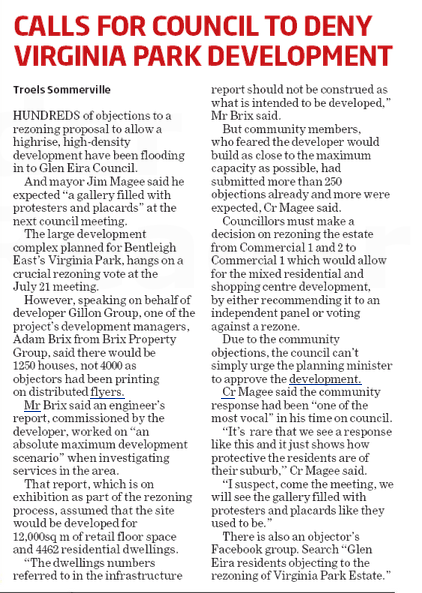
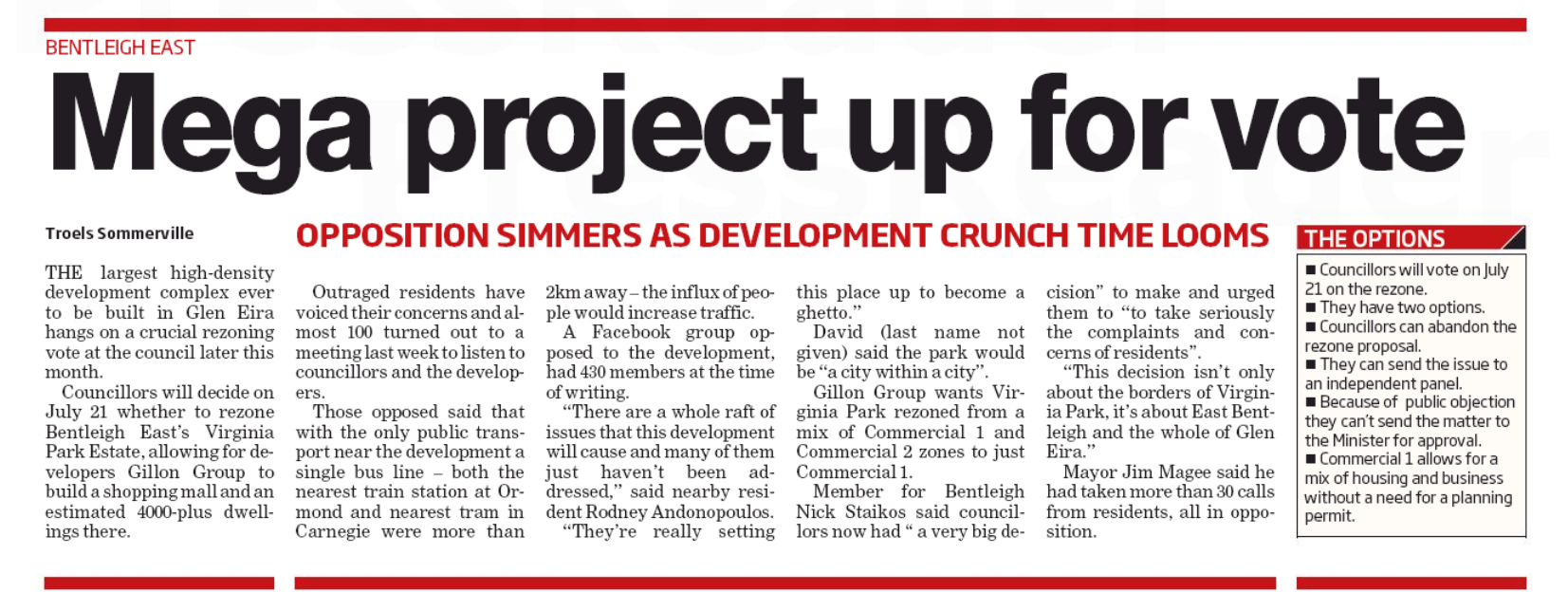
The front page of today’s Moorabbin Leader features claims by the Gillon Group on the proposed Virginia Park development. Residents have been down this track before with the Caulfield Village. When Amendment C60 was first proposed it was stated:

The development will include:

  • Retail premises consisting of a convenience-oriented neighbourhood shopping centre anchored by a supermarket with additional specialty shops and mini major stores as well as cafes, restaurants and a food court;
  • Commercial office space
  • Up to 1200 residential units
  • Short term accommodation up to 100 beds (Quest style) (minutes of April 28th, 2011)

Please note:

Caulfield Village is currently set to have 2063 dwellings. 40% are single bedroom units. Retail originally cited as 35,000 square metres – now reduced to 12,500 square metres. By the time development plans are submitted for the remaining precincts these figures are sure to be varied. We see no reason to think that Virginia Estate will be any different. The motive is profit and if profit is derived from residential development, then so be it!

calls

How many more times will this council permit the Melbourne Racing Club to get away with blue murder? How many more times will permits not be worth the paper they are written on? Or to be even more cynical, what kind of collusion is occurring between the MRC and council?

The latest outrage concerns the use of the four storey ‘big screen’ that council so kindly permitted to be placed on Crown Land. The officer’s report recommending approval of the permit stated –

The purpose of the proposed screen is to display race-day activities including live video feeds, race replays and sponsor information…..As such it is considered reasonable to have a screen as a component of the horse racing use. (minutes of May 20th 2014).

It now looks as if the definition of ‘race-day activities’ is about to expand and take in the Ashes Cricket and rugby too. More importantly, the MRC intends to have the screen going to 1am this coming Wednesday (ie tomorrow).

Once again we can only lament the arrogance and disregard for the local community by the MRC and we suspect, ably abetted by Council. Below is the advertisement for this event – with no indication of course as to whether this is part of the ‘major event days’ or whether any traffic management plan has been submitted to council and granted approval! 

Source:  http://mrc.racing.com/calendar/2015-07-08/super-sports-night

Game on at Caulfield! Trying to decide what to watch next week, either NRL SOO III or The Ashes? Problem solved, come and watch both at our place.

Come and join us for a Super Sports Night in the Medallion Bar at Caulfield Racecourse. 

As Australia starts their campaign to hold on to the Ashes against fierce rivals England in two weeks’ time, on the same night, Queensland and NSW will take to the field and battle out the State of Origin title. With the series now tied at 1-1, game III “the decider” is sure to be a thriller.

Caulfield’s new 38.4 metre wide Super Screen will provide dual coverage of both the Ashes and the State of Origin with 32 screens from start of play until 1:00am.

Gather your friends, family and colleagues and join us for a night of sporting action in Caulfield’s premium Medallion Bar to share in the excitement and passion as we cheer on our nation.

With free entry and prizes to be won, and great beer on tap, this is the perfect night to watch great sporting action with your mates.

Make sure you arrive by 6:30pm to be eligible for some great prizes.

Date: Wednesday 8th July 2015

Time: 6:00pm till 1:00am.
Patrons can then process to the Caulfield Glasshouse to watch the final innings of the Ashes or the Tour de France. The Caulfield Glasshouse closes at 4:00am.

Where: Medallion Bar, Caulfield Racecourse. Enter via Gate 23, Stations Street, Caulfield East. Limited parking provided Gate 2.

Happy Hour from 6 to 7pm – selected beverages $5.00 during this time. Hot items will be available for purchase from the standard Medallion Café menu, as well as specials for a more substantial meal.

For more info call 1300 GO RACE (46 7223) or Click here to view the menu (PDF)

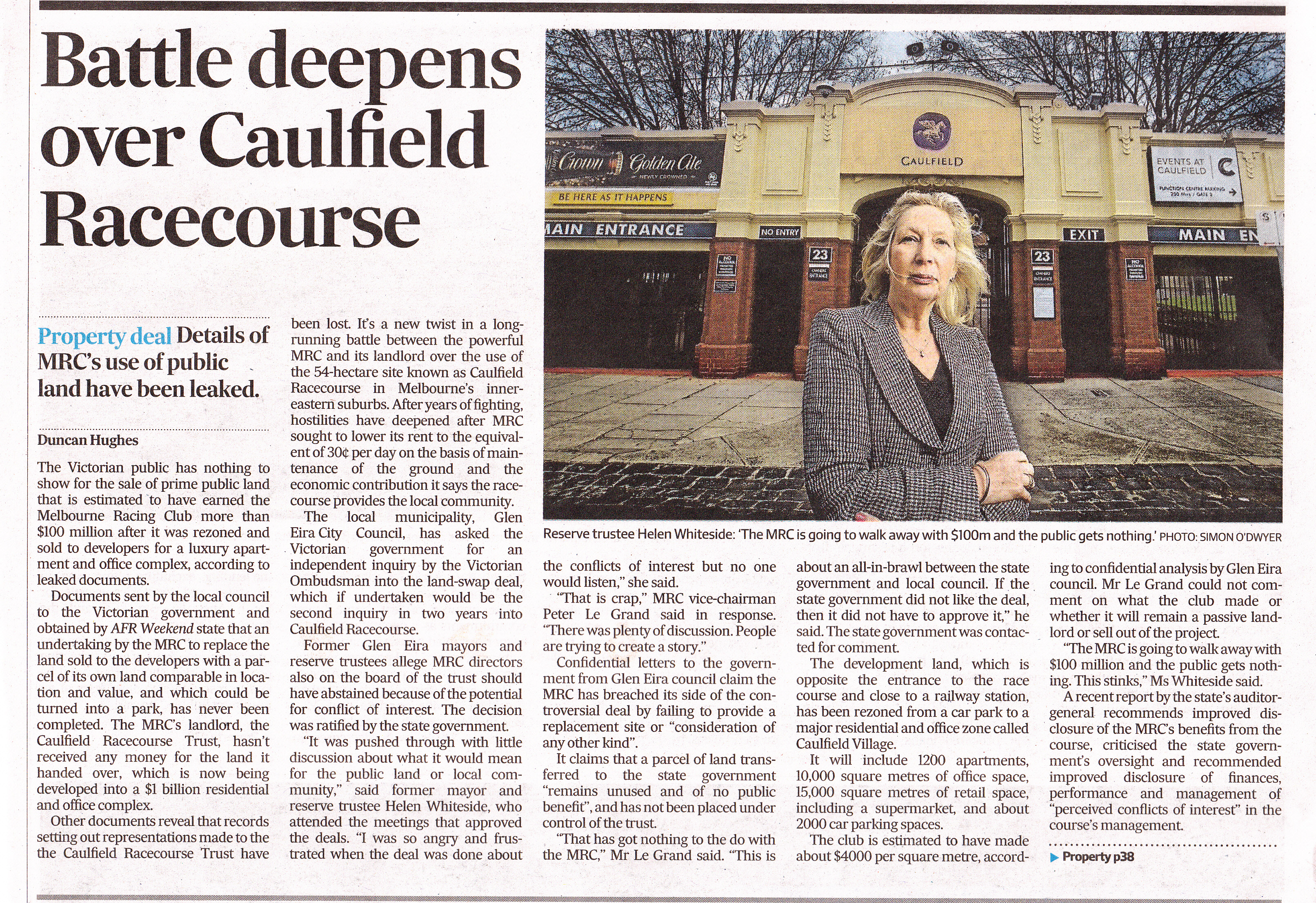
PS: for all those who haven’t as yet had a read of the Australian Financial Review article on the Melbourne Racing Club, we reproduce it below

Nagging questions about Victorian racing icon 

by Duncan HughesIt’s a 54-hectare site in the prized inner-eastern suburbs of Melbourne. The tenants are offering less than 30¢ a day in rent. And the ensuing dust-up is exposing deep rifts in the city’s tight-ruling elites.

The Caulfield Racecourse Reserve was originally intended for use as a racecourse, a park and public recreation area when it was created 155 years ago on the then-outskirts of booming Marvellous Melbourne.

It embraced the ideals of Empire and Britishness in a state named after the reigning monarch, Queen Victoria, and a capital named after one of her favourite prime ministers, Viscount Melbourne.

Today it might be less famous than Flemington Racecourse in the city’s inner west. But Caulfield is on the “right side” of town. It’s a dress circle race track amid dress circle properties. And the landlord thinks the rent is far too cheap.

The tenant is Melbourne Racing Club, an establishment powerhouse that packs as much political punch as the Australian Football League.

The landlord is Caulfield Racecourse Reserve Trust, a governing body that includes a Federal Court judge and is chaired by Greg Sword, former ALP federal president and political powerbroker.

For more than 20 years  MRC has paid an annual rent of $95,000, which is adjusted for inflation.  Since 2012 it’s been squabbling with its landlord about its renewed offer of just $100 rent per annum. That amounts to just 30 cents a day.

MRC says that’s a fair sum, based on an independent valuation that takes into account millions it has spent on maintaining the racecourse plus hundreds of millions of economic activity generated by race meetings.

Local community leaders, whose constituents live in multimillion-dollar Victorian and Edwardian villas along whipper-snipped boulevards, claim they are being bullied.

One of them is Jim Magee, a former racecourse trustee and current mayor of Glen Eira, the local government for the area surrounding Caulfield Race Course.

He says the MRC’s offer is a “joke” and condemns how the MRC has used what is supposed to be public space.

Public campaigners claim race days and use of the track and its surrounds to train hundreds of horses have limited safe public access to a minimum.

Inadequate signage and entrances add to the difficulty of finding a way in.

“To get onto the reserve through the main entrance you have to navigate your way around 150 metres of horse poo and then an obstacle course of fences ostensibly intended to protect the public,” says Magee.

Hundreds of local schoolchildren are being forced to play for neighbouring community sports’ clubs because there are no local fields on which they can kick a ball, he says. The racecourse has monopolised a space equivalent to 15  Melbourne Cricket Ground playing fields.

His complaint is backed up by a report done last year by the Victorian auditor-general, John Doyle, who found that 11 hectares, 20 per cent of the land, is under lease to the MRC; another  37 hectares, 69 per cent, is used by the MRC without any clear legal entitlement or payment arrangement.

The remaining six hectares is open space for the community from 9.45 am to sunset except during 22 race meetings.

MRC vice-chairman Peter Le Grand is digging in for a fight. He says the annual offer of $100 in rent takes into account maintenance and security spending. The local council has failed to make any contribution to recent renovations and maintenance, he says.

But there’s even more mud being thrown around the turf. The Caulfield Racecourse Reserve Trust has discreetly raised its nagging concerns about senior MRC officials’ financial interest in the racing stables on the course, according to leaked letters to the state minister in charge of the course obtained by AFR Weekend.

The letters raise concerns that  MRC chairman Mike Symons, who is also a trustee, has an ownership interest in Aquanita Racing, a company that leases stables from the MRC under sub-lease from the trustees.

The letter, signed by Greg Sword, chairman of the trust, discloses that annual lease payments for the stable are about $27,000. An independent valuation by Charter Keck Kramer said the rental could be $328,000.

“Any financial negotiations involving the company is done at arm’s length,” says Symons about payments.

MRC vice chairman Le Grand adds: “Mike, or any of the board members, would exclude themselves from any debate, or discussion, that might involve a conflict of interest.” He says that “nothing had come up” about Aquanita Racing at MRC meetings during the past 10 years.

Auditor-general Doyle recommends improved disclosure of the MRC’s benefits from the course, criticised the state government’s oversight, and recommended improved disclosure of finances, performance and management of “perceived conflicts of interest” in the course’s management.

There is now speculation that the trust will be replaced by a management board similar to the statutory bodies that run the  Melbourne Cricket Ground Trust or the Melbourne and Olympic Parks Trust.

There is also talk about reviewing the way the land is managed.

“That’s news to me,” said mayor Magee. “It’s nice for the government  to tell someone what’s going on. You would have thought they would contact the local council about the most appropriate use for the land. But we have not heard a thing – its silence has been deafening. We only want to share the land.”

The cry from residents should not simply be ‘save East Bentleigh’, but rather ‘Save Glen Eira’. Street after street is being ravaged and not only in the so-called ‘growth zones’ or in the major activity centres. Our alleged 80% ‘protected zones’ of Neighbourhood Residential Zones (NRZ1) are equally at risk of seeing the doubling of dwellings with resultant impacts on amenity, traffic, infrastructure, and open space.

Council clings to the myth that the zones (secretly introduced) have got nothing to do with this onslaught – that it is all the result of a statewide building boom. What is happening in Glen Eira has everything to do with the new zones and the appalling lack of ‘protection’ contained within the Planning Scheme. When other councils can do their homework and have structure plans, design and development overlays that mean something, parking precinct plans, tree protection clauses, development contribution levies for drainage, and our council refuses to even entertain such tools, then there is something drastically wrong.

Victoria in Future 2014 (a government ‘predictor’ of housing needs) asserted that from 2011 to 2031 Glen Eira households will increase by another 10,000. That’s roughly 500 new dwellings per year. Glen Eira in the past 11 months has had roughly 2400 new dwellings approved – with still a month to go according to the Planning Permit Activity Reports from government. Thanks to the new zones and an outdated and woeful planning scheme, Glen Eira is in the top ranks of handing developers carte blanche to build and build and build with barely an impediment to mega profits. The refusal to revisit, amend, and tighten the Planning Scheme has got nothing to do with the ‘building boom’ and everything to do with a culture that is utterly pro-development with little concern for residential, environmental and social amenity of residents. How any council can operate efficiently when its housing strategy is based on data from 1996, and planning scheme reviews are delayed and delayed, residents should start asking why? And how well our 9 councillors are doing their jobs in representing their constituents.

Below we feature applications that have come in over the past two months and have not as yet been decided by council (a token few have been ‘refused’ and another couple are for amended permits). Given council’s and VCAT’s ‘generosity’ to developers, we anticipate that 95 to 98% of these applications will get the nod. Please note:

  • The scale of development due to the zoning
  • The fact that it is basically the residential ‘growth areas’ that are being inundated and not the Commercial zones which council claims will take the majority of development
  • A planning register that is not worthy of that name since what does ‘multi-unit development’ actually mean? Is this for 10 units, 20 units, or 100 units? Surely it is incumbent on council to provide full details (as demanded by legislation) in its online planning register?
  • East Bentleigh, McKinnon, Murrumbeena, Ormond aren’t even Major Activity Centres – yet they are being over-developed and ruined – again thanks to the zoning!
  • The list below does not include the literally hundreds upon hundreds of applications for 2 storey attached dwellings in quiet residential streets!

5-9 Elliott Avenue CARNEGIE VIC 3163 – 4 storey, 36 dwellings, reduction in visitor parking

86 Truganini Road CARNEGIE VIC 3163 – Construction of two or more dwellings on a lot (GRZ2) Buildings and works (SBO) Reduction in the standard car parking requirement (52.06)

10 Ames Avenue CARNEGIE VIC 3163 – 6 dwellings

9 & 9A Truganini Road CARNEGIE VIC 3163 – four storey building comprising 20 apartments

331-333 Neerim Road CARNEGIE VIC 3163 – 4 storey, 26 dwellings, no visitor car parking

455 South Road BENTLEIGH VIC 3204 – Proposed apartment complex & shop (C1Z)

6-8 Blair Street BENTLEIGH VIC 3204 – Construct a four storey apartment building above basement car parking and a reduction in the standard car parking requirement (visitor parking) (RGZ1)

21-25 Nicholson Street BENTLEIGH VIC 3204 – Construct a four storey residential building comprising 45 apartments above basement car parking and a reduction in the standard car parking requirement (visitor parking)

322-328A Centre Road BENTLEIGH VIC 3204 – Multi storey (max 9 levels), mixed use development comprising basement car park (62 spaces), ground floor retial and residential development (C1Z)

20 Bent Street BENTLEIGH VIC 3204 – Multi level residential unit building (RGZ1)

37-39 Nicholson Street BENTLEIGH VIC 3204 – RGZ – Construction of more than two dwellings on the land (RGZ1)

14-14A Vickery Street BENTLEIGH VIC 3204 – Construction of 10 x 2 bedroom townhouses, dispensation 2 vsitor car parking spaces

77 Robert Street BENTLEIGH VIC 3204 – The construction of a three (3) storey building above basement car parking to comprise of sixteen (16) dwellings

27-29 Nicholson Street & 20 Hamilton Street BENTLEIGH VIC 3204 – Construction of a three (3) storey building comprising of five (5) units, construction of a two (2) storey building comprising of five (5) units and a reduction in the visitor car parking requirements – Amendment

52 Hill Street BENTLEIGH EAST VIC 3165 – Proposed apartment complex with basement (GRZ1)

51 Browns Road BENTLEIGH EAST VIC 3165 & 670-672 Centre Road BENTLEIGH EAST VIC 3165 – Use of the land for accomodation where the ground floor frontages excced 2 metres and building and works in a Commerical 1 zone, construction of a residential building in the General Residential Zone, reduction of car parking under Clause 52.06, waiver of on-site loading facilities under Clause 52.07, removal of an easement under Clause 52.02 (GRZ1)

9 Francesco Street BENTLEIGH EAST VIC 3165 – The construction of six (6) double storey attached dwellings – Amended

2 John Street BENTLEIGH EAST VIC 3165 – Proposed three storey of residential apartment building comprised of 12 units with basement car parking

48-50 Hill Street BENTLEIGH EAST VIC 3165 – The construction of ten (10) attached dwellings (4 double storey dwellings and 6 three storey dwellings)

46 Hill Street BENTLEIGH EAST VIC 3165 – Construction to the land for four (4) dwellings

12-14 Quinns Road BENTLEIGH EAST VIC 3165 – The construction of a three (3) storey building above basement car parking comprising of up to 30 dwellings

18 Browns Road BENTLEIGH EAST VIC 3165 – Construction of four (4) three-storey dwellings above basement car parking

16-18 Glen Orme Avenue MCKINNON VIC 3204 – 9 x 3 storey townhouses

3 Malacca Street MCKINNON VIC 3204 – Development of the land with three dwellings

151 McKinnon Road MCKINNON VIC 3204 – Proposed shop and 3 apartments

27 Station Avenue MCKINNON VIC 3204 – seven (7) double storey

29 and 31 Prince Edward Avenue MCKINNON VIC 3204 – three (3) storey building above basement carparking comprising of twenty-one (21) dwellings

193-195 McKinnon Road MCKINNON VIC 3204 – Construction of a four (4) storey building comprising of two shops and up to twelve (12) dwellings, a reduction of the car parking requirement and a waiving of the loading bay requirement – amended

245 Jasper Road MCKINNON VIC 3204 – four (4) double storey

10-12 Station Avenue MCKINNON VIC 3204 – 3 storey, 21 dwellings (refusal)

24 Station Avenue MCKINNON VIC 3204 – 3 storey, 7 dwellings

17 Rosella Street MURRUMBEENA VIC 3163 – 6 dwellings

7 Toward Street MURRUMBEENA VIC 3163 – 17 apartments with basement car parking for 19 cars

8 Murrumbeena Road MURRUMBEENA VIC 3163 – Construction of a three storey building comprising fourteen (14) residential apartments above a basement car park – Amended

3-5 Adelaide Street MURRUMBEENA VIC 3163 – 6 dwellings

600-604 North Road ORMOND VIC 3204 – Demolition of the existing building and construction of new six storey building for use at the ground level for retail purposes (shop) and the upper levels for residential apartments with 76 car spaces and 26 bicycle spaces. Waiver of the on site loading bay requirement and reduction in the statutory requirement for on site car parking associated with the residential visitors and shop. (C1Z)

34 Cadby Avenue ORMOND VIC 3204 – Multi-dwelling development (building and works) (GRZ1)

13 Lillimur Road ORMOND VIC 3204 – Construction of five (5) dwellings (2 double storey and 3 three storey)

534-538 North Road ORMOND VIC 3204 – The construction of a four storey building for use as 2 shops and 20 dwellings, a reduction of standard car parking requirements associated with the shops and waiver of loading bay requirements – amended

24-26 Cadby Avenue ORMOND VIC 3204 – Construction of a three (3) storey building comprising twelve (12) dwellings above a basement car park and reduction of visitor car parking requirements

235 Grange Road ORMOND VIC 3204 – The construction of a three (3) storey building above basement car parking comprising of up to eleven (11) dwellings and alterations to access to a road in a Road Zone, Category 1

630-632 North Road ORMOND VIC 3204 – The construction of a four storey building comprising of two ground floor shops and fourteen dwellings, waiving of loading bay requirements and a reduction in car parking requirements – Amended

20 Wheeler Street ORMOND VIC 3204 – The construction of eight (8) double-storey dwellings and a basement car park – refusal

23-25 Rothschild Street GLEN HUNTLY VIC 3163 – Construct a three storey development comprising 26 apartments above basement car parking and a reduction in the standard car parking requirement (visitor)

19-21 Rothschild Street GLEN HUNTLY VIC 3163 – Construction of a multi unit residential development and a reduction in the provision of car parking (GRZ1)

2 and 2A James Street GLEN HUNTLY VIC 316 – Construction of six (6) three storey dwellings and a reduction in the car parking requirements of Clause 52.06 (refusal)

143-147 Neerim Road GLEN HUNTLY VIC 3163 -Construction of a three storey building comprising up to 30 dwellings above a basement car park and alteration of access to a Road Zone Category 1 (permit)

Bentleigh East high rise development hangs on Glen Eira Council’s rezone vote

Rodney Andonopoulos is worried a new development at Virginia Park, Bentleigh East, will c

Rodney Andonopoulos is worried a new development at Virginia Park, Bentleigh East, will cause traffic chaos around the neighbourhood. Picture: Valeriu Campan

HUNDREDS of objections to a rezoning proposal to allow for a high-rise, high density development have been filling Glen Eira Council’s mailboxes.

And Mayor, Cr Jim Magee said he expected “a gallery filled with protesters and placards” at the next council meeting.

The large development complex planned forBentleigh East’s Virginia Park, hangs on a crucial rezoning vote at the July 21 meeting.However, speaking on behalf of developer Gillon Group, one of the project’s development managers, Adam Brix from Brix Property Group, said there would be 1250 houses and not 4000 as objectors have been printing on distributed flyers.

Mr Brix said an engineers report, commissioned by the developer, worked on “an absolute maximum development scenario” when investigating services in the area.

That report, which is on exhibition as part of the rezoning process, assumed that the site would be developed for 12,000 square metres of retail floor space and 4,462 residential dwellings.

“The dwellings numbers referred to in the infrastructure report should not be construed as what is intended to be developed,” Mr Brix said.

But community members, who fear the developer would build as close to the maximum capacity as possible, have submitted more than 250 objections already and more were expected, Cr Magee said.

Councillors must make a decision on rezoning the estate from Commercial 1 and 2 to Commercial 1 which would allow for the residential and shopping centre development, by either recommending it to an independent panel or voting against a rezone.

It can’t simply urge the planning minister to approve because of the community objection.

Cr Magee said the said the community response had been “one of the most vocal” in his time on council.

“It’s very, very rare that we see a response like this and it just shows how protective the residents are of their suburb,” Cr Magee said.

“And I suspect come the meeting we will see the gallery filled with protesters and placards like they used to be.”

There is also a Facebook group opposed to the development.

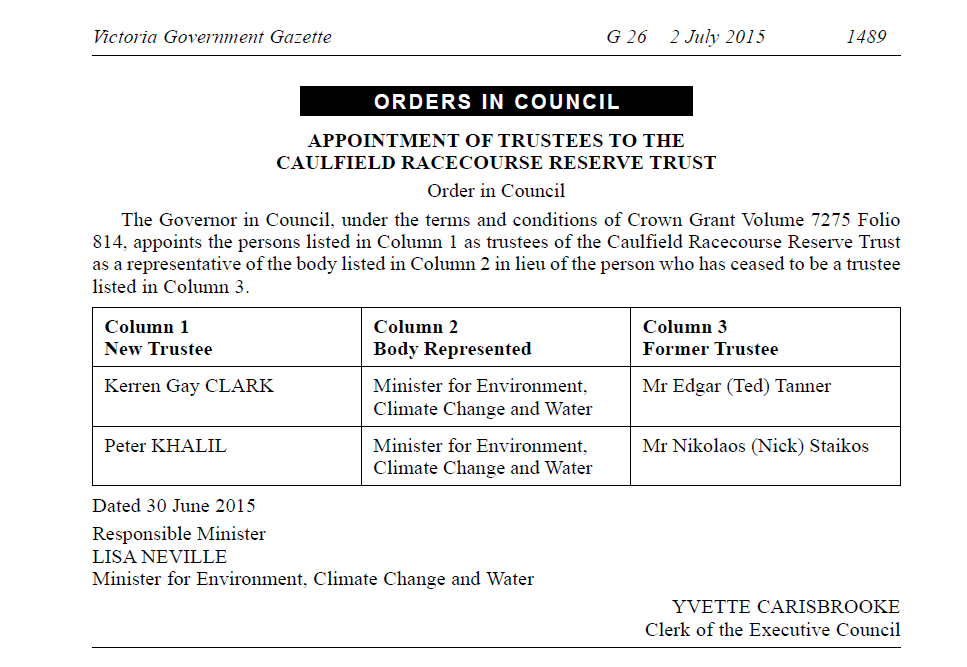
PS: OFF TOPIC BUT OF INTEREST TO RESIDENTS. FROM YESTERDAY’S GOVERNMENT GAZETTE

Untitled

leader

Melbourne City Council ‘slow’ and ‘bureaucratic’: internal review

Date: June 29, 2015 – 7:03PM

Aisha Dow

“Slow” and “bureaucratic” is how Melbourne City Council has been described in an unflattering internal review, which has criticised ageing senior leaders for not spending enough time looking at the big picture.

In a document that flags concerns Melbourne could lose its liveable-city status, it was found the municipality is at the “crossroads of either stagnating or embarking on next wave of change”.

The council’s five long-serving directors, who had been in the same job for between five to 19 years, were singled out for failing to work as a team in the report chaired by former Brisbane City Council chief executive Jude Munro.

“Directors are relatively senior in age, lengthy in tenure, male-dominated and lacking in ethnic diversity,” the review said. “They are seen to focus on operational issues to the marked detriment of leading strategic approaches.”

Questions were also raised about the efficiency of the council.

A number of external groups told the review that dealing with council was “bureaucratic” and “slow”, while finding the right person to deal with could be difficult.

Within the council, there were problems getting staff from different departments to work together. “For example, it can take up to six employees, two forms and two weeks to assign an employee to a project,” the review said.

And most staff were frustrated with the IT systems, which were described as “antiquated” and behind”. Many employees were working manually where it would be more efficient to work electronically or automatically.

However it was also noted the majority of employees had a strong passion for Melbourne and were willing to work long hours “for a city they love”.

The council’s new chief executive, Ben Rimmer, commissioned and published the review. He said most large government organisations would find that it “takes them too long to make decisions”, but the council was committed to improving this.

“We’ve had a good hard look at ourselves,” the said. “There are some areas that we want to review I am confident that we can review quite rapidly.”

A 32-page action plan has already been produced to address the problems raised.

It includes a pledge to update council’s 10-year community plan “Future Melbourne”, which is about seven years old, and to improve succession and retirement planning.

Four of Melbourne top directors have worked at the council for more than a decade. Renowned urban planner Rob Adams is the longest serving, having been at the municipality for almost 30 years.

Mr Rimmer said while it was good “as a general rule” to have some change in the management team for new perspectives and ideas, the wealth of experience and knowledge long-serving staff brought was also valued.

The review’s chair, Jude Munro, said there was always a risk that when people were in the same role for a long time they could “become used to working in a certain way”.

“Our report was talking about greater teamwork and collaboration and their role shifting to have better focus on planning for their organisation”.

Victoria’s capital is facing a period of rapid change, with the population of the inner-city set to almost double – from 122,000 people to 205,000 by 2031.

There will be increasing competition to win the Economist Intelligence Unit’s most-liveable city accolade and the review warned the loss of this crown would affect Melbourne’s ability to attract talent and investment.

Source: http://www.theage.com.au/victoria/melbourne-city-council-slow-and-bureaucratic-internal-review-20150629-gi0rh4.html

« Previous PageNext Page »