In September 2023 the state government released its latest version of Victoria In Future (VIF). Promoted as a yearly document, this one only took four and a quarter years to materialise! Councils are directed to base their strategic planning on this document. What is interesting about this latest prognostication is that instead of Glen Eira’s projected 188,000 in the 2019 version, the 2023 version projects the number of residents in 2036 to reach 174,000. In terms of dwellings required this has now changed from 78,500 to 79,090. Thus VIF 2023 projects that between 2021-2036 Glen Eira will require 12,850 net new dwellings to meet population growth needs.
The latest VIF data can be accessed via https://www.planning.vic.gov.au/guides-and-resources/data-and-insights/victoria-in-future
Glen Eira however continues to base all its strategic planning on facilitating far more than 13,000 net new dwellings by 2036 as evidenced in its latest structure plans, the housing strategy and Amendment C220. If our projected population has dropped by 14,000, together with a decline in required housing, then why are we still going full bore for more and more development?
If we look at our major planning documents (ie structure plans and priority development zones) and what these documents forecast, the true picture reveals itself. Background papers for these plans forecast the following (conservative) numbers of net new dwellings over the next 15 years –
Glen Huntly -410
East village – 3000+
Caulfield village/Caulfield Staion – 3,500+
Bentleigh – 2388
Elsternwick – 2000+
Carnegie – 2,500+
TOTAL: 13,798
It should also be remembered that both Caulfield and East Village are only ‘preliminary’ figures. In both cases they can well and truly exceed these forecasts as the permit for East Village has already enshrined! Thus if we simply focus on the above we already surpass the proposed target, without even counting development that is occurring in our eleven neighbourhood centres, and residential areas. Yet council is not satisfied, and with the housing strategy recommendations ALL of Glen Eira will be turned into a developer’s paradise.
Please note that our Housing Strategy and Amendment C220 forecasts the rezoning of over 10,000 sites and this includes the removal of the mandatory garden requirement for ALL sites zoned General Residential zone, and the creation of a new zone NRZ2 which will increase the permissible site coverage and reduce current permeability requirements. All engineered to allow more and more development on single sites.
When other councils are trying their hardest to stop their municipalities becoming congested and environmentally unsustainable areas, Glen Eira is doing everything it can to achieve the opposite. Here as some example quotes from these councils’ Housing Strategies. Compare these with the Glen Eira vision and what is proposed:
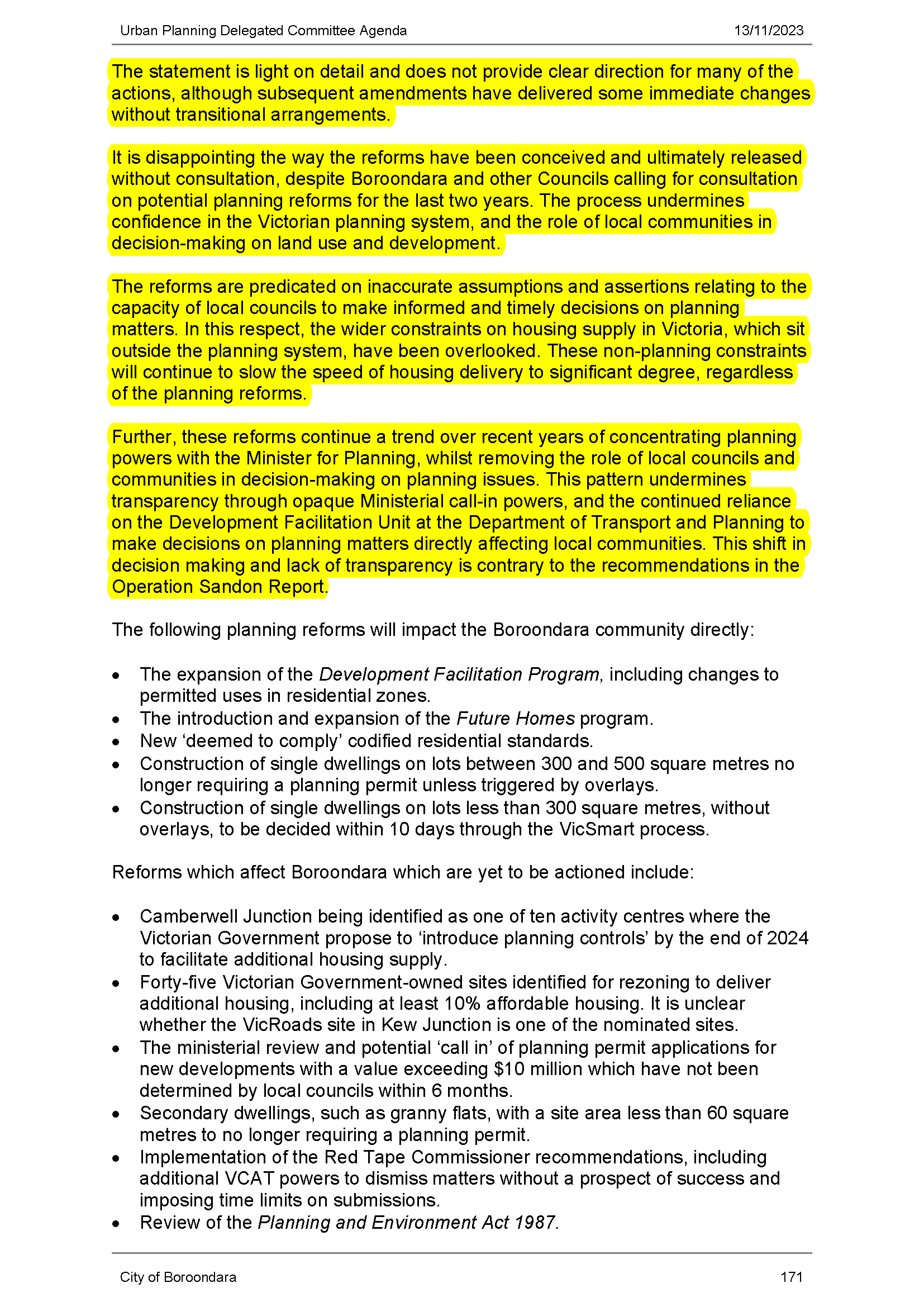
Boroondara
The BHS (Boroondara Housing Strategy) recognises that the need for housing diversity should also be considered in conjunction with the capacity and functions of key infrastructure, such as roads, sewerage, drainage, public services and public transport. If these services cannot sustain additional population in particular locations, it would be unsustainable to increase densities in these locations until the necessary infrastructure can support the change. (page 2 of the Housing Strategy)
COMMENT: In the Glen Eira documentation, there has been no assessment that we are aware of which provides any analysis of existing infrastructure and future need. No costings have been provided; no time-lines have been provided, and no evidence to support the sustainability of 13000+ net new dwellings.
Bayside
The Review also found that Bayside’s growth locations have sufficient housing capacity to meet anticipated population increases over the next 15 years to 2036 as required by State planning policy. (page 3)
….the overarching spatial approach outlined in the Housing Strategy, 2012 and in this update to the Housing Strategy, is delivering increased housing in Bayside in locations that are well served by public transport, shops and services. This is the most sustainable approach to delivering increased housing density and is in line with State Government planning policy. Should further housing capacity be required in the future, a future review of the Housing Strategy can consider other locations that may be suitable for increased housing density in addition to those already identified in the Housing Strategy. This approach allows Council to direct and manage growth in the short to medium term. (page 6)
Retain the existing residential zoning in Bayside. This clearly implements the Housing Strategy’s vision and spatial approach to managing housing growth in Bayside
COMMENT: Bayside sees no need to change zoning given the growth in its major activity centres. Glen Eira on the other hand intends to ensure that 10,000 sites will be rezoned when our major activity centres alone can meet projected growth.
YARRA
As shown by the assessment of the Yarra’s activity centres to accommodate future housing growth, Yarra can rely on existing capacity and does not need to make significant changes to rezone other land at this time to provide additional housing supply. If housing delivery trends continue to be strong in Yarra, within the next 5 to 10 years it will be important to identify key precincts to undertake further strategic planning to identify long term housing land availability. (page 67)
COMMENT: Yarra takes a similar approach to Bayside. Capacity is sufficient and if there is a need for more dwellings then this can be addressed at the time. In Glen Eira, policies/zonings once introduced stay there forever. The residential zones introduced secretly in 2013 have not had a thorough review, and certainly no public consultation. No attempt has been made in 12 years to address shortfalls in permeability and site coverage requirements when countless other councils have up to 40% permeability requirements for their General Residential Zone areas. And yet, we are supposed to have an Urban Forest Strategy and a concern about sustainable development.
CONCLUSION
With the latest projections provided by VIF 2023, council must review its strategic planning and assure residents that development at all costs is no longer necessary nor sustainable in our municipality.








 Glen Eira Debates