GE Open Space


Council is wonderful in producing stats that sound scary and ostensibly support their case. More often than not, these stats tell only half the story. For example this paragraph from the Activity Centre Strategy  –

State Government statistics indicate that over the last five years (2011–2016), Glen Eira has experienced significant change with a population increase of 11,233 and 4,300 new dwellings constructed (page 147)

Or this effort –

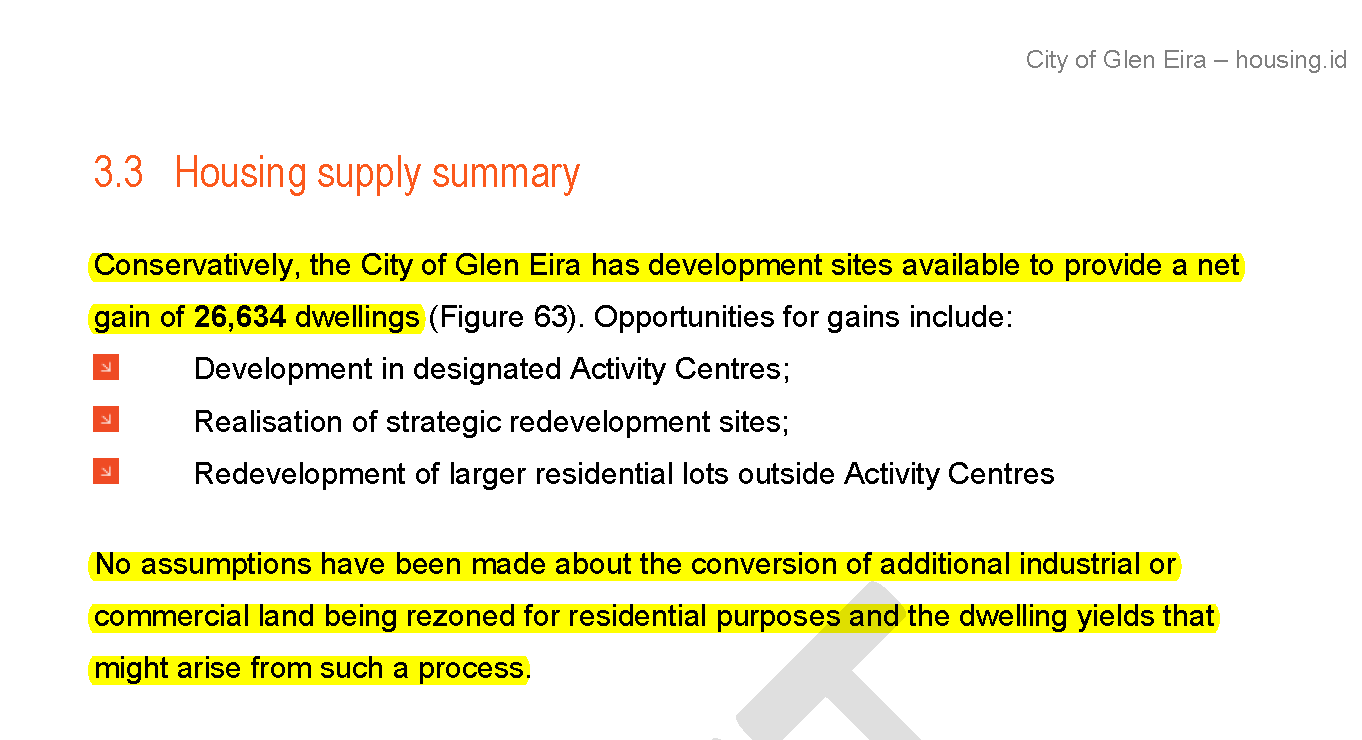
Recent statistics released by State Government (Victoria in Future 2016) indicate that Glen Eira’s population is likely to increase by a further 15 per cent over the next 15 years, resulting in the need for an additional 9,000 dwellings.(page 159 and repeated in the glossy section at page 22).

So exactly what do these figures mean? 9000 new dwellings sounds like a hell of a lot and is meant to – but this is over a projected 15 year period. Hence all Glen Eira requires to meet its population growth according to these figures is a measly 600 net new dwellings per year! Hardly enough to justify the strategy and its ambition to hand over more and more land to developers.

Nor do these figures take into account what has been happening in Glen Eira for the past 5 to 6 years. Australian Bureau of Statistics data on building approvals provides a window into the rampant development that has already occurred. Building approvals are development applications that have already received their permits and have been given the green light to begin construction. Here are the ABS figures for new dwellings –

2011/12 – 912

2012/13 – 957

2013/14 – 1,231

2014/15 – 1,786

2015/16 – 1,680

2016/17 – 1520 (end of March 2017)

TOTAL – 8086

This figure of 8086 new dwellings DOES NOT INCLUDE:

  • The 1200+ new dwellings for Caulfield Village which have already been granted their ‘permits’ via the approved Incorporated Plan and various Development Plans
  • Another, 2000, 3000, 4000(?) potential apartments for Virginia Estate.
  • Nor does this figure of 8086 include all the permits which have been granted but are yet to be taken up and construction started (and hence are still awaiting their building permits)
  • Set down for decision Tuesday night, we get the recommendation for another 87 new dwellings! The meeting before, 18 new dwellings plus refusal for 169 which will end up at VCAT and in all likelihood get at least half of this number. These would not have been added to building or planning permit state registers as yet. Thus, in two council meetings we have just under another 200 net new dwellings in Glen Eira. Go back a couple of more council meetings and the picture is the same.

So what is the take home message for residents?

  • At the current rate of development, Glen Eira will be able to cater for projected population growth NOT IN 2031 BUT BY 2021!
  • 600 net new dwellings is the required ‘quota’ per year according to all recent projections. Glen Eira is averaging close to triple this amount per year.
  • Given the above, WHY IS THIS STRATEGY DETERMINED TO INCREASE DEVELOPMENT AND WHY THE SECRECY ON HOW RESIDENTIAL AMENITY IS TO BE PROTECTED?

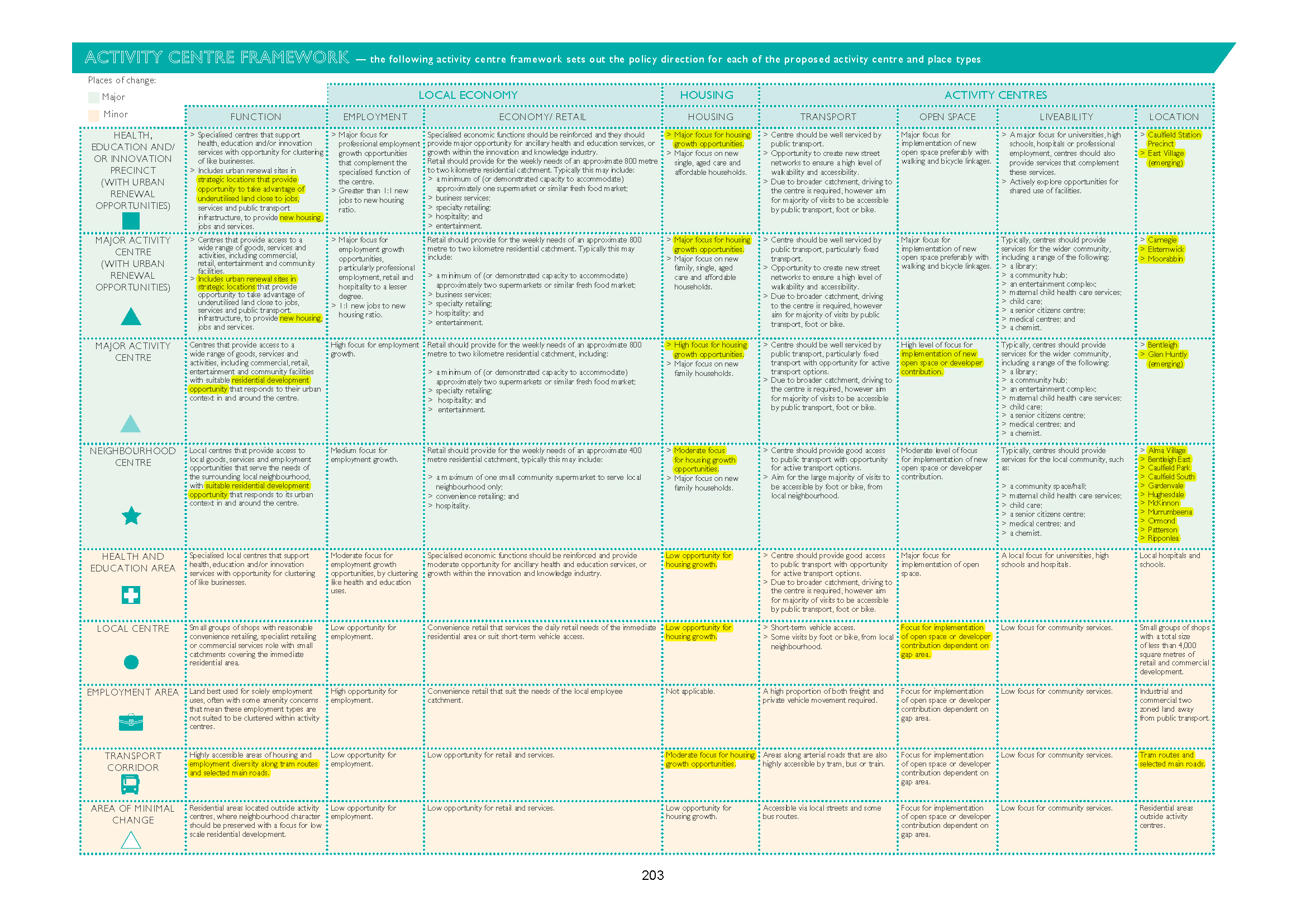
By way of summary, here is what the strategy wants to happen in order to facilitate further development. This may sound innocuous and to be merely repeating the current mantra of housing diversity versus minimal change and thus directing development to ‘appropriate’ spots. It is the extent of expansion, the vague references to ‘strategic sites’ plus ‘arterial roads’ and the upgrading of local centres to neighbourhood centres, or neighbourhood centres to major activity centres that is the concern.

CLICK TO ENLARGE – Couldn’t council have produced a far more legible document that could be read clearly without the need for a magnifying glass?

Council has finally released its draft Activity Centre Strategy. We are left speechless at both the quality and the deliberate camouflage of council’s intentions. Not only is the document a vapid, repetitious , and totally uninformative vision of the future but it lacks everything that an Activity Centre Strategy should include. For example:

  • No detail on proposed height limits
  • No detail on proposed building form
  • No detail on proposed open space requirements
  • No definition as to what ‘urban renewal’ really means
  • Plenty of promises that largely repeat the promises made in 2003/4 but without any timelines
  • Statistics that are wrong, wrong, wrong!

Worse still is the tone! Lack of detail is one thing, but when a strategic document of this importance includes the following rubbish it is totally unacceptable. We quote directly from the strategy and invite ‘interpretations’ as to the true meaning of any of these sentences –

As our local centres become more affected by globalised and mobilised markets, it becomes more and more important to create community rich experiences within these centres that cannot be bought online

Explore opportunities to facilitate local flexible working opportunities such as co-working spaces or expanded library areas.

Strategically locate future parcel pick-up stations and other digital transactions facilities within activity centres that encourage community interaction

Strengthen the heart of the community

Foster ‘bottom-up’ change through a focus on place-making.

Ensure key community needs are provided in each centre (such as banks, post office, grocers, butchers and bakers). (Please remember that council has no control over banks, post offices, nor private retail!!!)

Housing capacity and building scale can be separated from activity centre hierarchy by clearly identifying housing typologies that can accommodate growth in strategic locations that respond to their immediate context and neighbourhood character, and also reduce impacts on amenity.

We also have succinct vision statements for each centre that belong to the world of Forrest Gump or the Wizard of Oz, rather than a local government strategic document. Here is the ‘summary’

We acknowledge that Plan Melbourne has foisted some conditions onto council – ie Caulfield Junction as a Major Activity Centre, plus Moorabbin, etc. However, this does not excuse the production of a document that is full of meaningless waffle and motherhood statements, plus similar promises to what has been made and not been acted upon in the past 15 years! It is surely time that council comes clean and informs its residents in a straight forward and honest manner exactly what it proposes! We would also welcome a submission period of longer than the 3 weeks indicated.

Finally, by way of contrast, we have to again bemoan the fact why  other councils can do things so much better and with so much more clarity, and dare way say, honesty! Here are a couple of Activity Centre Strategies from other councils. Please compare and contrast!

STONNINGTON – UPLOADED HERE

MORELAND – UPLOADED HERE


We’ve featured the above 2 videos because we simply cannot understand why 2 playground ‘upgrades’ should cost $650,000 (video no.1) and $350,000 (video no.2) according to the budget!!!!! Nor can we understand how council is willing to spend $285,000 on installing more concrete plinths into our parks – plus another $90,000 to pour more concrete into the Heritage area of Caulfield Park! Surely this million and a half can be put to far better use such as – drains, traffic management, bicycle strategy, etc. etc. etc?

In an era of cost cutting and councils crying poor, it is unacceptable that so much money be poured into what we believe many residents would regard as ‘non-essentials’!


A fairly good turnout of residents (approx. 45) at tonight’s Bentleigh Forum on the structure planning process. Introduced again by the facilitator Jane Nathan, who then handed over to Aiden Mullen – the officer in charge of all the current activity centre work.  Mullen summarised the results council had obtained thus far. Significantly missing from the presentation was resident concern with overdevelopment. This morphed into the somewhat simplistic categorisation as concern over heights!

Residents were asked to sit at the various tables and a planning officer was assigned to each table. One person from each table was asked to take notes and report back to the entire gathering. More disconcerting was that each officer had a prepared list of specific questions to ask – ie how many people in your household? How many bedrooms? How many onsite car parking spots? Where would you like to live in 15 years? etc. Basic demographics which in our view are both meaningless (given the sample available) and secondly far more precise figures are available from various sources.

A ‘vision statement’ was then put up as an overhead and residents asked to comment on whether or not they agreed with the statement. It basically went along the lines that Bentleigh needs to retain its ‘village’ feel as well as provide for a safe, diverse, and inclusive community. The majority of feedback indicated that people were in disagreement with calling Bentleigh a ‘village’ given the amount of high rise development and the promise of more intense development. Several residents were highly critical of council, claiming that they simply are not listening to what residents are saying and that council needs to inform people prior to asking Dorothy Dix type questions.

It would be fair to say that most residents wanted:

  • Adequate parking
  • More open space
  • Mandatory height controls
  • Protection of heritage
  • More safe bicycle and pedestrian paths
  • More community facilities

Our view is that council desperately needs to alter its approach to these events. Otherwise they are nothing more than a self-fulfilling prophecy. Instead of motherhood statements that can hide a multitude of sins, residents need to be provided with real information as a starting point. For example: council writes that it is investigating the borders of the activity centres, yet many residents believed that the exercise involved only the commercial centres. Secondly, Mullen kept praising the interim height guidelines without informing residents that they included 5 storeys as ‘discretionary heights’. Thus we have the near oxymoron of in the one breath talking about the ‘village feel’ of Bentleigh, without all residents being aware that 5, 6 or 7 storeys is now a possibility in Bentleigh. This height certainly does not gel with the idea of a ‘village’.

We simply ask:

  • Why can other councils produce reams of information that is posted to all residents explaining exactly what a ‘structure plan’ is? What it can do and what it can’t do? And what are the overall planning constraints, or advantages?
  • Why can other councils produce structure plans that contain data that goes beyond the 2011 census and Glen Eira City Council can’t do the same?
  • Why can’t Glen Eira City Council simply ask a direct question such as – what do you think is the appropriate height limit for Bentleigh, Carnegie, McKinnon, Ormond, etc etc etc

If the aim is to produce work that is truly based on community views, then the community must be given all relevant information up front. It must also stop resorting to language that is far from appropriate and present findings that are indeed an accurate record of what residents say they want, need, and aspire to. Thus far, this has not happened in our view.

PS: As illustrations of how other councils go about conducting their structure planning consultation, we’ve uploaded part of the first survey conducted by Stonnington (late 2016 and another one from late 2015). Compare and contrast this with the kind of questions asked of Glen Eira residents and the information provided in both instances.

Below is another extract from an initial ‘survey’ done by Stonnington –

A short post alerting residents to the fact that council has published its draft budget, community plan and also included plenty of planning applications in the current agenda – a massive 555 pages!

We will report on the first two in much greater detail once we have had the time to fully digest the documents. What follows are simply some overall first impressions:

  • The community plan is presented in a different format completely. The old ‘faults’ are still there however – ie. very little correlation between ‘objectives’ and assessment of these objectives. For example: on the theme of ‘informed and engaged’ one of the criteria for evaluating ‘success’ is recorded as “Rates per assessment will remain at the second lowest level of all metropolitan municipalities”.
  • If council is truly concerned about ‘transparency’ then we have to question why on page 101 of the draft budget council insists on highlighting the percentage increase for bins, rather than the actual cost increase – ie. “240 Litre Bin 1.95 per cent Increase” etc. Residents shouldn’t have to plough through hundreds of pages to be able to work out how much charges have increased. This is the first time we believe that this kind of presentation has been done.
  • For all the talk about open space expenditure, there appears to be zero allocated for the 2017/18 financial year according to the Strategic Resource Plan!
  • Rates of course are going up, as is every other single charge. Council has however stated that it will not be seeking a higher rate (mandated 2% increase) via an appeal to the Essential Services Commission.

On other matters –

  • Parking restrictions around the hospital will not change – despite protest after protest and nothing really forthcoming from the proposed ‘advocacy’ to Caulfield Hospital
  • More applications in for extended heights – Neerim Road going for 4 storeys when a previous permit application was successful for 3 storeys. Officer recommendation? – permit. We are also mightily amused by this argument in favour of the permit – The new top floor balcony is proposed to be setback approximately 6 metres from the street. It is considered that this setback is appropriate having regard to the approved setback of the fourth storey of the building to the east (253 Neerim Road) at approximately 6 metres.
  • For another application council officers see nothing wrong in waiving 5 car parking spaces for shops!

Watch this space!

We’ve received the following email –

“Over the last few years, Bentleigh residents have been actively lobbying Council to put in the right controls and plans for future developments within the area.  As an outcome of this lobbying, some interim height controls have recently been introduced and Council is now also undertaking a Bentleigh shopping centre and surrounds structure planning process. This structure plan will significantly influence future development and FYI we have attached the preliminary draft.
A Community Forum is to be held on Wednesday 3 May, 6.30pm–8.30pm at the Bentleigh Senior Citizens Centre, 2 Arthur Street, Bentleigh to further discuss this preliminary plan.  It is important that residents attend to express views on this draft plan. 
 
Our thoughts on the preliminary plan are:  
  • There is no meaningful increase in open space and this is an issue with increasing development and also the general lack of open space in Glen Eira (lowest in Melbourne).
  • It is proposed that the existing car parks are to be consolidated into a multi-storey with the remainder to potentially be converted into more residential developments. This is not acceptable (Stonnington for example are doing one underground car park and developing open space above).
  • There is limited if any innovation or creativity in the plan.  
  • It is proposed that the library be relocated ($20M plus cost) however this was not identified as a need by residents.  (perhaps Council wants to sell off the current library site for a major development?). 
  • There is no direction included for future development heights. 
In summary, we believe that more work needs to be done to deliver a plan that is consistent in quality with other local government areas.  Please attend the community forum to again ensure Council clearly understands the views of residents.  Numbers are important, please also forward this onto friends.
Kind regards,
Centre Road Bentleigh”
centreroadbentleigh@gmail.com
++++++++
The relevant document is uploaded HERE

The so-called ‘Tranformative Concepts’ for dealing with the issue of parking to in our activity centres basically proposes

  • To flog off to private development as much of council owned car parks as possible – the terminology became ‘repurposing’!
  • To replace these car parks with one single above ground car park of at least 2 or 3 storeys.

One Mile Grid was then commissioned to survey ‘traffic’ flow in various streets. Their brief is defined as

Without stating the obvious, traffic flow and parking should be two distinct areas. It appears that council is determined to conflate both issues in the attempt to provide support for its highly questionable  recommendations! Not surprisingly, the results of the One Mile Grid analysis for Elsternwick, Carnegie, Bentleigh concluded that – The results show that all intersections analysed are currently operating under ‘excellent’ conditions during both the morning and afternoon peak hours with minimal queues and delays experienced by motorists. Only Orrong Road brought up a ‘good’ condition report rather than ‘excellent’. Many residents travelling along these roads/streets would beg to differ!

We are not traffic engineers. We are simply residents attempting to understand how such results can lead to the recommendations when:

  • No account has been taken of anticipated residential developments in the area
  • No account has been taken of car parking spots in nearby residential streets
  • No account has been taken of council car park occupancy rates
  • No account has been taken of occupancy rates in surrounding streets
  • No account has been taken of car ownership in the area
  • No account has been taken of parking restrictions in the area
  • No account has been taken of ‘through’ traffic – ie not remaining in the activity centre itself but just passing through

If council is indeed sincere about providing adequate car parking in its activity centres, then one must expect far more than a highly suspect report that does nothing more than focus on ‘traffic flow’ at certain intersections and concludes that all is hunky dorey for the most part and that public land can be flogged off for more private development.

By way of contrast we urge all residents to read the following that comes from Moonee Valley council’s amendment seeking to introduce both a parking overlay for the Moonee Ponds Activity Centre and a developer contribution of up to $13,000 per each car parking waiver. Then ask yourselves would Glen Eira ever attempt something like this given its pro-development agenda? We’ve uploaded the Moonee Valley traffic analysis, (a 175 page document) HERE

The latest outrage in development applications concerns 9-13 Derby Road, Caulfield East. Advertising has now finished for an application that proposes:

  • 18 storeys
  • 158 student accommodation units ranging in size from 15 square metres to 32 square metres. Please note that both Monash and Whitehorse have a requirement in their planning scheme about minimum size of apartments and Monash stipulates that for ‘self-contained’ units the minimum size be 24 square metres of floor area. Such clauses are absent in the Glen Eira planning scheme!
  • 1 shop of 151 square metres
  • A car parking waiver of over 40 car parking spaces
  • Under a Heritage overlay

The fact that this has not been refused outright at manager level is astounding given that various other applications of the recent past have not been advertised at all. Recent manager refusals include the Development Plan for Precinct 2 of Caulfield Village (400+ units); 8 storeys in Hawthorn Road; 7 storeys in Neerim Road and another 8 storeys in Rosstown Road. Yet this one gets through unscathed! Why? We can only surmise that this is because of the state of the current planning scheme and the wheeling and dealing that is going on between Monash, the VPA, Council, State Government, and other vested interests in the Phoenix Precinct area.

To rub further salt into the wounds the planners can’t even proof read properly, or don’t even know where the site is located – ie Hawthorn East! Because the area is zoned Commercial 1 it is therefore okay to have zero permeability and 95% site coverage on a 540 square metre block.

Finally, here is what it purports to look like –

A huge gulf exists between resident responses to the ‘surveys’ on ‘transforming’ our activity centres, and what is portrayed as the ‘results’ of this ‘consultation’. The McKinnon report is another example of a work of fiction that fails to accurately represent what residents said – especially in the category of ‘private development’. Here is the pie chart claiming to depict the results –

Please note the following:

  • To claim that ‘there was no clear agreement on suitable building heights’ is rather rich given that residents have never been asked – what do you think is an appropriate development height in any of the activity centres!
  • The claim that only 27.8% of comments were opposed to development is utter nonsense. On this topic of ‘private development’ there were 64 valid responses. We’ve ignored blanks and those marked as n/a. Of these 64 responses, a clear 39 were opposed to development (highlighted in orange below). That makes it 60.93% of responses were opposed to development
  • The report also states that ‘Many felt it was the popularity of the suburb services, particularly the high school’ that resulted in ‘increased population’. A more honest response could have been that increased population is a result of the zoning. Further, of the 64 comments only 3 mention schools at all – that is 4.68% – yet it rates a prominent mention in the report!

Please read the following comments and judge for yourselves as to the validity, honesty, and accuracy of this ‘consultation’ report.

Booran Road has finally been opened to the public. It is not without controversy. Whether one loves the new park or not many, many issues require investigation as to how this development has been conceived, handled, and the cost(s) involved.

For a council that has the least amount of public open space in the state, it is unbelievable that an area can be designated as ‘open space’ yet fenced off behind tall (and expensive) gates and access denied. This is the situation at the new Booran Road ‘park’.

We estimate the closed off area to be in the vicinity of 2500 square metres of a 1.6 hectare site. What are the reasons for this exclusion and how can it be justified? Are we to assume that this ‘urban forest’ will become the private open space of the neighbouring apartment building? If so, have they paid for any of this?

The next issue is why council continues to change plans that were not part of any community consultation and without warning or costings provided? Below is part of the council ‘consultation’ flyer which reveals a totally different park to what we now have. The green open expanses depicted in this flyer have shrunk dramatically and been replaced by more and more concrete.

The third issue is cost. According to a recent Leader article council admits to an $11 million expenditure – but they have refused to provide any real details of these costs. We estimate the expenditure to have been far and above this figure. Even one consultant engineer employed for the project puts the figure at $12 million. The image below comes from Linkedin –

When ratepayer funds are used to create a ‘park’ that:

  • varies considerably from what was proposed
  • when council isn’t forthcoming on total expenditure
  • when public open space is barricaded and the public excluded

then residents have every right to question how well their rates are being used and whether or not this project is another example of sheer profligacy and poor management, plus lack of transparency and accountability.

As far as the aesthetics of the site go, opinion is divided. Some believe that what has been created is no more than a concrete Disneyland (suitable for young children perhaps) but certainly not catering to the consensus of opinion that desired ‘passive open space’. Time will tell……..

« Previous PageNext Page »