GE Open Space


Please read the following extracts from Item 9.9 of the current agenda (open space levies) very, very carefully. We believe that it shows in spades:

  • The total incompetence of this council, and
  • Why they simply cannot be trusted

Continuation of the policy of 25 June 2013 could potentially undermine Amendment C120 in so far as it directs the expenditure of all funds on the provision and capital works improvements to new open space rather than also improving existing open space which will be used by the future population. Councillors have received an independent briefing in relation to this advice.

And the ‘recommendation’ –

Abandons the policy introduced before the 2014 Open Space Strategy entitled ‘Use of Public Open Spaces Contributions Policy’ dated 25 June 2013.

In case people have forgotten what this council policy promised we reiterate –

Council will only spend Public Open Space contributions it receives after 1 July 2013 to acquire and improve land to serve as additional public open space.1 (including the former Glen Huntly Reservoir)

Council will not spend Public Open Space contributions it receives after 1 July 2013 to improve land which is already public open space. (25th June, 2013)

With much fanfare, beating of the chest, and promise after promise, March 18th 2014 saw the following resolution (and promise) repeated –

Crs Pilling/Lipshutz

That Council;

  1. Delete the last sentence in section 8.3B of the Strategy “Funds will also need to held for upgrades to existing open space”.
  2. Adopt the Glen Eira Open Space Strategy.
  3. Confirm the existing Policy adopted on 25 June 2013 that “Council will only spend Public Open Space contributions to acquire and improve land to serve as additional public open space”.

So what does all this mean?

  • You create a strategy, an amendment, and a policy and promise the earth only to discover innumerable errors later on! So instead of amending the strategy and policy, the solution is to renege on the promise made to residents!
  • That the old system will prevail and that instead of using the accumulated levies exclusviely for the ACQUISITION OF NEW OPEN SPACE, council will redirect this money into more concrete plinths, more pavilion redevelopments and given their past record, a minimum of new open space. Note that only 2 house blocks in Packer Park have been added to open space in the last 14 years – and that occurred because of the huge public outcry. Council’s first option was to sell the bowling green for residential development!
  • The total incompetence of those responsible for overseeing the open space strategy and the drafting of the amendment. How many more errors will be picked up after the fact before someone is held to account?
  • Council resolutions, policies, strategies are all totally meaningless. Promises are made and then broken willy nilly.
  • All credibility and faith in the competence of this council is shot to pieces.

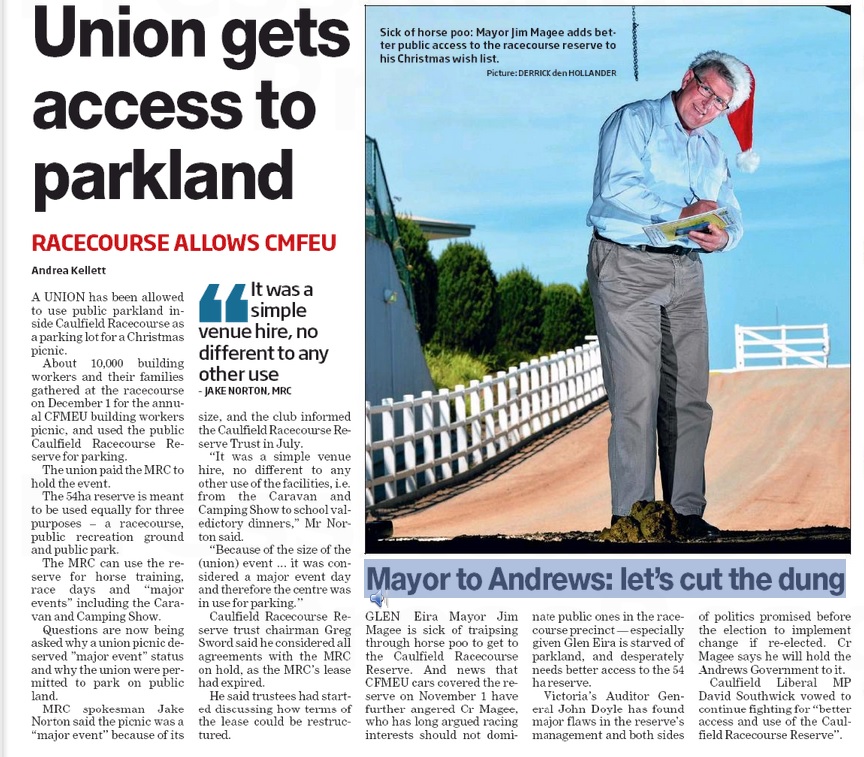
Caulfield Racecourse Reserve

Mr SOUTHWICK (Caulfield)—The matter I raise is for the Minister for Environment and Climate Change, and the action I seek is that the minister adopt the recommendations outlined in the Victorian Auditor-General’s Office report entitled Management and Oversight of the Caulfield Racecourse Reserve.

The report outlines that the trust has not been an effective manager of the reserve and that insufficient attention has been paid to fulfilling the potential for community use of this reserve.

It is important to mention that Caulfield Racecourse is one of most prestigious racecourses in Australia. It brings significant revenue into the state through racing and events. It hosts significant racing events, including the Caulfield Cup and the Caulfield Guineas, and was a training home of the legendary Black Caviar. In addition to a racecourse, the 1949 Crown grant designated the land as being for two other purposes: for public recreation and as a park. It would be fair to say that, despite the efforts of many, the trust has failed to deliver on the recreation and open space benefits to our community, which the report highlights. Without elaborating on the failure by the Labor government to properly administer land swaps and to take up recommendations from previous reviews, we are now in a great position to finally implement a management plan by taking up these recommendation to the benefit of both racing and community use.

Members would have heard me advocate in this place for more community use of the 54 hectares of land. We have seen racecourses, such as Happy Valley Racecourse, also having strong sporting facilities and golf courses in the middle of their reserves. We are perfectly placed to do a similar thing at Caulfield. I place on the record acknowledgement of the efforts of the current Melbourne Racing Club administration, which has demonstrated a willingness to adopt a plan that incorporates better public use of the facility. In 2012 I worked with the club and the City of Glen Eira to deliver a $1.8 million upgrade of the centre, including barbecue and jogging facilities. That project was funded by the racing club to encourage community use of the reserve.

Despite having done all of that, as we have known and as this report highlights, the community does not fully utilise this space because it is hard to get to. Caulfield Racecourse Reserve is desperately calling out for an active space plan to bring people into the centre of the reserve. We could do this through proper community consultation, which this report also suggests. I thank the minister and the current Department of Environment and Primary Industries administration for their commitment to fixing the inherent problems in managing this reserve and the work they have done so far with the trust.

The recommendations of the report include more rigorous oversight of the Caulfield Racecourse Reserve; adopting a governance framework consistent with contemporary standards, determining the trust’s responsibilities, powers and obligations; a community engagement strategy that can identify the needs and will ultimately result in a land management strategic plan that contains a clear and measurable outcome for use of Crown land consistent with the grant; and the exploration of alternative management arrangements for the reserve so it can be better placed to meet the needs of the racing and local community into the future.

Ultimately we are looking for the best outcome for all—the best outcome for residents and the community while keeping in mind that it is a racecourse.

I call on the minister to adopt all of these recommendations in this report. This is a once in a lifetime opportunity to get things right in this unique and valuable space known as the Caulfield Racecourse Reserve. I will give the community my undertaking to continue to fight for better community benefit in this great space.

A very brief report on tonight’s council meeting. Delahunty was absent and Esakoff left the meeting around 9.30pm. The latter had requested leave of absence until early October.

PLANNING APPLICATIONS

No surprises here. Councillors followed their usual pattern of lopping of one floor from the 6/7 application, thereby making the height 5/6 storeys and reducing the number of apartments. Lobo was the only councillor to vote against the motion. For the first application of 4 storeys Esakoff moved that another condition be added – setback on top floor to be increased to 11.83 metres. However balconies could still intrude into the set back of up to 2.4 metres. Passed unanimously.

Childcare centre featured Lobo and Magee as the only councillors to vote against. Lipshutz trotted out the same old refrain of how this applicant had not been a very good neighbour in the past, but if he didn’t behave himself from now on and abide by all the conditions set down, then council would come down on him ‘like a ton of bricks’. Funny how often this same old argument crops up from Lipshutz AND HOW LITTLE ENFORCEMENT ACTION THIS COUNCIL EVER TAKES!

RACECOURSE & LETTERS

Neither Lipshutz nor Hyams declared a conflict of interest. Labor’s Lisa Neville copped a hiding for her equivocal response and council determined to keep ‘agitating’ so that the centre could be turned into a ‘sporting ground’!

VIRGINIA ESTATE

Only two speakers and Magee’s concern was with the involvement of Elizabeth Miller writing to council and the Minister’s alleged attempt to bypass consultation. He did not ‘care’ whether the entire precinct became commercial via an amendment as long as there was community input. More on this in the days ahead.

GISBORNE STREET/RIDDELL PARADE CONSULATION

Pilling showed his true Mayoral qualities here by not halting Lipshutz and then Hyams when, instead of speaking to the topic, both used the occasion to launch into personal attacks on the two objectors to the Open Space Levy Amendment. According to these councillors both objectors (who were named – a first for council) were ‘holding the community to ransom’. Pilling then had his own go by parroting what Hyams had said several council meetings ago – ie that the objections were motivated by ‘mistrust of council’. Much, much more on this in the coming days!

The City of Melbourne appears to be making some major strides in achieving greater transparency and accountability – at long last! Not only do they have a Notice of Motion, webcasts of council meetings, but this latest vote on reporting on open space contributions definitely caught our eye. Needless to say, Glen Eira Council has nothing remotely similar!

Pages from JUL14 CCL MINUTES OPEN (UNCONFIRMED)

The Open Space Contribution Levy has featured prominently at the last two council meetings. At the July 1st meeting the claim was that with objectors going to a Panel this is estimated to add approximately 7 months and that revenue ‘foregone’ during this time could be of the order of $2m. At last night’s council meeting the $2 million suddenly morphed into this (from the officer’s report) – At the 2013-14 rates, that would be a difference of about seven months or around $700k. Lipshutz even made up his own figures and spoke of a million dollars! The best lines however came from Hyams with his assertion that the objectors had a ‘tribal distrust of council’ and this was their ‘motivation’ for lodging objections.

Perhaps a far more reasonable take on council’s approach to collecting money from developers would be to calculate how much money has been LOST over a period of 11 years. Perhaps residents should also be seeking answers as how much land council has sold, as opposed to how much land has been purchased in order to meet the open space demands – first identified in 1987.

Even on the new ‘transparency’ so lauded by Delahunty, the figures provided in the officer’s report are fascinating – and of course entirely begs the question as to why such data is only made available now and not on a regular basis! More telling is the fact that council states that the range of rates currently applied are – 2.25% to 5.0% (maximum). So how come, when the supplied list is analysed NOT ONE SINGLE DEVELOPMENT IN THIS LIST OF 54 HAS PAID 5%? Further questions should also be asked. For example:

  • If this is truly a complete list of all payments received, then given that council admits to roughly 350+ subdivisions (according to the State Planning Activity Permit Reports for last year) and if even half are for 2 lot subdivisions and therefore exempt, what has happened to the other 175 subdivisions? Did council collect a cent? Or were all of these subdivision payments waived?
  • If on the other hand this is not a complete listing, then why hasn’t this been stated upfront?

For eleven years now (since 29/5/2003) council has done nothing to up its open space levy – even though it has been fully cognisant of the fact that open space is a premium in Glen Eira. How many millions have been lost during this time? And how much money has been lost by not even applying the full 5% that council could legally apply?

Compared to the 11 years of doing absolutely nothing, a delay of even 7 months, seems very worthwhile in order to ensure that an amendment is passed which will truly benefit the community!

vegiegarden

PS: We’ve included some thoughts on this issue!

We believe that there is much more to this site than meets the eye. As one commentator pointed out, there was a Request for a Report by Magee and Hyams in May 2014. The ‘response’ to this request featured in the last council meeting (July 2014). Here’s what was reported back in regards to purchasing the site:

“The possibility of Council acquiring the vacant land at 846-848 Centre Road, Bentleigh East directly adjacent to the Centre Road Kindergarten.”

As stated above, the current and projected demand for kindergarten is fully provided for both in the municipality and in the East Bentleigh area.

846-848 Centre Road is reportedly for sale with an asking price of $1.8m to 2.2m.

Council’s valuation for Rates purposes is $905,000. This is on the basis of the land with no allowance for any town planning permit.

There is a current Planning Permit for the site (#GE/PP – 21681/2009), issued by VCAT in 2010. The permit allows a two storey building with basement car parking. It is likely to yield around 14 dwellings. The original Council resolution required deletion of dwellings resulting in a 10 dwelling development. Upon appeal, this condition was deleted.

Notable aspects of the permit and site:

Development must commence by 1 Feb 2015 and completed by 1 Feb 2017. Three permit extensions of time have been granted. It is unlikely a fourth will be granted.

The site is now in a Neighbourhood Residential Zone. Should the permit expire, the site will be restricted to a maximum of two dwellings.The site is affected by the SBO.

The site is potentially contaminated. A condition of permit requires a full environmental clean up to EPA requirements.

Other planning information includes:

May 2014 – Site being used unlawfully to store shipping containers. Planning Enforcement action current.

May 2014 – 17 dwellings, 2 storey application refused by Planning Manager.

June 2013 – 29 dwellings, 2 shops, 3 storey application. Lapsed application due to failure to provide information in time.

October 2007 – 16 dwellings/2 storey application refused by Planning Manager. Refusal affirmed by VCAT.

The site is a former petrol station. It would need to be remediated to EPA requirements.

Some parents would refuse to send their children to a kindergarten which used to be a petrol station regardless of whatever certificates or assurances were given. Any kindergarten on that site would be unlikely to be successful.

Council does not have $2m available. Council’s funds are planned out to achieve Council priorities including Public Open Space. 846-848 Centre Road is not in a gap area under the Open Space Strategy. Council is spending $3m nearby on the Centenary Park Pavilion.

To find such a sum would require cancelling other Council-approved projects.

Recommendation

1. That Council note that

a. 369 extra places have been provided over the last five years and that this response has met current and projected demand for kindergarten;

b. because Council is notified of births, Council will have several years’ notice of increases or decreases in numbers of children; and

c. the most significant change in Glen Eira’s future demographics is the projected growth in the 60-79 year age group.

2. That Council write to the owners of 846-848 Centre Road informing them that Council has no interest in purchasing that property.

Crs Magee/Delahunty

That the recommendation in the report be adopted.

The MOTION was put and CARRIED unanimously.

COMMENT

  • The Request for a Report DID NOT INFER that the land should be used for a kindergarten. In fact, it specifically cites the existence of an adjacent kindergarten. Yet, the Jones report deliberately links the purchase of this land for its use as a kindergarten!
  • Council admits that it is already receiving just under a million dollars in rates. Presumably, this amount is still being paid for the current year. Hence the asking price of $2 would be markedly reduced given the money council is currently collecting.
  • The land has stood vacant since at least 2007. Permit extensions have been granted time and time again. Seven years of extensions without providing any accounting of such decisions! Further, when Tang moved a request for a report on permit extensions in June 2012, the ‘response’ was that council does not keep such statistics, and couldn’t see any reason why it should change its ‘systems’. The resolution passed was the council ‘commence’ keeping such statistical records. This would take 4 years since permits are given a large grace period and then another grace period of building completion. Thus far there has been not one single officer report on how many permits are extended; the reasons; the locations. Developers can thus continue to land bank to their heart’s content!
  • The May 2014 permit rejection is also one to ponder. The application went in during July 2013. The refusal was given in May 2014. Why does it take 10 months to determine an application?
  • Having kindergartens on top of former petrol stations or contaminated grounds has not stopped council granting permits in the past. In fact the entire Clover Estate is built on contaminated ground that contained far more ‘dangerous’ toxins than a mere petrol station. The same goes for 175 Balaclava Road and probably countless other sites.
  • It should also be borne in mind that council is still waiting for Ministerial approval to exhibit its Amendment C115 which will allow higher density development in residential zones – ie more than 2 dwellings per lot. We wonder if the delay is to accommodate another application which this time will be rubber stamped with the new amendment?
  • Finding an extra million or so has never been a problem for council in the past – GESAC car park extensions, legal bills, relocating sporting ovals, etc. etc. etc.

044-2

The officer’s report –

A recent example was the Alma Club where Council officers attempted to secure land for an additional local open space in Caulfield North but, owing to the impact on the design, suitable land could not be made available and a cash contribution was made instead.

The Public Question –

Item 9.8 of the agenda cites the Alma Club site as an example of a cash rather than land contribution. For this site, I ask:
1. What was the undeveloped land value placed on the site?
2. What was the full cash contribution that council received?
3. Was this amount paid in one lump sum?
4. Why was any contribution paid prior to subdivision and as stipulated by law?

The ‘Answer’ –

The report at item 9.8 was correct in saying that Council tried to secure agreement to an open space contribution of land at the former Alma Club. It was right to say that, following a period of negotiation, that was not feasible and the open space
contribution will be in cash.

The report was mistaken to say that the contribution had been paid. What has been paid is back rates of $67,430. That was paid on 30 May 2014. (Back rates are payable when a property ceases to be eligible to be rated under the Cultural and Recreational Lands Act and becomes rateable under the general rating system. )

The misunderstanding between the payment of the back rates as opposed to the open space contribution was made during the writing of that section of the item between the Planning Conference on the evening of 25 June and the Item being finalised on 26 June. Council apologises for the mistake. The open space cash contribution will be payable in cash at the time of subdivision and calculated according to the value of the land at that time. If Amendment C120 is in effect, it would be 5.7% and could not be appealed to VCAT. While Amendment C120 is not in effect, it would be 5% or less and could be appealed to VCAT.
A difference of 1% would equate to approximately $75,000 for this one subdivision.

Sounness moved the motion to accept and added the clause that the financial report ‘disclose’ open space contributions. Delahunty seconded.

SOUNNESS: said that the amendment ‘follows on’ from the Open Space Strategy. Acknowledged the ‘problem’ of lack of open space and that with new development people should have access to ‘new public open space’. Went through some features of the Open Space Strategy such as biodiversity, and how to ‘fund these developments’. Importantly the amendment wants to increase these contributions. Said that the ‘standard rate is 4% and lots of councils have 4%. When there were greenfields developers may have been happy to give a bit ‘of dirt’ but in developed residential areas they wouldn’t want to give up a ‘unit 2 of the third storey’ and so prefer to pay cash. Spoke about the objections and ‘some very good points were put forward about transparency’ and consequently there has been a ‘robust conversation’ amongst councillors and there’s been a ‘number of conversations’ about ‘what’s fair, what’s reasonable’ and comparing to other councils and how all this ‘refers to our future expectations’. Asked a question of Akehurst about why under this amendment the contributions wouldn’t ‘be appealable to VCAT’?

AKEHURST: said that currently there’s a ‘base rate’ based on numbers and that ‘other factors can add to tne percentages’ and these are ‘subjective’ and so can be challenged. He gave the example of ‘proximity’ to existing open space. Went on to say that council assesses one cost and the developer assesses this differently and figure that the money spent on challenging council is worthwhile. This also costs council money in going to VCAT. With the C120 there’s no sliding scale and there’s one rate for ‘every case’ and everywhere and the developer doesn’t have ‘grounds to argue for a discount’. Said that the amendment was there to give ‘more certainty’, more ‘revenue’ and without the associated costs of going to VCAT.

SOUNNESS: said that one of the objections had noted how the money was ‘expended’. He gave the example of the alma club developer paying money and asked how this money was spent in helping achieve open space around the Alma Club. Wanted to know if the amendment ‘speaks’ to the ‘direction’ of expenditure of the levy.

AKEHURST: said that the amendment was ‘about how you raise revenue’ and that the amendment ‘optimises that collection’ and then it becomes ‘up to council how it is spent’. That is then ‘expenditure’ and ‘council has a policy’ that stipulates spending the money on acquisition of ‘new open space’. Council would also have to spend money outside of its collected levies to bring these places ‘up to standard’.

SOUNNESS: then asked that when the amendment goes to the panel whether they have ‘the capacity to direct expenditure’?

AKEHURST: ‘no’ – the panel is bound by the law which says that money raised is ‘spent on land acquisition and improvements to existing public open space’. Said that every council then makes up its mind about spending on existing and additional open space and repeated the policy about spending 100% of the levy on ‘additional open space’ in Glen Eira and ‘zero’ of these contributions on ‘existing open space’. Went on to say that the policy is ‘binding on all staff’ and the use of the ‘revenues’. There will be accounting of the money in ‘each budget and each annual report’ and that ‘there is nothing that council could do’ which isn’t ‘already in place’.

SOUNNESS: reiterated that the amendment basically ‘seeks to increase the revenue’ and that there’s ‘only so much that can be done’ with how the money is spent. Summed up that the amendment wants to implement what the community has ‘endorsed’ in the Open Space Strategy. Said that the objections had ‘raised some issues that have been quite valuable’ and like the landswap it’s ‘very good to see where the money goes’ and that’s why he’s added the clause about reporting in the financial review.

DELAHUNTY: said that open space issues has ‘occupied a lot of councillors’ time’ and that when she first thought of becoming a councillor, open space was one of the ‘platforms’ that she wanted to run on. As a parent she sees ‘how important’ even ‘small pockets of green’ is. The problem is big and it will take a ‘step by step’ process and this included the Open Space Strategy and ‘getting the right people to write the strategy’ and have the ‘public contribute’ to the strategy. Council also ‘took a policy change initiative’ to ‘fence off the funds’ that would be received from contributions. The amendment is now the ‘next really important piece’ in the process. This is the end result of a long ‘calculation that is done by the right people’, and had public consultation. There is now the motion to put this to a panel and she asked Akehurst ‘what does this mean’?

AKEHURST: said that the Minister ‘appoints a panel’. Council and the objectors then ‘put their view’ before the panel. The panel then reports back to council ‘in the form of a recommendation’. Their recommendations could be that the amendment be adopted by council as exhibited, or ‘in some other form’. Council doesn’t have to accept the panel’s recommendations ‘but it would need to have serious reasons not to do that’. It then goes to the minister for approval if council has adopted the recommendations of the panel.

DELAHUNTY: ‘What’s the downside risk’?

AKEHURST: said that the panel might think that the 5.7% ‘is too high’.

DELAHUNTY: councillors had read the submissions and thought that many of the points ‘were correct’. Other things could be ‘clarified’ but she again asked Akehurst ‘what this would do to the process’?

AKEHURST: said that there were a ‘couple of errors’ and these were corrected. Amendments are a ‘statutory process’ and that council can’t change things in any ‘material way’ if it’s already gone on public exhibition. So even if there are submissions that ‘have merit’ but weren’t ‘part of the exhibited’ amendment ‘they could not be incorporated into’ this amendment because they would ‘depart’ from what’s already been exhibited.

DELAHUNTY: then asked whether Akehurst ‘was surprised’ that there were no objections to the 5.7%

AKHURST: ‘yes’

DELAHUNTY: said that she was ‘surprised and delighted’ and that at ‘heart’ everyone ‘understands’ that there are challenges that have to be fixed and she was pleased with community involvement because it’s an ’emotive issue’ but council wants to ‘move on’. Said that Sounness’ amendment will increase ‘transparency’ in ‘making sure they are reported upon’ in a ‘separate and visible line item’ in the financial report. Thought this was good and ‘goes some way’ to answering the submitters ‘concerns’. Said that the submitters ‘did a good job in pointing out those errors’ and that they are ‘pleased that we could provide a stronger submission’ as a result.

OKOTEL: glad that council is a ‘step closer’ to raising the contribution levy. Said that the 5.7% levy is one that was ‘supported by the Open Space Strategy’ and that this provided for a ‘strong reference base’ for this amount. The rate is ‘evidence based’ and she hoped it ‘would be accepted’. She then asked Newton a question about the officer’s report stating that 7 months would be added to the process if it went to a panel and that around $2 million would be lost from revenue and whether projects set down for implementation ‘would be impacted’?

NEWTON: said that when exhibited they estimated that the ‘revenue’ would rise from $2.2 million a year to $6.1 million. Continued that the Strategic Resource Plan is ‘based on current arrangements’ and the ‘extra revenue’ hasn’t been ‘taken into account’. Said that the current budget is resourced but what’s planned for the future in open space will only happen if the ‘amendment is put into effect’ and ‘the longer it takes the less money we will have’ for ‘next year and every other year’.

OKOTEL: then asked what council ‘mightn’t be able to complete’

NEWTON: gave two examples. One was the Booran Road Reservoir which is a ‘very expensive project’ and ‘because the meeting went so well’ council was thinking of ‘accelerating’ the works such as ‘demolishing the walls this current year’ and that’s ‘not budgeted’ but they could with the extra revenue and ‘complete the work earlier’ ‘if the money is available’. The second example was ‘another road intersection’ in North Caulfield and would be ‘similar’ to the Gisborne St/Riddell Parade closure. ‘At the moment there is no money in the ten year plan for that’ but if the amendment came in quickly ‘there would be more money’ so that ‘next year there would be more open space’.

MAGEE: said this could be a very ‘happy story’ that everyone wants. If developers pay the 5.7% then the money will ‘accumulate very quickly’ and council could implement the things listed in the Open Space Strategy. Referred to Newton’s examples and how important the Reservoir is given that council has been ‘talking about this for at least 5 years’. Said that it’s about ‘communities coming together and working together’. Stated that there could be times ‘when processes’ are different and other times when people can say ‘I don’t agree with you but I should work with you’. The amendment ‘benefits all of Glen Eira’ and council is ‘very passionate about’ this. The money isn’t from residents but ‘developers’ and the ‘cost to us is open space’ which council has to keep improving the open space. They can’t do this ‘by procrastinating’. Individuals might have ‘issues’ but the ‘overall good’ is for the community. ‘I’m saying don’t hold it back, don’t stop us’. Some people might say they ‘don’t like’ how council operates, but ‘suck it up’. ‘we need the money’ and it’s the ‘number one issue’ for Glen Eira that everyone should be ‘working towards’. ‘The process we can argue about’ but ‘let’s move on’.

DELAHUNTY: asked Sounness as a green, what the Greens would ‘say’ about the Open Space Strategy and the levy.

SOUNNESS: said that with open space then it’s about ‘improving, expanding’, ‘community access’, ‘equity and fairness’, letting people access a ‘safe, healthy, clean’ space,   so the greens and every party would support this.

DELAHUNTY: then asked that since there’s all this ‘passion’ and ‘feelings around the table’ whether there is ‘another path’ that could be taken so that the projects and money ‘could happen quicker’.

NEWTON: said that there’s ‘only one option’ if there are submissions and that’s to appoint a Panel. There would be a Panel in October and they’d report back to council which council would then consider and report back to Minister. ‘That’s a long time’ and council ‘would not be getting 5.7%’. He was like Delahunty ‘surprised and delighted’ that no one had objected to the 5.7%. Went on to say that if there hadn’t been submissions then council could have ‘adopted’ the amendment ‘tonight’ and written off to the minister tomorrow and it could have been in operation by August.

DELAHUNTY: since there are admissions, then the whole process has to be gone through – ie panel, report back to council, decision by council, sending off to minister and waiting for his approval.

NEWTON: so ‘if the submissions remain, the panel remains’ and all the other processes have to take place.

ESAKOFF: said it was ‘disappointing’ when this is on the agenda and the added costs that will happen. So there will be ‘delays’ or the inability to ‘accelerate’ projects. ‘It’s very disappointing’.

HYAMS: was ‘very p0leased’ that no submissions came from developers but thought that ‘once they cotton on’ to this that they may go directly to the minister and ‘try not to give us as much money’ as council is asking and others might be ‘rushing their applications through’. Said that consultants did ‘the strategic work that justifies the 5.7%’ so they are ‘pretty confident’ that even if developers object they would still get this rate. Perhaps even the developers looked at the ‘documentation’ of the amendment and ‘realised that we do have a solid case’ and they didn’t want to ‘waste their time’ on this knowing that ‘it was going to get through’. Sumbissions pointed out ‘2 errors in the documentation’ which might have ’caused confusion’ so ‘it’s good’ that this has been fixed. Thanked submitters and said that the submissions also ‘raised a number of policy’ questions. Hyams then ‘sought clarification’ from Akehurst by asking whether Public Acquisition Overlays are something that council ‘could or should do as part of this amendment’?

AKEHURST: said ‘no’ that it wasn’t ‘lawful’ and that ‘no council could do it’. Said that public acquisition overlays can only happen by ‘amending the planning scheme’ and to ‘identify the land to be applied’ and the ‘purpose for which it is being acquired’. The minister would have to approve exhibition and wouldn’t get the go ahead if council asked for more ‘land than required’. Council would also have to prove that ‘it has the financial resources to buy the land’ and this is ‘accepting financial responsibility’. If this is in the planning scheme then ‘council can be asked immediately to buy the land’. It can also cause anguish to the owners and that’s why councils only have ‘small numbers of overlays’. Councils generally start by getting the money from levies and then being in a position to buy the land, put in acquisition overlays.

HYAMS: stated that as one submitter said that it’s ‘unreasonable’ that all the money coming in would go to ‘catering for new residents’ and that the ‘140,000 people currently living in Glen Eira miss out’. Asked Akehurst whether it would be applied in this way.

AKEHURST: said council has go ‘not choice’ and that’s why it’s phrased as it is. Said that the amendment isn’t ‘justified if it’s not raising money for future residents’. Claimed that this ‘isn’t bad news for existing residents’ since the Open Space strategy has got projects where the money will be spent and apolicy that council will spend money ‘by other means’

HYAMS: asked Akehurst about the choice of ‘acquiring land or acquiring money’ and that the amendment only has 3 areas for cash contributions listed as preferable, so how is getting a ‘little’ piece of land at the back of a development ‘better than getting money’?

AKEHURST: said that ‘it’s not better’ and that council would be very stringent in what land it accepted and this would really only be if there was a ‘significant development’ and that this wouldn’t ‘happen very often’ because ‘Glen Eira is substantially developed already’.   Council would get cash mainly because development is generally on ‘small to medium sized lots’.

HYAMS: repeated how pleased he was that there weren’t any developer submissions and he thought that the two objectors would have thought that there would be others so they wouldn’t have expected that their submissions would be holding up council. Said that if the submissions ‘are withdrawn we can go straight to the minister’.

SOUNNESS: said this was ‘all about money’. Didn’t want to ‘see concrete’ but ‘useful’ parks, and gardens and the amendment want to ‘seek the mechanism for improving that capacity’. Said councillors ‘elswhere would love to get 5.7%’. Whitehorse is 4% and their plan was done by the same consultants and they’ve now bought 3 residential lots over time. Getting the cash means that council ‘can adjust to cicrumstances’. In western Australia there’s 5% and ‘compulsory acquisition overlays’. When this happens ‘people go nuts’ and say ‘my home is being removed’. Thanked submitters because ‘it’s a champion thing that democracy does’ but was worried that developers will now see that ‘there’s a cut off time’ and will take advantage of this by council getting a ‘rush of subdivisions’ and therefore receiving less money.

MOTION PUT AND CARRIED UNANIMOUSLY


Delahunty moved to ‘note the report’ and added that council seeks information about the money that was paid by the MRC to the government and that this include ‘advice’ from the Valuer General about the ‘reasons’ for the landswap and the amount paid, when the money was received, how much and ‘the Department that received the funds’. She also asked for a ‘copy’ of documents that the then Minister Gavin Jennings spoke about in parliament at the time. If necessary, council should use FOI to get the information ‘if required’. Sounness seconded.

DELAHUNTY: Began by saying that the landswap was before her time but clearly something that’s grated on people. Said she was surprised that the money paid was so large when it was claimed to be ‘compensation’ for the ‘inequity of the swap itself’. She wanted to know more ‘about that money’ since the MRC’s last 3 annual reports writes about $8 million being set aside for the buying of land and this could be the buy out of private properties but also contain the money paid to the government. Therefore no one knows how much they actually paid and what they thought it was for. Hansard mentioned this several times in response to members asking questions. Said that David Davis was asking whether the swap was equitable and he referred to the panel he was chairman of and that he was ‘still uncomfortable’ about the Trust and land swap. Sue Pennicuik has also been a long time advocate and been a ‘great help’ for the community. She also asked ‘a lot of questions at the time’ from Gavin Jennings and wanted to ensure that the community could ‘derive’ some benefit. Jennings answered that the land would be valued, and that this then would be approved by ‘the Government Land Monitor’. This would ‘ensure’ that the government isn’t ‘disadvantaged’. Jennings then went on to say that the swap was contingent on the approval of these bodies and that there would be commercial rates paid for the land. The act was then passed. Delahunty then said if these assurances ‘were given’ but the public still doesn’t know the details such as ‘where the money went’ and ‘what it should have been used for’ so that when the vote was taken in parliament they voted on the assumption that things would happen, but none of this has happened. She ‘presumes’ that the money went into general revenue. Thought that ‘this money should come back to provide the community’ with the ‘equity it was supposed to deliver’. Said that council was ‘more than happy’ to move the depot to the Booran land site which ‘we never wanted in the first place’. Council would need to spend ‘residents’ money’ or ‘get residents’ money back’ from the landswap. Summed up by saying that want to restore Caulfield Park, and get the ‘best use’ out of the Booran site and for ‘the money that is owed to the community’ to be returned. Thought that 2012 was when the money was handed over and that it was intended for ‘the people of this community’. They want all the information to ‘inform the public debate’ and that people should know ‘where their money has got to’.

SOUNNESS: said the the whole issue including racecourse, c60 etc. can ‘fire up’ people and that the best option for getting to the bottom of things is to ‘follow the money’. Pennicuik tried this. Said there was ‘still a long path to go down’ and they’re trying to find ways to ‘move the depot’ and find ‘better array of services’. Good that council is trying to ‘achieve a better outcome’ for residents.

MAGEE: said this would be ‘win-win’ for everyone in that the depot would be moved, and that so far there ‘is no community benefit’ from the landswap and the money which was paid by the MRC. This money could be used to achieve this. Said that government’s job is to ‘assist the community’ and for Glen Eira with the least amount of open space, that the government should ‘give it to us’ (the money). SAid this was a ‘great opportunity’ to get a good result and ‘banging on forever’ about the landswap, trustees is useless. This is positive and they will ‘keep the pressure on’ both government and Southwick. Wanted everyone to ‘work together’ for a ‘community benefit’.

OKOTEL: reiterated that this was an ‘important issue’ and that Pilling had already met with government and that council would continue to ‘agitate’ on the issue.

HYAMS: said this was a ‘mess’ from the start and council wasn’t happy from day one but that both sides (Liberals and Labor) voted the landswap in. The Trust also voted for it and of the 3 council reps ONLY 2 VOTED AGAINST IT, which is ‘disappointing’. Council never wanted it and from the start they wanted a depot but the MRC said ‘no’ they didn’t want a depot and the department put it aside for ‘recreation’. Buildings also went which is ‘unfortunate’ because they ‘might have been useful’. Said that now government has given permission to put the depot there and that for once it’s ‘good to see that the MRC’ isn’t having it all it’s own way but, that council ‘needs the money’ for this to occur. Asked Delahunty what she ‘expects’ the ‘legally binding document’ to contain. Delahunty said ‘I don’t know’ and that this was mentioned in the actual debate in parliament but that she expects to find ‘some wording about the exchange’ and whether the money was to ‘come back to the community’.

DELAHUNTY: said it’s a mess and was ‘outside the control’ of council. But the ‘opportunity’ is now due to Media Release by Southwick where he claimed that he was ‘excited’ to be ‘able to reinvigorate’ Caulfield Park. With this there’s Hansard where Davis ‘sought assurances’. So ‘there’s no better time’ to get things done than ‘right now’. To succeed they ‘need to understand all the information’. All this can ‘put to rest some of the ill will’.

Delahunty then went on to say that the letter published in the agenda which was sent to Southwick ‘some time ago’ had as yet ‘not reached his office’. On Twitter, Southwick claims that he first saw it with the agenda.

MAGEE: asked that if council doesn’t get the money ‘can we still afford to do the landswap’?

NEWTON: according to the Strategic Resource Plan ‘there’s no money in any of the ten years to do this’ and the ‘only way you could do this is to lower the priority of some other projects’.

MAGEE: summed it up by asking ‘No money, no move’?

DELAHUNTY: answered and repeated ‘no money, no move’.

MOTION PUT AND CARRIED UNANIMOUSLY.

« Previous PageNext Page »