GE Planning


How many residents’/loading bay/visitor car parking spots has this council waived in the past few years? We wouldn’t be surprised if it approaches a thousand places given the rate of development that has occurred in Glen Eira. What all this means is that local neighbourhood streets are primarily bearing the full brunt of such dispensations. Heaven help residents who just happen to be living off any of the main shopping centre strips. They represent the immediate casualties.

We’ve decided to present some of the officer decisions on major developments for the life of this current council. All of these ‘recommendations’ were approved by councillors with a little bit of tinkering via conditions. Please note the:

  • Contradictions regarding stackers for visitor car parking
  • The failure to provide quantifiable ‘evidence’ for recommendations
  • The constant repetition – at times verbatim!
  • Logic that defies belief!

1056-1060 DANDENONG ROAD CARNEGIE – 12 storeys, 173 dwellings,  (13th November 2012)

264 car spaces proposed and Planning Scheme requires 276 (12 shortfall)

Council’s Transport Planning Department consider the planning scheme requirement of 3 parking spaces per 100 square metres of restricted retail floor area to be greater than the likely parking demand in this area. A parking provision closer to 2 spaces per 100 square metres is considered more appropriate (therefore a minimum of 32 spaces is required compared to the provision of 35 spaces for the restricted retail use component). It needs to be noted that non-compliance with a planning scheme car parking requirement does not necessarily flag a car parking shortfall for a particular site. This is because the planning scheme requirement is general in nature and the provisions are premised on a lower number possibly being acceptable having regard to the circumstances of a particular site. There is availability of on-street parking in the area for any overflow short term parking. In addition, the existing use of the site would have generated some demand for on street parking.

127-131 Gardenvale Road,Gardenvale –  4 storey building; 2 retail 12 dwellings (2 shortfall) 

No visitor parking has been provided. The Planning Scheme requires 2 on site visitor car spaces as a “starting point” (1 space for every 5 dwellings) however this can be reduced or waived depending upon traffic evidence and local circumstances. On the one hand, Council’s Transport Planning Department has requested the provision of two at-grade visitor car spaces. On the other hand, the applicant’s traffic engineering advice suggests that no visitor car parking is required given the ability to accommodate this parking demand in the surrounding streets. On balance, a dispensation is considered reasonable in this instance”   (27th November 2012)

483-493 GLEN HUNTLY ROAD ELSTERNWICK – 8 storey; 4 retail; 57 units (Shortfall 16)

In this case, a reduction in the visitor car parking requirement is justified. If sustainable transport modes are to be promoted, then a reduction in the visitor car parking requirement should be encouraged. It is considered appropriate to provide a modest level of visitor parking. However providing additional on-site parking for visitors will only encourage more vehicle traffic to an area which anecdotally has issues with traffic. It is also noted that a visitor parking rate of 1 space per 10 dwellings (as proposed in this case) has been supported previously in activity centre locations. Notwithstanding this, a shared arrangement could be incorporated with the 4 retail car spaces being made available outside normal business hours (achieving the 9 spaces suggested by Transport Planning).

(5th February, 2013)

451-453 SOUTH ROAD BENTLEIGH – 5 storey; a shop; 12 units  (Shortfall 2)

No visitor parking has been provided. The Planning Scheme requires 2 on site visitor car spaces as a “starting point” (1 space for every 5 dwellings). However this can be reduced or waived depending upon traffic evidence and local circumstances. Council’s Transport Planning Department has not raised any concern with the lack of any on-site visitor car spaces. On balance, a dispensation is considered reasonable in this instance/ (2nd July 2013)

674 CENTRE ROAD, BENTLEIGH EAST – 3 storey; 2 shops; 8 units (Shortfall 3)

A total of 8 car spaces have been provided on site within two car stackers. A total of 8 spaces are set aside for the residential component (as required by the Planning Scheme) and no spaces for the retail component. No visitor parking has been provided. The Planning Scheme requires 1 on site visitor car space. Transport Planning also prefers that 2 retail spaces are provided on site (1 for each shop). However these spaces can be waived depending upon traffic evidence and local circumstances. On balance, waiving the visitor space and the retail spaces is considered reasonable. (24th September 2013)

2 MORTON AVENUE, CARNEGIE 6 storey; 40 units; 1 shop (Shortfall 7)

The proposal generates a parking requirement of 49 car spaces. The proposed provision of 42 car spaces provides the required car parking rate for each of the dwellings (and provides an extra car space for one of the dwellings) but seeks to waive 7 visitor car spaces and the shop car space. The applicant is also seeking to waive the requirement for a loading bay for the shop. With the current permit, the waiving of 1 required visitor car space for the dwellings and the waiving of the loading bay for the shop were allowed. One car space was provided for the shop. It is considered satisfactory in this case to waive the parking and loading bay requirements for the shop given its small size, even in the enlarged form anticipated through the conditions addressing urban design issues. However, it is considered that at least 2 car spaces should be provided for visitors to the dwellings. This would necessitate the installation of a larger car stacker system.

It is noted that there is one visitor car space for the proposed 38 dwellings on the adjoining site to the east at 3 Morton Avenue. The primary justification for a reduction in the number of visitor car spaces is the availability of vacant spaces within on-street and public car park areas. Additionally, a note will be included to prohibit future residents from obtaining resident and visitor parking permits with a condition stating that the owner is to inform residents about this limitation.

(COMMENT: the argument that visitor car parking cannot be provided via stackers, has gone out the window on this application. Again, so much for consistency!)  (6th November 2013)


730A CENTRE ROAD BENTLEIGH EAST – 5 storey; 29 units; ‘food and drink premises’ (Shortfall 6)

Car parking has been provided for the residential component only (one space per dwelling). Given all dwellings are one or two bedrooms, this complies with the Planning Scheme. However a waiver of car parking for visitors and for the food and drink premises has been proposed. Council’s Traffic Engineering Department has reviewed the proposal and consider at a minimum three car spaces for the visitors and nine car spaces for the food and drink premises should be provided.

A recommended condition will require minimum car parking rates as follows:

 1 car space per dwelling (one or two bedroom)

 9 car spaces for the food and drink premises

A minimum of 3 visitor spaces (December 17th 2013)


 677-679 Centre Road BENTLEIGH EAST – 4 storey; 10 units; 2 shops  (Shortfall 2)

No visitor parking has been provided. The Planning Scheme requires 2 on site visitor car spaces as a “starting point” (1 space for every 5 dwellings). This can be reduced or waived depending upon traffic evidence and local circumstances.

Council’s Transport Planning Department has not raised any concern with the lack of any on-site visitor car parking. On balance, a waiver is considered reasonable in this instance given

(17th December 2013)


Agenda item 9.4 on Visitor Car Parking says it all in the following recommendation:

…..each multi-dwelling planning permit application contains a different set of circumstances. Therefore, the provision of on-site visitor car parking must therefore be considered on the individual merits of the particular application being assessed.

For eons this has been Council’s official line on most policies or strategies. It does, however, beg the central and most vital question – what’s the point of having any standard, policy, plan, strategy, if that standard is not applied? The answer of course is dead simple. Council does not want to be ‘tied down’ with something that could potentially limit development. That’s also why there has never been any attempt to implement sensible Parking Overlays throughout the municipality (except for the ‘gone missing’ C99 for student housing) or even Structure Plans that address parking in a comprehensive and analytical manner. And that’s why council will probably accept the Caulfield Village development plan where NOT ONE SINGLE VISITOR CAR PARKING SPACE has been assigned for 442 dwellings!

Akehurst’s arguments are worth looking at in detail. There is the usual point about ‘mandatory’ versus ‘discretionary’ parking rates and how council is ‘powerless’ under such circumstances where VCAT is the single ‘villain’. But as councillors themselves have repeatedly stated – why should VCAT enforce the standards when council on its own repeatedly whittles away at those very standards? Esakoff remember, recently settled quite happily for 3 visitor car parks, when 5 should have been demanded.

Akehurst then presents the bogus argument of a 40 seat restaurant and its need for 16 onsite parking spots. What is not disclosed is that if this same restaurant had a parking overlay assigned, then the rate would be 3.5 car parking spaces for every 100 square metres of leasable floor space instead of the 0.4 ratio! And besides, most problems are not the result of restaurants, but residential over-development! It’s a pity that Akehurst doesn’t release any figures on how many units have been built and how many potential parking spots have been waived by this council and its failure to insist on its own policy!

Much is made of VCAT decisions and the reliance on ‘evidence’. We would also love council to rely on ‘evidence’. Unfortunately most VCAT decisions feature council actively supporting car parking waivers with very little quantified data presented by council’s advocate: Some recent examples:

Further I note that on-street parking is available along Centre Road and Grey Street at peak visitor times (i.e. non –business hours) that the Council is satisfied is sufficient to meet demand.  (http://www.austlii.edu.au/au/cases/vic/VCAT/2013/2067.html)

I also agree with Council that one car space for each shop is appropriate. The shops have a floor area of around 50 sq m. (http://www.austlii.edu.au/au/cases/vic/VCAT/2013/1791.html)

the proposal has a shortfall of two car parking spaces for visitors.  Condition 1(j) requires the provision of one car parking space for visitors to be provided within the basement car park. This reflects a position of Council that some waiver of parking may be acceptable. (http://www.austlii.edu.au/au/cases/vic/VCAT/2013/1713.html)

Whilst other councils undertake thorough local analysis in order to introduce Parking Precinct Plans, or Structure Plans, Glen Eira does nothing. We doubt that council even knows how many street parking spots are available in its Activity Centres, much less in other zones. Akehurst’s report is true to form for a council that has consistently failed to enforce its own plans and is reluctant to put in place any strategy which will ameliorate the impact on local amenity – especially if it means that development may be somewhat curtailed.

In typical piecemeal fashion, another Amendment is up for discussion at next week’s council meeting. It involves ‘non-residential uses in residential areas’. Granted that with the new residential zones, there are some changes – ie businesses may set up within 100 metres of a designated activity centre without permit requirements depending on size, etc. Much is still the same however. What therefore needs to be seriously queried is:

  • Why do we need another watered down amendment at this point in time?
  • The Planning & Environment Act states that councils MUST REVIEW their planning schemes “no later than one year after each date by which it is required to approve a Council Plan under section 125 of the Local Government Act 1989”. Council Plans according to the LGA must be approved no later than June 30th after an election. Glen Eira approved its Council Plan last year. That means that it is now due to REVIEW IN FULL ITS PLANNING SCHEME. Why isn’t this happening and why is there this consistent chipping away at residents’ amenity in every single amendment that is being pushed through?

We’ve done what we’ve done in the past – compared the proposed new version with the old. It should be obvious to even Blind Freddy that what this administration now proposes is to expand development and business ‘opportunities’ in residential areas at the cost of local amenity, environment, traffic, parking and all the other components that go into sound planning. For starters, here are just a few of the sentences which have now been dropped completely from the proposed amendment – followed by the more important changes via the table.

Stormwater runoff directed into garden areas to reduce watering and demand on drainage infrastructure

To maintain and protect any dwellings/buildings of historical/cultural significance

To ensure that adequate provision is made for appropriate on-site parking for all non-residential uses

To maintain the garden character of the neighbourhood

Car parking facilities not dominate the development or street frontage

CURRENT PLANNING SCHEME

PROPOSED AMENDMENT

Objectives

To encourage the development and location of new non-residential uses in areas which are compatible with the residential nature of the area and comply with orderly and proper planning principles.

REMOVED ARE THE FOLLOWING important clauses –

  • To successfully integrate non-residential uses into residential areas with minimum impact
  • To ensure that adequate provision is made for appropriate on-site parking for all non-residential uses
  • To ensure that traffic generated by the use of the site is appropriate to the street and the locality and will not adversely affect existing traffic patterns and safety
  • To maintain the garden character of the neighbourhood
Objectives

To encourage the development or extension on non-residential uses, in suitable locations which comply with orderly and proper planning principles.

POLICY

  • The standard car parking requirement will only be reduced where the Responsible Authority is satisfied that the area is supported with suitable levels of public car parking and public transport
  • Loading bays be provided where necessary
  • BOTH OF THESE ARE NOW TOTALLY ABSENT IN THE NEW DRAFT
 INSTEAD THERE ARE THESE QUALIFIED STATEMENTS –

Ensure that the streetscape character of the neighbourhood is respected and maintained, particularly in terms of building height, length, location, setbacks (front, side and rear), front fences and appearance.

 Retain existing dwelling stock, where practical, and any associated extensions/alterations maintain or enhance its residential character.

Performance measures

Do not exist in current version

PERFORMANCE MEASURES

Any buildings are not greater than mandatory maximum height specified in the relevant residential zone applying to the subject land.

(note: does this now mean that a 3 or 4 storey medical centre may be built in a GRZ or RGZ zone?)

LANDSCAPING

The retention of any significant trees or landscape features be a high priority in the design

LANDSCAPING

Retain any high priority significant trees or landscape features within the design where possible.


GENERAL AMENITY

The developments not overload the capacity of public infrastructure

THIS IS MISSING IN PROPOSED VERSION
SET BACKS/CORNER SITES

Buildings proposed fronting the long side of a corner site have a side street setback of 3 metres


Where car parking areas abut residential dwellings, and adequate landscape buffer (suggested width of 1.5m) be provided and be heavily planted with large shrubs and trees.

The planning scheme for corner sites now states –

The same distance as the setback of the front wall of any existing building on the abutting allotment facing the side street or 2 metres, whichever is the lesser.


Where car parking areas abut neighbouring residential dwellings, an adequate landscape buffer (minimum width of 1.0m) be provided and be heavily planted with large shrubs and trees.

HOURS OF OPERATION

Mon-Friday – 8.30am – 6.00pm

Saturdays – 9.00am – 1.00pm

Sundays/Public Holidays – Closed

HOURS OF OPERATION

Mon- Friday – 7.00 – 6.30pm

Saturdays – 8.00am – 6.00pm

Sundays/Public Holidays – Closed

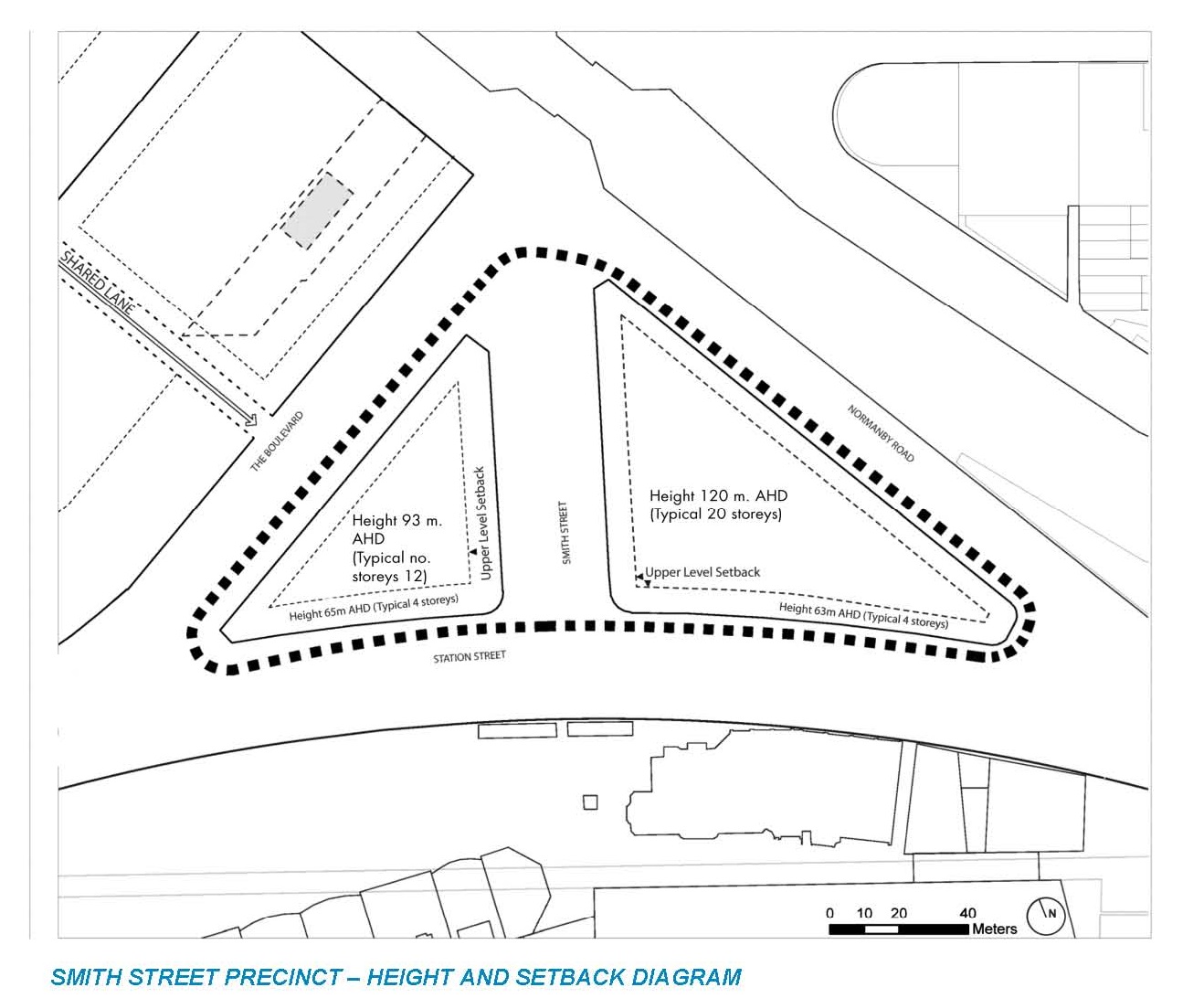
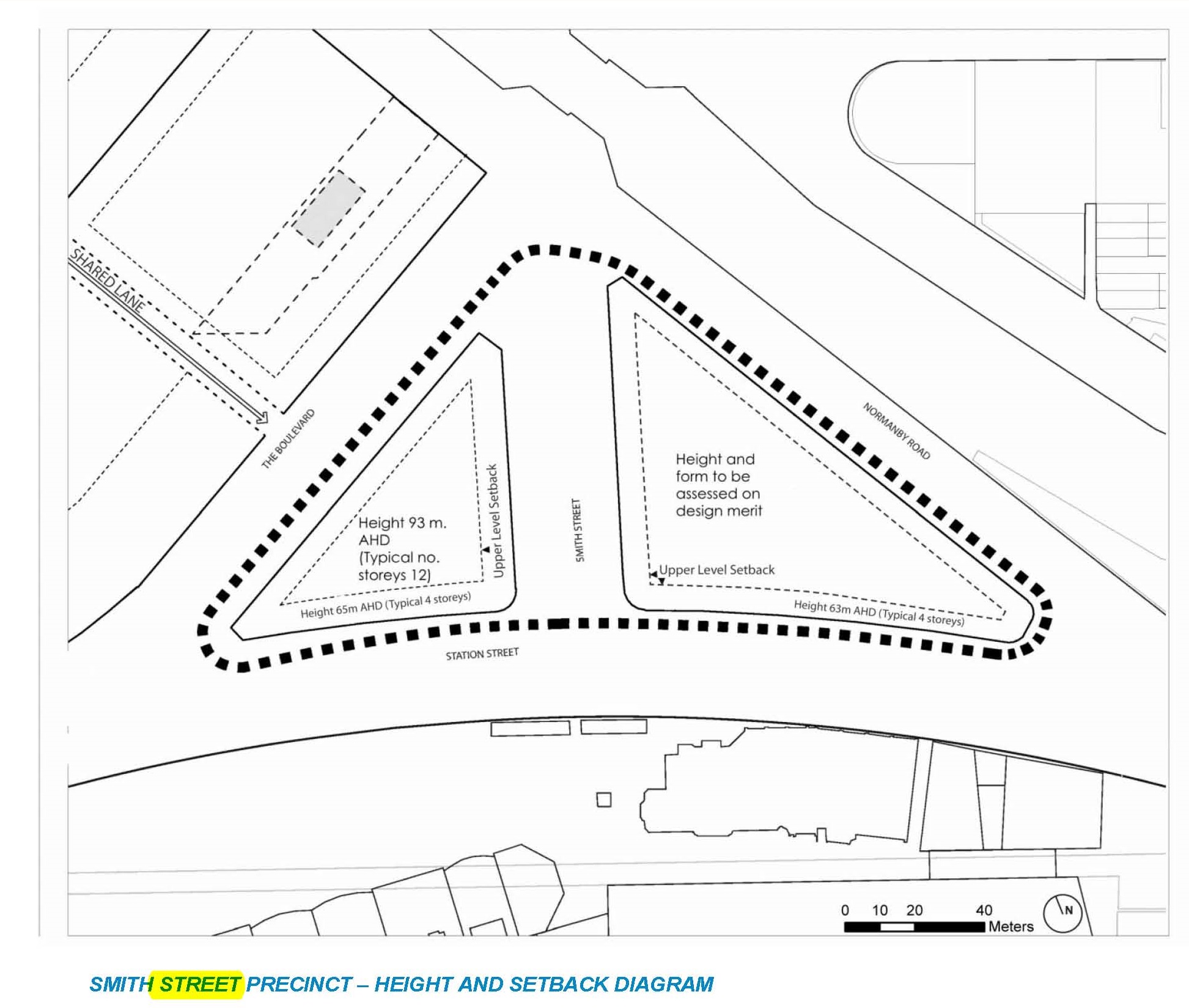
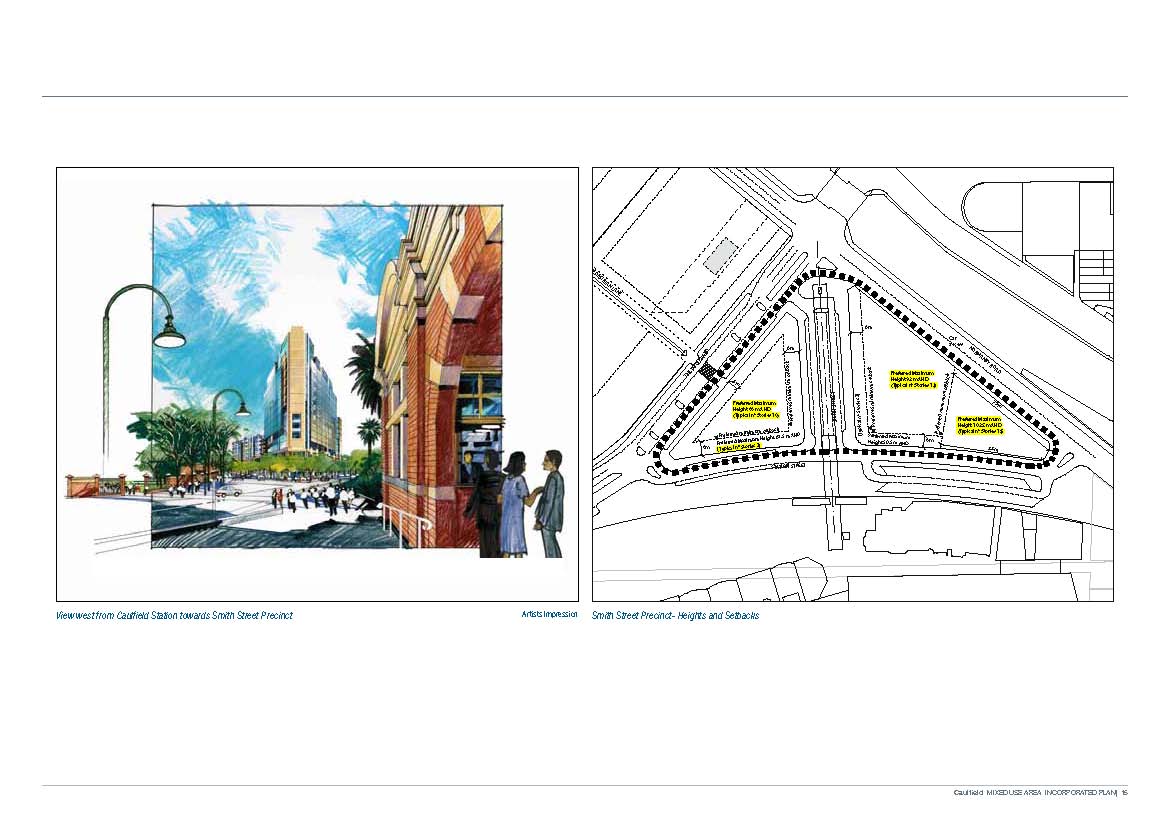
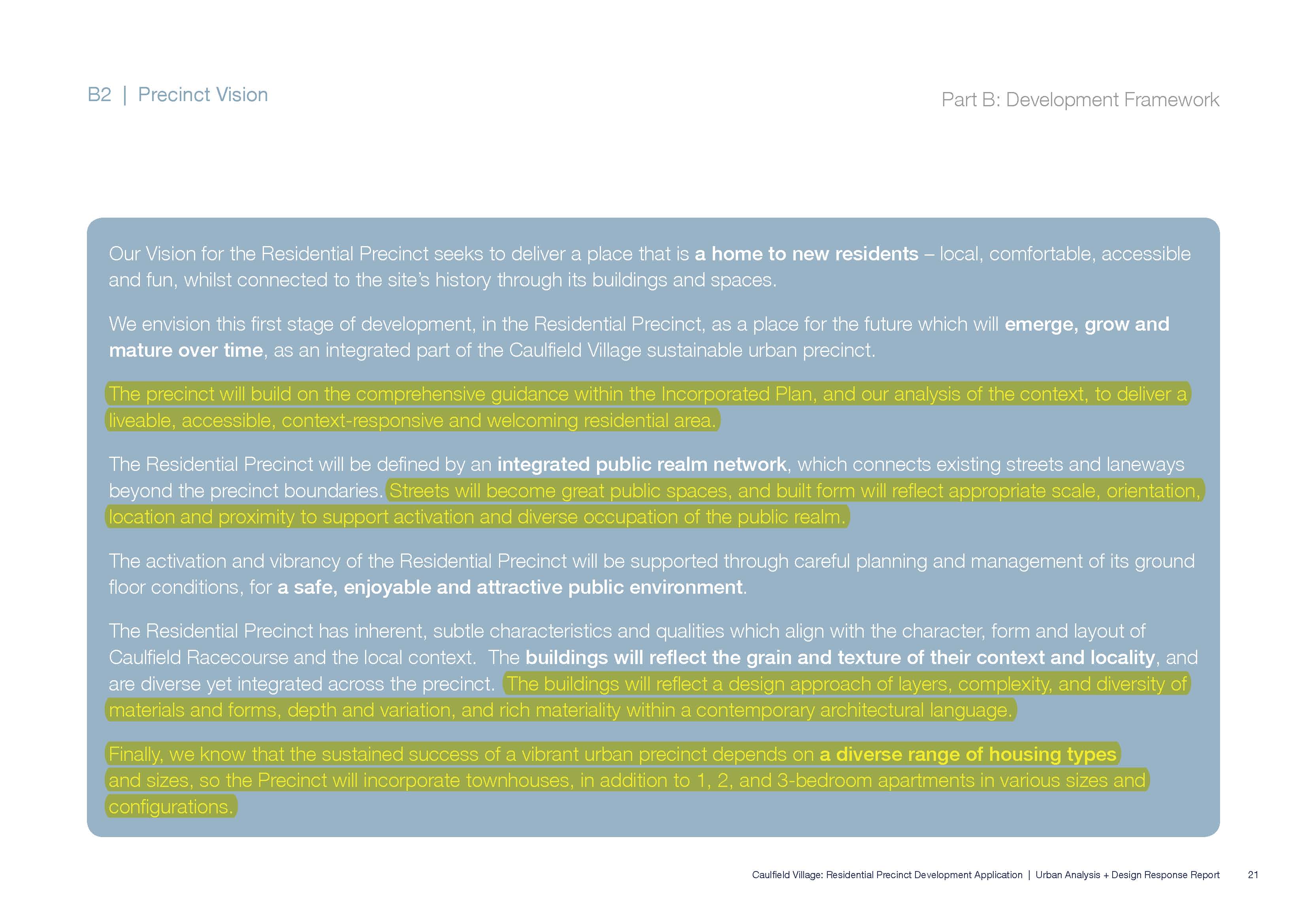
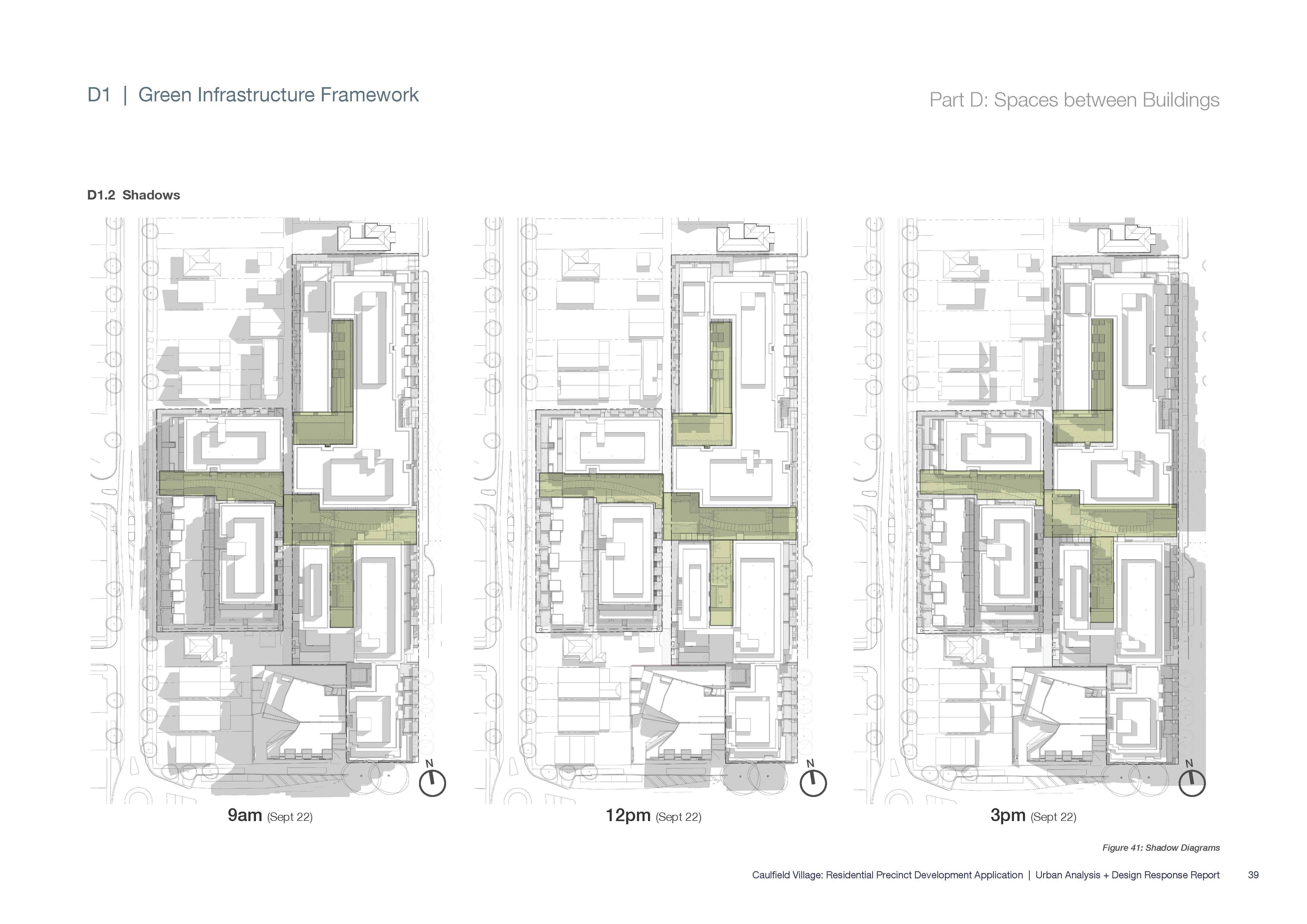
Buried in the fine print of several of these documents, some truths are finally revealed. Residents were repeatedly told by council and the MRC that the project envisaged 1200 dwellings, plus commercial and retail areas. It then burgeoned into 1500 units. Now we are looking at the possibility of 2040 of which the vast and overwhelming majority are SINGLE BEDROOM apartments! We can only wait with baited breath for stages 4 onwards, when height for the remaining buildings are revealed.

Below are the figures taken directly from the ‘Precinct Plan’ and the argument is that this is still in line with the Incorporated Plan!!!!! What bunkum and what collusion!

3

2

1

c601c602c603

PPS: All the documents are available from:

http://www.gleneira.vic.gov.au/Council/Planning_and_building/Planning/Caulfield_Village/Development_Plan_1

PS: From ‘The Age’ today!

Victoria’s racing industry pay rates run a distant last

Date: January 27, 2014 – 9:38PM

Illustration: Matt GoldingIllustration: Matt Golding

Strappers and stablehands in Victoria’s racing industry earn the lowest pay and have the worst conditions, according to the national workplace ombudsman.

An audit by the Fair Work Ombudsman of ?eastern seaboard racing tracks resulted in Victoria chalking up the worst performance in properly paying strappers and stablehands – the people who groom, feed and saddle racing horses and clean and maintain their stables.

Only a third were found to be paying their staff properly, far worse than in other states.

The audit followed the ombudsman receiving almost 100 complaints over pay and conditions from people in the industry, 35 from Victoria.

Of the horse-training businesses checked in Victoria, only 31 per cent complied with workplace laws. In NSW 86 per cent of businesses paid staff properly as did 76 per cent in Queensland.

In all, ombudsman inspectors checked the books of 86 horse trainers in metropolitan and regional NSW, Victoria and Queensland late last year.

A report to be released by the ombudsman on Tuesday cites the case of one horse trainer in Victoria whose business employed stablehands hired for periods of less than the legal minimum of three hours.

One Victorian trainer interviewed as part of the report said he was not aware there was a minimum amount for shift lengths and paid back $1985 to eight of his employees.

The correct rate of pay for strappers and stablehands is about $21 an hour depending on which state.

A trainer who was noted in the ombudsman’s report was found to be paying her casual staff a flat rate of $20 an hour, despite many working on Sundays when penalty rates applied.

The trainer back paid almost $16,000 to eight of her workers.

Of the 86 horse trainers audited, 34 were found to have underpaid a total of 61 employees almost $40,000.

Read more: http://www.theage.com.au/victoria/victorias-racing-industry-pay-rates-run-a-distant-last-20140127-31j5f.html#ixzz2rddD7MkD

Neighbours allege ‘threats’ from Kornhauser family

Nicole and Eliezer Kornhauser (left) at home and (right) the Springfield Avenue building at the heart of the conflict.Nicole and Eliezer Kornhauser (left) at home and (right) the Springfield Avenue building at the heart of the conflict. Photo: Ken Irwin

A property dispute in a sleepy corner of St Kilda East has spilled from the courts into the streets following allegations that members of one of the nation’s wealthiest families threatened their neighbours.

Police have received complaints about a death threat and abusive behaviour involving Nicole and Eliezer (Eric) Kornhauser, a scion of the Kornhauser business and property empire worth an estimated $430 million.

The couple have been locked in a protracted battle against more than a dozen neighbours and Glen Eira City Council over the future of the Orthodox Jewish school that operates out of a specially designed building attached to their mansion in Springfield Avenue.

Council and court records show complaints about noise, parking and traffic problems in the residential area associated with the ”education centre”, which provides gender-segregated religious instruction to more than 30 boys and young women.

The Kornhausers’ bid to receive retroactive planning permission for the growing ”home school” facility was denied by the council and rejected on appeal to the Victorian Civil and Administrative Tribunal last year.

But the stoush has now come to police attention amid claims of intimidation and threats of violence in the lead-up to a Supreme Court challenge to the VCAT ruling.

Springfield Avenue resident Jannine Gross has filed a complaint with police following an alleged confrontation with Ms Kornhauser after trying to visit a common neighbour.

”As we were walking through Max’s front gate, I noticed out of the corner of my eye one of Nicole’s young children who is five or six years old walking towards us. He saw us and turned around and ran back towards his house,” the statement said.

”All of a sudden Nicole [Kornhauser] rushed in the gate before we had even left. She put her face about one millimetre away from mine and was screaming into my face, ‘If you touch my children, I will kill you. I will kill you. I will kill you. I will kill you.”’

The complaint also described an incident a month earlier when Mr Kornhauser allegedly pushed Ms Gross’ husband and threatened to ”destroy him”.

Police have declined to comment because of the Supreme Court civil proceeding. But Fairfax Media understands no charges have been laid relating to the complaint.

A spokeswoman for the Kornhausers said: ”The Kornhausers continue to be committed to do what they can to bring about peaceful relations with their neighbours – an outcome recently encouraged among all the neighbours in that area by their ward councillors, at the conclusion of a planning matter involving the parties.”

But some residents are gearing up for a new fight after the council recently withdrew from the Supreme Court case and reversed its opposition to the school.

The council has now voted unanimously in favour of the project after the Kornhausers agreed to cap the number of students at 25, reduce its operating hours and incorporate a neighbouring property they own to provide off-street parking.

”We felt the second application was far better – especially relating to the car parking – and it allayed the concerns we had around the original proposal,” Glen Eira mayor Neil Pilling said.

Fairfax Media understands the council’s new decision will be contested by Springfield Avenue residents in VCAT.

■ cvedelago@theage.com.au

Twitter: @chrisvedelago

One component of this strategy has been the review of the current open space contributions program. Areas for improvement that have been addressed in the review include simplifying the schedule of rates, broadening the contribution requirement to all development in the City of Glen Eira, providing direction on when a land contribution should be required, and re-calculating the rate based on the projects included in this strategy and linked to population change in the municipality during the strategy planning period. The strategy establishes the need for all subdivisions to contribute to open space and the type of contribution required, whether as land or equivalent value in cash.

A new schedule is proposed for Clause 52.01 of the Glen Eira Planning Scheme An averaged rate to apply across the municipality would replace the schedule of multiple rates currently in the planning scheme. This would simplify the percentage rate calculation for open space contributions and link the funds collected to the open space projects contained in this strategy. Based on the projects recommended in this draft strategy, it is anticipated that this rate will be in the order of 4 to 5 per cent.

Thus sayeth the consultants in the draft Glen Eira Open Space Strategy. How they justify the recommended 4 to 5% flat rate is anybody’s guess given that:

  • No figures are provided on anticipated costs of acquiring new open space
  • No figures are provided on anticipated necessary expenditure  – for example on pavilion ‘improvements’
  • No figures are provided on what income is expected from a 4 to 5% increase and to what extent this meets the anticipated costs.

More important is the fact that this draft strategy TOTALLY IGNORES the possibility of levies higher than 5%. Stonnington for example is currently seeking an 8% levy across its municipality largely based on the fact that it has the second lowest amount of public open space in the state. If Glen Eira has the lowest, and is facing major residential development everywhere, then even a 5% levy is a joke!

We cite the following from the Stonnington review of its open space levy strategy and have uploaded the full document HERE. What is most impressive is the detail, the financial analysis, and the correlation between all of Stonnington’s policies – ie Public Realm, Pavilion Strategy, etc.

For starters, here’s what is not revealed in the Glen Eira version –

Clause 52.01 of the VPPs expressly recognises the power of councils to obtain open space contributions under the Subdivision Act, and provides a mechanism for councils to amend the provisions to suit local circumstances.

The Schedule enables a council to set its own contribution rate(s) subject to strategic justification. This can exceed the 5% limit of the Subdivision Act. The percent contribution can be tailored to meet the specific needs of areas and sub-areas, subdivision types (i.e. residential, commercial and industrial) and method of contribution (i.e. cash, land or both). Details of liability can be more clearly defined to suit local conditions. Councils are effectively immune from challenge to the contribution if a Schedule to Clause 52.01 is incorporated into the Planning Scheme and it is unambiguous and applied appropriately. Implementation of a Schedule to Clause 52.01 requires a Planning Scheme amendment. (page 4)

There is then an overview of the various levy approaches that could be taken by councils. For example:

The main advantage of this is its simplicity, clarity and certainty for subdivision proponents and council. A rate around 5% can deliver a significant income stream to council for open space.

The main weakness or disadvantage of this approach is that the nexus between who pays and who receives open space investment benefit – by area – can be weak. As such, it may be difficult to justify a rate higher than the Subdivision Act benchmark of 5% in using a flat rate even if some parts of a municipality would justify this due to high development pressure and open space need. (page 7)

Precinct Based Fixed Rate

The precinct based levy approach differs from the flat rate in that it seeks to provide a stronger nexus between developments that pay open space contributions and areas that receive benefit from planned open space investment. The upshot is that areas with more open space investment will pay a higher contribution, all other things being equal.

The approach links planned investments in an area to the contribution requirement. If an area is to receive no open space investment, the contribution in the area will be zero. The basis for the levy is therefore the planned investment as follows:

Strategic planning work is undertaken and this identifies infrastructure and open space projects that are required or desired for the planning area. This can be documented in a specific open space strategy or plan or a structure plan

The open space projects are identified and costed from this strategic base. The cost of each project is apportioned to subdivision over the life of the funding plan.

The strength of the precinct based approach is that it provides a stronger nexus between developments that pay open space contributions and areas that receive benefit from planned open space investment

The main weakness of the approach is that more justification may be required to support the Planning Scheme amendment process compared to a simple model. The validity of the approach may be based on the rigour of the supporting strategy and information inputs. (page 8)

The report then goes on to provide the necessary financial framework for the final recommendations-

Across the City as a whole, the current levy schedule has delivered about $3.3m per annum on average over the last four years and $6.2m in the latest full financial year.

If a 5% flat rate levy was used instead of the sliding scale over the last four years of levy operation, the income to Council would have been $15.0m over four years at an annual average of $3.8m (instead of the actual $13.2m at $3.3m).

The 5% flat rate would have delivered $6.8m in the 2011/12 financial year (instead of the actual $6.3m). This marginal change is explained by the fact that in that year most subdivisions applied a rate at or near 5%.

Various scenarios using 5% to 10% flat rate levies are shown in Figure 19 below. These levy rates are applied to:

The four years of levy collection from 2008/09 with an average per annum figure produced

The last financial year of levy collection 2011/12

The figures are extrapolated over 20 years to gauge what might be required to achieve approximately $314m in income to cover the cost of proposed open space works via this tool.

The four year data suggests that a flat rate of well over 10% would be needed if planned open space expenditure were to be fully funded from this levy over 20 years. Using the latest year data, projected revenues would be significantly greater, but even at a 10% levy rate, this mechanism would only collect 87% of projected expenditure.

In terms of the Chapel reVision area the levy would need to be set at 8% to fully recover the cost of acquisition and works planned for the area.

CONCLUSIONS?

  • Stonnington has decided that 5% is far from adequate. We suggest that the same holds true for Glen Eira.
  • Is Glen Eira Council capable, and/or willing, to do the necessary analysis that will provide the detail for any amendment that has a chance of getting up? Or is it easier to take the simple path and just pluck a figure from the air without really knowing how far this will advance the acquisition of more open space in the municipality?
  • Is 4 to 5% seen as the secret threshold that will not put off too many developers – even though these extra costs will undoubtedly be passed on to eventual purchasers.
  • And the perennial question is: why can one council do all this work, be upfront with their strategic planning, and our glorious council persists in waffle, lack of detail and financial justifications, and misinformation!?

The latest example of Glen Eira secrecy and decision making behind closed doors comes with the December 6th closing date for submissions on the State Government’s Plan Melbourne – arguably the most important document since Melbourne 2030.

Other councils:

  • Have published their submissions and had the drafts ratified at council meetings. Glen Eira has done neither of these things
  • Have involved the community in drafting their submissions. Glen Eira has been totally secretive.
  • Glen Eira has not made a ‘submission’ but written a ‘letter’.
  • Glen Eira stated on December 17th that the ‘letter’ would be put on on its website. It is yet to appear.

We certainly do not expect this ‘letter’ to be anything other that a page or two of waffle, self congratulations, and total endorsement of Plan Melbourne. Other councils, in contrast, have taken the time and effort to analyse and (often) criticise what they perceive to be the major failings of this document. Below are some extracts taken from these submissions. We wait with bated breath for the Glen Eira version to appear so that residents can clearly see how Glen Eira is failing its ratepayers.

Port Phillip  (41 page submission): Source – http://www.portphillip.vic.gov.au/Report_7_-_Plan_attach_1.pdf

Council highlights its concern that the detailed initiatives and actions proposed in Plan Melbourne do not always align well with ‘issues’ identified in the Plan, nor adequately support implementation of the Plan’s strategic objectives and directions. Proposed initiatives are often lacking in detail and clarity of intent. There are also notable ‘gaps’ in potential actions which offer greatest opportunity to effectively deliver on the objectives of the Plan.

Plan Melbourne does not address how government will respond to the impacts of climate change – specifically climate adaptation to heat waves and flooding/sea level rise. This is considered a major gap in a long term strategy for the development of Melbourne.

Plan Melbourne proposes several initiatives to ‘streamline’ the planning system, including applying VicSmart to medium density housing and affordable housing projects. Proposals which limit community involvement in the planning process, or reduce Local Government’s decision-making responsibilities are not supported.

The new commercial zones reflects a ‘one size fits all’ approach and are contrary to the emphasis in Plan Melbourne on protecting the ‘distinctiveness’ of local areas and to the recognition given to Local Government’s role in planning for Activity Centres.

BOROONDARA – (59 page submission) Source: http://www.boroondara.vic.gov.au/~/media/Files/Your%20Council/Building%20and%20planning/Strategic%20planning/Metro%20planning%20strategy%20discussion%20paper%20submission.pdf

Council wishes to express its disappointment at the short time frame given to local governments, the community and stakeholders for reviewing the Strategy and providing submissions. The initiatives and actions in the Strategy will have many local impacts and therefore consultation with communities is very important.

The Strategy does not state whether Local government will have an opportunity to comment on the revised SPPF. Considering that councils use the SPPF in their decision making, it is considered important that they are consulted before the SPPF is finalised.

Clarification is required as to how new locations for Activity Centres will be determined, and what measures will be used to determine the need for new centres. It is unclear if there are State-driven targets for retail or commercial floorspace that the State Government will be seeking to meet. The implications of rezoning land for commercial purposes would need to be looked at on a case by case basis.

The publishing of annual housing development data to inform the development and monitoring of municipal housing strategies is supported, however the ability to gain such information on an annual basis is questioned. It is also unclear what the next step will be once this data is obtained, for example, are there going to be annual reviews and changes to the application of the new zones in response to the data received? Given that the new residential controls have been introduced prior to undertaking the strategic work of projecting housing needs, it is unclear how those projections will be accommodated in the controls.

Updating the design guidelines and introducing measurable standards for high density residential and mixed use development is supported, as is a review of the design, layout, internal living amenity and balcony needs of apartment development. Clarification as to how this will be implemented is required, beyond a consideration of current planning and building controls identified in the Strategy.

STONNINGTON (18 page submission)

Council notes the strategic importance of this Strategy in planning for the City over the next 40 years, and is disappointed that further time wasn’t allowed for Councils and the community to fully consider and respond to this consultation particularly in light of the timing around locally applying the residential planning zone reforms.  In addition, Council notes that the State Government expects to release the final Plan Melbourne in January 2014, and is concerned that adequate time and consideration will not be given to the comprehensive comments provided by the City of Stonnington and other submitters

We are aware that the comment period for the Plan Melbourne – Metropolitan Planning Strategy closes on 6 December 2013.  To this end, Council has held two Drop-in Information Sessions for the community, launched a dedicated consultation web page on Council’s website, placed information regarding the Strategy in the Stonnington Leader, distributed an email alert and undertaken hard copy and electronic surveys to gauge local opinion on the proposed Strategy.  These views have helped inform this submission

Plan Melbourne to delete the reference to within 400 metres of an Activity Centre and instead refer to identification of suitable areas in locally specific structure plans and planning controls.

The Caulfield Urban Renewal Area should not extend north of the major barrier of Dandenong Road / rail line.

Strategies requiring State Government lead, include Design Guidelines for higher and medium density development including internal amenity, ESD (Environmental Sustainable Design), WSUD (Water Sensitive Urban Design), licensed venues and liquor licensing policy, and developer contributions schemes.

The Metropolitan Planning Strategy lacks clarity with regard to ‘Activity Centres’ and ‘Neighbourhood Centres’. In some instances these terms are mutually exclusive and in others, Neighbourhood Centres are considered as a subset of Activity Centres.

There are numerous areas around the Stonnington rail lines that are important in terms of heritage and neighbourhood character. Areas suitable for additional residential and mixed-use development, including provision for new open space, should be identified through locally specific structure plans and planning controls

A key concern for Stonnington residents is inappropriate higher density development and the impact on neighbourhood character and internal and external amenity. Robust principles and performance-based guidelines are needed to inform good design outcomes that are responsive and respectful of the local context.

Another key concern is the increasing provision of one person homes to poor standards which can be seen to create ‘slum-like’ areas.  Stonnington therefore advocates that greater emphasis needs to be placed in the Strategy on minimum design standards for residential apartments.

Council believes it is not appropriate for Plan Melbourne to specify that land within 400 metres of an Activity Centre are key areas to accommodate higher density housing. Concerns raised are mainly because of the confusion as to which takes statutory and regulatory precedence; Plan Melbourne (which identifies areas within 400 metres of an Activity Centre to be intensified) or the Local Planning Policy Framework, which could potentially have protected areas within this 400 metre radius.

At present there is no evidence-based link between public transport capacity to accommodate increased demand and development approvals. Council believes there needs to be greater emphasis on projected public transport capacity in the application of the new residential zones, whereby lack of public transport capacity is sufficient reason to reduce the intensity of development. For example in saturated road conditions, developments should not be approved on tram or rail corridors until it can be established the that demand created by the development growth can be accommodated.

Levels of parking provision in development proposals must also take into account transport impacts, and not solely market demand. This is of particular importance when the responsible authority considers there are alternative options to the private car available, where several public transport modes are within walking distance such as the Forrest Hill urban renewal area.

Council has noted that there does not appear to be any specific Directions or Initiatives in relation to ESD or WSUD.  Stonnington Council wishes to reaffirm the importance of metropolitan-wide strategies requiring State Government lead in both these areas, and the importance of water sensitive urban design in better managing stormwater run-off. 

Finally, we’ve uploaded the Save our Suburbs analysis which clearly outlines why Plan Melbourne has the potential to be a boon to developers and a blight on neighbourhoods. We urge all readers to please read, consider and then compare with what kind of effort eventually surfaces from Glen Eira administration and its bunch of ‘yes sir’ councillors!

The 2010 Planning Scheme Review promised the following actions on heritage :

  • Heritage review of Caulfield Racecourse Reserve Crown Land
  • Include draft heritage guidelines as reference documents in scheme
  • Prepare a Heritage Strategy for Glen Eira in line with Heritage Victoria requirements

None of these ‘promises’ have eventuated three years down the track. Glen Eira still languishes under ‘reviews’ and ‘strategies’ that date back to 1996. Given that there are many ‘heritage’ properties currently in Housing Diversity areas, we fear for the future given the inability of this council to actually get its planning scheme in order so that it does protect what it’s supposed to.

Below are some extracts from a recent VCAT decision which illustrate why residents have cause to ask what this council has actually done in the last 15 years except pave the way for developers?

  • Importantly, the Ormond and Bentleigh Draft Heritage Guidelines July 2002 document does not form part of the Glen Eira Planning Scheme and has therefore not been subject to the transparent scrutiny and comprehensive assessment that is an essential part of modifying the planning scheme through the formal planning scheme amendment process. This document has been in existence for over ten years and Council has never sought to include it in the planning scheme by undertaking this process.
  • The document which has been subject to the scrutiny and rigour of the planning scheme amendment process is the Glen Eira Heritage Management Plan prepared by Andrew Ward & Associates in 1996. This document is formally identified as a reference document in Clause 21.10 of the planning scheme. It is this document which I am bound to consider as part of my deliberations. Because the Andrew Ward Glen Eira Heritage Management Plan is the relevant reference document, I have not given any weight to the Ormond and Bentleigh Draft Heritage Guidelines July 2002 document in my assessment and findings.

I find that the demolition of the subject building is acceptable as it will not have a detrimental impact on the significance of the heritage place (that is, on the significance of the area identified by the Heritage Overlay No. 75) as:

  • It is not identified as a ‘contributory building’ in the Andrew Ward Glen Eira Heritage Management Plan;
  • It has been identified as a ‘building defaced’ in the Andrew Ward Glen Eira Heritage Management Plan;
  • Mr Bick’s evidence confirms that this assessment is correct, and this has been confirmed by my site visit; and
  • I have not given any weight to the Ormond and Bentleigh Draft Heritage Guidelines July 2002 document for the reasons already provided.

Source: http://www.austlii.edu.au/au/cases/vic/VCAT/2013/2136.html


In terms of transparency, accountability, and genuine community engagement, it is our view that this council has slipped even further into the mire. Nothing that we can see would indicate any change in the culture, objectives, and policies of the ruling clique. If anything, the situation has worsened with the continued defection of Pilling, and the gang’s ‘recruitment’ of Sounness and Okotel and at times, Delahunty.

2013 will stand as testimony to the failure of this council and its councillors to achieve anything approaching the principles of good governance and working for the community. We base our judgement on the following list of catastrophes –

  • The continued reappointment of Newton without advertising the position PLUS a 30 to 40 thousand dollar pay hike!
  • The introduction of the new Residential Zones in secrecy and as per norm, without any public consultation
  • The continued presence of Lipshutz, McLean and Gibbs on the most vital advisory committee – the Audit committee.
  • The riding roughshot over residents’ views – GESAC car park extensions; devious destruction of Caulfield Park trees; Koornang Rd and Centenary park proposed tree destruction.
  • The above demonstrate the failure to plan in a prudent and cost effective fashion. When literally millions are spent as an ‘afterthought’ on bitumen and concrete plinths, what does this say about prudence, business planning, and overall financial management?
  • The failure to introduce a Notice of Motion and other democratic reforms
  • The continual reappointments of Lipshutz, McLean and Gibbs to the Audit Committee
  • The formation of a ‘consultation committee’ that hasn’t played any role in any ‘consultations’ for the past 18 months and the failure to appoint the original submitters since they presumably did not meet the ‘pliable/ignorant’ requirements of the ruling clique
  • The failure to ensure that those who fork out the money (ie residents) are given priority in any sporting allocation especially the McKinnon Basketball Club at GESAC, and Ajax Seniors
  • The continual doctoring of minutes, and failure to produce answers, rather than ‘responses’ to public question
  • The continued approval of substandard dwellings of 8, 10, 12 storeys
  • The continued waiving of car parking requirements without justification
  • The failure to introduce proper reporting standards in planning
  • The failure to pursue developers for breaches of permits or the law
  • The continued cow-towing to the mrc
  • The continued ‘top down’ approach to consultation
  • The failure to include community representation on most committees

There is much, much more that could be mentioned. Much needs to happen in order for this council to be dragged screaming into the realm of good, open government. We remain committed to working towards this objective and continuing to highlight the shortcomings and duplicity of these councillors and their overlords.

« Previous PageNext Page »