GE Planning


The following stems from another public question asked at last council meeting. Whilst the original question is admittedly long and not numbered, we have attempted to organise the question and answer along some logical lines. This proved to be a most difficult task given that there is no real connection between what is asked and the response! All the questions relate to parking and traffic management in an upcoming Murrumbeena development. 

Why hasn’t the council been pro active knowing that post development there will be traffic and parking issues?  

Answer – William Street, Murrumbeena is situated within Council’s Housing Diversity Area. A key reason for this designation is the good access to public transport (including Hughesdale Railway Station) which provides opportunities for residents and their visitors not to use private vehicles. Development is therefore directed towards these areas.

What are councils plans regarding parking and traffic flow in and out of William st knowing that reports are already available.? 

Answer – It is acknowledged that some additional vehicle movements will be experienced in William Street as a result of the new development however State Government Planning Guidelines state that reasonable traffic volume targets for local access streets are variously between 1,000 – 3,000 vehicles per day.  

Why does the council continue to fail the residents and stakeholders regarding this development?  

Answer: Council annually receives many requests for traffic management works but resources for works of this type are finite requiring prioritisation of resources. Resources are directed to those streets in greatest need of attention (not where new rateable homes are provided). Council operates a warrants system whereby streets are prioritised for attention on the basis of objective criteria including vehicle speeds, traffic volumes, reported crashes, peak hour traffic volumes and land uses (activity generators).

Why cant the the council be proactive and involve the residents and stakeholders with and open forum to appease concerns regarding access in and out of William st let alone parking post development? 

Answer: Traffic counts will be undertaken following the occupation of the new apartments to determine the number of vehicles using William Street. 

It is obvious that there will be traffic issues in William st post development, imagine 50 cars trying to get in and out of Poath rd in peak hour. keeing in mind cars parked in the street.  

Answer: It is not appropriate to assume that traffic and parking impacts after construction will be unreasonable. 

The resources are available as there is 41 new rateable homes, The information regarding traffic management is available and already supplied.  

What is the councils plans to assit and appease the residents and stakeholders concerns regarding traffic and parking in William St Murrumbeena?”

Answer: Once data is collected in William Street, it will be added to this list to determine its priority for traffic management works.


Application lodged for Carnegie Recycling Plant

Residents are facing the prospect of a recycling plant in the unlikely location of Glen Huntly Rd, Carnegie.

An application to build the plant to recycle plastic, foam, timer, metal and bricks at 1254-1258 Glen Huntly Rd is open for objections until August 3. The site also subject to a rezoning application, is 650m from Glen Huntly Primary School.

Trucks would bring materials to the site throught the day. Dust, noise and traffic congestion were worries raised by nearby homeowners. Sam Zervides, who lives nearby with his wife, Helen, said the plant would wreak havoc on the “prime residential area”.

Dust, noise and traffic jams were worries raised by Adrienne Tomzai and other homeowners. “we are completely shocked – this is not an industrial area,” Mrs Tomzai said.

Mrs Zervides said she had not received any written notification of the application, despite living so close. Deputy Mayor Neil Pilling said the council had followed protocol. He said worried residents should lodge objections.

The Leader was unable to contact the plant’s applicant.

Radical Plan for Racecourse

Andrea Kellett

Caulfield Racecourse Reserve is set for a dramatic shakeup. The new chairman of the reserve’s board of trustees, Glen Eira councillor Jim Magee, has vowed to end racing’s stranglehold on the land and return it to the people. He also wants to make the board “more accountable” and end the days of “secrecy” surrounding management of the crown land.

“The racecourse belongs to you and me not the MRC”, he said last week. He is also looking to increase the Melbourne Racing Club’s annual rent on the reserve land from $77,000 to a “more realistic” $1 million and phasing out training at the racecourse.

“I will put together a licensing agreement for what the centre of the racecourse can be used for and as part of that I want to see more public access and the moving of training from the racecourse” he said.

He has sought legal advice about changing the way the board of trustees operates, including making meetings open to the public.

Cr Magee intends to hold a board meeting next month where he will call for a vote on many of the changes.

Melbourne Racing Club spokesman Jake Norton said the club did not wish to comment.

PS: LEST WE FORGET!!!!!!

From the minutes of 15th March 2011

Crs Penhalluriack/Forge

That Council invites authorized representatives of the Melbourne Racing Club to meet with Councillors to discuss future arrangements, including timetables, for the sharing of the Caulfield Racecourse Reserve Crown Land. The Mayor shall open the meeting and introduce Councillors Forge and Magee who shall explain, using overheads, Council’s position. The meeting shall then be open for all Councillors and MRC representatives to contribute. The meeting shall be minuted.

DIVISION

Cr Penhalluriack called for a Division on the voting of the Motion.

FOR                                                    AGAINST

Cr Penhalluriack                                Cr Pilling

Cr Forge                                             Cr Tang

Cr Magee                                            Cr Esakoff

Cr Lobo                                              Cr Lipshutz

                                                              Cr Hyams

On the basis of the Division the Chairperson declared the Motion LOST.


Crs Lipshutz/Hyams

That Council authorize Andrew Newton, Chief Executive Officer, Cr Margaret Esakoff, Mayor, Cr Michael Lipshutz, Chair of the Caulfield Racecourse Precinct Special Committee and Cr Jim Magee, member of the Caulfield Racecourse Reserve Trust, to meet with representatives of the Melbourne Racing Club to put Council’s position in relation to the improvements to the centre of the Racecourse, after which they will report back to Councillors promptly and in detail. Any decisions would be made by Council resolution. 

The SUBSTANTIVE MOTION was put and CARRIED.

This is a contentious post because it asks the most basic questions – how should a council support its residents? What is the best way for a council to ensure that it is protecting the amenity of its residents? How much money should be expended on defending council planning decisions and supporting resident objectors? Is it better for example, to spend half a million dollars on erecting concrete plinth curbing in Caulfield Park, or using this money for expert testimony at VCAT? How much money should a council spend in defending its decisions at VCAT?

Glen Eira spends practically zilch on outside ‘experts’ – except when it suits their agendas! We’ve taken the time to go through various councils’ VCAT appearances and to note how often they employ outside expertise. We draw no conclusions as to outcomes. We’ve simply gone through sequentially 20 decisions for each of Glen Eira, Kingston, and Bayside and ask readers to once again compare how Glen Eira operates, in stark contrast to these other councils. They do not appear to have too many qualms in hiring experts to defend their cases. They spend rate-payers’ money trying to defend council decisions and supporting residents. Glen Eira cannot claim the same.

Below are tables for each council. Please note that the 2 times that Glen Eira hired ‘outsiders’, these cases involved the MRC where council’s lawyer practically did all the work for the MRC, and its ‘valuer’ when a resident objected to increased valuation on their property. All the rest of the time council officers have presented the case. It then becomes highly questionable whether these same officers, who possibly recommended the permits or conditions, can actually then turn around and argue against the original recommendation!

VCAT   HEARING

COUNCIL   REPRESENTATION

Pascoe   v Glen Eira CC Officer
Younes   v Glen Eira Officer
Baxas   v Glen Eira CC Officer
Imperium   Design v Glen Eira C Officer
Furman   Construction (Vic) Pty Ltd v Glen Eira CC Officer
Fredman   Malina Planning v Glen Eira CC Officer
Chipp   v Glen Eira CC (Correction) Officer
Sharp   v Glen Eira CC Officer
Healy & Anor v Glen Eira CC &   Anor Mr I Pridgeon, solicitor, Russell   Kennedy
Mokro   Pty Ltd v Glen Eira CC Officer
Arch   10 Pty Ltd v Glen Eira CC Officer
Blue   Wolf Development Group Pty Ltd v Glen Eira CC Officer
Glenhawk   Pty Ltd v Glen Eira CC Officer
Cullity   v Glen Eira CC Officer
Delanex   Pty Ltd v Glen Eira CC Officer
Popov   v Glen Eira CC & Ors Officer
Elfman   v Glen Eira CC Officer
Stanjkiewicz   v Glen Eira CC & Ors Officer
Glavinic   v Glen Eira CC Mr John Kennedy, of Patel Dore Valuers Pty Ltd appeared for the   respondent municipality. (Note: this was about a resident contesting Council’s rate valuations!)


Gryngras   v Glen Eira CC & Ors Officer
Homes   v Glen EiraCC Officer
B   Central Development Group v Glen Eira CC Officer
McCabe   Architects Pty Ltd v Glen Eira CC Officer


BAYSIDE

APPEAL

REPRESENTATION

Asmar v Bayside Mr B Mcilrath, Solicitor, of Maddocks


Roach v Bayside Officer


Premier   Projects Pty Ltd v Bayside Officer
Tan &   Anor v Bayside Officer
Haileybury   v Bayside Mr Jason Kane, Barrister by direct brief.


Hotel   Brighton Pty Ltd v                                                                       Bayside Ms Kim Piskuric, solicitor, of Maddocks


Baker v Bayside   CC Officer
Diecke v Bayside Officer
R K Tech   Studios v Bayside Officer
de Silva v   Bayside Officer
Gyopar   Holdings Pty Ltd v Bayside Officer
Spernat v Bayside Mr B McIlrath, Solicitor, Maddocks


Manotti   & Ors v Bayside Officer
RJL   Properties Pty Ltd v Bayside Mr Jason Kane, Barrister by direct brief.


Clarendon   Property v Bayside Mr Jason Kane by direct brief.


Chambolle   Holdings Pty Ltd v Bayside Mr J Kane of Counsel by direct brief, and Ms N O’Leary, Statutory   Planning Co-ordinator. Evidence was called from Mr B Raworth, Conservation   Consultant and Historian of Bryce Raworth Pty Ltd.


Peter   Wright & Associates Pty Ltd v Bayside Mr Darren Wong, Solicitor of of Maddocks.


Nates   Adams & Associates Pty Ltd v Bayside Officer
Foy v Bayside Mr J Kane, Barrister, Direct Brief


Abdou v Bayside Mr Jason Kane, barrister, direct brief


KINGSTON

APPEAL REPRESENTATION
Pace   Development Group Pty Ltd v Kingston CC [2012] VCAT 831 Mr Cameron Gentle, town planner of Hansen Partnership Pty Ltd.
Takla   & Anor v Kingston CC [2012] VCAT 820 Officer
Rodlink   Pty Ltd v Kingston CC [2012] VCAT 694 Mr Redmond McNamara, town planner of Hansen Partnership Pty Ltd.

Evidence was called from Mr Chris Coath, traffic engineer of GTA   Consultants


Transpacific   Waste Management Pty Ltd v Kingston CC & Ors Mr Ragu Appudurai, Solicitor, and Mr Stefan Fiedler, Solicitor, of   Russell Kennedy.

They called the following witness:

Robert Henry Amaral, Geotechnical Engineer

Fastnet   Consulting Pty Ltd v Kingston CC (Correction) Ms. Maggie Ene, Town Planning Consultant, Brown & Tomkinson


Frederick   Nudel & Associates v Kingston CC [2012] VCAT 611 Officer


Tsganas v   Kingston CC & Ors [2012] VCAT 602 Mr R   McNamara, Planning Consultant, Hansen Partnership
Camelia   Woods Pty Ltd v Kingston CC [2012] VCAT 551 Mr Cameron Gentle of Hansen Consultants.


Guastella   v Kingston CC (Correction) [2009] VCAT 2015 Mr Peter Soding (planner) of Tixxis Pty Ltd


Di Cosmo v   Kingston CC [2012] VCAT 93 Mr Cameron Gentle, town planner of Hansen Partnership


ARPC   Consultants Pty Ltd V Kingston CC & Ors Mr Gary Wissenden, Town Planner of Hansen Partnership


Pace   Development Group v Kingston CC [2012] VCAT 38 Mr Stuart Morris QC, barrister, assisted by Mr J Dabscheck, solicitor,   Maddocks

He called the following witnesses:

  •   Mr Robert McGauran, architect and   urban designer, McGauran Giannini Soon Pty Ltd
  •   Mr Craig Czarny, urban designer,   Hansen Partnership Pty Ltd
  •   Mr Chris Coath, traffic engineer, GTA   Consultants


Boxtel   Homes Pty Ltd v Kingston CC [2012] VCAT 3 Mr G Wissenden, Town Planner of Hansen Partnership.


Boxtel   Homes v Kingston CC [2011] VCAT 2208 Mr Gary Wissenden, Town Planner of Hansen Partnership Pty Ltd.


Rushworth   & Ors v Kingston Officer
Taylors   Development v Kingston Officer
PMC   Developments Pty Ltd v Kingston Ms Fiona   Slechten, planning consultant of Brown & Tomkinson Pty Ltd.
Bjbac Pty   Ltd v Kingston Mr Cameron Gentle, town planner, Hansen Partnership Pty Ltd


Murray v Kingston Mr Peter Soding, Town Planner of
  Tixxis Pty Ltd.


Salemi v Kingston Mr Redmond   McNamara of Hansen Partnership


Planning for disaster

July 15,  2012
 
Michael Buxton

Melbourne already has 30 years of land supply but Ted Baillieu  and Matthew Guy want more.

Illustration: Matt Davidson.Illustration: Matt Davidson.

HOPES have faded that the Baillieu government would continue the moderate  approach to land use of former premier Sir Rupert Hamer. Instead this is  government in the Jeff Kennett style.

The Baillieu administration is rushing to change the Victorian planning  system, with radical deregulation changing Melbourne irrevocably for the  worse.

Planning Minister Matthew Guy has advantaged a select group of landowners by  adding their 6000 hectares to the recent 43,000-hectare increase in Melbourne’s  area. Guy cynically dubbed this process ”Logical Inclusions” but it is wholly  irrational.

A land glut has been created as demand for outer urban housing has crashed.  Developers quickly added new home subsidies to the price of housing. Subsidies  encouraged new home buyers to borrow heavily in the belief that land prices  would always rise. Now they are falling, potentially trapping the most  vulnerable in a debt crisis.
Melbourne has 30 years’ land supply at world’s lowest densities. Yet Guy  perseveres, adding land to potentially enrich a few at the expense of the many.  Melbourne cannot afford premiers and planning ministers who get land markets so  disastrously wrong.

Almost every outer urban council has chronicled a growing catastrophe of  inadequate infrastructure and jobs. Governments cannot afford to meet the rising  costs of outer urban infrastructure. This failure and car-dependent urban design levies crippling running costs on to many outer  urban householders.

Baillieu and Guy show a single-minded intent to finish the job Kennett and  his Planning Minister, Robert Maclellan, started. This is part of a systematic  confrontation. Melburnians should get ready for a rough ride – the planning  battleground until now will be just a skirmish to this coming war.

New planning zones will protect relatively small areas of historic housing,  open up other residential areas to major growth and leave much of Melbourne with  little protection against piecemeal redevelopment. The government clearly thinks  it is clever to satisfy some influential resident groups while giving the rest  of Melbourne and Victoria over to developers.

New commercial zones will lead to a retailing and commercial free-for-all.  Much of Melbourne’s historic strip shopping centres will be demolished or  distorted to facades in front of medium and high-rise development. Struggling  centres will feel additional pressure from a broad range of allowed uses and  expanded bulky goods complexes.

Another blow is directed at Melbourne’s green wedges and rural areas. The  government will allow large-scale commercial development through hotel,  conference and restaurant complexes in beautiful places such as the Upper Yarra  Valley and Mornington Peninsula. An extended range of accommodation types will  be allowed.

Rural subdivision will be encouraged, creating thousands more small rural  lots on some of the world’s most fire-prone land. Already, well over 50,000  allotments exist in Melbourne’s hinterland. Why do we need more?

Matthew Guy’s new planning system will also allow the unrestricted expansion  of industrialised farming on rural land. There is a need for such massive  structures, but the previous farming zones tried to confine them to acceptable  areas.

The process this government is following in introducing its changes is also a  concern. Guy withheld the details of new zones to sell his message before its  full impact is realised  hoping that bad news in the fine print will be  overlooked when eventually revealed. This is a cynical attempt to manipulate  public opinion.

This government revels in its blatant advantaging of vested interests. It  provides unrestricted access to property groups and openly panders to them. Many  of the new uses and developments will be allowed without the need for planning  permits with no right of resident notification, objection or appeal. There are  going to be a lot of very unhappy Victorians.

What could have been done instead of assailing the last vestiges of the Hamer  legacy? Most people agree the Kennett planning system is a disaster, one of the  world’s largest, most complex, costly and uncertain. These problems can be fixed  by rules that state clearly what is and is not allowed. Prohibitions for  inappropriate uses as much as allowing minor uses without the need for permits  provide certainty.

Like most of the world’s planning deregulators, the Baillieu government says  it will provide certainty for ”mums and dads” and small businesses. But this   is a smokescreen for pandering to big business. Rewarding the powerful and  connected is the real motivation. Allowing developers to build dysfunctional  suburbs, big retailers to destroy small business and big agriculture to ruin  landscapes will advantage only them, at massive cost to everyone else. There is  nothing rational about this unless you are a recipient of the largesse.

The cities that  survive this century will be those that protect their vital  resources. Melbourne’s greatest long-term assets are its people and its  environment. Amenity is almost everything to a city. It is right to intensify  mixed-use activity centres near public transport nodes but not at the expense of  our built heritage. It is madness to even contemplate the destruction of our  Victorian and pre-war strip shopping centres. These are among the city’s  greatest economic assets, attracting innovators, investors and a broad range of  economic drivers.

The natural resources and environment of Melbourne’s hinterland similarly are  vital to the city’s future prosperity and success. We destroy them for the  short-term gain of a few at our peril.

■Michael Buxton is environment and planning professor at RMIT  University.

Read more: http://www.theage.com.au/opinion/politics/planning-for-disaster-20120714-222v5.html#ixzz20eFXXTd5

Matthew Guy and the Department have released what can only be euphemistically called a ‘discussion paper’ (uploaded here). Short on details, but big on generalities and promises, the paper is anything but what most reasonable people would consider to be an objective and informative outline of the proposals, and the potential benefits and drawbacks.

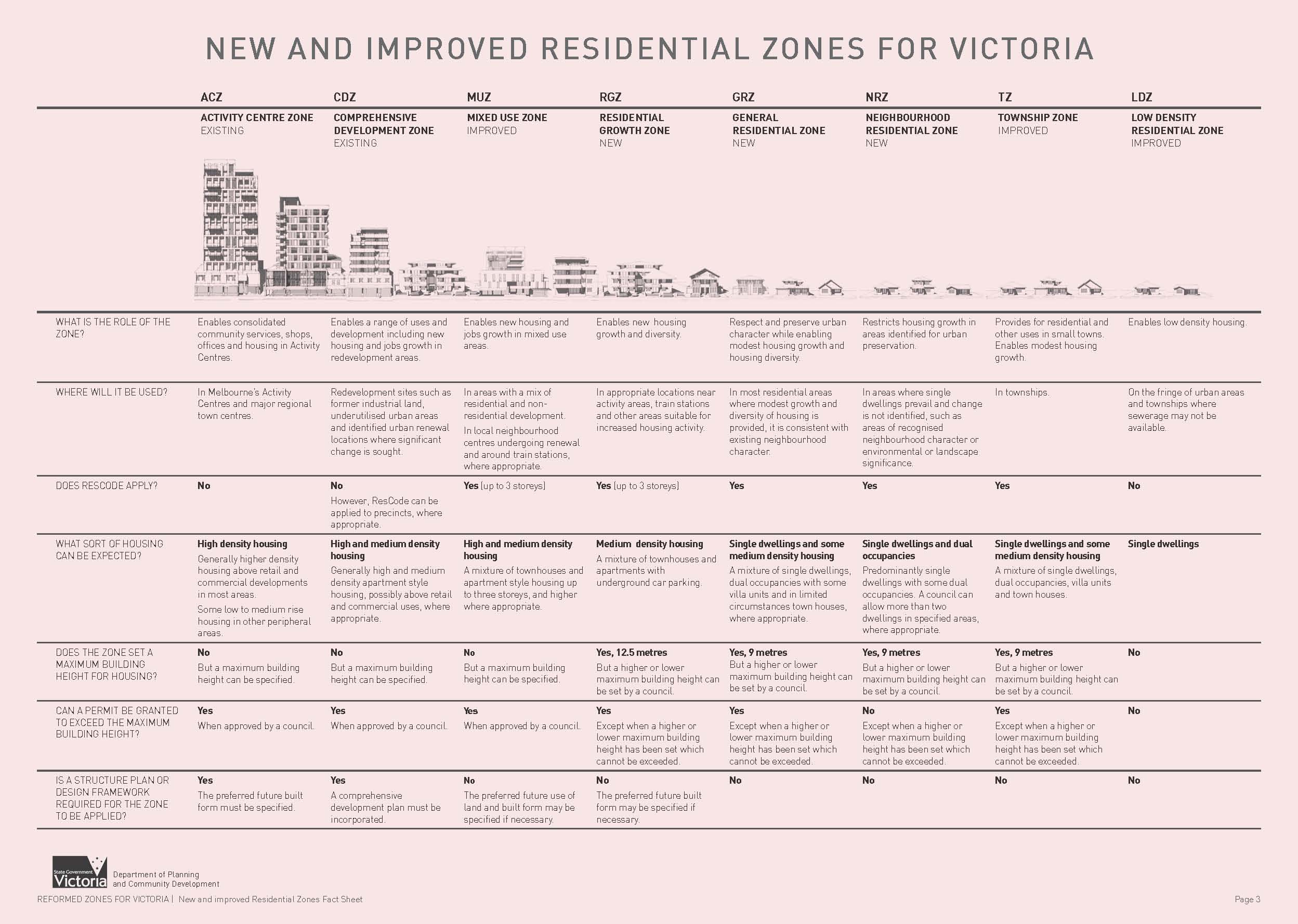
Most concerning is that ‘feedback’ is required by late September, yet full details will only be released in October. In other words, the public is expected to comment blindly on something that they have limited information on. We suggest that readers pay particular attention to the following table extracted from the ‘fact sheet’. Please click on the image to enlarge.


Zone reforms to return planning certainty

Wednesday, 11 July 2012

The Victorian Coalition Government’s sweeping reform of planning zones will return certainty to our suburbs and towns and in particular to councils, residents and the development industry.

“Planning zones are the greatest indicator of the style of development for any area. The Coalition Government’s sweeping zones reform package aims to give certainty for areas that deserve protection and those identified as growth nodes,” Mr Guy said.

“The Coalition Government’s zone reforms reflect what communities have been crying out for, for many years – clear identification of areas that can grow and strong protection for areas that are designed to be low rise, low density neighbourhoods,” Mr Guy said.

“These reforms will protect what makes Melbourne great – our streetscapes, our amenity, our liveability, while encouraging density and growth in clearly defined areas,” Mr Guy said.

The Coalition Government’s zones reform package features three new residential zones:

  • Residential Growth Zone;
  • General Residential Zone; and a
  • Neighbourhood Residential Zone.

“The new Neighbourhood Residential Zone will be an instrument that can be adopted by councils to protect existing amenity of suburbs and towns.

“It will give many areas the protection they deserve and will be the strongest residential protection zone ever offered in the Victorian planning system,” Mr Guy said.

This zone will include a number of features including mandatory height controls, stricter regulations around subdivision and the consideration of minimum lot sizes. The Neighbourhood Residential Zone will also be able to protect existing streetscapes and amenity with clear guidelines on what can be supported by a planning permit application.

In order to support integrity of the new Neighbourhood Residential Zone the Coalition Government has also introduced a number of complementary residential zones that will support development of medium and higher density housing in appropriate locations.

The new Residential Growth Zone will provide for a clear level of growth and change in identified areas that have clear targets for greater density. Councils will be able to use this zone to provide a new incentive to direct density and built form change in areas that are well known and identified.

“Importantly, these zones will be at the discretion of the local councils. It will ultimately be the view of the community that will inform which zone best fits where,” Mr Guy said.

“Victoria’s economic integrity is at the forefront of its planning decisions and these reforms are no different. The residential zone reform package supports Victoria’s economy by clarifying where development can occur and what can be built,” Mr Guy said.

“Importantly, it returns a level of planning certainty that has been sorely missing for the past decade,” Mr Guy said.

Under the Coalition Government’s planning reform agenda, plans for new outer urban growth have been released as well as the identification of Australia’s largest inner city, urban renewal project in Fisherman’s Bend.

These projects, combined with planning law changes and planning zone reform represent a major overhaul of the Victorian planning system since the change of government in November 2010.

“The time is right for planning reform and the Coalition Government is getting on with the job of delivering it.”

The key features of the reformed planning zones will be issued for feedback for a period of 2 months from Monday 17 July until Friday 21 September.

Council policy detrimental 

IT’S no wonder the blocks in Glen Eira get smaller and the growth gets higher. Glen Eira Council continues to operate planning policy to the detriment of residents.

It will soon get to the point where there are as many amendments to their scheme as there are applications.

A number of voters are calling on the council to review its entire planning scheme and introduce structure plans that can identify density and heights before applications are received.

Newton Gatoff

++++++++++++++++

Bitter blow to residents  

NEWS of the Caulfield racecourse development proceeding is a bitter blow to local residents.

While the development will be almost a billion dollars itself, little, if any, infrastructure will be provided to cater for it. This will see both road and rail networks overwhelmed, along with drainage and parking. Open space will also be reduced. Given the chorus of community opposition, you really have to wonder if we are living in a developers’ dollar-dazzler democracy.

Matthew Knight

Tuesday night’s ‘discussion’ on the VCAT results for the Rosstown Rd application were full of the usual handwringing by several councillors – Esakoff, Hyams and especially Magee. In the end they all continue to miss the point and to parade themselves as concerned, indignant, and outraged residents lambasting VCAT for all of council’s planning ills. Nothing, but nothing, could be further from the truth. In essence, what the member concluded in the Rosstown Rd judgement was clear and unavoidable – if Council can’t apply their own policy, then VCAT would do it for them! And what is this policy? Major activity centres should have up to 10 storey developments according to the ground rules laid down by council and supported year after year by councillors!!!

We’ve said this time and time again. Glen Eira Council’s Planning Scheme is manna from heaven for developers. Without structure plans, without interim or permanent height limits, without explicit parking precinct plans, activity centres and their residents have been sacrificed on the altar of greed. The arguments that VCAT is totally to blame remains a nonsense. Magee’s claim ‘I hate VCAT’ is even more insulting in light of his and other councillors’ total inaction. We even are left to wonder if:

  • Councillors have ever read the planning scheme?
  • Do they really understand its full implications?
  • How many of them go back and read the actual VCAT decisions?
  • How do they explain the fact that this council has NEVER EVEN ATTEMPTED to gain formal height limit restrictions?

Tang now talks of ‘ideology’. Rubbish we say! Ideology which is quite prepared to inflict such pain on residents has no place in any planning scheme. Councillors who continually ignore the root cause of a major problem have no right to claim to represent residents. And councillors who continually trot out the bogey-man excuse of VCAT have no real understanding of what is going on.

We urge all readers to carefully consider what the member actually stated. Below are extracts from his judgement and from other judgements that he quotes. Newton and Akehurst have set the agenda via their planning scheme. This is the future, unless the ‘revolution’ continues!

“The Council conceded that the site is located within the Carnegie Urban Village, identified as a Major Activity Centre, and therefore in a higher order activity centre where Council’s Municipal Strategic Statement encourages significant urban consolidation.

Carnegie is identified as a Major Activity Centre and therefore is identified as an appropriate location to achieve more intense forms of urban consolidation than would be expected in the residential hinterland, and in lower order activity centres.

the central area of these type of urban villages can be expected to attract redevelopment proposals involving at least 5-10 levels of proposed built form, or even possibly more (recognising however that each application must be assessed on its own merits)

It is clear therefore, from the analysis of policy, that more intense building forms are anticipated within these urban villages, increasing in intensity as one draws closer to the core of these centres.

The review site is therefore firmly entrenched near the core of the urban village. This has implications due to the local policy as to the intensity of development that is encouraged on the review site.

I therefore find that both state and local policy encourages an intense form of residential development to be achieved on the review site, which would represent a significant degree of change from the traditional housing stock. Policy does not anticipate that the form and scale of development will respect the existing character of the surrounding neighbourhood, as would be expected in a location outside of the activity centre. Instead, in this location developments that are more intense than the surrounding character are firmly encouraged.

Both the Council and Mr Dyer demonstrated that the existing approvals for development within the Carnegie Urban Village currently peak at four storeys. However I do not draw the conclusion urged upon me from that analysis, that four storeys should be, or is likely to be, the ultimate height for future development in this activity centre. More to the point, if indeed this Major Activity Centre were limited to four storeys of development in the future, it would represent a significant under-realisation of the expectations of this centre from both State and Local policy. If Carnegie were to develop to a maximum of four storey forms, it would amount to a failure of policy to achieve the outcomes that it so clearly seeks to achieve.

I therefore do not accept the submissions made that four storeys is an appropriate limit for development generally in the Carnegie Urban Village.

In my view it would be absurd to require development on the review site to transition to the existing single storey housing stock, when that housing stock is encouraged by policy to be replaced by more intense building forms.

Having regard to the whole of policy that is before me, it is therefore entirely clear that a five storey development would be entirely consistent with the strategic objectives for this locale. Indeed, from my analysis I conclude that policy supports a building greater than 5 storeys in height in this location, but a five storey development is what is before me, and it is clear that has policy support.”

+++++++++++++++++++++++++++++++++++++++++++++++++++++++++++++++++++++++++++++++

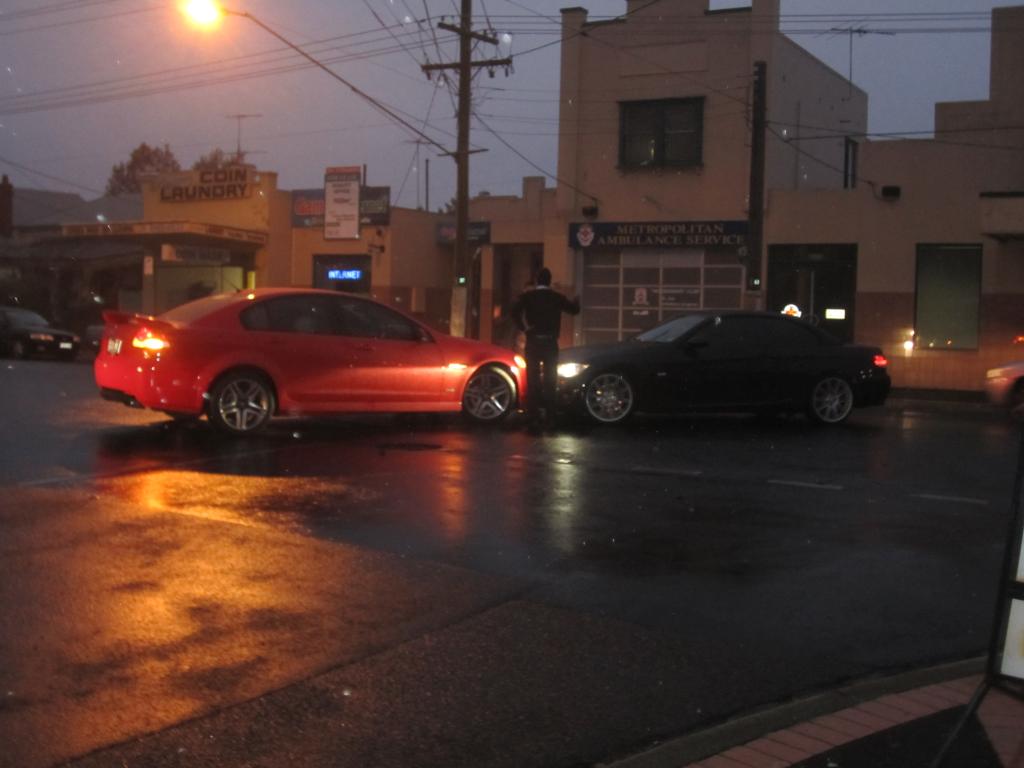
To make matters worse, below is a photograph (taken earlier this week) of ‘traffic management’ in Rosstown Rd!

Three items at tonight’s Council Meeting produced ‘revolutionary’ results by councillors. Now whether this is mere electioneering or genuine, it is definitely a welcome sign. Our only regret is that it has taken nearly 4 years for councillors to assert themselves and to do what they were elected to do!

The issues we are referring to are:

  1. The deferment of Amendment Non-Residential Uses which we analysed several posts ago. See: https://gleneira.wordpress.com/2012/06/29/chip-chip-chipping-away/
  2. The rejection of an officer’s report and the demand for the information in the original request to be included
  3. The strong implied criticism of Paul Burke and the manner in which sporting allocations are done.

It should also be noted that Lipshutz and Forge are on extended leave and that Penhalluriack was absent. Newton was also absent. We will deal only with the first item in this post – the rest will follow in the days ahead.

Amendment C102

Tang moved that this item be deferred. Esakoff seconded.

TANG: Started off that the two amendments on the agenda came out of the Planning Scheme Review and that for the previous Amendment (rezoning) he was ‘satisfied’ with the ‘strategic’ justification and ‘merit’. Although ‘there may be some strategic merit in the suggestions’ for C102 there are also come ‘concerns’ and Council should be ‘prudent’ in ‘trying to address those concerns before proceeding’. Said that a resident had pointed out the ‘blog’ and that the moderators ‘were certainly very dedicated’. Tang went on to state that he was concerned about the ‘accuracy’ of the blog  and ‘balance of the views expressed’ but in a ‘democratic society’ people are permitted to express their viewpoint. He then went on to state that as a ‘community representative’ he was happy to ‘review’ those views  and if they had support to ‘bring them to council’. Said that he wanted to be 100% ‘satisfied’ about the concerns raised ‘in relation to the watering down of restrictions’….’expansion of the breadth of the policy….’and descriptions…..around significant trees’. ‘Council should consider what else it can do….before proceeding’.

ESAKOFF: Agreed but with ‘slightly different reasons’ to Tang. ‘ I would like some more time to work on this….’

LOBO: ‘it is a good idea to defer this’….’many (of the changes) are in favour of a developer’

HYAMS:  Said he understood the ‘aims in redrafting in making it more streamlined….(claimed he hadn’t read the blog) ‘for some time’ and that he’d come to the conclusion himself that ‘there were concerns with this’ such as putting in Housing Diversity as ‘preferred’ locations. Stated that he would be ‘more comfortable with some further consideration’.

TANG: ‘acknowledged’ that Hyams brought up ‘similar concerns’ to his own.  Said that the only reason he mentioned the blog is that ‘it is so often used ….as a vehicle for hate…spreads innuendo….or inaccurately assesses council’s performance….without checking the veracity of the underlying information’. Went on to state that ‘in this instance….the blog has done a good thing’ in comparing past policy with draft suggestions. ‘That’s fine and in fact very useful in the democratic debate’…..’regardless of how councillors have come to the conclusion I just hope they will take on board concerns’.

CARRIED UNANIMOUSLY

« Previous Page — Next Page »