GE Planning


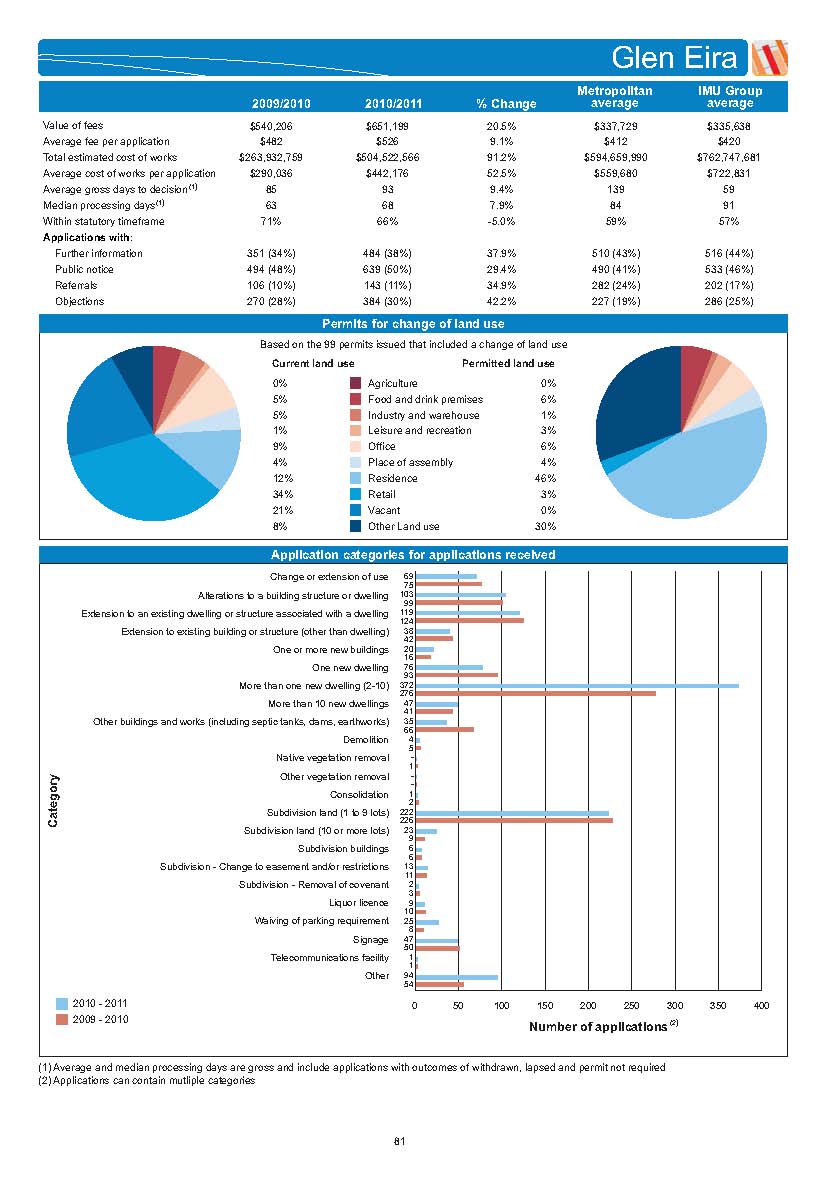
We’ve received some emails from a reader in relation to the recent Planning Audit Report for 2010/11 published by the Department and which we highlighted several posts ago. The emails reveal that all the figures and graphs have been compiled on the basis of the data submitted to the Department – ie Councils have provided the stats. We are left to ponder once again whether the Glen Eira figures represent another ‘clerical error’?!!  Our focus is the stated increase in the car parking waivers. The bar graph shows that for this category in 2009/10 Glen Eira had 8 applications and in 2010/11 the claim is that they had 25 applications.

We cannot agree with these figures. The Department’s definition of this category is: “An application which requires consent for a waiver or reduction in car parking requirements” (page 201 from the full report). They have also written:

Put simply, any application for a planning permit received by Council (be it for a new permit, or an amendment to an existing permit) that includes a waiver/reduction of car parking should be marked as such. Be aware that whether the permit is issued/refused or winds up at VCAT should have no bearing on this number, as it is when the application is first received at Council that we count it.

Glen Eira claims that they have received approximately 1200 applications. Of these, only 25 included the request for a reduction/waiver in car parking schedules for the financial year of 2010/11.

We’ve therefore gone to the trouble of double checking all the VCAT reports contained in council minutes for the period under consideration. We’ve looked at all the scheduled hearings and their descriptions of the actual applications. Readers should note that the VCAT appeals represent applications that have already been decided – not simply applications that have been ‘received’. Even on these reduced figures we find that nothing tallies. VCAT appeals that contain car parking waivers tally over 30 and not the 25 that presumably council provided to the department. We emphasise that we have no way of knowing how many other applications that did not go to appeal and were simply decided via delegation also included the request for car parking waivers. It could tally hundreds and not merely 25 as claimed.

Listed below are the addresses that we’ve found of the VCAT appeals for 2010/11 that contain such waiver components. Even if not all of these were decided in the 2010/11 period, it would still not cover the countless decisions made under delegation, or by the full Council.

  • 1032 Dandenong Road, Carnegie
  • 439 and Lot S4 441-495 Inkerman Road St Kilda East
  • 82 Hotham Street, St Kilda East
  • 326-328 Hawthorn Road, Caulfield
  • 36-40 Hawthorn Road, Caulfield North
  • 619 Glen Huntly Road, Caulfield
  • 9 Morton Ave, Carnegie
  • 763 Centre Road, Bentleigh East
  • 261 Centre Road, Bentleigh.
  • 356-364 Orrong Road Caulfield North
  • SUITE 1-2G, 261 Centre Road, Bentleigh.
  • 1 & 1A Albany Court, Caulfield North
  • 142 McKinnon Road, McKinnon
  • 285-305 Centre Road, Bentleigh.
  • 233-247 Glen Huntly Road & 12-14 Ripon Grove, Elsternwick.
  • 15 Dudley Street, Caulfield East
  • 111-113 Poath Road, Murrumbeena.
  • 36-40 Hawthorn Road, Caulfield North.
  • 107-109 Gardenvale Road, Gardenvale.
  • 888-890 Glen Huntly Road, Caulfield South
  • 389-395 Neerim Road & 10 Emily Street, Carnegie.
  • 2-4 Station Street, Caulfield North.
  • 47 Kooyong Road, Caulfield.
  • 5 Dudley St & 1 Gibson St, Carnegie.
  • 183-189 Booran Road, Caulfield South (waiver of loading bay)
  • 715-727 Warrigal Road, Bentleigh East
  • 31-32 Leamington Street, Caulfield East.
  • 354 Glen Huntly Road Elsternwick
  • 443-457 Hawthorn Road, Caulfield East.
  • 251 Koornang Road, Carnegie
  • 633 Centre Road, Bentleigh
  • 4 Maple Street Caulfield

GRAND TOTAL – 32

This of course leaves open to question how many other ‘clerical errors’ might be contained in the data that council sent off to the Department?
Good planning  must balance rights

March 16, 2012

STRIKING a balance between efficiency and fairness in urban planning is a  vexing challenge for state governments of whatever political persuasion. It is  precisely this tension – the need for a streamlined system of planning approvals  as against the rights of residents to shape their communities – that informs the  debate over a dramatic overhaul to Victoria’s planning system scheduled to be  introduced in State Parliament by July.

In one of the biggest reforms of the state’s planning laws in a decade,  councils and communities will define what development is allowed in their area,  including height and density. Building applications that comply with the  guidelines would then be fast-tracked through the planning system. Crucially,  once the system is in place residents will no longer be notified of new  development proposals and will not be able to object.

The government envisages this ”code assess” system applying to more than  one in five development applications and will require them to be processed  within 10 working days. While councils will initially use the system to develop  guidelines for low-level applications – extensions and dual occupancy  developments, for instance – the changes are also intended to govern more  significant proposals, including high-rise towers in key suburbs targeted for  urban growth, such as Box Hill, Frankston, Ringwood and Dandenong.

The case for a planning shake-up is a compelling one. Developers, councils  and indeed the wider community pay a heavy price for the excessive red tape,  uncertainty and litigiousness that characterise the current system. The problems  consume council resources, and pose a threat to both the short-term imperative  of economic growth and the longer-term goal of urban consolidation. But given  the emphatic changes to residents’ rights, and we’re potentially talking about  residents watching helplessly as a high-rise suddenly goes up next door, the  onus is on the Planning Minister to ensure the laws do not strike at local  democracy. Bill McArthur, president of the Municipal Association of Victoria, is  correct in warning, ”clear policy and objective criteria must be agreed with  the community” before basic rights be removed.

The legislation must enshrine the principle of genuine community consultation  in the development of guidelines. And developers too must be denied  wriggle-room, losing all right of appeal if planning applications fall foul of  the guidelines. Certainty in planning must cut both ways.

Read more: http://www.theage.com.au/opinion/editorial/good-planning-must-balance-rights-20120315-1v86s.html#ixzz1pEPjMqUZ

Tonight’s GERA Overdevelopment Forum was a major success with well over 80 people cramming into the Bentleigh Club and, we’re told, many new memberships to GERA resulting.

Unfortunately Cr. Thomann was a no show, but Cr. West from Kingston was most informative and engaging. Residents received the clear message on how different Kingston Council was in its planning processes compared to Glen Eira. For example: the manner in which planning conferences are held, restricting planning officers’ delegatory powers, Kingston’s hiring of ‘experts’ to support resident objectors, and in the mere fact that Kingston has all those things which Glen Eira doesn’t – structure plans, height limits, developer contributions etc. Cr. West also emphasised the importance of lobbying individual councillors, especially with elections around the corner, and standing candidates who are truly representative of community wishes.

Speaking with people afterwards, their comments revealed how much they had learnt about good planning processes and how much needs to change in Glen Eira.

It was also obvious that upon listening to the audience’s questions and comments Cr. West was astounded at some of the stories and how planning matters are handled in our fair city.

We congratulate GERA for their efforts in this inaugural event and look forward to many more forums that focus on residents and their concerns.

Planning reform blocks appeals

Jason Dowling
March 15, 2012

A DRAMATIC overhaul to the state’s planning system will soon mean residents will not be notified of thousands of new development proposals or be able to object to them.

The government says the new planning system to be introduced in State Parliament by July will cut red tape, reduce waiting times and free up council resources for complex planning issues.

Under the changes – one of the biggest overhauls of the state’s planning laws in a decade – councils and communities will define what development is allowed in their area, including height and density, and then applications matching the definition will be fast-tracked through the planning system.
0pposition planning spokesman Brian Tee said the new system would reduce community consultation in planning decisions.

”Communities will be locked out and watch helplessly as historical buildings and tree-lined streets are attacked by [Planning Minister Matthew Guy’s] wrecking ball and replaced by high-rise skyscrapers,” he said.

The new planning system is expected to apply to more than one in five development applications and will require them to be processed within 10 working days with no notification or appeal rights for neighbours.

The system, called ”code assess”, will initially be used by local councils for processing low-level planning issues such as extensions and dual occupancy developments.

But the system is also intended for key development areas across Melbourne – Box Hill, Broadmeadows, Dandenong, Footscray, Frankston, and Ringwood – to process development applications that could include apartment towers of more than 20 storeys.

Mr Guy said the new system would add ”certainty and clarity” to planning.

He said guidelines for development set by councils and communities would be mandatory and developers would only be able to appeal a council’s decision if it was inconsistent with the area’s new planning code.

”It will determine what can be built and where,” he said.

Bill McArthur, president of the Municipal Association of Victoria, said the planning system needed improvement but warned, ”clear policy and objective criteria must be agreed with the community before removing public notice and third party appeal rights”.

”Until this happens, councils will remain concerned about including some single dwellings, extensions and multi-units in a fast-track process,” he said.

Mary Drost, from community group Planning Backlash, said councils and the community should set the rules for development in their areas and developers should not be able to appeal the decisions under the new accelerated planning process. ”If it’s out – it’s out,” she said.

Victoria’s building and development industry has long advocated for an accelerated planning application system. The Property Council’s Victorian executive director, Jennifer Cunich, said changes to planning laws would help economic growth.

Gil King, of the Housing Industry Association, said developments that met existing planning guidelines were chewing up council time and resources in a drawn-out approval process.

”This will actually make it clearer, if it meets the requirements it will be approved much more quickly, it will streamline the whole process.”

Read more: http://www.theage.com.au/victoria/planning-reform-blocks-appeals-20120314-1v3li.html#ixzz1p87UvdML

A reminder about tonight’s GERA Community Forum.

TIME: 7.30 (nibbles at 7)

VENUE: The Bentleigh Club, Yawla St., Bentleigh.

For full information see: http://geresidents.wordpress.com

PS: From today’s Age. Does C60 and 1400 units also qualify?

Health fear on  estates

Miki Perkins
March 15, 2012

NEW suburbs in Melbourne are so poorly designed that residents face an  epidemic of chronic diseases such as obesity and depression that will cost the  health system millions of dollars, a state government inquiry has been told.

Councils in  outer growth areas say soaring populations have outstripped  their ability to provide basic infrastructure such as public transport, parks  and medical services, and are creating ”obesogenic” environments that promote  weight gain.

The concerns have prompted a state government inquiry into the impacts of  urban design on health, and fuelled calls to make health a priority in planning  laws.  ”When it comes to urban planning, we are building suburbs that in 20  years will be ghettos of ill health,” said Margaret Beavis, a Melbourne doctor  who appeared before the inquiry.

Wyndham, in Melbourne’s outer west, is the fastest growing municipality in  Australia in percentage terms. Each week about 60 babies are born and the  council receives 120 new requests for a bin service.

Mayor Kim McAliney said research showed residents were  suffering from an  ”epidemic” of obesity and diabetes exacerbated by decades of car-focused  planning, which meant locals had limited or no public transport within walking  distance.

”We are beholden to the annual budget cycles of central governments to get  buses, trains and arterial roads,” said Ms McAliney. ”Being the fastest  growing area is not something we wear as a badge of honour.”

Other councils in areas of rapid growth – such as Whittlesea, which  expects  a 90 per cent increase in population in the next two decades – face similar  concerns.

A VicHealth submission said children living in  growth areas reported higher  hospital admissions for respiratory problems, which were likely to be from air  pollution from road traffic.

VicHealth also wants planning regulations to take account of the risks  associated with bottle shops, which are concentrated in poorer communities.

For every 10,000 litres of pure alcohol sold from a liquor shop, the risk of  violence on residential properties nearby increased by 26 per cent.

”We are designing communities that are making people sick and politicians  have to listen to that,” said opposition planning spokesman Brian Tee.

Melbourne University planning expert Carolyn Whitzman said Melbourne needed  to stick to its urban growth boundary and encourage mid-rise development  throughout, rather than ”sprawl”  on the fringes and high-rise in and around  the centre.

In 2010, the Brumby government extended Melbourne’s urban growth boundary by 43,600 hectares – increasing what was already one of the world’s most sprawling  urban areas,  stretching 100 kilometres from east to west.

Many experts told the panel that health needed to be made a key objective in  the state’s planning laws.   The Age contacted Planning Minister  Matthew Guy but did not receive a comment before deadline.

The committee is expected to release its report by June.

Read more: http://www.theage.com.au/victoria/health-fear-on-estates-20120314-1v3lw.html#ixzz1p7r0VxVr

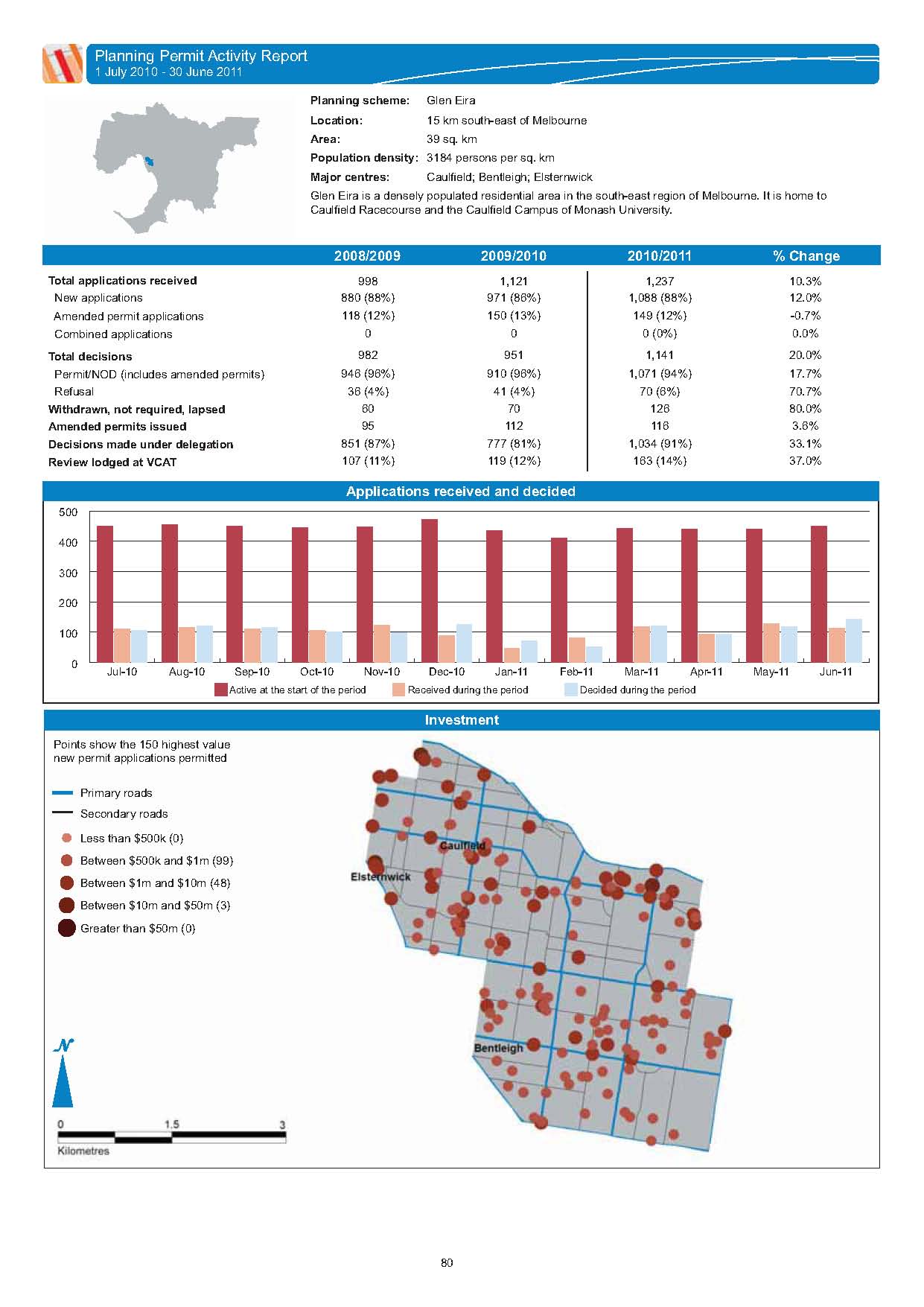
Below are a couple of pages extracted from the DPCD report on building/planning activity in all municipal localities. They make for some very interesting reading – particularly in the number of applications for 2 to 10 lot residences. We are not entirely convinced however as to the accuracy of some of the figures – ie. the number cited for vegetation removal and car parking waivers. Readers need to click on the image in order to get a clearer view or refer directly to the SECOND HALF of the report which is uploaded HERE

Last week’s council meeting saw councillors (with the exception of Penhalluriack) knock on the head the officers’ recommendation that Council apply to the minister to reduce the 80% mark for impervious surfaces in developments. The recommendation had been that this occur only in Minimal Change Areas. Via a motion moved by Tang and seconded by Pilling, the vote was to extend this to Housing Diversity Areas as well.  We certainly congratulate councillors on this move. However, we also have to wonder why it’s taken so long and could it possibly have anything to do with the upcoming election?

The general thrust of the presented arguments was that Council should at least try to cover all of the municipality and if the Minister knocked back the proposed amendment, then council could revert to its original idea of only implementing this for the Minimal Change Areas. Ostensibly, a logical argument. We just scratch our heads at the lack of consistency in councillors’ arguments over the past few years. The constant refrain against introducing any (innovative) change has always been

  • Amendments take too long
  • The Minister will knock it back
  • Too expensive to implement/oversee
  • Glen Eira shouldn’t go it alone

Suddenly such arguments were conspicuous by their general absence. Now it was all about residents’ concerns, flooding, climate change, and increased development. Whilst these are all true, wouldn’t it be nice if ‘residents’ concerns’ featured in ALL COUNCILLOR DELIBERATIONS and not just 7 months out from an election – especially when some councillors keep telling groups that they won’t be moved by ‘lobbying pressure’ (ie. Victory Park Pavilion debate).

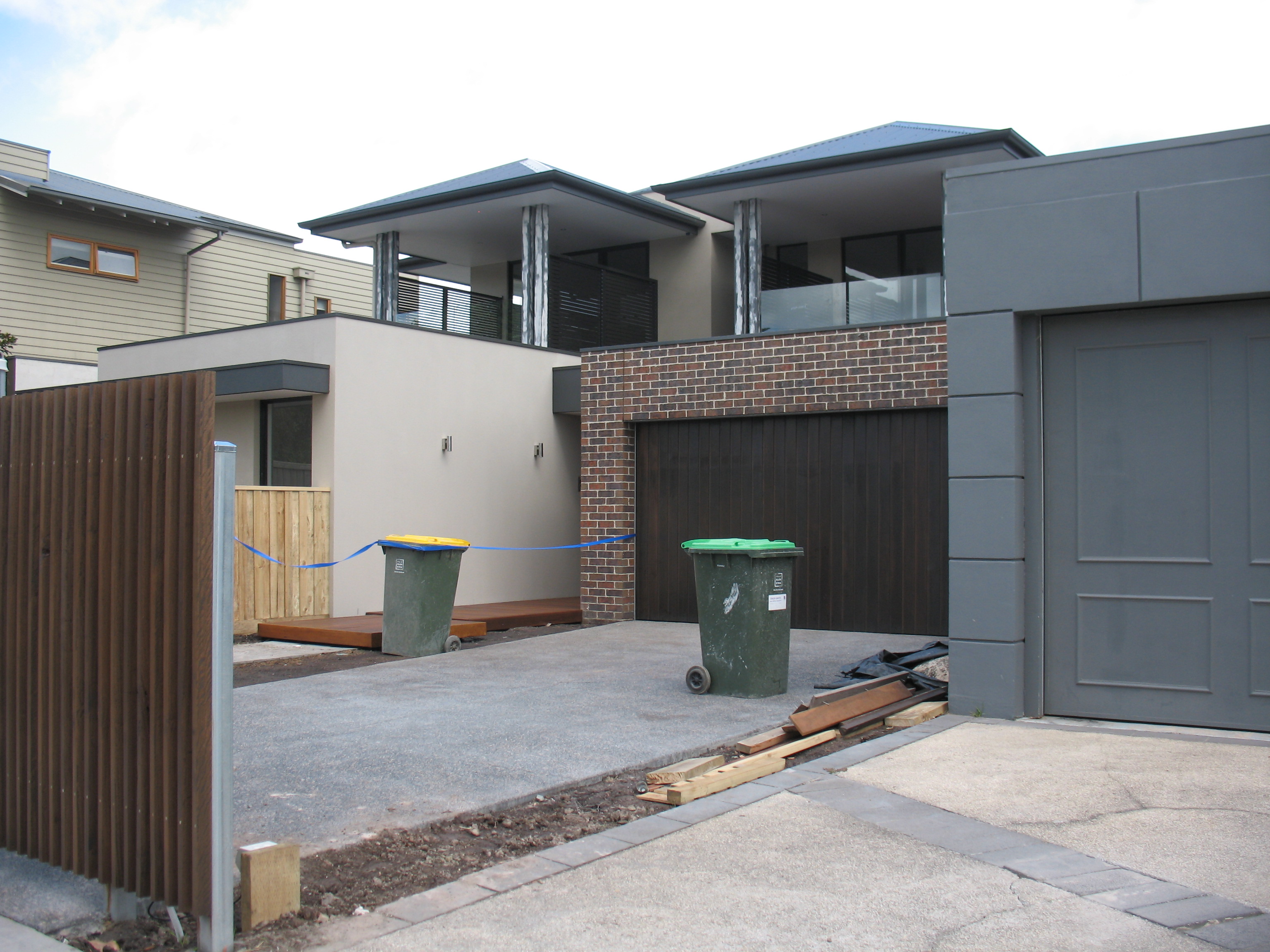
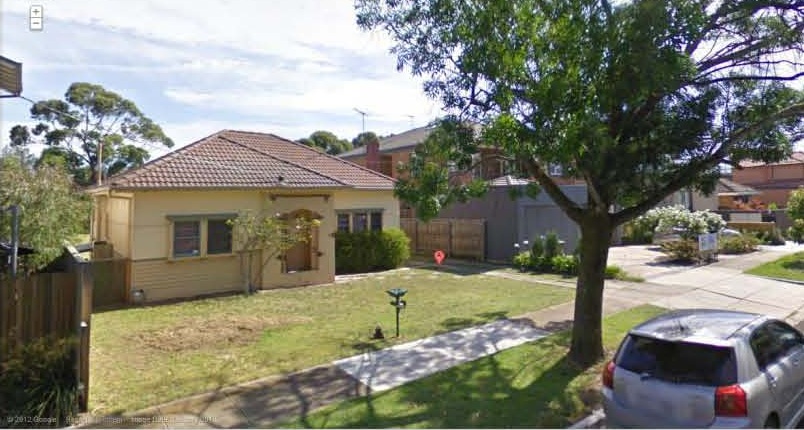
To illustrate the potential importance of such an amendment – and the lack of real ESD (Environmental Sustainable Design) policies in Glen Eira – below are two images. A ‘before and after’. Please note that the 20 to 30 foot tree visible in the first image has not been replaced – and we have been told that it won’t – as well as the extent of concrete everywhere.  The second unit (not pictured) has approximately 2 square metres available for planting and not a single blade of grass either! We are not commenting on aesthetics, or the rights of owners to ‘express themselves’. What we are saying is that much, much more needs to be done by this council – particularly in terms of tree registers, moonscaping, etc. Elections should not be the spur for sudden pangs of ‘conscience’!

We’ve previously posted on the total dissatisfaction of residents with a recent Planning Conference chaired in court room style by Lipshutz. The following emails are the follow up from this event. We draw readers’ attention to these salient points:

  • Not one single concern raised by this resident has been answered by Hyams
  • The spin is offensive, especially council’s reference to ‘resolution’ and ‘facilitation’
  • The entire process is offensive and slanted in the developer’s favour
  • Council does nothing to assist residents

Here are the three emails.

“Extract below is from the Glen Eira Council’s website. 

What is the purpose of the planning conference? 

  • To ensure all parties have a clear and accurate understanding of the proposal;
  • To provide an opportunity for all parties to express their views in respect to the proposal;
  • To allow the community to air their views and concerns about a development proposal;
  • To facilitate an understanding of the matters/issues which are in contention; and
  • Where possible, attempt to resolve or reduce the issues in dispute.

The planning conference on 22 Feb 2012, for development at (address deleted) did not follow the above as set by the Council. After 3 residents had spoken, the rest of the objectors were snubbed by the moderator and were not allowed to express their views in a fair manner. We are all civilised residents of Glen Eira and had a fair reason to be there. The moderator, (Lipshutz) conducted the forum like a courtroom proceeding. It should be clarified within the purpose of the planning conference that discussions are not permitted.

There was no attempt by the planning rep or the developer’s rep to answer any questions about issues. The council’s planning rep could not even define medium density. Is it an interpretation that works in favour of the developer?

Objectors were not permitted to ask a question of the developer’s rep. The meeting was concluded abruptly and residents have no way of knowing how the issues raised will be resolved. We came away from the meeting no more satisfied than before we went in.

The next step I believe is the voting on 20 March. In the interim, residents know nothing till it goes to vote. You call this system of listening to objections fair? In order to do that, you need a neutral moderator and some allowance for discussion. Otherwise, you are wasting the residents’ time.

If that was the only opportunity for the residents to get answers and clarifications, the entire process was less than satisfactory

Thank you

++++++++++++++++++++++++++++++++++++++++

Mayor Hyams responded:

Dear (name deleted)

Prior to the matter going to a vote, residents will have the opportunity to see our planning officer’s recommendation. This will be part of the agenda for the Council meeting, which will be available online or from our libraries from around noon the previous Friday. Residents may also contact councillors at any time to express their views about the application, and, once the agenda becomes available, about the recommendation. 

Regards,

Jamie

++++++++++++++++++++++++++++++++++++++++++++++++++++++++++++++

Here is the resident’s answer to this missive:

Dear Jamie

Thank you for your response. I pleased to know that there will be an opportunity to see the recommendations made by the planning officer on Friday 16th March. If the matter is being voted on the 20th March, it leaves the objectors with a day to discuss further, if permitted!  What is the procedure should the residents have objections to the recommendations?

There is a strong sense of disgruntlement amongst residents regarding transparency and clarity on part of planning officers. Particularly when they cannot define medium density. Most importantly, have any of the planning officers on the case of (address deleted) development actually visited the street? Are decisions made on the basis of drawings alone? If that is the case, the drawings for this project represent nothing of the street’s character. It is of utmost importance that planning officers get a look and feel of the streets that plans are being submitted for and get in touch with reality.

It was requested at the conference that a proper independent traffic survey be conducted by the Council for (name deleted) Street, as the one provided by Urbis was not a true representation. So far the residents have seen nothing.  Conducting a traffic survey for a couple of hours for a development which will have high impact on the street infrastructure is not adequate.  We have called up the company that conducted the survey for Urbis/Vujic, however, they declined to comment or offer general advice as they were working with the developer and it would be conflict of interest. Other companies that conduct such surveys also were unhelpful due to conflict of interest!

The Planning Process is less than satisfactory and something that the council must review. For a proposal of such nature, the planning officers should have tossed it out at the pre application planning meeting. It beggars belief about the planning departments transparency.

Thank you

GERA has organised a Community Forum entitled: Overdevelopment – Coming to you soon!

Guest speakers are councillors from the municipalities of Port Phillip and Kingston (Serge Thomann and Rosemary West) so this should give Glen Eira residents a good insight into how these neighbouring councils approach, and ‘solve’, some of the problems associated with over development. It will be interesting to see what these councils do in contrast to what Glen Eira doesn’t do but is capable of doing if only the will was there! We believe there will be plenty of opportunity for Q & A sessions.

So, come one, come all, and learn about planning, the future of your street, and what can be done to halt rampant overdevelopment.

Full details are on the GERA website (http://geresidents.wordpress.com), but FYI the arrangements are:

DATE:             15th March

TIME:               7.30 (drinks & nibbles at 7)

VENUE:           The Bentleigh Club, Yawla St., Bentleigh.

ENTRY:            Members free. Non members – gold coin donation.

We’ve received the following email from a resident –

“Hello

The planning conference last evening regarding the development on Mavho Street was a joke! We had a great turnout of objectors from Mavho and surrounds. We were disappointed with the way the proceedings were moderated by the Councillor in chair Michael Lipshutz. There were other Councillors present in the room – Mayor and CrLobo. At the end of the session, the objectors left feeling rather dejected about the attitude of the moderator and the inability to have a more open session of Q & A.

We were instructed to discuss the issue just once and if more than one person wanted to reiterate a point about traffic, parking or bulk or privacy, it would not be permitted as it been heard and noted. ( Does the Council ever hear orlisten to anything?)

An important point raised was about what the council saw as medium density and the answer was that they had no idea what the definition of medium density was! Even the planning person could not clarify that one! The response was that this Urban Village Policy was formulated in 2000, way before their time and the community was consulted. We have requested to see the process under FOI. In my opinion, if there is no definition to a important part of a policy  -medium density housing within the urban village – there can be no informed voting.

There was one representation from Urbis development. The lady mentioned the site was selected as it was within the urban village scheme and had no heritage listing.Their proposal was in line with the neighbourhood character, which she explained was a mix of everything! We were not allowed to ask her any questions at all! I thought the purpose of this meeting was to have an open discussion about ourconcerns and be able to ask the developer questions. There could be only 2 reasons for this. One, the councillor wanted to get home, two, he was protecting the representative from the objectors. The whole process did not seem particularly transparent.

A resident raised whether there had been an pre application planning meeting with developer and if so, the application of such a nature should have been thrown out of the door to save everyone’s time. The planning rep would not comment whether a pre app session did take place. Clearly this developer, Urbis and builder, Vujic, have a good understanding of the Councils modus operandi!

We’ll continue to lobby the councillors and work on a strategy to get more people involved in the fight against raising monstrosities in residential areas”.

« Previous PageNext Page »