GE Planning


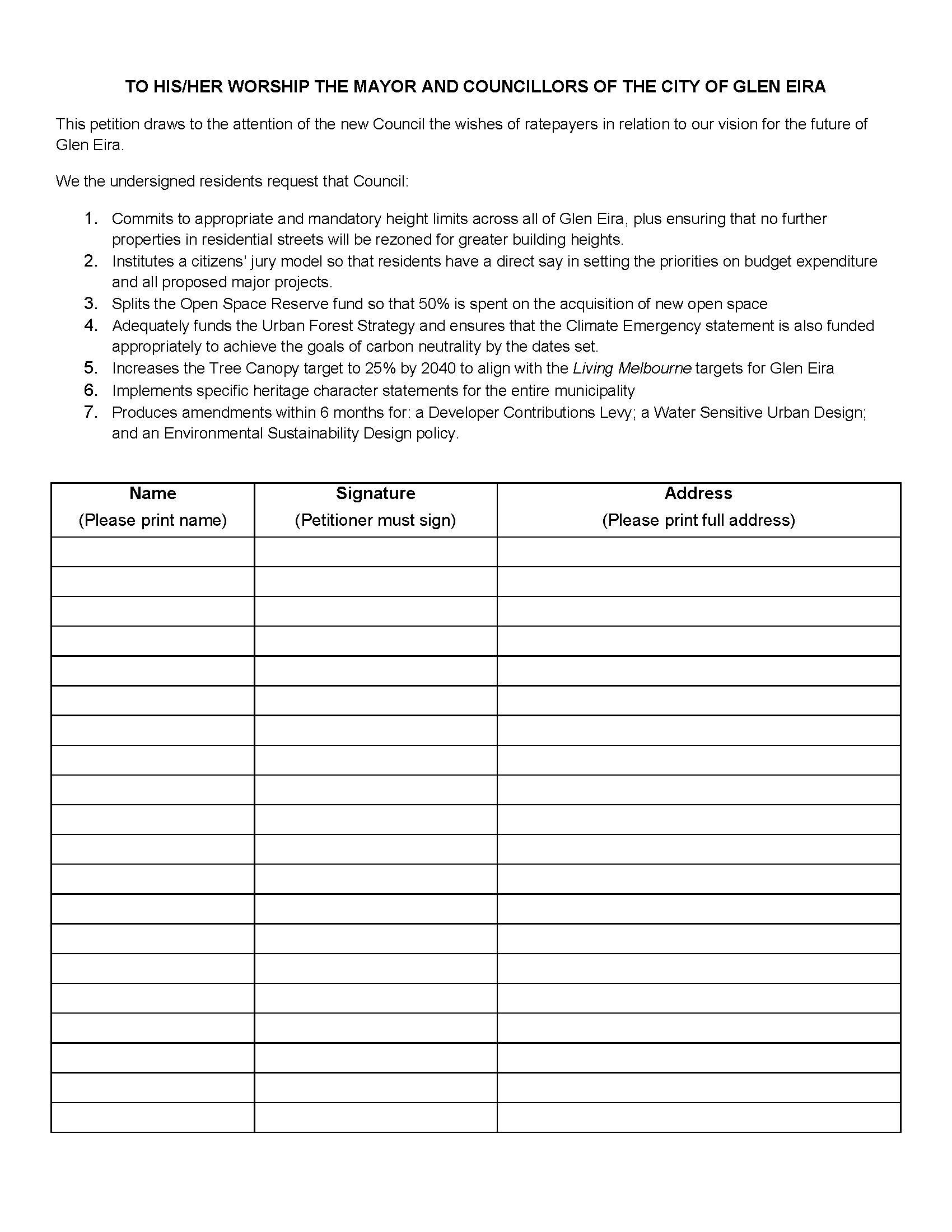
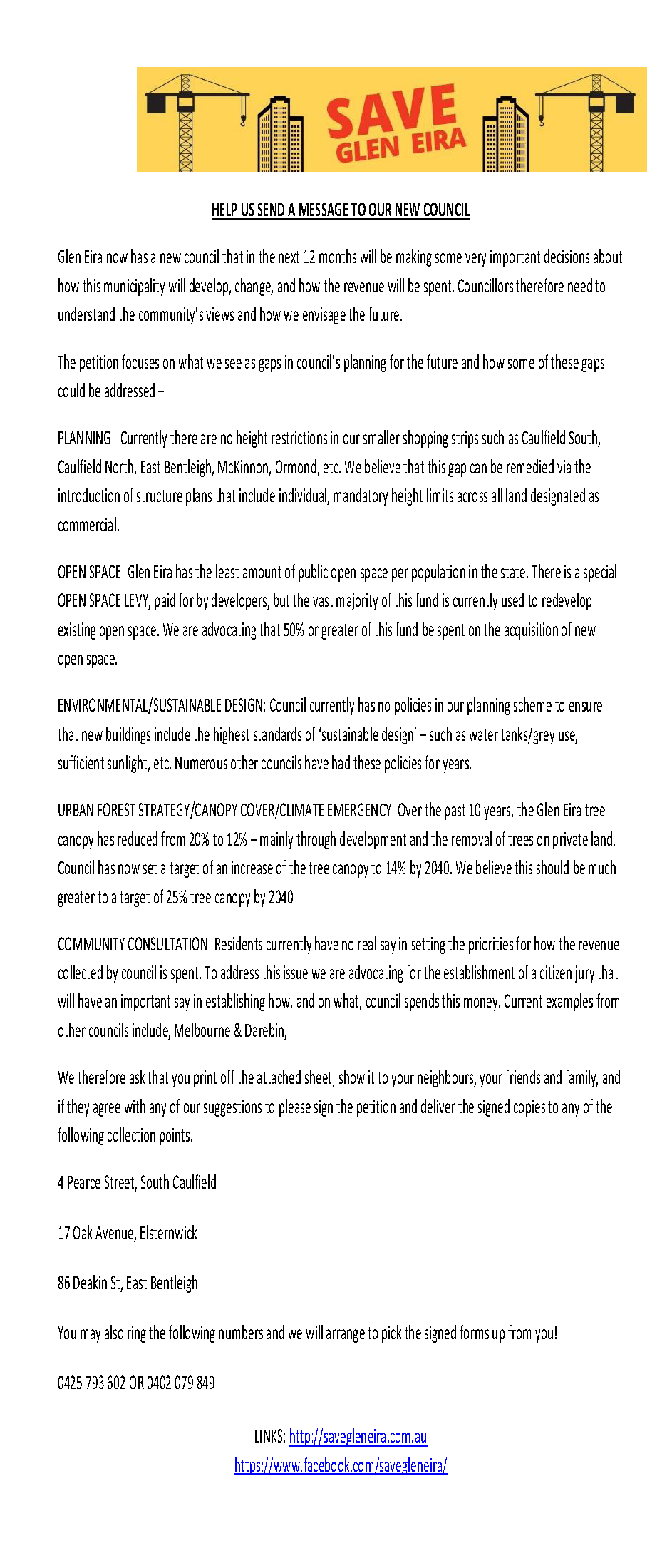
The Save Glen Eira community group, has published a petition which will be presented to the new council. The stated objectives of this petition is to ensure that councillors have a clear idea of what residents expect from their new council and what ratepayers would like to see achieved.

The petition can be accessed via – https://savegleneira.com.au/petition-to-new-council-2020/

We assume that residents should download and print off a copy of the petition and then once signatures are collected, to hand them in at the various collection points mentioned.

Here is a screen dump of the petition and the accompanying information sheet.

In February 2020, council adopted its City Plan. Now 9 months later we are still waiting for an amendment to be produced which would allow this policy to be included in the planning scheme. But this delay is only part of the problem which is facing many of our neighbourhood centres – in particular what is happening around Caulfield South and Caulfield itself.

Two recent VCAT decisions illustrate how this council is failing its residents. Both applications received their permits from VCAT. They are:

  • 348-354 Hawthorn Road, Caulfield South which was granted a permit for 8 storeys, a supermarket, and reduction in retail car parking requirements.
  • The second permit was 679-683 Glen Huntly Road, Caulfield which will become a 6 storey building with 50 apartments and car parking reductions for its retail component.

Both judgements of course made mention of the fact that for commercially zoned land in these neighbourhood centres, Glen Eira does not have anything in its planning scheme to control building height, setbacks, or podium heights. The Glen Huntly application elicited this comment from the member: The land is in an area where there is design and built form policy to guide decision-making but without specific development controls in the scheme articulating, guiding or capping heights and setbacks.

What is intriguing about these two decisions is the divergent and misleading role that council’s representative took at these hearings.

For the 8 storey proposal we find that council argued as follows –

City Plan is key to the Council’s position. Its position to support the proposal subject to deleting Level 05 is underpinned by City Plan.

The Council relies on City Plan in support of its position.

City Plan is intended to form the basis of a planning scheme amendment/s to implement aspects of the plan, including local policy. But amendments have yet to progress with respect to the CSNC. While City Plan is relevant and provides a clear statement of the strategic direction currently being articulated and to be pursued by the Council, the expected built form outcomes  cannot be used as if they are controls or policies in the scheme.

When the above is compared to the Hawthorn Road application we find the following member comments:

Since our decision of Bewhite in 2018 the council has adopted the Glen Eira City Plan in February 2020. This sets a broad framework for planning of activity centres and nominates a preferred building height across the SCAC of five storeys. The plan does not identify how this height was derived or its relevance to the specific circumstances of the SCAC. Rather it appears to be drawn from a hierarchy of activity centres across the municipality, with the SCAC sitting in a ‘substantial change 3 area’ along with a number of other neighbourhood activity centres.

The council acknowledged in its submission that it is only in the very early stages of developing a structure plan for the SCAC and consequentially it does not place any weight on the City Plan for the purposes of the proceeding before us. It submits that the City Plan ‘simply provides useful context on Council’s current thinking’ for the SCAC. We accept the City Plan may be the council’s current broad thinking about activity centres in general, but we give it no weight as a tool to assess building height, relative to the urban design tests of the planning scheme as set by both the State and local policy frameworks

So what is the truth? Why do we have council’s rep in the first case placing such emphases on the City Plan, and in the second case an acknowledgement that ‘consequentially it (council) does not place any weight on the City Plan’?

What is even more fascinating is the statement that council is in the ‘very early stages of developing a structure plan’ for South Caulfield. Really? Is this representative totally ignorant of council’s stated position for South Caulfield, or is he simply and deliberately misleading the tribunal? Numerous public question responses and the 2018 work plan published by council make it clear that our neighbourhood centres will NOT HAVE STRUCTURE PLANS. They will eventually be ‘controlled’ via Urban Design Frameworks and maybe, just maybe, Design and Development Overlays.

These two decisions raise innumerable questions about the state of planning in Glen Eira and how well objectors are represented at VCAT hearings.

The City Plan is not a bona fide housing strategy which council was told to undertake. It represents the lowest common denominator in strategic planning – ie a ‘one size fits all’ approach where every single neighbourhood centre or local centre is viewed as identical. Council has had 5 years to come up with a decent housing strategy and has failed miserably. We can only hope that our new council sees these policies for what they really are – useless and totally ignoring what the community has stated it wants.

The above decisions can be found at:

https://www.austlii.edu.au/cgi-bin/viewdoc/au/cases/vic/VCAT//2020/1231.html

and

https://www.austlii.edu.au/cgi-bin/viewdoc/au/cases/vic/VCAT/2020/1211.html

Mr HAYES (Southern Metropolitan) (15:28): I move:

That this house requires the Environment and Planning Committee to inquire into, consider and report, by June 2022, on the adequacy of the Planning and Environment Act 1987 and the Victorian planning framework in relation to planning and heritage protection, and in particular the committee is to examine:

(1) the high cost of housing, including but not limited to:

(a) provision of social housing;

(b) access for first home buyers;

(c) the cost of rental accommodation;

(d) population policy, state and local;

(e) factors encouraging housing as an investment vehicle;

(f) mandatory affordable housing in new housing developments;

(2) environmental sustainability and vegetation protection;

(3) delivering certainty and fairness in planning decisions for communities, including but not limited to:

(a) mandatory height limits and minimum apartment sizes;

(b) protecting green wedges and the urban growth boundary;

(c) community concerns about VCAT appeal processes;

(d) protecting third-party appeal rights;

(e) the role of ministerial call-ins;

(4) protecting heritage in Victoria, including but not limited to:

(a) the adequacy of current criteria and processes for heritage protection;

(b) possible federal involvement in heritage protection;

(c) separating heritage protection from the planning administration;

(d) establishing a heritage tribunal to hear heritage appeals;

(e) the appointment of independent local and state heritage advisers;

(f) the role of councils in heritage protection;

(g) penalties for illegal demolitions and tree removals;

(5) ensuring residential zones are delivering the type of housing that communities want; and

(6) any other matter the committee considers relevant.

When developers brazenly demolished the Corkman hotel, Melburnians were appalled. The minister responsible for heritage protection, the Minister for Planning, Richard Wynne, thundered that he would make them rebuild it ‘brick by brick’. Now, that was an impulsive but regrettably empty threat. He did not, nor does he, have the legal power to do this. The Corkman hotel vandals got away with it. They escaped with a fine, which does not even cover the extra money they can now get from selling the property as vacant land as a development site. Now, if this were an isolated example of Melbourne’s heritage being demolished while this Parliament turns a blind eye, that would be one thing, but it is not.

Here is a list of heritage homes demolished in my electorate alone all due to a lack of heritage protection. Some were demolished while their heritage values were still being assessed. They are: 34 Armadale Street, Armadale; 19 Moir Street, Hawthorn; Forres at 9–11 Edward Street, Kew; 981 Burke Road, Camberwell; 993 Burke Road, Camberwell; 33–35 Huntingtower Road, Armadale; 34 Were Street, Brighton; Idylwilde at 16 St Georges Road, Toorak; 18 St Georges Road, Toorak; 27 Mariemont Avenue, Beaumaris; 19 Nautilus Street, Beaumaris; Breedon House at 34 Were Street, Brighton; 32 Middle Crescent, Brighton; 25–27 Victoria Avenue, Canterbury; 360 Auburn Road, Hawthorn; 368 Auburn Road, Hawthorn; 55 Seymour Road, Elsternwick; 2 Burgess Street, Beaumaris; 46 Rowland Street, Kew, the home to young Gough Whitlam; and 1045 Burke Road, Camberwell.

That is just 20 heritage homes in the last few years in my electorate alone, and that is also Mr Davis’s electorate, Ms Crozier’s electorate, Mr Erdogan’s electorate and Ms Taylor’s electorate too.

Here I am talking about heritage, but this motion seeking a referral to the Planning and Environment Committee, of which I am deputy chair, is about a broader and at present all-encompassing issue of planning, which I will talk to later in this speech. I want to thank my crossbench colleague Dr Ratnam, also a valued member of the committee, for her initial collaboration in framing the terms of reference and her continuing support in getting this motion before this house and, with the government’s and hopefully the opposition’s support, getting the issues before the committee.

During my time as an MP I have received many expressions of concern from constituents about the loss of these homes and what these continuing demolitions say about the poor state of heritage protection in Victoria. I have come to the view that a parliamentary inquiry is needed. Some suggestions I believe require investigations by a committee, especially in regard to heritage protection, and they are the adequacy of existing arrangements for heritage protection in Victoria; whether there should be a federal minister for heritage and a federal department of heritage; whether heritage protection in Victoria should be moved away from the Minister for Planning and have its own minister and its own department; whether there should be a separate Victorian heritage tribunal rather than having heritage decisions made at VCAT; whether developers should be required to pay for independent heritage advice on any building they propose to demolish but not be permitted to appoint the heritage expert; whether councils should have their own heritage department outside the council’s planning division, which would promote local heritage and maintain lists of independent heritage advisers; whether penalties for illegal demolitions, such as the Corkman hotel disaster, and illegal tree removals are sufficient; whether buildings which have been altered to some degree still retain ongoing heritage significance and value; whether the two levels of heritage protection available—significant and contributory—are sufficient.

In this respect, as well as others, we should look at practices in other jurisdictions, which we have done. This is by no means an exhaustive list of heritage issues which we can consider. Other things that have been brought up are whether communities should make some contribution to helping heritage owners maintain heritage properties in some ways too, but Victorians in general are dismayed and even aghast at the lack of heritage protection in this state. It is a matter I have discussed directly with the minister, and to the minister’s credit he has expressed his concern about this as well. I am glad to have the government indicating it is going to support this today. I am really very pleased to hear that, and I thank the minister.

Here are some of our residents’ thoughts. First, a demolition permit should not be issued without a planning permit. That means you cannot knock down what is there until the planning process has decided what is going to replace it. The current practice puts demolition powers in the hands of private building surveyors, and as I have said to this house previously, the system of private building surveyors is a scam, and it has had a detrimental effect on the quality of our buildings since the Kennett government introduced it and subsequent governments have continued to support it. Heritage protection should not be privatised out to unqualified building inspectors. However, if we required a planning permit or something similar before a demolition could proceed, this would bring councils into the picture, as they should be.

Respected Melbourne planning expert Professor Michael Buxton from RMIT has told me our heritage system is ineffective compared to that of many other countries. He said there is no proper consideration of precincts and that the system relies on the use of the heritage overlay, which he considers a flawed process. Overlays omit too many important areas and buildings. The process is costly and cumbersome and the overlay provisions are weak. Constituents have suggested we look at the heritage provisions in the UK or Canada or New Zealand. Some have noted that in jurisdictions like New South Wales heritage is part of the environment department.

And heritage is not just about old buildings. There is cultural heritage. Some buildings are not architecturally special but have significance due to their place in history. Then there is Indigenous heritage, and I am concerned about the heavy-handed force used to ensure the destruction of significant Indigenous trees as a consequence of the Western Highway extension. Earlier this year the federal government for the second time rejected an application to protect these trees, and I hear there has been some success in a court today but I do not have all the details here.

And there is context too in relation to landscape. In the case of some of the homes in Toorak which are at risk of demolition, it is not so much the home as the loss of the magnificent grounds and gardens which needs to be prevented. One of my constituents, former TV presenter Ilona Komesaroff, has collected the signatures of over 600 Toorak residents on a petition demanding an end to the destruction of local heritage by developers. The United Kingdom’s Conservation Principles, Policies and Guidance for the Sustainable Management of the Historic Environment sets out four groups of heritage values.

One:

Evidential value: the potential of a place to yield evidence about past human activity.

Two:

Historical value: the ways in which past people, events and aspects of life can be connected through a place to the present …

Three:

Aesthetic value: the ways in which people draw sensory and intellectual stimulation from a place.

And four:

Communal value: the meanings of a place to the people who relate to it, or for whom it figures in their collective experience or memory.

My constituents see little evidence of these sorts of values being seriously applied on the ground. Ms Dasha Kopecek from Box Hill advised me of a case in Box Hill where she said that the heritage officer employed by the developer presented a biased, ill-informed heritage perspective, unsurprisingly intended to support the developer. The council heritage officer did not attend a planning forum designed to give residents a chance to discuss the heritage significance of the site. The council officer who did attend and chaired the meeting was unable to summarise the heritage officer’s long and technical report. Few people—residents or council staff—would have actually read his report. VCAT appears ill-equipped to deal with complex heritage matters and has a poor history of dealing with residents’ concerns. Bernadette Pierce from the Save Glen Eira group said their members are concerned about the effect on heritage buildings of large developments carried out adjacent to them. Overshadowing, access to sunlight, wind issues, changes in the water table and so on can negatively affect heritage buildings causing distress and expense for their owners.

Last year the National Trust released a document concerning federal heritage priorities. They pointed out that Australia’s heritage creates a unique identity, a sense of place and a strong reminder of our proud history. Our heritage places, from buildings to landscapes, from song lines to character areas, from trees to shipwrecks, all represent our story—the story of our people and our shared connections. They said Indigenous cultural heritage continues to be at risk from incremental destruction and the cumulative impact of large-scale landscape change. Government heritage departments at all levels are underfunded and under-resourced. The ongoing loss of trade skills in heritage leaves heritage places vulnerable to poorly executed repairs and conservation work.

They advocated a program of accredited job skill training to boost the traditional heritage trade skills. They advocated more effort to protect, conserve and celebrate Australia’s heritage. Also, last year the National Trust’s Kristin Stegley had an opinion piece published in the Age titled, appropriately, ‘Governments only pay lip service to heritage’. She said there is a failure to appreciate how heritage contributes to social cohesion and to vibrant, prosperous and healthy communities. She is right. Governments have not done enough to promote social cohesion in recent times, and we could use all the social cohesion we can get right now. She also referred to an editorial in the Age which called for the buck-passing between state governments and councils over heritage protection to stop. The Age is right of course. Both government and councils have a responsibility to protect heritage, and as you can see from the list of demolitions I read out earlier, they are failing to discharge it, and property speculators benefit from this failure in responsibility.

Residents in Boroondara are strongly supporting my campaign for a parliamentary inquiry. Sandra Alexander, Rose Blanden and Christina Branagan from the Boroondara Group for Advocacy and Protection described the changes to the statewide Victorian planning provisions introduced by amendment VC148 in July 2018, just two years ago, as an alarming development which threatens heritage and residents’ rights through exempting notice requirements and the like. As examples, they pointed out that a local house had recently been approved for contributory heritage protection after a huge community campaign. Then the owners made a planning application to council which would seriously degrade the heritage elements, and due to amendment VC148 local people were not informed, nor does council have to consider their objections as part of the decision process.

A second example is a house and garage with an individually significant grading. The owners can subdivide that land, build a fence or demolish the garage or sell the land as a development site, and local residents would be given no notice and have no rights of objection.

They have also raised the issue of VCAT with me. They say that VCAT has become increasingly focused on whether a heritage property has had alterations. This is increasingly being used as a reason to deny heritage protection, yet there is nothing in the guidelines or regulations to support this approach. The fact is that all heritage places have been altered in some way over the years. It is a part of their heritage, and it is what happens all around the world. The claim of alterations was the claim made by developers who developed two century-old buildings in Burke Road, Camberwell, on either side of Victoria Road intersection, but minor alterations should not destroy the case for heritage protection.

The Boroondara residents also raised the issue of facadism. Planning guidelines are supposed to discourage the demolition of buildings except for their facade, but increasingly places of heritage value are being all but demolished in this way.

In Bayside residents have been concerned about the demolition of unique mid-century heritage. The award-winning Breedon House in Brighton, designed by Geoffrey Woodfall and built in 1966, was demolished in May this year after being refused an interim protection order because it was considered not to be under immediate threat. In the same week a mid-century home in Nautilus Street, Beaumaris, designed by the architect Charles Bricknell, was demolished despite objections from the National Trust and the community group Beaumaris Modern. Beaumaris Modern president Fiona Austin described that week as ‘devastating for our architectural heritage’. She has advised me that Heritage Victoria denied an application by them for an interim protection order after a phone call was made to the owner of Breedon House. Apparently Heritage Victoria was reassured by phone that the owner had no immediate plans to demolish the house. So they did not put a protection order on it, but the owners demolished it the very next day. What a farce. And what does it say about the effectiveness of Heritage Victoria?

National Trust chief Simon Ambrose said:

Mid century homes are an important part of our history and utilised groundbreaking construction methods, innovative approaches to open-plan living and connections to the landscape.

The battle goes on. In August Hawthorn residents launched a campaign to save a 1916 Queen Anne federation villa in Berkeley Street which is at risk of being sold, having been passed over in a heritage study, and a modernist home in Tannock Street, Balwyn, designed by renowned Melbourne architect Robin Boyd in 1949, was also at risk of being listed for sale in August—and what is more, it is being advertised as a redevelopment opportunity. Professor Philip Goad, a professor of architecture at the University of Melbourne and a board member at the Robin Boyd Foundation, says that more than 60 years later the building is still virtually intact. In mid-October we learned of plans to tear down four period homes in Hampton and replace them with a three-storey apartment block with 36 apartments. Apparently we do not have enough apartments. Changes to the residential zones which allow multi-unit developments in older areas where previously only two new dwellings on a block were allowed have accelerated the market-driven destruction of our heritage.

And it is not just private developers who are the culprits when it comes to heritage destruction. The state government’s Level Crossing Removal Project has been removing a lot more than level crossings. The Upfield line project destroyed trees at Moreland station that were more than 100 years old and destroyed the historic Munro Street signal box despite the objections of hundreds of local residents and the Coburg Historical Society. The fact is that heritage matters. The fact is we are failing in our duty to protect it for the enjoyment of this generation and the ones who come after, and we need an inquiry to produce ways we can lift our game and do better.

So far I have been speaking about heritage protection, but the motion goes to a number of other important issues concerning the Planning and Environment Act as well. The first of these is the high cost of housing, and I know I am not alone in being very concerned about the high cost of housing. The extent of homelessness and rough sleeping in Melbourne is unacceptable. It is shameful. It is worthy of note that the state government was quite able to find accommodation for our homeless people when it became a public health issue due to the coronavirus pandemic. Let us learn from this and take the opportunity to get fair dinkum about putting an end to homelessness. On our road to recovery from the pandemic I believe that it would serve Victorians better in the light of near future if public money was being spent on social housing, which might give homeless people a break and also employ local builders, rather than huge, environmentally damaging infrastructure projects.

The inquiry would also look at environmental sustainability, vegetation protection, mandatory height limits, minimum apartment sizes, protecting the green wedges, the urban growth boundary, concerns about VCAT’s role, third-party appeal rights and ministerial call-ins. These issues are all fundamentally important to me and to our party, Sustainable Australia. I have spoken about them many times in the past couple of years. Last year I put forward a private members bill concerning mandatory height limits and restricting VCAT appeals. The bill was narrowly defeated in this place, and I believe it is a great pity for our state because it would have reshaped planning in Victoria and given citizens a much greater say in important planning issues.

This year has shown more than any other since the Second World War how much we depend on social cohesion and people being prepared to act for the good of the community rather than simply pursue their own personal interests. We politicians are much more likely to get that cooperation and support if people know they are being listened to and have a stake in the results. In the area of planning, the community is only involved in a token manner. Property developers have the ear of governments and are far too close to them and, as we have seen many examples of lately, improperly close to them.

Governments have been imposing ever-denser populations in Melbourne to satisfy the development industry, often against the express wishes of the community. Now we are faced with a time of change—an unmitigated disaster but an opportunity too. We need to learn the lessons of the coronavirus pandemic and a lesson which we learned in the past but have forgotten.

Right around the globe population density has been a contributor to disease and death. We are witnessing a revolution in working habits, and we must rethink our planning and transport systems. Will more public transport be necessary now, or will more and more freeways continue to be seen as the answer to ever-increasing density? Will ever-increasing density everywhere be seen to be desirable again? To property developers of course yes, but will the general public want to go along with them again? CBD office space is now empty, and it is a long way back from here.

It is time for a rethink of Plan Melbourne, which was written by the true believers that bigger and denser is always best for everyone, especially property speculators. And it is time for a rethink of the planning and environment legislation, which could possibly turn its focus away from an overwhelming concern with higher density and focus its attention on community health, community wellbeing and of course our precious environment and what we value about the past. All of these are primary concerns to local residents but are rarely taken into account in planning decisions under this much-corrupted act. I commend this motion to the house.

Source: https://beta.parliament.vic.gov.au/parliamentary-debates/Hansard/HANSARD-974425065-9050/
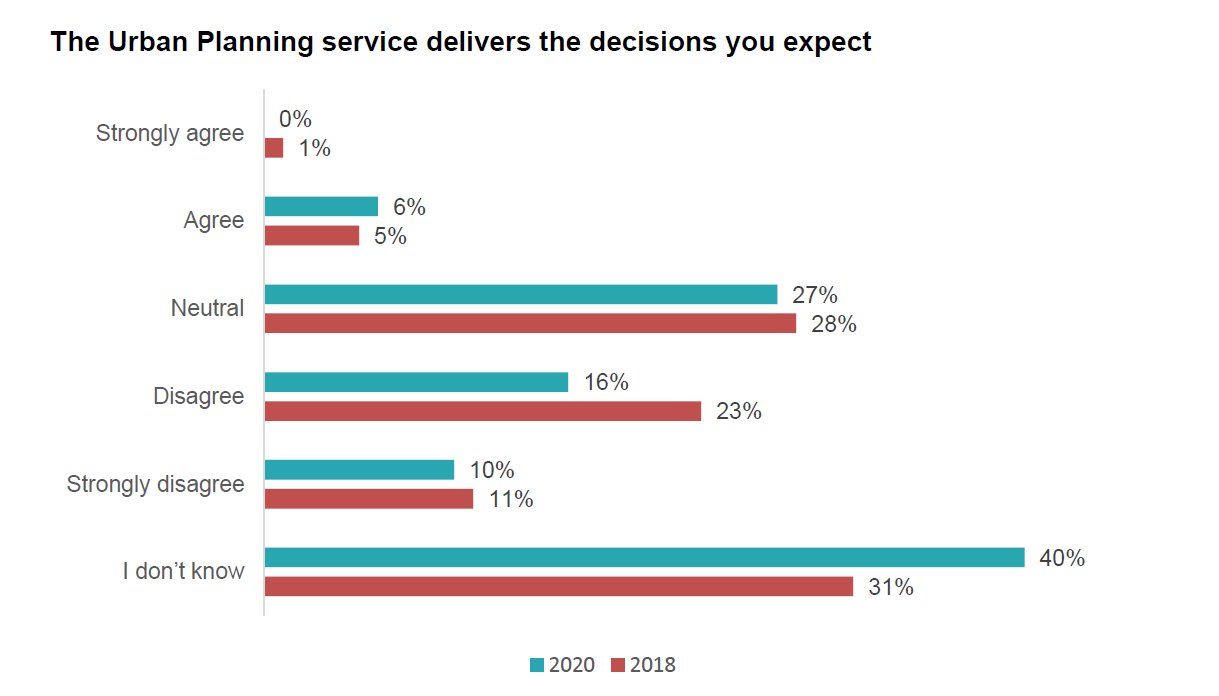
Below is the blurb that has accompanied the latest ‘survey’ for Community Voice members. It purports to investigate how our public open space has been used during COVID and to provide an insight into potential future use.

The questions (only 3) for this ‘survey’ were:

Question 1 – Since the beginning of the pandemic, I have used parks or shared paths (not including street footpaths) in Glen Eira… (a) more frequently; (b) the same; (c) less frequently.

Question 2 – Do you anticipate that you will continue to use parks or shared paths (not including street footpaths) in Glen Eira more frequently than before the pandemic for the foreseeable future? …(a) yes; (b) no; (c) unsure

Question 3 – Is there anything you would like to add about Glen Eira’s public parks and paths? (Space provided for a comment)

If council really wants to know how to “plan for the changing needs” of the community then surely the very first set of questions that need to be asked are:

  • How did you use parks during covid? – ie passive enjoyment? Exercise – walking? Walking the dog? Meeting friend(s)? Bike riding? etc.
  • Were any of the above new to your previous use of parks?
  • Which parks did you visit and why?
  • Was the existing infrastructure adequate? (seats, barbecues, water fountains, toilets, shade? etc)

There are many, many more questions that could and should have been asked in order to come up with a ‘survey’ that is genuine, valid, and fully informative. We allege that this is merely another instance of ‘consultation’ that is not only meaningless but a waste of money and officers’ time. Yet it will undoubtedly lead to council proudly proclaiming how often and how well they ‘consult’ with residents. Nothing could be further from the truth. 

It has taken council no less than 4 weeks to fulfill its promise of answering ALL questions posed by residents at the 20th August Zoom meeting on planning.

What is concerning about the responses is:

  • The failure to answer some of the questions posed
  • The reliance on more and more motherhood statements that are meaningless
  • The unwillingness to engage directly (and honestly) with what the questions actually asked.

We’ve uploaded council’s version of the questions and their responses HERE.

Even more significant is the number of questions that remain unanswered. We list them below. We have edited out comments and only included what can be regarded as ‘questions’.

How many homes has the State govt required GE to provide over what period of time and how are we on track for that? At some point can we say ‘that’ it, we’ve built  our allocation and we can stop now’?

Can you define housing and how the current repeat building of shoe boxes is meeting the needs of older Australian’s or young families

Ron’s  photo with title”the right housing in the right place” is shops and apartments at corner of Glenhuntly Road corner of James St in Glen Huntly. But this development has a step at shop front doors and disabled access is only by pressing buzzer through apartment entry in side street. Does Glen Eira Planning Scheme now require universal access for all new shops and ground floor apartment ? Especially as Ron noted aging population wit likely greater accessibility needs.

How is planning going to fund adequate open space into activity centres, areas of need, increased population to ensure resident recreation, mental health and a decent Urban Forest policy as if 5.7% open space levy has not increased open space, 8.3% may well also be inadequate.

in regards to the Elsternwick Structure Plan, particularly as it relates to the Urban Renewal North Area. In Dec 2018 we were provided with a step-by-step process by the Mayor. Where are we at right now specifically in that  process that was presented?

How does bulldozing one heritage home after another present has proctection

In Feb 2018, Council endorsed max. of 5 stories in all Neighbourhood Centres as recommended by the Planning Officers.  To have made this recommendation Planning Officers must have undertaken statistical analysis that supported that decision.  Please advise when the Amendments supporting a request for interim height controls for 5 stories was submitted to the Minister

You mention diversity but there seems to be little diversity in  what’s being built that’s new… lots of tiny apartments.  What about townhouses, low cost housing, well equipped house sized apartments for downsizers …??

what is the status of the Caulfield North Activity Centre planning? has it been discussed with the community because the area is a real dogs breakfast at present

how do the conditions imposed on planning permit applications get enforced and followed through by Council?

When will ESD LPP be introduced and when will Council include zero net emissions from buildings  and transport by 2030 in the Planning Scheme? Is Council considering water sensitive design and biodiversity sensitive design? How will council prioiritise active transport and reduce car-dependence and car-parking provision?

how do the conditions imposed on planning permit applications get enforced and followed through by Council?

It sounds like the Planning team is under-resourced, having to put important work on hold while attending to other work – do you need more staff?

Sorry Matt but if the council isn’t listening to the community why spend money on so called “consultation”.

Caulfield South is a Neighbourhood Activity Centre, which, in the Glen Eira City Plan 2020, height limits of buildings in commercial zones are designated as 5 storeys.

 As we meet this evening there are 5 developer proposals heading to VCAT:  one of 9 storeys, one of 8 storeys and three buildings of 7 storeys in Caulfield South Neighbourhood Centre. Caulfield South is not a Major Activity Centre. Developments of this nature will seriously impact the neighbouring properties and destroy the concept of what is presently a neighbourhood centre.

Residents should not be expected to fight these battles on their own. As there are no structure plans in place for Caulfield South, and there are currently no mandatory height limits for Caulfield South Neighbourhood Centre, residents will struggle to win at VCAT.

Will Council commit to defending its City Plan by providing external legal representation to help residents oppose these developments when each of these proposals goes before VCAT?

CONCLUSION(S)

The questions that weren’t answered are important. Some seek information on status of policies and structure planning; others seek specific statistics that council should have at its fingertips. In terms of council’s needs is it really that difficult to provide a ‘yes’ or ‘no’ to a straight forward question of ‘do you need more planning staff’?

Given the sheer number of questions that didn’t receive an ‘answer’, it is impossible to accept the possibility that missing all of these was nothing more than an ‘oversight’. So why weren’t they answered? And why does council keep promising things that it has no intention of fulfilling?

It literally staggers belief how often public questions remain unanswered and unchallenged by our group of councillors. Last week’s council meeting was the perfect example of a council determined to deflect, dissemble, and refuse point blank to respond accurately and transparently to resident concerns. It remains one of the most shameful incidents of recent times.

There were quite a number of questions at this meeting. We will highlight only one of the responses  in this post – (they certainly do not merit being called  ‘answers’).

QUESTION: Can Council advise what is the number of additional dwellings that are possible under the current Planning Scheme and the total dwelling capacity of Glen Eira? 

RESPONSE: There is no prescribed limit to the number of dwellings that can be provided under the provisions of the Glen Eira Planning Scheme. The Victorian Planning System is performance based, which means that every application requires analysis of its context and the application of policies and established planning principles. The planning system is designed to enable development while protecting amenity. 

As such, the total dwelling capacity of the municipality is not fixed. 

Council however monitors the number of new dwellings that have been constructed against State Government housing targets identified in Victoria in Future. Council has previously informed you that Glen Eira is on track to meet the State Government housing targets. 

COMMENT: The question was very straight forward – ie asking for the number of ‘possible’ additional dwellings given the current Planning Scheme. The response was a deft deflection through the use of the word ‘prescribed’. Yes, nothing much is ‘prescribed’ in the Planning Scheme, and ‘yes’ it is “performance based’ where each application is evaluated individually. Having said all that, what council has refused to acknowledge is that every single version of its structure planning is based on a ‘capacity’ or ‘opportunity’ analysis of the municipality’s housing.

In 2017 we got 2 versions of such documents as the  Analysis of housing consumption and opportunities. On top of this we also have: Planning Strategy Impacts on Housing Opportunity. This latter document included the sentence: Council should seek to demonstrate adequate Housing Opportunity to ensure that expected housing targets will be met. Thus available land, population, and residents per dwellings are crunched to envisage some kind of ‘capacity’ under different zonings.

Even in the documentation accompanying  the draft C184 Amendment for Bentleigh & Carnegie we also have the 2020 version from SGS entitled: Addendum: Updated Housing Assessment for Bentleigh and Carnegie Activity Centres. In short, every application for interim heights and/or structure plans has included data on the potential number of additional dwellings that can be crammed into the municipality.

Here’s a breakdown of the published data:

In October 2017, we were told that housing ‘opportunity’ was – Using various methodologies outlined previously, this report has identified opportunities within the City of Glen Eira to provide a net gain of 25,970 dwellings. At 2011-2016 rates of development, this represents approximately 36 years of supply. This figure was repeated by the authors in the December 2017 version.

What needs to be remembered is that this data was the ‘backbone’ for the introduction of the interim height amendments C147 and C148 that had discretionary 6 and 7 storeys for Carnegie and 4 mandatory and 5 discretionary for Bentleigh. With Amendment C157 (August 2018) this suddenly became 12 storeys mandatory for Carnegie. And now through proposed Amendment C184, these mandatory heights are to become discretionary, plus the removal of the mandatory garden requirement for properties proposed to be zoned GRZ5. NRZ2 will revert to pre 2004 site coverage of 60%.

What’s important is that the so called experts were telling us that with the first versions of structure planning we would achieve the potential of 25,970 net new dwellings – nearly 8000 more than required by Victoria in Future 2019. Hence, why is council prepared to accept even more and more rezoning and greater heights that destroy our neighbourhoods?

And why can’t council quote these very figures in response to a public question? Is it because they do not want residents to suddenly put one and one together and start questioning the very basis of all planning in Glen Eira? If in 2017 we had capacity for over 25000 net new dwellings, then surely we don’t need structure plans that allow developers to reach for the sky? Or is this simply another example of council’s pro-development agenda?

The refusal to provide a straight forward response to a public question, when all the data has previously been published, is inexcusable.

Council’s penchant for secrecy and burying important news in its voluminous documentation continues with the release of the July 2020 financial report contained in the agenda for the upcoming Special council meeting (8th September).

We learn that $150,000 has been spent on the purchase of 66 and 66a Mackie Road, Bentleigh East. This is a 937 square metre property, that directly abuts Mackie Reserve. The property was sold on the 20th July 2020 for $1.605M. We can only assume the $150,000 is only the deposit and that settlement had not as yet occurred to warrant entry in the July financial report.

Why is there no open and transparent statement from council as to this purchase? Why is something as important as open space buried deep with two throwaway lines in a financial report that we doubt many people would bother ploughing through? Why the secrecy once the purchase has been made?

There are many queries regarding this purchase:

  • Does this constitute a wise decision given its 500 metre proximity to Bailey Reserve and the fact that at the back of this property sits Mackie Reserve? The following map illustrates other open space areas within walking distance.

  • Is it ‘beneficial’ to simply increase the size of existing open space when countless other areas are severely open space deficient – ie major activity centres?
  • Why was this land purchased when the Open space Refresh only graded its ‘importance’ as ‘medium’. And why was the land bought prior to the recommendations of the OSS, that a master plan be created for this reserve? As far as we know, no ‘consultation’ on Mackie Reserve has been done. Here are the ‘recommendations’ of the Open Space Refresh –

The following image from Google Earth shows why we have major concerns about this purchase and whether it is really ‘value for money’. Nothing however can excuse this council’s refusal to be open and transparent with its ratepayers.


This is a very, very brief report on last night’s council meeting. It represents in our view one of the most shameful performances in living memory. Inconsistencies in argument abounded, as did the continuation of council policy in NEVER, but NEVER answering residents’ questions that are deemed ‘embarrassing’ to council. And God forbid that any councillor actually has the balls to criticise or even question such responses or the substandard officer reports that are continually tabled in chamber.

The true highlight is Athanasopolous’ comment that councillors should not appear to be in the ‘pockets of residents’. Esakoff and her cohort were guilty of this very thing – but only when it suited. On the one hand they supported the 9 storey development in Selwyn Street in the face of massive opposition, and then when it came to the Glen Huntly Structure Plan, the argument suddenly changed to we ‘have to listen to our residents’.

Each and every one of these councillors has failed the community time and time again. It is definitely time for change.

Featured below is an interview with a Caulfield South resident on what is happening to this neighbourhood centre. As we have stated numerous times residents have never been given a clear unequivocal answer as to whether or not Caulfield South, Bentleigh East and now Caulfield North will have structure plans with mandatory heights, or merely Urban Design Frameworks that are nothing more than ‘guidelines’. More to the point, even if structure planning is undertaken, it will still take years and years for these plans to have any legal effect.  In the meantime these suburbs will, and are already, having high rise plonked alongside one and two storey dwellings.

Council is of course playing the blame game – ie it is all the government’s fault. Nothing could be further from the truth. Had council done what every other council has for the past decade, such as structure planning, design and development overlays, and decent strategic planning, we would not be in the mess we are now. Residents are the true victims of this councils inaction and pro development agenda for the past 15 years!!!!!

Please listen to this interview since it reveals fully the impact on residents.

At Tuesday’s meeting, council will consider an application for a 9 storey building opposite the Woolworths application for a 14 and 10 storey apartment/supermarket complex. The VCAT decision on the latter is imminent.

In regards to the current application the officer recommended a permit. Please note the following:

  • The application includes provision for a maximum of 600 people attending the building at the same time. Hours will be up to 10pm on most days
  • The parking shortfall is 231 and this is considered ‘acceptable’ given the availability of public transport. There will be NO ONSITE PARKING available.
  • The height of the proposed building is equivalent to what the Woolworth’s proposal is
  • Overshadowing and overlooking is ‘acceptable’ according to the report because this is an ‘activity centre’ and hence can’t have the same safeguards

The one sentence in this entire unbelievable report which is completely insulting and dismissive to residents and objectors reads:  Each of these matters (ie objections) have been considered in this report and there are no outstanding objector concerns to consider.

Our take on this report is that resident objections have NOT BEEN considered in any meaningful way. The entire report is designed to justify the unjustifiable. We do not deny the importance of a Jewish cultural precinct, nor the fact that both state and federal governments have provided millions to ensure this happens. What we do object to strongly is the failure to assess this application on pure planning matters and current council policies.

For starters the actual permit conditions concentrate almost exclusively on what most residents would regard as ‘minor’ compared to size, bulk, and traffic management issues. We get pages and pages about preserving the Kuldig stained glass windows and the bass relief. Pages and pages about ‘updated’ traffic and acoustic reports – but only after development has already been done! Of course there is the usual Construction Management conditions but hardly a word about setbacks, heights, etc. All of the latter remain ‘acceptable’ in this report.

Much is made of the current interim structure plan and the Design and Development Overlay No.10. Yet in this report basic features are easily pushed aside. For example: on street wall height the DDO requires 13 metres and upper level setbacks of 5 metres. The application is for A four storey, 17.39m high street wall is proposed along the Selwyn Street frontage. In determining that this is okay, we get this gem:

Whilst this is higher than that envisaged by the DDO, it is consistent with the recently approved street wall height of the Holocaust Centre immediately to the north at number 13-15 Selwyn Street. 

In the first place council granted the 13-15 Selwyn Street permit in June 2018. Amendment C157 was gazetted in 16th August 2018. That is two months after council granted the permit. Hence there was no DDO at the time of this decision. Also worthy of noting is that council’s structure plan had already been accepted with a three storey street wall height in February of 2018. Council’s incompetence at that time in ignoring its own structure plan and Quality Design Guidelines therefore paves the way for this application to get the nod and the pathetic argument is that because one building has a four storey street front it is okay for the entire street to look like this – ie. the podium is acceptable and will provide a consistent street wall character. 

We next come to the issue of overall height and again the variance with the current DDO –

The roof height complies with the DDO, whilst the architectural feature that serves to screen and integrate the plant equipment extends more than 4m above that the preferred height. It is important to recognise that the architectural feature is curved, so its encroachment is softened. It is considered that the curved design of this feature is an important design element as it not only serves to screen the plant equipment, but also adds visual interest and a more sculpture look to the tower 

Does this mean that anything that is of ‘visual interest’ or ‘curved’ can attain any height the developer wants – in spite of what planning law states?

One of the most questionable ‘conditions’ comes with the issue of overlooking. Instead of requiring the developer to alter his plans, council comes up with the following ‘solution’ –

To limit overlooking impacts from these areas, expanded metal mesh cladding is proposed to cover the entire windows of these areas. The cladding will only be 23 per cent visually permeable. This affords a higher degree of protection than if the Clause 55 overlooking standard was applied. 

So we get to the ludicrous situation that where ‘convenient’ for the developer, Clause 55 does come into play and is ‘improved’ upon – even though it carried no real weight given the proposed height.

The best part is the finding that a car parking waiver of 231 spots is just fine! Why? –

The proposal generates a requirement for 231 car parking spaces and 17 bicycle parking spaces based on the Scheme requirements. No car parking is provided as this is not achievable on this land due to both the shape and size of the lot, however 40 bicycle parking spaces are provided.  

And

It is recognized that there are no options for providing any on-site parking and this must be balanced with the broader benefit of the building. 

Really? So local residents are nothing more than ‘collateral damage’????!!!!!!! And since when are there ‘no options’. There are no ‘options’ only when it doesn’t suit council and the developer and the objective is to have a 9 storey building! 

Apart from this nonsense we also have to take the word of transport assessments that state:

Car parking surveys of the area demonstrate that throughout the day there are at least 100 spaces available with typical occupancy rates of approximately 20% at the busiest times which increases to approximately 50% outside of peak times. 

Even if this were true, it does not include the resultant traffic and parking issues created by the Woolworths development and the potential supermarket traffic and that of 173 apartments in the complex. More importantly, since this application wants attendances until 10pm at night then the argument about other developments wanting ‘long term car parking’ spots goes out the window. How many visitors attending a function until 10pm that starts at say 7pm will want to travel home by public transport – especially the elderly?

Basic questions have simply not been addressed or brushed under the carpet. The so called developer’s answer to traffic and parking includes a majority of ‘promote’ options with no empirical evidence provided that these have a chance in hell to be successful.

All in all, this is a deplorable officer’s report and should be condemned for what it really is – an excuse to give the developer everything he wants. This council is simply going from bad to worse in order to facilitate its pro development agenda!

« Previous PageNext Page »