GE Service Performance


GESAC, LAWYERS & LIQUIDATED DAMAGES

Buried in the financial report we finally, after several months silence, get some more comment on the tussle with Hansen & Yuncken. Problems are far from resolved. How much this is costing ratepayers in legal fees is anyone’s guess. But we can at least be certain that it is not chicken feed and that there are some very real problems with the construction of GESAC itself. Here’s what’s been disclosed –

The GESAC construction contract was entered into between Council and Hansen Yuncken in December 2009, for an amount of $41.2M. The defects liability period has been extended under the contract and the final certificate of completion will not be issued until at least May 2014. Council has paid $39.99M against the contract. The contract provides for mechanisms to determine matters in dispute.

There are a number of issues concerning the building of the centre which are currently in dispute. They include the delay in completion of the centre (liquidated damages), variations, and back charges for use of Council utilities during construction and defects. The matters are the subject of proceedings brought by Council. A Directions Hearing has been adjourned to 23 August 2013.

It would seem that another $122,000 has been ploughed into GESAC this financial year (as carry over) and that’s on top of the previous $45,000 a few months back. Please note: we still do not know how many full time, part-time and casual staff are under the employ of council and how much this is costing per year. Transparency and accountability are the inevitable victims here especially when all figures are either fragmented or lumped together into a general, but vague number. We’d even go so far as to doubt whether councillors themselves have ever sighted a proper balance sheet or ledger that clearly itemises every single expense against every cent earned as income.


RECORDS OF ASSEMBLY

Revisions and amendments to the records continue unabated. At least 4 ‘alterations’ to the ‘minutes’ this time around. Rewriting history has become par for the course it would appear.

For the VERY FIRST TIME (August 13th) and well after the 5th August announcement by the Minister on the Residential Zones, we find the notation – Item 9.14: Mandatory Maximum Height Limits over all Residentially Zoned Land. Only after the fact does this major item surface in the Records of Assembly and its link to C110. For month after month the records of assembly have been nothing more than a deliberate attempt to camouflage and thus keep secret what was going on.

COUNCILLOR CODE OF CONDUCT

In the light of the above paragraph it’s quite laughable that one of the proposed changes to the code includes the insertion of the word ‘transparency’ – The business of the Council is conducted with efficiency, impartiality transparency and integrity.

One extraordinary new addition reads: 4.8.3 It is important that outside parties feel they can deal with Council in good faith and that officers can advise councillors in confidence. In order to achieve this Councillors should not distribute or disclose the contents of correspondence to or from Council or internal Council working documents unless it is for the benefit of Council and the Councillor group has agreed.

The noose tightens some more but the hypocrisy remains. That’s why Newton can decide to publish private correspondence of individuals and councillors as he has done in the past with equanimity?

Our last comment on this document draws readers’ attention to the glaring absence of ANY MENTION OF DISPUTE RESOLUTION PROCESSES BETWEEN COUNCILLORS AND STAFF, AND/OR THE PUBLIC. All that this code contains is a short blurb about disputes between councillors alone. Given this council’s history under Newton (ie investigation after investigation) the inclusion of protocols that deal with councillor/staff disputes would seem to be essential. Other councils that have been chosen for the Notice of Motion item have no problems in including such protocols in their codes of conduct – ie. Bayside; Boroondara, Greater Dandenong and Knox. There are plenty of others throughout the state – but NOT GLEN EIRA!
The Agenda for Tuesday night features several items of real importance. Both focus on governance. This post concentrates on the Notice of Motion officer report. Our next post will feature the ‘new’ Councillor Code of Conduct with its even more draconian measures designed to gag councillors and strengthen the walls of secrecy.

NOTICE OF MOTION

For those unfamiliar with the term, or its significance, a notice of motion is a means for an item/issue to appear on council’s agenda and hence to be discussed by full council in an open meeting. What it also means is that an individual councillor, or two councillors, (ie a minority) are able to ensure that council considers what might otherwise never see the light of day. In Glen Eira sole control of the agenda is ceded to the CEO. Other councils do not operate in this fashion. But this is Glen Eira after all!

So there now appears after 3 council meetings the officers’ report in response to Delahunty’s request for such a report. It is certainly more benign than Newton’s effort of 3 years ago, but is equally non-informative and includes some wonderfully misleading statements. We note once again that NO OFFICER’S NAME APPEARS AS THE AUTHOR. So much for accountability and taking individual responsibility. When no name is listed than no-one can be accused of sub-standard work or inaccuracies.

The usual arguments are trotted out on cue: councillors have plenty of opportunity to have an item included on the agenda – all they have to do is ask! Another method is the Request for a Report. The anonymous author then gives some examples of the latter that are entirely innocuous and far from contentious – Murrumbeena Road Pedestrian Crossing; Sustainable Design Building Practices; Car Sharing; Murray Road Tree Planting; Elsternwick Plaza and the Toy Library. Of course, the only one from this list that got the nod of approval was the Elsternwick Plaza!

Readers should bear in mind the following scenario. A few meetings ago Delahunty declared that she ‘lost the argument’ about community consultation for the introduction of the Residential Zone Reforms. Okotel also intimated that this ‘decision’ caused her some angst. With a Notice of Motion this issue could have been placed on the agenda. It would then have been discussed in open and more importantly residents would be given the opportunity to hear what each councillor’s position was. Even better, residents would have been privy to the voting of each councillor. But no! Without such a notice of motion everything was done behind closed doors and in secret. Despite the empty words of the councillor code of conduct far too much that occurs at Glen Eira is shrouded in such secrecy.

Another craftily drafted statement from the officer’s report reads: If the Councillor group asks for a matter to be brought before the group, it is. There are several points to note here:

  1. 1.     What’s important is not what the CEO AGREES TO, but what he DISALLOWS and doesn’t agree to!
  2. 2.     The phrasing of the above makes it clear that it takes more than one councillor to have something placed on the agenda – it requires the ‘councillor group’. Hence, the minority of councillors who may wish to represent their electorate on a controversial issue do not have a hope in hell unless it is endorsed by the ruling clique.

Finally, we note the somewhat misleading nature of this sentence – introducing a Notice of Motion could be done by Council directly or via the Local Laws Advisory Committee.  What is not stated is that any change to the Local Law requires formal notification of an Amendment and the call for public submissions under Section 223 of the Local Government Act. It MUST hear submissions and must make everything public. The advisory committee may draft the document but that it still must go out for consultation.

We also remind readers that the Notice of Motion issue is only one single aspect of the Meeting Procedures that needs amendment. Other aspects that basically gag and undermine representative government we’ve already alluded to in the past – dissent from chair, notice of rescission, role of chairperson AND setting clear parameters for advisory committees by including them within the powers of the Local Law. Finally, we also remind readers that Councillor Questions were removed from the Local Law in 2009 with the promise that a new policy be introduced. It is now 2013 and this policy has been left untouched. It is the most Draconian and anti-democratic policy of all and pushed through on the second attempt by Lipshutz and his mates. The gag has now remained for 4 years – out of mind and out of view. This needs council attention now.

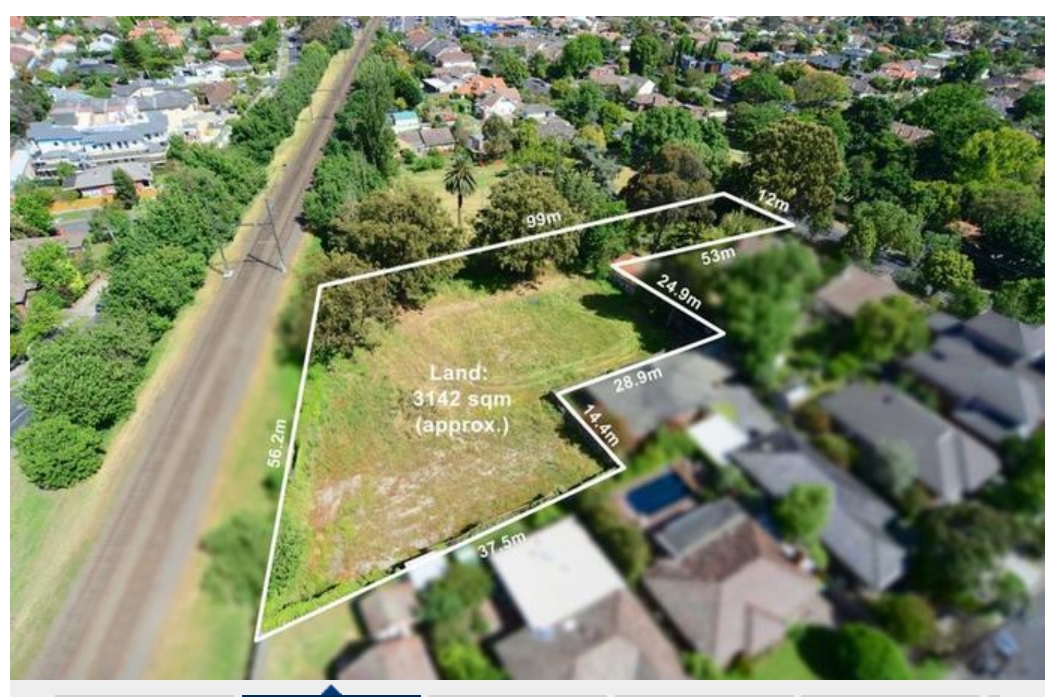
We’ve reported previously on the sale of 487 Neerim Road that abuts parkland. Council claimed that it could not buy the land to extend open space and so was sold off to a developer for over $2 million. It is on the market again – as a mortgagee’s auction! (see below). However this time, the pending sale is in concert with a planning application for 17 ‘villas’. Obviously a ploy to increase the value of the land and reap the biggest return. We reiterate, that what was originally Minimal Change is now well and truly planted in the middle of a Growth Zone. So much for council’s concern for neighbouring amenity. This speaks volumes of the incremental, secret, and ongoing increases in Housing Diversity throughout the municipality. For those interested, GERA, made several postings on this matter a while back. See: http://geresidents.wordpress.com/2013/02/09/lost-open-space-opportunity-update/

487

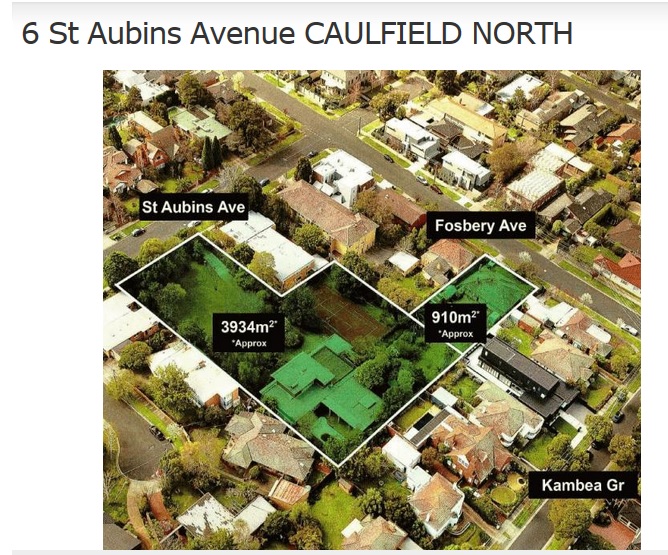
PS: Surprise! Surprise! Here’s another large sized property up for sale and Yes, there’s a planning application in for “multi-level” and 30 dwellings – all smack in the middle of Minimal Change! The application went in on the 15th August – well after the official announcement by the Minister but before the gazetting of the new zones! How convenient!

st aubins

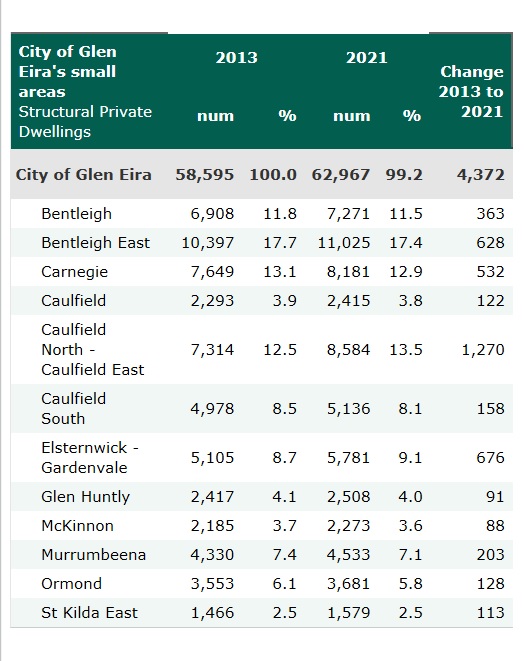
Over the next 20 years, the City will undergo moderate population growth and will see a continued decline in household sizes. As a consequence, there will be a need to plan for the additional 6,000 dwellings which are predicted for Glen Eira by 2021 as well as encouraging a more diverse housing stock (Department of Infrastructure, 1999, Victoria in Future). 

So sayeth Council in its latest spin document. When were these prognostications made? 1999? 2012? Your guess is as good as ours. But it certainly serves the objectives of the public relations department of Glen Eira. Clearly these figures are highly questionable. If the claim is that these projections represent the latest up-to-date data, then residents are being led up the garden path.

The Department of Planning’s latest version of Victoria in Future, 2012 makes the following predictions:

Currently the figures tell us that in 2011, private dwellings totalled 55,150. No figures are given for the numbers in 2013 although Profile.Id tell us that the figure is currently over 58,000. The projected figure needed for 2021 is claimed to be 59,908. Hardly an extra 6000 dwellings! (See: http://www.dpcd.vic.gov.au/home/publications-and-research/urban-and-regional-research/census-2011/victoria-in-future-2012/vif-2012-data-tables)

Profile.id.com in their predictions also come up far short of the cited 6000 dwellings.

dwelling forecastsWhat is most important is the need to take into account the development that has been rampant for the past decade. Council appears at VCAT and argues that population has already exceeded projections, so there should be some constraints on development. Yet their planning policies continue to invite massive scale developments without providing the needed strategic planning and investment in basic infrastructure such as drains, open space, etc.

Analysis of the Planning Activity Audit which is submitted by councils to the government on a regular basis reveals the extent of this development. Please note: we believe that these figures (as submitted by Council) are far from accurate given past history and if anything they underplay the scale of development. The duplication of some figures is also unexplained. The table below documents the number of applications submitted and the number of permits granted. The final column lists the number of permits for 2 or more dwellings.

Year

No of applications

Permits granted

2 or more dwellings

2003/4

1038

654

160

2004/5

950

586

143

2005/6

907

586

143

2006/7

919

522

192

2007/8

1188

1028

283

2008/9

998

946

209

2009/10

1121

910

317

2010/11

1237

1071

419

2011/12

1237

1071

337

Source: http://www.ppars.dpcd.vic.gov.au/Reports/04

At the very least the figures indicate that a MINIMUM of 7,000 dwellings have already gone into Glen Eira. The real figure  could be tenfold bigger since we’re only adding up the number of granted permits. These figures also do not reveal how successful the policy of creating DIVERSITY actually is. For example: of the thousands and thousands of units erected in the past decade, and looking ahead to the future, HOW MANY ARE 1 BEDROOM APARTMENTS? HOW MANY ARE 2 BEDROOM APARTMENTS? HOW MANY ARE 3 BEDROOM?

Do councillors ever ask for such figures? Do they in fact even know what is really going on in their neighbourhoods? Or do they leave everything to be (secretly) shunted through by an administration hell bent on more and more development at the cost of social, economic and environmental amenity for the majority of residents?

PS: We neglected to include the most vital statistic of all – the 1500+ units that will comprise the C60 development. So much for the need for another 6000 dwellings!

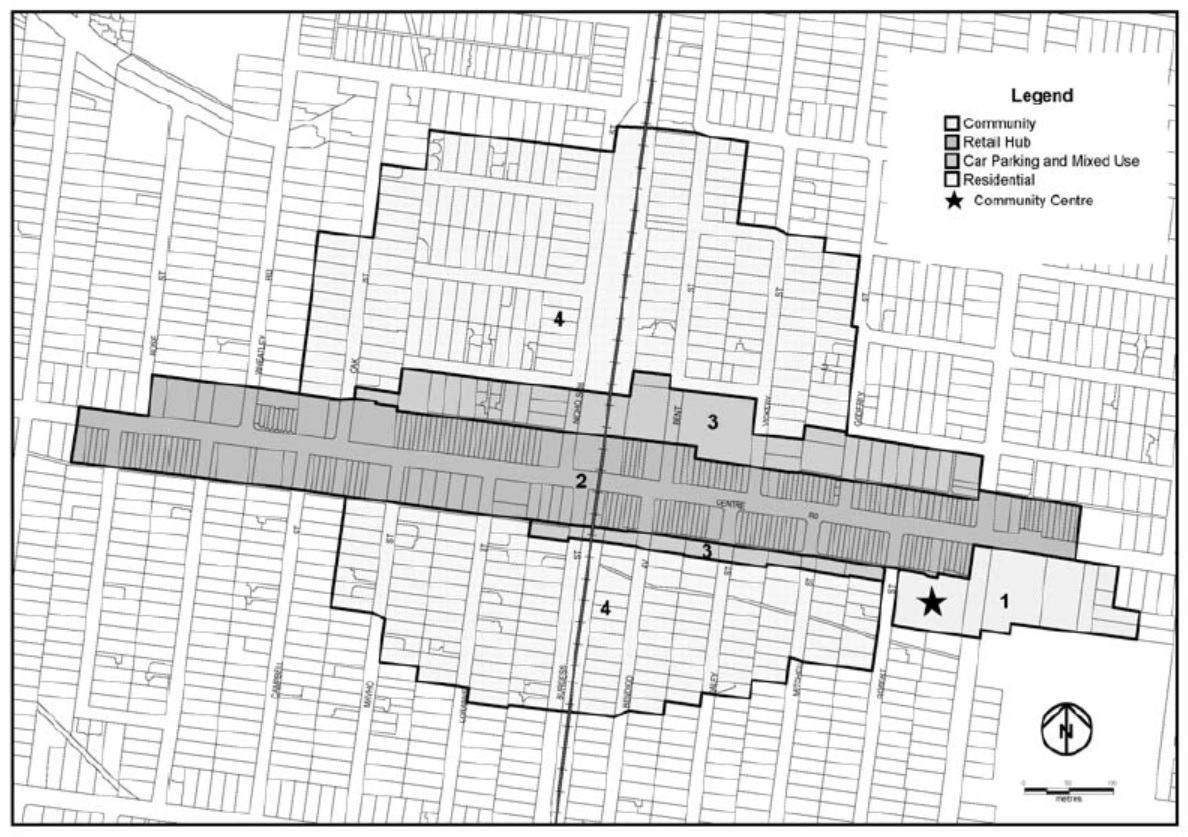
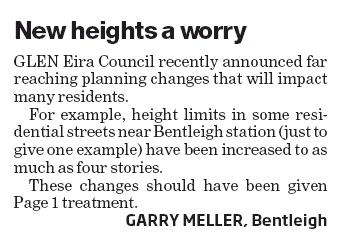
Here is a very real scenario that has now descended onto residents as a result of Amendment C110. To illustrate our argument the picture below features the Bentleigh carving up of streets PRIOR to the current Amendment. Readers may well ask themselves:

  1. Why the jagged lines everywhere? Why should a property that is 11 houses from Centre Rd be included in Housing Diversity and the house that is 12th be designated as Minimal Change? What is the strategic justification for such demarcation?
  2. Why should one side of a street be designated as Housing Diversity and the other side of the same street as Minimal Change? Again, questions about the efficacy of strategic planning and justification come into it. See map below taken from the OLD VERSION of the planning scheme.

bentleigh

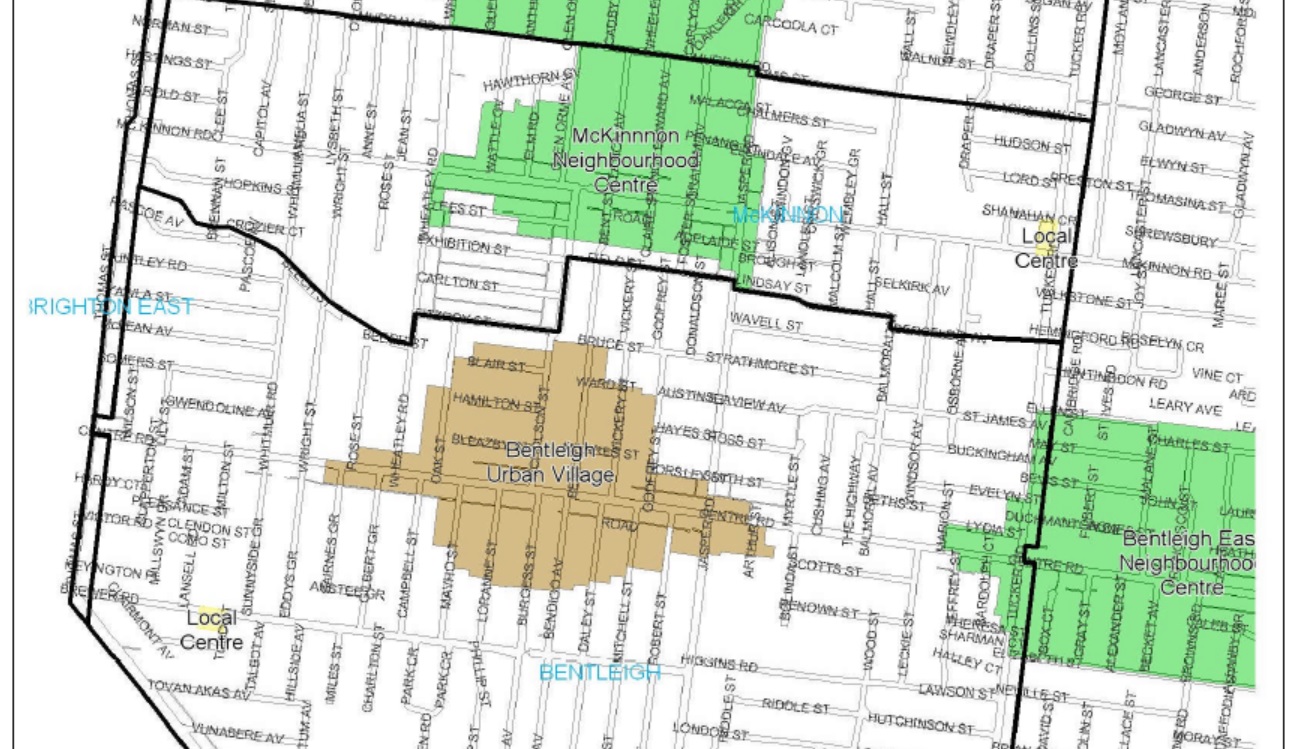
With the new Amendment c110 ALL AREAS ARE NOW DESIGNATED AS worthy of 4 STOREY DEVELOPMENT (IE BROWN)

bentleigh2

Almost by stealth, residents in these areas now face the real possibility of waking up to find that their residential streets have suddenly become fair game for 4 storey apartment blocks and heaven knows how many units. But that’s if you happen to live in the 11th house along Mahvo for example and on a certain side of the street. If you reside in the 12th house on that side of the street then you are technically in minimal change. However, you do face the prospect of having a 4 storey place smack bang next to you cutting out light, overlooking, and not a peep about traffic management plans anywhere within this amendment. There’s also the prospect of 8 or 10 or 12 storeys in the commercial centres just up the road, since this is open slather with no designated height limits, structure plans, or anything for the area.  Please remember that all of this has been achieved WITHOUT PUBLIC CONSULTATION AND WITHOUT ANY ADEQUATE  EXPLANATION TO RESIDENTS. It still remains to be seen how much of this amendment will stand up to the machinations of developers and the rulings of VCAT  – and last but not least – how well this council will actually enforce its own planning scheme. We are not very optimistic on this final point.

Pages from Kingston-Your-City-KYC-August-2013-WEB

The infamous C110 is now available. We will be commenting on this amendment over the next few postings. This post concentrates on the Housing & Residential parameters as stated. All extracts are verbatim quotes from the document and uploaded here.

This amendment has been prepared by the Minister for Planning who is the planning authority for this amendment.The amendment has been made at the request of the Glen Eira City Council.

COMMENT: So much for the myth that Council did not know well and truly beforehand that community consultation would not be occurring. Nor does it excuse the fact that the date submitted to the department was well before the public questions on consultation were tabled at council meetings. The responses were thus untruthful and deceitful.

The amendment applies the NRZ to the Minimal Change areas, the RGZ to the Housing Diversity areas and the GRZ to the small areas around the periphery of the Housing Diversity areas and along transport routes.

COMMENT: Nothing could be clearer than that HOUSING DIVERSITY HAS EXPANDED! Yet Council, apart from admitting changes to the Alma Club site and one other, still maintain that nothing much has changed and that the amendment is simply a ‘translation’ of current zones.

Another objective of Council is to promote the integrated planning of the city. Integrated planning involves working with the community, residents, traders, service providers and other stakeholders to enhance the quality of Glen Eira’s suburbs and their environmental, economic and social sustainability. Integrated planning involves looking beyond traditional town planning solutions. It is important to encourage people to participate in the development of their city and to develop overall visions and plans for areas. It involves holistically looking at a wide range of issues in the local community including; infrastructure, social planning, economic development, recreation and capital works.

COMMENT: So much for the spin versus the reality! So much for ‘integrated planning’ that involves the community. To include such blatant propaganda in an official document that has no relationship to actual events is both insulting to residents and says much about the workings of council.

  • Facilitate high quality urban design and architecture that will enhance neighbourhood character.
  • Encourage the retention of existing vegetation, in particular vegetation and trees which contribute to the City’s tree canopy.
  • Encourage energy efficient housing design, landscape design, construction materials and techniques that will minimise environmental impacts in residential developments.
  • Encourage residents and developers to adopt more environmentally friendly practices such as reducing water usage, recycling and reducing energy use.
  • Encourage rainwater retention and usage in larger developments.
  • Ensure that the community is involved in decision making about their neighbourhood.
  • Ensure that the traffic impacts are adequately addressed when considering new residential development.
  • Ensure that where new development places an increased burden on infrastructure it contributes to the upgrading of infrastructure. 

COMMENT: All motherhood statements that have lacked and continue to lack strategies and policies to enforce these objectives. We have commented numerous times on council’s refusal to introduce Environmental Sustainable Design, water saving design, traffic management precinct plans into its planning scheme. These sentences merely continue the moratorium on action. They are intended to sound good, but are meaningless. How wonderful too that ‘infrastructure’ gets a mention when council REMOVED ITS DEVELOPMENT CONTRIBUTIONS LEVY. Ironically, they may now be forced to re-introduce it!

  • Using the Commercial Centres Policy to strengthen the core of strip shopping centres, identify declining centres and identify new opportunities for non-retail functions. 
  • Using the Monash Medical Centre Precinct Structure Using the Non Residential Uses in Residential Zones Policy to provide some certainty when planning to establish non residential uses in residential zones (eg medical centres, childcare centres).
  • Using the Heritage Policy to manage new development (including additions, alterations and demolition of all or parts of a heritage place) in all areas covered by the Heritage Overlay.

COMMENT: These sentences are possibly the most damning in the entire document since they exhibit for all to see the sheer incompetence of council’s and the minister’s planning department(s). It simply reveals that Glen Eira council either does not check its work carefully enough, or that it does not even know what is in its own planning scheme. PLEASE NOTE: Council does not have a ‘commercial centres policy’ – that was removed over a year ago as was the Monash Medical centre (and it was never a structure plan!). Childcare centres are lumped together with medical centres. It seems that Glen Eira planners don’t know that they introduced a separate ‘childcare’ policy and removed it from the ‘non residential uses’ quite recently. Sloppy, inept, and totally unprofessional!

FUTURE STRATEGIC WORK

  • For housing diversity areas, in conjunction with Melbourne Water, further investigating the capacity of drainage infrastructure to accommodate multi-unit development.
  • Developing local structure plans / urban design frameworks to guide development in the neighbourhood centres.
  • Investigating a vegetation management program which considers appropriate controlsand guidelines to ensure vegetation protection.
  • Developing environmental sustainability guidelines for residential development bydrawing together the best practice in this area to ensure that new residential development is more environmentally sustainable
  • Developing “suburb” plans for each suburb which integrate land use and developmentplanning, with planning for infrastructure, capital works, recreation, parks and gardens,street trees and business development.
  • Developing local area traffic management plans and parking precinct plans to control the effects of parking and traffic intrusion in residential areas.
  • Implementing local area traffic management changes in existing areas in consultation with communities to improve safety and amenity and discourage use by inappropriate traffic.
  • Investigating mechanisms which require developers to undertake street tree planting.

COMMENT: Promises, promises which we believe will never be introduced or undertaken given the record of this council over the past decade and its abject failure to make a move on most of these aspirations. The 2010 Planning Scheme Review, plus the 2011 Planisphere report recommended reviewing Heritage Areas. This hasn’t been touched since 1996! Readers also need to note that the accompanying ‘policies’ in this document go as far back as 1999. The promises of years and years ago remain the unfulfilled promises of today. This does not fill us with confidence that any of these ‘future’ plans will be acted upon – but they sure as hell sound good for any resident who might decide to actually read the amendment and/or the planning scheme.

Screen shot2 2013-08-19 at 3.15.20 PM

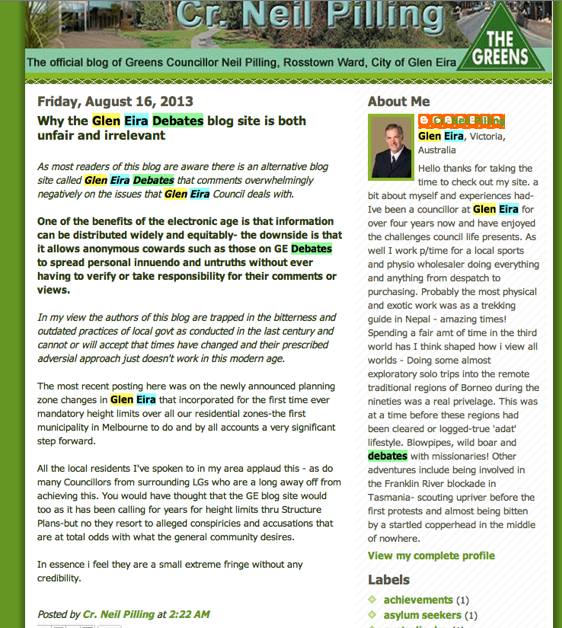
We take this opportunity to respond to the comments made by Cr Pilling featured above. It’s worth noting that this posting has now been removed!

GE Debates is labelled as ‘unfair’, ‘irrelevant’, consisting of ‘cowards’ and ‘untruths’ amongst other things.  It is also claimed that we do not ‘verify’ our data. All of these labels are symptomatic of a council and its councillors who believe that by attacking the messenger they can absolve themselves from having to deal with the countless issues we have raised over the past 3 years. On every vital aspect of governance this council has underperformed. Here is a list in case Cr Pilling has forgotten –

  • Meeting procedures that stand in stark contrast to every other council in the state
  • Consultation or lack thereof especially in relation to the residential zones, budgets and council plans
  • Lack of transparency re countless decision making processes – especially planning and role of the DPC
  • Acceptance of sub-standard reporting by officers
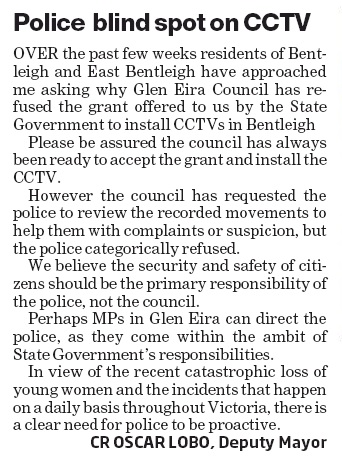
  • Lack of commitment and action on numerous issues – carbon reduction targets; tree register, vegie gardens, cctv cameras; car sharing; ESD policies; WSUD policies; Urban Design Frameworks – and the list goes on and on.
  • Repeated failures to provide comprehensive cost-benefit analysis within officer reports

For each of these issues we have taken the time and effort to contrast this council’s performance with that of its neighbours. We have supplied facts, figures, statistics, and we believe sound argument. Glen Eira Council, in contrast, has repeatedly come up short when it comes to these basic elements. Residents need to ask themselves just one thing – Why? Why is it that other councils can achieve all these things and Glen Eira is incapable, or even worse, unwilling? And, if we are so ‘irrelevant’ then why bother putting up such a post and why the repeated attempts in council meetings to answer our criticisms.

Pilling’s post is typical then of the modus operandi of this council. Ignore the issue and slay the messenger. If the issue just can’t be ignored then there is always spin or secrecy. The most self incriminating comment that Pilling can make and which exemplifies his own inadequacies is the sentence – In my view the authors of this blog are trapped in the bitterness and outdated practices of local government as conducted in the last century….. . It is certainly illuminating and sad, that a current councillor believes that the call for transparency, accountability, and sound financial management belongs in the last century! Our view is that times may have changed, but that Glen Eira Council remains marooned in a past where oligarchies ruled and their actions went unquestioned. In 2013 thanks to the internet and social media all is open to scrutiny. That is the foundation of good government – so sorely missing in Glen Eira thanks to the inability of its councillors to recognise and accept this simple fact.   As decision makers councillors should be called to account when their decisions so often fly in the face of community aspirations and their arguments lack all credibility and substance.

Finally it is worth pointing out that over 461,000 hits must be a sure sign of ‘irrelevance’!!!!!!

pzcctv

Below are the ‘responses’ to last week’s public questions. We ask readers to consider:

  • How much credibility do any of these ‘responses’ deserve?
  • How much faith should residents place in the imputation that the zones are largely the handiwork of the Minister and that little ‘ol Glen Eira Council was not the instigator and/or responsible for the outcomes?
  • Why would a Minister bother with such a small site as the Alma Club when he hasn’t intervened in the C60 or other major developments such as the Clover Estate, etc? In our view, the rezoning of the Alma Club and other sites has to be placed fairly and squarely at the feet of Council and not the Minister.
  • Who wrote the schedules? Surely not the Minister?
  • Please note how many sections of these questions are totally ignored
  • Once again, not all public questions were read out or their existence even acknowledged.
  • And the most important question was – why the secrecy?

QUESTION 1

1. On what precise date was Amendment C110 (Residential zones) submitted to the Minister and/or DPCD?

2. Why hasn’t the full Amendment and its schedules been made public by council prior to its being gazetted – especially since it has now been announced?

“Council does not have Amendment C110. It is, of course, not possible for Council to publish a document that is not in our possession.

When the Minister announced the creation of three new residential zones in March 2013, he said that he would translate Councils’ planning schemes into the new zones by Ministerial Amendment. A Ministerial Amendment is different to the process you are familiar with which involves Exhibition, an Independent Panel and Adoption.

After the Minister announced his openness to Ministerial Amendments, this Council sought differential zones and mandatory maximum height limits, which the Glen Eira community and Council have sought for many years, based on the established Minimal Change and Housing Diversity policies. On 5 August, the Minister announced that he had approved a translation into the new residential zones and issued a Media Release to that effect.

Ministerial Amendment C110 also includes some elements which Council did not raise such as the rezoning of the site of the former Alma Club in Caulfield North to the General Residential Zone and the rezoning of the ABC’s studios in Gordon St, Elsternwick to the Residential Growth Zone.

It follows that there was no precise date on which Amendment C110 was submitted to the Minister in the way that most planning scheme amendments which have been prepared and adopted by a Council.

Amendment C110 is scheduled to be Gazetted on 23 August 2013. The mandatory maximum height limits and other benefits will apply to applications lodged on and after that date.”

QUESTION 2

New Residential Zones were announced last week which show 1 Wilks St site allocated General Residential Zone Schedule 1 with minimal setbacks to the abutting Neighbourhood Residential Zone Schedule 1. This fails to meet the Transition Buffers as elucidated to in “5.9 Transition Buffers” of the Guide to the New Residential Zones; buffers which apply to all other abutting transitions. 

Question 1. Please provide IN DETAIL ALL the reasons why the zoning for 1 Wilks St site was not retained as Neighbourhood Residential Zone, the equivalent of the old Minimal Change Area, particularly as it completely contravenes all the reasons given by Council for unanimously rejecting the Planning Application GE/PP25557/2013? 

Question 2. Please provide IN DETAIL ALL the reasons why the zoning was made General Residential Schedule 1 not General Residential Schedule 2, particularly as 1 Wilks St is abutted on over 3 sides by Neighbourhood Residential Zone Schedule 1?  

Question 3. Who (officer, department, council or government person or the like) made these aberrant recommendations and who authorised these aberrant decisions?

Question 4. Under whose or what authority were these decisions made?

Question 5. Further to my question on zoning of 1 Wilks St, what action is Council now taking, or intends to take to rectify the error in Transition Buffers for all properties abutting the 1 Wilks St site? 

The Minister for Planning applied the new zones by Ministerial Amendment, taking into account and largely adopting requests from Council. However, Council did not canvass any change for the site of the former Alma Club at 1 Wilks Street, Caulfield North. Council assumed a direct translation from Minimal Change to the Neighbourhood Residential Zone.

Council was advised on 5 August that the former Alma Club had been included in the General Residential Zone. Council’s understanding is that the site will have its own Schedule which will be consistent with the setbacks set out in the officer report on the planning application considered by Council on 2 July 2013. Details should be clear by the time of Gazettal which is scheduled for 23 August.

The planning application for the site is before VCAT. That appeal would be determined in accordance with the rules which applied at the time the application was lodged, including the Minimal Change policy

QUESTION 3

Given that the

1. Glen Eira Planning Scheme was last reviewed in 2010 and scheduled for the 4 yearly review in 2014 and

2. Council had 12 months to implement the new residential zones Could Council please provide its reasons for electing not to consult with the community on the introduction of the new residential zones? 

Glen Eira has had policies in the Planning Scheme for the last nine years which differentiate the municipality into Minimal Change Areas and Housing Diversity Areas. Those policies were incorporated into the Planning Scheme following extensive community consultation. The policies are well understood within our community. (Policies are, however, open to interpretation as is regularly seen at VCAT and greater certainty could only be achieved by the use of controls ie zones.)

Council undertook a Review of the Planning Scheme in 2010-11. Through the consultative mechanisms of the Review, the community made clear that it is seeking:

 mandatory maximum height limits binding on all parties, including VCAT;

 transition controls to step development more gradually between higher and lower density areas; and

 greater certainty for both existing residents and providers of additional residential housing.

The three new zones provide the opportunity to achieve these enhancements which are not possible under a policy framework.

Based on the outcomes of these consultative processes, Council sought a direct and neutral conversion to the new zones which achieved the outcomes sought by the community. If the process had not addressed the community’s expressed priorities, Council would have discontinued that process.

The translation which has been approved introduces greater protections for the benefit of existing residents as well as greater clarity for those wishing to proceed with residential development. The mix of zones, like the policies before them, provides for a clearer balance between retaining valued Neighbourhood Character and opportunities for higher density sustainable development at appropriate locations around public transport and shopping centres.

It is important to bear in mind that these zones were applied by Ministerial Amendment, taking into account, and largely adopting, Council requests. It is our firm belief that further consultation could not have resulted in a better outcome, and may well have had the opposite effect. Our concern, on this as in all matters, was to achieve the best possible result for the Community.”

« Previous PageNext Page »