GE Service Performance


Source: Australian Jewish News, 12th June 2013, Page 21

Time to Throw out Conservative councillors

A few weekends ago nearly 1500 locals gathered to support AJAX Senior Football Club when it recently played away at Princes Park in South Caulfield. Yet this club has been barred from home games at the ground by an unfair and unknown decision-making process wielded by the seemingly all powerful bureaucrats hidden in the halls of Glen Eira Town Hall.

Over a decade in politics I have observed with increasing bemusement the relative weakness of most elected councillors compared to the officials who seem to dominate Glen Eira Council. It must be said that the chief executive Andrew Newton of Glen Eira Council is polite and highly professional.

Many of the Glen Eira councillors are well-intentioned people but their conservative values dictated by the Liberal party have put them at odds with their community, have made them weak and they have not sought to bring much needed transparency to decision-making. New Councillor Mary Delahunty will make a difference.

Residents of Caulfield are fed up by the popular local footy club being barred from its local ground or by its over-development by a rapacious racing club fawned over by conservative councillors.

Sorry to say, however, the answer for Glen Eira residents fed up with overweening power of unelected professionals is more politics, not less.

Glen Eira voters must turf out the conservative councillors afraid to take on the bureaucrats.

Their replacements must run on an explicit program of asserting themselves over the civil servants of Glen Eira.

I am afraid that is the only way AJAX Senior Football will get to Princes Park, where so many of their boisterous local family and friends celebrated the opportunity for them to play in an “away” game.


MICHAEL DANBY

+++++++++++++++++++

Challenging council on ground allocation

Regarding Council allocation Mayor Hyams has not quite got it right/ Ajax could have got the Princes Park allocation and Old Haileybury could have stayed at McKinnon Reserve.

Alternatively, Old Haileybury could have been sent to GlenHuntly Oval and shared that ground with Caulfield Grammarians, where no junior Sunday games occur.

That way, no existing ground allocation would need to be cut. Glen Eira Council could have catered for the existing tenants and also catered for its real community club around Princes Park – AJAX FC where the junior play on a Sunday.

So as Councillor Hyams has advised in Council Minutes – that Old Haileybury has been moved due to the need to give the Mckinnon Reserve a rest. It is safe to assume that Old Haileybury will be moved back to its traditional home ground for 2014 opening the EOI (expression of interest) process for Princes Park?

IAN FAYMAN

There are some very interesting public questions as well as a few other events from Tuesday night’s meeting that are worthy of highlighting. First the public question on the Racecourse:

“At council meetings I note reports are frequently given by representatives who attend other bodies such as the MAV on behalf of council and reports are given. This being the case why do our three representatives on the Caulfield Racecourse Trustees never give a report, because it is absolutely impossible to find out what is going on in the Caulfield Racecourse Reserve. Do the Glen Eira Council Trustees realise that their residents are actually never granted permission to attend a CRT MEETING although this is advertised as being possible on The City of Glen Eira website as being the case? Is council prepared to take any action to ensure that the entrance to our reserve from Glen Eira Road is made to be more welcoming?

Or is council prepared to have the entrance pathway sealed and cleaned so that wheelchairs and prams do not collect horse excreta over the tyres and what action can be taken to remove the barrier at the eastern end of the pathway. A person in a wheelchair would have to reverse all the way to get out if unable to remove the barrier when in their wheelchair. This barrier has been in place for quite some time.

Could our representatives on CRT walk on this path and into the park and assess the situation in detail rather than speed through by car? Council came to a decision with the Melbourne Racing Club regarding this entrance issue and once again it seems the non-racing public has come off with a very bad result as it is being currently administered. Can our three trustees move to improve the situation for all residents of Glen Eira even those travelling in wheel chairs and pushing prams?”

The Mayor read the response on behalf of the Councillors who are appointed as Trustees to the Caulfield Racecourse Reserve Trust. He said:

“Thank you for your questions.

1. The premise in your first question however is not correct. Whereas there are Council representatives on various committees and bodies representing the views and interests of the Council – hence reports are made to and received by Council – that is not the case with the Caulfield Racecourse Reserve Trust.

Council is requested by the State Government to nominate Councillors to be appointed as Trustees. Council nominated 6 Councillors and it was the State Government that then appointed the Trustees. The three Councillors who are Trustees do not sit on the Trust as Council representatives per se but as Trustees. Any enquiries about the deliberations of the Trust should be directed to the Trust or to its chairperson, Mr Greg Sword.

2. We are aware that to date residents have not been granted permission to address the Trust. The decision as to whether a non-Trustee may address the Trust is determined by a majority of the Trustees. Council has advocated for the Trust to be more open and transparent, and will continue to do so.

3. Council has advocated for some time and continues to advocate that the tunnel entrance from Glen Eira Road be more welcoming and accessible to the public. It is for the Trust however to ensure that the entrance is clean and not for Council.

4. As Trustees we will certainly be raising with the Trust the issues to which you refer.”

++++++++++++++++++++++

The in camera report contains the following:

Crs Lipshutz/Delahunty

That Council

i) Rescind its 18 December 2012 resolution to appoint Green Home Green Planet Pty Ltd, ACN 137 823 360 as the contractor under EOI number 2013.030

Two points bear making here:

  • The Local Law does not have provision for rescinding motions as we’ve stated numerous times
  • This council appears to make its own rules as it goes along and when it suits. For example the recent resolution to enter into further ‘community consultation’ regarding the Caulfield Park Conservatory was made WITHOUT rescinding a previous motion that the conservatory be ‘restored’ and ‘redeveloped’.

++++++++++++++++++++++++++++

Finally, there is this Request for a Report regarding the ABC Studios in Elsternwick. We have no doubt that since this has reared its head and has come up at a council meeting that plenty of ‘negotiations’ have already occurred and that the potential token ‘open space’ that Council might be granted will be offset by another huge, multi-storey development! Watch this space!

Crs Pilling/Delahunty

That a report be prepared on the ABC site at Elsternwick. This report should detail past history, current usage and outline the present future plans for the site. It should also identify types of community uses and benefits for at least part of the site and set out strategies and steps Council can take to achieve this.

DECLARATIONS OF INTEREST

The Chief Executive Officer (CEO) declared a Conflict of Interest as he lives in close proximity to the site.

9.06PM the CEO left the Chamber.

The MOTION was put and CARRIED unanimously.

Here are some extracts from public submissions on the Budget & Community/Council Plan –

Centenary Park Car Park

#1 – The plan will have little effect on the number of cars which park on the roadside. The proposal to turn the northern car park into a garden area will to a degree isolate the childrens playground and the barbecue area. The removal of mature eucalypts which are an integral part of the park is an unattractive and environmentally unfriendly proposition. In conclusion I put it to you that the expense ($600,000) cannot be justified and it is in everyones interest to leave things as they are.

#2 – currently it is only during. the football season that there is insufficient parking space. This is on Sunday between 9am and 5pm when up to fifty or more cars are parked at any one time in brady road and leonie avenue. this amounts to about 25 days in the year. the cricket activity does not attract as many cars. the increased parking capacity in the proposed development of 63 to 75 (12 cars} will have little effect relative to the current situation,…. currently having two separate car parks – each with two exitientry points and separated by the wooded area, the traffic flow is better managed…..i agree that pedestrian safety is paramount however to date i am unaware 0 f any incident involving injury. with this background i put it to you that there is no perceived benefit in spending $600,000- to accomodate twelve more cars (which equates to $50,000 per car space.)

Caulfield Park

sports Ground Tolerant Grasses- by far the largest sum is allocated for this item which is purely to serve the purposes of active sport. An equivalent sum should be allocated to serve the needs of the many thousands of non-active sport users of the park. However. by our reckoning the sum of all the other budget items for Caulfield Park is at best $291.500.

Park Pathway lighting. We assume that this is to light the perimeter path. We also assume it includes the removal of the now redundant lights which used to light the central pedestrian pathway until it was relocated. These lights are still illumined every night and serve no useful purpose. The unsightly poles should be removed and the area planted with more trees to enhance vistas, provide more shade and increase habitat for birds across the centre of the park.

6. Playground Shade Sails Oval Number 2. This is another puzzling item as there is no playground near Oval No.2. so more explanation is required about this item. If money is to be spent on playgrounds it would be preferable to install some more play equipment at the main Park Crescent playground. on the large area recently created adjacent to Park Crescent and covered with unsightly wood chips. This area could be greatly improved by the addition of some play equipment to suit the 5-10 year age group. which is generally lacking in the park. This would be a better use of the $30.000 than installing shade sails at a non existent playground

A proper study to identify and secure an altemative location for the depot. Unless a specific study is carried out nothing is going to happen and the relocation of the depot is crucial step to providing more open space in this area of North Caulfield.

An in-depth study into the impact of climate change upon the trees in the west end of the park. Studies undertaken by the Melbourne Cify Council (Urban Forest strategy) indicate that within in the next decade 27 per cent of the current tree population in the cify’s parks are expected to die and 44 per cent in the next 20 years

Biodiversity/Sustainability

Biodiversity protection is an important part of Glen Eira’s Sustainable Living Plan, and it should be acknowledged with an accountable budget allocation. All decisions and measures taken by council should include an assessment of impacts on our local biodiversity and its sustainability.

Child Care

Year after year, we are presented with child care fee rises as a fait accompli. It would be respectful-and an act of good public relations- to present parents with the reasons for the increases. I would like to see a justification for not being be/ow average of the 38 centres in Glen Eira. As a community-based and notfor-profit service, I would not expect to see these fees on par with the plethora of privately run child care services in Glen Eira. Being average amongst profit-driven businesses is not a good thing.

Is the staff at Glen Eira’s centres any better qualified? Is more money put into their professional development? Do our children have better equipment or grounds? • How are these fees justified when other services provide meals and nappies and Glen Eira does not?

I believe that price increases and indeed, any fees at or above average, needs to be explained and justified: we are entitled to know where the fees are spent and to either rest assured that this service has an advantage over others- as perhaps an explanation might show- or to choose an alternate service that supplies nappies and meals for the same fee.

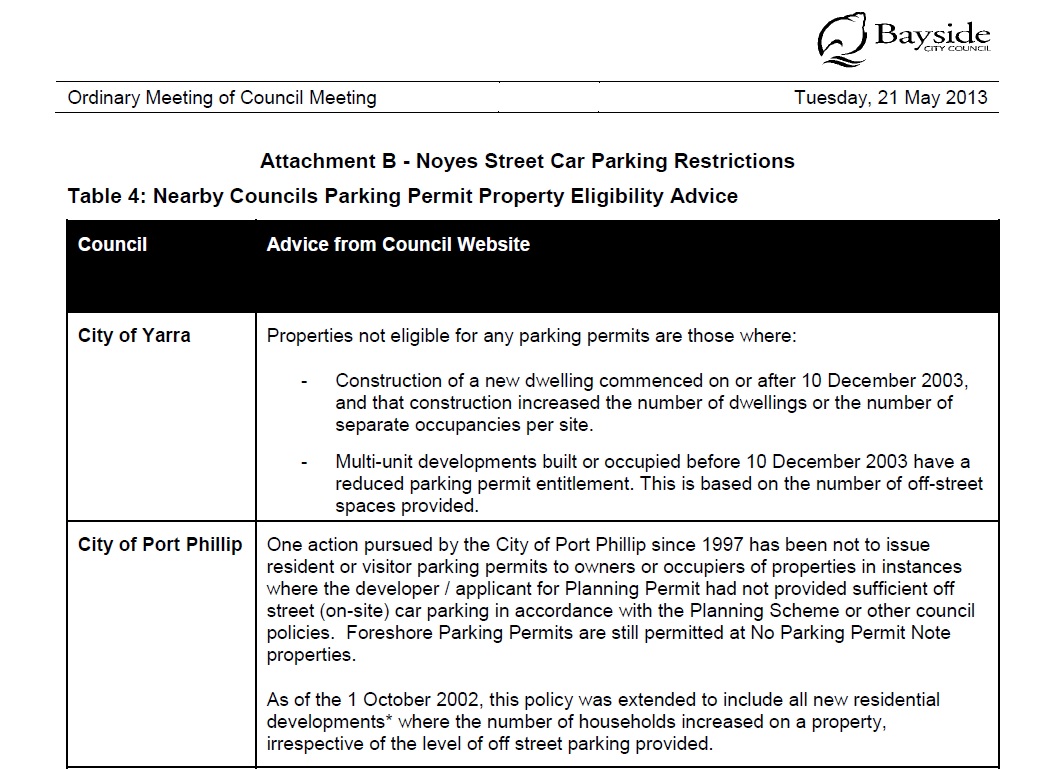
Another item up for decision on Tuesday night is the residential parking permit scheme. Our take on the proposals are that whilst Rome is burning our glorious council keeps fiddling and fiddling rather than addressing the problem head on as countless other councils have done – some in fact have been at it for over a decade. All Glen Eira seems capable of doing is burying its head in the sand whilst pretending to protect streets in Housing Diversity. But the horse has well and truly bolted so the suggested solution is akin to putting a bandaid on a gaping and suppurating wound. What is required is radical surgery.  Here’s why –

  • Council totally ignores the fact that Minimal Change Areas are being reshaped by 2 and 3 unit developments – ie the ‘problem’ is not just in Housing Diversity
  • Granting permits for car parking waivers only exacerbates the problem everywhere
  • The consistent refusal to introduce well researched and designed Parking Precinct plans or parking overlays (except for student housing) means further adhoc and hence substandard planning.
  • A policy that shunts car parking to ‘neighbouring’ streets is only transferring the issue elsewhere

The Akehurst ‘solution’ is simple – no Residential Parking permits in Housing Diversity (We’ve uploaded the report here).  It does not hold up to close examination and is a tacit admission of council’s spectacular failure to protect amenity and manage the issue. We highlight the following extracts from this ‘report’:

The policy has been applied for 10 years. In this time 457 dwellings have been excluded from obtaining a RPP (Residential Parking Permit).

COMMENT: From 2002 to roughly 2007/8 Council approved 600 dwellings per year. Since then the figure has escalated to approximately 1000 dwellings per year with only about 30% being single dwellings. On such estimates we can argue conservatively that around 5,500 units have been built. To only have 457 dwellings EXCLUDED in a decade is thus a total joke.

Akehurst does briefly note that “some councils deliberately selectively choose to under provide car parking in terms of the ResCode rates” but Glen Eira has always applied the standard ResCode rates related to bedroom numbers and no change to this position is envisaged in this review.

COMMENT: That’s it! A blanket statement with no justification, no facts, no figures, no nothing. Once again, this council washes its hands of anything that involves change and might just threaten the profits of developers. The ‘excuse’ that if change is required then it is considered preferable to link this to new developments  totally ignores that fact that ‘new developments’ are also rampant in Minimal Change! What’s even more damning is that Akehurst himself goes on to define ‘medium density’ as ‘two dwellings or more’!

Councillors and residents have to ask:

  • Why is this policy only applicable to Housing Diversity given that 2 or more dwellings are also mushrooming in Minimal Change and will continue to do so given that the infill in diversity areas is running out?
  • Why the failure to plan strategically, holistically, and appropriately?
  • Why can other councils (listed below) introduce a variety of options and Glen Eira is totally incapable or unwilling?

Moreland – Council issues up to two residential parking permits depending on whether or not there is a driveway crossover to your property.  If you have a crossover, then you are eligible for one permit only. AND Properties are not eligible for parking permits where approval of a planning permit for subdivision was issued after 31 August 2011 and this results in an increase in the number of separate occupancies on that site. (http://www.moreland.vic.gov.au/parking-roads-and-transport/parking-permits-moreland/residential-parking-permits.html)

Bayside –  – 3 permits AND Multi Unit Development Properties are not eligible to participate in the scheme. (http://www.bayside.vic.gov.au/parking_residential_parking_permits.htm)

Port Phillip – One action pursued by the City of Port Phillip since 1997 has been not to issue resident or visitor parking permits to owners or occupiers of properties in instances where the developer / applicant for Planning Permit had not provided sufficient off street (on-site) car parking in accordance with the Planning Scheme or other council policies.  Foreshore Parking Permits are still permitted at No Parking Permit Note properties.

As of the 1 October 2002, this policy was extended to include all new residential developments* where the number of households increased on a property, irrespective of the level of off street parking provided. (http://www.portphillip.vic.gov.au/resident-visitor-foreshore-parking-permits.htm)

Darebin – Each household can have a maximum of two permits. Households with off-street parking (eg driveway), right of way (laneway between house blocks) or with a garage are entitled to one permit only. (http://www.darebin.vic.gov.au/page/Page.aspx?Page_Id=6215)

Monash – single dwelling 2 permits; 2-4 dwellings 1 permit; 5 or more dwellings no permit

Whitehorse – 1 dwelling 3 permits; 2-5 dwellings 1 permit; more than 5 dwellings no permit.

It’s also worth noting that Frankston has a visitor car parking scheme based on the WIDTH OF THE RESIDENTIAL ROAD/STREET. The narrower the street, no parking! (http://www.frankston.vic.gov.au/library/scripts/objectifyMedia.aspx?file=pdf/309/09.pdf&..)

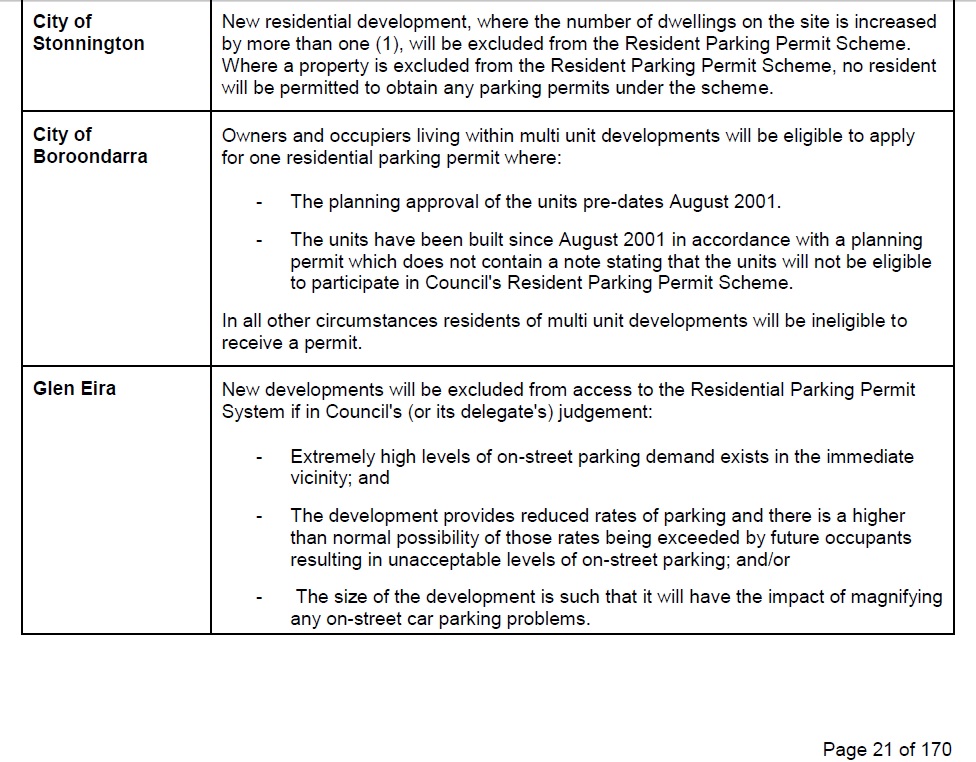
Boroondara – multi unit development prior to 2001 receive one permit. Post 2001 don’t get a permit. (http://www.boroondara.vic.gov.au/~/media/Files/Your%20Council/Parking%20and%20traffic/ResidentialParkingPermitPolicy2011pdf.pdf)

Tonight’s Planning Conference on the Alma Club development revealed in all its sordid glory how rigged the game really is. To their credit however, the developers’ rep did show up and fronted an audience of over 50 people including councillors Delahunty, Hyams, Lobo and Sounness. Magee chaired the conference. Andrew Bromley was the council planner. Even Newton made an appearance for a short time.

Several points need to be highlighted right from the start –

  • The developers and council have agreed that a 4.75% open space levy will be applied. Absolutely amazing when other councils (Bayside, Port Phillip, Moreland and countless others have introduced a MINIMUM of 5% levy across their entire municipalities for a meagre 3 lot subdivision. Here we have 75 units and the blood money is a paltry 4.75%. It would also be interesting to know: who agreed to this? when was it signed on the dotted line?
  • The developers ‘experts’ have verified that 4 visitor car parking spots are ‘adequate’
  • The one bedroom apartments will be exempt from car parking spots!
  • The claim is that the units (in a Minimal Change Area) equate to 42% of site coverage. We are certainly sceptical of this figure judging by the plans!
  • The most vital question however is that given this is in a Minimal Change Area and suggest 4 storey development, then why oh why wasn’t this application rejected right from the start under delegation? The single fact that it is a large site should not over-ride every other single ‘standard’ that is applied to the Minimal Change Area.
  • As a ‘planning conference’ this failed dismally to live up to the published council propaganda – ie ‘Where possible, attempt to resolve or reduce the issues in dispute’. Nothing of the kind happened or was even attempted!

Here is the sequence of events:

Magee claimed that residents were extremely lucky to have these ‘conferences’ because many other councils didn’t do this. Sadly, Magee neglected to mention that other councils have Planning Committees made up of councillors and residents are permitted to address full council on their objections. In Glen Eira objectors do not learn of the planners recommendations until the Friday before the application is set down for council decision and then there is no opportunity to address the council. Magee even had the gall to state that residents should wait for the recommendations and THEN LOBBY THEIR COUNCILLORS!

Bromley started ‘the process’ by explaining the plans. 75 dwellings, 4 storeys. Internal departments had had a look at the application. Objections were basically about: intensity of develolpment, streetscape, parking and traffic, loss of amenity, overlooking/overshadowing, storm water etc. Bromley emphasised that his decision would be mainly looking at the Minimal Change Policy and Neighborhood Character and parking. His report would go to council for decision on the 2nd July.

Objectors then had the opportunity to speak. First speaker said that she represented 22 households and asked for clarification. Said that the Minimal Change policy talked about ‘higher yield’ which doesn’t necessarily mean ‘higher density’ and this term refers to 4 storeys and above.

Asked about the telecommunications pole and the setbacks which weren’t clear from the plans. There was also an issue about an oak tree and wanted to know how this was to be protected. Said there were ‘unclear items’ on the plans. In terms of amenity for surrounding properties, there is a substation kiosk and exhaust right near fences. How many cars each day, etc. Wanted clarification on all these issues. Also wanted to know about the ‘internal amenity’ in the 4 storey apartments because of 4 light courts from the rooftoop to ‘ground level’ as this is the only light source and none will have ventilation. Also asked about drainage and whether this had been ‘factored into the design’. Finally given the layout, how emergency services vehicles were going to have access to the apartments.

MAGEE then said that these were a lot of questions and that the answers would ‘come out in the report’

Next speaker stated that the only large dwellings were basically on Dandenong Rd and a couple along Waiora Rd but they were ‘well set back’. Was also concerned about the body corporate and the decision making when so many owners would be involved and with elevators and other things there would be long term maintenance issues.

Another Waiora Rd residents spoke about a 7 unit development next to her and there were 20 odd cars coming in and out just from this one site. Said it was a ‘complete fiasco’ that that’s been accepted by Council. This application could have over 200 cars and ‘where are they supposed to come out from’? Asked if this was ‘responsible’ for councillors to accept something like this design.

MAGEE then said that it’s the state government who is responsible for setting parking allocations and ‘it’s not something that council can change’.

Another residents said that there were ‘natural springs’ there underground and a while back water came up on Alma Rd. Wanted to know about the water tables on the site and that this site was the centre of the spring, so what measures will be taken to remove the water. And if removed will it come up in someone else’s back yard and what is the process for compensation to residents affected by this? Wanted to know if any of this has been considered and what the strategy is to deal with this. Also wanted ‘assurance’ that the pedestrian right of way would still be open to people. Bemoaned the fact that council didn’t buy the property when it had the chance.

One lady said that she has recently sold her house because she believes that ‘the amenity of the area has been destroyed’ because of all these developments, especially along Dandenong Rd. Said that she lost about $50,000 because of this when she sold. She then took Magee to task stating that the Council had violated  ResCode numerous times and ‘that it is only a guideline not a rule’. Listed several properties that don’t have the car parking that ResCode advises.

Next resident said that anyone who believes that 75 dwellings in a dead end street should have ‘their licence taken away’. Said that plenty of his friends who live in apartments have ‘two or three’ visitor car parks for blocks of 10 units. ‘How 4 car spaces could possibly serve 75′ units ..’is beyond me’.

Another Norwood St resident stated that he had ‘difficulty parking outside my own house’ because of the developments and Norwood has become a rat run through to Dandenong Rd and King David. Said that with what’s happening there are now over 120 new apartments ‘in less than two years’. Said that everything in the area has been ‘altered’ and all to the negative. Said that ‘rates have gone up and property values have gone down’.

One Wilks St resident stated that an application for 2 town houses had been rejected because it was considered ‘high density’ in a minimal change area but ’75 apartments seems to be okay’. Said that in a 16 dwelling street this represents over 400% increase. Said there’s already problems with flooding because of the slope of the land and there have been sandbags in the street.

An Alma Rd resident talked about the traffic which she knows well since she’s lived there since 1986. Said the intersection was dangerous and more traffic is only going to make it worse. Reminded councillors that they’re supposed to represent residents! Caulfield North used to be a ‘blue ribbon’ area and now it’s not. Prices are dropping and thus her children’s futures are affected.

One resident asked that the application not be ‘negotiated’ but ‘flatly rejected’.

The next few speakers all spoke about the traffic and parking and that it’s ‘out of character’ with minimal change. Asked ‘what’s the point of having minimal change’? Reiterated that ResCode is nothing but a guide and an ‘absolute minimum’. Dandenong Rd will have 300% increase in dwellings in the next few years and that ‘will flow on’ into Norwood and Palm Avenue. Said that the area had been flooded 3 times in the last few years and that’s ‘no attention’ in the plan for this. Talked about the tennis pavilion and said that it was considered for heritage listing which never came through and he wonders why. Thought it should be retained in the development.

Next resident asked about the actual construction phase and the congestion, pollution that would occur. Was concerned about the oak tree and the safety issue if it wasn’t protected fully.

One resident highlighted that council approved permits all the time and that if the new unit windows are 9 metres away then that’s okay because these new people ‘are blind’ and ‘can’t see’ anyway! Was disappointed with council for not collecting all the money it could from developers and then open space is further lost to buildings.Asked why this council is going beyond the population figures that the government expects them to meet. Said that the population had increased proportionately more than anywhere else.

One person commented that this would go to VCAT and he doubted that council could stop the development but that they had to ‘draw a line in the sand’ and insist that there be no residents parking permits for this development.

Another resident talked about the tonnes and tonnes of excavation materials that would need to be moved and estimated about 2000 truck movements ‘over four or five months’. Council therefore needs to put ‘a very big bond on the developer’  to ‘rebuild Wilks St’ because it will be ruined. Magee then said that ‘construction plans’ are often ‘put in place’ and that will ‘be part of the process’.

THE DEVELOPER’S REPRESENTATIVE

Said that he wasn’t here ‘to solve’ the issues but that’s it’s all about ‘information’ and him ‘learning from what’s been said’. Said to the first speaker that the architects’ would be happy to sit down with her and explain in ‘more detail’. Said that the planning scheme does acknowledge that it can ‘accommodate’ an area in minimal change if it’s just under 7000 square metres. Said that that’s ‘going to be the real test’ and that’s what ‘officers’ will have to do. Their view is that the proposed density ‘fits’ and that in terms of contemporary planning its becoming less important in the assessment and more about ‘quality of development’. Said it wasn’t an ambit claim and that was put together by consultants.

Said that the telecommunications tower issue is being discussed and will be moved. An arborist looked at the oak tree and they’ll ask that ‘he has another look at that issue’. Said there was no ‘unreasonable overshadowing’; car parking was ‘sufficient’ and that they provide ‘what the planning scheme says we need to provide’ but they are seeking a reduction in visitor car parking. The traffic report says that they’re ‘providing the right nunmber’ but that needs to be ‘tested’. Admitted that there would be ‘additional traffic in Wilks St.’ but they’re not starting from a ‘base line’ where there’s no traffic in Wilks St. There are 100 car parking spots on site and average it out then that will give about 500 extra movements in Wilks St but the street ‘can take that’ according to their traffic advice.

Said that site coverage is 42% because of basement car parking. There is a landscape plan and on drainage they got engineer’s advice. Not a planning issue because there’s no flooding overlay and they are ‘following it up’. If they’re successful and subdivided they will pay 4.75% of land value. Said that insurance, pedestrian right of way still needs to be negotiated with council. On construction there would be a management plan. If successful they were also willing to ‘make streetscape improvements’ in Wilks St.

There was discussion on how the money from the open space levy would be spent and Magee said that would be up to council and not the developer. Also discussion on whether the walkway represents ‘open space’ and the safety given that there had been several attacks in recent years.

When asked if anyone on the team had a concern about the people and ethics the developer’s rep responded that he took advice from experts and was guided by the planning scheme. Said that the traffic engineers have done surveys in comparable developments and they say that 4 spaces are ‘sufficient’.

Magee then summed up saying that on 2nd July the application would be decided but people can’t speak. Their opportunity will come on the 28th when the agenda goes up with the officer’s recommendations. ‘You then have the opportunity to contact the 9 councillors….you’ve got Friday, Saturday, Sunday, Monday, Tuesday’. Councillors can accept the officers’ recommendations or reject, modify them. Applicants or objectors can then go to VCAT.

One resident asked that the meeting be adjourned and that people who couldn’t be present come along for another meeting. Magee declared the meeting closed.


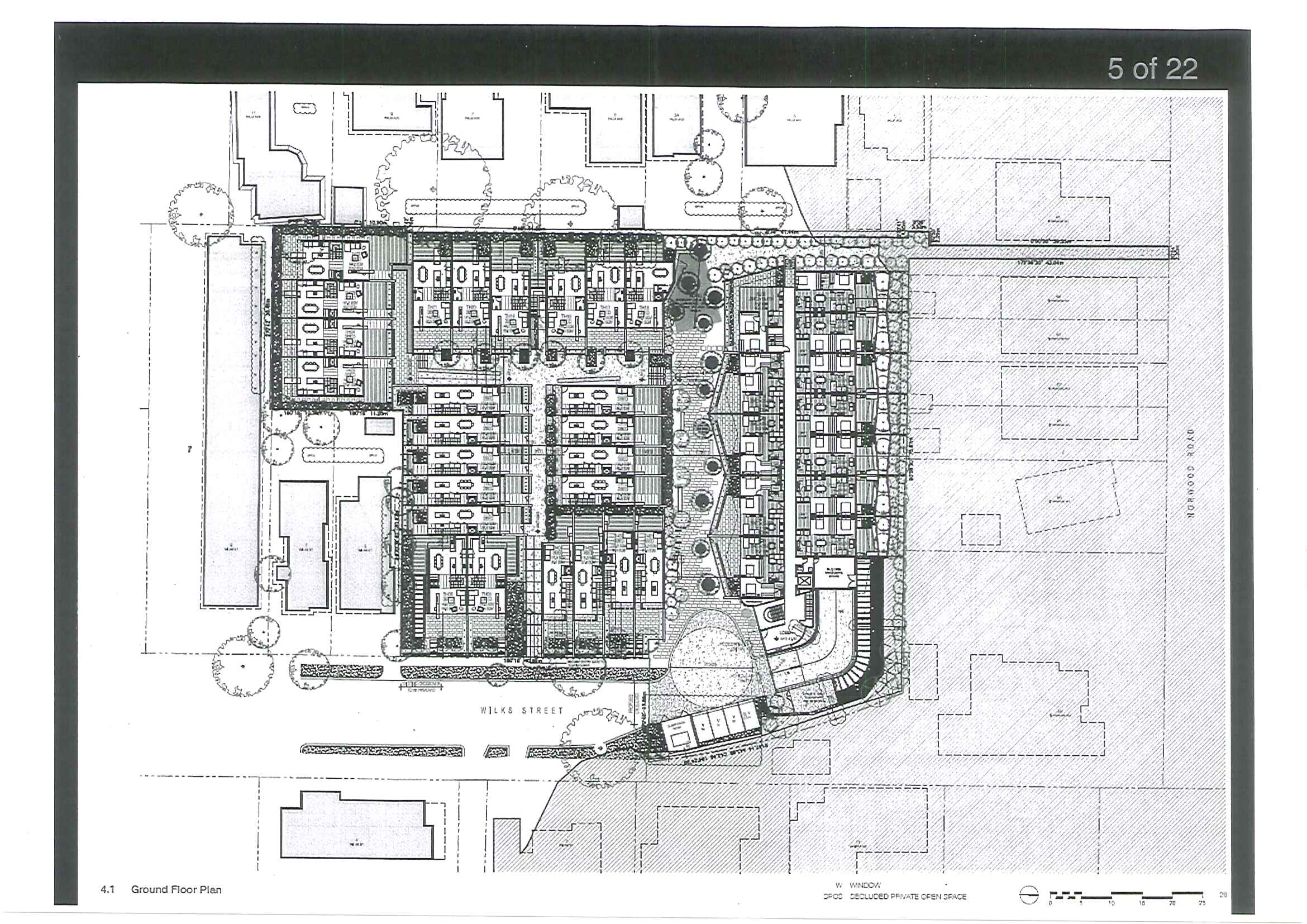
PS: we thought it would be informative if we uploaded one of the pages for the plans. Please note:

  • the ‘gated city’ effect so that emergency vehicles have literally no access.
  • the lack of sufficient open space

130606 Plan 5 of 22 Ground Flr of 1 Wilks Street

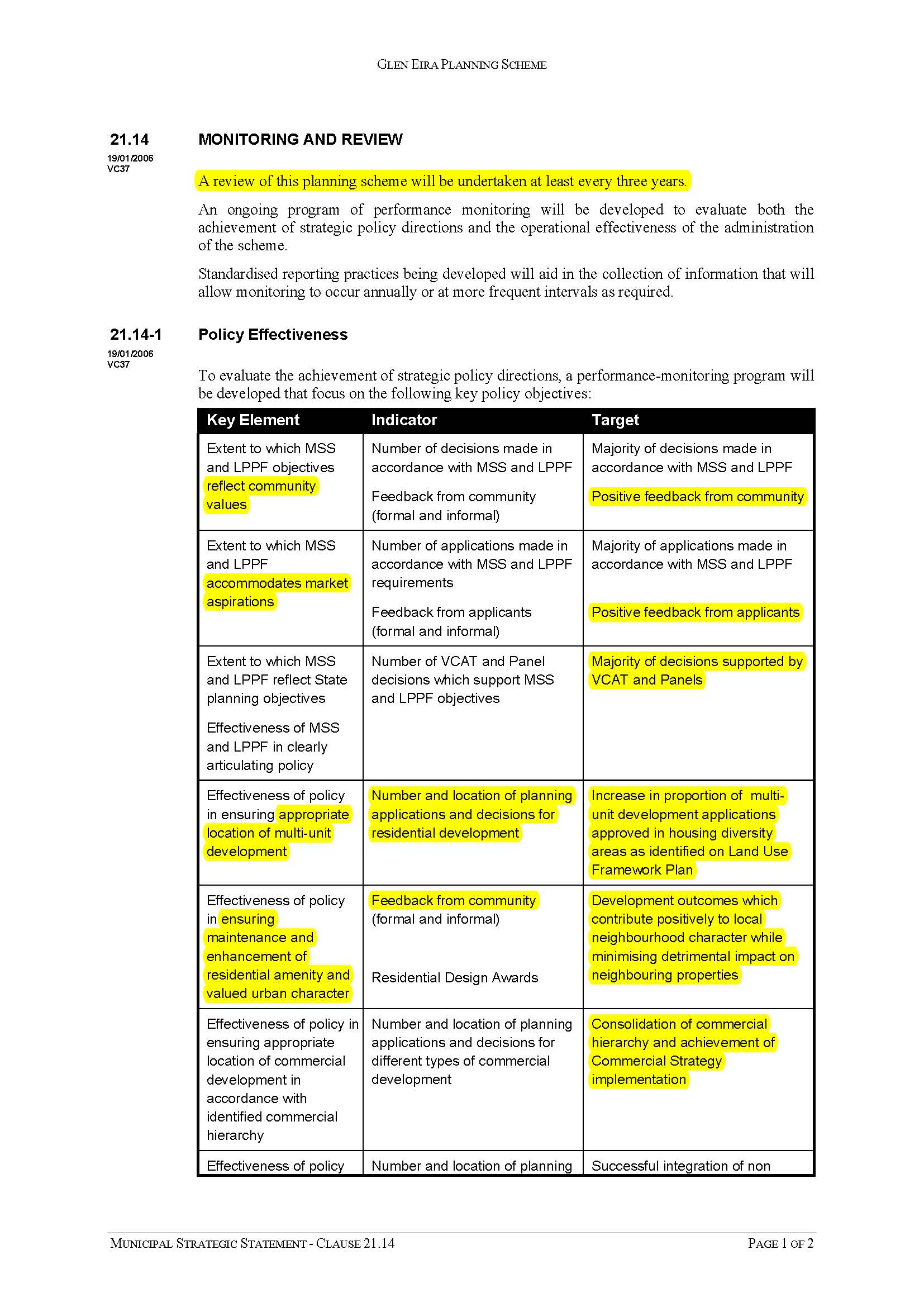
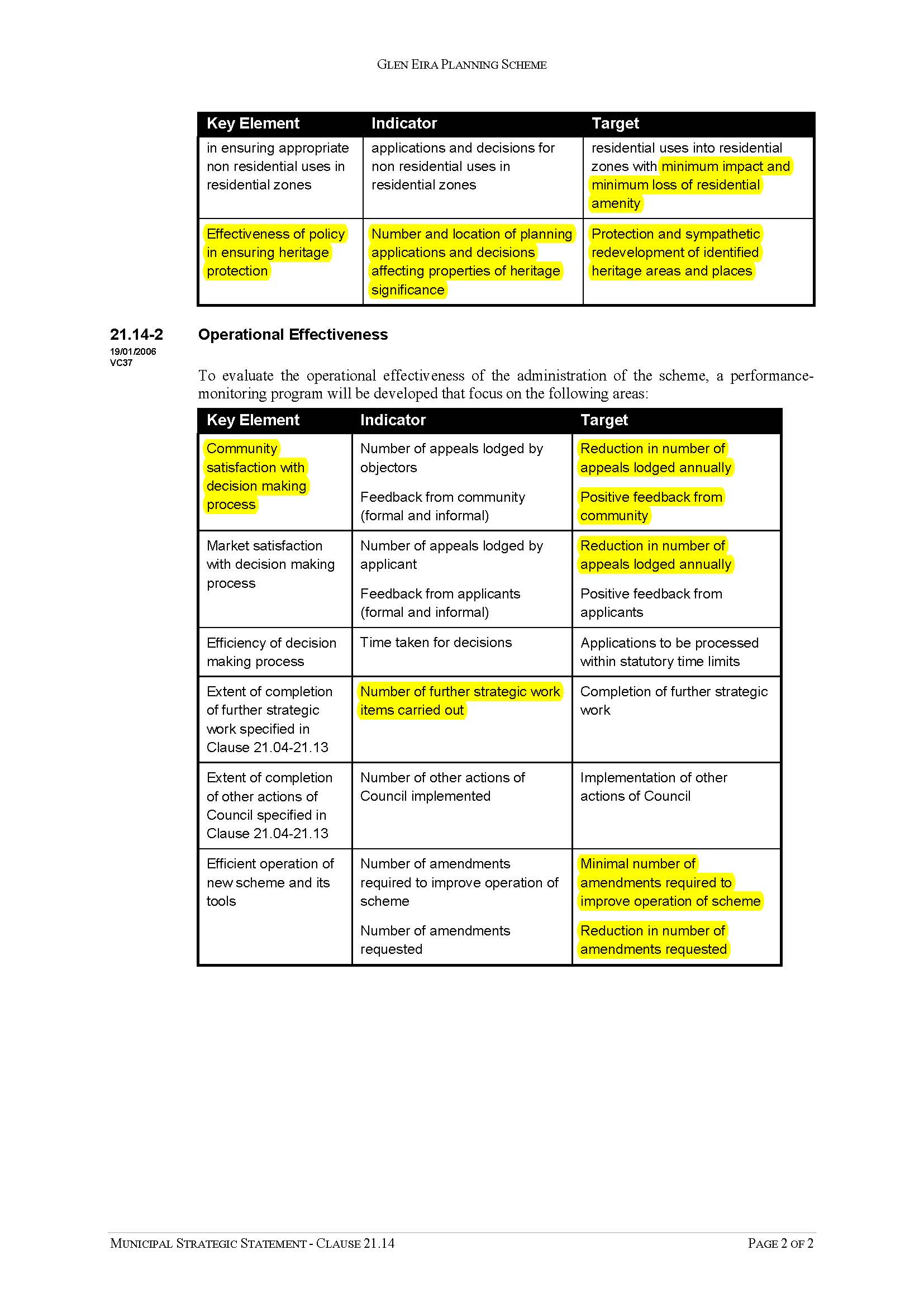
There’s the opportunity in all council planning schemes to include a ‘Monitoring’ and/or ‘Review’ section. Most councils use this to establish their objectives and the criteria against which the ‘success’ of their policies will be evaluated. Many include such elements as: drainage, open space, social and environmental amenity, transport options, etc. In Glen Eira, these terms barely get a look in! All in all, the Monitoring and Review pages of the Glen Eira Planning Scheme are nothing but empty pledges and more public relations propaganda. We ask readers to examine the following and to make up their own minds as to the real value of the criteria themselves and how well council has performed even against these lamentable standards.

21_mss14_glen_Page_121_mss14_glen_Page_2

How many more stuff-ups should the community pay for before heads start to roll? What excuses will this planning department come up with this time? Another ‘clerical error’? Another ‘slight oversight’? Each stuff up costs money, staff time, and of course, embarrassment and an insight into plain old incompetence. In this instance, the VCAT member himself has laid all bare. When officers delegated with the responsibility of making decisions based on their own planning scheme don’t seem to know what the planning scheme contains, then one has to question what is going on. We present some of the extracts from the latest schemozzle. For the full decision, see: http://www.austlii.edu.au/au/cases/vic/VCAT/2013/770.html. The application is for 20 Hawthorn Rd, North Caulfield and involved a 3 storey and nineteen dwellings (eleven one-bedroom and eight two-bedroom).

There is uncertainty about whether the subject land is located in a housing diversity area or a minimal change area under local planning policy.

There is little doubt in my mind that the subject land is in a housing diversity area under local planning policy. As the purpose of local planning policies is to give effect to the municipal strategic statement (MSS), it is relevant to start with the MSS. The MSS includes a Framework Plan the purpose of which is to ‘support and promote’ specific land use outcomes. The Framework Plan, although indicative, includes the subject land as an area along a tram route where ‘multi unit development will be encouraged’. The MSS adopts a targeted approach to meeting future housing needs. It encourages multi-unit housing in identified housing diversity areas. Land along tram routes is a housing diversity area.

The housing diversity area policy confirms the subject land is in a tram routes housing diversity area, having regard to the Glen Eira ‘policy framework plan’ and the Caulfield North ‘Framework Plan’. I will return the specifics of the tram routes policy shortly.

That the subject land is in a housing diversity area is confirmed by the minimal change area policy. The policy was recently remade with amendments in Amendment C87 of the scheme (C87). The Council exhibited C87 before deciding this permit application. In the ‘Policy Framework Plan Minimal Change Areas’ map in the scheme when C87 was exhibited and in C87 shows the subject land not in a minimal change area. C87 was approved and commenced on 31 January 2013 and after the Council decided the permit application. It did not change the identification of the subject land as in a minimal change area in that map. In other words, C87 has not changed the identification of the subject land as not being in a minimal change area.

I refer to this history because the Council assessed the permit application as if the relevant policy was the minimal change area policy rather than the housing diversity area policy. This was an error. The Council has now decided that the identification of the subject land as not in a minimal change area for policy purposes was a ‘mapping error within clause 22.08 mistakenly introduced in Amendment C87’, and has prepared Amendment C108 to correct the ‘error’.

I must apply the scheme in its current terms. The subject land is not in a minimal change area for the purposes of the local planning policy framework. The Council has prepared an amendment to include it in such an area but no notice of the amendment has yet been given, so it may be well away from being adopted and being a serious entertained planning proposal or being approved. I therefore give Amendment C108 little weight.

The schedule to the R1Z is now potentially inconsistent with the local planning policy framework. The schedule sets modified standards for site coverage, rear setbacks and private open space for land in ‘a minimum change area … as shown on the map forming part of this schedule’. The map attached to the schedule shows the subject land in a minimal change area.

How should the scheme be read to resolve this potential inconsistency? In my view, even though the subject land is not in a minimal change area for policy purposes but is in a minimal change area under the schedule, the scheme needs to be read to as if there are two minimal change areas for separate purposes. The separate and distinct nature of the two areas is reinforced when it is understood the drafters of the scheme could have applied the different standards for a ‘minimal change area as specified in clause 22.08’ in the schedule. That would have been clearer. But the drafters did not do this. They decided to refer to a minimal change area as defined by map included in the schedule. It may be unfortunate and confusing that both are identified as a minimal change area and the relevant maps are very similar in overall appearance but the potential inconsistency must be resolved by giving the two minimal change areas an independent effect

Building site coverage is complex for this proposal. Mr Bastone’s (for developer) estimate is 53%. Mr O’Leary’s (for Council) estimate is that, although the basement covers about 75% of the site, it is over 60% because part of the ground floor is above the ground towards the rear of the subject land. Mr O’Leary unnecessarily and inaccurately included ground level covered by projecting balconies in his calculation. For the purposes of assessment, I would accept that the coverage is around 60%. The schedule to the R1Z provides a standard that coverage not exceed 50%. It applies to land in a minimal change area shown on the map in the schedule. In a housing diversity area, the standard is 60%.

In my Mr Fairlie’s opinion, one basement visitor space is impractical but I prefer the submissions of Mr O’Leary that with sufficient organisation between residents and their visitors, one space would be of assistance. The owners corporation will need to make rules about use of the space.

concern

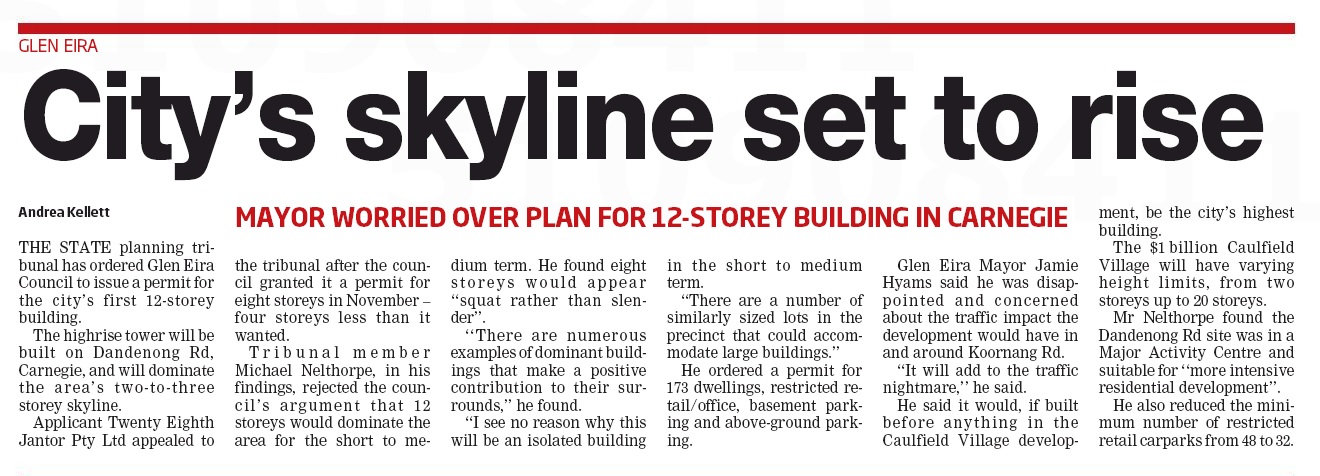
Readers will remember the 1056-1060 Dandenong Road application for 12 storeys, 173 dwellings and retail/office premises. They will also remember councillors’ ‘compromise’ of a permit for 8 storeys and 70 odd dwellings. Needless to say the VCAT judgement has come down and the developers basically got everything they wanted. We’ve no doubt that VCAT will again become the convenient scapegoat  – it is never but never this Council’s fault that Glen Eira is turning into a developer’s paradise.

We urge residents to have a very careful read of the judgement and to note in particular the following extracts taken directly from – http://www.austlii.edu.au/au/cases/vic/VCAT/2013/745.html

The review site is in Precinct 1 ‘Dandenong Road Precinct’ of the Carnegie Urban Village. There are no specific policies for this Precinct in clause 22.05 as they expired in 2007.

Given the lack of specific policies, Mr Crack took me to the objectives of the Urban Villages Policy, which include:

To encourage increased densities within and around commercial/transport nodes which respects transition to the surrounding residential area.

To ensure development respects the amenity of the surrounding area and provides a transition to the surrounding residential area.

To ensure future development is appropriate to the constraints of infrastructure and vehicular traffic movement (including parking).

Based on these submissions, Mr Crack contends that the Planning Scheme’s policies require that a development must ‘be mindful of and have regard to the prevailing character’ and ‘sit comfortably in both the existing and emerging context’.

Alternately, Mr Pitt took me to Amendments C46 and C77 to the Planning Scheme. In 2005, Amendment C46 introduced new land use and built form directions in the ‘Dandenong Road Precinct’ of the Carnegie Urban Village. Mr Pitt referred to the Explanatory Report for this Amendment, which identified this Precinct as being strategically acceptable for major change, including high density residential development.

In January 2011, Amendment C77 rezoned the site and surrounds from Business 4 to Business 2. This change allowed the land to be used for housing whereas previously it could not. The Explanatory Report for Amendment C77 describes its principal purpose was to facilitate the establishment of large format retail uses this area, however, it also states that:

Other planning policy objectives that will be satisfied as a result of the rezoning include allowing additional office floor space and the potential for new residential accommodation.

The Explanatory Report goes on to say that the zoning change would support and implement local policies relating to housing, urban villages and housing diversity.

Mr Pitt contends the strategic context for this area remains as described in the Explanatory Reports of Amendments C46 and C77 and that the site is a candidate for major change.

I find it is appropriate, as Mr Crack has done, to ‘de-fault’ to the general urban village objectives. I find the Explanatory Report for Amendment C77 is relevant as it describes the justification for the current zoning of the land, however, I will not assume the Explanatory Report for Amendment C46 describes the strategic context for the site and surrounds as the interim controls have expired and have not been re-activated.

I do not need to rely on the Explanatory Report for Amendment C46 to find in favour of the Applicant for Review. I am satisfied that the site’s physical context can accommodate major change at the review site and elaborate on this finding in the reasons below.

I disagree with Mr Crack’s submission that the Planning Scheme’s policies require a regard for the area’s prevailing character. This is not what the policies say. In a nutshell, the policies support transformative change as long as it is site responsive and, in Glen Eira’s case, transitions acceptably to nearby residential areas.

I also see no reason why this will be an isolated building in the short to medium term. There are a number of similarly sized lots in the precinct that could accommodate large buildings. The policy framework supports transformative change and recent rezoning allows this to happen. As such, it is likely that other tall buildings will emerge in this precinct in the short to medium term.

I acknowledge the building will not be screened by street trees such as occurs in some places in the Phoenix Precinct. This is not a reason to reduce its height. Only the lower levels of buildings in the Phoenix Precinct that are screened by trees and the upper levels are fully visible. Apart from this, it would be inappropriate to screen the restricted retail showroom that occupies the building’s lower levels as the showroom relies on exposure to passing trade.

Is it appropriate to restrict the proportion of dwellings that use borrowed light?

Condition 1(a) reads as follows:

No more than 20% dwellings reliant on ‘borrowed light’ (i.e. Type A dwellings facing east). The remainder of the dwellings must include direct natural light and ventilation to all habitable rooms to the satisfaction of the responsible authority. This may result in a reduction of dwellings.

It is common ground that 29% of the proposed dwellings (50 in total) rely on ‘borrowed light’. It is also common ground that these are one-bedroom dwellings of the same design and that all are oriented to the east. It is relevant that the council is not opposed to dwellings with bedrooms reliant on ‘borrowed’ light and only contests the proportion of such dwellings in the building.

Mr Crack contends that limiting the number of ‘borrowed’ light dwellings is justified by Design Suggestion 5.4.1 of the Guidelines for Higher Density Residential Development which encourages development that:

Provide(s) direct light and air to all rooms wherever possible.

He contends that a proportion of 20% of all dwellings is the ‘right balance’ in this building. He justifies this by saying it will ensure that some of the most affordable dwellings will have a level of internal amenity comparable to that of the larger dwellings in the building.

I do not accept this argument. I consider the proposed one-bedroom dwellings have an acceptable level of amenity and I find that Design Suggestion 5.4.1 of the Guidelines does not justify the contention that only 20% of dwellings in this building should rely on ‘borrowed’ light.

On the second point, Design Suggestion 5.4.1 envisages higher density developments may contain some rooms that do not have direct access to light and air. One of the emerging principles on dwellings with rooms reliant on ‘borrowed’ light is that the proportion of such dwellings in a development is an irrelevant consideration on the basis that if a particular dwelling design provides an appropriate level of amenity, then that decision is valid for all such dwellings.

This principle applies directly here. As the council supports 20% of dwellings with bedrooms reliant on ‘borrowed’ light, the amenity of the remaining dwellings of this configuration must be satisfactory.

Mr Kiriakidis relies on empirical surveys of existing restricted retail uses with floorspace of 5,000 square metres or less. He draws on 14 such surveys that indicate an average demand of 1.51 car spaces per 100 square metres and an 85th percentile demand of 2 spaces per 100 square metres. Based on these surveys, he is confident that 32, rather than 48, car spaces will satisfy the showroom’s car parking demand. He notes that the officers of the council’s Transport Planning Department share his view.

Mr Kiriakides statement of evidence also contains a survey of the existing demand for car parking within 200 metres of the site. This survey identified a total of 177 on-street spaces, including 84 that are subject to restrictions during business hours. The surveys show a peak demand of 120 spaces or, put otherwise, an occupancy rate of 68%.

Mr Bluzer submits that this survey is inadequate as it was undertaken in 2011, prior to the opening of the supermarket complex at the corner of Koornong/Dandenong Roads. He also believes the survey was inadequate as it was done for one mid-week day only.

Despite having regard for the issues raised by Mr Crack, Mr Favre, Ms Cranage and Mr Bluzer, I accept Mr Kiriakidis evidence. I find the quantum of surveys of existing restricted retail uses carries more weight than Mr Fauvre and Ms Cranage’s contention that the standard rate should be applied as a matter of principle. I note that the Planning Scheme allows a reduction in parking for a range of reasons, including empirical evidence of a lower rate of demand. In my view, the surveys relied upon by Mr Kiriakidis, demonstrate an empirical demand for restricted retail showrooms that is lower than the standard of the Planning Scheme.

I acknowledge Mr Bluzer’s points about the car parking survey. I would be concerned about the usefulness of the survey if it showed an occupancy rate far higher than 68%, yet it does not. At 68% it indicates that almost one in three car spaces were available at the time of the survey. This is a considerable number.

Mr Kiriakides’ evidence is that the likely traffic volumes are well within acceptable standards. His surveys demonstrate the Egan Street arm of the Koornang Road/Egan Street/Woorayl Road intersection will remain well below saturation levels if the building was approved.

He also notes the comments of the council’s officers that: The convenient accessibility of the site to public transport will encourage greater use of public transport. It is acknowledged that the proposal will result in an intensification of vehicle movements in the area. This is a by-product of both State and Local Planning policies channelling more intensive development and use into activity centres such as Carnegie. An opportunity to exit onto Dandenong Road is considered to be a significant advantage for this development site.

I accept Mr Kiriakides evidence and support the comments of the council’s officers.
parkingparking2

« Previous PageNext Page »