GE Service Performance


Several comments on the GESAC issue have prompted this response. We freely and proudly admit that we are biased. Our bias is always towards open, accountable and transparent government. These features are sadly lacking in Glen Eira Council and nowhere moreso than in the dealings over the development of GESAC and the sporting allocations for the basketball courts. It is certainly time that this Council ‘comes clean’ in disclosing exactly how ratepayer funds are being spent. It is certainly time that fact replaced spin, and that secrecy was put to bed.

Here are the ‘facts’ and questions –

  1. Council continually talks about the $41.2 million CONSTRUCTION CONTRACT. Figures on total costs (including oufittings, higher purchase agreements, road restructuring, electricity substations, and countless other items) have never been fully itemised, nor added up into one single figure and made public in a manner that clearly shows the precise amount that this has cost.
  2. How many staff are currently employed by Council? 50 or 250 and how much is this costing?
  3. Did council pay any GESAC hired staff throughout the duration of the 5 month delayed opening? How much did this cost?
  4. How on earth can council sign itself up to a 15 year fixed loan on 8.04% and which would now cost $4 million to convert to a fixed and variable rate? The argument of course is that council had the ‘best consultants’ – was there no contrary official legal/financial advice proffered?
  5. How good are these ‘consultants’ when well over $1 million unbudgeted funds have been spent on car park extensions and relocation of playgrounds?
  6. Why has there been no ‘consultation’ with local residents and why oh why were there no traffic studies undertaken prior to the Gardener’s Rd debacle? How safe is this latest encroachment into public space?
  7. Why, if it exists, is the sport allocation policy, and its criteria not in the public domain?
  8. Why were the Pools Steering Committee Meeting minutes a total joke in terms of actually informing the public as to what was going on?
  9. How many GESAC members have not renewed their memberships? How many complaints and/or negative comments has council received regarding entrance prices and general high costs?
  10. How much does daily, weekly and monthly maintenance cost – ie insurance, cleaning, chemicals, heating/cooling etc?
  11. How detailed and frequent were/are reports back to councillors on operations?
  12. Why have councillors not honoured their public statements that an EOI process would be undertaken in 2012 – that is a year following the Warriors allocation?
  13. Why have councillors allowed employees to consistently run the show?
  14. Why are teams for individual sporting grounds no longer on the website?
  15. How many NON-LOCAL teams does Glen Eira house on its sporting fields?
  16. How many locals are members of both the Warriors and McKinnon Basketball Association?
  17. How much has already been spent on lawyers on the ‘liquidated damages’ issue and is Council facing the prospect of a huge pay-out if they lose the case?

There are probably countless other questions that need to be asked. We do not hold out much hope that this lot of councillors will have the nous, or courage to ask them – especially not in public! Again, this stands in stark contrast to what is happening with the Pool in the Mornington Shire. For those interested we ask them to peruse this Notice of Motion (verboten in Glen Eira!) from one of their councillors. It makes for fascinating reading. See: http://www.mornpen.vic.gov.au/files/Governance_Agendas/131203ca_add_41_NOM127.pdf

Councillors have been away for their ‘budget retreat’ recently. No doubt they have been ‘nursed’ along in the process of determining their ‘priorities’ for the budget. They’ve undoubtedly also wrestled with how to pay off GESAC at the fixed rate of 8.04% for the next 15 years. On top of this there’s the $7.1 million superannuation liability that also has to be paid off. Whilst other councils are contemplating paying this in one lump sum to avoid the high interest repayment, we suspect that Glen Eira does not have this option. Imagine borrowing another $4 million or so – that’s if anyone would even lend them this amount! We’re also pretty confident that the question of a top heavy and extremely well paid administration, plus consultants galore, and an unprecedented and constant staff increase with the advent of Newton, would not have figured prominently in these deliberations! It’s therefore really refreshing to read the following from a Monash City Councillor and makes us contemplate the question – would our councillors dare ask these questions? More importantly, would they ever get the answers?

Source: http://www.monash.vic.gov.au/news/bulletin2013/february/councillor.htm

Untitled

We’ve featured the Gardener’s Rd conversion into a GESAC car park previously. A comment from a resident’s relative has prompted us to revisit the issue. What is clear is that when it comes to fixing up council’s howlers residents do not matter. They are expendable, irrelevant, and not even worthy of “consulting” with, despite the chaos that is about to descend on their doorsteps. There has been no traffic investigation before the decision was made; no real accounting for why the original design got it so horribly wrong and no problems in suddenly finding $600,000 that is not budgeted for from a council that is cash strapped!

Here’s the comment and some updated photos.

“My parents live on Gardeners Rd, and I grew up there. My grandfather had the house built in 1952, and my Mum has lived there since then, since she was 9 years old. She was given the house by her parents, after she and Dad got married. I and my 4 siblings lived there till we grew up and moved out. I now live in East Bentleigh not far away with my family. We had the best environment as kids. Beautiful Bailey reserve across the road, and “the pools” in summer. I used to take my kids to the pools and the park too, until recently. We were all devastated when we finally lost the 15 year fight to save the pools and GESAC was built. I hate it. I will never go there, and neither will my kids. We call it BALLSAC. We watched in horror as it was built, half the reserve was turned into a carpark, and the playground was removed and replaced with the junk that’s there now. It’s been devastating to see this happen. And now…NOW… they’re carving up the whole street and turning it into a carpark!!! Right in our street, right outside our house. Mum and Dad, and all of us, and all the neighbours, are devastated. Mum and Dad say they are going to sell up and move, out of sadness and disgust. They were never consulted, no-one in Gardeners Rd was. I’d like to ask the councillors, “How would you like this done to YOUR street? Outside YOUR house?”. What a bunch of (MODERATORS: word deleted). I’m so upset but feel powerless to do anything. Is there ANYTHING that can be done? Can we stop it, get an injunction? Does anybody know? We need legal help. I really can’t believe it and I’m so so sad. This is breaking the hearts of so many people and the Council doesn’t give a shit. What has the world come to? If anyone has any ideas or some legal skill please reply.”

P1000052

P1000061P1000060

P1000057

The committee appointed to ‘investigate’ the proposed new zones has had its report finally made public – together with the government’s response. A quick perusal of the documents indicates that nothing major has changed. What is unique about this ‘consultation’ is that there were 2,083 SUBMISSIONS – surely a record! It’s also worth noting that at the last parliamentary sitting the government promised to table ALL submissions by February 5th. Yesterday’s Hansard records a letter from Matthew Guy which states in part: “Regrettably, the Government is not able to respond to the Council’s resolution within the time period requested by the Council. The Government will endeavour to respond as soon as possible.”!!!

We urge all residents to read the documents contained in the Media Release below since it is a foregone conclusion that Glen Eira Council’s mandatory ‘consultation’ process will be the typical rubber stamping process that has occurred time and time again.

Reformed residential zones bringing new certainty to Melbourne’s neighbourhoods

Tuesday, 05 March 2013

Sweeping reforms of residential planning zones are one step closer as Planning Minister Matthew Guy announced the Victorian Coalition Government’s final details on the reform of Victoria’s residential planning zones.

After a detailed consultation process with over 2,000 submissions from individuals, businesses, councils and community groups, the Coalition Government will now establish the three reformed residential zones on 1 July this year.

A key feature will be the new Neighbourhood Residential Zone which will be the strictest planning zone in Australia, aimed at protecting existing suburbs’ neighbourhood character.

“The Coalition Government’s reforms to residential zones reflect what communities have been calling for, for many years – certainty for neighbourhoods and protection from inappropriate development,” Mr Guy said.

“These reforms will protect what Melburnians love about Melbourne. Our streetscapes, our amenity and our liveability which are too valuable to ignore.

“At the same time the new zones will clearly define the appropriate locations where growth and density should occur,” Mr Guy said.

The Coalition Government’s Ministerial Advisory Council (MAC) on zone reform has suggested a number of improvements to the residential zones as initially proposed last year, to ensure the protection of community amenity and provide clearer rules and greater certainty for the community.

“The improvements recommended by the MAC further protect residential amenity and neighbourhood character and are supported by the Coalition Government,” Mr Guy said.

“Today’s announcement is about the right development in the right locations and the package of residential zones will deliver this for local communities.”

The new Neighbourhood Residential Zone will provide the strongest protections for local neighbourhood character for the first time in Victoria’s planning history. Key features of the zone include:

  • implementing local neighbourhood character policy to provide increased weight to local planning policy;
  • limiting increased residential development through lot size restrictions; and
  • providing an eight metre mandatory height limit.

In contrast, the Residential Growth Zone will be applied in areas determined appropriate for increased growth and density and provide for medium density developments.

Minor commercial uses will be permitted in the Residential Growth Zone to provide additional local services to the population, subject to strict conditions.

“Local communities will now know and clearly understand where growth can and will occur, unlike the previous haphazard approach that was allowed to foster under the previous Labor Government,” Mr Guy said.

“Importantly, these zones will be at the discretion of local council and it will predominately be the view of the local community that informs which zone should be applied where.”

The Coalition Government will work with local councils between March and May to further develop the implementation procedures and criteria. The Department of Planning and Community Development will also provide technical assistance to local council’s in implementing the residential zones.

Implementation of the residential zones will commence on 1 July 2013 and will be completed over a 12 month period.

A copy of the MAC report and the Coalition Government’s response can be found at: www.dpcd.vic.gov.au/planning/reszones

PS: An email from a reader –

Mailand/ Architektur/ Bosco Verticale

At the outset we wish to state clearly and unequivocally that we have no interest in football allocations per se. What does concern us is the lack of transparency in any of the decision making that surrounds sporting ground allocations. The article at the conclusion of this post comes from today’s online version of the Australian Jewish News. It is quite feasible to draw the conclusion that this is ‘pay back’ for the Ajax – Caulfield Bears saga of last year in that Ajax did not get their sought after allocation.

As stated above, we have no problem with this. What is a huge problem is:

  • All is left in the hands of Burke and his underlings with no need for accountability, nor transparency
  • There is no POLICY that is in the public domain
  • There is no published criteria to account for the decision making
  • Councillors are out in the cold with no role, no say, no nothing
  • Such ‘secret’ and unilateral decision making is fraught with danger and the real potential for nepotism, secret deals, intimidation, and woeful decision making as with GESAC.
  • Councillors MUST PUT A STOP TO THIS if their credibility is not to go completely out the window!

By way of contrast, here is part of the Banyule Sporting Allocation policy where the criteria used to decide who gets what is public and easily accessible –

criteria

Numerous other councils don’t seem to have any problem whatsoever in publishing their policies. As always, Glen Eira keeps everything under wraps – that’s if it even exists, and if it does, the promises in the Community Plan to publish ALL council policies are not adhered to. Here are some other Councils’ URLs for residents to check out –

http://www.banyule.vic.gov.au/Assets/Files/14457%20Sporting%20Reserves%20Allocation%20Policy%202011-2014.pdf

http://mvcc.vic.gov.au/experience-moonee-valley/sports-grounds/~/media/Files/Experience%20MV%20Documents/Sports%20club%20information/2010_11_Seasonal_Allocation_Policy.ashx

http://www.bayside.vic.gov.au/Sportsground_allocation_policy.pdf

http://whatmattersmanningham.com.au/document/show/63

http://www.moreland.vic.gov.au/mccwr/publications/policies-strategies-plans/policy%20-%20council%20resolved%20-%20allocation%20of%20sporting%20grounds%20and%20pavilions.doc

http://www.boroondara.vic.gov.au/freestyler/files/Draft%20-%20Sportsground%20Allocation%20Procedure.pdf

Governance is at an all time low in this council as we’ve repeatedly stated. This is just another example of why drastic change is required.

AJAX allocation battle resurfaces

March 4, 2013

IN a major blow for the AJAX Football Club and the local Jewish community, Glen Eira City Council has denied the club from relocating to Princes Park, instead granting access to Old Haileybury’s Thirds and under-19 teams.

AJAX president Ian Fayman expressed his disappointment at the decision, pointing out that even though the club plays in a different municipality to the juniors, it deserves the right to function as one club at the same home ground.

“The argument is that the seniors and juniors are different clubs,” Fayman told The AJN.

“But they have the same jumper, the same sponsors and the same logo, and the community sees them as one club.”

Fayman accepted that the re-allocated club must be from within Glen Eira, but questioned why the opportunity to join the juniors and seniors was overlooked.

“If an allocation has to be from within the Glen Eira municipality, why is it not AJAX?” Fayman asked.

“It’s the most obvious decision that the junior club should have its senior teams at the same home ground to make a strong pathway, which is a policy of AFL Victoria, and so that the local community can follow.”

In response, council spokesman Paul Burke said that the main reason AJAX was overlooked is because it is based in the Port Phillip municipality.

“As the AJAX [senior] Football Club is not a tenant in Glen Eira, council did not contact them in relation to the coming football ­season, just as council did not contact other clubs that are tenanted outside of Glen Eira,” Burke told The AJN.

“[And] to ensure that sports fields can sustain the wear and tear from match play and training, existing tenant clubs are sometimes required to use grounds other than their home grounds for either training or matches.”

The other major disappointment for Fayman and the club is that no public expression of interest was undertaken, which he said the council committed to in a previous letter to an AJAX representative.

The question is, why a public and very transparent process was not implemented,” Fayman said.

“It cannot be accepted that a decision has been made without a public process.”

He also noted the success of last year’s community day, which attracted around 1500 people,  as an indication of public support.

“The key example is the community day, where the local community wanted AJAX to be there,” Fayman said.

“We have 72 per cent of our members as voters in Glen Eira, and where do Haileybury’s members reside? Yes they are an internal club in Glen Eira, but their school is based in Mentone.”

PS: And here’s the Leader take on the story –

Ajax Football Club denied the chance to reunite juniors and seniors at Caulfield

  • Andrea Kellett
  • March 05, 2013 12:00AM
Ian Fayman and Eugene Routman .

President of the AJAX Senior Football Club,  Ian Fayman with player, Eugene Routman. Picture: Paul Loughnan, Leader

AJAX Football Club is furious its seniors have been denied a move to Princes Park in Caulfield.

The club says it was trying to unite its junior and senior players in Caulfield but Glen Eira Council has overlooked it in preference for another amateur club’s third team.

The council has given the Saturday tenancy to Old Haileyburians Amateur Football Club.

AJAX Senior Football Club president Ian Fayman wants the council to review its decision, hold a public forum and consider shared tenancy at Princes Park.

“AJAX juniors and seniors have the same logo, the same jumper, the same ethos, the same community base,” he said.

“Speak to anyone in Glen Eira and ask is it one club or two and everyone would say, ‘Of course it’s one club’.”

AJAX juniors have trained and played at Princes Park for two decades, while the seniors train and play outside the municipality, in Albert Park.

The club has long wanted to have its senior in the Caulfield area.

Glen Eira Council does not consider the seniors an “existing” tenant.

AJAX controversially offered another club, the Caulfield Bears, $175,000 last year to leave Princes Park so it could play there. The money was never paid.

The council’s community relations director Paul Burke said the council proritised the needs of Glen Eira clubs first.

“AJAX Senior Football Club is not an existing winter tenant in Glen Eira and has never been a tenant in Glen Eira,” he said.

In a letter to Glen Eira Council, Mr Fayman said the council had reneged on a promise AJAX would be consulted about the new ground allocation.

“The AJAX Junior Football Club, which is the current existing tenant on Sunday of Princes Park, was not given any opportunity to make an application for Saturday ground allocation,” he wrote.

“We believe AJAX FC is the local community football club that represents the local community interests and should have at the very least been given the opportunity to make a formal application to have its senior teams play from the same home ground.”

Mr Burke said the council had not called for “new” tenants.

“Council is not offering a new tenancy.

“We are accommodating the requirements and needs of existing tenants,” Mr Burke said.

AJAX Junior Football Club president Daniel Antman said as long as the council considered the seniors an outside club the dream could never be achieved.

“AJAX is one of the few clubs in the region that has a senior club based outside the region, for reasons beyond our control and desire,” he said.

Old Haileyburians Amateur Football Club did not wish to comment.

COMMENT: ‘New tenants’ is an interesting phrase to say the least! The Old Haileyburians are fielding an entire ‘new’ team – the thirds! The game of semantics is alive and well in Glen Eira! See: http://www.sportingpulse.com/club_info.cgi?client=1-3232-36895-0-0&sID=61506&&news_task=DETAIL&articleID=22252086

Untitled

The folly of GESAC is about to come back and bite residents really hard. Faced with a $7.1 million bill for employee superannuation, councils have the choice of paying their share off in one lump sum or spreading the repayments out over 10 or 15 years. Glen Eira, because of GESAC, would not have this choice we believe. By borrowing $25 million they are already over committed and no bank in its right mind would lend them any more. The result is that in all probability Glen Eira will be paying off its dues over the extended time period. That means more money down the drain in interest and an inevitable huge rate hike to meet all the bills.

Other councils such as Bayside ($5.1 million) and Nillumbik ($4.78 million) and probably countless others are endeavouring to pay this amount off in one hit. Both will borrow in order to avoid unnecessary expenditure on interest – but they are capable of doing this. For Glen Eira, we would wager that there is not this option. Instead we will be facing years upon years of endless interest repayments.

Serious questions need to be asked about the financial management of this council. Why is there no substantial ‘nest egg’ to cover such unexpected emergencies? Why have all our eggs been placed in the suspect GESAC basket, and now everyone’s got egg on their faces! Why in this cash strapped council that was designated as ‘high risk’ less than a year ago and has only managed to climb up to ‘Low risk” by delaying Duncan McKinnon for over a year, plus other capital works programs, do we have to witness the pathetic squabbling over whether to spend $16,000 for a lolly pop person or other safety measures for our kids? Yet, there’s no problem in finding another $1.5 million for car parking at GESAC.

By our reckoning this council will be facing an interest bill of at least 3 to 4 million dollars per year for the next 15 years.  This figure is based on the Nillumbik calculations and the document which was sent to all councils with their individual calculations. (uploaded here) .We have to wonder whether councillors even got to see this paper? Here’s the important page based on Nillumbik’s share of $4.78 million. When the maths are done for $7.1 million then the interest is astronomical.

Pages from August_2012_OCM116-12_Defined_Benefit_Attachment-2

What is required is the complete tearing apart of all financial records by a government appointed forensic accountant. More importantly a full blow by blow costing for every single nail that has gone into GESAC. We have absolutely no idea of how our money has been spent, nor how much it costs to keep this place running on a daily basis, nor how many members have not resigned once the novelty has worn off, nor how many staff are being paid for by residents, nor how much subsidy the Warriors are receiving from ratepayers. The questions are multitudinous and the responses non existent. That is councillors’ jobs – to not just ask, but demand and then to ensure that residents know exactly how and why their funds have been spent in this unaccountable and non-transparent fashion!

For starters no amount of spin, bluff and bluster can hide the fact that GESAC has incurred additionals costs that have never been either reported upon, nor directly associated with its construction. We highlight just a few:

  • Lawyers for the ‘liquidated damages’. What happens when council is perhaps found liable to pay the difference, plus punitive damages, plus more interest?
  • Why isn’t the construction of an electricity substation, plus road works and traffic lights included in the ‘construction costs’? The figure of $41.2 million is thus not only disingenuous, but totally bogus when one considers the money that has been forked out to facilitate the actual ‘construction’.
  • What are the insurance costs? why the need for a higher purchase agreement?
  • What are the heating, cooling, cleaning, maintenance, etc. costs? How much does this tally per day, per week, per month?

Over to you councillors! Do you have the courage?

From Hansard (19th February,2012) –

Caulfield Racecourse Centre Park: opening
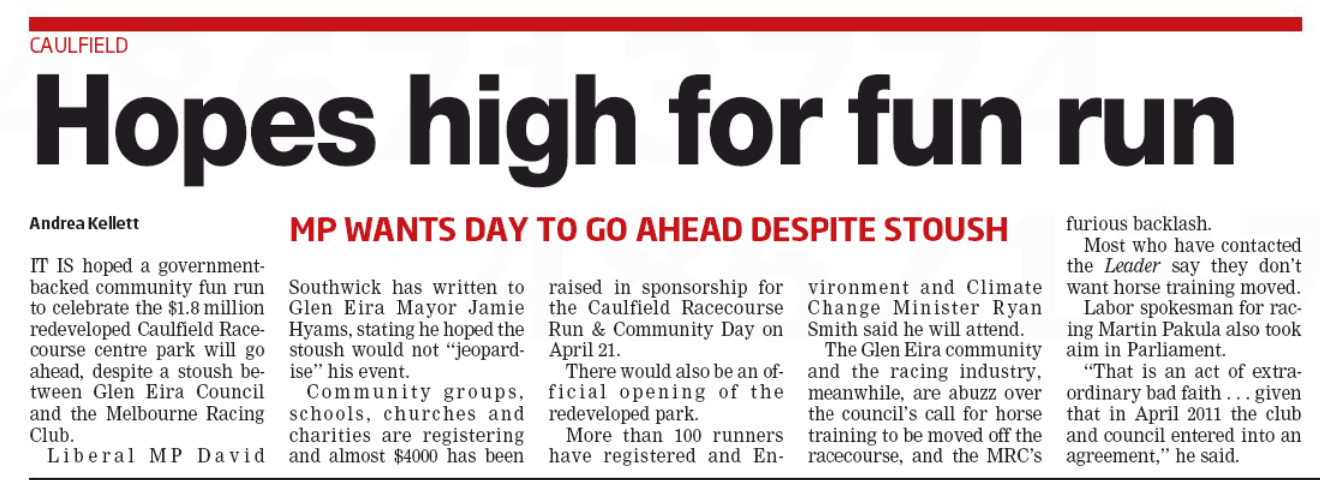
Mr SOUTHWICK (Caulfield)—It is my great pleasure to rise to address the Minister for Environment and Climate Change in my adjournment matter tonight. The action I seek is that the minister attend my electorate on 12 April to open the new Caulfield Racecourse Centre Park. The Caulfield Racecourse is Crown land, granted in 1885 for use as a racecourse and public open space. There is no doubt that previous governments have delivered in creating a racecourse that is recognised as a premium racetrack on the world stage and is an international icon. However, previous governments at all levels have missed the opportunity to provide public access to this Crown land for the residents of Caulfield in the form of open space and a public park. The failure to deliver public space at the Caulfield racetrack has been evident for over a century.

One of my major priorities since coming to office has been negotiating a better deal for residents to access Caulfield Racecourse. I have been working closely with the City of Glen Eira and the Melbourne Racing Club (MRC) to achieve this result. This has led to a $1.8 million investment by the Melbourne Racing Club to create a new park in the centre, which will feature five recreational precincts and great amenities, including a junior footy oval, a 1.6 kilometre running track, exercise stations, a dog-off-leash park, a boardwalk, a barbecue area and toilet facilities, to name a few.

I am pleased to report that on 21 April this new park will be open, providing a great new recreational facility for my electorate and for the wider community. To celebrate this I am working with the MRC, the Rotary Club of Glen Eira and the Caulfield Park Community Bank to host a community day and fun run as a fundraiser for local charities and organisations. This will be known as the Caulfield Racecourse Run and Community Day.

Charities struggle to raise funds to carry out important work in difficult economic times. I know this is a challenge, and I thought it would be good to bring all these community organisations together for one big fundraising push. The fun run will consist of a 3.5 kilometre walk and an 8.5 kilometre run around the Caulfield Racecourse. Charities, community groups, schools and clubs can register, create a team and fundraise for their own organisation. This will be a great community day which will celebrate the redevelopment of the park in the centre of the famous Caulfield icon, the racecourse. The day will see the community come together for a fun run, entertainment and festivities to celebrate what will be a memorable occasion.

We hope this facility will be the beginning of a conversation to bring local Caulfield residents to the public open space at the racecourse and create further interest in developing this great public asset for community benefit. Most importantly, many residents who I meet are still unaware that this public open space within the Caulfield Racecourse exists, and events like this are an ideal way to inform them. The City of Glen Eira has the lowest amount of open space of any municipality in Melbourne. What we have done will hopefully make the best of this new park at the Caulfield Racecourse, and this event will help to deliver this.
I repeat my call on the minister to join me at this new park in the centre of the Caulfield Racecourse on 21 April and share in this historic moment.”

PS: Council does not appear to have any problem in doing the bidding of the MRC, via publishing the Agenda for the next trustee’s meeting on their website. This is set down for March 27th – five weeks off! Yet, they cannot inform the public of the above event. Residents have to learn about this by scouring Hansard!

Media Releases 2013

Council submission on VCAT fee regulations

18 Feb 2013
Stonnington Mayor, Cr Matthew Koce has made a submission to the State Government Department of Justice on behalf of Stonnington Council in relation to proposed VCAT fee increases.

The submission responded to the Regulatory Impact Statement for proposed VCAT fees regulation, released in December 2012.

Cr Koce said: “Council is concerned that several of the fee increases proposed appear out of step with the key objectives of the Victorian Civil and Administrative Tribunal which is to provide the community with access to a civil justice system which is both accessible and cost-effective.

“In particular, fee increases for ‘objector appeals’ and mediation will be particularly hard on ordinary residents, who unlike property developers, are unable to claim the cost of VCAT fees as a tax deduction or business expense. These proposed fee increases are substantial and risks placing the justice system beyond the reach of many Victorians.

“Cost-effective dispute resolution is, and must remain, a fundamental objective of VCAT because VCAT was established to provide affordable and fair access to justice for the whole Victorian community.”

Mayor, Cr Koce said: “Council is concerned that the Regulatory Impact Statement mentioned VCAT could introduce mediation fees – to be set at a level equivalent to 45 per cent of the estimated cost of carrying out the activity.

“Increased fees should not be imposed for mediation. Mediation provides a useful tool in resolving issues without the formality of a hearing, coupled with obvious time and cost savings to all parties. Increasing such fees may dissuade participants to utilise this option.”

However, no objections were proposed in relation to VCAT fee increases for major cases, large scale developments and enforcement orders relating to breaches of the Planning Scheme.

Cr Koce said: “The fee increases for some permit applicants appear relative to the cost of a larger development. It is considered appropriate that this fee is increased based on the cost of the development (i.e. increasing after both $1m and $5m) – which is generally proportionate to the resources required to deal with the matter.”

He said that in terms of Enforcement Orders, Council took no objection to a fee increase as Council can recoup such costs as part of such applications to the Tribunal (in the instance of successfully being able to establish a breach of the Planning Scheme).

The submission letter is available on the Stonnington website at www.stonnington.vic.gov.au/news-and-information/whats-new
Media Contact: Media and Communications Coordinator T: (03) 8290 1113 M: 0408 523 708

Here we go again! Officer reports that are incomplete, inaccurate and which deliberately neglect to mention, much less highlight, crucial factors that would impact on any decision making in a normal and transparent council. Add to this councillors who either haven’t been adequately briefed, or the more plausible explanation we believe, is that they quite willingly go along with this deception.

We are referring to the Council Meeting of 18th December, 2012 when Council passed the resolution that another $600,000 (estimated) be spent on GESAC car parking. This is on top of the near $1,000,000 already spent in extending the existing Bailey Reserve car parking and to ‘relocate’ the playground. The motion that was passed in December read:

Crs Lipshutz/Lobo

That Council endorse Option A, additional car parking on the Bailey Reserve side of Gardeners Road, in order to provide additional car parking around Bailey Reserve. That Council continue to examine Option C, timed parking restrictions on the Bailey Reserve side of East Boundary Road, and Option D, East Boundary Road Median Strip parking.

Cr Sounness was the only councillor to vote against the motion. We also remind readers that the argument against the installation of an underground car park was the estimated cost of $1.5 million dollars. Now, when council has already spent this amount and it still hasn’t solved the problem, the argument switches to the laughable claim that underground parking was rejected primarily because women did not feel safe! No such excuse was proffered at the time of the original decision back in July 2011, yet it surfaces on this occasion. Some real scraping of the bottom of the ideas barrel here! Then there’s Lobo’s claim that ‘safety’ is an issue and therefore council is unable to ‘consult’. Quite ludicrous we think. From the architect’s drawing it would appear that cars will be parking perpendicular to the reserve. That means that they will have to either reverse into the spot, or more than likely, reverse back out into Gardiner’s Rd in order to exit. This street is also a bus route and it is extremely narrow. (So much for at least 2 years of”advocating’ that the bus route be switched to East Boundary Rd!) So we now will have cars reversing, buses passing, kids alighting, – all on a narrow residential street. Another great solution in averting ‘risk’.

The argument we love the best however is the one about councillors not wanting to see poor old cricketers and baseballers having to park in ‘residential streets’, or worse, Centre Rd. According to this logic, Gardiner’s Rd does not qualify as a ‘residential street’. Readers should go back to the December ‘debate’ and have a good laugh at the appalling level of argument, and plain old humbug. (See: https://gleneira.wordpress.com/2012/12/19/gesac-read-weep/)

But it gets even worse in terms of what happened on December 18th  and the total failure of this administration and its councillors to be transparent and accountable. There cannot be any excuse for failing to fully inform residents that more open space will be lost and that bitumen and car parking are the priorities in Glen Eira regardless of cost. Here’s what was not written or stated:

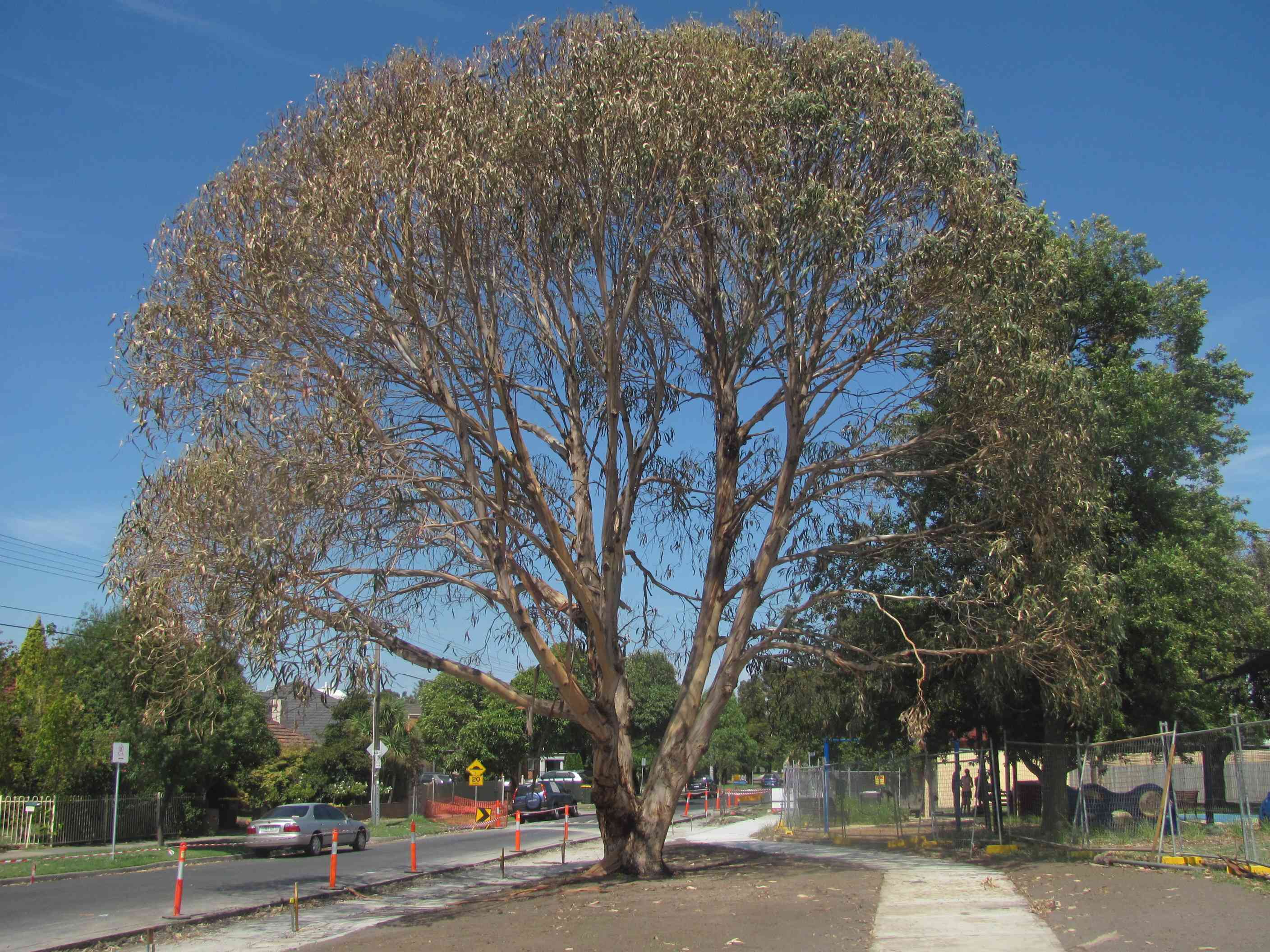
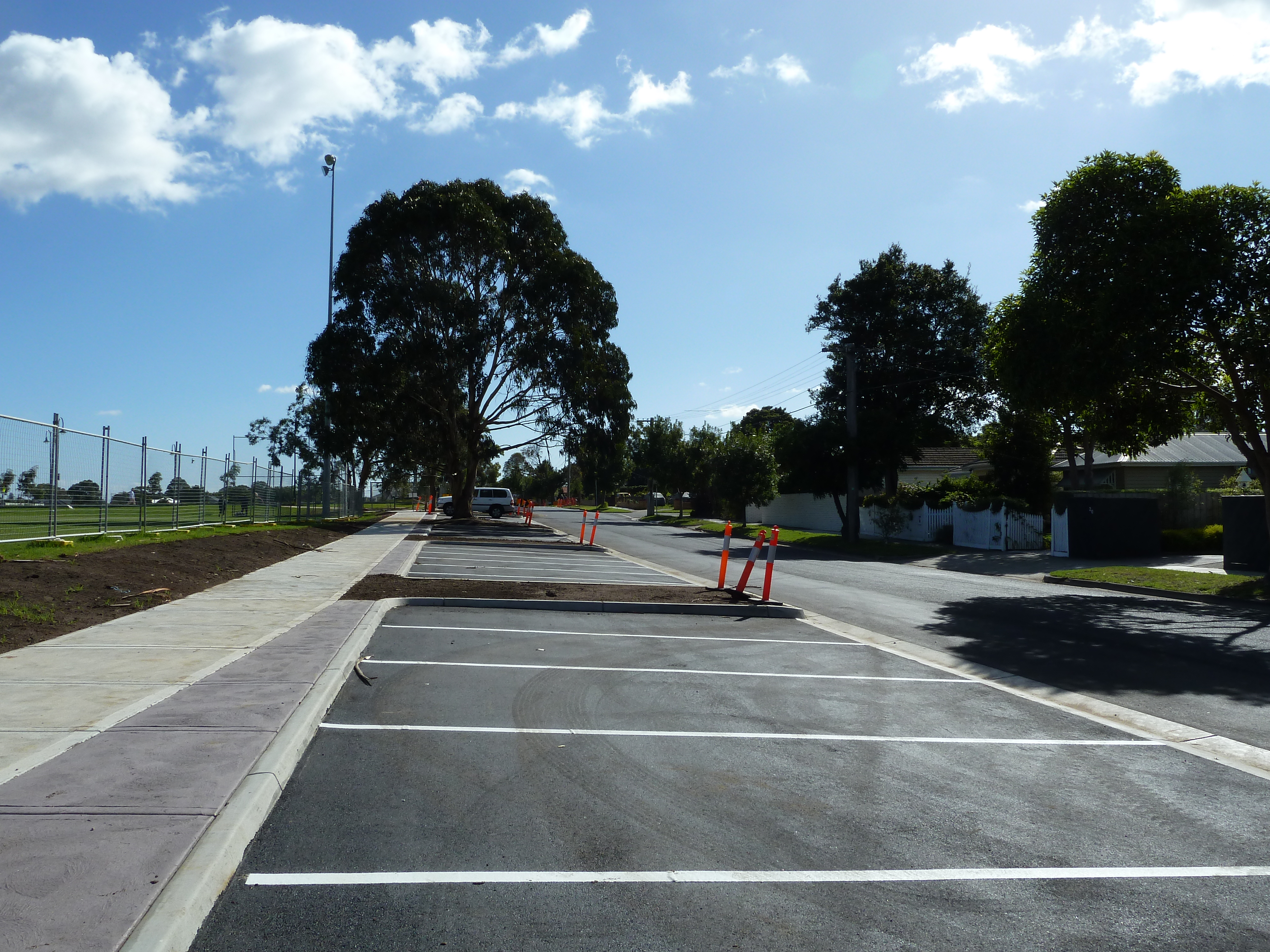
  • Throughout the entire officer’s report there is NOT A SINGLE MENTION of the fact that open space WITHIN BAILEY RESERVE will be diminished and turned into more car parking spots. The only sentence of any relevance on the issue is this feeble, and ultimately misleading one-liner – “A guiding principle has been to try to avoid any further reduction of public open space”.
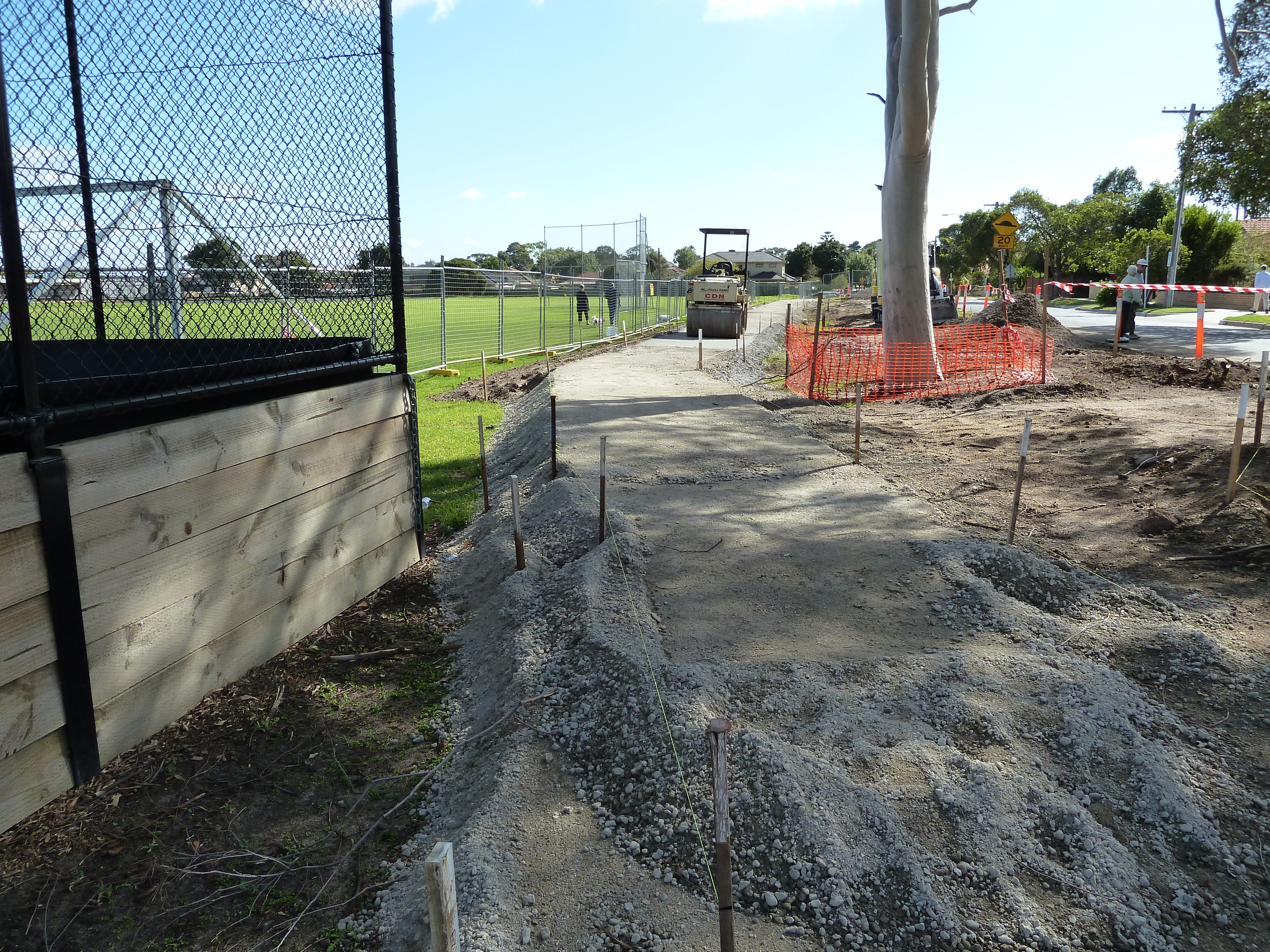
  • Not one councillor in the ‘debate’ referred to the encroachment on Bailey Reserve itself. In fact, Magee proudly proclaimed: “WE’RE TAKING AWAY A BIT OF NATURE STRIP AND GETTING A MUCH NEEDED CAR PARK”. The photos below show that much, much more than a ‘bit of nature strip’ is going. Lipshutz in turn could only say that as ‘victims of our success’ that more car parks “won’t have any impact’ on the reserve. So much for accuracy, and so much for revealing all the facts.
  • Yet, the plan that was part of this item, makes it absolutely clear that Bailey reserve itself would be hacked to pieces and that more open space will be lost. Didn’t any councillor look at this? Didn’t the author of the item (unnamed of course!) look at the plan? Or was all this done in the hope that NO-ONE would bother looking at the detail so residents could once again be easily duped into believing the half-truths and mistruths that issue from this council?
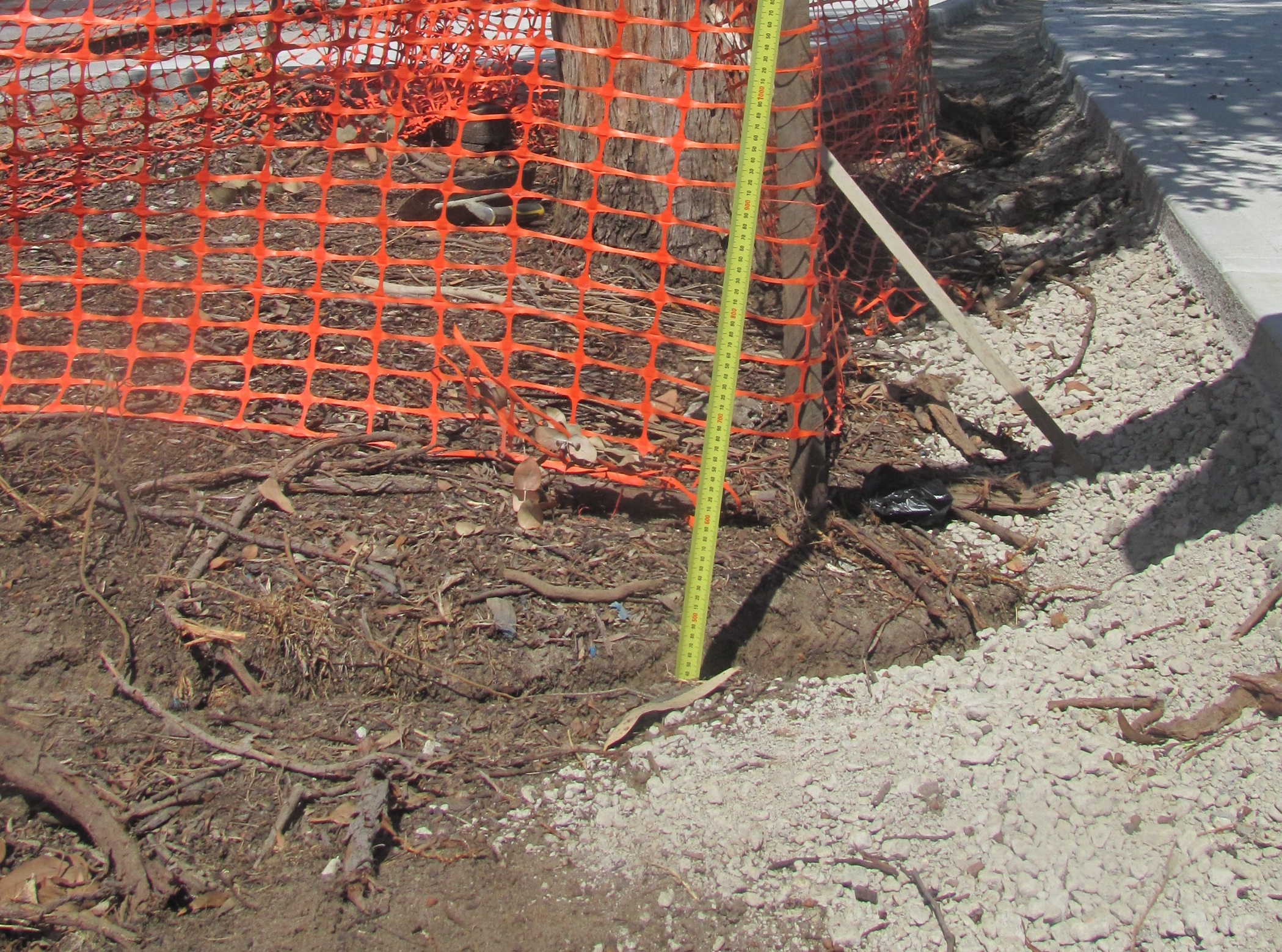
  • Finally, what of the trees? The almost illegible table on the left hand side of the diagram states ‘No. of trees to be retained’ and ‘no. of trees to be removed’. The actual figures are impossible to read. Yet, no-one even uttered the word ‘trees’ and it does not appear anywhere in the officer’s written report. The plan certainly has no trees actually included in the diagram! The root systems have been badly mauled and it would not be any surprise to find council’s arborist in the very near future reporting that the tree is “unstable’ or “diseased” or “unsafe” and that it has to be removed! After all, this is Glen Eira so what are a few fine gum specimens, or other long established trees, or even recent landscaping that cost the earth no doubt, compared to a GESAC car-park extension?

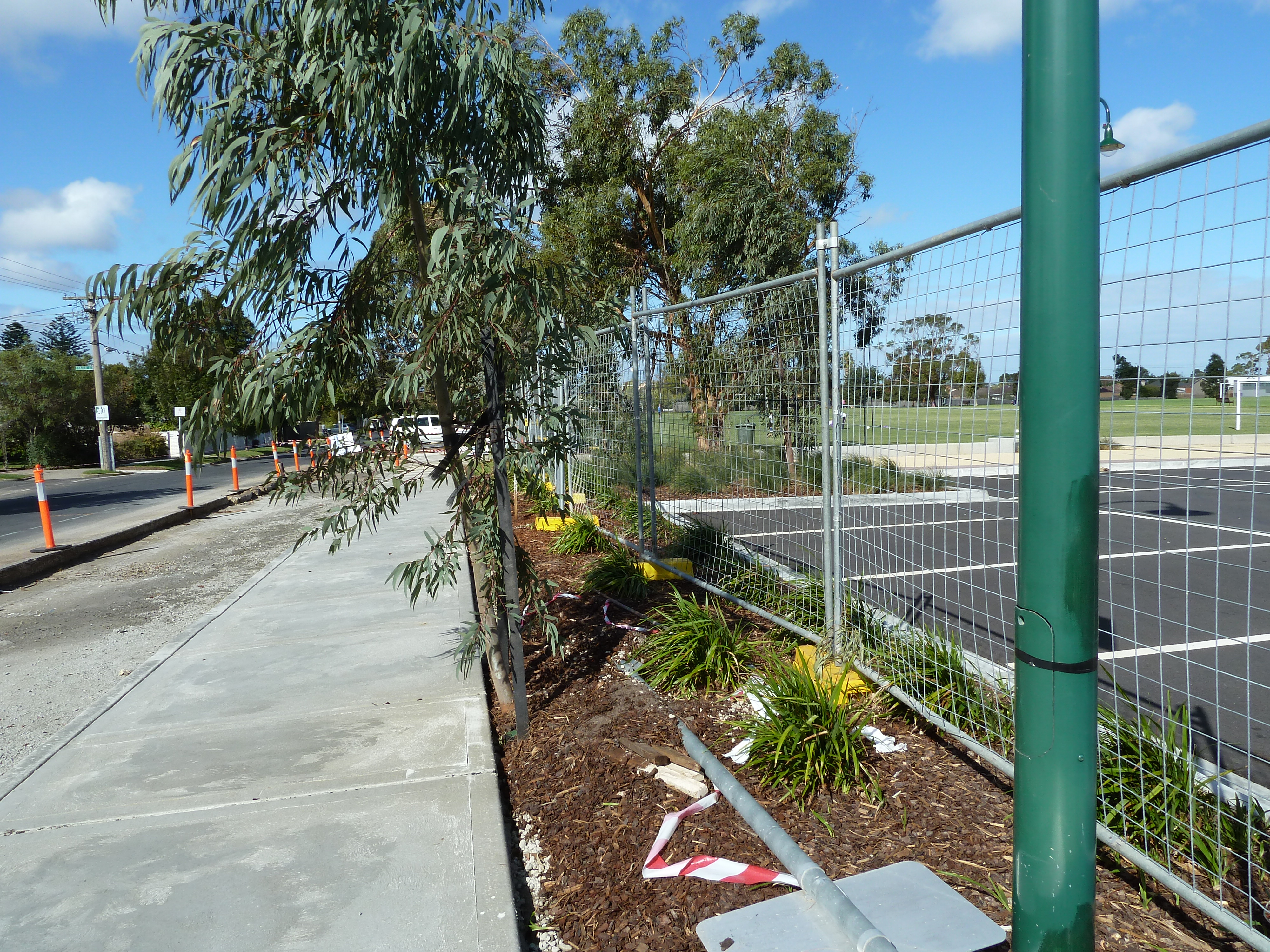
We’ve visited the site in the past few days and below are some photos taken over  several days of the ongoing works. We’ve decided to present them in their full glory, rather than as a slide show.  Please note:

  • Photo 1 displays the area cordoned off WITHIN BAILEY RESERVE before work started
  • Photo 2 displays the original footpath/nature strip which is located to the LEFT of the gum and has now been removed
  • Other photos reveal the new ‘path’ that is well inside Bailey Reserve itself, plus the shredded roots of the gum.

GESAC 13Feb13 IMG_0612

GESAC 13Feb13 IMG_0614

P1000036

P1000035

P1000041

P1000047

P1000045

P1000042

P1000043

P1000046

P1000038 - Copy

P1000044

Untitled

Here is the second part of our email which continues on from the quotes derived from the 2002 Housing Strategy.

“There is plenty more in this document and it reads well. I have just concentrated on residential development, population estimates, and the public realm issue in the wider sense. It would be good if Councillors concerned with overdevelopment, high rate of residential development and the type of development and its consequential very high population increase could pursue the review of the Housing and Residential Development Strategy. It only needs 5 Councillors and it seems that Cr Lobo and Cr Sounness, as the one with some town planning background could start the ball rolling by first asking how many action points have been implemented. So how did Glen Eira actually develop? Let me expand on the issues raised and its problems.

The residential development is always greater than forecast by a significant amount. In 1996 it was 300 dwellings per year, 2001 over 600 dwellings per year, and 2006 and beyond nearly 900 dwellings per year. And the current building applications are close to 1200 per year. It is not clear if building application means 1 dwelling or a number of dwellings. Clearly, the rate of development is much greater than anticipated and there has to be a reason for that. Is the Council doing its job to ensure that infrastructure, public realm and services are there for such a large development rate?

The result of all that development is the population explosion in Glen Eira (http://profile.id.com.au/glen-eira/population-estimate ). In 1996 it was around 115,000 with projected figures of 121,000 by 2020. In 2001 it was 123,000 with a forecast of 130,000 by 2021. In 2006 it was 130,000 with estimates of 136,000 by 2011, 148,000 by 2021 and 157,000 by 2031 (forecast2.id.com.au/templates/forecast2/Clients/133Glen/PDF/10.pdf ).

In the 2002 document the capacity for multi-dwelling developments (lot availability) was estimated to be in the order of 10,000 dwellings to be used up by 2020.  This estimate depends on the density of dwellings built. We suggest it is a gross underestimate. Over 6,000 dwellings have already been built. The service reports indicate that 80% of those are in the housing diversity areas, so 5,000 dwellings have already taken up the available lots. With greater density being built one can safely assume another 10,000 dwellings can be built in the housing diversity areas. The population under such condition is likely to grow to 160,000 by 2021 and 180,000 by 2031. Properly conducted structure plans as suggested in 2002 would elucidate more accurately the lot availability and density of dwellings. As it is now, Councillors and the community are left deliberately in darkness.

But there is more. The sleeper issue is the minimal change area. Once the pressure is on to develop it will. So what is the capacity for developments in this area since it is 4 times bigger than housing diversity area. The 2002 report gives a figure of 5,000 dwelling opportunity for low density developments in housing diversity area. With the existing rules for dual occupancy, single or double storey units, flats and subdivision, all allowed in minimal change area, the end point of 20,000 dwellings is not unreasonable. Assuming a very low no. of 2 to 3 people per dwelling we get a whopping population of over 220,000 perhaps by 2041. The population density in 1996 was 29.7 per hectare growing to a 41.4 by 2021 and 56.9 persons per hectare by 2041. Clearly, such an influx of people with nearly double the density will have major implications on the character, lifestyle and liveability of Glen Eira. Is there evidence of minimal change areas developments? YES. Take Bentleigh East with the largest minimal change area and the smallest population density. The dwelling growth of medium density housing between 1996 and 2011 was 127% as opposed to only 26% in Glen Eira overall i.e. more than 4 times the average. Councillors should ask for details of each suburb growth patterns in terms of medium density and high density. The pressure to develop is on everywhere. What are we building? Is the Council ready for it?

Nearly all developments outlined are suitable for small time developers, who like Glen Eira Council focus on a single project at a time. Koornang Rd Carnegie has exceeded its electricity power capacity and requires a new sub-station to be built. Jemena, the infrastructure provider will not provide more electricity than necessary if it is a case-by-case approach rather than an area approach.  Ormond has a number of recently built apartment blocks erected from concrete. When you flush a toilet, you can hear it throughout the building. Quality is not there and they will become rental slums. Ormond – Glen Huntly reached the dubious distinction of the greatest population density increase of suburbs in Melbourne (http://chartingtransport.com/2012/09/21/first-look-2011-density/ ). Why? And what about water supply and drainage? Are we sufficiently ready for the over 200,000 people living in Glen Eira?

Now to the level crossings of which Glen Eira has 9. Work on North Rd level crossing begins with Murrumbeena Rd being next. The Department of Premier and Cabinet website says: “A program of level crossing removal will contribute to improved productivity and safety outcomes in Melbourne and improved land use outcomes by supporting urban renewal to cater for Melbourne’s growth.” (http://www.dpc.vic.gov.au/index.php/featured/infrastructure-australia-update/ia-appendix). One of the criteria for priority level crossing removal is urban renewal, which means more residential development in the area. Lowering of the rail provides more opportunities than having a flyover rail line, although it is probably cheaper. With $100m to remove a level crossing the State Government is looking for funding from private corporations. They are willing to do that for a price (http://www.afr.com/p/national/cash_cocktail_for_melbourne_rail_Sgxu1YvQcayPIEk9lqWwoK ). If private capital is to fund the level crossing removal then what development would cover such a cost?

Caulfield Village development gives a clue to that with about 7 to 10 times the value of level crossing removal i.e. $700m to $1billion. That would provide a huge injection of capital into the Ormond area. Businesses and traders will support it wholeheartedly. The result for residents may not be that great. The Dorothy Ave bridge would disappear and Dorothy Ave, Royal Ave, Katandra St, and the land around Ormond station redeveloped. This development is for the ‘big boys’. Similar consideration goes for Murrumbeena Rd. Of course if the Committee for Melbourne would have their way they would prefer to do a sequence of level crossings e.g. from Caulfield to Patterson (Frankston line) and from Caulfield to Oakleigh (Dandenong line). Each level crossing removal could add few thousand people into the area. With 9 of them in Glen Eira we could see another 20,000 to 30,000 people. How long would it take? Committee for Melbourne claims they can do it in 20 years. So by 2041 we could see a population of 250,000 (http://blogs.crikey.com.au/theurbanist/2011/08/16/should-replacing-level-crossings-be-given-high-priority/).

One has to ask how all this development affects the Public Realm, which is the responsibility of every Local Government. Glen Eira Council has no definition of Public Realm and has a narrow focus on Open Space. Stonnington Council has developed a Public Realm Strategy (http://www.stonnington.vic.gov.au/your-council/strategies/ ) – “This Strategy extends the typical open space strategy, which includes ‘green spaces’ such as gardens and parks, to the broader understanding of the public realm, which includes all external space that is available for public use”. And it illustrates the concept with the following diagram

public realmThe diagram illustrates the context in which this Strategy operates. The outer layer identifies the broader State policies that govern public space policy in Victoria. The next layer identifies the Council Plan as Stonnington’s key strategic document. The next layer shows both the Municipal Public Health Plan and the Municipal Strategic Statement. The Public Realm follows, and includes streets, parks, hubs and links. Stonnington’s public realm is further divided into suburbs and the many elements from across Council that form the core of the Public Realm Strategy.

Glen Eira Council is conducting a Survey to review its Open Space Strategy – “Open space is all publicly owned land that is set aside primarily for recreation, passive outdoor enjoyment and nature conservation” and the Strategy “includes planning ahead for the provision and design of open space to meet the needs of the anticipated future population”. How they can do it without an integrated approach to planning and by letting developers drive the City growth is a question to be asked. When one examines Glen Eira Council Strategies one gets the feeling it is for administrative/public relations purposes. Look at the Stonnington Council Strategies and one feels more confident in their ability to plan comprehensively and manage their plans in an integrated way.

Perhaps we may as well ask again after Cr Lobo – ‘are we building Calcutta or Richmond’. Over to you Councillors.

« Previous PageNext Page »