We are committed to facilitating genuine debate within Glen Eira. Your views on planning, environment, open space, CEO and councillor performance matter.
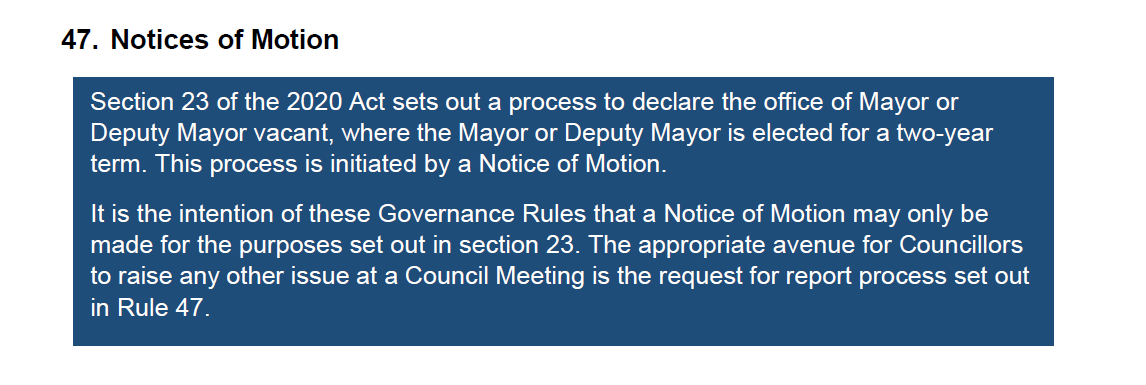
Last night’s council meeting included a Glen Eira first – a Notice of Motion presented by Cr Zyngier. This was permitted since council’s governance rules were once again shown to include a monumental stuff up and hence the denial of a real Notice of Motion was not possible. Admittedly we had not picked this up previously but can now conclude that the following was the reason why the governance rules (as intended) would not hold up to legal scrutiny. The crucial section is contained in this dialogue box taken directly from the governance rules –
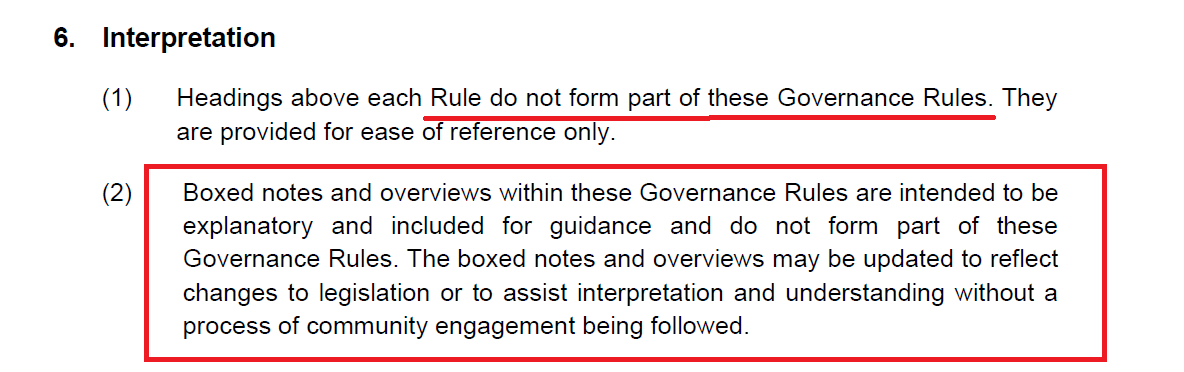
We then get this caveat which basically undermines and rules useless the attempted Clayton’s Notice of Motion.
Thus we get a first in Glen Eira – a genuine Notice of Motion!
Please listen very carefully to the following audio of this motion. It failed once again on the casting vote of Magee after Penniciuk declared a conflict of interest and left the chamber.
What however is quite staggering in this item, needs to be highlighted and seriously questioned!
Why are councillors denied access to essential consultant/officer reports that would substantiate the ensuing recommendations and claims made?
How does this equate with informed decision making, when councillors are not privy to the evidence?
Why are potential inaccuracies in officer/consultant reports not open to scrutiny or review?
How many more times are councillors forced to vote on something of major significance without the benefit of the full data?
Transparency, and accountability, plus informed decision making by this council is clearly non-existent!
We have for ages bemoaned the fact that in Glen Eira residents are confronted with an uphill battle to fully comprehend what council proposes in its structure planning – unless they are willing to spend hours upon hours in deciphering hundreds of pages of documents. There has never been a simple, single page document which itemises proposed controls and/or changes, that are easily accessed and read. Luckily, not all councils operate on the principle of obfuscation like Glen Eira does!
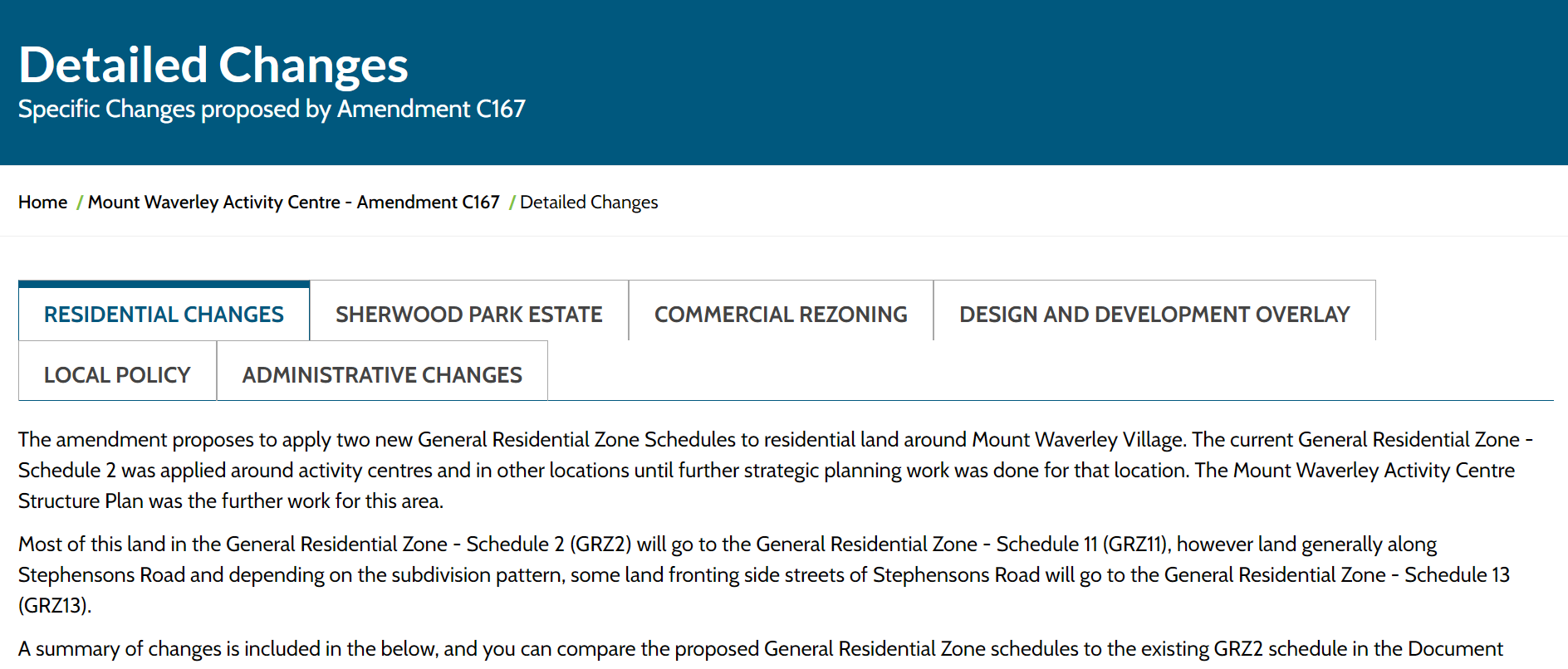
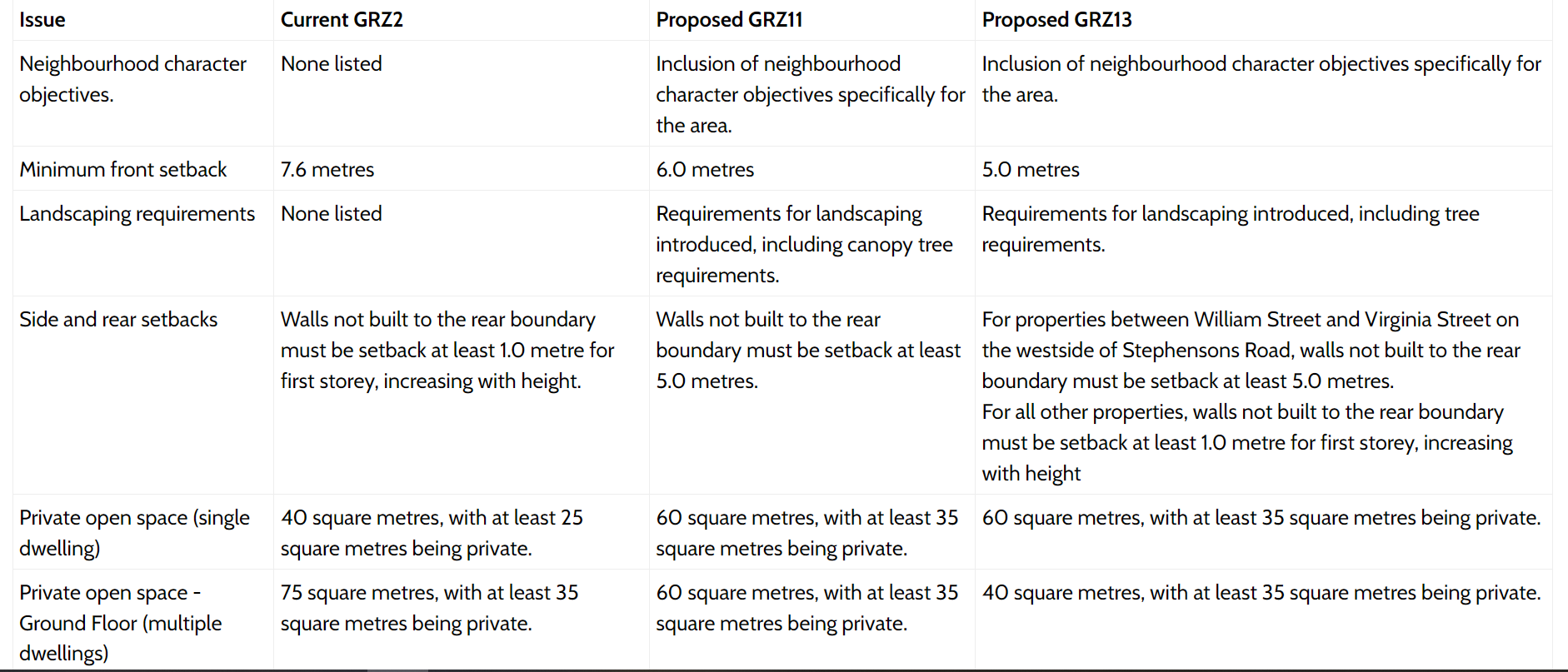
The clear summaries for the various types of sites – ie commercial, residential, etc.
Interestingly, Monash sees fit to assign a 29 metre preferred height for its 8 storey development(s), whilst Glen Eira wants 31 metres!
Note the increase in private open space requirements. Readers will remember that in Glen Eira, the housing strategy recommends the removal of the mandatory garden requirement in all areas zoned GRZ!
Lastly, it beggars belief why Monash is allowed to include so many residential properties in their structure planning area and in Glen Eira, the proposed DDO’s for Bentleigh, Carnegie, and Elsternwick only apply to the commercial and mixed use zones for the major part.
We are not commenting on how ‘good’ or ‘bad’, the Monash plan is. All we wish to highlight is the manner in which Monash informs their community in a simple and clear fashion and how it conducts its consultation programs. In Glen Eira we get nothing like this!
We’ve received the following email from a Bentleigh resident. It was sent to councillors, the CEO, and to the Minister.
“Good morning Mr Mayor.
I am writing in regard to your recent correspondence about a petition which was submitted to Council around the proposed inappropriate structure plan. We dedicated a good deal of time to get to the residents and to obtain 221 signatures from 221 very angry residents who deserve to have their feelings included in the process of Community consultation.
Your advice to us is that the 221 residents will be considered as one submission. Your words in your email are;
“The petition will be included as a submission on the draft structure plan, but in accordance with Council practices, it will be considered as a single submission”.
So if I understand you correctly, we might as well have saved a considerable amount of time and effort and submitted just one resident. It would carry the same weight as the 221 names we provided.
I request clarification as to my interpretation of your comments, and if I am correct, I want to know the reason behind ignoring the remaining 220 residents who have provided their details.
This seems to me and to a number of those who took the time to provide their details to be simply wrong and against any fair inclusion of their wishes. I said that there was anger by the residents we contacted with the petition, but that pales into insignificance when compared to the anger shown by those who I have already advised of the Councils position regarding their involvement.
I wonder if this council and its planning department is really interested in Residents issues and wishes or is this process of Community Consultation again just for show.
This, if my interpretation of your comment is correct, is a disgusting situation.
I look forward to your clarification in this matter.
Thank you,”
COMMENT
Not for the first time has Council ignored community feedback, arguing that forums were either ‘information sessions’, and hence don’t ‘qualify’ for official ‘consultation’ events. What bunkum! Readers will remember that:
Over 100 residents came out on a cold winter’s night to present their views on the Housing Strategy. The resulting reports on that evening revealed that the anger was ‘palpable’, especially when officers attempted to close down the meeting instead of continuing to listen to what residents had to say.
Way back over 200 people attended another ‘information forum’ on the draft Elsternwick structure plan. Again ignored. Bentleigh structure planning was another instance of down playing feedback.
The very fact that in the vast majority of council reports outlining community feedback, there is a failure to include honestly and comprehensively what residents had to say. Legitimate concerns about ‘overdevelopment’ are simply swept under the carpet and barely rate a mention. Council even fights tooth and nail to prevent the verbatim publication of such feedback when previously this was seen as proper process when strategic planning first began.
We have now had structure planning endorsed for Glen Huntly, Bentleigh, Elsternwick, Carnegie, and Caulfield accompanied by bogus surveys, ‘information sessions’, and spin. Not once have these surveys been road tested with the community consultation committee, and councillors barely get a look in. Repeatedly, councillors have been forced to vote without all the relevant documents available to them, or without sufficient time to critically analyse and digest what it is they are being asked to vote on. This planning department and administration has much to answer for!
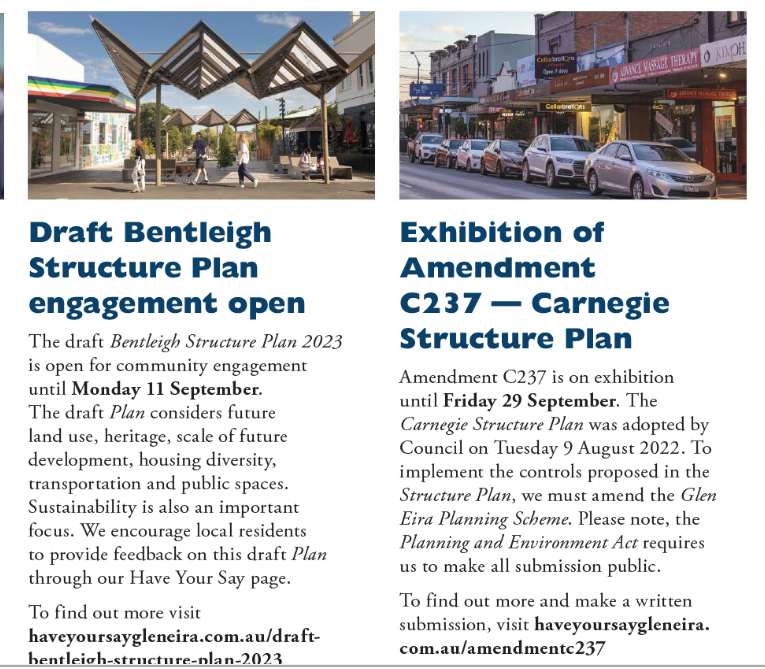
Structure planning is vitally important to the residents of Glen Eira. Council continually espouses how vital it is to hear back from the community and to engage as many constituents as possible. Yet, their methods of achieving this goal are deliberately circumscribed and inadequate. One would surely think that when submissions are called for Bentleigh & Carnegie these would achieve major prominence in the Glen Eira News. Furthermore, that the actual proposals are listed. Not so. What we get in the latest Glen Eira News is the following – and buried at page 8. It consists of the usual spin – ie ‘land use, heritage’, etc. but without a single word actually describing what is proposed. Definitely deliberate because if residents were told that the drafts contain plans to permit 12 storey discretionary, and that heritage listed places can be 5 and 6 storeys, then there would probably be plenty of submissions forwarded to council. The plan is clear: keep residents as ignorant as possible unless they are prepared to plough through hundreds upon hundreds of pages in order to decipher the true vision. This is unconscionable and contrasts sharply with other councils’ approaches.
Simply ask yourselves – would any reader of the following image have any real idea of what lies in store?
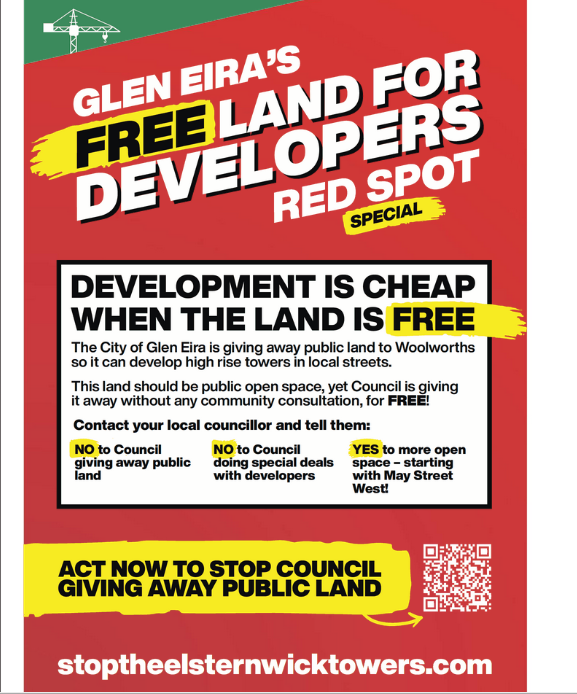
Old photos are the latest weapon in a long-running battle to stop Woolworths building high rise apartment towers in Elsternwick.
A community group fighting the proposal says the images cast doubt over whether the council could “give away” part of the land needed for the development.
The parcel of land in dispute, May Street (west), forms a 500sq m component of Woolworths’ larger development site and is essential for the project to proceed on the old ABC TV site.
On September 7, 2022 VCAT granted planning permission for a mixed use development including a supermarket and apartments at 10-16 Selwyn St. A condition of the planning permission was that work could not begin until Glen Eira Council was satisfied that May St was not a legal road.
Earlier this year Glen Eira Council accepted evidence provided by Woolworths that the land had not been used as a road since World War II.
However, Stop The Elsternwick Towers said it had received expert legal advice that May Street west was a road that had never been discontinued by the council.
“Legally it belongs to Council on behalf of ratepayers and not Woolworths, who have gated the area and plan to build over it,” the group said.
Group spokesman Max Deacon said photos, including an image from 1968, proved the land was open to the public in the late 60s.
“The new research shows that May Street was set aside for public use from 1889 and that it remained open to the public until a gate was placed at the Selwyn Street end of May Street during the Second World War,” Mr Deacon said.
“Council’s acceptance of Woolworths’ claim suggests nobody used May Street for some 50 years. And that nobody has used it after the Second World War, despite aerial photos showing it open to the public again in 1968. “That simply doesn’t make sense.”
Mr Deacon said the group had sent the information to the council and wanted the decision reviewed.
“At law any transfer of public land from council control to the private sector must undergo a thorough community consultation process,” he said. “This has not occurred. “What is worse, is Council is giving away public land to developers for nothing.” Mr Deacon said the value of the land could be as much as $5m, based on the $55m purchase price of the overall site.
“Development is cheap when the land is free,” he said. “Woolworths must be rubbing their hands with glee.”He said the community wanted the site turned into a public park.
Glen Eira chief executive Rebecca McKenzie refuted the claim the council was giving away public land to a private developer.
“The planning permit requires Woolworths to provide evidence that part of their land is not a public road that should be transferred to Council, which they have done,” she said. “We have received evidence from both Woolworths and Stop the Elsternwick Towers (STET). “We undertook our own due diligence and agreed that it is not a road at law.”
COMMENT
Council’s claims of ‘due diligence’ would carry far greater credibility if the assumed ‘legal advice’ they received was made public. The same can be said for the Woolworth’s advice.
The above image featured in today’s Age. It concerns the ongoing saga around the Woolworths’ development in Selwyn Street, Elsternwick and the continuing council limbo around May Street. According to senior legal advice May Street is, and always has been a ROAD and thus lies smack in the middle of the Woolworths’ planning permit for high rise towers and a supermarket.
So what is council doing about this? It would appear that they are content to do nothing and to cede this land worth an estimated $5M to the developer ‘free of charge’. The folks at Stop the Towers, have for ages advocated that this land be turned into open space and failing this, that council (and hence ratepayers) be reimbursed for its value. Instead, everything is in limbo, with council sitting on its hands and hoping that the issue fades away. In a suburb with the least amount of public open space in the municipality, $5M could certainly buy quite a decent sized piece of land.
We acknowledge upfront that each activity centre is unique and different. But, there are surely certain planning principles which must be applied equally to each centre. In this post we focus on what council considers appropriate for sites located in the existing heritage overlays for both Elsternwick and Carnegie and the ensuing proposals for height limits and overshadowing.
Council’s planning for these two structure plans attempts to convince us that preserving and protecting heritage is vital. The planning scheme however, differentiates between ‘significant/contributory’ sites within each heritage overlay. Those sites designated as ‘non-contributory’ may be ‘developed’ whilst those deemed ‘contributory’ will hopefully have mandatory height limits assigned.
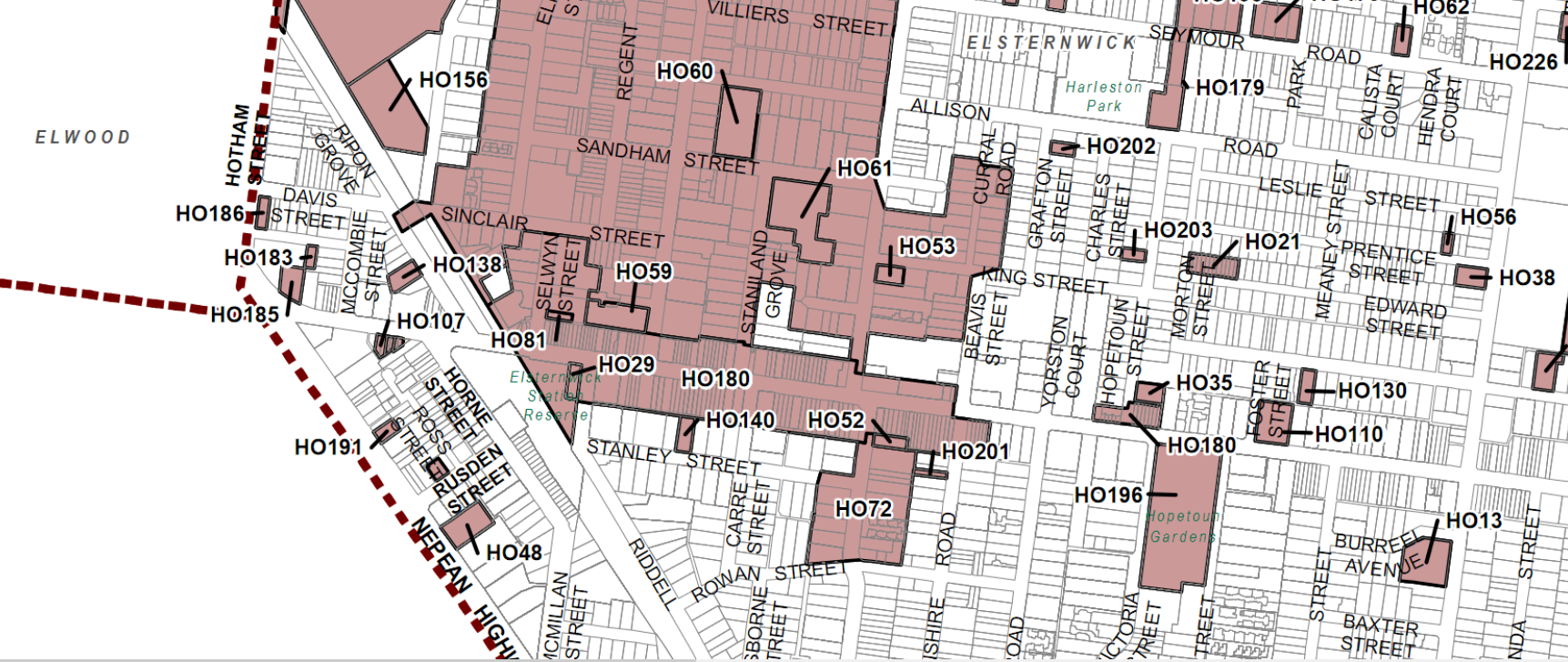
The following screen dumps show the existing overlays for both Bentleigh and Elsternwick. We have concentrated on the commercial spine of Glen Huntly Road and Koornang Road. Both shopping strips have a heritage overlay applied.
Given the above one should suspect that the resulting heights would be identical given the heritage overlays. But they aren’t! For the Koornang Road strip the proposed structure plan nominates a 5 storey height limit whilst the Elsternwick version includes height limits of 6 storeys (discretionary). The question then becomes: are all sites in Koornang Road deemed ‘contributory’? Here is the evidence that shows at least 11 sites that are designated as ‘non-contributory’.
Why then should Elsternwick’s non contributory sites be given leeway for a 6 storey discretionary height limit and Koornang Road’s non contributory sites be awarded a 5 storey height limit?
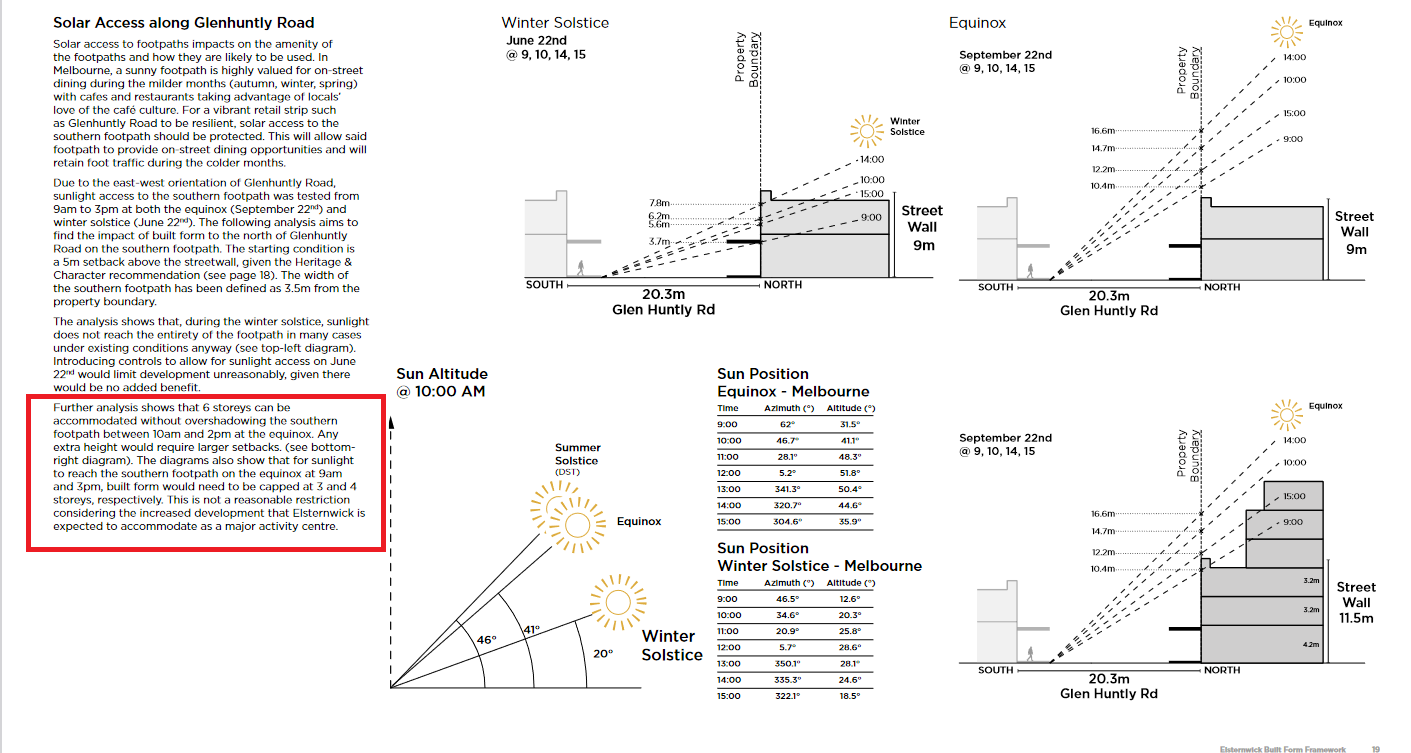
What must also be remembered is that Koornang Road runs in a north/south direction whilst Glen Huntly Road runs east/west. For Glen Huntly Road, as well as Centre Road, this means that at the winter solstice, and even the summer equinox at certain times, sunlight will not reach the southern footpaths where people are enjoying their lunches and coffees. We highlight this because the inconsistency between council’s planning is really unbelievable.
Here are screen dumps from both the Carnegie Urban Built Form Framework (page 20) and the Elsternwick one. Please note carefully the boxed sections and the introductory blurbs waxing lyrical about the importance of sunlight.
This raises a myriad of questions:
Why can a north/south running shopping strip have a 5 storey mandatory height limit and an east/west shopping strip be allowed a 6 storey discretionary height limit?
Why aren’t ‘non-contributory’ sites treated the same?
How reliable and accurate are the actual shadow diagrams presented in both cases?
Why the differences between both given that the Carnegie sunlight exposure reaches to the back footpath section and the Elsternwick one only reaches the front edge of the footpath. Given that both are the work of the same consultancy firm, then why the differences?
What we’ve presented are fair and legitimate questions and go to the heart of decent and consistent strategic planning. Our conclusion can only be that the consultant’s reports are simply there to confirm what has already been decided by this planning department. Again, transparency and accountability simply do not exist!
Last night’s debate on the Elsternwick structure plan would have made Machiavelli proud in terms of the chicanery that was enacted. This council has reached the nadir of good governance and accountability and obviously has no compunction in employing every dirty trick it can to further its agenda. Here are some of the lowlights of what happened.
Out of the blue a note suddenly materialised and was presented to Magee stating that Pennicuik had a ‘conflict of interest’. Who wrote the note, and when it was written remains undisclosed. Interesting, because when Magee asked for any conflicts of interests at the start of the meeting, there were none. Suddenly we get the Pennicuik one. The consequence of this was that only 8 councillors were permitted to vote and Magee therefore had a second, casting vote. A number of questions arise as a result. If this was a genuine conflict of interest (which we doubt) then why was Pennicuik permitted to vote previously on anything to do with this structure plan? And if it is a genuine conflict of interest, then why don’t the same principles and standards apply to Athanasopolous’ voting when it comes to Carnegie and the business he runs there? Does this mean that any councillor who owns a property in an area cannot be involved in decision making for that area and thus can’t represent his constituents? It is ludicrous that this is the standard that Glen Eira chooses to implement – but only when it suits of course!!!!!
Every effort was made by Magee to silence Cr Zyngier on numerous occasions, especially when he queried the accuracy of the data that the officers had provided to consultants and which all had a significant impact on the consultants’ ensuing recommendations.
Torres continues to mislead this council and it can only be deliberate. For example: when discussing the difficulty of enshrining winter solstice standards into the planning scheme, Torres also referred to council’s reliance on ResCode. What he does not say cannot be seen as an oversight since he knows full well that ResCode DOES NOT APPLY to buildings that are above 5 storeys. The issue here is 6 storey and higher buildings on Glen Huntly Road. ResCode is entirely irrelevant!!!!!
The gallery was told several times that there were several alternate amendment motions. Why it was the Cade amendment that was heard first (and thus was voted in on Magee’s casting vote, instead of the Zyngier proposal) raises further questions of manipulation to achieve the desired outcome. There was literally not even a nano-second, or pause for breath, between Magee asking for a motion and then immediately calling on Cade! Pre-arranged? You bet!!!!!There is no way that this could be seen as anything other than backroom orchestration designed to prevent the Zyngier proposed amendment!
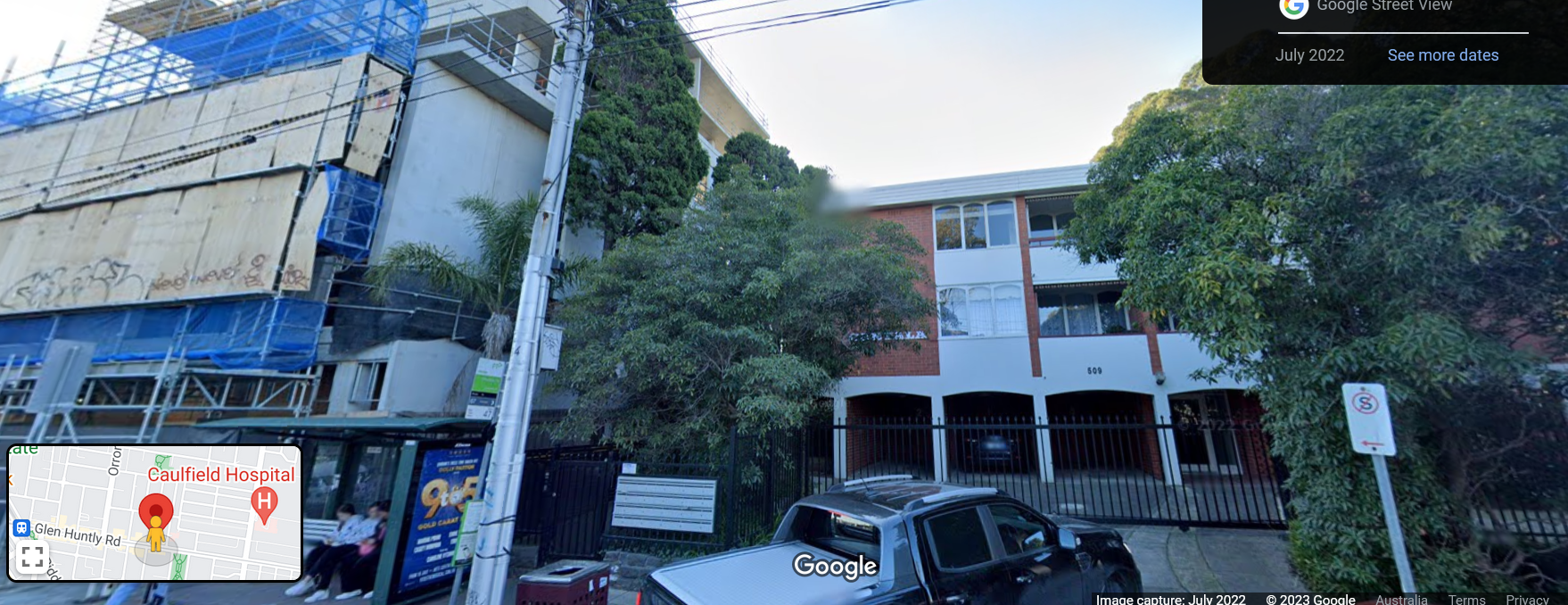
At one point Zyngier attempted to prevent the removal of Pennicuik, by proposing a ‘friendly amendment’. He suggested that 509 Glen Huntly Road be removed from the Cade amendment, which was the property causing the alleged conflict of interest. We note that 509 is: (1) a block of apartments; (2) it is not listed as a ‘significant’ heritage building and is very unlikely to be demolished and have a six storey dwelling erected in its place because of the sheer number of apartments and presumably individual owners.
Here is what it looks like:
Magee ruled that this was NOT a ‘friendly amendment’ since it is an ‘alternate’ recommendation! Further, he ruled that both the mover and seconder did not accept this – YET THEY WERE NEVER DIRECTLY ASKED WHETHER THEY WOULD ACCEPT THIS as is the normal custom. He simply made the decision to discount Zyngier’s attempt with the lamest of excuses! Furthermore council’s own governance rules state the following in regard to ‘friendly motions’ –
Clause 38(2): A friendly revision of a Motion may propose to alter a Motion by leaving out, inserting or adding words which complement the Motion.
The aim of last night’s meeting was to achieve by hook or by crook the ratification of the Cade amendment. It was designed to prevent council taking a position on protecting sunlight to the southern side of Glen Huntly Road because this would further limit the heights of development on the northern side. For all the rhetoric of giving a damn about heritage, and the ‘village feel’ of Elsternwick, the Cade amendment revealed how little council cares about these issues. 12 storeys still remains, and that’s supposed to be in line with the ‘village’ atmosphere. And we are supposed to take comfort in the fact that a 6 metre setback will now be sufficient to avoid additional overshadowing when no documentation/evidence has been supplied to justify this claim.
Residents need to hold such manoeuvring and councillors to account. We have a mayor whose only function appears to be to steam roll through anything that the planning department puts in front of him. It is indeed a very sad day for Glen Eira residents because this sets the precedent for Bentleigh, for Carnegie, and for every activity centre in the municipality.
Please listen very, very carefully to the following audio of the ‘debate’ and note Magee’s actions and words throughout this item.
Council has released its revised structure plan for Elsternwick.
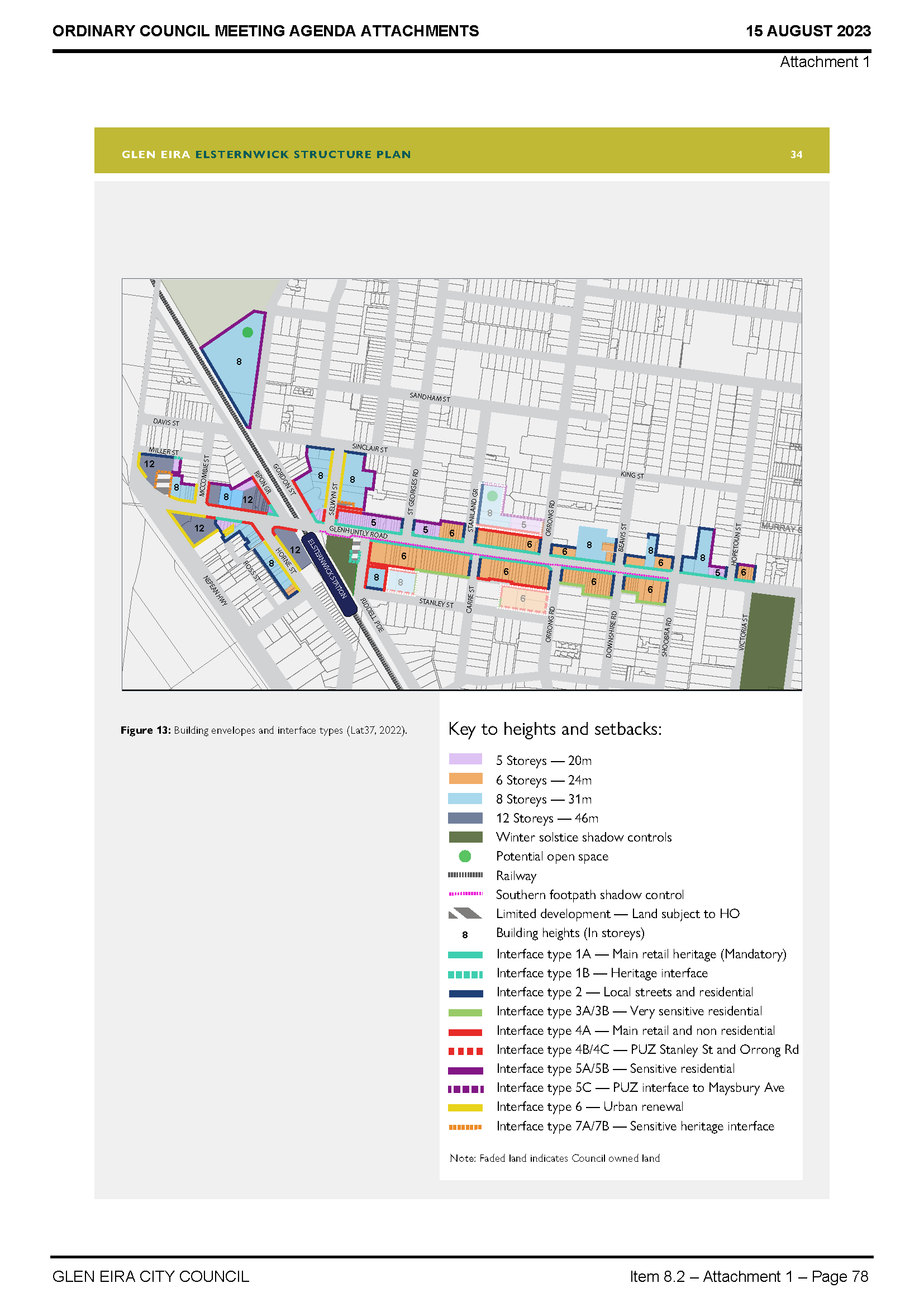
Here is what is now envisaged. Please note carefully the proposed heights (remembering that many are discretionary) and ask yourselves why the height in metres has increased dramatically from the current interim Design & Development overlay.
As expected, what we now have is nothing more than some minor tinkering from what was initially proposed. Despite the majority of community feedback opposed to the suggested (discretionary) heights, the need for sunlight on southern footpaths at the winter solstice, and the lack of sufficient open space, Council has seen fit to ignore all of these concerns. We still have:
No change to suggested building heights along Glen Huntly Road
No protection of southern footpaths at the winter solstice
Instead, council has simply changed some of the upper level setbacks for (some) heritage sites from 5 metres to 6 metres. Of course, we are not provided with any specifics or ‘evidence’ as to how this change will impact on overshadowing – especially to the southern side of Glen Huntly Road. We are supposed to take council at its word!
Yes, some originally proposed heights have been reduced – ie Horne Street from 12 storeys down to 8 storeys (discretionary). But they back onto Ross Street which is a tiny, narrow street consisting primarily of single storey homes. As with Bentleigh, council sees nothing wrong with having towers abutting single storey properties. This isn’t planning. It is literally a ‘f-ck you’ to residents!
The officer’s report makes the above sentiment absolutely clear when we are told the following:
The report outlines the revisions to the final structure plan in response to community comments, however there are components of the draft plan which remain unchanged. The consultation outcomes identified that proposed building heights were of concern for some but whilst making wholesale changes to building heights may seem popular, these cannot be justified or pursued based on community preference.
COMMENT: The question isn’t solely about ‘community preference’ but sound and valid strategic planning. Why and how can a 12 storey building be justified when the projected population growth is only 1400 residents by 2036. We’re told that population per dwelling will drop to 2.3 individuals in 2036. Even if we’re looking at 3 individuals per dwelling, or for that matter only 1 individual per dwelling, that means that we have a range of 460 to 1400 net new dwellings that are required over a period of 15 years. Council of course claims that they have to look beyond the 2036 date – the inference being that once adopted this structure plan will not be touched again for at least 20 years. That is council’s history and modus operandi! Whilst we’re promised a ‘review’ every four years, the results of this ‘review’ will only be to communicate what was been done in the intervening period we strongly suspect. We also have to laugh at council’s ‘implementation’ timelines. We find that ‘immediate’ means 1 to 5 years; ‘medium’ means 5 to 10 years and ‘long term’ blows out to over 10 years! Thus a Development Contributions Levy on developers could be 5 years down the track after it was ‘promised’ in 2016. Or, affordable housing, open space, and community uses might not happen for 10 years. But in the meantime of course, development will steam roll ahead!!!!!
The other amazing comment from the officer’s report is:
We are pursuing winter shadow protection for existing and potential future public open spaces including Elsternwick Plaza. However, winter shadow controls cannot be pursued for the southern footpath as many forms of redevelopment would be severely limited. This is contrary to the role of a MAC to accommodate future growth. For these areas, the equinox shadow is the standard to apply.
COMMENT: What the above makes absolutely clear is that anything that is likely to put a constraint upon development will not be pursued. Thus heritage and sunlight is expendable when it comes to the potential of facilitating more development. What is not stated is that ‘future growth’ can be accommodated according to what is required as shown above, and not what will benefit developers. Interestingly the Bentleigh traffic report provided figures on the net number of new dwellings anticipated by their draft structure plan which showed that over 2000 net new dwellings could be squeezed into Bentleigh. We do not remember seeing any such figure for Elsternwick. So if Elsternwick is proposing 12 storeys and Bentleigh 8, then we can only assume that Elsternwick is trying to ensure more than 2000 net new dwellings – regardless of whether we actually need this number in the ensuing 15 years!
CONCLUSION
Planning in Glen Eira continues to be driven by the development industry and by an administration that does not care one iota for its community and residential amenity. We have had consultations after consultations that are meaningless, ignored, and consultant reports that do nothing more than attempt to confirm decisions already made. Plus we have certain councillors who simply do not appear to care, or have the integrity to challenge such poor planning. Which leaves us with the question that if council is now claiming to have made changes in response to community input, and gone out again to so called ‘experts’, then why couldn’t these revised views and expensive ‘expert’ reviews been done initially? Or is it more of the same? – the pretending that we have listened to the community but in the end, done very little to ameliorate our concerns?
It’s time to call a spade a spade when it comes to this administration and its disregard of residents. To put it bluntly:
Resident views simply don’t matter, especially if they are opposed to council’s pro-development agenda and its predetermined decision making.
Council engages with residents, in the most minimalist manner on all important projects because the law says they must and NOT because there is any real intention to seek genuine resident feedback.
Only two conclusions are possible when it comes to evaluating council’s approach to seeking feedback from the community. Either we have some completely incompetent officers who are incapable of devising a survey/questionnaire that will deliver valid results, or the resulting surveys are designed with leading questions that can only be used to support already predetermined decisions. The latest example is the Bentleigh Structure Plan survey.
To avoid any meaningful input by either councillors or the community, the now released survey has been rushed through to publication. The original officer’s report stated that consultation would begin towards the end of the first week of August. It has been brought forward (without explanation) to July 31st. This doesn’t sound like much, but what it means is that councillors have had minimal time to evaluate the survey and that the Community Consultation committee has again been successfully bypassed!
It’s also worth remembering that originally this administration had no wish to include a survey in its consultation – as it has done with other structure planning. It was quite prepared for the ‘quick and dirty’ route of formal submissions, and ‘meet and greet’ with officers – with 3 out of the 4 proposed times being totally inappropriate for the vast majority of residents. It was only after councillors requested a survey that we get to this point.
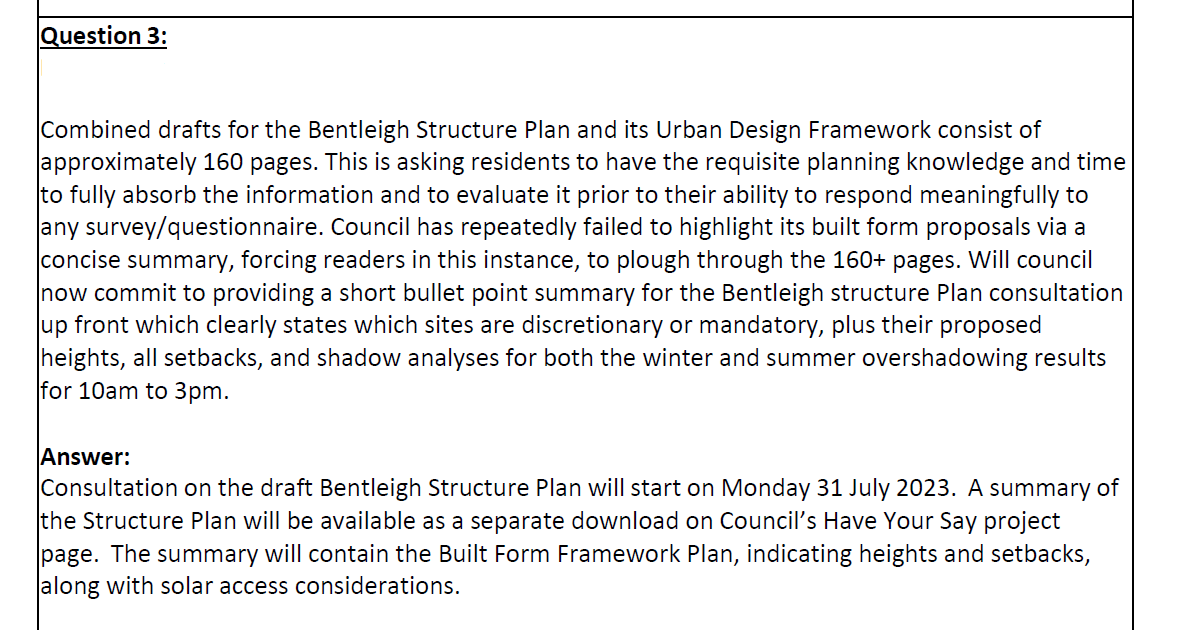
At the last council meeting one public question asked that a succinct bullet point summary of proposed heights, setbacks, and overshadowing analyses be part of the consultation process. The question and answer are below:
What we get is an 18 page so called summary, that is full of spin and guilty of the sins of omission! The ability to decipher exactly what is proposed from this document is impossible given that the full picture is never revealed in a concise and honest fashion. For example, when referring to proposed building heights, this administration chose to include the following map.
Why couldn’t this document include the following image that featured at the 25th July council meeting? Is it because this map is far easier to decipher?
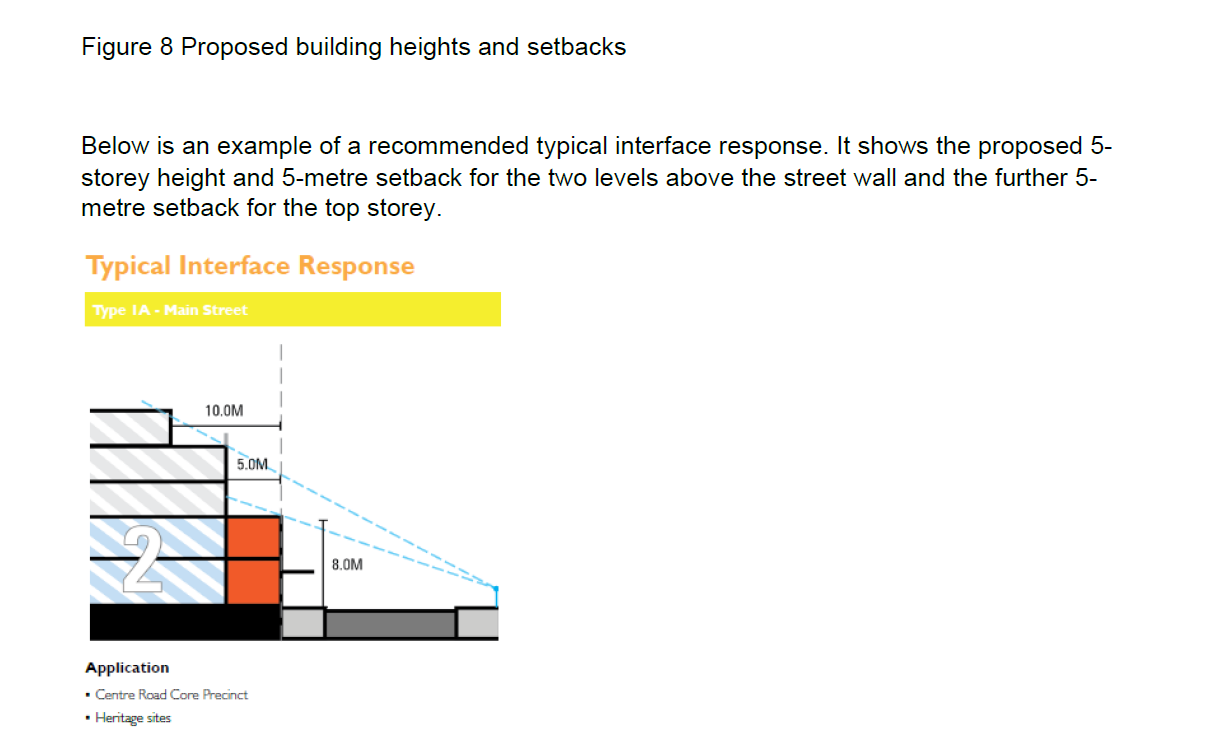
We then get only one example (for a heritage site) of the proposed setbacks as depicted below.
What we aren’t told is anything about rear and side setbacks, for a proposed 7 or 8 storey building that is NOT heritage listed.
In short, this ‘summary’ is a carefully manipulated document that fails to fully inform the community of what the draft structure plan intends to achieve.
THE SURVEY
Any decent survey should never include leading questions. This survey is replete with either useless questions of this ilk, or questions that don’t provide the necessary information in order to elicit fair and valid responses. Here are some examples:
Question: Do you agree that we should seek opportunities to create open space in the draft Plan?
Comment: Of course, nearly everyone would answer ‘yes’ to this question given Glen Eira’s lack of public open space. But does a ‘yes’ response to this mean that everyone is in agreement with the possibility of flogging off other council owned land for mixed use development? And will the additional open space of whatever size (since this is yet to be determined) be large enough to cater satisfactorily for the projected population increase?
Question: Do you think accommodating growth above the commercial strip is better than doing it in other parts of Bentleigh?
Comment: Even if the majority of responses are ‘yes’ to this question, it does not mean that those individuals who ticked the ‘yes’ box, are in favour of discretionary heights of 7 and 8 storeys! Without revealing the full extent of the ‘growth’ proposed any answer needs to be treated with caution. But of course, council can use the ‘yes’ responses to support their high rise agenda! Furthermore, the question fails to take into account issues of adequate infrastructure, parking, overshadowing, etc.
Question: The draft Plan recommends height limits and upper-level setbacks for new development. Do you agree that such measures would help to retain the character of Centre Road?
Comment: If respondents have no idea of what the height limits and the setbacks are for various sections of Centre Road, any responses given will be meaningless. Furthermore, unless they are au fait with which sites are heritage listed, then again the notion of ‘retaining the character’ of the area is nothing more than subterfuge. How on earth it is even possible to use the word ‘retain’ when discretionary heights of 7, and 8 storeys are nominated is obscene!
Question: The draft Plan identifies the western and eastern ends of the centre as the most suitable for higher density buildings as they would be away from the more sensitive heritage shops. Do you think this is a suitable approach?
Comment: Again, the question is deliberately misleading in that what is NOT mentioned is the fact that the highest proposed heights directly abutt either single storey dwellings in heritage overlays, or other residential areas. Nor are the proposed heights nominated. Plus, the recommendations fly in the face of council’s previous decisions on Bentleigh, that high rise should be located near the railway station and not at the extremes of the activity centre. Again, no explanation for this change in approach. Nor the question of whether this is indeed good strategic planning!
CONCLUSION
There are many other questions we could have commented upon, but the above should suffice. This is the latest example of how little respect is afforded to residents and how contrived and manipulated all community consultation processes are in this council. It is more than incompetence! It is a deliberate and disgraceful attempt to bypass the community, and even councillors, in order to achieve more and more development and to fill the pockets of developers and probably to earn more brownie points from the increasingly autocratic government.





 Glen Eira Debates