GE Service Performance


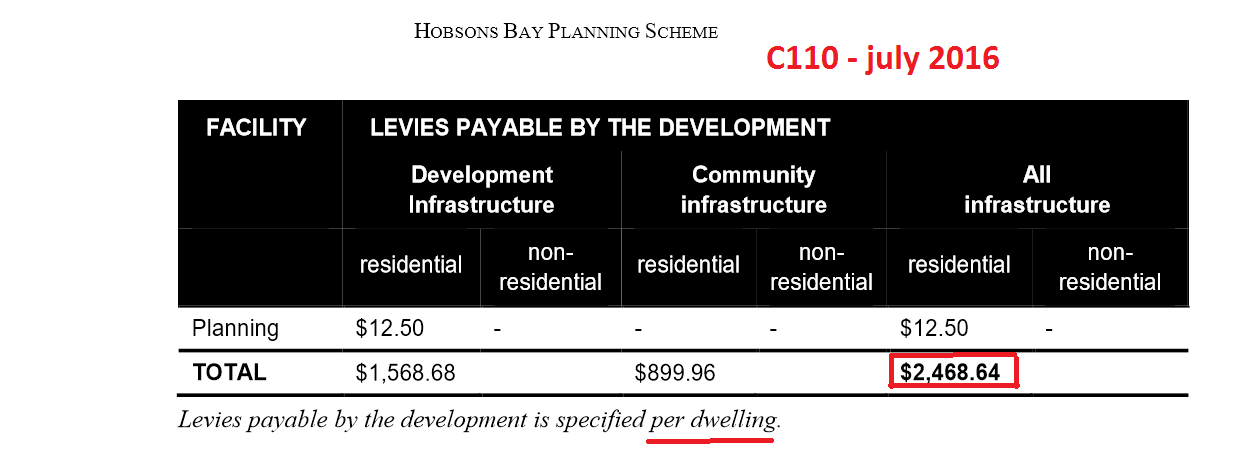
As a follow up to our last post, here is a screen dump from just one council that has done its homework and managed to impose an infrastructure levy on developers. Please note that the amount stated is for each dwelling constructed. Glen Eira dropped its levy in 2011! Thus residents have been subsidising developers 100%.

untitled

Commentary and photos on yesterday’s flooding is receiving huge coverage in both the dailies and on social media. Not for the first time have large areas in Ormond, McKinnon, Bentleigh and Caulfield found themselves under water. Our concern is whether council has learnt its lessons from 2011 which was also supposed to be a 1 in a 100 years event.

Here is some food for thought –

  • Development upon development must be impacting on the capacity of the drainage system – especially when the amount of impermeable surfacing, the increase in crossovers, and the removal of vegetation means that water now runs off into the drains instead of being absorbed into the ground.
  • Council’s budget on drainage has remained the same for years on end (ie $3m). Thus, given rising costs, this equates to a reduction in real expenditure.
  • It is amazing that both Bayside and Port Phillip have been able to introduce an amendment based on work with Melbourne Water that provides up-to-date analysis of potential areas under threat of flooding and imposes an SBO on these areas. Glen Eira in contrast keeps telling its residents that Melbourne Water has put any such work on hold. We find this incredible and unbelievable since the Elster Creek flows from Glen Eira directly into Port Phillip and the Elwood Canal. Why these councils have been able to successfully work with Melbourne Water and Glen Eira hasn’t (or won’t) is the real question here.
  • These other councils have also introduced amendments that INCREASE the developer levy designed to pay for infrastructure. Glen Eira REMOVED ITS LEVY in June 2011 – thus presenting the developer with another ‘present’ and forcing residents to subsidise new developments. Please see our previous post on this – https://gleneira.wordpress.com/2011/06/25/floods-and-drains-failure-and-cover-ups-continue/

If we are correct, and greater permeability and less site coverage is a contributing factor in reducing flood risks, then Glen Eira has not learnt a thing. We remind readers that:

  • The carving up of the municipality into ‘minimal change’ and ‘housing diversity’ occurred in 2004. At this time minimal change areas were to have a 50% site coverage and 25% permeable surfaces. Housing diversity on the other hand was to have 60% site coverage and 20% permeability requirements. The introduction of the new zones could have made huge improvements here. They did not – in contrast to the following councils –
  • Banyule for its General Residential Zone 2 has a site coverage of 40% (Glen Eira – 60%)
  • Bayside for its Mixed Use zone has a site coverage – 50% (Glen Eira – 60%) and for its General Residential Zone a site coverage of 50% (Glen Eira 60%)
  • Brimbank for its Neighbourhood Residential Zone has a PERMEABILITY requirements of 30% & SITE COVERAGE  of 50% (Glen Eira has permeability requirement of 25%)
  • Darebin for its General Residential Zone has a site coverage of 50% (Glen Eira 60%)
  • Whitehorse – for its General Residential Zone has a site coverage – 50% and permeability of 30%. Its General Residential zone (GRZ2) has a 40% site coverage and 40% permeability requirement, whilst its & GRZ3 has a 50% site coverage and 30% permeability Finally, in Whitehorse, residents living in the Neighbourhood Residential zones have a site coverage of 40% AND a permeability requirements of 40%. In NRZ5 the permeability schedule is 30%. Once again, the real question is – why these other councils have been able to achieve so much more protection for residents and Glen Eira has done nothing since 2004 when the opportunity was there via the introduction of the zones?

Finally, we highlight Hyams comment made on the Glen Eira Residents’ Action Group Facebook page. Another exercise in spin and half-truths!

The flooding issues were in many places across Melbourne today, but we should still be trying to resolve them in our area. We spend around $3 million a year on improving our drainage. However, the main issue is that the Melbourne Water pipes lack the necessary capacity to carry all the water when there is heavy rain like today. The water from our council pipes hits the overflow in the Melbourne Water pipes and backs up so no more can get into our drains. In the floods in February 2011, the back up had so much force that concrete drain lids were lifted off. We have been strongly advocating to Melbourne Water since then for them to increase drainage capacity, and will continue to do so. It would therefore be useful, as Joel said, if you could forward to us any photos or footage you have of flooding in your street, and please also state the name of the street. As far as planning and development goes, if we were to simply refuse every application due to lack of infrastructure, VCAT would just overturn our decisions, and we would probably hear from the government. When the planning zones were implemented in 2013, we varied the ResCode requirements so that, in the Neighbourhood Residential Zones that cover nearly 80% of Glen Eira, the maximum site coverage was reduced from 60% to 50%, and the required permeable surface was increased from 20% to 25%. In the General Residential Zones and Residential Growth Zones, it remained at ResCode standards. As part of our Planning Scheme Review, we are looking at a levy so that developers contribute to the cost of infrastructure, and I’d also like to have another look at site coverage and permeability, so again, it would be useful to have evidence and details of flooding.


PS: Some developer Xmas presents –

23 Koornang Road CARNEGIE – Construction of a fifteen (15) storey building comprising ground floor retail and eighty-six (86) dwellings above basement car parking, reduction in car parking and bicycle requirements and waiver of loading bay requirements

277-279 Centre Road BENTLEIGH -Construction of a nine (9) storey building comprising ground floor retail and seventy-two (72) dwellings above basement car parking on land adjacent to a Road Zone Category 1, Use of the land for accomodation (dwellings) and reduction of statutory car parking requirements

348-352 Centre Road BENTLEIGH -Construction of an eight storey building comprising ground floor retail and thirty (30) dwellings above basement car parking on land adjacent to a road zone category 1 and affected by the special building overlay, use of the land for accomodation (dwellings), reduction of statutory car parking requirements and waiver of loading bay requirements

+++++++++++

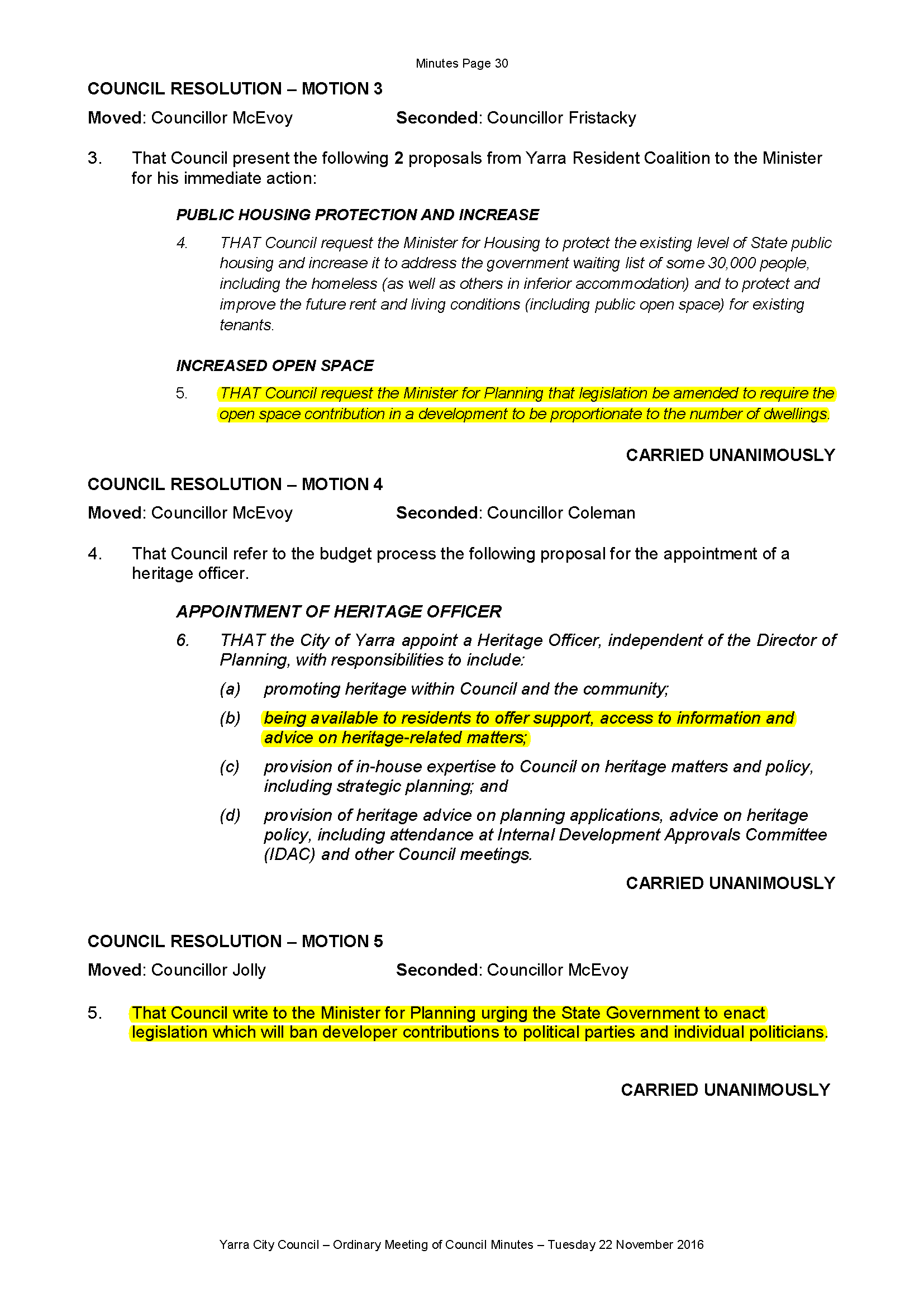
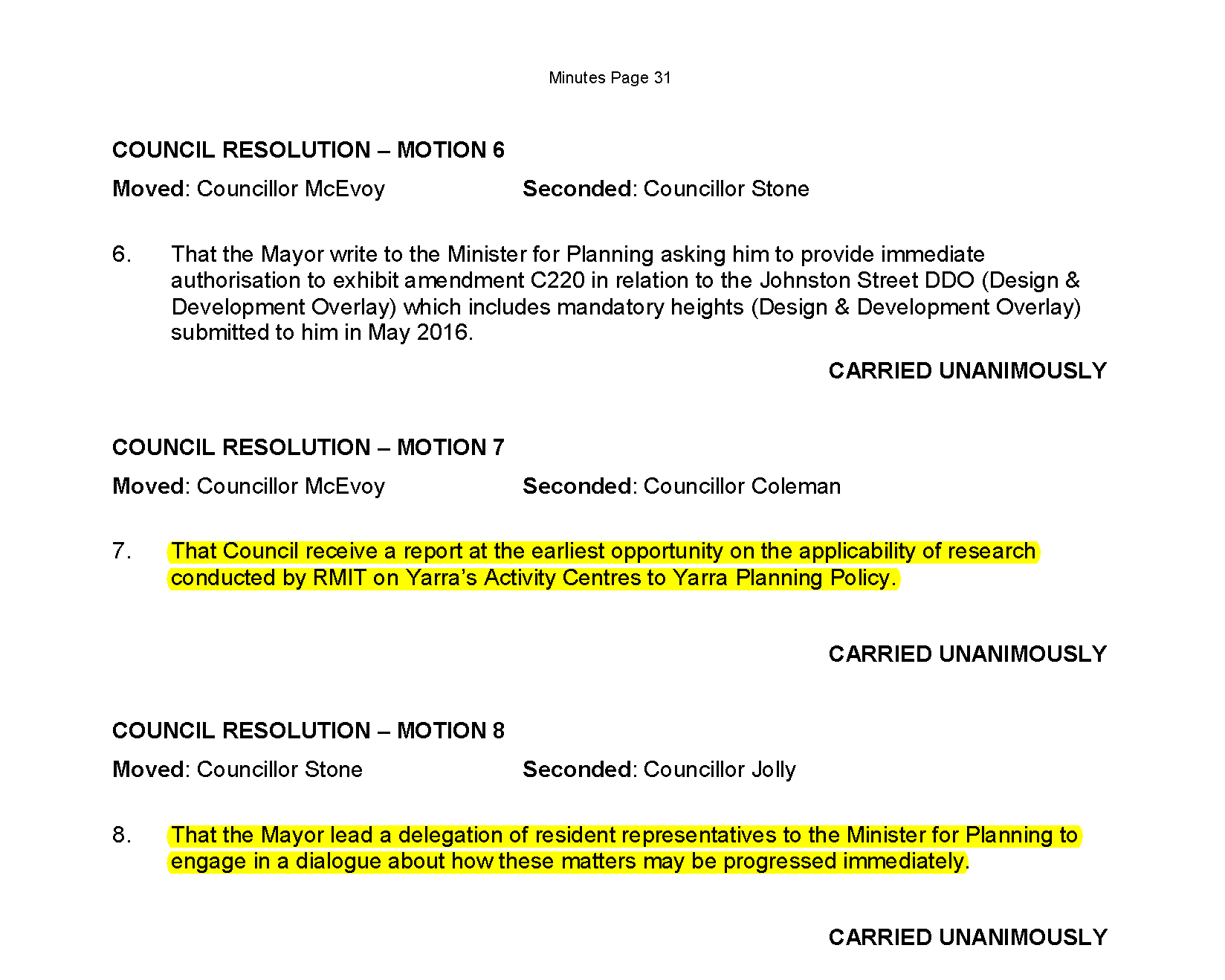
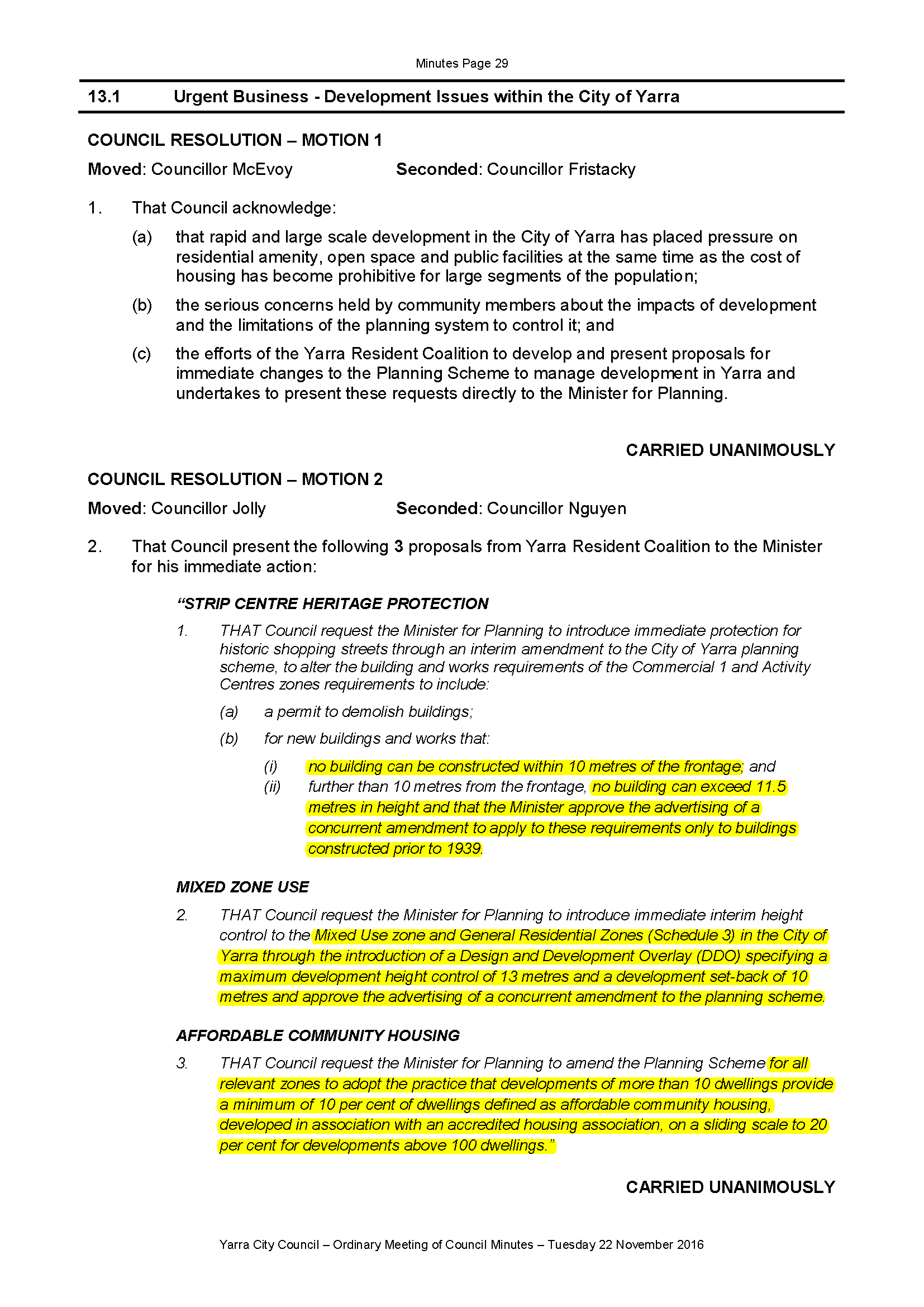
The following resolutions come from Yarra City Council’s meeting minutes of November, 2016. They illustrate perfectly what people power can achieve together with a newly elected crop of councillors who are committed to listening and acting on residents’ behalf. Whilst the proposed amendments are only the start and still have to be rubber stamped by the Minister, they are light years ahead of what Glen Eira is doing. For example: would Glen Eira even dream of organising a meeting between residents and the Minister? Would Glen Eira ever demand 3 storey maximum heights in its neighbourhood centres?

pages-from-revised-public-minutes-22-november-2016_page_1pages-from-revised-public-minutes-22-november-2016_page_2pages-from-revised-public-minutes-22-november-2016_page_3

Delahunty moved a motion for a Request for a Report on the Caulfield Village. Her request was that the report include ‘planning options’ available to council on the social housing issue for the Village. Taylor seconded.

DELAHUNTY: said that the VCAT decision on Precinct 2 was that council was ‘unsuccessful’ in the attempt to ‘require’ the developer to include social housing. Called this a ‘surprising judgement’ and wondered whether the member had ‘actually seen or heard of’ social housing. Said the judgement was ‘so far removed from the way social housing operates’. Claimed that for the member to state that the ‘requirement to provide social housing’ is ‘financially prohibitive is rather surprising’. Said that ‘of course’ there’s a financial ‘imposte’ but ‘that’s what it is’. Called it an ‘incredibly disappointing result’ and when you have such a massive development almost like a ‘new suburb’ that there should be ‘some proper social housing provider attached to it’. Acknowledged that the developer ‘came up with their own scheme’ but this ‘doesn’t meet anyone’s definition of social housing’ and this looks like a pay later ‘lending scheme’. ‘It was an attempt to circumvent this requirement’ and all it would do would be to ‘help people access deposits’ or ‘get their hands on the deposit faster’.  Claimed that this doesn’t ‘address disability at all’ but helps the developer ‘sell their properties faster’. Said she ‘doesn’t understand at all’ how the judgement ‘was made’ and ‘won’t let this rest’. The report is asking for help to ‘understand what levers, what tools’ can be used. Said ‘noise’ is ‘available, appealing to the hearts of the developer is available’ but there ‘must be some planning levers that we can still pull’. ‘It’s unconscionable to let this go’.

TAYLOR: thought about the cost and ‘access to public land’ and ‘it’s not all about take, take, take’. The developer ‘can’t have it all one way’. On accessing a ‘social housing organisation’, ‘how difficult is this?’ Said there are ‘at least 39 social housing providers’ and it’s a ‘matter of liaising with them’. It’s ‘not onerous’ and a few meetings or emails can set this up. This ‘didn’t sit well with me’ so she ‘highly commends this report’.

ATHANASOPOULOS: started by saying that ‘we live in a society that is very inclusive’. Said he had visited a family member in London who lived in a property bought from the government and it was ‘very nice’ in an allotment of ‘maybe another 30’ units in a village that ‘probably had another 100’ units. Said it was ‘great’ that this ’90 year old lady’ could walk everywhere and there was a ‘sense of community’. If it can happen in a ‘massive city like London’ then ‘why can’t we create’ something similar here? They need more ‘than vcat on our side’ but also ‘local members’ and ‘ministers’ in order to ‘get something better than this’ because ‘people deserve it’.

SILVER: asked that the motion also include ‘examples’ of social housing from other municipalities and their major developments. Went on to say that the judgement was from a ‘legal member’ and ‘whether something is regarded as reasonable is a matter of policy’ ‘rather than planning scheme’ so it’s not necessarily ‘fair to the tribunal to say’ that it’s a bad decision because they have to ‘implement the law’ even though council mightn’t like the decision.

Delahunty then asked Torres whether this amendment would ‘slow down our efforts’ on advocacy? Torres said ‘no’ in that there ‘are other examples in other councils’. Delahunty accepted the amendment.

HYAMS: said ‘there is also a matter of principle here’ because VCAT was supposed to ‘apply the objectives’ of the Incorporated Plan and the ‘objective is social housing’. ‘They are now saying they are not going to have social housing’ and he ‘can’t see’ how this is in keeping with the plan. Claimed that another objective was ‘that there be no loss of on street parking’ and the VCAT decision means that they are losing car spaces to the ‘net loss of 45’. These are mostly metered parking spots, so ‘it will be a cost to the community’. Hoped that they would ‘also be looking’ to see ‘how we can reverse that’.

MOTION PUT AND CARRIED UNANIMOUSLY

COMMENTS


The history of Caulfield Village is literally the history of utter failure by Council to do its job of land management competently, transparently, and for the benefit of residents. Over the years, every single aspect of this project has been mired in controversy, lies, and repeated cave-ins. The machinations go back right to the beginning with the establishment of a Special Committee to decide on the C60 and which consisted of Hyams, Lipshutz, Esakoff and Pilling. These 4, together with Newton and this administration did everything in their power to accede to every MRC demand.

Not surprising that the developer keeps winning when the Incorporated Plan is literally such a joke and should never have been accepted by the 4 councillors involved. The municipality is now paying the price for this collusion and incompetence.

Admittedly, Delahunty was not part of these earlier decisions and to her credit she, Magee and Lobo have been consistent on their demands for social housing. The same cannot be said for Hyams and Esakoff. Here is what the former said when the first amended Development Plan for Precinct 1 came in – ie more dwellings and reduction in 3 bedroom apartments leading to more single bedroom apartments.(taken from our post of May 3rd, 2015)

HYAMS: said there will be more apartments, thus more people, but the ‘building still stays’ within the parameters of the incorporated plan. Said that objectors raised the issue of ‘lack of diversity’ but ‘I don’t know that there needs to be that diversity in every site – there needs to be diversity across Glen Eira’. So even though there will be many one and two bedroom places there are ‘family sites around the area’ so that’s the diversity. As for social housing ‘that is a requirement’ for the end of the development but ‘I don’t think there was a requirement’ for social housing in ‘every single part’ of the development. Didn’t think that it was ‘appropriate’ for council to ‘move the goal posts’ now in regard to social housing. He was ‘sure this would be enforced in due course’.

As for the role of the administration and its planning department, the following quote from the Camera report on the first Development Plan should be enough to convince readers of either how incompetent they are, or how committed they are to basically duping residents.

This document gives certainty to the local community by precisely stipulating building envelopes; their heights, setbacks, and siting. It can be said that the Caulfield Village development is one of the most planned development sites in the municipality. The future development of this land has been “locked in” following a rigorous community consultation and amendment process, the community now has a high level of certainty in what to expect at Caulfield Village

Finally, a word of warning to residents on the Virginia Estate proposals. Their draft ‘management plan’ is basically a duplicate of the MRC plan for social housing. They have undoubtedly witnessed the successes of the MRC and are employing identical tactics. We can only hope that with this new council, they will have learnt the lessons of the past when it comes to deciding on the Virginia Estate development – which we believe will dwarf what is occurring in the Caulfield Village.

Readers might also like to revisit one of our earlier posts – https://gleneira.wordpress.com/2016/06/21/are-we-about-to-be-screwed-again/
According to Item 9.11 of the current agenda, Council has been offered $350,000 and $25,000 per annum in order to become the Committee of Management for the land at the top of Glen Eira/Booran Roads.  This land featured in the notorious ‘land swap’ between the Government and the Melbourne Racing Club and was to be established as a ‘public park’. Council’s position has been that it will not accept the land because of its poor access, size, lack of adequate ‘surveillance’, etc. The land was returned to the government once council refused.

Now we find:

  • That clearly some secret deal has been made between the Department, the MRC, and council – to the exclusion of the public
  • Council is willing to renege on its previous position for the meagre sum of $350,000 – (far from the true value of the land)

The officer’s report contains these recommendations. That council –

authorises officers to meet with DELWP to negotiate favourable conditions for Council’s use of the land, including clarity on the type of recreation facilities that could be incorporated onto the site

Potential for the site to be rezoned in future for other uses, without a nett reduction in open space across the municipality;

Plus these paragraphs:

This reserve has previously been offered to, and refused by Council, with Council’s previous position on the land swap arrangement being that any land should be of equivalent value and made available for public use. In the original offer to Council, the (then) Department of Sustainability and Environment (DSE) had stipulated that the land had to be utilised as public open space.

The new offer from DELWP still states the condition that the reserve is to be used for public recreation purposes. However, officers understand that the current offer is potentially open for discussion on the restrictions, which enables other options for discussion on use of the land

Even more disconcerting is this paragraph –

A current offer has been made of the land of $350,000 to develop it and approximately $25,000 per annum to use to maintain it. This will be inadequate to deliver a quality open space. However, it will be enough to ensure that Council is notdisadvantaged by taking on the reserve in the short term, and will enable Council to implement some potential low cost temporary uses for the space.

Thus, we have the situation where ‘short term’ expediency trumps long term planning and the carrot of $350,000 is sufficient for council to sell its soul! Plus, we certainly do know that once council implements something, then it is almost impossible to change!

It is obvious that discussions have already occurred and will continue. This does not provide justification for a report that is so vague and so uninformative on an issue which has featured prominently for years and years.

There is much in the current agenda for Tuesday night’s council meeting that residents need to be aware of and to actively lobby the new council on. Whilst there are clearly some major improvements in terms of community consultation, and a more ‘up front’ approach to letting residents know what is on the drawing board, vigilance by residents is still required. Plus of course the demand that council is explicit and precise in all its communications with residents.

This last point is crucial, especially as it applies to Item 9.7 of the agenda – ie ‘city strategy’ and the work council is proposing to undertake in the next 18 months on planning. The item basically promises 3 things:

  • To update the 2005 Activity Centres Strategy
  • To complete structure plans for Bentleigh, Carnegie and Elsternwick, and
  • To continue and expand the ‘engagement’ practices currently initiated for the shopping strips

Whilst this all sounds wonderful, there are some real concerns as exemplified by this sentence – The revised Activity Centre Strategy will inform Building and Development (or Urban Design) Guidelines which will guide the design of future developments within all commercial areas.

And

Community feedback will be sought on built form controls across all commercial areas with a more detailed focus on Urban Villages.

We remind readers that an ‘activity centre’ is much, much more than the ‘commercial’ areas. It also incorporates the surrounding residential areas that are currently zoned either Residential Growth Zone, and/or General Residential Zone (ie 4 and 3 storeys respectively).

Then there is also this nebulous sentence  – This work will manage development in key sensitive areas whilst also aiming to strategically unlock some key sites close to train stations for redevelopment. Exactly what does this mean? Which sites are in the firing line?

Until council is prepared to commit to a full and comprehensive review of its residential zones, then no amount of structure planning, or urban design frameworks alone will ameliorate the damage that is currently continuing to occur in our local residential streets. The real questions that residents should be demanding answers to are:

  • If the major shopping strips can provide enough housing to cater for the population growth, then does Glen Eira really need 40+% of Ormond, for example, zoned as General Residential Zone?
  • Why do so many streets have 3 distinct zonings when the recommendations from the Minister’s Standing Committee on the new zones recommended against this practice?
  • Why have so many heritage areas been included as part of growth zones and others haven’t? What is the logic and the consistency behind the new zones and does this stand up to scrutiny?

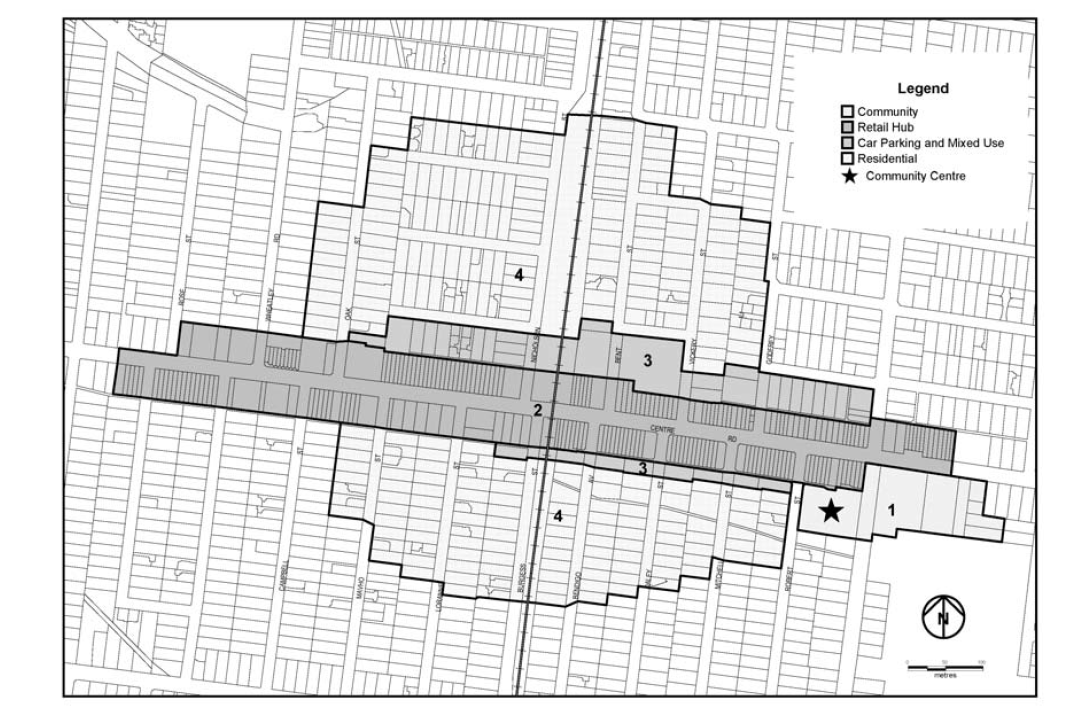
The following screen dump from the current planning scheme will show why we are concerned about the potential direction of planning in Glen Eira if the intention is to only concentrate on the commercial areas and totally ignore the surrounding residential streets that are part of all activity centres. The shaded areas largely represent the commercial and mixed use zonings in Bentleigh. The darker single lines represent the ‘circumferance’ of the Bentleigh activity centre. Most of the activity centre is comprised of nearby streets and therefore housing.  To ignore these countless streets which are zoned GRZ and RGZ and to only concentrate on the commercial zoning as the draft Amendments C147/8 do is to wash one’s hands of protecting neighbourhoods and undertaking planning of the highest order. In the meantime of course, officer recommendations are to grant permits for another 61 units over 3 locations of 3 and 4 storey heights!

untitled

City of Boroondara demolishes Kew townhouses after ‘gross’ permit breach

Dec 15, 2016 Denham Sadler

Two brand new townhouses in Kew have been demolished by the local council after the developer “grossly” exceeded the planning permit. The new development on Normanby Road was ruled to have breached the Boroondara Council’s planning permit by VCAT including by height and its boundaries and was demolished this month. The two townhouses were constructed at 11.5 metres and 12.15 metres high, well above the council’s nine metre height restriction, Boroondara Mayor Phillip Healey says.

“They weren’t missing by millimetres or centimetres, they were missing by a lot,” Cr Healey said. “This wasn’t marginal, this was grossly over where it should be.”

The original building permit to construct the two townhouses was obtained by Nicholas Pantas in September 2012. After a planning officer visited the construction site, an investigation found that Mr Pantas had made “numerous unauthorised changes” to the development.

This decision was then appealed at Victorian Civil and Administrative Tribunal in August 2015, where the developer was given until February this year to amend the developments or have them demolished. The City of Boroondara also took action against Mr Pantas in the Magistrates Court in December last year; he was fined $8000 in penalties and costs.

The National Australia Bank then took possession of the property but were unable to meet the permit and the townhouses were subsequently demolished this month.

“The builder’s action was downright illegal,” Cr Healey said. “This is a costly reminder that planning permits and approved plans must be complied with.”

Kosa Architects helped the developer to obtain the permits and designed the building, but principal Stephen Kosa says the drawings weren’t followed. “The builder didn’t follow the town planning permits or building planning permits,” Mr Kosa said. “Unfortunately the builder decided to try to maximise what he thought to be the end outcome and didn’t follow the approved drawings. We end no involvement in the end construction.”

Despite attempts, Mr Kosa said it was impossible to alter the buildings so they would meet the permits. “The buildings were virtually irretrievable and to bring them back into compliance would virtually be a demolition,” he said.

Cr Healey said the move had enjoyed strong support from the local community. “It’s very pleasing to get supported because we are given the task of managing this and enforcing it, but we don’t always get this level of support,” he said. “We have a responsibility.”

With the two townhouses now completely gone, a new permit will be submitted for the Kew property, and Cr Healey urged the developer to work with the council, not against it. “Work with us – don’t come to us after you’ve done it,” he says. “Work with the process and then these sort of things don’t happen.”

The City of Boroondara has had several recent wins against developers and landowners in court, with a Kew landowner fined $13,500 in May for attempting to remove native trees without a permit, and a builder in Balwyn North fined $6500 for failing to protect two trees during construction.

Source: http://www.domain.com.au/news/city-of-boroondara-demolishes-kew-townhouses-after-gross-permit-breach-20161214-gtas2a/

Over the past year the number of applications for 2 double storeys that have ended up at VCAT is remarkable. We would even go so far as suggest that objections in Neighbourhood Residential Zones are now outpacing  objections for the so-called ‘growth zones’. Most are not due to resident objectors, but to the developer either contesting council’s refusal, or contesting the myriad of imposed conditions.

The mantra of council has always been that the NRZ is ‘protected’ and that the zones bring ‘certainty’ to both developers and residents. The exact opposite appears to be happening. More to the point, every single appearance at VCAT is costing ratepayers money. We remind readers that the so-called ‘protection’ in the Neighbourhood Residential zones date from 2004. Nothing much changed with the new zones of 2013, except for mandatory height and mandatory 2 dwellings – only on ‘average’ sized blocks that is! The Planning Scheme thus basically remained unchanged over this period and onwards to now. Setbacks, permeability, site coverage, etc. all date from 2004!

Thus, if the planning scheme has remained the same for 12 years in relation to Minimal Change areas, then why oh why do we have instances after instances where council fronts up to VCAT with a series of conditions that do not have a hope in hell of getting passed by VCAT given what the planning scheme says? The latest example involves an application in Cushing Avenue Bentleigh. Council sought to impose 6 conditions initially – all of which were either ‘deleted’ or rejected by the Member. And we can’t blame him given the reasons provided below. When ‘standards’ are met, then the developer is home and hosed. What is the point of arguing for conditions that are not supported by the very planning scheme that is the basis for decision making? And what is the point of continuing to ignore the problems with minimal change and expecting to front up at VCAT and win? There is nothing from council to indicate that improvements to the Minimal Change zoning are even on the horizon according to the planning scheme review. Unless this area is addressed, we should expect more of what is shown below.

This condition sought a setback of 3.75 metres from the southern boundary for the length of the elevation, pursuant to standard B10 (Energy Efficiency Objective). The Council officer report indicated that this setback is required to ensure the efficiency of the solar panels located on the adjoining dwelling at 18 Cushing Avenue.

  • At the hearing, the Council confirmed that it no longer wishes to pursue this condition, as standard B20 (Energy Efficiency Objective) is the relevant standard in that instance and that this has been met by the proposed design.
  • While we understand the concerns of the owners of 18 Cushing Avenue with respect to the impacts on their solar panels, I accept the Council’s position that the relevant standard has been met and overshadowing will not unreasonably impact upon their efficiency.

From the submissions presented, the increased upper level rear setback required by the condition is not based on any standard or specific policy requirement. Nor is the increased setback required to achieve the improvement of amenity of neighbouring properties with respect to matters such as daylight or overshadowing

  • I find that the condition is unwarranted for the following reasons:
  • The upper level rear setback, at 5.6 metres, exceeds that required under standard B17 (Side and Rear Setbacks Objective) as modified in the Schedule to the zone (4 metres).
  • The setback proposed allows ample opportunity for the planting of canopy trees which is an outcome desired by policy. The proposed upper level will not impede the canopy of such trees.
  • The upper levels are well setback from the side boundaries. They are stepped in from the ground level footprint, with the setback exceeding the requirements of standard B17 (Side and Rear Setbacks Objective).
  • The upper levels as proposed results in compliance with the requirements of clause 55 with respect to daylight, daylight to northern windows and overshadowing of neighbours.

Source: http://www.austlii.edu.au/au/cases/vic/VCAT/2016/2047.html

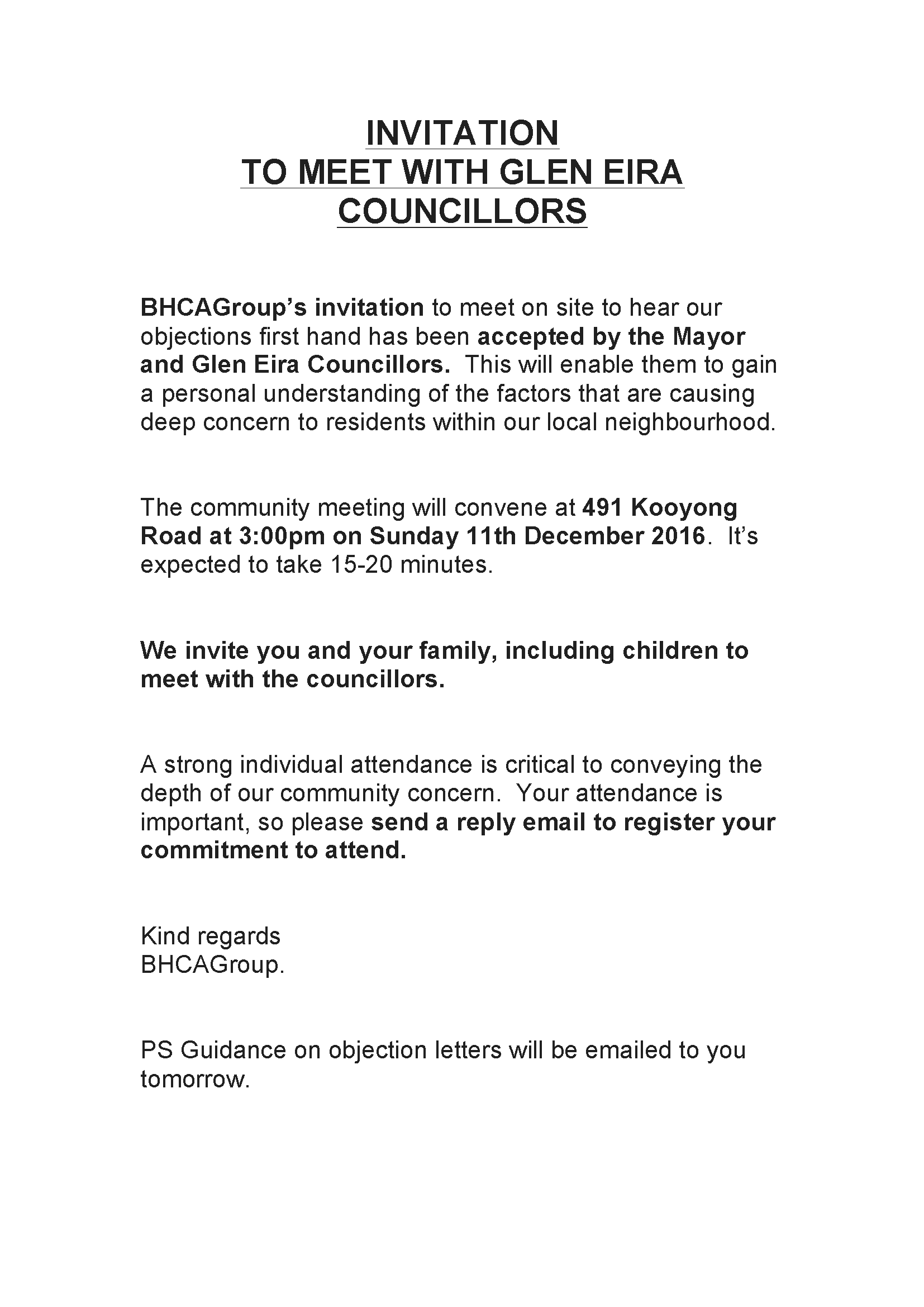
We’ve been sent the following announcement. The email to contact the group is – bhcagroup@gmail.com

invitation-2

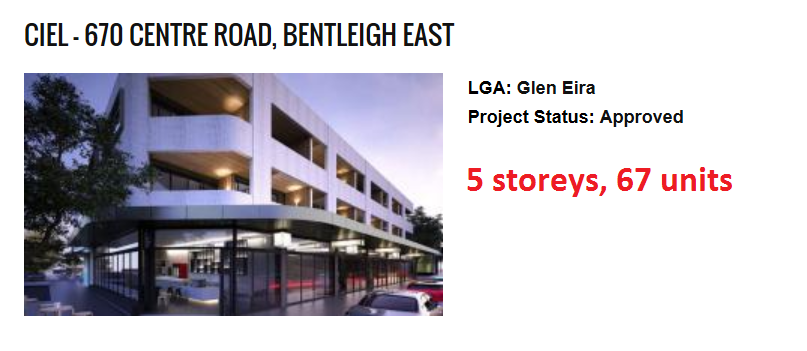
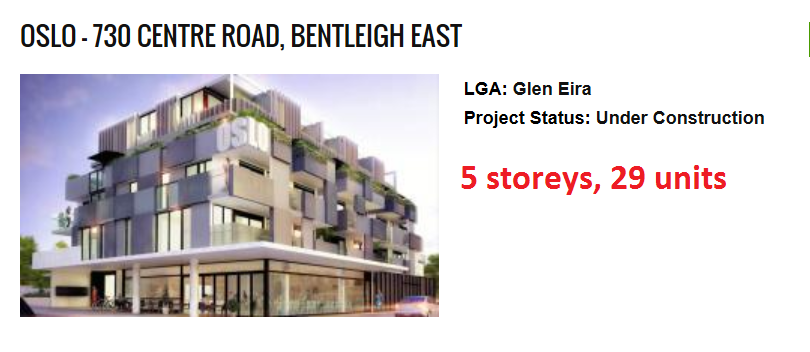
The best illustration of how woeful council’s planning scheme is, together with its recently completed ‘work plan’, comes from the following screen dumps of developments in East Bentleigh. These are significant since:

  • East Bentleigh, plus another 9 suburbs, are classified as ‘neighbourhood centres’ and therefore lower down in the ‘hierarchy’ for development that council stipulates in its planning scheme.
  • Yet, council saw fit to impose a 5 storey preferred height limit for Bentleigh (an ‘urban village’) when East Bentleigh is already undergoing major 6 storey developments.
  • Since the introduction of the zones, developers have had a field day. Amended applications keep coming in to increase either heights or the number of apartments. The latest is for the Browns Road/Centre Road site where the developer wants a 5 storey permit changed to allow 6 storeys. Given the countless loopholes in the planning scheme, and other 6 storey buildings in the area, he will no doubt be successful.
  • East Bentleigh is already seeing countless 5 storey permits being granted, as are other neighbourhood centres. Caulfield North already has a 6 storey permit and there is an application in for 8 storeys! If the workplan stays as it is, then residents in these areas can expect to wait at least another decade before council gets around to addressing the development pressures in its neighbourhood centres. Not good enough!
  • Residents may wish to consider the possibility that this inaction is perhaps deliberate? Or is it due to a lack of money or expertise to do the necessary work? Why when other councils can produce amendments that cover all their shopping centres (ie Bayside, Boroondara) has Glen Eira decided to concentrate on only Bentleigh and Carnegie and in a stated time frame of 4 years?
  • Neighbourhood centres cannot afford the luxury of being left behind

bebe1be2

« Previous PageNext Page »