Miscellaneous


We have been asked to publish the following comments regarding further shenanigans at Caulfield Racecourse.

In case many readers have missed the latest news we are pleased to announce that the MRC’s attempts to bypass the payment of $3M as an open space levy for its proposed subdivision has been knocked back by VCAT. They will now have to pay council this amount.

Here are the comments mentioned at the start:

Caulfield Racecourse Flying Club excluded by trust

In 1879, Caulfield Racecourse was bequeathed as a Crown Land Grant to the community for horse racing for 25 days of the year and for the rest of the time, as a recreational reserve and parkland. The Caulfield Racecourse Reserve Act 2017 (Vic) gives effect to the current trust and encompasses the functions and duties of the trustees. However, there is some doubt whether the new trustees are complying with the purposes of the Act and objectives of the trust. “Truly inclusive open space” and “what the community can expect” is not living up to “making the reserve a place for everyone to use and enjoy” The new trustees are regulating and even banning some community groups who have used the land for many years for recreational activities. The Caulfield Racecourse Flying Club Inc (CRFC) is one such group that has used the Racecourse Reserve for over 50 years. It has been used for flying model aircraft probably since its inception. The former trustees had such a bad reputation for management of the Reserve that they were formally removed as trustees but at least identified CRFC as the controlling body for flying RC planes (1994 Regulations XI). The CRFC now holds no confidence that new trustees can be entrusted to do any better. The reserve is 54 hectares of near open space with at least 8 hectares of completely open grassland, well buffered by vacant land.  It has been ideal for flying model aeroplanes (or now sometimes drones) since the reserve was formed. CRFC was incorporated in 1988 and is now a member of the Australian Men’s Shed Association. “Open spaces are vital to our collective health and wellbeing.” CRFC members have been using the open area for many years and always under the auspices and sanction of the Trust at the time, DELWP and the Melbourne Racing Club reserve management. The Club was always insured by Victorian and Australian affiliates and complied with their safety guidelines. Now the Trustees have banned us. A ban on flying models is targeted at our club only and not non­members or other people. The process to get rid of us was a carefully planned ploy starting with absurd restrictions such as; restricting flying hours to 10:00 AM to 2:00 PM Monday to Friday (hardly recreational hours and well after the wind had come up); proof of insurance cover that covered us while travelling between the reserve and home. Further absurd restrictions were introduced to the point where if a member wanted to fly a model even as small as your hand, he must have 4 club officials present to act as ‘spotters’. We are a recreational club, participating in a recreational activity, in recreational reserve and yet we could only use it under the Trustee’s absurd protocol. We wonder what other recreational users will be banned for un founded safety reasons – fishermen, dog walkers (on-lead and off-lead), bicycle riders, joggers, disk golfers, kite flyers and rocket enthusiasts. All these have no insurance and yet our members would have $20 million cover including public liability. We now seek your help and advice regarding a dispute resolution process e.g. VCAT.

 Sincerely,

David Casley, President of the CRFC
Melbourne Racing Club claims $195m Mount Scopus deal imperiled by council levy

By Lachlan Abbott

September 29, 2025 — 6.58pm

Melbourne Racing Club has vowed to press on with a debt-clearing deal to sell a $195 million slice of Caulfield Racecourse to a private school despite telling a tribunal that a council levy had put the plan at risk.

The MRC has taken Glen Eira City Council to the Victorian Civil and Administrative Tribunal challenging conditions on a subdivision permit required to sell land along Kambrook Road to Mount Scopus Memorial College.

It has asked the tribunal to scrap the estimated $3 million public open space contribution normally imposed on subdivisions, arguing it went against the levy’s purpose of promoting greenery alongside residential, industrial or commercial development.

“This is an extraordinary impost for a proposal that is no more than an internal boundary realignment,” the MRC said in its submission, obtained by The Age.

The racing club then suggested the entire Mount Scopus plan could be in jeopardy if the tribunal didn’t amend the approved planning permit.

“The alternative is to retain condition 11 in its current form and thereby to impose a substantial unwarranted burden on MRC that could imperil the proposal the condition is otherwise intended to allow.”

But when contacted by The Age on Monday, an MRC spokesman backed away from the club’s lawyers’ submission that the open space levy imperiled the land deal and was adamant the transaction would proceed.

“What we can confirm is that the Mount Scopus project is progressing and remains firmly on track. This is a routine VCAT process regarding conditions on an already approved permit, and any finding from VCAT will in no way impact the project. Both the MRC and Mount Scopus remain committed to completing the transaction.”

The MRC announced a 7.5-hectare land sale last December, but it is still not finalised as the school has two years to settle.

The deal would give Mount Scopus, a private Jewish school, a land tract which runs the length of the western area of Caulfield Racecourse – from Station Street along Kambrook and Booran roads to Glen Eira College – and allow it to consolidate three campuses into one in Melbourne’s Jewish heartland.

A subdivision was required before the sale as an existing northern parcel within the larger proposed development site included administration buildings and track access that the MRC needs to keep.

The larger slice of the subdivided block, which is mainly now a car park, is slated for Mount Scopus in a future completed sale.

The deal is crucial for the racing club and chairman John Kanga, who dramatically took control of the $1 billion MRC last year and soon announced the sale of old training facilities to Mount Scopus to help clear the club’s debt.

The MRC’s annual report released last week showed debt had increased to $178 million.

In its submissions to VCAT, the MRC conceded its request to not pay the open space levy was “novel and unusual” but argued the circumstances – in which part of the land “might one day be used for a school” – were unique as well.

The entity leading the Mount Scopus development, Project Generation Ltd, also joined the VCAT case to oppose a condition requiring the new owner of the subdivided parcel on Kambrook Road to enter into a covenant with the Heritage Council that blocked any new buildings.

PGL argued it could have a devastating impact on Mount Scopus’ transformative project and was unnecessary.

“This potentially renders the site too small for PGL’s purposes and threatens the commercial feasibility of the project,” the submission said.

But on Monday, Scopus Foundation president David Gold said Heritage Victoria had withdrawn its covenant condition.

Mount Scopus hopes to enrol the first students at its new campus in 2030.

“We’d been told it was no longer an issue,” he said.

A spokesman for Heritage Victoria said a heritage permit would still be required for any development proposal.

Acclaimed New York-based architect Daniel Libeskind has been brought in to design the new Mount Scopus campus, and more detailed development plans are expected to be finalised in November.

A spokeswoman for Glen Eira City Council declined to comment on the ongoing dispute with the MRC over the open space levy.

The VCAT decision on that matter is expected in the coming weeks after a hearing was held on September 8 and 9.

Source: https://www.theage.com.au/national/victoria/melbourne-racing-club-claims-195m-mount-scopus-deal-imperiled-by-council-levy-20250924-p5mxix.html

COMMENTS

It’s a bit rich for the MRC to complain about a potential $3M open space levy when over the years they have been granted extraordinary largesse from both government and Glen Eira council. Here are some facts that have garnered the MRC millions thanks to council and government:

  1. land swap that facilitated the development of the Caulfield Village
  2. The development plan accepted by council that imposed a rare gift – open space levies of only 4 and 5 percent.
  3. The latest development plan included a ‘built to rent’ for over 400 new apartments. No open space levy paid on that!
  4. Decades of subsidised council rate payments on the land
  5. Increasing encroachment of crown land by the MRC – ie second race track, more events hence less public access, etc.
  6. There is heaps more that could be added to the above!

The select committee’s report on its investigation into the recent planning provision amendments has now been released. In many respects, the report is a damning indictment of both process and the lack of transparency by this government. It is available via this link – https://www.parliament.vic.gov.au/get-involved/inquiries/VPPamendments/reports

The report contains 12 recommendations and 20 findings most of which are highly critical of government. These findings/recommendations are significant in that they highlight many of the issues that Glen Eira’s submission basically ignored and which we commented upon in our previous post! What is disappointing is that there is no specific recommendation regarding the proposed removal of third party objection rights. The committee basically states that this element has a long and important role in the state’s planning history!

We’ve highlighted some of the major comments and conclusions below. They are quoted verbatim.

A major problem facing the Committee was the absence of requested modelling from the Government, to demonstrate that the amendments will achieve their objectives. Without that modelling, the Committee was reluctant to downplay the many unintended consequences arising from the new planning provisions that were identified by users of the planning system.

Of the many unintended consequences identified by stakeholders, the most concerning for me related to the new townhouse and low-rise code: the removal of consideration of flood risks from the planning process, the reduction of environmentally sustainable development standards in major local government areas, and the excessive removal of existing trees. Surely we can address Victoria’s housing challenges without also creating these new risks (from introduction by chair – David Ettershank)

Finding No. 5 – Little convincing evidence was advanced to the Inquiry that the State Government’s announced planning changes will guarantee additional housing and no substantive evidence was advanced that the Government’s plan would with certainty provide additional affordable housing.

FINDING 6: The Victorian Government did not properly consult on these three amendments and the Committee is of the view that the Minister has inappropriately exempted herself from expected consultation.

RECOMMENDATION 4: At a minimum, modification of planning scheme amendments should be undertaken after a round of genuine consultation with councils and communities.

FINDING 9: The Committee acknowledges that the concerns expressed by many submitters that heritage and heritage values are at serious risk of being compromised by these planning amendments are valid. Protections should be available to protect our city and its magnificent heritage buildings and zones.

RECOMMENDATION 7: The decision guidelines of clause 65 of the Victoria Planning Provisions should apply to all decisions made under clause 55. This is most important where risks to human life and health, and to the environment, should be identified and managed.

FINDING 15: Without being presented with any evidence to the contrary, the Committee is concerned that clause 55 of the Victoria Planning Provisions may lead to the excessive removal of existing trees and reduce tree canopy.

RECOMMENDATION 9: That the Victorian Government publish and release modelling regarding the expected impact of the planning scheme amendments on tree canopy and vegetation in areas affected by the changes.

RECOMMENDATION 10: That the Victorian Government make improvements to clause 55 of the Victoria Planning Provisions including the addition of a separate landscaping objective and standards, and changes to the tree canopy cover objective and standards. The introduction of any improvements should be undertaken as early as possible.

RECOMMENDATION 11: That the Victorian Government promptly review and improve the environmentally sustainable development standards in clause 55 of the Victoria Planning Provisions with a view to ensuring the statewide standards meet the higher standards found in 28 local government areas.

FINDING 18: The planning amendments mark a reduction in long standing third party appeal rights in the planning system.

With the end of the year fast approaching, we are still waiting for the State Gov to release the information on the 50 activity centres that will be earmarked for developments ranging from 3 to 20 storeys. If past history is any guide, then we suspect the publication of these centres will appear Christmas Eve or possibly New Year’s Eve!

If by some miracle they come earlier, we can be sure they will again be bereft of detail, strategic justification, or accompanied by any important data such as traffic analyses, overshadowning data, etc. We anticipate that several of our activity centres will be added to the list following the recent inclusion of Moorabbin as one activity centre.

It’s perfect timing for the State Gov, with the festive season in full swing and holidays to occupy people’s minds.

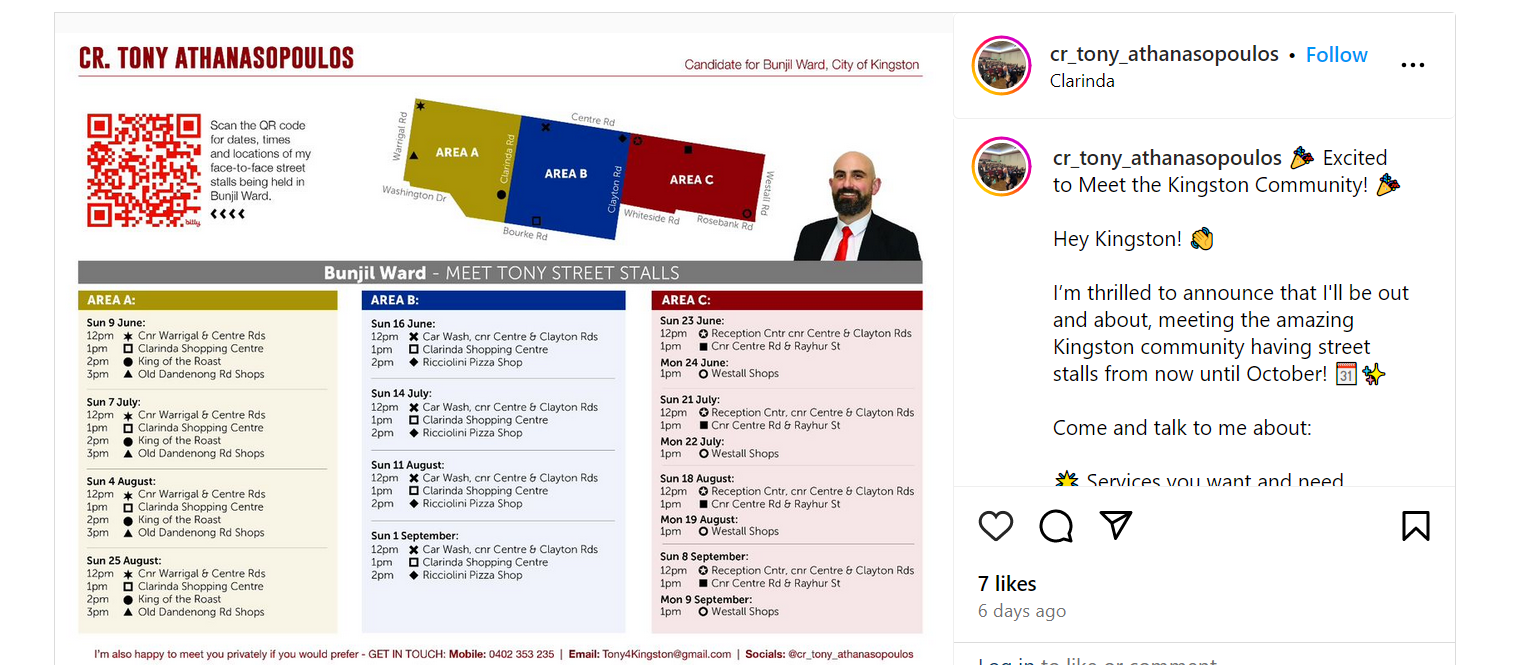
CLICK THE ABOVE IMAGE TO ENLARGE

Our reaction to the above is basically unease and a questioning of how appropriate such actions are from a sitting Glen Eira councillor.  Athanasopolous’ record at Glen Eira is highlighted by his far too frequent absences from both council meetings and assembly meetings as well as his unabashed and consistent support for development and more development.  To now spend all this time in campaigning for another council whilst still being paid by Glen Eira residents does not sit well with us.

Athanasopolous is clearly a ‘political animal’ following in his brother’s footsteps at Kingston and its large Greek community. Nothing wrong with this, except for the timing and his current role as a Glen Eira councillor. Perhaps the 40 or so nominated hours of campaigning could be better spent attending to his Glen Eira duties?!!!!!!

What do you think?

Hitting the news over the past few days has been the state government’s release of its preliminary housing targets for each municipality. Glen Eira is being geared to add another 65,000 net new dwellings by 2051 which represents, according to The Age, a 92% increase on current development rates.

Consultation is now open for comment by individuals and organisations. See: https://engage.vic.gov.au/project/shape-our-victoria/page/housing-targets-2051

No one denies the lack of affordable housing, or even housing itself – especially if population growth continues. But to simply decree that what will fix the problem is another 2,000,000 homes by 2051 without any planning for infrastructure, open space, and financial input is in our view sheer madness. Glen Eira has been more than pulling its weight over the past 15 years. To expect a doubling of construction is not planning – it is a recipe for destroying neighbourhoods and liveability – even if this target is possible given the rise in construction costs, labour shortages, and developers’ goal of ever increasing profit.

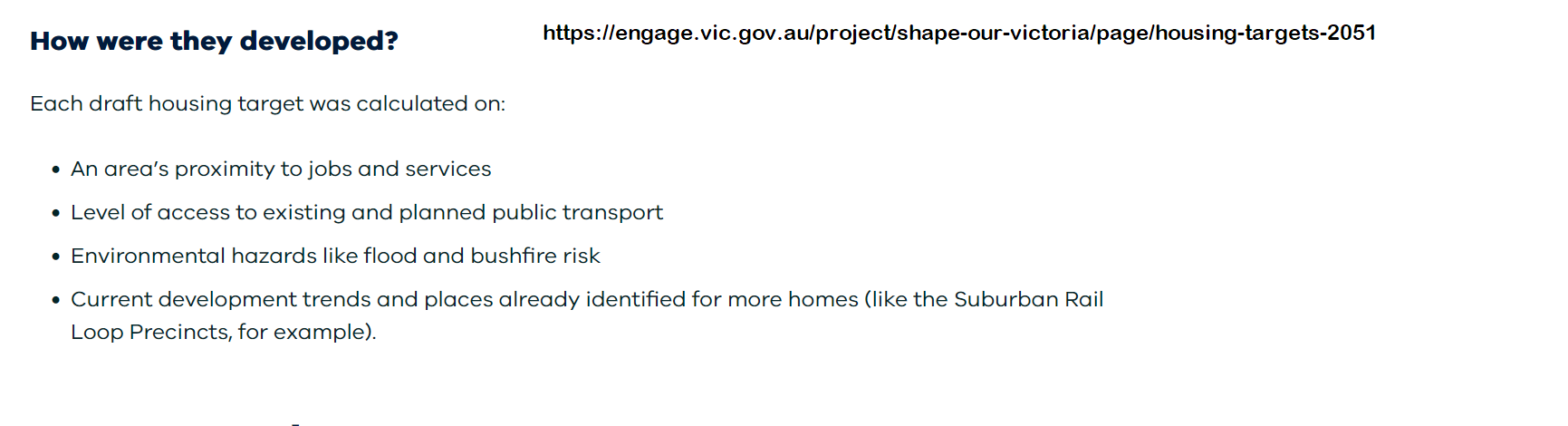
How on earth these numbers were derived is anyone’s guess. The government website simply justifies the data with the following:

The above ‘criteria’ raise a number of questions:

  • Glen Eira has 9 railway stations in 38.7Km of land. Add to this 6 Major Activity Centres/Comprehensive Development Zones, and about 11 neighbourhood centres that total a good proportion of available land then we can expect most of Glen Eira to be ‘built out’.  When Glen Eira is compared to its neighbours and their targets we are certainly being overdeveloped. For example here are the targets for councils lumped together in the government map (highlighted as green) together with their size in square km –

Hobson’s Bay – 31,000 – 64km

Maribyrnong – 46,000 – 31.2 km

Moonee Valley – 57,000 – 43 km

Merri-bek – 72,000 – 51 km

Darebin – 72,000 – 54km

Banyule – 47,000 – 63km

Booroondara – 67,000 – 60 km

Manningham – 39,000 – 113 km

Whitehorse – 79,000 – 64 kn

Monash – 72,000 – 82km

Bayside – 31,000 – 37 km

Kingston – 59,000 – 91 km

As this shows, apart from Maribyrnong, Glen Eira is far smaller than all other council areas. Add to this the lack of open space, tree canopy loss, and wide areas subject to flood, then we are indeed in deep shit if this proposal is ever to eventuate.

Not a single word refers to population DENSITY and what the repercussions of living with increased density will mean in terms of traffic congestion, lack of open space, urban heat, overshadowing, etc. The basic question of what is an ‘acceptable’ number of people living in each square km is never addressed – and this assumes that infrastructure has been built, that jobs are available, schools nearby, roads accessible, and public transport vastly improved.

The question should be whether Glen Eira has already achieved saturation point. Below we present profile.id data that shows population density as of 2023 in our suburbs. What will this be in 2051 when we add another 65,000 dwellings?

DENSITY PER SUBURB

BENTLEIGH – The 2023 Estimated Resident Population for Bentleigh is 19,360, with a population density of 4,025 persons per square km.

BENTLEIGH EAST – The 2023 Estimated Resident Population for Bentleigh East is 31,214, with a population density of 3,476 persons per square km.

CARNEGIE – The 2023 Estimated Resident Population for Carnegie is 19,412, with a population density of 5,266 persons per square km.

CAULFIELD – The 2023 Estimated Resident Population for Caulfield is 5,905, with a population density of 4,009 persons per square km.

CAULFIELD NORTH – CAULFIELD EAST – The 2023 Estimated Resident Population for Caulfield North – Caulfield East is 19,452, with a population density of 3,566 persons per square km.

CAULFIELD SOUTH – The 2023 Estimated Resident Population for Caulfield South is 12,748, with a population density of 3,897 persons per square km.

ELSTERNWICK-GARDENVALE – The 2023 Estimated Resident Population for Elsternwick – Gardenvale is 12,455, with a population density of 4,354 persons per square km.

GLEN HUNTLY – The 2023 Estimated Resident Population for Glen Huntly is 5,202, with a population density of 5,824 persons per square km.

MCKINNON – The 2023 Estimated Resident Population for McKinnon is 7,205, with a population density of 4,536 persons per square km.

MURRUMBEENA – The 2023 Estimated Resident Population for Murrumbeena is 10,449, with a population density of 3,976 persons per square km.

ORMOND – The 2023 Estimated Resident Population for Ormond is 8,956, with a population density of 4,323 persons per square km.

ST KILDA East  – The 2023 Estimated Resident Population for St Kilda East is 4,480, with a population density of 4,686 persons per square km.

TOTAL GLEN EIRA – The 2023 Estimated Resident Population for the City of Glen Eira is 156,837, with a population density of 4,056 persons per square km.

Source: https://profile.id.com.au/glen-eira/about?WebID=10

Now is the time to provide your input into this government ‘plan’ if you don’t want to see your neighbourhoods completely destroyed. See the above link and please respond. And wouldn’t it be good if for once our council came out with some formal opposition to such planning?

The following post appeared recently announcing Magee’s decision not to stand for the 2024 council elections. See: https://www.linkedin.com/feed/update/urn:li:activity:7163721229558800384/

We have copied the post below –

After almost 16 wonderful years as Councillor for Tucker Ward in the City of Glen Eira, I have decided not to contest the 2024 local government election.

Those who know me will know that I have always been a great believer in renewal. In any democracy, it’s important to have new faces representing the rich diversity of their communities. Now is the time for someone new to take on this important role. I will remain a Councillor until the next election in October.

It has been an absolute honour and privilege to represent the people of Tucker ward, as well as to serve as Mayor for three terms and Deputy Mayor for two terms.

I am and always will be a fierce advocate for local government. Councils are the closest level of government to the people. While we have the smallest budgets,3% off all taxes are collected by councils we are responsible for one thread off our country’s infrastructure, we arguably have the greatest responsibility to provide services and infrastructure which meaningfully touch everyday lives in our communities. We build community wellbeing and social cohesion, plan for the future, and build and maintain billions of dollars of infrastructure for our communities.

We responded to real and emerging challenges — confronting the long-term sustainability of the councils, shrinking revenue, increasing cost shifting from other levels of government, and rising community expectations. These conversations have a long way to go, but I am proud to have helped to spark them.

To have represented a City as liveable, welcoming and diverse Glen Eira — working alongside many other incredible Councillors — has been a privilege I will never forget. Every day, I worked to do what I could to make Glen Eira an even better place to live, work, study and play.

Thank you to the people of Tucker Ward for this incredible honour. Thank you to the many Councillors and officers who have supported me and my work. And thank you most of all to my wife Claire, and sons Daniel and Joe for your love and support. I couldn’t have done it without you.

I am looking forward to the next chapter and exploring what the future holds.

The government has gazetted the changes to council wards for numerous municipalities today. Glen Eira will now have 9 wards and one councillor for each ward. What this means for future candidates is the $64 question.

Below is the map which outlines the new wards and their boundaries. CLICK TO ENLARGE!

The Victorian Electoral Commission (VEC) ran a recount vote this morning to elect a councillor to replace David Zyngier. Jane Karslake won the recount. We are yet to see the actual numbers on how the voting fell. This will be available in the next few days on the VEC website. Assuming that Ms Karlake signs the relevant papers she will represent Camden Ward.

Ms Karslake has twice stood for council elections in the past. We wish her well for the remainder of this term.

For Glen Eira it doesn’t seem to matter that over 7000 individuals signed an online petition to keep the early learning centres open, or that a hard copy petition of over 2000 was recently tabled at council meetings. Further, that 94% of participants in the online surveys also were of this viewpoint, plus letters from MP’s and other organisations. The recommendation remains that these centres be closed.

The only compromise was that instead of a December 2023 closure, this be delayed until March 2024! How magnanimous!!!!!

The report highlights again and again ‘financial viability’ and that maintaining the centres will amount to a cost to council of nearly $600,000 per annum. With a 94% of responses in favour of keeping the centres open, council still finds it appropriate to state:

Whilst acknowledging the views and feedback expressed by directly impacted staff, families and the community, additional information has not come to light which materially alters the assessment that the combination of factors surrounding Council’s service provision still present unresolvable challenges for Council to continue deliver a contemporary, financially viable ELC service.

Council has also rejected the option of building a new hub, stating:

Initial estimates of the capital investment that would be required to construct a child and family hub on the Murrumbeena ELC site was conservatively estimated at $9.5M if the infrastructure project was built in 2024, rising to $10.04M if it was built in 2025. However, this could be higher depending on construction industry pricing escalation trends.

Consequently, the costs associated with building a new centre would have significant impact on Council’s budget and would reduce the capacity of Council to meet its current infrastructure commitments, including investment to unlock more open space, infrastructure improvements in Glen Eira’s parks and the ability to effectively maintain existing assets such as roads, footpaths, and community facilities.

Even with the potential for a $4.5M government grant the conclusion is – Council’s adopted Long Term Financial Plan has no budget provision for major building investments relating to the three ELCs.

What this final sentence does not acknowledge of course is that councils are free to amend their long term financial plans as they see fit and has been done repeatedly in the past.

As far as the consultation feedback report goes, we again have been denied the raw data, all the comments and emails. The employee consultation is deemed ‘confidential’ so all we get is a very short ‘summary’!!!!!!

If the only option to cut costs is seen as removing services, then we are in deep trouble. Yes, there are financial constraints on all councils, and yes, costs are rising. But how hard has this council tried to either increase their revenue, or cut costs in other areas? Staff numbers keep rising; consultant costs keep rising; and imposing levies on developers for car parking waivers, and community infrastructure both remain in the land of never-never.  Council’s simple solution is to withdraw services from the most vulnerable (aged care) and child care. Surely it should be up to communities to determine which services they believe should be subsidised and not a bunch of bureaucrats who earn over $200,000 per annum and a CEO who is rumoured to be on about $450,000 per year! Whilst other councils include statements about ‘savings’ in their budgets and annual reports, we can find nothing of this ilk in anything Glen Eira publishes.

What has also occurred here is the cart before the horse scenario. Our priorities consultation is yet to be published so that this decision is made BEFORE the community response is available – this assumes of course that the ‘consultation’ asked relevant questions!!!! Similar things occurred with structure planning and land use frameworks prior to the endorsement of the Housing Strategy. It would seem that this orchestrated approach is there to ensure that predetermined decisions are cemented despite what the community might think and want.

It is now over to councillors to make their decision. We can only hope that their primary objective is to represent the thousands of constituents who want this service to remain.

Next Page »