• Child care fees up $5 per day
  • Expediture on drains remains at $3.5m which doesn’t even cover inflation and cost increases
  • GESAC fees up 3.5% (until January, then predictably higher) PLUS the following expenses –$261,000 for legal fees; GESAC plant and equipment – $86,000; Gesac defects rectification $617,320;Gesac refit administration area 1st floor stairwell with 3 consulting rooms for new therapy services $200,000
  • Government contribution to the pensioner rebate continues to rise – meaning that Council’s ‘largesse’ diminishes year after year.
  • Staff numbers of course keep rising!
  • The only REDUCTION in fees applies to some of the rubbish bin size collection.

High-rise plan for railway hubs

Date:May 4, 2014

Royce Millar and Adam Carey

Residents of Melbourne’s politically sensitive south-east face the possibility of high-rise development at their rail stations including Murrumbeena, under a confidential deal between the Napthine government and a consortium led by the city’s private rail operator.

The deal for the proposed multibillion-dollar upgrade of the Pakenham-Cranbourne rail corridor – contained in documents leaked to The Sunday Age – includes a specific clause about development around sites identified for level crossing removals.

”Key” issues to be negotiated with the Hong Kong-based rail operator Metro Trains Melbourne (MTM) and its partners include ”exploring value capture opportunities associated with land development at grade separation sites”.

The Sunday Age is aware that MTM views the Pakenham-Cranbourne project – including property development – as the first of a series of schemes across the Melbourne network.

The ”commitment deed” spelling out the in-principle understanding between the government and the consortium, is one of a batch of high-level leaks to Fairfax Media about ”Project Flinders”, including cabinet-in-confidence documents.

In March the government made a surprise announcement about the upgrade, which it said would deliver a 30 per cent capacity boost along the congested Dandenong corridor. The revamp includes removing level crossings at Murrumbeena, Koornang, Clayton and Centre roads and rebuilding Murrumbeena, Carnegie and Clayton stations.

At the time no mention was made of the potentially controversial property development component of the project. Detail, such as the precise areas to be developed, and planning issues such as height, are yet to be finalised. So too, it seems, is any agreement about the millions of dollars likely to be generated from the sale of apartments, and commercial space.

In Hong Kong, MTM’s parent, MTR, has overseen skyscraper development around its celebrated rail network. Melbourne’s planning politics is unlikely to allow such building height or density.

More likely is the kind of development already overseen by the government-owned rail property agency VicTrack, such as the $70 million, 10-level apartment and commercial development at Glen Waverley. Other VicTrack projects either under way or in the pipeline include stations at Jewell in Brunswick and Alphington, Hampton and Pascoe Vale.

University of Melbourne transport academic Chris Hale said development around a station like Murrumbeena should be 15 levels at least.

Dr Hale said many people want to work in the CBD, and live near rail stations, but could not afford inner-city houses. He said there was a lack of housing opportunities near stations in the middle suburbs, within a 30-minute train trip to the CBD.

He called for care in planning such high density schemes. ”Rather than concrete canyons they should be lively green zones with plenty of trees and grass and great architectural qualities. State and local government needs to become more effective in their stewardship of transit-oriented design and planning.”

On Saturday, Treasurer Michael O’Brien confirmed the government would ”explore” development opportunities through the Pakenham-Cranbourne upgrade. But he stressed the government would drive a hard bargain in any such deals.

”It is the Victorian government, not third parties, that will determine whether and how any value capture opportunities are pursued.

”Any suggestion that the Coalition government has sold a right to develop land around level crossings as part of the Cranbourne-Pakenham rail project is barking up the wrong tree,” he said.

Project Flinders is Victoria’s first ”unsolicited proposal”, a new and controversial policy that allows the private sector to propose new infrastructure, even if the projects identified are not government priorities. It is Australia’s biggest rail public-private partnership.

While the government spruiked the scheme as a $2 billion to $2.5 billion (in today’s dollars) project, The Saturday Age reported yesterday that Victorians would have to pay up to $5.2 billion, or almost $1 million a day in annual services payments to the consortium until 2034.

The Saturday Age also revealed the project had been expedited to ensure contracts were signed before the November state election and that a key ”milestone” was ”contractual close” by September 29, two months before the election

Project Flinders also includes buying 25 ”next generation” high-capacity trains, high-speed signalling and a new train-maintenance depot on green wedge land at Pakenham East.

Read more: http://www.theage.com.au/victoria/highrise-plan-for-railway-hubs-20140503-37p6f.html#ixzz30hCKbwUu

Council

Rate Increase

Projected Capital Works

GLEN EIRA 6.5% 35.1 million

(8 Million is carry –over from 2013/4)

MONASH 6.0% 27.0 million
BOROONDARA 4.6% 54.11 million
MANNINGHAM 4.5% 31.23 million
STONNINGTON 4.3% 36.5 million
MOONEE VALLEY 6.0% 36.5 million
YARRA CITY 5.4% 35.6 million
WHITEHORSE 5.8% 29.0 million
BAYSIDE 3.9% 27.8 million
KINGSTON Not available as yet  
PORT PHILLIP 4.75% 32.73 million
FRANKSTON 5.5% 50.73 million

Next Wednesday, the 7th May, will see the Planning Conference for the Big Screen at Caulfield Racecourse take place.

TIME: 6.30pm

CHAIR: Cr Jim Magee

VENUE: Town Hall

We can only hope that this time:

  • doors will not be locked
  • that clear directions are provided to residents so they can find the exact location
  • that enough plans are provided to go around
  • that the MRC deigns to appear and answer questions, and
  • that in future Council consider that 6.30pm is NOT the best time for such meetings if their objective is to truly engage with residents!

+++++++++++++

PS: and if any further evidence was needed to prove how Glen Eira City Council operates in contrast to its neighbours, we provide the following:

Residents and councillors reject State Government call for greater housing density in Boroondara

Boroondara residents and councillors have rejected a call from Planning Minister Matthew

Boroondara residents and councillors have rejected a call from Planning Minister Matthew Guy for an increase to the proportion of residential growth zones in the municipality. Source: News Limited

ANGRY residents and councillors have rejected last-minute planning zone changes that would see more neighbourhoods opened up to 13.5m-high residential developments.

More than 600 residents packed into the Camberwell Town Hall this week to hear councillors unanimously reject a planning scheme amendment that would see a greater proportion of residential areas allocated the Residential Growth Zone.

It was originally planned for 0.8 per cent of areas to be given the zone, under amendment C190. Planning Minister Matthew Guy asked for this to be increased to 2.5 per cent, under amendment C199.

A total of 123 residents wanted to speak at the special planning committee meeting, of which 52 were heard. The meeting stretched into the early hours of Tuesday morning.

Cr Jim Parke described the proposed changes as “utter nonsense”.

“What was put forward (originally) is a great outcome for Boroondara and council had every right to expect they would be approved by the minister,” Cr Parke said.

“Not for one moment did council tend to alter the protection of our city. It goes to show with the depth of feeling here tonight, that should also be conveyed to our local state members.”

Boroondara Residents Association President Jack Roach said there had been an unnecessary delay in approving the C190 amendment, which many people had found “unacceptable and detrimental” to the region.

“We request the minister approve C190 without delay,” he said.

‘There are 700 people here tonight who do not like this growth. These added bits are an insult to us all and the minister has to be told the people are not happy with this.”

The Leader asked Mr Guy’s office for a response to the meeting and details of when he plans to finalise planning scheme amendment C190.

A spokesman for Mr Guy said “An independent advisory committee is considering the merits of this issue and will give a recommendation back to the minister.”

++++++++++

And from Council Minutes 29/4 –

It has become apparent overtime, the Gallery feel we should have the opportunity to be able to speak as we are a democratic country. Instead we’re being gagged. Afterall we the ratepayers are paying the Councillors wages. So a motion should and needs to be passed on the above. During a meeting with the Mayor (Neil Pilling) last month he said he would agree to the idea of the Gallery being able to voice questions with certain restrictions. EG: time restraints. If the Councillors are discussing a particular subject the Gallery should be able to interject and ask a question by raising their hand, which is allowable in VCAT. What’s the point of attending Council Meetings monthly when we the ratepayers can’t voice our opinions.

The Mayor read Council’s response. He said:
“Over recent years Council has considered the issue of meeting procedures including the provision for a public question time.
Council, by a majority decision, decided not to change the current format.”

In what can only be interpreted as a real slap in the face to community, 4 councillors last night showed exactly how hypocrisy reigns supreme in Glen Eira. For all the talk of ‘listening to the community’ and the absolute waste of public funds on ‘consultation’ year after year after year, it is the secret, behind the scenes ‘negotiations’ that matter far more than what ratepayers want. As Pilling so disingenuously stated ‘consultation is only part’ of decision making despite the fact that in September 2013 he had extolled the virtues and the binding nature of ‘consultation’ when he moved the motion to ‘restore’ the conservatory saying at the time that the motion ‘was justified by the consultation’.

The conservatory will be destroyed thanks to the votes of Lipshutz, Pilling, Esakoff and Delahunty – the latter seconding the Lipshutz motion. Hyams and Okotel were absent. Camden ward voters should note that this decision was supported by 2 out of their 3 representatives! Sounness, Magee and Lobo voted against the motion.

The hypocrisy mentioned above is made all the more apparent when we turn to our archives and highlight the sad history of the conservatory ‘debates’ over the years. Yes, individuals may alter their positions but certainly not for a paltry $200,000 and not when the community has spoken again and again about what they want done. This issue we believe is far more about integrity than money! As we’ve said, millions of dollars in budget blow-outs occur (ie Duncan MacKinnon, Booran Road Reservoir; car parks at GESAC) and no doubt will continue to occur. We therefore invite readers to peruse previous comments made by these four councillors at different times and ask themselves whether or not they are truly the voice of the people?

OCTOBER 2011

Pilling – sooner ‘we get back to restoring the facility the cheaper it will be’…

MAY 2013

Lipshutz – ‘There’s no suggestion’ that the place would be ‘demolished’…….‘it’s for the community to decide’.

Delahunty – important that community has input to get this ‘right’ but the question is what’s ‘right’. It’s always been her ‘ethos’ that the role of a councillor is to ‘represent’ and there are strong views about this issue and community groups such as Friends of Caulfield Park ‘can inform us’ and ‘own this process’ as to what it will look like down the track and not ‘spend the community’s money’ on what mightn’t ‘be the end result’. Said that previous consultation wasn’t about concepts and ‘possibly didn’t ask the right questions’ nor ‘broad enough’. Thus she thought that ‘we have to take the lead’ and tell people ‘these are the options’ and ‘hoped’ that community groups ‘take hold of this’. They should ‘inform us’ and ‘help us deliver’ the outcomes. Previous survey ‘only heard from 312 people’ and that’s ‘possibly not enough’ and wanted a ‘more ringing endorsement’ about what to do. ‘Will cop’ that this (ie consultation) has been ‘done before’ but ‘let this be the last time’.

Pilling: Said that the last resolution was to fix up the conservatory and ‘protect’ it and that this motion just ‘delays that’.

SEPTEMBER 2013

Delahunty – ‘that’s the process, that’s how it should happen’ that people are asked. ‘I really want to see the community involved in this’ so that in ‘ten years time’ if it comes up again. Wanted community groups to put forward their ‘great ideas’ and that it ‘encourages interaction’. ‘It’s a very clear outcome now’.

Pilling – acknowledged that there were divergent views from councillors but they were motivated by the desire to use ‘the conservatory better’ and ‘this has been justified by the consultation’. Ultimately ‘this is a win for everyone’.

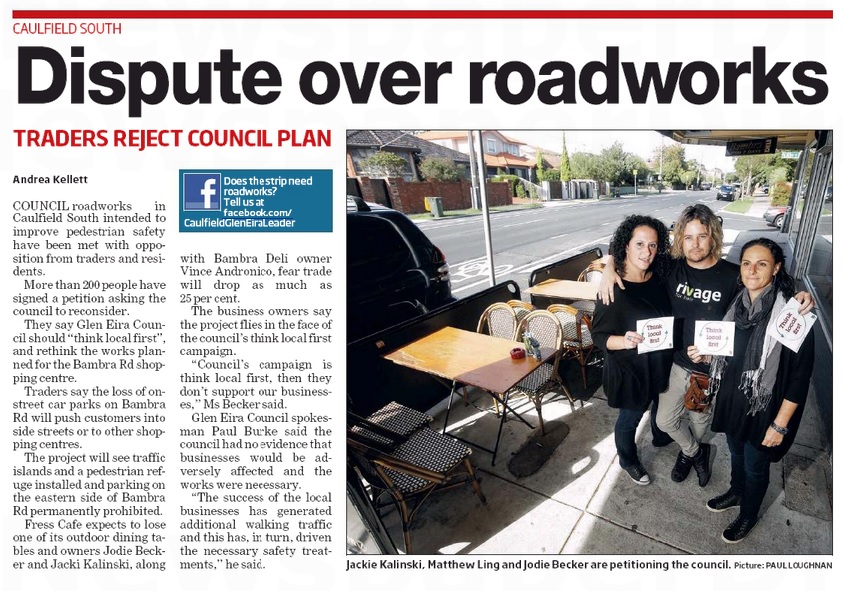
localPaul Burke states that there is “no evidence that businesses would be adversely affected.” Research by Monash University certainly casts major doubt on such a statement!

Driving a changed approach to shopping

11 April 2013

Parking restrictions, single lanes, local council controlled parking areas, higher parking fees, train crossings and traffic lights were seen as barriers to shopping at local centres.

Small suburban shopping centres are disproportionately threatened by policies on climate change and traffic congestion that discourage consumers from using their cars, research shows.

The Monash University study found many people already favour larger shopping malls over local centres because of the perceived ease of parking and access.

Dr Vaughan Reimers from the Department of Marketing examined the importance shoppers gave to car convenience, recognising that urban sprawl and decentralised retail options had contributed to reliance on the car. He found that irrespective of age, gender or income, shoppers regarded access and parking as important determinants of where they chose to shop.

He also assessed perceptions of shopping malls and shopping strips, and then compared the actual level of convenience provided by both for people travelling by car. The results were published in Transportation Research Part A.

Dr Reimers’ study showed that although shopping malls had more parking than local centres, people were more likely to be able to park close to desired stores at their local centre. However, it was commonly believed that large shopping complexes always had better parking options – a belief that has helped contribute to the rise of the mall.

Parking restrictions, single lanes, local council controlled parking areas, higher parking fees, train crossings and traffic lights were seen as barriers to shopping at the smaller centres by respondents.

“On the basis of the results of this study, any strategies designed to deter car-usage are likely to tip the balance even further in favour of the mall,” Dr Reimers said.

“Many policies related to tackling climate change have not only failed to achieve their objective but have also had a negative effect on the retail sector.”

Dr Reimers said modern transport systems needed to find a balance between environmental sustainability and economic growth, a fact that was particularly significant in light of the competitive disadvantage faced by suburban shopping centres.

“Policy makers and urban planners must give careful consideration to the negative consequences that may stem from strategies designed to deter car-based shopping,” Dr Reimers said.

Source: http://monash.edu/news/show/driving-a-changed-approach-to-shopping

Here we go again, with the continuing saga of the Caulfield Park Conservatory. The Council agenda for Tuesday night contains this set of recommendations/’options’ authored by that ubiquitous entity – Mr Nobody!

Options include, but are not limited to:

a. select a tender for the restoration of the conservatory and accept the significantly increased cost;

b. remove the conservatory and return the area to open space including new plantings of exotic species – estimated cost $75k;

c. remove the conservatory and amphitheatre and return both areas to open space including new plantings of exotic species –estimated cost $140k;

d. undertake consultation on alternative proposals;

e. other action as directed.

7. Recommendation

That Council give direction.

Residents may well ask:

  • Didn’t Council really know that the cost of refurbishment would be more than the amount budgeted for less than a year ago? Or is this officer’s report just another example of fudging the truth? For example we urge readers to return to somee of our earlier posts (https://gleneira.wordpress.com/2011/10/12/council-meeting-caulfield-park-conservatory/ and https://gleneira.wordpress.com/2013/05/01/the-conservatory-debate/) where Lipshutz , arguing for the café option, states that ‘keeping the conservatory’ would be $300,000 to $400,000. That was October 2011!
  • Since when has the realisation of increased cost been a deterrent to find extra money by this council? We note the 2 GESAC car park extensions; the blow out from 6 million to ten million for the Duncan MacKinnon Pavilion and now the mooted 7 million to 9 million for the Booran Road Reservoir! Finding extra money for these mega palaces has never been a problem in the past.
  • Why has the conservatory been allowed to become so run down year after year? To the best of our knowledge the only funds allocated to any kind of work on the conservatory was $100k in 2007/8. Since then it’s basically been allowed to rot!
  • How many more goes should residents expect on the issue of the conservatory? How many more resolutions regarding ‘full restoration’ need to be carried before anything is done?
  • As the minutes of April 2013 tells us –

Council has considered the matter at its Ordinary Meetings of 13 December 2006, 14 December 2010 and 11 October 2011. On the last occasion Council resolved:

“(a) That Council recognises the heritage value of the Caulfield Park Conservatory

(b) That Council determine not to proceed with and Expression of Interest campaign for the Caulfield Park Conservatory

(c) That Council considers funding in the 2012/13 budget for the repairs and full restoration of the Caulfield Park Conservatory.

Carried”

That resolution of course went nowhere since the cafe option reared its ugly head once more only to be soundly trounced by community views in the ensuing ‘consultation’. It’s certainly time that councillors accept what the community wants and that they ensure that ‘full restoration’ and adequate maintenance is carried out immediately. Eight years of neglect and pussy footing around has to stop.

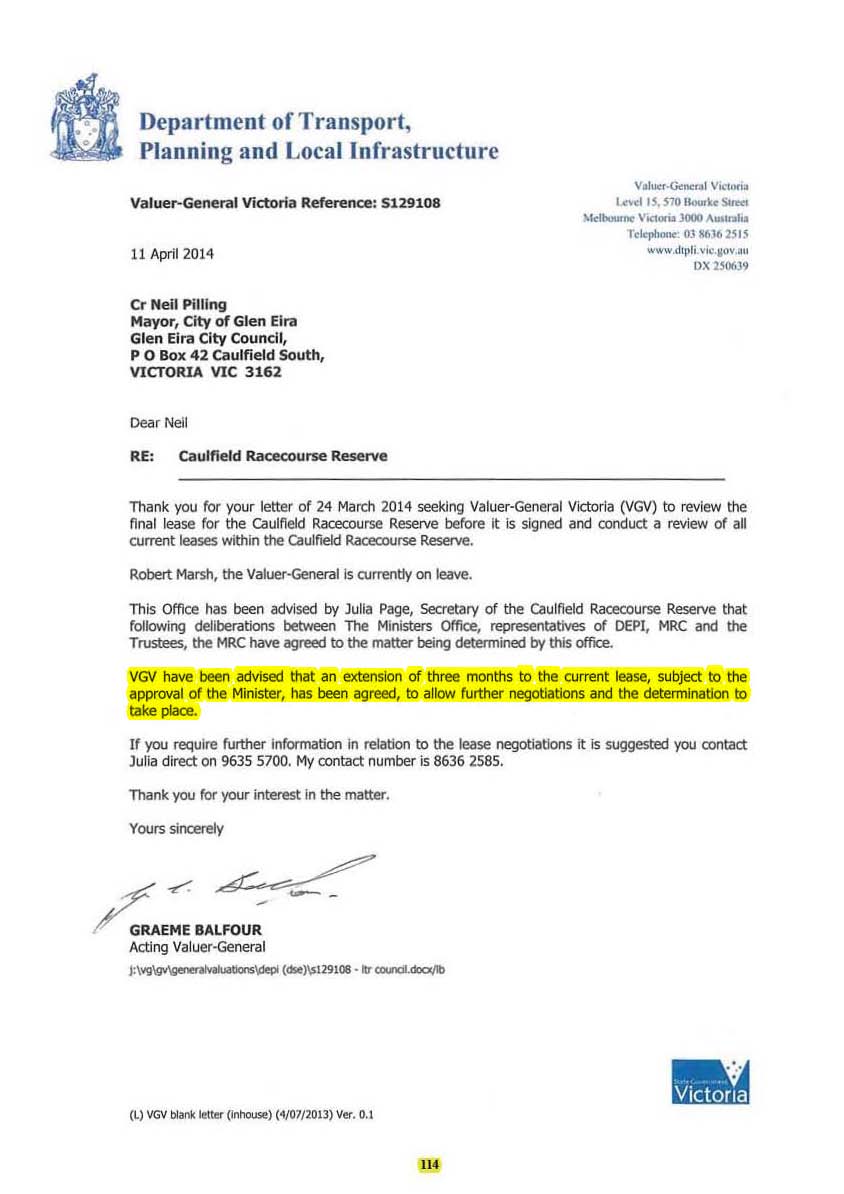
Included in the agenda items for Tuesday night’s Council Meeting, there is a letter from the Valuer General’s office in response to Council’s missive. The letter provides an affirmative response to Magee’s motion that the Valuer General become involved in the Trustee/MRC lease negotiations. All well and good and certainly a step forward. However the letter basically concentrates only on the current lease negotiations and remains quite taciturn (and evasive?) on the request to REVIEW ALL LEASES.  Whether this is intentional, or merely an oversight, we leave readers to decide for themselves.

Duration of the ‘new’ lease and the implications it has for the removal of training is yet another element that does not feature but which is vital if the Reserve is to fulfill its function as a racecourse, public park and recreation area.

We also wonder what has happened to the rest of the Magee resolution of March 18th – ie to involve the Auditor General re the landswap and hence the potential conflict of interest issues. Has Council had any response(s) to this component of the resolution? Why isn’t this mentioned in the report?Pages from APRIL29-2014-AGENDA


We’ve received an email from a resident which in our view epitomises everything that is wrong with the Glen Eira City Council administration and, in particular, its penchant for secrecy and putting every single obstacle it can in the way of residents.

Here’s what happened.

  • A resident went down to council offices and asked to see the Melbourne Transport Victoria submission on the Caulfield Village Development Plan.
  • An officer finally came down with the submission and told the resident that photographs or copies were verboten.
  • The resident, not to be put off, then started to transcribe the submission in full.
  • The officer remained watching the resident write for at least ten minutes and was clearly bored out of his brain and inwardly fuming. He then called in an underling to continue with the surveillance.

What is so outrageous about this behaviour is:

  • There is NOTHING, not a single word, in the Planning and Environment Act which precludes residents from taking a photo of a submission. The ‘embargo’ by council is simply another example of their determination to make things as difficult as they possibly can for residents. It is simply another ‘rule’ concocted by council to prevent widespread dissemination of a public document.
  • It also illustrates the common council practice of ‘if it’s not stated in the legislation’ then we can’t do it. Or the reverse is also true – if it’s not stated in the legislation, we can do it’. It all depends on the situation and the objective – for example: the Local Law and the Meeting Procedures and attempts to dissent from the chair!
  • Residents need to ask: how much did this officer surveillance cost ratepayers? How many dollars went down the drain when two employees stood around watching someone else write instead of getting on with the work they are paid (by us) to do?

Finally, here is the transcript as forwarded to us. All that has been left out are the reference numbers –

Received – 27th February 2014


Public Transport Victoria

Ref FQL

Rocky Camera

Coordinator Statutory Planning

Thank you for your letter dated 28/01/14 referring the Caulfield Village Development Plan to Public Transport Victoria. Please find Public Transport Victoria’s comments below.

While the accompanying Integrated Transport Plan (ITP) has made references to most items as outlined in Schedule 2 to the Property Development Zone PTV requires the following additional information to be able to conduct a proper assessment of the plan.

1/ Demonstrate how Station Street will accommodate the ‘Undivided Connector Road – B’ as detailed in the Public Transport Guidelines for Land Use and Development (i.e. a minimum 4.2 metres shared carriageway for both vehicles and bikes and a minimum 2.3 metres wide parking lane).

2/ Provide further information regarding the layout and location of the proposed bus stop at the intersection of Station Street and The Boulevard. Confirm that such bus stop would be funded by the development.

3/ Further detail on how existing tram services along Normanby Road and bus services along Station Street will be impacted by the proposed development (i.e. delays to journey time) including the intersection plans showing the proposed works, how they will accommodated within the road reserve and how they will operate.

4/ Further detail on the future planning for the Normanby Road / Smith Street tram stop (i.e. timing, planning location and design of a potential Superstop).

In addition, PTV does not support the introduction of a shared tram and traffic lane as suggested in Table 4.3 of the ITT on the Normanby Road/The Boulevard/Smith Street intersection. Introducing additional traffic to the existing tram right turn would cause travel time delays to the tram service. The intersection should be designed as not to detrimentally impact the current levels of tram operation.

The PTV would prefer that the Implementation Plan submitted with the Development Plan documents clearly sets out how each intersection across the development will be constructed and the timing for delivery detailed in an approved implementation plan.

Yours,

Richard McAliece

Manager

Land and Planning

24 / 2 / 2014

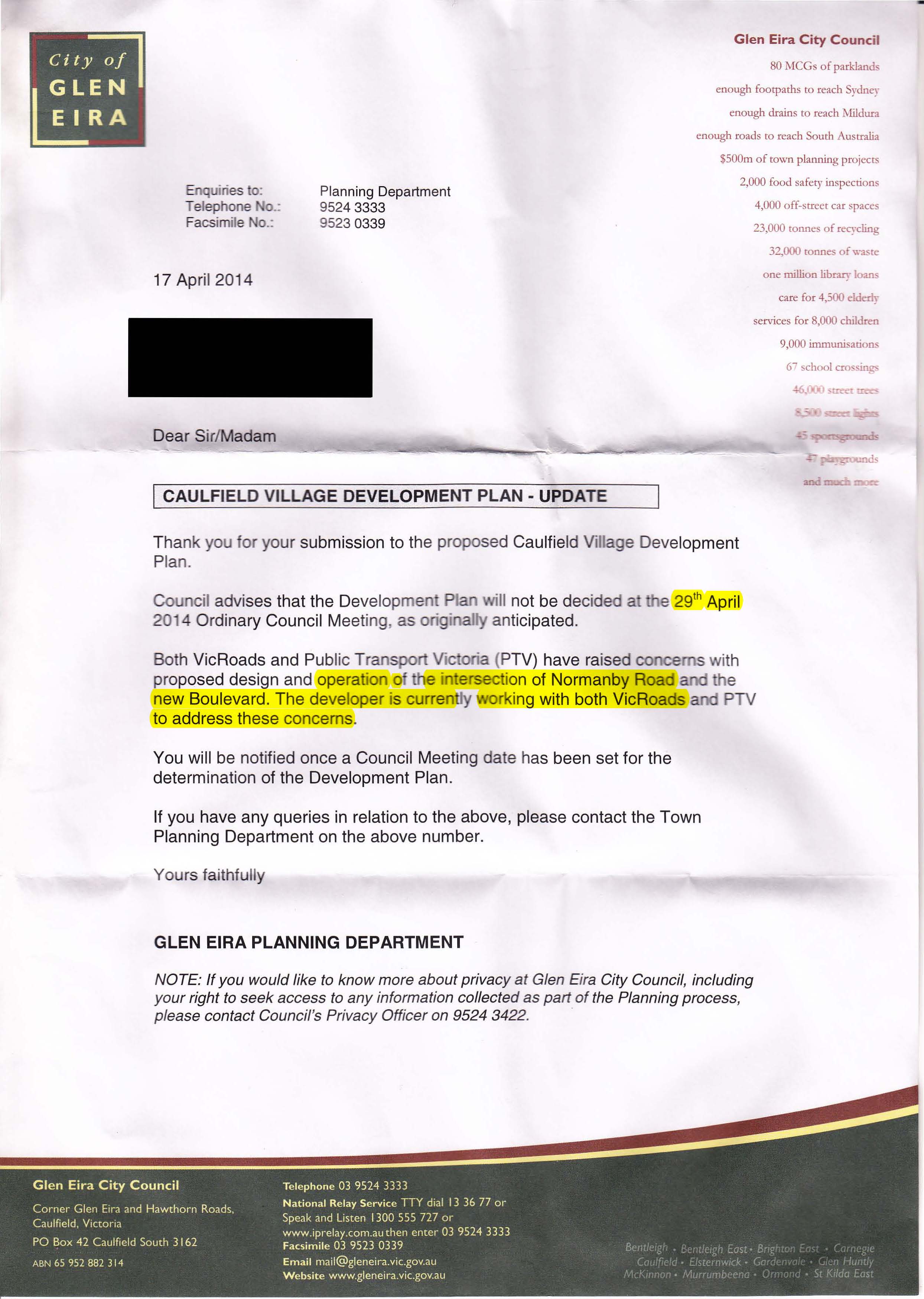
Submitters to the MRC Development Plan have received a letter from council. We urge readers to note the following:

  • April 29th was never the set date for decision. Pilling announced it was to be April 8th. This delay far exceeds the requirements of Schedule 2 associated with the C60.
  • Normanby Road intersection is not the only problem highlighted by VicRoads as we’ve already shown in an earlier post. (https://gleneira.wordpress.com/2014/04/10/caulfield-village-vicroads/). Yet Council only mentions this one example. Why?
  • The VicRoads submission also mentioned working with the developers AND COUNCIL. In  this letter the role of Council does not even rate a mention! Are residents supposed to believe that Council has no role, no function, and no say in what changes are now made? Hardly!
  • Why, given these objections, and the countless other problems outlined by residents has Council not simply rejected outright the entire Development Plan? Why this ongoing behind the scenes manoeuvring? It couldn’t be could it that by rejecting the Development Plan council would be providing residents with the green light for third party objection rights?
  • Question after question on traffic, drainage, etc. has not been answered by this council except for the stock response of ‘we’re investigating’. After 4 months Council should well and truly have determined all the flaws in the plans. They should also have conducted their own traffic analysis as any decent council would if they were truly concerned about the flow on effects. Thus far and to the best of our knowledge, this Council has done nothing but accept the developer’s version of reality as factual and sacrosanct!
  • Finally, it beggars belief that official missives of Council fail to include the name of those individuals responsible for their decision making. The blanket title of ‘Glen Eira Planning Department’ will simply not do! Who is responsible? Who signs off on such letters and planning decisions and why is there no accountability and/or transparency within this administration?

IMG