FINANCIAL REPORT

LIPSHUTZ: council is again ‘progressing well’ and that GESAC is doing a lot better than council ‘anticipated’. They’d originally been looking at a $300,000+ ‘surplus’ but this has now gone out to over a million dollar surplus. Claimed that GESAC is now covering ‘all its borrowing costs’ but not ‘operating costs’. There are over 8,500 members and that he ‘anticipates’ that it will be ‘covering operating costs completely’. Also noted a sentence on page 2 where there ‘was a transfer of $136,000’ from a maternal child & health centre to GESAC for ‘heating and ventilation’. Said that this ‘wasn’t so much a transfer of funds’ out of the health centre but that council were thinking of ‘redeveloping’ the centre staff room. ‘Council decided that when they looked at the plans….it wasn’t worth doing….and as such it didn’t occur’. The money was therefore ‘surplus’ and now used for GESAC. Because GESAC is ‘so heavily used’ and there are lots of people in the centre that ‘we needed to lower the temperature’. ‘We don’t ordinarily remove funds from’ one project to another. Noted that what the Auditor General had said was that unlike other councils, Glen Eira has a ‘business plan before we do anything’ and if ‘it doesn’t stand up, we don’t do it’. So when officers looked at the issue of the staff room it didn’t ‘stack up’…’and as such it didn’t happen’. Went on about ‘operating costs per assessment’ – Glen Eira has one of the lowest & rates and charges are also one of the lowest; ‘fourth highest for pensioner rebates’ and ‘third highest for grants and subsidies’ and 3rd highest in capital works. Said that in some other councils the criticism is that money should be used ‘to pay back debt’. Claimed that was ‘poor’ because it would mean the degradation of facilities and ultimately cost more to replace.Glen Eira has a ‘rolling program’ that means they ‘keep things moving’ ‘so we don’t have to spend money’….’cost saving’. Summed up that it was an ‘excellent report’ which shows that ‘council is on track once again’ and that Glen Eira is a ‘template’ for quality and other councils.

DELAHUNTY: disagreed with Lipshutz on Auditor General’s report. Said that council had been asked to maintain a liquidity ratio somewhere ‘greater than 1.5’ and the report clearly says that over the next few years it will remain ‘around 1’ so there is a need for ‘caution’ with cash flows, ‘so there is a need for concern’. Said that congratulations are due to GESAC but it’s not yet ‘paying for itself’ since it costs council $1 per visit. Agreed with some of the things Lipshutz said but the liquidity ratio needed some caution.

HYAMS: said that Lipshutz is ‘adamant’ that all surplus should be ‘spent on capital works’. Spoke about the $7 million dollar debt for the Benefits scheme which council was ‘going to be charged 7.5% interest on’ that there are ‘grounds to consider’ whether some of the debt should be paid off sooner. ‘That’s a discussion we will all have no doubt’. Referring to Delahunty’s comments on the liquidity ratio agreed that ‘yes it is something we will need to keep our eye on’ but he ‘wouldn’t say it is cause for concern’ but a ’cause for caution’. It’s only ‘one indicator taken in isolation’ and overall ‘we are in a very sound financial position’ and that the report ‘reflects that’. Said that council is generally conservative in its forecasts so that the projected liquidity ratio is of this ilk and will stay ‘well above’ the 1 figure.

LIPSHUTZ: said that Delahunty ‘didn’t have the benefit’ of being present at the Audit committee when the Auditor General came out. The AG was ‘very satisfied’ with the ways things were being handled, congratulated them in fact and that ‘council was handling (things) very, very well’. ‘There was nothing of concern at all’….’we have to be cautious, we have to watch our ratio’

CARRIED UNANIMOUSLY

COMMENTS:

We freely admit that we are not accountants. Yet, some of the revelations ensuing from this item we find to be extraordinary. For the first time we learn that the Employee Retirement Fund cost of over $7 million is to incur a loan of 7.5% interest. Council has repeatedly claimed that the first $3 million plus, that is due to be paid by June 2013 has already been budgeted for. Does this therefore mean that council over the next 15 years can’t find a meagre $4 million dollars to pay off this debt? More significantly why are they locked into an interest rate of 7.5%? This is surely astronomical given today’s falling interest rates. Is this a sign that Glen Eira Council is in fact viewed by lenders as ‘high risk’ and hence the high interest rate? Why must there be any borrowing at all for a measly 4 or 7 million unless the cash flow is indeed on very parlous grounds?

So, for all the talk of being ‘on track’ and how wonderful this council’s finances are, there are countless questions that need answering and figures that reveal the absolute truth. Here are some further questions to ponder:

  • If Glen Eira is so wonderful with its ‘business plans’ then how can a budget be approved, funded, and then suddenly money is withheld from a child care centre and transferred to GESAC?  The actual sentence referred to by Lipshutz reads: “Transfer funds of $136K from Caulfield MCHC to GESAC HVAC works to cover the expenses on the additional HVAC plant”. Since these acronyms would mean nothing to 99% of residents, surely it is time that an important document such as this was made intelligible to people? More importantly, what does this again indicate about the overall planning and astuteness of the entire GESAC project? How often has this council ripped money out of one agreed to project to cover the costs of another?
  • Why has so little money been spent on other projects? Are they being delayed because there simply isn’t the money to go ahead with them? Lipshutz argues that ‘surplus’ is spent on capital works, yet over $10 million dollars is carried through from LAST YEAR’S budget! If that’s not delaying projects to an inordinate amount, then we don’t know what is!
  • The public deserves a fully itemised ledger on exactly what GESAC is costing. Figures cited in these reports need to be fully DEFINED. For example: do the ‘expenses’ listed for GESAC include interest repayments, staff costs, or are they simply everyday costs, such as heating, maintenance, etc? Without clear definitions the public is lost. Of course, this may all be deliberate!!!!!! It is definitely time for less spin and more upfront and detailed accounting!
The fully orchestrated nature of the councillor briefing was evident in the first item of tonight’s council meeting. Esakoff moved to accept the minutes of previous meeting “as printed” when Hyams said “Are you sure of that?”. Esakoff then looked at her notes and moved that there be a correction – changing the printed days from a Monday to a Tuesday for the Special Council Meeting! But the meeting reached new heights of arrogance, if not sheer lunacy when it came to public questions. One question asked what input residents could have as to the development and maintenance of their parks and facilities. The response was a world record no doubt – at least 5 minutes of the most inane, irrelevant and arrogant waffle ever produced by any council we would think. Once the full minutes come out we urge all readers to take the time to peruse this response. It is quite unbelievable.

GARDENVALE RD DEVELOPMENT

Delahunty moved an amendment which basically included changes and additions to the conditions imposed on the application – ie. carparking, insertion of bollards, car stackers to be maintained by body corporate ‘in good working order’. Seconder was Lipshutz.

DELAHUNTY: Said that this area ‘was very close’ to her heart and that she had spent many hours in this area. The proposed development ‘has some excellent features’ and doesn’t impact on residential areas and that a notice is published about residents not being issued with residential parking. Stated that since it’s so close to the railway station it will be ‘a selling point for the developers’. Went on to say that the Martin St., shopping strip belongs to Bayside Council and that right now that council ‘is considering the development of structure plans…..(and is)’recognition that (the area) is growing (into an important community centre and Bayside see the preparation of a structure plan as ‘required’. The ‘structure plan is a long term guide for land use….it creates the framework of how  a centre is planned….and the actions needed to realise that framework’. Concluded by ‘urging’ councillors to consider the ‘greater strategic role’ for shaping Gardenvale ‘through the use of structure plans’.

LIPSHUTZ: concurred with Delahunty that this area is ‘appropriate’. Was concerned about parking and ‘unfortunately this particular site doesn’t lend itself to have ‘ visitor parking available but there’s areas on the street so residents won’t have this added pressure put on them. Didn’t agree with Delahunty on structure plans because they are a ‘blunt instrument’ and ‘certainly not very flexible’ but that’s ‘a debate for the future’.

ESAKOFF: doesn’t support the recommendation because she felt that ‘the number of car parking spaces for visitors….should be provided’. The area is already ‘busy’ and ‘it would be an unfortunate precedent’ not to insist on visitor car parking spaces. Said that these requirements should have been applied and if they couldn’t be then another option was to ‘reduce the number of dwellings’. Confirmed that ‘parking is an ongoing issue in Glen Eira’ so even though it might seem a ‘small reason’ not to support the recommendation ‘but it’s my reason’.

OKOTEL: supported Esakoff. Said that the planning scheme requires that there be 2 visitor car parking spaces ‘as a starting point’ but this could be waived ‘depending on’ evidence. Said that she didn’t think that this ‘warrants a waiver’…’important that we ensure there is compliance with’ the planning scheme.

AT THIS POINT A MEMBER OF THE GALLERY ASKED IF HE COULD SPEAK. HYAMS SAID ‘NO WE’VE HAD A PLANNING CONFERENCE WHICH’ gives the opportunity for the public to speak….’we don’t allow members of the public to address council’. The resident then asked ‘when is the planning conference?’. Hyams said that it had been held and that all objectors were notified.Resident said that ‘I’ve got a notice here saying that there’s a council meeting’ on the 27th’ ‘and I’m invited to attend’. Hyams then said ‘Yes but it doesn’t say you’re invited to speak’. Resident said ‘I’ve got a problem with this’. Hyams – ‘said he ‘understood’ but the Local Law is ‘that councillors speak at council meetings’ unless it’s on the agenda that the public is ‘invited to speak’. Went on to say that they ‘specifically’ have planning conferences where the public can ‘address’ councillors…’it’s not a statutary requirement, but we do it’ and people can then speak to council. ‘Council meeting is not the forum’.

Went on to the application. ‘Normally I would say there should be visitor parking, but in this case it is ‘not practical’ because of the car stackers which visitors couldn’t use. It’s also a commercial areas so people wouldn’t come outside ‘commercial hours’ there would be ‘spots for visitors to park’ and on ‘that basis’ he supports the recommendation/amendment

MOTION PUT and CARRIED: Voting for were: Hyams, Delahunty, Pilling, Souness, Lipshutz. Against – Okotel, Esakoff, Magee (Lobo was absent)

We will follow up with the rest of the items in the coming days.

Here we go again. Another ‘report’ into an issue that reared its ugly head years ago and is still to be resolved – the toy library.

Magee and Pilling moved on November 13th that a report be prepared:” “on the Carnegie Toy Library currently located within the Carnegie Pool facility. Concerns have regularly been raised with Councillors about the inadequateness of this arrangement. This report should detail all options for improving the present service including:

‐ expanding the present facility

‐ identifying alternative suitable sites to relocate the service

‐ any grants or funding opportunities available.

The MOTION was put and CARRIED unanimously.”

History tells us that two and a half years ago this problem was known. In fact the library raised their concerns about a Health and Safety issue in June 2010 and made a submission to the budget at that time. Since the spin is continually about how this council is so concerned about its health and safety record we are amazed that for nearly 3 years nothing has been done to eliminate all potential risks. Below we feature the reports from the time in chronological order.

Full toy story for Caulfield’s library of fun

7 Jul 10 @ 10:20am by Jenny Ling

Toy library president Kym Arthur, with Liam and Zoe, says the library is running out of space.

A CRAMMED collection of toys at a Carnegie toy library has become a safety hazard for parents, staff and children, a report has found.

With membership numbers nearly tripling in 10 years, the Caulfield Community Toy Library is appealing to Glen Eira Council for funding so it can expand.

Library president Kym Arthur said up to 300 Glen Eira families now used the borrowing facility, up from 100 families when it opened at the Carnegie Swim Centre in 2000.

The number of toys has increased to 2500 to match demand.

A report, by design consultant Space Matters, said the small area had created a “serious occupational health and safety risk” and was “impacting the functionality, quality and range of services, as well as the safety of members and visitors”.

“We have just run out of space,” Mrs Arthur said. “We’re literally packed to the rafters. It’s very dangerous.”

The report, submitted to the council, proposes $7500 funding for extra storage space or $180,000 to construct a demountable building on the site.

The construction of the $41 million Bentleigh East aquatic centre had also put pressure on the library because equipment was being stored at Carnegie during the work, she said.

Glen Eira Mayor Steven Tang said the council would “look at the future of the library as part of any decision about the future of the Carnegie site after GESAC is opened”.

“If they have identified an occupational health and safety issue they would need to resolve it,” Cr Tang said. “One way of doing that would be to reduce the amount of stock at that premises.”

Now, two and a half years later, the Leader has run this story –

Cramped Carnegie toy library needs space

7 Nov 12 @ 05:00am by Andrea Kellett

GLEN Eira families have new hope that a solution can be found to their toy library’s space problems.

Caulfield Community Toy Library members are delighted Glen Eira councillors have called for a report into expanding their “cramped” service.

Council officers have been asked to consider options including expanding the existing space at the Carnegie Swim Centre, or relocating it. Parents have for years begged the council to help them find more room. They have nowhere to hold meetings, nowhere for children to play, little room to move, no heating, no dedicated space for toy repairs and not enough display room.

President Jo Prendergast said meetings were held at a local pub and half of the children’s costumes could not be displayed. “There are so many good toys here and you can’t see them or get to them,” Ms Prendergast said.

She has grand visions for the toy library to become a “community space”. “This could be more than just a toy library.” But for now, she and vice-president Corinne Goudge are pleased the library’s needs are “on the council’s radar”.

Cr Neil Pilling asked for the report, saying volunteers were “drowning in toys”. Mayor Jamie Hyams said the problem had dragged on for years.

The Caulfield Community Toy Library is at the corner of Moira Ave and Lyons St, Carnegie.

COMMENTS:

  • GESAC has been operating for 6 months now, but clearly nothing has been done to solve the issue
  • Why has it taken nearly three years for any action to eventuate – especially if there is a health and safety risk?
  • 6 of the current 9 councillors were in office at the time this was first brought up. What have they done to resolve the issue in the meantime, especially after the toy library’s comprehensive budget submission of 2010 (uploaded here)
  • How long will it take for the officer’s report to appear? Will it actually provide funding, sensible recommendations, or will the status quo continue?

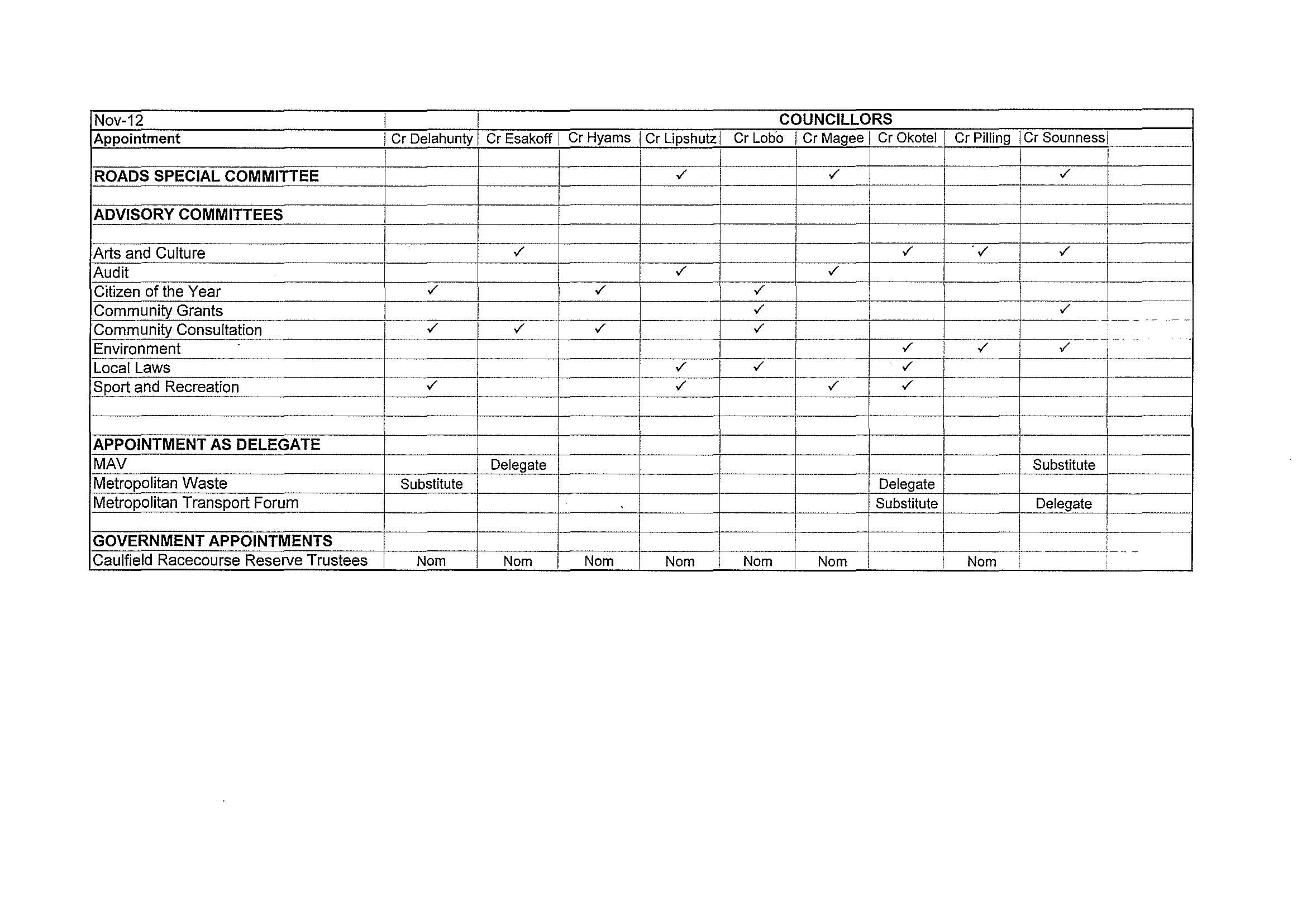
Backroom wheeling and dealing, plus the continued inability to present honest and forthright officers’ reports continues with the appointment of councillors to the various committees. There is much in this report that requires commenting upon. We will go through this sequentially

  1. Again no author noted. It’s rule by nobody in Glen Eira.
  2. Spurious claims as to the rationale behind the creation of the Racecourse Special Committee. For example, we’re told that the committee “was established because there was a risk that a Council Meeting dealing with an item concerning the Racecourse might fail for lack of a quorum”. In order for this possibility to eventuate a series of truly extraordinary events have to take place: all trustees must declare a conflict of interest; a councillor must decide to Winky Pop him/herself and someone must be absent. Even if someone is ill, there is no plausible reason as to why any meeting could not be deferred for a week, or possibly even 2! When the MRC is quite capable of delaying ‘developments’ at the racecourse we see no reason why council cannot defer a meeting for a few days until a councillor is able to attend and ensure a quorum. The C60 decision was in fact delayed for several months following the recognition that the farce of ‘consultation’ had to be endured as a good public relations exercise.

Even then, Lobo did not declare a  conflict of interest, he was not a trustee, and his presence would have ensured a quorum. The real reason for the creation of the Racecourse Special Committee is clear to everyone – insurance that the C60 and the ‘agreement’ with the MRC was passed.

The real sting in the tail however, comes with this incredible paragraph: “That Council now has a different composition and it may be possible to abolish this Special committee and deal with Racecourse matters in Ordinary Council Meetings. That will be determined after Trustees have been appointed”. Why the existence or otherwise of this Committee should be ‘determined after Trustees have been appointed” is the real question. It couldn’t possibly be that if Newton doesn’t get his little select band chosen as trustees, then he’s better off going to a full council meeting where their votes will count? If, on the other hand, the gang are selected as trustees, then residents can bet their houses that the Committee will continue! It will be business as usual if this scenario eventuates.

3.  Next we have the Roads Special Committee. Suddenly this becomes ‘unwieldy’ if dealt in an ordinary council meeting! Strange that the same argument is not used for the Racecourse Special Committee. We also need to highlight that as a Special Committee, created under Section 86 of the Local Government Act, such committees are obliged to present both agendas and minutes of its meetings. To the best of our knowledge, no agenda or minutes have been presented from this committee for at least 3 years! So much for proper governance and adhering to the Local Government Act! Even better is that the CEO appointments Special Committee is yet to publish its minutes also dating back several months!

We further draw readers’ attention to the fact that in the Annual Report the Delegated Planning Committee is referred to as a ‘Special Committee’ (Page 81). It is NOT A SPECIAL COMMITTEE established under the Act. It is the creation of delegatory authority with no published agendas, minutes, or obligatory schedules. To term it a ‘Special Committee’ is deliberately misleading and mischievous. 

4. This sentence on advisory committees is also worthy of comment – “It is important, however, to ensure that decisions and priorities are set by those who have been elected ie Councillors.” What a nice way of saying that residents will not get a look in!

5.     There’s also the blanket statement that the CEO Contractual Arrangement Special Committee, the Animal Management advisory committee and the Racecourse advisory committee will all be abolished and that these functions will be ‘handled by Council’. Of course, since Penhalluriack is no longer there, the Contractual Committee doesn’t have to exclude anyone (at this point in time) and the Racecourse advisory committee which also included Penhalluriack can also disappear. Animal management of course hasn’t had a meeting for over a year and since it takes its order from the Rec department, it is also superfluous. Interestingly, the argument used for the Roads Committee (ie that matters are too ‘wieldy’ for ordinary council meetings) doesn’t appear to hold much water in these instances. The inconsistencies and spin are quite unbelievable.

Finally, we wish to point out a couple of other salient facts.

  • With the abolition of all these advisory committees, this council has the least number of advisory committees of any neighbouring council as far as we can tell.
  • Glen Eira has the least number of committees that include community reps in the metropolitan area
  • And what of the Pools Steering Committee? Not a word! Since GESAC is doing so brilliantly, it no longer needs ‘supervision’ we assume, even though it is costing ratepayers a fortune. All can now be left in the capable hands of the Audit Committee and administrators!


Council resolutions and policy in Glen Eira are very flexible instruments depending on the individual issues they cover, and the perceived ‘sensitivity’ of these issues. Planning undoubtedly comes under the umbrella of ‘sensitive’. Hence, formal council resolutions, such as items from the Community/Council plan are repeatedly ignored, forgotten and distorted. The Community plan, repeated in the 2011/12 Annual Report under Strategic Planning, stated:

“Strategy: Ensure town planning controls and policies are as clear, concise, relevant and helpful as possible in deciding planning applications in a logical, repeatable and transparent manner.

Action: Report the numbers of dwellings approved for minimal change areas and housing diversity areas.

Measure: Report the numbers of dwellings approved for minimal change areas and housing diversity areas quarterly.”

Unless we are entirely deficient in our English Language Skills, ‘numbers’ does not mean PERCENTAGES, and ‘quarterly’ refers to the 4 times a year SERVICES REPORT. The last council meeting had the Services report (ending September 2012) as one of the items. Included in this report was the following:

84% of dwellings approved for first quarter are in Housing Diversity Areas.”

That’s it! No numbers, no mention of Minimal Change statistics, and no real overview of what is happening in the municipality in terms of the success of failure of the 80/20 policy. We have to go to the Annual Report to glean some information on this vital question.

The Annual Report includes in very small font this statement for dwelling approvals– “Total for 2011–12 minimal change 345, housing diversity 830”. This means that the so called 80/20 division of Glen Eira is rapidly falling to bits since we do not believe that the majority of approvals in these areas would be the simple replacement of one dwelling for another single dwelling. Further, 345 approvals makes the ‘division’ of Glen Eira more like 60/40 instead of the touted 80/20. Amendment C25 claimed to “re-direct multi-unit housing into appropriate locations” and “within the minimal change areas, existing low intensity, low-rise character will be protected and enhanced.” It goes on to claim “For the majority of the City, single houses, extensions to existing houses and two dwelling developments are envisaged as the predominant types of dwellings. By limiting development to this level, existing neighbourhood character can be protected, while still promoting a range of housing through the City.” Is this really happening? How many developments in Minimal Change Areas are more than 2 units per block? How many protect ‘neighbourhood character’ given that there is no real mandatory Urban Design Framework in Glen Eira?

Again, we have to go back to the crucial questions of:

  • Where is the information that will reveal the true ‘success’ or ‘failure’ of these objectives?
  • What’s the point of having Council Resolutions when these aren’t adhered to?
  • Why aren’t councillors insisting that their Resolutions are carried out to the letter?
  • Why are such vital statistics allowed to be buried, instead of highlighted?
  • How much longer will ‘transparency’ be merely a word, rather than the fundamental tenet underpinning all operations in Glen Eira?

We’ve featured the Minister for Planning’s response(s) on the question he was asked in parliament last week concerning the publication of submissions on the Zoning Reforms. His answer was that it is all in the hands of the Advisory Committee who must first perform a ‘peer review’ of the submissions. As the opposition member pointed out, the real reason is probably that the vast majority of the submissions were totally negative!

Just to clarify the issue further we quote from the Minister’s terms of reference for this Advisory Committee –  “Any documents provided to the Committee must be available for public inspection until submission of its report, unless the Committee specifically directs that the material is to remain confidential”. More buck passing it appears, since the Minister in his response does not seem to understand the terms that he or his department set down. He stated: “It would not be appropriate that they would be peer reviewing a public document, because obviously there would be influence on them to do that. The documents will be made public when the process is concluded. That is the appropriate way to do business, and that is how it will be done.”

We got pretty tired of waiting, so doing a simple Google search, revealed the following submissions. No real surprises in that the Building and Planning industries are all gung-ho about the proposed changes. Readers may access the documents simply by clicking on the desired ones.

Master Builders Association

Housing Industry Association

Victorian Farmers’ Federation

Planning Institute of Australia, Victorian Division

Port Phillip

Greater Geelong

Boroondara

Maribyrnong

Brimbank

Casey

Manningham

Frankston

Melton

Cardinia

Bayside

Victorian Local Governance Association (VLGA)

This comment has come in which we repeat as a post in the public interest.

Delegation to the Minister:
On November 14 a delegation meet with the Minister for Local Government (your member Jeanette Powell) to discuss the plight of the ratepayers relative to inputs to local government.

The thrust of the discussion was to be about how ratepayers are disadvantaged when compared with Municipal Association of Victoria and Victorian Local Government Association and other high profile peak bodies.

Our intent was to solicit her help in how to get more ratepayer input into key documents like The local Government Act, and to stress the point that we are all volunteers competing against high profile organizations that have lots of $$$ from councils while we are significantly disadvantaged and without any professional staff and our voice is marginalized as a result.

After meeting with the minister, I felt like I had been blasted with the Ghostbuster Proton Pack and needed a shower.

Had I not taken my dog tranquilizers prior to the meeting I would have left Parliament house and laid on a tram track waiting for a tram to end my misery.

It was a humbling experience to visit with a minister who has no empathy at all for the plight of the ratepayer and was too busy spinning how great she was doing to actually listen.

However a snitch at Parliament House told us that the government fears inputs from an organized group who represents ratepayers as the changes to LGA1989 would have to be monumental.

So the State government, like our local government, marginalizes ratepayers and community groups.

Every time we tried to make a point she would say that our recourse was at the ballot box to vote in who we wanted and get rid of those not doing our bidding in local government.

It is obvious that she has little grasp of the real world in this instance and with this in mind it is more important than ever to address this issue.

So I am soliciting your support to use our power at the voting box and to make sure she is “unelected”.

Would appreciate any links to other ratepayer organizations I could contact.s.

If you would like a copy of the slide presentation that we wanted to make (sidelined, of course) I can provide it to you.

Cheers, Joe Lenzo; OAA, OADH, OASP:
Mornpenshire.elected2012
“demanding, nurturing, and realizing
transparency, accountability and democracy”
Mornpenshire.elected2012@gmail.com 0430.450.657

http://mornpenshireelected2012.net/

Several posts back we reported on the ‘debate’ in chamber regarding the mooted Open Space Strategy. From comments made by several councillors it was obvious that in Glen Eira the ACQUISITION of open space is a forlorn hope and that the emphases has been, and will continue to be, how best to utilise the existing land stocks. We also remind readers that in Glen Eira the revenue accrued from the Open Space levy falls well below the 5% currently permitted and that most of this revenue is used for ‘maintenance’ rather than the purchase of additional open space. For a municipality continually crying about its status as having the lowest amount of public open space in the state, such policy directions arguably fall well short of what is required.

By way of contrast we highlight extracts from the November 19th 2012 agenda items from Stonnington. Please note that Stonnington has the SECOND least amount of public open space behind Glen Eira. Their officers’ report on their upcoming Open Space review stands in stark opposition to the mentality that is evident in Glen Eira. Here are some interesting quotes –

“The purpose of this report is to consider adoption of a long term strategy that identifies and funds land that can be progressively acquired to increase open space and associated strategic links, and address some areas of critical flooding risk.  This initial report is for Councillor Briefing only.”

Stonnington cannot catch up to the levels of open space, recreation facilities and landscaping provided in other municipalities. It does however need to actively pursue additional open space as opportunities arise.  There is a need to look for non traditional opportunities such as improving the public realm through local streetscaping, undergrounding parking to create open space on top, and encourage green walls/ rooves, and require setbacks and landscaping in new developments to maintain and foster a City which is as green as possible. It also needs to more proactively pursue new open space opportunities, associated and new linkages to improve access to open space and in general. 

The strategy involves the comprehensive assessment and identification of open space, access and some drainage needs and opportunities on a suburb by suburb basis to be outlined in detail in subsequent reports to Council.

Council has an open space reserve fund of $23m for the purchase of open space. While this is a very significant amount of money given a normal small land purchase is in the order of $2m the current fund could represent say 10 properties or 8000m2. This fund accumulates from resort and recreation payments required by the current Subdivision Act. The Act requires up to 5% of the land value is paid to Council when a new unit development is subdivided. This money is held in reserve and is required to be spent in the suburb it was collected in. The money can be used to upgrade existing open space, and / or acquire new open space.

In reviewing opportunities for additional open space, problem drainage and overland flood areas were also reviewed. These areas can provide useful areas of open space and address drainage concerns at the same time.

It is proposed that Council considers a detailed review for each suburb on potential opportunities and costs for land acquisition for open space, strategic links and drainage improvement, and adopts an approach for funding this acquisition.

It is estimated assuming similar ongoing levels of redevelopment that the reserve funds from developer contributions will accumulate and support strategic property purchases over the next 15 years. It may be possible to increase the base of this fund. A report has been commissioned into how these developer contributions can be widened to other uses and the percentage contributions increased…”.

That’s Stonnington! We remind readers that in Glen Eira the Open Space Levies are miniscule and that there was no definite indication in the Planning Scheme review  of 2010 that things would really change. Two and a half years on, this council is silent on the issue.

Poor governance has been the perennial issue at Glen Eira. It continues unabated. We’ve taken the time to compare the Community Plan as accepted by formal Council Resolution on June 26th   and what now appears as part of the formal Community Plan in the Quarterly Report (13th Nov minutes). The changes are alarming. Further, they have NOT BEEN SANCTIONED BY FORMAL COUNCIL RESOLUTION and nor has there been any public statement, officers’ report, or open discussion about these alterations. We allege that these changes represent another failure of transparent and open government in Glen Eira. We are especially concerned about:

  • Changes in wording from the accepted Community Plan to what is now paraded in the current Community Plan
  • The removal of certain actions from the original plan
  • Resolutions relating to Amendments withdrawn without another full council resolution
  • Measures that are meaningless and do not address either the objectives or the stated measures

There are only two conclusions possible – either unelected bureaucrats made these decisions or, if councillors did have a say then they were made behind closed doors in secret. We find it appalling that unless the public are willing to analyse and compare documents word for word, then such changes remain unknown, hidden, and the public is continually being duped and kept ignorant. The only conclusion possible is that this tactic is deliberate. Important policy decisions are continually buried in the volumes of waffle rather than highlighted and commented upon. The result is the failure of good governance and open, transparent government.

In the June version of the accepted Community Plan there was this ‘action’ item: “investigate the feasibility and applicability of introducing a Development Contributions Plan”. The ‘measure’ was stated to be – “Report provided to council”. This has now completely disappeared from the September version. We ask: who made this decision? When was it made? Where is the ‘report’ to council?

Next there is the subtle change in language. Another of the ‘action’ items from the June version states “Introduce a Local Law which creates the framework for a Classified Tree Register”. The measure is: “Local Law considered by council” The September version has altered this to read: ‘Local Law adopted by council”. Whilst not earth shattering in itself, the very fact that  terms can be changed without formal resolution is a concern. Again, who decided and when was the decision reached? Doesn’t this in fact pre-empt the entire process of community consultation on the Local Law?

We also need to highlight just one of the ludicrous ‘progress reports’ on vital aspects of planning which totally ignore both ‘actions’ and ‘measures’. Here is an example:

Measure – “Reduce the number of applications being referred to DPC for a decision by trialling a mediation process and report the results to Council. Provide an information video which explains the DPC role and purpose for the benefit of residents involved.” The progress reports says: “DPC Video has been finalised and is being shown to participants prior to meetings. 4 mediation meetings held to date”. We note that:

  • No report has gone to a formal council meeting
  • No logical connection between the ‘success’ of a video and ‘mediation’
  • No  statistics that reveal the success or failure of mediation, video, or anything

Also buried in the documentation is the withdrawal of Amendment C90 – ie the ‘Transition Zones Policy”. This came before council on the 30th August 2011. The resolution to seek authorisation from the Minister to exhibit the amendment was passed unanimously. Now over a year later we find out that “Amendment will be withdrawn. The issue of transition will be addressed through the New Zones”. Once more the question becomes: who decided upon this? When was it decided and why, oh why, did this not go to a formal Council Meeting? Even the language associated with this decision is conflicting and unclear. The Quarterly Report stated the the Amendment will be ‘withdrawn’. The Community Plan Report simply states this is ‘on hold’. Whichever is closer to the truth the fact remains that none of this has ever been highlighted, explained, or discussed in an open forum.

Since a year has now practically passed since the original council resolution we cannot believe that the matter wasn’t referred to the Minister for permission to exhibit. The Amendment has not been advertised as far as we know, nor has it been gazetted as granting permission. Thus we suspect that someone must have contacted the Minister and said ‘hold on’ – again without any formal announcement to the public, nor any formal council resolution.

It would appear that it’s business as usual with this Council – a clear case of the tail continuing to wag the dog! Residents would be well advised to ask their supposed representatives the following questions –

  • How well do councillors actually read officers’ reports?
  • Do any of them question the data/information that is provided?
  • If the above questions are to be answered in the affirmative, then why was nothing said about any of the points we have raised in this post?
  • Why do these councillors continue to allow what appears to be unelected officials to make crucial decisions on issues that dramatically impact on residents?