In allowing officers to exercise full control over sensitive and community oriented issues such as sporting ground allocations, councillors have now found themselves literally between a rock and a hard place – do they support the community or the questionable decision making capacity of officers under delegation? First there was, and continues to be, the farce of the GESAC basketball allocations which resulted in ratepayer funds being wasted on legal advice upon legal advice, and the issue dragging on for 6 months or so. Now we have another instance of dictatorial decision making by the Sports Department (Linda Smith and her master Paul Burke) in their refusal to allow the Ajax footy club to hold a community event to celebrate the 40th anniversary of the junior footy club on September 1st.

The outcome is a lengthy so called ‘report’ appearing in this week’s agenda. Once again, it  does not bear any officer’s name and basically seeks to justify the decision to deny Ajax the opportunity to celebrate this anniversary via dissembling, half truths and selective publication of correspondence. We’ve uploaded the report for all to read.

A few salient points need to be made regarding this ‘report’.

  • Much is made of seasonal allocation to sporting clubs and the need to submit an expression of interest each year for ground allocations. We question the mentality and efficacy of such a system. Surely all sporting clubs need more than a year’s notice to ensure the growth of their clubs and to facilitate proper planning? Contracts are surely written with caveats that would allow the suspension of leases because of anti-social behaviour so this shouldn’t be an issue?
  • Allegations were made at last council meeting that grounds are not for sale to the ‘highest bidder’. Ajax is now accused of entering into a private arrangement with the Caulfield Bears for a ground swap and a financial ‘incentive’ to improve the pavilion facilities. The report states that this disadvantages other clubs and that all pavilion redevelopments are funded by Council. Funnily enough, Council did not seem to have any problems in accepting close to $1,000,000 from Maccabi in order to allow this group to build the Leo Haskin Tennis Pavilion and associated courts. In fact, Maccabi proudly writes –

“Maccabi Victoria Sports Foundation oversaw the fundraising, planning and construction of the Leon Haskin Tennis Centre which opened in February 2008. This state-of-the-art home for the Maccabi Tennis Club features eight Plexicushion courts, a Pavilion and Club Room, providing a fantastic venue which will be a magnet for Jewish tennis players, and will serve the wider Maccabi community and the local community for many years.”

http://www.maccabi.com.au/VIC/Page/259/Sports-and-Social-Facilities.cfm

  • The report also goes to great lengths to drag up ancient history on the Caulfield Bears – going as far back as 1999. Apart from being totally irrelevant to what is happening today with this club, and the issue of a community event for one, single day, we just have to wonder: if the club has really been as bad as all this, then why has their tenancy been renewed year after year? Why haven’t they simply been chucked out?

There’s much more that could be said about this report. At the heart of this issue is the question of control. What stands out clearly is that the biggest crime committed by Ajax and the Caulfield Bears is the fact that they got together and worked out a mutually beneficial agreement to the exclusion of the power brokers. God forbid that clubs should be talking to each other and actually sidelining the bureaucrats. That is the ultimate threat to their power base.

We end with this letter received from Ajax which logically and sensibly reveals how slanted and totally irrelevant the officer’s report really is. Councillors, through their temerity and continued blind support of officers, show again and again how they fail to represent their constituents.

“Dear Councillors,

I have read the report supplied by the Council Officers in response to a previous request from an earlier Council Meeting.

Council at its last meeting was considering the reasons for rejection of the request for a Community Day-and the fact that those reasons were not relevant to the actual request for a one day use/hire of a public facility.(Paul Burke’s letter of 27/6/2012)

The Council then requested a report on:

1. The activities or functions that may be displaced by a Community Day, including senior football, being held at Princes Park on September 1,2012

I wish to make the following comments , so that you all have the opportunity to consider both sides, before you make an informed decision whether to allow the AJAX Football Club’s request or reject it.

I will restrict my comments to the only relevant matter- Ajax Football Club’s request to hold a Community Day,at Princes Park, including 2 games of VAFA senior AJAX football to celebrate the 40 years of the existence of the AJAX jnr Football Club, which is a tenant at that facility.

The Officers’ report begins with comments about the facilities at Princes Park-and elsewhere.ie the general aspects of open public space within the Glen Eira Municipality.

We agree that the upgrade of facilities at Princes Park are fantastic, and were done to allow football to be played there.

The Council’s own web site encourages the use and hiring by the public and sporting clubs, of Council-owned Public open spaces and parks-including Princes Park.

Local Parks

No matter what your age, our parks and reserves have something for everyone.

There are plenty of reasons to be out in one of the 67 parks in the municipality — from wide open spaces to shady hollows and playgrounds of all shapes and sizes to attract the young to barbecues that provide a meeting point for families and walking tracks for the more energetic.

Enjoy the flowers, marvel over the exotic trees, relax in a delightful rotunda or simply enjoy the fresh air.

With so much on offer, the recreation opportunities in Glen Eira are almost limitless. Take a look at these great parks and reserves.

The fact that the applicant is a tenant at Albert Park is irrelevant to the request to use/hire Princes Park for one day.Glen Eira Council allow anyone to hire public facilities. (our emphases)

The report then refers to an Agreement between Caulfield Bears and AJAX and then spends several pages on Caulfield Bears/Koornang Park/liquor licences etc etc

There is a financial agreement between two football clubs  One is the Ajax Senior Football Club Inc (“Ajax Seniors”). It has ground allocations at Albert Park, owned by the State Government, and located within the municipality of Port Phillip ……………………………

The agreement would appear to constitute a contingent liability on the part of one club and a contingent asset on the part of the other club and would need to be reflected in the clubs’ financial statements from the time that the agreement came into effect.

There are several other comments made in the report about the Agreement.But Council Officers have not seen the Agreement and it has nothing to do with the request to have a Community Day on 1/9/2012.There is no “contingent asset nor liability” and it is in fact totally irrelevant to the issue currently at hand for Councillors consideration and determination. (our emphases)

The Officers make many implications and assertions that are wrong and irrelevant about the Agreement.The Officers admit they have never seen the said Agreement.So it is wrong for Officers to make comments about an Agreement that :

1-they have not seen

2-that is irrelevant to the request for senior footy to be played on 1/9/2012.

It is critical that Council only considers the relevant matters as regards to 1/9/2012 and a Community Day with senior footy on Princes Park-on one day.Nothing else is at all relevant.Any Agreement between 3rd parties that do not concern Council I believe should not be raised at all nor considered.The officers’ report finally correctly states that the Agreement has no effect on Council processes and decisions.So why is it raised at all? (our emphases)

Princes Park is owned and controlled by Glen Eira Council for the general public.This Community Day request is not about seasonal ground allocations-this request is to have a one day community event to celebrate the 40 year anniversary of the AJAX junior football club, which is in fact a tenant of the Glen Eira Council at Princes Park.The AJAX junior players would have the best possible opportunity to see their senior teams play competitive footy at their own “home” ground on a Saturday, and they could aspire to play for that same club in future years.It is policy of Council to support and encourage junior and senior teams where possible to play from same ground to encourage that pathway.

The report rightly concludes:

5. Recommendations

That Council note that a financial agreement between a Glen Eira based club and a non-Glen Eira based club has not had any effect on Council’s systems of allocation of grounds or improvements to pavilions

So the Agreement does not effect Council’s allocations, systems and decisions.So the Agreement should be totally ignored.

In fact the report clearly does not set out ANY…..

……. activities or functions that may be displaced by a Community Day, including senior football, being held at Princes Park on September 1,2012

There are no activities nor functions displaced by the AJAX Football Club Community day on 1/9/2012 at Princes Park.The Council officers’ own report clearly answers the specific request by Councillors from the previous Council meeting.There are no reasons to reject the request for a Community Day.

So the request should not be rejected nor denied.In fact it should be actively encouraged and supported by Council.

Hence the only fair and reasonable conclusion is that the request to hold a Community Day on 1/9/2012 including 2 senior AJAX Football Club VAFA games should be allowed as no other Club, activity nor functions is displaced-on that day.In fact the majority of the local community would support and encourage this Community Day. (our emphases)

The fact that the proposed game is currently scheduled at Albert Park is irrelevant . Anyone can hire the open public spaces in Glen Eira.

AJAX jnr. Football Club is a tenant of Princes Park.

AJAX jnr.Football Club is celebrating 40 years since it began.

AJAX Football Club is the only Jewish football club.

A large proportion of rate payers in Glen Eira Municipality are Jewish and keenly follow the AJAX football club where their children, family, friends play footy.

The Jewish Orthodox community could walk to the game on Saturday.They can not do that at Albert Park.

The Council encourages the use and hiring of Public open space by any persons-there are no restrictions on hiring of open space for events and functions.There should be no discrimination.

This would be an event that the Jewish community would fully support.The Councillors would be seen by the voting community in a very positive way as Council would be facilitating the use of a state of the art facility, built and improved at substantial public expense for the specific use-football.

No one else is effected.no other activity or function is displaced.

The South Caulfield Cricket club does not need the centre pitch to Mid-October.There is ample time to have ground ready for the cricket season allocation.

This is a simple and straightforward request to celebrate a milestone event-40th anniversary of a tenanted club- on one day that does not effect anyone else.No one is displaced nor disadvantaged.It would be a great and memorable event for the Glen Eira Council.The Council would be paid for hiring of the facility.

We would ensure the facilities are properly cleaned after the event.

The Council web site sets out the guiding values.

Our Organisation

Our guiding values

Community focused, responsive and inclusive

We work to develop a tolerant and caring community, where everyone can feel they belong and participate in the decision-making that leads to achieving the best possible health, safety and lifestyle options within the City.

Accountable and relevant leadership

We consult, listen, and take note of community views to determine its priorities and needs and then acts through open, transparent processes that are financially and environmentally responsible and sustainable. We constantly work to find innovative ways of providing services measured against recognised benchmarks to improve services and set improved standards that will meet tomorrow’s increasing demands.

Community wellbeing

Glen Eira City Council, with an increasingly diverse community, treats all people with respect and dignity, providing equal access for all to services and resources. We operate to identify gaps and lift standards, currently not being met by other community providers or levels of government, within the constraints of its limited resources.

I hope and expect the Council will agree to approve the request as it would be consistent with, the Report provided by the Council Officers, and with the general policies of Council.

If any of the Councillors would like to meet with me to further discuss any matters about this request I am available to come to Council Chambers at mutually convenient times.

Thank you for taking the time to consider both sides.

Yours sincerely,


The agenda for next Tuesday night is out. It must go down in history as one of the most arrogant pieces of work ever to issue from this administration. When councillors pass resolutions and these resolutions are not carried out to the letter by council’s employees, then proper governance is truly dead in Glen Eira. Two important officer reports again have no names attached to them (rule by nobody!); specific requests are either overlooked or summarily dismissed in a tone that is condescending and totally unacceptable.

For this post, we will concentrate only one of these instances – the rest will follow once we’ve had time to properly digest the full implications of such arrogance.

At last council meeting, Lobo sent back the officers’ report on his request for the aboriginal flagpole. He specifically asked that the new report include ‘costs’. This second time around there is no ‘report’ as such, but an attachment from an Assembly of Councillors meeting dated the 17th July. We cite one paragraph from this in its entirety –

“The costs of these three options are not material. The issue is not so much cost but what is appropriate and what the community would prefer? Those are matters for judgement by elected representatives.”

What in effect this is saying is:

  • We will not answer your question
  • To hell with your council resolution for answers, and
  • Logically it is untenable. How can councillors decide on any option without knowing costs?

In the great scheme of things, this issue is trivial, inconsequential, and certainly doesn’t warrant the attention it’s been receiving. However, what it reveals about the workings of this council, its culture and mentality of administrators is priceless. It clearly indicates that for officers they will brook no opposition to their plans – even if that means not fully adhering to council resolutions. Councillors and their requests are mere flies in the ointment.

Over to you councillors. Will you accept this further slap in the face, or assert your legal rights and electoral responsibilities?

This is a contentious post because it asks the most basic questions – how should a council support its residents? What is the best way for a council to ensure that it is protecting the amenity of its residents? How much money should be expended on defending council planning decisions and supporting resident objectors? Is it better for example, to spend half a million dollars on erecting concrete plinth curbing in Caulfield Park, or using this money for expert testimony at VCAT? How much money should a council spend in defending its decisions at VCAT?

Glen Eira spends practically zilch on outside ‘experts’ – except when it suits their agendas! We’ve taken the time to go through various councils’ VCAT appearances and to note how often they employ outside expertise. We draw no conclusions as to outcomes. We’ve simply gone through sequentially 20 decisions for each of Glen Eira, Kingston, and Bayside and ask readers to once again compare how Glen Eira operates, in stark contrast to these other councils. They do not appear to have too many qualms in hiring experts to defend their cases. They spend rate-payers’ money trying to defend council decisions and supporting residents. Glen Eira cannot claim the same.

Below are tables for each council. Please note that the 2 times that Glen Eira hired ‘outsiders’, these cases involved the MRC where council’s lawyer practically did all the work for the MRC, and its ‘valuer’ when a resident objected to increased valuation on their property. All the rest of the time council officers have presented the case. It then becomes highly questionable whether these same officers, who possibly recommended the permits or conditions, can actually then turn around and argue against the original recommendation!

VCAT   HEARING

COUNCIL   REPRESENTATION

Pascoe   v Glen Eira CC Officer
Younes   v Glen Eira Officer
Baxas   v Glen Eira CC Officer
Imperium   Design v Glen Eira C Officer
Furman   Construction (Vic) Pty Ltd v Glen Eira CC Officer
Fredman   Malina Planning v Glen Eira CC Officer
Chipp   v Glen Eira CC (Correction) Officer
Sharp   v Glen Eira CC Officer
Healy & Anor v Glen Eira CC &   Anor Mr I Pridgeon, solicitor, Russell   Kennedy
Mokro   Pty Ltd v Glen Eira CC Officer
Arch   10 Pty Ltd v Glen Eira CC Officer
Blue   Wolf Development Group Pty Ltd v Glen Eira CC Officer
Glenhawk   Pty Ltd v Glen Eira CC Officer
Cullity   v Glen Eira CC Officer
Delanex   Pty Ltd v Glen Eira CC Officer
Popov   v Glen Eira CC & Ors Officer
Elfman   v Glen Eira CC Officer
Stanjkiewicz   v Glen Eira CC & Ors Officer
Glavinic   v Glen Eira CC Mr John Kennedy, of Patel Dore Valuers Pty Ltd appeared for the   respondent municipality. (Note: this was about a resident contesting Council’s rate valuations!)


Gryngras   v Glen Eira CC & Ors Officer
Homes   v Glen EiraCC Officer
B   Central Development Group v Glen Eira CC Officer
McCabe   Architects Pty Ltd v Glen Eira CC Officer


BAYSIDE

APPEAL

REPRESENTATION

Asmar v Bayside Mr B Mcilrath, Solicitor, of Maddocks


Roach v Bayside Officer


Premier   Projects Pty Ltd v Bayside Officer
Tan &   Anor v Bayside Officer
Haileybury   v Bayside Mr Jason Kane, Barrister by direct brief.


Hotel   Brighton Pty Ltd v                                                                       Bayside Ms Kim Piskuric, solicitor, of Maddocks


Baker v Bayside   CC Officer
Diecke v Bayside Officer
R K Tech   Studios v Bayside Officer
de Silva v   Bayside Officer
Gyopar   Holdings Pty Ltd v Bayside Officer
Spernat v Bayside Mr B McIlrath, Solicitor, Maddocks


Manotti   & Ors v Bayside Officer
RJL   Properties Pty Ltd v Bayside Mr Jason Kane, Barrister by direct brief.


Clarendon   Property v Bayside Mr Jason Kane by direct brief.


Chambolle   Holdings Pty Ltd v Bayside Mr J Kane of Counsel by direct brief, and Ms N O’Leary, Statutory   Planning Co-ordinator. Evidence was called from Mr B Raworth, Conservation   Consultant and Historian of Bryce Raworth Pty Ltd.


Peter   Wright & Associates Pty Ltd v Bayside Mr Darren Wong, Solicitor of of Maddocks.


Nates   Adams & Associates Pty Ltd v Bayside Officer
Foy v Bayside Mr J Kane, Barrister, Direct Brief


Abdou v Bayside Mr Jason Kane, barrister, direct brief


KINGSTON

APPEAL REPRESENTATION
Pace   Development Group Pty Ltd v Kingston CC [2012] VCAT 831 Mr Cameron Gentle, town planner of Hansen Partnership Pty Ltd.
Takla   & Anor v Kingston CC [2012] VCAT 820 Officer
Rodlink   Pty Ltd v Kingston CC [2012] VCAT 694 Mr Redmond McNamara, town planner of Hansen Partnership Pty Ltd.

Evidence was called from Mr Chris Coath, traffic engineer of GTA   Consultants


Transpacific   Waste Management Pty Ltd v Kingston CC & Ors Mr Ragu Appudurai, Solicitor, and Mr Stefan Fiedler, Solicitor, of   Russell Kennedy.

They called the following witness:

Robert Henry Amaral, Geotechnical Engineer

Fastnet   Consulting Pty Ltd v Kingston CC (Correction) Ms. Maggie Ene, Town Planning Consultant, Brown & Tomkinson


Frederick   Nudel & Associates v Kingston CC [2012] VCAT 611 Officer


Tsganas v   Kingston CC & Ors [2012] VCAT 602 Mr R   McNamara, Planning Consultant, Hansen Partnership
Camelia   Woods Pty Ltd v Kingston CC [2012] VCAT 551 Mr Cameron Gentle of Hansen Consultants.


Guastella   v Kingston CC (Correction) [2009] VCAT 2015 Mr Peter Soding (planner) of Tixxis Pty Ltd


Di Cosmo v   Kingston CC [2012] VCAT 93 Mr Cameron Gentle, town planner of Hansen Partnership


ARPC   Consultants Pty Ltd V Kingston CC & Ors Mr Gary Wissenden, Town Planner of Hansen Partnership


Pace   Development Group v Kingston CC [2012] VCAT 38 Mr Stuart Morris QC, barrister, assisted by Mr J Dabscheck, solicitor,   Maddocks

He called the following witnesses:

  •   Mr Robert McGauran, architect and   urban designer, McGauran Giannini Soon Pty Ltd
  •   Mr Craig Czarny, urban designer,   Hansen Partnership Pty Ltd
  •   Mr Chris Coath, traffic engineer, GTA   Consultants


Boxtel   Homes Pty Ltd v Kingston CC [2012] VCAT 3 Mr G Wissenden, Town Planner of Hansen Partnership.


Boxtel   Homes v Kingston CC [2011] VCAT 2208 Mr Gary Wissenden, Town Planner of Hansen Partnership Pty Ltd.


Rushworth   & Ors v Kingston Officer
Taylors   Development v Kingston Officer
PMC   Developments Pty Ltd v Kingston Ms Fiona   Slechten, planning consultant of Brown & Tomkinson Pty Ltd.
Bjbac Pty   Ltd v Kingston Mr Cameron Gentle, town planner, Hansen Partnership Pty Ltd


Murray v Kingston Mr Peter Soding, Town Planner of
  Tixxis Pty Ltd.


Salemi v Kingston Mr Redmond   McNamara of Hansen Partnership


Almost half of the 2010 Municipal Inspector’s report concerned itself with council ‘minutes’. Councillors were cautioned to ensure that an independent minute taker was present at councillor only meetings; that all minutes include resolutions. The drawback was that there was no ‘breach of the Act’ even though minutes were doctored, changed, amended repeatedly.

Two years later, nothing much has improved in this area. If anything it has got worse. Advisory committees now often come under the umbrella of ‘records of assembly’ so all that is legally required is noting those present, the subjects discussed and if there are any conflict of interest declarations. The Pools Steering Committee is the perfect example of this. Even worse is that a perusal of the records of assembly feature numerous ‘amendments’ and the deletion of phrases. The most frequent advocate for this is Hyams. The Sport & Rec meeting of several years ago is clear testimony to how much is censored and left out.

Then there’s the question of consistency of reporting. The Environment Committee has arguably the most ‘extensive’ minutes, although when a community rep on this committee lamented that the minutes needed to be far more expansive, she was told that minutes aren’t Hansard. In contrast, other committee minutes such as the Pools Steering Committee are lucky to consist of 100 words most of the time. There simply is no consistency, no procedures, and no mechanism within Council’s Local Law Meeting Procedures which ensures full transparency and accountability for all meetings.

One way of doing away with this problem of accurate reporting is simply not to hold any committee meetings. The Finance Committee has been allowed to evaporate, as has the Roads Special Committee, the Racecourse Advisory Committee, the Animal Management Committee, and so on and so on. The latter 2 have not met for over a year we believe.

Such is governance in Glen Eira. Secrecy is all and accountability the poor relation. What minutes are published admittedly do not have to be the equivalent of Hansard, but they must be a truthful and accurate account of what went on. We assert that this principle has been flagrantly abused.

Residents’ rat-run rage

Andrea Kellett  

COUNCIL CHALLENGED OVER TRAFFIC AND PARKING ISSUES

GLEN Eira residents fed up with rat runs and limited parking have gathered to vent their anger and discuss change. The Glen Eira Residents Association held a forum in Elsternwick last week titled ‘‘Rat runs and no parking — a feature of life soon. What’s the alternative?’’

President Don Dunstan said it was the association’s first forum on the issue and 50 people turned up. He said the association had surveyed residents and found traffic and parking were causing angst. ‘‘People are fed up,’’ Mr Dunstan said. ‘‘There are quite a few streets where, at night, you can’t get parking because there isn’t any.’’ Rat runs had formed in Elsternwick as a result of lower speed limits in Glenhuntly Rd. ‘ ‘ The only way to get change is to change the council in October,’’ Mr Dunstan said.

The association said speed cushions on McKinnon Rd were also causing problems. Traffic and parking management were common concerns raised as part of Glen Eira Council’s 2013- 2017 community plan consultation early this year. Mayor Jamie Hyams said the council was ‘ ‘ aware these are issues of great concern’’.

+++++++++++++++++++++++++++++++++

City picks up super shortfall  

Donna Carton  

OPERATOR NEED PAYOUTS TO FINANCE PENSIONS

GLEN Eira Council is still waiting to hear how much it must pay out in extra super payments.

Local governments are reworking t heir 2012- 13 budgets as they anticipate the extra payments, likely to be in the millions of dollars. Super fund operator Vision Super last month confirmed it needed significant additional payments from councils to meet pension needs. There is speculation that the shortfall in its defined benefits scheme could be bet ween $ 5 0 0 million and $750 million.

Glen Eira community relations director Paul Burke said the council was ‘‘awaiting notification of the figure’’ but that it would be spread out over a number of years. ‘‘It will be factored into council’s existing planning and budgeting cycle and incorporated in the 2013 strategic resource plan that will go out for community consultation,’’ Mr Burke said.

Port Phillip estimates it will have to pay $4 million over five years, but mayor Rachel Powning said it was budgeted for. Mornington Peninsula Shire fears it is facing a $10 million superannuation shortfall. Vision Super chairman Rob Spence said the global financial crisis had hurt its performance and council payments must increase.

The minutes from last week’s CEO Special Committee have been published. The relevant motion reads:

Crs Magee/Pilling

That the meeting be now closed to members of the public under section 89(2) of the Local Government Act 1989 in order to consider Agenda Item 6.1 which relates to the review of the performance of the Chief Executive Officer and is confidential pursuant to section 89(2)(a) ‘personnel’ and (d) ‘contractual’ of the Local Government Act 1989. 

The MOTION was put and CARRIED unanimously.

Forge and Lipshutz were absent and Penhalluriack obviously excluded. Several observations are necessary:

  • Newton’s latest contract officially began in April 2012. Hence less than three months into this new contract we have a performance review? Why? Local Government Victoria recommends one performance appraisal per year. Even if Newton’s contract varies these terms, it is still most unusual to conduct this appraisal so early into a new contract. We surmise that these tactics are due to the upcoming election and the real possibility of a different group of councillors. It would thus make sense to bank some brownie points whilst the gang is still in office.
  • It should also be asked why the meeting went ahead when two councillors were absent – leaving only 6 to adjudicate. Surely no catastrophe would have occurred if the meeting was several weeks later when all councillors were present?
  • The continued secrecy of this council in all matters dealing with the CEO is unacceptable. Other councils appear to have no problem with making public the performance criteria that is used to assess their CEOs. In Glen Eira, nothing is public. The following links provide clear examples of how other councils choose to operate –

http://www.mornpen.vic.gov.au/Files/CEOPerformanceReviewCriteriaAppointmentReappointment2011.pdf

http://www.portphillip.vic.gov.au/Report_13_-_Chief_Executive_Officer_Annual_Review.pdf  AND http://www.portphillip.vic.gov.au/Report_13-_Attachment_1_-_Achievements_Against_2010-11_Council_Plan.pdf

When salaries of well over $300,000 (PLUS POSSIBLE BONUSES) are paid to individuals, it behoves organisations to ensure full transparency and accountability. Note, we are not suggesting that performance reviews be done under the full glare of public scrutiny. What we are suggesting is that it is imperative that residents know precisely HOW and against what targets performance is assessed.

Planning for disaster

July 15,  2012
 
Michael Buxton

Melbourne already has 30 years of land supply but Ted Baillieu  and Matthew Guy want more.

Illustration: Matt Davidson.Illustration: Matt Davidson.

HOPES have faded that the Baillieu government would continue the moderate  approach to land use of former premier Sir Rupert Hamer. Instead this is  government in the Jeff Kennett style.

The Baillieu administration is rushing to change the Victorian planning  system, with radical deregulation changing Melbourne irrevocably for the  worse.

Planning Minister Matthew Guy has advantaged a select group of landowners by  adding their 6000 hectares to the recent 43,000-hectare increase in Melbourne’s  area. Guy cynically dubbed this process ”Logical Inclusions” but it is wholly  irrational.

A land glut has been created as demand for outer urban housing has crashed.  Developers quickly added new home subsidies to the price of housing. Subsidies  encouraged new home buyers to borrow heavily in the belief that land prices  would always rise. Now they are falling, potentially trapping the most  vulnerable in a debt crisis.
Melbourne has 30 years’ land supply at world’s lowest densities. Yet Guy  perseveres, adding land to potentially enrich a few at the expense of the many.  Melbourne cannot afford premiers and planning ministers who get land markets so  disastrously wrong.

Almost every outer urban council has chronicled a growing catastrophe of  inadequate infrastructure and jobs. Governments cannot afford to meet the rising  costs of outer urban infrastructure. This failure and car-dependent urban design levies crippling running costs on to many outer  urban householders.

Baillieu and Guy show a single-minded intent to finish the job Kennett and  his Planning Minister, Robert Maclellan, started. This is part of a systematic  confrontation. Melburnians should get ready for a rough ride – the planning  battleground until now will be just a skirmish to this coming war.

New planning zones will protect relatively small areas of historic housing,  open up other residential areas to major growth and leave much of Melbourne with  little protection against piecemeal redevelopment. The government clearly thinks  it is clever to satisfy some influential resident groups while giving the rest  of Melbourne and Victoria over to developers.

New commercial zones will lead to a retailing and commercial free-for-all.  Much of Melbourne’s historic strip shopping centres will be demolished or  distorted to facades in front of medium and high-rise development. Struggling  centres will feel additional pressure from a broad range of allowed uses and  expanded bulky goods complexes.

Another blow is directed at Melbourne’s green wedges and rural areas. The  government will allow large-scale commercial development through hotel,  conference and restaurant complexes in beautiful places such as the Upper Yarra  Valley and Mornington Peninsula. An extended range of accommodation types will  be allowed.

Rural subdivision will be encouraged, creating thousands more small rural  lots on some of the world’s most fire-prone land. Already, well over 50,000  allotments exist in Melbourne’s hinterland. Why do we need more?

Matthew Guy’s new planning system will also allow the unrestricted expansion  of industrialised farming on rural land. There is a need for such massive  structures, but the previous farming zones tried to confine them to acceptable  areas.

The process this government is following in introducing its changes is also a  concern. Guy withheld the details of new zones to sell his message before its  full impact is realised  hoping that bad news in the fine print will be  overlooked when eventually revealed. This is a cynical attempt to manipulate  public opinion.

This government revels in its blatant advantaging of vested interests. It  provides unrestricted access to property groups and openly panders to them. Many  of the new uses and developments will be allowed without the need for planning  permits with no right of resident notification, objection or appeal. There are  going to be a lot of very unhappy Victorians.

What could have been done instead of assailing the last vestiges of the Hamer  legacy? Most people agree the Kennett planning system is a disaster, one of the  world’s largest, most complex, costly and uncertain. These problems can be fixed  by rules that state clearly what is and is not allowed. Prohibitions for  inappropriate uses as much as allowing minor uses without the need for permits  provide certainty.

Like most of the world’s planning deregulators, the Baillieu government says  it will provide certainty for ”mums and dads” and small businesses. But this   is a smokescreen for pandering to big business. Rewarding the powerful and  connected is the real motivation. Allowing developers to build dysfunctional  suburbs, big retailers to destroy small business and big agriculture to ruin  landscapes will advantage only them, at massive cost to everyone else. There is  nothing rational about this unless you are a recipient of the largesse.

The cities that  survive this century will be those that protect their vital  resources. Melbourne’s greatest long-term assets are its people and its  environment. Amenity is almost everything to a city. It is right to intensify  mixed-use activity centres near public transport nodes but not at the expense of  our built heritage. It is madness to even contemplate the destruction of our  Victorian and pre-war strip shopping centres. These are among the city’s  greatest economic assets, attracting innovators, investors and a broad range of  economic drivers.

The natural resources and environment of Melbourne’s hinterland similarly are  vital to the city’s future prosperity and success. We destroy them for the  short-term gain of a few at our peril.

■Michael Buxton is environment and planning professor at RMIT  University.

Read more: http://www.theage.com.au/opinion/politics/planning-for-disaster-20120714-222v5.html#ixzz20eFXXTd5

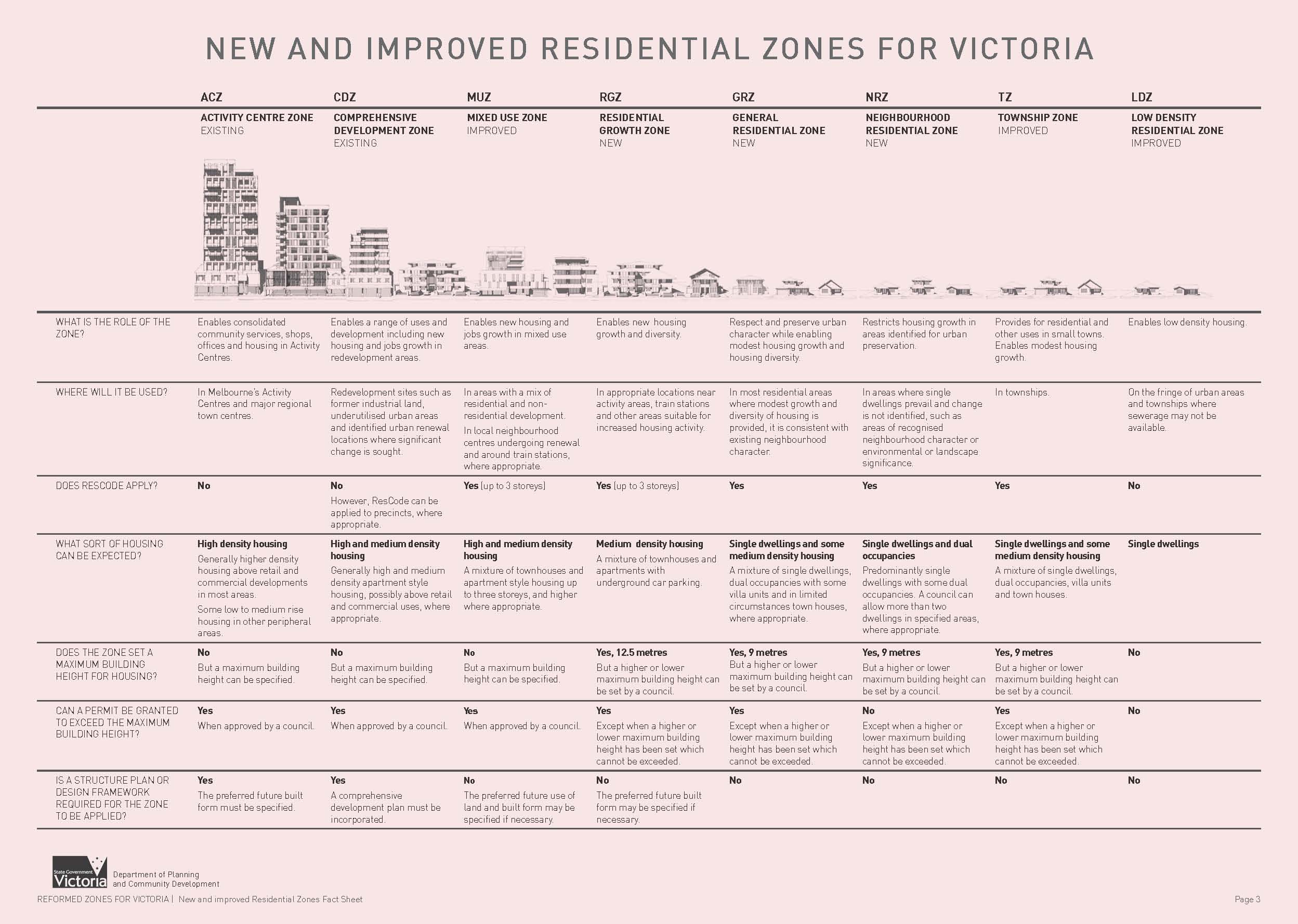
Matthew Guy and the Department have released what can only be euphemistically called a ‘discussion paper’ (uploaded here). Short on details, but big on generalities and promises, the paper is anything but what most reasonable people would consider to be an objective and informative outline of the proposals, and the potential benefits and drawbacks.

Most concerning is that ‘feedback’ is required by late September, yet full details will only be released in October. In other words, the public is expected to comment blindly on something that they have limited information on. We suggest that readers pay particular attention to the following table extracted from the ‘fact sheet’. Please click on the image to enlarge.


Approximately 50+ residents showed up to last night’s commununity forum to hear the latest on traffic management and parking. First cab off the rank was Dr. Bruce Corben who emphasised the importance of speed reduction in local residential streets and arterial roads and the health and environmental benefits this would achieve. Research revealed that pedestrians were at greatest risk even when cars were travelling at 30km per hour. He commented that the objective of all street calming projects was to lower car speeds and that roundabouts were the most effective in achieving this aim.

Cr Narelle Sharpe outlined the holistic 8 step program that Moonee Valley Council is employing. The beauty of this scheme was that it included in-depth research and analysis of entire areas resulting in 22 precincts that were ‘weighted’ according to various criteria such as traffic volume, speed, surrounding facilities, and most importantly, community consultation. The plan for each precinct cost in the vicinity of $45,000 and Moonee Valley had undertaken to complete 2 precincts per year. It was therefore a long term vision based on a thorough understanding of the needs of each local area rather than a single street.

Cr Serge Thomann highlighted Port Phillip’s approach and the pressures that this municipality faced in terms of incredible high density, tourists and visitors, as well as the ensuing parking problems. The strategy adopted by council was: (1) a hierarchical road strategy that placed pedestrians at the top followed by cyclists and then cars. (2) council’s refusal to issue residential parking permits for new developments; (2) extensive community bus services; (3) different street calming measures that varied across the municipality – ie raised pedestrian crossings in line with footpaths.

Whilst each municipality is unique, it is obvious that common problems exist. How these problems are approached by decision makers is what is important. We maintain that in Glen Eira the approach is haphazard, and lacks a truly integrated vision. If safety is the most important criterion then councils must be pro-active as both Moonee Valley and Port Phillip appear to be. It just is not good enough for residents to be told that your street is within the 85th percentile on speed and traffic volume so we won’t do anything! The old adage that prevention is better than cure certainly applies in this domain.

Zone reforms to return planning certainty

Wednesday, 11 July 2012

The Victorian Coalition Government’s sweeping reform of planning zones will return certainty to our suburbs and towns and in particular to councils, residents and the development industry.

“Planning zones are the greatest indicator of the style of development for any area. The Coalition Government’s sweeping zones reform package aims to give certainty for areas that deserve protection and those identified as growth nodes,” Mr Guy said.

“The Coalition Government’s zone reforms reflect what communities have been crying out for, for many years – clear identification of areas that can grow and strong protection for areas that are designed to be low rise, low density neighbourhoods,” Mr Guy said.

“These reforms will protect what makes Melbourne great – our streetscapes, our amenity, our liveability, while encouraging density and growth in clearly defined areas,” Mr Guy said.

The Coalition Government’s zones reform package features three new residential zones:

  • Residential Growth Zone;
  • General Residential Zone; and a
  • Neighbourhood Residential Zone.

“The new Neighbourhood Residential Zone will be an instrument that can be adopted by councils to protect existing amenity of suburbs and towns.

“It will give many areas the protection they deserve and will be the strongest residential protection zone ever offered in the Victorian planning system,” Mr Guy said.

This zone will include a number of features including mandatory height controls, stricter regulations around subdivision and the consideration of minimum lot sizes. The Neighbourhood Residential Zone will also be able to protect existing streetscapes and amenity with clear guidelines on what can be supported by a planning permit application.

In order to support integrity of the new Neighbourhood Residential Zone the Coalition Government has also introduced a number of complementary residential zones that will support development of medium and higher density housing in appropriate locations.

The new Residential Growth Zone will provide for a clear level of growth and change in identified areas that have clear targets for greater density. Councils will be able to use this zone to provide a new incentive to direct density and built form change in areas that are well known and identified.

“Importantly, these zones will be at the discretion of the local councils. It will ultimately be the view of the community that will inform which zone best fits where,” Mr Guy said.

“Victoria’s economic integrity is at the forefront of its planning decisions and these reforms are no different. The residential zone reform package supports Victoria’s economy by clarifying where development can occur and what can be built,” Mr Guy said.

“Importantly, it returns a level of planning certainty that has been sorely missing for the past decade,” Mr Guy said.

Under the Coalition Government’s planning reform agenda, plans for new outer urban growth have been released as well as the identification of Australia’s largest inner city, urban renewal project in Fisherman’s Bend.

These projects, combined with planning law changes and planning zone reform represent a major overhaul of the Victorian planning system since the change of government in November 2010.

“The time is right for planning reform and the Coalition Government is getting on with the job of delivering it.”

The key features of the reformed planning zones will be issued for feedback for a period of 2 months from Monday 17 July until Friday 21 September.