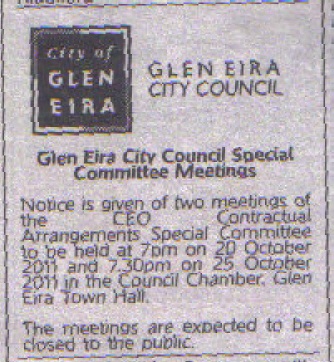
An alarming new trend in Council decision making has become increasingly obvious over the past few months. Major issues are suddenly not being handled by full council but are introduced, discussed, and deliberated upon through the secret and unaccountable advisory committees! Even worse, is that Officer’s reports presented to these committees never see the light of day! Apart from the Environment Committee, none have external representation, agendas aren’t published beforehand, and the public are definitely not invited. This is again highlighted in the agenda for Tuesday night’s council meeting.

It strikes us as strange that important Planning Scheme matters such as ‘impervious surfaces’, ‘Open space strategy’, ‘Environmentally Sound Design’ should be relegated to the Environment Committee alone and not full council so that proper debate, motions, resolutions and most importantly, officers’ reports are available for public scrutiny. We present the following
extracts from the Environment Committee ‘minutes’ and direct readers attention to:

  • Reports are to come back to the Committee, not council
  • Presentations are to the Committee alone. Why not to the public as well?
  • Note the failure to (include the) answer CL’s query on C60!
  • Note the dampeners always seem to come from Officers!

We do however acknowledge the efforts made by Cr. Pilling in relation to these issues!

“Open Space Strategy

Cr Pilling noted that Council had endorsed the Committee recommendation to consider a report on this matter.

CL (resident) sought information on population growth and enquired if the impact of the proposed Caulfield development had
been considered.

Action: Officers will enquire as to progress on preparing the report with the relevant Director and advise the Committee. Officers will provide the Committee with Glen Eira’s latest population projections. 

9.0 Sustainable Design in Planning Process

Cr Pilling suggested that a broader approach is needed to be in step with surrounding Councils who have already implemented some form of voluntary ESD requirements in their planning processes.

RR (resident) circulated a separate report on the matter.

The Chair acknowledged the challenges of using what is currently a voluntary scheme noting that having adequate provisions in the state policy section of the Planning Scheme would be far more effective as it would be enforceable.

DAF (Peter Waite: officer) noted there had historically been some concern in the community over councils using the planning application process to introduce matters outside of the scope of the Planning Scheme.

 JG (resident) stated that the introduction of a voluntary scheme would provide relevant information to developers which may not be readily available and developers could promote the ESD benefits at the point of sale.

Cr Pilling felt that as most neighbouring councils where using STEPs, Council should also.

Councillors carried unanimously the following recommendation to Council (moved by Cr Pilling, seconded by Cr Tang)

Action: Officers will invite a representative from a council that has recently introduced ESD controls (within last five years e.g. Boroondara, Bayside) to address the Committee at the next meeting. Officers will seek to provide further information to the next meeting about the effectiveness of voluntary ESD schemes at other
councils.
 

COMMUNITY PLAN & ENGAGEMENT STRATEGY  

This is another example where major decisions have primarily been channelled through a committee. Residents have not seen any of the public submissions, nor the rationale for the selection of community reps on the Steering Committee. Worse still is the proposed timeline and terms of reference for this latter committee. No mention of voting rights, community reps outnumbered by councillors, and inexplicably, the committee will CEASE IN FEBRUARY 2012 (unless reinvigorated by council) when the overall consultation proposals are still ongoing – especially the first draft, review, and dissemination. Further, there is no plan to include community reps on the Consultation Committee!

The terms of reference for both are:

“Community Consultation Committee Terms of Reference

Role of the Committee

The role and function of the Advisory Committee is to act as a steering committee to assist Council by providing recommendations in relation to reviewing, improving and broadening the ways Council consults with all residents, ratepayers and other stakeholders to ensure maximum participation, communication and value to the community.

Membership

Council will appoint members on an annual basis. The Advisory Committee will comprise:

Four Councillors
(including Chairperson)

Mayor – ex-officio

Meetings

Meetings shall be held at least four times annually.

Reporting

Advisory Committee recommendations will be submitted to the next appropriate Ordinary Council Meeting for determination.

Community Plan Steering Committee

A steering committee shall be established to oversee the development of a new Community Plan consisting of the Community Consultation Committee and representation of up to three external members.

Sunset Clause

Unless extended by Council Resolution, this advisory committee shall cease to exist on 28 February 2012.”

Last but not least, there is the NON APPEARANCE of the minutes of the Special Committee regarding CEO reappointment. For a 3 minute meeting, it shouldn’t take this long to put up some palty minutes! But even stranger is the fact that the entire AGENDA for this meeting has now disappeared from the Council website. It seems that this no longer exists!

Once again we’re grateful to one of our readers who has alerted us to the following. The sublime irony of course is that councils such as this (and Glen Eira one would suspect) are desperate to be officially installed as the ‘third tier of government”.

Councils in confidence

By ABC’s      Ryan Sheales

Updated          October 06, 2011 15:29:42

It seems counter-intuitive.

At Parliament House in Canberra, taxpayer-funded staff film the deliberations of the both houses (and their various committees) and distribute the recordings to hungry journalists. Reporters are largely free to roam the halls, crossing paths with MPs and staffers.

A similarly relaxed environment exists at the Victorian Parliament, where journalists are also allowed free rein, can dine at the parliament’s eatery and film and record the Legislative Assembly and Council.

In each place, a set of guidelines exist so the media don’t get in the way, but access is generally unencumbered.

But it seems these liberties don’t extend to Australia’s lowest level of government.

Not if this reporter’s experiences at the Casey Council this week are any guide.

I visited Melbourne’s largest council, to the city’s south-east, to report on a heated local debate about whether the city’s veteran CEO should have his contract extended without the position being advertised.

I spoke to the council’s media liaison officer earlier in the day and as a courtesy (or so I thought) told her I’d be attending that night’s meeting with a camera crew.

An email soon appeared in my inbox.

In relation to your request to film, Casey’s Local Law states that … any application for … consent [to film] a Meeting must be made, in writing, at least twenty-four hours prior to the meeting to which the application applies.

Accepting this, we arrived an hour prior to the meeting to film the empty meeting chamber, but our camera was barred entry from the entire building.

Two, uniformed ‘Local Law Officers’ politely but firmly enforced this restriction.

The pair preceded to watch me for the duration of the council meeting, at one stage summoning me into the hallway to enquire if I’d been taking photos or making recordings on my mobile phone.

(For the record, I had taken some photos on my phone and the officer watched as I followed his request for it to be deleted.)

Similar restrictions are in place at other Victorian councils, though some do welcome and encourage media coverage.

The local government sector in Victoria employs about 42,500 people and spends roughly $6.1 billion of residents’ money each year.

The reality is that most ratepayers don’t attend council meetings.

If they’re to have any confidence that money is being spent wisely, it has to come through the media’s access and scrutiny of events.

If it’s good enough for state and federal parliaments to run an open-shop, why isn’t it good enough for some councils?

Ryan Sheales is an ABC journalist and former Victorian State Political Reporter.    First posted          October 06, 2011 12:51:05

Last night’s Special Committee meeting was arguably the lowest ethical point in the history of this Council. Following the formation of this secret Committee (and the failure to record this in official minutes, nor to undertake adequate,widespread advertising) the committee outdid itself in refusing to grant Cr Penhalluriack permission to speak – twice!

Penhalluriack sat in the gallery, thereby providing concrete evidence that he has been excluded from this Special Committee. Twice he requested permission to address council and twice this was refused. Given that it is the Mayor’s prerogative to allow anyone to address any council meeting, such a decision is abhorrent to all residents concerned about democratic principles of transparency, accountability and open government.

The gallery was asked to leave so that the entire proceedings could occur in camera – that is, in secret, away from public gaze, and with no expectation that anything will be reported in the minutes.

On another issue, we recommend that residents look at the published agendaand note that the specific reason why the meeting was not to be public has not been declared as required under the Local Government Act. With three lawyers on council, a corporate counsel with a budget of over $1.3 million, one is entitled to start asking questions about the legal processes, and prowess of these legal eagles!

To quote Andrew Bolt, free speech was assassinated last night in a performance that will go down in history as the antithesis of what good governance is all about.

The Melbourne Racing Club wishes to keep you fully informed of short-term road closures during the upcoming 2011 Caulfield Spring Carnival. The road closures are required to ensure the safe entry of patrons into the racecourse and have been formulated in conjunction with Victoria Police, local authorities and specialist traffic management consultants as part of an overall traffic management plan.

We have included a Residents Pass to allow access to your street should you encounter a traffic controller on the day. To assist in the implementation of the plan it is advised that residents of Hudson St, Payne St, Eskdale Rd, Newington Gve and Redan Rd avoid using Glen Eira Road to return to their homes after 2.30pm.

The traffic management plan will be in effect on Caulfield Guineas Day 8th October, 2011and Caulfield Cup Day 15th October, 2011. In summary, please note the following changes to normal conditions:

• Normanby Road will be closed to all traffic between Smith Stand Queens Avenue from 8:00am on both Saturdays.

• No entry is permitted into Bond Street from Balaclava Road or HejLWDOdStreet from Normanby Road during the event except for residents.

• Entry to Payne Street is only via Kambrook Road and some delays may be experienced due to the increased traffic volumes on Glen Eira Road.

• Traffic in Bond St& Heywood St will be one way only and exit will be to Normanby Road or Balaclava Road at any time.

• Entryinto Bond Stand Heywood St,south of Members Drive, is permitted from Station St between 6.00am and 10.30am and thereafter only from Members drive which is accessible from Kambrook Road. Please note that access into Members Drive will require you to display a Members Car Pass(Pass included for Bond S & Heywood St Residents).

• The following streets will be closed to traffic:

Eskdale Road, Newington Grove and Hudson Street at Kambrook Road; and Wyuna Road at Redan Road. Entry for residents will be via Bambra Road Only

The following streets will be closed to non-residents:

Payne Street at Kambrook Road;

Bowles Avenue at Redan Road; and

Eskdale Road and Hudson Street at Bambra Road.

The last two dot points are to be implemented on a trial basis in response to resident feedback and in an effort to reduce traffic using these streets (and improve residential amenity). Council will be contacting residents in the weeks following the Spring Carnival to determine whether the trial was successful.

The level of understanding and co-operation received from local residents has been part of the great success of the Caulfield Cup Carnival in past years and it is always our intention to minimise any inconvenience on our premier race days. On behalf of the Melbourne Racing Club, I Wish to thank you for your assistance and hope you come and enjoy Caulfield this spring for the major annual sporting event in our local community.,

o Nazzareno Marchionda

FACILTIES& PROPERTYMANAGER,

Plea to stop the chop in Glen Eira

4 Oct 11 @  07:00am by Jenny Ling

http://www.facebook.com/extern/login_status.php?api_key=150419601638150&app_id=150419601638150&channel_url=http%3A%2F%2Fstatic.ak.fbcdn.net%2Fconnect%2Fxd_proxy.php%3Fversion%3D3%23cb%3Df5bb4e29346362%26origin%3Dhttp%253A%252F%252Fgleneira.wordpress.com%252Ff280ed3e084b8a8%26relation%3Dparent.parent%26transport%3Dpostmessage&display=hidden&extern=2&locale=en_US&next=http%3A%2F%2Fstatic.ak.fbcdn.net%2Fconnect%2Fxd_proxy.php%3Fversion%3D3%23cb%3Df26e372e649128a%26origin%3Dhttp%253A%252F%252Fgleneira.wordpress.com%252Ff280ed3e084b8a8%26relation%3Dparent%26transport%3Dpostmessage%26frame%3Df29cf5eaaffb408%26result%3D%2522xxRESULTTOKENxx%2522&no_session=http%3A%2F%2Fstatic.ak.fbcdn.net%2Fconnect%2Fxd_proxy.php%3Fversion%3D3%23cb%3Df252489db51ee4c%26origin%3Dhttp%253A%252F%252Fgleneira.wordpress.com%252Ff280ed3e084b8a8%26relation%3Dparent%26transport%3Dpostmessage%26frame%3Df29cf5eaaffb408&no_user=http%3A%2F%2Fstatic.ak.fbcdn.net%2Fconnect%2Fxd_proxy.php%3Fversion%3D3%23cb%3Df11129b2edef70a%26origin%3Dhttp%253A%252F%252Fgleneira.wordpress.com%252Ff280ed3e084b8a8%26relation%3Dparent%26transport%3Dpostmessage%26frame%3Df29cf5eaaffb408&ok_session=http%3A%2F%2Fstatic.ak.fbcdn.net%2Fconnect%2Fxd_proxy.php%3Fversion%3D3%23cb%3Df39a70e508f2df%26origin%3Dhttp%253A%252F%252Fgleneira.wordpress.com%252Ff280ed3e084b8a8%26relation%3Dparent%26transport%3Dpostmessage%26frame%3Df29cf5eaaffb408&sdk=joey&session_origin=1&session_version=3

Sheila Nash. Picture: Jason Sammon

Sheila Nash. Picture: Jason Sammon

RESIDENTS are calling for urgent and decisive action to stop significant trees being chopped down in Glen Eira. Elsternwick resident Sheila Nash said a century-old peppercorn tree near her house was cut down this month.

She said Glen Eira needed a policy, similar to those of the neighbouring Bayside and Port Phillip councils, which had by-laws controlling the removal of major trees on residential land.

“Everyone in the community benefits from a greener landscape. And although we all have certain private rights, isn’t that why we have planning laws?” Mrs Nash said.

Now most residents can remove trees from their properties without the council’s permission. Councillors voted to establish a classified tree register in April, but in June they voted to allow two mature trees in Carnegie to be felled, against advice from council officers.

Arborists would search for and identify trees that met criteria based on horticultural and aesthetic value, size, age and location. Council spokesman Paul Burke said controls would cover “the best of the best trees in Glen Eira, not a blanket control”. “It will take some time to carry out the survey,” Mr Burke said. “It’s a huge piece of work … no-one’s putting a time frame on it.”

A council report says “many residents have expressed concern over the loss of significant trees and council’s lack of control over these assets”. Mrs Nash wants residents to rally on the issue and email her at eiratrees@optusnet.com.au

What would any reasonable person conclude from the following sentence? –

“Council can assure you that emails to Councillors are treated in accordance with the wishes of individual Councillors”.

This sentence comes from the response to a public question (10th April, 2006) and signed off by the then Mayor, David Feldman. It suggests that vetting, intercepting, archiving, of emails is done with the INDIVIDUAL CONSENT OF EACH COUNCILLOR. Reality, however might suggest something entirely different. We might even contemplate whether each and every councillor is aware that this happens, the full extent of the ‘surveillance’, and if they are aware, whether or not they have ever granted their unequivocal, individual consent. It also raises many legal questions as to what constitutes ‘official council business”. If residents email a councillor inviting him/her to a private party because he/she happens to be friends with these residents, then what right have anonymous officers got  to view such private emails? And who is the ultimate arbiter of ‘official business’ anyway? The real issue though is how can something be classified as ‘official business’ unless it is first opened and read by an anonymous council-appointed censor?

The Whelan Report made it absolutely clear that the siege mentality of this administration is to gather as much ‘information’ (on councillor activity?) as possible –“The administration has adopted the practice of retaining copious records as protection against possible accusations by Councillors”. Logically then, in order to sift through what might be ‘accusatory’, everything must be captured, logged, archived, and kept in a little black book on someone’s desk.

Surveillance is enshrined even further through the Staff Code of Conduct – “Staff members must keep their manager/Director informed about information/requests from Councillors. If a matter is of interest to a Councillor, the Councillor may raise it with the Director or CEO and they ought to be aware of it so that they can respond effectively. The only officers who are authorised to provide written information to Councillors are the CEO and Directors. This includes faxes and emails. The reason is that the CEO and Directors meet regularly with Councillors and are aware of the context of requests and issues. All written information to Councillors goes via the Councillors’ secretariat in the CEO’s Office”.

In most organisations, this is innocuous and reasonable. How benign such as state of affairs is in Glen Eira is the fundamental question. Senior administration have elevated themselves to the role of self-appointed gatekeepers, collecting and feeding whatever information they want to councillors. Further, it could be argued that other staff are dragooned into being pseudo spies, reporting every conversation and request to those on high. We know of repeated councillor requests for information which have failed to materialise, or have been delayed for so long that the issue is dead and buried.

One thing is absolutely clear to many residents. The corporate culture of Glen Eira is in desperate need of change. Only Councillors can enact this change – if there’s the will and the courage – as demonstrated in the Gold Coast councillors’ resolution.

Lucas dodges council email scandal

Ken Vernon   |  August 5th, 2011

AN urgent investigation into the interception of that city councillors’ emails by council bureaucrats could see top officials losing their jobs or even jailed.

But Deputy Premier and Local Government Minister Paul Lucas said the intercepts were `essentially an internal matter for the council to resolve in the absence of any significant breach of the Local Government Act’.

According to Gold Coast criminal lawyer Bill Potts, the council may have no choice but to report the matter to police.

“Under the Local Government Act, the council is obliged to report possible criminal acts to the police and there is no doubt that intercepting private emails is a criminal offence,” he said.

“Such actions are offences under both the Privacy Act and the Telecommunications Act and criminal charges laid against council officials could result in jail terms if they are found guilty.”

He said the council could also be liable for damages to people whose privacy was breached when their emails were intercepted.

He said the CMC also had the power to independently investigate and while suspects had the right to refuse to answer questions from the police, the CMC had coercive power to force them to answer.

Yesterday Mayor Ron Clarke ordered an inquiry into the email interceptions with a report to be presented to Council on Monday.

The council’s communications department yesterday refused to say whether the interception operation was still in effect.

“Well, I can only assume it has stopped,” Cr Clarke said. “It better be.”

From Channel 9 News –

Permission needed to vet councillors’ email

10:48 AEST Tue Aug 9 2011

Bureaucrats will no longer intercept  the emails of Gold Coast City councillors without their permission. A row erupted last week when Mayor Ron  Clarke discovered emails from two people classed as serial pests were being  intercepted and screened by senior officials.

Some emails, threatening violence, have  been referred to police.

While a few councillors are happy to  have nuisance emails screened, most objected.

Council voted on Monday to immediately  stop officials intercepting incoming emails or letters.

The mayor’s motion that “under no  circumstances can the Chief Executive Officer or any administrative staff,  intervene or censor any mail, be it electronic or standard” was carried  nine votes to four.

Mr Clarke says any councillor who does  want pest emails diverted or stopped can simply give the CEO permission to  intercept them.

“To me the principle is that no bureaucrat interferes in any way, shape or form, with any email or mail or  telephone calls to councillors,” he told AAP on Tuesday.

“Councillors are there to represent the people and for better or worse, wherever they come from, they should be able to handle their correspondence otherwise they shouldn’t be in  the position.

“More importantly the ratepayers  should be confident that whatever they send to their councillors will get to  them.”

The mayor said he’s happy to get emails  even from serial pests labelled as “vexatious complainants”. “You don’t want emails saying what  a good job you’re doing all the time, you want to find out what you’re not  doing right and who is being upset,” he said.

COMMENT: Several public questions over the years have asked why emails to councillors have at times been intercepted by various officers PRIOR to their being received by the councillors to whom such emails were addressed. The responses have been that councillors ‘agreed’ to this ‘policy’. As far as we know, such a ‘policy’ has never seen the light of day, and certainly the current crop of councillors have never officially voted on such a surveillance technique. Perhaps councillors would be willing to state openly their opinion(s) on this issue and whether or not they believe that their private communications to residents and colleagues, (whether or not it is on so called ‘council business’) should be hijacked by various unelected officials?

http://www.austlii.edu.au/au/cases/vic/VCAT/2011/1824.html

Below we feature an extract from a recent VCAT hearing and the member’s comments on Council’s ‘Minimal Change Areas’. Whilst it is true that VCAT must only ‘consider’ planning policy, the comments below illustrate clearly the countless loopholes in the Glen Eira Planning Scheme.

“Are three dwellings in conflict with Council’s Minimal Change Area Policy?

4.         This was the key issue in Council’s case. It was agree by the parties that putting aside minimal change area policy, the site is well located to further urban consolidation policies. It achieves policies at clause 16 [Housing], which recognises the need to increase the proportion of housing to be developed within the established urban areas. It also furthers policies at clause 16.01-4 [Housing Diversity] to provide a range of housing types to meet the increasingly diverse housing types.

5.         However, Mr Hatcher submitted that Council’s Municipal Strategic Statement [MSS] establishes a targeted approach to residential development by establishing a hierarchy of housing diversity areas within the municipality, where a range or housing types are encouraged. In all other areas, Council seeks minimal change.

Council refused the application on the ground that the proposal fails to meet the test of Clause 22.08 [Minimal Change Area] policy as the proposal is for more than two dwellings. The review site is within a minimal change area. Council acknowledged that the size of the site may provide an opportunity for multi-dwelling development in it s own right, but fails in this case due to the minimal change policy. Specifically referring to the number of dwellings, the policy recognises that more than two dwellings may be appropriate to be achieved where factors such as the following apply:

  • Consider developments of more than two dwellings provided it is clearly demonstrated that the standards for site coverage, rear setback and private open space in the Schedule to the Residential 1 Zone have been met. Circumstances where more than two dwellings may be achieved could include any of the following:
  • Where the site is in an area characterised by larger than conventional lots.
  • Where the site is significantly larger than the majority of properties immediately abutting the title boundary and the properties directly opposite.
  • Where the prevailing development in the street and neighbouring streets is predominantly characterised by multi-unit development.

Mr Barber put to me that consideration of this proposal is not a ‘numbers game’ and that despite the policy as identified above, these provisions are not exhaustive, but rather are circumstances where it could constitute an appropriate reason for the construction of more than two dwellings.

The application of Council’s minimal change policy has been discussed by this Tribunal. I agree with Mr Barber that development of land should not be a ‘numbers game’. The planning scheme no longer refers to densities as a tool for assessment. In Galanis v Glen Eira CC[2] Member Hewet made observations regarding the Tribunal’s approach to development applications within the minimal change area. He states:

Minimal change areas are not “no change” areas. The policy recognises that within these areas a contribution still needs to be made to providing housing diversity and opportunities for new development. It needs to be recognised that that the planning scheme does not identify any residential areas as “no change” areas, and even those residential areas which are protected by heritage overlays (which this area is not) are not immune from development and
redevelopment.

[8] The inclusion of the review site within a minimal change area under the Council’s policy framework, does impose a constraint on the level and scale of development of the site, but it is not a prohibition on medium density housing.
An application for this form of development needs to demonstrate that it appropriately responds to and respects the existing character of the neighbourhood. I acknowledge that a judgement needs to be exercised in determining whether a proposal has successfully met this test, and legitimate debate can occur around the exercise of that judgement.

I adopt this approach and find that three dwellings are not prohibited on this site. The test is how the development respects the character of the neighbourhood, its assessment against the provisions of clause 55 and what impact the development has on its
neighbours, which are discussed below.

The minutes from last Council Meeting have finally made an appearance. Two questions were asked in relation to the initially proposed pedestrian ‘refuge’ in Alma Rd. We find these queries particularly informative – especially when they are compared to the announcement in the September Glen Eira News which stated:

“Alma Road, Caulfield

pedestrian refuge

Council sought submissions regarding a proposed pedestrian refuge in Alma Road, Caulfield North.The pedestrian refuge is planned to be installed just east of Wilks Street and is designed to facilitate walking and improve pedestrian safety in line with Council’s Towards Sustainable Transport 2011–2014 Strategy”.

The ensuing public questions were –

Subject: Pedestrian refuge in Alma Road

“What, if any is the justification for Councils proposal to put a pedestrian refuge in Alma Road Caulfield North? What if any investigations have been made with regard to the need for such a pedestrian refuge in the suggested position?”

The Mayor read Council’s response. She said: “Following public consultation Council’s Transport Planning department has decided not to proceed with this pedestrian refuge at this stage.”

Subject: Pedestrian refuge in Alma Road

“How does council justify spending money on an unnecessary pedestrian refuge in Alma Road North Caulfield? What if any evidence does Council have of any danger posed to pedesrian traffic which might outweigh the justification of denying residents adequate access to their homes? What evdience does council have to justify the comment that there is no demand for parking in the area? How does council justify written promises made to residents that parking in the area would not be affected by the addition of new bicycle lanes and then 6 weeks later write to resident with a completely opposite proposal? How does Council justify the inconsistancies in the implimentation of its own Glen Eira Road safety strategy?”

The Mayor read Council’s response. She said: “Following public consultation Council’s Transport Planning department has decided not to proceed with this pedestrian refuge at this stage”.

COMMENTS:

  • Residents reading the Glen Eira News could be forgiven for thinking that the refuge installation was a fait accompli.
  • Second question on ‘evidence/research/statistics’ remains typically unanswered
  • Residents are no clearer as to WHY Alma Rd was first chosen, and now, why it has been disgarded.