This item must surely win the award for obfuscation and keeping everyone in the dark. Here we have a 2 page officer’s report proposing the removal of the Commercial Centre Policy from the Glen Eira Planning Scheme. One page is fully taken up with the processes involved in seeking an amendment – ie. permission to advertise, submissions, perhaps a panel, etc. The first page is nothing more than waffle, and we believe a deliberate attempt to disguise what is really going on and the motives behind such a move. When any amendment is proposed, residents have every right to expect the following:

  • Clear, comprehensible, and comprehensive information as to the reasons which justify the amendment. In this case, all the rationale states is that the original policy dates from 1998 and is ‘redundant’. Not good enough we say. What’s wrong with updating and improving a policy rather than removing it entirely?
  • No explanation is given as to the potential ramifications if the policy is removed. What will it mean to traders? To residents? To the neighbourhood? To those little shopping strip centres that are already struggling against the big ones, Chadstone and now the C60 stores? Where are the statistics, planning strategies – in short, where is the evidence that this policy is now ‘outdated’ as claimed and that the municipality will be better off without Clause 22.04 remaining in the Planning Scheme?
  • We also wonder whether the removal of the Commercial Centres policy is simply one way of declaring open slather for all  forms of (residential) development and council washing its hands of all strip shopping centres except for the big three – Centre Rd, Carnegie & Elsternwick. So much for enhancing, developing, and maintaining local strip shopping! So much for looking after this sector of the community!

If councillors pass this as stands then we believe they are again not fulfilling their obligations as councillors. They must question in depth this proposal and not simply sit there and rubber stamp everything that is stuck under their noses. Such a report should never be accepted. It is bereft of detail, logic, and argument. It remains a ‘report’ in name only and certainly a below par effort. But then again, perhaps this is the objective – to get something through with as little fuss, furore, discussion and debate as possible? Rule by stealth perhaps? Make up your own mind when you read these paltry few pages.

We urge all readers to pay careful attention to the various Records of Assembly and the range of topics that are discussed behind closed doors, in secret, and which never seem to make it into the council chamber. The Pools Steering Committee Meeting Minutes is of the same ilk. For example: for months and  months now Cr. Lipshutz has been spruiking how wonderfully well GESAC is going –  apart from rain delays it seems. Only at the last council meeting was it  disclosed that tiling was somewhat behind schedule. Now we have mention of ‘liquidated damages’. According to Wikipedia, the definition of this  term is:

“Liquidated damages  (also referred to as liquidated and ascertained damages) are damages whose  amount the parties designate during the formation of a contract for the injured  party to collect as compensation upon a specific breach (e.g., late  performance).

en.wikipedia.org/wiki/Liquidated_damages

Do these damages apply to the tiling or are there other aspects of this extravaganza that are not going all that well? And how much are  the ‘damages’ actually worth? Are we talking a paltry few thousand or do the  figures run into hundreds of thousands – thereby signalling some major hiccup and placing many of Lipshutz’s early claims into the very doubtful basket. Of  course, it would be too much to ask that council is upfront and fully  forthcoming on these issues!

Tang also appears to have great difficulty in showing up to meetings – he missed the August 2nd August, 9th  & the 16th August meetings!

Councillor Assembly for the 9th August includes the  following: “Confidential – ‘contractual’, ‘legal advice’ and ‘may prejudice the  Council or any other person’ which relates to GESAC. Cr Magee – access to two  other legal opinions and his conversation with the Ombudsman. Section 3 of the  Whistleblower Protection Act and S. 76D of the Local Government Act.”

Two things to notice: (1) more money is now being spent on lawyers and the GESAC allocations stuff ups and (2) the whistleblowers act does not enforce the stipulation of ‘confidential information’ whilst the Local Government Act does. So what has all this to do with Magee? Is he being read the riot act by Newton and Burke and accomplices over his support for the McKinnon basketballers? We can only speculate of course, since all of this is carried on behind closed doors. And again, we are expected to believe that NO DECISIONS are being made – only continual straw votes it would appear!

We do however discover that on the 23rd August there WAS a draft submission  to the Ministerial planning Review – it even went to 8 pages. Again we ask: where  is it? Why isn’t this public? Why do such important discussions and decisions which impact on the entire community only occur behind the closed doors of Assembly Meetings? If other councils can publish their submissions and have councillors debate the drafts, then the question must be asked as to why Glen Eira is again the odd man out?

Last but not least there is  again an ‘OH &S’ matter where Penhalluriack leaves the room. We can only  assume that this is again related to Newton’s bullying charges. Oh what  wonderful games are played out in these meetings and how little the public is  informed as to what is really going on and how their monies are being spent.

Below are two extracts from the Auditor General’s Report that are critical of Whittlesea and Hepburn. It’s curious that: 

  • Whittleseas’ acquatic centre comes in for special mention, yet there is not one single word about GESAC in the entire report. Readers will remember the original cost estimates for GESAC and what we’re now saddled with. Further, there is no mention of the additional $450,000 for a car park nor any investigation as to why this wasn’t included in the original ‘business plan’ or design.
  • One would reasonably expect that when a municipality binds itself to a $40 million plus infrastructure project that it would at least deserve one sentence in any report. The fact that there is total silence, makes us scratch our heads and wonder what on earth is going on?
  •  Hepburn also comes in for criticism about its site selection and the additional funding that was required. We should keep in mind the Caulfield Park relocation of ovals as a result of the pavilion construction. Again, not a word from the Auditor General on this little ‘alteration’ after the fact.

Figure 3A

Redevelopment of Thomastown Recreation and Aquatic Centre – Whittlesea

Whittlesea’s redevelopment of the Thomastown Recreation and Aquatic Centre was adversely affected because a robust business case reflecting the project’s final design was not sufficiently developed.

A feasibility study was completed in January 2007 that identified the project’s need, various delivery options and an initial budget estimate of $17 million. However, the design of the preferred option was not sufficiently developed at the time construction started in mid-November 2008. The decision to start the project in the absence of a robust business case was not consistent with good business practice.

The design was changed substantially prior to, and during, the construction phase following consultation with various stakeholders. The ongoing design changes meant that the initial feasibility study was no longer relevant as it did not examine the impact of these changes.

The design changes led to the project’s budget being revised to $24.6 million, and to a dispute and negotiated financial settlement with the contractor who was paid a further $570 300 in additional costs incurred as a result of the incomplete design at the start of construction.

The project is presently around $12.9 million (75 per cent) over the initial budget and $5.3 million (21 per cent) over the revised budget.

Figure 3B

Construction of elderly persons units – Hepburn

Hepburn’s decision to invest in the construction of three elderly persons units without a business case resulted in it committing $591 000 in its 2010–11 capital budget to a project that it later discovered was not feasible on the selected site.

The risks and costs associated with the project were not sufficiently considered in identifying the preferred option, resulting in the need for an additional $150 000 for unforeseen remedial works on the chosen site rendering the project impractical.

The initial proposal was not soundly based, and to date Hepburn has spent $15 000, including staff time, on the original plans.

Hepburn has since decided to carry forward the project’s budget into 2011–12 and to explore alternative sites. A comprehensive business case developed at the outset could have averted this situation.

Some edited highlights from the just released Auditor General’s report (uploaded) Business Planning for Major Capital Works and Recurrent Services in Local Government –

This audit examined Glen Eira City Council, City of Whittlesea, South Gippsland Shire Council and Hepburn Shire Council as a representative selection of councils to determine whether they had effectively integrated their planning and budgeting, considered the long-term sustainability of selected investments and produced accurate and reliable budgets and forecasts.

While Glen Eira generally manages its planning and budgeting well, considerable improvement is still required by the other three councils examined before they can provide adequate assurance to ratepayers they are spending their funds appropriately and effectively.

While all councils had long-term financial plans going out 10–15 years, there was little assurance they were soundly based because they were not adequately supported by equivalent strategic and/or service and asset management plans. Further, none of the councils examined could demonstrate they adequately consulted their communities on the financial and other consequences of their aspirations when initially developing their council plans.

Glen Eira mitigated this through its ongoing program of community consultation informing its annual Best Value reviews, service delivery decisions and business cases for capital projects, but this was not so at the other councils.

In addition to progressive engagement during the course of the audit, in accordance with section 16(3) of the Audit Act 1994 a copy of this report, or relevant extracts from the report, was provided to the Department of Planning and Community Development, Glen Eira City Council, City of Whittlesea, South Gippsland Shire Council and Hepburn Shire Council with a request for submissions or comments. The Glen Eira City Council acknowledged the request and elected not to make a submission. Submissions were received from the Department of Planning and Community Development, City of Whittlesea, South Gippsland Shire Council and Hepburn Shire Council.

Best Value Principles

The Act also sets out the Best Value Principles that should inform council decisions on services. The application of these principles aims to improve local government services by making them affordable and responsive to local needs, and to encourage councils to engage with their communities in shaping councils’ services and activities. The Act identifies the following six principles to guide how a service should be monitored and reviewed on an ongoing basis:

  • • all services should be responsive to community needs
  • • each service should be accessible to those community members to whom the service is intended
  • • a council should achieve continuous improvement in the provision of services to its community
  • • a council should develop a program of regular consultation with its community in relation to the services it provides
  • • all services provided to the community should meet cost and quality standards set by the council.

Developing good quality plans is central to assuring that councils effectively and efficiently meet community needs. This requires engaging with local communities on the feasibility of their immediate and long-term priorities. It also requires measurable objectives linked to these priorities supported by clear strategies, actions and performance monitoring, and clearly identifying the service levels, resources and responsibilities for achieving them.

By closely integrating their strategic, operating and financial plans councils will be better assured that their services are sufficiently funded and delivered at an appropriate cost to the public.

Glen Eira’s planning and budgeting is well integrated and generally effective. However, the quality of the strategic, financial and asset management plans at the three remaining councils is poor. Objectives, strategies and actions were not clearly specified nor linked to useful performance indicators. Community input into the development of council plans was limited, and these plans, including shorter-term operational plans, are not underpinned by rigorous service and asset management strategies. Consequently, the plans are not sufficiently integrated and do not align well with their annual budgets.

Accordingly there is little assurance that these three councils have sufficiently identified community needs, that they have appropriate strategies in place to address them, and that they have made sound budget decisions.

Quality of planning

There was significant scope to improve the quality of the strategic, operational and financial plans of three of the four councils examined. Glen Eira had an ongoing program of community consultation, but the remaining three councils had not adequately consulted their communities on the feasibility of their priorities in initially developing their council plans. Strategic and operational objectives were not clearly specified, nor were they supported by soundly developed strategies, actions and performance indicators. Operational plans also lacked sufficient detail on the required service levels, resources needed and responsibilities for achieving objectives.

2.3.1 Community consultation

Council planning begins with consulting the community on its needs and expectations for the future, and its ability and willingness to pay for services and assets. The community needs to be well-informed on the social, environmental and financial implications of its aspirations to give the council reliable guidance on its long-term direction.

Glen Eira, South Gippsland and Hepburn have a community engagement policy but only Glen Eira applied it as intended when developing its council plan.

Long-term strategic plans

Only Whittlesea had developed a long-term strategic plan that outlined its vision to 2025. Glen Eira indicated that it intends to start consultation on the development of a 10-year community plan in mid-2011.

Long-term financial plans

All four councils examined had a long-term financial plan covering 10 to 15 years, designed to assure services are provided in a financially sustainable manner. However, they were not paired with equivalent long-term strategic plans in any council except Whittlesea.

Strategic resource plans

The audit compared each council’s current operating and capital works budgets with the forecasts published in their 2009–10 strategic resource plans to assess the accuracy and reliability of their budgeting and forecasting. The variances in total revenue and expenditure were not material. However, the councils had greater difficulty estimating future capital expenditure, with variances of 14 per cent in Glen Eira, 19 per cent at Hepburn and in excess of 50 per cent for both Whittlesea and South Gippsland.

Annual budgets

The annual budget process at all councils informs councillors in a timely way of the assumptions underpinning the budget. However, the shortcomings identified at Whittlesea, South Gippsland and Hepburn mean there is little assurance councillors have sufficient, appropriate information to assess the soundness of proposed investment decisions or whether services are of appropriate cost and quality.

Investments in capital works are not supported by rigorous business cases at the councils examined except for Glen Eira. This provides little comfort that these councils’ investment choices are sound and adequately support the achievement of their long-term objectives.

Although Glen Eira had developed sound business cases for the vast majority of projects examined, three instances of inadequate practice were identified and are outlined in Figure 3C.

Figure 3C

Opportunities to improve business cases for capital projects – Glen Eira

In one case, $300 000 was included in the 2010–11 capital works budget for a dog agility park without a supporting business case. The project was added at the request of councillors but it had not gone through the usual capital evaluation process. Council staff advised that they do not retrospectively develop business cases when councillors exercise their prerogative to fund such projects. However, this may result in committing funds to projects whose need, scope and feasibility has not been sufficiently recognised.
In this case, after $54 500 had been spent, councillors decided in February 2011 not to proceed with the project and to re-evaluate its need following the outcomes of a dog off-leash review by the council.

The business cases for a new maternal child health and kindergarten centre worth $600 000, and the upgrade of ageing shopping centre infrastructure valued at $640 000, did not contain key information needed to demonstrate the rationale for proceeding with the projects: such as a description of why they were needed, an analysis of risks, whole-of-life cost, outcomes of consultations and a cost-benefit analyses were not included. Nevertheless, funding for each project was approved in the 2010–11 capital works budget. In the absence of this key information, it cannot be shown that the need, scope and long-term viability of the projects were adequately considered.

Glen Eira did Best Value reviews that assessed the quality, cost and responsiveness of its services. However the cost and quality indicators for aged care and recreation services were of limited use. For example, there was no quality standard/target for aged care services and the cost standard used was for the total cost of community care services, incorporating aged care, not the unit cost. Similarly, while quality standards were evident for recreation services, there was no cost standard. Despite these limitations, Glen Eira did have a range of other useful measures to monitor its services, which if incorporated would enhance its Best Value reviews.

McKinnon chainsaw massacre

14 Sep 11 @  07:00am by Jessica Bennett

The tree stumps at McKinnon Reserve. SUPPLIED

The tree stumps at McKinnon Reserve. SUPPLIED

FURIOUS residents have slammed Glen Eira Council’s decision to cut down 178 cypress trees at McKinnon Reserve, with one local describing the scene as a “tree cemetery”.

Newton Gatoff – who shot the main photos at right with his iPhone – said while homes immediately surrounding the reserve were notified that mature cypresses would be chopped down from August 29, the rest of the local community wasn’t told or given a chance to object.

 “Their removal with such haste and lack of general consultation is nothing short of an insult to this community and to Glen Eira’s heritage,” he said.

Glen Eira spokesman Paul Burke said an independent arborist had identified the need to remove the eastern (Tucker Rd) and southern rows of trees. He said the trees were in poor condition with branches falling and had to be felled to “eliminate the risk to people, powerlines and property”.

New trees will be planted later this year, though the species and the exact timeframe are yet to be determined, Mr Burke said.

But Mr Gatoff said if the council had consulted with the community, an appropriate alternative could have been reached.“Everyone I’ve spoken to in my street just can’t believe it,” he said.

“Walking around the reserve is like walking around in a tree cemetery.”

Another resident who contacted the Leader said he had never seen or heard of any branches falling off the trees. He said residents around the park were not given the chance to try to protect the trees. “From a grand park, McKinnon Reserve is now a bare and empty park with only small trees as replacements to the old sturdy cypress trees,” he said.

Council  biometric scanning plan slammed

September 8, 2011 – 11:35AMA digitial scanner used to collect fingerprints.

A union has slammed as an invasion of privacy a move by a local  Melbourne  council to introduce biometric scanning for library workers.

Under  the plan, Monash City Council would require library staff to provide   DNA samples in order to scan workers’ veins using pattern recognition   technology when they clock on and off for a shift.

Australian  Services Union (ASU) assistant branch secretary Igor Grattan says  members have expressed concerns about the security of personal  information and  its storage.

He said swipe cards or PIN codes are preferable methods for workplace  timekeeping or security purposes.

“It’s  got to be easier than storing people’s personal information,  especially  when we don’t know what it all means in the long term,” Mr Grattan  said. “You’ve just got to take a deep breath and think about people’s privacy.”

Mr Grattan said his members have been advised not to comply with the  plan.

Victorian  Privacy Commissioner Helen Versey said in a statement any  organisation  considering the introduction of biometric technology should  conduct a  thorough assessment of privacy implications.

“The collection of  biometric data by the Victorian public sector, including  local councils,  is subject to the Victorian Information Privacy Act 2000 and   organisations proposing to introduce such a system would be well advised  to  seek advice from my office,” Ms Versey said.

Comment is being sought from Monash City Council.

Read more: http://www.theage.com.au/technology/technology-news/council-biometric-scanning-plan-slammed-20110908-1jyok.html#ixzz1XN1DRRns

COMMENT:

It would be fascinating to know exactly how much and what kind of information councils collect about their residents – especially in Glen Eira. Rumours have continually cropped up that in this municipality a tight watch and dossier is kept on:

  • individuals
  • blog sites
  • letters to the editor
  • complaints
  • correspondence

In addition, we wonder whether the following technologies are employed:

  • reverse telephone directories which identify callers (even if they wish to remain anonymous)
  • website tracking
  • files on individuals (usually classified as ‘activists’)

All of the above can of course be explained away as enhancing ‘business processes’ such as improving customer service, improving website navigation, legal obligations, and so on. Wouldn’t it be terrific if residents knew exactly whether or not the above tactics were being employed and, more importantly, for what purpose? Now that would be real transparency and openness!

We’ve received an email from one of our readers asking that we put the following up as a post –

How can a building be completed and occupied when the basemen car park was not built to the Approved Plans?

Carnegie  residents were surprised to receive an application from the developer for an amendment to the VCAT approved plans of a 3 storey apartment  development in Neerim Road, Carnegie. his might not be unusual, except for the fact that the apartments have been completed and occupied  for over 12 months

It appears the ramp into the basement car park was not built to the approved plans. In fact the ramp that was constructed does not meet Australian standards.

So the developers are going back to VCAT to seek an amendment to the plans after the building has been constructed proposing changes to the length and angle to the entrance ramp to the requirements of  council.

How  can a  development to be completed, signed off, occupied and then found  to have not been built to plan, particularly when the basement car park  is one of the first things constructed?

How can this happen? Why wasn’t this picked up at the very earliest stages of construction by the building surveyor who has a legal responsibility to ensure plans are complied with?  Who signed off the project at different stages of construction to say it met with the approved plans? What was council’s role in this and if council didn’t have a role in signing off on the construction then what action will be taken by council against a building surveyor who has signed it off?

It  is beyond belief that a project can get to this stage and this issue arise following construction and occupation of a building.

There  are very serious planning issue for council and the questions must be  answered.  This is not the first time developers have constructed buildings multi storey buildings  in Cargnegie not to the approved plans. Council has chosen  in these instances to take no action against the developer or the surveyor.  SO how can we as residents have faith or  trust in the  developers and the planning and building  system of this municipality?

Top city bosses’ wages hit $400,000

• John Masanauskas
• From: Herald Sun
• August 29, 2011 12:00AM

COUNCIL chief executives are on notice about their pay packets as the top municipal salary package breaks through $400,000.  Several metropolitan council chiefs earn about $350,000, including bonuses, putting their salary packages up with the $365,000 a year paid to Prime Minister Julia Gillard.

Local Government Minister Jeanette Powell said she had asked her department to look at how managers were paid in other jurisdictions to see if councils could be better advised on appropriate CEO salaries.  “Council CEO salaries have been raised with the peak bodies of the local government sector as part of discussions on a range of issues,” she said.

Melbourne City Council’s Kathy Alexander is the highest paid CEO, with a $425,000 annual package.  A council spokeswoman said Dr Alexander was in charge of a $346 million budget and 1200 staff. “The role of a capital city CEO requires strong leadership and professional and technical expertise (and the salary) is reflective of the significant responsibility and expectation associated with the role,” she said.

Darebin Council CEO Rasiah Dev has a package of up to $349,000, while Boroondara’s Catherine Dale and Kingston’s John Nevins earn up to $340,000.  Bayside CEO Adrian Robb earned up to $260,000 last year, but said his current pay could only be revealed through a personal inspection of a register at the council’s offices.

Mornington Peninsula Shire councillors have come under fire for renewing veteran CEO Michael Kennedy’s contract without advertising the position.  Former Kennett government minister Robin Cooper said Mr Kennedy was first appointed in 1999 and it was a disgrace that councillors were not testing the market for the $319,000-plus perks job. But Mornington mayor Graham Pittock said councillors had voted to stick with Mr Kennedy after an external assessment.

Hobsons Bay councillor Tony Briffa said CEO salaries were rising too fast. However, Municipal Association of Victoria president Bill McArthur said CEOs ran big operations. Their salaries should be compared with those of public service heads, not politicians.  “I believe council CEOs receive a justifiable salary for what is a pretty tough job,” he said.  “When you look at similar roles in private enterprise, their remuneration goes into the millions of dollars, even for poor performance.”
masanauskasj@heraldsun.com.au

COMMENT: Ratepayers everywhere should be grateful to councillors at Hobson’s Bay, since they probably got the ball rolling on this contentious issue. On February 8th, 2011 they passed a resolution (in response to a Notice of Motion!!!!) which read:

“Moved Cr Tony Briffa, seconded Cr John Hogg, that the Council:

1. Writes to the Premier, (the Hon. Ted Baillieu), Minister for Local Government (the Hon. Jeanette Powell), the Shadow Minister for Local Government (the Hon. Richard Wynne), the members of the Victorian Legislative Assembly for Altona and Williamstown Districts and the members of the Victorian Legislative Council for the Western Metropolitan Region, recommending that the Minister for Local Government appoints a panel to conduct a public review into the remuneration of Victorian Local Government Chief Executive Officers;

2. Submits a motion for the consideration of the May 2011 meeting of the Municipal Association of Victoria State Council, seeking a resolution to support the request for a Local Government (CEO Remuneration Review) Panel; and

3. Requests the Victorian Local Governance Association support a Local Government (CEO Remuneration Review) Panel.”

Of course, setting a limit to CEO salaries only addresses half of the problem. When councils have 5 directors sitting on over $230,000 per annum (plus other fringe benefits) as Glen Eira does, then the argument becomes a lot easier that CEOs should receive heaps more. Perhaps one possible solution is cut the pay of underlings and that will stop the huge pay hikes for CEOs? and who, after all, establishes director pay scales and is in charge of hiring and firing?

Vision for Caulfield campus approved

An impression of the Caulfield campus

The Monash University Council has given its seal of approval to a plan that will define the look of the University’s Caulfield campus over the next 20 years.

The Caulfield campus master plan will be followed shortly by a similar plan for the Clayton campus.

Together, the schemes make up Monash Master Plan 2030. It is the culmination of close to two years of painstaking work that has involved more than 2000 people, both internal and external to the university community. There have been more than 200 meetings and feedback has been sought from all sections of the University.

Bradley Williamson, Director, Strategic Planning and Development at Facilities and Services said that there had been a very thorough process to produce the plans.

“They provide the guiding framework that will transform the physical environment of the campuses over the next 20 years,” Mr Williamson said.

“The plans identify where buildings will be developed and consider the complex relationships between the buildings, deliveries and servicing, the wayfinding routes and the outdoor spaces that surround them.

“The aim of the master plan is to facilitate the organisational vision and to transform our campuses into inspiring and motivating environments. The master plans include a set of principles that will endure throughout the life of the plans and will be applied to all work on the campuses.”

There are six core improvement themes forming the backbone to each master plan. They are:

  • access and wayfinding
  • spaces and places
  • precincts and identity
  • collaborations
  • partnerships and community
  • sustainability

Facilities and Services will be responsible for implementing the master plans through the capital development and minor works programs identified by the University’s business units.

An executive summary of the Caulfield master plan is available online

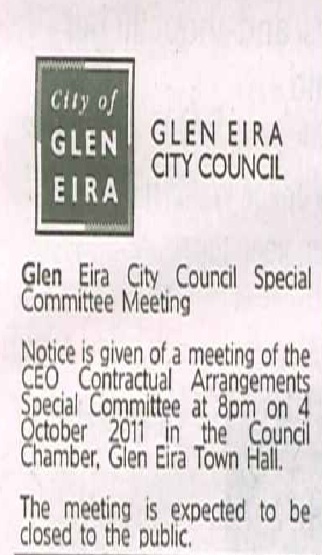
The question of whether Andrew Newton will have his contract renewed, or whether the position will be advertised, will be answered shortly. If the position is to be advertised, then Councillors must decide in October.

Newton has presided over a traumatic period in Glen Eira’s history. He has been the common denominator in 3 Municipal Investigations, (and we learn that there is another one in progress). Numerous incidents have also revealed how this council remains divided and how little trust or goodwill, exists between administration and councillors. When we look over the history of Newton’s reign, these have been the defining characteristics with each group of different councillors. He is obviously an individual who incites either loyalty or condemnation. In our view, this history does not augur well for a municipality that requires strong leadership and commitment from all.

The past year has seen countless ‘stuff ups’ in a whole variety of areas. GESAC allocations, and then the fiasco of having to increase car parking space; next there’s the whole issue of the C60 and centre of the racecourse; various ‘clerical errors’ have even been admitted and to top it off claims of harassment and bullying against Penhalluriack. None of these events show an administration functioning well and on top of its game. Nor does it reveal an administration that is working in unison with its entire group of councillors.

In our view, to reappoint Newton is to short change the Glen Eira community. Surely it is no coincidence that since his arrival this council has been embroiled in continual governance issues including one sacking. How much more does the community have to endure? It is time that new blood and an entirely new vision was brought in to manage Glen Eira. It’s also time that a new culture that acknowledges the importance of accountability, transparency and openness was created and fully implemented. These principles have been the casualties in the past decade.

Pilling has already gone on record that the position should be advertised. We can only hope that other councillors follow suit. The slate must be wiped clean and a new administration brought in that embraces diversity of views, accepts challenges, and accords the community the respect it deserves.