We are committed to facilitating genuine debate within Glen Eira. Your views on planning, environment, open space, CEO and councillor performance matter.
Social media has been busy with the Woolworths’ new plans for Selwyn Street, Elsternwick. As pointed out repeatedly, they have gone directly to the planning minister with a new application that seeks to undermine previous VCAT decisions and restore heights that had been knocked on the head years ago. In other words, if you don’t get what you want, then simply ignore the umpire’s previous decision and have another go via one single individual – the planning minister. Even worse is that such an action effectively sidelines objectors and even council.
This is hypocrisy of the highest level – especially when we consider the Woolworths’ arguments at the second VCAT hearing, which they now clearly have forgotten. At this hearing, their argument was:
The Applicant’s closing submission highlights examples of this and points out a second VCAT hearing should not be about forum shopping and relitigating previously determined matters in the hope of securing a different outcome. The Applicant also highlights that the previous Tribunal comprised experienced legal and planning members and their reasoning was considerable in explaining why particular issues were acceptable.
So these ‘experienced legal and planning members’ of VCAT, cannot now be ‘trusted’ to endorse Woolworths’ ambitions. They must be sidestepped and appealed to the planning minister in the hope of a fast tracked permit that is all for seeking a ‘different outcome’.
The only conclusions that can be drawn from these events is that our planning system is an entire mess that invariably favours developers. Council itself has been complicit in these events as its lousy planning over the years and unwillingness to take on major developments have shown – ie with the MRC, with the Virginia Estate, and now with Woolworths. It is residents who literally pay the costs of such folly and craven inaction.
A dormant high-rise housing project – derisively dubbed the “Ormond Sky Tower” when plans for it emerged eight years ago – has been revived as the latest in a string of build-to-rent projects for Melbourne.
The tower was first planned to reach 13 storeys above largely low-rise Ormond, rising from a concrete platform the Andrews government built over the Frankston line train tracks when it removed the North Road level crossing in 2016.
The revised plans for the Ormond station development would rise to 10 storeys at North Road and six storeys elsewhere.
It was to have been the first example of value capture from the government’s multibillion-dollar level crossing removal program and one of the tallest residential buildings in Melbourne’s south-east.
But it was later shaved to 10 storeys after the Coalition and the Greens joined forces to block the development in a rare parliamentary revocation of a state government planning approval.
The proposal includes 288 build-to-rent homes and a supermarket.
The purpose-built concrete platform above and next to Ormond station remains empty despite a new planning permit being granted to developer DealCorp in 2021.
But DealCorp now hopes to revive the project as a mixed-use development with almost 300 rental apartments, office spaces, a ground floor supermarket and several smaller stores.
Amended plans lodged with the Department of Planning last year and obtained by The Age reveal DealCorp wants to build a 288-unit building which would rise to 10 storeys above Ormond station on busy North Road and to six storeys where it extends into quieter residential parts behind the station. The development would have 514 parking spaces and 289 bicycle parking spaces.
DealCorp director David Kobritz said construction cost increases of about 50 per cent over the past few years had rendered the original build-to-sell project financially unviable. Trying to sell the apartments to investors or owner-occupiers could take years in the current market, increase costs and jeopardise the project’s viability yet again, Kobritz said.
“So we think build-to-rent is the correct option,” he said.He hoped construction on the project, which would cost more than $200 million, would begin this year and be completed by 2027.
Melbourne’s apartment market is unique among Australian cities in that the number of new build-to-rent developments in the pipeline has overtaken traditional build-to-sell developments. Kobritz said this was due to rising costs and flat sales.
The City of Glen Eira opposed the original “sky tower” in 2016 and the scaled-down 10-storey version approved in 2018. But current mayor Simone Zmood said it made sense to support population growth where there was easy access to public transport, shops and services.
“We think it’s important to get the balance right between the inevitability of population growth – and with it, higher density housing – and the neighbourhood character our residents know and love. This is what we’ve done through our structure plans, created through conversations with our community,” Zmood said.
She said the Ormond station proposal was being led by the Victorian government, with minimal council involvement.
Ormond was not included among the first 25 train and tram zone activity centres where the state government is poised to seize planning controls to encourage greater housing density.
Liton Kamruzzaman, an associate professor of transport at Monash University, has studied how the government’s level crossing removal program has changed land use around each site.
Kamruzzaman said the program had not led to a housing boom so far and was a “missed opportunity in terms of urban regeneration”.
Analysis of land use changes at 13 level crossing removal sites found a significant increase in commercial activity within 100 metres of each site, a significant increase in open space and a rise in car parking availability. But the proportion of residential land had fallen almost 30 per cent.
“There is a missed opportunity because huge investment is going on there on the transport side; with a little bit of impetus from the government on the land use side you would see much more integrated development,” Kamruzzaman said.
The Monash University study found that level crossing removals in which the tracks were lowered, such as at Ormond station, produced the least change in land use, while elevated tracks spurred more.
“Overall, the [removal program] resulted in more open spaces, parking and commercial land, while the relative proportion of residential areas showed a pattern of reduction,” the study said.
“In addition, the [program] achieved an increase in pedestrian and cycling lanes to replace railroads on the ground. These changes are expected to enhance the living environment for residents around the case sites.”
Whilst this has been a long time coming, we note the following:
No mention of social housing in a 288 apartment development
No mention of rental period, nor the concessions provided to these tenants – ie as with the Caulfield Village development, only a ten year lease and only 20% reduction on current rental costs.
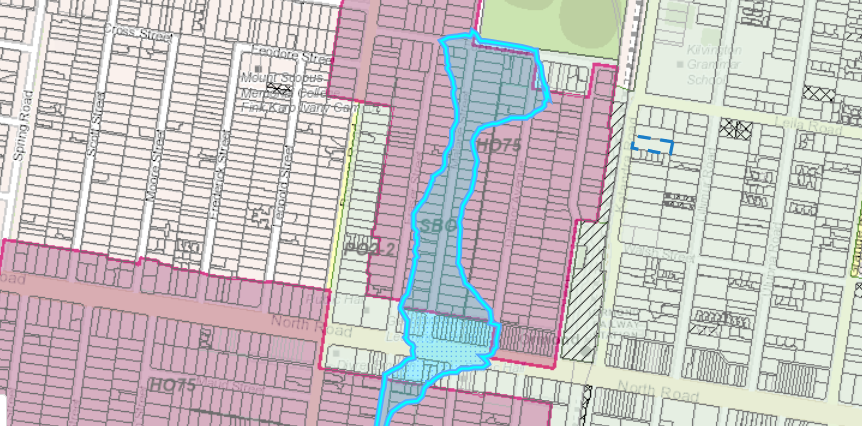
No mention of the fact that abutting properties on the western side are under a heritage overlay and have an SBO running right through the area.
The vast majority of properties along the neighbouring streets are single storey which would now be confronted with heights of 6 to 10 storeys.
Below we show the current zonings and the flooding overlay –
Whilst Glen Eira basically sits back and does practically nothing, apart from a very belated media release by the CEO, Bayside City Council has been working flat out to ensure that the community knows what the State Gov is planning for their council. They have:
Held a community forum on December 18th with expert commentators where over 200 residents attended
Published summaries of what is proposed and its impact on their municipality
In contrast, residents of Glen Eira would be hard pressed to locate any specific information on council’s website, and there certainly has been no information sessions/forums held by our council.
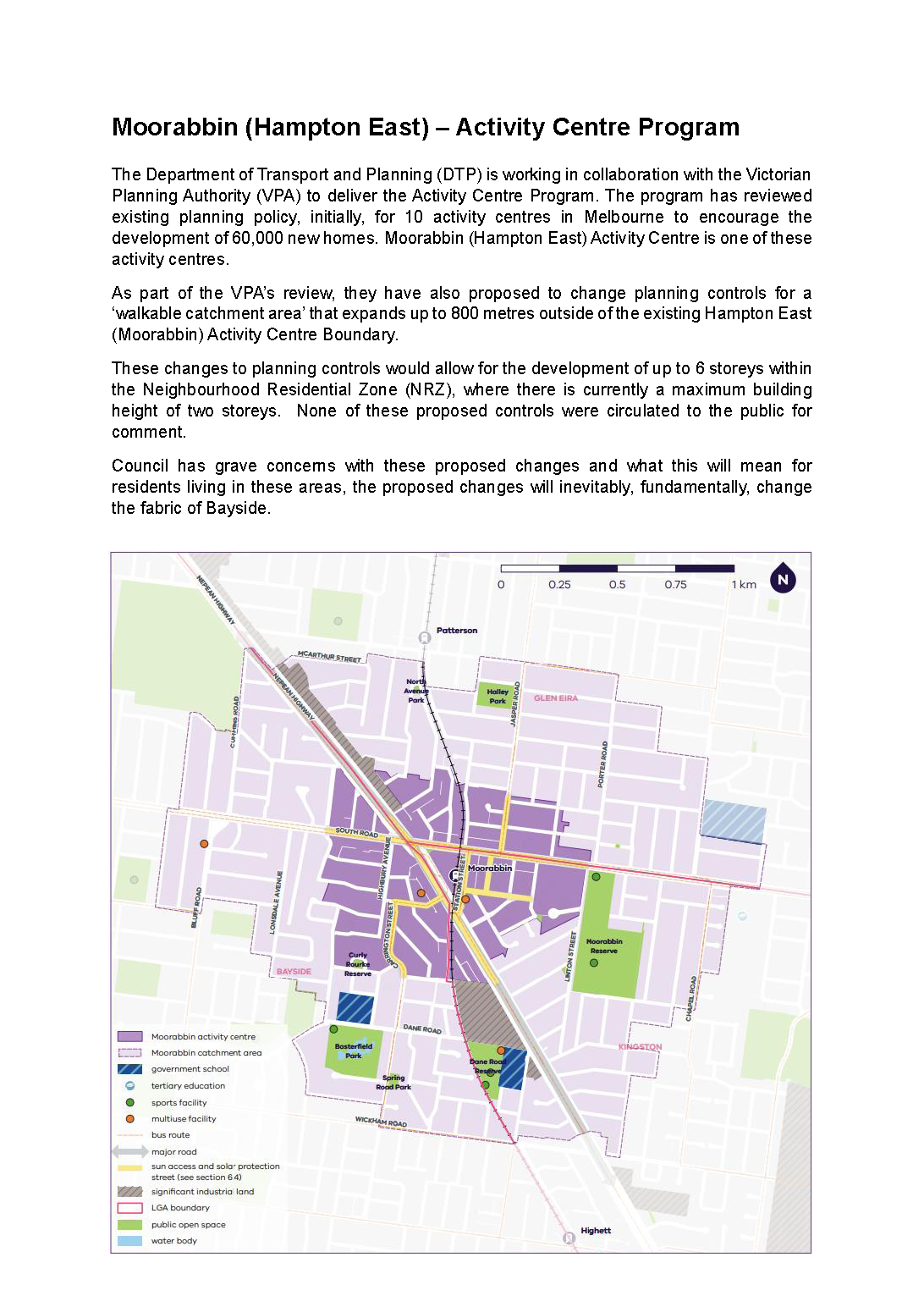
One activity centre of concern to Glen Eira is Moorabbin where the west side of South Road is in Glen Eira and the East covers Kingston and south Bayside. Here is what Bayside has said about the proposals for this area and its views on the proposed housing targets –
With the end of the year fast approaching, we are still waiting for the State Gov to release the information on the 50 activity centres that will be earmarked for developments ranging from 3 to 20 storeys. If past history is any guide, then we suspect the publication of these centres will appear Christmas Eve or possibly New Year’s Eve!
If by some miracle they come earlier, we can be sure they will again be bereft of detail, strategic justification, or accompanied by any important data such as traffic analyses, overshadowning data, etc. We anticipate that several of our activity centres will be added to the list following the recent inclusion of Moorabbin as one activity centre.
It’s perfect timing for the State Gov, with the festive season in full swing and holidays to occupy people’s minds.
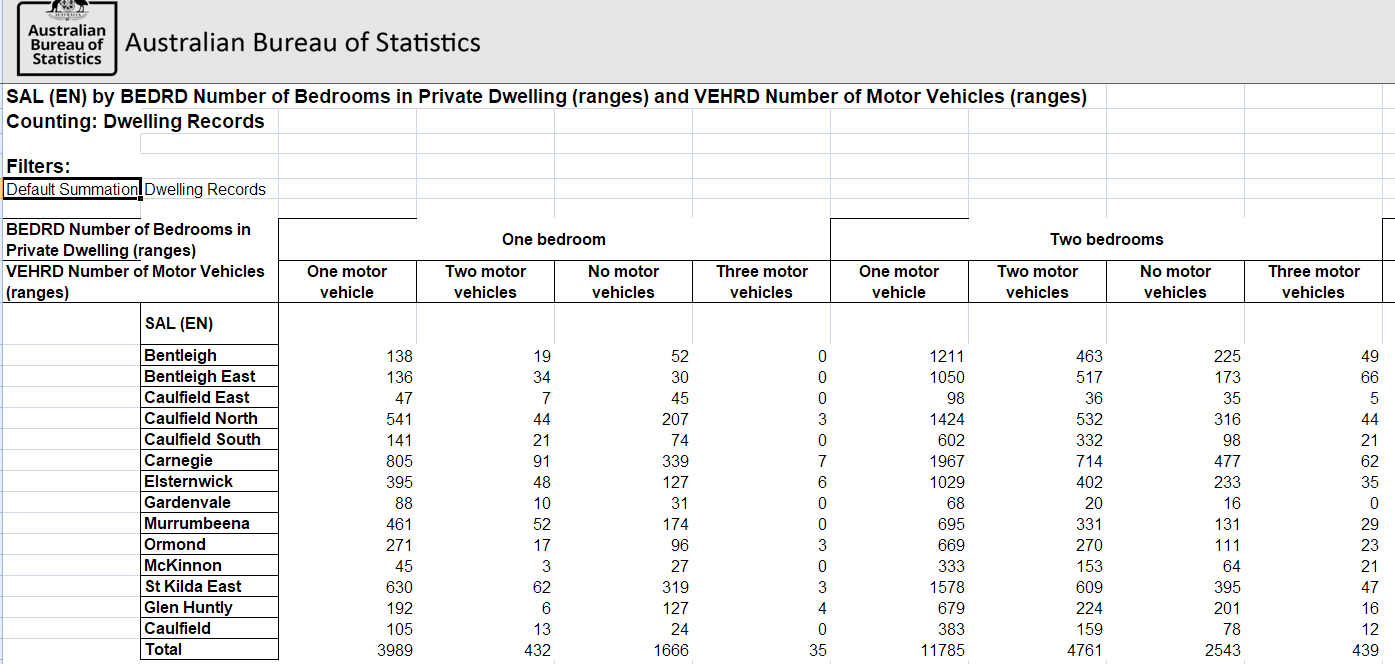
Our previous post featured car ownership data across all of Glen Eira. The following table has broken down the stats to show what is happening across individual suburbs. The vast majority of these areas are within our major activity centres, or our neighbourhood centres, plus featuring major roads.
(CLICK THE ABOVE TO ENLARGE)
What the data reveals is that assigning a one onsite car parking spot for dwellings that contain either one or two bedrooms is doing nothing to reduce car ownership – which is purportedly the aim. And parking issues are even further exacerbated when we have council or vcat waiving spots. We have not included this variable in the above analysis.
What we can conclude is that:
Over 6,141 cars do not have onsite parking spots – and probably more given car parking waivers. That can only mean that they are parking outside on the street. This number is based on the following calculation – 432 second cars in one bedroom places, plus 70 spots for 3 cars per such dwellings. Added to this we have 4,761 two car households in two bedroom homes, plus 439 three car households. The latter figure means that 2 cars won’t have onsite parking, which makes it another 878 cars likely to park in the street. The total becomes 432+70+4,761+878=6,141!
There are of course certain assumptions made in the above calculation. For example: whether two bedroom places are townhouses with driveways and a one car garage, so that the second and third car might perhaps park in the driveway. However, the number of two bedroom town houses/units is quite small, (just over 5000) so should not over-ride the conclusion that there is a huge shortfall of required onsite parking in our municipality.
For council and VCAT to frequently waive onsite car parking and to even consider further reducing the ratio can only worsen the situation. It also shoots down in flames the argument that people living near transport areas will not own cars. Furthermore, if the major criterion is how people get to work, then this tells us nothing about how people use their cars apart from getting to work – ie. shopping, picking kids up from school, visiting places and friends. It also assumes that public transport is great at all hours of the day. What is indisputable is that the number of cars is increasing based on the past census data and they are outstripping the number of new dwellings. To assume that people living in one bedroom apartments in particular and who live close to transport will not own and use cars, is to ignore the facts.
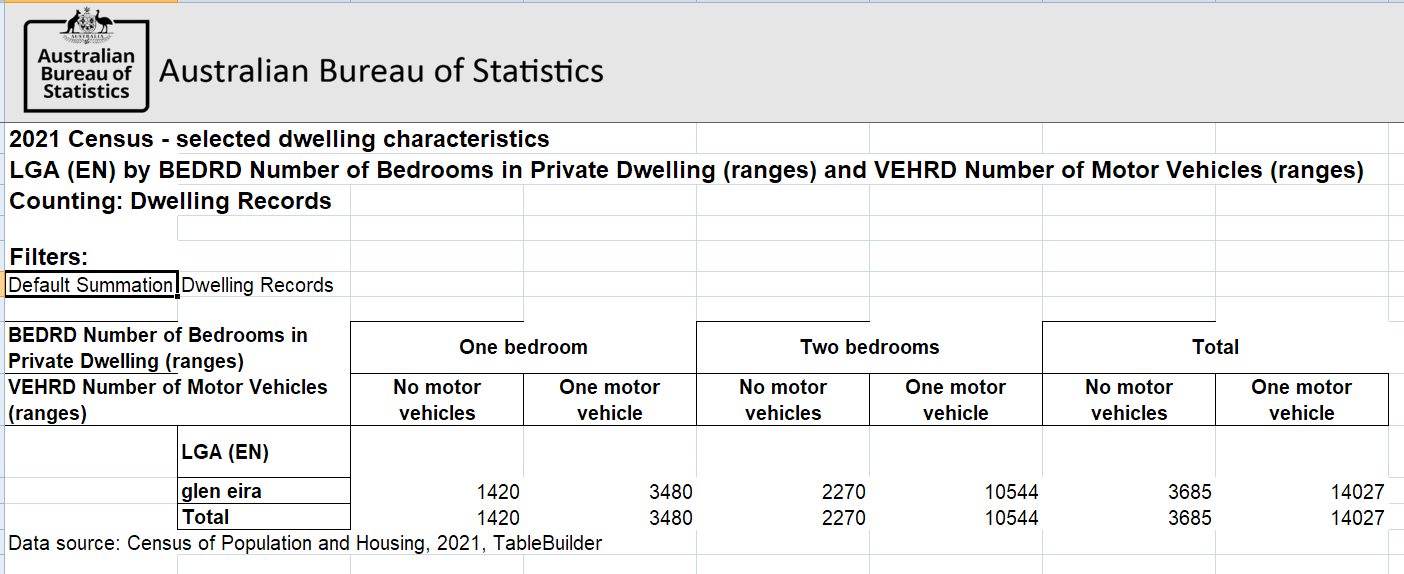
According to the 2021 census results Glen Eira had 5,357 one bedroom dwellings and 17,588 two bedroom dwellings. We can assume that the vast majority of one bedroom dwellings are within our activity centres and/or around main roads and transport hubs. The question then becomes how many of these one and two bedroom homes own motor cars? How well do all the assumptions regarding car ownership and whether or not residents living close to public transport do not own, nor have a need for cars actually stand up to scrutiny? Do the stats support this state and council thinking?
We have had a closer look at the 2021 census results in the attempt to answer these basic questions. The results clearly indicate that the spin does not match reality. The majority of people who live in one bedroom apartments still own a car and the same is true for those folks who live in two bedroom homes.
Below is a screen dump derived from the ABS which provides tallies of the number of NO CARS and ONE CAR for each dwelling of either one or two bedrooms.
If we do a simple calculation based on the above data, we can see that:
Only one quarter of residents in single bedroom homes do not own a car (ie 26%)
In two bedroom homes only 12.9%do not own a car
Thus if we have 75% of residents living in single bedroom homes owning cars, and 87% who reside in two bedroom dwellings also owning cars, what does this say about the requirements for adequate onsite parking? What does it say about off street parking becoming impossible for the majority of residents if onsite car parking waivers are the norm as illustrated with the recent Halstead Street application? And let’s not forget that council has already mooted that it intends to REDUCE the requirement for onsite parking in our major activity centres in the very near future.
The constant refrain of recent times is that car parking in Glen Eira is inadequate. Streets are ‘parked out’ and residents often cannot even get out of their own driveways. Yes, it is laudable that alternative modes of transport are being considered (ie bike paths, car share, etc.) but NOTHING can improve the situation when developments are continually allowed to waive the requisite number of onsite car parking spots. Cars are a fact of life in Australia and will remain so. It is indeed time that council acknowledged this and did everything in its power to address the problem instead of adopting policies that are pie in the sky, feel good, motherhood statements (ie 50:50 mode share).
Perhaps it is a little bit early to pass complete judgement, but the hope that with this new council, decision making could potentially be free from political party alignments and/or affiliations appeared to be firmly dashed on Tuesday night. The item that illustrated this in spades was the proposed 3 storey development at the corner of Halstead and Hawthorn Road in Caulfield North.
Here are some details of the application:
3 storeys, 26 dwellings of which 12 are single bedroom and 14 double bedroom
The officer report recommended a permit and the waiver of 4 onsite parking spots
The double site is 1300 square metres and just outside the Caulfield North activity centre
The area is zoned GRZ2 and is located along a main road hence no requirement for visitor parking
Prior to the item being debated, Halstead Street residents voiced their strong opposition in the public participation section of the meeting. They emphasised again and again the lack of available street parking given the close proximity to the commercial core in Hawthorn Road which meant that visitors to the shops were often forced to park in surrounding residential streets. The result, according to residents, was that Halstead street was already ‘parked out’ and made it impossible for tradies, emergency vehicles, visitors, carers, etc. to find parking near their destinations. Interestingly, only 7 properties had been notified of the application and yet there were 32 objections.
Karslake moved the motion to accept the recommendation and this was seconded by Zhang. The ‘accepting’ vote went along indisputable ‘party lines’ with Karslake, Zhang and Ragni voting in favour of the permit and Esakoff, Daniel, Szmood, Kennedy and Rimbaldo voting against. The motion was thus defeated 5 to 3. Parasol had previously declared a conflict of interest.
Once the motion to grant a permit was defeated, Esakoff presented an alternate motion that the proposed 26 units be reduced to 22, and thus the allocated parking would not involve any waivers. This was passed 6 to 2 with the opposing councillors being Karslake and Zhang. Ragni decided to vote in favour of the motion this time around.
Whatever the outcome at the presumed future VCAT hearing, the issue here is not really about the merits of the application, but whether or not certain councillors will see their role as backing state government proposals instead of firmly representing their constituents and addressing the ills of our current strategic planning.
We’ve uploaded the comments made by Karslake, Zhang and Esakoff and ask readers to carefully listen to what was said and then decide as to the credibility of the arguments. We will also comment on the officer’s report for this item in our next post.
Elections have come and gone and Glen Eira has 4 new councillors – Daniella Arabella, Kimberley Young, Kay Rimbaldo, Luca Ragni. Returning councillors are: Margaret Esakoff, Jane Karslake, Sam Parasol, Li Zhang and Simone Szmood. The latter was last night unanimously elected as Mayor.
We wish all these new councillors well over the coming four years and hope that their vision is firmly centred on representing their constituents rather than any allegiances to political parties. Glen Eira certainly needs a proper commitment to preserve heritage, stop state government ad hoc planning travesties, and to prioritise our environment and its challenges. We also need consultation processes that are genuine and have full councillor and consultation committee involvement.
We would be remiss if we didn’t mention that we are surprised, yet pleased, that two candidates failed to achieve election – Magee and Pilling. This engenders hope that the community is becoming more aware of what is required in this municipality from their councillors.
Nominations are now in for the upcoming council elections. As in previous elections we face the same situation – names that are totally unknown with many claiming to be ‘independent’ but in reality are aligned, affiliated or members of the various political parties.
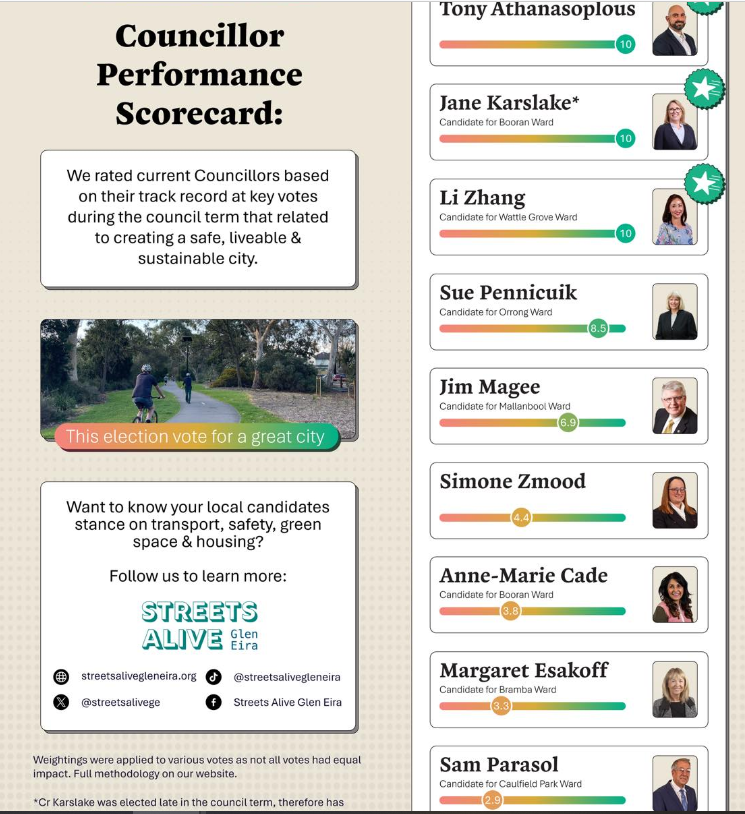
For starters, we have a new Labor oriented group calling themselves ‘progressives’! Their leanings are clear with how they rate current councillors with Liberal links. This is reposted on the Karslake facebook page. Note the order – especially the last three councillors .
Even more interesting is that Port Phillip has also established a group calling themselves ‘Progressive Port Phillip’. Looks like Labor is going all out for the upcoming election. Here are the members of the Glen Eira version:
Nothing wrong with this except what it camouflages and the impression it seeks to create. At least the Greens make a public declaration of who they are and which party they belong to.
The Liberals are far more restrained and – hidden!
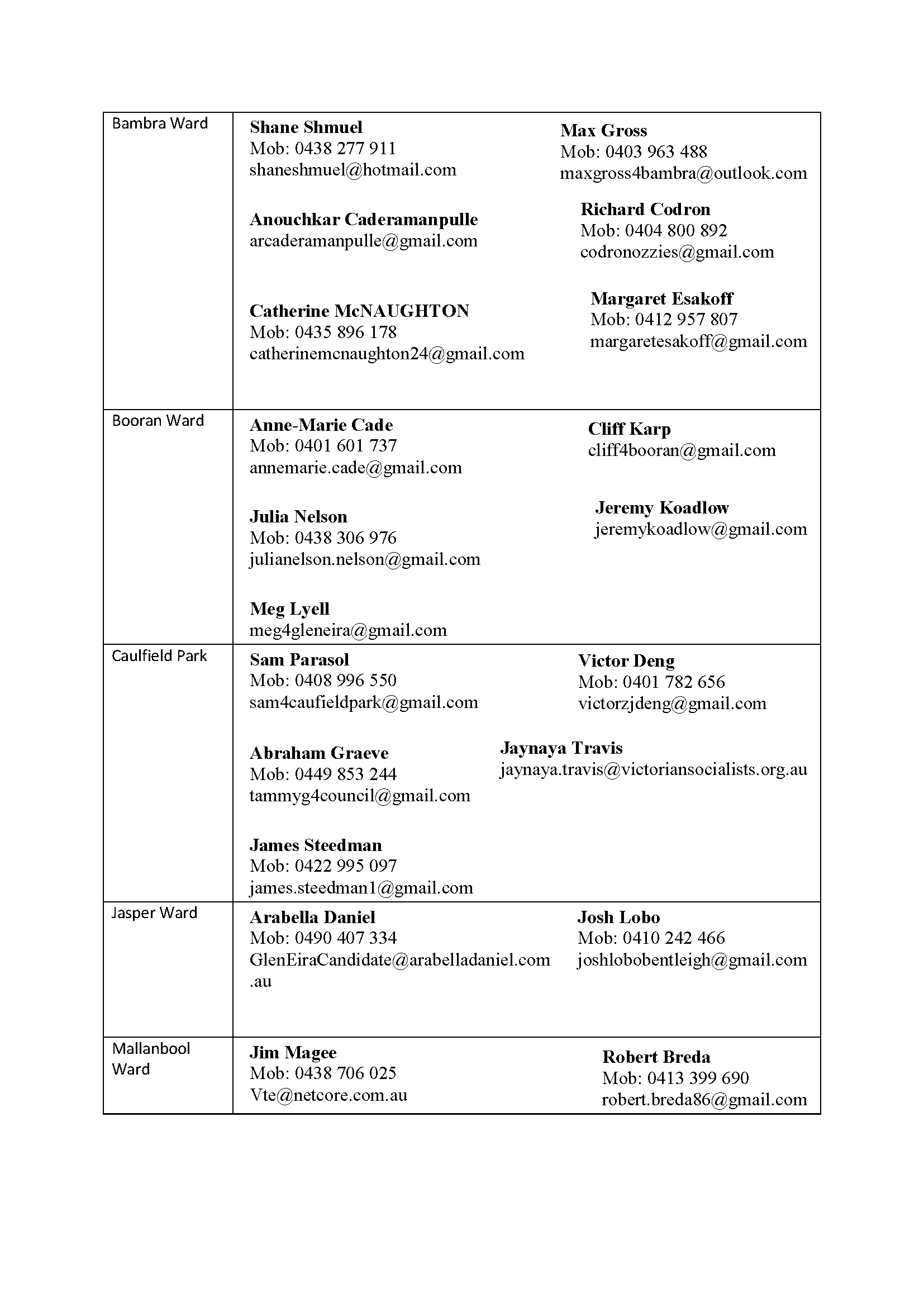
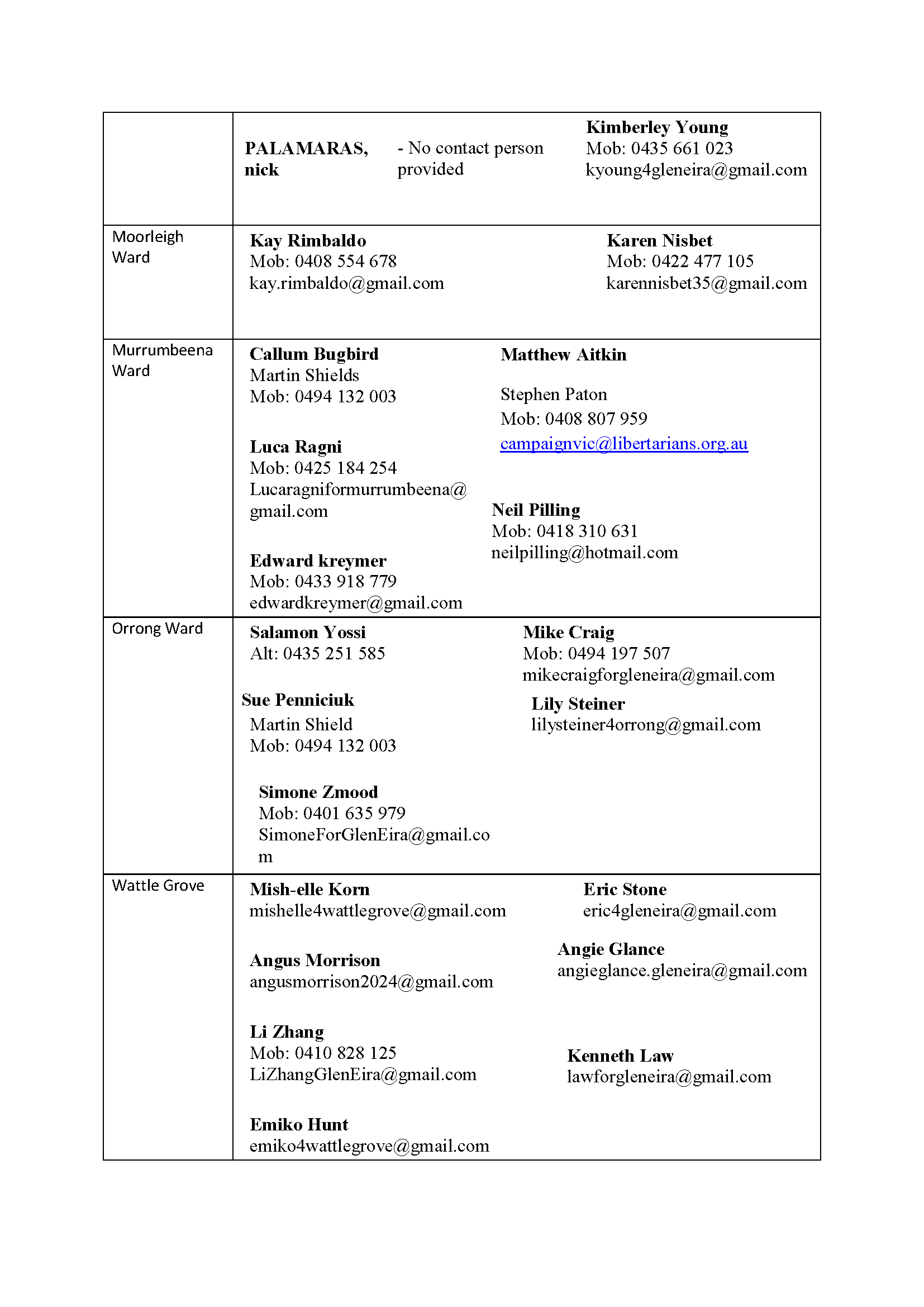
Most of the nominations come from individuals we have never heard of. For the majority of these new nominations, their involvement in council issues is zero as far as we can tell. Nothing on the various social media platforms and no public questions tabled at council. The few that have asked questions are mostly related to the closure of the childcare centres. Even if most are ‘genuine’, then why the absence of contact details including phone nos? So how many are stooges, conscripted to provide preferences for their favourites?
There’s only one thing for sure. We will have at least 3 existing councillors departing. Athanasopolous is heading for Kingston, and in two wards two councillors are fighting for the single position – Cade versus Karslake in one ward and Szmood versus Pennicuik in another ward.
Most disappointing are the results for two wards where only 2 candidates nominated in each.
Finally, we highlight one name – Matthew Aitken. If this is the person we think it is, then it’s interesting that he was Glen Eira’s chief prosecution officer a while back!
We have repeatedly contrasted how other councils approach dealings with the State Government and how their official communications vastly differ. In Glen Eira the criticisms and dare we say ‘outrage’ is muted and practically non-existent. Nor are residents truly informed as to what is going on behind the scenes.
This post concentrates on the draft Moorabbin Structure Plan released by the State Government in August 2024. Bayside publishes its proposed submission in the current agenda. Glen Eira merely presents a ‘summary’ of what officers will draft (September 3rd council meeting) and then resolves to send this off without placing the eventual submission into the public domain. The submissions are due on the 29th September.
Bayside does not hold back in informing residents as to what occurred. Their officer’s report states:
The VPA and DTP scheduled a meeting with officers from Glen Eira, Bayside and Kingston City Councils on Wednesday 21 August, informing that Phase 2 Engagement on a Draft Plan for Moorabbin would likely occur within the coming days, and that the Draft Plan would be released to Council officers and the public at this time. On 22 August, release of the Draft Plan was made via an article in the Age
All we learn from Glen Eira via the September 3rd report is:
The State Government has released the Draft Activity Centre Plans for Moorabbin and Chadstone for comment to both Council and the public on 22 August 2024.
No mention of the indecent haste; no mention of meetings and certainly no mention of the failure to inform council and the community directly. Is this a minor oversight, an unfortunate lapse? Or does it signify Glen Eira’s refusal to even imply major criticisms of the State Government’s processes and autocratic actions?
Here are some other comments made by Bayside in their officer’s report –
Council officers are extremely disappointed in the manner that the VPA and DTP has and continues to engage on this important project. The limited time and information available to provide meaningful feedback has created significant scepticism and lack of trust in the State Government’s ability to appropriately plan or manage such projects. Specifically, the approach provides little confidence and raises significant concern about the State Governments failure to follow its own planning framework and principles of the State Governments own Planning and Environment Act 1987 which sets out the principles for a transparent planning process. Instead, the State Government, VPA and DTP are failing to openly engage with Council or the community, presenting all parties with plans for the Moorabbin Activity Centre without any technical reports, justification for the proposed approach, or any planning provisions.
There are grave concerns that the State Government is operating on the very outskirts of the Planning and Environment Act 1987, with the process of this program going far beyond what orderly and proper planning seeks to achieve. (Bayside bolding)
The Activity Centres program continues the State Government’s continued erosion of the community and local government participation in the planning process. It is based on the State Governments false narrative that Councils are a critical block in the delivery of housing.
The VPA and DTP have informed Council officers that there will not be an open or transparent review process. The plan will be presented to a Standing Advisory Committee on papers only – considering submissions raised. This approach will remove any peer review or cross examination of experts. The State Government, VPA, and DTP are running a process where there is no accountability or opportunity to question their work (which has not been released to the public).
It is understood that the Activity Centre Program is a pilot program which will be used as a basis to replicate across the metropolitan area. The approach undertaken by the VPA and DTP does not provide Bayside, nor should it provide the remainer of the Local Government Sector across Victoria, with any confidence that a replicated approach could be efficiently or effectively rolled out. The localised issues and needs of communities will be different and the work undertaken has not given due regard to the community expectations.
The VPA and DTP continue to inform Bayside of the program rather than genuinely consult or collaborate which represents a lost opportunity for a collaborative approach which could genuinely achieve improved outcomes. Bayside sees the output to date by the VPA and DTP as not having any real value or improved planning outcome beyond a small uplift in building heights in the most sensitive part of the project area.
There are plenty of other statements we could have included. This officer’s report is then followed by a 25 page formal submission. If the Glen Eira submission gets to even 12 pages we will be surprised!
The Bayside submission includes discussion on:
The State Government’s abandonment of its own planning rules and processes
Whether the gov’s draft plan is in accord with the ’purpose’ of an Activity Centre Zone to facilitate commercial growth.
The 3rd September Glen Eira report ignores most of the above categories. Not a word is stated in regard to: housing affordability; transport and traffic; Sustainable Design; actions/plans in accordance with the ‘purpose’ of an Activity Centre Zone. Whilst the 3rd September report is supposed to be a ‘summary’ only of what will eventuate in the actual submission, its lack of coverage and detail is concerning. Of greatest concern is the overall TONE of the report. Yes, we get verbage such as ‘concern’, a token acknowledgement of the ‘community’ but nothing to match what Bayside sees as vital to full transparency and democratic process.
This isn’t simply an issue of semantics. When we have a State Government that bulldozes through ill thought out planning changes as a political escape clause to camouflage its incompetence and indifference to the housing crisis, then it is incumbent on ALL councils to stand united and to call out such incompetence in the strongest terms. Glen Eira remains the odd man out – refusing to call a spade a spade, and thereby failing in its obligations to the thousands of residents (and future residents) who will be impacted by these spurious ‘reforms’. As we’ve said before – why on earth is Glen Eira taking this course? What is really behind such mealy- mouthed responses?