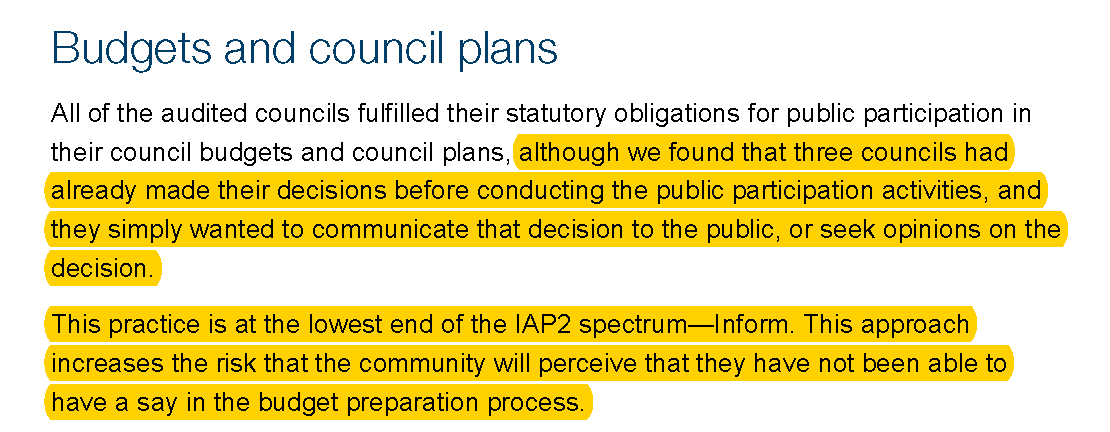
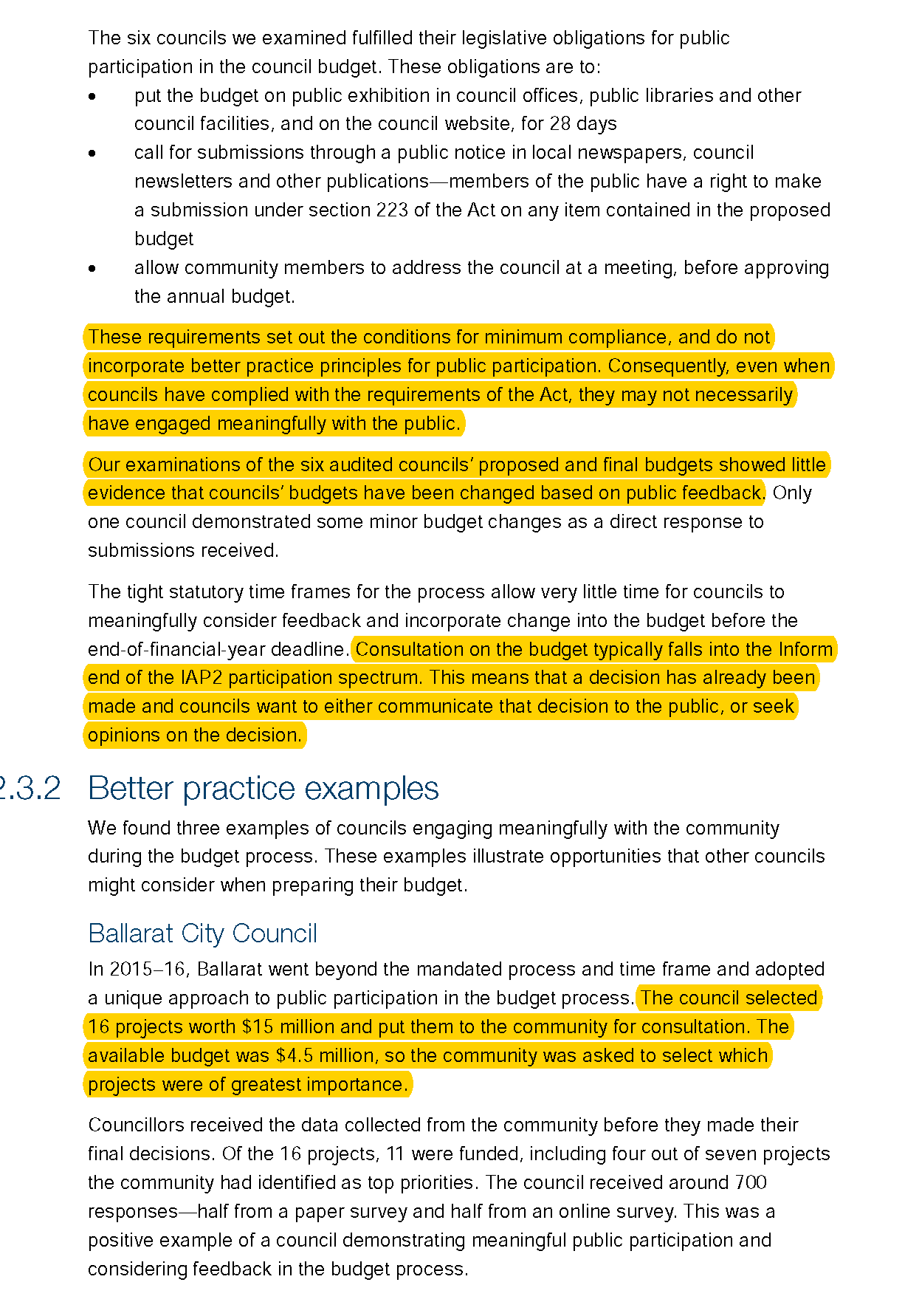
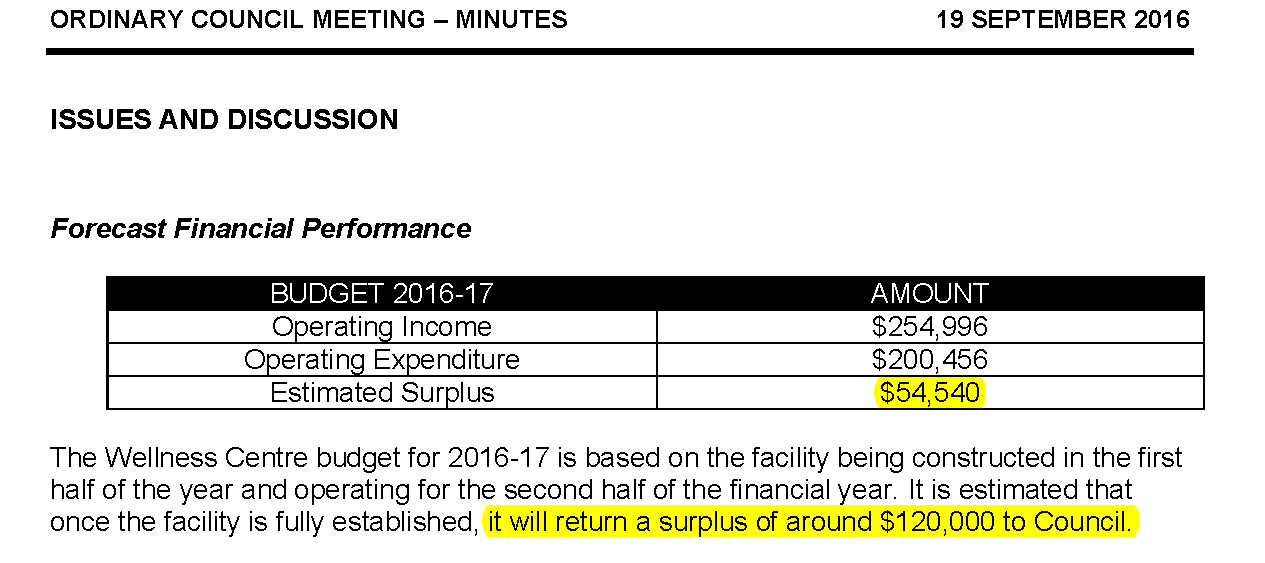
A fairly good turnout of residents (approx. 45) at tonight’s Bentleigh Forum on the structure planning process. Introduced again by the facilitator Jane Nathan, who then handed over to Aiden Mullen – the officer in charge of all the current activity centre work.  Mullen summarised the results council had obtained thus far. Significantly missing from the presentation was resident concern with overdevelopment. This morphed into the somewhat simplistic categorisation as concern over heights!

Residents were asked to sit at the various tables and a planning officer was assigned to each table. One person from each table was asked to take notes and report back to the entire gathering. More disconcerting was that each officer had a prepared list of specific questions to ask – ie how many people in your household? How many bedrooms? How many onsite car parking spots? Where would you like to live in 15 years? etc. Basic demographics which in our view are both meaningless (given the sample available) and secondly far more precise figures are available from various sources.

A ‘vision statement’ was then put up as an overhead and residents asked to comment on whether or not they agreed with the statement. It basically went along the lines that Bentleigh needs to retain its ‘village’ feel as well as provide for a safe, diverse, and inclusive community. The majority of feedback indicated that people were in disagreement with calling Bentleigh a ‘village’ given the amount of high rise development and the promise of more intense development. Several residents were highly critical of council, claiming that they simply are not listening to what residents are saying and that council needs to inform people prior to asking Dorothy Dix type questions.

It would be fair to say that most residents wanted:

  • Adequate parking
  • More open space
  • Mandatory height controls
  • Protection of heritage
  • More safe bicycle and pedestrian paths
  • More community facilities

Our view is that council desperately needs to alter its approach to these events. Otherwise they are nothing more than a self-fulfilling prophecy. Instead of motherhood statements that can hide a multitude of sins, residents need to be provided with real information as a starting point. For example: council writes that it is investigating the borders of the activity centres, yet many residents believed that the exercise involved only the commercial centres. Secondly, Mullen kept praising the interim height guidelines without informing residents that they included 5 storeys as ‘discretionary heights’. Thus we have the near oxymoron of in the one breath talking about the ‘village feel’ of Bentleigh, without all residents being aware that 5, 6 or 7 storeys is now a possibility in Bentleigh. This height certainly does not gel with the idea of a ‘village’.

We simply ask:

  • Why can other councils produce reams of information that is posted to all residents explaining exactly what a ‘structure plan’ is? What it can do and what it can’t do? And what are the overall planning constraints, or advantages?
  • Why can other councils produce structure plans that contain data that goes beyond the 2011 census and Glen Eira City Council can’t do the same?
  • Why can’t Glen Eira City Council simply ask a direct question such as – what do you think is the appropriate height limit for Bentleigh, Carnegie, McKinnon, Ormond, etc etc etc

If the aim is to produce work that is truly based on community views, then the community must be given all relevant information up front. It must also stop resorting to language that is far from appropriate and present findings that are indeed an accurate record of what residents say they want, need, and aspire to. Thus far, this has not happened in our view.

PS: As illustrations of how other councils go about conducting their structure planning consultation, we’ve uploaded part of the first survey conducted by Stonnington (late 2016 and another one from late 2015). Compare and contrast this with the kind of questions asked of Glen Eira residents and the information provided in both instances.

Below is another extract from an initial ‘survey’ done by Stonnington –

For once it appears that common sense has prevailed! Councillors voted unanimously to reinstate the 2 hour parking restrictions on both sides of the streets surrounding the Caulfield Hospital and the townhall. That this could have dragged on for so many months is unacceptable. What is also unacceptable is the inconsistency with which council handles all the parking issues – ie Phillip Street for example where exactly the same thing happened over a year ago and nothing has changed. It should not take a concerted and consistent effort by residents to ensure that something is done to address problems. Nor should it take countless thousands of dollars to initiate a traffic survey that ends up reporting that there is no parking problem, or that cars are parking safely, when countless residents report the exact opposite.  This is bureaucracy and bloody mindedness gone mad.

Here is the discussion on the issue –

Silver moved motion to reinstate 2 hour parking on both sides of the street, plus continued monitoring and in future that before any changes to parking restrictions are made that the matter be referred to a full council meeting. Seconded by Sztrajt.

SILVER: thanked residents and apologised for ‘it taking so long as it has’ to restore the previous parking restrictions. Said these are narrow streets and when people park ‘close and opposite’ to driveways it makes it hard for people to ‘get out’ of their driveways. History involves hospital introducing parking costs and that council made a ‘decision internally’ to change the restrictions to all day parking on one side of the street. ‘That has caused problems’. Said he has visited and ‘saw the problems there’. Said it’s ‘not about parking availability’ but the ‘impact of parking’ and the problems caused. Residents have told council that they want their ‘legitimate concerns’ taken into account. It is ‘challenging’ because there are 2 major employers in the area – council and the hospital. ‘We can’t deny that there is a need for staff parking’ in both areas and in the ‘future’ there will be ‘challenges’ for both institutions. So this definitely will be an issue for ‘future consideration’. He hoped to hear that ‘residents’ lives have improved by next week’.

SZTRAJT: asked what the cost is for staff parking at the hospital. Delahunty responded that staff pay $2 per day and visitors $6. Sztrajt then queried whether staff could claim this as a tax deduction and Delahunty replied that it comes out of their ‘pre-tax salary’. Sztrajt then said that his question was to determine whether staff who can spend roughly $1.20- $1.30 a day refuse to park in the onsite car park and use the gate to get to the hospital to ‘save $1.30 a day’ so they park in ‘narrow residential streets’. This has ‘created an unfair circumstance’ for residents. The hospital had to ‘take the matter all the way to the CEO’ of Southern Health about whether to close a gate or not. Said that ‘with the best of intent’ by council, residents have been ‘upset’ and council’s attempts to find a solution by closing the gate ‘have just been delayed’ and residents have ‘been put out’ by the time lag. He now thinks that ‘we are not in a position to wait for the hospital’. ‘We are now in the situation where we will do what our residents asked us to do’. Residents ‘have spoken’ and ‘spoken loudly’. They’ve emailed all councillors, and he ‘commends’ them for taking up the issue and ‘using local government’ in the way it was intended – ie letting residents have ‘an avenue’ to ‘contest issues’. Council can change the restrictions and he is regretting that ‘it has taken us a long time’ to ‘do the right thing here’.

DELAHUNTY: said that council ‘shouldn’t have taken the decision to remove parking restrictions without consultation’. Even though it ‘wasn’t in contravention of our policy, it is not in keeping with the spirit of it’. Said the report stated that there is ‘sufficient on street parking’ and changing will force cars into nearby streets but ‘I don’t think you can have both of those positions’. If ‘reinstating the original conditions will reinstate the original complaints we had’ then council would get zero complaints. Didn’t think there would be any issues with reinstating ‘while officers continue to work on the closure’. Said that it is ‘mindboggling’ that this ‘very minor’ issue has to go all the way to the CEO of Southern Health.

SILVER: said that he is also amazed at the protocols and still feels the decision by the hospital could have been ‘made faster’. The hospital is a ‘neighbour’ and would want a ‘good working relationship’ with everyone.

MOTION PUT AND VOTED IN UNANIMOUSLY

PS – AND JUST A REMINDER ABOUT PHILLIP STREET THAT SURELY FALLS INTO THE SAME CATEGORY OF LACK OF CONSULTATION AND LACK OF JUSTIFICATION?

Item 9.10 features the ongoing saga of parking around the town hall and Caulfield Hospital. After months of supposed ‘negotiation’ with the hospital to close a gate, there is still no outcome. Councillors have thus been offered 3 choices. They are:

  1. Continue With The Current Restrictions – since (a) there is plenty of available parking in the streets and (b) that time should be given for council to complete its ‘municipal wide’ parking strategy in order to reach a ‘more balanced and consistent framework’.
  • Reinstate The Previous Restrictions (pre-June 2016) – this would however force cars to park in nearby streets so the ‘problem’ would only be passed on to surrounding areas. One paragraph from this option deserves citing in full –

Community criticism over the lack of consultation in the recent parking restriction changes is acknowledged. Given the potential for increased parking demands on Glencoe Street, Garrell Street, and Dunbar Avenue, it is recommended that the residents of these streets be consulted prior to any decision to remove unrestricted parking from: Hillside Avenue, Harcourt Avenue, Gerard Street, Hartley Avenue, Sylverly Grove, and Alfred Street.

  • The third option involves having small sections of the street (ie 4 car spots) earmarked for unrestricted parking – but this also requires consultation.

The upshot of all this is, let’s do nothing, or let’s delay some more. Council keeps presenting the argument that it is working on a ‘precinct wide’ traffic management plan. The Planning Scheme review stated that parking precinct plans would be introduced for its activity centres. The streets mentioned above ARE NOT included in any major activity centre, nor are they part of any neighbourhood centre. All council comments related to parking apply only to their ‘structure planning’ – ie As part of the structure planning process, parking and traffic movement will be reviewed with the potential for new traffic measures and controls to be introduced. (April, Glen Eira News).

No specific timelines are provided. Since only structure plans for Bentleigh, Carnegie, Elsternwick, and now Virginia Estate will be done in the next 18 months we have little confidence that parking will get a look in elsewhere – especially since council is now not promising structure plans for its other districts but an ‘Activity Centre Strategy’!

Residents are being given short shrift in our view. Council needs to be upfront and inform residents exactly what it plans to do about parking everywhere. Timelines are required as is a waterproof policy that is up-to-date and which initiates action now and not years down the track.

A short post alerting residents to the fact that council has published its draft budget, community plan and also included plenty of planning applications in the current agenda – a massive 555 pages!

We will report on the first two in much greater detail once we have had the time to fully digest the documents. What follows are simply some overall first impressions:

  • The community plan is presented in a different format completely. The old ‘faults’ are still there however – ie. very little correlation between ‘objectives’ and assessment of these objectives. For example: on the theme of ‘informed and engaged’ one of the criteria for evaluating ‘success’ is recorded as “Rates per assessment will remain at the second lowest level of all metropolitan municipalities”.
  • If council is truly concerned about ‘transparency’ then we have to question why on page 101 of the draft budget council insists on highlighting the percentage increase for bins, rather than the actual cost increase – ie. “240 Litre Bin 1.95 per cent Increase” etc. Residents shouldn’t have to plough through hundreds of pages to be able to work out how much charges have increased. This is the first time we believe that this kind of presentation has been done.
  • For all the talk about open space expenditure, there appears to be zero allocated for the 2017/18 financial year according to the Strategic Resource Plan!
  • Rates of course are going up, as is every other single charge. Council has however stated that it will not be seeking a higher rate (mandated 2% increase) via an appeal to the Essential Services Commission.

On other matters –

  • Parking restrictions around the hospital will not change – despite protest after protest and nothing really forthcoming from the proposed ‘advocacy’ to Caulfield Hospital
  • More applications in for extended heights – Neerim Road going for 4 storeys when a previous permit application was successful for 3 storeys. Officer recommendation? – permit. We are also mightily amused by this argument in favour of the permit – The new top floor balcony is proposed to be setback approximately 6 metres from the street. It is considered that this setback is appropriate having regard to the approved setback of the fourth storey of the building to the east (253 Neerim Road) at approximately 6 metres.
  • For another application council officers see nothing wrong in waiving 5 car parking spaces for shops!

Watch this space!

We’ve received the following email –

“Over the last few years, Bentleigh residents have been actively lobbying Council to put in the right controls and plans for future developments within the area.  As an outcome of this lobbying, some interim height controls have recently been introduced and Council is now also undertaking a Bentleigh shopping centre and surrounds structure planning process. This structure plan will significantly influence future development and FYI we have attached the preliminary draft.
A Community Forum is to be held on Wednesday 3 May, 6.30pm–8.30pm at the Bentleigh Senior Citizens Centre, 2 Arthur Street, Bentleigh to further discuss this preliminary plan.  It is important that residents attend to express views on this draft plan. 
 
Our thoughts on the preliminary plan are:  
  • There is no meaningful increase in open space and this is an issue with increasing development and also the general lack of open space in Glen Eira (lowest in Melbourne).
  • It is proposed that the existing car parks are to be consolidated into a multi-storey with the remainder to potentially be converted into more residential developments. This is not acceptable (Stonnington for example are doing one underground car park and developing open space above).
  • There is limited if any innovation or creativity in the plan.  
  • It is proposed that the library be relocated ($20M plus cost) however this was not identified as a need by residents.  (perhaps Council wants to sell off the current library site for a major development?). 
  • There is no direction included for future development heights. 
In summary, we believe that more work needs to be done to deliver a plan that is consistent in quality with other local government areas.  Please attend the community forum to again ensure Council clearly understands the views of residents.  Numbers are important, please also forward this onto friends.
Kind regards,
Centre Road Bentleigh”
centreroadbentleigh@gmail.com
++++++++
The relevant document is uploaded HERE

The so-called ‘Tranformative Concepts’ for dealing with the issue of parking to in our activity centres basically proposes

  • To flog off to private development as much of council owned car parks as possible – the terminology became ‘repurposing’!
  • To replace these car parks with one single above ground car park of at least 2 or 3 storeys.

One Mile Grid was then commissioned to survey ‘traffic’ flow in various streets. Their brief is defined as

Without stating the obvious, traffic flow and parking should be two distinct areas. It appears that council is determined to conflate both issues in the attempt to provide support for its highly questionable  recommendations! Not surprisingly, the results of the One Mile Grid analysis for Elsternwick, Carnegie, Bentleigh concluded that – The results show that all intersections analysed are currently operating under ‘excellent’ conditions during both the morning and afternoon peak hours with minimal queues and delays experienced by motorists. Only Orrong Road brought up a ‘good’ condition report rather than ‘excellent’. Many residents travelling along these roads/streets would beg to differ!

We are not traffic engineers. We are simply residents attempting to understand how such results can lead to the recommendations when:

  • No account has been taken of anticipated residential developments in the area
  • No account has been taken of car parking spots in nearby residential streets
  • No account has been taken of council car park occupancy rates
  • No account has been taken of occupancy rates in surrounding streets
  • No account has been taken of car ownership in the area
  • No account has been taken of parking restrictions in the area
  • No account has been taken of ‘through’ traffic – ie not remaining in the activity centre itself but just passing through

If council is indeed sincere about providing adequate car parking in its activity centres, then one must expect far more than a highly suspect report that does nothing more than focus on ‘traffic flow’ at certain intersections and concludes that all is hunky dorey for the most part and that public land can be flogged off for more private development.

By way of contrast we urge all residents to read the following that comes from Moonee Valley council’s amendment seeking to introduce both a parking overlay for the Moonee Ponds Activity Centre and a developer contribution of up to $13,000 per each car parking waiver. Then ask yourselves would Glen Eira ever attempt something like this given its pro-development agenda? We’ve uploaded the Moonee Valley traffic analysis, (a 175 page document) HERE

The latest outrage in development applications concerns 9-13 Derby Road, Caulfield East. Advertising has now finished for an application that proposes:

  • 18 storeys
  • 158 student accommodation units ranging in size from 15 square metres to 32 square metres. Please note that both Monash and Whitehorse have a requirement in their planning scheme about minimum size of apartments and Monash stipulates that for ‘self-contained’ units the minimum size be 24 square metres of floor area. Such clauses are absent in the Glen Eira planning scheme!
  • 1 shop of 151 square metres
  • A car parking waiver of over 40 car parking spaces
  • Under a Heritage overlay

The fact that this has not been refused outright at manager level is astounding given that various other applications of the recent past have not been advertised at all. Recent manager refusals include the Development Plan for Precinct 2 of Caulfield Village (400+ units); 8 storeys in Hawthorn Road; 7 storeys in Neerim Road and another 8 storeys in Rosstown Road. Yet this one gets through unscathed! Why? We can only surmise that this is because of the state of the current planning scheme and the wheeling and dealing that is going on between Monash, the VPA, Council, State Government, and other vested interests in the Phoenix Precinct area.

To rub further salt into the wounds the planners can’t even proof read properly, or don’t even know where the site is located – ie Hawthorn East! Because the area is zoned Commercial 1 it is therefore okay to have zero permeability and 95% site coverage on a 540 square metre block.

Finally, here is what it purports to look like –

A huge gulf exists between resident responses to the ‘surveys’ on ‘transforming’ our activity centres, and what is portrayed as the ‘results’ of this ‘consultation’. The McKinnon report is another example of a work of fiction that fails to accurately represent what residents said – especially in the category of ‘private development’. Here is the pie chart claiming to depict the results –

Please note the following:

  • To claim that ‘there was no clear agreement on suitable building heights’ is rather rich given that residents have never been asked – what do you think is an appropriate development height in any of the activity centres!
  • The claim that only 27.8% of comments were opposed to development is utter nonsense. On this topic of ‘private development’ there were 64 valid responses. We’ve ignored blanks and those marked as n/a. Of these 64 responses, a clear 39 were opposed to development (highlighted in orange below). That makes it 60.93% of responses were opposed to development
  • The report also states that ‘Many felt it was the popularity of the suburb services, particularly the high school’ that resulted in ‘increased population’. A more honest response could have been that increased population is a result of the zoning. Further, of the 64 comments only 3 mention schools at all – that is 4.68% – yet it rates a prominent mention in the report!

Please read the following comments and judge for yourselves as to the validity, honesty, and accuracy of this ‘consultation’ report.

Booran Road has finally been opened to the public. It is not without controversy. Whether one loves the new park or not many, many issues require investigation as to how this development has been conceived, handled, and the cost(s) involved.

For a council that has the least amount of public open space in the state, it is unbelievable that an area can be designated as ‘open space’ yet fenced off behind tall (and expensive) gates and access denied. This is the situation at the new Booran Road ‘park’.

We estimate the closed off area to be in the vicinity of 2500 square metres of a 1.6 hectare site. What are the reasons for this exclusion and how can it be justified? Are we to assume that this ‘urban forest’ will become the private open space of the neighbouring apartment building? If so, have they paid for any of this?

The next issue is why council continues to change plans that were not part of any community consultation and without warning or costings provided? Below is part of the council ‘consultation’ flyer which reveals a totally different park to what we now have. The green open expanses depicted in this flyer have shrunk dramatically and been replaced by more and more concrete.

The third issue is cost. According to a recent Leader article council admits to an $11 million expenditure – but they have refused to provide any real details of these costs. We estimate the expenditure to have been far and above this figure. Even one consultant engineer employed for the project puts the figure at $12 million. The image below comes from Linkedin –

When ratepayer funds are used to create a ‘park’ that:

  • varies considerably from what was proposed
  • when council isn’t forthcoming on total expenditure
  • when public open space is barricaded and the public excluded

then residents have every right to question how well their rates are being used and whether or not this project is another example of sheer profligacy and poor management, plus lack of transparency and accountability.

As far as the aesthetics of the site go, opinion is divided. Some believe that what has been created is no more than a concrete Disneyland (suitable for young children perhaps) but certainly not catering to the consensus of opinion that desired ‘passive open space’. Time will tell……..

The current agenda features 3 items of particular interest. Two involve planning applications and the third is an officer’s response to a request for data on car parking waivers as a potential tool to use at VCAT. What is presented in each of these reports we find staggering and wonder what on earth is going on with planning in this council.

  1. Data on Car Parking Waivers

As per usual, the report  concludes that – It is considered that the extensive resources required to collate car parking waiver data could be more effectively directed towards creating the strategic basis for future car parking provisions. By doing so, much needed clarity can be provided to the town planning process in Glen Eira with subsequent benefits in defending VCAT appeals.

Backing up the ‘do nothing approach’ we get – A comprehensive audit of past planning decisions to obtain car parking waiver data would be a resource intensive exercise.

The ultimate recommendation therefore reads – That Council acknowledges this report and the strategic work that is underway which will ultimately lead to clearer and more effective planning provisions around car parking.

We also urge readers to note the following paragraph – In terms of specific controls,Council’s adopted Planning Scheme Review Workplan is committed to investigating the use of Car Parking Overlays and Parking Precinct Plans. These controls can provide greater clarity for decision makers, the community, and permit applicants through location specific car parking rates or developer contributions.

COMMENT

  • Resident comments on the planning scheme review were strongly in favour of developer contributions. Here we find ‘or developer contributions’ and this is the only time in the entire report that this issue rates a mention. Question: does council really have any intention of introducing a levy for car parking waivers? Given that the emphases is entirely on overlays and Parking Precinct Plans, which were promised in 2003/4 – our skepticism is probably warranted!
  • More of the same from this council? – ie let’s not do anything for the moment until our structure plans are in place! We do not see how the collation of empirical data should impact the ongoing development of structure planning. We would also assume that such data should be available on council’s computer systems. If it isn’t then why not? – especially when millions upon millions are spent on council’s systems. Surely it is time that some decent programming was undertaken so that all data pertaining to an issue is there at the click of a button?

 The Planning Applications

Below are two screen dumps that show the zoning for the applications. One in North Road, Ormond (5 storeys, 4 units) and one in Jasper Road, McKinnon (4 storeys, 4 units). Worth noting that council hasn’t used zoning maps, but instead included aerial shots which (perhaps intentionally) do not show up the planning contexts of these sites. Before proceeding further, readers might like to hazard a guess as to which application was refused and which was granted a permit?

  1. North Road Application

The officer’s recommendation was refusal. Yet scattered throughout the report we find the following:

  • The waiving of one visitor car spot was fine since – given the site’s proximity to Glen Orme Ave there would be ample on street car spaces for the one visitor car space shortfall
  • It is considered that the proposed development complies with Council’s Housing Diversity Area Policy. The height, density, mass and scale of the development is considered appropriate for this location.
  • The height and scale of the proposal are in keeping with the emerging character of the areaencouraged by State and Local Policy.The proposal has a maximum height of 16.7 metres. This is comparable to the approved development under construction next door at 534-538 North Road which also has a height of 16.7 metres.
  • On overshadowing – Whilst there will be overshadowing created by the proposal it is not considered to have any unreasonable impact on any adjoining land given the mixed use zoning to the east and west and the non-residential use immediately to the rear.
  • Internal amenity is deemed satisfactory

Thus on all the major ‘criteria’ this proposal meets the requirements. The refusal boils down to laneway access and car stackers and that the plans have not ‘satisfactorily demonstrated’ that access and layout provide a ‘safe environment for users’. So we now have the situation where an application for 5 storeys in a Mixed Use Zone and surrounded by GRZ, and other commercial sites that are already 5 storeys is refused on grounds that we doubt will stand up at VCAT. Besides, council already thinks that 8 storeys is appropriate for the Ormond Tower!

  1. Jasper Road Application

This application gets the nod of approval – despite the fact that it directly abuts a Neighbourhood Residential Zone; no onsite parking is proposed for the food outlet, and no visitor car parking for the 4 units (ie the magical number is 5!). We then get these extraordinary components –

  • Transport planning is against waiving of the car parking spot for the food outlet but in the end it is considered ‘acceptable’ to waive the requirement because of the ‘availability of public transport’, and ‘onsite car parking’. Isn’t North Road also close to public transport?
  • Internal amenity is only ‘generally appropriate’ and this can be fixed by a condition requiring a window or a skylight
  • The laneway of 3.5 metres is considered to be a ‘sufficient buffer’ to the NRZ residents
  • Car stacker is ‘generally satisfactory’ but more detail is required! (Note the contrast of this to the North Road application!)

CONCLUSIONS?

  • How about some consistency?
  • How about providing the full facts – ie width of laneway in North Road application?

Finally, just to add salt to the wounds,  the hole in the ground opposite the Jasper road application was originally granted a permit for 4 storeys in 2014 by council. The land and permit were then on-sold and we now have another application for –

The construction of a five storey, mixed use building above basement car park (comprising a food and drink premises and 45 dwellings); a reduction of car parking requirements; waiver of loading bay requirements; alteration of access to a Road Zone Category 1; construction of buildings and works within a Special Building Overlay

What does this all this say about council considering ‘cumulative impact’ on street car parking spaces and on the overall approach to providing transparent and credible officer reports?