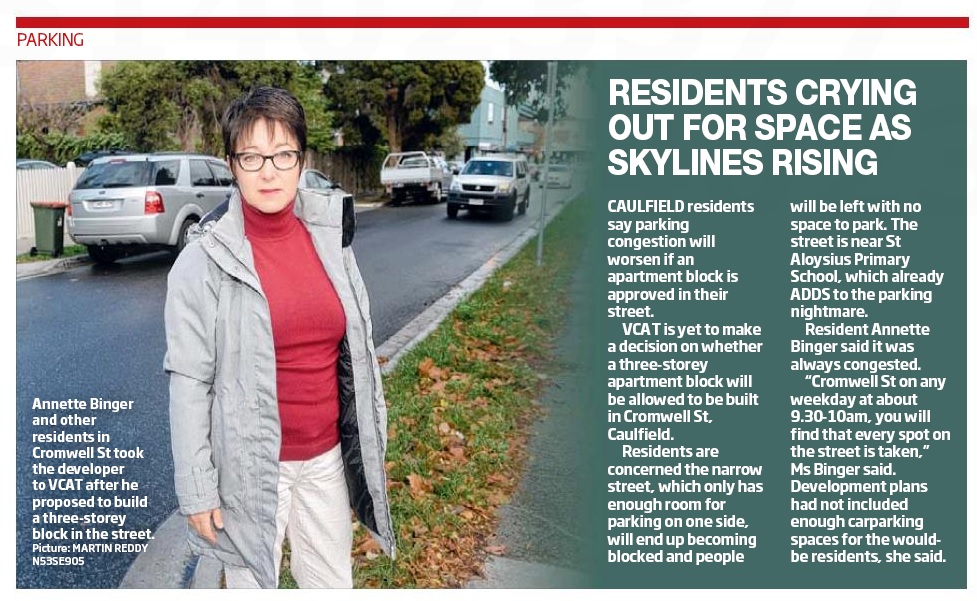
On  4th September 2012 Council passed a resolution to refuse an application for a 3 storey, 11 unit development in Cromwell St, North Caulfield. Officers had recommended the go ahead arguing the usual – housing diversity, near a tram line and commercial centre, etc. On the same night, there was another application for a 4 storey development in Howitt Road. Lipshutz and Esakoff sought to reduce this second application to 3 storeys. It abutted a Minimal Change Area. In the end the 4 storey motion got through. Whilst it could be argued that we are comparing apples and oranges, it’s perhaps worthy of noting that the Cromwell St application (for 3 storeys) was rejected. We also ask, how many other 3 storey applications have got the gong from these councillors in the recent past? There was also this declaration –

Cr Lipshutz declared a conflict of interest in this item pursuant to Section 78E of the Local Government Act being an indirect interest by reason of his mother being an objector to the application.
8.19PM Cr Lipshutz left the Chamber.

The Cromwell St. saga now features in today’s Leader.

cromwell

We’ve been waiting and waiting for the promised March appearance of the ‘review’ of the Local Law. Of particular interest will be: the fiddling with the ‘organised sport’ clause and the much awaited euphemistically called ‘tree register’ controls. More importantly we envisage that the meeting procedures aspects of the current anti-democratic law will largely remain untouched and buried in the publicity that will surround other aspects. In other words absolutely no intention of:

  • Introducing a Notice of Motion
  • Introducing a Dissent From Chair
  • Introducing a Rescission Clause

If our suspicions prove correct, then it will be most interesting to hear the arguments of Pilling who is on record as supporting a Notice of Motion and some of the other councillors. Residents should also be prepared to highlight this ‘oversight’ in their submissions.

By way of contrast once again, here is what Kingston Council is contemplating for their Local Law Amendments for the above categories (UPLOADED HERE). We remind readers once again that Glen Eira is the ONLY COUNCIL IN THE STATE OF VICTORIA that does not have a notice of motion enshrined in its local law.

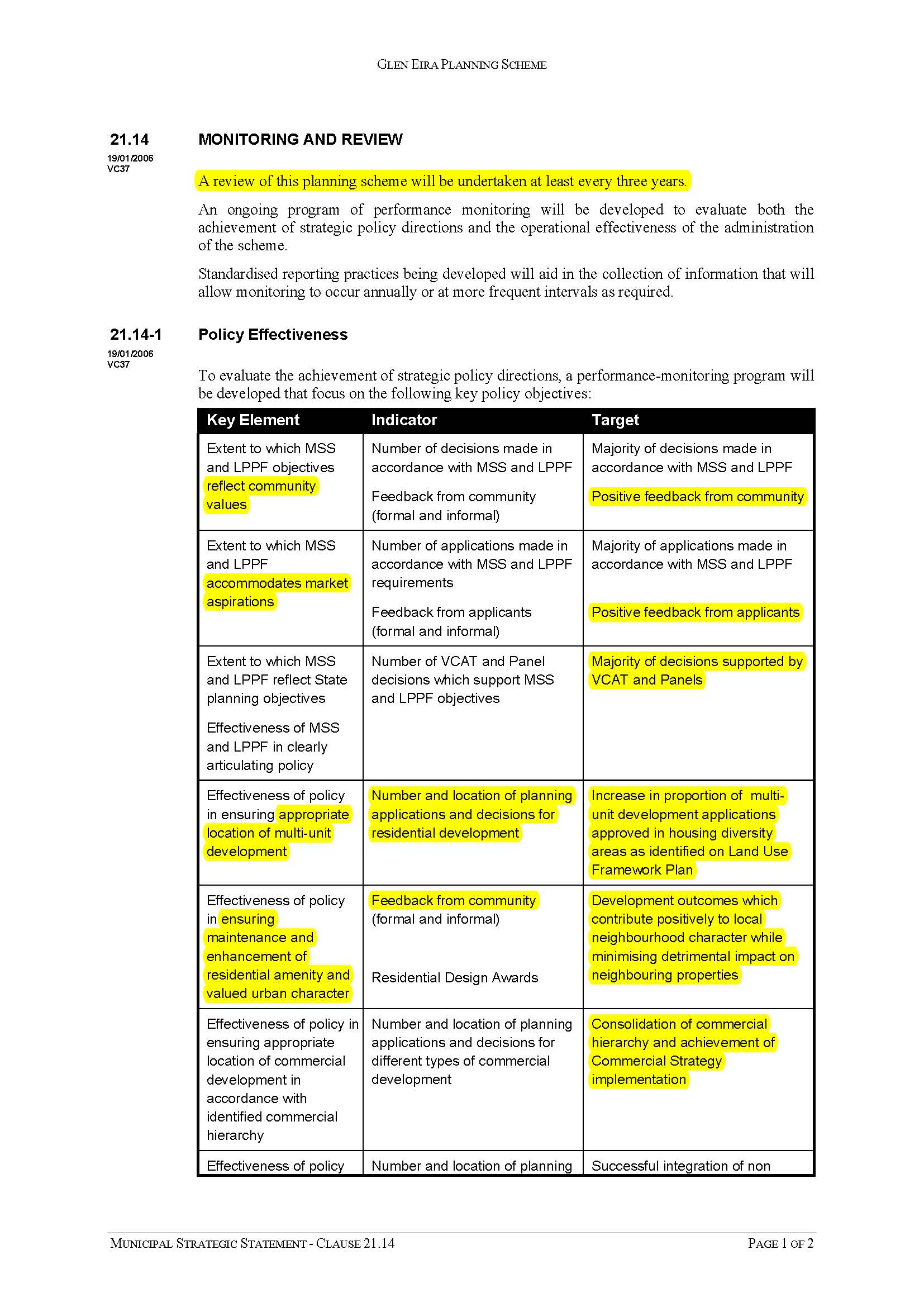
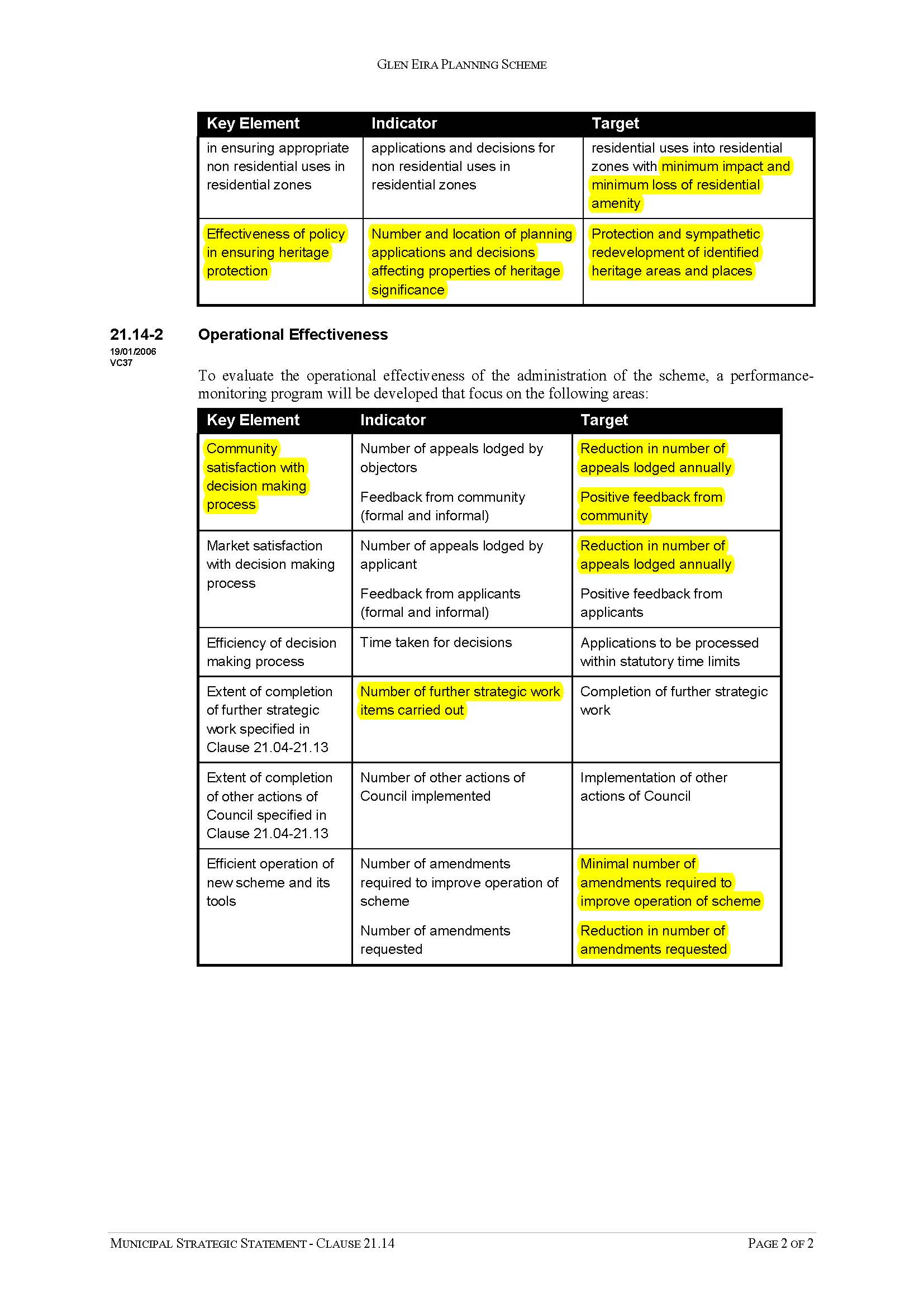
There’s the opportunity in all council planning schemes to include a ‘Monitoring’ and/or ‘Review’ section. Most councils use this to establish their objectives and the criteria against which the ‘success’ of their policies will be evaluated. Many include such elements as: drainage, open space, social and environmental amenity, transport options, etc. In Glen Eira, these terms barely get a look in! All in all, the Monitoring and Review pages of the Glen Eira Planning Scheme are nothing but empty pledges and more public relations propaganda. We ask readers to examine the following and to make up their own minds as to the real value of the criteria themselves and how well council has performed even against these lamentable standards.

21_mss14_glen_Page_121_mss14_glen_Page_2

How many more stuff-ups should the community pay for before heads start to roll? What excuses will this planning department come up with this time? Another ‘clerical error’? Another ‘slight oversight’? Each stuff up costs money, staff time, and of course, embarrassment and an insight into plain old incompetence. In this instance, the VCAT member himself has laid all bare. When officers delegated with the responsibility of making decisions based on their own planning scheme don’t seem to know what the planning scheme contains, then one has to question what is going on. We present some of the extracts from the latest schemozzle. For the full decision, see: http://www.austlii.edu.au/au/cases/vic/VCAT/2013/770.html. The application is for 20 Hawthorn Rd, North Caulfield and involved a 3 storey and nineteen dwellings (eleven one-bedroom and eight two-bedroom).

There is uncertainty about whether the subject land is located in a housing diversity area or a minimal change area under local planning policy.

There is little doubt in my mind that the subject land is in a housing diversity area under local planning policy. As the purpose of local planning policies is to give effect to the municipal strategic statement (MSS), it is relevant to start with the MSS. The MSS includes a Framework Plan the purpose of which is to ‘support and promote’ specific land use outcomes. The Framework Plan, although indicative, includes the subject land as an area along a tram route where ‘multi unit development will be encouraged’. The MSS adopts a targeted approach to meeting future housing needs. It encourages multi-unit housing in identified housing diversity areas. Land along tram routes is a housing diversity area.

The housing diversity area policy confirms the subject land is in a tram routes housing diversity area, having regard to the Glen Eira ‘policy framework plan’ and the Caulfield North ‘Framework Plan’. I will return the specifics of the tram routes policy shortly.

That the subject land is in a housing diversity area is confirmed by the minimal change area policy. The policy was recently remade with amendments in Amendment C87 of the scheme (C87). The Council exhibited C87 before deciding this permit application. In the ‘Policy Framework Plan Minimal Change Areas’ map in the scheme when C87 was exhibited and in C87 shows the subject land not in a minimal change area. C87 was approved and commenced on 31 January 2013 and after the Council decided the permit application. It did not change the identification of the subject land as in a minimal change area in that map. In other words, C87 has not changed the identification of the subject land as not being in a minimal change area.

I refer to this history because the Council assessed the permit application as if the relevant policy was the minimal change area policy rather than the housing diversity area policy. This was an error. The Council has now decided that the identification of the subject land as not in a minimal change area for policy purposes was a ‘mapping error within clause 22.08 mistakenly introduced in Amendment C87’, and has prepared Amendment C108 to correct the ‘error’.

I must apply the scheme in its current terms. The subject land is not in a minimal change area for the purposes of the local planning policy framework. The Council has prepared an amendment to include it in such an area but no notice of the amendment has yet been given, so it may be well away from being adopted and being a serious entertained planning proposal or being approved. I therefore give Amendment C108 little weight.

The schedule to the R1Z is now potentially inconsistent with the local planning policy framework. The schedule sets modified standards for site coverage, rear setbacks and private open space for land in ‘a minimum change area … as shown on the map forming part of this schedule’. The map attached to the schedule shows the subject land in a minimal change area.

How should the scheme be read to resolve this potential inconsistency? In my view, even though the subject land is not in a minimal change area for policy purposes but is in a minimal change area under the schedule, the scheme needs to be read to as if there are two minimal change areas for separate purposes. The separate and distinct nature of the two areas is reinforced when it is understood the drafters of the scheme could have applied the different standards for a ‘minimal change area as specified in clause 22.08’ in the schedule. That would have been clearer. But the drafters did not do this. They decided to refer to a minimal change area as defined by map included in the schedule. It may be unfortunate and confusing that both are identified as a minimal change area and the relevant maps are very similar in overall appearance but the potential inconsistency must be resolved by giving the two minimal change areas an independent effect

Building site coverage is complex for this proposal. Mr Bastone’s (for developer) estimate is 53%. Mr O’Leary’s (for Council) estimate is that, although the basement covers about 75% of the site, it is over 60% because part of the ground floor is above the ground towards the rear of the subject land. Mr O’Leary unnecessarily and inaccurately included ground level covered by projecting balconies in his calculation. For the purposes of assessment, I would accept that the coverage is around 60%. The schedule to the R1Z provides a standard that coverage not exceed 50%. It applies to land in a minimal change area shown on the map in the schedule. In a housing diversity area, the standard is 60%.

In my Mr Fairlie’s opinion, one basement visitor space is impractical but I prefer the submissions of Mr O’Leary that with sufficient organisation between residents and their visitors, one space would be of assistance. The owners corporation will need to make rules about use of the space.

concern

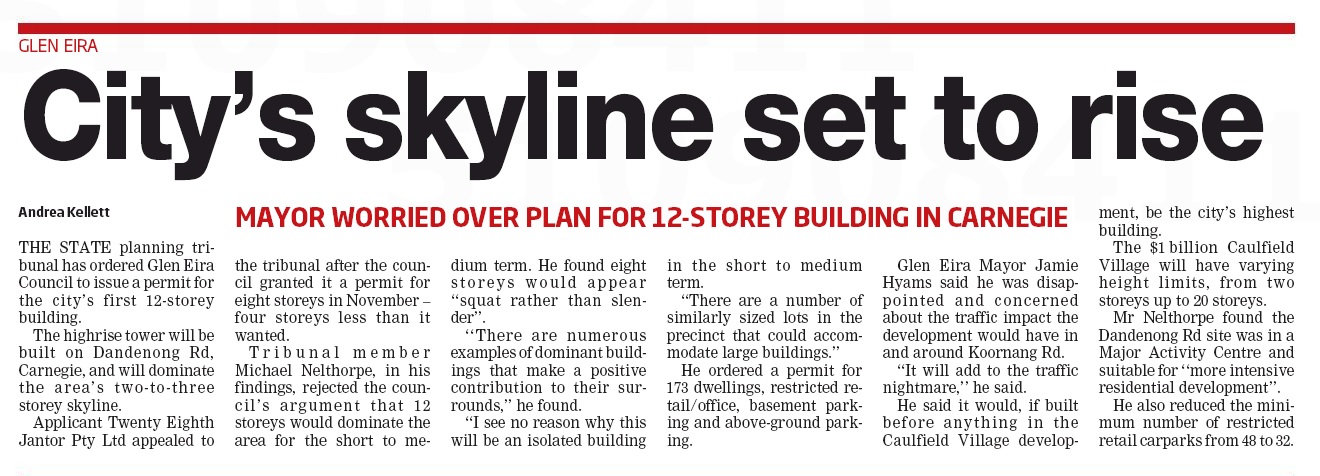
Readers will remember the 1056-1060 Dandenong Road application for 12 storeys, 173 dwellings and retail/office premises. They will also remember councillors’ ‘compromise’ of a permit for 8 storeys and 70 odd dwellings. Needless to say the VCAT judgement has come down and the developers basically got everything they wanted. We’ve no doubt that VCAT will again become the convenient scapegoat  – it is never but never this Council’s fault that Glen Eira is turning into a developer’s paradise.

We urge residents to have a very careful read of the judgement and to note in particular the following extracts taken directly from – http://www.austlii.edu.au/au/cases/vic/VCAT/2013/745.html

The review site is in Precinct 1 ‘Dandenong Road Precinct’ of the Carnegie Urban Village. There are no specific policies for this Precinct in clause 22.05 as they expired in 2007.

Given the lack of specific policies, Mr Crack took me to the objectives of the Urban Villages Policy, which include:

To encourage increased densities within and around commercial/transport nodes which respects transition to the surrounding residential area.

To ensure development respects the amenity of the surrounding area and provides a transition to the surrounding residential area.

To ensure future development is appropriate to the constraints of infrastructure and vehicular traffic movement (including parking).

Based on these submissions, Mr Crack contends that the Planning Scheme’s policies require that a development must ‘be mindful of and have regard to the prevailing character’ and ‘sit comfortably in both the existing and emerging context’.

Alternately, Mr Pitt took me to Amendments C46 and C77 to the Planning Scheme. In 2005, Amendment C46 introduced new land use and built form directions in the ‘Dandenong Road Precinct’ of the Carnegie Urban Village. Mr Pitt referred to the Explanatory Report for this Amendment, which identified this Precinct as being strategically acceptable for major change, including high density residential development.

In January 2011, Amendment C77 rezoned the site and surrounds from Business 4 to Business 2. This change allowed the land to be used for housing whereas previously it could not. The Explanatory Report for Amendment C77 describes its principal purpose was to facilitate the establishment of large format retail uses this area, however, it also states that:

Other planning policy objectives that will be satisfied as a result of the rezoning include allowing additional office floor space and the potential for new residential accommodation.

The Explanatory Report goes on to say that the zoning change would support and implement local policies relating to housing, urban villages and housing diversity.

Mr Pitt contends the strategic context for this area remains as described in the Explanatory Reports of Amendments C46 and C77 and that the site is a candidate for major change.

I find it is appropriate, as Mr Crack has done, to ‘de-fault’ to the general urban village objectives. I find the Explanatory Report for Amendment C77 is relevant as it describes the justification for the current zoning of the land, however, I will not assume the Explanatory Report for Amendment C46 describes the strategic context for the site and surrounds as the interim controls have expired and have not been re-activated.

I do not need to rely on the Explanatory Report for Amendment C46 to find in favour of the Applicant for Review. I am satisfied that the site’s physical context can accommodate major change at the review site and elaborate on this finding in the reasons below.

I disagree with Mr Crack’s submission that the Planning Scheme’s policies require a regard for the area’s prevailing character. This is not what the policies say. In a nutshell, the policies support transformative change as long as it is site responsive and, in Glen Eira’s case, transitions acceptably to nearby residential areas.

I also see no reason why this will be an isolated building in the short to medium term. There are a number of similarly sized lots in the precinct that could accommodate large buildings. The policy framework supports transformative change and recent rezoning allows this to happen. As such, it is likely that other tall buildings will emerge in this precinct in the short to medium term.

I acknowledge the building will not be screened by street trees such as occurs in some places in the Phoenix Precinct. This is not a reason to reduce its height. Only the lower levels of buildings in the Phoenix Precinct that are screened by trees and the upper levels are fully visible. Apart from this, it would be inappropriate to screen the restricted retail showroom that occupies the building’s lower levels as the showroom relies on exposure to passing trade.

Is it appropriate to restrict the proportion of dwellings that use borrowed light?

Condition 1(a) reads as follows:

No more than 20% dwellings reliant on ‘borrowed light’ (i.e. Type A dwellings facing east). The remainder of the dwellings must include direct natural light and ventilation to all habitable rooms to the satisfaction of the responsible authority. This may result in a reduction of dwellings.

It is common ground that 29% of the proposed dwellings (50 in total) rely on ‘borrowed light’. It is also common ground that these are one-bedroom dwellings of the same design and that all are oriented to the east. It is relevant that the council is not opposed to dwellings with bedrooms reliant on ‘borrowed’ light and only contests the proportion of such dwellings in the building.

Mr Crack contends that limiting the number of ‘borrowed’ light dwellings is justified by Design Suggestion 5.4.1 of the Guidelines for Higher Density Residential Development which encourages development that:

Provide(s) direct light and air to all rooms wherever possible.

He contends that a proportion of 20% of all dwellings is the ‘right balance’ in this building. He justifies this by saying it will ensure that some of the most affordable dwellings will have a level of internal amenity comparable to that of the larger dwellings in the building.

I do not accept this argument. I consider the proposed one-bedroom dwellings have an acceptable level of amenity and I find that Design Suggestion 5.4.1 of the Guidelines does not justify the contention that only 20% of dwellings in this building should rely on ‘borrowed’ light.

On the second point, Design Suggestion 5.4.1 envisages higher density developments may contain some rooms that do not have direct access to light and air. One of the emerging principles on dwellings with rooms reliant on ‘borrowed’ light is that the proportion of such dwellings in a development is an irrelevant consideration on the basis that if a particular dwelling design provides an appropriate level of amenity, then that decision is valid for all such dwellings.

This principle applies directly here. As the council supports 20% of dwellings with bedrooms reliant on ‘borrowed’ light, the amenity of the remaining dwellings of this configuration must be satisfactory.

Mr Kiriakidis relies on empirical surveys of existing restricted retail uses with floorspace of 5,000 square metres or less. He draws on 14 such surveys that indicate an average demand of 1.51 car spaces per 100 square metres and an 85th percentile demand of 2 spaces per 100 square metres. Based on these surveys, he is confident that 32, rather than 48, car spaces will satisfy the showroom’s car parking demand. He notes that the officers of the council’s Transport Planning Department share his view.

Mr Kiriakides statement of evidence also contains a survey of the existing demand for car parking within 200 metres of the site. This survey identified a total of 177 on-street spaces, including 84 that are subject to restrictions during business hours. The surveys show a peak demand of 120 spaces or, put otherwise, an occupancy rate of 68%.

Mr Bluzer submits that this survey is inadequate as it was undertaken in 2011, prior to the opening of the supermarket complex at the corner of Koornong/Dandenong Roads. He also believes the survey was inadequate as it was done for one mid-week day only.

Despite having regard for the issues raised by Mr Crack, Mr Favre, Ms Cranage and Mr Bluzer, I accept Mr Kiriakidis evidence. I find the quantum of surveys of existing restricted retail uses carries more weight than Mr Fauvre and Ms Cranage’s contention that the standard rate should be applied as a matter of principle. I note that the Planning Scheme allows a reduction in parking for a range of reasons, including empirical evidence of a lower rate of demand. In my view, the surveys relied upon by Mr Kiriakidis, demonstrate an empirical demand for restricted retail showrooms that is lower than the standard of the Planning Scheme.

I acknowledge Mr Bluzer’s points about the car parking survey. I would be concerned about the usefulness of the survey if it showed an occupancy rate far higher than 68%, yet it does not. At 68% it indicates that almost one in three car spaces were available at the time of the survey. This is a considerable number.

Mr Kiriakides’ evidence is that the likely traffic volumes are well within acceptable standards. His surveys demonstrate the Egan Street arm of the Koornang Road/Egan Street/Woorayl Road intersection will remain well below saturation levels if the building was approved.

He also notes the comments of the council’s officers that: The convenient accessibility of the site to public transport will encourage greater use of public transport. It is acknowledged that the proposal will result in an intensification of vehicle movements in the area. This is a by-product of both State and Local Planning policies channelling more intensive development and use into activity centres such as Carnegie. An opportunity to exit onto Dandenong Road is considered to be a significant advantage for this development site.

I accept Mr Kiriakides evidence and support the comments of the council’s officers.
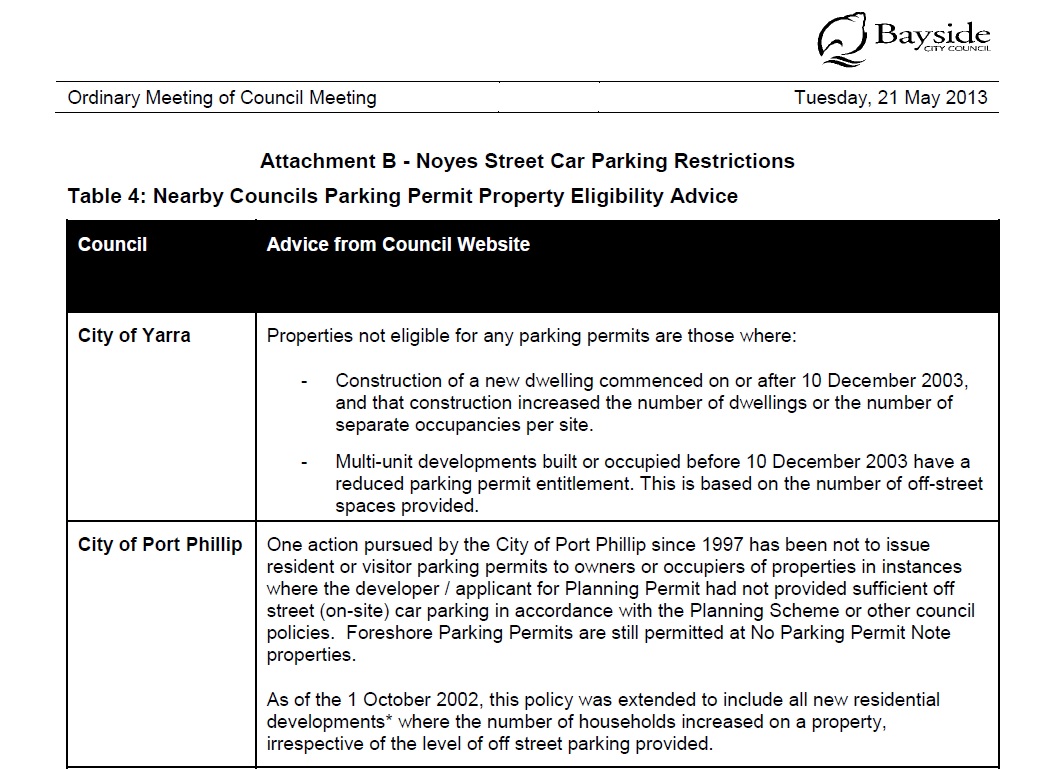
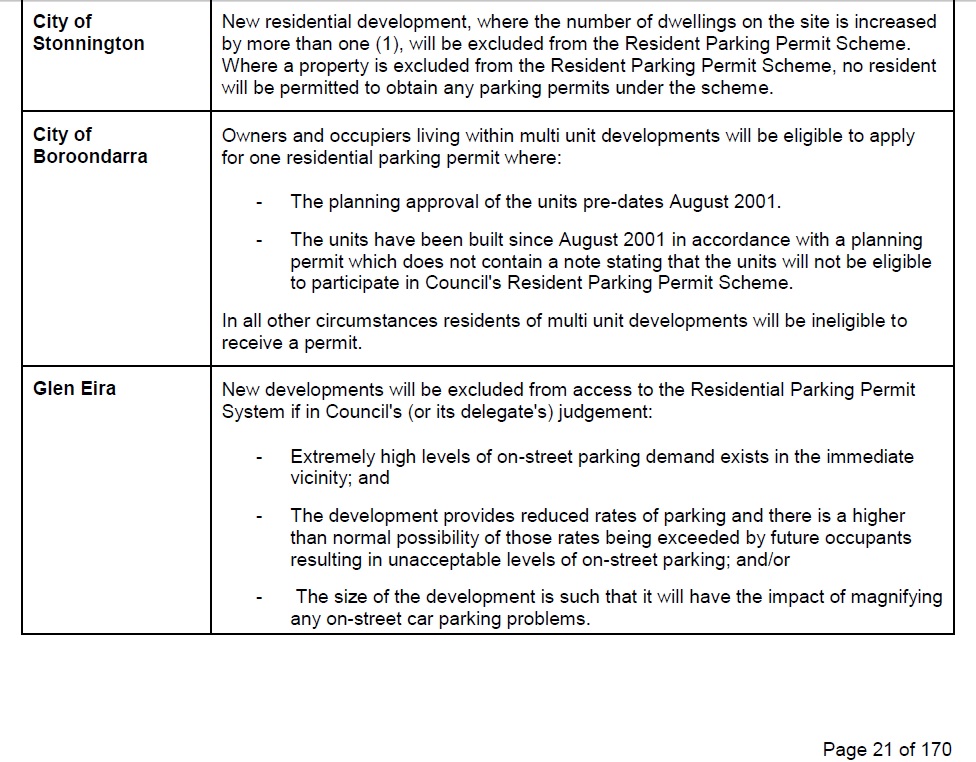
parkingparking2

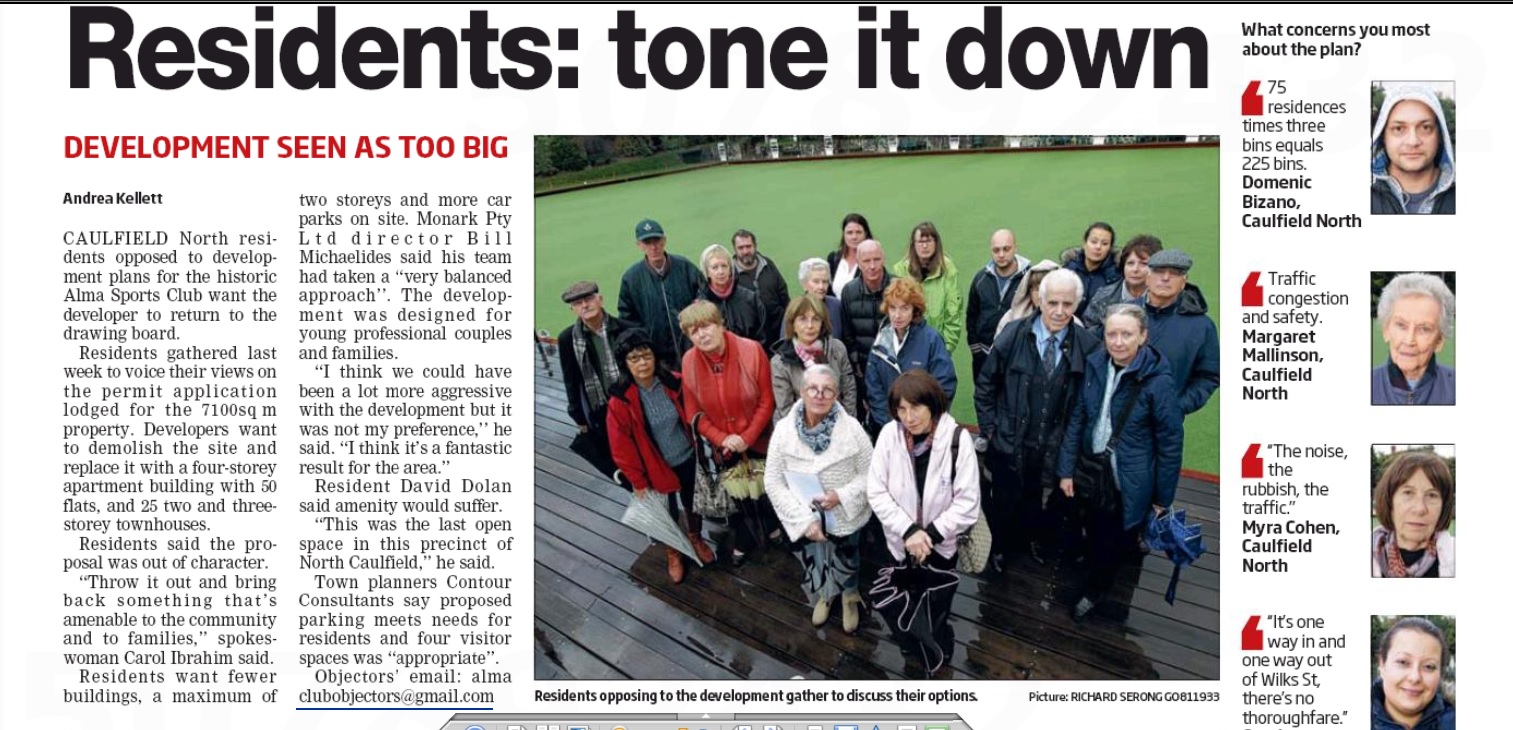
alma

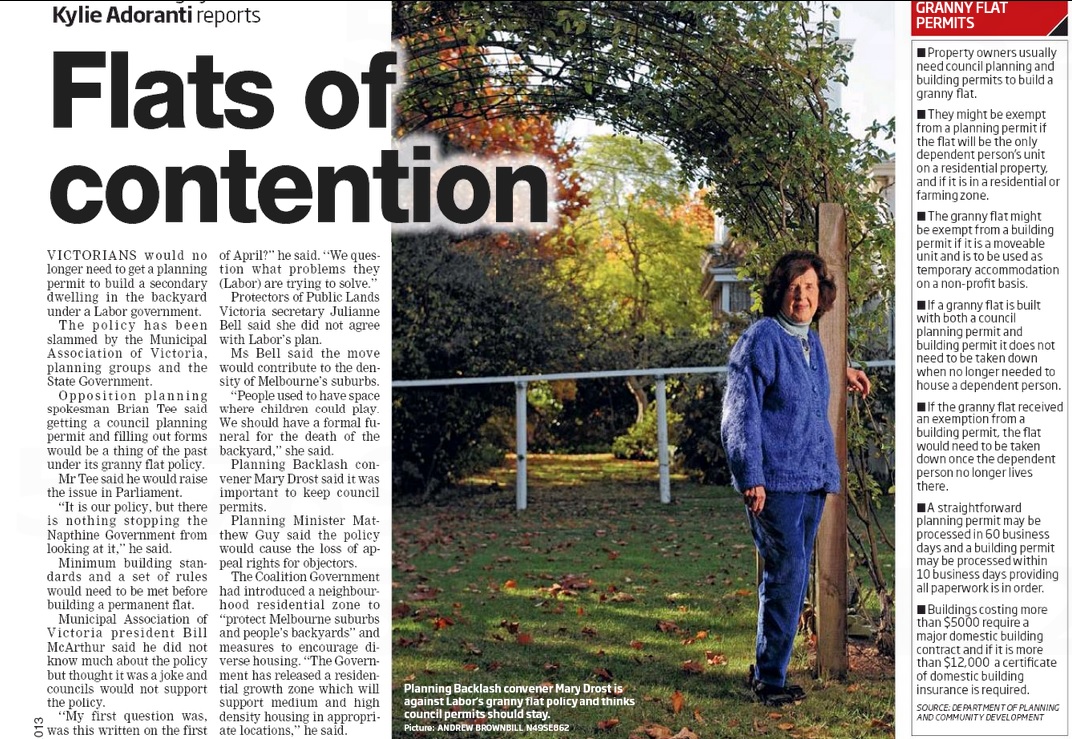
granny

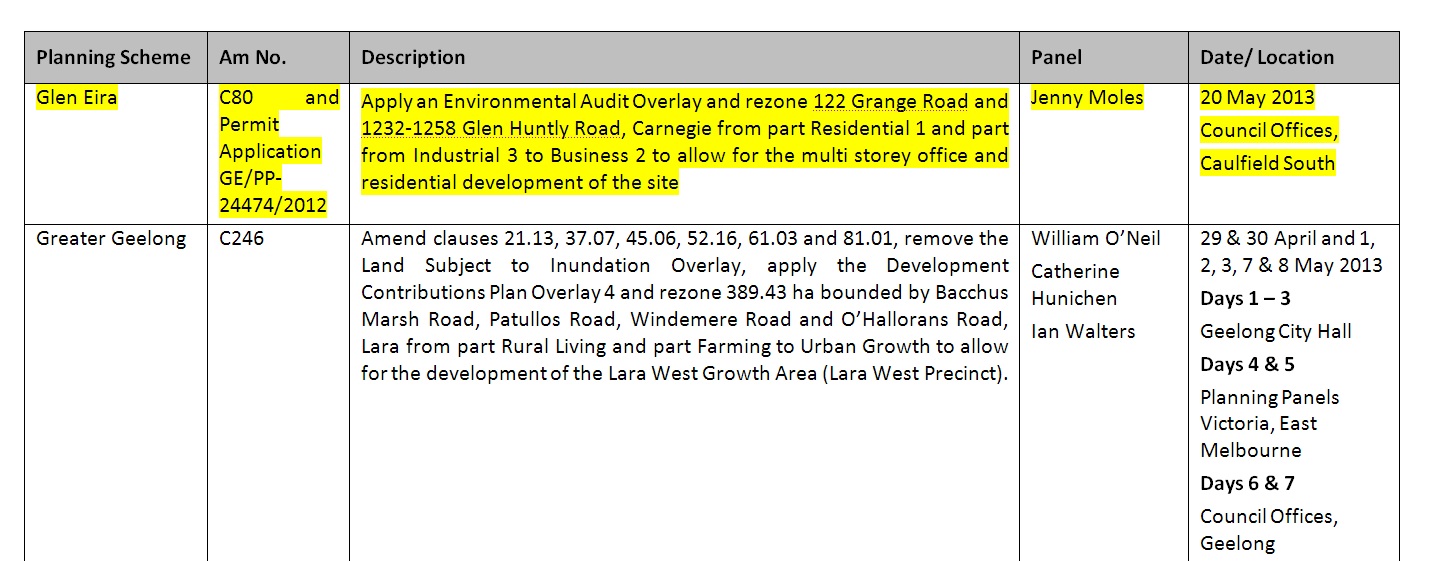
On the 20th May (ie tomorrow) a Planning Panel hearing will be held regarding Amendment C80. To refresh people’s memory, this concerns the rezoning of part of Glen Huntly Rd PLUS an application for a 5 storey development consisting of up to 62 units!

When this first came up before council in 2011, councillors voted unanimously to seek authorisation from the Minister to exhibit – even though Esakoff proclaimed some ‘concerns’ over the application part of the amendment. Then on December 18th 2012, following the Minister’s approval, and after much argey-bargey in council, this resolution was passed unanimously

Crs Lipshutz/Esakoff

1. That Council request the Minister for Planning to refer Amendment C80 to an Independent Panel to consider the submissions, but limited to the rezoning application.

2. Advise the Minister and the Independent Panel that Council has abandoned planning permit application GE/PP-24474/2012.

So what is Monday all about? Here’s the Department’s blurb on what this Panel Hearing is about (taken from the DPCD’s website) –

c80

Given the history of C87 where residents were literally duped, mislead, and deceived we have little faith that the fate of the C80 will be any different. With the C87, Lipshutz and Hyams in particular were at great pains to tell residents that they could forward their objections and recommendations and that the Panel would consider them. However, when it came to the Panel Hearing it turned out that the TERMS OF REFERENCE had been set and that the panel could not consider anything extraneous to these terms – for example, why other properties could not be included as part of the Significant Character Area. Our suspicion, given the notification above, is that we are probably heading down the same path – ie the Panel terms of reference stated above INCLUDE the application for the 5 storey, 62 unit development. It will therefore be most enlightening to see what and how Council’s planning department argues on this one. Will they actually carry out a Council resolution and desist with the arguments for the application, or will they simply toss their hands in the air and use the woeful excuse that the Planning Panel has the legal authority to make a decision on the application as well? Will residents be screwed once again? And it would be most enlightening to know if the Minister was ever notified of the existence of this resolution as stipulated?

If tomorrow’s hearing includes consideration of the application together with the rezoning of the land, then residents have once again been duped. Far more important is the question as to the value of any council resolutions and whether these councillors really know what they are doing.


Tuesday night’s agenda is definitely geared towards a ‘feel good’ session. We have the Arts & Culture strategy, the Disability strategy and finally the report on River Red Gum maintenance in Glen Eira. Never mind of course that it doesn’t include all the trees that Sounness identified in his Request for a Report. Also, the promised and re-promised tabling of the draft Local Law for May, is still a no show. There are however a few items of interest.

COMMUNITY CONSULTATION COMMITTEE

No community reps were present. In fact, it looks like the 3 sitting reps may have been given the boot since the committee has decided to advertise via expressions of interest and to ‘inform’ current members. It will be fascinating to see if any of the current sitting members re-apply and whether they are given the nod. If not, then will they be given any plausible reason for their ‘departure’?

Delahunty has been ordained as Chairperson, but only after a split vote with Hyams. Here’s what we’re told – Director Community Services called for nominations. Cr Esakoff nominated Cr Hyams; Cr Lobo nominated Dr Delahunty. Following acceptance of nominations a vote was held and the voting was tied. After further discussion it was agreed Councillor Mary Delahunty be appointed as Committee Chairperson, and agreed in principle that the chair would rotate to Cr Hyams after a year

If this isn’t pre-empting a council decision on who will sit on which committees, then we don’t know what is!

Also noteworthy is the ‘review’ of the Engagement Strategy and the stated intent to investigate methodology and VLGA ‘principles’. We wait with bated breath!

PLANNING ZONE REFORMS

Whereas other councils (Whitehorse, Stonnington, Bayside) keep publishing updates on their progress with the Planning Zone Reforms and the likely impact on their municipalities, all residents in Glen Eira get to know is the occasional throw away line in the Records of Assembly. For example:

Cr Okotel – can the MAV assist Councils to understand the new planning zones

Cr – Okotel – new planning zones

Workshop – new planning zones

We remind readers that these new zones come into operation on July 1st 2013 and Councils have 1 year to ‘adapt’. Within this year other councils are completing or undertaking their Housing Strategy & Neighbourhood Reviews. Glen Eira, we fear, is quite willing to rely on its antiquated data and suspect policies. More importantly, why have residents not been provided with any information since the release of council’s response?

AMENDMENTS

We must take some credit for the following VCAT Watch item. It concerns a decision where council argued that its yet to be advertised Transition Zone Policy should be considered in the application. We took them to task for arguing for something that doesn’t exist as did the member in his decision. In Quarterly Reports we’ve been told that this amendment is ‘on hold’ until the zone reforms come in. Now we’re told – Councillors will recall that the Minister for Planning refused Council’s request for authorisation to place Amendment C90 on public exhibition.

Why we ask? Why wasn’t this information forthcoming at the time with reasons clearly explained? Why argue for this at VCAT when it is KNOWN that the amendment as it stands can’t get to first base? Why can’t residents be told the truth right from the start and, in fact, what is the truth?

PS: please also note that the tree labelled as River Red Gum Eucalyptus camaldulensis at Duncan McKinnon plus the very nice photograph (n0 6.) does not exist anymore! IT WAS CHOPPED DOWN EARLIER THIS YEAR. So much for the accuracy, comprehensiveness and full disclosure of this report!