Councillor Performance


Readers may remember that prior to the recent state election, Bayside was on the verge of having its RGZ areas removed from the municipality. With a change in government, and a new planning minister, Bayside is again moving towards improving amenity for their residents. All of this goes to show that amendments, changes, and preserving local amenity is possible for councils. Of course, there has to be the will to do so and to pursue these issues.

In the published agenda for their first council meeting of the year, Bayside is seeking a formal resolution to:

  • Organise a meeting with the new planning minister
  • Proceed with those aspects of Amendment C106 which were refused by Guy

Bayside is seeking, via this amendment to:

  • Remove all areas zoned RGZ
  • Have a minimum lot size of 400 square metres in its Residential zone
  • Increase permeability to 35%
  • Maximum of 10 metres height in GRZ6
  • Increase private open space requirement according to number of bedrooms

For a full coverage of this amendment, see Agenda Item 10.3. Available at – http://www.bayside.vic.gov.au/documents/Ordinary_Meeting_Agenda_27_January_2015_without_Confidential.pdf

All of the above makes us wonder what on earth our band of councillors are doing 18 months down the track and when the full disaster is becoming more and more apparent with each passing day.

In comparison to Bayside, we remind readers once again, of what Glen Eira underachieved and continues to underachieve when mirrored against the real gains of countless other municipalities – all of which we’ve highlighted over the past year.

  • NO MINIMUM LOT SIZE (meaning that 487 Neerim Road can have subdivisions of 199 square metres)
  • 3 GRZ SCHEDULES (in reality only 2 applying widely)
  • GRZ zones where ‘one size fits all’ of 10.5 metre height
  • Permeability of 20% in housing diversity, and 25% in minimal change
  • Open space again, ‘one size fits all’, regardless of numbers of rooms, size, etc.
  • Residential Growth Zones in narrow, local streets (Bent, Mavho, Loranne,Belsize, etc. etc.)

Council rates capped from mid-2016

Date: January 21, 2015 – 2:23AM
Luke Battersby
Council rates will be capped next year with the state government forcing councils to justify any increases above the rate of inflation.

The new Minister for Local Government, Natalie Hutchins, wrote to mayors and chief executives last week advising the cap would be introduced before the start of the 2016-17 financial year.

“[T]his should not be seen as an opportunity to raise rates above inflation prior to the implementation of the rates cap … Unnecessary rate rises in 2015-16 may affect your eligibility for future rate cap exemptions,” she warned.  “However, the public’s support for our election commitment is a clear message that they expect councils to provide […] services while keeping rates at an affordable level.”

Councils must now send their budgets to the Essential Services Commission for permission to raise rates above inflation under Labor’s new policy.

Inflation – as measured through the consumer price index [CPI] – was currently running at 2.3 per cent. Last financial year rates increased by an average of 4.23 per cent, to an average assessment of $1725.

However, president of the Municipal Association of Victoria, Bill McArthur, disagreed with the government’s decision to peg rates to the CPI, saying the costs of running a household were irrelevant to council’s costs.  He also noted the federal government had cut funding to Victorian councils by $124 million over three years.

“CPI is a measure of a common household basket of goods, they do not take into account construction costs … It does not measure the cost of community services or construction,” Mr McArthur said.

The MAV’s taskforce has met with the new government and wants to commission a “top tier consultancy” to create a cost index to “reinforce that CPI has no bearing on the changes to councils’ underlying costs”, Mr McArthur said.  However, the MAV would work with the government “to achieve a sustainable outcome”.

The current rate cap in NSW and a previous cap in Victoria had “devastating long term consequences, including a reduction in capital spending on necessary maintenance and assets”, such as roads, parks, sport facilities, footpaths and community centres, Mr McArthur said.

The Kennett government capped rates in 1995 after reducing the number of councils from 210 to 78 and forcing rates down by 20 per cent. It then imposed a cap of one percentage point below inflation, which was running at 1.5 per cent in 1996. The cap was lifted in 1997 to allow increases of up to 3 per cent – with Ministerial approval –  to help councils raise money to fund pension obligations. In 1999 the Bracks government scrapped the cap altogether.

Chief executive of the Victorian Local Governance Association, Andrew Hollows, said state government interference in local government raised questions about democratic independence.

“We are not saying there should not be some moderation on rates, that is fair enough. [But] don’t just look at rates, look at the whole picture,” he said.

Source: http://www.theage.com.au/victoria/council-rates-capped-from-mid2016-20150120-12tz7k.html

monashmonash2

State Government vows to make Places Victoria more efficient, monitor parking spaces

  • Kylie Adoranti
  • Leader
  • January 15, 2015 12:00AM

THE State Government has vowed to make government developer Places Victoria more efficient and promised to monitor councils’ decisions on parking spaces in new apartment complexes.

These are among a list of thorny planning matters Acting Planning Minister Tim Pallas has assured the government will address.

Mr Pallas said under the new Labor Government, Places Victoria would have “a greater purpose and focus”.

He described Places Victoria as being “a shambles” under the former Liberal Government.

“There was a revolving door of management and we look forward to a period of better management,” he said.

Mr Pallas said his government would oversee councils’ use of carparking waivers “to protect livability and to make sure cars aren’t causing congestion and parking in suburban streets”.

“Local councils decide the carparking ratios for apartments in their areas. State governments have a responsibility to protect Melbourne’s livability. Development is important — but it needs to strengthen our communities, not weaken them,” he said.

“There was a revolving door of management and we look forward to a period of better management,” — Acting Planning Minister Tim Pallas

When asked about whether the scrapped Linking Melbourne Authority would be replaced, Mr Pallas said the government was in the process of establishing Infrastructure Victoria — an independent organisation to oversee capital projects.

He said there were no plans to review the urban growth boundaries and the green wedge would be protected.

The government has also promised to conduct a review into the residential planning zones.

Mr Pallas told the Leader the government would recast Fishermans Bend as a series of neighbourhoods.

“Part of this involves ensuring there is a mixture of heights and densities — from medium to high. Fishermans Bend is not a short-term project. It is a place that will evolve over many years into a precinct where people will want to live, to work and to raise a family.”

Mr Pallas was acting planning minister at the time of publication, replacing Acting Planning Minister Robin Scott who has been on leave and who was replacing Planning Minister Richard Wynne who was recovering from a minor heart attack.

Opposition Planning Spokesman David Davis said Mr Pallas criticising Places Victoria was “the pot calling the kettle black”.

“Places Victoria was a step by the previous government to clean up the rabble and mess left by Labor by the Vic Urban authority.

“Presumably Tim Pallas will retain the butler that was introduced in Labor’s period,” he said.

Mr Davis said the government had to release more details on its plan for Fishermans Bend.

“I have no idea what the erratic Andrews Government will do (to Fishermans Bend). The CFMEU-inspired planning spokesman prior to the election had no idea where it was heading.”

MRC lodges plan for outdoor cinema at Caulfield Racecourse

The Melbourne Racing Club has asked Glen Eira Council for permission to run the summer cinema at Caulfield Racecourse.

It would be located between the racecourse administration building and the racetrack and cater for up to 500 people a session.

Consultants have lodged a planning permit application and details include:

— A mobile 7m high by 11m movie screen on the back of a flat deck truck which would be parked in position each screening night;

— Guests to view movies from the lawns between dusk and 1am;

— Parking to be provided in the Guineas carpark;

— Food and beverages to be available to buy and users to bring or buy picnic meals.

The consultants’ report describes the outdoor cinema as a “unique entertainment experience”.

Melbourne has a number of outdoor cinemas, among them the Moonlight cinema at the Royal Botanic Gardens, December — March; and Ben & Jerry’s open air Cinemas at St Kilda’s South Beach Reserve, November-December.

The MRC wants a permit to run its outdoor cinema between November and March, with an option to use the land for an outdoor cinema throughout the year.

MRC spokesman Jake Norton said ticket prices had not yet been decided.

“No. The concept, if the application is successful, would not be rolled out until next summer. Given that timing, as well as the fact that the application has yet to be approved, practical plans around ticketing, event logistics, dates and times, the product itself, content, associated food and beverage offering etc are still some way off,’’ Mr Norton said.

Glen Eira Council granted the MRC a permit for a permanent $3 million super screen at Caulfield Racecourse last year.

That screen displays race day activities including live video feeds, race replays, race day information and sponsor information.

++++++

 COMMENT

The following sentences are taken directly from the formal application. We urge readers to carefully note the hyperbole, the spin, and what this could mean for residents. Most importantly, we have to again question what has happened to the so called ‘agreement’ between Council and the MRC and the role of the Minister and the Department in this entire episode. The standout issues as far as we can see are –

  1. Public Transport does not operate till and after 1am weekdays
  2. Does extending the area for a liquor license fly in the face of the alcohol ban and how would the local constabulary view this attempt?
  3. Is Crown Land again being used for private commercial gain – especially when the MRC claims to be a ‘non-profit’ organisation?
  4. Have the Trustees signed off on this latest effort? Did they give permission for the application to the Department?
  5. Will the centre potentially be used for car parking?
  6. And will council once again cave in – either on the night, or at VCAT?

Here are the quotes:

Access to and parking at the racecourse is available with minimal impact to the community

The proposed outdoor cinema makes use of an entertainment facility that would otherwise lie idle during the proposed hours of operation.

Melbourne Racing Club is the custodian of a range of land holdings associated with and including the Caulfield Racecourse. The land holdings are a combination of freehold and Crown Land. The site which is the subject of this application is known as 31 Station Street and is contained within Crown Land referred to as Allotment A as Caulfield, Parish of Prahran.

The (Glen Eira) MESS notes at clause 21.01-2 that Caulfield Racecourse and Monash University are facilities of metropolitan significance and both are of major importance to the local economy. Further, Clause 21.02-1 Key influences – Advantages and Opportunities, recognises Caulfield Racecourse as a landmark and regional facility that contributes to the attraction and ‘liveability’ of the municipality.

Clause 21.06-2 identifies the objectives and strategies in relation to Business within the municipality, including:

  • To encourage more local employment and attract more local spending in partnership with business
  • Encourage new and innovative retail and commercial activities to establish in the municipality having regard to the hierarchy of centres as well as opportunities to developer appropriate freestanding sites for suitable retail or commercial use.

It is submitted that the proposal will achieve the following key imperatives of the SPPF by:

  • Encouraging a sue that meets the communiy’s needs for entertainment and providing a net community benefit in relation to accessibility, efficient infrastructure use and the aggregation and sustainability of commercial facilities.

With the event proposed at the northern end of the subject site, patrons are within walking sitance of the Caulfield Railway Station interchange (with train, tram and bus services available). The Guineas car park which adjoins the proposed event location will also be available to patrons who choose to drive.

…..any overflow parking requirements can be provided by Melbourne Racing Club’s numerous other car parks.

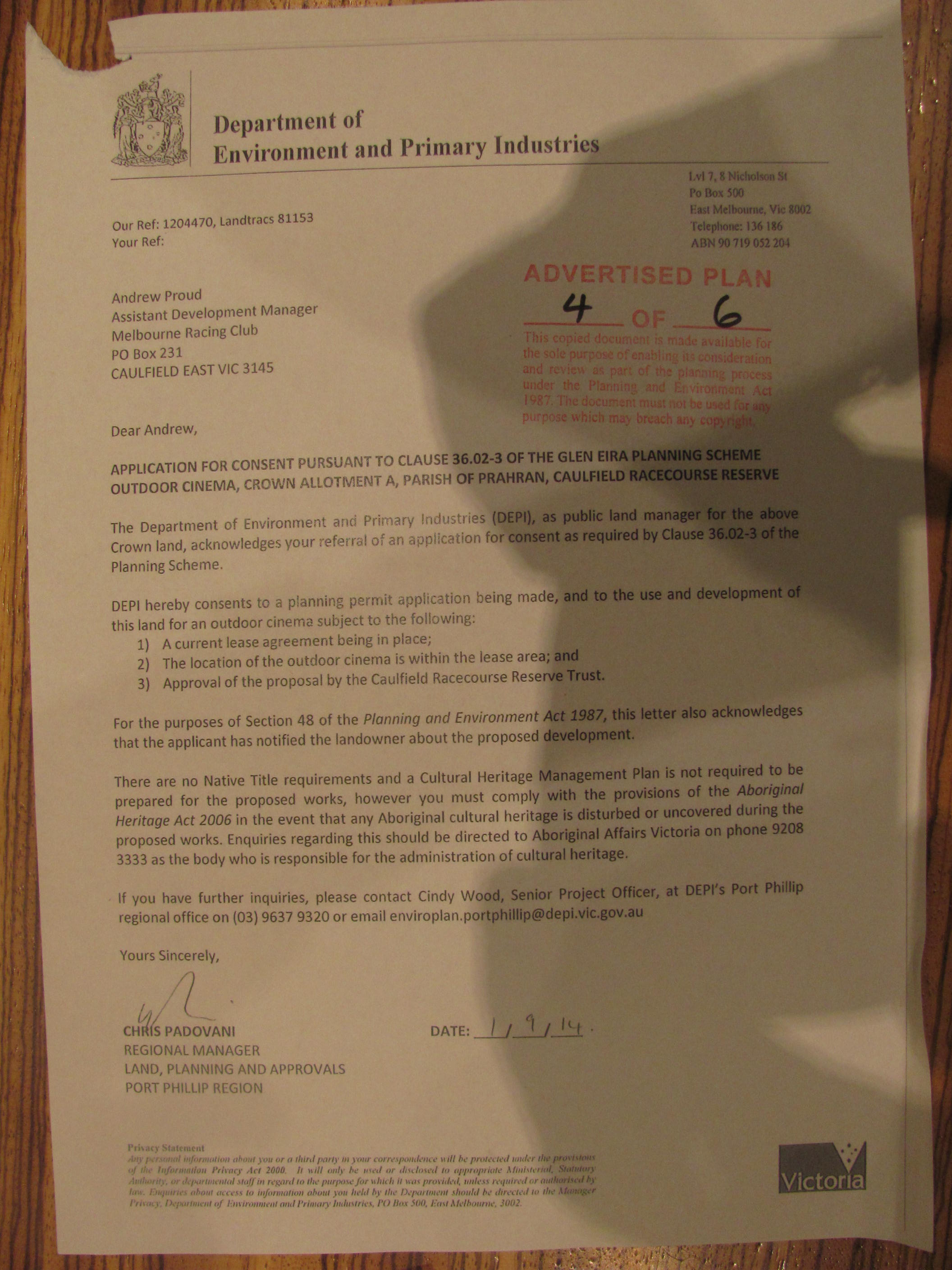
DPI

In Glen Eira contracts awarded under tender are invariably decided behind closed doors via the in camera provisions of council meetings. Residents are not even always provided with information as to the outcome of these tenders. Not only does Glen Eira not provide any information on WHY and HOW the tenders are awarded, nor why company ‘A’ was successful as opposed to company ‘B’, but the performance criteria themselves are kept secret, the officers involved are secret, and the voting is secret.

We’ve reported previously on how other councils go about their tender decisions. Many publish full accounts of the companies involved; the scores they achieved against the criteria, and the individuals involved. Further, these are published in full in council agendas and minutes. Glen Eira maintains its cloak of secrecy.

This recent tender from Monash council caught our eye for several reasons. Readers should note the following:

  • The relative speed with which flooding issues have been addressed, and
  • How developer levies on drainage lessen the cost to ratepayers.

We have uploaded the full report HERE

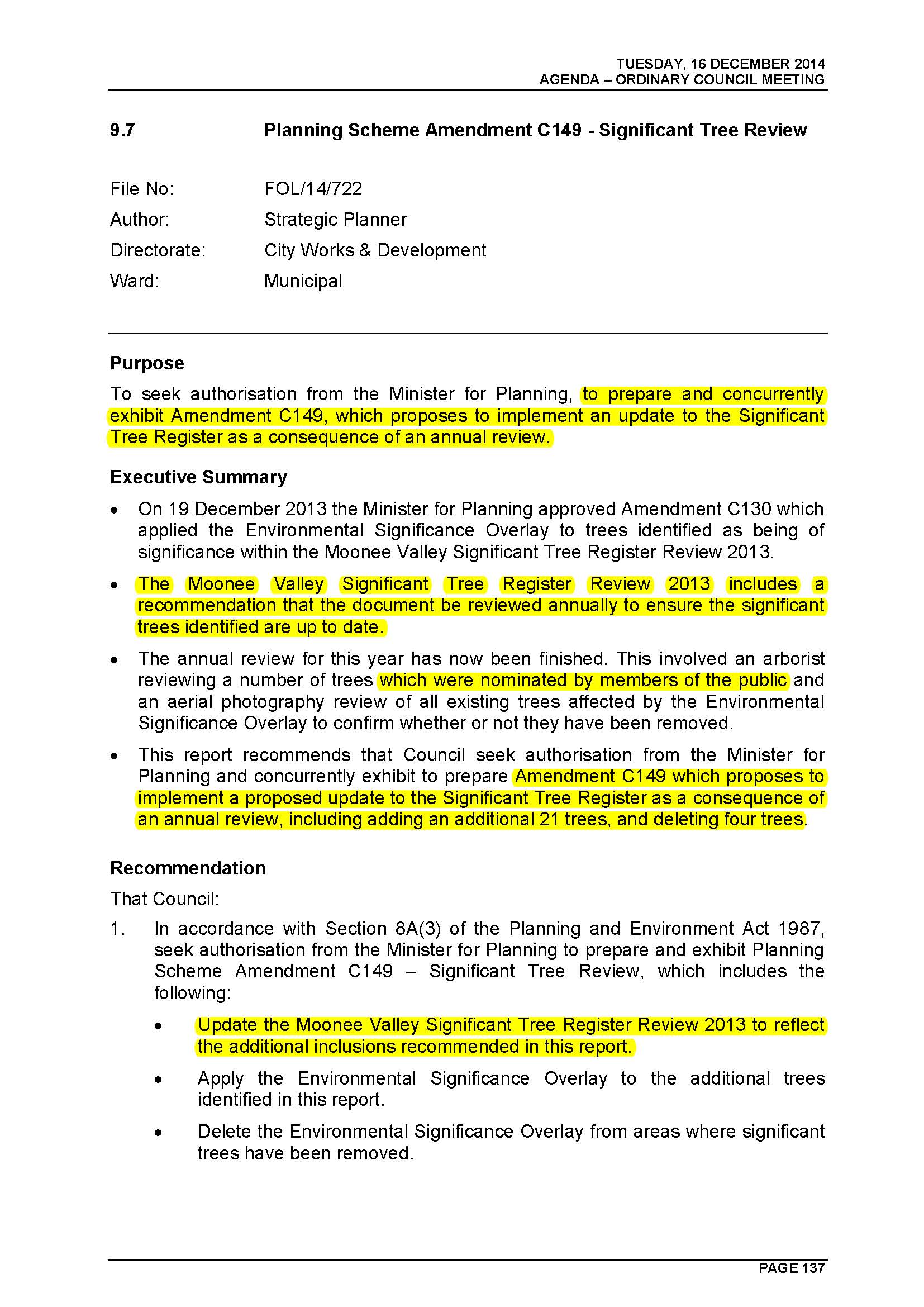
Pages from Agenda  Ordinary Meeting of Council to be held 16 December 2014Ten years at least and still counting for Glen Eira to achieve anything on tree protection. We have reported on this several times already and direct readers to a previous post – https://gleneira.wordpress.com/2013/10/14/the-saga-of-the-tree-register/

In February 2011, hundreds of properties in Glen Eira were flooded. Council’s response was a report three months later which concentrated on either laying the blame elsewhere (ie Melbourne Water, developers and residents), or patting itself on the back for its ‘emergency response’. Promises were made, such as – Council officers are currently investigating increasing Council’s drainage maintenance resources and will report on this in due course. (Minutes of 28th June 2011). Needless to say, such a report has never seen the light of day in three and a half years!

Compounding the problem of flooding in Glen Eira is the fact that it is now 9 years at least since the introduction of the Special Building Overlay into the Planning Scheme. Such overlays are meant to safeguard against the risk of flooding by mandating floor level heights. Past estimates have placed properties at risk of flooding in Glen Eira as well over 12,000. With rapid development going on in the municipality, coupled with the increase of impermeable surfaces that such development brings, it surely is time to reassess the entire local drainage system and to evaluate whether any additional sites are now also deemed to be at flood risk.

Other councils have been proactive on this issue – Darebin, Greater Geelong and Port Phillip are the current examples. Port Phillip, which bears the brunt of much water flowing down from Glen Eira’s territory, resolved at its last council meeting to seek an amendment. The amendment follows several years of joint study with Melbourne Water and intends to clearly differentiate between Melbourne Water drains and local council drains. We’ve uploaded the full officer report HERE, but included below some important extracts –

Commencing a planning scheme amendment to update the SBO immediately is recommended. Following the SBO Review, it is now known that the current SBO does not accurately reflect all properties at risk of overland flooding. Council has a responsibility to keep the planning scheme up to date, and the SBO provides an important and transparent statutory mechanism for indicating properties that are subject to inundation in a severe storm event

Modification of the SBO boundaries on planning scheme maps to reflect the revised flood shape agreed by Melbourne Water and Council (refer maps at Attachment 4). This would:

  • Include approximately 10,200 new properties which have now been identified as being subject to inundation.
  • Remove approximately 500 properties from the SBO which are no longer identified as being subject to inundation.
  • Retain the SBO over approximately 17,300 properties which remain subject to inundation. (Note: The extent of the SBO over these properties may be altered.)

Port Phillip has also included maps of the new sites in its proposed amendment. We find it extremely difficult to accept that potential flooding risk as determined by Port Phillip ‘conveniently’ stops at the border with Glen Eira. If many of the streets running off Hotham on the Port Phillip side are now deemed to require an SBO, then surely many of the properties less then 20 metres away on the Glen Eira side of the street could also be under threat. The questions that need to be asked regarding these new studies are:

  • If ‘Council has a responsibility to keep the planning scheme up to date’, then what has Glen Eira done in the past decade or so in relation to its SBO?
  • Why has Council been so reticent in providing any information on its flood risks and measures taken to improve and extend local drainage systems – especially after its ‘promise’ of 2011.
  • The current buzz word for councillors is ‘capacity’. How is this quantified, evaluated, and acted upon?
  • What impact is all this new development having on Glen Eira’s drainage systems and the water table? Does Council even know?
  • And the most important question for residents is – how much longer will ratepayers continue to subsidise developers given that Glen Eira has abandoned its development contributions levy scheme?

Finally, readers may also find the Darebin proposed amendment of interest. Uploaded HERE.

Plan to fund new drainage works

17 December 2014

Developers will be asked to contribute towards the cost of drainage works to improve flood protection in Bayside under a proposed development contributions plan.

Bayside City Council Mayor Cr. Felicity Frederico said the Bayside Drainage Development Contributions Plan (DCP) proposes a fair and equitable system for developers to make a contribution to the increased drainage capacity required when units and apartment blocks are built.

“The plan also allows Council to remain focused on its long-term financial management by continuing to look at opportunities for alternative revenue streams to take pressure off rate increases,” said Mayor Cr. Frederico.

The DCP proposes a development levy of $2000 for each additional ground floor dwelling, $1000 for each additional upper floor dwelling and $340 for each additional 100 sq.m of commercial development built in the Bayside municipality.

Contributions from developers will only be spent on infrastructure that services the drainage needs of new development in that catchment.

Residents building one house on a block of land will be exempt from paying the levy. Other exemptions include additions or extensions to existing dwellings, new dwellings that replace an existing dwelling, or commercial development that does not increase the existing building area and development on public land.

Contributions will be collected when applications for planning permits are approved or at the time of subdivision.

Implementation of the DCP is dependent on its incorporation into the Bayside Planning Scheme which requires authorisation from the Minister for Planning and will follow the planning scheme amendment process.

For further information contact Council on 9599 4444.

Source: http://www.bayside.vic.gov.au/about_the_council/media_release_fund_new_drainage_works.htm

We thought it fitting that for the final post of 2014, we revisit the secret introduction of the new residential zones. Fifteen months down the track readers can judge for themselves the total ineptitude and complicity of councillors in the duping their community.

The following extracts all come from statements made on the 13th August 2013 Council Meeting.

HYAMS – Went on to speak about the 3 new zones and that together they ‘will cover 95% of Glen Eira’ and ‘every resident of those zones will have their amenity protected better than before’.

LIPSHUTZ – Glen eira is the first council to ‘adopt these plans’ and that’s because they have ‘vision’ and that’s because years ago Akehurst and ‘his team’ saw that ‘we neeed to have distinct areas to protect our suburbs’. Because these plans already exist they were ‘able to translate very quickly’ into the new zones ‘and that’s a credit to our officers’….The zones are ‘protecting our neighbourhood, we are protecting our municipality and that’s important’.

MAGEE: Apart from commercial zones, there is now a ‘sense of security’ for developers because they know what they can do and get a loan easier. Developers can therefore plan better. Said that the 4 storey buildings around tram lines is only 2.2% ‘of our city’ and ‘you might actually struggle to find a block big enough’ to build 4 storeys because of ‘setbacks’ on top floor. So a lot of these could ‘end up being 3 storeys’. Said it was a ‘really good outcome for the residents of Glen Eira’…..Congratulated officers on ‘getting this through’ and didn’t think it ‘was a surprise because that’s the sort of work we do here’…’we are very good at what we do’. In the future council can say ‘no, it’s wrong’ and ‘go away’ to developers because they haven’t got it right. Also have to thank the state government in ‘being proactive and helping us get this in place’. ‘I think the outcome for Glen Eira is superb’

DELAHUNTY: ‘generally’ supports that this is a ‘good outcome’ but the ‘Minister sought different zoning’ for the Alma Club site and ‘that was done without any consultation with Council’ and she ‘finds this a little bit disappointing’ because he zoned differently there and could have also looked at the ‘old Open Space Strategy’. ‘It would have been a fantastic opportunity to have had that conversation’ with the Minister. The same goes for the ABC site. Also ‘at the start’ she had ‘reservations’ about the ‘lack of public consultation’. She ‘lost the argument’ on that one but ‘I have to say I deserved to lose the argument’ but since she wasn’t part of the 2010 consultation and ‘that doesn’t mean that the community’s views have necessarily changed’ so people got what they wanted. She’s just left with the ‘inkling of bad taste’ about the Alma Club and ABC sites

OKOTEL: congratulated for the ‘very hard work’ by Newton and Akehurst and team. It was a ‘very quick turnaround to make sure this happened’. The old system was ‘plagued by inefficiencies and uncertainties’ for planners and residents so it’s ‘pleasing’ that there are now height limits and that will ‘certainly’ eliminate the uncertainty. This is ‘exciting and well overdue step’. Said that she ‘maintains’ that a ‘consultation process would have been appropriate’ and that since this was in 2010 this wasn’t the direction prior to the  ‘submission being made to government’ and it ‘was a submission put to government and ultimately it was the government’s decision in terms of what the new zones look like’. But ‘despite that’ the decision is ‘very pleasing’

AND HERE’S PART OF COUNCIL’S RESPONSE TO A PUBLIC QUESTION

It is our firm belief that further consultation could not have resulted in a better outcome, and may well have had the opposite effect.!!!!!!!!!!!!!!!!

« Previous PageNext Page »