Councillor Performance


We’ve received numerous comments and emails from residents as to the failure of both Council, the MRC and/or Trustees to ensure that the terms of the ‘agreement’ are adhered to – especially in terms of ACCESS to the Racecourse. Time after time gates, which are supposed to be open from 9.30 to sunset are locked.  Not good enough! What has council been doing to ensure that access is available? Why is this situation being allowed to drag on for years and years? Why has there been no public comment from this council demanding that all terms of the agreement are met – especially the removal of fences and access.

We’ve revisited the January 2011 VCAT decision on the 7 lot subdivision and note that the member made explicit comments as to the Section 173 ‘agreement’ regarding access. It is now 14 months later and residents still cannot enter the racecourse as determined. Why has council allowed such a situation to continue? Here are some extracts from the decision –

“Prior to the issue of a Statement of Compliance, the owner of Lot 5 must enter into a section 173 agreement which provides that public access across Lot 5 to the entrance to the tunnel to the centre of the racecourse must be provided to the satisfaction of the responsible authority.

The Tribunal understands that it is the Trustees of the Crown Land that set conditions relating to public access to the Centre of the Caulfield Racecourse and whilst the MRC has control over its own land that abuts the racecourse, as well as occupying the Centre of the Racecourse, it does not control or set in place the conditions for public access to the Crown Land. MRC can therefore only control access over its land from Glen Eira Road to the entrance to the Tunnel.

The Club will reconfigure all horse movement to enable the tunnel from Glen Eira Road to be open 9.30am to sunset.

Public access to the Centre will be provided as follows.

On all days excluding scheduled race days and 10 event days as above:

a. by vehicle through the Tunnel from Glen Eira Road

b. by a footpath created in the tunnel from Glen Eira Road – the footpath will be separated from the vehicle pathway by post-and- rail fence with the tunnel having enhanced lighting

c. by the pedestrian tunnel from the Guineas car park

d. by new surface pedestrian access from Glen Huntly Park across the race tracks into precinct 4 by providing gates or gaps in all the rails. The Club reserves the right to modify, suspend or change access after consultation with the Council in the event of damage to the racing surface

e. by foot via the existing gate from Queen’s Avenue

On all days excluding 3 scheduled race days and 10 event days as above:

a. by vehicle through the tunnel from Glen Eira Road

b. by a footpath created in the tunnel from Glen Eira Road – the footpath will be separated from the vehicle pathway by post-and- rail fence with the tunnel having enhanced lighting.

All the above applies up to 352 days per year as above, 9.30am – sunset, as set pout in section 2.1.

The improvements in a – e above will be established by the MRC within 3 months of this agreement being executed subject to formal planning approval, the Trustees approval and Public Land Manager consent.

The Responsible Authority agreed that MRC’s recommendation of the entering into of a section 173 agreement between MRC, as owner of lot 5 and the Responsible Authority would allow for an assurance that public access would continue to be available over this portion of land.

In particular the entering into of a section 173 agreement that is required to be placed on the title to lot 5 will ensure that public access can be continued in this location.

Source: http://www.austlii.edu.au/au/cases/vic/VCAT/2012/104.html

This is an exceedingly long post but one which is arguably the most important we have ever put up. It features the events surrounding the planning application for an Ormond 3 storey, 11 dwelling development at the last council meeting. The officer’s recommendation was to grant a NOD for 10 dwellings.

We believe the ‘debate’ that occurred on this application epitomises all that is wrong with planning in Glen Eira. It reveals the usual bogus and contradictory claims made by all and sundry, as well as the full inadequacies of the current planning scheme and its total disregard for residents in Housing Diversity Areas. We also wonder if Pilling and Sounness in particular, have the foggiest idea about planning or they are just there to support whatever is dished up to them. We can only shake our heads at the naivety, if not straight out stupidity of various councillors.

This will become obvious upon reading. We remind residents that the Emmy Monash development mentioned throughout, involved the granting of a permit for a 4 storey development on Hawthorn Rd. Lipshutz moved the motion about removing setbacks and this was supported by the majority. It also came to light that the developer just happened to be the same individual who was handing out How To Vote cards for the gang! (No conflict of interest was declared!).

We urge all residents concerned about the future of their neighbourhoods to pay careful attention to what transpired last Tuesday night. Our ‘commentary’ on this fiasco will feature in a future post – this is just a blow by blow description of our councillors ‘at work’!

Esakoff moved to reject the application. Seconded by Okotel.

ESAKOFF: refusal based on on ‘visual bulk’, ‘excessive height’, doesn’t meet ResCode standards of the planning scheme and doesn’t respect ‘neighbourhood character’ and Housing Diversity policy. Said that there are ‘several factors’ that fail to meet requirements here and that couldn’t be addressed by merely adding conditions. Spoke about ‘amenity impact on neighbours’ and ‘intensity of development’ as well as ‘set backs’ – especially building right on a laneway where bedrooms would be overlooking the laneway. It’s an ‘overdevelopment’ and therefore not ‘appropriate’ or ‘fits into’ this position in Ormond.

OKOTEL: started by saying that everyone thinks that ‘appropriate development’ should happen in Glen Eira but that the ‘key word is appropriate’. The planning scheme she claimed ‘sets out for everyone’…..‘what is considered appropriate’ and that this application ‘doesn’t meet those standards’. It ‘falls outside the upper limits’ of height, site coverage, and neighbourhood character.

PILLING: whilst he ‘appreciated’ the arguments put up so far, he was supporting the recommendation. The property is in a neighbourhood centre and a retail centre, and ‘within a very short distance’ there’s the railway station. Policy is to ‘encourage development in these areas’ and therefore ‘not in minimal change areas’. Thought that council therefore ‘had to be consistent’ since they were ‘trying to get appropriate increased development in these areas’. The application shouldn’t be refused even though it is slightly over specifications and there are ‘some detrimental aspects’ but this still shouldn’t ‘sink’ an application ‘like this’. If the motion to refuse failed then he would be moving a motion to accept the recommendations.

DELAHUNTY: said she didn’t ‘like’ the setbacks of the proposal and ‘I’m confused by my fellow councillors’ by applying the criteria of setbacks to ‘knock back applications on the one hand’ and then ‘not in another’. Referred back to the Emmy Monash 4 storey application on Hawthorn Rd that was passed and ‘some councillors’ argued then that setbacks didn’t matter. Now they’re arguing that it does matter. Said she was ‘confused’ about the setbacks and the ‘different directions this is taking’.

MAGEE: admitted that he had ‘no idea which way I was going to vote tonight’ and was hoping ‘to get persuaded by some really good arguments’ but that ‘so far all speakers have failed to engage me’. The laneway ‘probably saves it’ and then it starts to ‘encroach’ into residential. Asked then ‘where to draw the line’? ‘If nothing else, we have to be consistent’. Was hoping that someone could convince him but he told councillors that they’d just have to wait to ‘see which way my hand goes up’.

SOUNNESS: said he’d try to be ‘inspirational’ but that Magee ‘was a hard act to follow’. From a single house ‘we’re going to stick 11 dwelling on there’..’that’s a lot’…’a big up’ in density. But he’d ‘rather have a bunch of people’ that are close to transport and shops than put ‘in the middle of minimal change areas’. Asked where all the ‘extra people’ can go and what can be protected. Here, ‘they’re next to shops, they’re next to public transport’. Further, ‘it’s not a beautiful place to live’ and he wouldn’t like to live there, but ‘it’s not meant to be a luxurious’ garden area. ‘This is a place for dense living’ and you put this where ‘services and facilities are’. This application ‘might have issues with design’ but that’s the job of council’s urban designer and there are conditions that will deal with trees and access. Said that the ‘issue’ that the application ‘fails on is height’ but the rise of the land makes this about landscaping. He supports the recommendation.

HYAMS: agreed with Sounness and Pilling that ‘this is the right place for increased development’. Overall he wouldn’t ‘have a problem’ but he doesn’t ‘particularly like’ this proposal. Said there’s a difference between saying that we can have increased development and that ‘this is the building that should go there’. Thought that ‘too many issues’ on this application ‘required rectification’. Mentioned site coverage and ‘up the road from a flood zone’. Said that ‘we have rules’ and these ‘rules say 60% site coverage’ so this should be ‘60% site coverage’. It’s also 9.6 metres high and should only be ‘9 metres maximum’. Also that it’s right on the laneway also ‘concerns’ him. Trucks use the laneway and he wouldn’t like to have trucks going ‘thundering’ down outside his bedroom window so that ‘also concerns me’. ‘Generally’ he doesn’t mind tinkering with application because individually all these things wouldn’t necessary occasion a refusal, but taken together ‘there are too many of these things’.

Said that Delahunty’s view of lack of consistency over the Emmy Monash decision but that the setbacks there were ‘the front setbacks’ and ‘still quite a few metres off Hawthorn Rd’  unlike this one which would be right ‘up against the laneway. Said that Pilling and Sounness’s  foreshadowed motion doesn’t deal with the issues he’s outlined and ‘doesn’t make those adjustments’ so if councillors want ‘adjustments’ they should vote for the motion to refuse.

ESAKOFF: ‘an application either meets policy or it doesn’t. This clearly doesn’t’. Reiterated the argument about ‘too much’ site coverage and height and said that ‘if there was a way to address this via conditions that would have been done’ but here it would require a ‘total redesign’. No application like this would come in for a minimal change area. ‘It is in the right spot, housing diversity’ but ‘it has to meet policy’. ‘Increased development is right for this street’ but ‘it has to fit’. Urged councillors ‘not to look at the address’ but as an ‘application for anywhere in Glen Eira and vote with your conscience’.

HYAMS put the motion. Voting in favour of refusal were – HYAMS, ESAKOFF, OKOTEL. Voting against – MAGEE, DELAHUNTY, PILLING, SOUNNESS, LOBO. Motion lost.

Pilling then moved the motion to accept ‘as printed’ and Sounness seconded. Neither Pilling nor Sounness spoke to the motion.

OKOTEL: said that what worries her is that this suggests that ‘it is acceptable to push the limits of the Glen Eira Planning Scheme’ and also to ‘exceed them’. Said that there’s a policy in place because after consultation with residents that ‘was seen to be what was needed’ for the area and ‘if we don’t apply and uphold our planning policy’ then the question is whether ‘we can blame VCAT for not upholding our policy’? Said that it’s important for councillors to ‘stick to our policy’ and don’t allow applications that go beyond height and site coverage or set backs. Since these standards have been set they should be supported. This application just says that ‘it is acceptable to push those boundaries’ and that ‘anything goes’ in Glen Eira. Went on to say that the planning scheme developed in ‘consultation with residents’ is ‘what they want’ and councillors should stick to that. “I think it’s a sorry day when councillors cannot uphold their own scheme’ and then ‘look to vcat’ when it says that council doesn’t care about its own scheme.

DELAHUNTY: asked Akehurst a question. Since both Okotel and Esakoff had said that the application doesn’t meet ‘planning policy’ she wanted to know whether ‘this application meets planning policy or does not meet planning policy’?

AKEHURST: said he was caught in ‘crossfire’ here and that the application ‘demonstrated’ the problems with people not understanding town planning. Stated that there’s the government code called ResCode which is how the government thinks ‘Victorians should live’ and that has ‘prescriptive standards’ and in this application some have been met which Okotel and Esakoff pointed out and some haven’t such as the 9.6 height which should be 9 metres. ‘There have been other standards which have been breached in this application’ – ie site coverage. ‘But this is where it gets difficult’ since Rescode is ‘interpreted as a guide’ and councils are being asked to ‘have overall’ views on the ‘objectives’ of each of these standards. So, ‘it is possible to say that objectives of certain measures of ResCode have been met’…’even though the prescription has been clearly breached’.

DELAHUNTY: said that she is again ‘expressing my confusion’. Quoted Okotel in saying that it would be a sad day when council doesn’t apply its policy. ‘I stood here and I argued as hard as I could about the setbacks on Hawthorn Road’. Disagreed that ‘it doesn’t affect people’s amenity’ and that people complained ‘directly to the applicant’ and to council about the setbacks ‘and we didn’t enforce’ it. ‘That was a sorry day!’ ‘This is in line with policy’.

ESAKOFF: agreed that it is a ‘sorry day when we can’t uphold our policy’ and when they do what vcat is criticised for doing.‘ Our policy is supposed to be superior to all other municipalities’ and that ‘we protect our residents more than all other municipalities’. Said there’s policy and that ‘we need to be upholding those’.

MAGEE: said that policies ‘are not laws, policies are guidelines’ and it’s up to councillors to accept, reject or modify the proposal and that ‘we’ve had several weeks to do that’. If it’s all about just policy ‘then we might as well not be here’ since they’re superfluous. Asked why councillors who ‘do not have a 4 year degree in town planning’ are necessary if the policy should dictate everything. Said councillors are just ‘mums and dads’ who ‘live next door to developments’ and the decisions are based on asking oneself whether they’d like to live next door to something like this. ‘We will always interpret a guideline the way we need to interpret a guidelines’. Rescode and the planning scheme has to be looked at by officers and then councillors. Said that councillors have to make the decision based on what they think after digesting all the information and not just according to the guildelines or policy because there’s no need for councillors if that’s all they had to do.

HYAMS: said that in planning some things are ‘objective’ and some things ‘subjective’. Some things are ‘measures’ like site coverage and ‘easy to apply’ but other things like neighborhood character and front setbacks ‘are a bit harder to apply’. Setbacks are ‘measured by the average of other houses in the street’. Emmy Monash has got one nearby property right on the street and another one across the road, ‘right back’ ‘so there’s room for interpretation’. This is also true for neighbourhood character. What councillors should be doing is that ‘where it’s prescriptive you apply it’ and ‘where there’s room for interpretation you interpret it’. Referred back to last council meeting and the sign that was applied for the Kittens car wash. Here ‘policy was very clear’ in that there was ‘nothing in planning policy that said you couldn’t have that sign’ but some councillors were worried about the content of the sign and its influence on gender issues. These arguments he claimed ‘weren’t relevant’ but that some councillors ‘used their subjectivity on that’. And ‘a couple of those same councillors are saying that we should let this’ application go through. Mentioned another decision about alcohol for lawn bowls club and some councillors again voting against this but are ‘somehow managing to vote’ in favour of the application ‘tonight’. So he doesn’t want to hear ‘lectures on consistency’ from those councillors.

MAGEE then asked ‘which ones’?

DELAHUNTY: then said ‘I think Okotel because she also voted against the sign. Is that right?’

HYAMS: said that since Okotel is opposing the motion she’s being ‘consistent’

OKOTEL: asked Delahunty to withdraw her remarks.

HYAMS: said that Delahunty’s comment ‘was out of order’ since she ‘didn’t have the floor’ but didn’t say ‘anything that goes against the Local Law’. Went on to say that there are subjective elements and that ‘it’s up to each councillor to apply them as they see fit’. This application has some breaches which ‘are a lot less’ capable of involving ‘subjectivity’ and because ‘this breaches so many prescriptive measures we should refuse it’.

PILLING: thought that everyone’s got the ‘best intentions’ and that’s why these sorts of applications come to council since there are always ‘two sides’ to the issue. ‘On balance’ he’s recommending accepting the recommendation.

MOTION PUT: Esakoff called for a division. In favour: Delahunty, Sounness, Pilling, Magee, Lobo. Against: Esakoff, Okotel, Hyams. Motion carried.

Below is an exchange that occurred at last night’s council meeting under the guise of ‘Councillor Questions’. Readers should note:

  • The item on the Caulfield Racecourse had already been decided. If Hyams wished to ask or question anything that was the time that it should have been asked as he has himself ruled for other councillors in the past – especially Penhalluriack.
  • How can a Mayor rule on a point of order on himself? Hyams should have stood down
  • Hyams did not declare the section of the Local Law that governed his ruling as required
  • This was nothing more than an attempt to gain a cheap and irrelevant shot at the Labor party. There was no explanation of what was ‘misleading’ in Magee’s statements.
  • Once again governance is the victim in Glen Eira.
  • Once again the entire truth is never uttered. The special committee gave the initial go-ahead for the C60 of which Hyams was a part of. The Minister simply endorsed what he said (erroneously) at the time was a ‘council decision’. In reality it was a decision of 4 councillors only!

COUNCILLOR QUESTIONS

HYAMS: said he had a question for Newton ‘on very short notice’ and hoped that he ‘could handle it’. Hyams said that on the Racecourse item Magee had been talking about the landswap which ‘was quite scandalous’ and that the government has since then allowed the C60 so he wondered if Newton could tell ‘us which government was actually in power and approved’ the land swap.

DELAHUNTY: ‘Point of order Mr Mayor’. Said that she didn’t think this was ‘relevant’ to any point that Hyams was making.

Hyams then turned to ‘Mr Newton’ but Delahunty asked that ‘he rule on the point of order’.

HYAMS: thought that it was ‘relevant’ because there were ‘points made during the debate which might be misleading’ and that ‘I wish to get a clarification’

NEWTON: said that the landswap ‘required legislation’ and this was passed in the ‘last term of parliament’ and it was supported by both the Libs and Labor and opposed by the Greens’.

MAGEE moved to accept. Delahunty seconded.

MAGEE: said that the document sets out council’s ‘reasonable expectations’ on the use of Crown Land. Went over the history and that the reserve was set aside for ‘racing, recreation’ and park. Stated that racing is ‘well and truly catered for’ and that recreation and park isn’t.

Didn’t think that trustees should be in control but a committee of management since it was gazetted in 1886 as a committee of management but this was abolished in the 1920’s. Went on to talk about the Guidelines put out by DSE on committees of management and that the trustees are seen as such a committee. But these trustees don’t produce an Annual report, nor a financial statement, nor publish their minutes. Members of the public are also excluded. Went on to explain composition – ie 6 members of the MRC, 6 government appointed members and 3 councillor representatives. Said that the 6 MRC members can basically ‘adjudicate’ on everything. Gave the example of the trustees ‘about to lease the racecourse to the MRC’. Said he wanted to clarify that the trustees are ‘very honourable’ people but that perceptions from the community are ‘hard to’ argue against when 6 trustees aren’t just members of the MRC, but on the ‘committee’ of the MRC. The Chair of the Trustees  is vice chair of the MRC and the Chair of the MRC is also a trustee (McDonald). Stated that there’s therefore the situation where the trustees are leasing land to themselves for $71,000 per year. ‘The court of public opinion is what matters here’. Magee said that he ‘raised a lot of these concerns’ last year and that conflict of interest is ‘something that’s very dear to us’ and that council has to abide by these rules. Said that he asked for 3 things: advice from Auditor General, valuer general and DSE. He wanted to know the ‘value of the racecourse and what we’re leasing’; also wanted legal advice on conflict of interest and solictor general’s advice ‘came back….you have a conflict of interest’ and the ‘trustees said No I don’t’.

People also raise issues about ‘business’ running on Crown Land. The trust leases this to the MRC ‘for about $10,000 per year’. That’s then leased to the Aquinita stables. The people who run these stables (Symonds etc.) are MRC people. So question people might ask is ‘is it right or is it wrong’? Wants Napthine to ‘answer these questions’. Said he’d written letters previously but got no answers. He thought that some of these people have ‘conflict of interest’ and people want this looked at.

DELAHUNTY: said that it’s important that ‘council speak in one voice’ and that she thought it is ‘the biggest issue’ that the council would have to ‘deal with’. Said that the current governance ‘arrangements’ are ‘an absolute insult to us as citizens’. The 3 purposes for the land (racing, park, recreation) ‘is paramount’ to ‘restoring supply issues’ (ie sport). Getting rid of training is important for this to occur. The creation of the synthetic training track ‘seems to be at odds with their statements of 2009’ where the position then was quite ‘collaborative’ – read bits from the statement especially the bit about the MRC providing council with an annual update. ‘Well I think we just got our update!’  ….’2.8 million dollars says that training is there to stay and that’s not good enough for the people of Glen Eira’. The money spent on the training track is ‘one million more than they managed to scrape together’ for the centre and that in their media release they ‘use a comparison to sporting grounds’ explaining to people ‘just how big this bloody track is’…’65 tennis courts they say….(this is their version of) ‘flicking the bird at the people of Glen Eira’.

Getting rid of parking is a necessity ‘because it’s a public park’. She agrees with the position but that’s irrelevant because when passed the resolution becomes ‘our position as councillors’ and ‘this is a position I will uuphold, even though it might be difficult’ (family functions). Said that whomever she speaks with that this will be ‘my position’ whether it’s speaking with local MPs or perhaps attending the fun run and ‘I know this might be difficult for some of my council colleagues’ but they understand that ‘they must uphold this position at every reasonable opportunity’. This puts ‘what the public’s position is’ and isn’t ‘asking for anything that’s unfair’. Saw this as a ‘rebalancing act’ which has been ‘tried in the past’. Mentioned Esakoff being here for 10 years and ‘putting up with these issues’ but with no ‘resolution’. Supports the motion and will support it fully at fun-runs and any liberal functions even though she doubts she’ll get an invite and if she didn’t fully advocate this position that she would have to ‘seriously consider’ her role as a councillor. Asserted that ‘to do her job properly as a councillor’ she’ll use all the ‘political influence I can muster’. Challenged other councillors to ‘do the same’. Said that unless all councillors were willing ‘to advance this position’ that they would not be ‘acting in the best interests’ of those people who elected them.

PILLING: endorsed Magee’s ‘passion’ and acknowledged that the issue ‘has been around for a long time’. Thought that this position was better than previous ones because it’s ‘more defined’ and ‘appropriate’. Said that the issue was a result of both sides of politics not ‘addressing’ the issue and that the new council was committed to this. Removing horse training was a ‘key part’.

LOBO: Spoke about the lack of open space in Glen Eira and that population increase as predicted would put further stress on Glen Eira’s lack of open space. Said that ‘extensive developments’ had occured at the racecourse ‘resulting in the exclusion’ of residents to land that ‘have been legally accessible’ for ages. Said that much of the  2 billion dollars of land is now behind fences and people are excluded. ‘Even Berlin got their wall down 23 years ago’ but the MRC are just continuing to ‘put their walls up’. With high rise and increasing population the need for more open space is crucial. This means that people are turned away from sporting clubs. Called ‘upon the MRC to release the grounds to the rightful owners’. Said he hoped that the new councillor trustees would ‘put up a very passionate fight’. Stated that is the government wanted more people in Glen Eira that they should ‘stop shaking hands’ with the MRC management.

Went on to talk about the money the MRC makes from gambling and how this isn’t shared with the community.

OKOTEL: said it was ‘exciting’ to see council taking the issue on ‘so seriously’. It was ‘wonderful’ to see how ‘committed’ the council is to ‘advocate’ for the position put in the motion and how the views of residents are ‘being considered for the use of the land’. Asked a question about whether the stables are on crown land or freehold. Was told that the Aquinita was on crown land. Hyams said that she might have been thinking about the heritage stables and not Aquinita.

HYAMS: said as a new trustee he wrestled with the question of whether there’s a conflict of interest and ‘came down on the side’ that he doesn’t have a conflict of interest. Reason was that there’s a law about ‘conflicting duties’ which says that if you’re an officer that has a ‘direct interest’ then there’s an ‘indirect interest’. Said that ‘direct interest’ means that there’s a possibility of benefiting the opportunities (in this instance the Trust) ‘would be directly altered’ if decisions were made in a specific way. (Hyams cited the Local Government Act on all this). Said that he ‘would love it’ if circumstances could be altered by their decisions because then the trust would be doing ‘what it was meant to do’. But didn’t think that council taking this decision would have ‘a direct affect’ on the Trust and therefore he didn’t think that he’s got a conflict of interest.

Said that his position on the MRC is different because their job is to ‘promote racing’ and that’s what they’re doing. The ‘scandal’ is that the ‘MRC has been allowed to do this’ as a result of trustees ‘abrogating their duty’. The trust gave control to the MRC and that ‘should no longer’ go on. Said that he’d been ‘invited to speak at the opening’ but wasn’t sure whether ‘after tonight’ the invitation would still be there. Said that ‘there is a park in the middle of the racecourse’ and that’s a ‘good first step’ but that ‘people will expect more’.

Referred to Delahunty saying that this has been ‘going on for a long time’. He then mentioned the Select Committee hearing of 2008 and how council ‘articulated’ their position through Esakoff as Deputy Mayor. Said that that position was ‘very similar’ to this motion and even the Select Committee’s report ‘was very similar’. Said that when Magee asked all councillors to support that Hyams is sure that Magee ‘in no way intended to infer that this was not the position of all councillors’ nor that ‘any of us needed to be persuaded’.

Stated that the existence of racing is ‘accepted’ but that it’s time that ‘other uses had equal acceptance’ and that he wouldn’t have any problem putting this position forward as a trustee. Said that the trustees are an ‘anachronomism’ and would like to see a committee of management and the MRC charged a commercial rate.

MAGEE: started to ‘defend’ the MRC because ‘they do what they’re allowed to do’. The trustees haven’t got any ‘guidance’, ‘rules’ or ‘policies’. The only thing that’s in place is that the public are excluded from meetings, no annualj report, no minutes, etc. Said he asked for documentation on the ‘rules’ and was told by one trustee ‘think I saw a little red book once’! So a ‘2 billion dollar asset being run by a little red book’ that ‘may or may not exist’. Stated that he wanted the Caulfield Cup ‘run there for the next 100 years’ but he also wanted to see the place opened up.

Talked about the land swap and how the role of the trustees was to protect the land and they decided that it was no longer needed and the MRC bought it and last year the Minister ‘announced a 1 billion dollar development on that land’ and that the developer is the MRC. They are now ‘one of the largest commercial developers in Victoria’. Also that the Minister ‘decided that I’m not worthy of being a trustee anymore’ and that it could have ‘something to do with the letter’ he wrote to Baillieu. The MRC is classified as ‘non-profit’ but here they are as a major developer. They own 11 hotels, 3 racecourses, tabarets and are ‘into gambling’….’all we want is some land in the centre of the racecourse which is ours’. Said that at the trustee meetings he argued against the landswap because the trustees ‘were getting nothing’ because ‘the land never came back to the trust. It belongs to the DSE’. Said their, the trustee’s  land is now 8,500 metres smaller and the trustees themselves did this. They did this because there isn’t any documented policy. Wanted to know how the trustees ‘could give this land to the MRC….not knowing that there is conflict of interest’ and how could the 6 MRC members buy the land and then ‘announce a development of 1 billion’ without seeing this conflict of interest. This happened because ‘there are no rules’. The result is that residents are locked out and that whenever something is on they need the land for parking so people are again losing out.

HYAMS PUT THE MOTION. CARRIED UNANIMOUSLY.


PS: THE LEADER VIEW!

Melbourne Racing Club, Black Caviar booted from Caulfield Racecourse Reserve

  • Andrea Kellett
  • March 20, 2013 11:48AM
Black Caviar

Champion mare Black Caviar with strapper Vanessa Bartlett at Caulfield. Picture: Michael Klein Herald Sun

GLEN Eira Council last night sent an explosive message to the Melbourne Racing Club and horse trainers at the Caulfield Racecourse Reserve – move horse training elsewhere.

Caulfield Racecourse is home to world champion mare Black Caviar.

Councillors voted unanimously to adopt a 10-point position statement that commits all councillors to advocating for horse training to be phased out so the Crown land is open for more public use.

Should the reserve be used for different purposes? Have your say below.

The nine-point statement demands massive change, including phasing out all racehorse training.

Other key demands:

  • Equal land for community sport and racetracks;
  • Leases or licences put in place for each of the reserve’s three main uses;
  • Horse training to be phased out;
  • Public use to take precedence over car parking;
  • Commercial rent charged for all commercial activities; and
  • Governance by committee of management.


Glen Eira has the smallest amount of public open space of any Melbourne council.

Here’s a very brief rundown on tonight’s council meeting. A full report will be forthcoming – we’re just highlighting the decisions. As predicted, and after much huffing and puffing by certain councillors, it was decided:

  • The Special Racecourse Committee is now defunct – unanimous
  • The council ‘position’ on the racecourse is affirmed – unanimous
  • The planning application went through after the motion to refuse was defeated.
  • Plenty of public questions on Ajax footy club, Gardener’s Rd incursion into public open space. As usual, pathetic non-answers to the vast majority!
  • Hyams declared that he does not have a conflict of interest as a Trustee. Tried his usual little Dorothy Dixer to Newton to score a point against the Labor Party but was called on a point of order by Delahunty.
  • Lipshutz was absent but well ‘deputised’ by Pilling!

All in all a fascinating evening of selective memory, chest beating, and playing to the gallery and posterity.

Below are some extracts from the minutes of the February Audit Committee Meeting. We think they speak for themselves!

“Mr McLean requested that the Audit Committee be kept updated with respect to the dispute resolution process between Council and Hansen and Yuncken”.

“Financial Sustainability Risk matrix

The meeting was advised that on the basis of the Council’s existing accounting policies for Aged Care Bonds, Council’s liquidity ratio is projected to exceed 100%. If accounting policies were changed, ratios could be impacted. The Chairman asked that management review Council’s options around the liquidity ratio, including deferral of payments of the Defined Benefits Superannuation Fund liability shortfall.

Mr McLean raised the question for follow up as to whether any liquidity covenants existed around the borrowings for GESAC”.

Decision on use of Caulfield Racecourse Reserve likely to rule out racehorse training

  • Andrea Kellett
  • March 18, 2013 2:17PM
Cr Jim Magee

Cr Jim Magee is hoping there will be support for the statement on the Caulfield Racecourse Reserve.  Picture: Jason Sammon Leader

GLEN Eira councillors will tomorrow night be asked to adopt an explosive position statement on Crown land at Caulfield Racecourse Reserve.

The nine-point statement will push for massive change, including phasing out all racehorse training.

It comes just a week before the reserve’s governing body the Caulfield Racecourse Reserve Trust is due to meet.

The State Government has appointed three new Glen Eira councillors to the trust. Mayor Jamie Hyams, Cr Michael Lipshutz and Cr Margaret Esakoff’s appointments were gazetted last Wednesday. Former trustee chairman Cr Jim Magee was not reappointed.

Cr Magee will call on all councillors to support the statement.

“It’s one of the most significant statements council has ever made regarding the racecourse,” he said.

If the statement is adopted, the council will be committed to advocate for:

  • Equal land for community sport and racetracks
  •  Leases or licences put in place for each of the reserve’s three main uses
  •  Horse training to be phased out
  • Public use to take precedence over car parking
  • Commercial rent charged for all commercial activities
  • Governance by committee of management

View the full statement at gleneira.vic.gov.au.

Read next week’s Caulfield Glen Eira Leader for the council’s decision and the community’s reaction or email andrea.kellett@news.com.au with your thoughts.

Two items of interest feature in the upcoming council meeting –

  • The demise of the Racecourse Special Committee
  • Council’s belated ‘position statement’ on the centre of the racecourse

The demise of the Racecourse Special Committee comes as no surprise given that it has already performed its ‘dirty deeds’ and we now have Esakoff, Hyams and Lipshutz as MRC Trustees. The committee has served its purpose!

The second item, whilst most welcome, is also very belated and ironic in that it reiterates many of the points that Penhalluriack was insisting upon years ago. The tragedy is, that this position is AFTER THE FACT and should have been ‘non-negotiable’ right from the start. Writing to a bunch of Ministers and parliamentarians after the horse has literally bolted rings hollow indeed.

A few points are worth pointing out in this Newton drafted pitch for posterity –

  • ‘recreation’ has morphed into ‘sporting grounds’ whereas the original ‘agreement’ forbade ‘ball games’
  • It’s also quite amusing to read ‘The area allocated for community sports grounds should be no less than the area allocated for race tracks’. Given that it was Council which passed the Centre of the Racecourse permit and allowed leggo land fencing to encroach more and more on OUR land, then these words are nothing more than another public relations exercise.
  • Lipservice is also paid to the major bone of contention –‘training should be phased out’ – but with no set time line, etc.
  • One positive note that echoes Penhalluriack and Magee is the notation that commercial rates should be paid for this Crown Land.
  • Access is of course mentioned, but not a word about why fences are still up, nor hours of access.

We reiterate. This statement is welcomed but far, far too late. The failure of the Special Committee and Newton to insist on these right from the start should never be forgotten. As for ‘outcomes’ from this? Well, we’re not holding our breath given history and certain letters from the DSE, plus Premier Napthine’s love of racing.

 A public question was asked at the 5th February Council Meeting. It read:

“Glen Eira Council is reported as having made a submission to the Ministerial Advisory Committee investigating Development Contributions under the Planning and Environment Act. Will Council make this submission public and accessible to all? When was this issue discussed with councillors?”

The Mayor read Council’s response. He said: “In September 2012 Councils were asked a standard list of specific technical questions relating to the DPCD position paper entitled Standard Development Contributions Paper – A Preferred Way Forward.

Council officers provided answers to these technical questions in October 2012.

Councillors were informed of this during that time.

It is understood that Councils and members of the public will be given opportunities in the future to make further submissions.”

Since then there has been no public disclosure, and no further mention of this important issue. Even worse, the fact that councillors were ‘informed’ does not feature anywhere in the Records of Assembly for this period. Conclusion? Either the Records of Assembly are a total (censored) joke, the ‘informing’ was a brief verbal aside, or perhaps did not even take place?

We’re getting mightily sick of revealing how often this council is out of step with the majority of its neighbours. This is not the first time that submissions to various committees or government have not been ratified by council resolution first off (as done in other municipalities) much less made public. Residents have no idea as to how this council votes at MAV conferences; what positions will be taken, or much about anything. We even wonder if councillors get a look in, or have a say on anything. Yet they do nothing!  They allow residents to be treated like mushrooms and the disease of inaccurate reporting and secrecy continues unabated.

The development contributions is a vital issue for any municipality that is experiencing the unprecedented growth that Glen Eira is. Given that this council has REMOVED the contributions from its planning scheme it becomes even more important that residents know what council’s position is. Will Newton and his cohorts meekly accept the pro-development agenda, or will there be some insistence that ratepayers stop subsidising greed?

Below are the views of our neighbours – all made public and above board – not like Glen Eira City Council!

1. PORT PHILLIP EXTRACTS

http://www.portphillip.vic.gov.au/Report_3_-_Submission_to_Standard_Development_Contributions_Advisory_Committee.pdf


There remains a bias in the design of the proposed development contributions framework towards the establishment of development contributions in growth areas. This translates into some gaps in the frameworks application in established areas where project delivery can be much more complex and expensive that broad acre green field development. These gaps include:

• Assumptions about spare capacity in existing infrastructure to cope with development.

• The suggestion that a “25% discount” be applied to standard leviesin established areas compared to growth areas.

• Failure to recognise the complexities and additional costs associated with development in established urban areas.

• The significant land cost component in the provision of new infrastructure in established areas.

Project contingencies cost allowance set at 10% of project cost. A contingency set at a standard 10 % is very low for projects, particularly in inner urban areas. This should be scaled across a range in accordance with industry best practice and be project specific.

There is no recognition in the proposed framework that additional growth in established urban areas can create “tipping points”, exceeding infrastructure capacity and rendering some types of existing infrastructure redundant. This in turn will necessitate complete replacement in order to upgrade the capacity.

The framework proposes that historical capital works expenditure and population growth over time be used as a basis to set the contribution for new development. This approach is not supported as it:

• has no direct relationship to actual need for infrastructure generated by additional growth relies on historical spending that may not be an accurate indication of either infrastructure cost or infrastructure need

• takes no account of the nature of the population increases and subsequent infrastructure needs

• does not allow for consideration of current standards and costs of infrastructure provision

• is contrary to the basic tests of need and nexus that have long been established in setting development contributions.

2. BAYSIDE

http://www.bayside.vic.gov.au/5_March_2013_Councillor_Briefing.pdf

in the councillor briefing notes under – ‘proposed submission’


3. STONNINGTON (uploaded in full here)

  • The application of the Development Levy Scheme (DLS) to only large scale Strategic Redevelopment Areas lacks the flexibility needed to respond to the various levels of development occurring and infrastructure needs across metropolitan Melbourne. The needs in the Chapel Street Principal Activity Centre are not considered.
  • That the DLS decision making process should include a Social Impact Assessment

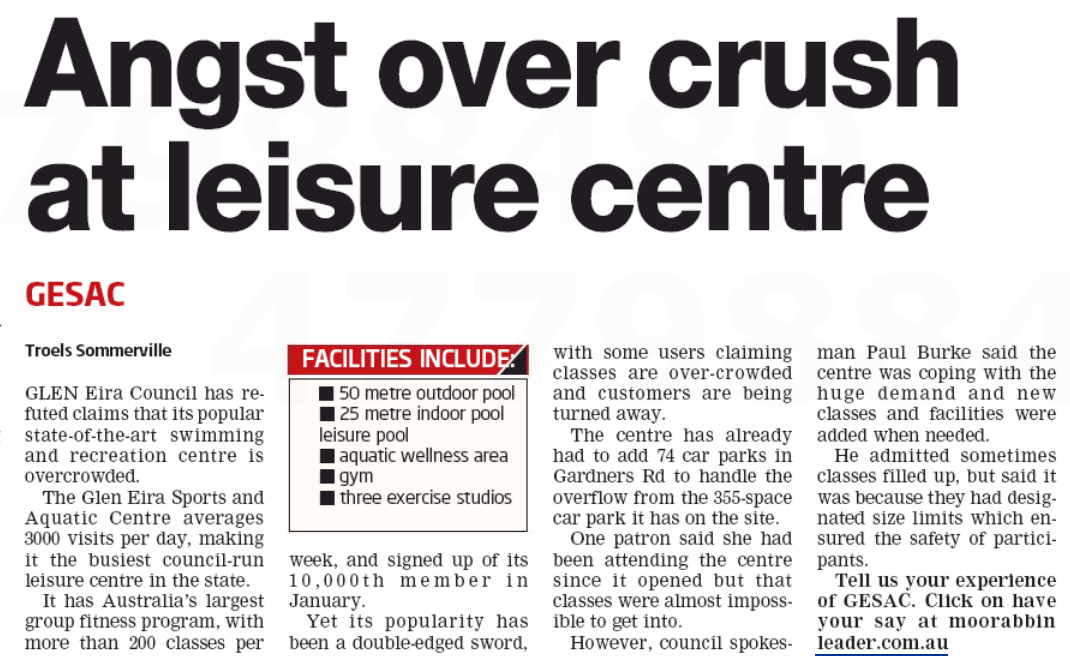
gesac

LETTERS TO THE EDITOR

Waiting for bus service

I remember our mayor and local member promising a bus along East Boundary to run directly to GESAC at the last election.

A regular bus service would reduce the need for the council to build more car parking spaces with ratepayers picking up the tab. It would mean more people could use GESAC. I hope the mayor is lobbying Ms Miller to honour her promises and a bus service will be travelling to GESAC very soon.

Be fair to the retailers

When I was a councillor for the City of Moorabbin (1984 to 1990), I introduced a council policy that council buildings not be allowed to be used/hired for the purpose of becoming retail outlets.

I did this because it is not fair on the ratepaying retailers, who put in all year, to have blow-ins come into your area at prime times, such as Christmas, set up shop in a non-retail building, thus taking away potential customers from the local retailers.

It would seem to me that Glen Eira Council needs to introduce a similar policy. How such places as Caulfield Race Course are allowed to become retail outlets from time to time is beyond me and in fairness to all genuine retailers in Glen Eira, it should not be allowed.

I counted 13 empty shops in Centre Rd, Bentleigh, from Wheatley Rd, to Jasper Rd. Of course, the Bentleigh Sunday Market has a huge impact on the viability of retail shop/businesses in the local area. Many of the “professional” retailers at the Bentleigh Market every Sunday do not come from Glen Eira. So what input do they have to our community? They take but give nothing back. Caulfield Race Course, seems to want to be “all things, to all people”. It is a racecourse on crown land.

Woman of fine principles

Last week I had the great privilege of attending the state funeral for the Honourable Joan Child AO. Ms Child was the first female member of the ALP to be elected to the House of Representatives and later served as Australia’s first female speaker of the House.

A long-time residents of Glen Eira, Ms Child raised five children largely as a single parent after being widowed at 42. Her much discussed campaign headquarters in Grange Rd serves as a reminder of the important role our area has played in progressive political activism.

May favourite saying of hers is “everybody counts or nobody counts” because it is a simple phrase of lofty principles which I hope to uphold in my role as a local councillor. It is why we must accept petitions, seek consultation on important issues and support strong community groups because everybody counts or nobody counts.

Vale Joan Child, life lived in pursuit of fairness.

Cr Mary Delahunty

« Previous Page — Next Page »