Councillor Performance


Tomorrow night, council is holding a ‘symposium’ on the proposed housing strategy. The speakers are:

Bernard Salt (demographer)

Lester Townsend (Planning Panels Victoria)

Kate Breen (Affordable Development Outcomes)

Maria Yanez (Nightingale Housing)

Whilst these four individuals are undoubtedly ‘experts’ in their respective fields, we need to consider why these people have been chosen by council and exactly how much they know about Glen Eira and its current housing needs, its zones, its development rate, its lack of strategic vision! It’s all very well to look at the ‘big picture’ across the state, but housing strategies are meant to be ‘individualised’ and pertain to unique municipalities.  We are therefore very sceptical as to the value of tomorrow night’s symposium and how well it will address the fundamental issues facing Glen Eira. Yes, what is happening statewide and nationally is important, but even more important is what is and what has been happening in Glen Eira.

Even more disconcerting are the following statements (cited verbatim) all taken from this link – (https://www.haveyoursaygleneira.com.au/our-housing-our-future/widgets/344509/faqs#80192)

The event is the opener for our early community engagement phase which will continue to the end of August.  A second phase of consultation will take place in early 2022 on the content of a draft housing strategy.

Council has stated that the Housing Strategy will be completed in April 2022. Does the above paragraph then imply that the ‘second phase of consultation’ will simply be on what council produces as its one and only draft strategy? Why the huge gap of 6 months before any further ‘consultation’ takes place?

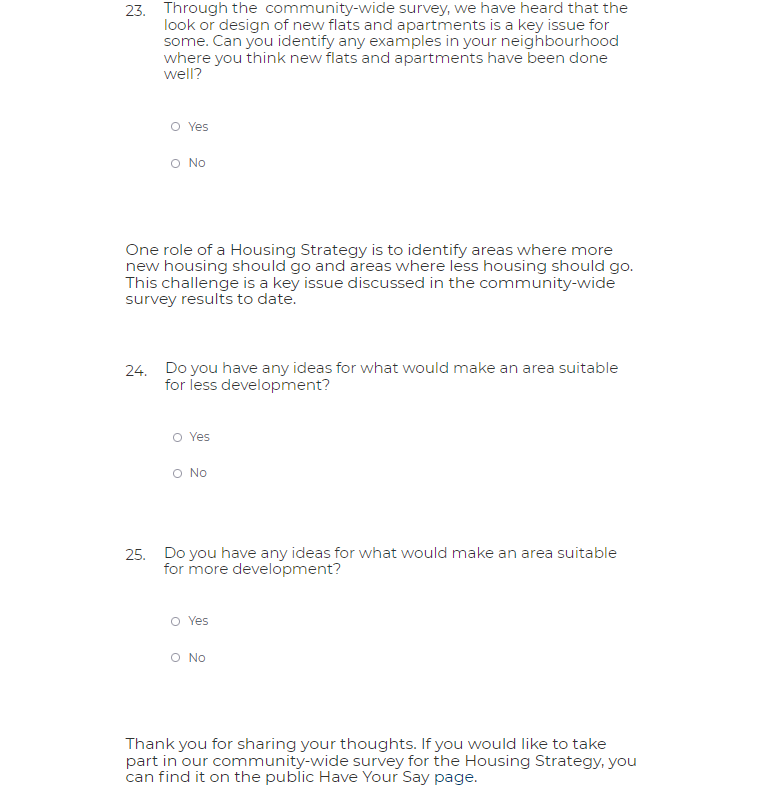
This might have been kosher if the survey and the issues paper were up to scratch. They are not. Once again we find that detail is lacking, pertinent questions and options are lacking, and residents are asked nothing more than irrelevant Dorothy Dix Questions, that add nothing to a full understanding of Glen Eira’s future and the role council needs to play.

Finally, we have this other quote:

As the purpose of the event is to explore information about demographics and housing rather than specifically about the current housing strategy project, Councillors and Council officers will not be answering questions on the night.  Drop-in sessions on 22 and 26 July are planned and will be an opportunity for the community to discuss the themes of the housing strategy discussion paper and the housing stragegy (sic) project with Council officers.

 Why then hold such a forum if it does not relate specifically to our local housing strategy? Why deny residents the opportunity to ask questions of officers and councillors? How much has this public relations exercise cost?

In the coming days we will analyse the survey and reveal why it is nothing more than another bogus exercise in so-called ‘ consultation!

PS: In 2019 Stonnington Council also held a symposium for its revamped housing strategy. They did include speakers from Planning Panels and Nightingale just like Glen Eira is doing. However, they also had someone from Profile.id – a company that Glen Eira and most other councils in the state rely on for their ‘individualised’ information. This presentation focused exclusively on Stonnington – its population growth, its development rate, its age structure, etc. See the presentation via this link: https://drive.google.com/file/d/1odRg-PHd-pmfAGCJ_oN44sI5rJkJR5oN/view. In Glen Eira such information is deemed unnecessary it would appear!

At Tuesday night’s council meeting, another policy that achieves practically nothing in comparison to other councils was enshrined through an unanimous vote – the social and affordable housing policy. It was decided that council would seek 5% contribution from developers for any development over 20 dwellings with only the possibility of a higher percentage for major developments. Of course, no figure was provided for what this might be.

We remind readers of council’s lamentable efforts in this area – the backdown on the Caulfield Village development where not even 5% has thus far been achieved and the even more pathetic 5% for 3000 dwellings in Virginia Estate. If the number of dwellings reach 4000 then it would be 10% for anything over 3000. Thus the potential is there for a 6.25% social/affordable housing component if the final number of dwellings is 4000. The fact that Magee lauds this as an ‘achievement’ shows how out of tune this council is in comparison with its neighbouring municipalities.

Policy after policy that is produced is big on waffle, generalisations, and priceless motherhood statements. But when it comes to actually implementing objectives that must be applied, council goes missing. The refusal to impose any policy which might affect the developer’s pocket is simply staggering.

Other councils have been active in this area for years now, with many continually updating their strategies and increasing the demands on developers. Below is a small sample of how these other municipalities view the issue. We have also included the various dates of these policies and their revisions. All are direct quotes:

Yarra (2018 & 2019) Yarra has worked with a number of site owners to provide at least 10% affordable housing. At the former GTV9 site, Richmond, affordable housing will represent at least 10% of the total number of new apartment dwellings. At the former Gasworks site, Fitzroy North a range of dwelling types will cater for a variety of housing needs including the provision of up to 20% affordable housing. Council will continue to seek additional affordable housing for our very low, low and moderate income community.

AND

Council expects that any affordable housing should be tenure blind and integrated with market housing, meaning that subsidised and private dwellings should not be able to be readily differentiated through either their appearance, quality or amenity and should have equal access to all communal indoor and outdoor spaces.

HOBSON’S BAY (2016) – This policy statement calls for 10 per cent affordable housing within Strategic Redevelopment Sites and encourages affordable housing in activity centres and established suburbs

FRANKSTON: (2018) – A possible threshold could be that for developments with 20 dwellings or more, 5% of the total number be allocated to a social housing and 10% to be affordable housing by agreement (15% all together). This would mean that 1 dwelling in every 20 would qualify as Social Housing under this approach.

MARIBYRNONG (2018) Investigate a contribution of a minimum of 50% of the value uplift created when land is up-zoned, to be used for affordable housing ―― Require a contribution of 10% of housing units to be used for affordable housing in areas currently subject to a Development Plan Overlay

MELBOURNE: (2020) Urban renewal areas present unique opportunities to substantially increase the supply of new affordable housing. This is due to the extent of underused land available in these areas and the opportunity Council has to shape these precincts as they are regenerated. On these sites, consideration will be given to accommodating greater than 25 per cent affordable housing

CASEY(2020) – ….guide action towards increasing the supply of affordable housing and working towards achieving a minimum of 12 percent of all new dwellings built to be affordable housing.

Council will be voting on the draft budget this Tuesday night. The differences between the May version of the budget and what is now presented is remarkable. Whilst some areas have received increased funding, the issues that were highlighted in the submissions have been totally ignored. This once again raises the question of why bother to ask for community input, when the recommendations are so flagrantly ignored year after year? Residents are never given the opportunity to specify what their priorities are. Instead we continue with the top-down approach and the minimalist adherence to the legislation. God forbid that residents be given the opportunity to answer such questions as: where do you want your money to be spent and how much?

The submissions made it very clear that what was needed was:

  • Increased funding for the urban forest strategy. This still remains at the May version of $200,000!
  • More funding for the acquisition of new open space. Nothing has changed from the $7M proposed in May.
  • Residents wanted the bicycle strategy to receive a minimum of $500,000. We are still stuck on $250,000.

At this rate, we can be waiting well into the 22nd century before our tree canopy reaches any reasonable target, or there is sufficient open space to accommodate the increasing population.

Yet council has still managed to find and allocate huge increases to various projects that are not only questionable, but where we believe most residents would argue aren’t necessary and certainly not on the top of the priority list. Please note, we are not arguing that these things shouldn’t be done. What we are suggesting is that given all the other major issues that are currently confronting Glen Eira, that much of this money should have been directed into those areas that demand immediate action – such as open space, the urban forest strategy, structure planning, amendments for development contribution levies, etc.etc. Five years on from the ordered Planning Scheme Review, we have practically nothing in concrete outcomes.

Below is a table which depicts the monies allocated for the various projects according to the May and then the June draft budgets – and all with hardly any detail.

PROJECTMAY DRAFT BUDGETJUNE DRAFT BUDGET
Caulfield Park Masterplan$600,000$710,000
Duncan Mackinnon Netball$200,000$250,000
Pedestrian Safety$205,000$355,000
GREAT WALKS STREETNot listed$700,000
Outer Circle$40,000$700,000
Lord Reserve/Koornang Park master plan implementation$500,000$680,000
Hopetoun Gardens$40,000$220,000
Tennis Strategy$75,000$275,000
Caulfield Park master plan implementation$40,000$790,000
Princes Park Playground upgradeNot listed$1,250,000

Surely some of these projects, and their massive increases in funding, could be deferred until this council sorted out its other major concerns as we’ve listed above.

Finally, it is also remarkable that in the space of one month, we have gone from an estimated deficit of $45,000 to a suggested surplus of over $11M where the announced government grants somehow don’t add up to this amount!

Our final comment is that until this council is prepared to provide full and comprehensive explanations for its decision making and budget allocations, residents are once again left in the dark with no real say as to how their money is and should be spent.

It’s with great interest that residents need to follow the following Supreme Court Case –

This raises innumerable questions:

  1. How much of ratepayers’ money will council expend in fighting this case?
  2. Were councillors apprised of what was happening and if so, when?
  3. How many more times will this planning department overlook their own planning scheme and recommend permits that are highly questionable?

PS: Today’s (Saturday’s Age) –

https://www.theage.com.au/politics/victoria/well-connected-ex-banker-takes-on-council-over-elsternwick-tower-plan-20210618-p5826q.html

Public submissions for the draft budget and Strategic Resource Plan, have one consistent theme running through nearly all of the presentations. This is best summed up with this sentence from one such submission –

It is one thing to have a strategy and action plan in place, it is quite another to implement them. As Councillors would well know, implementation requires funded projects. It is here that Council is lacking.

Time and again throughout all of these well documented and thoughtful submissions we find similar statements. Council has policies, plans, strategies but implementation is either non-existent, or years behind schedule, and simply underfunded and/or forgotten about. This applies across all departments – from Caulfield Park implementation of the Master Plan, to bike paths, open space, the Urban Forest Strategy or the Climate Emergency. Nothing seems to have been done or certainly not funded enough to ensure real progress on any of these issues.

Then we also have the penny pinching that is so common in Glen Eira. Child care fees go up another $3 per day. Council’s persistent claims about such repeated rises is that they are on a par with the private providers. Only now the differences are made clear thanks to these submissions – ie whilst the fee per day might be equitable, council does not provide lunches or nappies. As for the car share options, that has remained static, yet for all the talk about reducing the number of cars on our roads, very little has been done to expand this option for residents. Instead fees are through the roof! Glen Eira’s car share policy first came to notice in 2016. Its subsequent policy is dated 2017-20 – hence defunct and out of date. We currently have 12 car share spaces in comparison to: Yarra – aiming for 231 in the next 5 years; port Phillip in 2018 had 181; and as far back as 2015 Moreland had 40. The rhetoric and the reality are simply miles apart on so many issues.

Council can ratify as many policies/strategies as it likes, but until there is a genuine commitment to fund such projects adequately nothing will change. Policies become nothing more than another worthless piece of public relations providing the illusion that council does give a damn about the lack of open space, the destruction of our tree canopy, and the failure to progress the bicycle strategy or provide sufficient car share opportunities. Residents should really start asking themselves whether this council’s priorities are in line with ratepayers’ thinking. Of course, ratepayers have never been provided with the opportunity to have a say in what these priorities should be before they are presented with the draft budget. In Glen Eira it would be fair to say that residents are nothing more than cash cows!

If any resident still has doubts as to the planning department’s priorities then listening to Item 8.1 from Tuesday’s council meeting will resolve any doubts still held. (See: http://webcast.gleneira.vic.gov.au/archive/video21-0608.php#placeholder)

Item 8.1 was for an application at 646-66 Glen Huntly Road, Caulfield South – a 5 storey mixed use development including 18 apartments, a shop and an office.  There were 16 objections including one from an adjoining  resident who asked that council include in its conditions screening for the balcony on one of the units since this directly overlooked his back yard’s private open space. No such condition appeared in the officer’s recommendation.

We therefore congratulate the 8 councillors who finally determined that such a condition be imposed within the ensuing permit – especially councillor Zyngier who first brought the issue up and moved the amendment for the inclusion of the condition. The only councillor who saw fit to reject such a proposal was Athanasopolous. His arguments revived the nonsense that was the modus operandi of Hyams, Lipshutz and others from the past – that VCAT would not uphold this condition since all the ResCode guidelines on this issue had been met. After 5 years as a councillor one would hope that Athanasopolous should know by now that future decisions by VCAT are irrelevant to council’s decision making. Planning Schemes make no mention of VCAT. What they do say is that each application must be evaluated on its individual merits – ie according to zoning, urban design, decision guidelines, etc. What VCAT may or may not decide is irrelevant. Furthermore, since the additional condition of screening is certainly minor, the developer would do his sums, consider the inevitable time lag, and in all probability decide that going to VCAT was not in his best interests.

But it gets worse when Torres was asked two questions. We include both of his responses below.

COMMENTS:

  • The reliance on Rescode as an argument against imposing the condition is nothing more than a furphy. First of all, there is nothing MANDATORY about ResCode. Secondly, ResCode does NOT APPLY to building of 5 or more storeys!
  • Council has on numerous occasions imposed conditions that far exceed the ResCode requirements. The perfect examples are previous applications along Neerim Road, Belsize, etc. These were all for 4 storeys where ResCode did apply.
  • It is very sad indeed that in Torres’ second response his emphases was entirely on the amenity of the apartment, rather than the amenity of the neighbouring resident!  Also the response is quite frankly ridiculous given that other apartments in this development all required screening! So much for ‘avoiding screening’!

Again, we congratulate those 8 councillors for showing common sense, and a concern for residents. Something this planning department appears incapable of doing!

At last night’s Zoom forum on the Built Form Frameworks for Caulfield South, we had Kate Jewell (Co-ordinator City Strategy) make the pronouncement that’s in the header to this post. This statement followed resident after resident complaining vigorously about council’s reluctance to impose mandatory heights.

Here is the audio of this interchange:

Jewell’s statement tosses the ball straight back into councillors’ court. They have the power to oversee policy direction. They also have the power to pass resolutions which officers are mandated to follow. We have already had some examples of this – namely the abandonment of Amendments for Glen Huntly and for Bentleigh & Carnegie. This is no different. The question thus becomes:

  • Will councillors have the courage to insist on mandatory heights for all neighbourhood centres?
  • Will councillors, as representatives of their constituents, act in accordance with the community’s wishes?
  • Will councillors finally see the folly of this planning department and insist that the foundation for all strategic planning must derive from a comprehensive Housing Strategy that should be prioritised immediately and certainly before any decisions are made on structure plans or built form frameworks.

We also have to wonder whether Mr Slavin’s quick intervention in the above audio, cutting off the Jewell response, was that he perceived she was heading into ‘dangerous waters’ for the bureaucrats?

Save Glen Eira has published the following media release that we believe is well worth a read and consideration. Professor Michael Buxton’s comments are spot on and call into question Council’s track record on planning.

Year after year we have witnessed the farce that is called ‘public question’ time in Glen Eira. In the vast majority of cases no ‘answer’ is provided to the questioner. At best they receive a ‘response’. The question remains unanswered.

Residents have every right to expect that when a reasonable and relevant question is asked, council provides a clear and complete answer. Such occurrences are extremely rare.

This raises several fundamental issues of governance and the role of councillors. Given that the often carefully crafted and obtuse responses are delivered in councillors’ names, and signed off by the Mayor, then surely it is incumbent on these nine individuals to stand up and insist that questions are not simply fobbed off, but answered respectfully and truthfully. Only once in living memory has a councillor taken such a stance where he stated that he did not agree with the response.

One must therefore wonder:

  • Who writes the responses? And who finally authorises each response?
  • Do councillors actually get to see the questions before they are read out at the council meeting? If they do see the questions, when do they receive them?
  • Do councillors have any say, or contribute in any manner to the responses? If not, why not?
  • Why do councillors sit in chamber and never proffer any opinion/reaction to the response – even if they strongly disagree with what has been written?
  • How does such councillor silence engender greater ‘community involvement’ and/or faith in open and transparent government, or does this achieve the direct opposite?

Wednesday night’s council meeting provided the perfect example of this farce. We will focus on one question in particular. In this instance, a resident asked the simple and basic question about the budget – what projects had been abandoned, deferred or delayed over the past 2 financial years and what savings had accrued as a result of such delays? Here is the audio of the question and the ‘response’.  Interestingly, the sound quality of this recording is woeful. Given the millions that council has spent on technology, one should expect that public recordings provide decent audio versions.

Apart from the simple fact that this question remained unanswered, referring a resident to the budget and SRP (Strategic Resource) documents only compounds the problem of council’s lack of clear reporting. For anyone to try and make sense of what is proposed takes great effort and at the very least some modicum of accounting knowledge. Even more difficult is to remember what was contained in the previous year’s budget and to reconcile this with what is in the current budget. It should be council’s role to explain and expand on any variations. One example should suffice:  In the 2020/21 SRP we find on page 8 the following sentence: Town Hall Refurbishment – total of $8M ($2M per annum from 2021/22 to 2024/25). In the current SRP (page 12) this has changed to: Town Hall Refurbishment and Essential Safety Measures: $4M from 2021/22 to 2023/24. What does this actually mean? Is this a ‘saving’ of $4M or $2M given the different years stated?

We then have the latest Quarterly Report which does state that the Carnegie Market development has been ‘deferred’ and that both the Bleazby and Stanley Street proposed multi-storey car parks are ‘under review’. Whilst it is true that no specific funding was allocated to these projects in the current budget, and hence no real ‘savings’ per se, council could have highlighted these decisions in both its response to the public question and in its budget papers.

More importantly, given that there are frequent mentions of ‘efficiencies’ in council’s budget papers, a simple table that itemises ‘savings’ in each department would not go astray. Residents might also be interested to know which departments have had their budgets cut and by how much! Until all the information is out there in a simple, straight forward manner, residents will remain confused, befuddled, and ignorant of what is really happening to their money and how it is being spent and/or wasted.

Nor does it help create a climate of transparency when all councillors simply sit there like silent statues and accept the tripe that parades as ‘answers’ to public questions!

Council’s latest decision regarding waste collection changes has spurred much controversy on social media. Council has decided that the green bin collection will now become weekly instead of fortnightly and the red bin collection will change over to fortnightly. Food waste is now meant to go into the green bin.

This decision is supposedly based on a trial run of 1000 residences in the McKinnon/Ormond area. On the basis of this trial we now have the decision to forge ahead with this changeover.

Our understanding is that by diverting food waste into green bin collections this will reduce the amount of garbage going to landfill and also have environmental benefit in terms of reducing carbon emissions from this food waste  – as claimed in the letter dated 3rd May that was sent out to households.

We are not advocating in favour or against this decision. What we are fully cognisant of is the lack of process that has informed this decision making. When council decides something that will have an immediate and huge impact on residents’ lives, then they had better make sure that all the data is accurate, that it has majority community support, and is economically viable.

To the best of our knowledge, no formal consultation was undertaken by council for the trial and certainly none for this final decision. In other words, what is the real level of community support for this change? Nor do we know the cost of the green tidies that council has produced for distribution. We also don’t know how much the garbage ‘police’ surveillance is likely to cost. Or the cost of providing extra bins for those families that deal with nappies.

All we have to go on to determine whether the trial is in fact working and worthy of being implemented across the entire municipality is to be found in the small print of the current Quarterly Report. Here is the screen dump (page 31) from this report.

If the objective is to increase the amount of food scraps being diverted into the green bin, then the above results clearly show that this isn’t happening. So, what does this really mean? That residents aren’t embracing the change? If so, then what guarantee does council have that this will improve – unless of course they introduce a fine system to ‘encourage’ compliance! Nor do we accept the pathetic reasoning that seeks to blame COVID for the lack of improvement. Surely people still continued eating and creating food scraps regardless of whether they were in COVID lockdown or not. We could even argue that with lockdown more people would be cooking and eating at home rather than going out, so the production of food scraps should have increased! We also find it hard to buy the argument about seasons. Does this mean that winter produces more food scraps than summer? Where is the evidence for any of this?

Summing up we do not appear to have necessary pre-requisite data, or community support, that justifies the decision that has been made. Instead we are forging ahead with a project that cannot guarantee ‘success’, and has the potential to impact dramatically on countless residents. Perhaps we should simply say that this is another example of pre-determined decision making by council that ignores process and thorough testing, monitoring, and analyses.

« Previous PageNext Page »