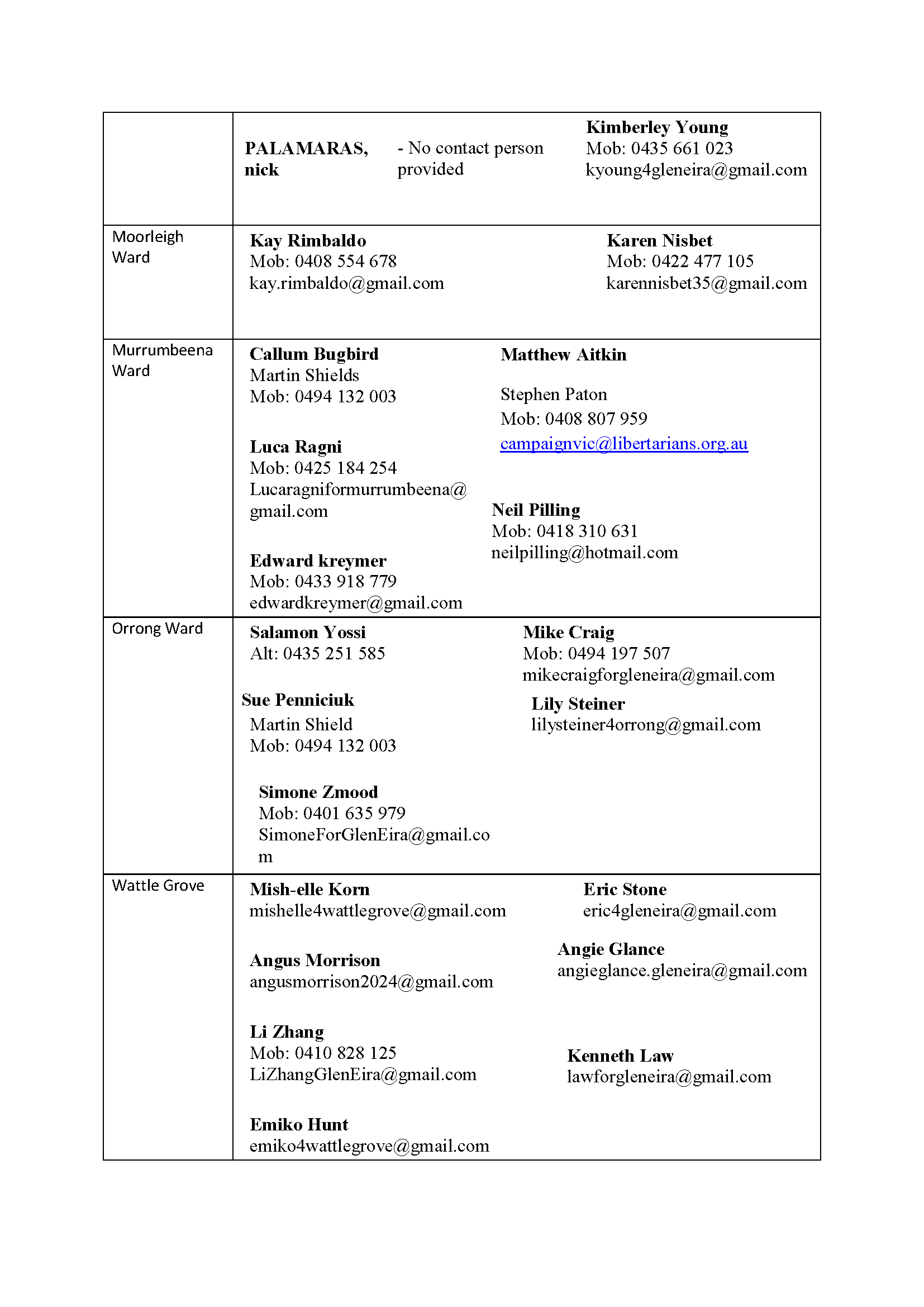
Councillor Performance


Perhaps it is a little bit early to pass complete judgement, but the hope that with this new council, decision making could potentially be free from political party alignments and/or affiliations appeared to be firmly dashed on Tuesday night. The item that illustrated this in spades was the proposed 3 storey development at the corner of Halstead and Hawthorn Road in Caulfield North.

Here are some details of the application:

  • 3 storeys, 26 dwellings of which 12 are single bedroom and 14 double bedroom
  • The officer report recommended a permit and the waiver of 4 onsite parking spots
  • The double site is 1300 square metres and just outside the Caulfield North activity centre
  • The area is zoned GRZ2 and is located along a main road hence no requirement for visitor parking

Prior to the item being debated, Halstead Street residents voiced their strong opposition in the public participation section of the meeting. They emphasised again and again the lack of available street parking given the close proximity to the commercial core in Hawthorn Road which meant that visitors to the shops were often forced to park in surrounding residential streets. The result, according to residents, was that Halstead street was already ‘parked out’ and made it impossible for tradies, emergency vehicles, visitors, carers, etc. to find parking near their destinations. Interestingly, only 7 properties had been notified of the application and yet there were 32 objections.

Karslake moved the motion to accept the recommendation and this was seconded by Zhang. The ‘accepting’ vote went along indisputable ‘party lines’ with Karslake, Zhang and Ragni voting in favour of the permit and Esakoff, Daniel, Szmood, Kennedy and Rimbaldo voting against. The motion was thus defeated 5 to 3. Parasol had previously declared a conflict of interest.

Once the motion to grant a permit was defeated, Esakoff presented an alternate motion that the proposed 26 units be reduced to 22, and thus the allocated parking would not involve any waivers. This was passed 6 to 2 with the opposing councillors being Karslake and Zhang. Ragni decided to vote in favour of the motion this time around.

Whatever the outcome at the presumed future VCAT hearing, the issue here is not really about the merits of the application, but whether or not certain councillors will see their role as backing state government proposals instead of firmly representing their constituents and addressing the ills of our current strategic planning.

We’ve uploaded the comments made by Karslake, Zhang and Esakoff and ask readers to carefully listen to what was said and then decide as to the credibility of the arguments. We will also comment on the officer’s report for this item in our next post.

Elections have come and gone and Glen Eira has 4 new councillors – Daniella Arabella, Kimberley Young, Kay Rimbaldo, Luca Ragni. Returning councillors are: Margaret Esakoff, Jane Karslake, Sam Parasol, Li Zhang and Simone Szmood. The latter was last night unanimously elected as Mayor.

We wish all these new councillors well over the coming four years and hope that their vision is firmly centred on representing their constituents rather than any allegiances to political parties. Glen Eira certainly needs a proper commitment to preserve heritage, stop state government ad hoc planning travesties, and to prioritise our environment and its challenges. We also need consultation processes that are genuine and have full councillor and consultation committee involvement.

We would be remiss if we didn’t mention that we are surprised, yet pleased, that two candidates failed to achieve election – Magee and Pilling. This engenders hope that the community is becoming more aware of what is required in this municipality from their councillors.

Nominations are now in for the upcoming council elections. As in previous elections we face the same situation – names that are totally unknown with many claiming to be ‘independent’ but in reality are aligned, affiliated or members of the various political parties.

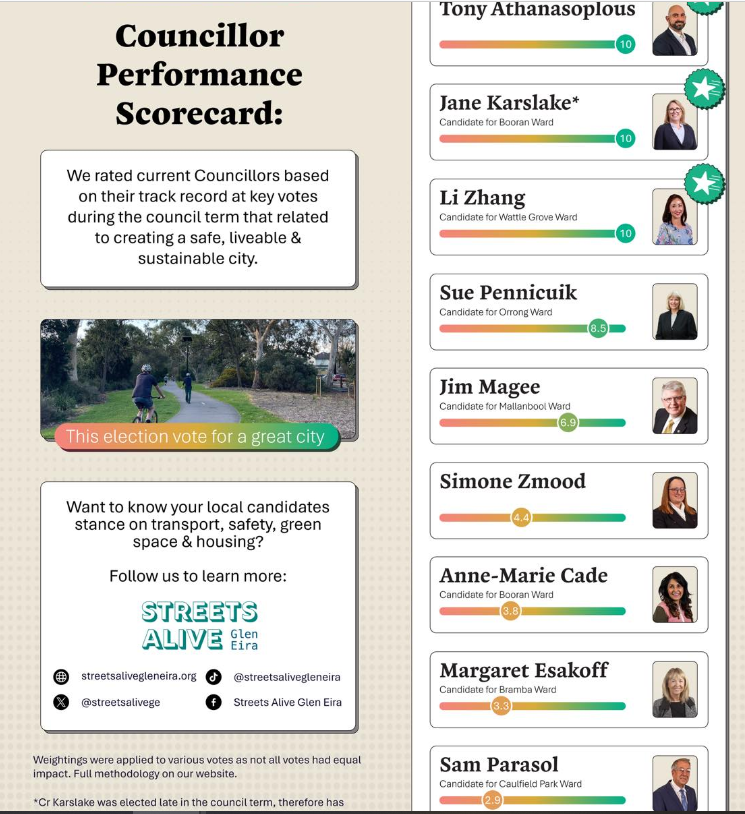
For starters, we have a new Labor oriented group calling themselves ‘progressives’!  Their leanings are clear with how they rate current councillors with Liberal links.  This is reposted on the Karslake facebook page. Note the order – especially the last three councillors .

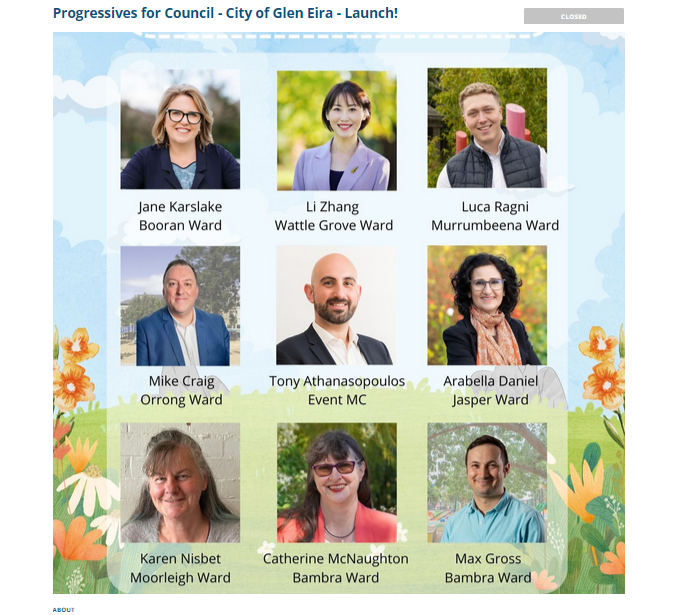
Even more interesting is that Port Phillip has also established a group calling themselves ‘Progressive Port Phillip’. Looks like Labor is going all out for the upcoming election. Here are the members of the Glen Eira version:

Nothing wrong with this except what it camouflages and the impression it seeks to create. At least the Greens make a public declaration of who they are and which party they belong to.

The Liberals are far more restrained  and  – hidden!

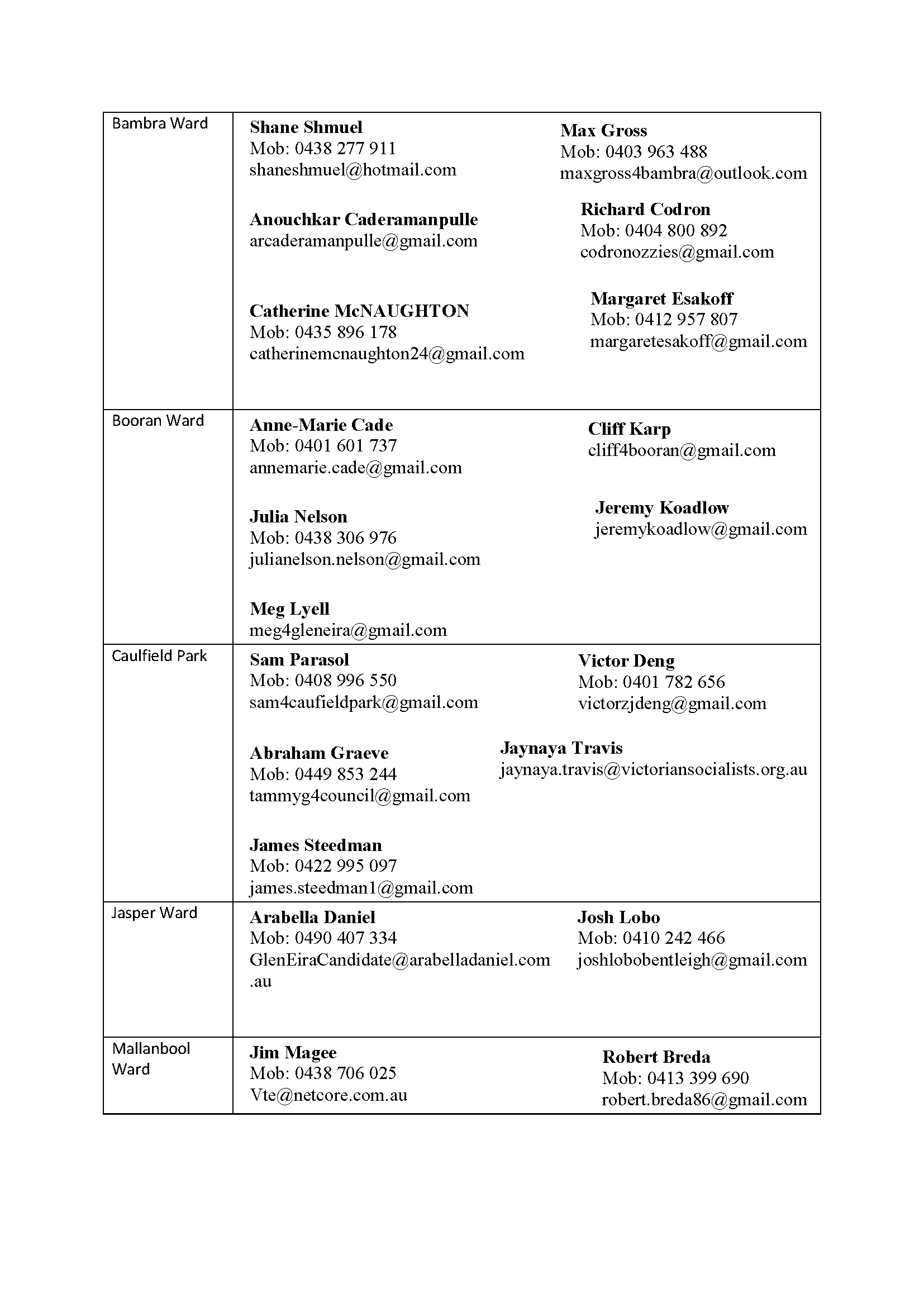
Most of the nominations come from individuals we have never heard of. For the majority of these new nominations, their involvement in council issues is zero as far as we can tell. Nothing on the various social media platforms and no public questions tabled at council. The few that have asked questions are mostly related to the closure of the childcare centres. Even if most are ‘genuine’, then why the absence of contact details including phone nos? So how many are stooges, conscripted to provide preferences for their favourites?

There’s only one thing for sure. We will have at least 3 existing councillors departing. Athanasopolous is heading for Kingston, and in two wards two councillors are fighting for the single position – Cade versus Karslake in one ward and Szmood versus Pennicuik in another ward.

Most disappointing are the results for two wards where only 2 candidates nominated in each.

Finally, we highlight one name – Matthew Aitken. If this is the person we think it is, then it’s interesting that he was Glen Eira’s chief prosecution officer a while back!

Here is the final list of candidates –

We have repeatedly contrasted how other councils approach dealings with the State Government and how their official communications vastly differ. In Glen Eira the criticisms and dare we say ‘outrage’ is muted and practically non-existent. Nor are residents truly informed as to what is going on behind the scenes.

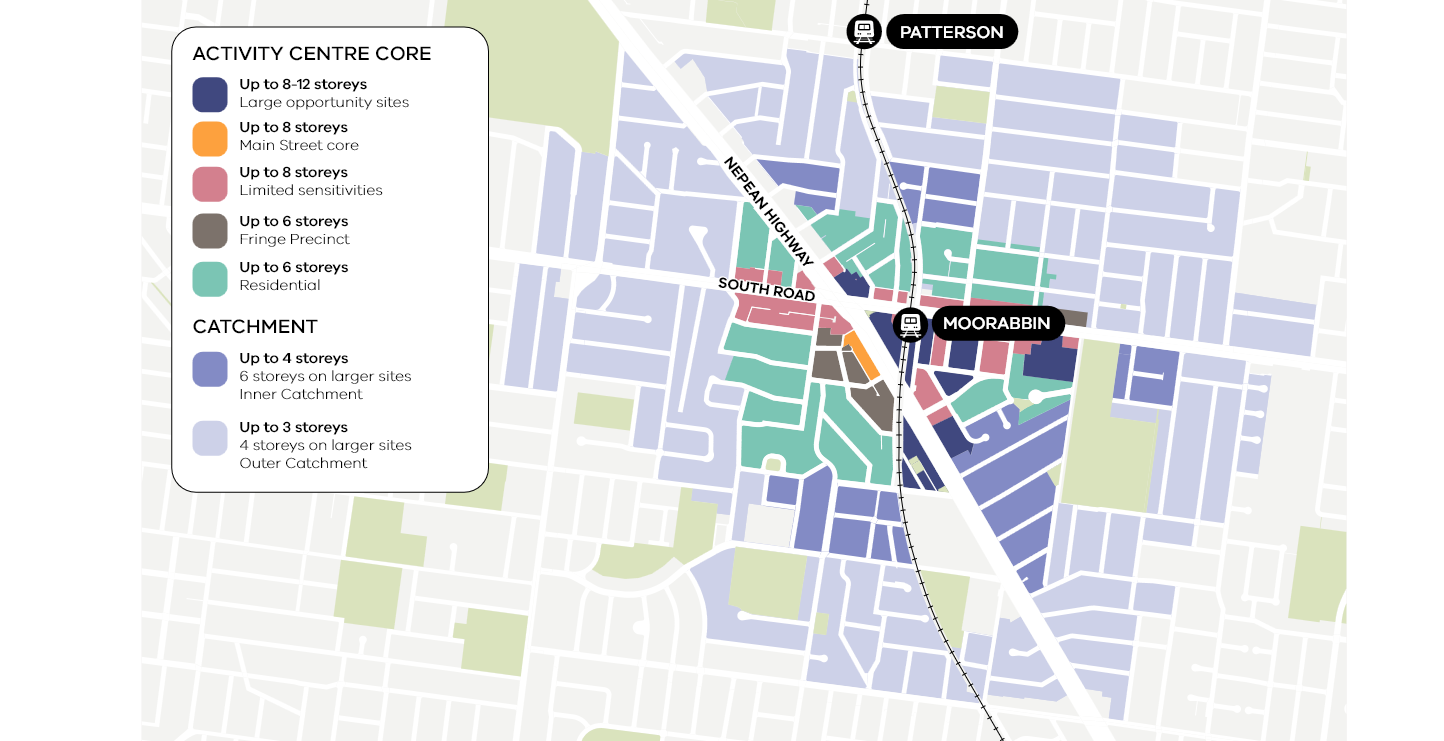
This post concentrates on the draft Moorabbin Structure Plan released by the State Government in August 2024. Bayside publishes its proposed submission in the current agenda. Glen Eira merely presents a ‘summary’ of what officers will draft  (September 3rd council meeting) and then resolves to send this off without placing the eventual submission into the public domain.  The submissions are due on the 29th September.

Bayside does not hold back in informing residents as to what occurred. Their officer’s report states:

The VPA and DTP scheduled a meeting with officers from Glen Eira, Bayside and Kingston City Councils on Wednesday 21 August, informing that Phase 2 Engagement on a Draft Plan for Moorabbin would likely occur within the coming days, and that the Draft Plan would be released to Council officers and the public at this time. On 22 August, release of the Draft Plan was made via an article in the Age

All we learn from Glen Eira via the September 3rd report is:

The State Government has released the Draft Activity Centre Plans for Moorabbin and Chadstone for comment to both Council and the public on 22 August 2024.

No mention of the indecent haste; no mention of meetings and certainly no mention of the failure to inform council and the community directly.  Is this a minor oversight, an unfortunate lapse? Or does it signify Glen Eira’s refusal to even imply major criticisms of the State Government’s processes and autocratic actions?

Here are some other comments made by Bayside in their officer’s report –

Council officers are extremely disappointed in the manner that the VPA and DTP has and continues to engage on this important project. The limited time and information available to provide meaningful feedback has created significant scepticism and lack of trust in the State Government’s ability to appropriately plan or manage such projects. Specifically, the approach provides little confidence and raises significant concern about the State Governments failure to follow its own planning framework and principles of the State Governments own Planning and Environment Act 1987 which sets out the principles for a transparent planning process. Instead, the State Government, VPA and DTP are failing to openly engage with Council or the community, presenting all parties with plans for the Moorabbin Activity Centre without any technical reports, justification for the proposed approach, or any planning provisions.

There are grave concerns that the State Government is operating on the very outskirts of the Planning and Environment Act 1987, with the process of this program going far beyond what orderly and proper planning seeks to achieve. (Bayside bolding)

The Activity Centres program continues the State Government’s continued erosion of the community and local government participation in the planning process. It is based on the State Governments false narrative that Councils are a critical block in the delivery of housing.

The VPA and DTP have informed Council officers that there will not be an open or transparent review process. The plan will be presented to a Standing Advisory Committee on papers only – considering submissions raised. This approach will remove any peer review or cross examination of experts. The State Government, VPA, and DTP are running a process where there is no accountability or opportunity to question their work (which has not been released to the public).

It is understood that the Activity Centre Program is a pilot program which will be used as a basis to replicate across the metropolitan area. The approach undertaken by the VPA and DTP does not provide Bayside, nor should it provide the remainer of the Local Government Sector across Victoria, with any confidence that a replicated approach could be efficiently or effectively rolled out. The localised issues and needs of communities will be different and the work undertaken has not given due regard to the community expectations.

The VPA and DTP continue to inform Bayside of the program rather than genuinely consult or collaborate which represents a lost opportunity for a collaborative approach which could genuinely achieve improved outcomes. Bayside sees the output to date by the VPA and DTP as not having any real value or improved planning outcome beyond a small uplift in building heights in the most sensitive part of the project area.

There are plenty of other statements we could have included. This officer’s report is then followed by a 25 page formal submission. If the Glen Eira submission gets to even 12 pages we will be surprised!

The Bayside submission includes discussion on:

  • The State Government’s abandonment of its own planning rules and processes
  • Whether the gov’s draft plan is in accord with the ’purpose’ of an Activity Centre Zone to facilitate commercial growth.
  • Affordable housing
  • Built form typologies and standards
  • Landscaping and trees
  • Infrastructure and open space
  • Transport and traffic
  • Environmentally Sustainable Design

(The full submission can be accessed at Item 10.3 via this link –  https://www.bayside.vic.gov.au/sites/default/files/2024-09/16_september_2024_council_meeting_agenda.pdf)

The 3rd September Glen Eira report ignores most of the above categories. Not a word is stated in regard to: housing affordability; transport and traffic; Sustainable Design; actions/plans in accordance with the ‘purpose’ of an Activity Centre Zone. Whilst the 3rd September report is supposed to be a ‘summary’ only of what will eventuate in the actual submission, its lack of coverage and detail is concerning. Of greatest concern is the overall TONE of the report. Yes, we get verbage such as ‘concern’, a token acknowledgement of the ‘community’ but nothing to match what Bayside sees as vital to full transparency and democratic process.

This isn’t simply an issue of semantics. When we have a State Government that bulldozes through ill thought out planning changes as a political escape clause to camouflage its incompetence and indifference to the housing crisis, then it is incumbent on ALL councils to stand united and to call out such incompetence in the strongest terms. Glen Eira remains the odd man out – refusing to call a spade a spade, and thereby failing in its obligations to the thousands of residents (and future residents) who will be impacted by these spurious ‘reforms’.  As we’ve said before – why on earth is Glen Eira taking this course? What is really behind such mealy- mouthed responses?

Last night’s ‘debate’ on the proposed new local law/meeting procedures belongs in the annals of high melodrama. It is also an indictment of councillors who once again failed miserably to support residents by ensuring  democracy is alive and well in glen Eira.

What’s Missing

Cade moved the item and introduced several amendments – all technical – but without a single word explaining the necessity for these amendments. Residents would not have a clue what these things meant.

More concerning was that no councillor mentioned the most important aspects of the proposals such as we’ve highlighted in our previous post. Of course ‘best practice’ rated a few mentions!!!!

No one commented on:

  • Why the banning of notice of motion 6 months out of an election
  • Why Glen Eira differed so dramatically from what other councils have done
  • Why notices of motion could not apply to council policies
  • Why notices of motion required 3 signatories when other councils insist on one, or two signatories

Not one single mention was made of any of these points by any speaker. And we note that most councillors were silent and simply put up their hands at the end to vote these laws in unanimously! Surely when important issues are up for decision, residents have a right to know WHY councillors vote they way they do? Even the councillor Code of Conduct requires this – ie Councillors swear that they will: represent my views truthfully and be prepared to discuss how my views were formed. This did not occur. In the end residents are the losers as councillors meekly towed the party line and handed over full control to our unelected bureaucrats.

The Melodrama

All attention was focused on the clause which would ban placards and posters being brought into council meetings. Two councillors (Karslake and Athanasopolous) voted against the local law, solely it would seem, on this basis. Athansopolous even brought props with him – a walking stick, cakes of soap, handwash, and various bits of makeup that could reside in a woman’s handbag. His claim was that any of these things could be used as projectiles and since the proposed law didn’t cover these items, that concentrating on posters was basically discriminatory and ineffectual.

We take no position on this issue. What we do expect however is that ALL aspects of the proposed laws are given the same attention as this single clause. It wasn’t.

That leaves some questions:

Did all councillors agree with ALL the clauses of the proposed law? If not, then why not comment and provide your views? If they did agree, then again, the reasons should have been forthcoming.

Is the 9 to 7 vote real or simply a camouflage? If a camouflage then what does this say about the internal operations of this council and the pressure that is put on some councillors to keep shtum? And what does it say about the way in which this administration and councillors view and treat their residents?

Last night was indeed a sad day for Glen Eira ratepayers!

The chasm between what council promises via its various policies and what actually happens is on full show with the proposed new governance and meeting procedure laws. (Item 8.3 in current agenda).

For starters, council’s Engagement Strategy tells us that residents will learn and understand how their feedback has influenced the final council decision. Here’s what page 25 of this strategy states:

Increase transparency about what the community feedback was, how it was considered and how it has influenced the decision.

 Regularly publish on Council’s website what it was we wanted to know (we asked), what we heard from the community (you said), and how the feedback was used to influence Council’s decisions (we did).

The community will be able to see how their feedback has or has not influenced Council’s decisions.

Sounds great! In reality however nothing could be further from the truth. For item 8.3 of the agenda, there is not one word which explains why the views of residents were either ignored or, if genuinely considered, were rejected for inclusion in the final draft documents.

Adding further insult to injury, we have this comment in the officer’s report –

The full engagement summary report is provided as Attachment 4.

We have searched back over the past agenda items and this is the first time we have found the so called ‘engagement summary’. Adding to the confusion, it was only on the July 9th council meeting that resident responses were published. This was NOT labelled as the ‘engagement summary report’. So why has it taken until now for this ‘summary’ report to be put into the public domain? And as for the report itself it again falls well below what residents should expect in terms of objective and comprehensive reporting on resident feedback.

Item 8.3 continually refers to council following ‘best practice’. This term is mentioned 5 times in this item. On perusing the July 9th comments, one submission highlights what ‘best practice’ actually means by quoting from 6 of our surrounding councils and how they handle the notice of motion issue  – Bayside, Monash, Boroondara, Kingston, Port Phillip and Stonnington.  Why the final Glen Eira draft on this issue differs from ALL of these other councils is not explained or even mentioned. Residents have absolutely no idea as to why their recommendations and comments were ignored or ultimately incorporated. This practice does not adhere to the above quotes from council’s own engagement strategy!!!!!!!

Here is just one example of a resident’s views which did not eventuate in the final proposed draft. Again, no explanation as to why not!

While it may be helpful for those watching a meeting for officers to give the background to a report, if officers give the reasons for the recommendation, they are effectively debating the motion. This is not the role of officers. It should be left to the councillor moving the motion and the other councillors who support it to do this. As well as officers intruding into the role of councillors, it would also put those councillors who disagree with the recommendation, as is the absolute right of any councillor, in the awkward position of having to publicly disagree with the officer who has just spoken. This could also cause ill will on both sides, and is therefore detrimental for cohesion between officers and councillors.

Contrary to this recommendation, council proposes instead:

Before an Officer Report is considered by Council and any motion moved in relation to such report, the Chief Executive Officer may, at the invitation of the Chair, introduce the report by setting out in not more than 2 minutes: 30.1.1 its background; or 30.1.2 the reasons for any recommendation which appears.

Even more baffling and unexplained is council’s new ‘arrangements’ for a notice of motion –

Questions abound:

  1. Why restrict notices of motion to more than 6 months out from an election? No other council we know of has done this!
  2. Why when certain councillors have voiced public opposition to the need of 3 signatories, is this still in place?
  3. 6 ‘business days’ in effect means at least 9 days prior to a council meeting
  4. Unclear if the officer report would be tabled at the designated council meeting or would this drag out for months until the report was written and tabled?
  5. Why can’t a notice of motion have anything to do with council policies?

Basically, what all of the above ‘conditions’ establish is the previous iteration of the mooted local law – an officer report that would take an eternity to eventuate. Given that the purpose of a notice of motion is the ability for councillors to get something onto the agenda, especially if it is urgent, this is simply another attempt to limit the input and autonomy of councillors.

By way of contrast, please see the following from Bayside and Boroondara and the ‘restrictions’ they place on their councillors via the notice of motion issue.

There are countless other examples where the final drafts fall well short of ensuring that governance in Glen Eira meets the full standards adopted by other councils. Unless processes are spelt out fully then all remains in the hands of this administration and/or is left to the poorly defined discretion of the Mayor.

It would appear that once again residents have had the wool pulled over their eyes. As a local law that in all probability will remain untouched for the next 10 years, it binds the upcoming future councils to a set of processes that are anything but explicit, democratic, and transparent. It seems that this administration is determined to keep full control in their hands and to sideline as much as legally possible both councillors and residents!

After two months of total silence on the proposed state government housing targets, council has produced its formal submission on the matter. Readers should remember that Glen Eira has been told that its target will be 65,000 net new dwellings by 2051 – that is a doubling of the current housing numbers.

The submission does highlight what most other councils have complained about – ie.lack of detail; lack of strategic justification; lack of funding for essential infrastructure; importance of open space and the failure to consult with councils and community. But, unlike other councils’ submissions which are currently available, Glen Eira in both tone and content baulks at truly trying to protect the municipality. Here’s some of what other councils had to say in their submissions.

Stonnington

The Council’s attempts to engage in meaningful consultation with the State Government to ensure that the needs of the local community are met have been largely ignored.

On behalf of its local community, Council challenges the State Government to do better in future developments, in areas such as:

• High quality design of buildings, landscaping and public realm

• On-site provision of wraparound services to support community wellbeing

• the significant impacts to existing public facilities on which current and future residents will rely (for instance overshadowing of open space and recreation facilities)

• sufficient provision of useable, activated and safe open space and on-site amenity relative to the increase in population

• Embed decision-making processes that respond to site context, elevate sustainable design and value the voice of all stakeholders; increasing rigour through efficient and transparent planning approval processes, and at its core, the delivery of long term sustainable housing and services that are fit-for-purpose and support residents to thrive in the community.

Bayside

Council has grave concerns about the draft housing target for Bayside. The target of 31,000 additional homes has the potential to irrevocably change Bayside’s character and undermine the strategic planning framework that has been put in place tomanage and facilitate growth, whilst maintaining the liveability and character of themunicipality.

Council is concerned about the preparation, and release, of housing targets which vastly contradict current planning with no engagement with Councils, community or industry bodies. Furthermore, releasing these targets directly to the media without engagement or warning to industry bodies further fuels unnecessary concern in the community

Frankston

While Metropolitan and Major Activity Centres are locations identified for change and growth, the right balance must be struck to ensure that strategic planning for these centres ensures the right outcomes. It is important that development, open space and streets have access to sunlight, that built form is responsive to its environment, streets are of a human scale and that these centres remain liveable – the very essence of Melbourne, ‘the world’s most liveable city’.

Hobson’s Bay

The current Hobsons Bay Planning Scheme and its zones and overlays for the municipality, based on the Housing Capacity assessment from 2019, has a significantly lower capacity than the State’s June 2024 draft Housing Targets and at present, the Housing Targets cannot be accommodated in Hobsons Bay

The best that Glen Eira can come up with is – The submission argues that the housing targets of 65,000 additional new dwellings for Glen Eira should be revised down to 55,000 to reflect the capacity identified in Glen Eira’s Housing Strategy 2022. The Housing Strategy was underpinned by detailed neighbourhood character assessments and a housing capacity and demand analysis as well as extensive community consultation.

No real mention in the Glen Eira submission of: neighbourhood character, sunlight, or flooding risk (council’s overlays date back to 2005!!!!). Again, readers should remember that the Housing Strategy was voted in by the skin of its teeth and as far as consultation goes this was nothing but a sham when over 110 people attended a meeting at the town hall and voiced various objections. This did not even rate a mention in the summary report. Council also refused to release the community surveys. All we got was a bogus ‘summary report’.

Whilst council might not agree with 65,000 new dwellings, they are happy with 55,000 arguing that this is based on the ‘capacity’ analysis which accompanied the Housing Strategy. Several points need to be borne in mind here:

  • The capacity analysis was completed in 2021. How many sites have now been developed in the last three years which reduce the figure of 55,000?
  • What is totally ignored and unstated in the council submission is that the capacity analyses that landed on the figure of 55,000 was Scenario 3 which mooted the removal of the mandatory garden requirement for all 7000+ properties zoned GRZ. The subsequent amendment decided against this move. Hence, there is less land available for development and certainly less than the cited 55,000.
  • When the analysis was done, not all of the subsequent heritage listed properties were done,  dusted, and gazetted. Several amendments are still waiting to be gazetted. Again, this removes the ability to increase units per site and is again ignored in the latest council document.
  • To settle on a figure of 55,000 as suitable and appropriate is literally mind boggling and strategically impossible to justify given all the above.

To base planning completely on a fictional housing capacity figure as the state government insists upon is untenable. If this were the case, then in all probability most councils could have capacity for 100,000 new dwellings. It would be easy to achieve by simply allowing towers of 20 to 30 storeys in all activity centres and ignoring the environment, heritage, required infrastructure, and the contentious issue of ‘neighbourhood character’. Even a ‘reduction’ to 55,000 as council has done would spell disaster for many of our suburbs.

WHAT DOES THE SUBMISSION SAY?

On some of the most important issues Glen Eira sticks to the current pro-development ideology. Here are some of them –

Social/Affordable housing

Instead of fully supporting the introduction of a MANDATORY aspect to the provision of social/affordable housing, Glen Eira instead argues:

….Council cautions against introducing a system that makes all new housing more expensive to subsidise affordable housing and one that potentially makes it even more difficult to build new housing in a climate where land and construction costs are already very expensive.

In other words, nothing should be mandatory. Compare this approach to some of the other councils’ submissions –

Frankston – An easier, mandatory affordable housing mechanism must be considered as part of the Plan for Victoria, prioritising locations that are close to services, jobs and transport and in locations where there is a cluster of key workers, such as a health and education precinct.

Moonee Valley – argues for Mandatory planning controls in the Victorian Planning Provisions to deliver social and affordable housing at scale.

Mandatory controls versus the current ‘performance based’ process

It would appear that for Glen Eira mandatory controls should be severely limited. Again, this flies in the face of what other councils have put forward. In terms of deciding planning applications, Glen Eira comes down firmly on the side of ‘let’s have flexibility’ and let planning officers decide rather than adhering to mandatory/ prescriptive standards. Here’s how this is argued:

Council’s urban planners do an excellent job in negotiating improved outcomes on developments, and while some of what they do could be codified, their work sees better outcomes than if much of what they do were to be codified.

In other words, ‘we don’t want mandatory standards’ where it might impact on developers!!!!! Is this why these officers are incapable of ensuring more than a 5% social housing component, or a paltry 150 such dwellings in a yield of 3000+ for the Virginia Estate project? Why can other councils ‘negotiate’ up to 20% for a social housing component?

Data Presented in the Glen Eira Submission

Featured prominently in the Glen Eira document are several tables including the number of permits granted, as well as dwellings completed in various years. We take issue with what is presented and ask: is the divergence from publically available data deliberate? Where are the explanations for how this data has been compiled and accounted for?

Here are two tables where the figures are so skewed it is truly remarkable.

The first table is supposed to tell us how many developments of 10 or more dwellings were either completed, underway, or not yet started between 2018-2023. There is no breakdown of year to year. We have resorted to the state government’s Urban Design Development program which is based on data presented by council. This site presents what has been completed, or under construction, or ‘firm’ (ie with a permit) for various years. See: https://mapshare.vic.gov.au/udpmap/

We have concentrated solely on the results for 2022. According the map share data, the ‘completion’ rate is well above council’s claim of only 16 for a 5 year period. We have only bothered to look at some of the areas and our totals are well and truly above what council claims. Here is a shortened list for 2022 alone. We did not bother to go through other years ‘completion’ rates! If for simply one single year there have been at least 14 completed projects, then how on earth can council claim THAT FOR A 5 YEAR PERIOD THE TOTAL NUMBER IS 16?

27-29 Bent Street, Bentleigh – 31 dwellings

277-279 Centre road, Bentleigh – 36 dwellings

98-100 Truganini Road, Carnegie – 34 dwellings

1240-1248 Glen Huntly Road, Carnegie – 104 dwellings

285-287 Neerim road, Carnegie – 47 dwellings

54 Kambrook Road, Caulfield – 54 dwellings

80 Hotham Street, St.Kilda – 10 dwellings

96-100 Truganini road, Carnegie – 12 dwellings

22-26 Ridell Street, Elsternwick – 24 dwellings

34-36 Jersey Parade, Carnegie – 16 dwellings

1110-1112 Dandenong Road, Carnegie – 38 dwellings

29-31 Jersey parade, Carnegie – 10 dwellings

1.111 Normanby Road, Caulfield North – 283 dwellings

45-47 Kangaroo Road, Murrumbeena – 15 dwellings

The second council table is also open to query.

This is supposed to tell us how many permits were granted for 2, 3, 4, 5, etc. dwellings. We are told that for the year 2023, only ONE permit was granted for 5 dwellings. Then why does council’s own planning register reveal that there have been at least 3 such permits granted. Here are the addresses and the dates permits were granted – all according to the online planning register –

90-92 McKinnon Road MCKINNON VIC 3204 – 5 lot subdivision – permit issued 14/10/2023

76 Truganini Road CARNEGIE VIC 3163 (NOD -4/7/2023 and amended permit granted 18/8/2023)

14 Cadby Avenue ORMOND VIC 3204 – permit issued 6/12/2023

All of this brings us to the central question: If we can’t trust council data, then how on earth can we trust their decision making? Or is all data simply geared to producing one single desired result? Who is accountable for this?

This has been an extremely long post for which we beg indulgence from our readers. However, it does go to the heart of what we believe is wrong in Glen Eira. Namely:

  • A refusal to take a far more critical and public stand against government policy as countless other councils continue to do
  • The continued publication of data that is both suspect and misleading and proffered as absolute ‘fact’
  • The continued preference to leave ‘control’ basically in the hands of officers, rather than see the introduction of essential mandatory standards
  • The failure to introduce any processes that can benefit the community – ie developer contribution levies, as well as opting for more than 5% for a social housing component in all major projects

Until residents can have absolute trust in this administration, or in councillors that are truly fulfilling their roles of oversight, questioning, and listening to the community, we will continue along this same path that ignores all that the community has stated again and again is fundamental to its ‘liveability’.

Last night’s council meeting unanimously passed the ‘updated’ Community Engagement Strategy/Policy. It was lauded as foundational to everything council did and how important community feedback was. There was not one reference to the quality of the ‘engagements’, the value of the continued pathetic surveys, nor the validity and accuracy of the various consultation summary reports.

We illustrate how skewed and manipulated these summary reports are by analysing the most recent effort – the fenced off leash area in the Caulfield Racecourse.

Here is a summary of what we’re told:

  • There were 368 comments made in the survey responses
  • There were 13 emails sent in as responses – none of the points made in these emails were cited or commented upon. In other words, we have absolutely no idea what these 13 emails stated!
  • The claim is that 62% were in favour of council’s proposal and 38% were opposed.

Here are some thoughts to ponder.

The vast majority of responses came (as expected) from dog owners. These participants used the racecourse more than any other cohort of users – ie 85% we’re told. So how are they likely to respond to the question asked – Do you support the proposal to formalise a fenced dog off-leash area in the north-west corner of the Caulfield Racecourse Reserve?  Given that there is nothing in the survey to tell participants anything about the site chosen – ie size, distance from water, etc. how many of the ‘yes’ or ‘no’ responses can be taken at face value as support or opposition to the proposal? Over recent years there have been numerous public questions and requests to council to introduce fenced off leash areas. Council has responded that fencing does not fit in with their ‘open space’ planning.  Thus, how many of the ‘yes’ responses are a result of wanting a fence, but not necessarily what has been put forward?  Is the figure of 62% fully endorsing council’s plan, or simply endorsing the idea of a fenced area but not necessarily what is presented? We can’t tell based on how the question is presented and the lack of accompanying information.

We then get down to the nitty-gritty of the so called ‘Survey Data Analysis’ and this is assessed largely by the section called ‘Free Text Feedback Analysis’..  We are told:

 Of the 325 responses which provided free-text feedback to question two, 185 responses support the proposal and 140 responses do not support the proposal.

The implication of such a sentence is clear – participants support the council proposal!

We then get this breakdown of written responses –

Please remember that the ‘conclusion’ was 140 responses DO NOT SUPPORT THE PROPOSAL!!!!! Is this figure accurate? How is this number arrived at? What criteria was used to interpret the responses? Or were these ‘interpretations’ simply done to ‘confirm’ overall support’ and hence council’s stated position?!!!!!

We have highlighted in orange all those response which might be interpreted as opposed to the proposal – acknowledging that we can only go on the ‘themes’ that council claims came up more than 10 times in the responses. Given that council refuses to publish the comments, as they used to do, we have no idea of what was actually stated by participants!

The highlighted sections represent those responses that we are fairly confident might indicate opposition to the plan. The figures are: 94 + 53 + 22 + 19 + 14 + 13 + 10 + 6 + 5 + 3 = 239. Yet we’re told  that the total number of opposed comments only equals 140!!!!! Tallying up even the first two categories alone (ie 94 +53) gives us a total of 147 and not the 140 cited!!! Subtracting some of the ambiguous ‘themes’ such as ‘dog training’, or ‘Exercise with dog’ still leaves us with numbers well and truly above the claimed 140!!!

The very act of enumerating ‘themes’ is a pointless exercise, as does counting  the number of mentions. Unless the full comments are published we do not have any idea as to what the participants actually prioritised or thought.

There are plenty of other contentious ‘conclusions’ in this summary. Is it simply incompetence on the part of the report’s authors, or is such skewing of results deliberate and orchestrated?

Until we have a set of councillors who actually bother to analyse what is put in front of them, and who have the courage to call out such manipulative practices, then community consultation is Glen Eira will remain a farce.

There are several items in the agenda for Tuesday night’s council meeting which illustrate the utter cowardice and complicity of the Glen Eira administration with the State government’s ad hoc and appalling planning processes and plans. In addition there is the continued watering down of consultation protocols that further limit transparency and, most importantly, community involvement in decision making.

We will focus on these two separate items.

  1. Proposed Government Planning for the Moorabbin Major Activity Centre

Item 8.3 consists of 4 pages outlining the ‘preliminary/draft’ Moorabbin plans. Two of these pages consist of the maps created by the government. The other two pages are spin and summaries of what the government has stated as its goals. Throughout this verbage there is not one single criticism or even analysis of what is proposed. Instead, we are repeatedly told that:

Council officers are actively involved in these discussions

Council officers will continue to be involved in the briefings with the VPA/DTP and ensure appropriate feedback is provided on the proposed controls and the respective Activity Centre plans. Feedback will align with Council’s priorities and more importantly advocate to be coordinated with funded infrastructure improvements to ensure our communities are not disadvantaged unfairly.

It is anticipated that a significant level of change in these activity centres will be proposed with further changes to be seen in the surrounding catchment areas as depicted in the figures within this report.

Moorabbin Activity Centre planning does not merely impact on Glen Eira. It also includes Bayside and Kingston.

Here is what the Bayside officer report stated on the issue. All quotes come from the 21st May agenda from that council. Please read carefully and ask yourselves which council is really standing up for its residents?

… there are concerns with the manner these projects are being undertaken, and the lack of genuine engagement with the affected councils

The program has been given an un-realistic deadline of implementation of planning controls into the planning scheme by December 2024. Council Officers have had minimal engagement with the project with the following key questions unable to be addressed by the VPA:

• What boundary of the activity centre is being used?

• What are the proposed planning controls to be used?

• What mechanisms for the collection of development contributions will be used to fund infrastructure triggered by the program?

What technical studies are being undertaken to inform the work?

• How will the community and Council be meaningfully engaged in the process?

Until now, Council officers have had no meaningful engagement with this project, with no information forthcoming in response to any concerns

As this report critically points out, increasing population and development growth in these areas will only exacerbate the need for more infrastructure and community services. Victoria is already witnessing the amounting pressures on our public health system and ambulance services – a result of under resourcing and funding by the State Government. There is real concern that proper planning will not be accounted for as part of these Major Projects and impact the liveability of our current and future residents.

Council fundamentally questions where strategic justification for these targets has arisen from and whether the processes being led for these major projects are consistent with theoutcomes of the Planning and Environment Act 1987 and the objectives of Planning in Victoria,

Council has previously raised concerns with the SRLA, Victorian Planning Authority and Department Transport and Planning regarding the process, governance and Council’s role within these major projects being led by the State Government. At present, Council has been mostly kept informed and ‘drip fed’ decisions rather than having any real ability to input into these processes and decisions being made.

There are also major concerns regarding the State Government’s agenda to ‘fast-track’ these projects. Proper planning takes time, resources and input at the local scale – this includes both local government and the community. Fast-tracking these major projects only further restricts Council and the community’s input and role in these processes.

Questions

  • Why is it that on the same issue, one council can have an officer report that is highly critical of what is happening and Glen Eira has taken 2 months to come up with a report that basically says nothing and is silent on the processes and impacts of the government proposal? Add this issue to the total deafening silence on the published housing targets of 65,000- net new dwelling by 2051, then this just confirms how little our administration cares about liveability and advocating for residents in Glen Eira.
  • Can we really trust the officers and their stated ‘involvement’ in any discussions? Are councillors informed of what is being discussed? Do they ever see hard copy printouts of discussion points or ‘resolutions’? Or are councillors, as usual, kept in the dark?
  • The real question is – what does council have to gain by being fully complicit with this government? Who is this administration really representing?
  • Community Engagement Strategy

The current Community Engagement Strategy, adopted in 2021, was supposed to run until 2026. So we now have a new strategy 2 years before the current one is set to expire. Why? What’s the rush? What’s the purpose of introducing a new strategy so far ahead of time?

Once the proposed draft is examined, we can achieve some understanding of why this administration is pushing for a new strategy. Put simply, it is to further reduce community input into council decision making.

The key paragraph of the new policy is to be found in these officer comments :

As the updated Policy does not substantively change the intent of the previous Policy, and was co-designed with the Community Engagement Advisory Committee, Council will undertake an ‘Inform’ level community engagement program.

The most important word here is ‘inform’. This is a reference to the IAPP standards of community engagement/consultation where we have ‘inform’, ‘consult’, ‘involve’ and ‘collaborate’ as the steps on the ladder of full and meaningful consultation with the community. ‘Inform’ is the lowest level of consultation. It basically says, ‘here is what we will do and we’re simply telling you about it’. End of story.

When the initial strategy came to light, and included which plans, issues would occasion what sort of consultation, councillors passed the resolution that major issues such as structure plans, important infrastructure, etc. would go well beyond the ‘inform’ or ‘consult’ stage that was initially proposed for all consultations – apart from those  mandated by legislation. Councillor then voted for this resolution:

Since the above resolution was passed we have not had ONE SINGLE ‘involve’ or ‘collaborate’ for any of the structure plans.

But what is even more alarming in the new proposed draft is the complete EXCLUSION of any link between projects and the anticipated level of consultation.  We have no idea which issues will have more than ‘inform’ or ‘consult’ associated with them.

We have written previously on how other councils have designated their intended level of consultation. See: https://gleneira.blog/2021/01/07/consultation-2-2/. With this new draft all we get are motherhood statements, vague promises, and nil detail.

Here is one page from the ‘framework’ document. Please note:

  • ‘Engagement Level’ has now nothing whatsoever to do with how council will consult, much less the level of consultation according to the IAPP standards. It now simply becomes a question of how long the consultation will last!

We then get another page that supposedly outlines the methods of consultation.

Once again we have no idea which projects will involve which levels of consultation. The stated methodology also leaves much to be desired. For example: the community engagement committee is stated as having input into the ‘consult’ and ‘involve’ standards. To the best of our knowledge and according to the minutes of this committee, not once did this committee produce any ‘recommendations’ or even discuss the various draft structure plans. They certainly have had no input whatsoever into the framing, analyses and testing of the atrocious survey questions that are continually produced by this council.

The final outrage is that in the actual draft policy we find this table that is supposed to outline the level of consultation. The very inclusion of a sentence such as ‘Level to be selected depending on the complexity of the matter’ is the loophole that allows this administration to do whatever it likes, when it likes. In other words, because the standard isn’t in black and white, council can neatly side step the need for ‘involve’ and ‘collaborate’. This is both dishonest and devious!!!!!

We have previously shown how other councils specifically itemise the task and the appropriate level of consultation. None of this exists in this new proposal. It represents nothing more than a continued watering down of the fundamentals of sound governance and democratic process. Sadly, it also means that residents, and probably councillors are once again sidelined as much as is legally possible. What a sad state of affairs and what a self serving administration we truly have.

It hasn’t taken long for several of our neighbouring councils to present their views on the latest State Government’s housing target announcement. Glen Eira remains silent – at least in the public domain. God forbid that this council should ever criticise the government and god forbid that it should stand up for its residents.

Here are the responses from Bayside and Boroondara. They are presented in full.

BAYSIDE

Housing target looms large for Bayside

Tuesday 18 June 2024

A 70% increase in housing by 2051 could fundamentally alter the character of Bayside, dramatically compromising liveability.

Bayside City Council is deeply concerned regarding the 70% draft target announced by the Victorian Government.

Bayside Mayor, Councillor Fiona Stitfold said delivering this number of dwellings by 2051 without compromising the much loved, neighbourhood character of Bayside would be very challenging.

“Achieving a target of this magnitude would require dramatic change across Bayside,” Councillor Stitfold said.

“We are alarmed regarding the lack of transparency and are calling for the Victorian Government to provide Council with the evidence and data that has informed the target.”

“Bayside will work cooperatively with the Victorian Government however the process to date has not included effective engagement with either Council or the community. 

“Any engagement on the draft target should also include details on how the Victorian Government will fund additional community facilities, services and infrastructure to accommodate an influx of new residents as this is a key concern of both Council and the community,” Councillor Stitfold said.

Bayside has a strong record of approving housing planning applications with approximately 85% within the state government’s requisite timeframe.

Bayside City Council has previously expressed concerns regarding building heights and density proposed in the Suburban Rail Loop Precinct Key Directions statement which focuses growth in the communities of Highett, Hampton East, Cheltenham and Pennydale in particular.

Achieving a 70% increase to housing would require growth across Bayside as well as in the SRL precinct. This growth would most likely occur along the Sandringham Railway Line which has received no state government investment via Level Crossing Removals. 

“While the increase in the number of dwellings appears to be the simple answer to affordability and supply, the reality is that the current housing market is complex and impacted significantly by the state of the economy, supply chain issues, and State Government Taxation” Councillor Stitfold said.

Have your say on the draft housing target via the Victorian Government engagement website.  Source: https://www.bayside.vic.gov.au/news/housing-target-looms-large-bayside

BOROONDARA

State government’s approach to the housing crisis is disappointing and flawed

Tue 18 June 2024

The state government’s approach to the housing crisis is both disappointing and flawed. The need for additional housing is understood but any suggestion that setting housing targets will solve this challenge or even be an effective tool is misleading for several reasons.

First, the housing crisis is the result of poor planning policy by commonwealth and state governments over many years. The cost of government taxes, cost of borrowing for both developers and purchasers, the cost of building materials, shortage of skilled labour due to government projects, cost of living and immigration levels have created this crisis. These are matters for state and commonwealth governments, not local governments. The setting of housing targets does not address any of these fundamental causes.

Secondly, to release housing targets on the scale proposed (a 300% increase on the number of dwellings constructed each year to date in Boroondara) without making any commitment to the infrastructure required to support such exceptional growth is irresponsible planning. Our community has a right to such fundamentals as public open space, adequate drainage and sewage systems, education facilities, health services and transport networks. There is no analysis of this and no corresponding budget allocation over future years from the state. The government must be aware of the need for infrastructure planning given the experience of residents in growth areas, repeated over decades, who continue to have poor access to fundamental services.

Thirdly, housing targets do not produce housing. Developers do that. Councils cannot force developers to make planning applications for new development and councils cannot force developers to build the housing for which they have approval. This is clearly evidenced by the thousands of dwellings which have approval across the state but are not being built.

If the state and commonwealth governments were to accept their roles in planning for adequate housing supply in this country there would be a joint taskforce focused on the macro-economic factors required to stimulate supply and their respective budgets would allocate infrastructure funding required in long term financial plans. This will assist in ensuring quality neighbourhoods and living environments are created for our communities. Community wellbeing and sustainable housing supply should be our focus, not short term politically motivated measures designed to deflect responsibility.

We look forward to a more holistic approach.

Source: https://www.boroondara.vic.gov.au/your-council/news-and-media/boroondara-news/state-governments-approach-housing-crisis-disappointing-and-flawed

« Previous PageNext Page »