Councillor Performance


Question after question has sought answers to what is really going on with our neighbourhood areas (activity centres) that do not have any controls on height in the commercial and mixed use zoned shopping strips.  Council’s response has been consistent: not enough ‘resources’ (presumably this means staff), plus not enough money. That they are flat out on the structure plans for Bentleigh, Carnegie, Elsternwick, East village, Caulfield  and recently added, Glen Huntly. Well, Bentleigh and Carnegie are now on the desk of the Minister awaiting permission to advertise. East Village is done and dusted as far as rezoning is concerned, and Caulfield is largely work being done by the Victorian Planning Authority. Yet, residents are still being told that controls for South Caulfield in particular are at least another 2 years away.

Nor have residents been able to get any clear response from council as to their ultimate objective. Language has varied considerably over the past 18 months. We have been told that ‘structure plans’ are in the vision. Next this becomes mere Urban Design Guidelines or a Design & Development Overlay. There is absolutely no guarantee forthcoming that our neighbourhood centres will have structure plans.

As for the delay in introducing even the most minimal controls, we do not for one second buy council’s excuses. Our theory is:

  • Council has always envisaged Glen Huntly Road from Kooyong to Hawthorn as being one single precinct – ie the expansion of the South Caulfield activity centre. Only stern opposition in 2002 prevented this from occurring.
  • Delaying controls facilitates the pro development agenda. We now have at least 5 applications in for Caulfield South (including one in Caulfield) that sit between 7 and 9 storeys and literally hundreds of apartments. Once these get their permits, probably within the next 8 months, it will be almost impossible for council to argue that the building heights under even a structure plan should be 5 storeys! We speculate that this is totally deliberate on the part of council.

The other question of course is WHY? What is the real reason that council is so gung ho on more and more development – especially when Glen Eira is well and truly above its housing needs to cater for population growth? Why have they caved in so easily on removing the mandatory height limits in Bentleigh & Carnegie and substituting ‘discretionary’ height limits? Yes, it is very easy and convenient to have Wynne as the scapegoat and put the onus on government rather than themselves. When other councils can fight tooth and nail for their residents in terms of pushing for greater land use control, knocking back panel reports, or sending out thousands of mail to their residents, our council distinguishes itself by either total silence, or complete acquiescence. The tragedy is that our councillors have all been complicit in this agenda.

Logic would suggest that there must be some ‘pay back’ or ‘benefit’ in adhering without question with government that is given greater priority than residential amenity, sustainability, and general welfare of constituents. We can only hypothesize, but suggest:

  • More dwellings, with miniscule restrictions on development, amounts to more incoming revenue.
  • More revenue is required for the grandiose schemes of at least $52 million to ‘redevelop’ Carnegie swimming pool; $5 million for a library that was ‘redeveloped’ less than 3 years ago; and the list of projects goes on and on. Please also keep in mind that residents have not been privy to any business plan (that is, if they even exist!!!!)
  • A quid pro quid with government so that grants increase? (ie the nonsense of the Inkerman Road safe bicycle track)
  • Also on the cards is the flogging off of council land to developers in order to proceed with high rise/multi level car parks. Envisaged by Monash to cost around $18 or so million for one. And all the while pathetic little done about procuring more and more desperately needed open space.

We certainly are not privy to the discussions that have occurred behind closed doors with state authorities, and even between councillors. What we do know is that strategic planning in Glen Eira continues to be a disaster. Residents can no longer accept excuse after excuse about the lack of money and resources that council claims is behind its ‘do nothing’ agenda. This excuse must be seen for the furphy  it is, especially when planning applications are down, and council’s staff numbers continue to climb, plus rates and charges also continue to climb. Residents need a council that will put ratepayers before large developers!

Last night’s council meeting showed the first public sign that maybe things aren’t as hunky dory within this councillor group as they would like us to believe. The feathers were definitely flying with Delahunty, Davey and then Athanasopolous getting up on their high horses to implicitly criticise and condemn Esakoff.

All of this related to the ‘debate’ on the Parking Strategy. Esakoff, as is her right, spoke against the strategy. Mind you, she spoke for just on 10 minutes without getting a time extension. So much for the meeting procedures, eh? The bone of contention related to her use of the term ‘social engineering’ (twice in this 10 minute speech).

Here is the full audio of what she said:

Delahunty then rose to object to the terminology. This was followed up by Athanasopolous’s Right of Reply (see below).

Social engineering originates from social science and the term was first used in the 1890’s. In this context of social and/or political science, dictionaries provide the following definitions:

Wikepedia: means of influencing particular attitudes and social behaviors on a large scale

Oxford: the use of centralized planning in an attempt to manage social change and regulate the future development and behaviour of a society.

Webster: management of human beings in accordance with their place and function in society

Collins: is the use of planned measures, for example, measures that affect people’s social or economic position, in order to create a desirable society.

One could quite reasonably ask: Does Glen Eira Council practice social engineering? When we look at recent policies and strategies developed by this council, then the answer is clear. Yes, council does engage in ‘social engineering’!

Here are some recent examples:

  • Waste reduction and food scrap containers.
  • Parking strategies
  • Bicycle strategy

The stated objective(s) of all of the above endeavours are to bring about behavioural change. To basically introduce programs, policies, and laws that will ‘encourage’ people to moderate their behaviours. That’s the purpose of the current Parking strategy – to get more people to use public transport and the Inkerman Road fiasco is supposedly to get more people riding bikes. Providing food scrap containers and changing what can go into green bins is another example of trying to influence behaviour.

We are not discussing the value or efficacy of these programs. What we would like to know is how on earth Delahunty, Davey and especially Athanasopolous can get up on their high horse and protest vehemently about the ‘language’ that Esakoff used. This strikes us as hypocrisy of the highest order. More to the point, it raises the question of WHY this outrage and why now?

For Athanasopolous to bring up Pol Pot, Stalin, and presumably Hitler in what amounts to a personal attack on Esakoff is quite unbelievable. We are not in the business of defending Esakoff. However in this instance, the response to her use of the term Social Engineering is way beyond the pale, especially when council is the supreme agent of its own social engineering which is often accomplished in the face of stern opposition from residents. May we even suggest that by ignoring community opposition, such actions would resonate beautifully with Stalin and his aberrant version of ‘social engineering’.

Council has released the results of its community consultation on the proposed Parking Policy and set out several recommendations for councillors to adopt.  However, the tradition of drowning residents in so called ‘data’, coupled with conclusions devoid of real supporting evidence continues with analyses and recommendations that would fail any grade 7 mathematics exam/test. Dubious assumptions that then become the foundation for subsequent recommendations abound. We can only suggest that had the initial questions been more water tight, and unambiguous that the ‘results’ would be far more credible.

The resulting policy/analysis purports to present data from two distinct surveys. A general one that was freely available online to the entire community, and a second ‘survey’ that was directed to the 450+ registered users of Community Voice. (CV) Of these latter 450+ community representatives,(CV) council only received 190 responses. For the community wide survey there were 592 responses. Thus, the ratio was 3 times as many ‘answers’ from the wider community as there was for the Community Voice survey. Yet incredibly, far greater credence is given to the CV responses time and time again in the accompanying officer’s report and in the recommendations put forward to council. Here are some examples:

When considering if the proposed introduction of a fee is fair/reasonable for resident car owners in Glen Eira a majority of respondents to the community survey either disagreed or strongly disagreed (76 per cent). This was reinforced by 18 letters/emails an 9 phone calls to Council which explicitly referenced issues around permit fees. Concerns and questions were expressed around the fairness of the proposal and a perceived entitlement to free permits under Council rates. When considering if this approach is fair/reasonable for the wider Glen Eira community the majority of respondents who disagreed or strongly disagreed reduced to 53 per cent. 

Community Voice members were also asked the same question. When asked if this approach is fair/reasonable for resident car owners in Glen Eira a majority of respondents agreed or strongly agreed (54 per cent). When considering if this approach is fair/reasonable for the wider Glen Eira community this majority of respondents who agreed or strongly agreed increased to (62 per cent). 

And the final officer recommendation is: Officers recommend retaining the residential permit fee structure as consulted within the draft Parking Policy (Attachment 2- Residential Parking Permit System, section 3.3.6).

Also extremely important in analysing any of this data is the makeup of the various groups and how their circumstances might have influenced their responses. For example: we are told that the vast majority of respondents from the community wide survey were in possession of residential parking permits (440 out of 576 responses). For the Community Voice participants only 48 out of 190 had these permits. Thus 76% versus 25%!!!!! Secondly, we need to consider the physical attributes of the various suburbs that these participants live in and their probable parking arrangements.

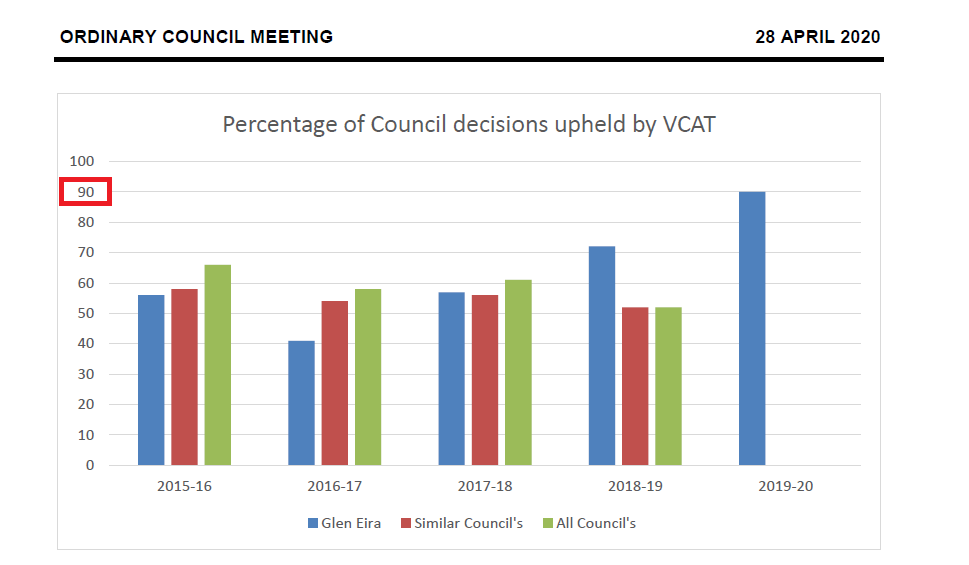
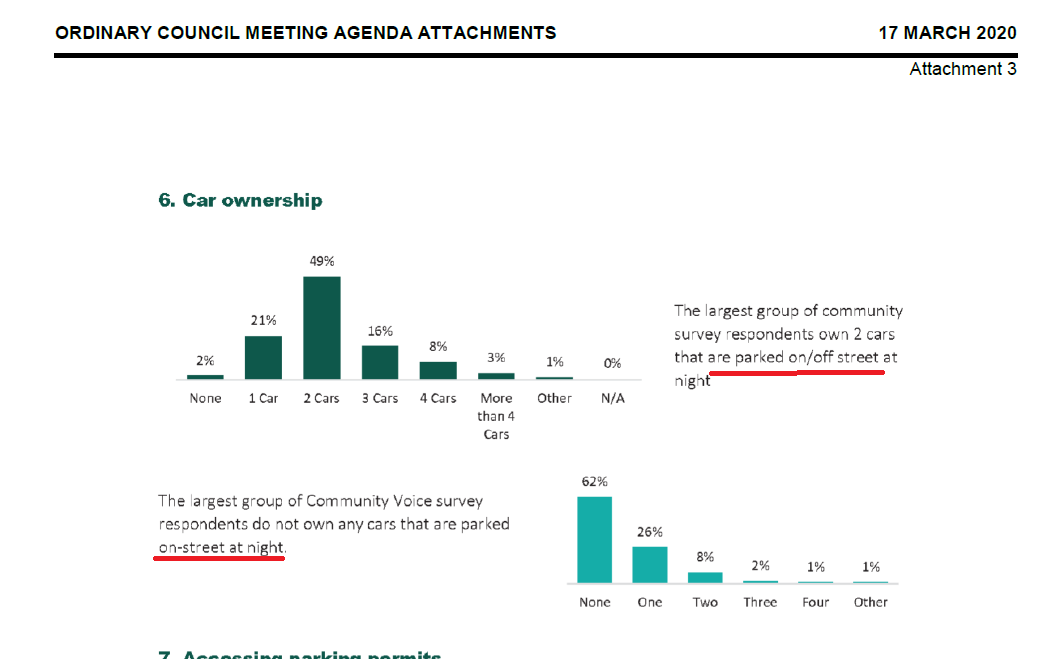
The following screen dump does have these percentages (not numbers we note).

One could quite reasonably question the value of the above data given the following:

  • East Bentleigh has the largest proportion of single detached dwellings in the municipality. Presumably a large percentage of these homes would also have onsite parking and therefore parking is not necessarily the problem it is in other areas. This is reflected in many of the Community Voice (cv) responses.
  • The Community Voice responses were significantly lower in those suburbs where parking is an acknowledged problem ie. Elsternwick/Gardenvale; Caulfield North/East. Where higher (ie McKinnon and Murrumbeena) the issue is not so urgent.
  • What valid conclusions can then be drawn from such numbers? We posit very little!

What irks us the most however is the following.

Please note:

  • Are we comparing apples with oranges?
  • What is this supposed to prove when the community wide survey includes both ON and OFF street results and the Community Voice simply lists ON STREET?
  • Comparing the two graphs reveals NOTHING as to the real numbers parking on the street. Interestingly 37% of the Community Voice people also park cars overnight on the street.
  • Why wasn’t the identical question asked of the Community Voice participants? ie do you park on or off site?

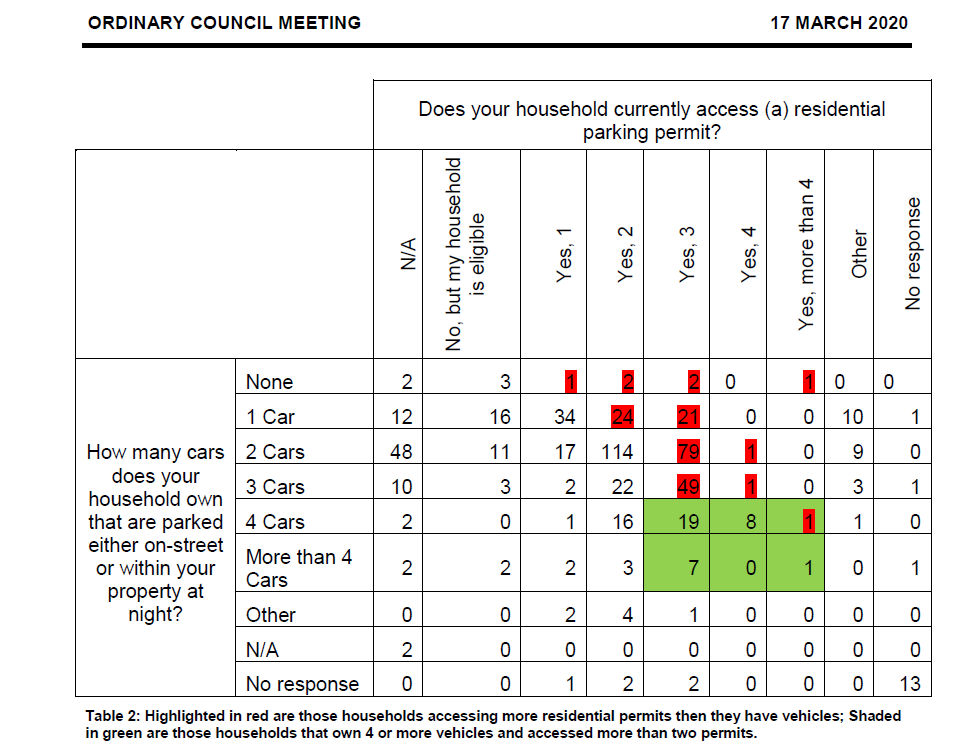
The most contentious argument in the entire policy rests on the following statement and its accompanying table:

When considering car ownership and access to permits the draft Parking Policy, the community survey shows that out of 493 permit eligible households,182 accessed more residential permits than they have vehicles. This indicates that as many as 37 per cent of current permit holders who completed the survey are accessing more permits than they need.

Even if we accept these figures, the questions keep coming. Permits are currently linked to specific cars. Residents have to fill out a form and provide a license plate number. Thus, how is it possible that someone with 2 cars should have 4 permits? Doesn’t council check what they are applying for? Are residents lying and making up license plate numbers? Have respondents confused ‘residential’ permits with ‘visitor permits’ in their responses? To then conclude that the parking policy is aimed at these drivers in particular and the aim is to change ‘behaviour’ is laughable. Behaviour will only change once there are adequate options. No figures are provided as to how many of these 37% of permit holders even have access to on site parking. Nor do we know where they are located. Assumptions on top of assumptions should never be the basis for policy!

Other assumptions are also worth commenting upon. Here is an extract from the report that focuses on the proposed charge for the second and third parking permit:

To understand the impact of permit fees an assessment (Attachment 4) has been undertaken on the car ownership and access to permits data provided within the draft Parking Policy community survey. To assist with this assessment the following assumptions have been made:

  • A minimum of one car will be parked off-street. Therefore, charges for permits will not begin until a household owns 3 cars.
  • A fee for a third permit has only been applied to those households within the bus only(Bentleigh East) precinct.
  • Approximately 18.4 per cent of residents in Glen Eira are aged over 60 years.Therefore, a concession rate has been applied across 18.4 per cent of households.

As a result of these statements, we can reasonably ask:

  • On what basis can the assumption be made that one car will be parked ‘off-street’ – especially since there is no correlation with where these residents live, nor how many of these permit holders do in fact have off street parking available?
  • Why conflate the NUMBER of residents over 60 in the municipality with the number of households? Surely there must be 60+ residents who live together and not in single member households?
  • Is this simply a ploy to assure ratepayers that council is not gouging more and more from our pockets when we are told that revenue will only amount to $149,099 per annum? And even this amount is likely to be less because council goes on to state: However, due to the introduction of a fee, it is expected that a portion of the community will change their parking behaviour (including utilising off-street parking such as driveways and garages, or parking in unrestricted areas). This has been estimated at 30 per cent. When applying this behaviour change reduction, the total amount raised from permit charges is estimated at $104,369 per year. No explanation has been given as to why there is this assumption of 30%. Nor are we told anything about the likely lack of parking in the proposed ‘unrestricted areas’ if these streets become the only option for parking.

There are literally countless assumptions made throughout the report. To comment on all of them would require many more pages. The bottom line is that residents deserve better. Survey questions need to be precise, unambiguous, and clearly related to unearthing data that is valid, relevant, and consistent.

Until this council learns to produce genuine consultation, and to produce reports and analyses that actually tells the real story, residents of Glen Eira can have no confidence whatsoever in any consultation that this council undertakes. More to the point, they can have no confidence that their voices are being listened to.

Council’s ability to deliver real community benefit on its financial arrangements keeps cropping up. The latest example is the agreement with the National Trust for a 3 year lease that will allow Glen Eira residents access to the Ripponlea gardens for free. No doubt a very worthwhile idea. But at what cost? And why is it that other councils can achieve the same outcome but at a cost of 5 times less? Who negotiated this deal?

The following screen dumps compare what Port Phillip managed to achieve for its residents at the cost of a maximum of $50,000 per annum and good ol’ Glen Eira is paying $250,000 for exactly the same thing!!!!

The Glen Eira resolution:

Now for the Port Phillip agreement:

History tells us that this council is woeful in negotiating anything. A $25 million loan was ‘negotiated’ at a fixed 8.4% for 25 years. To ‘renegotiate’ for a lower rate it cost ratepayers quite a tidy little sum. Of course we mustn’t forget the pathetic 4% and 5% that the Caulfield Village (MRC) development is paying for something approaching 2,500 dwellings. Every major project that this council has undertaken has resulted in time delays, over budget, and countless court cases. It is a history of poor financial management and poor decision making.

Council is proposing a new Open Space Refresh strategy. The questions residents need to consider are:

  • Does this latest version successfully address the lack of open space in Glen Eira?
  • Is the proposed increase of the developer levy sufficient?
  • How well is council utilising the revenue collected?

In order to determine resident views on these issues, we have designed a short survey which will take about one minute of your time. It also seeks to ask the questions that council doesn’t want asked. Please forward this link on to all of your contacts.

Several residents have contacted us with queries about Council’s renting of 840 Dandenong Road, Caulfield East. This was ‘vacated’ by Stellar in mid 2019. Real Estate websites state that the rental space was approximately 1200 square metres and that Stellar were paying rental of between $320 and $340 per square metre.

A check of council minutes reveals that in July 2019, as part of the in camera section of the council meeting, this item came up for deliberation. No result/outcome was listed in the ensuing minutes. Hence, we have to ask:

  • Why is council renting this property?
  • What is the rental being paid?
  • How long is the lease?
  • Did council spend extra on outfitting this property? If so, how much?

If any concerned resident were to peruse the monthly financial reports it is impossible to discern where this money is coming from, nor how much.  In terms of ‘income’ versus ‘expenditure’ we find that there is a category labelled ‘other expenses’. The budget claimed that this figure would be $3.5 million. The actuals now state that this figure has blown out to $5.168 million. Thus how much of this blowout is the result of the new lease? We can only guess at the amount that council is paying but given the above figures it would not surprise us if this lease was in the vicinity of $400,000 at least per annum, and possibly much higher!

It is also worth stating that the word ‘lease’ does not appear anywhere in the financial report. Thus, we are left in the dark (again) as to how this council is spending ratepayers’ money and the purpose for such expenditure.

Here’s a screen dump of the site:

The long awaited Ombudsman’s report has now been released. See: https://ombudsman.vic.gov.au/our-impact/investigation-reports/investigation-into-three-councils-outsourcing-of-parking-fine-internal-reviews/

What we discover is that councils (Glen Eira, Stonnington & Port Phillip) all owe millions to drivers who were fined by outsourced agencies (ie Tenix) and requests for review were not done by council but this agency. This is seen by the Ombudsman and government as contrary to law under the Infringement’s Act and the Road Traffic Act.

What is even more reprehensible is that all of these councils knew of this for years but did not notify the public. In refusing to remove parking fines none of these councils made it crystal clear that Tenix was the body reviewing the fines and not council officers. Furthermore, all rejection letters included anonymous signatures such as  ‘Appeals Review Officer on behalf of Glen Eira City Council’. The lack of transparency and accountability is commented on repeatedly. Even more insulting is that all of these councils had meetings, legal advice, etc. without once informing residents. Adding salt to the wounds is the refusal of these councils to furnish the ombudsman with the legal advice provided (which councils are legally entitled not to do). But, unless there is something to hide, why not furnish these documents? In short, the name of the game was to keep mum, avoid responsibility, and hope all this goes away.

It didn’t thanks to the public announcements by such councils as Monash and Kingston, the complaints forwarded and the initiative of the ombudsman.

All of this simply makes us wonder what else this council is keeping quiet about. When a council foregoes it duty to be open, transparent and accountable, we are in trouble.

Here are some quotes and stats from the report that relate specifically to Glen Eira.

  • In 2017/18, 68,000 parking infringements were issued
  • Glen Eira said that it ‘relied on Tenix to provide appropriate advice in accordance with its contractual arrangements’. Tenix responded that ‘in no way could it be reasonably interpreted that the council would require that Tenix act as its legal advisor as regards whether or not the council had the authority to contract the services in the first instance’.
  • When Ombudsman officers asked the councils why they did not identify decision makers in their letters to motorists, Glen Eira said: Council is unaware of any requirement under legislation that the decision maker is identified by name in the decision notice’.
  • Glen Eira has more than 36,000 affected infringements valued at $3.67 million

The most scathing and salient comment by the Ombudsman’s office is arguably the following:

The councils’ statements that they currently have no express legal obligations to identify internal review decision makers or answer questions from lawyers overlooks their broader obligations as public authorities. Councils have been entrusted with a service to the public that affects people’s rights and liabilities. With that trust comes a responsibility to behave accountably and transparently. The Infringement Act only permits certain persons to make internal review decisions. Affected motorists cannot tell whether their internal review decision was authorised and valid, unless they know the identity of the decision maker. This transparency builds public confidence in the system.

Finally, here’s Glen Eira’s lamentable response:

Despite the lack of any legal determination regarding the reasonableness of Council’s actions, we do take our responsibility to act ethically and with integrity seriously. Council will therefore reflect on the findings and recommendations of this report and give early consideration to what further action may be appropriate in the circumstances, including consideration of an in good faith reimbursement scheme.

PS: COUNCIL’S MEDIA RELEASE

Another item of interest in the current agenda is the proposal to steam roll ahead with spending $51+ million on the redevelopment of the Carnegie Pool. Needless to say by the time anything is constructed this figure will have increased tremendously so we could easily be looking at a cost of $60 million plus.

As with all council proposals, residents are not given the opportunity to have a real say. The formula is to present a series of options determined from above. Surely before council commits to such huge expenditure residents have a right to see a Business Case, costings for various options, detailed ‘community benefit’ outcomes. Instead, all we often get are pretty pictures and no real detail.

Reading through the comments on the Carnegie pool, the overwhelming majority state again and again that they do not want a miniature GESAC created. The emphasis is clearly on outdoor pool and open space and the retention of the history and ambience of this pool.  The writing is on the wall that council wants another GESAC (albeit smaller)!

Next we have a forecast expenditure of $5 million on the creation of Eat Street in Bentleigh and another $5 million upgrade for the library (which underwent an upgrade less than 4 years ago). So that’s another $10 million at this stage. Add in the Inkerman Road bicycle path and the real possibility that it will be council paying for everything, then millions more are set to be spent.

We are not against upgrading ageing facilities. Nor are we against providing important community infrastructure. What we are questioning is whether all of these projects provide ‘value for money’ and how essential they really are? When council is soon to borrow another $30 million whilst still owing about $10 million, we have to query the wisdom of such decision making, especially when the community is crying out for more open space and some decent strategic planning that would safeguard our neighbourhoods. These two areas have been put on the back burner and instead we get project after project that ignores these most pressing issues.

In Glen Eira residents do not have a say on budget priorities. It is definitely time that they did.

Two planning applications are up for decision next Tuesday night which will forever change the face of Caulfield East and Caulfield South. Both have officer recommendations for approval. The recommendations are further evidence of:

  • Cow towing to the MRC in spite of what the 2014 Incorporated plan for Caulfield Village actually specifies. This is simply the continuation of the voting by Esakoff, Hyams, Lipshutz and Pilling going back nearly a decade and looks set to continue.
  • The Caulfield South (Hawthorn Road) decision flies in the face of council’s adopted strategy from last council meeting. How the planning department can ignore its own policy statements is beyond belief.

For this post we will only concentrate on the Caulfield South application.

380 Hawthorn Road, Caulfield South

The application is for the Godfrey’s site and is asking for 7 storeys, 42 apartments, 3 shops and a car parking waiver of 26 spots. The officer recommendation is for 6 storeys and the granting of a 20 spot waiver.

We find this recommendation totally unacceptable on the following grounds:

  • At last council meeting, councillors voted in the new City Plan. This included height limits for our neighbourhood and local centres as being 5 storeys. We are, 3 weeks later, being told that 6 storeys is now acceptable!
  • Having decided that a 20 spot car parking waiver is ‘acceptable’, we find that council’s urban designer had other ideas. We quote from the report: Whilst Council’s Urban Designer has advised that the reorientation of the on-street parking in Olive Street would be desirable and would improve the streetscape and safety, this is considered to be unnecessary as it would reduce the number of on-street public car spaces in the area. So first you waive 20 spots and then worry about on street car parking availability. More importantly safety becomes a lesser priority than forcing the developer to provide sufficient on site parking!!!!!
  • On potential overshadowing we get this comment: It is acknowledged that overshadowing is a significant concern for residents. The most affected properties would be those at 24-34 Cedar Street. The applicant has provided hourly overshadowing diagrams for the Equinox (September 22) from 9am to 3pm showing the effects of the proposed building on adjoining properties and the surrounding area. A review of this information has been undertaken and it is considered that the overshadowing impact of the proposal would not be unreasonable as adjoining properties, whilst experiencing new overshadowing, would still have an acceptable level of solar access, from 11am to 2pm. It is acknowledged that shadows cast in Winter would be longer and affect the Cedar Street properties to a greater extent than the Equinox shadows.

Shown below is the developer’s shadow diagrams for this period of 11am to 2pm. How on earth these diagrams can then be interpreted as an ‘acceptable level of solar access’ is truly mind boggling! And with no attempt to introduce winter solstice controls into the planning scheme the impact in winter is totally ignored.

Even more disturbing is the following:

It is acknowledged that there are currently no maximum mandatory or discretionary height limits for this area. Detailed strategic planning work will be done by Council for this activity centre in the near future. It is considered that the recommended 6 storey height of the proposed building, will not prejudice that work or the orderly planning of the area. 

But what will it do in terms of setting a precedent we ask, especially when surrounding applications are asking for 7 and 9 storeys? 

Council has been promising further work ‘strategic work. Yet this report also contains on page 31 of the agenda, under the heading of ‘seriously entertained amendment’ the response of ‘NONE’. Does this therefore mean that:

  • Caulfield South will not be part of any structure planning amendment?
  • Caulfield South will not be part of any Design & Development Overlay? or
  • Caulfield South will only be granted some wishy washy Urban Design Guidelines that are not MANDATORY and may not even be included in any shape or form into the planning scheme? They will simply remain as council ‘policy’. We remind readers that at last council meeting Hyams specifically used the term ‘urban design guidelines’. Hence, isn’t it time that residents got a firm answer as to council’s intentions?

There are many other comments throughout this report that should be severely questioned. Things are also missing. For example: legislation now requires ‘communal space’ for 40 or more dwellings. There is no discussion of this in the officer’s report. Even more disquieting is the constant referral to other applications that have not as yet been decided. Yet they are part of this decision making!

It will be mighty interesting to see what councillors do with this application given the potential, precedent setting decision.

It is becoming increasingly obvious that this council is not working for residents. Its major beneficiaries have been, and remain, developers. Nowhere is this more apparent than in its latest strategies, namely, the Open Space Refresh and the appallingly named City Plan.

The outcomes that will eventuate from such policies will only further assist in encouraging more and more development to the detriment of residents.

OPEN SPACE  

Councilors were patting themselves on the back at the last council meeting proclaiming how wonderful an 8.3% open space levy was. Admittedly, this is an increase on the current 5.7% levy. The question that residents need to ask themselves is whether or not an 8.3% levy is sufficient to meet the open space requirements of this municipality. It is not!!

Why is council opting for this sum when other councils such as Monash and Darebin are currently seeking 10% and municipalities such as Yarra are also contemplating up to 10%. In terms of existing open space, both Monash and Darebin have far more than Glen Eira. They are also much larger with Monash being 80 square km compared to Glen Eira’s 38.7 square km. The rate of multi unit development in Glen Eira is also outstripping what happens in these councils. Yet, Glen Eira sees fit to ask for much less. Why? Surely the only feasible answer is that they do not want to put too much of an impediment in the way of developers! Residents’ needs for open space is second to facilitating more development!

Here are the proposed amendments from these other councils:

CITY PLAN

Here’s another policy that leaves much to be desired and is an insight into the shoddy strategic planning that has been endemic in Glen Eira for decades. With no up to date, genuine housing strategy, with no real activity centre strategy worth the name, council has been forced to do another slap dash, one size fits all ‘refit’. If planning had been done properly years ago we would not be in the position we are in now.

Nowhere is this ‘one size fits all’ approach illustrated more clearly than in the proposed five storey height limit for our local centres. Each centre is treated as if they are identical and all will be allowed to have 5 storey discretionary height limits. No thought has been given to the differences that exist between each local centre in terms of surrounding residential areas, transport, amount of commercial space, etc. All are treated as identical! Again, this is not planning. It is policy without strategic justification.

Once again Glen Eira stands in the shadow of how other councils go about their planning. Bayside for instance in its Amendment C126 had this to say about its local and neighbourhood centres:

Only when councillors stop endorsing such poor planning will they be doing their mandated jobs of proper oversight. Thus far they have failed dismally.

« Previous PageNext Page »