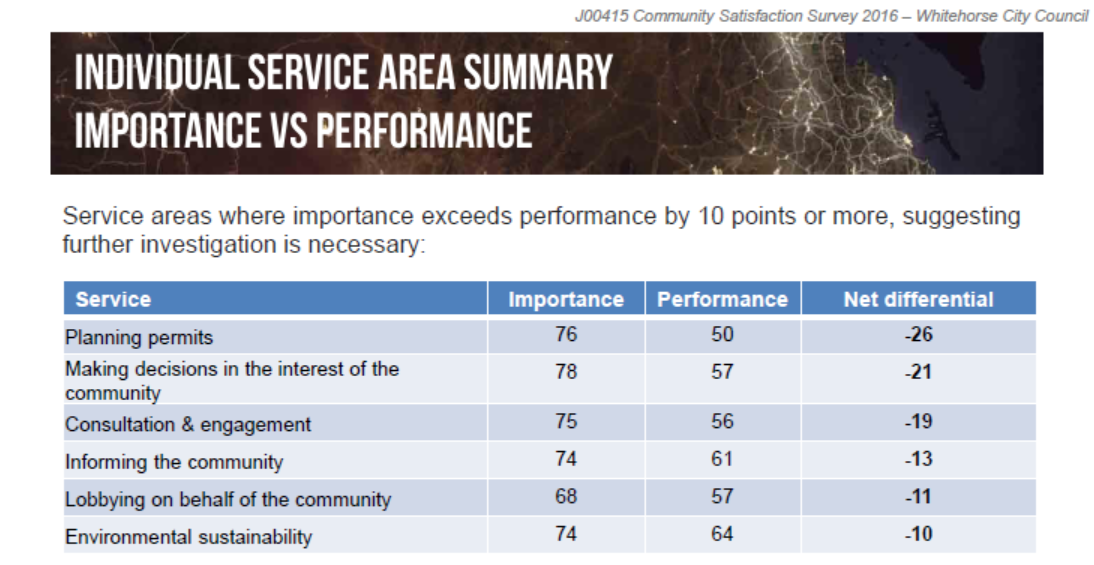
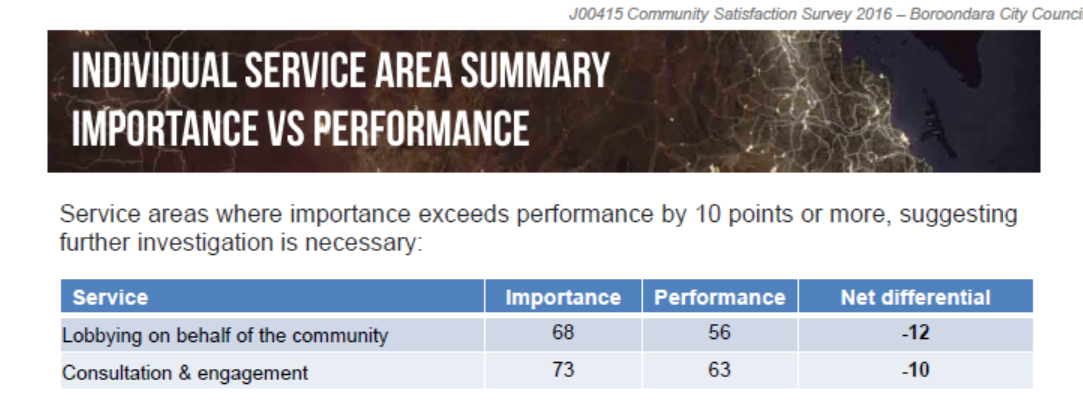
Councillor Performance


The lack of open space in Glen Eira has been known for years. It is high on the list of resident priorities for some dramatic change in council’s approach – for instance, the purchase of new open space. The claim to counter this is that Glen Eira is highly ‘urbanised’ and purchasing land is very expensive. Yes, land is expensive and council did raise the developer levy to 5.7%, (only after years of collecting a pittance). Objectors in 2014 argued that even this new levy was insufficient to meet the needs of the existing and future population. Now there is an officer’s report on whether council should seek to raise the levy even further. The recommendations read:

That Council:

Σ notes the report

Σ requests that a report update be prepared following the release of the 2016 ABS Census data

The report claims that the Census data will be released in ‘early 2017’. Another porky by Council. We prefer to rely on what the Australian Bureau of Statistics(ABS) tell us and not what features in officer reports. Here’s the ABS version:

census

Thus nothing will be done for at least a year, and then another year to go through the amendment process, consultation process, possible planning panel review, and then awaiting the Minister’s rubber stamping.

Further, we see absolutely no reason why council needs to wait. All of the relevant statistics should be available right now to council. They should know precisely:

  • The number of new dwellings built
  • The location of these new dwellings
  • The number of permits granted
  • What areas these permits are in
  • If council and the consultants relied on Profile.id prognostications in 2013/2014, then they can rely on the updated figures right now!

In 2014 it was obvious that council’s and the consultants’ prognostications were inadequate given the zones and the inundation of planning permits. It is our firm belief that if council had done its work properly back in 2013/2014, then the open space levy would not now be an issue. If a correct levy was sought, then residents would now have plenty of more open space, instead of a decline per individual as is happening. Contrary to what is currently claimed by the ‘consultants’, their report, based on the statistics provided by council was totally inadequate and inaccurate. At the time of the planning panel, objectors highlighted this again and again. For example:

  • The claim was that Caulfield Village would still only be 1100-1200 units, when the Development Plan for 2046 units had already been rubber stamped and would near completion by 2026
  • Virginia Estate was ignored
  • Countless amendment rezoning to Mixed Use were ignored
  • Council’s estimate of only 5.22 hectares being redeveloped in the space of 14 years in Carnegie had already seen this number exceeded in the space of a single year and the same was true for the other activity centres. How on earth council could claim that only 5 hectares is available from 3.8 square km and over a third zoned for ‘growth’ is beyond us!
  • Council’s ‘estimate’ of existing public open space was and is, literally a joke, since they had changed the ‘definition’ of open space and of course included car parks within this calculation.

There is absolutely no excuse waiting another year before an increase is even attempted. This of course fits right into the philosophy of this council – do nothing if you can help it!

Three planning applications for Tuesday night’s council meeting deserve some close attention and questions asked about:

  1. The competency/objectivity of the planning department
  2. What outside influences are at play here?

We are not arguing in favour of development here. We are simply questioning the basis of this council’s decision making.

One application involves Bentleigh, and the other Carnegie. Both are zoned RGZ, and both are within council’s lines drawn on a map that designate them both as being within the Urban Village structure. Yet, remarkably, the one in Bentleigh for 30 odd units receives the nod of approval and the one in Carnegie for ‘only’ 13 units is refused. Why? – when both are basically ‘compliant’ with the planning scheme? Secondly if the one in Bentleigh can be ‘fixed’ via the imposition of conditions, then why not the one in Carnegie?

Even more disturbing is the absolute rubbish that we find in the Rocky Camera reports – inaccuracies, and blatant bias as evidenced in the following. We’ve drawn up a table so that readers can compare like for like.

applications

The Tranmere Avenue application also makes reference to Skyrail and the land’s proximity to the proposed rail line. The developer has submitted a noise impact statement for trains at ground level only. Given that no one knows much about Skyrail and its impacts, it is interesting to note that for Montgomery House application council granted a permit with the notation that should Heritage Victoria not rule in favour of retention, then a new application can be submitted. No such leeway was provided to Tranmere.

Application for 2 double storey in Barry Street, Bentleigh

Please note:

  • The site is zoned Neighbourhood residential Zone – ie suitable for 2 dwellings
  • No objections
  • Area of approximately 650 square metres – well and truly able to ‘cater’ for 2 double storeys

The officer’s report states:

  • An acceptable level of articulation has been provided for the development. The first floor is recessed behind the ground floor walls, with minor staggering of facades providing further articulation. Single garages are proposed ensuring that garages are not a dominant feature of the development.
  • The dwellings have both been provided with ground floor, east-facing private open space areas of 58m2 and 87m2 respectively, in accordance with the requirements of the zone and Rescode.
  • There are adequate landscaping opportunities at the front and rear of the site. Councils Landscape Officer has recommended that two canopy trees be planted in the front and rear yards of each dwelling (4 trees in total). Site coverage is less than 50%, which complies with Rescode requirements.
  • All proposed setbacks are in compliance with the State Government guidelines

 COMMENT

Thus we get a page and a half report where practically every aspect of the planning scheme is met, plus NO OBJECTIONS TO THE APPLICATION. Yet, it still is put on the agenda for a council resolution. Why? When countless other applications are decided at officer level, why is this one granted the privilege of a council resolution? What factors are at play here? Why is council’s time being wasted on such an application when the agenda is already overpacked (a mere 721 pages for Tuesday night). Is this a case of someone knowing someone else? Or knowing what might eventuate a year or two down the track? Who is responsible for getting this onto the agenda and what are the real motives?

PS: The World According To Ho – https://www.crikey.com.au/2016/06/24/councillor-in-same-sex-marriage-controversy/

We are not accountants, but we do regard ourselves as reasonably intelligent people who should be able to make sense of most things in a budget. Not in Glen Eira it would seem! Readers will remember that the restructuring of the GESAC loan (and the payment of a $4.9 million penalty) has forced Council back to the drawing board and the requirement to publish a new Strategic Resource Statement and Budget. It is this latest version of the accounts that raises a multitude of questions.  Are we in fact dealing with ‘creative accounting’? If not, then every single item should be beyond doubt and self-evident. They are not! There simply is no correlation between the figures presented on May 3rd and the figures that now appear in the new budget. Why not? Have any councillors bothered to ask any decent questions? And why aren’t the changes highlighted and fully explained to residents?

Here are some of our concerns:

1COMMENT

Thus in May, just 6 or 7 weeks ago, residents were lead to believe that all that was necessary for the completion of the Booran Road Reservoir was the expenditure of another $903K – as further evidenced by the screen dump below, where no further expenditure is forecast.. So now we suddenly learn that another $3 million plus is to go into this project? Why? Where’s the money coming from? And what is the total cost of this originally mooted $5m redevelopment?

srp

GESAC

2y

BUDGET ESTIMATES

One of the most bewildering announcements from the two budgets are the figures for the income derived from ‘general rates’. Both budgets claim that the numbers were compiled from the ‘financial statements as at the end of January 2016’. Thus they should be identical – especially since they are ‘forecasts for 2015/16’ and not for 2016/17. Yet the discrepancy is staggering – a $5 million difference for figures that are supposedly based on the identical financial statements. In short, ‘forecasts’ for the past year should not change – but in Glen Eira they do!

june rates

Finally, here are some other comparisons from the May and the June documents. The onus is firmly on this council to explain these ‘discrepancies’ in plain English and to account for every single dollar that is to be spent. We also remind readers that the new ‘negotiated’ interest rate for GESAC has not been revealed when the previous interest rate was NOT deemed top secret! Why the difference? And why aren’t residents privy to what is happening to their hard earned cash? We also note that the claim that GESAC is paying for itself is no longer included!

May 3rdThe expected operating result for the 2016-2017 year is a surplus of $16.61m which is a $124k increase from the 2015-2016 annual forecast. (The forecast operating result for the 2015-2016 year is a surplus of $16.48m).

June 28thThe expected operating result for the 2016-2017 year is a surplus of $17.22m which is an increase of $5.74m from the 2015-2016 annual forecast. The forecast operating result for the 2015-2016 year is a surplus of $11.47m. Included in the 2015-2016 forecast is the economic cost of $4.93m associated with Council restructuring its loan facility.

May 3rdTotal cash and investments are expected to increase by $6.23m during the year to $45.24m as at 30 June 2017. This is due to a higher than anticipated closing cash balance as at 30 June 2016. (Cash and investments are forecast to be $39.02m as at 30 June 2016).

June 28thTotal cash and investments are expected to increase by $1.72m during the year to $45.58m as at 30 June 2017. This is due to a higher than anticipated closing cash balance as at 30 June 2016. (Cash and investments are forecast to be $43.86m as at 30 June 2016).

3rd May – Borrowing repayments of principal and interest costs of $2.88m will be made during the 2016-2017 financial year. Borrowings outstanding as at 30 June 2017 are projected to be $18.71m. The repayment of all borrowings is fully funded by GESAC.

28th June – On 17 May 2016, Council approved to restructure the existing loan facilities with a revised term of 7 years and a fixed interest rate. Loan repayments of approximately $4m per annum have been included in the SRP. Borrowings outstanding as at 30 June 2017 are projected to be $21.46m.

May 3rdInterest-bearing loans and borrowings are borrowings of Council. Council is budgeting to repay loan principal payments of $1.31m over the year.

June 28thInterest-bearing loans and borrowings are borrowings of Council. Council is budgeting to repay loan principal payments of $3.24m over the 2016-2017 year.

If any readers can shed light on the above comparisons, we welcome their thoughts!

The latest Development Plan for the Mixed Use Precinct of the Caulfield Village reveals once again the failure of this council to keep its residents informed as to what is really going on. Worse still, the proposed plans are another example of MRC profit making and to hell with the local community.

Council Secrecy

The plans reveal the following (and we quote) –

On 27 May 2014 Glen Eira City Council (GECC) approved the initial Development Plan for Caulfield Village (DP 16060/2013) relating to that part of the Residential Precinct west of Bond Street. That Development Plan approval was subsequently amended on a number of occasions, most recently on 05 May 2015  (page 6 –Town Planning Assessment Report)

Condition 24 of Development Plan approval DP 16060/2013 required that the proposed design of the Normanby Road / Boulevard / PHE / Sir John Monash Drive intersection be resolved and approved by SJB Planning Council before further work on the future stages of Caulfield Village can advance. Following extensive engagement with State and local government stakeholders, an updated Integrated Transport Plan was submitted to Council for endorsement on 01 October 2015. (Page 13/14)

Thus, the MRC keeps putting in amended plans and residents know nothing about the amendments and what concessions have undoubtedly been granted to the MRC and by whom! There has not been any formal council resolution on the 5th May 2015, nor any notice that amendments were sought. Why not? And who made the decisions and under whose authority? And as we stated in our previous post, who made the current decision to ‘refuse’ the new Development Plan and what were the grounds of refusal? Why aren’t residents informed as to what is going on until after the fact?

The Development Plan

There is much that could be said about this current proposal. We will only highlight the most obvious things –

  • Another 397 apartments proposed in 4 buildings
  • Building A – 9 storeys of 56 one bedroom and 56 two bedroom
  • Building B – 9 storeys of 44 one bedroom, 56 two bedroom and 9 three bedrooms
  • Building C – 5 storeys of 36 one bedroom and 12 two bedroom
  • Building D – 7 storeys of 92 one bedroom and 36 two bedroom

Thus the percentage of family oriented three bedroom apartments is the wonderful number of 2.26% – whereas the documents claim 5%!

The proposed configurations of these apartments are also nothing to write home about. For example:

No of apartments under 50 square metres – 51

No of units between 50 and 60 square metres – 60

No of balconies under 8 square metres – 71

We remind readers that council caved in on the requirement for 8 square metres of balcony on a previous amendment. Also the State Government’s Better Apartments is looking at legislating for a minimum size and 50 square metres is one suggestion.

Traffic Management & Parking

  • Thanks to the incompetence of the Incorporated Plan, there is NO VISITOR CAR PARKING
  • 397 units plus retail only warrants 441 spots
  • The ‘statistics’ used date from 2010 and ‘updated’ in 2013! No mention of course of impacts on Eskdale Road, Newington, and other local streets all round the precinct!

Affordable Housing

We are so dumbfounded by this proposal that we cite it in full. Please remember that some councillors wrung their hands in dismay when there was no provision for ‘affordable housing’ in Precinct One. The argument put forward by the Lipshutzs and Hyams and Pillings of this world, was that the other precincts would fulfill this requirement. Well here is the ‘master plan’ for affordable housing, courtesy of the MRC. We are sure that readers will get a good laugh out of the following:

Aspirations for the provision of affordable housing within the Caulfield Village development are expressed in the Incorporated Plan. In the current absence of a Federal or State Government scheme to support the development of affordable rental housing, BPG has given detailed consideration to how it might self implement an opportunity for affordable housing within its development that is suitable to Caulfield Village and the broader Caulfield context.

The Caulfield Village & Affordable Housing Report at Appendix Q explores a variety of models that might be adopted to facilitate affordable housing opportunities within the development. It identifies the “Pathway to Ownership” model as the most appropriate having regard to the particular circumstances of the proposal and its context. Broadly, the model would offer assistance to low-to-moderate income renter households to purchase an affordable home in the Caulfield Village development by providing people in affordable or private rental with a savings record an opportunity for assistance to meet the necessary start up funds to facilitate ownership. Deposit subsidies from BPG to eligible participants also form part of the assistance package. The scheme would be administered by a community housing provider. It is anticipated that eligible purchasers would currently be living in community housing or private rental accommodation, with limited opportunities to otherwise enter the housing market.

The added benefits of the scheme include the direct expertise of a community housing provider to assist appropriate and eligible candidates on the pathway to ownership, and the freeing up of low rental accommodation previously occupied by participants in the Pathway to Ownership scheme.

The preferred affordable housing model, which will be known as Caulfield Apartment Start Program (CASP) could potentially be applied to any of the proposed accommodation within the development, rather than limited to certain apartments or apartment types. Likewise there would be no limit to the number of apartments able to be purchased under the affordability scheme. The model applies a subsidy to eligible purchasers, rather than dwellings. It is uncertain, until the scheme is up and running, what the uptake of accommodation through the Pathway to Ownership model will look like, but BPG is committed to implementing the program for accommodation within the Mixed Use Precinct, and potentially future development stages

Our final word of caution

Whilst the variously dated Incorporated Plan (ie some of the documents refer to the Incorporated Plan as being 2011 and other documents cite 2014!) stated that the maximum preferred heights for Precinct 1 was 5 storeys, we now have 6 storeys looming over Station St. This is because of the neat little trick perpetrated by the MRC and permitted by council of using the formula of AHD. This refers to sea level heights. Thus if the land is sloping, then instead of the preferred height of say 5 storeys, the MRC can build 6 storeys. Council of course, and all their expert planners, did not pick this up – or if they did, did not care! Thus we warn residents that the mooted heights of these building are just that – mooted and nothing is set in concrete!

PS: stuck between the four building of 9/10 storeys, and 5/6 and 7/8 storeys, the MRC proposes to create a ‘pocket park’. The accompanying visuals are astounding: vast expanses of ‘open space’ that make the area look like a major park and not a ‘pocket park’. No real high rise to dominate the site; no overshadowing whatsoever, and nowhere in the landscape plan could we find any data which states the size and dimensions of this proposed ‘park’. What we do know at this stage is that 25 onsite trees will be removed and 14 street trees at least!

pp


CLICK TO ENLARGE

Untitled

COMMENT

Residents should be outraged at the processes involved with the development of this project. At last council meeting a public question was asked in relation to a Practice Day hearing held at VCAT on this application. The response was far from satisfactory. Be that as it may, plenty of questions need answering, and all have to do with due process and sound governance.

  • When did council first receive this second stage Development Plan?
  • Who made the decision to ‘refuse’ and why wasn’t this done via a formal council resolution given the magnitude of the plans and the contentious nature of the entire project?
  • What was the purpose of the Practice Day hearing and what were the grounds for someone’s (not Council’s) refusal? What is the outcome of this hearing?
  • If decisions by VCAT are already pending as potentially indicated by the response to the public question, what is the use of calling for submissions after the fact?
  • Time for submissions is 16 days. Whilst this does meet the conditions set by the relevant Schedule it is far from satisfactory, given that council also had the option of 28 days – ie “Display the development plan for public comment for at least 14 days, but no longer than 28 days”
  • And how does the VCAT involvement meet this stated requirement from the Schedule – “The responsible authority must decide whether to approve a development plan or amendment to a development plan within 60 days after the display of the development plan is completed.”

In short, we maintain that every single aspect of planning for this site, has been abysmal with council and especially Hyams, Lipshutz, Esakoff and Pilling, falling over backwards to accommodate the MRC!

PS: the link to view the plans is – http://www.gleneira.vic.gov.au/Planning-and-business/Planning/Large-scale-developments/Caulfield-Village-Development-Plans/Development-Plan-2

Not on this topic, but worth a read – http://www.danielbowen.com/2016/06/20/use-other-footpath/

RESIDENT #5 – stated that he ‘lived directly behind the town hall’ and that council talks about ‘community planning’ but they got a letter ‘yesterday’ telling them that their 2 hour parking on their street would now become all day parking. Believed that this change was to ‘facilitate council employee’ parking and not residents.  Facilitator again interrupted and said that the resident is basically asking about the amount of information and ‘why’ this is happening. Resident answered that he is talking about ‘prior consultation’.  Facilitator then rephrased again to include ‘consultation’.

TORRES: started saying about a ‘review’ of parking in the municipality, but was interrupted by the resident saying that he isn’t concerned with the entire municipality just why this happened to his street. Torres then continued and said that some ‘underutilised parking areas’ had been identified and having one side of the street as two hours and the opposite as unrestricted is ‘consistent’ with other streets in Glen Eira. Also said that parking is ‘dynamic’ and changes happen ‘over time’ so ‘it’s not a permanent situation’.  The letter also said that the new conditions would  be ‘reviewed early next year’.

Resident then explained how he already can’t get out of his drive. Facilitator again suggested that the resident speak with Torres and to provide him with details about the ‘process that took place’ and how the resident might ‘make an objection’.  Resident claimed that this situation is exactly the same as happened to the other speaker’s question on Phillip’s Street changes. Facilitator summed up by saying ‘parking is a huge issue’ and therefore there needs to be the opportunity for this to be ‘examined’.  Resident then went on with issue about trees and breaking branches and that ‘nothing’ ever happens about their concerns.

COMMENT

The resident’s question of ‘consultation’ has again been neatly sidestepped as has justification for the changes.  In light of these actions, readers need to consider council’s ‘policy’ on traffic management changes. To the best of our knowledge this policy is still extant and is available online. Only 2002 this time!Traffic_Management_Consultation-1_Page_1Traffic_Management_Consultation-1_Page_2 AND

13.3_Parking_Restrictions_Page_113.3_Parking_Restrictions_Page_2

Residents at Wednesday night’s ‘feedback’ forum were provided with the opportunity to ask questions. Here is a summary of the first few –

Resident #1 –  asked what part of structure planning will ensure, for example that heights are mandatory?

THE TORRES RESPONSE: said that there can be a mixture of controls – some are discretionary and also mandatory. ‘Ideally’ they want mandatory which VCAT cannot overturn. Glen Eira has got mandatory height controls over residential zoned land and VCAT can’t change this, but they can over-ride the ResCode guidelines such as setbacks, car parking requirements, etc.

Resident 1 then asked whether ‘we can assume’ that mandatory height limits will be put on commercial zoned sites like in Centre Road?  Torres responded by saying that there would be a ‘thorough review’ of what people want to see develop in the future and that ‘there are tools available to produce greater clarity’ and height limits is one of these and there is ‘potential for mandatory height limits’ but this will involve a planning scheme amendment, then ‘ultimately the Minister for Planning has to approve that’. We will ‘ensure that we produce the best strategic justification’ for this.

RESIDENT #2 – spoke about heritage and that ‘our heritage areas are being attacked and we are losing them’.   Said he couldn’t understand why council hasn’t done anything about its 2002 draft heritage guidelines which VCAT continually ignores because it is only a ‘reference document’ in the planning scheme and not a major policy. Said that he ‘understands’ that all that needs to happen is for this draft to be ‘ratified’ in some way. So instead of having ‘five or ten years of destruction happen’ he can’t understand why this draft document isn’t ‘ratified’ since a lot of the work has already been done and ‘is far better than the 1996 plan’. ‘We need to do something about it now’.  (applause).

TORRES: said that what was called the ‘draft’ is part of the plan for the review and they’re ‘not talking 5 or 10 years’ time . The review will also probably recommend an ‘updated status’ of heritage within the planning scheme. They still need to go through the planning scheme review process though.  Resident then asked that the draft plan stems from 2002 and that’s 14 years, so ‘why wasn’t this certified or ratified’? Also stated that he doesn’t understand Torres’ response and asked if he’s saying that it ‘can’t be certified or ratified now or do we have to wait for this other grand plan?’

Torres replied that there has to be a planning scheme amendment process in order for this to be ‘elevated’ in status in ‘our planning scheme’.  They are reference documents currently and VCAT is ‘not giving them the weight’ that they should have.  Resident again asked why this draft ‘can’t be certified now. Why wait’. The facilitator then interrupted asking officers to explain the amendment process to the audience because ‘there is a process involved here’. Torres then went through the process – ie asking the minister for authorisation to exhibit the amendment, public consultation, and if there are concerns then an independent planning panel is convened and this ‘applies to all of Victoria’. ‘There are many legal stages and they have to be honoured’.  The comment was that all this could take 18 months.

Again the resident stated that he didn’t understand why nothing has been done in 16 years on something that is a lot better than the work produced in 1996. Then resident asked ‘why can’t this be taken as interim’ for the time being? Facilitator then intervened suggesting that the resident sit down with Torres privately so he could explain the State Government ‘process and the local council process’. Resident again stated that if it is taken directly to the Minister that the minister ‘can come up with some interim’ orders. Smith responded that it is part of the ‘work plan’ and that they can’t do anything that hasn’t been ‘reviewed’.

COMMENT

The responses to both of these questions are informative not for what they state, but for what is left UNSTATED! On the heritage questions, Torres kept insisting on the legal processes of a formal advertised amendment, possibly a planning panel and then the Minister’s approval. What is NOT STATED and could be a viable option is an application to the Minister under Section 20(4) of the Planning and Environment Act, asking the minister to intervene and approve the amendment, or impose interim controls – without the need for public consultation or a panel. This we remind readers is what council did when they introduced the residential zones by stealth and in secret! Of course, the major obstacle to such an approach is that since council has done bugger all for the past 14 years on Heritage, the minister may well be loath to rubber stamp a document that is so out of date. Another scathing indictment of the failure of this council to act and to fulfil anything that it has promised in the planning scheme.

On the first question of height limits for Centre Road, we again have to query the comprehensiveness of the Torres response. When both Lipshutz and Hyams have declared that they think that 6 storeys is appropriate in Centre Road, then how much credence should residents have that their preferred heights (which some have already stated to be 4 storeys) will get a look in from this council. Once again council has the option of applying for interim height controls whilst working on their structure plans and thus ten years need not go by before anything is done. This option is not stated!

Nor is it clear what position LOCAL CENTRES have in all this discussion of ‘activity centre’ commercial zoning. Glen Eira has heaps of LOCAL CENTRES and in each we have commercially zoned sites, many directly abutting Neighbourhood Residential zones. Not once has the discussion paper referred to these areas. Not once has any councillor or planner referred to these areas.  Nor is it even clear whether Local Centres are classified as ‘activity centres’!

As part of his ‘feedback’, Ron Torres told last night’s audience the following –

TORRES: Said that the ‘work plan’ will ‘recommend’ structure plans. Stated that structure plans ‘contain a shared vision’  of’ how our activity centres should develop and evolve’.  Said that council has in the past discussed structure plans but ‘things have changed today’. Now they ‘believe there is a strong need to further develop structure plans in our activity centres’. Claimed that this was because ‘the planning landscape is very different to what it was in the past’. Said ‘in the past our policies were defensible’ at VCAT. But ‘today it is a very different storey’. ‘VCAT is brazenly over-riding or ignoring our policies’ and ‘VCAT is expressing to us where they believe our policies fall short’.  This makes things very difficult when council’s policies ‘can be challenged and over-ridden’.

The other thing that is different from the past is population growth and ‘Melbourne’s development boom’.  Also Plan Melbourne Refresh has ‘clearly suggested’ that municipalities like Glen Eira will have to accommodate ‘the majority of Melbourne’s increasing population’. So all of this combined has lead for a clear ‘call to better manage’ growth in ‘our activity centres’.  There’s a ‘call for greater clarity, greater certainty’. The tools used could ‘take the form of height controls’; ‘development contributions’; ‘perhaps car parking precinct plans’ and ‘perhaps a mix of different zones’.  In order to ‘achieve’ all of this they need the ‘foundation’ of structure plans in order to deliver all of these tools.  It’s not a case of one size fits all because ‘not every shopping centre is the same’. Bentleigh residents were strongly represented in the feedback and they put in a ‘strong call’ for lower height limits in ‘that shopping centre’.  Said other shopping centres also called for height limits but these were of a ‘different flavour coming from those shopping centres’.  Thus ‘we believe that structure plans can deliver that shared vision’ and the necessary ‘controls’.

COMMENT

We challenge the repeated propaganda that is now par for the course that VCAT is the major villain in all our woes. We challenge even more vigorously the total untruth that ‘in the past our policies were defensible at VCAT’.  Council’s ‘policies’ have never been ‘defensible’ at VCAT!  The following table provides clear evidence of this. We have gone through every published VCAT DECISION from 2003 until the present day. We have tabulated all those decisions which either overturned council’s decision, varied them, or confirmed them. These figures do NOT INCLUDE permits granted as a result of Practice Day hearings or Mediation, since VCAT does not publish these. Thus we have no record of how many times council may have caved in to developer demands at such meetings and the application never went to a full hearing. Further, on variations, this overwhelmingly involved the developer objecting to conditions that council had imposed. In well over 90% of cases, the conditions were thrown out or greatly modified. Another ‘victory’ for the developer! And as further ‘proof’ to our claims we present extracts from VCAT member decisions dating as far back as 2001 and 2006. The arguments that the developers used then are still being used today and the gaps in the planning scheme have remained since these earlier cases. That is inexcusable. Council’s task should be to analyse every single VCAT decision and to attempt to plug the holes. The holes have been there for eons and nothing has been done. It is high time that this council admitted the truth – their total unwillingness and/or ineptitude in dealing with planning issues! Unless this Planning Scheme Review includes a full and comprehensive analysis of all VCAT decisions and makes definitive recommendations on how to address the policy failings, then nothing will change in Glen Eira.

Here is the said table and the percentages refer to council’s success rate in having VCAT confirm their decisions. This is followed by the extracts from earlier VCAT decisions. Thus for a council which can’t even come close to having at least half of their determinations ratified by VCAT, then something is drastically wrong – either with the planning scheme itself, or with those who are duty bound to enforce it.

UntitledWhile it formed no basis for discussion in the officer report and while the grounds of refusal are silent on the issue, Council now claim that the proposal offends the “character” of this area. Council submitted that “..the combined mass, height and scale of the building do not provide an acceptable degree of change in the neighbourhood context.” Council believe that the proposal is not of a high standard design although I note that at no stage in the planning scheme has Council indicated what it wants McKinnon to look like.
(Domus Design Pty Ltd v Glen Eira City Council) 2001/50797:

The Tribunal therefore thinks it is misleading to “piggyback” the residential urban character ambitions of Council on to this commercial centre. Reliance on “character” as a basis for a decision must have its limits. It simply cannot be used as a reason for every modification or rejection especially when the MSS is silent on its relevance in specific areas.

Secondly, there is no suggestion anywhere from Council as to what the character of the McKinnon shopping centre is anyway. There is no relevant study; as noted already, there is no MSS position; there is no Design and Development Overlay to refer to, and there was no attempt in either the Council report or the Council submission to define what makes up the character of this area. On the Tribunal’s observations, the centre appears as an attractive local neighbourhood centre which hosts a variety of uses and building styles with interwar double storey shops being the dominant built form. There is already evidence of change taking place with newer buildings being constructed or permitted.

But the third and more important reason is that in many cases, it will be a futile exercise to demand respect of a “character” in an area that you are hoping will change. If, as is the case here, Council is contemplating the rejuvenation of a small activity centre with shop top housing and higher density development, then of course the “character” that is there today will be different to the character that will be there if Council’s strategy comes to fruition. (Decision: 27th March, 2006 – 156 McKinnon Road)

Source: http://www.austlii.edu.au/au/cases/vic/VCAT/2006/452.html

Notwithstanding that increased housing diversity in the Housing Diversity Areas will be associated with increased development intensity, Council has not adopted any statements of preferred neighbourhood character for these areas that recognise such likely change. The only direction that is provided is from one objective and related policy of Clause 22.07 that have been highlighted above, that is:

n To ensure that the density, mass and scale of residential development is [sic] appropriate to the location, role and neighbourhood character of the specific housing diversity area

36 However, and in contradiction to its clear purpose of facilitating change, this objective appears to refer to “existing” neighbourhood character as a criterion, as that is the only neighbourhood character that can be referred to. This seems to me to involve an inherent contradiction: how is one to assess the degree of change that is appropriate in the context of existing neighbourhood character which is historic and is expected to change as a result of the new development that is being assessed? (3rd May, 2006 – 225-9 Koornang Road, Carnegie)

Source: http://www.austlii.edu.au/au/cases/vic/VCAT/2006/778.html

Tonight’s meeting drew a big crowd. Over 100 people in attendance. Missing in action were – Lipshutz, Esakoff, Ho, Delahunty. Ms McKenzie (CEO) was present as were Lobo, Hyams, Magee, Pilling and Sounness.

The evening started with the facilitator introducing the format and then Ms McKenzie providing the ‘context’. Acknowledgement was given as to the criticism levelled at council and the amount of work that was required. This was followed by Torres providing feedback on the results of the community consultation and then Russell Smith (acting manager Strategic Planning) providing a synopsis of the planning tools available which could address the issues raised by residents. Residents were then invited to ask questions of planners.

The Positives

Despite years and years of refusing to undertake various initiatives, tonight possibly, maybe, perhaps, signalled a change in direction. Here is a brief list of what council proposes to do according to their stated ‘draft work plan’.

  • Structure planning
  • Water Sensitive Urban Design
  • Vegetation Protection
  • Environmental Sustainable Design
  • Preferred Neighbourhood Character Statements
  • Heritage Review
  • Development Contributions Levy for drainage
  • SBO – overlays to mitigate flooding
  • Update the Municipal Strategic Statement and Local Policies

Without unduly blowing our own trumpet, we wish to point out that these initiatives are what we, and countless residents, have been demanding for years and years and which council has steadfastly refused to implement! Whether this represents a real change in culture, attitude, and listening to residents remains to be seen.

The Negatives

Council’s ‘draft work plan’ was stated as:

3 structure plans to be carried out over first 5 years with a view to continue developing structure plans or Urban Design Frameworks over all activity centres after this period of 10 years……

Residents were also asked to ‘prioritise’ the list provided at the start of this post. Torres explained in response to a question that the 3 structure plans does not automatically mean that this will be the 3 major activity centres of Bentleigh, Elsternwick and Carnegie. People were free to suggest that the initial structure plans should involve such neighbourhood centres as Glen Huntly for example.

We do not deny the amount of work involved in preparing sound and competent structure plans. Nor do we deny the costs involved. Our concerns are as follows:

  • If only 3 are to be completed within 5 years and the rest subject to council’s budgets/finances and a time span of ten or more years, then the reality is that of the 10 neighbourhood centres, most will remain untouched for the next decade.
  • No ‘official’ reference was made to reviewing the zones, or the associated schedules. What this means is that if structure plans are developed for the major activity centres, then the neighbourhood centres and their surrounding residential areas, will continue to allow three and four storey overdevelopments for the next decade. Only at question time from the audience was the completely lame response given that the neighbourhood character policy review would safeguard these centres. We beg to differ! If the mandatory height limit remains at 3 and 4 storeys for large swathes of McKinnon, Ormond, Glen Huntly, Murrumbeena, Bentleigh East, Caulfield North, then no local policy will prevent this overdevelopment of local residential streets. Without reviewing the extent of the zones, then structure plans alone will not safeguard residents from overdevelopment!

Our next post will focus on the questions asked by residents and the often unsatisfactory responses received. Overall, whilst this planning scheme review has seen changes that are positive, and explicitly acknowledged by the new CEO of council’s failure to address planning issues over the past decade, there is still room for major scepticism as the answers to the questions revealed. More on this in the days ahead.

The Gillon conglomerate has now released its next phase of ‘consultation’ for Virginia Estate. Residents should note:

  • The site keeps expanding. It now includes the area between Griffiths Avenue and North Road. We estimate that the site is approximately 25 hectares.
  • Detail is non-existent and several of the maps in relation to NEW OPEN SPACE are contradictory.
  • Terminology is obtuse (ie Mixed Use Development we argue should be read as a euphemism for residential development).
  • Solution to traffic is the installation of two sets of traffic lights within 100 metres of each other along East Boundary Road.

Readers should consider the following carefully in terms of:

  • If all the buildings marked as ‘redundant’ are to go, will they be replaced with apartments?
  • Are we really looking at an ‘employment hub’ that covers 90% of the site, or is this simply doublespeak for 2 shops and hundreds of apartments above? Remember that the centre of the site has already been rezoned and ‘permission’ granted for 10 storey developments.

Conclusion?

Until the Gillon group is prepared to be upfront with residents and to provide full detail then little credence can be given to these ‘concepts’.

Pages from Design-concepts-final-May-2016-1

« Previous PageNext Page »