Councillor Performance


Not for the first time has Hyams had the gall to get up in chamber and tell bare faced porkies. Not once has he been cautioned by the chair and not once has council decided to take any disciplinary action against him. Not only is telling lies a breach of the Councillor Code of Conduct, but it is a breach of the Local Government Act and yet Pilling and his cronies do nothing except attempt to gag any other councillor who may be ‘aggrieved’ by the falsehoods and inanities that emanate from Hyams’ mouth.

In May this year there was an important event taking place – a citizenship ceremony in front of 200 people at which Hyams called Lobo a ‘fuckwit’. Here is part of the Leader, May 27th   article (see: https://gleneira.wordpress.com/2016/05/27/what-a-surprise-3/)

Hyams has confirmed he called Cr Lobo a “f**kwit” at the ceremony. He refused to go into details about the incident, but said the insult was levelled at Cr Lobo after he was “severely provoked”. It is believed Cr Lobo and Cr Hyams were almost involved in a physical altercation at the citizenship ceremony when the argument spilt into the town hall foyer. Cr Hyams apologised to his colleagues for the outburst in a late-night email following the incident.

At Tuesday night’s council meeting, many public questions were about this incident. One which Hyams did answer was –

“Dear Cr Hyams, This question relates to when you insulted Cr Lobo by calling him a “f**kwit” at a public ceremony. a) If Cr Lobo insulted you in public by calling you a “f**kwit, what action would you take? b) Considering Cr Lobo’s censure for inappropriate comments, and with regards to transparency, fairness & equity, would you agree you have left your fellow Councillors with no alternative but to censure you for inappropriate comments?”

Cr Hyams responded to your question. He said:

“(a) It would depend on all the circumstances including whether members of the public heard the comment. In the case you mentioned they did not.

(b) No.”

The sheer front of this response is unbelievable!

  • In the first place, whether or not anyone heard the insult is irrelevant! The Councillor Code of Conduct demands ‘respect’ between colleagues, officers, and members of the public. Calling another councillor a ‘fuckwit’ whether in public or privately breaches this code.
  • Secondly, how does Hyams know that those sitting close to the stage, or even up on the stage did not hear his insult? We have it on good authority that the insult occurred in the middle of the Southwick speech and that it was so loud and so pronounced that Southwick had trouble continuing with his talk. He was embarrassed by the episode. We also know that audience members heard the language and were equally shocked.
  • If this was a quiet little altercation, then why the need to apologise to fellow councillors that very same night?

Telling lies is not new to Hyams. There has been the ‘whining bitch’ episode and his denial – only to have this true behaviour disclosed by a recording.

Nor has Pilling covered himself in glory either. His continual gagging of Delahunty is reprehensible and another good reason why the Meeting Procedures of the Local Law needs to be redrafted completely. In our view, neither of these individuals deserve to serve as councillors and their actions only drag the reputation of Glen Eira City Council further into the sewer! Nor can the other councillors escape equal criticism- they sit there like dummies and thus are equally culpable since silence may be interpreted as consent to this kind of behaviour.

CLICK TO ENLARGE

Untitled

We remind readers of the following:

  • Changes to parking arrangements according to council ‘policy’ is to undertake a survey of all residents and requires a vast majority of responses in support. Was a survey undertaken?
  • What has happened to council ‘policy’ that new developments will not be eligible for residential parking permits?
  • What rationale could support the removal of 2 hour parking? Were residents informed, warned? Where is the data to support this?
  • Is council monitoring this street and fining drivers if they break the law?

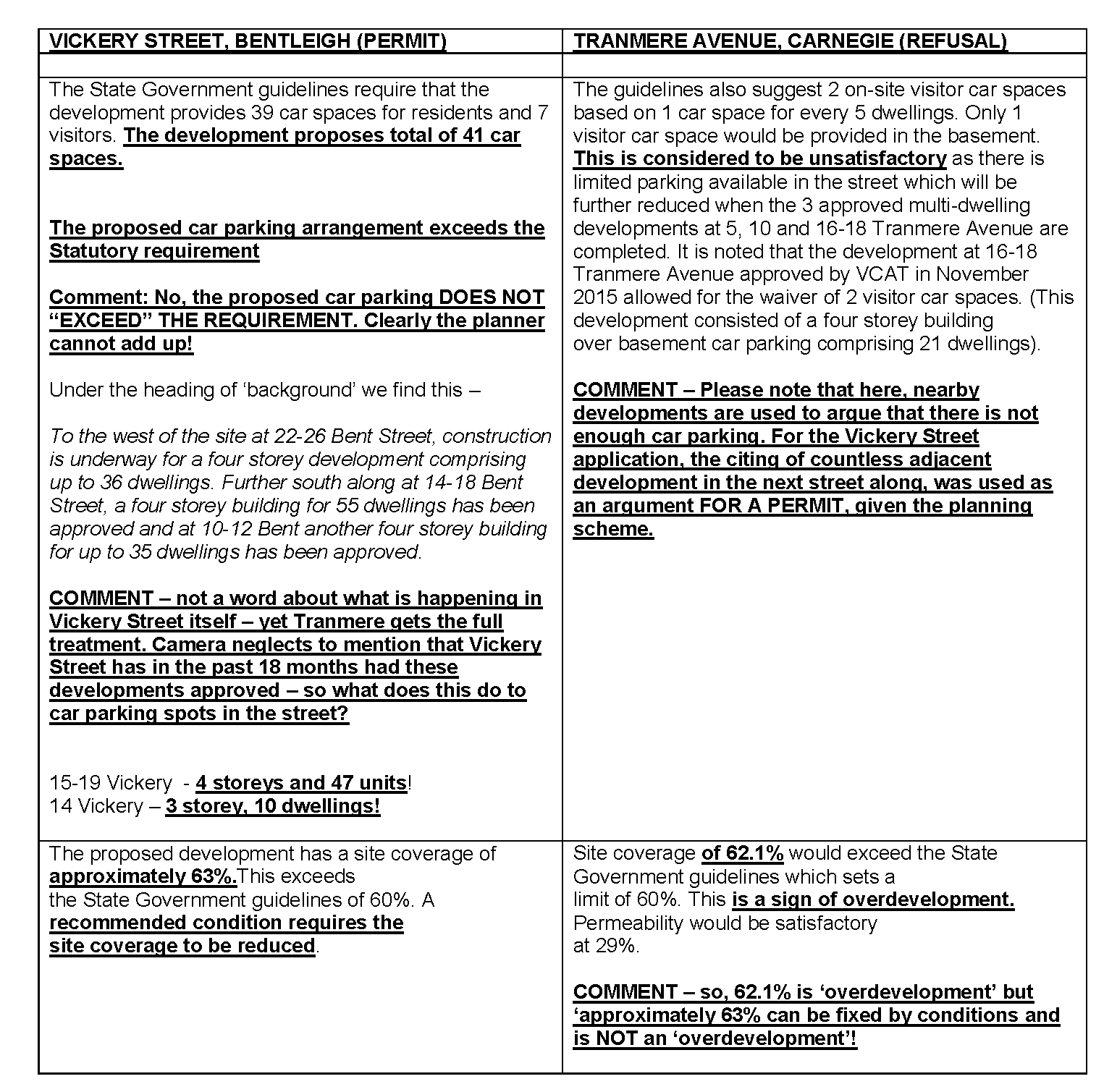
A definite trend is coming to the fore where developers are seeking reimbursement of their costs from councils who fail to determine their applications  within the 60 day time limit. Glen Eira has finally been caught with its pants down and ordered to pay Pitard Knowles $2086.20. In the great scheme of things, the sum is paltry – a mere drop in the ocean when we consider the multi-million dollar business which is council. Yet, this decision on Vickery Street, Bentleigh reveals much about the planning department and councillors’ stupidity and inadequacy.

This is another example where councillors probably sought to ingratiate themselves to residents (39 objections to a 4 storey, 47 apartment block). Their resolution to again lop off one storey and reduce the number of proposed apartments came after the developer went to VCAT. Yet again they imposed conditions which were ludicrous given the planning scheme and yet again the VCAT member proclaimed the inadequacies of the planning scheme. Councillors just do not seem to get the essential point. We repeat – on EVERY SINGLE DECISION WHERE COUNCILLORS reduced the number of storeys and/or apartments, and the developer went to VCAT, the developer won. This has been going on for years and years – but our lot simply don’t get it. The fault is NOT VCAT per se – but the planning scheme. Thus thousands upon thousands of ratepayers’ money was been washed down the drain defending the indefensible at VCAT instead of addressing the real problem – the planning scheme, its zoning, its schedules, its lack of preferred character statements, its lack of real policy!

This Vickery Street case however, introduced a new element. The shoddy performances of the planning department. We have to wonder why, if council can spend $4,500 per day to solve its own internal squabbles, why can’t it spend money on ensuring that the planning department is properly resourced. We’ve already pointed out in a previous post the number of staff involved in ‘public relations’ compared to the number of staff working in planning and traffic combined!

Here is part of what the VCAT member stated –

This is a review under s79 of the Planning and Environment Act 1987 because the responsible authority failed to grant a permit after considering the application for 104 days. Section 115CA of the Victorian Civil and Administrative Tribunal Act 1998 provides the opportunity for an applicant to request the Tribunal’s fee to be reimbursed in these circumstances. At the completion of the hearing the applicant requested the reimbursement of its fee, being $2086.20.

  • The responsible authority requests the application to reimburse fees be dismissed because the permit application is complex, there were unavoidable scheduling constraints caused by the Christmas holiday period and it facilitated discussions with the applicant and objectors by convening a planning forum in January 2016 before it was to be presented to a Council meeting in February 2016. These reasons are rejected by the applicant.
  • I agree with Mr Bromley that the proposed development is not particularly difficult or complex for the following reasons:
  • The Council has considered many three and four storey apartment buildings in Bentleigh and its other urban villages in contexts similar to Vickery Street.
  • The proposed development comprises a design, height and massing that is similar to many other developments designed by Steller. The proposed layout does not differ in any significant respects to other proposals previously considered by Council.
  • The planning policy, amenity and car parking issues are well known to Council.
  • The planning scheme has not changed for some time and provides a well-known and understood assessment framework. There are no recently approved planning zones, policies or overlays that add complexity to the assessment.
  • No external referrals were required that may have added complexity to, or delayed the assessment.
  • The Council has had the benefit of multiple Tribunal decisions on similar applications to guide its assessment.
  • With regard to the conduct of the applicant, the responsible authority accepts it has not contributed to undue delays by not providing information in a timely manner, delaying public notification, or in any way acting vexatiously or unprofessionally.
  • Mr Bromley says the Council took an unreasonable time from the completion of public notification in mid-November 2015 to intending to decide the application early February 2016. He says the time required to arrange and conduct a planning forum on 13 January 2016 resulted in unnecessary delays. He says the application could have been presented to a Council meeting in December.
  • Mr Bromley says the planning forum in January 2016 made no positive contribution to the resolution of issues or the merits of the proposal. It only enabled the objectors to express their concerns with the development. He says Council did not actively engage with the parties between November 2015 and late January to mediate an outcome.
  • The responsible authority says it processed the application with reasonable promptness, the time periods were not unusual for a larger development, and the planning forum is a necessary part of Council’s assessment process. The Council could not truncate the application process over the Christmas holiday period.
  • While I agree with Mr Bromley that a three week period to give directions for public notification following the submission of all information is frustrating, it is not unusual in a busy planning office, and would be generally acceptable. If that were the only delay, the claim for reimbursement of fees would have limited weight.
  • Hence I have to decide if a delay in the order of six weeks (between Council meetings in mid-December 2015 and early February 2016) to enable the application to be discussed at a community planning forum was justified, and whether Council proactively sought to resolve outstanding issues in this period.

AND HERE’S THE REAL STING IN THE TAIL –

  • By contrast effective mediation requires considerable time and meetings needs to be led by expert mediators. Time is needed to enable parties to express their concerns, for the real issues to be identified, and for solutions to emerge. Parties often have to be actively encouraged to collaborate to resolve their differences and to find acceptable solutions.
  • I understand that Council only arranged the planning forum between mid-December 2015 and February 2016, and I accept Mr Bromley’s assertion that Council made no efforts to conduct mediation outside the planning forum.
  • In my view, Council made the conscious decision to defer considering the application in December 2015 so it could convene the planning forum. It was aware there was limited prospect the planning forum would be likely to resolve the issues or add new information that was not already available on the file (provided with the application, referral advice and objections) and summarised in the officer’s report.
  • It did so knowing it would delay its consideration of the application for at least six weeks. It did so knowing that it could face a review at the Tribunal under s79 of the Act, and consequently it would be likely to have to respond to an application to reimburse fees. It took no other actions such as mediation to resolve the planning application in this period.
  • it is not acceptable that the arrangements for a planning forum commence after the technical assessment has been completed. I consider Council has to arrange these much earlier in the assessment process. The planning forum should not unduly delay the presentation of an application to a Council meeting for a decision. It is not acceptable the permit applicant has to wait some weeks for a decision that could be made earlier, particularly if the planning forum is highly unlikely to add new information or does not form part of a genuine mediation process.
  • I am satisfied the Council unduly delayed its decision on the application and the applicant’s fees should be reimbursed.

Source: http://www.austlii.edu.au/au/cases/vic/VCAT/2016/920.html

COMMENT

Council’s Planning Conferences are not there to achieve real ‘compromise’ in our view. Their function is primarily a public relations exercise. It would be most informative if council were to provide the following data so that residents could assess for themselves council’s processes and their efficacy –

  • How many times has the developer not shown up at these conferences?
  • How many times have MAJOR changes occurred to the plans as a direct result of the conference?
  • How many times has the officer failed to include all residents’ views in his/her report to council?
  • How many times has the developer or the objectors walked away satisfied that a ‘consensus’ has been arrived at?

Glen Eira Council considering height limits for commercial zones in Glen Eira under planning scheme review

June 5, 2016 12:00am

Chad Van Estrop

Moorabbin Glen Eira Leader

HEIGHT restrictions could be imposed on commercial zones in Glen Eira following a review of the council’s planning scheme.

Glen Eira’s director of planning Ron Torres said the review, expected to be complete by June 30, would consider height limits.

Angry residents have been calling for the limits on developments in activity hubs like Centre Rd, Bentleigh and say commercial zones, which do not have mandatory height limits, are fuelling over development.

“The key theme that the community raised consistently were the rate and level of development occurring in Glen Eira and in particular around our shopping centres,” Mr Torres said of recent community consultation sessions.

“While our policies don’t contain numerical heights they talk about transitioning down in scale to the residential areas.”

The review comes as two apartment blocks — one of eight storeys (33 dwellings) and another of six storeys (22 dwellings) — have been approved for Centre Rd since April.

Mr Torres was concerned the Victorian Civil and Administrative Tribunal was not implementing council’s policy when their decisions were appealed.

“What our particular concern has always been is that VCAT is not giving the due consideration to our policies,” he said. Mr Torres said VCAT was “not necessarily” setting a precedent with its planning decisions.

He said the planning review would address development scale and size, car parking, heritage protections and neighbourhood character but that any changes to Glen Eira’s planning scheme would need approval from planning minister Richard Wynne.

RMIT professor of urban studies Peter Norden backed the community call for height limits within commercial zones. “I can see that if we starting getting (more) six and seven storey developments on Centre Rd it will conflict seriously with the local urban context,” he said. Prof Norden, a Centre Rd resident, said development was necessary to cater for Melbourne’s booming population. “I’m not against development but it needs to be done in a way that is balanced and not giving green lights to greedy over development.”

In a letter to council last year Mr Wynne said he was concerned that Glen Eira’s planning policy “may not be providing adequate guidance in relation to development within Glen Eira’s activity centre.”


VCAT has once more pronounced ‘judgement’  on council’s Planning  Scheme and shown its inadequacies to prevent overdevelopment. One of the latest decisions comes from the same developer who gained a permit for the 8 storey proposal in Centre Road, Bentleigh. This time it is for a 3 storey, 21 apartment  venture in Prince Edward Avenue, McKinnon.  Below are some extracts from the decision. If Council is ‘fair dinkum’ about shoring up its defences against inappropriate development, then each and every VCAT decision must be considered and amendments drawn up to plug the countless loopholes that developers have so successfully exploited. Anything less is unacceptable.

In principle, I consider that the zone, the absence of overlays, the consideration of relevant planning policies and the locational attributes all lend support to a more intensive development on the review site. Although residents may prefer medium density developments of not more than two or three double storey townhouses, that intensity of development is inconsistent with the extent of built form expected within a neighbourhood centre and in a housing diversity area.

However I make the point that more intensive development does not necessarily mean that individual lots along Prince Edward Avenue will be capable of accommodating three storey apartment style buildings containing ten dwellings. It may be, for example, that individual lots are unable to comfortably accommodate such development and that lot consolidation will provide a means whereby such buildings can be comfortably accommodated in this area. It is certainly the case that policy at Clause 22.07-3 encourages lot consolidation to promote development opportunities.

In contrast with the residential areas which lie outside the Housing Diversity Areas (within the Minimal Change Areas), there is no neighbourhood character policy to articulate the expected outcomes here. Nor are there any built-form overlays, such as a Design and Development Overlay, to establish the parameters which would apply to new development. Beyond the policies which have been detailed above, the only guidance which can be gained from the Planning Scheme is essentially from the purpose of the GRZ1, the 10.5 metre height limit specified in the schedule to the GRZ1, and the provisions of Clause 55.

The extracts from Tribunal decisions provided earlier confirm that the new buildings within Housing Diversity Areas are not expected to respect the existing character. To do so would detract from the policy direction that these areas are to evolve over time into locations where there is a predominance of higher density housing. This view is supported by the fact that the Planning Scheme does not include a neighbourhood character policy for the Housing Diversity Areas. They are expected to change in quite a substantial way, and this involves a very obvious departure from the traditional dwelling forms and styles which presently characterise streets like Prince Edward Avenue.

Having regard to the maximum 10.5 metre building height provided for in the Schedule to the zone, submissions that development should not be greater than two-storeys cannot be substantiated, as this specified height allows for three-storey development. The inclusion of Prince Edward Avenue in GRZ1 is an indicator that, at a point in time, a conscious decision was made that three-storey development in this street would represent an acceptable outcome. The provisions of the GRZ1 as they currently stand reflect an expectation that, over time, three-storey buildings will be constructed not only in Prince Edward Avenue, but also in the nearby residential streets contained within this zone. Indeed, approvals for such buildings are in place for sites in Station Avenue and Penang Street, both of which are within the residential area of the Neighbourhood Centre.

Within the zoning and policy context where these forms of development are anticipated, it is inevitable that new buildings of this type will affect neighbouring properties. The resultant impact on the occupants of those properties will, undeniably, be significant. It will represent a significant change from what they have become accustomed to and will, of course, affect their amenity. This is particularly so for the properties at 27 & 33 Prince Edward Avenue and at 30 & 32 Station Avenue, all of which I have inspected. The residents’ opposition to the development is entirely understandable.

However, as explained in earlier Tribunal decisions, the Council has identified this neighbourhood as one which will undergo a much greater level of change than other residential locations which are situated in Minimal Change Areas and where the Neighbourhood Residential Zone (NRZ) applies. In those other areas, new development is restricted by the zone provisions to a maximum of two dwellings on a lot and the height is restricted to 8.0 metres (equivalent to two storeys). That is not the Council’s vision for this neighbourhood, as articulated in the Planning Scheme. If it were, then it would have sought to apply the NRZ here. It has not. Rather, a strategic decision has been made based on the location within a Neighbourhood Activity Centre to apply the GRZ1 and to allow higher and more intensive development. This is not without its consequences for the amenity of adjoining properties

I acknowledge the residents’ opposition to the proposed overlooking on the basis that views beyond 9.0 metres into their secluded private open space areas will be possible. While this may be true, the Objective is to limit views, not to prevent them altogether, and the Standard only requires views within 9.0 metres to be screened. The Planning Scheme’s provisions do not address views beyond this distance

The residents expressed concerns regarding the capacity of local services to absorb the demand generated by developments such as this. Although these concerns may be understandable, I have no evidence before me to lead me to conclude that the capacity of local infrastructure will be exceeded as a consequence of this development.

Source: http://www.austlii.edu.au/au/cases/vic/VCAT/2016/823.html

The agenda for Tuesday night’s council meeting is interesting not merely for what it contains, but more so, for what is not included. A few examples:

  • No mention in any of the records of assembly of council’s ‘discussion’ on the appointment of Ms Fiona O’Brien to investigate allegations of bullying. Pilling has been quoted as stating that council ‘engaged’ Ms O’Brien to undertake this work. Hence, we wonder when and where this decision was made. Even if ‘confidential’, our reading of the Local Government Act would still require a note that some item of a confidential matter was being discussed. No such notation exists.
  • On the 26th April (that is two council meetings ago) there was a request for a report on the potential for an increased open space levy. The report has not yet materialised – meaning that if it does appear for the next council meeting, it will have taken 2 months for a document to be tabled. In our view, not good enough!
  • The records of assembly meeting of 24th May include this item – (a) CFO – outcome of loan re-structuring negotiations. No item in the agenda to inform residents of what this will mean in terms of late payments, the new interest rate, or in fact any information whatsoever. We assume that ratepayers will be required to plough through the new Strategic Resource Plan (when it appears) and try and figure out what is really happening! Surely some media release or official statement would not go astray at this point in time?

A new application for a 16 storey mixed use development has come in for Egan Street, Carnegie. This is the second time the developer is asking for this height. The first application was refused by council in December 2014 and VCAT affirmed Council’s decision in October 2015. What should be noted about this VCAT refusal is that 16 storeys was considered acceptable by VCAT given Council’s planning scheme (ie – ‘As I have indicated in this decision, there are many aspects of the proposal that I do support, including its overall height.’) What stymied this first application was ‘internal amenity’ (apartments without natural light, some of miniscule size – 41 square metres, and whether or not there would be ‘equitable’ opportunities for potential development for buildings alongside this project. It should also be noted that this site is listed as being in Precinct 1 of the Carnegie Urban Village. Tough luck that this feature of the planning scheme lapsed in 2007!!!!!! The following paragraph from the decision sums it up nicely –

Whilst the State and Local Planning Policy Frameworks encourages the development of higher density housing on this site, the planning scheme does not contain specific design guidance usually provided within planning schemes for locations such as the Carnegie Urban Village. A Design and Development Overlay has not been applied to the site, and there is no guidance as to the expected height of buildings within Precinct 1.

This is clearly another example of council sitting on its hands until it is too late. Yes, there is now a planning scheme review. However, the chances of amendments being introduced in time to limit height and design and then being applied retrospectively is zero in our view. Then there is of course, the other option of the developer going immediately to VCAT if council does not come up with a decision in the required 60 days.

The take-home message from all of this is that unless the current planning scheme review achieves major reform and that includes much, much more than simply slapping on a height limit for commercial sites, then inappropriate development will continue.

Councillor camps out at Caulfield Racecourse to campaign on public space

Date: May 30, 2016
Councillor Jim Magee at his Caulfield Racecourse camp site.Councillor Jim Magee at his Caulfield Racecourse camp site. Photo: Jason South

Jim Magee is camping out. Conservative by nature, the Glen Eira councillor is not the type to conduct a sit-in, or break his own council’s by-laws banning camping on public land.

But he was worried his long-running campaign to draw attention to the little-used public space inside Caulfield Racecourse might end up going nowhere with the state’s new environment minister, Lily D’Ambrosio.

So last week he dug the family tent out of the garden shed. “Finally in my old age, I’ve become an activist,” says Cr Magee, sitting by a fire, outside the five-person tent he pitched on Saturday by the racecourse.

Jim Magee at his Caulfield Racecourse camp sit-in.Jim Magee at his Caulfield Racecourse camp sit-in. Photo: Jason South

There are local laws against camping on public land, which Glen Eira is usually quick to enforce.

“But this is a political sit-in,” says Cr Magee, who has been told by council officers that unless there are complaints from residents, they are unlikely to issue him with a notice to vacate.

Cr Magee will stay put until Saturday afternoon, by which time he hopes to have met Ms D’Ambrosio to discuss the fate of the 54 hectares of land in the centre of Caulfield Racetrack.

The reserve, set aside for the public more than a century ago, is hard to get to, because of the racing infrastructure that must be navigated. It’s open from 9.30am each morning until sundown, and many locals don’t even know it’s there.

Cr Magee was concerned that, with Ms D’Ambrosio only recently taking over environmental matters, she might not pay enough attention to a review under way by the Andrews government.

There’s little chance of that now, with the land at the centre of a fight that has led to much debate – and a scathing Auditor-General’s report. It found the public land was being used almost exclusively to serve the interests of the Melbourne Racing Club.

Cr Magee has five more nights ahead of him before his hoped-for meeting with the minister, and a rally of sporting clubs who want ovals built on the land, which equates to 15 MCG playing surfaces.

“I’ve been here through two very cold nights so far – I’ve made friends with a couple of foxes,” says a slightly blurry Cr Magee, who says he is waking every 90 minutes or so. “I’m doing more sitting than sleeping – I’m actually right next to a very busy roundabout.”

The Andrews government is reviewing the status of how the land is governed and controlled, and Cr Magee – who was once a member of the trust that controls the land – says it must change.

He wants Ms D’Ambrosio to step in as minister and take control of the land and help Glen Eira council turn it into sporting fields and parklands for use at all times.

Ms Lily D’Ambrosio said she understood the high level of community interest in the public land at the racecourse and that the government had set up a bi-partisan working group to consider the issue.

“I’m expecting to receive this report next month and look forward to working with the community to reach a resolution,” she said.

Investigation launched into bullying accusations at Glen Eira Council

May 27, 2016 6:11pm

A CULTURE of bullying and intimidation among Glen Eira councillors is under investigation by eminent barrister Frances O’Brien QC, an insider alleges.

Ms O’Brien, whose report led to the sacking of Geelong Council in April, has been appointed by mayor Neil Pilling, as rumblings between councillors increasingly spill into the public domain.

Her appointment as an independent arbiter follows a tumultuous four-year term at Glen Eira, which came to a head at a citizenship ceremony in March.

The sordid history of infighting among councillors saw the council sacked in 2005.

The Herald Sun understands all councillors have met with Ms O’Brien at the Glen Eira town hall as she seeks to unravel the increasingly “toxic” culture.

A number of councillors have confirmed they are to be interviewed by Ms O’Brien.

Some of the incidents which may come under investigation include:— Cr Jamie Hyams calling Cr Oscar Lobo a “f**kwit” at a ceremony attended by 200 people at the Glen Eira town hall.

— Cr Oscar Lobo’s allegedly anti-Semitic slur at a December council meeting.

— A 2010 email councillor Michael Lipshutz sent to Cr Lobo asking him if he had worked for a bank linked to terrorists.

Cr Hyams has confirmed he called Cr Lobo a “f**kwit” at the ceremony.

He refused to go into details about the incident, but said the insult was levelled at Cr Lobo after he was “severely provoked”.

It is believed Cr Lobo and Cr Hyams were almost involved in a physical altercation at the citizenship ceremony when the argument spilt into the town hall foyer.

Cr Hyams apologised to his colleagues for the outburst in a late-night email following the incident.

Councillors unanimously voted to censure Cr Lobo earlier this year for the allegedly anti-semitic slur.

“Ever since Cr Lobo made his disgustingly racist comments in the council meeting of December 15 he has treated myself and other councillors with complete contempt,” Cr Hyams said.

Cr Lobo has claimed to be the subject of bullying and racism for seven years.

“The council is trying to find out what these internal issues are and it has been given to an independent person to judge the gravity of the situation,” Cr Lobo said.

Cr Lobo denied he provoked Cr Hyams at the citizenship ceremony.

“He got up and said you’re a f**kwit and that’s when I lost my cool after that because he has done all these insults in the past and no one knows about it.”

“He wanted to provoke me to hit him because that’s an easy way to get rid of me.”

Cr Lobo called for Cr Hyams to resign in light of his behaviour.

The incident follows a failed bid by councillors to reprimand Cr Lobo in 2013 at a conduct panel, which cost ratepayers $27,000.

Ms O’Brien will prepare a report following her meetings with councillors, which may be referred to the ombudsman or Independent Broad-based Anti-corruption Commission.

Glen Eira mayor Neil Pilling confirmed Ms O’Brien had been “engaged” to provide advice on councillor conduct.

“As the confidential matter is currently in progress and subject to legal privilege, we are unable to make further comment at this time,” he said.

Ms O’Brien would not comment on the investigation when contacted by the Herald Sun.

chad.vanestrop@news.com.au

For the second consecutive time, Theme 1 (Municipal Strategic Statement & Local Policies) contained in the ‘Discussion Paper’ for the review of the planning scheme has been neatly side-stepped and no discussion permitted. We therefore wonder how Council can ‘know’ what residents suggest, or want, if they haven’t even bothered to ask. What comments council officers have made in previous forums on this theme has been far from satisfactory. Torres simply admitted that the Municipal Strategic Statement (MSS) is well and truly outdated and will need to be ‘revised’. That’s it!

Given that the MSS and its associated Local Policies are perhaps the most important components of any planning scheme, it is unforgiveable that residents have not been provided with (a) enough information on these sections, and (b) that ‘discussion’ has been literally ‘censored’. That of course leads to the very obvious questions of:

  • Is this another Clayton’s consultation where ‘changes’ have already been predetermined but residents are kept in the dark like mushrooms?
  • Who decided to discard discussion on Theme 1? Was Ms Turner given her orders to do so or was it her decision alone?

Below is a screen dump from the Discussion Paper. Please note how bereft of detail this really is, yet how this Theme contains all the vital policies and which, of course, ultimately lead onto the zones and their schedules. From our perspective, it appears that council has done everything it can to avoid any discussion on the most contentious issue in Glen Eira – ie a review of the zones and their respective schedules.

Pages from Pages from april05-2016-agendaPS: also worthy of note – the only councillor to front last night was Lobo. No sign of Lipshutz at any of these ‘forums’ and Magee’s 5 minute appearance at the first one! Delahunty has also been a noticeable absentee.

« Previous PageNext Page »