GE Consultation/Communication


Council has finally released its draft Housing Strategy. The proposals will impact hundreds upon hundreds (if not thousands) of residents – without the necessary justification or evidence. Why do we think so?

  1. The various documents state over and over again that Glen Eira has the land CAPACITY to meet our projected housing needs of roughly 13,000 net new dwellings by 2036. If this is the case, then why do we need to rezone and facilitate more and more development?
  2. Much of the data provided is highly tenuous and conflicts with both Victoria in Future prognostications, as well as the Bureau of Statistics data.
  3. The assumption that building more and more will reduce prices is a fallacy and there is plenty of published evidence that would refute, or at least challenge this claim.
  4. Council has an Urban Forest Strategy, a declining tree canopy,  and a Climate Emergency policy, yet paradoxically is prepared to reduce setbacks, remove mandatory garden and parking requirements, and tellingly, instead of attempting to reduce the height island effect, council is prepared to reduce permeability so that more dwellings can occupy certain sites.
  5. Our conclusion is that this Housing Strategy is Amendment C184 in disguise – except that it will now extend to all of the municipality instead of only Bentleigh and Carnegie.

The important detail is presented below.

What the above implies about the potential zoning and schedule changes are:

  • Currently land zoned NRZ has a 50% site coverage, a 25% permeability requirement and a 4 metre rear setback. The above screen dump makes it clear that the new NRZ zone will in all probability become 60% site coverage, 20% permeability, and a removal of the 4 metre setback entirely.
  • The current GRZ zoning allows an 11 metre height maximum plus various setbacks for the upper second and third level of the buildings. There is also a mandatory garden requirement of 25% to 35% depending on the size of the property. Again, council is proposing to remove this so once again we can have more development on the site. Rear setbacks are also likely to go.

Council has provided the following map that is now the Framework Plan. Surely far more detail could have been provided such as clear differentiation of colours rather than what is shown as gradations of pink. Why not clear blues, greens, yellows that stand out? Or would this reveal too much to residents?

From this map it would appear that all Neighbourhood Centres zoned GRZ will have the mandatory garden requirement removed. Please consider the above map carefully and try to decipher whether you will be impacted by these changes.

There is much, much, more that could be said about this and council’s overall approach to consultation.  4 weeks is not enough to plough through 589 pages on the housing strategy itself. Consultation requires more than a ‘survey’ that in the past has not asked the right questions. Nor is it appropriate that council publishes a 1000 page agenda several days before vital decisions are to be made. How many more times will it be necessary to remind this council that the ombudsman recommended at least 5 working days for the publication of agendas?

We urge all residents to contact their councillors and to lobby hard for the rejection of this Housing Strategy!

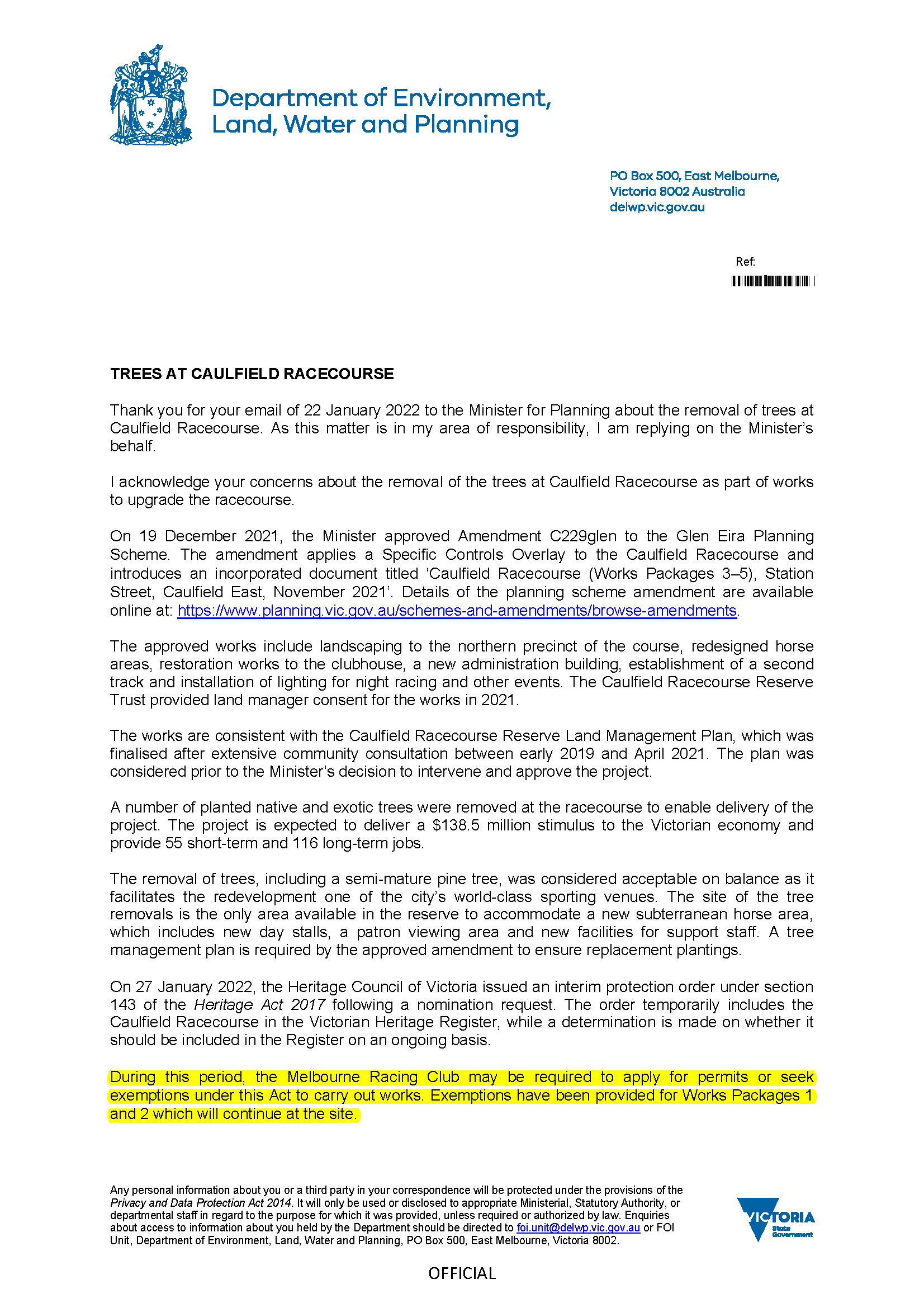
We have been forwarded the following letter by a resident. This is in response to an email sent to the Minister.

Please read carefully the highlighted sections. Unless we are mistaken, the decision(s) to pursue the destruction of potential heritage buildings and the further removal of trees has been given the go ahead – again without consultation and which flies in the face of the Heritage Victoria interim order. Put bluntly, the arrogance and complete disregard for the community is beyond belief!

PS – From Parliament Today –

Caulfield electorate

Mr SOUTHWICK (Caulfield) (14:39): (6176) My question is to the Minister for Planning. On Christmas Eve, while many locals were enjoying their holidays, you exercised significant ministerial power under the cover of darkness to remove significant trees and buildings at the Caulfield Racecourse without consultation. Having been aware of the impending plans even a month later, many locals were left shocked when several trees, some 100 years old, were swiftly cut down in January. As a result residents have expressed their outrage that you gave approval for the felling of these trees and the demolition of these significant buildings without proper community consultation. Of particular significance among these trees is an Aleppo pine tree grown from the seed of Gallipoli’s Lone Pine which was also destroyed in the process. Minister, why did you make this order without consultation, and how will you protect the heritage significance of the Caulfield Racecourse precinct going forward?

‘Planning mess’: Outcry over Caulfield Racecourse redevelopment

By Cara Waters and Damien Ractliffe

February 1, 2022 — 12.01pm

The destruction of 100-year-old trees for the redevelopment of Caulfield Racecourse caused community outcry, but local authorities are unclear who bears ultimate responsibility.

Demolition work at Caulfield began on January 10 after a Christmas Eve amendment by Planning Minister Richard Wynne overruled heritage and council controls on the $570 million development of the racetrack and surrounding area.

One of the 42 trees destroyed was an Aleppo pine grown from the seed of Gallipoli’s Lone Pine. The works also involved the demolition of a toilet block and asphalt removal.

Heritage trees were cut down with chainsaws, prompting the interim protection order.

Work stopped this week after Heritage Victoria made an interim protection order on January 27 that means it must sign off on any work in the next four months.

Minister Wynne’s amendment to the planning scheme was requested by the Melbourne Racing Club. A spokesman said the club had done “everything by the book”, and had consulted on its plans with club members, the broader racing industry and the local council.

“We will also continue to do the right thing and work with Heritage Victoria on how we can proceed where appropriate,” the spokesman said.

The Caulfield Racecourse Reserve Trust said it was aware of the planned demolition work but did not realise it would start without any chance for public consultation.

Andrew Paxton, general manager of the Trust, said it was unusual that Minister Wynne approved a planning amendment scheme, which did not require public exhibition, on Christmas Eve.

 “The community of Glen Eira have an expectation of consultation and being engaged,” Mr Paxton said.

The local council said it was “blindsided” by the minister’s actions and the destruction of the trees. The Glen Eira council said it was yet to receive a response from Mr Wynne, confirming it was the Glen Eira Historical Society which applied for, and secured, the interim protection order after some trees had already been cut down.

The local council said it was unaware of the demolition work until it occurred, noting it lodged a request with the government on August 18 last year, seeking Mr Wynne authorise a heritage amendment to protect the racecourse.

“We’re a small little volunteer-run organisation, so not geared up to dealing with an entity like the Melbourne Racing Club,” volunteer Anne Kilpatrick said. “What we’ve come around to realising is that somebody needs to step up for this. In this instance, we thought well, no one else is, we will do that.”

Glen Eira Mayor Jim McGee said the council was “blindsided” by the demolition work. They’ve given the Melbourne Racing Club the go-ahead to do whatever they like, and unfortunately, they’ve started by destroying what I believe to be heritage buildings, destroying heritage trees and just going hell for leather,” he said. “It’s just another example of the Melbourne Racing Club, paying absolutely no attention to residents. They haven’t done it in 150 years, so I’m not surprised that they are not doing it today.”

In a letter to Mr Wynne, Cr McGee said the process for approving the redevelopment work on Christmas Eve appeared misleading and secretive.

“The community are rightly outraged about what’s happening at the racecourse,” he said.

Mr Wynne said the government had engaged extensively with the council, including as recently as last year, on its plans to redevelop the racecourse area into a “people friendly community recreation space”.

 “It beggars belief that the Glen Eira council is claiming to be surprised by the development occurring at Caulfield Racecourse Reserve – which the government has made significant investments in to unlock open space for the community,” he said.

However, many people, including MRC members, said they were surprised by the works.

“We have been racing at Caulfield for 150 years and most people would be very surprised that nothing at Caulfield has any sort of heritage protection,” MRC member Anthony Del Monaco said. “[The] question is why the club, the council or the government haven’t taken action earlier to get heritage protection for this much cherished state asset. and avoided the planning mess that has resulted.”

Member for Caulfield David Southwick MP said the community was consulted about the plans for the construction of buildings and new sports fields, but not about the demolition work or removal of heritage trees and buildings.

“They’ve gone so heavily in terms of consulting with the community about what could be in the middle of the racecourse, yet they’ve forgotten to actually look at protecting some of the heritage value around the actual precinct itself,” he said.

“There’s been no consultation with them, and the fact that the minister on the 24th – Christmas Eve – can effectively rubber stamp something and have these trees, including an Aleppo pine, destroyed I think is really upsetting.”

Mr Southwick said the way the redevelopment was handled had important implications for planning across the state.

“[If] you’ve got one minister, a planning minister, who can do whatever he likes in anyone’s backyard without any third-party appeal, then he’s a real concern for any Victorian right now,” he said.

Source: https://www.theage.com.au/national/victoria/planning-mess-outcry-over-caulfield-racecourse-redevelopment-20220131-p59si3.html

COMMENT:

The MRC in the above quote, admits to ‘consulting’ with members, race goers, and council. Significantly, the one important omission is the community/residents of Glen Eira.

Also surprising is Council’s claim to have requested interim heritage protection in August last year. There is no formal council resolution that we can find to this effect. Why wasn’t this brought before a full council meeting in order to (1) make this request public, and (2) to ensure full ratification by councillors?

Will council now make public all of its communication(s) with the Minister, the MRC, and with the department? Did Council employ its own heritage advisors or did they rely on the MRC appointed advisors? Were councillors fully aware of any of these meetings, communications?

There are a myriad of questions that need answering from all – including the Minister, the MRC, the Trustees and Council.

Council has published its submission to the inquiry on the current Planning & Environment Act, 1987 in today’s agenda. Whilst we agree with many of the comments, there are several major issues where council’s response is far from adequate or valid.

First, the ‘good points’.

  • Yes, there should be specific attention paid to the environment and sustainability
  • Yes, housing affordability is an issue, though most things are out of council’s control
  • Yes, heritage is important and there should be a fast tracking process for interim protections

Now for the ‘questionable’ responses!

SOCIAL/AFFORDABLE HOUSING

Here’s what council has to say in regard to providing social/affordable housing –

Council has a policy requiring a minimum of five percent affordable housing on rezoned sites. Ideally, this should be extended to higher density development proposals and adopted at a state level.

By way of comparison, readers should note what Yarra Council as one single example only, has done with its percentages on social/affordable housing. In its 2019 Housing Strategy, Yarra states:

Yarra has worked with a number of site owners to provide at least 10% affordable housing. At the former GTV9 site, Richmond, affordable housing will represent at least 10% of the total number of new apartment dwellings. At the former Gasworks site, Fitzroy North a range of dwelling types will cater for a variety of housing needs including the provision of up to 20% affordable housing. Council will continue to seek additional affordable housing for our very low, low and moderate income community. (page 18)

Why Glen Eira should be ‘satisfied’ with a meagre 5%, when other councils are seeking up to 20% is the central question here. When we are so ‘committed’ to the need for social housing, then why has council been willing to settle for 5% on such massive developments at Caulfield Village over 2000+ apartments, and soon East Village, with at least 3000 dwellings on the cards. Further, why limit the creation of social housing only to those areas that will be ‘rezoned’ – presumably sites listed as Comprehensive Development Zones, or Priority Development Zones, etc. There have been plenty of developments on straight forward MUZ, or C1Z sites, that are well over 100 apartments.

Maybe, the answer is very simple. Requiring too much from developers in terms of social/affordable housing, will simply be another impediment to development that council is not willing to put in place!

MANDATORY APARTMENT SIZES

A little background first. According to the 2016 census, Glen Eira has just under 9% of single bedroom dwellings and just under 30% of its dwellings that contain 2 bedrooms. That equates to well over a third of all our dwellings. Yet we have 50.1% of our population listed as families with children. This number is very likely to have increased by 2021 and is the cohort which according to common sense requires space. Further exacerbating the issue, is the lack of open space in the municipality.

Given these above stats, then the issue of space becomes vital – especially in this COVID world where more and more people are likely to remain working from home.

Over the years, there has been report after report (especially from the City of Melbourne, and The Age) revealing the dog boxes that have been going up. Many single bedroom apartments were under 20 square metres, and 2 bedroom apartments, less than 50 square metres.

So what is Glen Eira’s response to the question of whether there should be mandatory, minimum apartment sizes? Here’s what was stated:

Apartment sizes are already discretionary. This enables consideration to be given to the quality of the space in terms of flexible furniture layouts, circulation and good natural lighting. Smaller apartments are more affordable and policy and controls that aim to improve the quality of the space may be more useful than mandating a minimum size. Well designed smaller housing accommodates more people in well connected areas, close to shops and services, and offers an affordable housing option. The quality of the space is more important than mandating a minimum size. Mandating a minimum size may contribute to making affordable housing even more elusive than it already is.

We will leave it to readers to interpret the above and decide the real reasons for council’s opposition to mandatory sizes.

Submissions to the enquiry close this coming Monday. See: https://www.parliament.vic.gov.au/epc-lc/inquiries/article/4819

With another year almost gone, it is perhaps a good time to reflect on what has happened throughout this period. What, if anything, has improved? What has gone backwards? What has remained static? Have the new councillors performed well? Have the old councillors ‘improved’?

There have been some positive steps, although we must admit they are tiny baby steps compared to what is required. We finally, after 18 years of talk, got a significant tree register. However, the roll out of this program is well and truly behind schedule and ultimately will take another few years to reach even the miniscule figure of 250 trees given the current rate. More disheartening is the fact that the tree register remains part of council’s Local Law, rather than being enshrined in the planning scheme itself. A recent VCAT hearing had the member make this comment which reveals how important it is that controls are included in our planning scheme. We quote:

The site contains five (5) trees that are proposed to be removed as part of the car park development. All are of exotic species and the planning scheme does not have any tree removal controls. Hence, their removal is acceptable.

(SOURCE: – https://www.austlii.edu.au/cgi-bin/viewdoc/au/cases/vic/VCAT//2021/1549.html)

Whether or not one finds the conclusion valid, is a moot point. If council did have a planning scheme which sought protection of ALL trees meeting certain criteria, then perhaps such judgements would be far less frequent.

We have been told again and again that councillors are determined to address the municipality’s lack of public open space, sustainability, increase our canopy cover, and take real action on climate change. All well and good and to be applauded. However, when such aspirations are not backed up by sufficient funding, then we have to query whether anything will really improve over the next few years. The Open Space Strategy states that at least 150 hectares of additional open space is required to meet the community’s needs. The long term financial plan allocates roughly $7M per annum for each of the next four years. This is just enough to purchase roughly 1500 – 1800 square metres of property per annum. Even with the current proposal for an 8.3%  open space levy (when other councils are looking at 10%) this will still not be sufficient to come even close to the ‘required’ 150 hectares.

The above comments can also be applied to council’s action plan on increasing the canopy cover, and acting on reducing carbon emissions. Unless such policies are backed up by sufficient funding, then we can only anticipate a further loss of important canopy trees, and little improvement in climate management strategies. This of course goes to the heart of priority setting by this administration and its elected representatives. When council is committed to massive spending on infrastructure projects such as the Carnegie Pool, to the tune of now $52M (up from the budget forecast of $51M), and when no business case has been made public, we have to doubt the efficacy of such decisions – especially when countless comments from residents wanted the ambience and the foot print of the current pool retained. Very few desired another (mini) GESAC. 

Planning in Glen Eira remains as it has for decades – pro development, and lacking in enforceable strategies and policies. It is quite unbelievable that after the mandated Planning Scheme Review of 2016 we still do not have:

  • Permanent structure plans for Bentleigh, Elsternwick, and Carnegie
  • After being promised structure plans for our neighbourhood centres, we only have ‘guidelines’ (ie Built Form Frameworks) for three neighbourhood centres which are not as yet even in the planning scheme. No indication has been given as to what to expect for the remaining centres.
  • No developer contributions on parking as promised in 2016
  • No Water Sensitive Urban Design (WSUD) policy
  • No review of the residential zones and their respective schedules since 2013
  • And the most damning fact – no housing strategy since 2002 and council steam rolling ahead with amendment after amendment all PRIOR to the completion of an essential housing strategy.

Politics has continued to play an important role in many councillors’ decision making as evidenced by the car park issue and the acceptance (or not) of the $18M funding from the Federal Government. Politics is also evident in the alacrity with which some Labor aligned councillors so heartily support draft structure plans and applications that include heights so out of keeping with resident wishes.

Council signed an ‘agreement’ with several other councils this year to demand greater community and council input into the State Government’s planning agenda. Thus far, we have heard nothing back.  Have discussions been ongoing between councils and the department? If so, why not some updates?

We must also comment on the volume of useless community consultations. We maintain that they are indeed ‘useless’ when the questions on surveys are simply designed to elicit certain responses, and when councillors and the community consultation committee has no input into the final product. Residents are often faced with planning jargon that most will not be familiar with, or with hundreds upon hundreds of pages to plough through in order to come up with some decent submissions. The absence of Discussion Papers that are truly objective and informative is a major failing of this council. Surely a brief document that accurately summarises the issues would not go astray.

Several councillors have bemoaned the fact that the response rate on various issues is poor. Perhaps council needs to start asking why this might be the case. Is it simply because residents are apathetic? Or perhaps it might have more to do with the fact that so many people believe that their views will not be acted upon? Or maybe, the manner in which consultations are carried out, and the ‘useless’ questions are seen as a complete waste of time by residents?  Then again, people are simply tired no doubt, and flooding them with mock consultation after mock consultation is simply demoralising and counter productive. Perhaps more people would respond if more information was included that meant something. For example: pretty pictures of draft designs is not enough. Why not include some basics like -size, cost, footprint? Surely this would elicit some very relevant and greater feedback. The greatest fallacy however would be for this council to assume that because the response rates might not be up to par, that means that the majority of residents are in FAVOUR of the various projects. In our view, nothing could be further from the truth. Disquiet is growing and until this council addresses the fundamental issues of housing, open space, and sustainability, we will continue to head backwards. It is the role of councillors to ensure that this trend is reversed.

Our best wishes to all for a much healthier and far more fulfilling 2022.

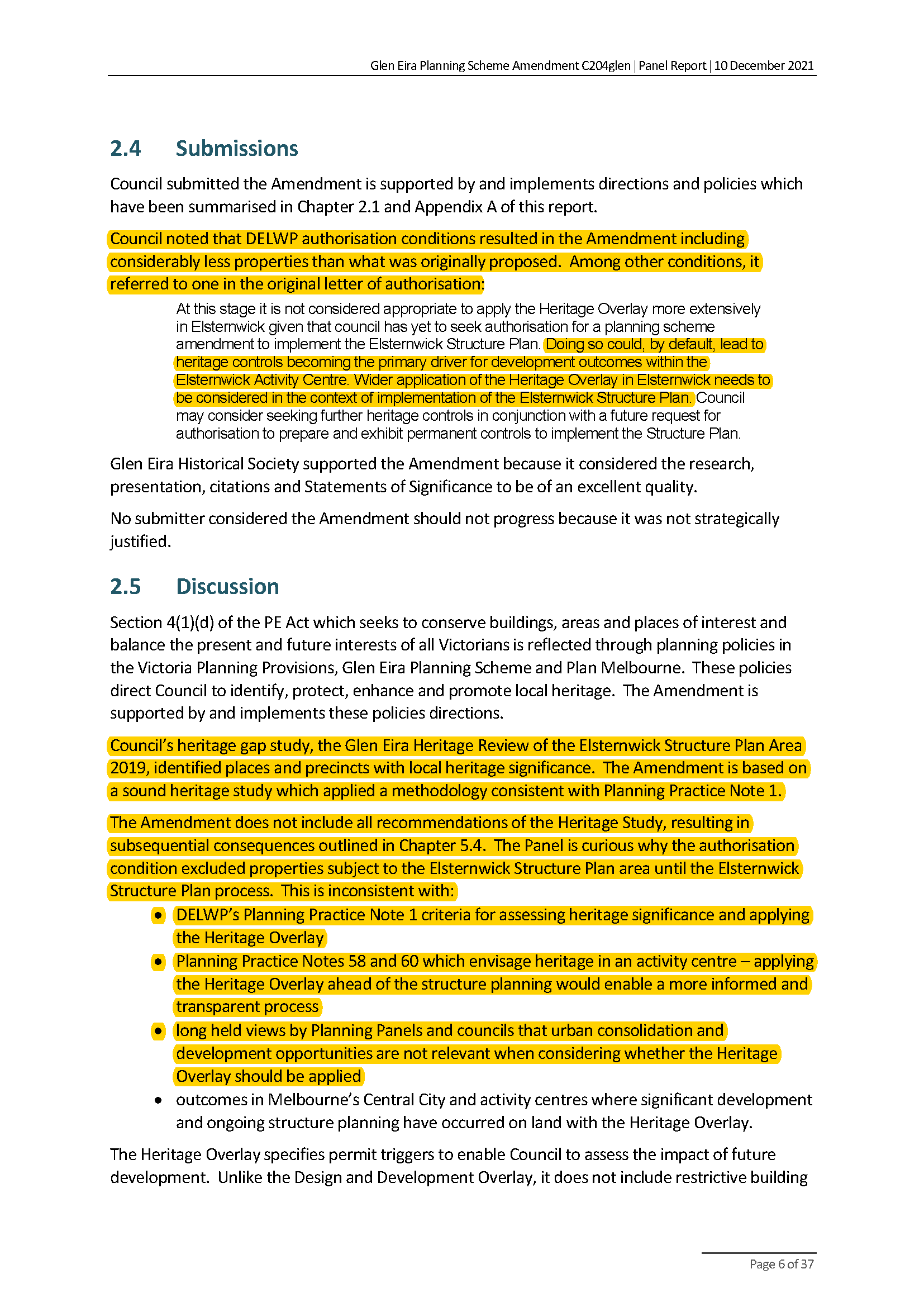
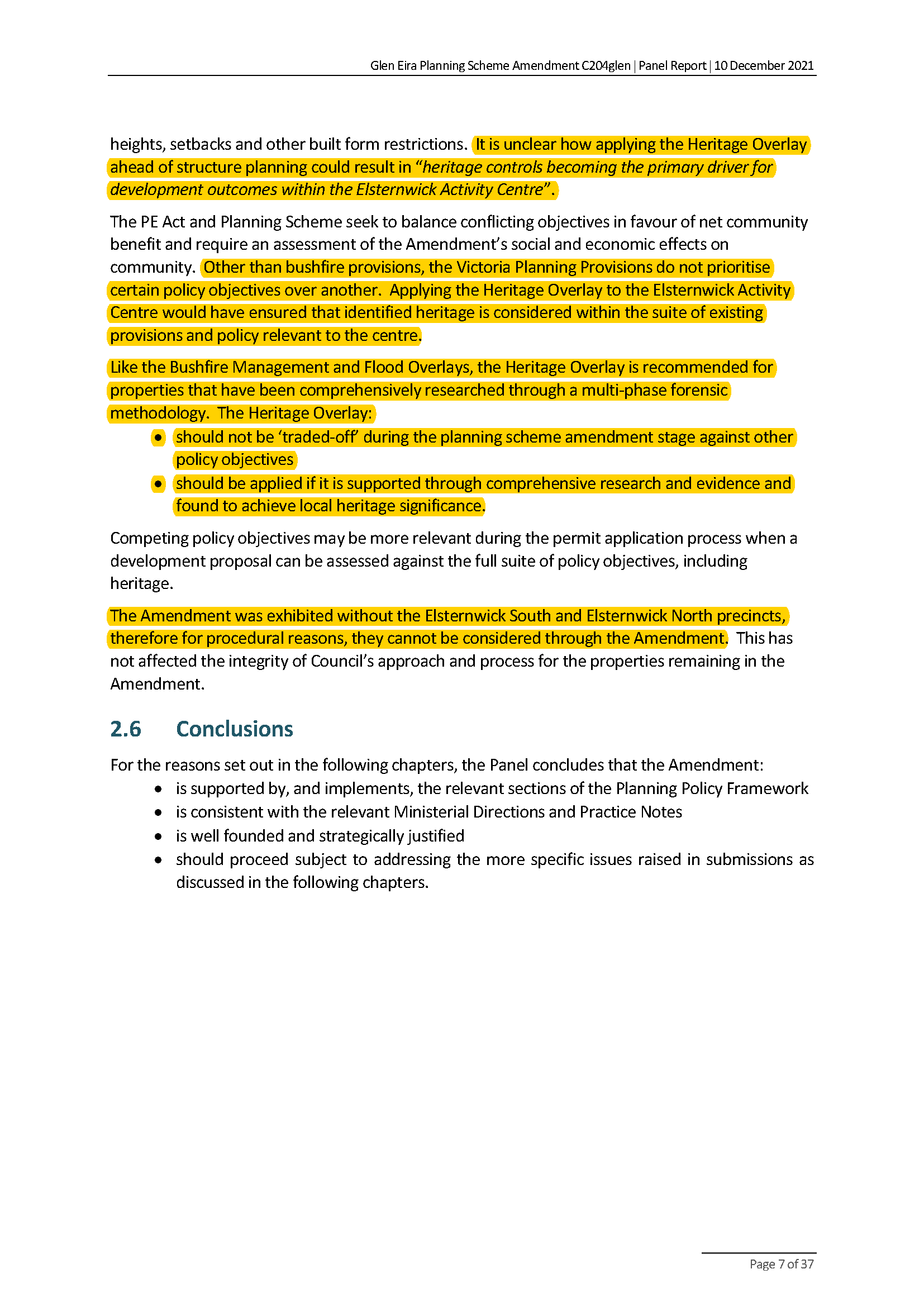
The Planning Panel Report on the ‘Hidden Gems’ amendment is now available. Council’s amendment is ‘appropriate’ and the panel has supported most of the recommendations contained therein. More importantly, the panel repeats previous criticisms of the Department and the Minister, where their refusal to include all the precincts identified by the external heritage advisor as suitable for heritage listing were omitted. The rationale was that listing these precincts in the Elsternwick Urban Renewal South, would likely be the ‘primary driver for development outcomes’. In other words – let’s not put any impediments in the way of the mooted high rise that is to go into Elsternwick.

To the Panel’s credit, this was not only commented upon, but the criticism is fully warranted. What is most disappointing however, is that there was not a single peep out of council (at least made public) when they were informed of these exclusions. Would it have killed council to announce their opposition to this decision? Would it have killed council to publish any letters it may have written in response – in fact, was there any correspondence, or did council merely and meekly accept a decision that goes against current legislation, planning practice notes, and its own VPPs? If this was the case, then once again, this council has chosen the route of compliance, rather than support for what the community values – ie heritage!

The following pages, taken directly from the Planning Panel report, show what the Panel thought of Wynne’s and the Department’s decision making and its justification –

Last night’s council meeting included another first – the refusal to allow a councillor his requested time extension. This occurred on the ‘debate’ for progressing the multi-storey car parks in Bentleigh and Elsternwick to the next stage – ie design, background reports, feasibility studies etc.

Zyngier rose to speak against the motion to proceed. He spoke for his 3 allotted minutes and then requested a time extension of 6 minutes. Magee replied that he would consider another 3 minutes first and then see how far Zyngier had got with his statements. The motion to allow the three minute extension was put and voted down. Those opposing the time extension were: Esakoff, Cade, Parasol, and Zmood. Given that Pilling and Athanasopolous were absent, these councillors constituted the majority.

Only Zhang later in the ‘debate’ commented how disappointing it was that this occurred.

It is indeed another sad day for Glen Eira when a councillor is denied his right to speak for more than 3 minutes. To the best of our knowledge, this has not occurred previously. Whatever Zyngier had wanted to say is not the issue. Nor is the final voting the issue. What is the issue, is how politics has come to play a major role in many council decisions and this applies to both sides!

Since none of the above 4 councillors provided reasons for their decision to disallow Zyngier his requested time, we have no idea why they voted the way they did. Simply not good enough.

On another matter, it seems that McKenzie has adopted the Paul Burke method of reading out public questions as fast as she possibly can in a steady monotone, making it difficult to follow the intricacies of the question for those listening or viewing. This was not the case 6 months ago!

As everyone has known for years, Glen Eira has the least amount of public open space per capita in the state. We also lay claim to the 5th densest municipality behind Melbourne, Yarra, Port Phillip and Stonnington (all of these being ‘inner municipalities’). Our rate of development continues practically unabated and lest we forget, East village and Caulfield Village are waiting in the wings for at least another 7,500 residents. Given these facts, it behooves all residents to ask some basic questions of their council – namely:

  • Why can Darebin, Monash produce current amendments which seek a 10% open space levy?
  • Why can Yarra produce a current amendment which seeks a 10.1% open space levy?
  • Why is Glen Eira ‘satisfied’ with a 8.3% levy in the face of its rate of development and lack of existing open space?
  • Is the Open Space Refresh document a valid strategic justification for this 8.3%?

Residents have until late December to provide a submission to this latest proposed amendment. We urge all readers to compare what other councils (with far greater existing open space) see as required compared to what Glen Eira proposes. Until a decent levy is imposed, Glen Eira will continue to see a decrease in its open space requirements.  

The Age has today published a letter from the Commomwealth Minister for Infrastructure in relation to the multi-level car park funding. It is presented below:

Whatever one may think of the entire car park issue, there have been plenty of ‘wrongs’ committed along the way by council and government.  Consider the following:

  • The first real inkling that residents had of council’s possible intention to built high rise car parks came with the structure planning for Bentleigh & Carnegie. At no stage were residents provided with the opportunity to say ‘yeeah’ or ‘naay’ SPECIFICALLY to these structures. An earlier background report for Bentleigh even suggested that two such car parks be erected and that council owned land could be sold off.
  • Now that there has been plenty of adverse criticism for the funding, a ‘consultation’ is finally taking place. But like most Glen Eira consultations, it is far from acceptable. (See: https://gleneira.blog/2021/10/13/multi-storey-carparks/
  • If council are so fantastic in their strategic planning, then why didn’t they get the proposed locations right the first time around?  Why were residents told that a 6 and 5 storey construction was required, to now have these heights reduced – without of course informing us as to the new proposed heights!
  • As for the Minister’s letter, thinly veiled threats are far from acceptable. Nor do we really know whether council was ‘tapped on the shoulder’ (as claimed) for these grants, or whether there was a formal submission. Perhaps if such a document exists, it could be placed in the public domain?

In our view none of this would have happened if a logical and clear process was followed. Namely:

  1. First the decision is made AFTER community consultation that such multi-level carparks are required.
  2. Consultation provides all the necessary detail – ie costings, design, etc.
  3. Government grants and the rationale for decisions are made public

So we are now really and truly in the proverbial! If for example the community is in favour of only one of these car parks, will council receive half the money, or none? Will council react to this clear intimidation, or meekly cave in? If this letter was sent in September, when were councillors informed as to its receipt? Or did they only find out today?

And when will politics finally keep its grubby little hands out of local affairs? Labor and the Greens are keen to use the ‘tainted’ nomenclature to earn some brownie points against Morrison’s gov , whilst the Libs are also not averse to screaming ‘community benefit’.

It will be very interesting to see which way this council jumps – assuming of course that residents will be informed of everything leading up to the final decision!

There can be no excuse for what is proposed for council’s Community Engagement Strategy. The vote on Tuesday night will seek to endorse a strategy that has been rejected by a council resolution on the 23rd February 2021. This resolution still stands!

Council’s presentation for this item is deliberately false, inaccurate, and devious. First off, we are told that the attachment represents the endorsed Community Engagement Policy from 2020. Here is the (false) presented version . Please note the highlighted sections at the bottom of the table.

On the 15th December 2020 the draft contained the following. Again, please note the highlighted sections and compare with what is now suggested as the 2020 policy.

Following public consultation, councillors voted on the 23rd February 2021 as follows:

COMMENTS

It is simply staggering that council should attempt to present such false information and in doing so,  over-ride a clear councillor resolution. Secondly, if this is passed then it achieves a reduction in community input to the most important aspects of council’s operation – ie strategic planning and policy development. As we’ve stated in earlier posts, Glen Eira compared to other councils is determined to limit resident participation as much as possible. ‘Inform’ and ‘Consult’ are the lowest rung of the engagement ladder according to these councils and the IAPP principles.  (see: https://gleneira.blog/2021/01/07/consultation-2-2/. But what is even more damning is our allegation that this is deliberate and an attempt to bypass and ignore a councillor resolution as well as limiting community participation. It is unconscionable!!!!

« Previous Page — Next Page »