GE Consultation/Communication


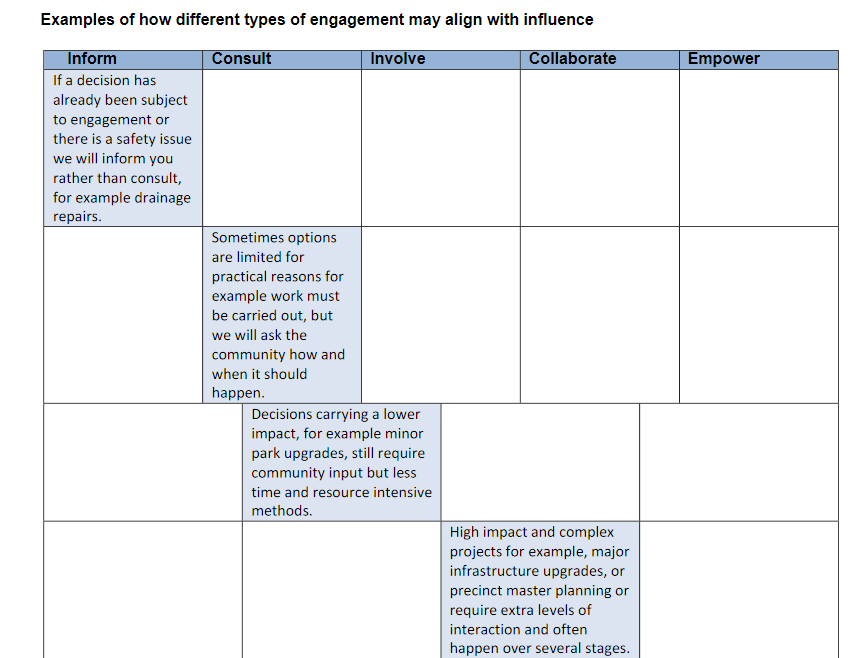
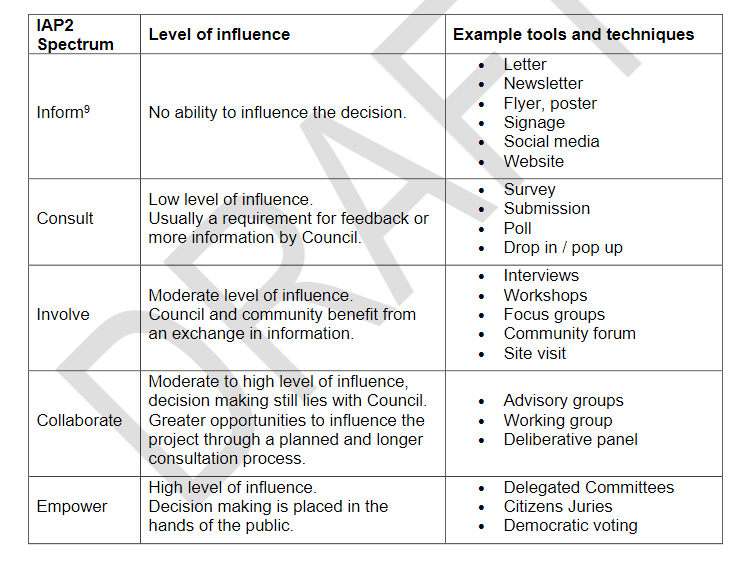
The most oft used phrase by council when it comes to justifying its decisions is that the issue has undergone ‘extensive community consultation’. Yes, there is Community Voice, and yes, there is Have Your Say, and yes, notices are up on council’s website and at times letters are posted to residents. But is this enough, or is it merely fulfilling the legal obligations and/or setting the groundwork so that the claim that ‘extensive community consultation’ has occurred is more tenable?

All of the above sounds great. Council admittedly has no control on how many residents decide to respond to the surveys, questionnaires, or even read the associated information. Which begs the question of why residents are generally so reticent to become involved. Our response to this query is:

  • Residents do not believe that their views will carry much weight in the final decision
  • Residents are not provided with enough information to assist in forming a view
  • Questions asked are often nothing more than Dorothy Dixers, or simply ambiguous so that valid interpretations become impossible
  • Council’s reporting of their ‘consultations’ is skewed, methodologically unsound and far from objective

We will go through some of the above providing examples that clearly illustrate our concerns with the way in which this council conducts its ‘consultations’ and how poorly the results are reported.

A perfect example is the recent Community Voice survey on the planning department. Council states that its objective in running this survey was:

In November 2018, we asked Community Voice members these same questions to identify aspects of Urban Planning that could be improved for the residents of Glen Eira.  

We wanted to know how far we’d come since implementing some changes following the last survey and improve our services to the community by determining where we could offer additional information or clarify processes. We have included results from 2018 in our graphs for comparison.

So this is largely supposed to be a comparative analysis of ‘progress’ and improvement of process over the past two years by the Urban Planning Department. Yet of the stated 193 responses we have no idea how many of the respondents were the same ones who filled in the 2018 survey, or are these 193 responses from entirely different residents? If improvement is to be accurately gauged, then having a clear and statistical overview of this component is essential. It would also be necessary to provide data that compares the number of applicant versus objector responses in 2018 compared to 2020. None of this has been done yet council is quite willing to conclude:

More than 32% of participants who had engaged with the Urban Planning team as an objector or supporter of a planning application indicated:

– They were ‘very satisfied’ or ‘satisfied by the availability of information on the application they objected to or supported (58%, a jump of 12% from 2018).

– They were ‘very dissatisfied’ or ‘dissatisfied’ with the support provided by Council when submitting an objection or support (38%, down by 4% from 2018).

– They were ‘very satisfied’ or ‘satisfied’ with the overall outcome of the application they objected to or supported (50%, down by 5% from 2018).

We’ve highlighted the above in order to point out how poorly questions and the definitions have been concocted, which must inevitably call into question the validity of the results.

Fair enough that the survey includes separate questions for applicants and objectors. Yet the full definition for the latter was:

if ‘yes, as an objector or supporter of a planning permit application’) Could you tell us how satisfied you were/are with the following elements of the objection process? If you have made a number of objections or supports, please consider your most recent objection/support when answering this question

Not only is this definition potentially contradictory, but ultimately very confusing. Yes, objectors can support a final decision on a planning application. But that’s only after the decision has been made – either by officers or councillors. They remain objectors to the application first off.  Yet the above phrasing does not make this clear and hence could also be answered by developers in favour of an application.

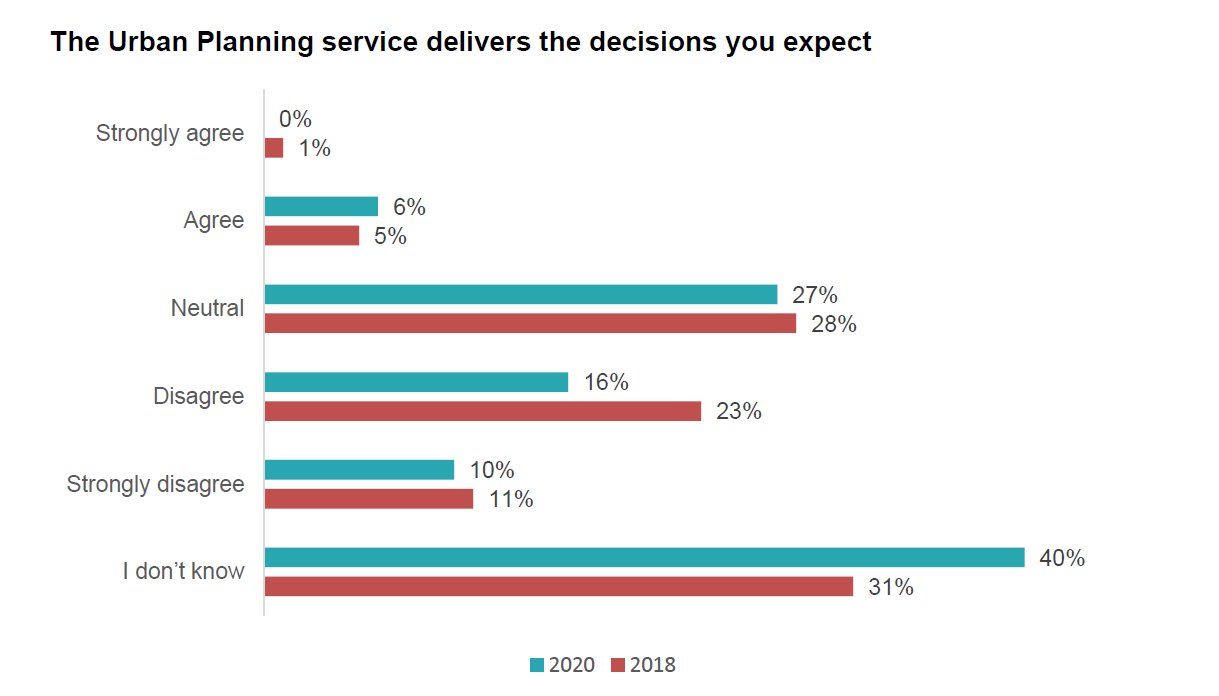
Other questions are equally ambiguous and hence their value needs to be taken with a huge grain of salt. For example here’s a screen dump of one question:

The question includes the word ‘expects’. How this was interpreted by respondents is anyone’s guess. Some objectors may ‘expect’ council to grant a permit given the rate of overdevelopment that has occurred in Glen Eira and council’s track record in recommending permits. But it may not be what they want! Furthermore, we have no idea as to the split of responses. How many were from objectors and how many from applicants?  In the end, does this question tell us anything useful about the Planning Department and how it might be improved?

Interestingly, the vast majority of responses to many of the questions simply clicked the ‘Don’t know’ box. What conclusions can and should be drawn from this? Considering that the stated results of ‘Don’t know’ were also very high in 2018, then how well has council addressed the issue with its purported but unnamed ‘changes’?

Finally, we note that publishing percentages alone as question responses is useless and misleading. 80% of 100 responses is certainly far more than 99% of 50 responses.

If council is sincere in wanting to improve its communication/consultation processes, especially in planning, then it needs to address the following:

  • Create questions that are clear and not open to various interpretations
  • Provide reports that include both percentages and numerics
  • Provide sufficient information so that respondents/residents have a clear idea of all pros and cons (including cost)
  • Call on community expertise to vet questions and to ensure their legitimacy

We’ve uploaded the full Community Voice report HERE. Council is currently also ‘consulting’ on its Community Engagement strategy. You may submit your thoughts via this link: https://www.haveyoursaygleneira.com.au/engaging-glen-eira

Congratulations to Save Glen Eira for their terrific effort in collecting 1667 signatures in a very short time. We have also been told that there are even more with late signatures also coming in.

See: https://www.facebook.com/savegleneira/

Hopefully this kind of response will once and for all put a stop to the myths that residents are ‘satisfied’ with planning, open space, environmental sustainability, and consultation by this council. Residents have spoken and we can only assume that they desire major change and a council that does listen and act in accordance with residents’ wishes.

Over the past few years there have been numerous issues which have raised the ire of many residents, evincing passions that have hitherto been unknown in this community. We are referring to the various draft structure plans, the proposed Inkerman bike path, as well as the Carnegie Pool redevelopment for the current projected cost of $51 million. Why this has and is happening relates directly to council’s overall approach to ‘consultation’ and the methodology for disseminating vital information.

A few overarching comments and questions to begin with:

  • How reasonable is it to release hundreds upon hundreds of pages of documents and expect residents to fully understand, or have the time, to read, digest, analyse, and then comment on any proposal?
  • How reasonable is it to present ‘designs’ that provide no essential data such as cost, or vital information on current traffic data, the percentage of green open space, versus concrete; the potential for overshadowing of open space; the number of proposed tree plantings versus removal of existing trees, etc.?
  • Is the ‘top down’ approach really providing residents with clear options based on the above?
  • Is the timing of forums the best approach for those who work, or for families with children – ie during the day, or smack in the middle of dinner time or bed time for young kids?
  • Are the questions asked in surveys truly designed to elicit informed choices?
  • Are the resulting officer or consultant reports a true reflection of the feedback provided?
  • How can the goals of transparency and accountability be integrated fully into all consultation methods?

We believe that residents and councillors deserve a lot better if the goal is truly ‘evidence based’ decision making as has been stated again and again. What is asked, and how it is asked and analysed validly, remains the cornerstone of sound consultation. How this is then reported becomes crucial.

Below we highlight our reservations plus providing recommendations to improve the process and to address the above bullet points.

STRUCTURE PLANNING

Council’s first step in the process of developing structure plans came in 2017 with its surveys on ‘activity centres’.  Fair enough! But did the actual questions provide residents with a realistic insight into what they were actually commenting upon? When the phrase ‘shopping strip’ is used again and again, how many respondents had any inkling that this could, and did, lead to the rezoning of surrounding residential streets? How many respondents had any inkling that the size of their activity centre was to be expanded when the terminology used was consistently ‘study area’? And how on earth could the resulting reports be so out of kilter with the data actually provided? (See: https://gleneira.blog/2017/03/21/structure-planning-consultation-2/

Here is an image of what was asked. Please note the continued and slanted emphases on ‘shopping strip’. Not one single question was designed to elicit responses to the matters that had clearly concerned residents for eons – namely building heights, open space, and parking.

RECOMMENDATIONS FOR ACTIVITY CENTRE STRUCTURE PLANNING CONSULTATIONS

  • Provide residents with a short, informative Discussion Paper that emphasises in a succinct manner all the pros and cons of what is proposed.
  • Ensure that council resolutions are carried through. For example, it was resolved on the 23rd May 2017 that council: endorses the creation of the Activity Centre Community Advisory Committee and request the expression of interest for community members. This never eventuated!!!!!!
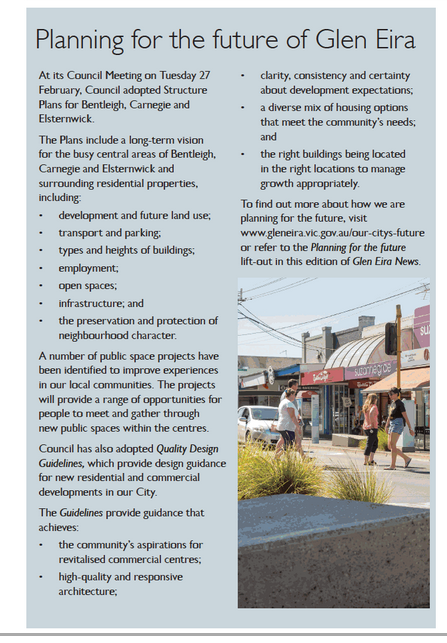
  • When the Glen Eira News provides articles on the issue, then it must include all the relevant details being considered.. This was not done in either the April, June, July, November, 2017 editions. Unless residents were prepared to plough through reams of documents, they would not have had any inkling that 12 storeys was being considered for Elsternwick and Carnegie. Even with the final announcement of April 2018 (see below) those residents who had not followed the issue closely would not know what had been passed. Instead we have the usual jargon of ‘right buildings’ in the ‘right locations’, or the import of the word ‘guidelines’ (ie prescriptive or discretionary) without any real information being communicated. All is made to sound wonderful in what can only be interpreted as nothing more than another public relations exercise rather than information provision!

  • Ensure that questions included in surveys are not nebulous and vague – that they direct residents to the crux of issues. For example, would it have been too hard to include questions along these lines –
  • What do you consider to be an appropriate height for Centre Road buildings?
  • Are you in favour of any council sell off of public land to consolidate car parking in one spot?
  • Where would you like to see extra open space created and why?
  • What parking restrictions should council consider for this activity centre?

Council did not come close to asking questions of this ilk!

Finally, why shouldn’t the Community Engagement Committee vet proposed questionnaires and surveys? Why must everything be a top-down approach? And why shouldn’t residents be directly involved in the analyses of any responses? Unless of course, council’s main objective has been to push through its agendas regardless of what residents say they want. And there is plenty of evidence to support this notion, sadly!!!

Apologies for this long post!

Council seems incapable of providing residents with clear, unequivocal answers to straight forward questions. Here is one taken from the last council meeting and concerns council’s plans for three of our neighbourhood centres/activity centres. 

Could Council categorically confirm or deny that none of our current neighbourhood centres will have structure plans? Could council also clarify whether the East Bentleigh, Caulfield South and Caulfield North proposed Urban Design Frameworks will also have Design and Development Overlays applied to them? If there are to be DDO’s, then will these contain discretionary or mandatory height limits? 

Response:

Thank you for your question. Typically, Structure Plans are undertaken only for Major Activity Centres, which in Glen Eira has included Bentleigh, Carnegie and Elsternwick. For smaller centres such as our Neighbourhood Activity Centres, Urban Design Frameworks provide the same function of planning guidance, but in a simpler, and relatively faster to develop process. Council is currently developing Urban Design Frameworks: Caulfield South, Caulfield North (at Caulfield Park), and Bentleigh East. 

A Design and Development Overlay (DDO) would be the most appropriate tool to guide building heights in these centres, given their size, complexity, and status under State and Local Policy. The Urban Design Frameworks will provide direction as to the most appropriate form of height and siting controls, be they mandatory or discretionary. No final decision has been made at this point. Consultation on the draft controls is scheduled for 2021.

In order to understand the significance of this response and its implications, readers need to be aware of what an Urban Design Framework (UDF) actually is and how it functions. The State Government’s Planning Practice Note No.17 states:

an Urban Design Framework should provide flexibility by identifying key principles rather than finite solutions. It is not a fixed view of the future nor is it a land-use report. It includes a design vision for how a place might develop and should include sufficient detail at key locations so that the vision can be tested for economic and functional viability. An Urban Design Framework should include sufficient information to allow continuous review of detailed actions within the strategic frame, and to enable councils to assess development proposals.

AND

The process for any particular framework study must be fine-tuned to accommodate local issues and objectives. Community involvement should be sought early in the process and at all relevant stages.

Most existing Urban Design Frameworks that other councils have are:

  • Instrinsically linked to Design and Development Overlays and/or specific structure plans
  • Most Urban Design Frameworks are nothing more than a Reference Document in the Planning Scheme. Hence, their ability to provide certitude and genuine ‘controls’ is limited.

Thus, unless the UDF also includes a Design & Development Overlay, or is coupled with the various schedules to the zones, and finally, but most importantly, is directly linked to the objectives of the Municipal Strategic Statement, it is practically useless. In Glen Eira, our MSS, is acknowledged as completely out of date. It needs to be relegated to the dustbin of history – as has been promised for years and years. We are still waiting!

Here is an explanation of what a UDF signifies by a VCAT member –

Strategic planning documents like a  UDF  often form part of the background material that has informed the creation of a DDO schedule and may therefore be a reference document in the planning scheme policies, so as to provide an explanation as to what has informed the creation of a DDO schedule that contains specific built form requirements

Source: Jabala Pty Ltd v Maribyrnong CC [2017] VCAT 1083 (20 July 2017)

Also worth pointing out is that other councils have decided that their neighbourhood centres are deserving of full blown structure plans. Bayside covered all its neighbourhood centres with one amendment and whilst they were not granted mandatory height limits, they are now providing further strategic justification in order to achieve this goal. Boroondara was also successful in gaining Wynne’s signature for mandatory height limits of three (3) storeys for 18 of its 21 centres.

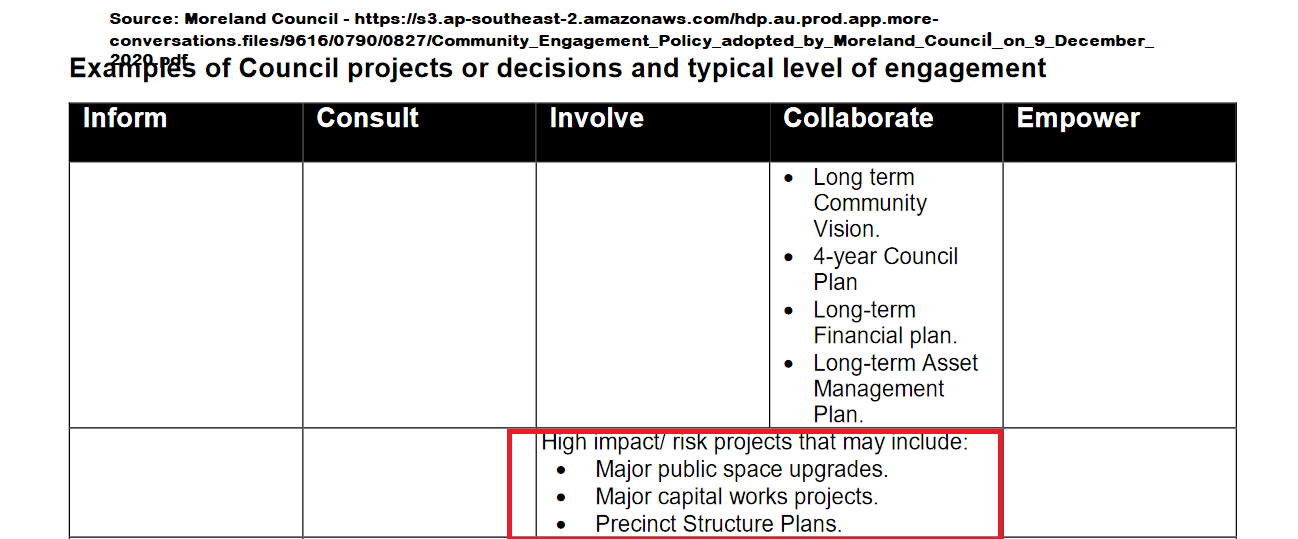
Several other councils have also enunciated their policies on structure planning for their neighbourhood centres – as depicted below.

For a long time mandatory height controls have not been supported in the Victorian planning system. However, recent changes have provided some support for mandatory heights in Neighbourhood Centres, in particular the new State planning strategy –Plan Melbourne and the new residential zones. Therefore, there is an opportunity for Council to pursue mandatory height controls in Moreland’s Neighbourhood Centres, subject to ensuring that housing supply and diversity is provided for across Morelandto cater for forecast housing needs. On this basis the Strategy recommends mandatory heights of four storeys acrossthe majority of the ‘focus areas for change’ in Neighbourhood Centres (which includes the Commercial 1 Zone, Residential Growth Zone and Mixed Use Zone)and a mandatory three storey height in areas where the Residential Growth Zone or Mixed Use Zone is located directly oppositethe Neighbourhood Residential Zone. The approach is supported by testing of building types across the most common lot sizes and an analysis of housing capacity in Moreland

https://www.moreland.vic.gov.au/globalassets/areas/amendments/amendmentslib-7208/c159/moreland-c159-neighbourhood-centres-strategy-reference-document-march-2017-adopted.pdf

A structure plan is a means to provide precinct-specific direction on the extent, form and location of land use and development. The preparation of structure plans for Maroondah’s Neighbourhood activity centres is designed to protect and enhance the role of the centres, help direct capital spending on public realm and infrastructure improvements, and protect residential areas from the encroachment of inappropriate commercial uses.

https://www.maroondah.vic.gov.au/Development/Planning/Planning-Framework/Structure-Plans/Heathmont-Activity-Centre-Structure-Plan

For council to therefore imply that a UDF (without associated DDO’S, MSS upgrades, structure plans or revised zone schedules) is sufficient to protect our Neighbourhood Centres is sheer bunkum.

Even more concerning is that reading between the lines, council intends to once again employ Section 20(4) of the Planning & Environment Act. That means no planning panel, no formal submissions  and the opportunity for residents to provide detailed input. The minister alone will be the final arbiter.

In the above quotes from the Planning Practice Notes, there is a strong emphases on the importance of community consultation. Council will no doubt claim that there has been plenty of ‘consultation’. Yet when we go back to the 2017 ‘consultations’ we find that the number of residents who bothered to contribute to the ‘survey’ on these three neighbourhood centres was minimal – ie

A total of 71 people contributed to the Bentleigh East survey

A total of 52 people contributed to the Caulfield Park survey

A total of 59 people contributed to the Caulfield South survey.

Hardly ‘comprehensive consultation’ and we remind readers that the survey was anything but a genuine attempt to discover what residents thought about development etc. when the terminology used was repeatedly ‘shopping strip’ and no question was directly querying matters of appropriate height, open space, etc.

There has not been any further ‘consultation’ on these three suburbs. Council will now produce its UDF, and residents will have the opportunity to provide feedback. Council will then presumably ignore this feedback and send this off to the minister as happened with the Elsternwick, Bentleigh & Carnegie interim structure plan process. That is how ‘democracy’ works in Glen Eira! Again, readers should remember the outcry over 12 storeys in Elsternwick & Carnegie. It mattered little to the subsequent decision making by this council. Our fear is that this ‘tradition’ will continue with our neighbourhood centres!


For those who are unfamiliar with the concept of deliberative democracy or citizen juries/panels, we invite you to watch the following video created by Darebin Council quite some time ago. When most governments, organisations, and yes, local councils, are now embracing this concept which has gained popularity since the 1980’s, it is still astounding that we have troglodytes who promulgate the myth that citizen juries are ‘undemocratic’.  The Darebin experience proves the exact opposite.

If this council is truly about an open, transparent, and accountable council, determined to work with the community, then establishing such a panel is the only way to go.

The Save Glen Eira community group, has published a petition which will be presented to the new council. The stated objectives of this petition is to ensure that councillors have a clear idea of what residents expect from their new council and what ratepayers would like to see achieved.

The petition can be accessed via – https://savegleneira.com.au/petition-to-new-council-2020/

We assume that residents should download and print off a copy of the petition and then once signatures are collected, to hand them in at the various collection points mentioned.

Here is a screen dump of the petition and the accompanying information sheet.

Below is the blurb that has accompanied the latest ‘survey’ for Community Voice members. It purports to investigate how our public open space has been used during COVID and to provide an insight into potential future use.

The questions (only 3) for this ‘survey’ were:

Question 1 – Since the beginning of the pandemic, I have used parks or shared paths (not including street footpaths) in Glen Eira… (a) more frequently; (b) the same; (c) less frequently.

Question 2 – Do you anticipate that you will continue to use parks or shared paths (not including street footpaths) in Glen Eira more frequently than before the pandemic for the foreseeable future? …(a) yes; (b) no; (c) unsure

Question 3 – Is there anything you would like to add about Glen Eira’s public parks and paths? (Space provided for a comment)

If council really wants to know how to “plan for the changing needs” of the community then surely the very first set of questions that need to be asked are:

  • How did you use parks during covid? – ie passive enjoyment? Exercise – walking? Walking the dog? Meeting friend(s)? Bike riding? etc.
  • Were any of the above new to your previous use of parks?
  • Which parks did you visit and why?
  • Was the existing infrastructure adequate? (seats, barbecues, water fountains, toilets, shade? etc)

There are many, many more questions that could and should have been asked in order to come up with a ‘survey’ that is genuine, valid, and fully informative. We allege that this is merely another instance of ‘consultation’ that is not only meaningless but a waste of money and officers’ time. Yet it will undoubtedly lead to council proudly proclaiming how often and how well they ‘consult’ with residents. Nothing could be further from the truth. 

It has taken council no less than 4 weeks to fulfill its promise of answering ALL questions posed by residents at the 20th August Zoom meeting on planning.

What is concerning about the responses is:

  • The failure to answer some of the questions posed
  • The reliance on more and more motherhood statements that are meaningless
  • The unwillingness to engage directly (and honestly) with what the questions actually asked.

We’ve uploaded council’s version of the questions and their responses HERE.

Even more significant is the number of questions that remain unanswered. We list them below. We have edited out comments and only included what can be regarded as ‘questions’.

How many homes has the State govt required GE to provide over what period of time and how are we on track for that? At some point can we say ‘that’ it, we’ve built  our allocation and we can stop now’?

Can you define housing and how the current repeat building of shoe boxes is meeting the needs of older Australian’s or young families

Ron’s  photo with title”the right housing in the right place” is shops and apartments at corner of Glenhuntly Road corner of James St in Glen Huntly. But this development has a step at shop front doors and disabled access is only by pressing buzzer through apartment entry in side street. Does Glen Eira Planning Scheme now require universal access for all new shops and ground floor apartment ? Especially as Ron noted aging population wit likely greater accessibility needs.

How is planning going to fund adequate open space into activity centres, areas of need, increased population to ensure resident recreation, mental health and a decent Urban Forest policy as if 5.7% open space levy has not increased open space, 8.3% may well also be inadequate.

in regards to the Elsternwick Structure Plan, particularly as it relates to the Urban Renewal North Area. In Dec 2018 we were provided with a step-by-step process by the Mayor. Where are we at right now specifically in that  process that was presented?

How does bulldozing one heritage home after another present has proctection

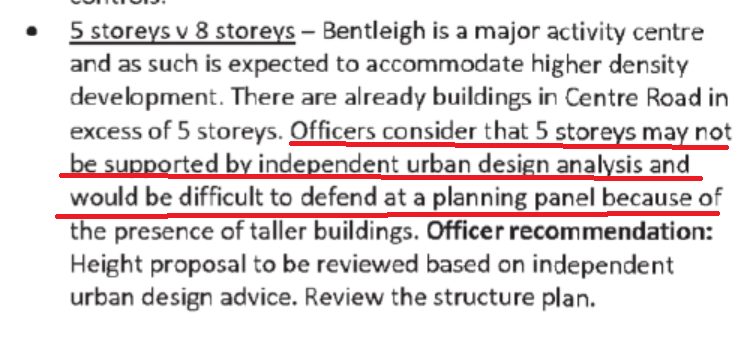
In Feb 2018, Council endorsed max. of 5 stories in all Neighbourhood Centres as recommended by the Planning Officers.  To have made this recommendation Planning Officers must have undertaken statistical analysis that supported that decision.  Please advise when the Amendments supporting a request for interim height controls for 5 stories was submitted to the Minister

You mention diversity but there seems to be little diversity in  what’s being built that’s new… lots of tiny apartments.  What about townhouses, low cost housing, well equipped house sized apartments for downsizers …??

what is the status of the Caulfield North Activity Centre planning? has it been discussed with the community because the area is a real dogs breakfast at present

how do the conditions imposed on planning permit applications get enforced and followed through by Council?

When will ESD LPP be introduced and when will Council include zero net emissions from buildings  and transport by 2030 in the Planning Scheme? Is Council considering water sensitive design and biodiversity sensitive design? How will council prioiritise active transport and reduce car-dependence and car-parking provision?

how do the conditions imposed on planning permit applications get enforced and followed through by Council?

It sounds like the Planning team is under-resourced, having to put important work on hold while attending to other work – do you need more staff?

Sorry Matt but if the council isn’t listening to the community why spend money on so called “consultation”.

Caulfield South is a Neighbourhood Activity Centre, which, in the Glen Eira City Plan 2020, height limits of buildings in commercial zones are designated as 5 storeys.

 As we meet this evening there are 5 developer proposals heading to VCAT:  one of 9 storeys, one of 8 storeys and three buildings of 7 storeys in Caulfield South Neighbourhood Centre. Caulfield South is not a Major Activity Centre. Developments of this nature will seriously impact the neighbouring properties and destroy the concept of what is presently a neighbourhood centre.

Residents should not be expected to fight these battles on their own. As there are no structure plans in place for Caulfield South, and there are currently no mandatory height limits for Caulfield South Neighbourhood Centre, residents will struggle to win at VCAT.

Will Council commit to defending its City Plan by providing external legal representation to help residents oppose these developments when each of these proposals goes before VCAT?

CONCLUSION(S)

The questions that weren’t answered are important. Some seek information on status of policies and structure planning; others seek specific statistics that council should have at its fingertips. In terms of council’s needs is it really that difficult to provide a ‘yes’ or ‘no’ to a straight forward question of ‘do you need more planning staff’?

Given the sheer number of questions that didn’t receive an ‘answer’, it is impossible to accept the possibility that missing all of these was nothing more than an ‘oversight’. So why weren’t they answered? And why does council keep promising things that it has no intention of fulfilling?

This is a very, very brief report on last night’s council meeting. It represents in our view one of the most shameful performances in living memory. Inconsistencies in argument abounded, as did the continuation of council policy in NEVER, but NEVER answering residents’ questions that are deemed ‘embarrassing’ to council. And God forbid that any councillor actually has the balls to criticise or even question such responses or the substandard officer reports that are continually tabled in chamber.

The true highlight is Athanasopolous’ comment that councillors should not appear to be in the ‘pockets of residents’. Esakoff and her cohort were guilty of this very thing – but only when it suited. On the one hand they supported the 9 storey development in Selwyn Street in the face of massive opposition, and then when it came to the Glen Huntly Structure Plan, the argument suddenly changed to we ‘have to listen to our residents’.

Each and every one of these councillors has failed the community time and time again. It is definitely time for change.

With the advent of Trump a new industry has evolved – ‘fact check’. We believe that a similar process should apply to the regular diatribes of Hyams in particular.

Below we quote some of the comments he has put up on social media in response to one of our earlier posts on C184.

Our objective is simple:

  • We want residents to judge for themselves how much of what he writes is ‘tripe’; how much is ‘dishonest’ and how much is guilt by omission – ie only revealing partial ‘truths’.

 POINT NO.1As Glen Eira “Debates” also knows, when we put our proposed planning scheme amendment, based on the structure plan, to the Minister in January 2019, it sat in his office until nearly the end of the year, and then he came back to us and said there would need to be major changes for him to give us permission to exhibit.

COMMENT: The implication of the above is that council was left sitting in the wings awaiting Wynne’s permission to exhibit for over a year. Nothing could be further from the truth. Council knew as early as the 22nd January 2019 that there were problems with the submitted amendment. Furthermore, the proposed amendment DOES NOT go straight off to the Minister but to the Department.

Following this extensive ‘review’ by the Department (DEWLP), council received the following letter from DEWLP which showed up the glaring errors in the proposed amendment. It makes us wonder once again at the competence of the planning department. Did they understand Plan Melbourne? Did they know what the VPP actually stated? What was their ‘strategic justification’ for ‘special circumstances’ relating to mandatory heights? How hard did our planners try on this point? Until today, no ‘evidence’ has been produced that council fought tooth and nail.

POINT NO.2 – It is also tripe that that the NRZ areas will now revert to what was there in 2004, because in 2004, there were no mandatory height limits in those areas, as there is now – a height limit of two storeys. It is also tripe that the zones that came in in 2013 are “notorious”. The zones gave us mandatory height limits in all but the commercial zones where previously there had been none. They also restricted development in the NRZ to two dwellings on any block, until the current government removed that restriction and put in the minimum garden requirement instead, and allowed us to require greater permeabilty and less site coverage, and increased setbacks.

COMMENT : Whilst it is true that prior to 2013 there were no mandatory height limits anywhere in Glen Eira, it is quite disingenuous to claim that the secret introduction of the zones was not the spark that caused the destruction of many residential areas in the municipality. We remind readers that many residents awoke one morning to find that their streets could suddenly go from a 9 metre discretionary height limit to a 13.5m height limit.

Hyams’ claim that these mandatory heights were ‘in all but the commercial zones’ is another furphy. Any site zoned Mixed Use and these are classified in all planning schemes as ‘residential’, remained without any height limits. Another example of ‘dishonesty’ is the statement that in 2013 sites in NRZ were restricted to ‘two dwellings on any block’ and this only changed when the MInisier removed this last year.

The zones were introduced under Amendment C110 which clearly stated:


Hence any site that was larger than your ‘conventional’ size lot became a target for multi dwellings.

Hyams’ third misrepresentation of the truth in the above comment relates to his assertion that the zones introduced greater site coverage, setbacks and permeability in the areas zoned NRZ. Not so! In 2004 with amendment C25 council achieved variations to the ResCode requirements of 50% site coverage and a 4 metre rear setback. Permeability did increase to 25% in 2013. Thus council’s proposed new zone of NRZ2 reverts back to what we had PRIOR to 2004 in terms of site coverage.

POINT NO.3 – . Also worth noting is that the new NRZ2 areas are GRZ and RGZ under the current planning scheme, and so will be getting increased protection, another reason why labelling this as negative and retrograde is tripe.

COMMENT: As per usual Hyams fails to reveal the full picture. Reducing the heights for various streets does not erase what has already been developed in these streets. When these ‘reductions’ are compared to the number of sites that are suddenly allowed to have increased heights, we can see exactly how much ‘protection’ has been introduced via this amendment. All the areas in Green below or dark blue were zoned NRZ (ie 2 storeys). Green is now zoned for 3 storeys and the dark blue for 4 storeys!

CONCLUSION

We regard it as really tragic for the residents of Glen Eira that conducting a fact check on what comes out of the mouths of our elected representatives, or council officers is even necessary. Living in a democracy one should expect that organisations answer criticisms honestly,fully and are completely transparent with their constituents. Spin, obfuscation, and deflection onto individuals rather than the issue, is the enemy of good government. It belongs in the world of Trump and his tactics. Not in a municipality that likes to portray itself as listening and acting in accordance with its residents’ aspirations.


« Previous PageNext Page »