GE Consultation/Communication


There are several items in the agenda for Tuesday night’s council meeting which illustrate the utter cowardice and complicity of the Glen Eira administration with the State government’s ad hoc and appalling planning processes and plans. In addition there is the continued watering down of consultation protocols that further limit transparency and, most importantly, community involvement in decision making.

We will focus on these two separate items.

  1. Proposed Government Planning for the Moorabbin Major Activity Centre

Item 8.3 consists of 4 pages outlining the ‘preliminary/draft’ Moorabbin plans. Two of these pages consist of the maps created by the government. The other two pages are spin and summaries of what the government has stated as its goals. Throughout this verbage there is not one single criticism or even analysis of what is proposed. Instead, we are repeatedly told that:

Council officers are actively involved in these discussions

Council officers will continue to be involved in the briefings with the VPA/DTP and ensure appropriate feedback is provided on the proposed controls and the respective Activity Centre plans. Feedback will align with Council’s priorities and more importantly advocate to be coordinated with funded infrastructure improvements to ensure our communities are not disadvantaged unfairly.

It is anticipated that a significant level of change in these activity centres will be proposed with further changes to be seen in the surrounding catchment areas as depicted in the figures within this report.

Moorabbin Activity Centre planning does not merely impact on Glen Eira. It also includes Bayside and Kingston.

Here is what the Bayside officer report stated on the issue. All quotes come from the 21st May agenda from that council. Please read carefully and ask yourselves which council is really standing up for its residents?

… there are concerns with the manner these projects are being undertaken, and the lack of genuine engagement with the affected councils

The program has been given an un-realistic deadline of implementation of planning controls into the planning scheme by December 2024. Council Officers have had minimal engagement with the project with the following key questions unable to be addressed by the VPA:

• What boundary of the activity centre is being used?

• What are the proposed planning controls to be used?

• What mechanisms for the collection of development contributions will be used to fund infrastructure triggered by the program?

What technical studies are being undertaken to inform the work?

• How will the community and Council be meaningfully engaged in the process?

Until now, Council officers have had no meaningful engagement with this project, with no information forthcoming in response to any concerns

As this report critically points out, increasing population and development growth in these areas will only exacerbate the need for more infrastructure and community services. Victoria is already witnessing the amounting pressures on our public health system and ambulance services – a result of under resourcing and funding by the State Government. There is real concern that proper planning will not be accounted for as part of these Major Projects and impact the liveability of our current and future residents.

Council fundamentally questions where strategic justification for these targets has arisen from and whether the processes being led for these major projects are consistent with theoutcomes of the Planning and Environment Act 1987 and the objectives of Planning in Victoria,

Council has previously raised concerns with the SRLA, Victorian Planning Authority and Department Transport and Planning regarding the process, governance and Council’s role within these major projects being led by the State Government. At present, Council has been mostly kept informed and ‘drip fed’ decisions rather than having any real ability to input into these processes and decisions being made.

There are also major concerns regarding the State Government’s agenda to ‘fast-track’ these projects. Proper planning takes time, resources and input at the local scale – this includes both local government and the community. Fast-tracking these major projects only further restricts Council and the community’s input and role in these processes.

Questions

  • Why is it that on the same issue, one council can have an officer report that is highly critical of what is happening and Glen Eira has taken 2 months to come up with a report that basically says nothing and is silent on the processes and impacts of the government proposal? Add this issue to the total deafening silence on the published housing targets of 65,000- net new dwelling by 2051, then this just confirms how little our administration cares about liveability and advocating for residents in Glen Eira.
  • Can we really trust the officers and their stated ‘involvement’ in any discussions? Are councillors informed of what is being discussed? Do they ever see hard copy printouts of discussion points or ‘resolutions’? Or are councillors, as usual, kept in the dark?
  • The real question is – what does council have to gain by being fully complicit with this government? Who is this administration really representing?
  • Community Engagement Strategy

The current Community Engagement Strategy, adopted in 2021, was supposed to run until 2026. So we now have a new strategy 2 years before the current one is set to expire. Why? What’s the rush? What’s the purpose of introducing a new strategy so far ahead of time?

Once the proposed draft is examined, we can achieve some understanding of why this administration is pushing for a new strategy. Put simply, it is to further reduce community input into council decision making.

The key paragraph of the new policy is to be found in these officer comments :

As the updated Policy does not substantively change the intent of the previous Policy, and was co-designed with the Community Engagement Advisory Committee, Council will undertake an ‘Inform’ level community engagement program.

The most important word here is ‘inform’. This is a reference to the IAPP standards of community engagement/consultation where we have ‘inform’, ‘consult’, ‘involve’ and ‘collaborate’ as the steps on the ladder of full and meaningful consultation with the community. ‘Inform’ is the lowest level of consultation. It basically says, ‘here is what we will do and we’re simply telling you about it’. End of story.

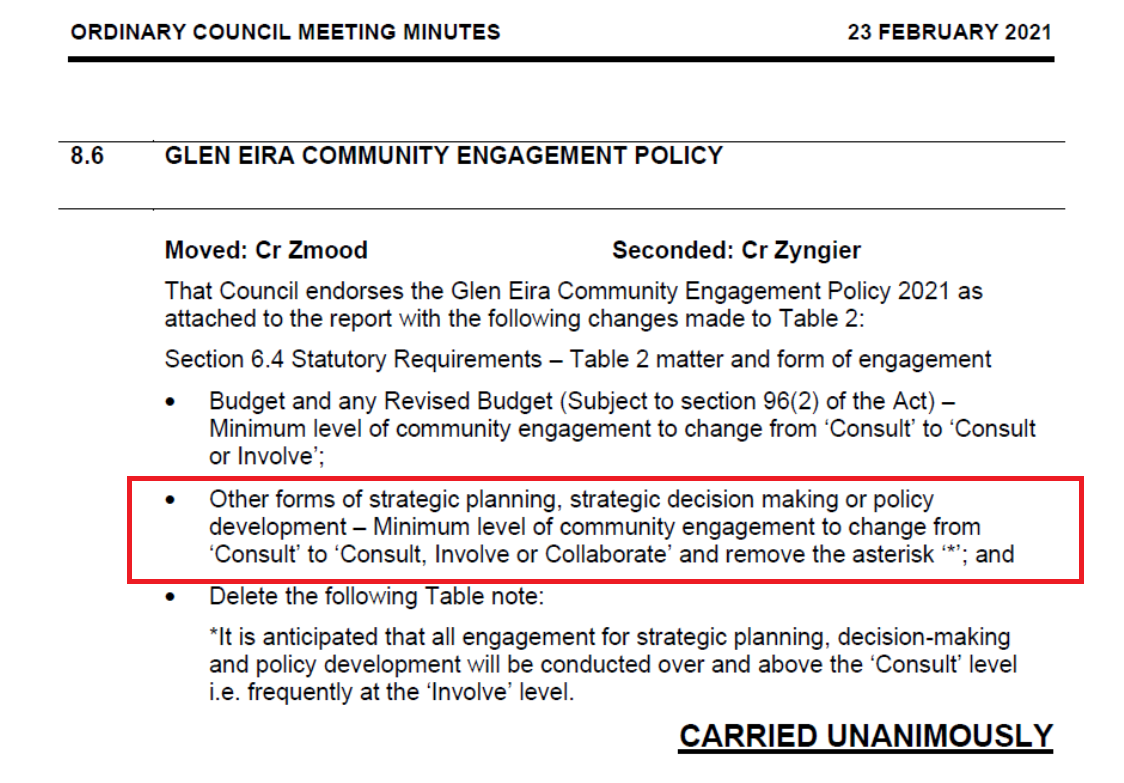
When the initial strategy came to light, and included which plans, issues would occasion what sort of consultation, councillors passed the resolution that major issues such as structure plans, important infrastructure, etc. would go well beyond the ‘inform’ or ‘consult’ stage that was initially proposed for all consultations – apart from those  mandated by legislation. Councillor then voted for this resolution:

Since the above resolution was passed we have not had ONE SINGLE ‘involve’ or ‘collaborate’ for any of the structure plans.

But what is even more alarming in the new proposed draft is the complete EXCLUSION of any link between projects and the anticipated level of consultation.  We have no idea which issues will have more than ‘inform’ or ‘consult’ associated with them.

We have written previously on how other councils have designated their intended level of consultation. See: https://gleneira.blog/2021/01/07/consultation-2-2/. With this new draft all we get are motherhood statements, vague promises, and nil detail.

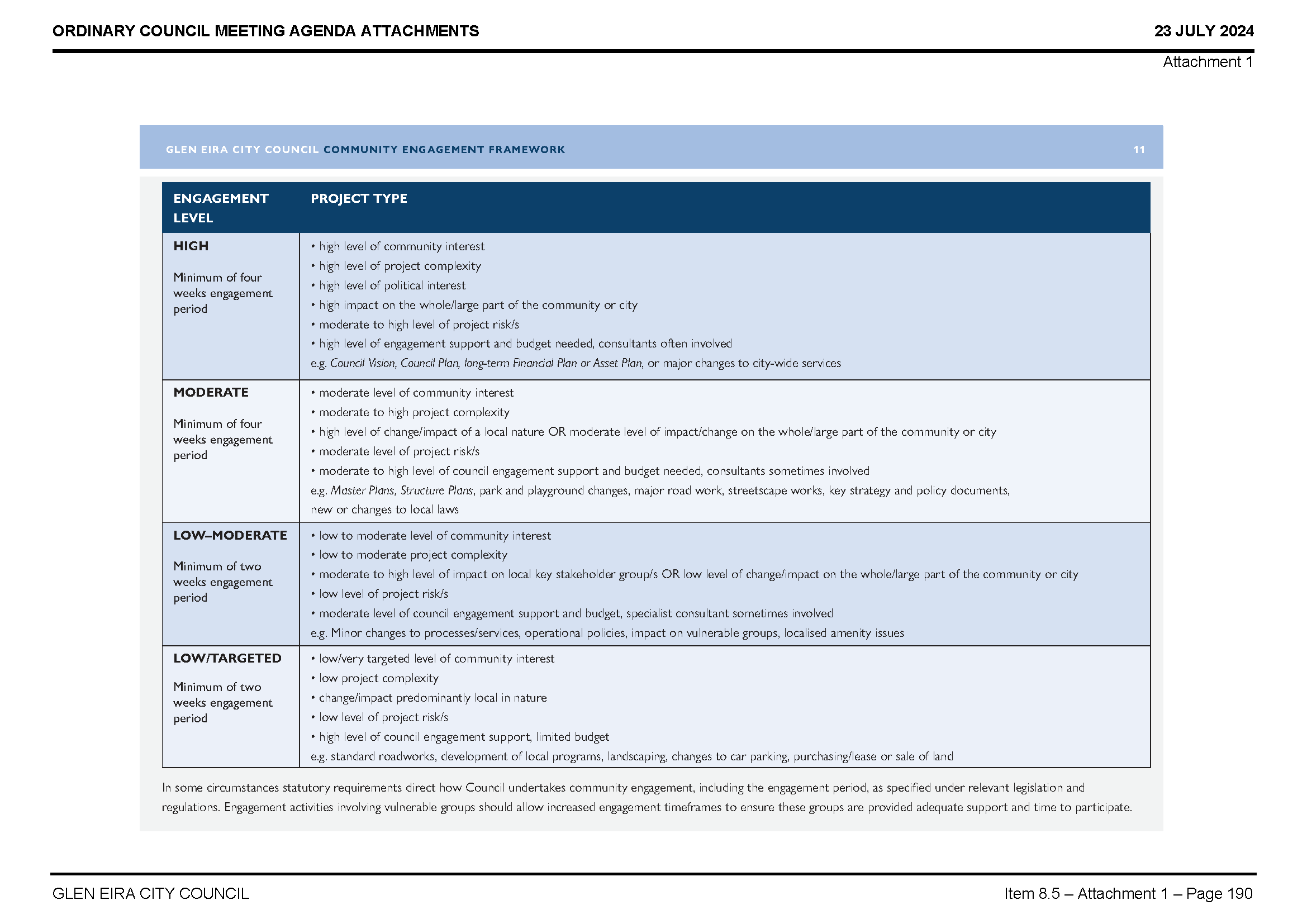
Here is one page from the ‘framework’ document. Please note:

  • ‘Engagement Level’ has now nothing whatsoever to do with how council will consult, much less the level of consultation according to the IAPP standards. It now simply becomes a question of how long the consultation will last!

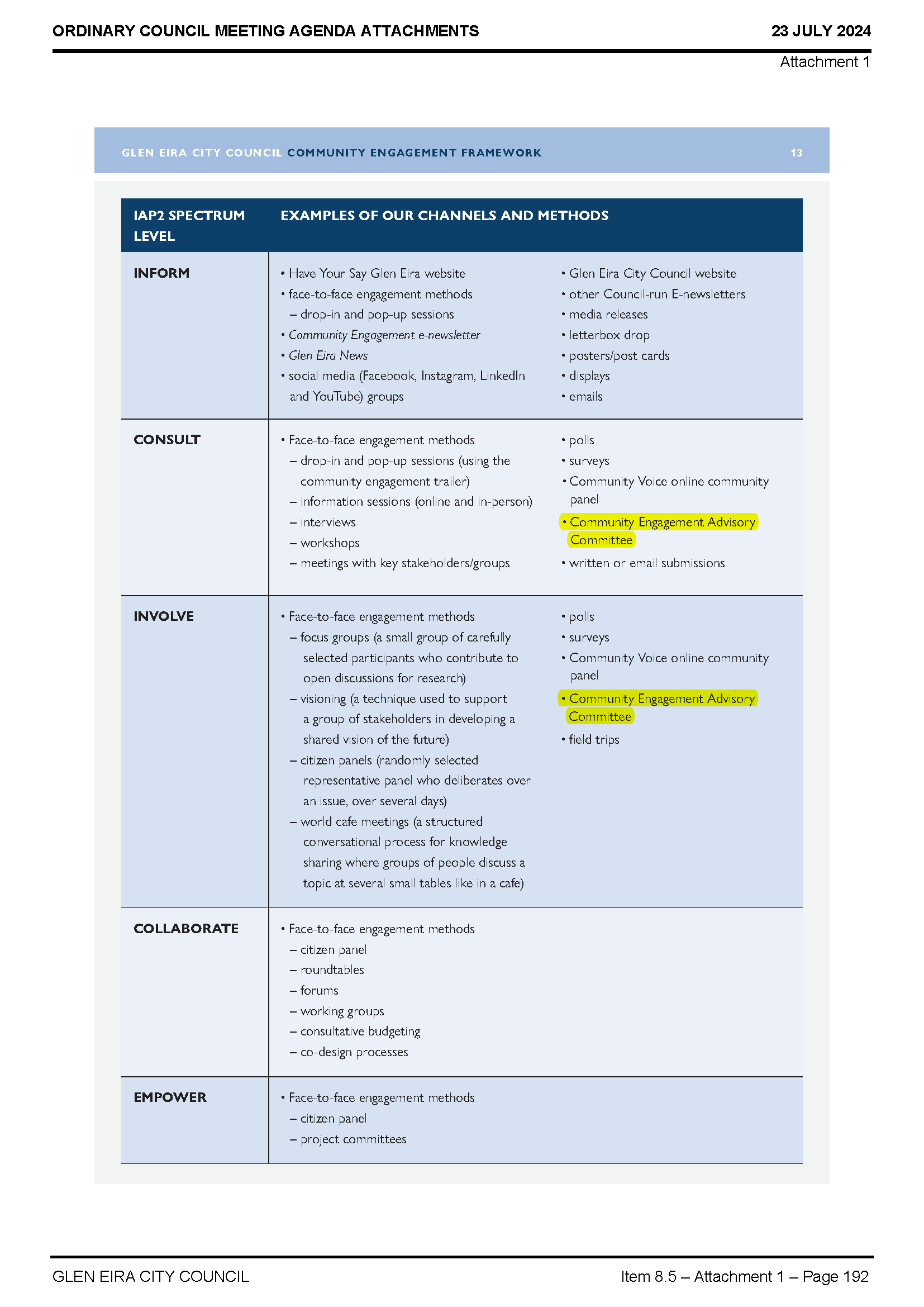
We then get another page that supposedly outlines the methods of consultation.

Once again we have no idea which projects will involve which levels of consultation. The stated methodology also leaves much to be desired. For example: the community engagement committee is stated as having input into the ‘consult’ and ‘involve’ standards. To the best of our knowledge and according to the minutes of this committee, not once did this committee produce any ‘recommendations’ or even discuss the various draft structure plans. They certainly have had no input whatsoever into the framing, analyses and testing of the atrocious survey questions that are continually produced by this council.

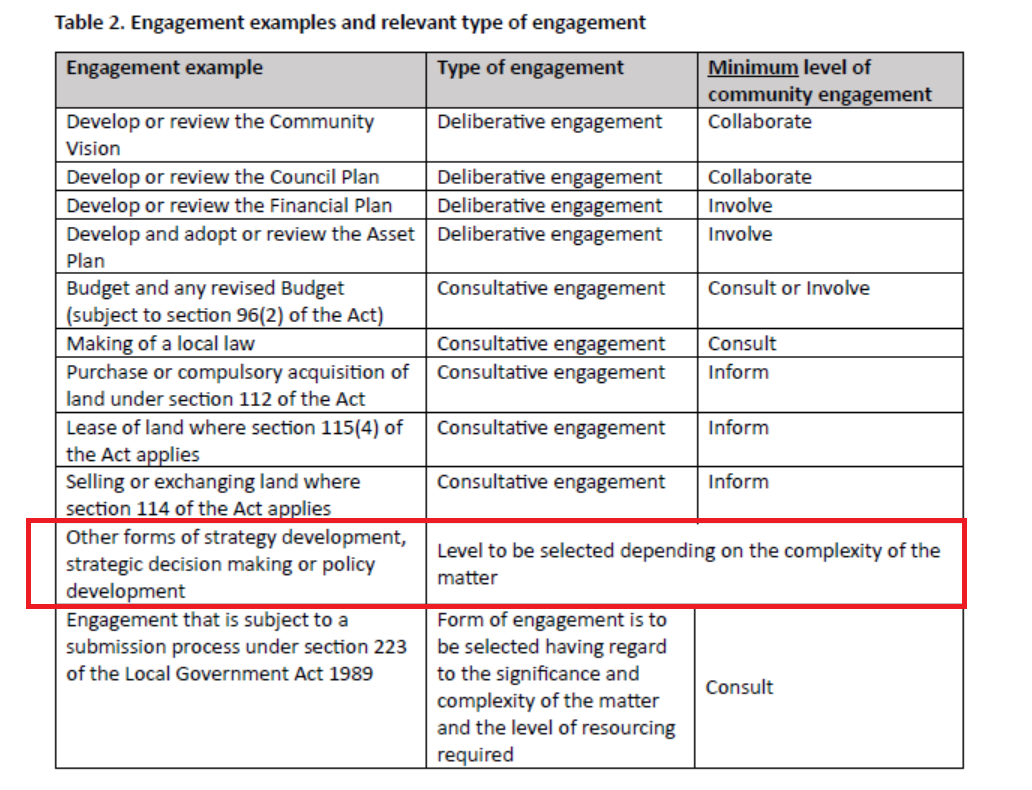
The final outrage is that in the actual draft policy we find this table that is supposed to outline the level of consultation. The very inclusion of a sentence such as ‘Level to be selected depending on the complexity of the matter’ is the loophole that allows this administration to do whatever it likes, when it likes. In other words, because the standard isn’t in black and white, council can neatly side step the need for ‘involve’ and ‘collaborate’. This is both dishonest and devious!!!!!

We have previously shown how other councils specifically itemise the task and the appropriate level of consultation. None of this exists in this new proposal. It represents nothing more than a continued watering down of the fundamentals of sound governance and democratic process. Sadly, it also means that residents, and probably councillors are once again sidelined as much as is legally possible. What a sad state of affairs and what a self serving administration we truly have.

Hitting the news over the past few days has been the state government’s release of its preliminary housing targets for each municipality. Glen Eira is being geared to add another 65,000 net new dwellings by 2051 which represents, according to The Age, a 92% increase on current development rates.

Consultation is now open for comment by individuals and organisations. See: https://engage.vic.gov.au/project/shape-our-victoria/page/housing-targets-2051

No one denies the lack of affordable housing, or even housing itself – especially if population growth continues. But to simply decree that what will fix the problem is another 2,000,000 homes by 2051 without any planning for infrastructure, open space, and financial input is in our view sheer madness. Glen Eira has been more than pulling its weight over the past 15 years. To expect a doubling of construction is not planning – it is a recipe for destroying neighbourhoods and liveability – even if this target is possible given the rise in construction costs, labour shortages, and developers’ goal of ever increasing profit.

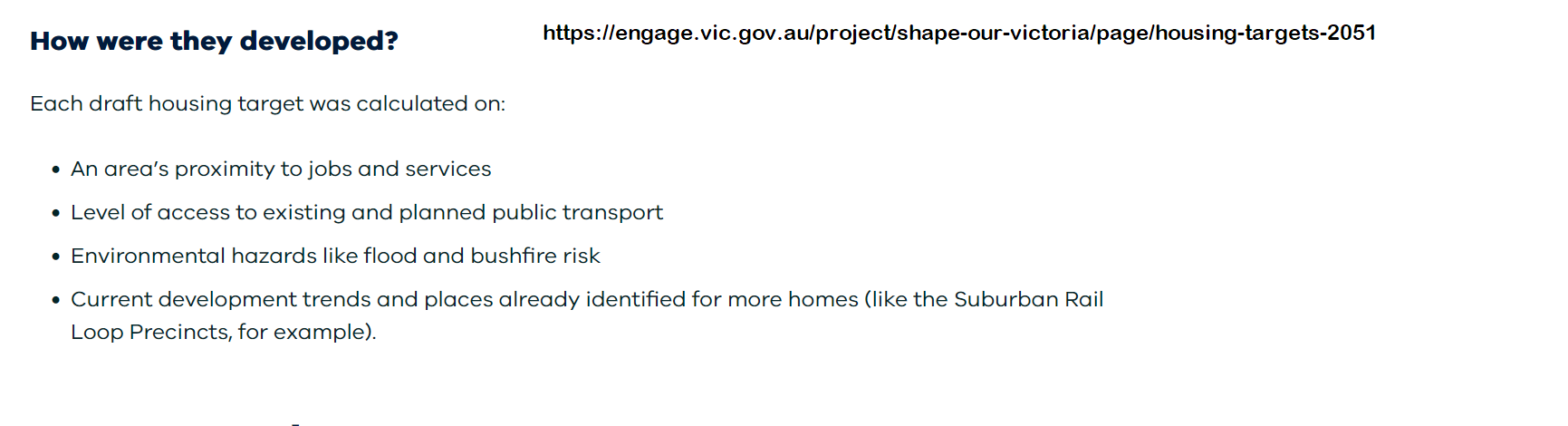
How on earth these numbers were derived is anyone’s guess. The government website simply justifies the data with the following:

The above ‘criteria’ raise a number of questions:

  • Glen Eira has 9 railway stations in 38.7Km of land. Add to this 6 Major Activity Centres/Comprehensive Development Zones, and about 11 neighbourhood centres that total a good proportion of available land then we can expect most of Glen Eira to be ‘built out’.  When Glen Eira is compared to its neighbours and their targets we are certainly being overdeveloped. For example here are the targets for councils lumped together in the government map (highlighted as green) together with their size in square km –

Hobson’s Bay – 31,000 – 64km

Maribyrnong – 46,000 – 31.2 km

Moonee Valley – 57,000 – 43 km

Merri-bek – 72,000 – 51 km

Darebin – 72,000 – 54km

Banyule – 47,000 – 63km

Booroondara – 67,000 – 60 km

Manningham – 39,000 – 113 km

Whitehorse – 79,000 – 64 kn

Monash – 72,000 – 82km

Bayside – 31,000 – 37 km

Kingston – 59,000 – 91 km

As this shows, apart from Maribyrnong, Glen Eira is far smaller than all other council areas. Add to this the lack of open space, tree canopy loss, and wide areas subject to flood, then we are indeed in deep shit if this proposal is ever to eventuate.

Not a single word refers to population DENSITY and what the repercussions of living with increased density will mean in terms of traffic congestion, lack of open space, urban heat, overshadowing, etc. The basic question of what is an ‘acceptable’ number of people living in each square km is never addressed – and this assumes that infrastructure has been built, that jobs are available, schools nearby, roads accessible, and public transport vastly improved.

The question should be whether Glen Eira has already achieved saturation point. Below we present profile.id data that shows population density as of 2023 in our suburbs. What will this be in 2051 when we add another 65,000 dwellings?

DENSITY PER SUBURB

BENTLEIGH – The 2023 Estimated Resident Population for Bentleigh is 19,360, with a population density of 4,025 persons per square km.

BENTLEIGH EAST – The 2023 Estimated Resident Population for Bentleigh East is 31,214, with a population density of 3,476 persons per square km.

CARNEGIE – The 2023 Estimated Resident Population for Carnegie is 19,412, with a population density of 5,266 persons per square km.

CAULFIELD – The 2023 Estimated Resident Population for Caulfield is 5,905, with a population density of 4,009 persons per square km.

CAULFIELD NORTH – CAULFIELD EAST – The 2023 Estimated Resident Population for Caulfield North – Caulfield East is 19,452, with a population density of 3,566 persons per square km.

CAULFIELD SOUTH – The 2023 Estimated Resident Population for Caulfield South is 12,748, with a population density of 3,897 persons per square km.

ELSTERNWICK-GARDENVALE – The 2023 Estimated Resident Population for Elsternwick – Gardenvale is 12,455, with a population density of 4,354 persons per square km.

GLEN HUNTLY – The 2023 Estimated Resident Population for Glen Huntly is 5,202, with a population density of 5,824 persons per square km.

MCKINNON – The 2023 Estimated Resident Population for McKinnon is 7,205, with a population density of 4,536 persons per square km.

MURRUMBEENA – The 2023 Estimated Resident Population for Murrumbeena is 10,449, with a population density of 3,976 persons per square km.

ORMOND – The 2023 Estimated Resident Population for Ormond is 8,956, with a population density of 4,323 persons per square km.

ST KILDA East  – The 2023 Estimated Resident Population for St Kilda East is 4,480, with a population density of 4,686 persons per square km.

TOTAL GLEN EIRA – The 2023 Estimated Resident Population for the City of Glen Eira is 156,837, with a population density of 4,056 persons per square km.

Source: https://profile.id.com.au/glen-eira/about?WebID=10

Now is the time to provide your input into this government ‘plan’ if you don’t want to see your neighbourhoods completely destroyed. See the above link and please respond. And wouldn’t it be good if for once our council came out with some formal opposition to such planning?

Glen Eira clearly makes up its own rules as it goes along, regardless of whether or not these rules are in accordance with its adopted policies and governance rules and which are still current. Recent meetings provide us with conclusive evidence of these machinations.  We refer to public participation and written questions to council.

Public Participation

Out of nowhere we are now being informed that residents in the public participation section of a council meeting have only 3 minutes in which to address council. Also, that the time allotted will be no longer than 15 minutes. Why? When was this decision made? And by whom? Most importantly, this new ‘law/policy’ is NOT IN ACCORD with the existing (2020) policy that clearly states at clause B(15) –

Members of the public addressing the Ordinary council Meeting are permitted to speak for a maximum of five (5) minutes (unless granted an extension of time by the Chairperson)

At last week’s council meeting one resident politely asked if he could have a 15 second extension. This was refused by Cade. Please listen carefully to this audio –

Neither the current guidelines nor the Local Law state the duration of public participation or the public question sections. Yet throughout most of this year we are told that they will last 15 minutes only. It’s important to note that the so called ‘guidelines’ which determine procedures have NOT BEEN AMENDED at the time of writing.

Public Questions

When compared to other councils we again fall short. Here’s what they do:

Monash – Public question time is limited to 30 minutes, unless otherwise resolved by Council.

Darebin – Public Question Time will not exceed 30 minutes in duration unless extended by resolution of Council through a procedural motion, in which case, it may only be extended for one (1) period of up to 30 minutes.

Merribek – The time provided for questions of Council and community statements will not exceed 30 minutes in duration, unless by resolution of Council, in which case, the time may be extended for one period of up to 30 minutes.

Boroondara – The time allocation of 15 minutes may be extended by resolution of Council.

Hobson’s Bay – Twenty minutes will be allocated in the agenda for Public Question Time. However, the Chairperson may vary the time allocated depending on the business to be considered at the meeting. No resolution of Council is required to extend Public Question Time.

Maribyrnong – Public question time will not exceed 15 minutes in duration unless the Councillors present unanimously agree to the time extension, in which case Public Question Time can be extended for further blocks of 15 minutes.

We certainly accept that when a contentious issue arises, there may be numerous residents who wish to address council meetings or submit a public question. Given the length of some agendas, it may therefore not be possible to allow everyone to speak or to answer all the public questions. But we would also argue, that if an issue is so contentious and/or divisive, that it has caused a massive public response, then the onus is on council to provide as much time as possible for councillors to listen to their constituents. Councillors must be provided with the right to extend both public participation times and public question times. Otherwise the perception remains that all council is doing is attempting to limit as much as possible resident voices.

All of the above is important because the draft governance rules and the associated policies are now out for public consultation. They basically seek to legally cement what has been happening this year, and hence are unacceptable.

Unlike other councils, Glen Eira’s governance rules in regard to public participation and public questions are basically bereft of important detail. What becomes the ruling factor are the so called ‘policies’. Whilst neighbouring councils itemise all aspects and procedures, Glen Eira relies primarily on the policies. Why? We believe that this action is designed to side-step the need for public consultation which a formal amendment requires as part of Local Law procedures. It also allows council to tinker repeatedly with these policies as they see fit. This is not sound governance and certainly not in the public interest.

The latest drafts for public participation and for public questions specify a 15 minute time limit. They do not provide any time duration for a resident addressing council in the public participation format. Everything is left open to the ‘discretion’ of the Chairperson (ie mayor). Nor are we told whether residents must be present in chamber for their question to be read out and answered as stipulated in the 2020 changes.

These above points are important because council has always operated on the principle that if it isn’t in the ‘rules’ then we don’t have to do it! Or conversely, because it isn’t in the rules, we can do it! One should expect that something as important as governance rules be spelt out to the nth degree. Not only do these new proposed rules represent a deterioration in governance at Glen Eira, they also further sideline councillors and residents.   

We have to question what is really happening with consultation in Glen Eira. Residents and councillors are literally snowed under with a plethora of current consultations. After tonight’s council meeting there will be seven issues that are currently open for input/submissions. Very soon, another 2 important planning items will be added – the Bentleigh and Elsternwick structure plans.

Questions abound! Why so many, why now, and how vital are they all at this point in time? And most importantly, what impact does a deluge of consultations have on community feedback and on councillors themselves? Was it really necessary that we now have a consultation on gambling, or even the economic plan? Considering that the budget will be discussed tonight, then surely this should precede an ‘economic plan’ so that the budget would set the parameters.

It is asking a lot for residents to partake in any meaningful manner on these consultations. Admittedly, not every issue will be of concern to all residents. Some may be interested in the annual budget, and not in gambling policy. People will pick and choose and decide if they have the time and energy to provide feedback. Glen Eira will of course continue the rhetoric that it cares about consultation and consults regularly. Over the years however, feedback on many of these consultations have been extremely poor – apart from the really contentious issues such as the Inkerman bike path, or the Queen’s Avenue cycling path. Yet, council has never really investigated why there has been a low feedback rate, and nor have they come up with any answers.

If there is simply apathy, then it is incumbent on council to explore why. Could it possibly be that once bitten twice shy?  When people have taken the time to provide feedback and then discover that nothing they have said has been responded to or even listed in summary reports they give up and believe that council simply doesn’t listen or act upon their suggestions? This would be enough to put anyone off from trying again! A truly responsive council is one that monitors and investigates the results of all its consultations. We don’t believe this is happening in Glen Eira!

 We have long advocated for the following to occur:

  • A short succinct summary of proposals that don’t require residents to plough through hundreds of pages (mostly of spin) prior to submitting their feedback
  • Surveys that are deliberately open ended instead of question upon question that is geared to garner the required response.
  • The involvement of councillors and the consultation committee in vetting questions and processes prior to consultation

In the next month or so residents and councillors will be confronted with up to 9 consultations occurring simultaneously. That is nothing but a recipe for disaster! But is this what council really wants?

Council is proposing a new Local Law designed to protect not only SIGNIFICANT trees, but also canopy trees on private property which qualify under height and width criteria. This is certainly an improvement and should protect more existing trees. However, how many existing canopy trees will actually be covered by the proposal(s) depends to a large extent on how well the upcoming Local Law is written and what is its true intent. What also needs to be considered is to what extent all decisions will be fully transparent and who will make these decisions. Will it be left entirely in the hands of officers, or will councillors have the final say as in numerous other councils on which permit applications are granted or refused?

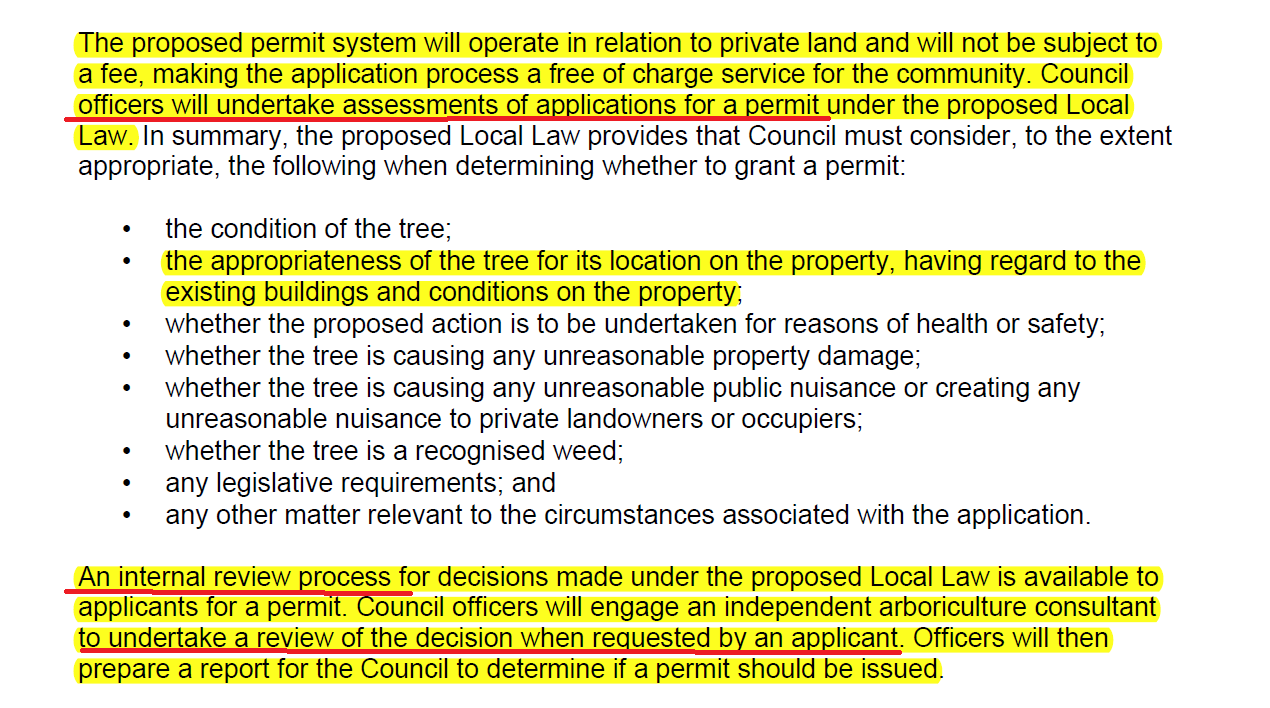
The officer’s report includes the following paragraphs on this last point:

The above is very ambiguous. We are told that officers will presumably undertake the initial assessment when there has been a permit application, and this is fair enough. The final paragraph however clearly states that there will be an ‘internal review process’ but only for those applicants who have requested a review. Thus, if a permit has been granted, then there is no need for a review! Officer’s will have made the decision and that’s the end of it with no councillor involvement, or no objection rights by anyone it would seem.

The paragraph continues that a report will be prepared but this is dependent on whether or not the applicant has chosen to seek a review as stated previously. What remains unclear is whether the officer report will also cover applications that have been granted a permit ‘internally’ and whether the tabled report is there simply for ‘noting’ or for councillors to make actual decisions? Even with the existing significant Tree register local law, councillors are sidelined and all decisions are made by officers. There is therefore no transparency and no accountability for decision making. We suspect that the proposed new law will be the same. Surely the onus on council is to clear up any ambiguity  and to ensure residents that trees will be fully protected.

There are other issues with the proposals as well. Here is our take on these:

Clause 2(b)of the proposed Local Law states that a permit is required to prune or direct, authorise or allow to be pruned a Classified Tree or a Canopy. But we then get the ‘exemption’ that this clause does not apply if Council is notified within five (5) working days of the commencement of the pruning.

 This may sound quite innocuous, but it has major repercussions. Why the 5 days grace? Most pruning would be concluded well within 5 days. If an applicant then calls council and says ‘I’ve pruned my tree’ what evidence exists that the pruning was in accordance with the 10% maximum reduction of canopy allowed? What evidence do we have that the branches were less than 10cm in width?

Bayside, by contrast, has processes that would ensure the pruning is done legally. They insist on:

  • Photos taken BEFORE and AFTER
  • That the work be done by a qualified arborist
  • That the arborist has to sign off by certifying the work done.

NONE of the above applies in Glen Eira!!! This leaves a huge loop hole that can easily be taken advantage of.

Compounding the problem we then get this additional clause regarding pruning:

Subclause (2)(b) does not apply to pruning, which is carried out to the following specifications—

(a) up to a maximum of 10% of the Classified Tree’s or Canopy Tree’s total volume within 12 calendar Months

We assume that this means there can be numerous episodes of lopping throughout a 12 month period. But given that no permit is required we again lack evidence that only 10% has been lopped? Nor are we told whether or not each lopping requires council to be notified – even within the 5 day period.

One other change to the current Local Law is also worth commenting upon. Please read the following carefully:

Questions abound. Consider this scenario – No permit has been applied for. A neighbour complains to council  that a large canopy tree is being removed next door. According to the current Local Law, the property could be entered by a council officer and inspected. With the proposed new law, this could only happen if the owner of the tree has ALREADY APPLIED FOR A PERMIT. If he/she hasn’t, then they the new law does not provide them with the power to investigate and potentially call a halt to the tree removal!

CONCLUSION

Whilst these proposed changes are definitely an improvement and an attempt to protect our existing canopy trees, they simply do not go far enough. We fully accept that there may be situations where a tree presents a major health risk due to storms, etc and should be lopped/removed in the name of safety. But, there are far too many loopholes in the proposed new law that can be exploited. All that is required is that clauses such as Bayside and other councils have is included and that the essential role of monitoring evaluations occurs by councillors. What role councillors will play needs to be spelt out clearly. This has not been done.

Leaving everything in the hands of officers does not engender full transparency and accountability in decision making. Bayside for example also publishes on a regular basis a list of permits granted for the removal of trees. There is nothing in this proposed law which will ensure that decisions on whether to refuse or grant a permit will ultimately be made in the full council chamber so that all residents can see and listen to the evidence.

ONE FINAL POINT. All of the above of course is dependent on whether a planning permit for the site has been granted. The permit could and often does include permission to remove existing trees. Given that planning permits are largely decided by officers and that at least 15 objections are required before the application can go to council, this again places enormous power in the hands of officers.

Over the past few years more and more residents are feeling aggrieved at the bogus consultation methodologies that this council trots out. Here is a summary of what is wrong with the entire process –

  • Survey questions are designed to elicit the required response. They are either totally irrelevant to the core issue or are simply vague and nothing more than motherhood statements. We are not told who designs these questions but more importantly whether they are first road tested with councillors and the community consultation committee. The latter group remains nothing but a public relations enterprise given that they have no real input into design or decision making of surveys or issues.
  • Public forums are also carefully manipulated and engineered. Half of the time officers present their  (positive) take on an issue and little time is left for resident queries and comments. Secondly the chat function is often turned off so that participants can’t communicate with each other and again recordings of the forums seldom are available to review. The latest forum on the Queen’s Avenue trees is the perfect example with council stating that they can’t release the video because of LXRP ‘requirements’ and conversely the LXRP stating that it is council’s forum and hence up to their discretion.
  • Consultation summaries are anything but accurate representations of what was stated. Often residents have to be satisfied with a sprinkling of what participants said instead of being able to read in full everything that everyone stated. FOI requests are met with sheer nonsense such as releasing all commentary would be an impingement on council resources and take time away from their other business. When the survey responses are anonymous and collected in a single file the excuse of a drain on council resources is sheer bunkum!
  • Often residents find themselves having to plough through hundreds upon hundreds of pages in order to get to the crux of the matter. Council refuses to provide short summaries of the major issues so that residents can know exactly what is at stake.
  • Meetings with officers are generally a waste of time. They trot out all the positives but neglect any negatives. Furthermore the times set aside for such activities are mostly during the day – hardly suitable for people who work, or have small children.

So how can all this be fixed? Here are some suggestions that we’ve made in the past –

  • Ensure that survey questions are reviewed by both councillors and the community consultation committee before anything goes public. Avoid generalities, closed questions, motherhood statements. Provide a short, succinct summary that addresses all the pros and cons of the matter. For major issues a Discussion paper is vital.
  • Given that council was quite prepared to release all commentary on its consultations several years ago, the current approach on the most contentious issues such as structure planning and the housing strategy, has been to cover up and hide as much of the negative feedback as possible. This has to change. All comments, emails (redacted to protect privacy) must be available.
  • Major consultations remain at the ‘consult’ level. According to the IAP2 we should surely be at the very least at the ‘involve’ level. Councillors have the power to ensure this occurs.
  • Forums either public or Zoom must include the chat facility so that participants can interact. Secondly the full version must be available for those who missed out. The focus should always be on resident feedback and NOT officer reports.
  • Finally, it is imperative that before residents are asked for their views, all information is provided to them. We have had councillors complaining that they don’t get to see some documentation prior to their voting, or that not sufficient time has been provided for them to digest the data. Residents also need to have all the facts before they commit to providing responses.

All of this is important if the community is to have any faith and confidence in this council. Refusing to implement genuine consultation only serves to foster suspicion and shows how the essential priority of transparency is moribund in Glen Eira.

With the close of the year just around the corner, we thought we would take a look back at what occurred throughout 2023 and what this reveals about council and its performance.

February 2023

  • A resolution to spend $75,319,095 (EXCLUDING GST) for the Carnegie Swimming Pool redevelopment. That makes it well over $80M. By the time this is built we could be looking close to $90M. We also have huge borrowings and no disclosures as to the interest rate payable, nor whether these rates are variable or if fixed, for what period. One could also question whether we really need another mini GESAC?

March 2023

  • Not for the first time we have councillors complaining about the lack of information and appropriate time to evaluate officer’s reports before being forced to vote on the items. Please listen again – https://gleneira.blog/wp-content/uploads/2023/03/711_0385.mp3
  • Given the declaration of a Climate Emergency and an Urban Forest Strategy, the adopted 2022/23 budget REDUCED the spending on the planting of new trees to $827,000 when in the 2021/22 budget it was $1,350,000!

April 2023

  • The decision to only publish ‘summary reports’ on community consultations when in the past the complete raw data was available reeks of a cover up – especially when the summary reports are vague with a predominance of such terminology as ‘several’, ‘many’ ‘some’. There is the continued failure to ensure that the actual survey questions are of quality and that they have gone through a proper testing process that involves councillors and the Community Consultation Committee.

May 2023

  • An Elsternwick forum of nearly a 100 residents turning up to voice their views on the draft Elsternwick Structure Plan. Result? No recognition or addressing the issues raised.

July 2023

  • Structure Plans that more often than not scrape through on the casting vote of the chair.

August  2023

  • Governance failures galore when Pennicuik was suddenly forced to declare a conflict of interest on the Elsternwick structure plan which meant that the final decision was again decided on the mayor’s casting vote. Several months later however, Pennicuik could vote on the Elsternwick amendment and nothing had changed since the acceptance of the draft structure plan!!! Amazing!!!
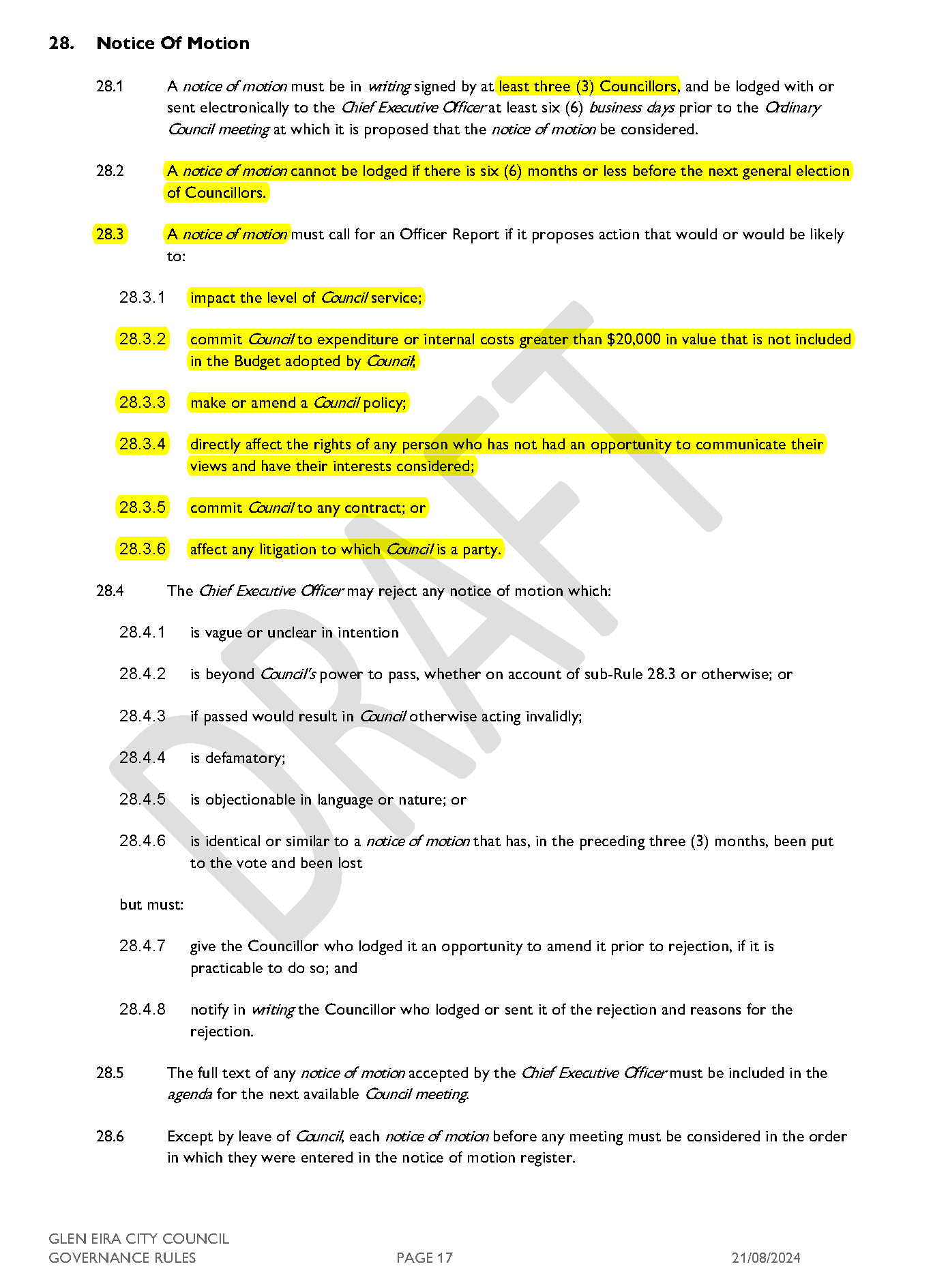
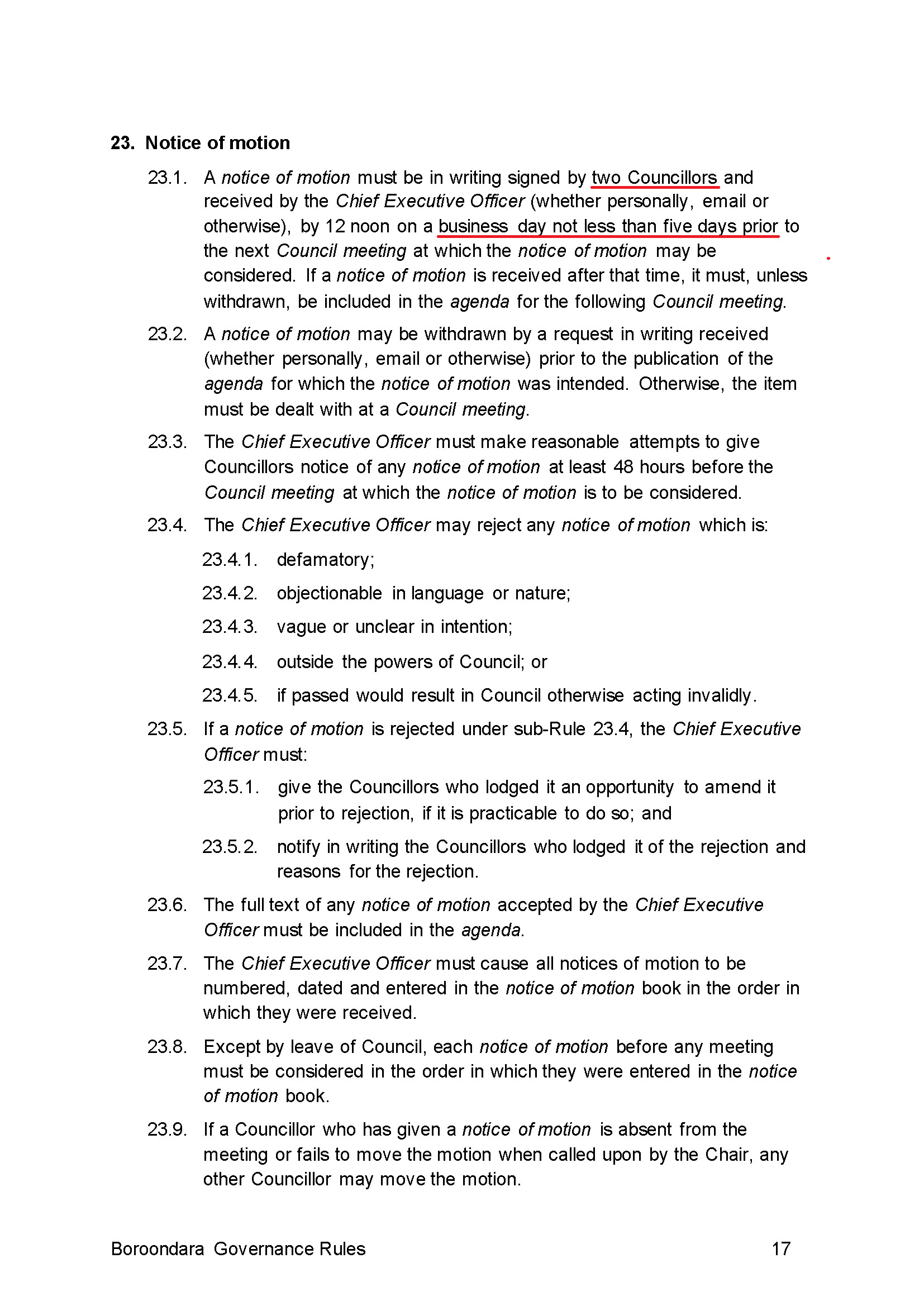
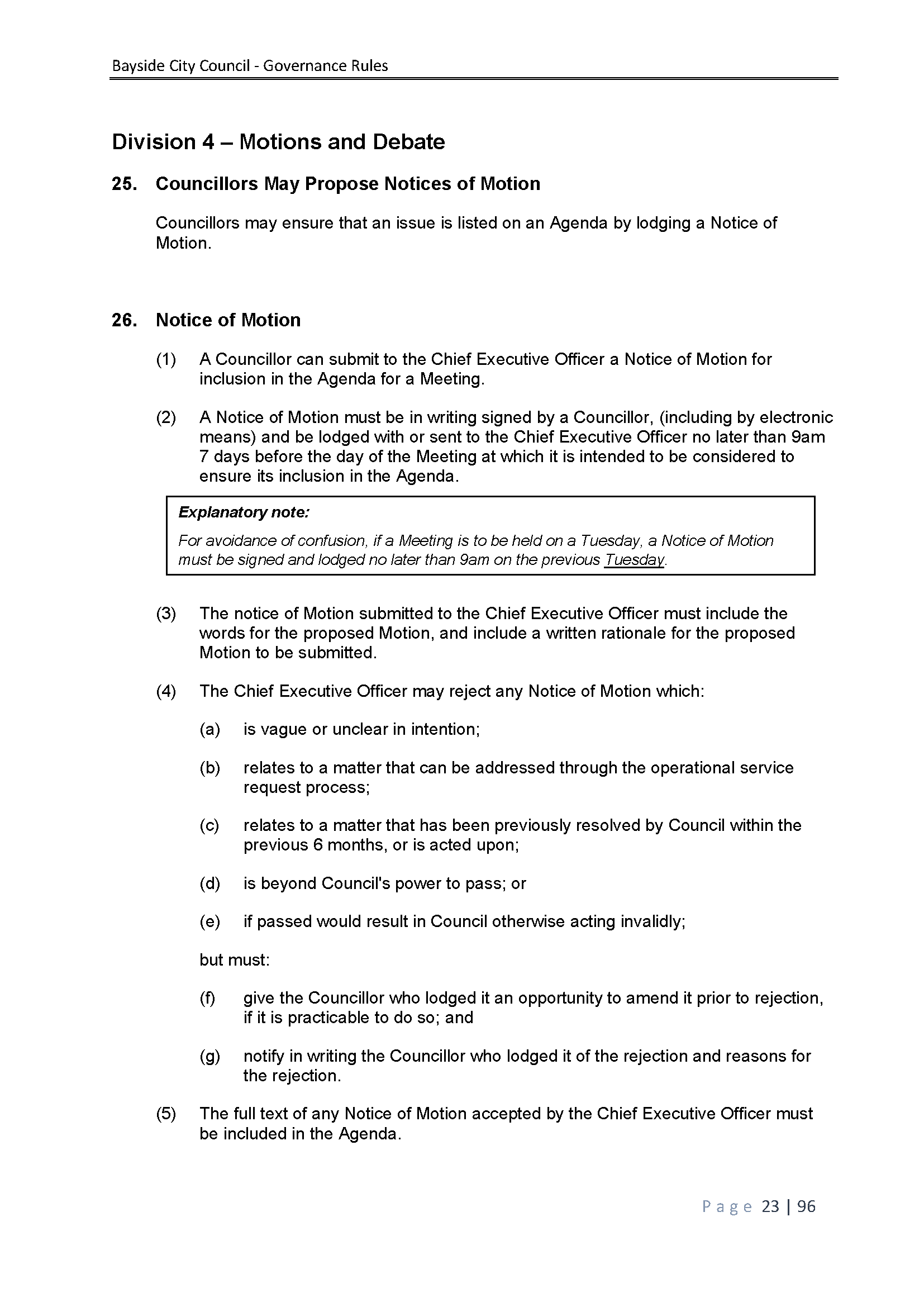
  • Miraculously, Glen Eira does have a Notice of Motion. But this was because of a huge stuff up in the writing of their governance rules and had nothing to do with the intent of the original wording. The aim was to prevent councillors from having items put on the agenda. It will be interesting to watch the upcoming version of the local law to see whether they keep trying to silence councillors in this fashion.

September 2023

  • More stuff ups in that the proposed pop-up park in Orrong Crescent was deemed ‘illegal’ since it depended on a road closure which had not been advertised and consultation called for. Ultimately this was abandoned, but how much have all the shenanigans cost?
  • More dubious consultation ‘summaries’ on Bentleigh & Elsternwick that pay scant attention to resident views

October 2023

  • Announcement of the secret meeting that decided on the ‘preliminary’ closure of the early child care centres. Consultation would now follow the decision!!!! Repeated claims about the legitimacy of the decision and the need to abide by the Local Government Act. We could not find anything in this Act which demanded a ‘preliminary’ decision!

December 2023

  • The decision to close the early child care centres for the paltry saving of $500,000 per annum. Plenty of public questions which queried the accuracy of the ‘discussion paper’ and some of the claims made by council.

CONCLUSION

2023 has largely been a disaster for residents. Here’s why –

  • the administration has steam rolled ahead with its agenda of rubber stamping major developments and structure planning that will facilitate more and more high rise – regardless of whether or not these new developments are needed to ensure that council meets the projected population growth.
  • Community views are treated as mere annoyances and basically ignored
  • Lack of transparency in decision making
  • Councillors denied timely access to all fundamental information to inform their decision making
  • No public announcements on whether or not there is progress on increasing tree canopy targets. No statements about cost savings or improved efficiencies.
  • Consultations remain nothing more than exercises in legal requirements with no intention of asking questions that would reveal what residents really think and desire.

Finally, we wish all our readers a healthy and peaceful 2024! Thank you all for your continued support!

When is ‘land management’ nothing but a euphemism for making money – especially when racing and the Melbourne Racing Club is involved? Both ably supported by government and the racecourse trust.

We have already witnessed the removal of scores of trees, the destruction of heritage sites, and now the latest application for the re-location of the Glasshouse to be immediately opposite residential properties.  We’re also facing the probable relocation of the Melbourne footy club to set up their training at the reserve. All this can only mean the further exclusion of the public on many more days plus the potential for more buildings and decreasing access and open space for residents.

It’s literally a crying shame that instead of trees and lawn areas upon entrance to the reserve we now have a tall, ugly, concrete wall. See the following photos –

Council should be screaming from the top of their lungs. All we get is a grovelling media release –

Statement on Melbourne FC’s Caulfield Racecourse Reserve feasibility study

Glen Eira has the least amount of open space per person in metropolitan Melbourne.

We always look to support creative opportunities to enhance sport and recreation in our community, with our recreation facilities hosting many local clubs including football, netball and soccer.

We recognise a move by Melbourne Football Club to Caulfield Racecourse Reserve has the potential to increase and accelerate investment in sporting infrastructure in the area.

However, we also know that investment from elite sporting clubs has been known to reduce community access in other locations.

The Caulfield Racecourse Reserve is Crown land in the heart of the Caulfield Activity Centre. It has long been identified as a missed opportunity for broad community use.

Any investment by Melbourne FC would need to be balanced with continued access to the Reserve by the broader community, including local sporting clubs, other levels of football, and protected areas for local plants and biodiversity.

We look forward to working with Sport and Recreation Victoria and the Caulfield Racecourse Reserve Trust to ensure that community use and environmental outcomes feature prominently in the future of the Reserve and are given due consideration in Melbourne Football Club’s feasibility study. 

Cr Anne-Marie Cade
Mayor

Worth remembering is that council decided to pay around $300,000 to the trust so that they might have a ‘seat at the table’!!!!! Money certainly NOT WELL SPENT judging on outcomes thus far. Perhaps council should demand a refund?!!!!!!!!!

Not for the first time do we have council handing over full control of planning to the Minister and the Department. We ask readers to carefully compare and consider the following screen dumps. They involve adopted amendments and the resolution to send the amendment to the Minister seeking approval for advertising and formal submissions.

The Whitehorse resolution contains no mention of the Minister or the Department as does the Glen Eira one. One may quibble as to the interpretation of ‘intent’ but giving the Minister the right to change whatever he likes can still fit into ‘intent’ given that this basically means to produce documentation for land use.

Here are a couple of other resolutions from Boroondara and Stonnington. Again, note the absence of mention of Minister and/or department.

So why has Glen Eira resorted to the inclusion of this phrasing when other councils haven’t?  The repercussions can be immense as proven previously with the increased heights for Carnegie and Elsternwick through the interim DDO’s. It also means that residents will not have any future say – it will be fait accompli. Instead of ensuring that what was decided upon remains, this clause simply allows more changes without community input.

Once again a whopping agenda that lumps together some of the most important planning issues that confront the community. These are:

  • Bentleigh Structure Plan community feedback
  • Bentleigh East  Neighbourhood Centre amendment
  • Elsternwick Structure Plan amendment
  • Carnegie Structure Plan amendment

Very little has changed in regard to the Major Activity Centres, especially in relation to heights, and overshadowing. All this despite the fact that the majority of responses were opposed to various recommendations in the structure plans and the mooted DDO’s. Carnegie did not even have community consultation following the abandonment of version one (ie Amendment C184)!!!!!!!

We will deal with each of the above as separate posts beginning with the Bentleigh consultation summary.

Bentleigh Community Feedback ‘summary’

  • There were 106 survey responses, 17 emails and a petition of 221 signatories. Council states that it sent out 4,101 letters to surrounding households. The feedback equates to a pathetic 2.56% response rate for the survey. Why? Are Bentleigh residents so apathetic that they don’t care? Have residents given up on believing that their voices can affect outcomes in Glen Eira? Or is there something drastically wrong with the way in which council communicates its intentions? We have yet to see any analyses EVER of why feedback is so low and what can be done to improve this. It serves council well to simply go through the motions of ‘consultation’ despite the fact that survey after survey has been anything but a genuine attempt to elicit relevant and valid responses.
  • Again, we are not privy to the raw data. No publication of the responses as has happened in the past. Instead we have a ‘doctored’ summary that falls far short of reporting on what was actually said/written.
  • Language used remains a problem. The officer’s report is vague and imprecise with terminology such as ‘mixed responses’, ‘about half’, ‘support for accommodating growth’, ‘some support’, etc. Very little is quantified.
  • The summary report itself is nothing more than a public relations exercise. For example: On ‘retaining character’ we find this conclusion in the report – 55 percent of participants indicated that accommodating growth above the commercial strip was better than doing it in other parts of Bentleigh. Ostensibly this sounds like a majority are in favour, but one must query the value of the question itself. There could very well be support for greater density in the commercial core, but THIS DOES NOT MEAN that respondents are in favour of 8 storeys (discretionary) adjacent to heritage homes. The value of any response and what conclusions might be drawn are 100% dependent on the quality of the questions asked. The online survey as we’ve commented on before was carefully engineered to avoid as much as possible any responses that could be interpreted as ‘negative’ or opposed to the recommendations of the structure plan.  
  • The above criticisms can also be directed to this conclusion – 51% of participants indicated they ‘strongly agreed’ or ‘agreed’ that measures such as height limits and upper-level setbacks for new development would help to retain the character of Centre Road. Of course people want height limits. But we were never asked what those height limits should be!!!!!!!
  • On page 4 of the summary report we are told that 20 percent of participants indicated they would like a building height limit reduction in the centre when asked about retaining character in a growing centre. This sounds like a clear minority in favour of reduced height limits. But this  alleged 20% is only from those individuals who took the option to write something in the text boxes. And again, no question asked what is an appropriate height limit?
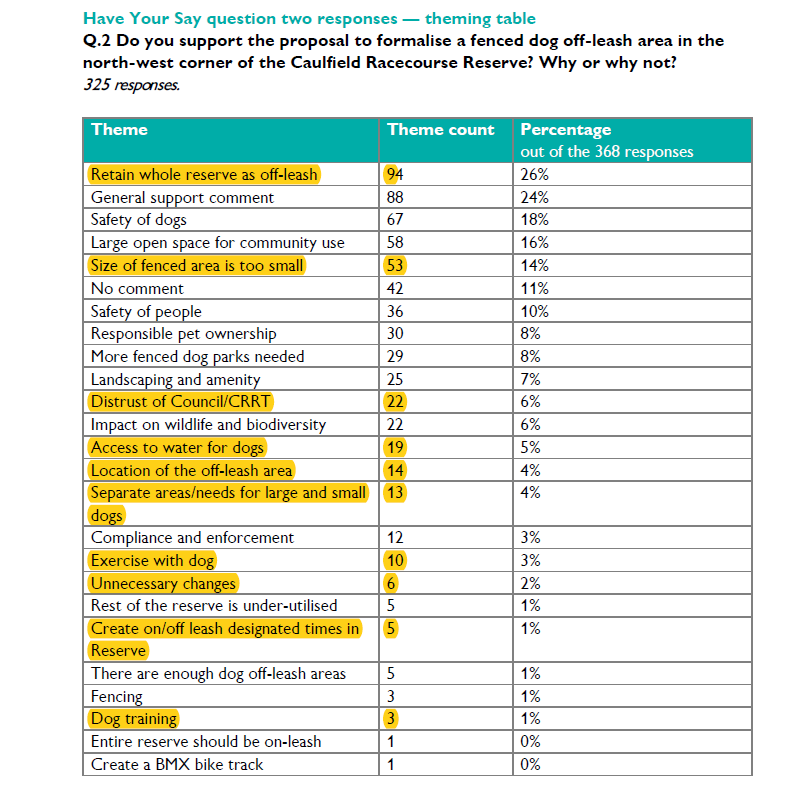
  • More concerning is that the above cited 20% does not correlate with what is then presented in the following table:

 We’ve highlighted all those responses which could be seen as pertaining to the issue of height. The totals are far in excess of the previously stated 20%!!!!!! However, without full publication of all the responses then it is not possible to determine whether the 20% is anywhere near accurate or council’s fudging of the responses. Transparency is again the victim in this reporting.

CONCLUSION(S)

Until this council is prepared to undertake genuine consultation that includes full oversight by councillors and the community engagement committee in the drafting of survey questions then residents cannot hope to be participants in anything but a carefully orchestrated farce that fulfils legal requirements and nothing else. Nor can residents have any confidence in the resulting feedback summaries when the raw data is with-held. When council fights so hard to avoid full disclosure one must surely doubt the results.

As stated earlier, there must be a full analyses of why consultation in Glen Eira is such a failure in terms of community feedback. This should start at the first stage of notification to residents – are they provided with enough detail to engage their interest/concern? Are they expected to undertake hours of reading that involves hundreds of pages instead of succinct summaries? And how many residents have simply given up because they don’t believe that anything they put forward will eventuate? This isn’t apathy we believe. It is simply distrust of council and the predetermined nature of all decision making. If residents truly believed that council was ready to listen and act, then we are confident that feedback would quadruple and that residents could actually believe that council was acting on their behalf. Sadly this is not the modus operandi of Glen Eira City Council!

« Previous PageNext Page »