We are committed to facilitating genuine debate within Glen Eira. Your views on planning, environment, open space, CEO and councillor performance matter.
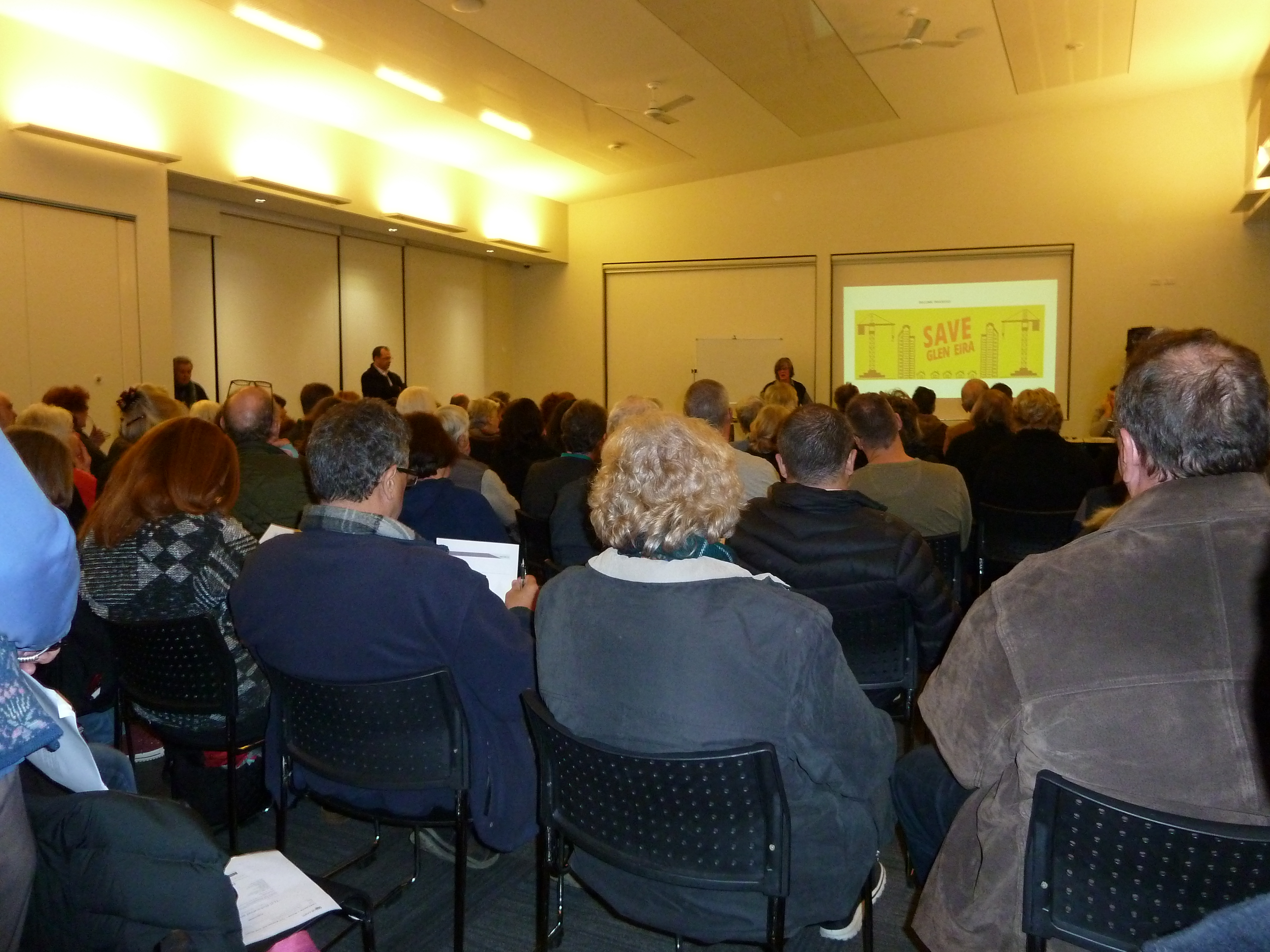
A fabulous turnout at last night’s Save Glen Eira inaugural meeting with an audience of over 100 concerned residents. And, their concern, anger and distrust of Council was palpable.
The evening began with several presentations from 5 residents. Four of the presentations honed in on current planning applications, their impacts especially on neighbouring sites and how little Council has done to ensure that such outrageous applications are doomed to fail at VCAT. The final presenter queried council’s prognostications as to the required housing needed to cater for the expected population growth and showed that at current rates Glen Eira’s building boom is close to double what is needed. The question thus was: why double the size of activity centres? Why insist on 12 storeys across the board? Where is there any strategic justification for such a ‘vision’?
The evening was then thrown open to the audience for a Q & A session. The questions and statements covered a range of topics, including:
Lack of genuine consultation and help from council
The need for sustainable development (and please remember that Glen Eira has no tree protection on private land)
The power of lobbying and lobbyists
Unifying community voices everywhere
Electing councilors who will truly represent the community
Much, much more was said. The overall feeling was that Save Glen Eira had taken a very positive step in uniting residents across all areas of Glen Eira. Planning incompetence touches everyone, especially when we have a council that refuses to listen to its residents. This was the real take home point from last night.
Also present were David Southwick and Kelvin Thompson.
The above screen dump is from Thursday’s Age newspaper and as stated is in response to a previous article written by the CEO of the Victorian Planning Authority. Please remember that the VPA is all about ‘development’. They are the government’s (of both persuasions) agency designed to achieve more and more development.
Putting this aside, it is a great pity that Tim Smith is more concerned with the simplistic solution of ‘decentralisation’ and pushing the Liberal agenda, than in really attacking the Mosely (VPA) argument. There is so much more he might have written. For starters, how about:
Reforming the planning system from a ‘performance based’ formula to one that contains prescriptive controls and parameters?
Reining in the powers of VCAT and councils?
Ensuring that residents do not subsidise developers, as in Glen Eira when we have no Development Contributions Levy and no Infrastructure Levy and this council is happy to exact pittance from its major developments for open space (ie Caulfield and East Villages)?
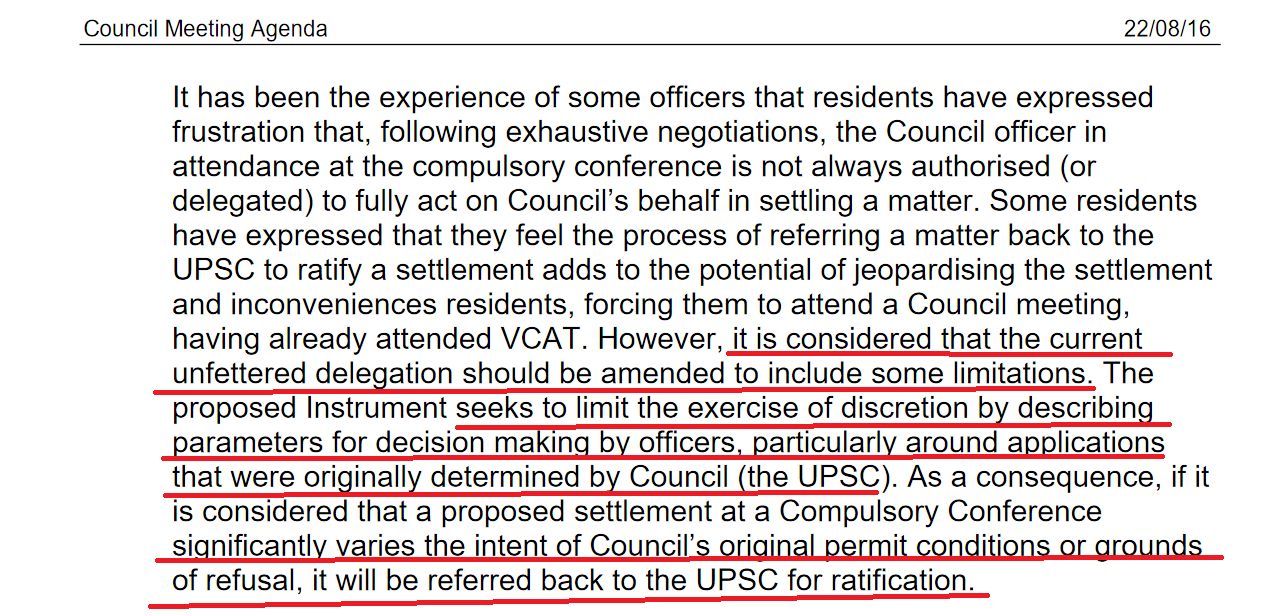
Ensuring that delegations at compulsory conferences are accountable to residents and councillors and do not simply cave in to developers.
Ensuring that the planning system is far more transparent and accountable to residents
That the ministerial intervention powers also be tightened and that full disclosure of department recommendations become public.
There is much that needs to happen before we have a planning system that works for residents and not developers. It’s just a pity that both sides of politics are so entrenched in their views that Mosely may just be right ie things will get worse and developers will continue to rule.
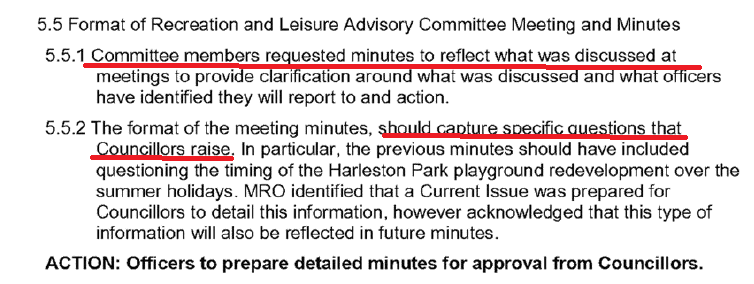
The following two screen dumps have been taken from the agenda items for next Tuesday night’s council meeting. They are part of the minutes for the Recreation Advisory Committee meeting.
Several things need pointing out:
Why has it taken 5 months for these minutes to make it into the public domain? This is becoming par for the course when we also have councillor requests for report(s) that have on occasion taken over a year to appear!
Who is really running the show here? Our councilors or unelected officialdom? The screen dumps provide an interesting insight!
For the past few years now social and affordable housing has been in the spot light at Glen Eira. So now we’ve finally got a ‘strategy’, but only after it was pointed out to council at VCAT that they didn’t even have a policy when they tried to enforce the social housing component for the Caulfield Village development. Further, this strategy comes only after the State Government provided Council with a grant to formulate the strategy! Other councils have had a strategy for well over a decade in some cases and without such state government benevolence! (A case of he who pays the piper…..?)
So how good is this strategy? What will it achieve? In our opinion, it follows the general pattern of all Glen Eira policies. That is:
Plenty of waffle
Plenty of empty promises
Plenty of shifting the onus onto state and federal government, meaning ‘let’s not do anything except wait because it is their responsibility’.
What is especially galling is the continued cave ins to developers. East Village is the perfect example. It appears that Council is ready to accept a 5% outcome on the current 3000 net new apartments. That equals a mere 150 homes out of 3000. Plus, we have no doubt that this ‘preliminary’ figure of 3000 will grow in precisely the same way that the original mooted 1100 for Caulfield Village has ballooned out to probably 2500 net new apartments! Thus 5% will eventually dwindle down to 3% unless these escape clauses are closed off in any Section 173 agreement.
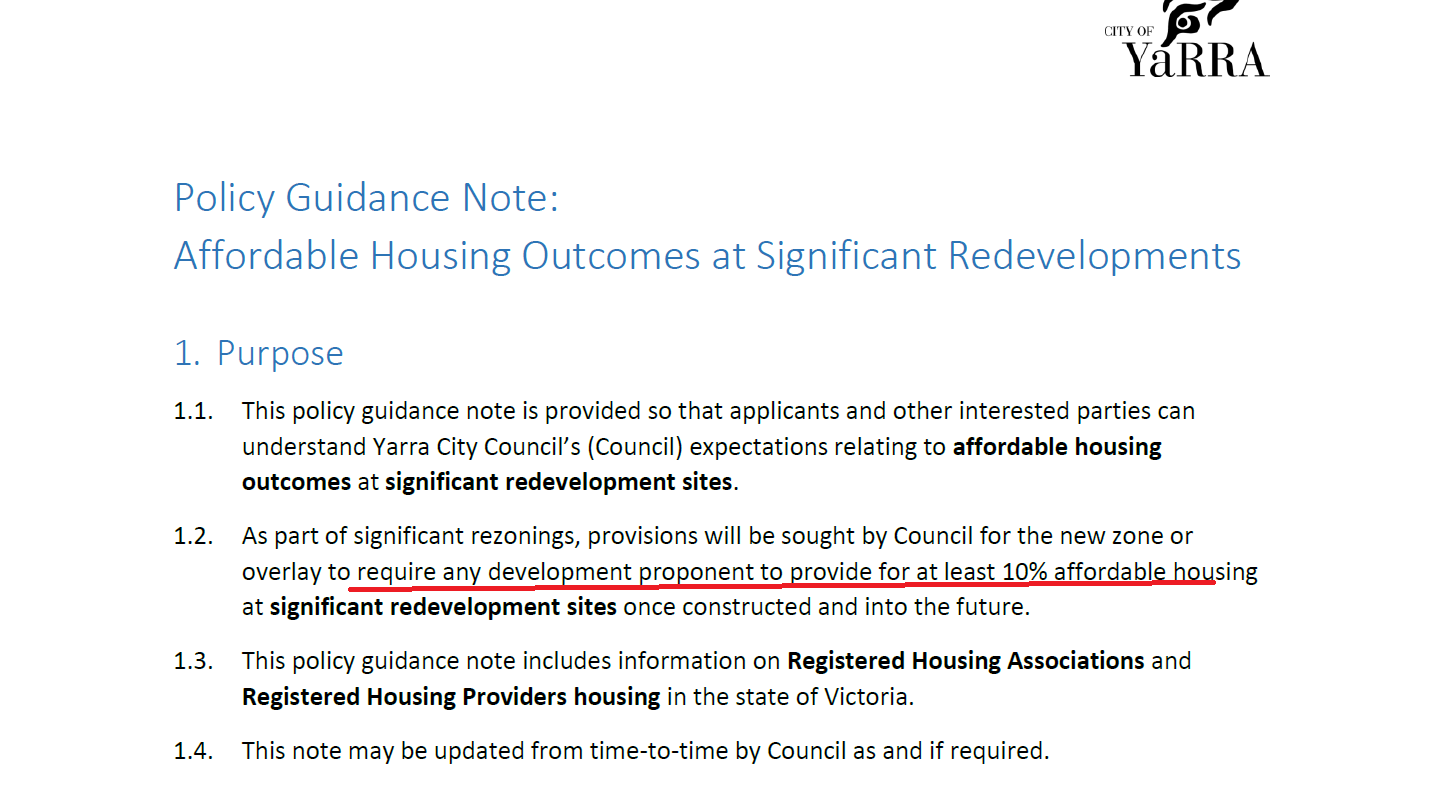
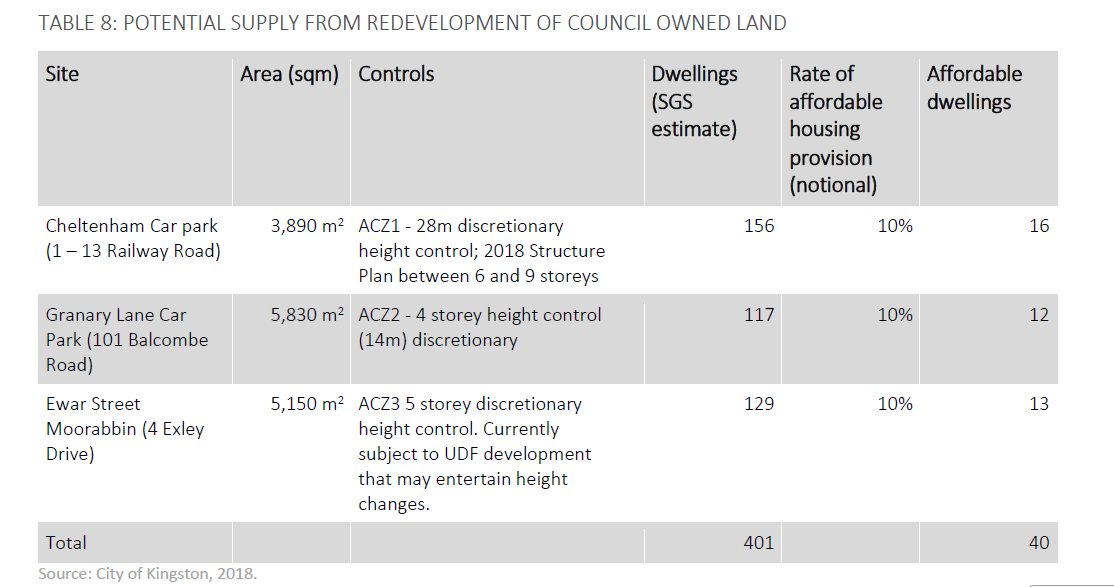
Thankfully, not all councils operate as Glen Eira does. Their policies and strategies do not accept a 5% number for social and affordable housing. They go much higher. Moonee Valley for example on its VPA partnership over the Commonwealth defence site has demanded a 20% coverage for social/affordable homes. There are others too, as shown in the following screen dumps from Yarra, Kingston, and Maribyrnong. Thus if social and affordable housing is such an issue for Glen Eira as proclaimed, then why are we settling for a paltry 5%. Why can other councils go for double this percentage and voice their opposition to government plans, as in Bayside? Why is Glen Eira so compliant? So amenable to developers? And so indifferent to the plight of its residents when it comes to anything to do with planning?
Admittedly all of the above are ‘policies’ and hence do not have great statutory weight. They do however outshine anything that Glen Eira produces. If this council is serious about addressing the issue of the lack of social and affordable housing then going for a 5% imposition is only scratching the surface. Gillon and his mates (the VPA) are continuing to laugh all the way to the bank!
Please listen very carefully to the following audio from last night’s council meeting. It features one resident’s questions that exemplify everything that is wrong with this council. Needless to say, the responses to her queries were anything but satisfactory!
This is not the first time that applications have gone to VCAT and been ‘settled’ at what is known as Compulsory Conferences. Countless times we have the situation where councillors have refused a permit outright, only to find that the planning delegate at VCAT has caved in and the developer got everything he wanted. Since these compulsory conferences are ‘confidential’ residents have no idea as to the reasons behind the cave in. Caving in at a compulsory conference also means that there is no full hearing and no decision published. Perfect for avoiding full transparency and accountability!
Here are some decisions that were agreed to by council’s delegate at VCAT compulsory conferences. More disturbing than anything is the fact that some of these decisions fly in the face of councillor resolutions to refuse the permit outright. We doubt that councilors are even aware of what officers argue in these compulsory conferences and certainly not the grounds upon which permits are granted. Since no decision is published since a full hearing was averted, the community has no idea why some of these applications got their permits. This in itself says heaps about the lack of transparency and accountability.
Here are some examples of cave ins at compulsory conferences:
2/4 Blair Street, Bentleigh. Councillors refused permit for 4 storeys and 24 apartments. A consent order granted 4 storeys and 22 apartments!
670 Centre Road & 51 Brown’s Road. Councillor refused amendment for addition level (up to 6 storeys). Permit granted for 6 storeys.
233/47 Glen Huntly Road. Councillors refused permit for 13 storeys . At compulsory conference permit granted for 12 storeys and 105 dwellings.
777 Glen Huntly Road, Caulfield. Councillors refused permit for 4 storeys. Permit granted at compulsory conference.
8 Egan Street, Carnegie. Councillors refused permit for 8 storeys. Permit for 8 storeys at compulsory conference.
Besides these major cave ins, there are plenty of others which were refused at officer level (ie never even making it to council) and then suddenly they get their permits at compulsory conferences. Admittedly, some developers might compromise and adjust their plans. This does not however excuse the granting of permits for high rise that were refused overwhelmingly by councilors.
So the questions remain:
Do councilors even know what happens at compulsory conferences in regards to the planning officer’s position on the application?
Have councilors voted or even agreed to the planning delegate’s position?
Why do Glen Eira councilors continue to allow unfettered delegations that excludes councilors completely from their rightful roles as decision makers?
Finally, we provide the following screen dump (from Boroondara council meeting) which shows clearly that not all councils operate in the same manner as our lot. Until our councilors have the balls to stand up to this planning department and insist on full transparency and accountability, then nothing will change. Residents will continue to be the casualties of a planning department allowed to run riot!
None of the above listed applications came back to council for deliberation.
The State Government’s latest ‘review’ of our laws has led to another instance of doublespeak, window dressing and the continued watering down of legislation that serves the purpose of making things as difficult as possible for communities to peek behind the veil of secrecy and lack of accountability.
We remind readers that on every occasion when real reform to local government and planning could, and should, have been achieved, Wynne and his cohorts have literally wimped it in favour of bureaucratic (continued) control, or in favour of developers and the construction industry.
We’ve had the following legislation changes that are nothing more than empty words:
The Objector’s Act that was supposed to take account of resident objectors’ concerns to development applications and pay heed to the number(s) of objectors. It does nothing of the sort and is a dismal failure as various VCAT decisions have pointed out.
Better Apartments. Another whitewash where instead of stipulating mandatory size apartments we got nothing more than guidelines for ‘ventilation’, etc. A complete cop out.
Garden area requirement for NRZ & GRZ developments. More fiddling and failure. Following several VCAT decisions where it was decided that land under eaves should NOT constitute part of the open space requirement, Wynne changed the Practice Note so now these areas CAN be included in the calculation. Also changed was the requirement that these areas be on the ground floor level. That also went so that now that this aspect of open space can be part of someone’s balcony.
VicSmart (Amendments C143 & C148) are nothing short of disastrous for residents. No need to advertise some applications and the introduction of the Transport Networks, has resulted in 80% of Glen Eira now not having to provide visitor car parking.
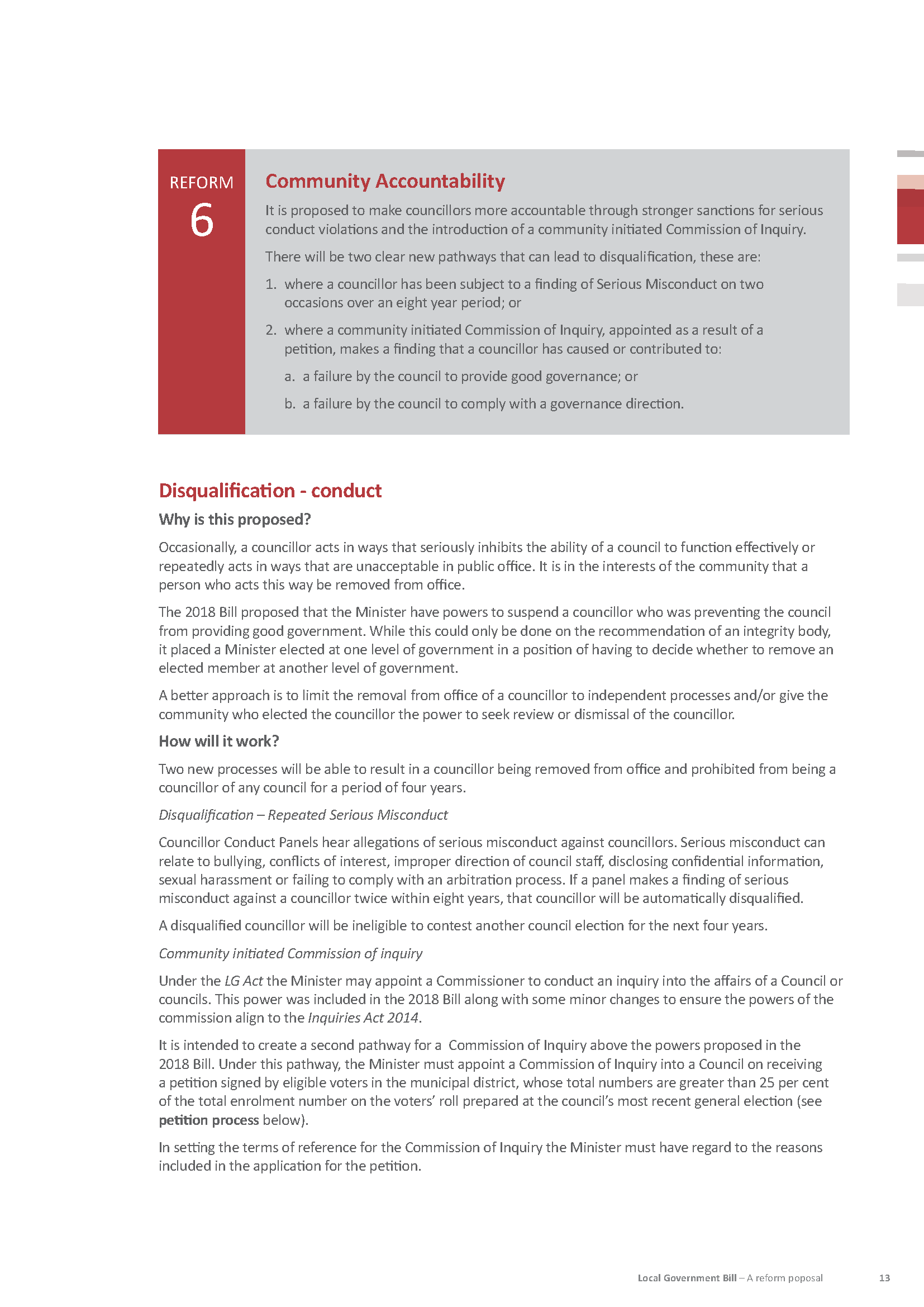
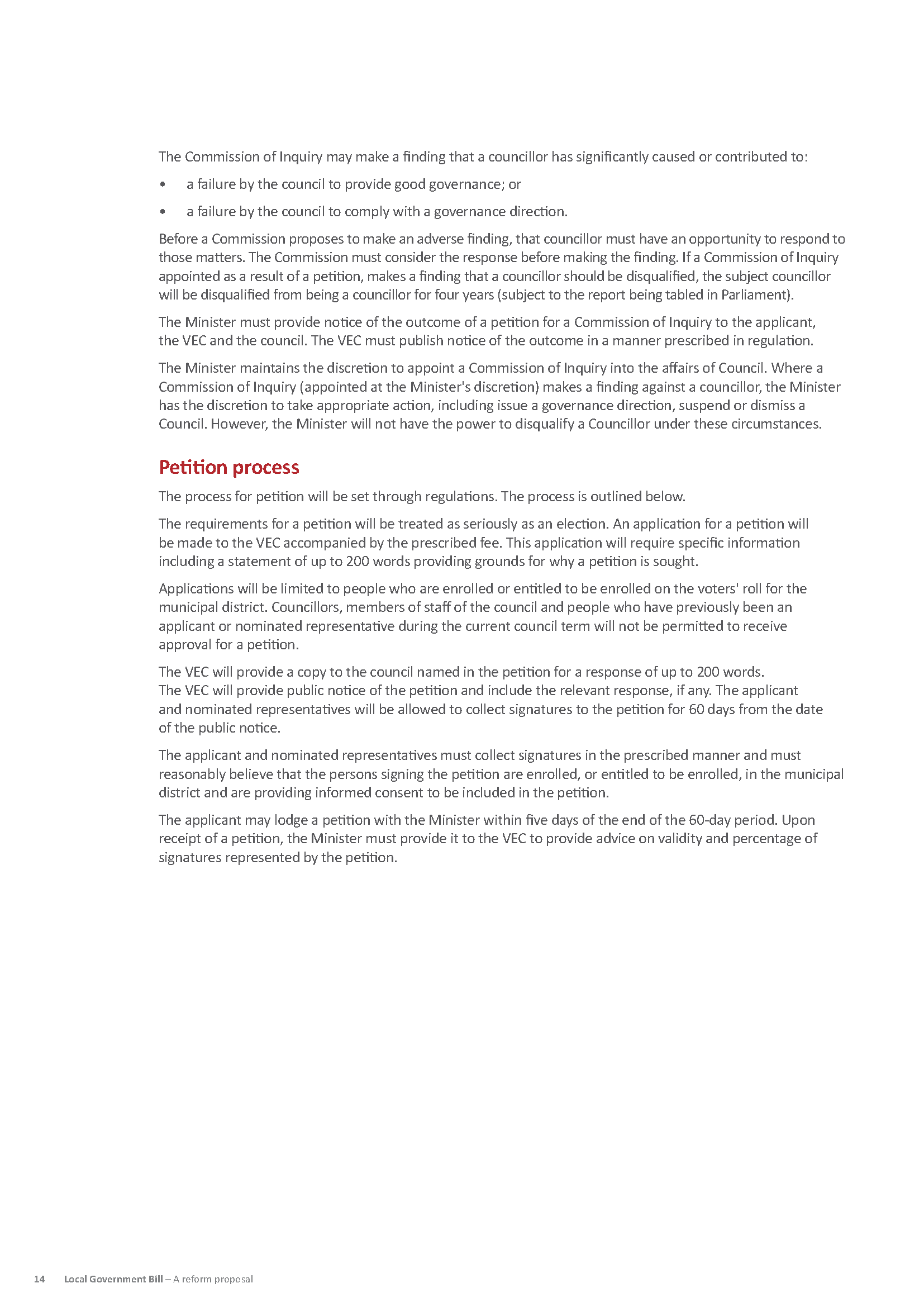
The latest woeful effort is the proposed changes to the Local Government Act. Instead of ensuring that councils are far more accountable and transparent, this proposed Bill does the exact opposite. Parading as giving residents more say we now have a farce writ large!
Currently only another councillor or an officer may report a councillor to a Conduct Panel. In trying to appear as if this government really gives a damn about resident views we have the intention to ‘broaden’ this so that a petition can be sent off asking for a ‘commission of enquiry’. Not so simple however. The applicant has a 200 word limit, plus this petition must obtain 25% of signatures of residents eligible to vote in the municipality. This is not only ludicrous. It is designed to fail. In Glen Eira at the last council elections there were 104,000 qualified voters. That means that any petition asking for an investigation under this ruling would require at least 25,000 signatures. The chances of that happening are zilch. But it surely sounds good, when the government talks about more ‘community accountability’.
Another aspect of great concern is the proposal that a councillor can only be dismissed if there have been 2 findings of gross misconduct in the space of 8 years. What happens if the misconduct takes place over 9 years? More importantly, this completely changes what the current Local Government Act states:
If VCAT makes a finding that a Councillor has engaged in conduct that constitutes gross misconduct, VCAT may order that the Councillor is disqualified from continuing to be a Councillor for a period specified by VCAT not exceeding 8 years and the office of the Councillor is vacated.
No second chances here. That councillor can be booted out immediately for a period up to 8 years!
We present below the two pages from this draft for readers to digest.
In summary, every legislative review of the past few years has not resulted in greater transparency and accountability to the community, but the exact opposite. Shameful in a so called ‘democracy’’
At this week’s council meeting, it was resolved to advertise the long awaited draft Local Law. Residents will be disappointed with the proposals given that:
The significant tree register does not feature. It will take another report, another round of consultation before anything is codified. We assume this will not be before March 2020. Shameful that after all this time, council is still unable to get its act together in a timely fashion. Further, there is still no guarantee that it will even get up with the likes of Magee, Esakoff, Sztrajt and Cade already stating their potential opposition to laws regulating private property. We will have to wait and see what kind of compromise the draft document features.
Even more disappointing is the failure of this council to even entertain the idea of a Notice of Motion. We have commented on this ad nauseum over the years. How is it in the best interests of residents and sound governance that Glen Eira is the only council in the state (the last time we checked this out) that refuses to grant councilors the opportunity to raise an issue and hence to adequately represent their constituents? If there is concern about making ad hoc decisions without the ‘expert’ advice of officers, this is easily overcome with the opportunity for officers to comment at the next council meeting. That’s how Kingston does it for example.
Also unacceptable is the continuation of the current Public Questions policy. Still a limit of 150 words. Still no public record of what was asked if the questioner isn’t present since the query is not read out and does not go into the minutes. Hence calling this section ‘PUBLIC QUESTIONS’ is ironic indeed. Answers to questions should be on the public record. That is how accountability and transparency are maintained. It is simply not good enough that a ‘response’ is given to the individual and the community has no idea of the question, the answer, and the issue.
Council’s constant refrain is that they desire to engage more people. Placing Public Questions near the end of each meeting defeats this entirely. It forces residents to sit through up to three hours (often of sheer tedium) before their questions are read out. All of our neighbouring councils see the folly of this approach. Municipalities such as Bayside, Stonnington, Port Phillip, Monash and Kingston for example place their Public Questions early on following the confirmation of the minutes. Why this can’t be done in Glen Eira is mind boggling, unless of course it is to ensure that few residents have the stamina to wait for hours before their question is read out and responded to.
Finally we also remind readers that an ombudsman’s report of recent times recommended that council agendas be made available at least 5 working days prior to a council meeting. In Glen Eira the mantra is that agendas are only available on the preceding Friday after noon and that public questions must be in on the following Monday before noon. It certainly does not give residents time to digest what is often hundreds upon hundreds of pages, nor the time to successfully lobby councilors before a decision is made.
It is instructive that when councilors resolved to advertise the Local Law the above issues (apart from the tree register briefly) weren’t even mentioned. If council is serious about enhancing community engagement, and being as transparent and accountable as possible, then these ‘laws’ are the things that will ensure it doesn’t happen.
The State government, via its recent Plan Melbourne Refresh, has reiterated that Glen Huntly is to be seen as a Major Activity Centre and not a Neighbourhood Centre as council has insisted upon for years and years. There are many pros and cons for either position. What concerns us here is the manner that council has gone about informing the community about its plans; its current ‘consultation’ methodology; and the ramifications for what this could all mean for residents.
INFORMING THE COMMUNITY
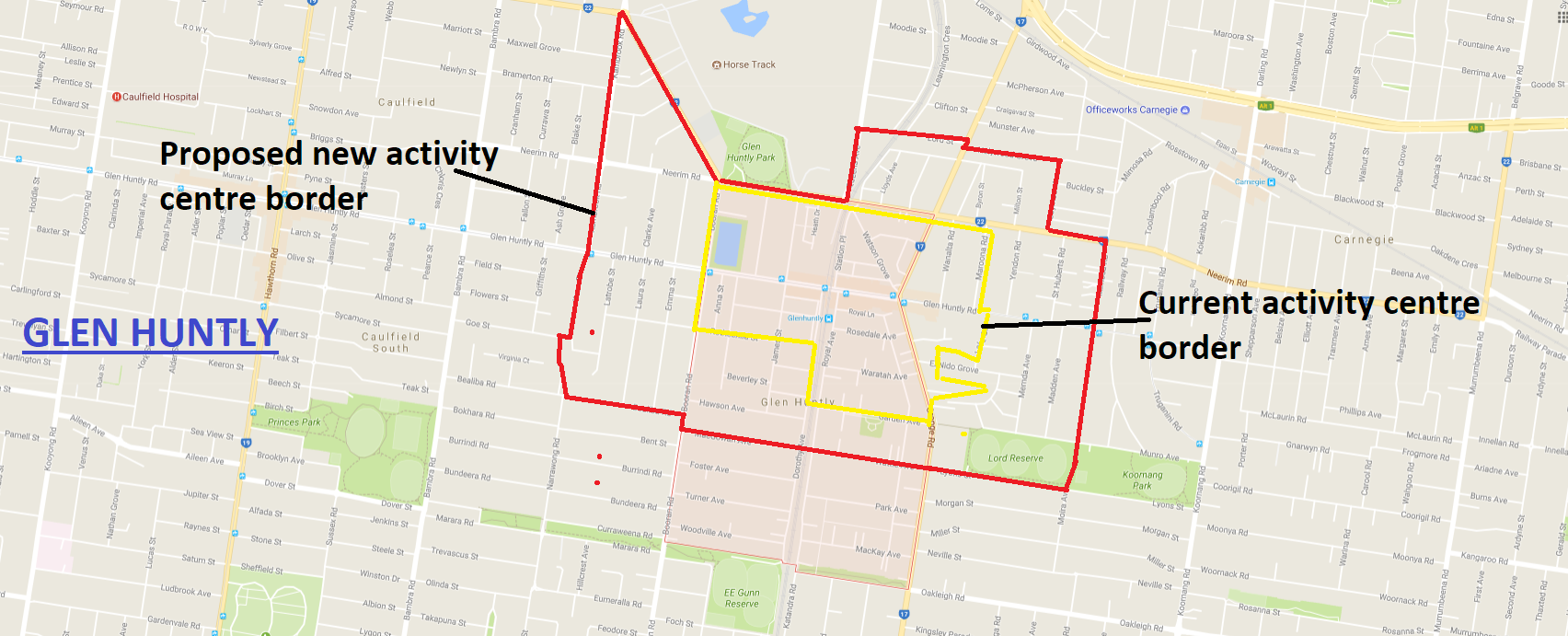
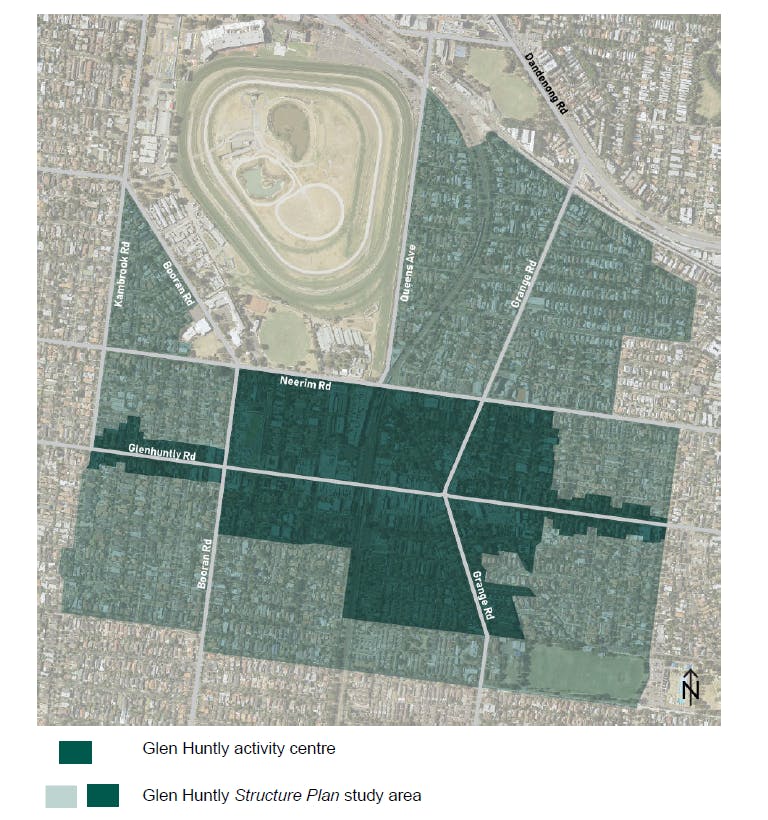
In documents dated May and July 2017, council nominated Glen Huntly as an ‘emerging Major Activity Centre’ with this ‘criterion’ for development: High focus for housing growth opportunities. A February 2017 document outlined the supposed ‘study area’ for Glen Huntly which increased dramatically from the borders that currently existed as shown below.
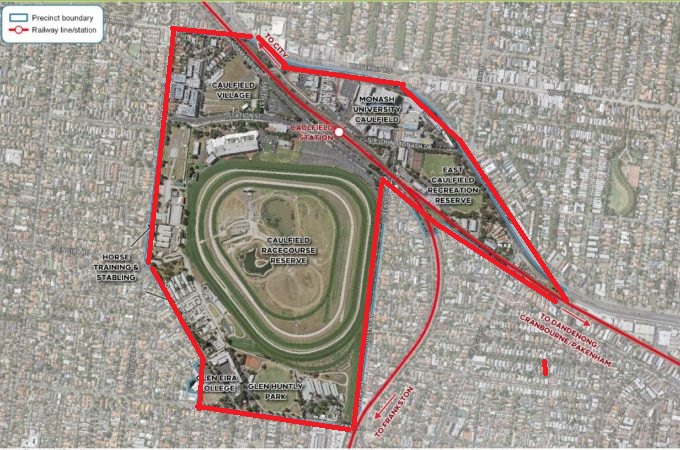
No mention was ever made of collaboration with the Victorian Planning Authority(VPA) and its work on the Caulfield Station Precinct until recently. In fact, at the time of writing the VPA website still includes its original borders. No mention is made of Glen Huntly as part of this development. (see below). We’ve highlighted in red the borders to make them clearer.
What residents now face is another expansion of the land subject for major development, albeit that council continues to use the label of ‘study area’. We have already had examples of how ‘study areas’ morph into the expanded borders of activity centres in Bentleigh and Carnegie. We doubt this will be any different.
Thus, potentially the current ‘activity centre’ border for Glen Huntly has at least tripled in size. Why?
WHAT DOES ALL THIS MEAN?
One thing is absolutely clear. Major Activity Centres are slated for intensive housing ‘growth’. They also include areas zoned Residential Growth Zone (ie 4 storeys or 13.5metre height limits). Commercial areas are also expected to carry much of the burden. Currently Glen Huntly does not have:
Any areas zoned as RGZ. It contains approximately 35% of its area (minus parks, utilities, etc) as GRZ (ie 3 storeys and 10.5 metre height limit). As a Major Activity Centre this will undoubtedly change. We envisage that rezoning will see much of the current GRZ become RGZ. How much of the current Neighbourhood Residential Zoning becomes GRZ is unknown at this stage. Given what has happened in Bentleigh, Carnegie and Elsternwick we anticipate the worst.
Currently there are no height limits for the Commercial and Mixed Use areas. Given what is happening in other Neighbourhood Centres not to mention Major Activity Centre, Glen Huntly will not be spared with a structure plan that allows a mere 4 storey height limit in these zones.
THE ‘CONSULTATION’ METHODOLOGY
Once again council resorts to the pretext of undertaking genuine consultation. Once again there is an online survey that hides a multitude of sins, namely:
Residents are asked to ‘prioritise’ up to 11 options several times that basically cover all the same ground as first ‘surveyed’ in early 2017 (ie what do you value about the precinct today?.)
Development as such, especially height limits does not rate a mention. Instead we get the category of ‘Housing Options’ for two different questions (ie what do you value and what should be improved?) How do readers interpret the phrase ‘Housing Options’? Does this mean affordable housing? 3 and 4 bedroom apartments? Low rise dwellings? High rise dwellings? Etc. Without clear direction and definition whatever answers council garners, the answers are open to manipulation. Is that the intent here?
When other councils undergo structure planning or any important community consultation there is inevitably a Discussion Paper released. Such papers set out the facts: all the pros and cons; the current situation and the possibilities. Glen Eira has never done this with its structure planning. Instead residents have been drip fed vague, useless tidbits of information (that change continually and without sufficient justification) and surveys that are devoid of all validity. Residents aren’t even provided with the opportunity here to consider their fellow residents’ views/responses and to comment on them if they wish. This is not ‘consultation’.
The prodevelopment agenda is alive and well in Glen Eira City Council. Partnering with the VPA (the State Government’s development arm) is fitting for a council determined to facilitate as much development as it can. The result will be that between 80 to 90% of Glen Eira will be turned into ‘activity centres’ if our fears are realised on ‘study areas’ becoming the final borders. Expansion has nothing to do with residential amenity but everything to do with packing in more and more development.
We ask that residents listen very carefully to the following audio. It features one question on flooding, Water Sensitive Urban Design, and permeability standards from a resident at the last council meeting, in the ‘participation’ phase of the meeting.
Thinks to note:
Whilst countless other councils have WSUD policies in their planning schemes, our wonderful council maintains its stance on ‘government responsibility’ and hence will not do anything other than ‘advocate’. See one of our previous posts on what other councils are doing and have achieved https://gleneira.blog/2019/01/19/esd-wsud-water-environmental-planning/
The claim that residents can express their views to a planning panel is deliberately misleading given previous events. Once an amendment is advertised then that’s it. Unless resident concerns are specifically listed then all comments will be regarded as outside the realm of the planning panel. They can only focus on what is in front of them. As occurred with Amendment C87 on Neighbourhood character overlays, residents found that if they wanted their views incorporated, then this would require a new amendment!
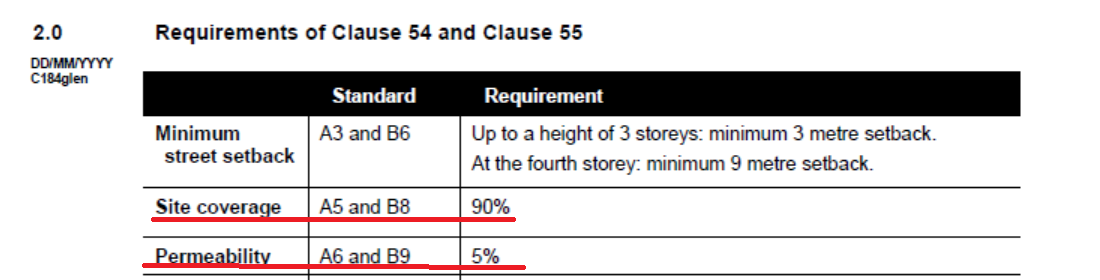
Council has had years upon years to change the schedules for its residential zones introduced in August 2013. Nothing has been done. Permeability remains at 20% for both the GRZ and RGZ and commercial areas don’t even rate a mention. Whilst council keeps patting itself on the back for its 25% permeability requirement and 50% site coverage in the Neighbourhood Residential zone, we wish to point out what some other councils have achieved in regards to permeability and/or site coverage throughout their municipalities: Banyule has a maximum 40% site coverage in its GRZ2 zone: Bayside in its GRZ1 AND GRZ6 & 7 has a 50% site coverage; Darebin also has a 50% site coverage in its GRZ1; Greater Dandenong has a 40% permeability requirement in its NRZ1 whilst MOnash has 30% permeability in NRZ1, 40% in NRZ2 plus 40% site coverage. Whitehorse has the following schedules: 50% site coverage for grz1 and 30%% permeability for grz1; grz2 40% and 40%; grz3 is 50 and 30% for permeability; grz4 50% and 30%; nrz1to 4 40% & 40%; nrz5 is 50 and 30%
Finally, council even considers these minimalist site coverage and permeability requirements as too much according to its draft amendment C184. Whether this remains once the amendment is advertised will be very interesting. Council has decided to create another zone RGZ4 (Garden apartments in activity zones) which will have a 90% site coverage allowance and a humungous 5% permeability requirement. Surely the way to go when all that matters is how many new apartment blocks can be crammed into Glen Eira? Here’s a screen dump of the draft proposal
Residents should indeed be following up and asking why this council is so adverse to introducing any decent controls into its planning scheme, such as a Water Sensitive Urban Design policy, or better still, amending its schedules so that site coverage and permeability standards are vastly improved. Other councils have done this, but not Glen Eira! We also note that the resident’s question(s) were directed to councillors. Sadly, not one councillor had the gumption to respond apart from Hyams and his usual waffle.



 Glen Eira Debates