From today’s Caulfield Leader
February 19, 2019
From today’s Caulfield Leader
February 15, 2019
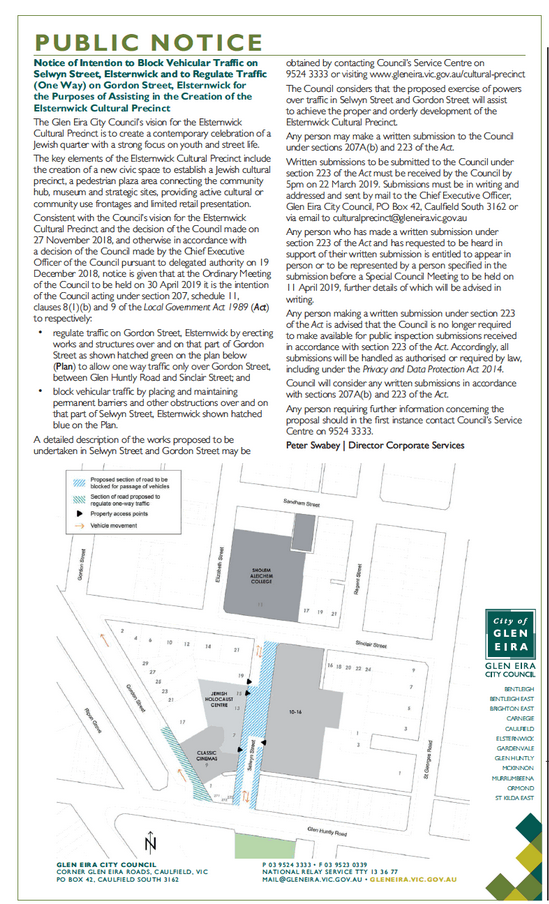
Below is an email that was sent by council to all Trade Associations in Glen Eira. Nothing wrong with this except:
1. Why aren’t residents included since the blurb below speaks of the ‘community’s views’?
2. Why is this the first we hear of council’s plans for A Place Making Action Plan?
We do not wish to diminish the importance of local business. However, we do not believe that traders should get precedence over the general community on something as important as planning and residential amenity. Furthermore, very little reporting of such meetings ever makes it into the public domain. It would appear that traders very definitely are at an ‘advantage’ in Glen Eira compared to the ordinary run of the mill resident!
+++++++++++
Local Economy and Place Making Action Plan – Traders Associations Consultation
Glen Eira City Council warmly invites you to participate in a discussion to help shape the development of a new Local Economy and Place Making Action Plan for our municipality.
As with Greater Melbourne, Glen Eira is currently experiencing a time of significant change, with transport upgrades, population expansion, shifting land use and changes to the way people work and do business. These significant, externally driven changes present both challenges and opportunities with regards to the economic and social viability of our municipality.
As a Traders Association you play a vital role in capturing and representing the views of the traders in your centre. We would like your input into what would make Glen Eira an even better place to work and do business, and how this could be achieved.
This is an exciting opportunity for you to help us ensure the Action Plan is informed by the community’s views and vision regarding developing our local economy. (our emphases). We really hope you are able to make it and contribute to this important conversation.
Date: Wednesday 27 February 2019
Time: 6:30pm for 7pm start. Concludes at 8.30pm (includes light refreshments on arrival)
Where: Glen Eira Town Hall, Caulfield Cup Room
RSVP: cityfutures@gleneira.vic.gov.au by Wednesday 20 February
Background information
| Regards
Alex Francis-Yu City Futures PO Box 42 Caulfield South VIC 3162 |
February 7, 2019
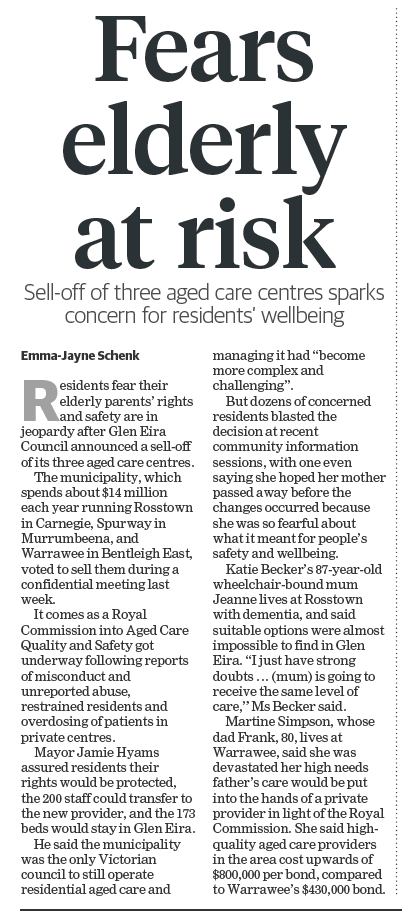
Council has resolved to sell off its 3 aged care facilities. Whether or not this is the appropriate decision is not the point. What concerns us is the manner and process by which this decision was made. There has been:
We certainly acknowledge that recent federal legislation has impacted severely on councils’ ability to provide such services. This however does not obviate the need for full transparency and communication with ratepayers and those directly impacted by such a decision. Our view is that it should be up to residents to determine how their money is being spent. Are residents willing to have their rates subsidise aged care in the community? Or, do they believe that private companies are the best option? Such decisions can only be based on council providing the community with the full facts. That has never happened in this council. No document has ever been tabled to explain why aged care has been running at such a loss for year upon year. Nor has any document been tabled which outlines a business case for the sale. Residents have been kept in the dark. That is tragically the modus operandi of this council on so many issues!
The very fact that such a momentous decision can be made in secret and that 9 individuals are totally complicit in endorsing this veil of secrecy is frankly unconscionable.
Many more questions need answering. For instance:
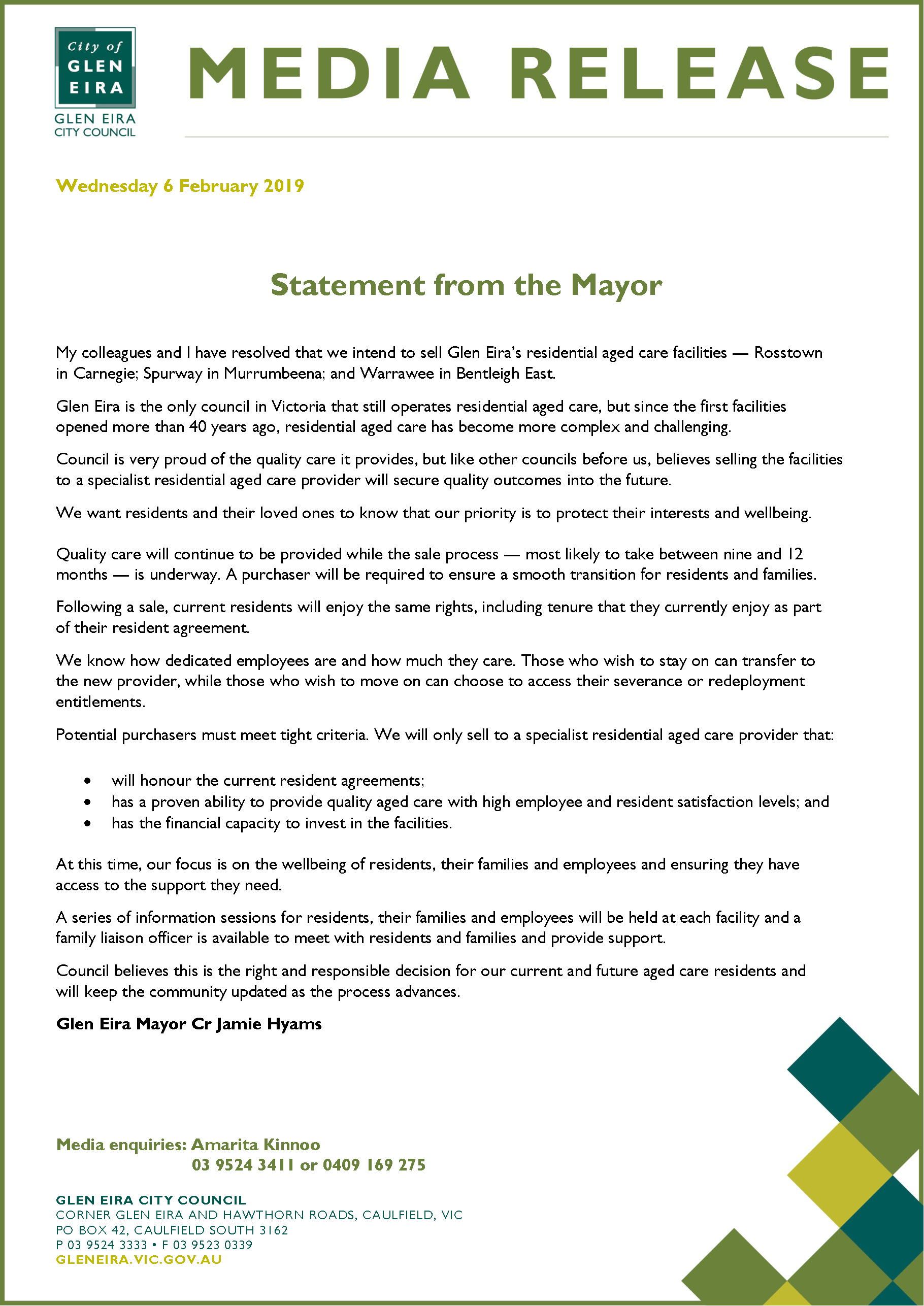
What irks us even more is the tone of the public statements issued by Hyams and the CEO. As shown below the Hyams document is nothing more than spin taken to the nth degree. The fact that employees can ‘transfer’ if they wish to the new employer ignores completely the fact that this only applies to permanent staff and not long term casuals and is at the mercy of the new owners as the McKenzie document (uploaded here) makes clear.
To see the impact that such a decision has had we publish one of several emails we have received. This is the human cost – something that our 9 councillors have obviously ignored and refused to put out for public debate!
This is my first time to get in touch with you, although I read your work with great interest.
I do need to stay anonymous, as I am an employee …. of one of the aged care residents. Do with this information what you will but please let me stay anonymous.
….. the very first I heard of this was this morning, February 6, 8.38 am in an email from mayor Jamie Hymes. Next communication came from the union, at 1.38 pm as I am an in-home-support staff as well. At 2.08 pm another email arrived from CEO Rebecca McKenzie, addressed to all employees of council.
All this without any inkling or whisper and with not much notice either.
As a permanent part-time staff of xxx years , working as an in-home-support worker, I can’t help but feel this is our fate for next year and this is exactly how it is going to be handled as well.
….. as an employee, what I find most offensive is 1. this was all done in secrecy, 2. no ifs and buts 3. Council is offering for residents and staff free “shrink” sessions.
Regards,
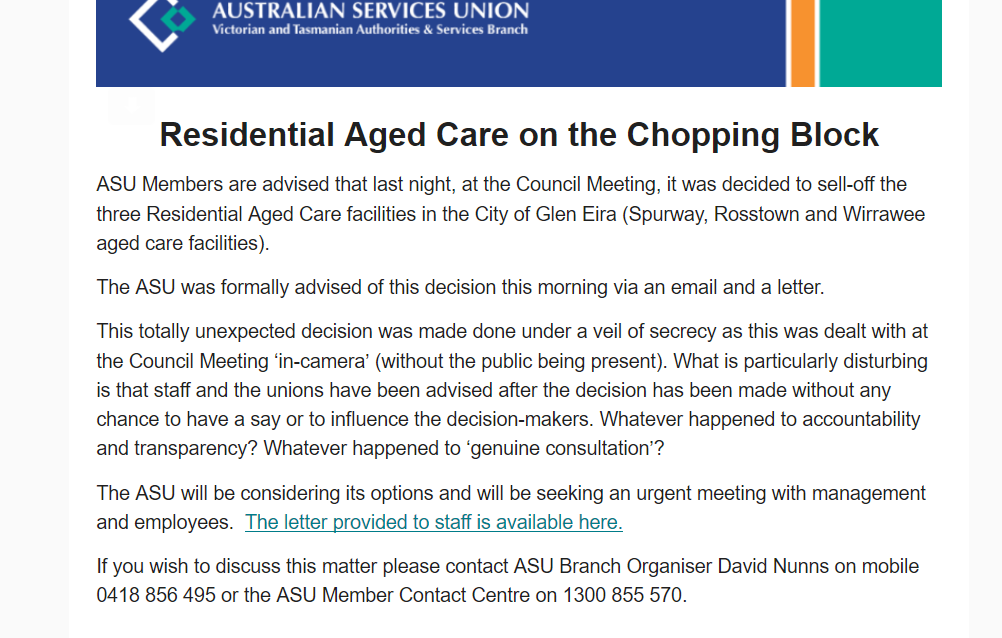
And finally, the Union reaction –
January 29, 2019
The tree register saga is now at least 15 years in the making. Following the September 2018 report we still are eons away from anything happening. As far as we can tell from council’s published information the eventual tree register will:
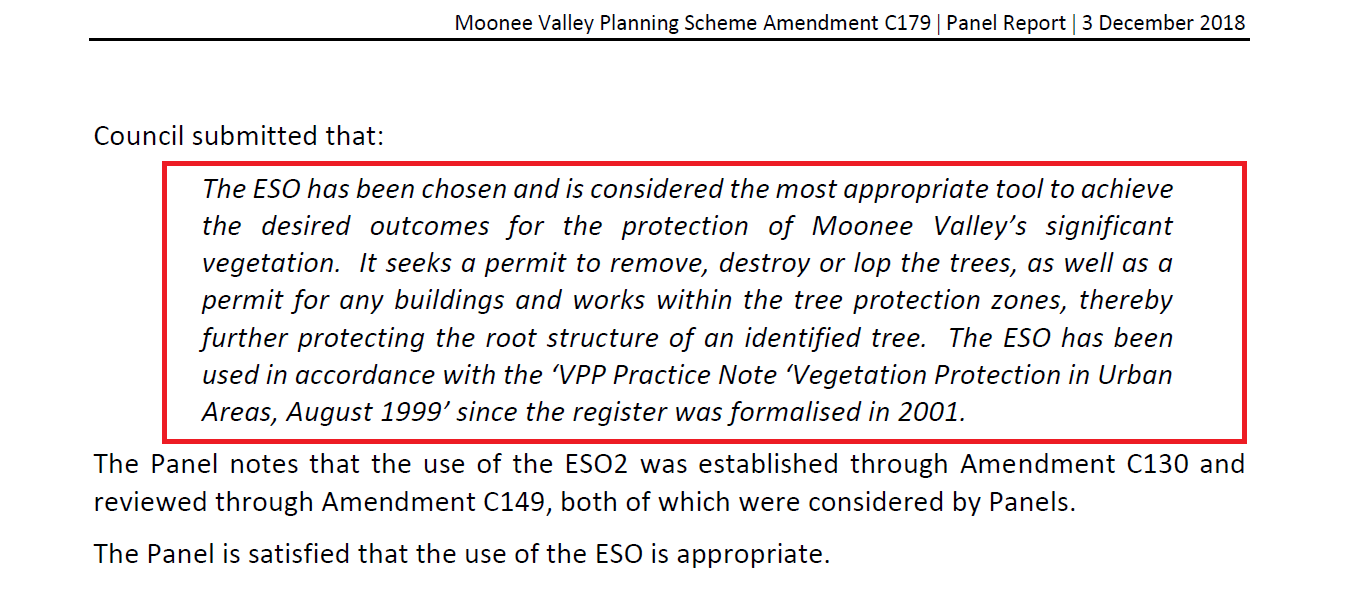
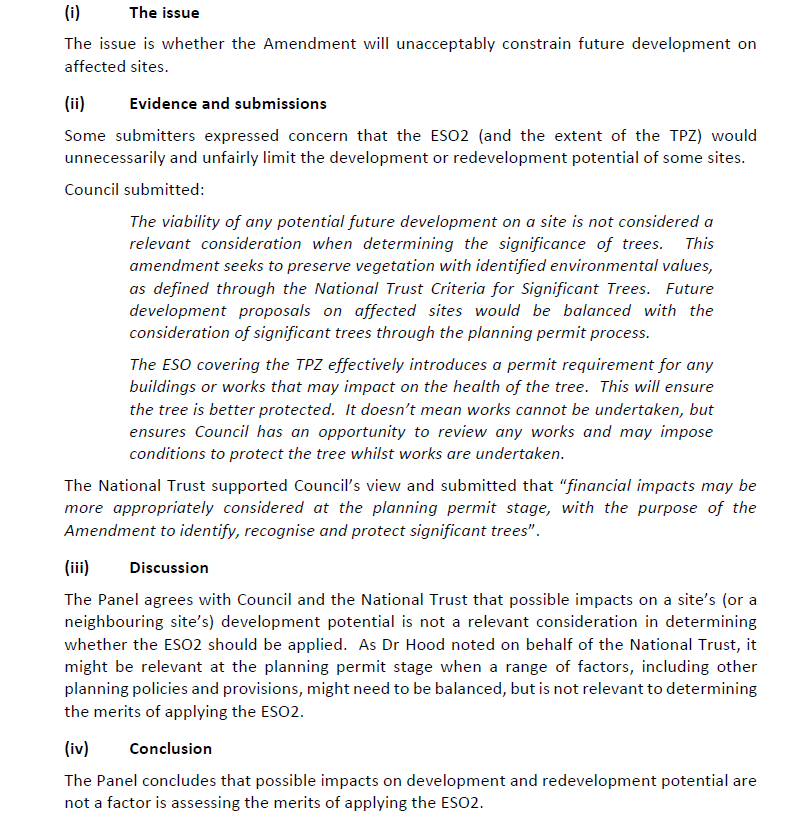
By way of illustrating what can and should be done we highlight recent amendments from Moonee Valley Council. This council has had a register for years. The register has been updated annually, plus it has existed for quite some time as part of its planning scheme. The latest amendment, gazetted recently, takes this a step further by placing an Environmental Sensitive Overlay (ESO) on every tree listed in the register. Whilst removal is still permitted, Moonee Valley has ensured that moonscaping is now much more difficult and unlikely. The ESO ensures that for each tree there will be permanent tree protection zones, regardless of development desires, and that only branches of less than 10cm in width may be lopped by developers.
Glen Eira’s stated proposals don’t come within cooee of such actions!
FYI we’ve provided the following screen dumps from the Planning Panel report which supported council in their endeavours to protect their habitat. Importantly, the imposition on individual landowners and developers was seen as less than the overall ‘community benefit’ to that municipality by the enhanced tree protection!
January 22, 2019
Allison Worrall Jan 21, 2019

The genteel streets of Elsternwick are not usually the scenes of a protest but on Saturday, more than 150 disgruntled residents, many with children in tow, marched with placards.
The rally was to highlight the community’s opposition to two apartment towers of 10 and 14 storeys proposed after supermarket giant Woolworths bought the site of the former ABC studios.
The resident action group behind the march is in its infancy; members banded together just weeks ago. “I’m a complete novice,” said organiser and veterinarian Karen Boyd-Jones. “I didn’t realise it was going to be all day, every day – lucky I’ve just retired.”
While resident action groups are not new, their prevalence, profile and role in Melbourne has grown as the city’s population has boomed. Social media has been harnessed to raise awareness, attract new members, co-ordinate campaigns and share information.
In Brunswick in the inner north, an established and well-organised action group with more than 1000 members is gearing up for the eighth day of hearings at the state’s planning tribunal.
Protect Park Street Precinct formed two years ago in response to the proposed 13-storey development of 333 apartments overlooking Princes Park. The application has since been revised to 14 storeys, 255 apartments and 12 townhouses.
To date, the group has raised more than $100,000 to mount a comprehensive legal case against the large legal team hired by developer JW Land Group, which paid $32 million for the site.
Members include former La Trobe University chancellor Professor Adrienne E Clarke, who said the group wanted to see “an appropriate building, respectful of heritage values” on the site.
The rise of resident groups has seen thousands of Melburnians, many with little or no experience in politics or lobbying, become resolute activists in recent years.
“I don’t think it’s any secret that the way the planning scheme operates at the moment tends to be quite pro-development and favours the big end of town,” says Glen McCallum, the president of Protect Fitzroy North, a powerful group that campaigned against a sprawling 16-storey apartment complex on Queens Parade proposed by developer Tim Gurner.
In that case, planning minister Richard Wynne controversially intervened to place a 10-storey limit on the site, which ultimately led to the project being greatly scaled back. Mr Gurner defended the project at the state’s planning tribunal and welcomed the approval when it was granted.
Since then, Mr McCallum’s organisation has offered assistance and fielded enquiries from resident groups in Collingwood, Alphington, Ivanhoe, Heidelberg and Brunswick.
“The pace of development has stepped up,” Mr McCallum says, “and the regime the councils operate under hasn’t changed since way back in the ’90s.”
With or without the support of councils – many of which have been inundated with development applications and are simultaneously juggling dozens of proposals and appeals – resident action groups are regularly taking on multi-millionaire developers in the Victorian Civil and Administrative Tribunal.
When a case reaches the tribunal, developers will often hire high-flying legal teams consisting of a QC, a junior barrister, several solicitors and a stream of other consultants and experts.
Meanwhile, residents may not have any legal representation or, if they have successfully fundraised, may hire a planning barrister like Daniel Epstein, who charges community groups a reduced fee.
“It’s absolutely a David and Goliath battle,” Mr Epstein admitted but added that resident groups had repeatedly proven effective. “It might be that the development goes through but is much more considered and restricted because of what the community did.”
Most resident groups vehemently reject the NIMBY label, and Mr Epstein agreed it was not the right description. He stressed that the dozen groups he had worked with were not anti-development, but against developments that were ill-considered or too large.
Those involved in planning disputes say it is arduous work entailing countless hours of research. “Our little structure plan for Elsternwick had approximately 19 documents, over 1000 pages,” said research scientist Jacinta Smith, who attended Saturday’s march.
“How do people cope with that? Only ridiculous people like me think ‘I’m going to read this with my highlighter’.”
Ms Smith said she had never stepped foot inside a council meeting until 18 months ago when her land was rezoned. “I, like many people, was ignorant and apathetic on local council issues,” she said. “We assume the professionals and experts will handle this for us.”
Glen Eira council will hand down its decision regarding the Woolworths development next month.
PS – From today’s Caulfield Leader

January 19, 2019
In the 2016 Planning Scheme Review, residents made it clear that high on their list of priorities for council action was the introduction of an ESD (Environmentally Sustainable Development) policy, plus a WSUD (Water Sensitive Urban Design) policy. The formal Review submitted to government went on to state (page 26):
ESD, loss of water, permeability, underground car parking
Feedback revealed a greater desire for environmentally sustainable developments.
It is recommended:
Σ That a town planning sustainability policy be developed together with ESD objectives in the MSS.
Σ Investigate possible incentives encouraging ESD for developments.
Σ Increase opportunities for planting
Σ Develop a Water Sensitive Urban Design Policy.
Σ Continue advocacy for a Statewide ESD Policy.
In the October 2018 review these ‘recommendations’ somehow went out the window with council resorting to its time honoured practice of ‘let’s wait for the state government to do something’ as evidenced here:
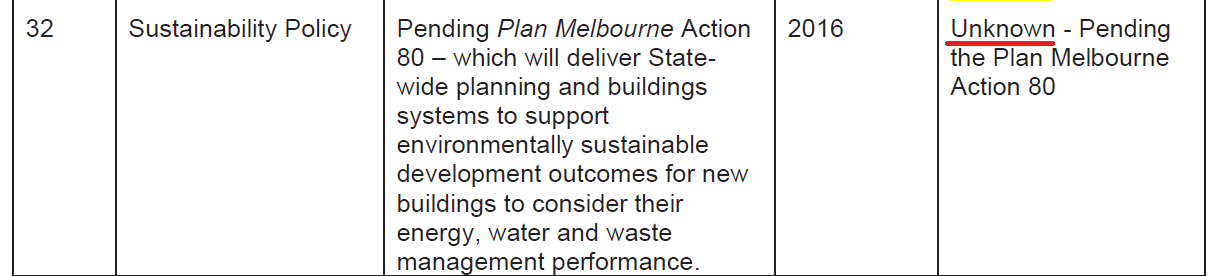
Even the WSUD idea morphed into the single issue of the Elster Creek Catchment project rather than seeing this as an issue for each individual development application.
For 30 other Victorian Councils, waiting around is not an option. Here’s a recent announcement from the MAV – the peak body of all councils.
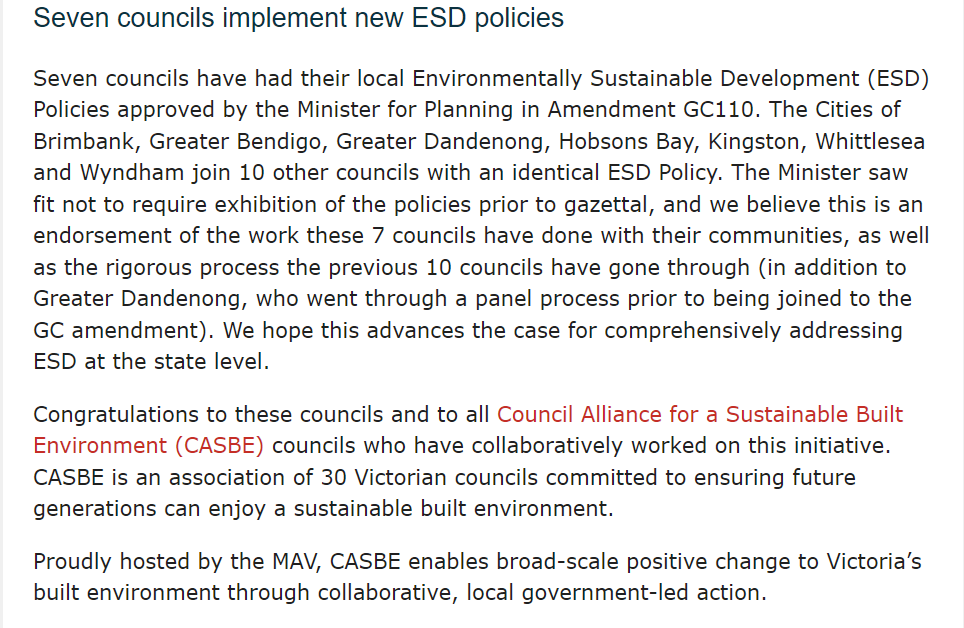
Glen Eira isn’t even a member of the above listed alliance! Why not? Why is this council so averse to working collaboratively with other councils to ensure positive outcomes for the community? Is it really so hard to devise a policy that is now firmly entrenched in countless other planning schemes? Or is it that any impediment to developers goes against the grain?
Here is a list, taken from the CASBE website of all councils forming this alliance.
Banyule
Bass coast
Bayside
Benalla
Brimbank
Darebin
Greater Bendigo
Greater Dandenong
Geelong
Hobson’s Bay
Hume
Kingston
Knox
Manningham
Maribyrnong
Maroondah
Melbourne
Monash
Moonee Valley
Moreland
Port Phillip
Stonnington
Strathbogie
Whitehorse
Whittlesea
Wodonga
Wyndham
Yarra
Yarra Ranges
January 16, 2019
The Australian Bureau of Statistics has today released its data for building approvals for the July to November 2018 period. Glen Eira remains well and truly above target to meet its housing needs for population growth.
The chart below features all building approvals since the 2011/12 financial year. Please note that these figures also include building approvals for single house replacements. Thus, whilst the chart indicates that Monash has 300+ more building approvals, once the number of permits for single houses are removed, Glen Eira is streaking it in. For example: during this period Monash has had 4432 single house permits granted. Glen Eira has had 2232 – ie Monash has had double the number. Boroondara is another example where the rate of single house replacement is very high – 3547. Further exacerbating this data is the size of these municipalities. When 80 square km (Monash) is compared to the 38.9 km of Glen Eira, questions of density, open space become critical. Something our council is ignoring completely!
Given this data, it remains unbelievable that council is still committed to doubling the size of our activity centres and facilitating apartment blocks of 12 storeys and more.

PS – in order to put some of these stats into perspective we are adding the following – a list of all municipalities that had more building permits granted than Glen Eira’s for the period July to November 2018. Glen Eira had 853 permits of which only 132 were for single house replacements. The following list includes the total number of permits, plus the number of single house permits following the bracket(/).
Casey – 1983/ 1794
Greater Geelong – 1416/1246
Hume – 1615/1395
Manningham – 1109/170
Melton – 1216/1199
Monash – 1201/291
Whittlesea – 1266/890
Wyndham – 2557/2296
January 2, 2019
Neighbourhood centres in Glen Eira have been totally ignored for years despite the fact that development is proceeding at a great pace and with ever increasing heights and density. The latest result of council’s failure to introduce any planning controls for these areas comes with a new application for a 7 storey development at 75-85 Hawthorn Road. This will sit directly alongside another 7 storey building and opposite a 6 storey building.
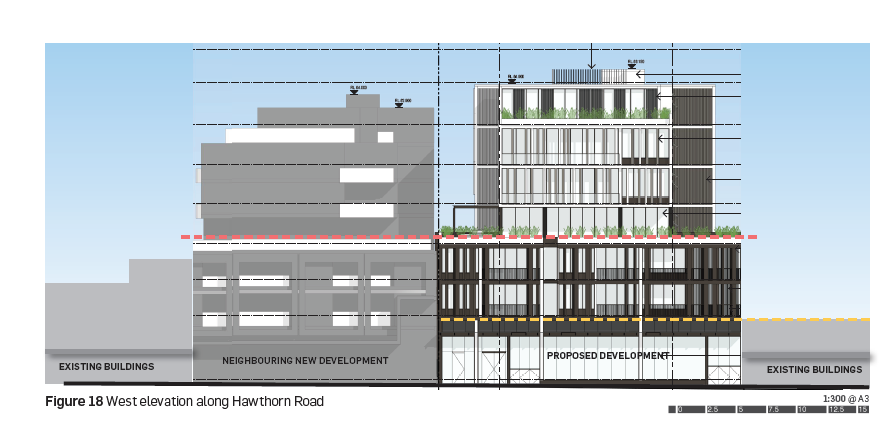 McKinnon now has 6 storeys. Glen Huntly has multiple sites with 6 storeys. East Bentleigh the same and will soon have at least 8 storeys. Murrumbeena and Hughesdale also feature 6 storey permits. Ormond will have 10 storeys and currently has several 5 storey permits. Each and every neighbourhood centre will now become another de facto high rise area.
So what is council doing about this? Very little it would seem. This stands in stark contrast to other councils who have refused to be so compliant and pro-development. Boroondara through its C229 Amendment managed to ensure mandatory height limits for all but its 3 major commercial shopping strips where the majority were of a maximum height of 3 storeys and only 1 was for 5 storeys. (See HERE). Bayside has also worked tirelessly to shore up protection for its neighbourhood centres. In Glen Eira we still await any indication as to:
True to form, council’s modus operandi remains the same – keep the plebs ignorant until it is too late!
December 24, 2018
To begin with, wishing all our readers a safe and healthy festive season, with thanks for your input throughout the year.
2018 has in many ways been pretty momentous. There have been some governance advances but overall majority resident views continue to be ignored. Here is a summary:
THE POSITIVES
THE NEGATIVES
There are plenty of other issues we might highlight. The take home message is that planning and traffic remain residents’ major concern and this council has done very little to ameliorate the continuing damage. When the vast majority of residents are opposed to 12 storeys in Carnegie & Elsternwick, and the majority were also in favour of only 4 storeys for Bentleigh, council has shown time and time again that it is intent on ramming its agenda through despite community opposition. Until we have a group of councilors determined to listen to its residents then nothing will change.

December 7, 2018
Common sense is a very scarce commodity in Glen Eira council. Why on earth would you close off three quarters of a family park on December 3rd when kids and families are about to go on holidays and would enjoy spending some time in a public park? Why now, and for a stretch of 6 months, when the decision to spend a squillion on Harleston park was made just on 18 months ago?
Here’s the breakdown of events:
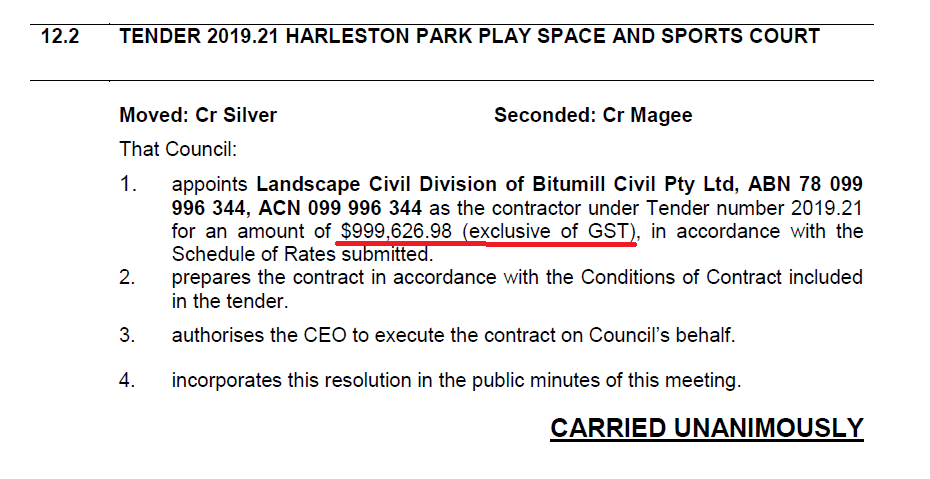
It is unclear whether this successful tender includes the toilet costs or is simply for the playground and landscaping. Please note that the stated amount is EXCLUSIVE of GST – meaning that this project will cost well over a million dollars.
This exercise raises plenty of issues, such as:
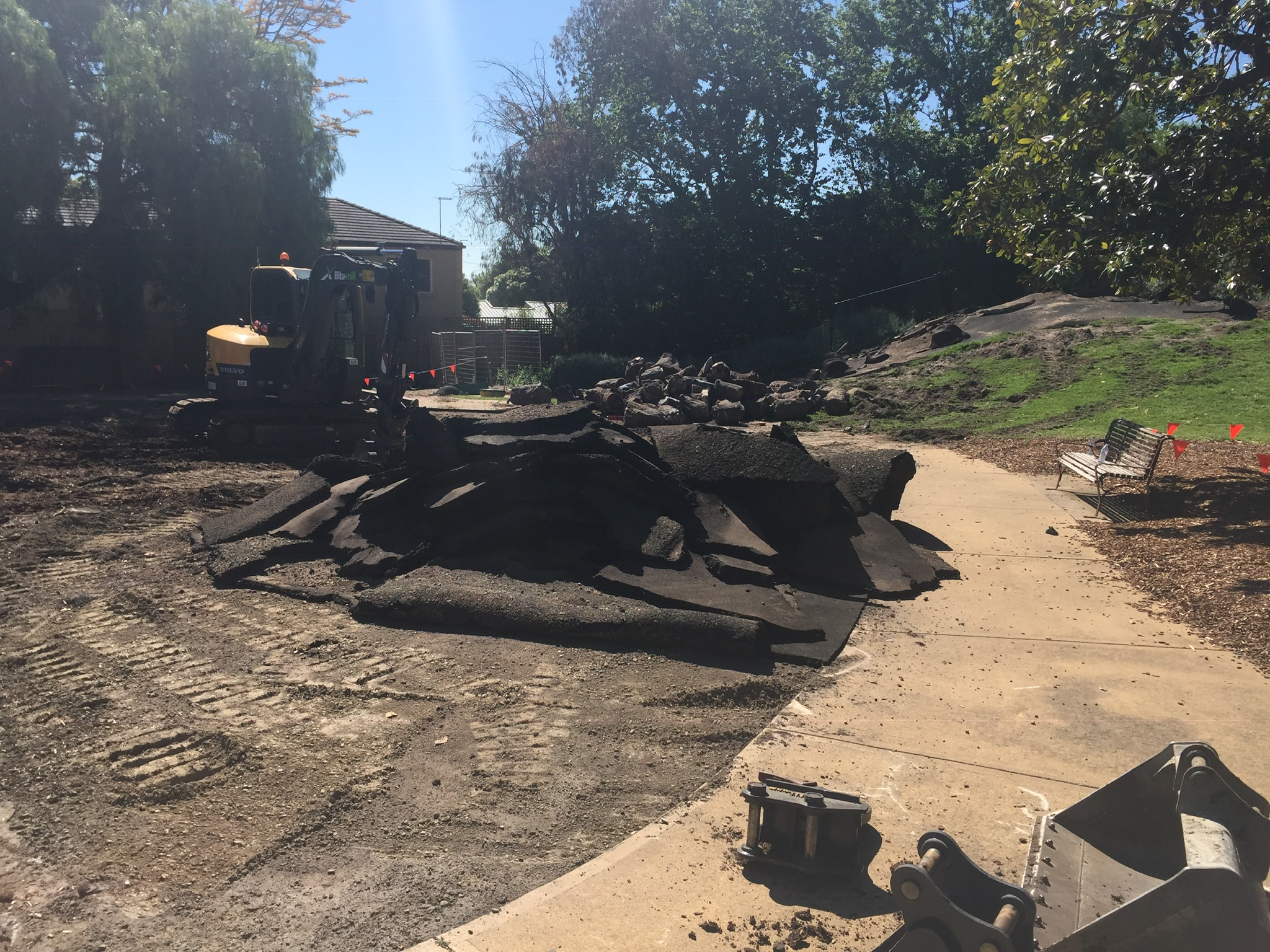
The photo (below) shows the removal of rubber matting that has only recently been installed and is probably still in very good condition. Again, how much did this cost?
 Glen Eira Debates