GE Consultation/Communication


No one expects council to complete its proposed infrastructure works in the space of a year or two. That does not mean that essential projects be held off for nearly a decade whilst developers get the go ahead to literally reach for the skies.

Council’s draft Strategic Resource Plan/Budget has some startling figures. We quote directly from these documents and ask that residents carefully consider the consequences of what this means.

ELSTERNWICK

  • Elsternwick Community Hub & Park – $32.45m (majority of spend in 2024-25 -to 2026-27).
  • Stanley Street East Multi-deck Car Park – $18m (majority of spend in 2023-24 – to 2024-25).
  • Selwyn Street Cultural Precinct – $1.2m (to be completed in 2023-24).

BENTLEIGH

  • Eat Street (Rotunda) – $2.55m (to be completed in 2020-21).
  • Bentleigh Library Upgrade – $2.9m (to be completed in 2023-24).
  • Horsley Street Multi-deck Car Park – $14.05m (majority of spend in 2027-28).

CARNEGIE

  • Koornang Road Streetscape Upgrade & Pedestrianisation – $6.45m (majority of spend in 2023-24 to 2025-26).
  • Shepparson Avenue Market Development – $2.95m for design, concept plans and initial consultation.
  • Kokarib Road Park – $50k for design works.

What these figures reveal is that residents will have to wait at least 10 years for most of these things to be completed. Given council’s track record on time lines and budget blowouts we expect the time lag and cost to be even more than indicated here.

No information is provided on:

  • Business case(s)
  • How costings were derived
  • Reasons for delay(s)
  • Percentage of third party involvement and their ‘contribution’

Even more discouraging is the fact that no dates are provided anywhere in the SRP or the Community Plan for the completion and introduction of such vital amendments as:

  • Car parking overlays
  • Infrastructure levies on development
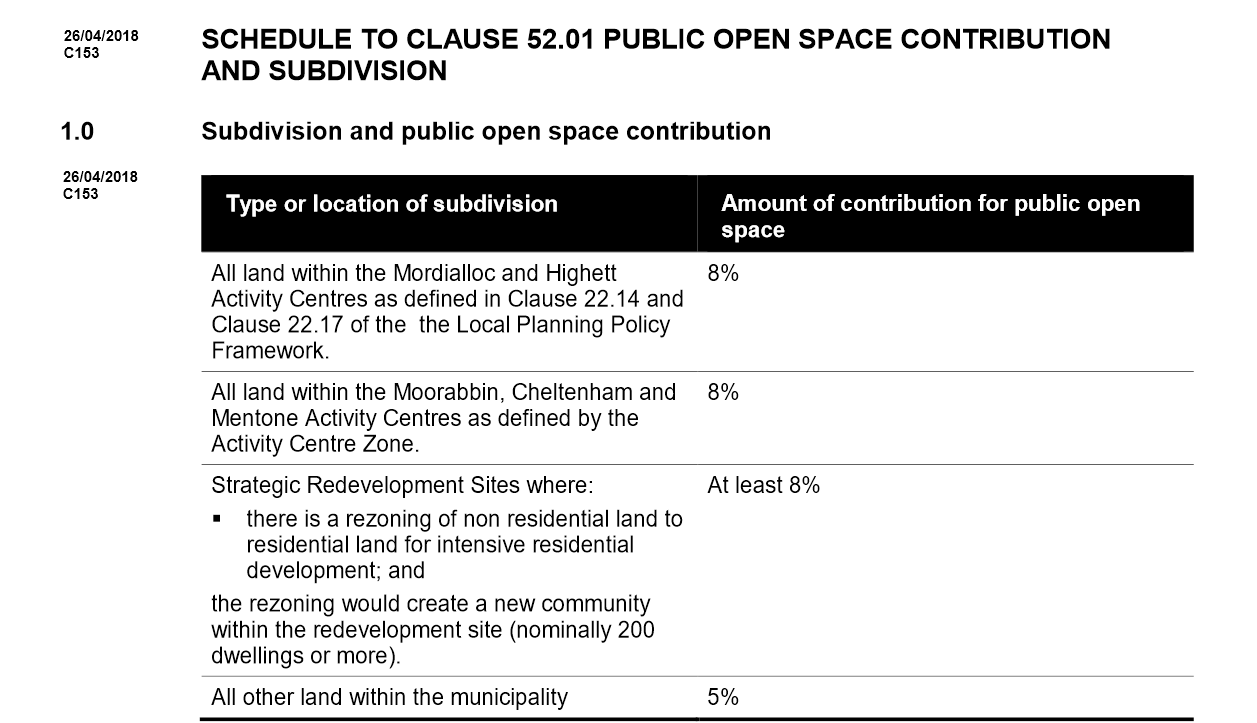
  • Increase of open space levies

Much of what is proposed has not been ‘endorsed’ by residents. Do residents really want to spend $14m for a high rise concrete car park in Bentleigh or $18m for one in Elsternwick? What ‘evidence ‘ is there that this will solve parking problems in these areas? Is this really ‘value for money’ or simply ‘value’ for developers when council land will be sold off? And do residents really want to be in hock again to the tune of an additional $30m  that council wants to borrow?

PS: As an example of what can be achieved right now (if there’s the will) the following Kingston amendment was gazetted a few days ago.

How councillors vote on Item 9.5 next Tuesday night will reveal much about their courage, their integrity, and their overall commitment to social/affordable housing. It will reveal once and for all whether all the recent huffing and puffing about supporting the less advantaged in our society has been nothing more than hot air and political grandstanding.

Item 9.5 concerns the proposed amendment designed to ensure that the Melbourne Racing Club (MRC) sticks to the terms of the Incorporated Plan and provides a modicum of social/affordable housing in its mammoth 2000 plus Caulfield village development. The officer’s recommendation is –

Having given consideration to the issues explored in this report, resolves to not proceed with Amendment C151 and support a position to the Panel appointed to consider Amendment C151 that it intends to abandon the amendment. 

We remind readers of the following:

  • The appointment of the gang of 4 (Lipshutz, Pilling, Hyams & Esakoff) instead of the entire councillor group to decide on the incorporated plan in 2011 which agreed to heights of at least 20 storeys.
  • Decision after decision that increased dwelling numbers from a stated 1100 to now over 2000 and by the conclusion will probably total closer to 3000 apartments – the vast majority being single bedroom dog boxes.
  • The continual cave in after cave in on each submitted development plan
  • The ridiculous acceptance of a paltry 4 and 5% open space levy
  • The failure to even have a social housing policy years after VCAT made note of this fact
  • Fences along Queen’s Road still standing though falling apart and
  • A ridiculous acceptance of a pathetic little ‘playground’ and barbecue area that is supposed to represent ‘open space’ for the community whilst the gates remain locked half the time.

Every single aspect of council’s dealings with the MRC has resulted in total disaster for the community. Now we have this latest outrage which will hand the developer millions more in profits no doubt. And one of the major ‘excuses’ for giving up and abandoning the amendment –

If the Amendment proceeds a considerable amount of funding and resources will be required in the preparation of a panel hearing. 

How this sentence can even be included is literally mind boggling – especially when the draft Strategic Resource Plan includes this gem of future expenditure Shepparson Avenue Market Development – $2.95m for design, concept plans and initial consultation (page 6). If we are reading this correctly, council is prepared to spend just under $3 million before the first sod of earth is even turned, yet they baulk at the prospect of even $100,000 to ensure that the MRC holds up its end of what the Incorporated Plan and the C60 schedule states.

What irks us even more is that the entire focus of the officer’s report is on the social housing aspect. Yet the proposed amendment contained much more. It was intended to ensure that the MRC could not alter the boundaries of the 3 precincts which would have enabled them to expand some areas and hence cram in more dwellings. No argument is presented as to why this should not be pursued!

The other issue this item raises is the competence of council’s planning department once more. If there are ambiguities in the draft amendment and therefore open to legal challenge, then what does this say about the expertise of those who drafted the amendment in the first place?

Regardless of the legal wrangles, council now has the opportunity to carry through on all its stated commitments to social housing. It should not come as a surprise that the MRC is fighting every step of the way. But so should council if they have any integrity left! Hire some decent legal eagles, do the necessary homework, and ensure that the MRC does not once again walk all over the community and its representatives! The expenditure of $100,000 is surely a drop in the ocean compared to the vast waste that is endemic in Glen Eira!

With every monthly release of new housing data, Glen Eira’s ‘projections’ are shown to be so out of kilter with reality that it calls into question every single aspect of their current structure planning. Council has based its planning on the allegedly required 9000 new dwellings by 2031. This is supposed to be the full justification for doubling the size of activity centres, ‘upgrading’ hundreds upon hundreds of properties to 3 and 4 storey height limits, and proposing 12 storey apartment blocks adjacent to heritage properties. Building approvals reveal that in the past 2 years alone (and we still have 3 months to go for 2017/18) 4000 permits were given out. Even if we subtract the roughly 17% that were for single house replacements that still leaves well over 3000 new apartments in the space of 21 months. Add in the fact that the overwhelming majority will be completed by 2031, then the alleged target of 9000 net new dwellings will be here in the next 3 years at this current rate of development. And even if development slows the number of permits still coming in will ensure that our 9000 is a reality well before 2031.

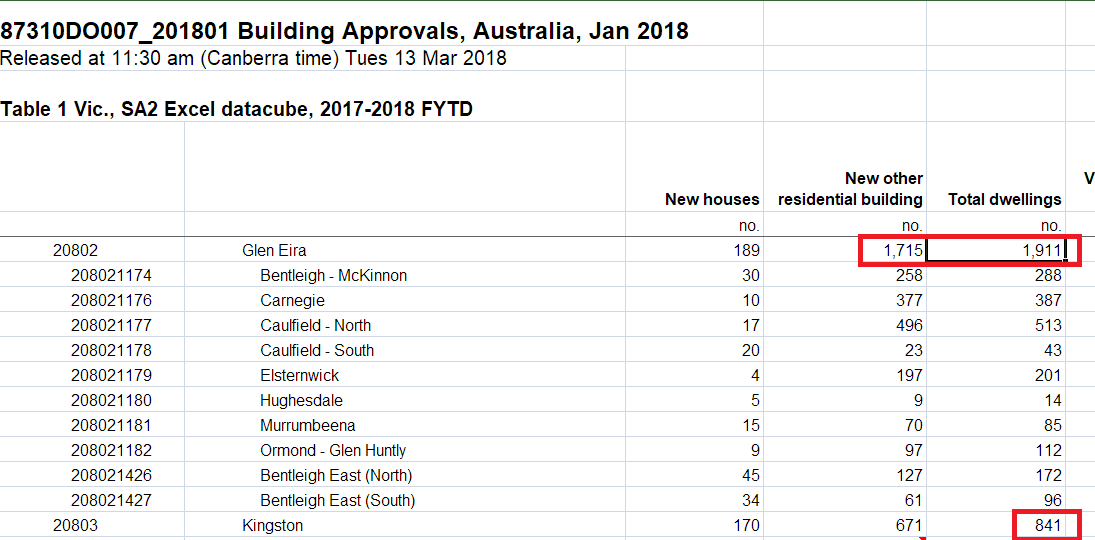
The ABS has released its latest building approvals this morning for the current financial year. (UPLOADED HERE). We’ve summarised the data for various councils. Only Monash exceeds Glen Eira’s numbers. However this municipality is also double the size of Glen Eira and has double the number of replacement single houses. In short, Glen Eira is still ‘leader of the pack’!!!! Why? And why is council continuing to support this unsustainable level of development and in fact, encouraging more?


The latest VCAT decision features an application for 7 storeys in Hawthorn Road, Caulfield South. Next door to what is currently the Godfrey’s shop front. Both Council and VCAT refused the permit. However, the member’s comments as to why he refused the permit should provide some salutary lessons for our planning department. We can only hope that the lessons from this case and the recent one in McKinnon Road, McKinnon are being analysed fully. This has not been council’s practice. No document that we are aware of has ever looked at VCAT decisions and made recommendations on how to plug the holes in the planning scheme. Even the recent Planning Scheme Review failed to provide any sensible recommendations regarding VCAT decisions. Nothing was truly analysed, dissected, and reported upon. All we got were generalised comments on the respective zones and not a word about individual decisions and how council should respond to such decisions.

Both recent decisions, and particularly this latest Hawthorn Road one, have profound implications for our so-called neighbourhood centres. Council’s current planning scheme includes the ‘policy’ that centres such as Caulfield South, McKinnon, Ormond, East Bentleigh etc. are lower in the hierarchy compared to the Major Activity Centres (Bentleigh, Carnegie, Elsternwick) and therefore should not be exposed to the same intensity of development compared to these major activity centres.

Planning for our neighbourhood centres has basically been non-existent. Yet large swathes of these suburbs are zoned GRZ. For example, over 40% of residentially zoned land in Ormond is zoned GRZ. All council has produced is a document which, in part, is euphemistically labelled ‘Activity Centre Framework’- replete with such jargon as ‘moderate focus’ on development, or ‘major focus’ on housing growth. Apart from the upgrading of South Caulfield and East Bentleigh there is little to differentiate McKinnon from Ormond, Ripponlea from Gardenvale and so forth.

This is vitally important given these two recent VCAT decisions for the simple reason that council CANNOT afford to continue ignoring these centres. Nor can they continue to treat them as identical and assume that the same planning controls (ie a one size fits all approach) will suffice. Both VCAT decisions make it abundantly clear that NO OVERARCHING POLICY WILL BE ENOUGH. That each centre requires its own, individual structure plan and mandatory controls. Thus, until council gets its act together, developers can continue to have a field day.

Council will undoubtedly pat itself on the back for the Hawthorn Road decision. Let’s not get too excited about the efficacy of the current planning controls. For starters the application was incredibly deficient. Five apartments were to be significantly BELOW GROUND LEVEL – suitable for moles and not humans! The following sections in italics are verbatim quotes from the judgement.

Due to the slope of the site, these largely sit below natural ground level……This identifies that the natural ground level sits close to the height of the ground floor ceiling at the rear of the building with a 2.5 metre setback from the rear boundary.

Next, neighbours with tiny back yards at the rear and zoned General Residential (ie 3 storeys) were facing the prospect of a huge wall – well beyond acceptable lengths

we find the most impacted site is 34a Cedar Street. This property has a small rear yard that is roughly 10 metres deep and 5.5 metres wide. It sits centrally to the rear boundary of the review site. As such the outlook from this rear yard will be dominated by a view to whatever is built on the combined four lots that comprise the review site.

From this central point, the view will be of a 17 metre wide building form. Due to the slope in the land, there is a 2.5 metre cut at the rear of the proposed building to accommodate the ground floor. This results in an apparent wall height of 4.5 metres from the adjoining rear yard.

There were plenty of other deficiencies in this application. But the most important aspect of both this decision and the McKinnon Road decision where the developer got his 6 storeys is the clear message that each neighbourhood centre MUST be viewed in isolation – as a unique entity with its own height limits, setbacks, etc. Thus far council has not provided any indication that this is on the cards. Bayside and other councils in the meantime have been able to produce different structure plans for their neighbourhood centres. They have not taken the easy way out and produced a ‘one size fits all’ set of planning controls. Whether council has the expertise, the will, and the foresight to produce similar work remains to be seen. If they don’t, then we can kiss goodbye to our smaller centres. They will each become home to high rise development.

Please note the following comments from this last decision. Nothing could be clearer for council. But are they listening?

In the case before us, much of the council submission is simply that the proposed building is too tall. This argument appears to be predicated on a principle that, as a neighbourhood activity centre, this location should support no more than four or five storeys, because larger ‘urban village’ centres are the locations for more intense buildings.

The council has adopted structure plans for the urban villages in February 2018 and recommend building of up to 8 – 12 storeys in Carnegie and Elsternwick, and 4 – 5 storeys in Bentleigh. Mr English (for council) contended that these structure plans give context to the council’s desire to diminish heights from higher to lower order centres. It contends that therefore the building on this site should be lower. We, however, share the findings of other divisions of the tribunal that:

  1. It is not appropriate to adopt a blanket position that a specific maximum height be attained because of controls introduced in other locations[2].
  1. Little weight should be given to recently approved planning scheme amendments that limit the heights of development in parts of Bentleigh and Carnegie for land outside these centres[3]. We add to this that the council adopted policies for these centres, and Elsternwick in 2018, are not necessarily relevant to consideration of a site in Caulfield South. This is because the design analysis has been undertaken for the specific considerations of those centres, not the area of our consideration.
  1. There is nothing in the planning scheme to indicate that a uniform height is sought for buildings in this centre[4], or any other neighbourhood centre.

While higher order centres have adopted council policies nominating particular heights, it does not necessarily follow that all development in other, lower order centres, must be lower. A more considered urban design assessment is required.

…. an accepted height, (or height restriction) in one centre cannot be simply transferred to another. We say this for the same reasons that we reject the council proposition that building on this site must be proportionally lower than height it has accepted for higher order centres such as Bentleigh and Carnegie. Just because six and seven storeys were approved in one neighbourhood activity centre it does not therefore mean seven storeys is an acceptable height for this site. A specific analysis of the proposed design against its immediate context needs to occur.

Source: http://www6.austlii.edu.au/cgi-bin/viewdoc/au/cases/vic/VCAT//2018/453.html
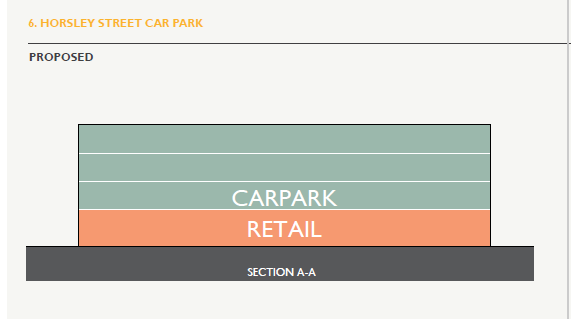
Council proposes to create at least 4 multi-storey parking lots throughout Glen Eira. Two are to be located in Bentleigh. If we are to take the pictures at face value, then one at least will be 4 storeys and possibly higher.

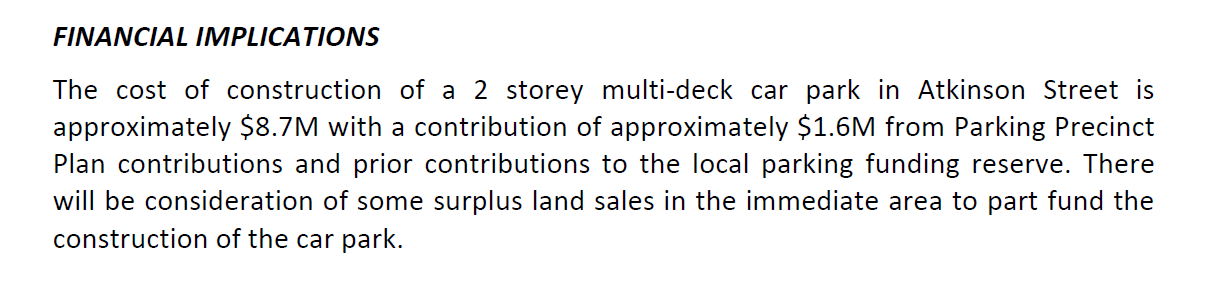
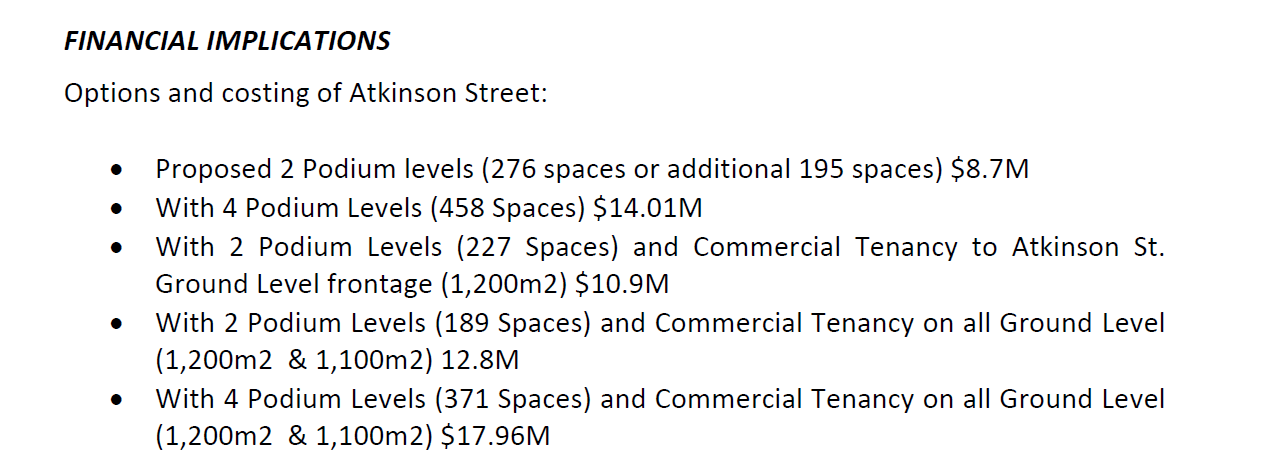
Not a single word has yet been spelt out as to cost and timing. Instead, residents have been provided with several documents on ‘case studies’, including the Monash Council’s development of the Atkinson Street multi parking site. Council also insists on citing the cost for this development as $7.1 million. This is only half of the stor(e)y (pun intended!) since the Atkinson Street development is only for 2 levels of car parking and not the three proposed by Glen Eira. Furthermore, the overall cost was $8.7 million of which $1.6 million was paid by Monash’s levies on developers.

Here is part of the Monash Council’s report from 2015. We’ve uploaded the full document HERE

Bearing in mind that this document was produced in 2015 and costs have surely gone up in 3 years, the following deserves close attention –

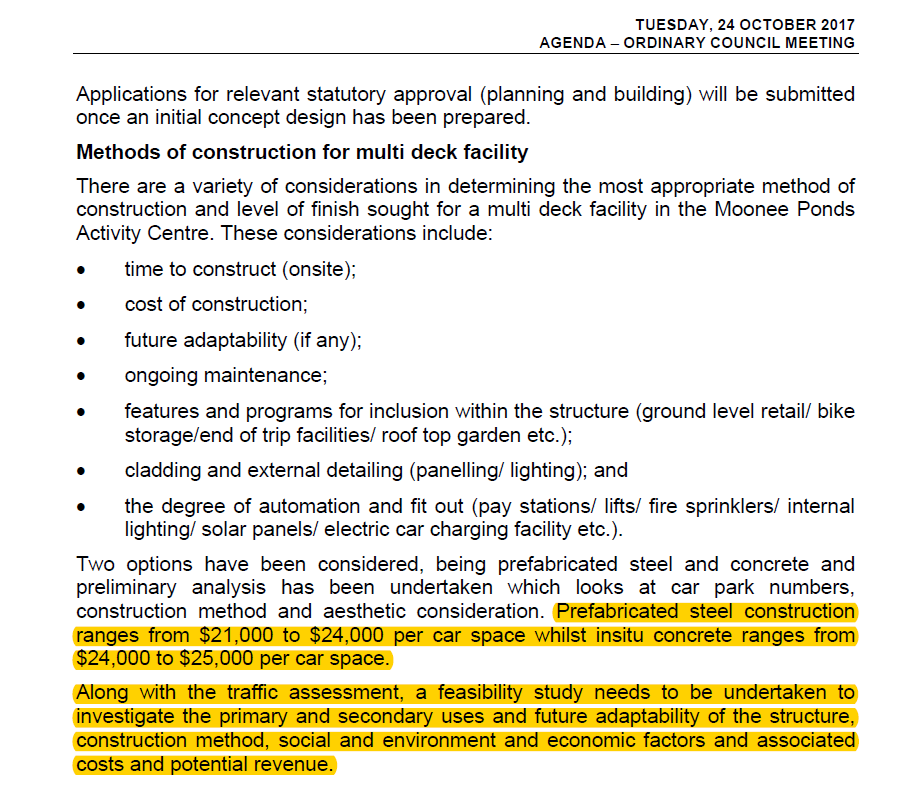
Moonee Valley Council also provides some food for thought in their council report on the prospect of developing multi level car parks.

Needless to say, Glen Eira council has simply decided to erect all of these multi-level car parks without providing the necessary documentation (ie strategic justification) for its proposals as cited in the above Moonee Valley document. Surely before any commitment is made to expend millions upon millions of dollars that such undertakings must be fully planned, costed, and details provided to residents!

Making matters even worse is the fact that according to council’s Strategic Resource Plan, Glen Eira is currently in debt to the tune of $18.4 million at the close of the last financial year – the result of borrowing $25 million for GESAC and the hefty interest rates incurred. If each car park will cost in the vicinity of $8 – $9 million at least, then that is roughly another $32 million that is needed but which council certainly does not have at the moment. Thus the question becomes:

  • When will any of this actually be completed? Well after developers erect their dog boxes and are granted car parking waivers?
  • It is certainly on the cards that much public land will be sold off to developers
  • It is certainly on the cards that meters will be introduced in order to bring in some cash
  • What other costs will rise in order to pay for these decisions?
  • Will Council attempt to borrow even more (up to the legal $25m) so that we are again in hock up to our ears?

Like everything else with this council residents are invited to give their opinions when the most basic information is with-held or hasn’t even been compiled as yet. Do residents really want to spend a fortune on high rise concrete bunkers is the question and what are the alternatives to this massive long term investment? Have alternatives even been considered? How much extra would underground parking cost?

Questions abound. Answers are in very, very short supply!

Council has consistently claimed that ‘evidence’ is the basis of all their decision making. Two items from tonight’s council meeting focus on this claim. We feature two recordings:

  1. Council’s response to the Mitchell Street residents’ letter, and
  2. A public question on the Elsternwick structure plan in the ‘community consultation’ phase of the meeting.

We urge all readers to listen carefully and to decide how well these councillors addressed what was being sought and asked.

MITCHELL STREET

  • Does Hyams’ motion change a single thing?
  • If parking/traffic changes are suggested then one should assume that officers did the necessary research to begin with and that their ‘evidence’ for the proposed changes are beyond question. Thus saying “’if this motion gets passed our traffic officers will examine the street and see what they can do there’ implies two things – (1) either no real ‘investigation’ was done PRIOR to changes being suggested, or (2) placating residents with vague, airy-fairy promises
  • Why can’t the results of this further investigation be tabled at council? What are the chances that the residents’ stated concerns will be taken on board?

ELSTERNWICK STRUCTURE PLAN

  • Has any councillor satisfactorily answered the allegation that decision making is ‘anecdotal’ and far from ‘evidence based’. We remind readers that Delahunty called the published shadow drawings as ‘rudimentary’!!!!!! Hardly the basis for informed decision making!!!!!
  • Not one single councillor, nor any published document has as yet presented any ‘evidence’ as to why 12 storeys is necessary.

The Glen Eira version of ‘evidence’ is let’s make it up as we go along to support the conclusions we arrived at from the beginning!


The ABS has today released its building approval figures for local areas. The data depicts approvals from July 1st, 2017 to the end of January 2018 – a period of 7 months. We’ve uploaded the full file HERE and present a screen dump for Glen Eira below. Unfortunately some suburbs are linked together (ie Bentleigh/McKinnon). However what these stats reveal is that development in Glen Eira is still way ahead of council’s predictions, raising the same old perennial questions –

  • Why do we need to double the size of our activity centres?
  • Why do we need to rezone areas to accommodate more dog boxes?
  • Why is council failing to respond to these essential questions?

‘Community’ responses to the Urban Design Guidelines have made a belated appearance on council’s website. Several factors are evident:

  • The overwhelming majority of submissions come from developers/planners representing clients. Some submissions would appear to be duplicated – mainly from the earlier submission(s)
  • These submissions invariably argue for less ‘prescriptive’ guidelines including no mandatory height provisions and the ability to go beyond 12 storeys in some cases. Only 2 specifically mention the originally suggested 6 metre setback that has now been reduced to 5 metres.
  • Resident views highlight the length of the document (167 pages) and how inaccessible it is to those without any planning knowledge.
  • Both developers and residents abhor the lack of definition, analysis, and the clear lack of quantifiable, strategic justification.

We thought it worthwhile in this post to focus on how developers view the guidelines as a planning document and what they basically think of council’s performance in this endeavour. Surprisingly perhaps, we feel that many residents would agree with the concerns raised – if not the conclusions (ie pro-development & less constraints). The following extracts reveal once again the shoddy, knee-jerk planning that is the hallmark of Glen Eira Council – and this comes not from residents but from the development industry. Yet this document was passed by councillors with very little change from the first version and once again basically ignoring community concerns. Nor did any councillor, claiming that they had read the submissions, bother to address ANY OF THE CONCERNS listed below!

Here is what developers think:

It is our submission that a definition of Strategic and Urban renewal Areas should be included in the QDG (Quality Design Guidelines). It is also requested that the information listed under Preferred Locations throughout the QDG be clarified, since it often overlays and/or is unclear.

Under Shared Side Boundaries development for Shop Top in commercial Strips areas the QDG states that when  abutting a heritage residential precinct or building, all upper levels must be recessive when viewed from nearby heritage street scapes. This is a vague and unhelpful statement, which does not explain what constitutes recessive, or from where within a heritage streetscape a view should be cast.

The Guidelines should be prepared to be read as a standalone document, yet key information required by readers is not provided. There is a lack of clarity around the identification of a site’s location.

We do not believe the process for community benefit has been appropriately defined nor strategically justified in the documentation provided. Such a proposal is in our view inappropriate and inequitable, particularly in the context where increased density will deliver on metropolitan policy objectives. The idea that scale can be agreed subject to community benefits (“cash for height”) does not represent orderly and proper planning. The processes of negotiation with Council has not been explained. It is our view that surety around this concept is required before it is adopted as part of the Quality Design Guidelines and certainly before it is sought to form part of the Planning Scheme. In our view, a more appropriate process is the use of a Development Contribution Plan Overlay rather than a piecemeal negotiated approach where only some developments contribute to the required community facilities and services.

The prioritisation of commercial land uses in strategic/urban renewal sites requires more consideration. The documentation does not provide any justification for this. The commercial viability and/or economic impact of introduction of so much retail and commercial space into mixed use precincts (if all developments are to utilise the lower three floors for non-residential uses) does not appear to have been assessed. To make the guideline meaningful, such a proposition may be justified if Glen Eira has an acute shortage of commercial or retail floorspace and an assessment exists (by suburb) to demonstrate this.

The guidelines identify “no additional overshadowing of identified key public open space” and yet do not provide the reader any indication of what the key public spaces being referenced are. Other sections also call up access to ‘winter sun’ but again no parameters are provided as to the key hours.

Clearly, additional work to the document is required in order to clarify how preferred building types will be applied and ensure that the guidelines can be read as a standalone document.

The seventh principle relating to the notion of ‘community benefit’ is subjective and does not provide quantifiable guidance to assess a ‘community benefit’….In our previous submission we strongly suggested that future Quality Design Guidelines include quantifiable criteria as to what defines ‘community benefit’. Such criteria would minimise uncertainty surrounding this principle.

We note that the preferred building typologies are not responsive to the actual context of each neighbourhood centre, nor do they permit site and context-responsive design. The preferred building typologies will introduce conflict with the design principle of the QDP which offer a greater degree of flexibility for great design, and provides a more performance based framework to assess design.

The guidelines do not provide any methodology as to how the Strategic Site typology would be identified through the municipality…..We suggest that a precinct analysis is undertaken for all neighbourhood activity centres and transport corridors to determine the locations of strategic sites and precinct specific requirements.

We suggest that upper level setback be considered at a precinct level. This is to ensure the existing character and role of precincts is considered in full

policy change. Overall, the challenge in this policy is that a proper review of the neighbourhood character has not taken place to accommodate the recent variation by the State Government. The review seems to rely on the existing character study, which could be outdated. Additionally, basic considerations  as the average lot size, lot depths and frontages should be properly reviewed to inform such a substantial

The guidelines are highly arbitrary and the level of rigour/technical justification behind many of the guidelines is not clear.

CONCLUSION

What is evident from these comments is that council simply has not done the strategic work necessary to justify any of the proposals contained in the document – including the proposals in the various structure plans. As with the introduction of the zones, what we have is another ‘one size fits all’ approach coupled with meaningless waffle.

Mr SOUTHWICK (Caulfield)

My question is to the Minister for Planning. Minister, many residents in Elsternwick have expressed concern over the impact of overdevelopment on their local amenity and liveability. The Elsternwick structure plan projects a 20 per cent increase in population and responds to the expectation in your government’s Plan Melbourne  Refresh that will require 22000 residents to be accommodated in Glen Eira in the next 15 years.

The plan, which has been approved by the council, will now go to a planning panel and ultimately you as the minister will be responsible for any changes in the Elsternwick precinct. As the structure plan outlines no measures to cope with this densification and will lead to the loss of established houses in the area, Minister, what is the government doing and what are you doing  to prevent local families losing their homes and to protect the liveability of Elsternwick and the surrounds?

Councillors of course voted in the latest version of the Urban or ‘Quality Design’ Guidelines at the recent council meeting. See Item 9.5 from the agenda.

But, if you blink you will miss the really important stuff in this item.

One little sentence buried on page 7 of an 8 page report tells the story of this council’s failure  to practice full and open disclosure.  The sentence we refer to is:

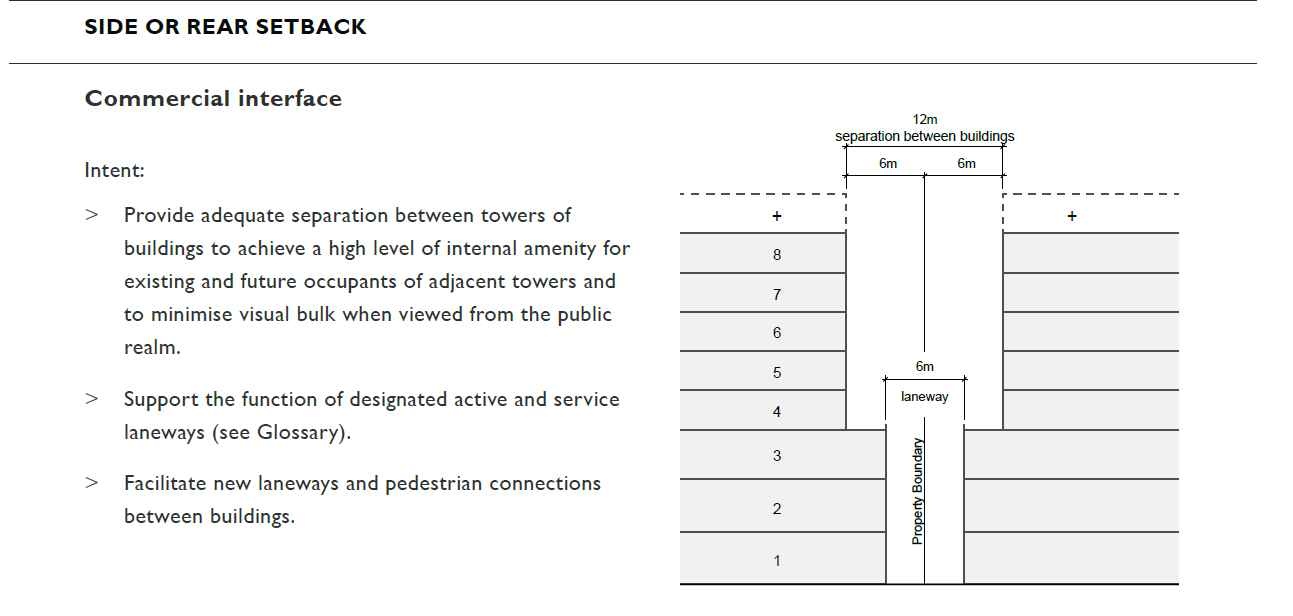
The commercial setback above the podium was reduced from 6 metres to 5 metres, which is in line with a number of submissions received

Really? A ‘number of submissions’? – Obviously not too many because council itself admits:

Between 30 October and 11 December 2017, Council sought community feedback on the draft Quality Design Guidelines. Over this 6 weeks period, 38 submissions were received (20 online and 18 in paper), along with 3 surveys and 14 Facebook comments.

Sadly, these comments have not been published by council. Nor do we have any explanation in this Mullin report as to why it was decided that Glen Eira residents will be better off when there is a reduction in setbacks? It couldn’t possibly be, could it, that with smaller setbacks, the developer can cram in more apartments?

And are we really to believe that even if every single one of these 38 citizens demanded a REDUCTION in setbacks that council was prepared to accede to this demand and completely ignore the hundreds upon hundreds of residents who opposed 8 and 12 and even 4 storeys to begin with?

What is also disconcerting is that the October version of the Quality Design Guidelines has now disappeared from council’s website – making it even harder for residents to compare the ‘before and after changes’. Surely a ‘fact sheet’ that provides a clear cut and honest summary of ALL CHANGES is required and not just the spin and deception that council continually practices.

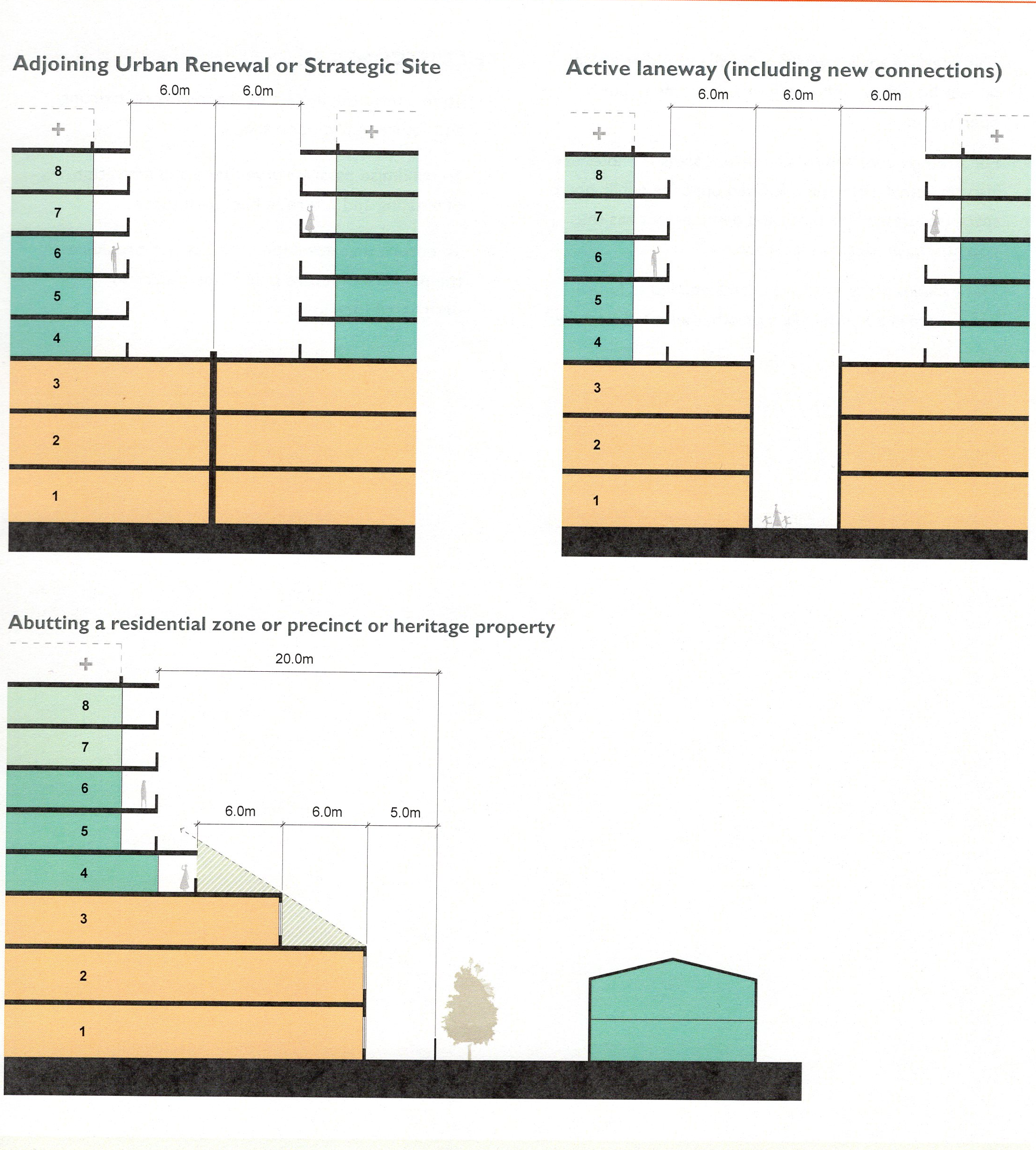
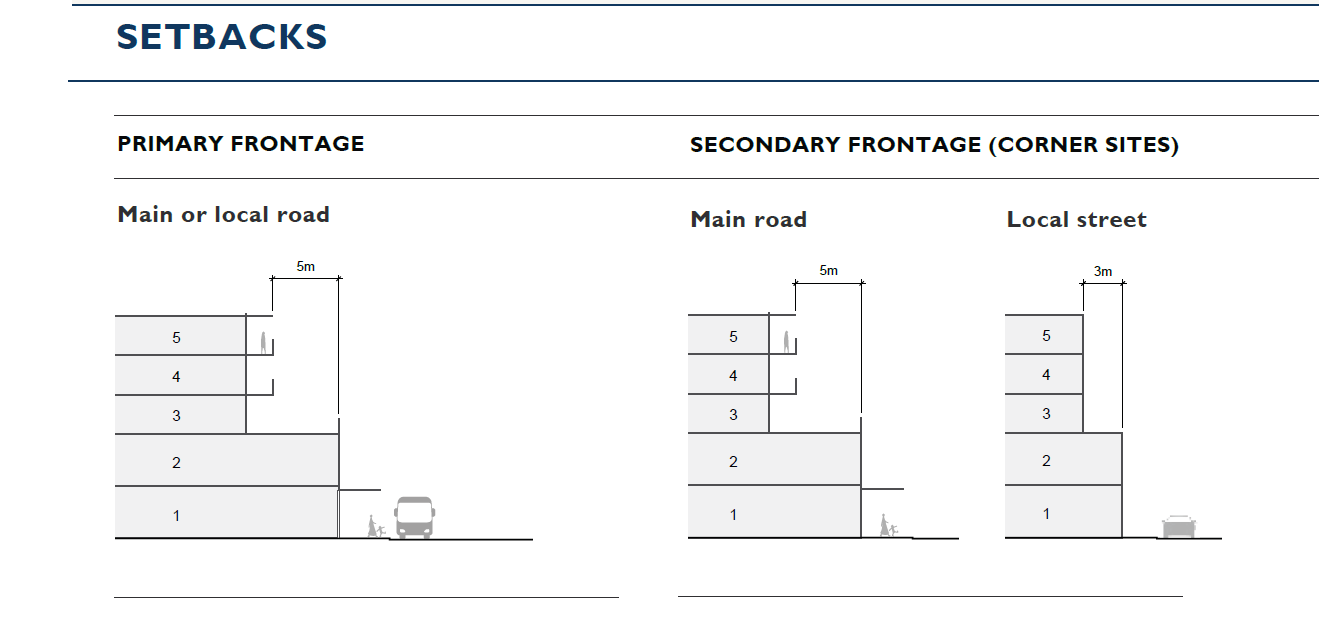
There are many changes in these documents. We simply highlight a few –

BEFORE

AFTER

AND FOR SHOP TOP (STANDARD) BEFORE

AND AFTER

There are many, many more points of comparison that readers should be looking out for – and not only in terms of setbacks, but also open space, etc.

This has now passed council. Again without giving residents the opportunity to comment or have any input.

« Previous PageNext Page »