GE Consultation/Communication


A quick report on tonight’s marathon council meeting:

  • Development applications went according to officer recommendations
  • Hard copy again different to online agenda in terms of the in camera item – more monumental stuff ups regarding potential purchase of open space with no explanation or apology offered
  • Amendments C147/8 on interim height limits were passed with Magee and Lobo voting against on the basis that everything should be mandatory. Arguments (if they could be called that!) put up by Lipshutz, Hyams, Esakoff, and Pilling, were once more based on ‘trust us, we know what we are doing because if we went for all mandatory, then the Minister would be likely to make it all discretionary’.
  • Caulfield Racecourse another monumental ‘let’s wait for the Minister to act, rather than have council reps resign now’ because there is a danger here in what the MRC could do!
  • Public question time reminiscent of kindergarten playtime, where the CEO asked questioners to put up their hands if they were present in the gallery. By this stage, after 2 hours of councillor waffle and woeful debate, most people had left and who could blame them given the fact that most of these councillors simply like the sound of their own voices and the quality of ‘debate’ is totally underwhelming! Please remember that if the questioner was not present then the question nor answer was read out and neither will this appear in the minutes. Thus the wider community has no way of knowing what the issues are, nor council’s responses. This is called open, accountable and transparent government – for which we’ve got Lipshutz, Hyams, Esakoff, Pilling, Ho to thank!
  • Magee being Magee – a useless request for a report on the Claire St VCAT decision. Asking what recourse council has – ie whether an appeal to the Supreme Court has any merit? No doubt the eventual report will come back and state that there is no grounding in law for an appeal and that it would cost hundreds of thousands. We suggest that the cheaper and quicker remedy would be to change the zones, which after all is what the community has been demanding for ages!

Full reports in the coming days.

In 2004 all councils throughout Victoria were given the option of introducing interim height limits for Neighbourhood Centres as well as interim structure plans for their major activity centres. Glen Eira Council voted against doing a single thing to help ameliorate the problems identified by residents as far back as 2003. The issues of 2016 are a mirror image of what was stated way back then and raises the fascinating questions of :

  • what would Glen Eira be like today if in 2005 Council had taken the opportunity to implement structure planning and interim height limits?
  • Would we now be faced with the fact that it has taken an order from the Minister of Planning to ensure that Glen Eira falls into line with every other metropolitan council?
  • To what extent would residents now be better off given the ineptitude of the proposed Amendments C147 and C148 simply because the necessary ground work has never been done and these amendments are merely the most minimalist response to the Minister’s demands?

One must wonder why in 2005 Council rejected the offer from the State Government. Was it because they realised that structure plans and height limits would hamper development? Was it because they simply didn’t have the competence to do a decent job of providing the necessary strategic justification? Has anything really changed in the past 11 years?

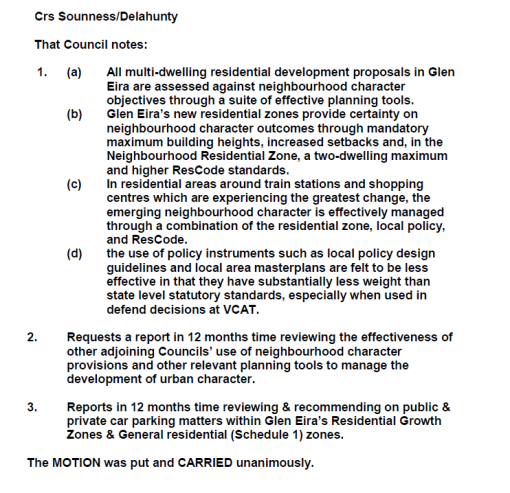
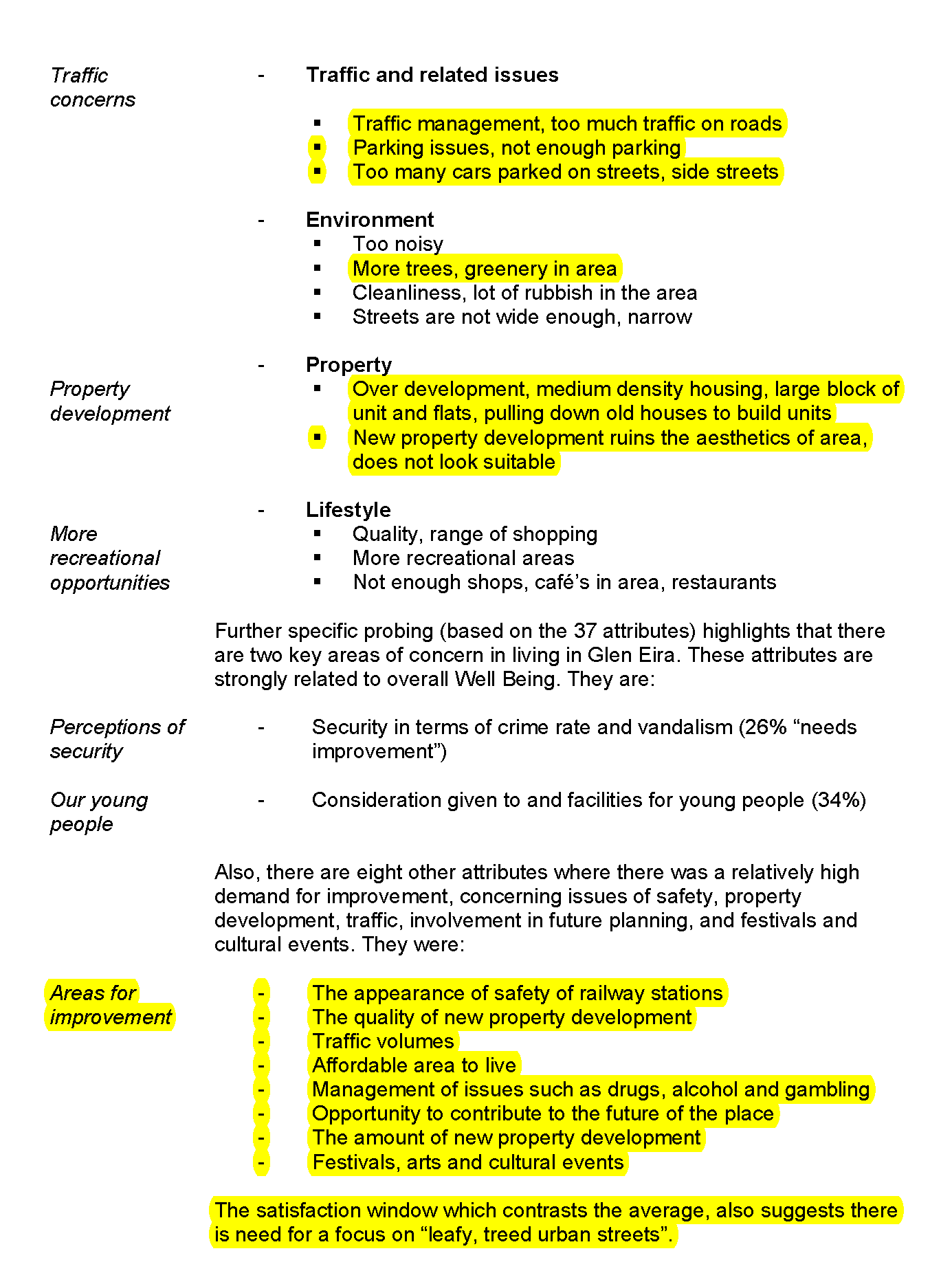
Below is one page from the Community Plan of 13 years ago that identifies in black and white the same issues that are still with us – plus another snippet which shows that today’s scapegoating of VCAT is also nothing new – but Council still didn’t address these concerns over 11 years. All that has happened is that we got the atrocious zones and the scapegoating of VCAT has become more vociferous!

Pages from 2004 CPlan2010-050615-2community plan 2003 presentation


So here is what residents could have had. On the 7th February 2005 an officer report was tabled which recommended no action be taken by council.  The following are all quotes from this report which we’ve also uploaded in full (HERE). Two councillors who voted for this dereliction of duty are Hyams and Esakoff. They are still there, joined by their fellow pro-development councillors and turncoats such as Pilling.

The recommendations read –

That Council notes that following the approval of former Amendment C25, it now has policy protection in the Glen Eira Planning Scheme for Minimal Change Areas (80% of the geographical area of the city) and Neighbourhood Centres.

C) That Council continue to monitor the performance of its local policies particularly at VCAT. Should it become evident that Council policy is not offering adequate protection for our centres and established residential areas,then use of these tools could be considered

At this stage there does not seem to be the need to embark upon what would be an extensive public consultation and amendment process when a level of protection through local planning policy already exists (introduced by Amendment C25).

Options / considerations –

  • There do not appear to be any neighbourhood centres under particular or immediate threat from inappropriate development which would warrant immediate application of a maximum height control.
  • A certain amount of strategic work would be required to justify any proposed height limit in a neighbourhood centre, balancing the need to protect the amenity and character of a centre whilst not discouraging appropriately scaled development from occurring.
  • The structure planning process needs to have commenced for this tool to be considered.
  • Interim Structure Plans could be a useful tool for the Bentleigh, Carnegie and Elsternwick Urban Villages. It is considered the optimum time to use this tool is once Council has adopted the Urban Design Frameworks and agreed to commence the amendment scheme process. In this way the adopted Structure Plan in the form of an amendment, would be given statutory teeth up until final approval by the Minister. (This is the same mechanism that is always used associated with heritage controls)
  • It is anticipated that the Urban Design Frameworks will be reported to Council mid-year

Local Policy Protection

Glen Eira is in the fortunate position of having local policies in place which limit development in our established or minimal change areas as well as guide development in our activity centres. With the approval of Amendment C25, a number of objectives and policy statements in our local policies now deal with the height of buildings. We thus have protection in both our minimal change areas and neighbourhood centres through policy wording. At this stage this degree of protection is considered appropriate.

The additional tools introduced by the State Government are a welcome addition to the suite of tools available for Councils to use where appropriate to improve their planning schemes. At this stage, however, there is no need or urgency for Glen Eira to apply any of these options.

Our established residential areas have policy protection through former Amendment C25, and there does not seem to be any such areas under threat from buildings higher than 9 metres.

Similarly, in neighbourhood centres, building heights do not seem to be a major issue and Glen Eira’s neighbourhood centres currently enjoy a level of protection introduced by Amendment C25 through the performance based requirements of Council’s Housing Diversity Areas Policy.

With regard to Interim Structure Plans, this tool may be useful when the Urban Design Frameworks for Bentleigh, Carnegie and Elsternwick have been adopted by Council and a planning scheme amendment is commenced.

It is important however that Council continue to monitor the performance of its local policies particularly at VCAT. Should it become evident that Council policy is not offering adequate protection for our centres and established residential areas, then use of these tools could be considered.

COMMENTS

  • Had council taken decisive action in 2005, then development could have been contained
  • Had council taken decisive action in 2005, then we would not have the need for the Minister to finally order Council to do what every other metropolitan council has done
  • Had council taken decisive action in 2005, then we would not have the knee-jerk and substandard Amendments C147 and C148 because a lot of the groundwork would already have been done to produce planning that is of a sound standard.

And it is worth keeping in mind the following:

  • Hyams and Esakoff were 2 of the councillors who voted for the ‘do nothing’ proposal in 2005.
  • Promises of urban design frameworks have never eventuated. Why not?
  • Monies for structure planning for Glen Huntly were handed back to the government. Council has simply refused to undertake and implement any structure planning
  • The housing trends were already surpassing the 9 metres in minimal change areas – council itself has provided statistics which show that 3 and 4 storey developments were occurring in minimal change. Yet the argument produced in 2005 was that everything is ‘fine’ and that Glen Eira has adequate ‘protection’. Even the period between 2005 and 2010 showed the lack of real policy protection for residents – again met with silence by council.
  • The Planning Scheme Review of 2010 (6 years later, when residents echoed the same concerns regarding overdevelopment) specifically noted that ‘no structure plans’ were to be done.
  • In 2003 council was already complaining about VCAT. Yet in the 2010 Planning Scheme Review it stated on page 8 – As a general rule, Glen Eira has little difficulty defending local policy at VCAT, which is a good indication that the underlying philosophy of policies is sound. We remind readers that our analysis of published VCAT decisions for the years 2008-2010 showed that council had less than a 50% success rate at VCAT.
  • The current mantra proffered by council is that with the new residential zones, resident demands for ‘mandatory height limits’ was implemented. Then why, oh why, is there not a single mention of this resident demand in the 2010 planning Scheme Review Report?

Nothing can excuse this council’s refusal to act. And the same culprits, especially Hyams and Esakoff, who were there in 2005 have been joined by the likes of  – Magee, Pilling, Lipshutz, Sounness, Delahunty, Lobo. Ho is new, but with his developer links and history, we do not hold out much hope that he would be any different if elected!

These documents truly reveal a dismal history of neglect, failure, and indifference to resident concerns.

Agenda Item 9.4: Interim Heights

Council’s agenda features Amendments C147 and C148 which will go to the Minister seeking ‘interim height limits’ for the Bentleigh and Carnegie activity centres. The proposed amendments are for areas zoned commercial and mixed use.

Whilst Council is to be applauded for getting the ball rolling, there are many features of these amendments that are far from satisfactory and which will achieve very little in terms of protecting neighbourhoods. We have uploaded the full report HERE.

The concerns we have are:

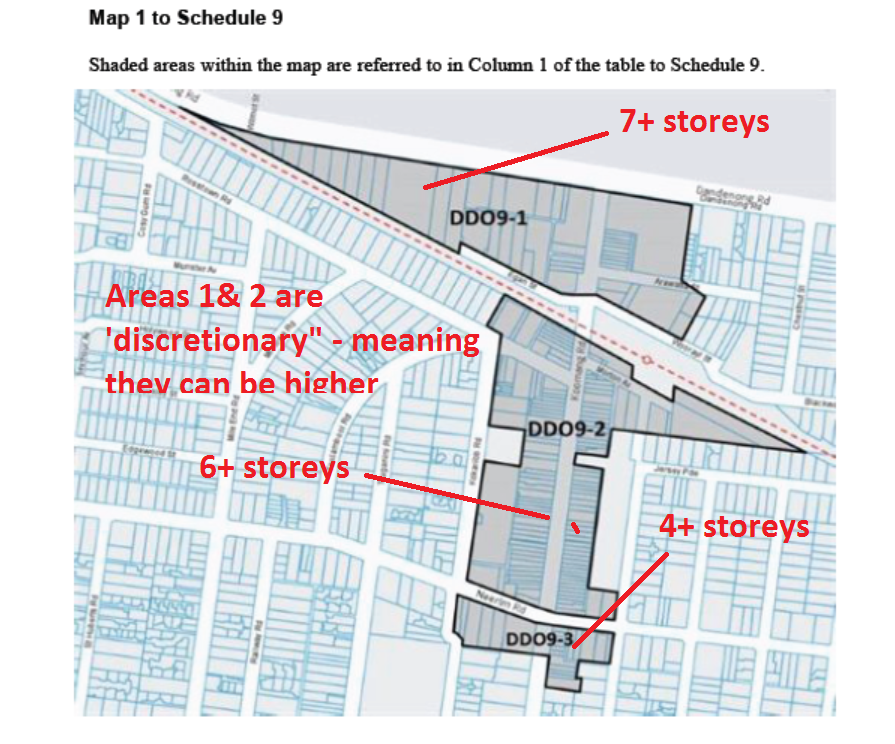
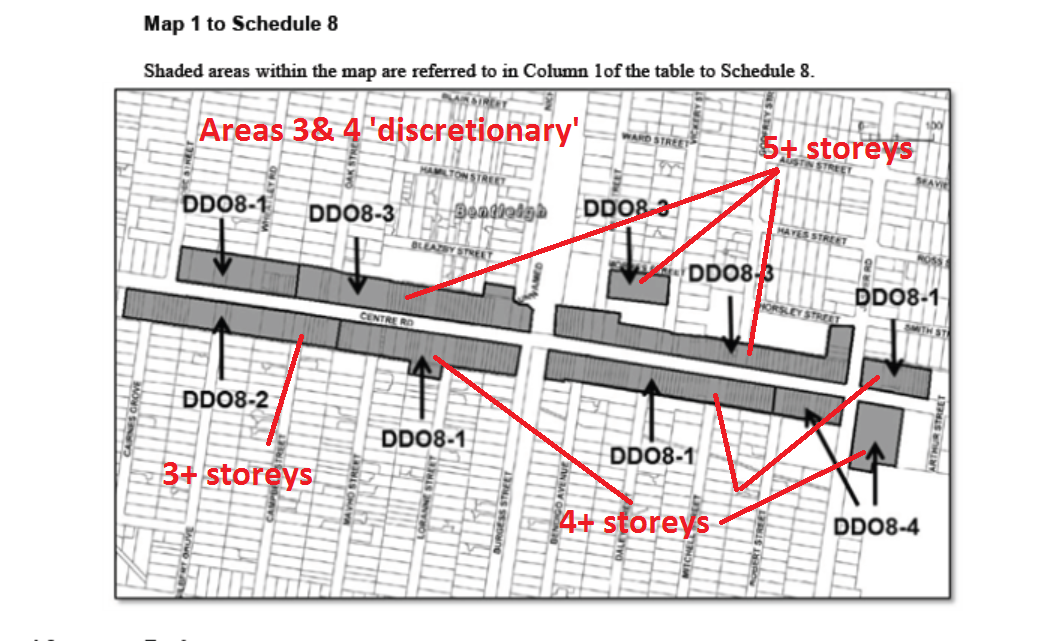
  • Many of the proposed height limits are ‘discretionary’ – meaning that developers can, and undoubtedly will, apply for much higher buildings.
  • The metres nominated are highly questionable – given the residential zones. For example: In both amendments we have such schedules as “14 metres comprising up to 4 storeys”. If developers can now erect 4 storey buildings with a height limit of 13.5m, then surely they can cram 5 storeys into 14 metres. All that has to happen is a lowering of ceiling heights, or the slope of the land. Why hasn’t council stuck to the 10.5 and 13.5 height limit here?
  • The amendments also allow a 4 metre extension (ie lift over-runs, antennaes, etc). 4 metres is extraordinary when the zones provide the developer with only a 1.5 metre leeway.

The most grating aspect of these amendments however is the failure to ask residents what they think are the appropriate heights in any of these areas. Now, with a resolution to go to the Minister under ‘fast track’, there will again be the exclusion of the public to provide a viewpoint. Nor is there one scrap of strategic justification provided as to why 7+ storeys is acceptable in Carnegie. Has council really done its necessary homework, or once again sat down at their computer desks and drawn lines on a map? And what of the requirements for setbacks? Why keep accepting ResCode when it has been such a dismal failure? We remind readers that when other councils introduce DDOs (Design and Development Overlays – even interim ones) these features are included. Not in Glen Eira! We suggest that once again this is lazy and poor planning and does not meet the community’s expectations.

Some aspects of these amendments are literally laughable.The Bentleigh one basically regurgitates what the current planning scheme contains – ie Buildings on the North side of Centre Road to be designed and articulated so that they do not overshadow onto the footpath on the southern side of Centre Road at the September equinox at noon. (amendment) and the current planning scheme has – Buildings on the north side of Centre Road are articulated, so shadow is not cast onto the footpath on the south side of Centre Road.  We therefore wonder how on earth the potential for a 5 or 6 storey building on the North side of Centre Road will not cast a shadow!

FYI, we’ve summarised the proposals below:

carnegiebentleigh

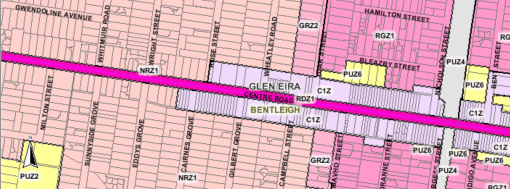
PS: we wish to highlight some other anomalies in these proposed amendments. Here is the map of the zoning in Centre Road.

bb

Please note:

  • For the ‘northern’ areas of Centre Road where commercial sits alongside Neighbourhood Residential zones (ie Wheatley Road, Rose St) council has imposed a 4 storey MANDATORY HEIGHT. Thus for this side of the road it was deemed appropriate that the 4 to 5 storeys sit alongside an 8 metre mandatory height limit.
  • On the other side of Centre Road (directly opposite) there is a mandatory height limit of 3 + storeys. Why? Admittedly there is a Heritage Overlay for these streets ( ie Sunnyside, Eddy’s Grove, etc) but this still does not excuse in our view why one side of the street should be given a different mandatory height when both abut NRZ homes.
  • Things get even more crazy when we consider the proposals for Robert Street A 4 storey mandatory height limit for commercially zoned land along the southern side of Centre Road between Mavho Street and Robert Street . Two streets up from Mavho, we have another heritage overlay. But these are zoned Residential Growth Zone. Thus, instead of changing the zoning, Council it seems has simply chosen to once again do nothing about the zones and to use these amendments to simply rubber stamp the existing zoning. When one side of Centre Road gets a 3 storey recommendation possibly because of its nearness to a heritage overlay, and up the road for streets that are in a Heritage overlay are assigned 5 storeys, then planning is awry and incompetent.

The bottom line is that council will do nothing that involves changing one single aspect of its atrocious zoning.

Readers will remember the furore over Claire St., McKinnon and how this dead end street of 14 or so houses (zoned GRZ) has been bought out by developers. The first application was for 3 storeys and 34 apartments. Both council and VCAT refused the application. So now we have the new VCAT decision for 3 storeys and 33 apartments. The permit was granted!

The member’s decision should be compulsory reading for every single resident who has any doubt about the impact of the zones and what they mean for their streets and their suburbs. Magee can cry all the crocodile tears he likes at VCAT’s doorstep, but what has he and the other councillors done to review and amend the zones over the past 3 years? The continual lament that VCAT ignores council ‘policy’ is shown up again for the bogus and spurious claim it is. Claire Street and its development is part of council’s ‘local policy’ and thus another street is literally handed over lock, stock and barrel to developers!

Please see the following extracts:

In the Steller Elite decision (ie first application) I analysed the guidance provided by the Glen Eira Planning Scheme, which lead me to conclude that the outcome encouraged for the review site is one of increased housing supply that will constitute a marked change to the existing neighbourhood character. I set out below that analysis and rely on it given that no consequential changes have occurred to the Glen Eira Planning Scheme in the intervening period.

I understand this vision does not agree with the hopes and aspirations of the local community, including those that appeared at this hearing. I was moved by the emotional submissions made by a number of residents that have clearly planned their long term future here in this neighbourhood, and who see this future threatened by the type of development proposed for the review site. While I have been moved by these submissions, I must be guided in my decision making by the content of the Glen Eira Planning Scheme. This Planning Scheme has been drafted and adopted following extensive community consultation, thorough analysis by an independent panel of experts, and approval by successive Ministers for Planning. By law, I am required to consider the submissions that I have heard, and assess the plans that are before me, through the prism of guidance contained in the Glen Eira Planning Scheme.

In this proceeding, Mr & Mrs Menko lamented that most of the lots in Claire Street have now been purchased by developers, and are likely to be subject to forms of development like the one before me. They resist this level of change, and the likelihood that only two of the original single dwellings will remain. They also raise concerns about how this extent of development can be suitable for a dead-end street, with its only access point to McKinnon Road, and limited on-street car parking supply. They also question the ability of McKinnon Road to accommodate the additional traffic. I understand the frustrations and anger expressed by residents about the rate of change that might occur in Claire Street. However the extent of redevelopment that is likely to occur is a direct realisation of the very clear intent of the Glen Eira Planning Scheme, in particular the local policies created by the Glen Eira City Council.

The Glen Eira Planning Scheme clearly supports substantial development in Claire Street, McKinnon. This substantial development is not expected to imitate or reflect the style and form of the single dwellings that currently exist in this and other streets. Instead, a policy intent has been clearly been articulated for Claire Street, by the Glen Eira City Council, that encourages more intense and more diverse housing forms. Invariably this means that apartment buildings are strongly encouraged in this neighbourhood.

It is clear, when taking into account the policy framework as whole, that apartment style development is the undeniable future for Claire Street, McKinnon, as clearly identified and articulated by the local policies contained in the Glen Eira Planning Scheme, as drafted by the Glen Eira City Council.

In their submissions in this proceeding, the Council did not challenge my previous analysis of the relevant planning framework, and conceded that there were no consequential changes to the relevant policy framework in the intervening period. As such I find it appropriate to rely on my previous analysis in this proceeding, an analysis that identifies significant policy support for increased housing that represents significant change to the existing neighbourhood character in this locality.

Clearly this is a typology and scale of development that will still contrast to the surrounding single and double storey dwellings. That outcome is an intended result of the application of the clear policies pursued by the Glen Eira City Council for this housing diversity area. It is an outcome that will continue to prevail throughout this housing diversity area, as more and more sites are redeveloped for apartment style development. However I am satisfied that the revised development for the review site now mitigates the offsite impacts of the proposed built form to the streetscape, in a manner that is appropriate and acceptable.

I acknowledge that the proposed development will represent a significant change for the adjoining property owned by Mr and Mrs Menko. However it is an extent of change that is anticipated, and indeed encouraged, by the provisions of the Glen Eira Planning Scheme. For these reasons I not persuaded that the matters raised in the statement of grounds lodged by Mr and Mrs Menko should influence the proposed outcome for the review site.

The proposed development provides car parking for both residents and visitors at rates that either meet or exceed that required under Clause 52.06 of the Glen Eira Planning Scheme. Therefore as no permit is required to reduce the extent of car parking to be provided on-site, I have no means by which to review whether the extent of car parking provided is reasonable and appropriate, nor to require additional car parking to be provided on-site.

In their statement of grounds, Mr and Mrs Menko again raise concerns in relation to the traffic impact on Claire Street. In the absence of any new analysis of the current and proposed traffic levels within Claire Street, I must give significant weight to the independent assessment that has been undertaken by Council’s traffic engineers, who support the proposed development, including the extent of traffic increase that will occur to Claire Street. I do not doubt that the additional traffic from the development of the review site will increase delays for drivers exiting Claire Street. However that is an inevitable consequence of the deliberate and informed decision made by the Glen Eira City Council to identify Claire Street, McKinnon as a preferred location for this extent of housing change.  For these reasons I find that there are no car parking or traffic grounds on which to withhold the grant of a permit.

I find that a number of the components as drafted by Council simply reiterate aspects of the proposal that are already shown on the plans. For example a condition requires the provision of car parking at certain rates when car parking is already provided at those rates, and another condition requires the development to have a specified maximum site coverage, when that site coverage is already achieved. I do not consider that an amended plans condition should be used in such a manner, and so have deleted parts of Condition 1 where I find that the requirements are already achieved.

Source: http://www.austlii.edu.au/au/cases/vic/VCAT/2016/1401.html
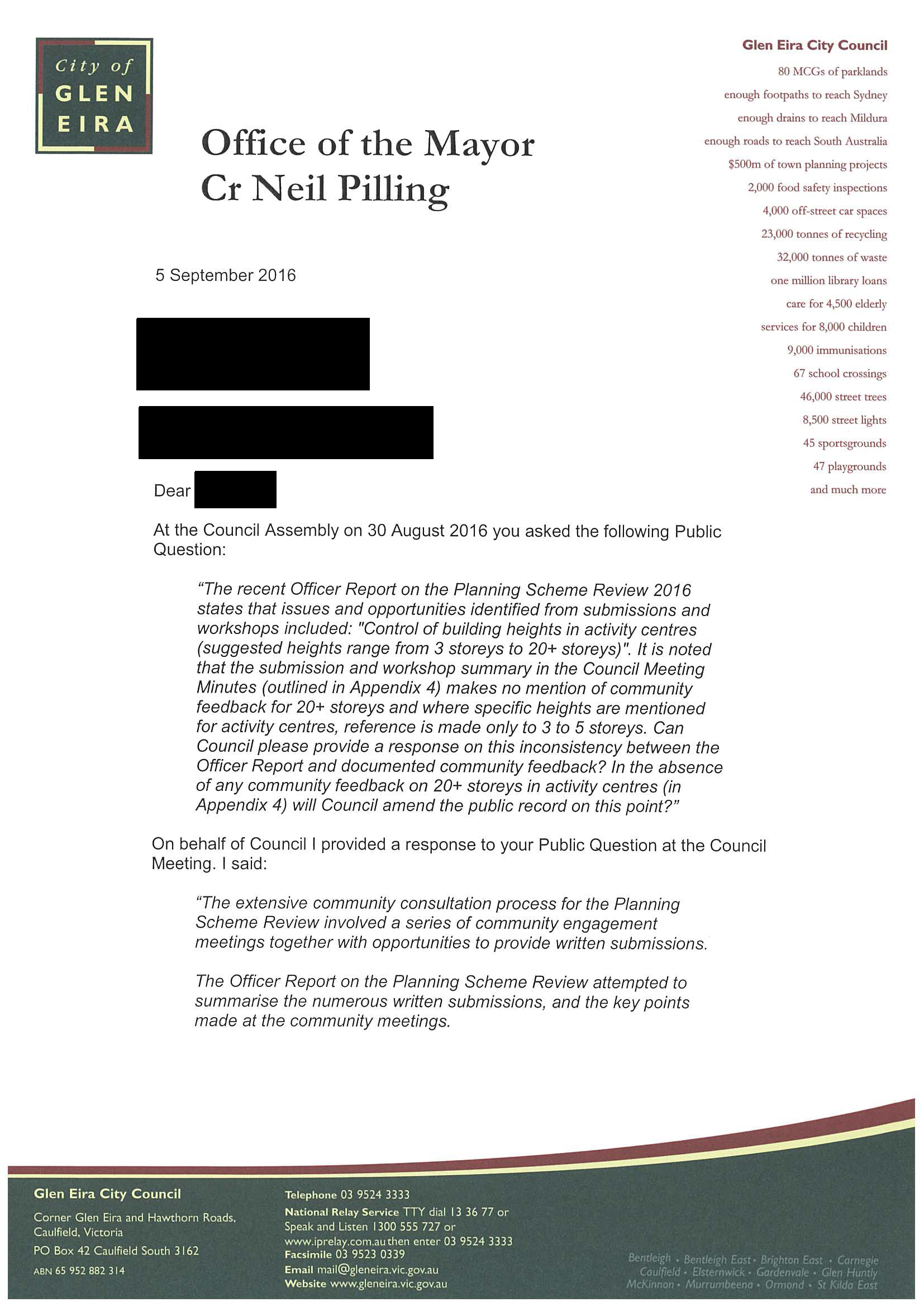
pill0003

Here is how Pilling summed up:

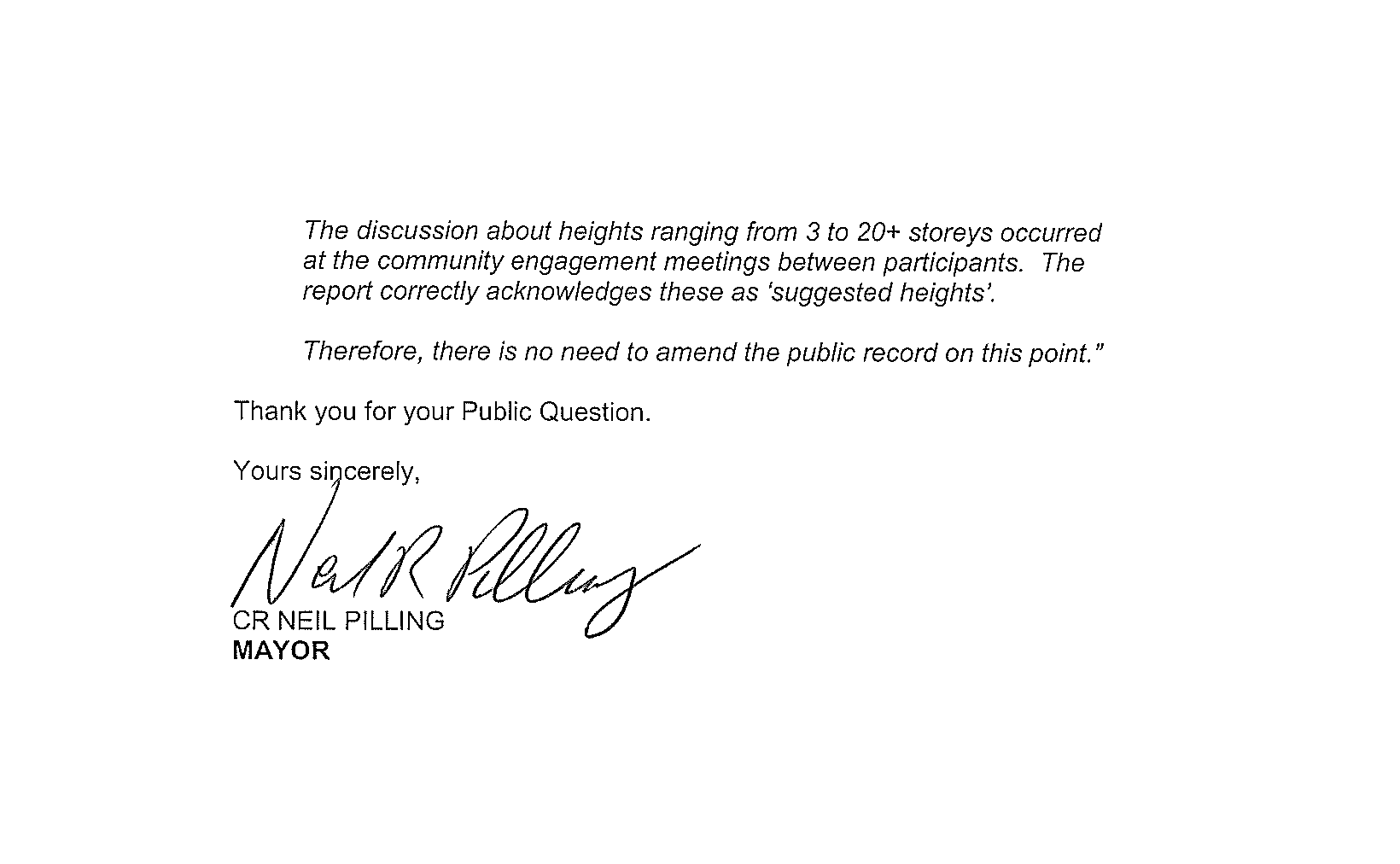
PILLING: thanked residents for the ‘most successful consultation’ in Glen Eira and that the review ‘largely reflects’ what the community wanted. Said that the issues are more than structure planning but include infrastructure, parking, etc. ‘It’s a wide range of issues’ but ‘the only practical way’ since it is an ‘ambitious’ document is to ‘allow time to get it right’. Endorsed Lipshutz’s comments regarding the Lobo comments and stated that the latter’s comments were ‘totally inaccurate’ and that he wants to remind Lobo that ‘he did vote to bring the new zones in as well as every other councillor who was here at the time’.

Thought that the action plan was ‘practical’ given the ‘biggest population growth in melbourne’s history’ and ‘we are trying to manage that’. ‘Looking back’ they may have done something ‘different in the past’ but ‘certainly times have changed’ and ‘we are responding to that’. ‘We are trying to address the concerns of the community’. So they are taking on board community concerns and talking with the planning department as to ‘what is achievable’. Repeated that the document is ‘ambitious’ but after ‘tonight will leave us in a better position to plan for our future growth’. Thought the ‘zones have been a very positive step’, Neighbourhood character is also ‘very important’. Council has ‘2 storey 8 metres over 78%’ of the municipality and this has ‘certainly helped’ to preserve neighbourhood character. ‘But can we do more? Yes’ by ‘identifying areas we can improve on’. ‘So it is a continual update’ and he regards it as ‘one of the most important documents’ since he’s ‘been on council’.

MOTION PUT AND CARRIED. MAGEE VOTED AGAINST. ALL OTHERS VOTED FOR.

COMMENT

  • Once again we have confirmation of the illegal processes this council undertakes. No formal resolution was ever tabled or voted on by councillors to introduce, or to even send off a ‘request’ to the Minister on the zones. Thus any ‘vote’ taken was taken in assemblies – a definite ‘no-no’ according to the Local Government Act.
  • On another governance issue – Pilling moved the motion on the interim heights. Since he is ‘chairperson’ of the meeting, he should have stepped down and the deputy mayor taken his place. Plenty of other councils stipulate this in their Local Law meeting procedures. The fact that Glen Eira doesn’t is another example of shonky process and poor governance. Since it is the chair who determines points of order, eligibility of questions, etc., it is inappropriate for that same individual to be moving any motion. But that’s Glen Eira – anything that favours the ruling clique goes!
  • Sounds as if the flavour of the month is the word ‘ambitious’. Perhaps Pilling could inform residents how ‘ambitious’ it is to set a time frame of up to 20 years to implement structure plans for all activity centres and 3 to 4 years for parking precinct plans that have been on the books for the past 10 years?

CONCLUSION

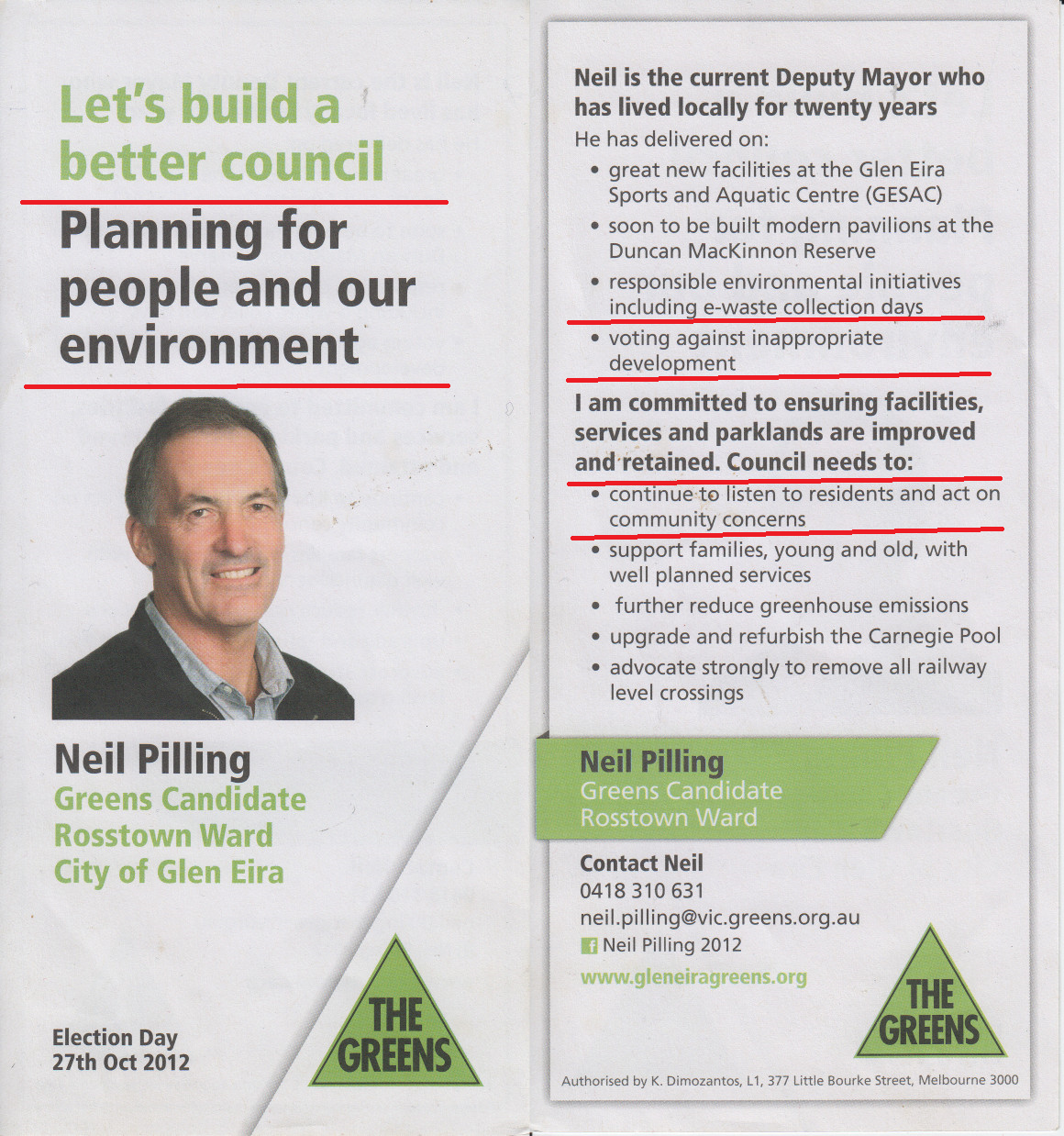
Pilling’s record as a councillor is frankly appalling. Elected on Green credentials he very quickly disowned that party and to all intents and purposes became a Liberal. Nothing wrong with changing allegiances, but not when people voted for him believing he is a Green. Since the party also funded his campaign has that money been returned? We also have it on good authority that some Pilling reps came cap in hand to the Greens seeking Pilling’s re-entry to the Greens and begging for another round of campaign funding! Given his 2 time mayoralty, we would have thought that $190,000+ should buy plenty of election posters and pamphlets! We can only hope that the Greens have learnt their lesson and formally excommunicated their Quisling.

Residents should also remember Pilling’s role in the most contentious issues of recent times and how his vote helped scuttle community aspirations. We refer to:

  • Caulfield Village C60 & Development plans
  • Caulfield Village Cinema
  • Frogmore heritage status
  • Turning more and more of Bailey Reserve into a car park
  • In 2011 Pilling was in favour of a Notice of Motion. In 2016 he voted for public question restrictions that limited transparency and community participation.
  • Casting vote in line with Lipshutz, Hyams, etc. on numerous developments
  • Gagging councillors repeatedly

Here is part of Pilling’s record in voting for permits, many of which he moved or seconded –

1056-1060 DANDENONG ROAD, 8 storeys, 97 units

127-131 Gardenvale Road – 12 units

483-493 GLEN HUNTLY ROAD, ELSTERNWICK – 8 storey, 57 units

687-689 GLEN HUNTLY ROAD, CAULFIELD – 28 units

451-453 SOUTH ROAD BENTLEIGH – 5 storey, 12 units

149-153 NEERIM ROAD & 4 HINTON ROAD, GLEN HUNTLY – 17 double storeys

2 MORTON AVENUE, CARNEGIE – 6 storeys, 40 units

15-19 Gordon Street ELSTERNWICK – 8 storeys, 55 units

730A CENTRE ROAD BENTLEIGH EAST – 5 storeys, 29 units

33-35 Jersey Parade, Carnegie – 4 storey, 28 units

115-125 Poath Road Murrumbeena – 4 storey, 33 units

67-73 Poath Road MURRUMBEENA – 6 and 7 storey, 39 units

144 Hawthorn Road CAULFIELD NORTH – 6 storeys, 40 dwellings

2-4 Penang Street MCKINNON – 3 storey, 23 units (permit was refused by councillors, but Pilling & Sounness voted against refusal)

15-17 Belsize Avenue & 316-320 Neerim Road CARNEGIE – 4 storey, 52 units

22-26 Bent Street BENTLEIGH – 4 storeys, 41 units

29-33 Loranne Street BENTLEIGH – 4 storeys, 42 units

168 Hotham Street ELSTERNWICK – Lipshutz & Pilling wanted 5 storeys and 78 dwellings

339-341 Neerim Road & 19-21 Belsize Avenue CARNEGIE – 4 storeys, 35 units

64-66 Bent Street MCKINNON – 3 and 4 storey, 31 units (again Pilling & Sounness moved to accept)

1240-1248 Glen Huntly Road CARNEGIE – 6 storeys, 117 units (Pilling/Delahunty motion)

DELAHUNTY: stated that Magee has got a ‘special place in my heart’ because ‘in one sentence’ you can find yourself disagreeing with him and then when he gets to the end you go ‘yeah’. Didn’t know whether she could ‘endorse’ all of Magee’s comments especially on structure planning and ‘proper strategic conversations’.  Said that the review is an important strategic document that should help residents ‘shape’ the community. Said that some councillors think that ‘we should be doing what other councils are doing’ like ‘going down the path of structure planning’. So ‘perhaps if these had been done some time ago’ then ‘we would have had the discussion about’ the strategic vision and maybe the same issues with VCAT but ‘with more influence and the greater ability to more strategically manage the outcomes’.  This is ‘what structure planning does’ even though it might ‘still have ambiguities in it when it comes to appeal rights’ that ‘sort of conversation with the public is very important to have’.  

Gave an example of a planning application for East St. Kilda where it is a very ‘small block’ surrounded by 5 and 6 storey buildings ‘all around it’. But at the ‘other end of the municipality’ the same planning rules exist – such as in Bentleigh and when an application comes in ‘you are standing in a quarter acre vegie patch’. ‘It just feels like such a different part of the world’. So in order to ‘properly’ define these neighbourhoods and ‘how they should grow’ and ‘how we manage the rate of change is an incredibly important piece of work’ and ‘it should have been done by council a long time ago’Said that she isn’t ‘having a go’ at others but that ‘we thought we had the right policies in place’ but ‘you always need to check whether you’re doing things in the best manner’. Thought that ‘we were a little left behind’ in this. Said that the Minister ‘is right to point out that we have some inconsistencies’ compared to other councils and that ‘it is right for us to come up with this work plan’. Thought it was proper to set aside ‘time’ and money in order ‘to have this conversation with residents to develop structure plans’

COMMENT

Some slack can admittedly be granted to Delahunty given that she has inherited the decisions of previous councils and was elected in 2012. However, her above comments also deserve some major criticism.

  • Is Delahunty hedging her bets? – ie on the one hand admitting council’s slackness in not achieving anything for years and years, but then on the other hand, excusing this inaction by claiming they thought they had got the policies ‘right’. All one needs to consider is the constant complaints about VCAT and it is obvious that the so called policies were not ‘right’.
  • Delahunty has publicly stated that she ‘lost the argument’ on community consultation on the new zones and that she is glad she lost the argument! In other words, this is condoning the decision to exclude the public. Now we get the motherhood statements of how important it is to have community consultation. Sounds a little like Magee we suggest – inconsistent and opportunistic.
  • Delahunty voted for this draft review, yet there is barely a word about the time lag of the work plan, nor any of the other recommendations. As for ‘setting aside money’ that won’t be until the next budget so more delay. Surely if someone votes for something the least that residents should expect is an insight into the rationale of why, or why not, the recommendations are acceptable?
  • Delahunty has also not been averse to voting for plenty of developments. Here is a list of her voting patterns. Many of these motions to grant permits were moved or seconded by Delahunty –

15-19 VICKERY STREET, BENTLEIGH – 4 storey, 47 units

670-672 CENTRE ROAD & 51 BROWNS ROAD BENTLEIGH EAST – 67 units

10 & 12 Bent Street BENTLEIGH – 35 units

9 & 9A Truganini Road, Carnegie – 20 units

23 Bent Street BENTLEIGH – 34 units

30-32 Ames Avenue CARNEGIE – 12 double storeys

1100 Dandenong Road CARNEGIE – 22 units

337-343 Balaclava Road CAULFIELD NORTH – 33 units

247-251 Neerim Road CARNEGIE – 48 units

143-147 Neerim Road GLEN HUNTLY – 32 units

817-819 Centre Road BENTLEIGH EAST – 26 units

629-631 Glen Huntly Road CAULFIELD – 15 units

1240-1248 Glen Huntly Road CARNEGIE – 6 storeys, 117 units

14-18 Bent Street BENTLEIGH – 55 units

339-341 Neerim Road & 19-21 Belsize Avenue CARNEGIE – 35 units

14-16 Elliott Avenue CARNEGIE – 21 units

495-501 Glen Huntly Road ELSTERNWICK – 7 storeys, 32 units

670-672 Centre Road BENTLEIGH EAST – 5 storeys, 50 units

168 Hotham Street ELSTERNWICK – 4 storeys, 67 units

29-33 Loranne Street BENTLEIGH – 42 units

22-26 Bent Street BENTLEIGH – 41 units

15-17 Belsize Avenue & 316-320 Neerim Road CARNEGIE – 52 units

150 Tucker Road BENTLEIGH – increase of dwellings form 13 to 20

401-407 Neerim Road Carnegie – 5 storey, 57 units

67-73 Poath Road MURRUMBEENA – 6 storeys, 30 units


ESAKOFF: stated that others had already brought up what she had wanted to address. Said that structure planning was the ‘first one’ she wanted to talk about. Said that she didn’t ‘know whether they are a good thing or they’re not’. Went on to say that ‘we’ve been advised in the past that unless you go for more they’re not likely to be approved’ and ‘time will tell whether this is in fact the truth or not’. Said she’s ‘been thinking back 13, 14 years before our zones were in place’ and ‘attending meetings that were held to do with the zones’ and in the discussions ‘people were shock, horror’ about 3 storeys ‘in an activity centre’. This ‘had not been seen before’.  15 years down the track and ‘we would probably be very glad that they had a minimum of 5’. ‘Perhaps if we had gone for structure plans that long ago we might have got 5’. ‘We might have been shocked at the thought that it’s five’ but ‘today it’s looking pretty good’. Said that ‘no one can see ahead’ and wished that ‘sometimes we could’. ‘We don’t know what’s around the corner in the years to come and what we will consider acceptable or not’.

Stated that the ‘topics of conversation’ at the forums ‘were pretty consistent’ and people noted structure plans, transition zones. Acknowledged that ‘transition has been an issue since I’ve been on council’ and that she’s ‘always wanted transition to be wider than one block’ and ‘that’s what people want too’. Hoped this could be achieved so it’s a ‘slower transition from one block to another’.

She hoped that ‘we can address’ neighbourhood character since ‘there’s a fair bit of damage done’ so difficult to ‘say in some areas what neighbourhood character is any more’. Hoped that with Neighbourhood Character Overlays this could ‘cover those areas still intact’.

On traffic and parking she thought this could ‘extend further’ than just the borders of the activity centres into residential areas where people are saying they can’t park in their streets anymore. Growing population will impact on this but council ‘has done a lot by way of parking around activity centres’ via refusing parking permits for new developments.

Heritage ‘can do with a review’. ‘No doubt, it’s been a while’. ‘Loss of trees on development sites was also an issue. ‘We have put in place some sorts of barriers to stop moonscaping’ but ‘that doesn’t always work – it doesn’t deter developers overly’.  So ‘whatever’ council decided to do ‘it has to be something that is passed’. ‘If it’s something that is going to stop development altogether it will be stopped in its tracks’ because the State Government ‘is for development’.

Went on about infrastructure and ‘improvements’ and thought this was ‘fair enough and we will see what we can do there’. Open space is also an issue and ‘that’s why we are trying to secure open space in and around activity centres’. However ratecapping ‘has put a little bit of a dampener on that’.

ESD is another issue that ‘we have addressed somewhat and will address further’. Underground parking is another issue and she ‘guesses’ this is about canopy tree coverage on development sites. But ‘underground parking allows for lower heights I believe’ since trying to ‘park at grade you are increasing your height because’ it’s got ‘nothing to do with the reduction of the number of dwellings’.


COMMENT

  • God help us!!!!!! Here is a 13 year serving councillor admitting she hasn’t got the foggiest about structure planning! Has she ever asked? What has she been told? Has she ever bothered to read other council’s planning schemes and their numerous structure plans? And what does this say about the ‘advice’ that councillors have been fed from the likes of Newton and Akehurst over the past 13 years? And more importantly, what does it say about the will of councillors and to what extent they have been complicit in a planning agenda that has finally been called out by the Minister as being totally out of kilter with best practice?
  • ‘No one can see ahead’. Surely that is the objective of a good planning scheme – to prepare a vision for a municipality that can stand the test of time. Exactly what is the overall ‘strategic vision’ of Glen Eira, except to create countless opportunities for developers to ruin suburb after suburb?
  • At least Esakoff acknowledges that ‘neighbourhood character’ is now hard to define in many areas. Perhaps if council had preferred character statements years ago, instead of waffly useless phrases like ‘emerging character’ in its planning scheme, many areas would still be ‘intact’? More importantly, is this an admission that all council is intending to do is include a few more streets under Neighbourhood Character Overlays? What is most disappointing about Esakoff’s statements is that residents are provided with literally no idea as to what anything means, nor what council plans to do. Detail is non-existent!
  • Esakoff’s and the other councillors short-sightedness is evidenced by her statements on underground car parking. The issue is far more important than whether or not a few canopy trees can be planted. The issue of underground parking could be calamitous in terms of its impact on the water table and the cumulative impact on constant digging. London research has shown that the more basement car parking allowed in one area, the greater the risk of sink holes – aka Monash last year!
  • Epiphanies keep coming for councillors when less than a year ago, Esakoff was quite happy with the provisions to stop moonscaping and no necessity for a tree register –  ‘the owner of that property should have every right to do what they like’. She has always ‘been on the side of personal rights’ and she doesn’t want people to be told ‘what they can and can’t have’ in terms of trees in their gardens. That’s their ‘domain’ and it’s ‘called private open space – private’. ‘To be personal and to accuse people of inconsistency I think is a disgrace’. Said that people can argue for protecting street trees and planting more trees, but on people’s own property they should decide. Went on to ‘red tape and the costs’ is ‘another layer that the community is over’. Said that the ‘community’ doesn’t ‘want any more red tape’ or costs in choosing ‘what to do with their own private space’. (24/3/2015)
  • and there are good protections currently existing via what council already has to deal with Mentioned ResCode and how this ‘removes the advantage that developers gain’. Permits also come with conditions that trees can’t be removed but this also has a ‘down side’ because years later there’s the request for a change in condition so these trees which are now ‘causing damage’ can be removed. There have to be avenues of appeal with the tree register because that would make it ‘fair’ and to remove ‘those rights of appeal would not be a fair process’. Said that ‘my position remains unchanged’ and that she is against ‘tree control in Glen Eira’. (16/10/2013)
  • Existing mechanisms include town planning, so that if there is a significant tree then town planning conditions are ‘put in place to protect them’. There are also ‘large penalties’ for ‘breach of those conditions’. Other safeguards are landscape plans, 4 metre setbacks and open space requirements which means that more trees can be planted. ‘There are enough hoops to jump through’ without adding to them. (14/10/2013)

LOBO:  was happy that Magee ‘to some extent’ agreed that ‘Glen Eira has to progress’. Stated that ‘all this hooha could have been avoided’ if Akehurst hadn’t taken ‘a shortcut’ and ‘asked us to take the zones’ to the government. ‘We accepted his recommendation and that was a rude awakening of our residents’. Result is that ‘we’ve now come back to the drawing board’ and they ‘could have come back early’ and ‘not have to wait for the Minister to tell us what to do’. He believes that ‘openness, transparency and accountability are the cornerstones of democractic system, free and fairness are the pre-requisites’.

LIPSHUTZ: thought that Akehurst ‘presided over a planning department that was second to none’. Said that council was ‘faced with a situation where we had policies that were not being looked at’ by VCAT. The Government then changed things and said ‘rather than having policies we are going to have zones’ and ‘that meant that VCAT had to adhere to the law’. Therefore ‘to criticise Mr Akehurst – I reject that completely’. Said that all councils are in a similar situation and Glen Eira ‘was the first council and we got the best deal possible, in fact the best deal than any other council’  because ‘we were the first’. He ‘rejects’ and thinks it is ‘dishonourable’ what was said about Akehurst.

Admitted that ‘I have never been a great fan of structure plans’. ‘They are very blunt instruments’. Thought the ‘aims’ of structure plans for activity centres was ‘a good thing I guess’ and that ‘they are long term arrangements’. But ‘things do change’. However, ‘I don’t see any alternative but to go ahead and do it’ because the ‘Minister has come along and said to us that that’s what they really want’. ‘We don’t have mandatory height limits’ and they are ‘finding’ that in Bentleigh and Carnegie 7, 8, or 9 storeys are going up ‘which are simply inappropriate and we can do nothing about it’ because all VCAT does is ‘we have to look at your policies’ but ‘don’t have to follow them’. They also ‘rely on their own precedent’ when they previously grant a 6 storey nearby and ‘ignoring what council and residents want’. So if council is to get a height limit and ‘we have to go through the structure plan process then that is what we are going to do’. ‘I don’t like it. I don’t think it is a very good way of going ahead’ but ‘we have no alternative’ to doing what the minister wants. The ‘real issue’ is that ‘rather than doing structure plans’, ‘rather than doing these half-baked planning review – I’m not saying this one is’, the government ‘needs to look at planning overall’.  They have to recognise ‘that we as residents know best what we want for our cities’ and that ‘we as councillors, representatives of our residents, have more say’ than the government.

COMMENT

  • Quite amazing that since we’ve published the Minister’s letter, there is (belatedly) the admission that council has been ORDERED by the Minister to do some work following years of doing bugger all and handing the municipality over to developers.
  • For a lawyer, and supposedly an intelligent individual, Lipshutz’s logic is woeful. But that’s what happens when you try to defend the indefensible and to save your own neck! First off: structure plans are not set in concrete. Like any other planning mechanisms they can be changed via amendments. All that is required is for the planning department to do some fair dinkum analysis, provide a feasible argument for a change, and produce the amendment. Obviously beyond this council’s will or capacity! Secondly, the claim that ‘we can do nothing about’ what’s been happening with heights is a blatant lie! During the past 13 years Council has had ample opportunity to introduce height limits; to introduce Urban Design Frameworks; to introduce Structure Plans; to introduce Design and Development Overlays. VCAT has been 100% correct in stating time and again that none of these tools exist in the planning scheme and therefore developers are within their rights to apply for what they want. It has nothing on earth to do with VCAT changing its interpretations and everything to do with Council’s refusal to implement any amendment which will impede developers and provide more stringent safeguards to the community. That is the bottom line and these councillors have all been complicit in allowing this state of affairs to continue unabated.
  • Being ‘first’ means nothing when other councils did their homework and achieved far better results for their communities through well prepared zones that were not ‘one size fits all’ – plus schedules that provided greater protections. And we do not need to remind residents that NO OTHER COUNCIL IN THE STATE, proceeded in the secret manner that Glen Eira did with councillors (undoubtedly Lipshutz, Hyams, Esakoff, Pilling, Delahunty and probably Sounness) deciding (illegally) behind closed doors that residents were not worthy of having a say!
  • As with our previous post on Hyams, Lipshutz can accept a large part of the responsibility for the erosion of resident rights and the appalling governance and internal divisions that have characterised this council for well over a decade. If he does stand again, and there is a very strong rumour that he won’t, then like the others, we urge residents to vote this ‘bastard’ out!

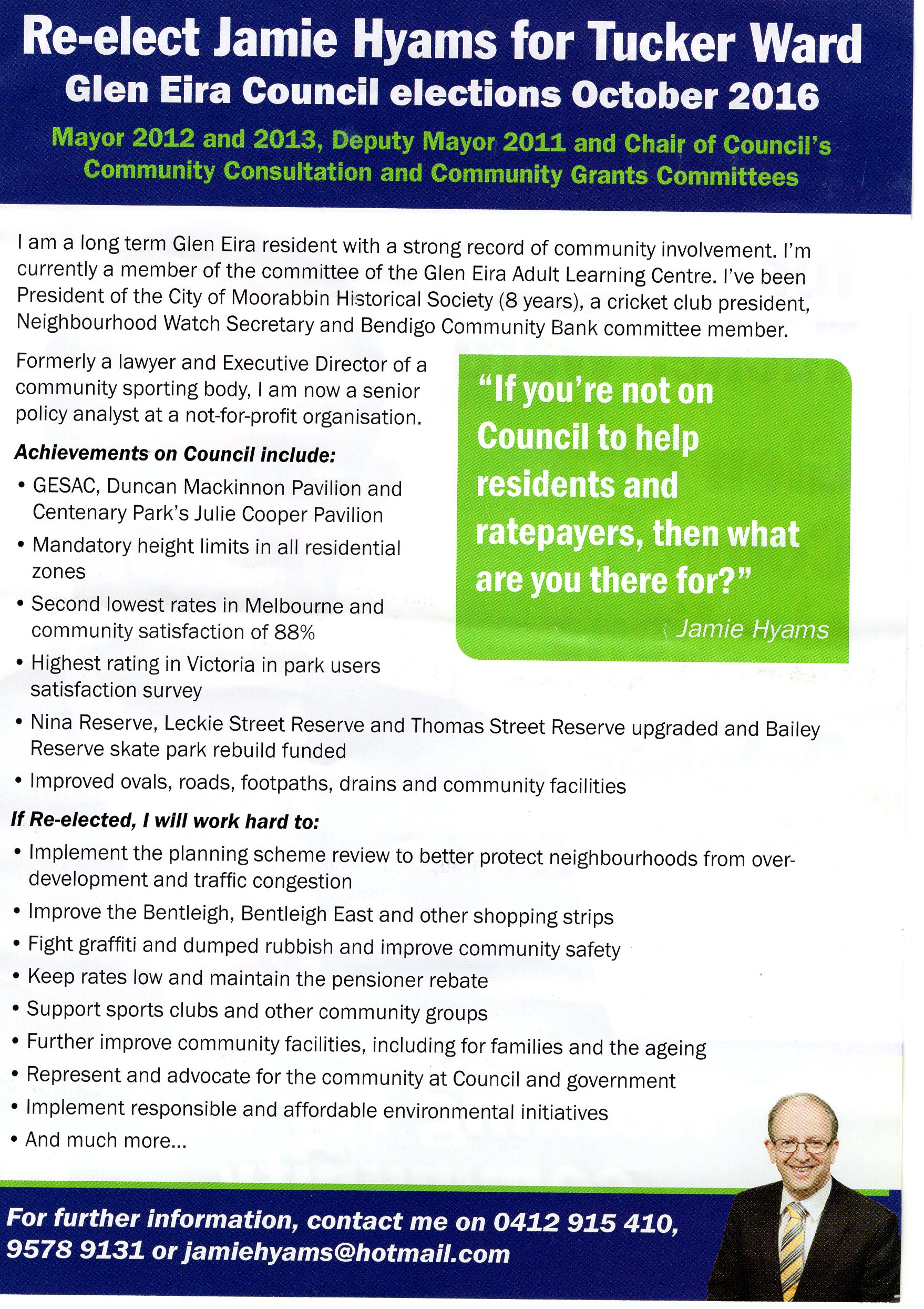
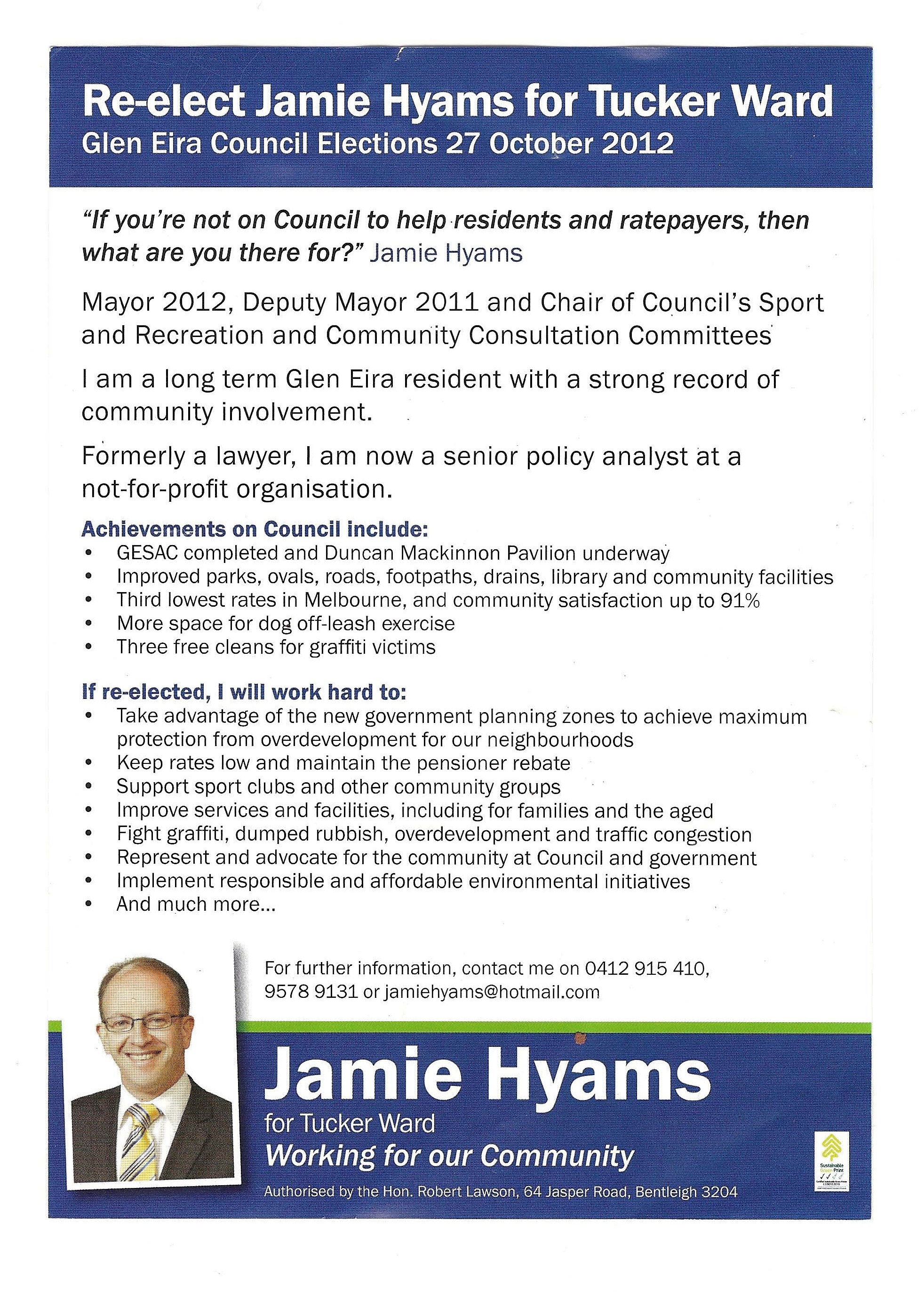
HYAMS: started off with ‘there is rapid growth all over Melbourne’ and other councils have had this for a long time and it is now hitting Glen Eira. The question is ‘are we equipped to protect our neighbourhoods?’ It ‘would appear not’ ‘given VCAT’s changing interpretation’. Claimed that policies were ‘previously sufficient, now not so much’. Council does ‘need to do something about it’ and the report does this. Said that at the last review ‘people were a lot less ambitious about what they wanted from us’ such as height limits, which council has now got. People also wanted ‘transition zones’ which is also achieved and ‘better protection of neighbourhood character’ and that’s been gained via the Neighbourhood Character Overlays. ‘So we basically carried out what was wanted in the previous review’ and ‘this is far more ambitious’ and ‘most of what residents have asked us for is represented in this plan’.

Admitted that some councillors, like Magee, ‘want the zones reviewed’. He believes that ‘it would be nice to do that’ but ‘it could be a double-edged sword’ and end up with things a lot worse.  The ‘more important point’ is that the Government is ‘in the process of reviewing’ the zones ‘so there is no point in us doing it’ because they would say like they did with Moreland that the latter’s proposed Better Apartment Guide wasn’t going to be ‘taken on’ because ‘we’re doing a Better Apartment Guide of our own’. So if council ‘was to do all the work on a review of our zones’ plus all the necessary strategic justification to go along with this, the government could then say why ‘are you wasting your time’ since we (the government) are already doing the review. ‘With a bit of luck’ the government review will achieve a ‘better outcome’.

With the zones, ‘nothing can be built now that couldn’t be built before’ but other things can’t be ‘built now because of the mandatory height limits’. The apartment boom did coincide with the introduction of the zones, especially in Bentleigh, and this isn’t ‘because of the zones’ since other areas like Carnegie ‘were copping’ growth ‘before the zones’. ‘There would be those who continue to misrepresent our zones for political purposes’.

Council ‘isn’t proposing to change the zones’ but to ‘strengthen the protection within each of the zones’ and this is the ‘neighbourhood character work’.  This, together with the structure plans, is the most important aspect of the workplan. This is important for the activity centes and the commercial zones and ‘whilst our policies haven’t changed but the interpretation of them has’ so both the government and VCAT are ‘now looking for something more explicit’ in place to give the protection ‘that we’ve achieved, or hoped to achieve in the past’.

On structure plans council had been told that unless you have ‘mandatory height limits in structure plans’ it is ‘hard to get mandatory height limits in shopping strips’ and these were interpreted as a minimum ‘height limit’ so developers went for higher. So now VCAT is ‘saying we don’t have height limits specified’ so we ‘now do need height limits even if they are not mandatory’.

Council is concentrating on Carnegie and Bentleigh because these are the areas that ‘residents said are the most important’ and ‘appreciates’ Pilling adding the clause about the interim height limits to the motion.  Said that there was a ‘gap identified in our heritage policy’ so this is the ‘first thing we will do’.

‘Unfortunately’ ‘everything we are planning to do does take time’. Council ‘would like to get’ these things ‘through quickly but the fact is that ‘we need planning scheme amendments’, and ‘you need to have done the research to present the government with truth’ etc and this could take up to 18 months. Claimed that the ‘government will never allow us to put at risk development’ and that’s what ‘all this is about’, ‘unless we make a very strong case based on the truth’.

On Magee’s thinking of what council should do, these are ‘encapsulated’ in the work plan and ‘we can’t really do them in a way except like this’. Admitted that it’s not something ‘that everyone would like’ but it’s putting one step forward and council wants to achieve 3 structure plans in 4 years. Saw this ‘as the best way forward’ and council would do ‘everything we can to expedite’ this and that involved ‘making budgetary decision next year’.

COMMENT

Like a dog with a bone, Hyams continues to stick to the glib, unsubstantiated claims that are designed to camouflage the incompetence of this council and his role as a ten year councillor.

We reiterate what we have previously stated –

  • VCAT has not changed its position. Glen Eira planning policies have always been deficient in terms of protecting our suburbs, especially housing diversity precincts. See the following post for VCAT decisions that precede the introduction of the zones: https://gleneira.wordpress.com/2016/07/22/lipshutz-versus-hyams/
  • Hyams like Magee, contradicts the report which states that council has reviewed the zones. Either the report is a work of fiction or both Magee and Hyams have either not read it, or ‘truth’ is not a priority component of their grandstanding.
  • Glen Eira has transition ‘buffers’ not ‘transition zones’ that would stand up to any real scrutiny. Zoning one property as GRZ2 hardly constitutes a ‘transition zone’. Further, Hyams claims of neighbourhood character protection is minimalist covering less than 2.5% of properties – and that’s if one can believe council’s figures!
  • How much longer will council use the excuse for doing nothing because the state government is looking at the issue or it should be the role of state legislation rather than local policies? That hasn’t stopped Moreland and other sympathetic councils from pursuing a Better Design Guideline for their municipalities. Nor has it stopped other councils from introducing Environmental and Water Sustainable policies years ago. Glen Eira’s persistent refusal to do anything is unforgiveable and residents are paying the price.
  • Council in its report admits that structure planning may necessitate the hiring of outside consultants and that this will be expensive. Yet, Hyams reveals that no money has been set aside in the current budget and it won’t be until next year’s budget. Thus, either we get a half baked structure plan devised by the current crop of Council’s planning ‘professionals’, or further delay is written into the workplan until funding is available.
  • Hyams continually hangs his hat on ‘mandatory height limits’ as the be all and end all. We remind readers of his contradictions when pre-zone he stated: that a problem was that if you set height limits then ‘people will build up to that height and you can’t stop them’ but if you don’t have height limits and let each application be ‘judged on its merits’ then you could get ‘better outcomes’. (from our post of 6/2/2013 – ie on application for Glen Huntly Road – 6 storeys and 45 dwellings which got a permit from council.)

Then post zones we get this diametrically opposed statement –

‘The new zones are limiting development’ because of the height limits and that ‘anyone who tells you otherwise doesn’t know what they are talking about’ or ‘is deliberately seeking to mislead you’.(25/9/2014)

  • Hyams’ record on voting in favour of major developments is akin to Magee’s. We won’t repeat by providing a list.
  • Finally, residents need to consider how much this individual has contributed to the poor governance within this council and how much this has subsequently cost ratepayers. We refer of course to the foul mouthed abuse of residents and Lobo and the bonanza this has created for lawyers. We also remind readers that it is primarily he and Lipshutz who have been the force behind: no notice of motion; no tree register; changing public question formats; and countless machinations over the continued reappointment of Newton. Nor does the community’s view appear to matter. When over 1000 people requested a Heritage protection overlay for Frogmore, it was Hyams, Lipshutz, and Pilling who denied residents the right to provide their evidence before a planning panel. It was also this unholy alliance which granted the MRC rights to their development via a fabricated ‘special committee’ arrangement. Countless questions of ‘conflict of interest’ also appear to have been ignored by these individuals. Thus, in our view, Hyams is definitely one of those ‘bastards’ who must be voted out!


« Previous PageNext Page »