GE Consultation/Communication


A definite trend is coming to the fore where developers are seeking reimbursement of their costs from councils who fail to determine their applications  within the 60 day time limit. Glen Eira has finally been caught with its pants down and ordered to pay Pitard Knowles $2086.20. In the great scheme of things, the sum is paltry – a mere drop in the ocean when we consider the multi-million dollar business which is council. Yet, this decision on Vickery Street, Bentleigh reveals much about the planning department and councillors’ stupidity and inadequacy.

This is another example where councillors probably sought to ingratiate themselves to residents (39 objections to a 4 storey, 47 apartment block). Their resolution to again lop off one storey and reduce the number of proposed apartments came after the developer went to VCAT. Yet again they imposed conditions which were ludicrous given the planning scheme and yet again the VCAT member proclaimed the inadequacies of the planning scheme. Councillors just do not seem to get the essential point. We repeat – on EVERY SINGLE DECISION WHERE COUNCILLORS reduced the number of storeys and/or apartments, and the developer went to VCAT, the developer won. This has been going on for years and years – but our lot simply don’t get it. The fault is NOT VCAT per se – but the planning scheme. Thus thousands upon thousands of ratepayers’ money was been washed down the drain defending the indefensible at VCAT instead of addressing the real problem – the planning scheme, its zoning, its schedules, its lack of preferred character statements, its lack of real policy!

This Vickery Street case however, introduced a new element. The shoddy performances of the planning department. We have to wonder why, if council can spend $4,500 per day to solve its own internal squabbles, why can’t it spend money on ensuring that the planning department is properly resourced. We’ve already pointed out in a previous post the number of staff involved in ‘public relations’ compared to the number of staff working in planning and traffic combined!

Here is part of what the VCAT member stated –

This is a review under s79 of the Planning and Environment Act 1987 because the responsible authority failed to grant a permit after considering the application for 104 days. Section 115CA of the Victorian Civil and Administrative Tribunal Act 1998 provides the opportunity for an applicant to request the Tribunal’s fee to be reimbursed in these circumstances. At the completion of the hearing the applicant requested the reimbursement of its fee, being $2086.20.

  • The responsible authority requests the application to reimburse fees be dismissed because the permit application is complex, there were unavoidable scheduling constraints caused by the Christmas holiday period and it facilitated discussions with the applicant and objectors by convening a planning forum in January 2016 before it was to be presented to a Council meeting in February 2016. These reasons are rejected by the applicant.
  • I agree with Mr Bromley that the proposed development is not particularly difficult or complex for the following reasons:
  • The Council has considered many three and four storey apartment buildings in Bentleigh and its other urban villages in contexts similar to Vickery Street.
  • The proposed development comprises a design, height and massing that is similar to many other developments designed by Steller. The proposed layout does not differ in any significant respects to other proposals previously considered by Council.
  • The planning policy, amenity and car parking issues are well known to Council.
  • The planning scheme has not changed for some time and provides a well-known and understood assessment framework. There are no recently approved planning zones, policies or overlays that add complexity to the assessment.
  • No external referrals were required that may have added complexity to, or delayed the assessment.
  • The Council has had the benefit of multiple Tribunal decisions on similar applications to guide its assessment.
  • With regard to the conduct of the applicant, the responsible authority accepts it has not contributed to undue delays by not providing information in a timely manner, delaying public notification, or in any way acting vexatiously or unprofessionally.
  • Mr Bromley says the Council took an unreasonable time from the completion of public notification in mid-November 2015 to intending to decide the application early February 2016. He says the time required to arrange and conduct a planning forum on 13 January 2016 resulted in unnecessary delays. He says the application could have been presented to a Council meeting in December.
  • Mr Bromley says the planning forum in January 2016 made no positive contribution to the resolution of issues or the merits of the proposal. It only enabled the objectors to express their concerns with the development. He says Council did not actively engage with the parties between November 2015 and late January to mediate an outcome.
  • The responsible authority says it processed the application with reasonable promptness, the time periods were not unusual for a larger development, and the planning forum is a necessary part of Council’s assessment process. The Council could not truncate the application process over the Christmas holiday period.
  • While I agree with Mr Bromley that a three week period to give directions for public notification following the submission of all information is frustrating, it is not unusual in a busy planning office, and would be generally acceptable. If that were the only delay, the claim for reimbursement of fees would have limited weight.
  • Hence I have to decide if a delay in the order of six weeks (between Council meetings in mid-December 2015 and early February 2016) to enable the application to be discussed at a community planning forum was justified, and whether Council proactively sought to resolve outstanding issues in this period.

AND HERE’S THE REAL STING IN THE TAIL –

  • By contrast effective mediation requires considerable time and meetings needs to be led by expert mediators. Time is needed to enable parties to express their concerns, for the real issues to be identified, and for solutions to emerge. Parties often have to be actively encouraged to collaborate to resolve their differences and to find acceptable solutions.
  • I understand that Council only arranged the planning forum between mid-December 2015 and February 2016, and I accept Mr Bromley’s assertion that Council made no efforts to conduct mediation outside the planning forum.
  • In my view, Council made the conscious decision to defer considering the application in December 2015 so it could convene the planning forum. It was aware there was limited prospect the planning forum would be likely to resolve the issues or add new information that was not already available on the file (provided with the application, referral advice and objections) and summarised in the officer’s report.
  • It did so knowing it would delay its consideration of the application for at least six weeks. It did so knowing that it could face a review at the Tribunal under s79 of the Act, and consequently it would be likely to have to respond to an application to reimburse fees. It took no other actions such as mediation to resolve the planning application in this period.
  • it is not acceptable that the arrangements for a planning forum commence after the technical assessment has been completed. I consider Council has to arrange these much earlier in the assessment process. The planning forum should not unduly delay the presentation of an application to a Council meeting for a decision. It is not acceptable the permit applicant has to wait some weeks for a decision that could be made earlier, particularly if the planning forum is highly unlikely to add new information or does not form part of a genuine mediation process.
  • I am satisfied the Council unduly delayed its decision on the application and the applicant’s fees should be reimbursed.

Source: http://www.austlii.edu.au/au/cases/vic/VCAT/2016/920.html

COMMENT

Council’s Planning Conferences are not there to achieve real ‘compromise’ in our view. Their function is primarily a public relations exercise. It would be most informative if council were to provide the following data so that residents could assess for themselves council’s processes and their efficacy –

  • How many times has the developer not shown up at these conferences?
  • How many times have MAJOR changes occurred to the plans as a direct result of the conference?
  • How many times has the officer failed to include all residents’ views in his/her report to council?
  • How many times has the developer or the objectors walked away satisfied that a ‘consensus’ has been arrived at?

Glen Eira Council considering height limits for commercial zones in Glen Eira under planning scheme review

June 5, 2016 12:00am

Chad Van Estrop

Moorabbin Glen Eira Leader

HEIGHT restrictions could be imposed on commercial zones in Glen Eira following a review of the council’s planning scheme.

Glen Eira’s director of planning Ron Torres said the review, expected to be complete by June 30, would consider height limits.

Angry residents have been calling for the limits on developments in activity hubs like Centre Rd, Bentleigh and say commercial zones, which do not have mandatory height limits, are fuelling over development.

“The key theme that the community raised consistently were the rate and level of development occurring in Glen Eira and in particular around our shopping centres,” Mr Torres said of recent community consultation sessions.

“While our policies don’t contain numerical heights they talk about transitioning down in scale to the residential areas.”

The review comes as two apartment blocks — one of eight storeys (33 dwellings) and another of six storeys (22 dwellings) — have been approved for Centre Rd since April.

Mr Torres was concerned the Victorian Civil and Administrative Tribunal was not implementing council’s policy when their decisions were appealed.

“What our particular concern has always been is that VCAT is not giving the due consideration to our policies,” he said. Mr Torres said VCAT was “not necessarily” setting a precedent with its planning decisions.

He said the planning review would address development scale and size, car parking, heritage protections and neighbourhood character but that any changes to Glen Eira’s planning scheme would need approval from planning minister Richard Wynne.

RMIT professor of urban studies Peter Norden backed the community call for height limits within commercial zones. “I can see that if we starting getting (more) six and seven storey developments on Centre Rd it will conflict seriously with the local urban context,” he said. Prof Norden, a Centre Rd resident, said development was necessary to cater for Melbourne’s booming population. “I’m not against development but it needs to be done in a way that is balanced and not giving green lights to greedy over development.”

In a letter to council last year Mr Wynne said he was concerned that Glen Eira’s planning policy “may not be providing adequate guidance in relation to development within Glen Eira’s activity centre.”


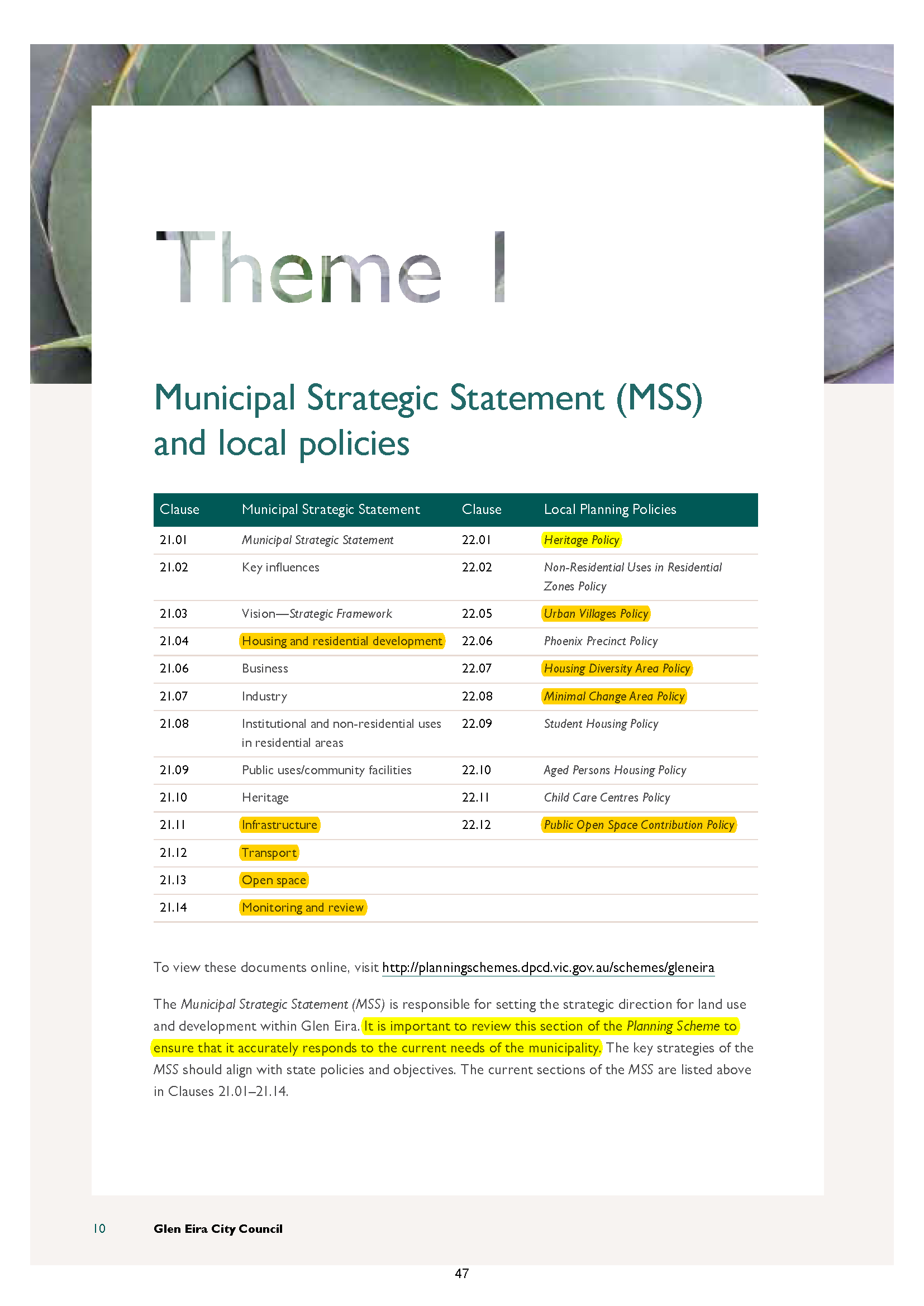
For the second consecutive time, Theme 1 (Municipal Strategic Statement & Local Policies) contained in the ‘Discussion Paper’ for the review of the planning scheme has been neatly side-stepped and no discussion permitted. We therefore wonder how Council can ‘know’ what residents suggest, or want, if they haven’t even bothered to ask. What comments council officers have made in previous forums on this theme has been far from satisfactory. Torres simply admitted that the Municipal Strategic Statement (MSS) is well and truly outdated and will need to be ‘revised’. That’s it!

Given that the MSS and its associated Local Policies are perhaps the most important components of any planning scheme, it is unforgiveable that residents have not been provided with (a) enough information on these sections, and (b) that ‘discussion’ has been literally ‘censored’. That of course leads to the very obvious questions of:

  • Is this another Clayton’s consultation where ‘changes’ have already been predetermined but residents are kept in the dark like mushrooms?
  • Who decided to discard discussion on Theme 1? Was Ms Turner given her orders to do so or was it her decision alone?

Below is a screen dump from the Discussion Paper. Please note how bereft of detail this really is, yet how this Theme contains all the vital policies and which, of course, ultimately lead onto the zones and their schedules. From our perspective, it appears that council has done everything it can to avoid any discussion on the most contentious issue in Glen Eira – ie a review of the zones and their respective schedules.

Pages from Pages from april05-2016-agendaPS: also worthy of note – the only councillor to front last night was Lobo. No sign of Lipshutz at any of these ‘forums’ and Magee’s 5 minute appearance at the first one! Delahunty has also been a noticeable absentee.

Last night’s community forum had a good turnout of residents. We estimate that 50+ people attended. Many new ideas were proffered as well as some old perennials – ie community gardens; tree register and protection, traffic, etc.

Whilst there are undoubtedly time limits and such meetings cannot go on all night, we were very surprised by the fact that Theme 1 of the Discussion Paper (ie the Municipal Strategic Statement (MSS)and all council’s Local Policies) did not get a guernsy. In fact, the ‘discussion’ went immediately to Theme 2. Given that the MSS is arguably Council’s most significant document since it sets the framework for all land use together with the Local Policies, and has not had a revamp for well over a decade, it is disappointing that residents were not provided with the opportunity to voice their views on this important component of the planning scheme. It should also be noted that only two councillors were in attendance – Sounness and Lobo.

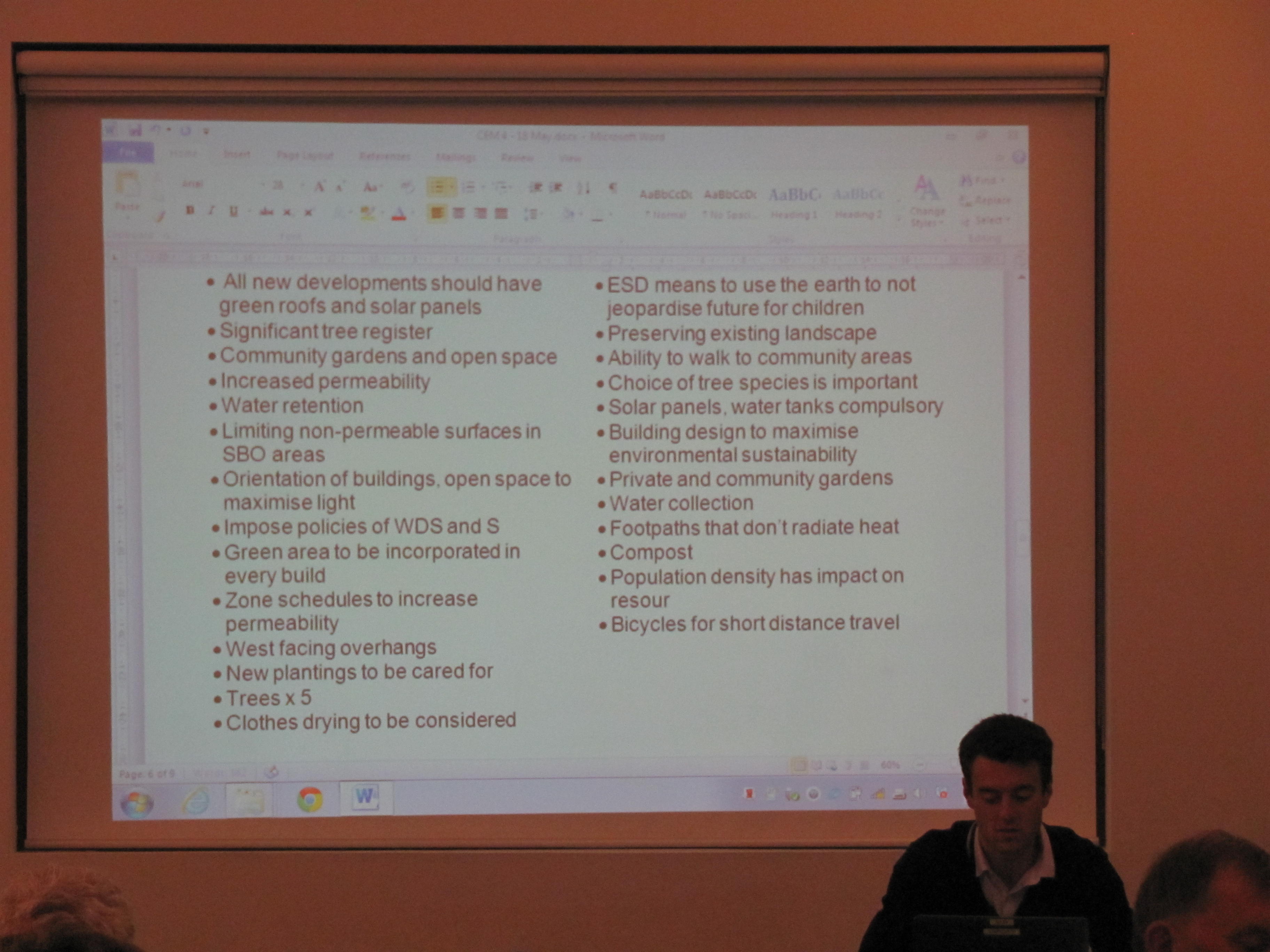
Below is a ‘snapshot’ summarising the feedback on the Environmental Sustainable Design theme as it went up on the overhead projector. (apologies for the poor quality!)

151

A sample of the other feedback provided throughout the evening was:

  • Review Urban Design for Racecourse, Caulfield Station, Monash Uni
  • Rubbish bins on roads
  • More family sized apartments
  • Open space levy increase to purchase land
  • More permeable surfaces for footpaths
  • One way streets to reduce congestion
  • All new dwellings to have solar power and green roofs
  • Significant tree register
  • Increased permeability for developments via schedules
  • Population density has impact on resources
  • Bicycles for short distance travel

Opening comments from some residents were also informative –

  • Heritage Update 2002 is not part of the Planning Scheme and that’s why VCAT does not have to consider it.
  • What is the capacity of population growth for Glen Eira and what does this say about density and all that follows from this?
  • As one commentator has said in our previous post, residents appeared to favour a 4 storey height limit for commercial dwellings/zonings.

We’ve received the following email that was sent to all councillors. It is also worth pointing out that less than half of these ‘representatives’ responded to the email. To emphasise what is happening and the shambles that is the current planning scheme, VCAT has just granted a permit for 4 storeys and 39 units at the corner of Jersey Parade/Elliott Avenue, Carnegie.

Here is the email –

“It seems that the final death blow to Claire St is about to be dealt, with the application for a permit for a huge development covering 5 of the 6 blocks on the western side of Claire St. The scale of this proposed development is totally out of all proportion to the street, and is a perfect reflection of the total failure of Glen Eira’s Planning Scheme. We are sure that even the most diehard supporters of this scheme are now realising what a disaster it has become; a free-for-all where the developers are falling over themselves to get in and create the most cost effective yet least attractive, environmentally insensitive and unsustainable housing possible, with the inherent destruction of all existing vegetation.  We would like to think that none of the councillors in their wildest dreams ever envisaged that this is what would become of the planning scheme – development so rapacious and insatiable that it is ripping the heart out of what was once an attractive, charming and very liveable suburb. It seems to us that in recent months the councillors have finally seen this for the total disaster that it is and are starting to reject some of the most inappropriate development proposals such as 6-10 Claire St. However, this gives us very little comfort, as we know that the developer will proceed straight to VCAT, which, operating within the parameters of Glen Eira’s own planning scheme, must still approve these developments as they comply with the requirements for this zone.

Our only hope now is that the upcoming review of the planning scheme will recognise how wrong Glen Eira got it and will make some serious changes to what can be allowed in a GRZ. This is the only way to allow both Council and VCAT to have some control over what is built in these areas. Can you please give us a commitment that you will agree to making major changes to the planning scheme to help protect  our residential areas from this tsunami of inappropriate development. It is OK for councillors to admit they got it wrong and try to do something about it; we sense a huge groundswell of anger from local residents who are now seeing what is happening all around them, and know that any councillor still trying to cling to this disastrous policy will face electoral oblivion at the upcoming council elections.

Yours sincerely,

XXXXXXX”

A comment went up on our last post which we believe needs to be highlighted:

We live in the house next to the 51 units, 4 storeys, 3-9 Elliott Ave. It is on our north side! We will also be opposite 60 more units in Elliott Ave. Only 6 out of 20 houses left in our part of this small suburban street…… what can we say. We explored all avenues including going to VCAT, employing a Planner for quite a substantial fee. We achieved some minor concessions with shadowing and setbacks. It has been an exhausting process. I wonder if we are completely stupid to continue to stay here after 36 years, enjoying the peace and convenience of living in Carnegie. However, all has changed. The council has won. The peace and joy of living here is shattered. We will stay and see how things pan out. The world is changing at such a rapid pace around us and I’m afraid we’ve lost faith in the Council and it’s concern for the community. We will look back in a few years time at the implementation of these zones and wonder how it could happen. In a bizarre way it makes me empathise with the first people of our country and the bewilderment of colonisation! Rapid change can leave a community depleted.

The comment is not from a NIMBY, or someone simply bemoaning the pace of change. What this comment expresses is:

  • the utter devastation that the zones have caused to neighbourhoods and to individuals
  • the failure of council administration and councillors to provide planning outcomes that are justifiable
  • It illustrates completely how incompetent and negligent the imposition of the zones are when they fail to even meet Matthew Guy’s parameters

We have commented numerous times on Elliott Avenue, Carnegie and shown the once beautiful, well kept Edwardian cottages that are now gone. (https://gleneira.wordpress.com/2015/02/09/one-little-local-street/) Elliott Avenue is only one street. The same is happening to countless other streets and entire neighbourhoods. Why? Because the zones and the planning scheme encourage such destruction when there was no need for it. Even in their secret meetings, Newton and Hyams promised Matthew Guy that there would be 80+ years of available development sites! Glen Eira has now quadrupled the number of new dwellings it needs to meet population growth. Yet nothing has been done to ameliorate the damage and to amend the zones so that residential amenity is given greater protection. This failure must be sheeted home to all councillors and planners.

Here are the facts:

  • Guy proclaimed that Residential Growth Zones (which this section of Elliott Avenue is zoned as) should be ‘Medium Density Housing’ and that the zones should be in ‘appropriate locations near activity areas, train stations, and other areas suitable for increased housing activity’. The current papers accompanying the review of the residential zones (MRDAC –advisory committee) define ‘Medium Density Housing’ as LESS THAN 75 DWELLINGS PER HECTARE. The section of Elliott Avenue zoned RGZ, is now approaching 220 dwellings per hectare!!!!!!! This kind of density belongs in selected commercial areas and never in a quiet residential street!

Untitled

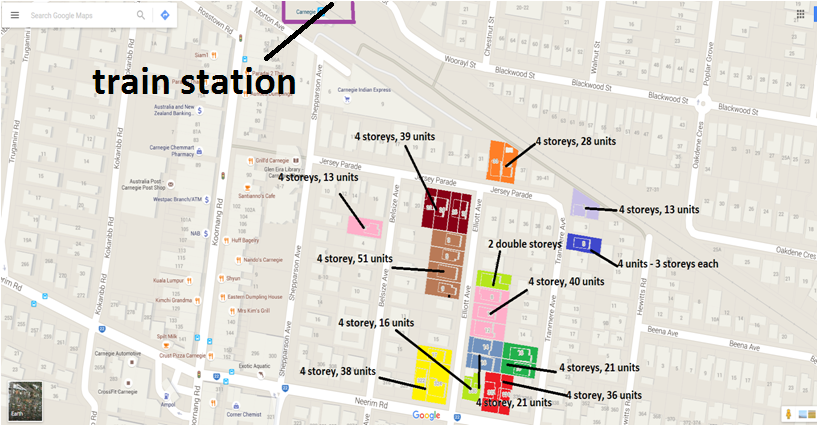
  • Council’s definition of planning is to simply place a compass point at a train station (ie as in Bentleigh and Carnegie) and then draw a circle with a circumference of roughly 400 metres. This then becomes the ‘activity centre’ and determines the RGZ zoning. The map above shows how insane this is when walking distance to the train station from Elliott Avenue is well and truly greater than 800 metres. Plan Melbourne Refresh insists on activity centres concentrating on ‘walkability’. To therefore determine that just because a train station is (as the crow flies) about 400 metres away that this street should therefore be RGZ, is planning at its most incompetent and lazy. But that is what this council has done time and time again.

Residents, especially those residing in activity centres (including ‘neighbourhood centres’) must insist that the current planning scheme and its woeful local policies be consigned to the rubbish bin and that amendments are introduced asap which seek to halt the destruction of streets such as Elliott Avenue. Anything less is unacceptable.

We reiterate and urge all attendees at the ‘forums’ to proclaim loudly and clearly the need for:

  1. structure plans
  2. height limits for commercial and mixed use zoning everywhere
  3. parking precinct plans
  4. Urban design frameworks and Design & Development Overlays (DDO) that include more than simply regulating fence heights as is currently the case in 3 out of the 5 DDO’s in Glen Eira
  5. Infrastructure levies on developers for drainage (removed in 2010)
  6. For every car parking waiver a levy of at least $10,000 per waiver
  7. Tree protection (on private land)
  8. Heritage review of entire municipality and that this has some ‘bite’
  9. And most importantly, amending the schedules to the zones, and the zones themselves!

Our thanks to Urban Melbourne for these pics!

IMG_0001IMG

Untitled

We revisit this issue since the Leader article has omitted to mention the most important aspect of the hour long ‘debate’ that occurred – the refusal by Hyams, Lipshutz, Esakoff, Pilling and Ho, to include Notice of Motion as part of the proposed changes to Council’s Meeting Procedures. We also note that 9 days after the resolution to seek an amendment was passed there is still no public notice up on council’s website, nor is there any advertisement in the local paper advising residents that their views will be sought via submissions. There is of course, a full page colour ad celebrating GESAC’s 4th birthday! How much did this cost we wonder?

To put the record straight, readers will be interested to know that the following list of councils ALL HAVE NOTICE OF MOTION. Hence in Glen Eira, 5 individuals are effectively gagging councillors and hence the community!

Alpine Shire

Ararat

Ballarat

Banyule

Bass Coast

Baw Baw

Bayside

Benalla

Boroondara

Brimbank

Buloke

Campaspe

Cardinia

Casey

Central Goldfields

Darebin

Colac-Otway

Corangamite

East Gippsland

Frankston

Glenelg

Golden Plains

Bendigo

Dandenong

Geelong

Greater Shepparton

Hepburn Shire

Hindmarsh

Hobson’s Bay

Horsham

Hume

Indigo Shire

Kingston

Knox

LaTrobe

Loddon

Macedon

Manningham

Mansfield

Maribyrnong

Maroondah

Melbourne

Melton

Mildura

Mitchell

Moira

Monash

Moonee Valley

Moorabool

Moreland

Mornington

Mount Alexander

Murrundindi

Nillumbik

Northern Grampians

Port Phillip

Pyrenees

Queenscliff

South Gippsland

Southern Grampians

Stonnington

Strathbogie

Surf coast

Swan Hill

Towong

Wangaratta

Warrnambool

Wellington

West Wimmera

Whitehorse

Whittlesea

Wodonga

Yarra City

Yarra Ranges

In what can only be seen as a total admission of failure (and straight out incompetent planning) Hyams and Delahunty moved this Request for a Report at last Tuesday night’s council meeting –

Crs Hyams/Delahunty

That a report be prepared on whether Council should apply for a planning scheme amendment to raise the Public Open Space Contribution Levy above the current 5.7%.

Thus, just on one year since the amendment was gazetted, council is now acknowledging that 5.7% falls far short of what is required. The ‘excuses’ provided were that Council’s ‘assumptions’ and conditions have changed. Nothing could be further from the truth! The so called building boom owes much to the introduction of the new zones which date from August 2013 – 2 years before the open space amendment was gazetted and a year after the deficient open space strategy was made public. The writing was literally on the wall and council needed to introduce a far higher open space levy to ensure that funds were available – but more importantly that the amount of public open space per individual did not decline.

Nor does this sudden interest in open space account for 11 years of doing absolutely nothing to raise funds to purchase open space. The levy from 2004 to 20015 was not only miniscule, but a gift to developers. Exacerbating the situation was the failure of council to purchase additional space apart from 2 house blocks in Packer Park even though the lack of public open space in Glen Eira was known and stated in both the 1987 and 1998 open space strategies.

What is even more disgraceful is the repeated and continuing slurs (including last Tuesday night) cast on the 2 objectors to this open space amendment and the completely bogus claim that their objections cost council in the vicinity of $1 million. How much did council cost ratepayers from 2004 to 2015 with its laughable levy rate? And how dare the likes of Hyams and Lipshutz in particular cast slurs on residents who decided to exercise their legal rights and object to council’s inadequate proposals and shonky strategic planning?

It is now obvious that 2 residents were able to forecast  what would happen a lot better than ‘consultants’ who cost $130,000 and councillors who were determined not to listen and bureaucrats who were only intent on limiting the damage for developers.

FYI, here is part of one of the submissions presented to the Planning Panel that argues strongly that a 5.7% levy is inadequate – especially since Stonnington with the second least amount of public open space opted for an 8% levy. In the end Stonnington achieved its 8% levy for 4 major suburbs – South Yarra, Windsor, Prahran and Armadale. The total area of these 4 suburbs at 8% will alone bring in more than Glen Eira’s 5.7% across the entire municipality. Further, Stonnington’s objective is to keep creating further open space with its $36 million in the kitty as opposed to Glen Eira’s splurging on mega palaces and concrete and disowning its twice passed resolution that the levy would go for the purchase of open space and not the ‘maintenance’ of existing open space!

“NEED FOR AN INCREASED LEVY

Contention: The proposed contribution levy of 5.7% is inadequate to meet the open space needs of the existing and future populations of Glen Eira.

Throughout this submission I have pointed out that:

  • The projected population figures are extremely conservative
  • The cited potential land development area is well and truly underestimated
  • The rate of development in Glen Eira has risen astronomically
  • The stated land values are well below the current market figures
  • Infill development figures and how they impact on potential revenue is ignored
  • Impact of strategic development sites is ignored

As a consequence of all the above, a 5.7% levy, and the overall recommendation to create (at a maximum) another 11 or so hectares of public open space will not meet the needs of the community. I acknowledge fully that there is no standardised methodology for determining what an appropriate contribution levy could be. I also acknowledge that the consultants were to a great extent dependent on figures provided to them by council. It is precisely these figures which I believe are suspect and need to be fully reviewed and updated.

Without access to current council data I can only hypothesize on what would be an appropriate levy given all the above factors. What I do find telling however is the comparison with the current Stonnington proposed contributions levy and the analysis done by their consultants. As pointed out in an earlier table, Stonnington is two-thirds the size of Glen Eira, has a smaller population, and has the second lowest amount of public open space in the state, behind Glen Eira’s record of having the least amount of public open space. Yet Stonnington’s consultants find that:

Based on current provision of open space throughout the City, the Strategy identifies that acquisition of 53 hectares is required to meet the benchmark. When factoring in population growth acquisition of 108 hectares would be required to meet the benchmark[1]

The Glen Eira OSS provides no quantifiable benchmark to work towards. If no targets are set, then I’d argue that it is extremely difficult to calculate what revenue is required in order to meet the most minimalist standards of open space per individual – especially if the data is highly suspect. At a maximum, the OSS recommends the acquisition of another 11 hectares of open space in the entire municipality.  The  least recommended would only equal another 2.2 hectares, and the ‘average’ is given as 6.51 hectares. None of these possibilities are adequate. If Stonnington is currently finding a deficit of 53 hectares then Glen Eira’s claims to need only an additional 11 hectares at best, does indeed appear well below the mark.

There’s also Stonnington’s request that their contribution levy be raised to 8%. Why a council with the second least amount of public open space should ask for an 8% levy, and the council with the least amount of public open space only demands 5.7% levy is quite frankly, beyond me.

Nor do the consultant’s reports provide any historical breakdown of levy contributions per precinct as does Stonnington. All that is cited are the cumulative figures for each financial year. Without such a breakdown it is incredibly difficult to gauge where the majority of subdivisions are occurring; the nature, scope, and size of these subdivisions and how these may indicate what occurs in the future – especially in the urban growth centres.

Stonnington has also created a list of proposed projects for its entire 20 year plan and its figures are based on the anticipated costs. Apart from disclosing 3 projects in the current budget, Glen Eira has not revealed whether in fact it even has such a long term plan and what the specific projects might entail and hence their probable costs. Again, a highly dubious basis upon which to calculate what needs to be done over the next 13 years.”

AND THE CONCLUSION

“Based on all the above I would strongly urge the Panel to recommend a higher contributions levy than what is currently proposed. I am not able to provide a definite figure since I have no access to the current data and I do not consider it my task to do so. That belongs to council and the consultants.

If the residents of Glen Eira are to be well served via the acquisition of the necessary public open space, then I urge the panel to recommend a total review of what has been proposed and that this is based on the most up-to-date and accurate data. Glen Eira residents cannot afford to undergo any further loss of open space which is inevitable I believe, if the current proposed amendment remains unchanged.”

[1] SGA Economics & Planning. (2013). Assessment of Mandatory Open Space Contributions – Page 16

« Previous PageNext Page »