GE Consultation/Communication


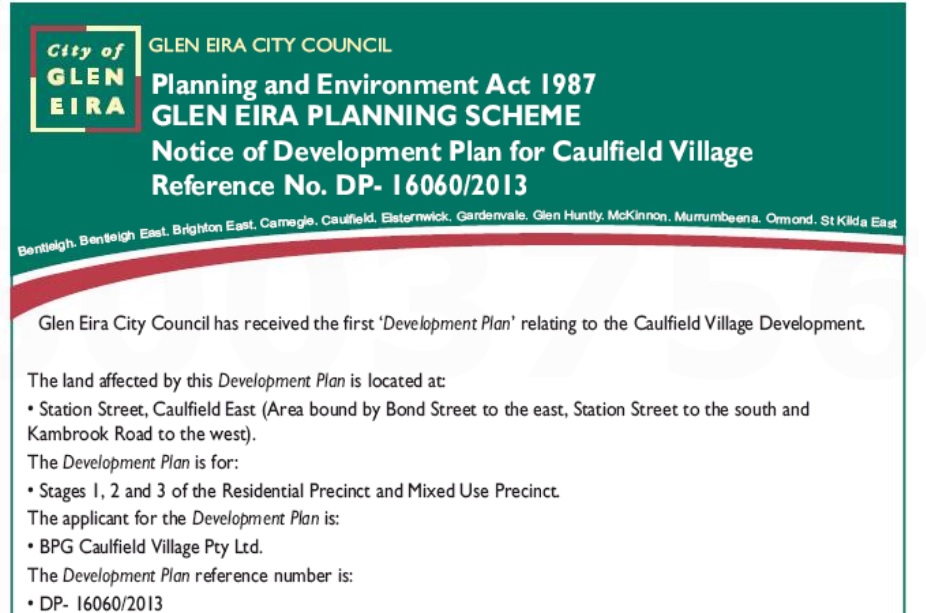
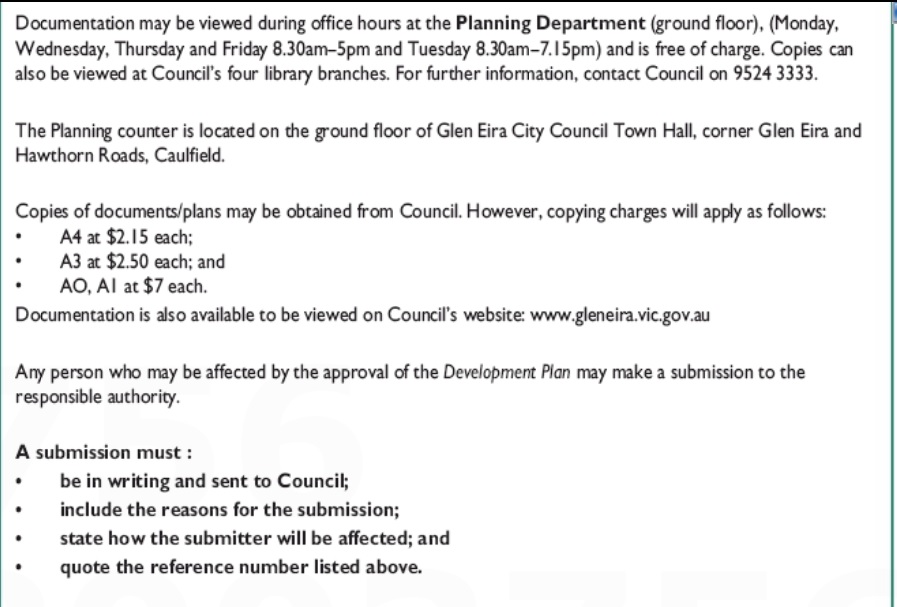
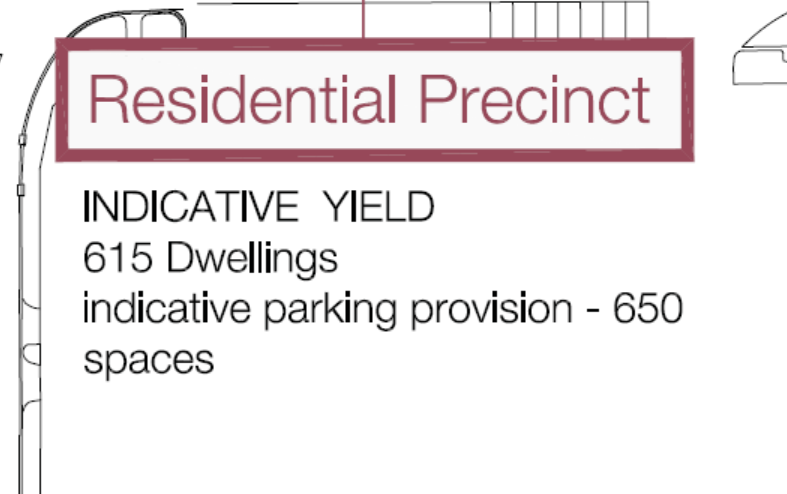
Buried in the fine print of several of these documents, some truths are finally revealed. Residents were repeatedly told by council and the MRC that the project envisaged 1200 dwellings, plus commercial and retail areas. It then burgeoned into 1500 units. Now we are looking at the possibility of 2040 of which the vast and overwhelming majority are SINGLE BEDROOM apartments! We can only wait with baited breath for stages 4 onwards, when height for the remaining buildings are revealed.

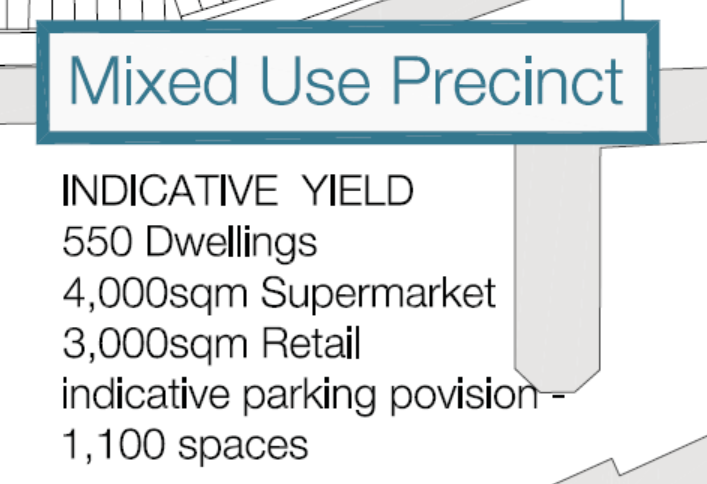
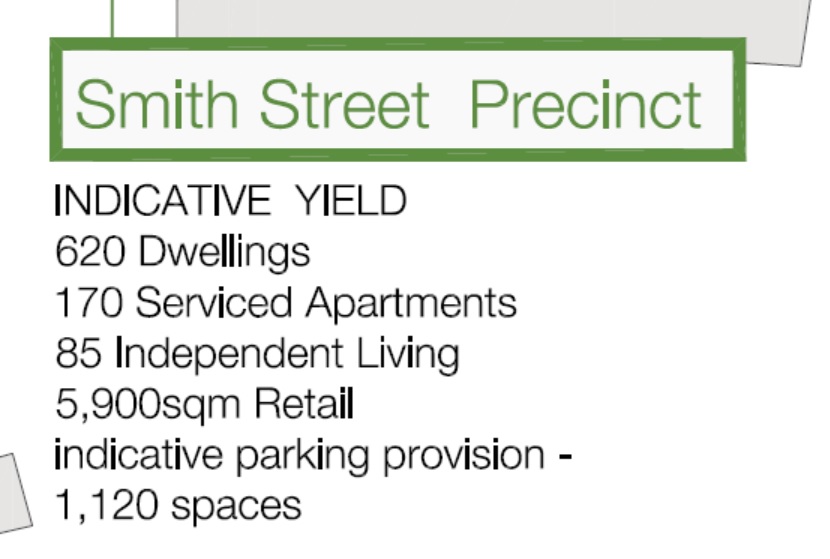
Below are the figures taken directly from the ‘Precinct Plan’ and the argument is that this is still in line with the Incorporated Plan!!!!! What bunkum and what collusion!

3

2

1

c601c602c603

PPS: All the documents are available from:

http://www.gleneira.vic.gov.au/Council/Planning_and_building/Planning/Caulfield_Village/Development_Plan_1

PS: From ‘The Age’ today!

Victoria’s racing industry pay rates run a distant last

Date: January 27, 2014 – 9:38PM

Illustration: Matt GoldingIllustration: Matt Golding

Strappers and stablehands in Victoria’s racing industry earn the lowest pay and have the worst conditions, according to the national workplace ombudsman.

An audit by the Fair Work Ombudsman of ?eastern seaboard racing tracks resulted in Victoria chalking up the worst performance in properly paying strappers and stablehands – the people who groom, feed and saddle racing horses and clean and maintain their stables.

Only a third were found to be paying their staff properly, far worse than in other states.

The audit followed the ombudsman receiving almost 100 complaints over pay and conditions from people in the industry, 35 from Victoria.

Of the horse-training businesses checked in Victoria, only 31 per cent complied with workplace laws. In NSW 86 per cent of businesses paid staff properly as did 76 per cent in Queensland.

In all, ombudsman inspectors checked the books of 86 horse trainers in metropolitan and regional NSW, Victoria and Queensland late last year.

A report to be released by the ombudsman on Tuesday cites the case of one horse trainer in Victoria whose business employed stablehands hired for periods of less than the legal minimum of three hours.

One Victorian trainer interviewed as part of the report said he was not aware there was a minimum amount for shift lengths and paid back $1985 to eight of his employees.

The correct rate of pay for strappers and stablehands is about $21 an hour depending on which state.

A trainer who was noted in the ombudsman’s report was found to be paying her casual staff a flat rate of $20 an hour, despite many working on Sundays when penalty rates applied.

The trainer back paid almost $16,000 to eight of her workers.

Of the 86 horse trainers audited, 34 were found to have underpaid a total of 61 employees almost $40,000.

Read more: http://www.theage.com.au/victoria/victorias-racing-industry-pay-rates-run-a-distant-last-20140127-31j5f.html#ixzz2rddD7MkD

The latest example of Glen Eira secrecy and decision making behind closed doors comes with the December 6th closing date for submissions on the State Government’s Plan Melbourne – arguably the most important document since Melbourne 2030.

Other councils:

  • Have published their submissions and had the drafts ratified at council meetings. Glen Eira has done neither of these things
  • Have involved the community in drafting their submissions. Glen Eira has been totally secretive.
  • Glen Eira has not made a ‘submission’ but written a ‘letter’.
  • Glen Eira stated on December 17th that the ‘letter’ would be put on on its website. It is yet to appear.

We certainly do not expect this ‘letter’ to be anything other that a page or two of waffle, self congratulations, and total endorsement of Plan Melbourne. Other councils, in contrast, have taken the time and effort to analyse and (often) criticise what they perceive to be the major failings of this document. Below are some extracts taken from these submissions. We wait with bated breath for the Glen Eira version to appear so that residents can clearly see how Glen Eira is failing its ratepayers.

Port Phillip  (41 page submission): Source – http://www.portphillip.vic.gov.au/Report_7_-_Plan_attach_1.pdf

Council highlights its concern that the detailed initiatives and actions proposed in Plan Melbourne do not always align well with ‘issues’ identified in the Plan, nor adequately support implementation of the Plan’s strategic objectives and directions. Proposed initiatives are often lacking in detail and clarity of intent. There are also notable ‘gaps’ in potential actions which offer greatest opportunity to effectively deliver on the objectives of the Plan.

Plan Melbourne does not address how government will respond to the impacts of climate change – specifically climate adaptation to heat waves and flooding/sea level rise. This is considered a major gap in a long term strategy for the development of Melbourne.

Plan Melbourne proposes several initiatives to ‘streamline’ the planning system, including applying VicSmart to medium density housing and affordable housing projects. Proposals which limit community involvement in the planning process, or reduce Local Government’s decision-making responsibilities are not supported.

The new commercial zones reflects a ‘one size fits all’ approach and are contrary to the emphasis in Plan Melbourne on protecting the ‘distinctiveness’ of local areas and to the recognition given to Local Government’s role in planning for Activity Centres.

BOROONDARA – (59 page submission) Source: http://www.boroondara.vic.gov.au/~/media/Files/Your%20Council/Building%20and%20planning/Strategic%20planning/Metro%20planning%20strategy%20discussion%20paper%20submission.pdf

Council wishes to express its disappointment at the short time frame given to local governments, the community and stakeholders for reviewing the Strategy and providing submissions. The initiatives and actions in the Strategy will have many local impacts and therefore consultation with communities is very important.

The Strategy does not state whether Local government will have an opportunity to comment on the revised SPPF. Considering that councils use the SPPF in their decision making, it is considered important that they are consulted before the SPPF is finalised.

Clarification is required as to how new locations for Activity Centres will be determined, and what measures will be used to determine the need for new centres. It is unclear if there are State-driven targets for retail or commercial floorspace that the State Government will be seeking to meet. The implications of rezoning land for commercial purposes would need to be looked at on a case by case basis.

The publishing of annual housing development data to inform the development and monitoring of municipal housing strategies is supported, however the ability to gain such information on an annual basis is questioned. It is also unclear what the next step will be once this data is obtained, for example, are there going to be annual reviews and changes to the application of the new zones in response to the data received? Given that the new residential controls have been introduced prior to undertaking the strategic work of projecting housing needs, it is unclear how those projections will be accommodated in the controls.

Updating the design guidelines and introducing measurable standards for high density residential and mixed use development is supported, as is a review of the design, layout, internal living amenity and balcony needs of apartment development. Clarification as to how this will be implemented is required, beyond a consideration of current planning and building controls identified in the Strategy.

STONNINGTON (18 page submission)

Council notes the strategic importance of this Strategy in planning for the City over the next 40 years, and is disappointed that further time wasn’t allowed for Councils and the community to fully consider and respond to this consultation particularly in light of the timing around locally applying the residential planning zone reforms.  In addition, Council notes that the State Government expects to release the final Plan Melbourne in January 2014, and is concerned that adequate time and consideration will not be given to the comprehensive comments provided by the City of Stonnington and other submitters

We are aware that the comment period for the Plan Melbourne – Metropolitan Planning Strategy closes on 6 December 2013.  To this end, Council has held two Drop-in Information Sessions for the community, launched a dedicated consultation web page on Council’s website, placed information regarding the Strategy in the Stonnington Leader, distributed an email alert and undertaken hard copy and electronic surveys to gauge local opinion on the proposed Strategy.  These views have helped inform this submission

Plan Melbourne to delete the reference to within 400 metres of an Activity Centre and instead refer to identification of suitable areas in locally specific structure plans and planning controls.

The Caulfield Urban Renewal Area should not extend north of the major barrier of Dandenong Road / rail line.

Strategies requiring State Government lead, include Design Guidelines for higher and medium density development including internal amenity, ESD (Environmental Sustainable Design), WSUD (Water Sensitive Urban Design), licensed venues and liquor licensing policy, and developer contributions schemes.

The Metropolitan Planning Strategy lacks clarity with regard to ‘Activity Centres’ and ‘Neighbourhood Centres’. In some instances these terms are mutually exclusive and in others, Neighbourhood Centres are considered as a subset of Activity Centres.

There are numerous areas around the Stonnington rail lines that are important in terms of heritage and neighbourhood character. Areas suitable for additional residential and mixed-use development, including provision for new open space, should be identified through locally specific structure plans and planning controls

A key concern for Stonnington residents is inappropriate higher density development and the impact on neighbourhood character and internal and external amenity. Robust principles and performance-based guidelines are needed to inform good design outcomes that are responsive and respectful of the local context.

Another key concern is the increasing provision of one person homes to poor standards which can be seen to create ‘slum-like’ areas.  Stonnington therefore advocates that greater emphasis needs to be placed in the Strategy on minimum design standards for residential apartments.

Council believes it is not appropriate for Plan Melbourne to specify that land within 400 metres of an Activity Centre are key areas to accommodate higher density housing. Concerns raised are mainly because of the confusion as to which takes statutory and regulatory precedence; Plan Melbourne (which identifies areas within 400 metres of an Activity Centre to be intensified) or the Local Planning Policy Framework, which could potentially have protected areas within this 400 metre radius.

At present there is no evidence-based link between public transport capacity to accommodate increased demand and development approvals. Council believes there needs to be greater emphasis on projected public transport capacity in the application of the new residential zones, whereby lack of public transport capacity is sufficient reason to reduce the intensity of development. For example in saturated road conditions, developments should not be approved on tram or rail corridors until it can be established the that demand created by the development growth can be accommodated.

Levels of parking provision in development proposals must also take into account transport impacts, and not solely market demand. This is of particular importance when the responsible authority considers there are alternative options to the private car available, where several public transport modes are within walking distance such as the Forrest Hill urban renewal area.

Council has noted that there does not appear to be any specific Directions or Initiatives in relation to ESD or WSUD.  Stonnington Council wishes to reaffirm the importance of metropolitan-wide strategies requiring State Government lead in both these areas, and the importance of water sensitive urban design in better managing stormwater run-off. 

Finally, we’ve uploaded the Save our Suburbs analysis which clearly outlines why Plan Melbourne has the potential to be a boon to developers and a blight on neighbourhoods. We urge all readers to please read, consider and then compare with what kind of effort eventually surfaces from Glen Eira administration and its bunch of ‘yes sir’ councillors!

In terms of transparency, accountability, and genuine community engagement, it is our view that this council has slipped even further into the mire. Nothing that we can see would indicate any change in the culture, objectives, and policies of the ruling clique. If anything, the situation has worsened with the continued defection of Pilling, and the gang’s ‘recruitment’ of Sounness and Okotel and at times, Delahunty.

2013 will stand as testimony to the failure of this council and its councillors to achieve anything approaching the principles of good governance and working for the community. We base our judgement on the following list of catastrophes –

  • The continued reappointment of Newton without advertising the position PLUS a 30 to 40 thousand dollar pay hike!
  • The introduction of the new Residential Zones in secrecy and as per norm, without any public consultation
  • The continued presence of Lipshutz, McLean and Gibbs on the most vital advisory committee – the Audit committee.
  • The riding roughshot over residents’ views – GESAC car park extensions; devious destruction of Caulfield Park trees; Koornang Rd and Centenary park proposed tree destruction.
  • The above demonstrate the failure to plan in a prudent and cost effective fashion. When literally millions are spent as an ‘afterthought’ on bitumen and concrete plinths, what does this say about prudence, business planning, and overall financial management?
  • The failure to introduce a Notice of Motion and other democratic reforms
  • The continual reappointments of Lipshutz, McLean and Gibbs to the Audit Committee
  • The formation of a ‘consultation committee’ that hasn’t played any role in any ‘consultations’ for the past 18 months and the failure to appoint the original submitters since they presumably did not meet the ‘pliable/ignorant’ requirements of the ruling clique
  • The failure to ensure that those who fork out the money (ie residents) are given priority in any sporting allocation especially the McKinnon Basketball Club at GESAC, and Ajax Seniors
  • The continual doctoring of minutes, and failure to produce answers, rather than ‘responses’ to public question
  • The continued approval of substandard dwellings of 8, 10, 12 storeys
  • The continued waiving of car parking requirements without justification
  • The failure to introduce proper reporting standards in planning
  • The failure to pursue developers for breaches of permits or the law
  • The continued cow-towing to the mrc
  • The continued ‘top down’ approach to consultation
  • The failure to include community representation on most committees

There is much, much more that could be mentioned. Much needs to happen in order for this council to be dragged screaming into the realm of good, open government. We remain committed to working towards this objective and continuing to highlight the shortcomings and duplicity of these councillors and their overlords.

Below we feature the incredible ‘discussion’ on the Sporting Ground Allocation Policy. We urge readers to carefully note:

  • Delahunty’s turncoat performance
  • Okotel’s remarks
  • Lipshutz’s inanities and little games of semantics
  • Both Hyams and Lipshutz’s attempts to win favour with Ajax – quite frankly we do not believe a word of it!
  • Control vested 100% in the hands of Burke and his cohorts, especially in regards to Expressions of Interest since the policy gives these bureaucrats the authority to ‘invite’ submissions!
  • Not one councillor commented or provided any reasons as to why ‘indoor recreation facilities’ (ie GESAC BASKETBALL ALLOCATIONS) are EXEMPT from this policy! To our mind the reason is obvious – so that the Warriors can continue unimpeded and no one will ever know whether or not they are fulfilling to the cent the obligations of their allocations!

ITEM 9.12 – SPORTING GROUND ALLOCATION POLICY

Delahunty moved motion with some changes – ie. putting policy up on website; to help public understand role of local government in sport; the policy would apply to Expressions of Interest by ‘inviting applications from any party’ and ‘Eoi’s will only be called if there is a permanent vacancy’. Hyams seconded.

DELAHUNTY: said this was a ‘long time coming’ but it doesn’t mean that the ‘operational’ processes ‘haven’t been applied’. Said that she’s always believed that if ‘we are applying something operationally’ then there should be a policy that is clearly ‘understood’ and ‘available’ to the public. This ‘helps the public understand’ council’s ‘role and commitment’ to local sport which is the ‘fabric of our society’ and helps people participate. Council is the ‘guardian of the places’ where this happens but council shouldn’t be ‘managing that in a different way to other people in Victoria’. Said that her objectives with the amendments were to ‘make it clearer what sort of’ principles are involved, but not ‘to differ terribly much from our municipal neighbours’. Went on to say that if Glen Eira did ‘differ’ then it would cause ‘operational chaos’. Also stated that by putting in ‘subjective’ criteria this would help people understand how council sees its ‘role’ BUT there may be times when ‘we may not be able to apply those principles’. This is something that officers have always ‘grappled with’ and the policy won’t cause a major ‘upheaval’ in regards to this since it’s important to have a ‘transparent policy’. She ‘recommends’ the amendments since they don’t basically change the ‘operational’ nature of what has already been happening. The amendments just ‘make it clearer’. The changes to ‘purpose’ explain ‘why we have written the document’. Second amendment was to ‘better explain the scope and not to change it’. Said she found that the McKinnon Basketball Association and some of its members use the terms ‘allocation’ and ‘expression of interest’ as ‘interchangeable’ and this has been ‘widely misunderstood’. The third change was in regards to the table and this sought to ‘clarify how many points were available’. On the expressions of interest she wanted it better understood so ‘that’s why I put in some subjective points’ that extend parts of the community plan, health plan into this policy. Importance of community sport ‘can’t be underestimated’ but ‘operationally’ it’s important that council doesn’t ‘differ that much’ from other councils.

HYAMS: said the policy sets out in a ‘straight forward and transparent way’ how grounds are allocated. The policy isn’t ‘being done for a particular football club’ but that’s ‘not so’. Said that they ‘brought to their attention’ the ‘need for policy’ and that ‘one incident brings shortcomings to our attention’ and this is an example of that. Claimed that council even decided to have a policy before all the public questions started flooding in from Ajax. Said that the policy shows that ‘we don’t throw’ out existing clubs if they are meeting their ‘obligations’. Some people might be suggesting this but he plays for a club that isn’t in Glen Eira and wouldn’t want that to happen so he could play in Glen Eira. Some ‘suggestions’ have been that council should consider the ‘number of residents in each club’ but ‘doing that may be difficult if not impossible’ but ‘we do it for community grants in a slightly different way’. The EOI ‘supposes a community connection’ and that’s ‘important’. ‘Personally’ he would like to have junior and seniors of the same club ‘playing together’ but he ‘understands’ that ‘that was not the will of the group’. Thought that Delahunty’s changes ‘improve’ the policy ‘especially’ on the tables and explaining that these also apply to EOI’s. The real solution is more open space and the policy sets out the plan for the racecourse and will be reviewed then or other times deemed necesary.

OKOTEL: appreciated the ‘work of officers’ and councillors for the policy but ‘I have been highly disappointed with the process that council has undertaken’. Said that she had ‘asked for a process of consultation’ with sporting groups and community ‘before we put this policy to the vote’ because this is a ‘new policy’. Previously council had been merely operating ‘on tradition’ and there was ‘no written documents before us’. Because this is new and ‘none of us are experts’ it ‘would have been appropriate’ for council to ‘engage in some form of’ consultation. Therefore she ‘doesn’t feel comfortable voting on a motion’ that she’s ‘unfamiliar with’ and therefore making a decision on behalf of people was ‘inappropriate without some level of feedback from the community’.  As a result she contacted some sports clubs herself and asked them if they had any comments. Said that the feedback ‘wasn’t that much’. When she raised the need previously she was told that inviting comments would only invite feedback that ‘might polarise the community, cause division’ therefore ‘it is best not to engage in consultation’. ‘I think that was entirely inappropriate and misconceived’ and that ‘we should never shy away from consultation with the community’. Quoted Delahunty saying that council is ‘guardian’ of sport. She thought that ‘partners’ is better so ‘it’s important that we do have feedback from our community’ on ‘such policies’. Said that the feedback from clubs was that there ‘was a lack of clarity in our policy’ as to clubs losing their allocations, and ‘what the deduction of penalty points would mean’ and she also ‘felt that there was uncertainty in that respect’. She’s ‘disappointed that such recommendations haven’t been taken into consideration’. She hoped that councillors vote against the policy but if not that any future review looks at these issues.

MAGEE: said he ‘disagreed with all speakers so far’. There is not ‘need to consult’ on sporting policy since ‘all that matters is longevity’. Said that clubs ‘don’t look at it as a seasonal allocation’. Said he can accept the policy ‘because it’s simple’. Said that they’re trying to do a ‘policy by committee’ and that’s not working. ‘This is a policy looking for a purpose’ and the purpose is that people who have a ground ‘are used to it’. Said that the argument that people who live around a ground have got a ‘greater connectivity’ to that ground and therefore ‘should score higher’ is not right. Didn’t think that any clubs would ever ‘fold up and move out from Glen Eira’ or that there would ever be enough grounds. Even if the racecourse is opened up he would bet that ‘Glen Eira would not be the committee of management’ and therefore allocations ‘would not be up to us’, so ‘this policy won’t matter’. He can’t see anything that would mean that ‘this policy is actually needed’. ‘The policy needs to be kept simply because the clubs don’t care’. All clubs worry about is ‘tenure’ and that’s ‘all this is about’. ‘You don’t need to go ask them that’. Said he was ‘disappointed’ that ‘we’re trying to make something that is relatively simple’ and ‘complicate’ it.

LIPSHUTZ: brought up a point about ‘incorporated’ bodies and ‘incorporated associations’. After some confusion, Delahunty didn’t accept. Lipshutz then said Magee is right in that ‘not much is going to change’. However, pavilions and grounds are important to council and clubs don’t have ‘adverse possession’ claims. So council does have an ‘obligation’ to act in accordance with policy. Said that if there is no policy then it’s ‘open slather and let the officers do as they wish’. A policy ‘gives a framework’ on how ‘things should be done’. Referred to Okotel saying that council should consult but ‘council does not consult on policies. Council consults on strategies’. Said that like Hyams he would like to see seniors and juniors together but that ‘the group’ didn’t agree on ‘this one’. Referred to sport and the ‘corruption’ that went on in Brimbank council where ‘clubs’ took ‘allocations for clubs or money or whatever’ but this ‘can’t happen here’ because there’s a ‘policy that doesn’t allow that’. In Glen Eira ‘council doesn’t get involved, council doesn’t have a say in who gets allocation’ because ‘the officers make that decision’. But ‘we set the framework’. Said that every corporate body has a ‘group’ that sets policy but then ‘officers implement that policy’. At this point LOBO VOTED AGAINST GIVING LIPSHUTZ A TIME EXTENSION. Lipshutz went on with ‘we have to have a franmework that is clear and unambiguous’. Said that the issue ‘didn’t come to council today out of the blue’ and that ‘every councillor’ has discussed it.

LOBO: said that if ‘I don’t know how minutes are taken at an assembly’ then Lipshutz should know the difference between operations and policy. Said that the latter is established on ‘legal matters’. Here ‘smooth functioning of sports club is all that is required’. If people don’t complain then this shouldn’t be ‘a big hassle’. He will ‘stick to the officers’ recommendation’.

DELAHUNTY: started by saying that it’s not like the officers ‘have been operating without guidelines’. They’ve had strategies and ‘conversations’. Said that there’s not this policy because of the ‘commitment to transparency’ so what’s been previously done under ‘operational’ they are now done under policy and this should be ‘open to the public’. Said this should be true for ‘all operational decisions’ but particularly for decisions that ‘affect so many people’. Council is ‘guardian’ of the facilities so they have to make sure to ensure the ‘longevity’ of these facilities. Said there are ‘principles written into the policy’ because Glen Eira doesn’t have a ‘strategy’ on community sport. Said again that her changes do not alter ‘operational’ matters but that ‘they do seek to make those decisions more transparent’.

MOTION PUT AND CARRIED. VOTING FOR – Delahunty, Esakoff, Hyams, Lipshutz, Pilling, Sounness. VOTING AGAINST – Lobo, Magee, Okotel

Apologies for what is an exceedingly long post but which focuses on 2 vitally important Amendment proposals that basically admit council’s previous stuff ups, plus the public relations exercise on the C60 and Caulfield Village. Please refer to the actual agenda items on council’s website for other items including – walking strategy, sporting ground allocations policy, and some very interesting in camera items concerning the Audit Committee.

Caulfield Village Development

Rocky Camera’s report is in response to the following Request for a Report passed at last council meeting – “That a report be prepared to determine the best methods to engage with the community surrounding the Caulfield  Racecourse in light of impending developments which will impact their amenity. That the report recommend ways to involve the community in helping to shape the future of their area be that through structure planning or another method used by other councils.”

We note at the outset that the request for ‘methods’ is not really addressed by Mr Camera’s response and ‘structure’ planning is mentioned only twice in passing, in the entire 6 pages of script! Instead, the report is a follow up to the Akehurst comments from this council meeting and the admission that residents’ opportunities to ‘object’ to the Caulfield Village are dead and buried!

Once again there is plenty of misleading information. Even though Probuild has formally announced its intention to build 1500+ units, this report still maintains – “Caulfield Village will contain 1200 dwellings’ and ‘improvements to three main road intersections’. The report then continues with assurances that “details” are known and this followed (of course) ‘extensive community consultation’. Probuild could not have employed a better public relations firm that Glen Eira City Council in spruiking the development as evidenced by the following highly dubious claims.

This document gives certainty to the local community by precisely stipulating building envelopes; their heights, setbacks, and siting. It can be said that the Caulfield Village development is one of the most planned development sites in the municipality. The future development of this land has been “locked in” following a rigorous community consultation and amendment process, the community now has a high level of certainty in what to expect at Caulfield Village. This certainty even extends to the location of new roads, infrastructure upgrades, and the use of laneways. If any person is unaware or unsure of the future development of the Caulfield Village, they simply just need to turn to the Incorporated Plan. In this respect, the community’s involvement in “helping shape the future of the area” has occurred.

The degree of detail and certainty far exceeds what a structure plan could offer. At best, structure plans are policy documents, providing general guidance on future development. The framework for Caulfield Village, with precise controls, and a rigorous ‘recipe’, means there is already absolute certainty about what the extent of future development will be.

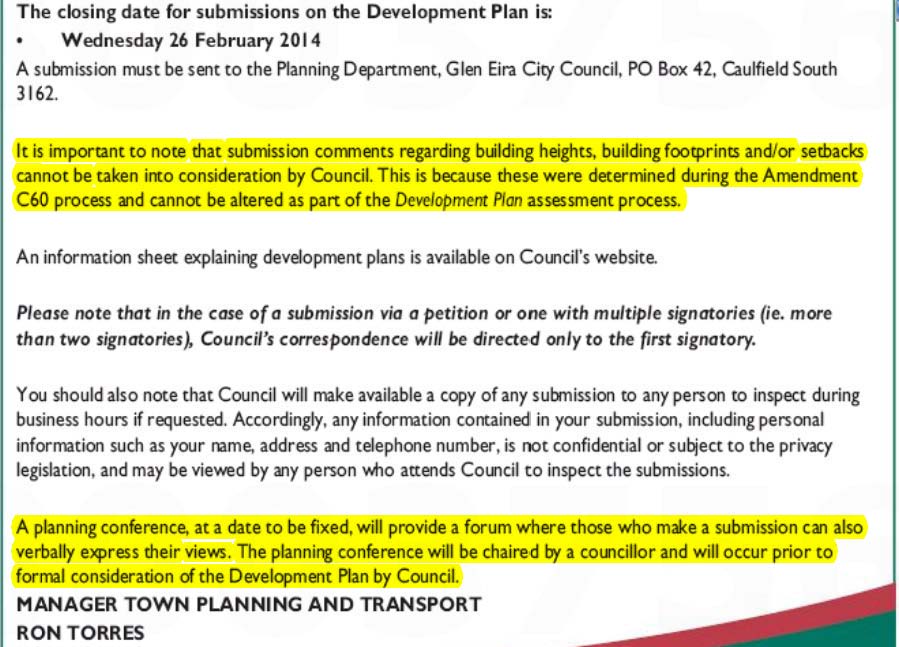
Thus, after a page and a half of unfounded assurances, the real truth emerges. All residents will be able to do regarding the Development Plan is submit ‘comments’. They will not have any objection rights to VCAT. The best residents can hope for is that someone with common sense realises that 1500+ units as opposed to 1200+ units, does in fact constitute a marked departure from the Incorporated Plan. The domino effect should then be applied to traffic, etc. But all we’re told is:

if the developer deviates from the Incorporated Plan (‘recipe’) and proposes, say, taller buildings than what is specified in the building envelope. In this case, a full town planning process, together with typical third-party rights must be undertaken. That is, if a proposal contains taller buildings than the agreed envelopes, or departs from the Incorporated Plan, the community needs to be further consulted.

What will be interesting is how ‘deviates’ is defined and by whom and what constitutes a ‘deviation’ from the sorely lacking detail of the Incorporated Plan!

There are several other admissions most notably that the open space levy extracted from the developers only amounts to $4m for the residential components. Given that the law at the time permitted up to 5% Council has again let the big boys off very cheap at 4%! Mention is made of the possibility of ‘back dating’ rates, but we assume that this will be calculated on the miniscule rates that have been part of the Planning Scheme since 2006/7 and not the uppermost limit currently available. Another present to developers!

We urge residents to read this report very, very carefully and to note the following:

  • The first development plan is already in the hands of council and will be made public early 2014
  • After so many assurances that ‘precise details’ are known about the future of this area, the recommendations confess that the C60 in effect only supplies ‘broad parameters’!

NEIGHBOURHOOD CHARACTER AND HERITAGE CONTROLS

If ever there was an admission of a total stuff up then Item 9.9 is the living proof. This harks back to Amendment c87 where the Neighborhood Character Overlays were introduced into the planning scheme. Readers will remember that councillors in their wisdom promised those residents who asked that their areas be included, or not excluded, that they could present their case to the Planning Panel, only to find that the ‘terms of reference’ could not be altered. Hence, all those individuals who believed council found out to their horror that their claims were not relevant to the deliberations of the Planning Panel. We also remind readers that both residents and councillors were not given the opportunity to put in any recommendations – it was all done ‘inhouse’ by officers and through the Planisphere report.

Well now (a year later) there is a massive public relations exercise about to happen, where a handful of residents from that time will get a look in. The proposals are minimalist in the extreme – a couple of more houses added to the heritage listing and basically one more street included. Of course, none of this will happen in the short term, given the length of time it takes for Amendments to get through. We simply ask why this couldn’t have happened right from the start? Why does it take this council attempt after attempt to get something close to ‘correct’?

LARGE SITES – NEIGHBOURHOOD RESIDENTIAL ZONE

This is nothing but a confession that the zone reforms are another major stuff up and this is purely a limited attempt at ‘damage control’ given the outcry from developers. It does not excuse, nor solve the problem as we see it because:

  • The proposed amendment only addresses lots that are larger than 2000 sq. m. What if block of land is 1000sq.m for example?
  • With no minimum size prescribed in the planning scheme we can have subdivisions upon subdivisions so the myth of two dwellings per lot may stand – but the overall effect would mean 2 dwellings on each subdivision. There is nothing in the planning scheme to prevent this and we believe it is already happening.

There is much, more more of significance in these agenda papers. As per the norm, major issues are all presented at the one time so that real discussion, debate, and the prospect of intelligent and careful decision making is jeopardised. We even wonder whether councillors have taken the time to actually read all 377 pages!

PS: We’ve neglected to mention the Elsternwick Plaza item. At last council meeting the following resolution was passed – “That Council not accept VicTrack’s revised offer and continue to advocate for finalisation of the lease as per the original plan.”. This was after the Lipshutz/Hyams motion was defeated. However, being persistent little councillors, we now find that Newton has undertaken further negotiations and that there has been some ‘movement at the station’. This new recommendations DOES NOT ADHERE TO THE EXISTING RESOLUTION. We presume that the motto of the gang is that if you don’t succeed first time around, try, try, try again! It will be fascinating to see if councillors have got the gumption to stick to their original motion or whether they will cave in as per usual. This item just happens to be 9.20 – last cab off the rank when ‘determination’ and ‘stamina’ have been well and truly exhausted by everyone! Ah, the games that we play!

Below is the latest Friends of Caulfield Park email –

Council “thumbs it nose” at the Community

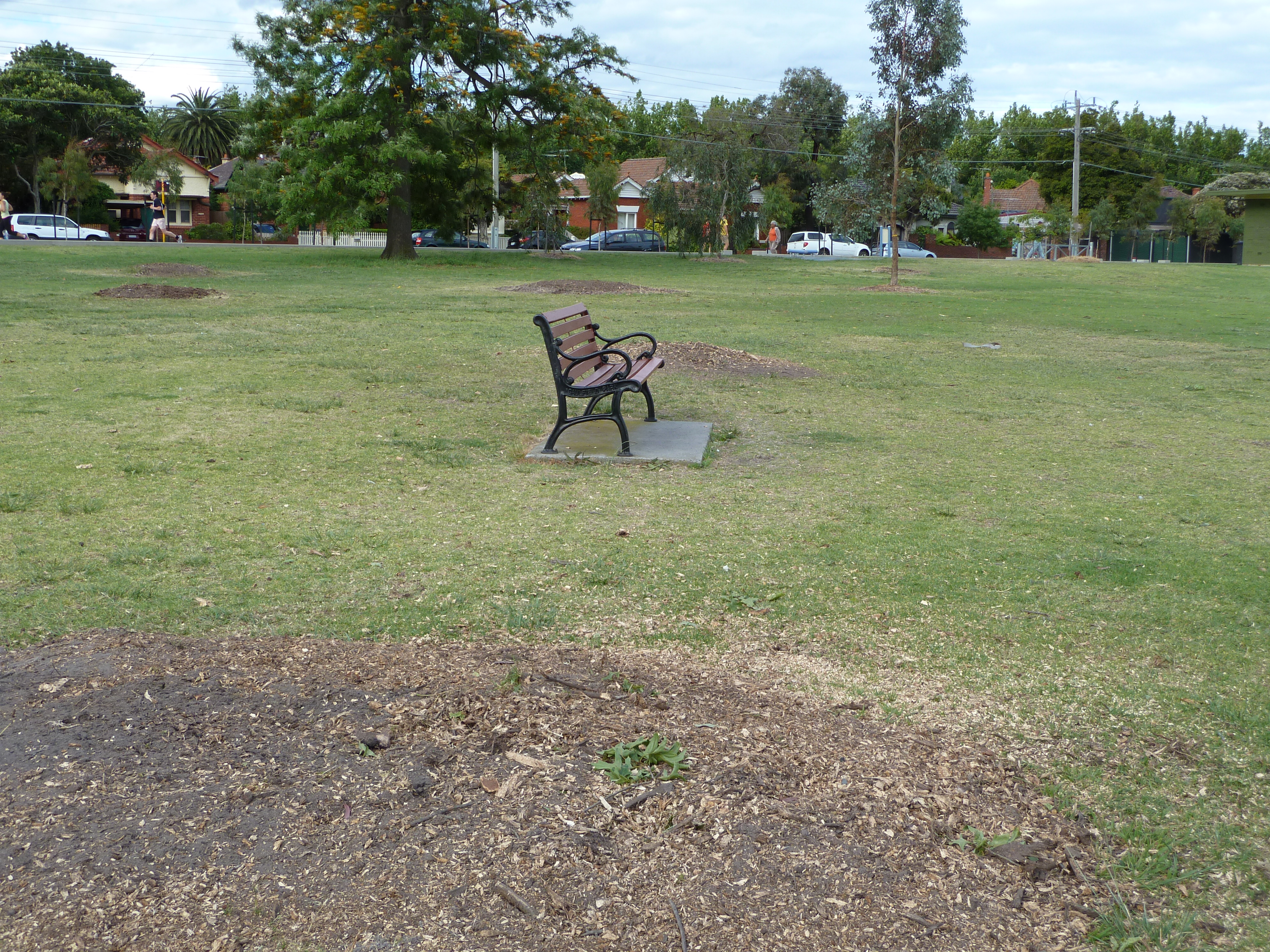
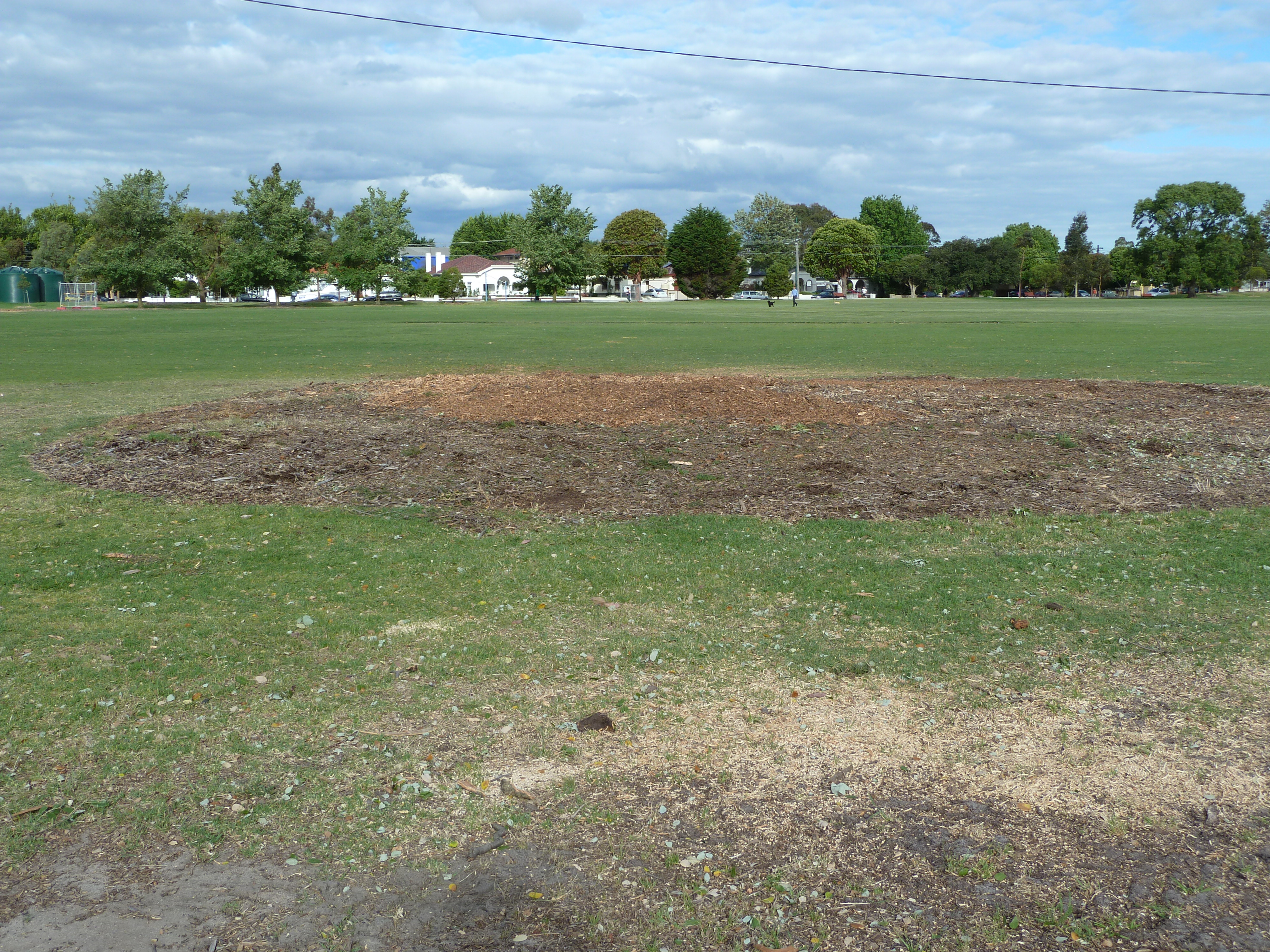
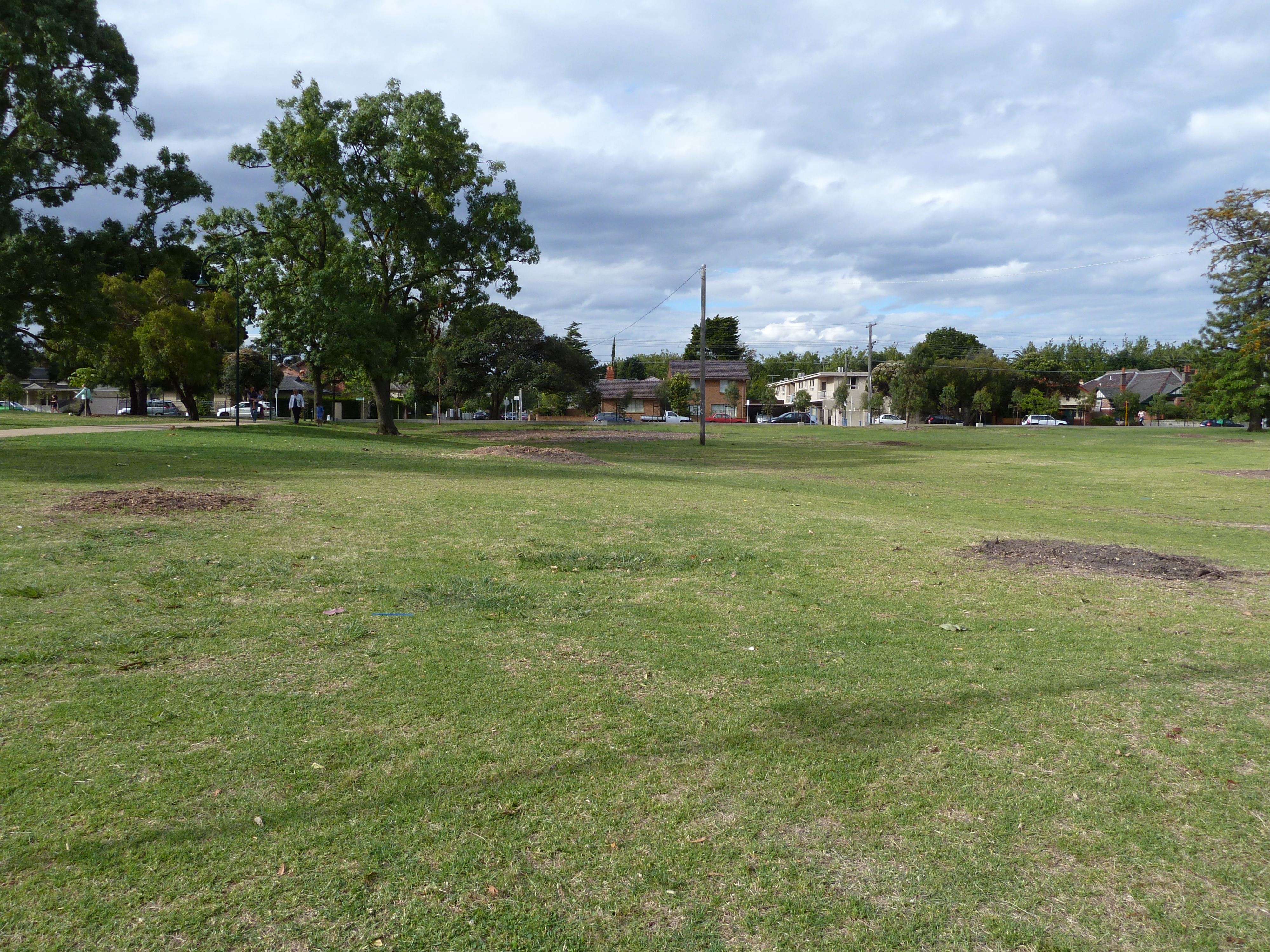
Like storm troopers, the secret executioners gathered in the early hours of this morning and, instructed by the administration and its officers, swooped on the 39 trees and cut them down.

The mayor said all the Councillors were behind this move.

He said there was nothing wrong with this action.

We disagree.

We know not all the Councillors were behind him and were kept in the dark about this destruction.

We believe that the Mayor and the administration realised that the FoCP petition of over 500 names (gathered in less than a week) would be presented to Parliament tomorrow and that their plan to cut down the trees would be in jeopardy.   They thought once cut down they were gone and they could proceed with their ill-conceived plan in peace.  With the Festive Season upon us we would all forget their contemptuous action and let them get on with it.  This is bureaucracy at its arrogant worst in overriding community wishes.

We have shown how their justifications for cutting down the trees are fabrications.  So what is the real reason for their determination to proceed, no matter what the community thinks?  If anyone knows the background to their hidden agenda, please drop a note to PO Box 2511 Caulfield Junction 3161.  It appears that they are somehow beholden to sports clubs above all other interests.  Something is rotten in the City of Glen Eira

David Wilde is handing in the Petition on the Parliament steps tomorrow at 9 am and would like others to join him.  If you are able to do so, then ring him on 0417 032 437 tonight up to 9 pm. We realise this is short notice, but please do your best.

What next?  The Council thinks it can thumb its nose at us.  They need to learn that the community is not impressed with their anti-social, anti-community behaviour.  There are two issues here. The one is the loss of the trees, and the other is the Council’s total disregard for the expressed concern of the community about this matter.

Let the Council know what you think of them.  Here are their contact details.  Email, message and phone them and tell them their behaviour is no longer acceptable.  Tell them we want those trees replaced with mature trees where those that were cut down previously stood, and that they cannot spurn the community in this way.

David Wilde

President

We’ve deleted the list of contact details for councillors and Newton!

PS: NOT ONLY DO THEY COME IN THE DEAD OF NIGHT, BUT THEY MAKE SURE THAT ANY ‘EVIDENCE’ IS REMOVED QUICK SMART – so unlike what happens to other trees that are removed and the trunks can lie around for days, if not weeks, untouched. This section of Caulfield Park is now a total wasteland! Residents should remember that the original ‘timetable’ announced that the trees would be removed IN JANUARY!

P1000215 P1000211 P1000212 P1000213

PPS: And from today’s online Leader (http://www.heraldsun.com.au/leader/central/glen-eira-council-culls-21-trees-at-caulfield-park/story-fngnvlpt-1226779662643)

Glen Eira Council culls 21 trees at Caulfield Park

  • Andrea Kellett
  • December 10, 2013 4:17PM
Cranes were used to help remove the mature trees at Caulfield Park. Picture: RICHARD CORNISH

Cranes were used to help remove the mature trees at Caulfield Park. Picture: RICHARD CORNISH Source: Supplied

GLEN Eira Council stands accused of organising a dawn raid tree chop in Caulfield Park without telling residents who were campaigning to save the trees.

Contractors removed and mulched 21 mature trees at the north-eastern end of the park this morning and Friends of Caulfield Park president David Wilde found out while walking his dog in the park at 8.30am.

“This is a deceptive and manipulative move by the administration,” Mr Wilde said.

“When I rang the mayor he said they had done everything by the book … If the book involves deception and manipulation then the book needs to be rewritten.”

Glen Eira Mayor Neil Pilling – a member of the Greens Party – said councillors were told preliminary works were about to start ahead of oval redevelopment but were not told an exact date.

Council signs erected in the park a month ago said redevelopment works for ovals three and four would start in January.

The council is now saying that does not include today’s “preliminary” works.


Trees being chopped up for removal from Caulfield Park. Picture: Derrick den Hollander

Trees being chopped up for removal from Caulfield Park. Picture: Derrick den Hollander Source: News Limited

Cr Pilling said the council had listened to the community and reworked its plans to reduce the number of trees that needed to be removed for oval refurbishment.

He refuted allegations of deception and denied councillors had been told not to tell residents.

“No, certainly not,” he said.

“We didn’t know exactly what day it was going to happen. We were advised a week ago that preliminary works would start in the second week of December and that included the trees.”

Caulfield MP David Southwick is also understood to be livid.

He had planned to table a petition to save the trees, containing about 600 signatures, in Parliament tomorrow.

His office confirmed this morning that he was not told about today’s tree chop.

“We had no idea it was going to happen today,” spokesman Adam McKee said.

Caulfield resident Richard Cornish, who photographed the tree chop at 8.20am, described today’s events as a “disturbing, devious dawn raid”.

Residents had vocally opposed plans to chop the trees down, organising protests and lobbying the council and government.

Cr Pilling was swept up in a storm of community outrage last month after news of the council plan to rip out the trees around two sports ovals to “improve” open space at the park’s eastern end.

Listed below are expenditure figures taken directly from the past 8 budgets which focus on sporting facilities and equipment. As a comparison we also list the amounts assigned to drains and Local Area Traffic Management over this time. Please note that the definition of ‘drains’ according to council is: “Drains include drains in road reserves and sports grounds drainage and irrigation”. Hence when the budget, for example, cites $3m on ‘drains’, residents need to subtract the amount that is set aside for sporting grounds and ‘irrigation’ in order to ascertain the real figures being spent on ameliorating the potential for flooding in residential areas.

At first glance some of the figures presented below appear to be repeated (ie coach boxes). However, no location is provided for many of these apparent ‘duplicates’, and since the sums differ, we can only assume that more than one location is intended.

Some of the costings simply beggar belief as does the numbers of ‘cricket net’ and ‘cricket cover’ replacements. With an ageing population, and a fall in the numbers of residents partaking in ‘organised sport’, we have to seriously question whether the priorities of this council are in line with the majority of residents’ priorities.

Last, but not least, we have omitted many of the “set up” expenditures on GESAC which according to council accounted for more than $7 million.

2006/7 BUDGET

Bricker pavilion – $1.15 million

Implementation of the Joyce Park master-plan – $758,000

Cricket wicket replacement – $54,000

Caulfield Park pavillon/Cricket net Replacement/Car Park access $1,000,000

Sport Ground Lighting program – $327,000

Sport Ground drainage, irrigation & surface reshaping – $277,000

Cricket Net replacement program – $159,000

Sport Ground Drainage – Centenary Park – $124,000

Sport Ground Spoon Drain -King George VI – $57,000

Sport Ground Spoon drain – Koornang Park – $45,000

Replacement of deteriorated coaches boxes at sportgrounds – $36,000

Replacement of deteriorated coaches boxes at sportgrounds – $25,000

High Jump Mats (Junior & Senior) & Enclosure – $45,000

Tennis hit up wall replacement – $37,000

Replacement of Cricket wicket covers at Sportsgrounds – $30,000

Drains – $1.6m

LATM – $100,000

BUDGET 2007/8

Caulfield Park Pavilion – $4.63M

Tennis hit up wall – concrete floor replacement – $18,000

Redesign of new pavilion – $200,000

Synthetic wicket cover replacements – $5,000

Sportsground rolling lighting program – $365,000

Steel goalpost replacement – $25,000

Cricket net replacement program – $246,000

Caulfield Park cricket wicket relocation – $225,000

Players shelter – $25,000

Softball roof and reshaping of diamond – $40,000

Drainage – $3.3M

LATM – $50,000

BUDGET 2008/9

Caulfield Park pavilion – $605,000

Sportsground drainage – $500,000

Sportsground lighting – $305,000

Design works at Duncan McKinnon – $200,000

Duncan McKinnon drought tolerant system – $150,000

Cricket net replacement – $95,000

High jump enclosure modification – $25,000

Minor pavilion renewal works – $40,000

Cricket net replacement – $95,000

Sports Ground lighting rolling program – $305,000

Wicket soil replacement – Moorleigh – $25,000

Improve accessibility to sports fields – $6,000

Sports ground fencing – $14,500

Sports ground drainage – $500,000

Expansion of wicket tables – $20,000

Cricket wicket area remedial works – $28,000

Duncan McKinnon Master Plan – $70,000

Sports ground shelters – $70,000

Duncan McKinnon athletics track speaker system replacement – $5,000

Sports ground spoon drain – Moorleigh Reserve – $50,000

 Drains – $3m

LATM – $50,000


BUDGET 2009/10

Sports Grounds Lighting $175,000.

Sports Ground Drought Tolerant Grass – Spring – Centenary – Reserve No.1, Koornang Park, EE Gunn-Oval No.1 $1,234,000

Reconstruction• Sports Ground Drainage, Irrigation, Reshaping and Redesign $650,000;

Reconfiguration of Marlborough Reserve $75,000

Installation of Excluding Zone Fencing $80,000

Sports Ground Drought Tolerant Grass – Autumn – Victory Park  No.1, King George Reserve No.1  $542,000

Cricket Net Upgrades/Replacements Program – $132,000

Pavilion Renewal Upgrade Program – $700,000

Sports Ground Lighting Timing Switches – $15,000

Cricket Wicket Reconstruction, Replacement, Remedial Works – $112,000

Replacement of Soccer & Football Posts – $40,000

Sports Ground Drainage, Irrigation & Redesign – $60,000

Synthetic Covers for Cricket Wickets – $40,000

Athletics Track Line Marking & Maintenance – $50,000

Fitness Equipment Undersurfacing Works – $30,000

Half Costing Fencing Assistance Program – $50,000

Drains – $3m

LATM _ $100,000


BUDGET 2010/11 

Sport ground drought tolerant grasses rolling program – $1,305,000

Sports ground lighting rolling program – $150,000

Duncan McKinnon Pavilion Upgrade – $750,000

Crcket Net synthetic surface replacement program at Koornang Park – $15,000

Detail design and documention of master plan – Marlborough Reserve and Caulfield Park sports grounds 3 and 4 – $55,000

Sports ground shelter (EE Gunn Reserve) – $30,000

Reshaping and resurface of Diamond 3 at Bailey Reserve – $50,000

Synthetic covers for cricket wickets – $40,000

Drip irrigation – sports fields – $130,000 

Drains – $3m

LATM – $325,000


BUDGET 2011/12 

Sports Ground Drought Tolerant Grass  $1,435,000

Sports Grounds Upgrade $70,000

Pavilion Renewal Upgrade $5,500,000

Replace Coaches Boxes (EE Gunn Reserve) – $35,000

Replacement of Synthetic Cricket Wicket Surface – $50,000

Driveway for Tractor Access to Sports Field – $30,000

Upgrade of Athletic Track Throwers Cages, Shot Put Zone & Surrounding Surfaces – $70,000

Drains – $3,

LATM – $360,000


BUDGET 2012/13

Sports Ground Drought Tolerant Grass – $650,000

Sports Ground Lighting -$125,000

Pavilion Upgrade- Duncan Mackinnon – $1,085,000

Pavilion Upgrade (Design) – Centenary Park – $200,000

Installation of Synthetic Cricket Wicket Surface – $30,000

Packer Park Velodrome Upgrade – $160,000

Heating Systems Renewal within Pavilions – $48,000


Drains – $3.94m (Including $450,000 govt grant that has to be returned since the full project for Boyd Park was abandoned)

LATM – $200,000


BUDGET 13/14 

Sports ground drought tolerant grasses – Caulfield park (ovals 3 and 4) – $650,000

Sports ground lighting, Duncan Mackinnon Oval; Duncan Mackinnon Track – $160,000

Pavilion upgrade – Duncan Mackinnon – $2,150,000

Construction of new Pavilion – Centenary Park – $1,300,000

Replacement and installation of synthetic cricket wicket surfaces within practice nets – $15,000

Softball diamond fencing upgrade – $85,000

Public tennis court resurfacing – $50,000

Packer park velodrome track resurfacing – $85,000

Centre wicket protecting fencing – $14,000

Drainage of tennis courts – EE Gunn Reserve – $60,000

Sport ground safety fencing Oval 1 King George Reserve – $25,000

Drains – $3.5m

LATM – $200,000
The ongoing saga of the intended ‘relocation’ of Caulfield Park ovals and the originally proposed removal of 39 trees should be a lesson to all Glen Eira residents. What has been made clear is:

  • The lack of straight talking and honesty from this administration and its councillors
  • No such thing as community consultation and certainly not adopting any community suggestions
  • When found out telling porkies simply change the argument and find another bogus excuse
  • Councillors, as always, remain superfluous appendages to the plans hatched by officers
  • Open space is becoming the exclusive preserve of sporting clubs under this regime
  • The environment, and especially trees, and tree management come in as very low on the list of priorities for this council

The arguments for the proposed expenditure of what we anticipate to be close to $800,000 have changed continually. Yet, in the fine print of various documents, the truth emerges – that is, if the poor resident can even find, collate, and then consider the implications of the buried, nebulous figures. Presented below are statements extracted from the last three Quarterly Reports. Taken together they provide the raison d’etre for what is happening now.

September to March 2013 – Summer season 2012/13 one social cricket club did not request an allocation. Team numbers down this summer season, the reduction was mainly with junior cricket teams.

Summer 2013/14 season team numbers dropped from 235 to 204, (31 team decline) the decreases were:• Softball 1 senior men’s, 3 senior women’s & 2 juniors

• Cricket 2 senior women’s and 23 juniors

Winter 2013 season team numbers have increased from 249 to 272 (23 teams) the increases were:

• 13 soccer teams

• 4 AFL teams

• 6 lacrosse teams

We do not take issue with the need for sporting fields as such. What we do take issue with is the lack of transparency by this council, the continual dissemination of deliberately misleading information, and why residents should always be the last to know what the real corporate vision is, the costs involved, and the deviousness with which plans are implemented. This is all best summed up in the latest email from the Friends of Caulfield Park!

Dear Mary

Thank you for coming clean yesterday about the real agenda driving the enlarged ovals.

We now know that it is not insurance and the buffer zones, they were simply a pretext; it is about cramming in as many junior soccer ovals as possible and cutting down trees that the kids might run into.  Further, it finally clear that the intent is to use the sports area at night since there is, for the first time, the stated intent to put in lights.  As usual, there was no consultation and it is certainly not in line with the Master Plan.

So it turns out that in objecting to the justifications given for cutting down the trees that we have been chasing a trail of red herrings while those in the know sat and smiled.  No wonder this Council keeps us all in the dark!  The paradigm of mushroom management is obvious.

Also, a benefit of enlarging the playing fields that is given in the Council website news update is typically misleading.   It compares the present number of available junior grounds with what could be achieved under the administration’s proposed plan. The real comparison should be with the number that would be available under the FoCP plan.  The difference would be far smaller.

We looked back at your election flyer where you stated that you will “work hard to preserve the beauty of Glen Eira, to increase the livability of our wonderful suburbs”.  How can you reconcile these undertakings with supporting the transformation of one of Melbourne’s premier parks, a park not owned by the Council but administered in Trust, into a treeless green wasteland?  Instead of the treed ovals of the past, we are left with interlocking treeless areas with a few saplings round the periphery.  Perhaps you can rationalise it, but those people who elected you have a much harder task.

We realise that the insurance need was a red herring, but we did as I believe that you suggested and we contacted the MAV about the insurance situation.  We were reliably informed that while all councils have an obligation to protect the safety of users of property for which they are responsible, there is NO set directive about buffer zones and no specific insurance requirements about buffer zones. Furthermore, contrary to what may have been said, there are no discounts on premiums as a result of having these buffer zones.

It seems to us as though the Administration is either deliberately misleading Councillors or is simply providing selective information to support its programs.  Certainly each time we demonstrate the emptiness of a justification to cut down these trees, a new one pops up.

Kind regards

Spike Cramphorn

Secretary FoCP

PS: the latest FoCP email

Dear Mary,

Thank you for your phone call.  You are right the phrase to “come clean” is not appropriate in this context and does not reflect what I intended to convey.

What I should have said was that after talking to you and looking at the Council’s new information, the total amount budgeted, and the amount allocated for this portion of the work, it had become clear to us that the the Council’s intent had always been to expand this area to accommodate lots of junior football fields whilst talking cricket ovals.  We then surmised that the uncommitted amount in the budget was for night lights and felt that we, the Friends of Caulfield Park had been unable to learn any of this until as late as possible.

It has been said that the FoCP are always negative, but this is only because we, the only representatives of the informal and casual users of the park, are left out of any consultation process on matters that affect Caulfield Park.  When there is a material departure from the  Master Plan, as in this instance, we believe that this is not appropriate and that often, with some minor adjustments, we could achieve much better outcomes for all.

None of this was attributable to you personally and I did not intend to convey this.  To the extent that it appeared to do so, I apologise without reservation.

Yours sincerely,

Michael

kingston

« Previous PageNext Page »