We are committed to facilitating genuine debate within Glen Eira. Your views on planning, environment, open space, CEO and councillor performance matter.
The chasm between what council promises via its various policies and what actually happens is on full show with the proposed new governance and meeting procedure laws. (Item 8.3 in current agenda).
For starters, council’s Engagement Strategy tells us that residents will learn and understand how their feedback has influenced the final council decision. Here’s what page 25 of this strategy states:
Increase transparency about what the community feedback was, how it was considered and how it has influenced the decision.
Regularly publish on Council’s website what it was we wanted to know (we asked), what we heard from the community (you said), and how the feedback was used to influence Council’s decisions (we did).
The community will be able to see how their feedback has or has not influenced Council’s decisions.
Sounds great! In reality however nothing could be further from the truth. For item 8.3 of the agenda, there is not one word which explains why the views of residents were either ignored or, if genuinely considered, were rejected for inclusion in the final draft documents.
Adding further insult to injury, we have this comment in the officer’s report –
The full engagement summary report is provided as Attachment 4.
We have searched back over the past agenda items and this is the first time we have found the so called ‘engagement summary’. Adding to the confusion, it was only on the July 9th council meeting that resident responses were published. This was NOT labelled as the ‘engagement summary report’. So why has it taken until now for this ‘summary’ report to be put into the public domain? And as for the report itself it again falls well below what residents should expect in terms of objective and comprehensive reporting on resident feedback.
Item 8.3 continually refers to council following ‘best practice’. This term is mentioned 5 times in this item. On perusing the July 9th comments, one submission highlights what ‘best practice’ actually means by quoting from 6 of our surrounding councils and how they handle the notice of motion issue – Bayside, Monash, Boroondara, Kingston, Port Phillip and Stonnington. Why the final Glen Eira draft on this issue differs from ALL of these other councils is not explained or even mentioned. Residents have absolutely no idea as to why their recommendations and comments were ignored or ultimately incorporated. This practice does not adhere to the above quotes from council’s own engagement strategy!!!!!!!
Here is just one example of a resident’s views which did not eventuate in the final proposed draft. Again, no explanation as to why not!
While it may be helpful for those watching a meeting for officers to give the background to a report, if officers give the reasons for the recommendation, they are effectively debating the motion. This is not the role of officers. It should be left to the councillor moving the motion and the other councillors who support it to do this. As well as officers intruding into the role of councillors, it would also put those councillors who disagree with the recommendation, as is the absolute right of any councillor, in the awkward position of having to publicly disagree with the officer who has just spoken. This could also cause ill will on both sides, and is therefore detrimental for cohesion between officers and councillors.
Contrary to this recommendation, council proposes instead:
Before an Officer Report is considered by Council and any motion moved in relation to such report,the Chief Executive Officer may, at the invitation of the Chair, introduce the report by setting out in not more than 2 minutes: 30.1.1 its background; or 30.1.2 the reasons for any recommendation which appears.
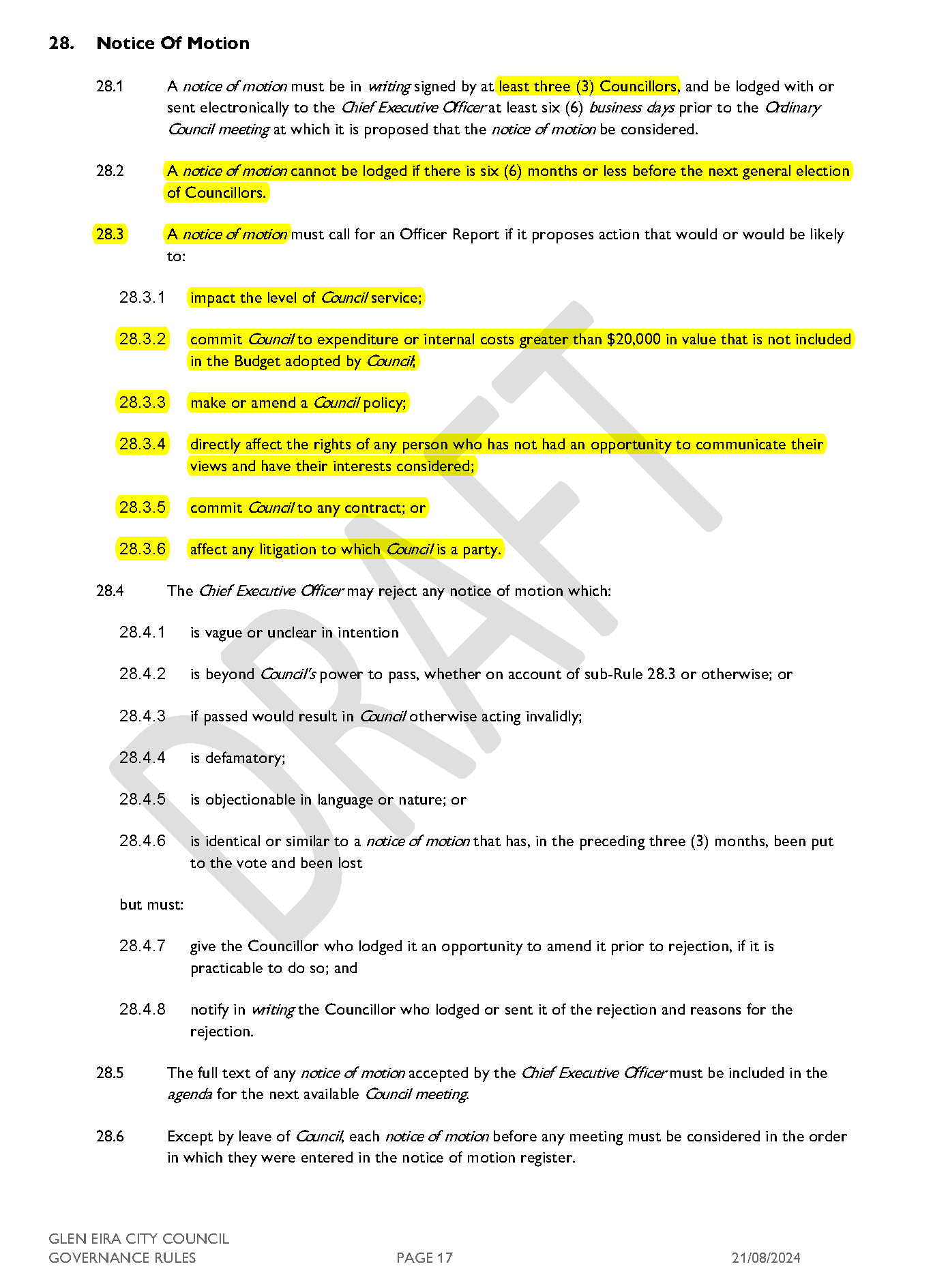
Even more baffling and unexplained is council’s new ‘arrangements’ for a notice of motion –
Questions abound:
Why restrict notices of motion to more than 6 months out from an election? No other council we know of has done this!
Why when certain councillors have voiced public opposition to the need of 3 signatories, is this still in place?
6 ‘business days’ in effect means at least 9 days prior to a council meeting
Unclear if the officer report would be tabled at the designated council meeting or would this drag out for months until the report was written and tabled?
Why can’t a notice of motion have anything to do with council policies?
Basically, what all of the above ‘conditions’ establish is the previous iteration of the mooted local law – an officer report that would take an eternity to eventuate. Given that the purpose of a notice of motion is the ability for councillors to get something onto the agenda, especially if it is urgent, this is simply another attempt to limit the input and autonomy of councillors.
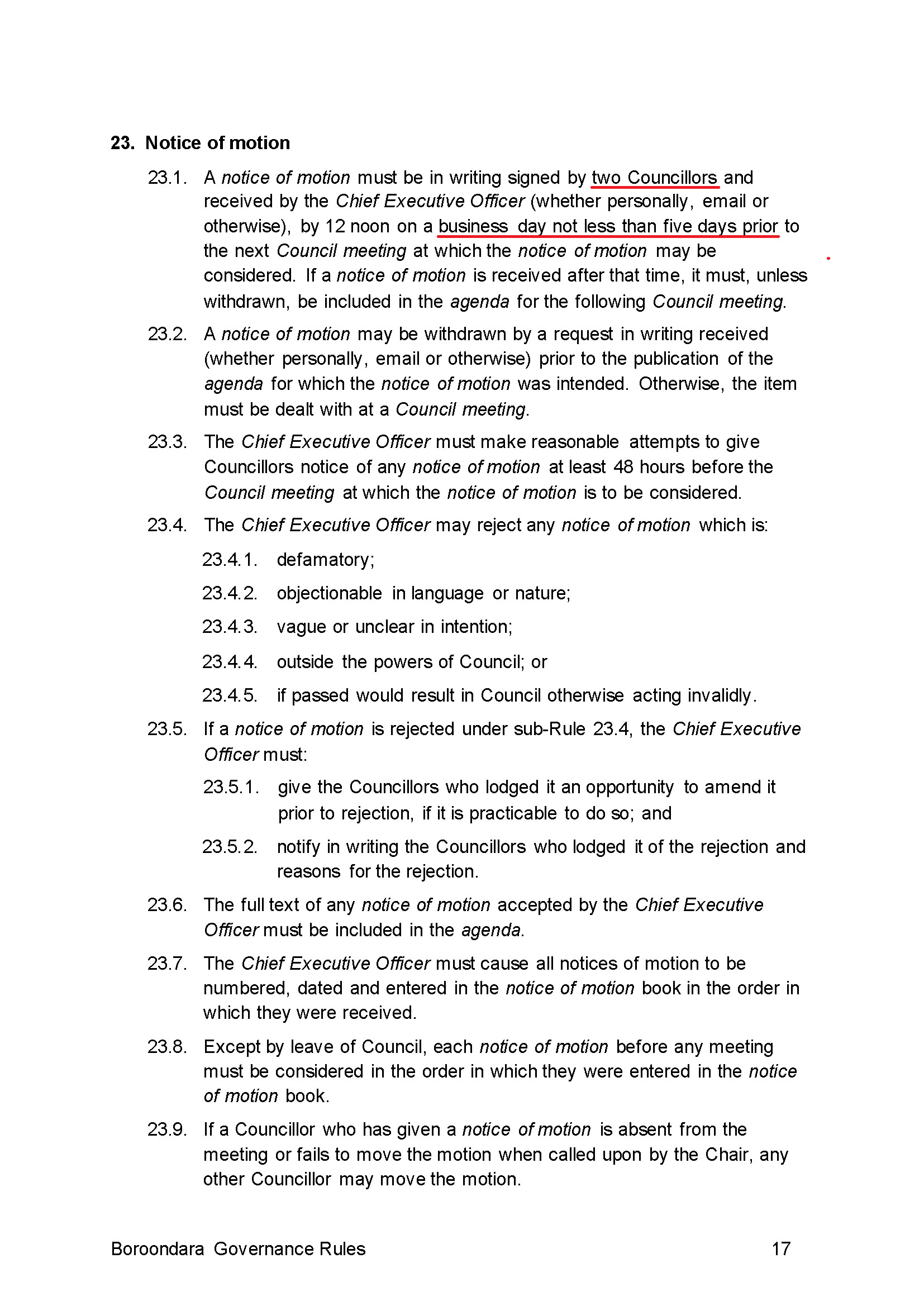
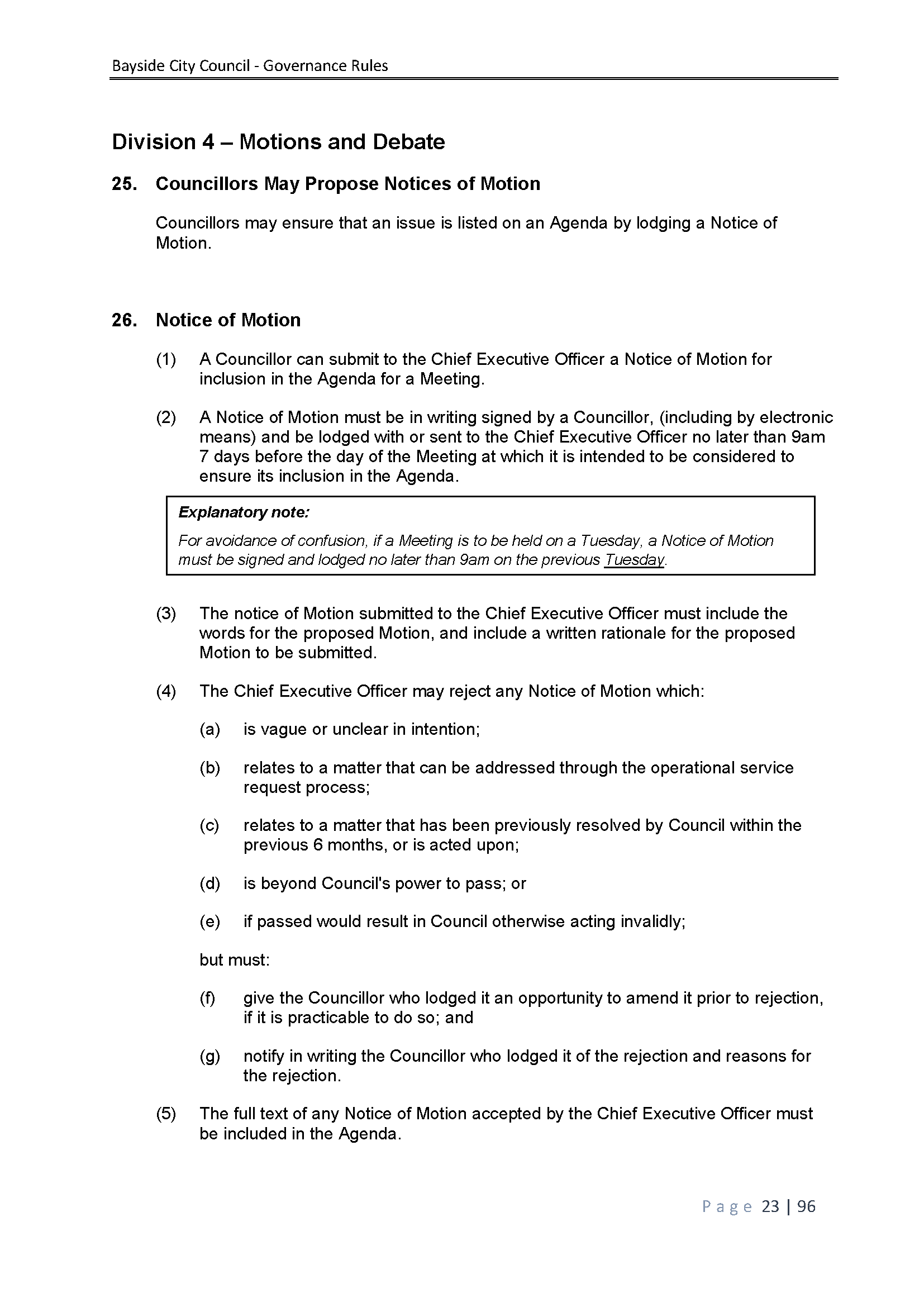
By way of contrast, please see the following from Bayside and Boroondara and the ‘restrictions’ they place on their councillors via the notice of motion issue.
There are countless other examples where the final drafts fall well short of ensuring that governance in Glen Eira meets the full standards adopted by other councils. Unless processes are spelt out fully then all remains in the hands of this administration and/or is left to the poorly defined discretion of the Mayor.
It would appear that once again residents have had the wool pulled over their eyes. As a local law that in all probability will remain untouched for the next 10 years, it binds the upcoming future councils to a set of processes that are anything but explicit, democratic, and transparent. It seems that this administration is determined to keep full control in their hands and to sideline as much as legally possible both councillors and residents!
After two months of total silence on the proposed state government housing targets, council has produced its formal submission on the matter. Readers should remember that Glen Eira has been told that its target will be 65,000 net new dwellings by 2051 – that is a doubling of the current housing numbers.
The submission does highlight what most other councils have complained about – ie.lack of detail; lack of strategic justification; lack of funding for essential infrastructure; importance of open space and the failure to consult with councils and community. But, unlike other councils’ submissions which are currently available, Glen Eira in both tone and content baulks at truly trying to protect the municipality. Here’s some of what other councils had to say in their submissions.
Stonnington
The Council’s attempts to engage in meaningful consultation with the State Government to ensure that the needs of the local community are met have been largely ignored.
On behalf of its local community, Council challenges the State Government to do better in future developments, in areas such as:
• High quality design of buildings, landscaping and public realm
• On-site provision of wraparound services to support community wellbeing
• the significant impacts to existing public facilities on which current and future residents will rely (for instance overshadowing of open space and recreation facilities)
• sufficient provision of useable, activated and safe open space and on-site amenity relative to the increase in population
• Embed decision-making processes that respond to site context, elevate sustainable design and value the voice of all stakeholders; increasing rigour through efficient and transparent planning approval processes, and at its core, the delivery of long term sustainable housing and services that are fit-for-purpose and support residents to thrive in the community.
Bayside
Council has grave concerns about the draft housing target for Bayside. The target of 31,000 additional homes has the potential to irrevocably change Bayside’s character and undermine the strategic planning framework that has been put in place tomanage and facilitate growth, whilst maintaining the liveability and character of themunicipality.
Council is concerned about the preparation, and release, of housing targets which vastly contradict current planning with no engagement with Councils, community or industry bodies. Furthermore, releasing these targets directly to the media without engagement or warning to industry bodies further fuels unnecessary concern in the community
Frankston
While Metropolitan and Major Activity Centres are locations identified for change and growth, the right balance must be struck to ensure that strategic planning for these centres ensures the right outcomes. It is important that development, open space and streets have access to sunlight, that built form is responsive to its environment, streets are of a human scale and that these centres remain liveable – the very essence of Melbourne, ‘the world’s most liveable city’.
Hobson’s Bay
The current Hobsons Bay Planning Scheme and its zones and overlays for the municipality, based on the Housing Capacity assessment from 2019, has a significantly lower capacity than the State’s June 2024 draft Housing Targets and at present, the Housing Targets cannot be accommodated in Hobsons Bay
The best that Glen Eira can come up with is – The submission argues that the housing targets of 65,000 additional new dwellings for Glen Eira should be revised down to 55,000 to reflect the capacity identified in Glen Eira’s Housing Strategy 2022. The Housing Strategy was underpinned by detailed neighbourhood character assessments and a housing capacity and demand analysis as well as extensive community consultation.
No real mention in the Glen Eira submission of: neighbourhood character, sunlight, or flooding risk (council’s overlays date back to 2005!!!!). Again, readers should remember that the Housing Strategy was voted in by the skin of its teeth and as far as consultation goes this was nothing but a sham when over 110 people attended a meeting at the town hall and voiced various objections. This did not even rate a mention in the summary report. Council also refused to release the community surveys. All we got was a bogus ‘summary report’.
Whilst council might not agree with 65,000 new dwellings, they are happy with 55,000 arguing that this is based on the ‘capacity’ analysis which accompanied the Housing Strategy. Several points need to be borne in mind here:
The capacity analysis was completed in 2021. How many sites have now been developed in the last three years which reduce the figure of 55,000?
What is totally ignored and unstated in the council submission is that the capacity analyses that landed on the figure of 55,000 was Scenario 3 which mooted the removal of the mandatory garden requirement for all 7000+ properties zoned GRZ. The subsequent amendment decided against this move. Hence, there is less land available for development and certainly less than the cited 55,000.
When the analysis was done, not all of the subsequent heritage listed properties were done, dusted, and gazetted. Several amendments are still waiting to be gazetted. Again, this removes the ability to increase units per site and is again ignored in the latest council document.
To settle on a figure of 55,000 as suitable and appropriate is literally mind boggling and strategically impossible to justify given all the above.
To base planning completely on a fictional housing capacity figure as the state government insists upon is untenable. If this were the case, then in all probability most councils could have capacity for 100,000 new dwellings. It would be easy to achieve by simply allowing towers of 20 to 30 storeys in all activity centres and ignoring the environment, heritage, required infrastructure, and the contentious issue of ‘neighbourhood character’. Even a ‘reduction’ to 55,000 as council has done would spell disaster for many of our suburbs.
WHAT DOES THE SUBMISSION SAY?
On some of the most important issues Glen Eira sticks to the current pro-development ideology. Here are some of them –
Social/Affordable housing
Instead of fully supporting the introduction of a MANDATORY aspect to the provision of social/affordable housing, Glen Eira instead argues:
….Council cautions against introducing a system that makes all new housing more expensive to subsidise affordable housing and one that potentially makes it even more difficult to build new housing in a climate where land and construction costs are already very expensive.
In other words, nothing should be mandatory. Compare this approach to some of the other councils’ submissions –
Frankston – An easier, mandatory affordable housing mechanism must be considered as part of the Plan for Victoria, prioritising locations that are close to services, jobs and transport and in locations where there is a cluster of key workers, such as a health and education precinct.
Moonee Valley – argues for Mandatory planning controls in the Victorian Planning Provisions to deliver social and affordable housing at scale.
Mandatory controls versus the current ‘performance based’ process
It would appear that for Glen Eira mandatory controls should be severely limited. Again, this flies in the face of what other councils have put forward. In terms of deciding planning applications, Glen Eira comes down firmly on the side of ‘let’s have flexibility’ and let planning officers decide rather than adhering to mandatory/ prescriptive standards. Here’s how this is argued:
Council’s urban planners do an excellent job in negotiating improved outcomes on developments, and while some of what they do could be codified, their work sees better outcomes than if much of what they do were to be codified.
In other words, ‘we don’t want mandatory standards’ where it might impact on developers!!!!! Is this why these officers are incapable of ensuring more than a 5% social housing component, or a paltry 150 such dwellings in a yield of 3000+ for the Virginia Estate project? Why can other councils ‘negotiate’ up to 20% for a social housing component?
Data Presented in the Glen Eira Submission
Featured prominently in the Glen Eira document are several tables including the number of permits granted, as well as dwellings completed in various years. We take issue with what is presented and ask: is the divergence from publically available data deliberate? Where are the explanations for how this data has been compiled and accounted for?
Here are two tables where the figures are so skewed it is truly remarkable.
The first table is supposed to tell us how many developments of 10 or more dwellings were either completed, underway, or not yet started between 2018-2023. There is no breakdown of year to year. We have resorted to the state government’s Urban Design Development program which is based on data presented by council. This site presents what has been completed, or under construction, or ‘firm’ (ie with a permit) for various years. See: https://mapshare.vic.gov.au/udpmap/
We have concentrated solely on the results for 2022. According the map share data, the ‘completion’ rate is well above council’s claim of only 16 for a 5 year period. We have only bothered to look at some of the areas and our totals are well and truly above what council claims. Here is a shortened list for 2022 alone. We did not bother to go through other years ‘completion’ rates! If for simply one single year there have been at least 14 completed projects, then how on earth can council claim THAT FOR A 5 YEAR PERIOD THE TOTAL NUMBER IS 16?
1.111 Normanby Road, Caulfield North – 283 dwellings
45-47 Kangaroo Road, Murrumbeena – 15 dwellings
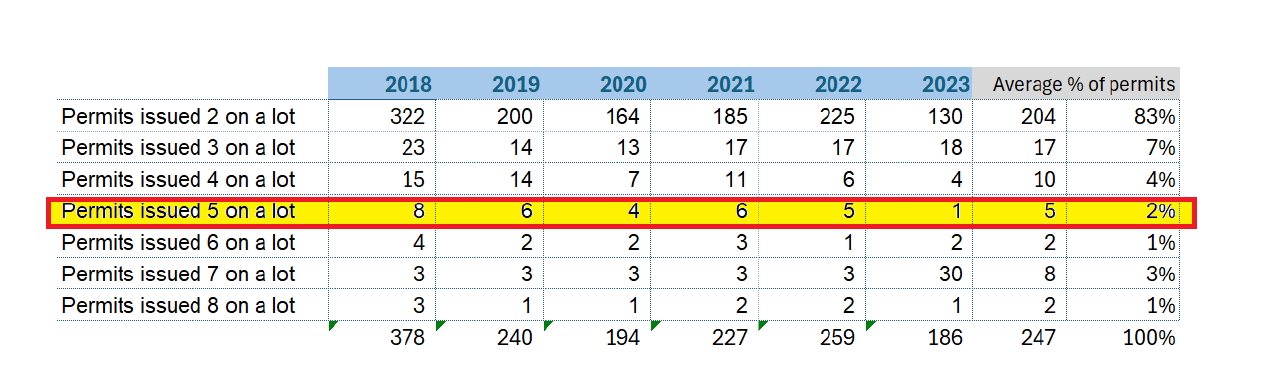
The second council table is also open to query.
This is supposed to tell us how many permits were granted for 2, 3, 4, 5, etc. dwellings. We are told that for the year 2023, only ONE permit was granted for 5 dwellings. Then why does council’s own planning register reveal that there have been at least 3 such permits granted. Here are the addresses and the dates permits were granted – all according to the online planning register –
All of this brings us to the central question: If we can’t trust council data, then how on earth can we trust their decision making? Or is all data simply geared to producing one single desired result? Who is accountable for this?
This has been an extremely long post for which we beg indulgence from our readers. However, it does go to the heart of what we believe is wrong in Glen Eira. Namely:
A refusal to take a far more critical and public stand against government policy as countless other councils continue to do
The continued publication of data that is both suspect and misleading and proffered as absolute ‘fact’
The continued preference to leave ‘control’ basically in the hands of officers, rather than see the introduction of essential mandatory standards
The failure to introduce any processes that can benefit the community – ie developer contribution levies, as well as opting for more than 5% for a social housing component in all major projects
Until residents can have absolute trust in this administration, or in councillors that are truly fulfilling their roles of oversight, questioning, and listening to the community, we will continue along this same path that ignores all that the community has stated again and again is fundamental to its ‘liveability’.
At last week’s council meeting councillors unanimously resolved to seek ministerial approval to advertise the Caulfield Major Activity Centre amendment. To refresh our memory here is some of the history surrounding this issue:
The final structure plan was decided in September 2022 and scraped through on the casting vote of Magee – as has happened with several other major structure plans. Those voting against the plan were Esakoff, Zyngier, Pennicuik and Szmood. Concerns included the proposed heights, the activity centre zoning, parking, etc. The final resolution accepted: one 20 storey height and other precincts ranging up to 12 storeys. All heights were discretionary with none cited as mandatory.
8 storey preferred height above heritage in Derby Road
The accompanying background document from the first version of the structure plan by Charter, Keck and Kramer stated that the various precincts would house 8700 new residents and that the vast majority of new dwellings would consist of 1 and 2 bedroom apartments.
So what has changed to have the four previously opposing councillors now voting unanimously for the draft proposals? Nothing we believe has really changed and the proposed schedule to the new Activity Centre zone falls far short of dealing with the concerns of both residents and the four councillors previously named.
If we examine the schedule closely we find:
A paltry 5% for every 20 dwellings to be social/affordable housing. When you are anticipating around 4000+ net new dwelling that makes it only 200 of these residences. Pathetic – especially when we are told time and again how lacking in social/affordable housing this municipality is.
No mention of overshadowing and sunlight requirements for open space and/or surrounding properties.
Reduction in car parking requirements
No consideration of the impact on existing and proposed new open space with the substantial mooted increase in population.
Review rights ONLY if the nominated heights and/or setbacks are exceeded in upcoming proposals. Even this is not across the board but only for specific precincts. It basically means that the proposed heights are now a given. Furthermore development plans only have to be advertised ‘for public comment’ and council is required to consider them rather than allow formal objections.
The schedule repeatedly mentions ‘diversity’ of dwellings, yet we know that the forecast is for over 90% to be single and 2 bedroom high rise apartments.
No mandatory height limit or setback requirements
As with everything this council does we have the magical get out of jail phrase of ‘where appropriate’ added to the objectives for decent landscaping and parking.The sentence which best sums up this nonsense is: To encourage the retention and enhancement of existing mature vegetation where appropriate.
Once again we find the phrase ‘generally in accordance’ with any future development plan. As we’ve seen with Caulfield Village this isn’t worth the paper it’s written on given that the Incorporated Plan nominated 1100 net new dwellings. Once finished Caulfield Village will exceed 2000! It is carte blanche once again for the MRC when we find the following sentence included in the schedule – Where there is an inconsistency between a provision of this schedule and the development plan, the provisions of the development plan prevail.
Activity Centre Zones (ACZ)
This is the first ACZ zone to be introduced into Glen Eira. It is therefore important to understand and compare what other councils have achieved with similar zoning. Below we feature the gazetted (ie approved) schedules that other councils have achieved in the past 20 months. We quote verbatim from the various schedules and simply ask – why don’t these conditions also apply in Glen Eira?
BANYULE – amendment C162 November 2022
Overshadowing and Pedestrian Amenity
Development should be designed to avoid casting shadows on the defined Solar Access Area shown on the Framework Plan and Precinct Plans for Precincts 1 and 3. Generally, buildings should not overshadow the footpath on the south side of this part of the Main Street between 11am and 2pm on 22 June.
Development should be designed to avoid casting shadows on the Town Square as shown on the Framework Plan and Precinct Plans for Precincts 1 and 3 between 11am and 2pm on 22 June.
DAREBIN – Amendment C182 – August 2023
The agreement must provide for an Affordable Housing Contribution defined as:
1. The transfer of land that has the demonstrated capacity to support the development of 10 per cent of the site’s total residential yield as affordable housing dwellings, to a registered housing agency at nil consideration for the Agency to develop and rent and/or sell completed dwellings to eligible households. An average 65 square metres /unit is proposed to be used to calculate the amount of land to be provided; or 2. 6 per cent of dwellings provided at 30 per cent discount to a registered housing agency;
Street wall height requirements
Street wall heights must not exceed the maximum measurements specified in clause 5.0 of this schedule
Overshadowing requirements for public open space
Development must not overshadow:
– more than 50 per cent of the primary public open space within the precinct between the hours of 11am and 2pm on 21 June.
– Any part of the Preston City Oval (playing surface and surrounding open spaces) between the hours of 11am and 2pm on 21 June.
– Areas of the public open space north of the Preston City Oval playing surface to the southern edge of the inner footpath and south side of Cramer Street (including the barbeque/picnic area in the north-eastern corner) between the hours of 11am and 2pm on 21 June
Moonee Valley – Amendment c207 – January 2022
Built form above the street wall height must cast no additional overshadowing between 11am and 2pm on September 22 to open spaces and streets identified with a spring equinox solar control on relevant precinct maps. The spring equinox solar controls apply to the length of the southern footpath on Holmes Road, Puckle Street and Alexandra Avenue, measured from the property boundary to the existing kerb. A permit cannot be granted to vary this requirement.
Built form above the street wall height must cast no additional overshadowing between 11am and 2pm on June 21 to open spaces identified with a winter solstice solar control on relevant precinct maps. A permit cannot be granted to vary this requirement.
A permit cannot be granted for buildings and works which exceed the maximum building height specified in Table 1.
Table 1 – Mandatory building heights
Sub-Precinct
Mandatory maximum building height (excluding basement)
9A
20 metres
9C
11 metres
9E
14 metres
9H
32 metres
Geelong – Amendment C431 – March 2023
Table 8. Mandatory overshadowing requirements for existing and proposed public open space and the proposed Geelong Station Forecourt.
Austin Park
Johnstone Park
Customs Park
Transvaal Square
Steampacket Gardens
No additional overshadowing. 10am-3pm 22 June
Proposed open space
Proposed Geelong Station Forecourt
No additional overshadowing beyond a shadow that would be cast by a wall on a boundary of not more than 8 metres. 10am-3pm 22 June
Conclusion
So we now wait for the formal consent to advertise this draft. It will head off to a planning panel where the chances of residents’ concerns being addressed and ameliorated will be minimal. That is what invariably happens once structure plans scrape through by the skin of their teeth and councillors permit sub-standard planning to end up at planning panels. This whole exercise is merely another example of how little Glen Eira council is prepared to say ‘no’ to anything associated with the Melbourne Racing Club.
Glen Eira clearly makes up its own rules as it goes along, regardless of whether or not these rules are in accordance with its adopted policies and governance rules and which are still current. Recent meetings provide us with conclusive evidence of these machinations. We refer to public participation and written questions to council.
Public Participation
Out of nowhere we are now being informed that residents in the public participation section of a council meeting have only 3 minutes in which to address council. Also, that the time allotted will be no longer than 15 minutes. Why? When was this decision made? And by whom? Most importantly, this new ‘law/policy’ is NOT IN ACCORD with the existing (2020) policy that clearly states at clause B(15) –
Members of the public addressing the Ordinary council Meeting are permitted to speak for a maximum of five (5) minutes (unless granted an extension of time by the Chairperson)
At last week’s council meeting one resident politely asked if he could have a 15 second extension. This was refused by Cade. Please listen carefully to this audio –
Neither the current guidelines nor the Local Law state the duration of public participation or the public question sections. Yet throughout most of this year we are told that they will last 15 minutes only. It’s important to note that the so called ‘guidelines’ which determine procedures have NOT BEEN AMENDED at the time of writing.
Public Questions
When compared to other councils we again fall short. Here’s what they do:
Monash – Public question time is limited to 30 minutes, unless otherwise resolved by Council.
Darebin – Public Question Time will not exceed 30 minutes in duration unless extended by resolution of Council through a procedural motion, in which case, it may only be extended for one (1) period of up to 30 minutes.
Merribek – The time provided for questions of Council and community statements will not exceed 30 minutes in duration, unless by resolution of Council, in which case, the time may be extended for one period of up to 30 minutes.
Boroondara – The time allocation of 15 minutes may be extended by resolution of Council.
Hobson’s Bay – Twenty minutes will be allocated in the agenda for Public Question Time. However, the Chairperson may vary the time allocated depending on the business to be considered at the meeting. No resolution of Council is required to extend Public Question Time.
Maribyrnong – Public question time will not exceed 15 minutes in duration unless the Councillors present unanimously agree to the time extension, in which case Public Question Time can be extended for further blocks of 15 minutes.
We certainly accept that when a contentious issue arises, there may be numerous residents who wish to address council meetings or submit a public question. Given the length of some agendas, it may therefore not be possible to allow everyone to speak or to answer all the public questions. But we would also argue, that if an issue is so contentious and/or divisive, that it has caused a massive public response, then the onus is on council to provide as much time as possible for councillors to listen to their constituents. Councillors must be provided with the right to extend both public participation times and public question times. Otherwise the perception remains that all council is doing is attempting to limit as much as possible resident voices.
All of the above is important because the draft governance rules and the associated policies are now out for public consultation. They basically seek to legally cement what has been happening this year, and hence are unacceptable.
Unlike other councils, Glen Eira’s governance rules in regard to public participation and public questions are basically bereft of important detail. What becomes the ruling factor are the so called ‘policies’. Whilst neighbouring councils itemise all aspects and procedures, Glen Eira relies primarily on the policies. Why? We believe that this action is designed to side-step the need for public consultation which a formal amendment requires as part of Local Law procedures. It also allows council to tinker repeatedly with these policies as they see fit. This is not sound governance and certainly not in the public interest.
The latest drafts for public participation and for public questions specify a 15 minute time limit. They do not provide any time duration for a resident addressing council in the public participation format. Everything is left open to the ‘discretion’ of the Chairperson (ie mayor). Nor are we told whether residents must be present in chamber for their question to be read out and answered as stipulated in the 2020 changes.
These above points are important because council has always operated on the principle that if it isn’t in the ‘rules’ then we don’t have to do it! Or conversely, because it isn’t in the rules, we can do it! One should expect that something as important as governance rules be spelt out to the nth degree. Not only do these new proposed rules represent a deterioration in governance at Glen Eira, they also further sideline councillors and residents.
We have to question what is really happening with consultation in Glen Eira. Residents and councillors are literally snowed under with a plethora of current consultations. After tonight’s council meeting there will be seven issues that are currently open for input/submissions. Very soon, another 2 important planning items will be added – the Bentleigh and Elsternwick structure plans.
Questions abound! Why so many, why now, and how vital are they all at this point in time? And most importantly, what impact does a deluge of consultations have on community feedback and on councillors themselves? Was it really necessary that we now have a consultation on gambling, or even the economic plan? Considering that the budget will be discussed tonight, then surely this should precede an ‘economic plan’ so that the budget would set the parameters.
It is asking a lot for residents to partake in any meaningful manner on these consultations. Admittedly, not every issue will be of concern to all residents. Some may be interested in the annual budget, and not in gambling policy. People will pick and choose and decide if they have the time and energy to provide feedback. Glen Eira will of course continue the rhetoric that it cares about consultation and consults regularly. Over the years however, feedback on many of these consultations have been extremely poor – apart from the really contentious issues such as the Inkerman bike path, or the Queen’s Avenue cycling path. Yet, council has never really investigated why there has been a low feedback rate, and nor have they come up with any answers.
If there is simply apathy, then it is incumbent on council to explore why. Could it possibly be that once bitten twice shy? When people have taken the time to provide feedback and then discover that nothing they have said has been responded to or even listed in summary reports they give up and believe that council simply doesn’t listen or act upon their suggestions? This would be enough to put anyone off from trying again! A truly responsive council is one that monitors and investigates the results of all its consultations. We don’t believe this is happening in Glen Eira!
We have long advocated for the following to occur:
A short succinct summary of proposals that don’t require residents to plough through hundreds of pages (mostly of spin) prior to submitting their feedback
Surveys that are deliberately open ended instead of question upon question that is geared to garner the required response.
The involvement of councillors and the consultation committee in vetting questions and processes prior to consultation
In the next month or so residents and councillors will be confronted with up to 9 consultations occurring simultaneously. That is nothing but a recipe for disaster! But is this what council really wants?
Bayside council completed a Panel Hearing during February 2024 for its heritage proposed amendment C192. The report is not yet available. What is significant in this council’s approach to preserving heritage when compared to Glen Eira is the insistence on the ‘value’ of heritage to the entire community. The Glen Eira approach has simply stated that because council has identified certain areas as suitable for ‘housing growth’ heritage can be overlooked!
Bayside council’s submission to the recent planning panel is fascinating when seen in the light of Glen Eira’s approach. Our council tells us repeatedly that there could be serious ‘social’ and ‘economic’ drawbacks if certain sites are allowed to remain in the existing heritage overlays. They can therefore be removed. Bayside counters such views with the following extracts from its formal submission. We’ve uploaded several sections from this document. Please note the differences in approach and what this means for heritage preservation.
Despite persistent claims from councillors and this administration that preserving heritage is vitally important, last night’s council meeting provided conclusive proof that in the choice between facilitating development or preserving heritage listed sites, heritage would always lose.
The issue surfaced with the proposed amendment to the Elsternwick heritage study which is now seeking ministerial approval for advertising. Repeated time and time again throughout the various attachments we find the following (verbatim) paragraph:
Including these sites within a Heritage Overlay would negatively impact on potential future housing growth within locations that Council has resolved to allocate to housing growth. This inconsistency has social and economic implications. When balancing Council’s adopted strategy for housing growth opportunities in these locations with heritage protection, it is considered that in these two instances, housing growth should prevail.
We note that there is no explanation of what these ‘social and economic implications’ are, nor how they are assessed and verified. Surely the preservation of heritage buildings has its own wider, ‘social’ benefits?
All of this stems back to 2019 when council attempted to have amendment C203 accepted. The Minister or department decided at that time that not all the nominated precincts be included because this would impede development. A department letter to council stated:
“At this stage it is not considered appropriate to apply the Heritage Overlay more extensively in Elsternwick given that Council is yet to seek authorisation for a planning scheme amendment to implement the Elsternwick Structure Plan. Doing so could, by default, lead to heritage controls becoming the primary driver for development outcomes within the Elsternwick Activity Centre.
Council’s response? Not a whimper! No public questioning of the legality and common sense in 2019 and not again in 2024. Council meekly accepted the decision and has now enshrined this in the latest amendment attempt. The result is the continued loss of heritage buildings in Glen Eira, and particularly in Elsternwick.
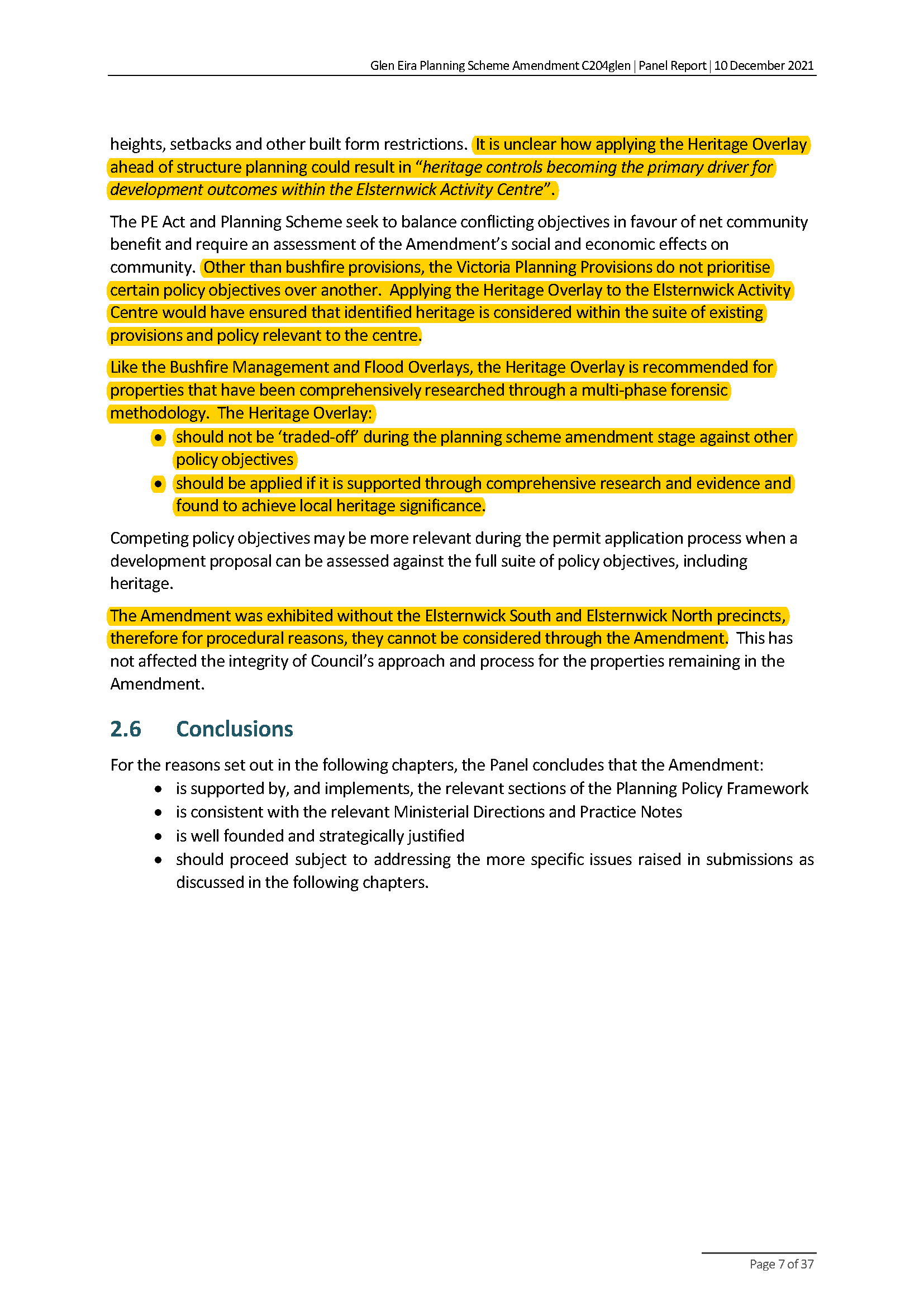
When Amendment C203 finally went to a planning panel, the members were not averse to stating clearly their disapproval of the imposed conditions. We have uploaded two pages from the panel report at the conclusion of this post. Their conclusions questioned the legality and evidence for the exclusion of the nominated precincts. They found that the amendment:
1. Is counter to Planning Practice Notes 1, 58 and 60 and that
2. Development potential is not a valid criterion when considering heritage potential.
3. Development potential is NOT prioritised above any other criteria in the planning provisions
4. No valid justification has been provided for the exclusion of the precincts
5. Contravenes Plan Melbourne where heritage is said to be ‘fundamental’ (Clause 4.4.3) to the state’s cultural identity.
Last night’s officer’s report confirms what an absolute shambles planning, and particularly heritage has been in Glen Eira. The latest amendment is simply trying to largely rectify the indifference and errors of the past when countless streets containing confirmed heritage overlays were rezoned as Residential Growth Zones (RGA and 4 storeys) when they should not have been! Here’s what the latest heritage report states:
The application of the RGZ in these almost exclusively residential Heritage Overlay areas is contrary to the guidance of PPN91 (Planning Practice Note 91 – Using the Residential Zones), which identifies that there will be difficulty in reconciling the conflicting objectives of substantial housing change (through the application of the RGZ) and the conservation of existing buildings (by applying the Heritage Overlay).
In other words, the introduction of the residential zones in 2013 was a disaster for heritage. Many sites in these heritage overlays have now been demolished and replaced with 4 storey apartment blocks as a result. We remind readers that we are yet to see a full and decent review of this zoning!!!!!
Our argument is simple. If something is determined to be worthy of heritage listing then it MUST take precedence over development potential. Council chooses the alternative – development always comes first!
The vote last night was 7 to 2. The opposing councillors were Esakoff and Parasol and NOT because they were against the removal of so many heritage sites, but because they wanted one nominated dwelling removed from being included in the overlay, even though it is surrounded by heritage cited properties! So much for giving a damn about heritage in Glen Eira!!!!!
Council is proposing a new Local Law designed to protect not only SIGNIFICANT trees, but also canopy trees on private property which qualify under height and width criteria. This is certainly an improvement and should protect more existing trees. However, how many existing canopy trees will actually be covered by the proposal(s) depends to a large extent on how well the upcoming Local Law is written and what is its true intent. What also needs to be considered is to what extent all decisions will be fully transparent and who will make these decisions. Will it be left entirely in the hands of officers, or will councillors have the final say as in numerous other councils on which permit applications are granted or refused?
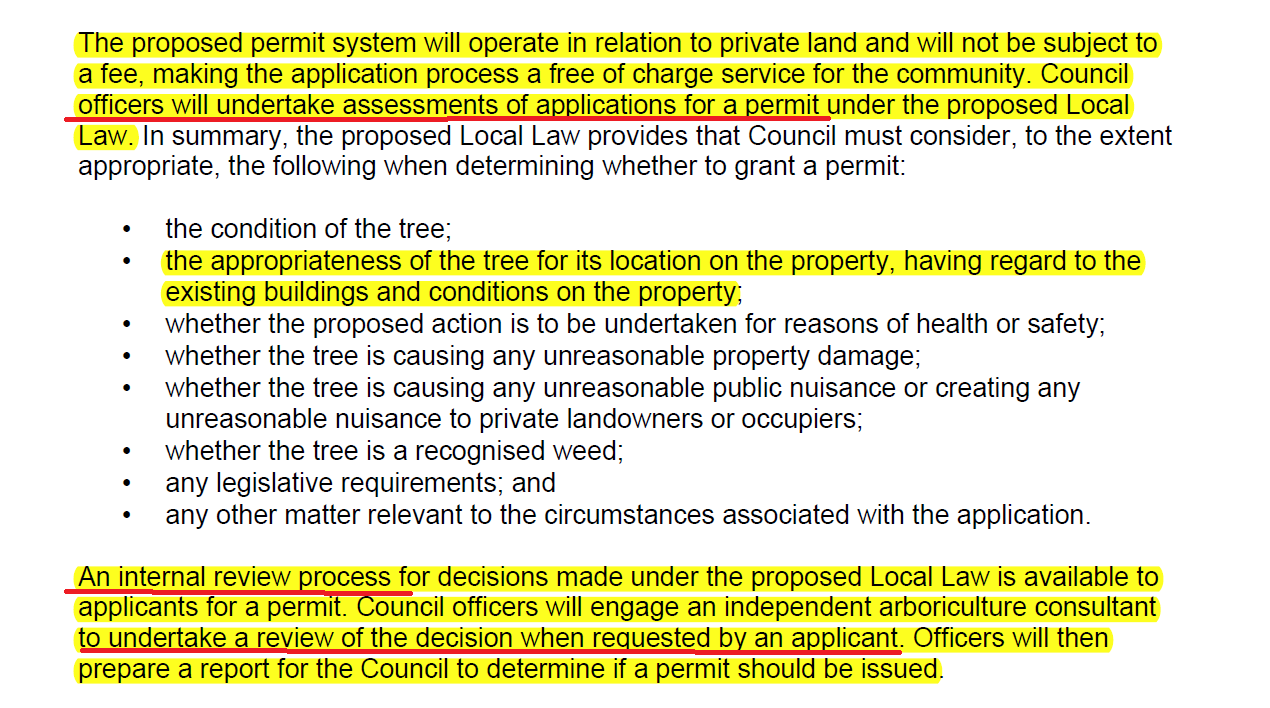
The officer’s report includes the following paragraphs on this last point:
The above is very ambiguous. We are told that officers will presumably undertake the initial assessment when there has been a permit application, and this is fair enough. The final paragraph however clearly states that there will be an ‘internal review process’ but only for those applicants who have requested a review. Thus, if a permit has been granted, then there is no need for a review! Officer’s will have made the decision and that’s the end of it with no councillor involvement, or no objection rights by anyone it would seem.
The paragraph continues that a report will be prepared but this is dependent on whether or not the applicant has chosen to seek a review as stated previously. What remains unclear is whether the officer report will also cover applications that have been granted a permit ‘internally’ and whether the tabled report is there simply for ‘noting’ or for councillors to make actual decisions? Even with the existing significant Tree register local law, councillors are sidelined and all decisions are made by officers. There is therefore no transparency and no accountability for decision making. We suspect that the proposed new law will be the same. Surely the onus on council is to clear up any ambiguity and to ensure residents that trees will be fully protected.
There are other issues with the proposals as well. Here is our take on these:
Clause 2(b)of the proposed Local Law states that a permit is required to prune or direct, authorise or allow to be pruned a Classified Tree or a Canopy. But we then get the ‘exemption’ that this clause does not apply if Council is notified within five (5) working days of the commencement of the pruning.
This may sound quite innocuous, but it has major repercussions. Why the 5 days grace? Most pruning would be concluded well within 5 days. If an applicant then calls council and says ‘I’ve pruned my tree’ what evidence exists that the pruning was in accordance with the 10% maximum reduction of canopy allowed? What evidence do we have that the branches were less than 10cm in width?
Bayside, by contrast, has processes that would ensure the pruning is done legally. They insist on:
Photos taken BEFORE and AFTER
That the work be done by a qualified arborist
That the arborist has to sign off by certifying the work done.
NONE of the above applies in Glen Eira!!! This leaves a huge loop hole that can easily be taken advantage of.
Compounding the problem we then get this additional clause regarding pruning:
Subclause (2)(b) does not apply to pruning, which is carried out to the following specifications—
(a) up to a maximum of 10% of the Classified Tree’s or Canopy Tree’s total volume within 12 calendarMonths
We assume that this means there can be numerous episodes of lopping throughout a 12 month period. But given that no permit is required we again lack evidence that only 10% has been lopped? Nor are we told whether or not each lopping requires council to be notified – even within the 5 day period.
One other change to the current Local Law is also worth commenting upon. Please read the following carefully:
Questions abound. Consider this scenario – No permit has been applied for. A neighbour complains to council that a large canopy tree is being removed next door. According to the current Local Law, the property could be entered by a council officer and inspected. With the proposed new law, this could only happen if the owner of the tree has ALREADY APPLIED FOR A PERMIT. If he/she hasn’t, then they the new law does not provide them with the power to investigate and potentially call a halt to the tree removal!
CONCLUSION
Whilst these proposed changes are definitely an improvement and an attempt to protect our existing canopy trees, they simply do not go far enough. We fully accept that there may be situations where a tree presents a major health risk due to storms, etc and should be lopped/removed in the name of safety. But, there are far too many loopholes in the proposed new law that can be exploited. All that is required is that clauses such as Bayside and other councils have is included and that the essential role of monitoring evaluations occurs by councillors. What role councillors will play needs to be spelt out clearly. This has not been done.
Leaving everything in the hands of officers does not engender full transparency and accountability in decision making. Bayside for example also publishes on a regular basis a list of permits granted for the removal of trees. There is nothing in this proposed law which will ensure that decisions on whether to refuse or grant a permit will ultimately be made in the full council chamber so that all residents can see and listen to the evidence.
ONE FINAL POINT. All of the above of course is dependent on whether a planning permit for the site has been granted. The permit could and often does include permission to remove existing trees. Given that planning permits are largely decided by officers and that at least 15 objections are required before the application can go to council, this again places enormous power in the hands of officers.
Tuesday’s council agenda features the latest version of the Housing Strategy. Readers will remember that there was a huge outcry surrounding the proposal that all GRZ sites would have the mandatory garden requirement removed. On a positive note, this idea has now been abandoned!!!!!
Readers should also remember the persistent claims that council is fully committed to improving landscaping, increasing tree canopy across all of Glen Eira, and implementing the Urban Forest Strategy. The claim then was that with the removal of the mandatory garden requirement this would ensure better landscaping opportunities. So what has council done now to ensure that our tree canopy increases and all principles behind climate change and the growth of the Urban Forest is well on track?
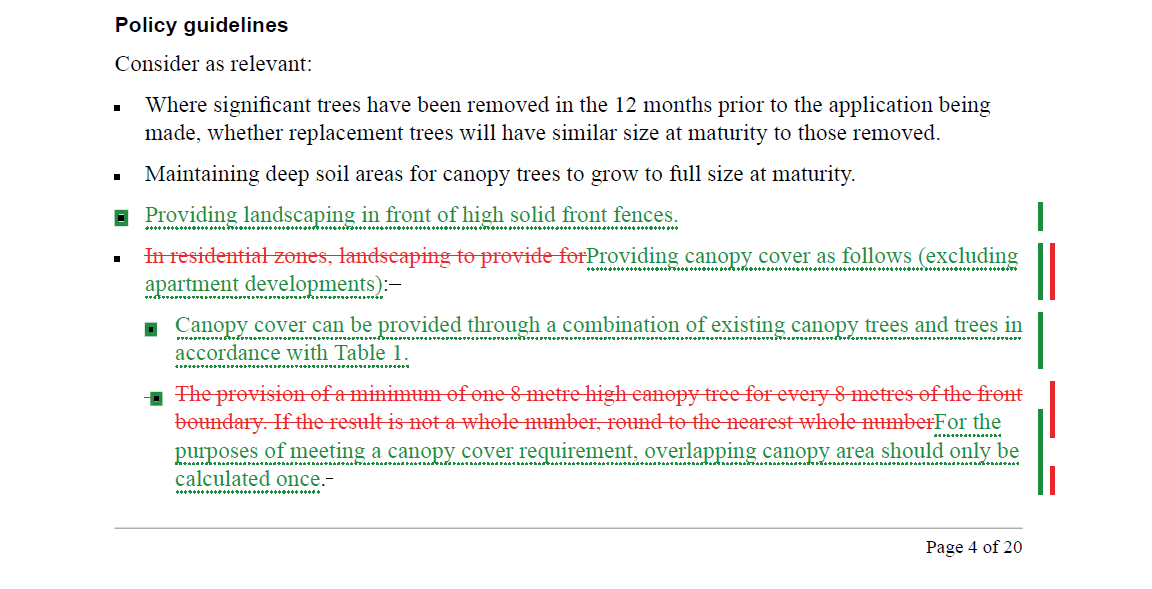
Included below are the pages from the agenda (p144-145) which outline all the new landscaping proposals. The writing in red (and crossed out) shows what is currently in the planning scheme and the green notations are the new recommendations.
Please notice the following:
The stated objective on page 144 is to: To strengthen landscape character across Glen Eira.If this is the case, then why are we told that apartments are ‘excluded’!!!!!! Surely apartments, and all GRZ and RGZ areas which would feature apartments are equally part of Glen Eira and deserve some decent landscaping?
Gone entirely is the following from the planning scheme: The provision of a minimum of one 8 metre high canopy tree for every 8 metres of the front boundary. There is also the requirement for canopy trees in rear setbacks as stated with the following: The provision of a minimum of one 6 metre high canopy tree for every 8 metres of rear boundary in the Neighbourhood Residential Zone and the General Residential Zone. However, the resulting new schedules to the NRZ and GRZ zoning completely alter the above standards. All that we now get are these miniscule requirements –
FOR SOME SITES ZONED NRZ the schedules state:
Retain or provide canopy cover equivalent to at least 22 per cent of the site area, including at least one medium canopytree within the front setback with a minimum mature height equal to the height of the roof OR THE EVEN WORSE ‘STANDARD’ OF – In addition to the requirements of B13, retain or provide at least one medium canopy tree within the front setback.
FOR THE GRZ AND RGZ ZONING ALL WE GET IS – In addition to the requirements of B13, retain or provideat least one canopy tree within the front setback
Please note that NO MENTION IS MADE OF REAR GARDEN REQUIREMENTS!!!!! Furthermore, given the reduction of both front, and rear setbacks in some of the proposed schedules, the end result can only be a further deterioration of our tree canopy and the sabotage of all council climate change policies.
Instead of using this opportunity to increase permeability in the GRZ, or at least maintain RESCODE street setbacks, council has forgotten all its promises, its policies, and its commitment to genuine climate change strategies. In short, this new version of the Housing Strategy, is nothing more than a return to the future in that single zoning and their schedules cover all GRZ and RGZ zones whilst others in the NRZ have increased site coverage, and a reduction in their current permeability requirements. In short, we are going backwards in order to cram as many new dwellings into Glen Eira as possible, and regardless of whether or not we need this development!
Last night’s council meeting confirmed the latest Tweedledum and Tweedledee union between Magee and Cade. As there were only 6 councillors present, Cade exercised her second vote on several important items to ensure that the motions passed. Zhang was absent as was Athanasopolous – again!
On the May Street issue as to whether this was a ‘road at law’ the vote to note the officer’s report was – Magee, Esakoff, Cade and opposed Zmood and Parasol. Pennicuik abstained. Cade used her casting vote to ensure it got through.
On the Glasshouse relocation at the Caulfield Racecourse Magee moved an amendment that the Queens Road gate be closed from 10pm until 7am instead of being open till 4am every day. Once this was the substantive motion it basically precluded the alternative motion that Szmood foreshadowed. Voting for this amendment were Magee, Cade, Esakoff and opposed Pennicuik, Szmood and Parasol. Cade again used her casting vote to grant the permit.
Thus two major issues got through with plenty of misleading statements by Magee. For example:
The MRC has done everything that it was allowed to do! Really? Does this include coming in and removing 42 trees many of them heritage listed, plus buildings, only to be halted by a Heritage Victoria injunction?
The May Street issue is over and there’s nothing more that can be done he claimed. Not so! We believe that the ombudsman is now involved. This is just the first step! Both Pennicuik and Szmood stated that they were unsure as to the current status of May St. They implied that the council decision to not recognise May St as a ‘road at law’ lacked all the necessary ‘certainty’.
In our view, Cade’s performance thus far does not augur well for what may be in store in 2024. Since becoming deputy mayor, and now mayor, Cade’s performances have seen a 180 degree about face. We remind readers that she voted AGAINST the first Carnegie structure plan as well as the Housing Strategy. One has to query why this sudden turn around and will it continue? Or will she come to truly represent her constituents?
PS: We forgot to mention another item which surely belongs in the world of Monty Python given its nonsensical process. This involved the Hawthorn Road application. Szmood moved an alternate motion that the proposed 4 storey development be reduced to 3 storeys. Supporting this motion were: Pennicuik, Zmood and Esakoff. Opposing the motion were: Parasol, Magee and Cade. Yet, when it came to her casting vote Cade decided to vote FOR THE MOTION!!!! How on earth can you vote AGAINST the alternative and then with your second vote, support it?!!!!!!!!!







 Glen Eira Debates