GE Council Meeting(s)


The purchase of this property for $2.1 million we believe raises many questions. The questions multiply when we find that council’s intention is to lease this property until community ‘consultation’ is undertaken! Here are some queries for your consideration –

  • What happens if the ‘consultation’ results in the majority of residents opposed to the idea as the recent Fosbery/St Aubins proposal showed? Are we therefore in a situation where we are again facing a Clayton’s ‘consultation’ because the decision has already been made – especially since so much money has been spent?
  • Why was this property purchased in the first place given its proximity to Princes Park? Carnegie has many more ‘high priority’ listings than South Caulfield according to the Open Space strategy!
  • Why has Carnegie and other suburbs been ignored and all open space developments have basically occurred in Camden? Given that the Open Space Strategy itself states that this area will only see a marginal increase in population due to its zoning as largely Neighbourhood Residential Zone, why has council spent millions in this ward alone?
  • If council has spent $2.1 million on a very nice looking house, and we would expect at least another half million or more to be incurred in the creation of a ‘park’, then that brings us close to $3 million. Is this really ‘value for money’ for a site that is just over 600 square metres?
  • What will be the length of the proposed lease – 6 months, one year, 2 years?
  • Since the site is on a corner, are we again facing the prospect of streets being closed off and traffic diverted?
  • Why has the purchase of the Magnolia Street house at $1.49 million not been included in the open space reserve budget, but included under the ‘capital works’ budget?

We repeat what we have previously stated. We are totally in favour of more open space throughout the municipality. However, we also desire sound financial decision making that is transparent and accountable and equitable for all residents. The rate of development in our GRZ and RGZ areas are a major concern as council admits. This is where the greatest number of new residents will live and it is in these areas that open space is most desperately required – not in quiet residential streets that are within a stone’s throw of already existing large areas of open space and which the Open Space Strategy admits to seeing only a ‘negligible’ rise in population.

Congratulations to Mary Delahunty on being elected unopposed as the new Glen Eira mayor this evening. Jim Magee was elected deputy mayor for a period of two years.

Delahunty’s acceptance speech set a new tone for this council, and again we congratulate her on this.

The highlights of her acceptance speech were:

  • that the 5 new councillors were being given a unique opportunity to work for the community. The job comes with opportunity but also challenges.
  • dedicated to leading a ‘cohesive council and achieving the goals of our community’
  • wanted council to be ‘strategic’ and ‘showing the rest of the state what local government can be’ in terms of being a good employer, and having services that ‘are meaningful to the community’m ‘environmentally’ responsible and a council that ‘deals with fiscal responsibilities’ but with a ‘social benefit’. Plus, ‘we can be an absolute force when it comes to community advocacy’.
  • Had ‘faith’ that the ‘diversity around this table will lead to good community outcomes’ and that councillors will ‘respect each other’, the process, ‘this chamber’ and ‘the people who put us here’.
  • There’s the need to make sure that all people ‘feel welcomed and have a voice on council’.
  • There will be opportunities and challenges such as the level crossing removal and making sure that ‘in a constructive way we are putting the best interests of the community forward’. Noted the 2016 Community Satisifaction Survey where there were a ‘few areas’ where ‘people were happy’ but other areas where they weren’t. Of ‘great concern to our community is the intensity of development’ and ‘we have to be more forceful’ and ‘proactive’. Council has to now concentrate on the necessary strategic work and on consulting and protecting heritage and trees. ‘We have to bring the voices of the people into the process’.
  • ‘Good financial management’ whilst important is not an ‘end goal’. They are ‘enablers’ for ‘progress’
  • The racecourse is still an issue and thanked Magee for his work on this. But ‘we will finally put this right’.
  • The ‘community has voted for some change and I’m sure we can deliver that’. ‘We need to be the community representatives but with a strategic mandate’ and ‘we need to make as many opportunities as possible to hear from the residents’ and to ‘adopt a learning posture at all times’. The Local Law doesn’t allow this but does allow the mayor to have ‘discretion’ in deciding what can be asked. ‘I intend to exercise this discretion for 15 minutes’ from the next public meeting (applause).
  • On councillor allowances she will be ‘directing’ that a ‘portion’ of the mayoral allowance be used to fund family violence strategies. Said that as the level of government closest to ‘the people’ that Council needs to ‘play a leading role’ in the safety of the community.

Ended up by thanking family and friends.

Lobo arrived approximately 15 minutes late and apologised for his lateness. We also assume that he had not been present at the pre-meeting Councillor Assembly since he asked for the relevant papers. Whether this was his choice, or he was told not to attend, we do not know.

The first sign of trouble started with Item 9.16 (Caulfield Racecourse) when this was moved up earlier on the agenda. Following Delahunty, Lipshutz and Hyams speaking on this item, Pilling called on Magee. Lobo claimed that he had put his hand up first. Pilling said he only saw Magee and Lobo said ‘okay’ and that Magee could speak first. Magee expressed his concern about Mike Symons and the Minister’s letter to Trustees, requiring them to resign as well as tenants resigning as well. (The letter will be in the minutes). Lobo acknowledged Penhalluriack’s work on the racecourse and ‘many others’. Said that he knows how ‘frustrated’ councillors were when the councillor trustees ‘were not reporting to us’ what has happening. Said he didn’t know what ‘criteria was used’ for the appointment of trustees. Said ‘I appreciate Cr Magee’s stand’ of setting up his tent and ‘going home to sleep in the night’ because ‘he was scared of foxes’.

MAGEE: rose with a point of order not ‘just on relevance but also fact’. Went on to say that ‘Cr Lobo has told a blatant untruth’.

LOBO: ‘I was there in a parked car at 11 o’clock’ and it was his word against Magee’s.

Pilling asked Lobo to ‘withdraw’ his comment. Lobo insisted that Magee ‘has told a fairytale’. Lobo then responded to Pilling that ‘for your satisfaction I will’ withdraw the comment. Finished up by saying it was ‘disappointing’ that Pilling approves of horseracing.

Next bout of altercation occurred over Item 9.3 – the Claire St potential appeal to the Supreme Court. Magee moved motion and spoke about his ‘liking’ for the Planning Scheme. Said in part that ‘while this is our planning scheme it is incumbent on anyone who sits in this room to accept that this is what our residents want’. Went on to say that ‘it is disappointing that new councillors’ come in and ‘say I want to change it’. ‘I think that’s wrong’ because ‘you have to have consideration for what’s put in front of you’ and ‘what your community has said what they wanted’.  ‘It’s not all about you. It’s not all about what you want’. It’s ‘what our community wants’ and they are ‘very clear’ following the reviews and consultation. In the past the community ‘told us they were happy with this’ but ‘wanted a few extra things’ like mandatory height limits and ‘greater setbacks’ and ‘that’s exactly what we put in’. Said that with the zones ‘we got exactly what our residents were telling us they want’. Said that with the building boom and the fact that VCAT now doesn’t apply council policy like it used to, that is ‘what brought on the’ planning scheme review. (We will report in full on this item in the days ahead).

Hyams, Lipshutz and Sounness then spoke. (again we will report on this later).

LOBO: said that when Akehurst ‘did the drawing’ for the new zones,  and ‘I was told off’ by Lipshutz, that Akehurst is an architect and ‘we have another now’ in Ron Torres. Said that Claire St was ‘designated for development because of the McKinnon zone’ and the railway station. Height was ‘not the point. The sky was the limit’ and he was told this by Magee. Went on to say that in the assemblies they ‘agreed’ that the zones ‘would not change’ and that VCAT ‘will approve’. ‘Now the wheel of fortune seems to be going the other way around’.

LIPSHUTZ: got up with a point of order that Lobo should stick to the ‘facts’ and he claimed that it is ‘not true’ that they were told that ”VCAT would approve’ the new zones’.

PILLING: said that ‘I understand that is the case’ and asked Lobo to withdraw his comment.

LOBO: ‘withdraw because the way you are playing partial’!

HYAMS: Lobo should ‘withdraw that comment because it is defamatory’.

LOBO: ‘shusshh’

PILLING: again asked Lobo to withdraw his comment and to ‘comment on the issue at hand’.

LOBO: withdrew his comment and told Pilling to ‘make your decisions properly’. Pilling responded ‘I will’. Went on to say that ‘Claire St was supposed to be the sky’s the limit’

HYAMS: said it was never the ‘sky’s the limit’ and there’s a height limit of 10.5 metres in Claire St. Pilling reiterated the 3 storey height limit.

LOBO: said that to challenge Claire St is a ‘waste of time, money’ as is the money spent on the open space for Nina Court. If Council was ‘really serious’ then they ‘should never’ have bought that ‘Caulfield house’. ‘a waste of money’. Said he wanted to ask the CEO a question – ‘How much does it cost for reports’?

CEO replied that that ‘it would depend’ on the ‘nature of the report’ and how much time had to be spent on it. Lobo then asked if ‘for the next meeting could we have a break down?’

PILLING: ‘as the ceo has said, it is virtually impossible to identify every report’ and that ‘I think the request is not practical’.

HYAMS: on another point of order saying that if Lobo wants officers to do this work then he ‘needs’ to do a Request for a Report and then councillors would decide if they wanted that report. Lobo said he doesn’t want the report because ‘it is costing money’ and in this council ‘going to the toilet’ elicits ‘a report’.

LIPSHUTZ: point of order saying that Lobo’s comment is ‘totally inappropriate’ and that he ‘should be asked to sit down now’ and his reference to toilets is ‘absolutely disgusting’ and ‘outrageous and he should be told to sit down’.

PILLING: cited section 236 from the Local Law saying that when a councillor speaks it should be relevant to the motion and that this is about Claire St. Said ‘I will be giving you one more opportunity to talk to this motion’ or “I will be asking you to sit down’. ‘Last chance’.

LOBO: said he needed to ‘ask a question from Ron Torres’. Said he has forgotten the answer that Torres gave him ‘about 5 months ago’ why when residents object ‘do you send those objections first to the builders?’ ‘Who is paying you money? The residents’.

PILLING: another point of order under Section 236 of the Local Law. Under the section ‘defamatory’. Asked Lobo to withdraw his comment and to sit down.

Lobo refused to withdraw his comment. Hyams then made another point of order saying that he ‘hoped’ that Lobo wasn’t saying that Torres ‘was being paid by developers’ and that what he meant was that since residents paid Torres then ‘he should have care for residents’.

PILLING: said it ‘was unclear’ about the ‘accusation’ and asked Lobo to ‘clarify the comment you have made’.

LOBO: repeated that ‘I am sitting down’. So ‘take me to a Code of Conduct and spend another $50,000’

Pilling then asked for other speakers.

All quiet on the Western Front until the next item on the Better Apartments. Lobo put his hand up to speak next and Pilling ‘cautioned’ him saying that he has powers under the Local Law to remove him from the chamber if he ‘disrupts’ the meeting. Pilling wants him to ‘participate’ but to ‘stay relevant’ to the item. Said he is ‘loathe to use it’ (ie removal). Lobo didn’t speak in the end.


Again quiet until Item on the Open space implementation. Delahunty moved motion and spoke first and refuted Lobo’s earlier claims that open space is a ‘waste of money’. (full report to come). Lobo then asked Pilling if he could ask a question ‘in defence’? Pilling said he would give him the ‘opportunity’ Hyams spoke next.

LOBO: said that he will ‘respect’ Delahunty ‘not as a member of any party’ but for her intelligence, ‘and passion’. Delahunty walked out at this point. Lobo continued with ‘Just do it’ (quoting Delahunty earlier) and saying that ‘you can’t just do it’ because ‘you will have problems’ later. Esakoff and Sounness then ‘filled in a minute’ until Delahunty returned to ‘sum up’.

Pilling then asked Lobo to leave the chamber under Local Law 244 saying that he will ‘not tolerate any more destructive behaviour’. Lobo responded with ‘You can’t ask me to leave’ and Pilling replied “i am asking you to leave’. Lobo stated ‘I will not go’. Pilling then asked Jones to ‘escort’ Lobo from the chamber. Lobo remained seated in his chair and said ‘You should announce to people what you have done to me’. Pilling then in a much louder voice said that ‘I have made a decision. I have the power and I’m using it’. A shouting match between Pilling and Lobo ensued with such comments as ‘you are not a fair man’; ‘get the police’, ‘this is not your council’. Pilling then said ‘I’m adjourning the meeting until the police come to escort you out’. Lobo kept calling out and Pilling told him to ‘please be quiet’. Lobo said he was speaking for the ‘residents’. Jones approached Lobo and the latter told him not to speak to him. Lobo repeated several times ‘get the police’ and ‘show me democracy’; ‘very mean and cruel’; ‘spoil my family life’ and ‘because of all of you I’m getting a divorce’. To Pilling – ‘you are a puppet’. ‘Bring handcuffs’. Councillors in the meantime had got up and left the chamber. Lobo walked out and the meeting resumed after a few minutes.
A very brief report on tonight’s marathon council meeting. It will go down in history as the lowest point ever reached by this council. What occurred was embarrassing for all concerned as well as uncalled for in our view. Following numerous cautions from Pilling and points of order from Lipshutz and Hyams concerning comments made by Lobo, Pilling resorted to Section 244 of the Local Law and asked Lobo to remove himself from the chamber. The clause states –

The Chairperson may ask any Authorised Officer or police officer to remove any person from a room in which a meeting of Council or a Special Committee is being held, if the Chairperson determines that the person is behaving in an improper or disorderly manner and so interrupting the orderly and lawful process of the meeting

Lobo refused and insisted that the police be called. The meeting dissolved into a shambles and was adjourned. Whether police were actually called we do not know since after 5 minutes of mayhem, allegations, and general confusion, Lobo left the chamber. The meeting then resumed.

We will report on this in full so that readers can judge for themselves what kind of governance and bullying exists in Glen Eira and how dysfunctional this council really is!

Item 9.12 deals with the proposed closure of Fosbery/St  Aubins Avenue to create open space. What will be fascinating is to see whether resident concerns are acted upon by councillors or ignored entirely.

The report states that for traffic in Kambea and Otira Road – The majority of the feedback was strongly opposed to the proposal based on concerns around traffic volume, congestion and vehicle movement. Responding to this opposition we have –

The analysis of this data indicates that:

Σ There would not be any noticeable change in the daily traffic conditions in Fosbery Avenue (north of St Aubins Avenue) and at Otira Road.

Σ Daily traffic volumes in Fosbery Avenue, south of the proposed open space area would decrease by approximately 70%.

Σ Traffic volumes along St Aubins Avenue are also expected to decrease.

Σ Traffic volumes at Kambea Grove, west of Fosbery Avenue would be expected to increase by approximately 219 vehicle movements per day, and up to 44 vehicle movements in the AM peak hour.

Σ The traffic volumes are considered appropriate noting the acceptable threshold volume for a local street under State Government planning guidelines is variously 2,000 – 3,000 vehicles per day.

The most incredible paragraph in response to the potential speed of cars reads –

The location of the proposed open space was not identified in order to address a specific traffic concern, although wider streets like St Aubins Avenue and the southern section of Fosbery Avenue (south of the dogleg) can attract more traffic ‘cutting through’ and travelling at higher speeds, due to ease of access.

Surely when up to half a million dollars of ratepayer funds is about to be spent on a project, all aspects should be considered and fully investigated. We also remind readers that less than 2 years ago a tender was granted for the ‘redevelopment’ of this site for approximately $930,000. We have wondered whether this means that work previously done will now be ripped up to make way for this project?

Some further information on open space

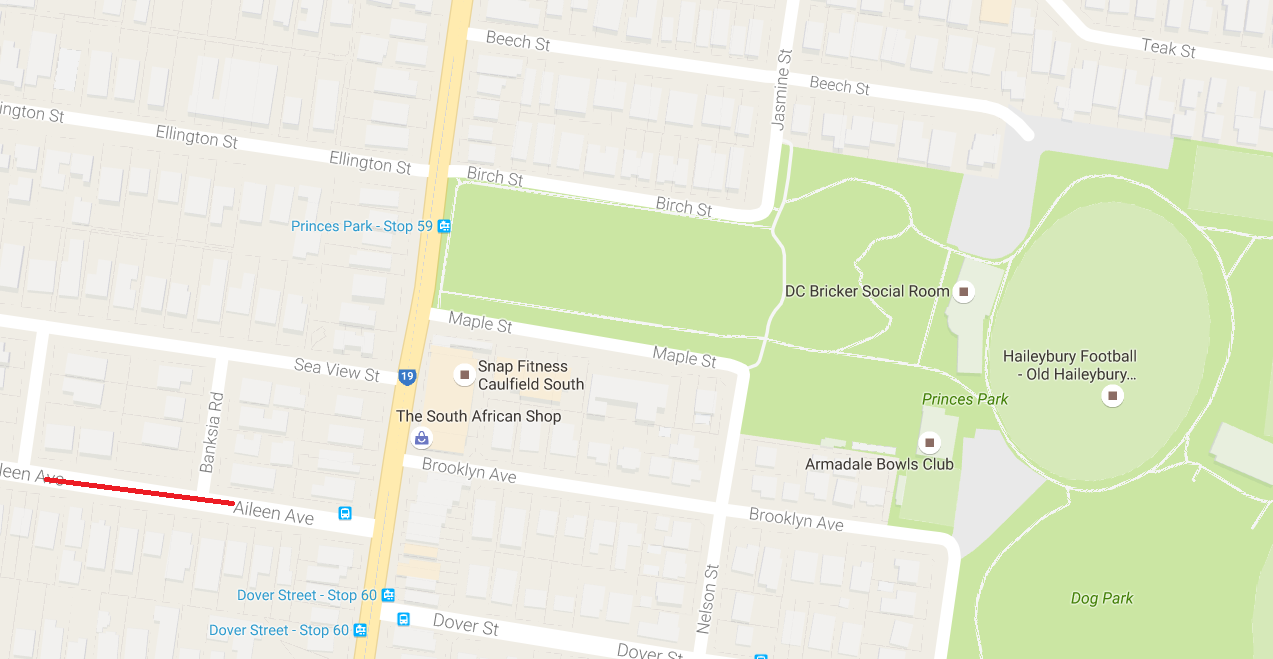
Page 212 of the agenda states – Purchase of a property in Aileen Avenue for a potential new open space opportunity in Caulfield South.

We assume that this relates to some recent in camera items and the resolution to ‘accept’ the officer’s report presumably for purchase. Readers should note:

  • Recent sales in Aileen Avenue are listed as over $2 million
  • Council’s purchase of a property in Aileen Avenue repeats the ongoing trend of concentrating on Camden ward to the exclusion of the far more ‘high priority’ recommendations from the Open Space Strategy for the Carnegie area. Why?
  • And why oh why is council continuing to spend valuable money on new open space that is literally a stone’s throw from existing open space? – ie Fitzgibbon/Eskdale (Caulfield Park); St Aubins/Fosbery (Greenmeadows)? And now Aileen Avenue – Princes Park?

os


With the new Public Questions format introduced recently, the wider community  literally has no idea as to what the public question was, nor the answer, if the questioner was not present in the gallery at the time the item comes up in the agenda. Given that public questions occur at the end of the meeting (and this can be hours and hours later) it is no wonder that some residents might simply give up and leave or simply cannot abide the thought of 2 to 2 and a half hours of woeful arguments and plenty of hot air and grandstanding. Nor do these new protocols take into consideration that someone might be ill and unable to attend.

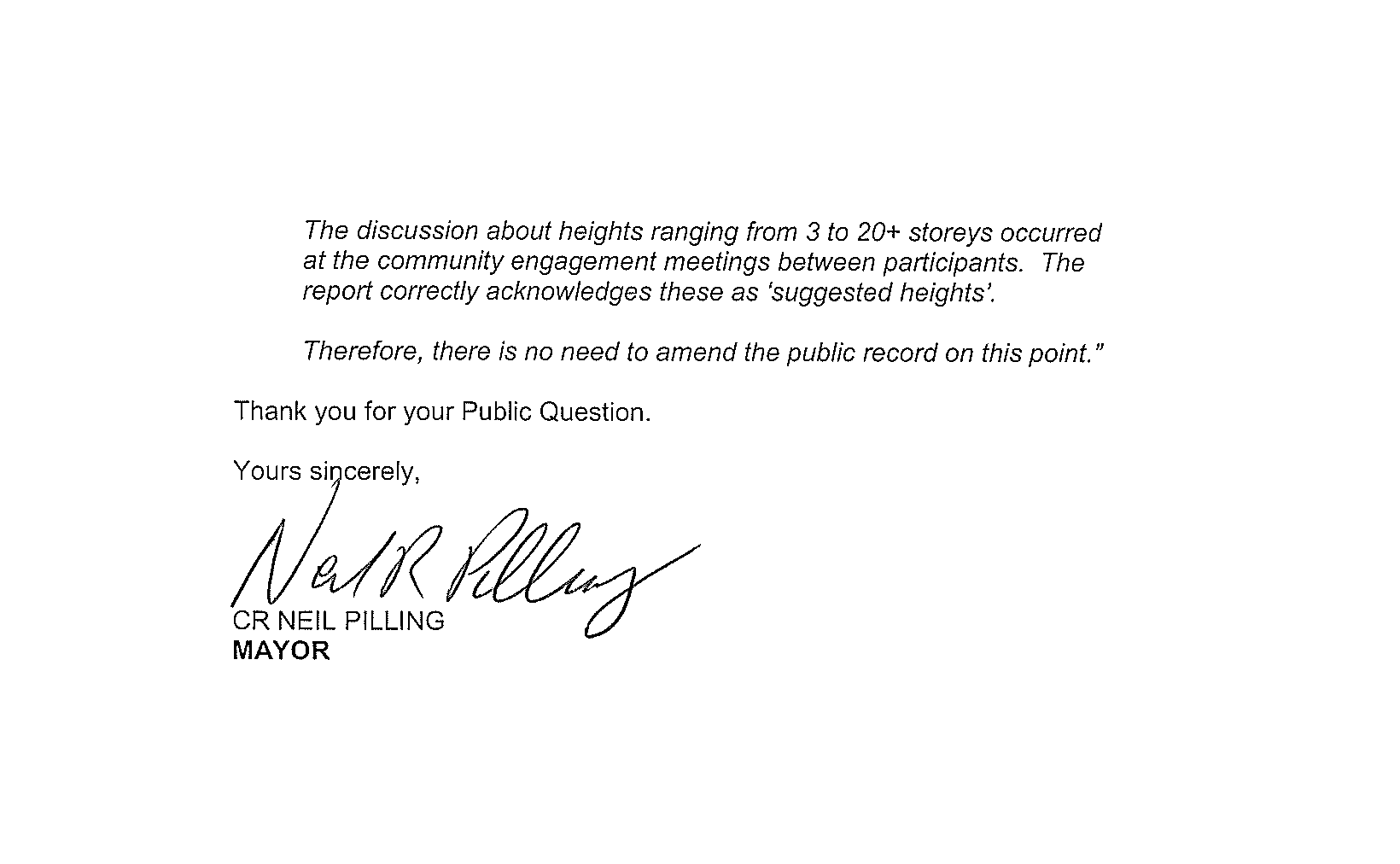
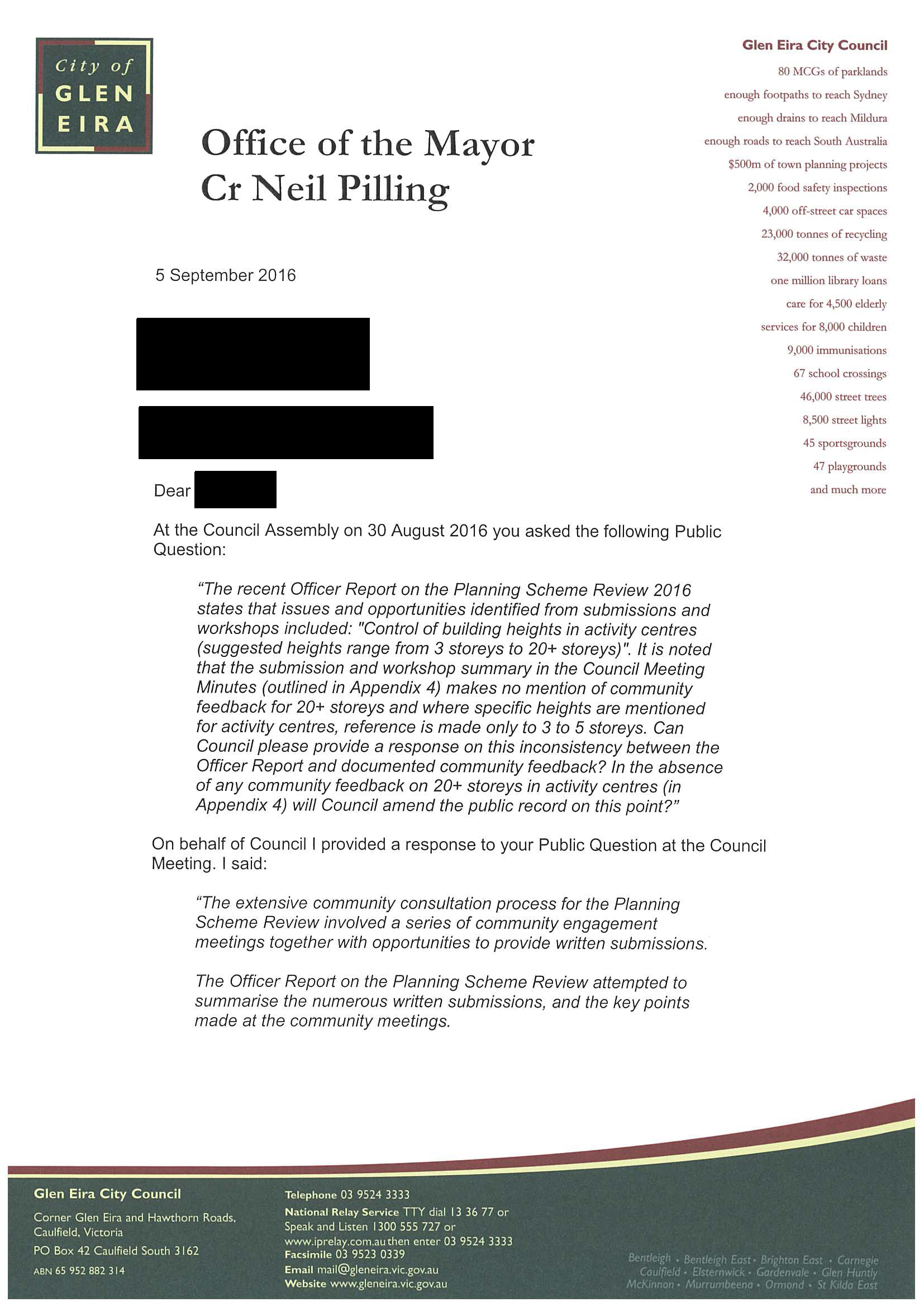
Councillors Hyams, Lipshutz, Esakoff, Pilling,and Ho have therefore successfully limited public access to resident views and queries since the questions and responses are not recorded in the minutes. We’ve however been able to subvert this anti-democratic practice by publishing one of these questions! Please note the answer and make up your own minds as to its veracity and faithful ‘reporting’ of events.

public-question_page_1public-question_page_2

untitled

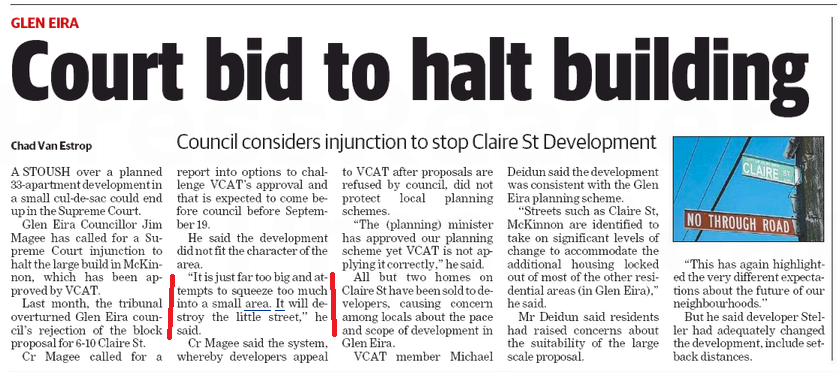
Are we asking too much for both journalists and councillors to actually portray the truth? Here are the facts:

  • Magee did NOT ASK FOR AN INJUNCTION. His motion asked officers for ‘options’ to ‘challenge the VCAT decision’ and to provide some figures on ‘costs’ and chances of ‘success’.
  • This site in Claire Street is far from a ‘small area’ as Magee would have readers believe. It is 2053 square metres – fulfilling council’s planning scheme objective to ‘encourage’ the ‘consolidation’ of sites!
  • In his chest thumping speech where VCAT was again the sole villain, Magee stated in part – This application ‘failed ResCode, failed the Glen Eira Planning Scheme’ but the VCAT member who refused the original application for 34 units has now granted a permit for this application for 33 units. The member said ‘Council encourages dwellings of this scale’ and he ‘could not be more wrong’. Council ‘does not encourage development of any scale’. ‘Council simply says what are the height limits’ and what the Planning Scheme allows and this was ‘set up via consultation’ in 2004 and in 2010 ‘our residents said to us very clearly’ that they wanted ‘increased set backs and height limits’. ‘We got’ these things but ‘VCAT again are not applying our planning scheme’. No point in ‘having a planning scheme then’ if VCAT ignores it and that’s why ‘mandatory controls are very important’. Nearly everyone in Claire St., ‘has sold out’ so council needs to ‘dissect’ the VCAT decision.
  • Several things to note in the above: (1) the VCAT member does NOT STATE that council ‘encourages dwellings of this scale’. What he does say is that council policy and the zoning makes Claire Street an ‘ideal’ location for 3 storey developments. (2) as for council not ‘encouraging’ ‘development of any scale’, perhaps Magee should have a read of the planning scheme he is supposed to administer!
  • The word ‘encourage’ occurs 352 times in the planning scheme. In the vast majority of these occurrences, ‘higher density’ is the goal. Here are some examples with the relevant clauses in parenthesis.

Higher density housing is encouraged within and adjoining the commercial zoning (Clause 21.03 )

Single dwellings and multi unit development are encouraged immediately adjoining the commercial areas of these centres.(21.03)

Industrial sites surrounded by residential areas are encouraged to convert to residential where appropriate.

A targeted approach involves identifying areas throughout the City where multi-unit development is encouraged and facilitated through local planning policies and statutory controls.(21.04)

Encourage a mix of housing types, increased residential densities and mixed use developments within urban villages and neighbourhood centres

The encouragement of residential development within and around commercial centres is a key strategy aimed at giving additional support to centres (21.06)

Where a small retail centre is in danger of losing its retail role, alternative land uses should be encouraged to fill vacant premises. Favourable consideration should be given to uses such as small business, clean light manufacturing, service business, residential and community use. This is particularly the case in centres such as McKinnon, Murrumbeena, Hughesdale and a number of local centres (such as Patterson).

Encourage conversion of derelict industrial sites to residential or mixed use activity where appropriate. (21.07)

Encourage highest residential densities in preferred strategic locations such as urban villages. (22.05)

To encourage increased densities within and around commercial/transport nodes which respects transition to the surrounding residential area

Where opportunity does exist,however, appropriate infill development at increased densities is encouraged.(22.05)

Buildings along Centre Road be encouraged to increase in height to provide for office,commercial and residential uses……

Where opportunities exist, medium density housing be encouraged in the residential areas surrounding the centre.

Encourage higher-density residential development.

Encourage site consolidation and redevelopment to support increased development densities.

Consolidate properties in the area west of Koornang Road to encourage more intensive development.

Commercial development on lots with frontage onto Neerim Road be encouraged

Increased density residential developments be encouraged

Increased density residential development be encouraged in Chestnut and Blackwood Streets with medium to high density development occurring on lots with frontage to Dandenong Road.

The re-development of 314 Neerim Road for medium density dwellings be encouraged

Increased density housing be encouraged, particularly along Rippon Grove.

Site consolidation to facilitate increased densities be encouraged

Encourage the higher and more intensive development in the southern and eastern parts of the precinct facing Station Street and the new road.(22.06)

Encourage the consolidation of sites to promote development opportunities.(22.07)

Encourage gradual changes in building heights between existing buildings and new developments.

CONCLUSION

Election time is definitely the top most consideration for many of the incumbents. Magee is excelling in his attempts to portray himself as a concerned councillor. We’ve had crocodile tears at VCAT, the demand for mandatory height controls instead of discretionary, and now the latest ploy – a request for a report on the Claire Street VCAT decision. We certainly doubt that this will go any further since appealing to the Supreme Court can only be done on a point of law and would cost the earth. Also, if council were stupid enough to vote in this course of action, then any determination would only be after the election. Thus, if Magee was so concerned about what is happening to McKinnon and other neighbourhood centres then where has he been for the past 18-24 months? Why does this crop up only now – 2 months out from election? Why all his votes for permits that we’ve previously pointed out? And why oh why, is so much of what comes out of this councillor’s mouth simply wrong, incorrect, and the opposite of the truth? What would help Magee’s election ambitions is that instead of lambasting VCAT again and again, he and his colleagues undertook to act upon resident wishes and review the appalling zones and rewrite the incompetent planning scheme. That would surely get him votes!

ESAKOFF: began by asking Torres to explain the ‘differences in the recommendations’ for Bentleigh and Carnegie.

TORRES: said that the ‘centres are different’ in ‘physical characteristics’ – ie Bentleigh is ‘east-west running linear’ precinct and Carnegie is ‘north -south’ centre ‘that is concentrated in the middle’. This ‘leads to different considerations especially in terms of shadowing’ and in Carnegie ‘commercial properties shadow each other’ but in Bentleigh the shadowing is on homes. Plus ‘the scale of development’ is ‘different’ which ‘leads to this different treatment’.

ESAKOFF: said she wouldn’t repeat what councillors had already said about ‘mandatory’ versus ‘discretionary’. Went over the consultation meetings for the Planning Scheme Review and highlighted – ‘amenity’, ‘traffic’, ‘visual bulk’, ‘congestion’, etc. Because ‘it will take some time to go through’ with structure planning, that’s why council is ‘asking for’ the interim controls. The zones ‘are currently being reviewed by the State Government’ so ‘until we are informed of that outcome’ they need to work ‘accordingly and that’s why we’re starting here’ even though she thinks that ‘it is the impact on those residential zones which is the most concern’. Repeated that for outside the major roads, ‘we need to see what the government does in those’ areas. ‘As I understand it’ council will be ‘looking at schedules to preserve those’ areas ‘better’ and ‘some further work at transitioning from zone to zone’. The interim controls ‘will give us some time to work through in greater detail’. Other councils ‘sometimes failing in their bid’ to have mandatory heights such as in Mentone who wanted 4 storey mandatory but the Minister made this discretionary, ‘they have already started receiving applications for 6 storeys’ and ‘that seems to be what we will have to expect’. Boroondara did have mandatory but ‘those have actually been overturned’ in the main activity centres. Said she was ‘hopeful’ and ultimately ‘moving along to other areas of Glen Eira that do need to be addressed’.

LIPSHUTZ: stated that ‘every councillor’ has ‘had concerns about height limits throughout our municipality’. Years ago 3 storey buildings ‘were too high’ but now it’s 6, 7 and 8 and ‘because we don’t have height limits’ and ‘the interpretation by VCAT has changed’ and they are ‘allowing buildings to go up which do not accord with what we and residents want’. ‘Politics is the art of the possible’ so ‘it’s not what’s right, what’s best’ but ‘what is actually attainable’. Said he would ‘love’ to see limits ‘across the board but realistically that’s not going to happen’. Said he saw an email from a resident who had written that if councillors ‘really cared’ they would ‘go for mandatory’ height limits. ‘We do care’ and we’re doing ‘this because (all mandatory) is not obtainable’. ‘It’s a huge risk’. The Minister could agree with mandatory ‘but realistically I don’t think that’s going to happen’. The Minister could also say ‘I”m rejecting it all; go back to the drawing board and start all over again’ or all discretionary. ‘We have to turn our mind to what we see as important’ and ‘we have a better chance of getting this’ than getting ‘nothing’. This is ‘interim’ so he hopes that ‘in two years time’ they will have done their ‘reasonable’ structure plans and this will enable them to ‘go to the Minister’ and say ‘some of the discretionary height limits should now be mandatory because of our research’.  ‘I would rather see something than nothing’ and this ‘plan is likely to be accepted’. ‘If we go the other way which is certainly the popular way to go’ then councillors would be ‘popular’ but it ‘isn’t the attainable way to go’.  As councillors ‘we have to ensure that we do the best for the city’ and ‘residents’.

LOBO: ‘we have rattled our residents with all the zones’. The forums let councillors hear ‘loud and clear’ how they are ‘destroyed’ and how their homes ‘have been taken by these residential zones’. There’s also the ‘ripple effect’ from the State Government’s ‘directives on parking’ and there’s the infrastructure ‘which will obviously have to be replaced’ and end up as ‘increasing rates’. One resident was so angry ‘he kept me for 2 hours in his house’ and told him ‘this is not the way to insult our intelligence’. ‘If we want to settle the anxiety of the residents’ then there shouldn’t be discretionary height limits. With discretionary then ‘vcat can do the opposite’. ‘This is not a solution’.

PILLING: thought that ‘we’re all on the same page here wanting the best possible protection’ but council needs to put the ‘strongest case forward’ and the ‘most likely’ to get approved and ‘then work towards getting even stronger controls’. According to the ‘best advice’ the option is to go for a ‘targetted approach’ which ‘gives full justification for the mandatory areas’ instead of doing a ‘blanket approach’. The north sides of both Carnegie and Bentleigh ‘do have car parks’ so their impact on residential zones is limited. Council is ‘calling for what residents have been asking for’. Thought that ‘we are addressing’ resident concerns and ‘doing it in a measured way’. As for what Lobo has said, he attended many of the forums and council is addressing what residents wanted especially about the southern sides of Neerim and Centre Roads. ‘We are listening to the community’.

MOTION PUT AND CARRIED

VOTING FOR: PILLING, LIPSHUTZ, HYAMS, ESAKOFF, HO, DELAHUNTY, SOUNNESS

VOTING AGAINST: MAGEE, LOBO.


COMMENTS

  • If Lipshutz is, and was, so concerned about height limits in Glen Eira, then perhaps he can explain why on on a 12 storey application and 173 units he espoused the following (dates are from our posts) – Went on to ask ‘why is 12 storeys wrong’? Agreed that there would be an impact on traffic though but that would happen regardless of whether it was 8 storeys or 12 storeys. Further, this is a ‘high quality building’ and not cheap and nasty. The area is mainly commercial/industrial and there’s nothing really nice about it and this would ‘improve the area’. If the application was for anywhere else he would support the alternate motion but not this time. “I see nothing wrong with this building in this particular site”. (13/11/2012).
  • Contradictions abound. Lipshutz says that the ‘research’ will be done in the next two years for the structure plans. Pilling says that council’s ‘targetted approach’ of only partially mandatory heights will have ‘full justification’. Thus has ‘research’ really been done already? Or has bugger all been done over the past 12 years and this is simply buying council time whilst fulfilling Wynne’s orders? Or has council via the back door already had confirmation that this will get through so no need to do all the hard yakka?
  • Esakoff like so many others fails to reveal the full truth. Boroondara gained mandatory height limits for 31 of its shopping areas. This included 28 ‘neighbourhood centres’ strips and 3 main commercial strips in the major activity centres. Wynne then did remove the mandatory height limits on the 3 major shopping strips but Boroondara has kept its three storey maximum in 28 neighbourhood centres. Further, because Boroondara had done its work there was ONE AMENDMENT which covered everything. In Glen Eira we face the prospect of 20 years work before all our 10 neighbourhood centres are protected.
  • The old tactics of fear dominate. Amazing how other councils refuse to wait and implement their own policies well before the State Government gets around to it – (ie Water Sensitive Urban Design) and parts of Moreland’s Residential Code. Surely it is time that instead of saying that things are ‘unattainable’ that council is prepared to have a go? Other councils do!
  • Finally, where is Ho on this vital issue? Why his silence? In fact, Ho uttered approximately 50 words in the entire council meeting! We guess that his developer interests might make his contribution(s) somewhat suspect?

Pilling moved motion to accept recommendations as printed. Sounness seconded.

PILLING: started off by going through the various height limits proposed in both amendments. Then said that this ‘came about’ because of the ‘extended consultation’ and how council ‘adopted’ residents views at last council meeting. Plus the motion to apply to the Minister. Claimed that the current motion ‘sets out’ what council ‘hopes to achieve’ via the interim height controls ‘while we do the work of the workplan‘. Called it a ‘targetted approach‘ and that council would ‘advocate strongly’ that the areas abutting residential zones ‘need more protection’. ‘We need to have more controls’ in those areas because they are the ‘most vulnerable’. The Minister has said that ‘mandatory’ height limits in commercial zones ‘will only be given in exceptional circumstances’ and council believes that ‘what we are doing tonight’ has ‘exceptional circumstances’. Said that ‘it is important that we do the work’ and in ‘putting in our reasons to the Minister which are quite reasonable’ and this ‘allows us in the interim to do the work’. Thought that ‘this addresses’ community concerns about ‘what will happen in the next couple of years’ and that this is a ‘good balance’ between ‘putting in some real protection’ and not putting in something that ‘will be rejected’.

SOUNNESS:  stated that this ‘is a contentious issue’ for people and that they want ‘more security’. Council can ask for measures and then the Department and the Minister will make their responses. Fearful that the two areas (Bentleigh/Carnegie) amendments will be rejected because ‘not founded with sufficient cause‘. Other councils have applied and they ‘haven’t been successful’. He thinks that ‘having a relatively simple application’ over ‘part of Glen Eira’s development areas and not all of it’ will be ‘more sympathetically received by the Minister’. If ‘we were asking for something more’ then the chances of rejections are greater. Said ‘we don’t know until we apply’ but it’s better to aim for ‘what we can get’ and what ‘the community wants’. ‘There does need to be some development taking place in Glen Eira’ and council wants to be ‘able to control that’ but like with the Level Crossings Removal Authority, they do what they want and ‘council doesn’t have oversight over everything’.  Saw this as a ‘fairly good attempt at getting a positive outcome’.

MAGEE: said that councillors had ‘sat around this table’ for 8 years and others 4 and there are two words that he has ‘come to dislike’ – ‘discretionary’ and ‘plan’. Said he’s ‘never seen’ either come ‘back in our favour’ from VCAT. When the VCAT member sees the word ‘discretionary’ then he says ‘great, leave it up to me’ and the same for plan, since ‘this isn’t law – it’s just a guide’. Council can only control things by ‘implementing mandatory height limits’ as they did with the new zones. ‘I’m more than happy with the 5 storey area’ but he is ‘unhappy with anything that is discretionary’ and gave the example of the 13 storeys around the Ormond Station where the ‘government has already made the determination that 13 storeys is acceptable’. With discretionary ‘we are leaving ourselves open to getting something we just don’t want’. These are interim while they do the structure planning and he’s not a ‘great fan of structure plans’ although they do ‘show where controls can be brought in’ and it’s just ‘what you think should be there going into the future’. For the Carnegie amendment ‘I don’t mind the 7 storeys’ but ‘again it’s got that word discretionary’. ‘There’s no win, there’s no gain for us having discretionary height limits’. They need mandatory especially when in ‘2 years time we’ve seen what the structure plan looks like’. The Minister has ‘asked us’ to do this not because ‘he thinks we are doing a bad job but because we actually wrote to him, asking could we do it’. Claimed council has got the ‘support’ of Staikos, the department and the Minister. Although there are car parks behind some of the discretionary 5 storeys in Bentleigh, who’s to say that this doesn’t become ‘6 or 8 storeys’ when applications come in. He again ‘cites what’s happening at Ormond’ where the government has ‘said that 13 storeys is acceptable’. So if it’s ‘acceptable there’ then Centre Road is ‘only a couple of hundred metres away’. He is worried that during the 2 years taken to do the structure plans ‘we’ve already got the sevens and eight’ storeys and ‘that becomes the pre-requisite’.  They’ve got 2 years to do the structure plans which will ‘point us in the right direction’ for the next 10 or 20 years and ‘council has always done this’ since they were ‘one of the first to actually have different zones’ and that’s ‘why it was so easy to transfer over’ to the new zones. ‘Mandatory is the protection we need’ and ‘I believe we have the will of the Minister’ and ‘we’ve got a lot of people on our side’. Said he is a ‘firm believer in seize the moment. If the opportunity arises, grab it’.

HYAMS: wanted to go through some ‘history’ since people are asking ‘why’ council is only doing structure plans now and ‘not earlier’. Stated that they had Jeff Akehurst and he was the ‘doyen of town planning’ and he got the first ‘town planner of the year’. ‘So when Jeff said something about town planning, we listened’. Back then you ‘couldn’t get mandatory height limits’ but only discretionary and Akehurst told them that ‘discretionary height limits tended to be in those days’ ‘to act as a minimum’. That meant with 4 storey discretionary ‘they would start at 4 storeys and then go up’ and that council ‘had policies that would protect us from that sort of thing’. Claimed that ‘that worked well until recently’ when VCAT ‘changed its interpretation’ and ‘all of a sudden our policies didn’t work so well’. The policies of council hasn’t changed but ‘VCAT’s interpretation’ of them. Since many other councils have got height limits, and the other policies like ‘overshadowing and setbacks’ don’t count. Council then ‘found ourselves in a position where we had to play catchup’. Claimed that ‘about a year ago’ as a result of ‘various VCAT decision, I and others’ thought that council has to now do something about it and ‘that’s why we are where we are’. Thus even though ‘discretionary may not be so great’ it is still ‘better than the alternative’. Strcuture planning ‘takes a long time’ because ‘you need to provide justification’ for the plan. So there is these interim height limits but ‘anything we do as a council’ still needs government ‘approval’. And council has to ‘prove to the government that we have the capacity to cater for the population growth’. Council can’t say that there are other councils which can handle this and that ‘we’re not going to’. Said that ‘I would like to put mandatory protection over all these areas as well’ but that’s only allowed in ‘certain circumstances’. Read from the officer’s report about the ‘exceptional circumstances’. Spoke about Mentone’s mandatory heights and how they ‘were peeled back by the Minister’. Hoped that council ‘could get mandatory’ height limits for those commercial areas that backed onto Neighbourhood Residential zones. Went through what the amendments asked for. Said that Carnegie is ‘less linear, has more development’ is it is therefore ‘justified’ that they have 7 storeys. The amendments also include other things apart from height such as ‘streetscape’, ‘neighbourhood character and amenity and so on’. He would prefer mandatory but ‘there’s no point in asking for what we won’t get’. If they ask for everything to be mandatory ‘without discerning where we have a strong case and don’t ‘ then the Minister ‘is likely to come back and say I’ll give you the height limits but’ they will be ‘all discretionary’. Said ‘I firmly believe’ that council will get ‘a better outcome’ by putting the case that ‘this area is special’ so it should be mandatory and ‘this other area we can accept discretionary’. ‘If we ask for all mandatory we don’t have the opportunity to put that case’. Plus the minister ‘might throw it out all together’ because he might think ‘we are being unreasonable and tell us to do it all again’.

COMMENT

Wouldn’t it be wonderful if we could have councillors who stood up and revealed the truth, the whole truth and nothing but the truth? That of course requires an admission that Council’s planning over the years has been abysmal, and represents a dereliction of duty. Further it would tell residents that the zones are all wrong and that council sat back and did nothing, even when it knew things were going belly-up for residents over the past decade.

Things to bear in mind:

  • Akehurst might have been the ‘doyen’ of planners – but did councillors ask for ‘evidence’ that their planning tools were working? When did they last ask? What answers were given? How many of them have even read the planning scheme?
  • Could we please stop resorting to the ‘fear tactics’ that have become endemic in this council – first warning off objectors from going to VCAT, and now the Minister has become the bogeyman. Of course, any chance of ‘success’ relies on the contents of council’s planning scheme and any ‘strategic justification’ that has been put together. Recent history suggests that both are sub-standard.
  • Hyams also neglects to include the basic point that with the introduction of the zones, Council did have the opportunity to have mandatory height limits on Mixed Use Zones. They didn’t of course!
  • And what in the end is the real ‘council vision’ except to have more and more development coming into Glen Eira via the zones and prior to that the carving up of the municipality willy-nilly into housing diversity and minimal change?
  • What on earth have our planners been doing for the past 8 months when the order from Wynne came in December 2015? The statistics and analyses of Bentleigh and Carnegie and Elsternwick should already have been well under way- besides, why spend a fortune on computer systems if they can’t provide the necessary data at the push of a button?
  • Wynne did tell council to pull its finger out because it has had a deplorable history in planning and is so out of kilter with every other municipality that he was forced to act!

Finally we wish to comment on something we have written on peviously. VCAT HAS NOT CHANGED ITS INTERPRETATION AS HYAMS WOULD HAVE US BELIEVE. We could literally pinpoint hundreds of VCAT decisions prior to 2013 and even as far back as 2005/6, where the decisions in favour of permits refused by council could have been written yesterday by the VCAT member. The reason is clear: permits granted have had absolutely nothing to do with VCAT changing its interpretations and EVERYTHING TO DO WITH COUNCIL’S OWN PLANNING SCHEME. Below are just two more examples of this – both from 2006 and both concerning developments in the so-called Urban Villages. We challenge anyone to indicate how these comments are any different to what VCAT members are saying today!

it was put to me that the proposal is an over-development of the site in being too high and/or out of character with the locality, or alternatively that the proposal will have unacceptable amenity impacts on neighbouring occupants. The critical issue in this opposition was clearly the acceptability of having a four level building compared to a three level one. I conducted a view of the site and locality after the hearing.
3 In summary, subject to a proviso listed below, I am satisfied that the proposed four storey building can comfortably sit on the site. I rely here on the strong policy support for the higher density residential use of the site, the context of other 2/3 storey existing buildings nearby, the quality of the design, and my view that any amenity impacts on the neighbours is within acceptable parameters. While I can see his arguments, I am not convinced that it would be a good planning outcome to shave one storey off the proposal as put to me by Mr Fleming.

It is clear to me that Elsternwick Village is one of a relatively few places in the Glen Eira municipality where the Planning Scheme is actively encouraging a bolder approach to new residential development. That is, in light of the reality that the Planning Scheme classifies much of Glen Eira as areas where minimal or possibly moderate residential change is encouraged, it is very significant that Elsternwick Village is one of relatively few locations where the Planning Scheme sends a very different message. It follows that if Glen Eira is to play a legitimate role in accommodating the population growth of Melbourne as per Melbourne 2030 in the face of these constraints on residential development in much of the Glen Eira “residential hinterland”, this arrangement only makes planning sense if urban village locations in the municipality such as Elsternwick make a major contribution to urban consolidation.
36 In this important overall policy context, I have highlighted above those sections of clause 22.05 (Urban Villages Policy) and the draft “Design Vision for Elsternwick” document which seem most applicable here. The key text from these documents send a clear message that higher density residential development is being encouraged in Elsternwick Village.
37 In summary, there is strong policy support for robust residential development in this part of Elsternwick Village, rather than an inappropriately timid approach. This policy situation reinforces the general “rule of thumb” that residents who live in or near an activity centre such as this cannot just expect the built form character in this locality to remain static, and also cannot expect the same levels of residential amenity as persons living in the “residential hinterland”. http://www.austlii.edu.au/au/cases/vic/VCAT/2006/83.html (2006)

As indicated earlier, the Bentleigh shopping centre has been identified as the focal point of 1 of the 3 “urban villages” identified by the council. The MSS states that urban villages are based around the major shopping centres within the municipality. Further, the MSS states that the urban villages are the places where smaller scale office development and higher density housing is encouraged both within and around the commercial zoning.[12] The MSS specifically contemplates that the “Urban Villages Policy” will be used to “promote higher development densities”.
47 The “Urban Villages Policy” at clause 22.05 then goes on to say that these areas are the “preferred location for the municipality’s highest densities of residential development”.

Under the policy, the site is located within precinct 2 – “The Retail Hub”. Outcomes envisaged for this area include the strengthening of retail activity at ground level; offices and residential uses to be located on upper floors and buildings along Centre Road to increase in height. We acknowledge that “parameters” for increased height with respect to matters such as the impacts of shadows, building articulation and the provision of a transition with the surrounding residential area; however, the policy makes a clear statement that increases in building height are to be expected.
49 We acknowledge that the policies and strategies within the scheme call for built form outcomes that respond to the context and character of the area. However, in our view, there can be no escaping the fact that the thrust of the strategic approach advanced by Melbourne 2030 and supported by the council’s own policies is to encourage intense redevelopment and the highest densities in and around the Major Activity Centres and/or Urban Villages.
50 Increases in building height are an inevitable consequence if the intensity of development is to be increased in a particular area and this is acknowledged in the Urban Villages Policy.

We appreciate that the height of the proposed building represents a reasonably significant departure from 1 and 2 storey height buildings that have traditionally been found along Centre Road. However, we do not consider that the assessment of whether the height of the proposed building is acceptable or “fits in” can be solely based on a comparison with what now exists. To do so would present a somewhat confusing scenario whereby on the one hand, the scheme’s policies encourage higher densities, more intense development and therefore “change”; only for this to be stifled by the requirement that new development must “fit in” with what now exists

Part 2 will follow shortly!

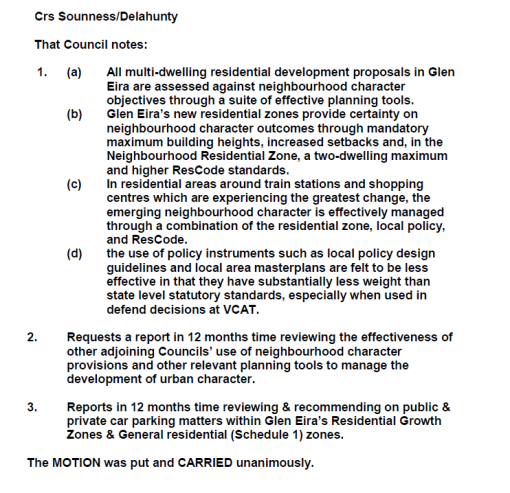
PS – We thought it worthwhile to remind readers of the following resolution from the minutes of May 2015 – just a little over a year ago! Please note that the requested reports ‘in 12 months time’ did eventually come up and councillors again voted in their usual manner – let’s do nothing! Thus, when Hyams opens his mouth and starts telling the gallery that he and others were becoming ‘concerned’ about the zones and VCAT, about a ‘year ago’, it is even more remarkable that he could vote for a motion that mandates the ‘do nothing approach’ and how wonderful the existing planning policies are! The gulf between words and action are greater than the Grand Canyon!may 19 2015

A quick report on tonight’s marathon council meeting:

  • Development applications went according to officer recommendations
  • Hard copy again different to online agenda in terms of the in camera item – more monumental stuff ups regarding potential purchase of open space with no explanation or apology offered
  • Amendments C147/8 on interim height limits were passed with Magee and Lobo voting against on the basis that everything should be mandatory. Arguments (if they could be called that!) put up by Lipshutz, Hyams, Esakoff, and Pilling, were once more based on ‘trust us, we know what we are doing because if we went for all mandatory, then the Minister would be likely to make it all discretionary’.
  • Caulfield Racecourse another monumental ‘let’s wait for the Minister to act, rather than have council reps resign now’ because there is a danger here in what the MRC could do!
  • Public question time reminiscent of kindergarten playtime, where the CEO asked questioners to put up their hands if they were present in the gallery. By this stage, after 2 hours of councillor waffle and woeful debate, most people had left and who could blame them given the fact that most of these councillors simply like the sound of their own voices and the quality of ‘debate’ is totally underwhelming! Please remember that if the questioner was not present then the question nor answer was read out and neither will this appear in the minutes. Thus the wider community has no way of knowing what the issues are, nor council’s responses. This is called open, accountable and transparent government – for which we’ve got Lipshutz, Hyams, Esakoff, Pilling, Ho to thank!
  • Magee being Magee – a useless request for a report on the Claire St VCAT decision. Asking what recourse council has – ie whether an appeal to the Supreme Court has any merit? No doubt the eventual report will come back and state that there is no grounding in law for an appeal and that it would cost hundreds of thousands. We suggest that the cheaper and quicker remedy would be to change the zones, which after all is what the community has been demanding for ages!

Full reports in the coming days.

« Previous PageNext Page »