GE Council Meeting(s)


Mounting opposition to Melbourne’s high-rise retirement village

  • Aisha Dow

Most people wouldn’t be too worried about having a retirement village next door, after all nursing homes tend to attract a type of neighbour unlikely to be the instigator of raging parties or burnouts.

But a unique proposal in the municipality of Glen Eira has many residents up in arms for a very particular reason. The new retirement facility would be 19 storeys.

The proposal is to redevelop the low-rise Calvary Health Care Bethlehem hospital in Caulfield South into a $73 million precinct including retirement village, aged care home and childcare centre.

A “loophole” in the planning law means the owners of the Kooyong Road facility could sidestep a strict eight-metre height limit, angering hundreds of local residents.

“We are not against the site being developed. It’s a very ugly building,” said Bethlehem Hospital Community Action Group spokesman Kelvin Cope.

Calvary Health Care’s national development manager Angus Bradley said the proposed redevelopment would be a place where the ageing and elderly could stay in their homes for longer, and couples remain together.

The new precinct would see 85 two and three-bedroom “independent” units with shared gym, art room and library. Those needing more living assistance could relocate into the aged care home with 80 beds. And there would be a  hospital specialising in palliative care and neurological diseases such as Parkinson’s.

“What is really important to us is that we are catering for the needs of the people of Glen Eira and surrounds for the medium and long term … so they don’t have to leave the place they may have lived in for 15 to 20 years,” Mr Bradley said.

But the proposal is facing fierce opposition from the community. Almost 300  people have officially opposed the application, with just eight in support.

Eight-year-old Finn Clarke is one those who have submitted an objection, writing he was worried that people in the planned tower could see him swimming in his backyard pool. His family lives near the hospital.

“Don’t build the tower here. Build it in the city where it belongs,” he wrote. Finn’s mother Melissa Monks described the proposal as “monstrous”.

“While the proposal may include underground car parking, like is the reality today, many staff and visitors will continue to try to park in the surrounding suburban streets, subjecting neighbours to gridlock, increased safety risks and increased noise,” she said.

Glen Eira councillors are scheduled to vote on the proposal on February 28 – but the council has already raised its concerns in a submission to the state government. It said current planning rules meant the area’s two-storey height did not apply to buildings defined “non-residential”, including independent living units and retirement villages. The council said this should change.

“It is considered that all buildings should be required to meet the mandatory maximum height limit in order to ensure that the neighbourhood character of residential areas is maintained.”

A spokesman for Planning Minister Richard Wynne said Glen Eira could still exercise its discretion and decide whether the proposal was appropriate for the area.

“This is an important matter for Caulfield South residents and it’s important the Glen Eira City Council gets it right,” he said.

Source: http://www.theage.com.au/victoria/mounting-opposition-to-melbournes-highrise-retirement-village-20170217-gufq4h.html


Apologies for this very long post. What occurred last Tuesday night on this item makes us wonder:

  • Has anything really changed in council?
  • How much are councillors really told/informed about?
  • When will the truth replace fiction? – ie Magee’s comments on ‘what sits next door’
  • Consistency remains elusive given the scores of times that councillors have lopped off several storeys in an application because it was good politics to ignore the ‘expert planners’ on council. Now suddenly it is vital that ‘expert’ recommendations are adhered to.
  • We ask residents to read and judge for themselves whether the level of debate has been elevated or whether this is nothing more than a continuation of the status quo?

Davey moved motion to accept recommendations ‘as printed’. Seconded by Athanasopoulos.

DAVEY: said the ‘report speaks for itself’ and that council has been ‘provided with expert’ advice and that 8 storeys is better than 13.

ATHANASOPOULOS: said he had spoken with residents about the issue. Made the points that ‘six storeys has already been approved in the area’ and this is a ‘stand alone site’ and  council will ‘fight’ so that it ‘won’t become a precedent’. Government wants ‘a landmark’. Council sought expert advice to present to the panel and they’ve got that and ‘the findings give us the tools’ and help council to ‘define our position’. This ‘wipes off 4 storeys from the initial plans’ and council is asking for ‘mandatory height’ which currently isn’t proposed. Said he could be ‘populist’ and ‘oppose the advice which we’ sought. ‘It would be much easier for me to say ‘no’, I think we should go for 6 storeys’ but they’ve ‘made a decision as a council that we want some evidence’. Council has asked for this ‘evidence’ but there will also be ‘other evidence’ that will be presented at the hearing. Said that the traffic evidence could ‘suggest that even 8 storeys is too high’. Said that if they ‘bundle’ all the reports together then if the panel chooses ‘not to go with something’ that could ‘undo all the work’ done. Council needs ‘evidence based defences when we come into these situations’ rather than being ‘wishy washy’ and saying ‘we feel this and so forth’.

ESAKOFF: started off by making several points. (1) this is a ‘neighbourhood centre’ and in council’s heirarchy of centres this is set down for less development in comparison to the 3 major activity centres of Bentleigh, Elsternwick, Carnegie. (2) this ‘sits at lowest’ centre for development (3) schools nearby, childcare, so there are ‘associated parking and traffic ‘ issues. (4) area ‘is a flood zone’ (5) heritage overlays are there and also Neighbourhood Residential zones. The consultants suggest 8 storeys as ‘maximum’ and is based on the desire for this ‘to be a landmark building’. Said that ‘community views in the main are not supportive’ of this and ‘I doubt they would be supportive of any development’ of 8 storeys. Thought that the ‘sticking point’ was the government’s wish that this be a ‘landmark building’. Asked ‘what makes a building a landmark’? Didn’t think that a landmark building ‘needs to be 2 storeys higher’ than its surrounds. Landmarks are building of ‘some special design feature’ and not just height. Said that heritage and neighbourhood status of the centre ‘should be respected’ and traffic shouldn’t be raised to levels that match ‘arterial roads’. ‘Community views should be respected’. Said her ‘preference is not to exceed’ what’s already approved – ie 6 storeys but could ‘succumb’ to a well planned 7 storeys.

SZTRAJT: Thought the whole issue was a ‘circus’. This was a state government project and they are making the decisions so ‘that is already absurd’. Went on to say that the government isn’t ‘building a park’ and they are ‘calling this landmark’ in order to ‘give them the possibility of creating a cash cow’ and to ‘recoup’ their costs for the grade separation. They are therefore ‘using the word landmark to convince us that a residential tower’ is ‘something special in a shopping area’. His concern was that council had to ‘put its stamp of approval on something’ and that ‘the minute we say 8 storeys is acceptable in Ormond’ it will be the  benchmark because this is the ‘first of many towers’ that the state government will be looking to build and ‘I can’t believe the state government is going to show restraint on the first project’ so for the other project ‘not being able to exceed the limits’ they’ve done in Ormond. ‘Therefore, they are not going to listen to this advice’ and will want to ‘build this as high as they possibly can’. They will build their 13 and in a couple of years there will be ‘an application from next door’ where the developer will say that even council supports 8 storeys. ‘We are setting ourselves up’. Said ‘I am disgusted by this report in the first place’ and council has to make sure that ‘if the state government is going to steam roll us, we are not giving permission’ for even 8 storeys. ‘To put anything higher than 6’ is he believes ‘irresponsible’.

SILVER: began by stating that the reason why this tower is proposed in Ormond is because ‘it is a Liberal electorate’ and Bentleigh and McKinnon aren’t. If this was proposed for these latter suburbs then he could ‘assure’ us that the sitting member ‘would be quite worried’. Supported the motion and does ‘prefer the evidence based approach’ although he isn’t completely happy with the proposal. Thought it was ‘damage control’. State government is in control and ‘they want to make a bit of money out of this site’. In cases like this it is worth being ‘objective and look at the surrounding area’ and ask ‘what is reasonable?’ Said that ‘unfortunately, we don’t have those controls anymore’ since it is a government controlled development. Said that the Panel ‘will look for the best evidence, the most persuasive’. Claimed that councillors had a ‘choice whether we put an emotive argument’ which people might be ‘happy’ about, but which is ‘unlikely to give us much credibility’. That would lead to 13 storeys and ‘I don’t want to see that’ nor does he particularly ‘want to see 8’ but ‘it’s better than 13’. Didn’t think ‘this should be happening’ and for the next state election to ‘give the state government hell over this’. Council needs to ‘put its best foot forward’ and to ensure that they have the ‘best option going forward’.

MAGEE: asked the mover and seconder whether they would accept the addition to the motion that council releases the Hansen report. Both agreed. Began by saying that there’s a ‘little place’ called the ‘real world’ and in this place the government has ‘every right’ to do some ‘value capture’ to recoup some of the money it has spent on the grade separation and this money eventually goes to ‘you and me’ as the tax and ‘ratepayers’. Said that council is ‘considering something that we asked for’ (ie consultant’s report). Council ‘decided’ that ‘we didn’t want to go to the Minister and say I think 5, I think 6’. He will ask how did you come to 6 storeys and we will say because next door is 6 storeys. Said that ‘regardless of what sits next door, VCAT cannot use this as a precedent’. With the amendment ‘we can prove how we came to that’ because ‘8 storeys doesn’t throw a shadow’ onto the south side and that the setbacks on the west are ‘sympathetic’ to heritage. ‘We brought in the experts’ and the Minister will listen to them because of all the criteria which ‘we mightn’t understand’ but the panel will. ‘This isn’t about 9 councillors saying I think, I like, I want’ because they are going to front a committee who understands how all this works. Can’t have the ‘expert’ saying 8 and council saying ‘7 or 6’ and council ‘not supporting the officer recommendation’. Said he doesn’t want 8, but he certainly doesn’t want 13 and can’t have a situation where ‘all the experts are saying this, but councillors are saying that’. ‘That defeats the purpose, no matter how much we don’t like it’. They’ve asked for an ‘evidence based approach’ and he thinks it is ‘incumbent on us to actually use that’.

TAYLOR: land is ‘precious’ and house prices are escalating and there’s a ‘housing shortage’. ‘On the other hand’, council has to ‘bear in mind where’ this development will go. All of this ‘has to be considered’ and perhaps a ‘little harsh’ to say that it’s ‘only a money grab’. ‘We did decide that we would defer to experts’ and ‘we are not experts’ in planning and if they are ignored then ‘why pay for experts in the first place?’ Experts give council ‘the best possible chance to get the best possible outcome’. On height and if councillors said only 6, then the panel would ask well, do you want 6 here, and here, over the whole site. But with this proposal there would be ‘bulk at the front’ only and a ‘greater probability’ of getting 3 and 4 storeys at the back. Worried that ‘if we trim that front they will say okay we’re going to have to get it somewhere’ so residents ‘will appreciate that they have a 3 level rather than a six level’ next to them.

SZTRAJT: wanted to ‘clarify something that was said before’ – hamely that if an application goes in for 8 storeys ‘next door’ and ‘we reject it’ whether this means that ‘VCAT can’t approve it’?

TORRES: said the site is under a ‘new set of rules’ which is a ‘building envelope’ and ‘you can build within that height without any resistance from local government’.

SZTRAJT: asked that ‘if a new developer’ and not government puts in an application for ‘8 storeys next door’, council rejects it and the developer goes to VCAT, can ‘VCAT not allow’ that development?

TORRES: asked if this was a ‘scenario on nearby land that is privately owned’. Was told ‘yes’. Said that it ‘would depend on the planning controls on that land’. If ‘it is in a Commercial 1 zone, there is no height control’ and the usual ‘decision making process could include VCAT overriding council decision’.  Said that according to the notion of ‘precedent’, that in planning there is the thinking that ‘each application is assessed on its merits and that tends to move away from the precedent notion’. This is because ‘every site is different’ even if they’ve got the ‘same zones’. ‘It can’t be said that just because there is 8 storeys near by that 8 storeys can just go’ into a neighbouring site.

HYAMS: agreed with Sztrajt and Esakoff ‘except for their conclusions’. SAid that ‘under normal circumstances’ he would never ‘say’ anything that could be seen as ‘supporting 8 storeys’ in Ormond.  Acknowledged that it’s a ‘lower order centre’ and 13 storeys is ‘way out of character’ for the area – ‘but these aren’t normal circumstances’. Government which ‘has power over all of us’ has set the circumstances and the urban design expert ‘has taken into account those circumstances’. Said he’s interested ‘in the best outcome for the community’ and this can only be achieved ‘if we make our expert evidence as strong as possible’. It is ‘possible’ that the government will simply put its 13 storeys up, but council’s best chance is to ‘go along with what our expert has said’. Doesn’t think that ‘just because an expert says something we automatically have to go along with it’. Councillors are the ‘decision makers’ and they have to ‘take that evidence, assess it’. But it’s also ‘important’ that ‘we do achieve the best result by assessing that evidence’.  On the question of ‘precedent’ he thought if it is 13 storeys then this ‘does change the way VCAT’ and applicants will ‘look at it’, and that’s one reason why council is ‘trying to keep it as low as possible’ by ‘throwing our weight behind the expert evidence’.

SZTRAJT: said they’ve been talking about ‘evidence based’ study but ‘we have one piece of evidence’ but ‘I understand that council may also have requested additional’ advice that ‘would include elements like the’ narrow streets alongside the project and ‘issues like the number of cars going’ down these streets. Wanted to know that if council is taking the ‘evidence based approach’ that they are not simply taking ‘one piece of evidence’ but ‘all three that have been requested by council’.

TORRES: said that council’s submission will ‘consist of 3’ expert evidence on traffic, urban design, and retail impact.

SZTRAJT: repeated that he wanted clarity that the evidence based approach is based on ‘all three’ documents and ‘not just one’.

TORRES: ‘yes’. SAid the council rep will ‘orchestrate’ at the panel the ‘strong presentation’ to ‘strongly support our submission’. All are on different topics, but will form part of the submission.

SZTRAJT: asked if ‘one piece of evidence’ is saying 8 storeys  and for example the traffic evidence says that the ‘bulk’ of the building ‘will create’ cars ‘in excess of what the streets can handle’ puts council in a position where they might have to ‘request less than 8 storeys’.

TORRES: said that traffic report ‘will not provide advice on urban design’ but ‘would likely come up with potential suggestions about road widths’ and so on.

ATHANASOPOULOS: asked why Torres had said to councillors that ‘evidence based’ would have ‘a bit more weight behind it’ when council would be arguing their case?

TORRES: said that ‘one word’ missing from all the discussion thus far is ‘independent’. The urban design report ‘has not been guided by officers’. SAid the report is based on ‘urban design principles’. Based on  council’s experience this kind of advice before panels and VCAT has ‘the strongest impact’.

DELAHUNTY: said council is in a very ‘unique’ position. Government on one side and community on the other, and so council had to do what it could to ‘collect the best evidence’. Said they’ve told the government that 13 storeys is ‘ridiculous’. Council has ‘done all that’ so they can’t come back and say ‘we want 5’ with ‘nothing backing that up’. ‘Our reputation is at stake in this process’ and the residents will benefit if ‘that reputation is intact’. ‘This process allows us to enhance our reputation’. They’ve also told government that it is a ‘mistake that they are the planning authority’ and it should be council. ‘Therefore, it is important that we do so with a straight bat’. SAid that the ‘solar access’ points made in the consultant’s report ‘are crucial’ whereas the ‘arbitrary 13 storeys said don’t worry’. Since both sides of the street should be in sunlight therefore the setbacks become important and ‘should be at this amount’. Everyone shouldn’t ‘just talk about height’. ‘Height can disappear if interaction is right’. Council is proposing that the building ‘better integrates’ into the village. There needs to be major ‘scaleback at the back’ to better integrate with heritage. Said that council is like an ordinary community member here and that the best way for them to go is ‘to use this evidence based approach’.

DAVEY: asked for details of when the panel would take place.

TORRES: said he wasn’t ‘up to speed’ on the panel hearing dates.

DAVEY: quoted Esakoff about getting ‘maximum building height’ so ‘hopefully they go less’. Said that Athanasopoulos cited ‘quite rightly’ that these sites have ‘specific controls’. What she found ‘quite disappointing’ plus recognising ‘the irony’ in her saying this as the Green ‘endorsed candidate’, the only party to formally endorse candidates, were Silver’s comments. It is disappointing that ‘we are bringing pure speculation’ about ‘the rationale’ behind the proposal. SAid the government ‘has every right’ to try and recoup its money. What’s disappointing is the speculation that this is ‘being done because of the sitting member in this seat’ (ie Liberal).


MOTION PUT AND PASSED. VOTING AGAINST – SZTRAJT AND ESAKOFF

Council has released the various documents it will be presenting at the upcoming panel hearing for the Ormond Tower project. The files are available at: http://www.gleneira.vic.gov.au/Council/News-and-media/Latest-news/Copy-of-Ormond-Station-proposal

We wish to note the following:

  • The only councillors to vote against the ‘official’ council position of a mandatory 8 storey height limit were Esakoff and Sztrajt. All others in our view adopted the spurious position of 8 storeys is better than 13 storeys. Hardly a convincing argument!
  • The fact that the so called ‘evidence’ was released only AFTER the decision was made cannot be seen as transparent and accountable government. It reinforces our view that like so many other contentious issues in Glen Eira, first make the decision and then massage the ‘evidence’ to support that decision!
  • ‘Evidence based’ is the latest jargon to infiltrate into polit-speak. Our understanding of ‘evidence-based’ is that it stems from medicine in the first place and involves data that is ‘scientific’, ‘objective’ and quantified through such processes as randomised clinical trials held over years and years. Individual ‘clinical expertise’ does come into it, but that ‘expertise’ is accorded the lowest rung on the hierarchy of ‘evidence’ and is measured against the overwhelming findings of the various data sets.
  • We find no such ‘evidence’ in the Hansen report for starters. The term ‘opinion’ is used at least 11 times in the document, whilst ‘in my view’ occurs countless more times. Basically, this is nothing more than the ‘opinion’ of one individual – albeit the opinion of someone with great experience.
  • We challenge anyone to find one single scrap of ‘evidence’ in the Hansen report that would justify the recommendation for an 8 storey building. There is absolutely nothing in this report that would indicate why 8 storeys is preferable to say 7, 6 or even 10 storeys!
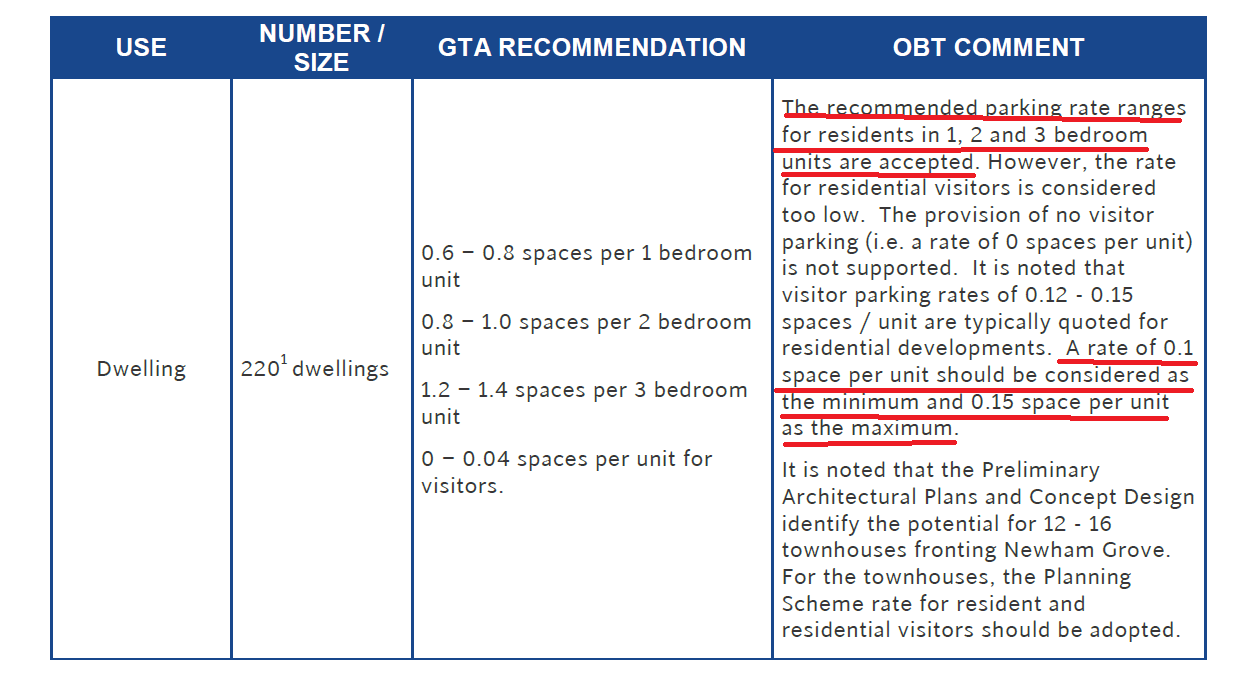
  • The traffic report is equally dubious. And why there is support for a reduction in resident and visitor parking is simply beyond us given that it does not accord with council’s own planning scheme! (see image below).

parking

  • The economic retail report is interesting for several reasons. It announces huge impacts on neighbouring commercial shopping strips if the project proceeds. Mention is made of Bentleigh and others. Yet when it came to the Virginia Estate proposed amendment, the initial officer’s report fobbed off the economic impact by stating that under the zoning of Commercial, the intent was to develop more ‘activity’ and ‘employment’ in these centres.

Thus we have to wonder – did each an every councillor bother to read these ‘expert’ reports? Did they ask some decent questions? When were they briefed on the reports? Or were they simply told by officers ‘this is what we think’ and you should abide by this? Finally, how much did all these ‘experts’ cost ratepayers?

We will report on the actual ‘debate’ in the coming days.

Hyams moved an amendment to accept the recommendations plus, to ‘include meaningful engagement’ with the community to be part of and ‘not following’ the draft structure plan. Taylor seconded.

HYAMS: began by saying that even though the recommendations as ‘set out in the report’ are ‘intended to be pretty thorough’ it recommends community consultation ‘on the master plan’ or structure plan ‘afterwards’. ‘My view’ is that ‘residents’ should have a say in the drafting of the structure plan. Said that ‘this would have happened anyway’ because that was what ‘council intended to do’ and ‘it’s better to have that clarified in the report‘. Called this a ‘great opportunity’ for Glen Eira because it is a ‘massive site’ and they intend to use this as an ’employment hub’ with retail plus residential. That’s ‘what we’re allowed’ by the planning scheme. Hyams went over past history – the first amendment which rezoned part to Commercial and the second application for amendment which proposed many residential premises and a ‘supermarket’ and council thought this wasn’t ‘appropriate’ for the site because ‘it didn’t do what we wanted it to’ as an ’employment hub’ and also ‘competed too much’ with other retail in the area. ‘So what we’re looking for here is something along the first lines’ (ie employment hub) but it’s a ‘huge site’ with many ‘possibilities, so it will be very complicated’ and that’s why the VPA is being brought in ‘to assist us’. Said that ‘all final decisions’ will ‘rest with council’. ‘We will direct the consultation, we will still make the decision’ but the VPA ‘will be using their greater expertise’ in ‘producing the best outcome for Glen Eira’. Apart from the consultation ‘which will be going on throughout’ the applicant can still put in their amendment planning scheme application. This will go through the ‘normal processes’ of submissions, panel if required, and ministerial approval. Summed up by saying that right through the process ‘there will be a great opportunity’ for people to ‘have input all the way through’. ‘Noted’ that the ‘current landowner has been a lot more consultative’ and ‘friendly’.

TAYLOR: began by saying that it is ‘absolutely a given’ that there is ‘full and transparent consultation’. Wanted to ‘reassure’ those people who had rung her and that it ‘doesn’t hurt to spell out’ the ‘continuous involvement’ of the community. ‘We genuinely want you to have a say’. ‘We are all members of this community’ and everyone has ‘something to offer here’.

ATHANOSOPOULOS: said that ‘everyone agreed’ that they need to ‘establish some key partnerships’ and this is ‘just an example of us doing that’. Said that if they are going ‘to deliver’ a ‘great’ development then they need to ‘consider the residents’, ‘housing responsibilities’, ‘educational responsibilities’ and overall ‘responsibilities for the whole of Glen Eira’. Said the developer’s ‘initial process’ was ‘railroaded through’ and they’ve realised they haven’t done a ‘good job and come back to us’ and ‘engaged with the community’ plus traders and others. Thought it was important that council establish partnerships ‘especially with resources being limited’. Vital that council be the ‘leader’ on this. Said that the ‘community has been screaming out’ about the site and this is the ‘first opportunity’ ‘for us to actually go ahead with this’. Said the most important point is that he has put forward a ‘recommendation’ based on a resident’s comment to ‘establish’ some form of community group ‘that does feed us, the council information as this project goes on’.  The makeup of the group is ‘unknown, maybe a couple of residents’, ‘community leaders’, etc.  This will ‘bounce ideas’ and ‘get a feel for what the community wants’.Said it was a good ‘opportunity for us to establish something like this’.

DELAHUNTY: asked the CEO to ‘explain’ what the VPA was.

MCKENZIE: said this is a recent extension of the Metropolitan Planning Authority and has a ‘role in providing guidance’ for major developments especially in new suburbs and ‘in creating jobs’. Council has ‘already committed to’ a huge program of strategic work and by forging this ‘partnership’ this ‘enables us to carry on this program of work in parallel’ with the other projects on structure planning. This ‘doesn’t derail’ the existing program but allows them to ‘carry on’ and to ‘deliver a cost saving to council’ and to ‘draw on specialist expertise’ – particularly on retail development and development contributions. ‘Council would retain the decision making role’ and ‘lead and take ownership’ of the ‘community engagement element of the project’.

MAGEE: said this has ‘come a long, long way’ and now there is a ‘far better approach’ than what happened in 2013. In 2013 one of the recommendations was to rezone all the site to Commercial and without community consultation. Said that council learnt of this via the department and the local minister and local member of the time supported this. The proposed structure planning now ‘is certainly the right way to go’ and ‘the approach now (by the developer) is totally different’. They have held a ‘number of community consultation meetings’, ‘poorly attended, but that’s our fault, not theirs’. Said that the ‘Minister likes the VPA’. ‘They are ‘experts in doing structure plans’. Thought that an application would come in this year for a ‘planning scheme amendment’ which could be ‘simple’ and asking for the ‘whole site’ to be Commercial 1. With Commercial you can ‘put residential, commercial and mixed uses in’. The VPA will ‘assist council in putting together a structure plan’ and at ‘all stages will talk with our community’. The community has to ‘understand’ what is going to happen on the biggest site where ‘we all live’. ‘This is a huge site and it has huge implications’ so even though ‘I welcome the new approach I’m still wary of what happened in 2013’. ‘Once this decision is made it will never be reversed’. He hopes that as councillors ‘we will drive past something that we are proud of’. ‘Concerned that we cannot get this wrong’. Welcomed the VPA involvement and community consultation but ‘don’t come at the end and say you don’t like what’s been written’. ‘Don’t say you didn’t get an opportunity’ to have a say.

DELAHUNTY: said she ‘welcomed this’ and it ‘allows us to get on’ with the program of planning and ‘adds to the resources of the council’. Last effort had mistakes by applicant and ‘this allows us to better formulate community engagement’ and the suggested reference group is ‘an interface between council and the community, not between the community and the applicant’ and ‘does add to our ability to take different views’. ‘This is worth being done properly’ and is exactly what council should be doing in ‘bringing in extra resources’.

MOTION PUT AND CARRIED UNANIMOUSLY

PS: Last night’s meeting was largely all about planning and ‘consultation’. It is a continuing shame how incompetent planning is in Glen Eira when we find (finally) an admission that Council with its proposed interim height amendments (ie Amendment C147) was nothing more than a knee-jerk reaction and a pretense that it was ‘listening’ to the community. It is no wonder that Minister Wynne has refused to gazette these amendments.

We draw readers’ attention to the following paragraph from a VCAT decision where the member granted the applicant a permit for an 8 storey building in Rosstown Road, Carnegie. It shows clearly how – (1) residents have been conned – again, and (2) the quality of council’s planning department, plus (3) why must such information be discovered from third parties and not directly from council itself? Here is what the member stated in his judgement –

Fourthly, I choose to give limited weight to Amendment C147 to the Glen Eira Planning Scheme which seeks to apply a Design and Development Overlay to the review site, which will apply a discretionary height limit of six storeys. The proposed height limit is discretionary, so it does not preclude the consideration of a well designed eight storey building on the review site. Further, in response to my specific question, I have been informed by Council that there is no strategic work that underpins or informs the proposed height limit of six storeys. If such strategic work did exist, and had been adopted by Council, it may have provided me with some understanding or basis on which to further consider whether a reduction of height is appropriate for the review site. In the absence of any such strategic work, I am left with what appears to be an abstract proposed discretionary height limit, which I can only presume is based on the aforementioned development at 2 Morton Avenue, and which is not a seriously entertained planning proposal.

Source: http://www.austlii.edu.au/au/cases/vic/VCAT/2017/158.html

++++++++++

Here’s a summary of how the voting went at tonight’s council meeting – plus a few ‘highlights’.

Ormond Road Eight Storeys – Council will be supporting 8 storey mandatory height limits

Virginia Estate & Victorian Planning Authority – Council will forge ahead with the ‘partnership’ and hold ‘community consultation’ earlier.

Cr Silver distinguished himself by stating that he does not support social housing in Camden Ward.

Council will not be seeking to amend its local law on meeting procedures until at least 2018/19 when the current sunset clause for the law kicks in. Remarkable we say, given that emasculating the public question component of the local law was done so easily and on the whim of Lipshutz, Hyams and Esakoff in particular.

Caulfield Racecourse Trustees have signed the resignation paper but there is a hold up since the question of leases is yet to be finalised. We wait with bated breath!

The details of the above will be forthcoming in the next few days.

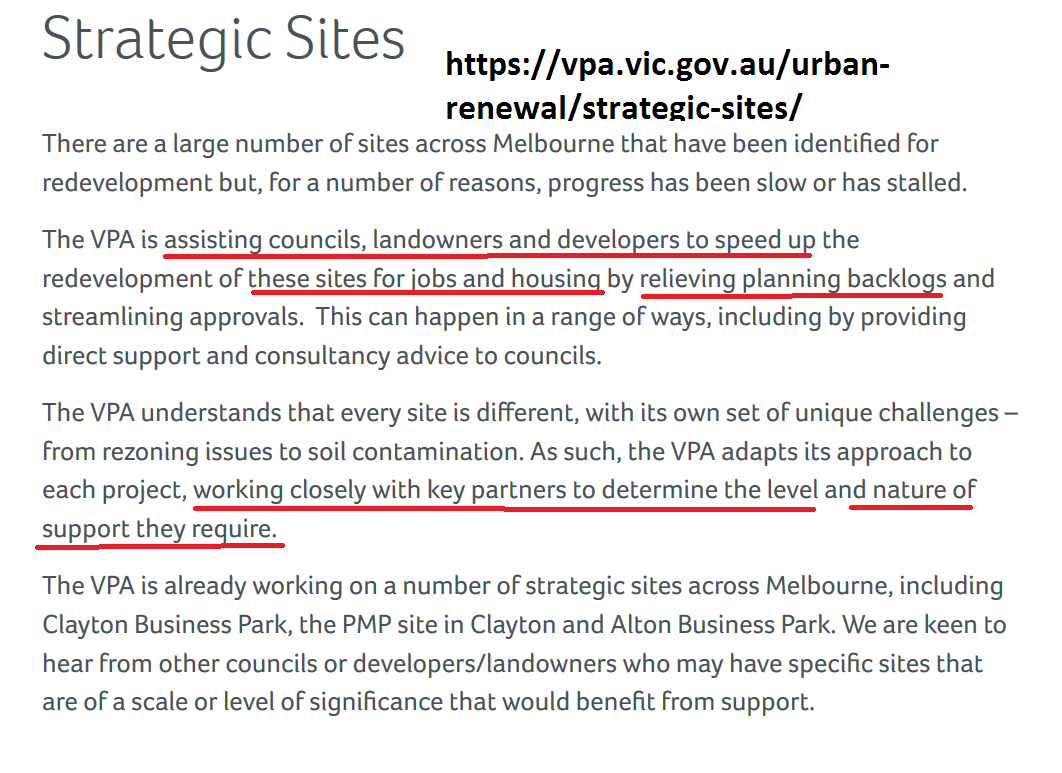
The plans for the development of Virginia Estate have taken a new turn with the proposed ‘partnership’ between council and the Victorian Planning Authority (VPA). This government body is primarily charged with the responsibility of overseeing ‘urban renewal’, especially in growth areas. They are also involved with large development sites within the metropolitan area such as the Monash/Clayton precinct and now East Village. Here is what their brief states –

redsites

All of the above would indicate that government, developer and council are keen to push through rezoning and amendments that will set the ball rolling for Virginia Estate. There is no doubt that at the latest stated figure of 24 hectares, Virginia Estate will be developed, and a very large component will feature residential accommodation. What concerns us is the role that the community will play in this development. The letter from the VPA, included in the agenda, outlines a brief timetable schedule. Please note carefully the following:

  • The time frame for the ‘delivery’ of a draft structure plan for the site is basically 3 months. Yet, the officer report keeps insisting that this will be part of council’s review of its ‘activity centre strategy’ – not due to be completed until 2018 at the earliest. Thus, what porkies are we being fed?
  • Why aren’t the community involved right from the start instead of having the draft structure plan thrust down their throat and then asked to comment? We all know what this means and how little is changed once the ‘draft’ of anything is completed.
  • Why does the officer report emphasise ‘business’ and ‘residential’ barely rates a mention?

We’ve uploaded the proposed schedule. Clearly discussions between government, developer and council have been ongoing for some time given this timeframe. We’ve also uploaded the full agenda item (HERE) so readers can see for themselves the lack of real detail provided.

vpa

In conclusion, VPA does have a role here and council is undoubtedly better off financially if much of the cost comes out of government and developer coffers. What we are concerned about is the level of genuine consultation with the community and whether development gets the go ahead well and truly before infrastructure, transport, etc. is completed.

Delahunty moved a motion for a Request for a Report on the Caulfield Village. Her request was that the report include ‘planning options’ available to council on the social housing issue for the Village. Taylor seconded.

DELAHUNTY: said that the VCAT decision on Precinct 2 was that council was ‘unsuccessful’ in the attempt to ‘require’ the developer to include social housing. Called this a ‘surprising judgement’ and wondered whether the member had ‘actually seen or heard of’ social housing. Said the judgement was ‘so far removed from the way social housing operates’. Claimed that for the member to state that the ‘requirement to provide social housing’ is ‘financially prohibitive is rather surprising’. Said that ‘of course’ there’s a financial ‘imposte’ but ‘that’s what it is’. Called it an ‘incredibly disappointing result’ and when you have such a massive development almost like a ‘new suburb’ that there should be ‘some proper social housing provider attached to it’. Acknowledged that the developer ‘came up with their own scheme’ but this ‘doesn’t meet anyone’s definition of social housing’ and this looks like a pay later ‘lending scheme’. ‘It was an attempt to circumvent this requirement’ and all it would do would be to ‘help people access deposits’ or ‘get their hands on the deposit faster’.  Claimed that this doesn’t ‘address disability at all’ but helps the developer ‘sell their properties faster’. Said she ‘doesn’t understand at all’ how the judgement ‘was made’ and ‘won’t let this rest’. The report is asking for help to ‘understand what levers, what tools’ can be used. Said ‘noise’ is ‘available, appealing to the hearts of the developer is available’ but there ‘must be some planning levers that we can still pull’. ‘It’s unconscionable to let this go’.

TAYLOR: thought about the cost and ‘access to public land’ and ‘it’s not all about take, take, take’. The developer ‘can’t have it all one way’. On accessing a ‘social housing organisation’, ‘how difficult is this?’ Said there are ‘at least 39 social housing providers’ and it’s a ‘matter of liaising with them’. It’s ‘not onerous’ and a few meetings or emails can set this up. This ‘didn’t sit well with me’ so she ‘highly commends this report’.

ATHANASOPOULOS: started by saying that ‘we live in a society that is very inclusive’. Said he had visited a family member in London who lived in a property bought from the government and it was ‘very nice’ in an allotment of ‘maybe another 30’ units in a village that ‘probably had another 100’ units. Said it was ‘great’ that this ’90 year old lady’ could walk everywhere and there was a ‘sense of community’. If it can happen in a ‘massive city like London’ then ‘why can’t we create’ something similar here? They need more ‘than vcat on our side’ but also ‘local members’ and ‘ministers’ in order to ‘get something better than this’ because ‘people deserve it’.

SILVER: asked that the motion also include ‘examples’ of social housing from other municipalities and their major developments. Went on to say that the judgement was from a ‘legal member’ and ‘whether something is regarded as reasonable is a matter of policy’ ‘rather than planning scheme’ so it’s not necessarily ‘fair to the tribunal to say’ that it’s a bad decision because they have to ‘implement the law’ even though council mightn’t like the decision.

Delahunty then asked Torres whether this amendment would ‘slow down our efforts’ on advocacy? Torres said ‘no’ in that there ‘are other examples in other councils’. Delahunty accepted the amendment.

HYAMS: said ‘there is also a matter of principle here’ because VCAT was supposed to ‘apply the objectives’ of the Incorporated Plan and the ‘objective is social housing’. ‘They are now saying they are not going to have social housing’ and he ‘can’t see’ how this is in keeping with the plan. Claimed that another objective was ‘that there be no loss of on street parking’ and the VCAT decision means that they are losing car spaces to the ‘net loss of 45’. These are mostly metered parking spots, so ‘it will be a cost to the community’. Hoped that they would ‘also be looking’ to see ‘how we can reverse that’.

MOTION PUT AND CARRIED UNANIMOUSLY

COMMENTS


The history of Caulfield Village is literally the history of utter failure by Council to do its job of land management competently, transparently, and for the benefit of residents. Over the years, every single aspect of this project has been mired in controversy, lies, and repeated cave-ins. The machinations go back right to the beginning with the establishment of a Special Committee to decide on the C60 and which consisted of Hyams, Lipshutz, Esakoff and Pilling. These 4, together with Newton and this administration did everything in their power to accede to every MRC demand.

Not surprising that the developer keeps winning when the Incorporated Plan is literally such a joke and should never have been accepted by the 4 councillors involved. The municipality is now paying the price for this collusion and incompetence.

Admittedly, Delahunty was not part of these earlier decisions and to her credit she, Magee and Lobo have been consistent on their demands for social housing. The same cannot be said for Hyams and Esakoff. Here is what the former said when the first amended Development Plan for Precinct 1 came in – ie more dwellings and reduction in 3 bedroom apartments leading to more single bedroom apartments.(taken from our post of May 3rd, 2015)

HYAMS: said there will be more apartments, thus more people, but the ‘building still stays’ within the parameters of the incorporated plan. Said that objectors raised the issue of ‘lack of diversity’ but ‘I don’t know that there needs to be that diversity in every site – there needs to be diversity across Glen Eira’. So even though there will be many one and two bedroom places there are ‘family sites around the area’ so that’s the diversity. As for social housing ‘that is a requirement’ for the end of the development but ‘I don’t think there was a requirement’ for social housing in ‘every single part’ of the development. Didn’t think that it was ‘appropriate’ for council to ‘move the goal posts’ now in regard to social housing. He was ‘sure this would be enforced in due course’.

As for the role of the administration and its planning department, the following quote from the Camera report on the first Development Plan should be enough to convince readers of either how incompetent they are, or how committed they are to basically duping residents.

This document gives certainty to the local community by precisely stipulating building envelopes; their heights, setbacks, and siting. It can be said that the Caulfield Village development is one of the most planned development sites in the municipality. The future development of this land has been “locked in” following a rigorous community consultation and amendment process, the community now has a high level of certainty in what to expect at Caulfield Village

Finally, a word of warning to residents on the Virginia Estate proposals. Their draft ‘management plan’ is basically a duplicate of the MRC plan for social housing. They have undoubtedly witnessed the successes of the MRC and are employing identical tactics. We can only hope that with this new council, they will have learnt the lessons of the past when it comes to deciding on the Virginia Estate development – which we believe will dwarf what is occurring in the Caulfield Village.

Readers might also like to revisit one of our earlier posts – https://gleneira.wordpress.com/2016/06/21/are-we-about-to-be-screwed-again/

According to Item 9.11 of the current agenda, Council has been offered $350,000 and $25,000 per annum in order to become the Committee of Management for the land at the top of Glen Eira/Booran Roads.  This land featured in the notorious ‘land swap’ between the Government and the Melbourne Racing Club and was to be established as a ‘public park’. Council’s position has been that it will not accept the land because of its poor access, size, lack of adequate ‘surveillance’, etc. The land was returned to the government once council refused.

Now we find:

  • That clearly some secret deal has been made between the Department, the MRC, and council – to the exclusion of the public
  • Council is willing to renege on its previous position for the meagre sum of $350,000 – (far from the true value of the land)

The officer’s report contains these recommendations. That council –

authorises officers to meet with DELWP to negotiate favourable conditions for Council’s use of the land, including clarity on the type of recreation facilities that could be incorporated onto the site

Potential for the site to be rezoned in future for other uses, without a nett reduction in open space across the municipality;

Plus these paragraphs:

This reserve has previously been offered to, and refused by Council, with Council’s previous position on the land swap arrangement being that any land should be of equivalent value and made available for public use. In the original offer to Council, the (then) Department of Sustainability and Environment (DSE) had stipulated that the land had to be utilised as public open space.

The new offer from DELWP still states the condition that the reserve is to be used for public recreation purposes. However, officers understand that the current offer is potentially open for discussion on the restrictions, which enables other options for discussion on use of the land

Even more disconcerting is this paragraph –

A current offer has been made of the land of $350,000 to develop it and approximately $25,000 per annum to use to maintain it. This will be inadequate to deliver a quality open space. However, it will be enough to ensure that Council is notdisadvantaged by taking on the reserve in the short term, and will enable Council to implement some potential low cost temporary uses for the space.

Thus, we have the situation where ‘short term’ expediency trumps long term planning and the carrot of $350,000 is sufficient for council to sell its soul! Plus, we certainly do know that once council implements something, then it is almost impossible to change!

It is obvious that discussions have already occurred and will continue. This does not provide justification for a report that is so vague and so uninformative on an issue which has featured prominently for years and years.

There is much in the current agenda for Tuesday night’s council meeting that residents need to be aware of and to actively lobby the new council on. Whilst there are clearly some major improvements in terms of community consultation, and a more ‘up front’ approach to letting residents know what is on the drawing board, vigilance by residents is still required. Plus of course the demand that council is explicit and precise in all its communications with residents.

This last point is crucial, especially as it applies to Item 9.7 of the agenda – ie ‘city strategy’ and the work council is proposing to undertake in the next 18 months on planning. The item basically promises 3 things:

  • To update the 2005 Activity Centres Strategy
  • To complete structure plans for Bentleigh, Carnegie and Elsternwick, and
  • To continue and expand the ‘engagement’ practices currently initiated for the shopping strips

Whilst this all sounds wonderful, there are some real concerns as exemplified by this sentence – The revised Activity Centre Strategy will inform Building and Development (or Urban Design) Guidelines which will guide the design of future developments within all commercial areas.

And

Community feedback will be sought on built form controls across all commercial areas with a more detailed focus on Urban Villages.

We remind readers that an ‘activity centre’ is much, much more than the ‘commercial’ areas. It also incorporates the surrounding residential areas that are currently zoned either Residential Growth Zone, and/or General Residential Zone (ie 4 and 3 storeys respectively).

Then there is also this nebulous sentence  – This work will manage development in key sensitive areas whilst also aiming to strategically unlock some key sites close to train stations for redevelopment. Exactly what does this mean? Which sites are in the firing line?

Until council is prepared to commit to a full and comprehensive review of its residential zones, then no amount of structure planning, or urban design frameworks alone will ameliorate the damage that is currently continuing to occur in our local residential streets. The real questions that residents should be demanding answers to are:

  • If the major shopping strips can provide enough housing to cater for the population growth, then does Glen Eira really need 40+% of Ormond, for example, zoned as General Residential Zone?
  • Why do so many streets have 3 distinct zonings when the recommendations from the Minister’s Standing Committee on the new zones recommended against this practice?
  • Why have so many heritage areas been included as part of growth zones and others haven’t? What is the logic and the consistency behind the new zones and does this stand up to scrutiny?

The following screen dump from the current planning scheme will show why we are concerned about the potential direction of planning in Glen Eira if the intention is to only concentrate on the commercial areas and totally ignore the surrounding residential streets that are part of all activity centres. The shaded areas largely represent the commercial and mixed use zonings in Bentleigh. The darker single lines represent the ‘circumferance’ of the Bentleigh activity centre. Most of the activity centre is comprised of nearby streets and therefore housing.  To ignore these countless streets which are zoned GRZ and RGZ and to only concentrate on the commercial zoning as the draft Amendments C147/8 do is to wash one’s hands of protecting neighbourhoods and undertaking planning of the highest order. In the meantime of course, officer recommendations are to grant permits for another 61 units over 3 locations of 3 and 4 storey heights!

untitled

A long post, but an extremely important one.  We urge readers to note:

  • The new (ill applied) language of ‘evidence based’.
  • The political grandstanding
  • The possible influence that Wynne’s ‘rejection’ of amendments C147/8 has had where no strategic justification was submitted!
  • The implicit admission that council’s planning for the past decade is abysmal and actually non-existent
  • And much, much more!

Item 9.3 – Council submission on Ormond Tower proposal

Motion to accept submission moved by Athanasopoulos  and seconded by Davey.

ATHANASOPOULOS: said that council needs to ‘hold’ a ‘very strong position’ and the submission does that.

DAVEY: thanks officers for their submission on something as ‘vast’ as the proposal. Said this was an opportunity for council to represent what ‘the community wants’ on this site. Officers had ‘raised’ what they saw as issues – ie ‘height and scale’ and 13 storeys is ‘huge’ and ‘we need to consider something smaller’. The suggestion of a supermarket is ‘also quite significant for that area’ because of its impact on the shopping centre and also ‘traffic’. Impact on Katandra which is used by commuters and school is also significant. Said she was pleased that the officers recommended that the State Government also consider some form of ‘social housing’.

ESAKOFF: moved an amendment that a five storey mandatory height limit be proposed and then scaling back to no more than 2-3 storeys at the back. Said that council would provide justification for this when they appear at the hearings of the advisory committee in February. Seconded by Hyams. Said that there was much ‘concern’ in Ormond and surrounding areas about ‘this proposal’. She was asking for councillors’ support and said ‘I am taking a firm stand on what is appropriate in Ormond’ and she didn’t want to be ‘wishy-washy in our response’. Said the proposal was ‘completely out of sync’ with the planning scheme and ‘community expectations’. Quoted from the actual submission on height and ‘scale’ that is ‘beyond that of urban villages’. This is not in accord with council’s housing diversity policy that designates neighbourhood centres to be of less density than the urban villages. Since Ormond is a neighbourhood centre, she couldn’t see how council can accept anything above 5 storeys.

HYAMS: explained to the gallery the formalities of motions and amendments. Supported Esakoff’s amendment because council has to give the community some idea of where they stand and the submission is ‘very good’. His opinion is ‘that we need to be consistent across Glen Eira’ and council has asked for interim height restrictions and in Bentleigh which is an urban village they’ve asked for 5 storeys. Thought that if council is to be taken ‘seriously’ then 5 storeys ‘also applies to Ormond’. Stated that people might be asking why 5 storeys in Bentleigh and then being ‘less’ concerned when ‘it comes to Ormond’.

MAGEE: said that there already are 5 storeys in the area and that ‘one could argue’ that ‘this is the appropriate height’ but that means that the developer is saying 13 storeys and council is saying 5 storeys. The result would be that council would ‘lose a lot of credibility’. Council would be better of by saying ‘let’s look at parking, let’s look at traffic’ and ‘amenity’. ‘How many floors are going to be parking’ and how many accommodation and ‘start building the profile of how that affects’ the area. If council simply says 5 storeys then this makes it ‘hard for officers’ when they ‘go and do their presentation’. Once they’ve done the traffic and parking it immediately starts ‘putting the negative tone’ and through consensus ‘you reach a common ground’. This ‘could be 5 storeys’ and ‘it might even be 6’. To now say ‘we don’t want anything’ but 5, is a ‘very negative path’ and is ‘very hard to argue that ongoing’. Said this was only the ‘beginning’ of the process and they’ve got the opportunity to ‘sit down and present our submission’ and ‘we have to back that up with figures’. It’s very ‘hard’ to simply ‘go in’ with 5 storeys. It ‘has to be backed up’ with data. Didn’t want ‘them on the back foot’ and ‘saying they just want 5’ and there’s ‘no justification for it’. Magee would prefer that ‘they listen’. Said that council isn’t accepting 13 storeys. Council is merely saying here’s what ‘we think’ and this is based on ‘very sound logic’ and ‘every department’ involved with planning at council ‘will have input into this submission’. ‘It is dangerous to simply say 5 storeys maximum’. He can’t ‘support the motion’ because ‘it doesn’t give us the strongest argument’.

DELAHUNTY: said she thought that council had a better chance of a good outcome if ‘we used an evidence based’ approach. Said councillors know the area and ‘we kind of know what would be appropriate there’ but that ‘we would make a better argument when we do the strategic work’. Therefore ‘I would like not to have a height named in the submission’ because ‘it doesn’t use an evidence based method’. The proposed submission makes a ‘good argument about the height and the scale’ and its ‘relationship to what is currently in Ormond’. Said that council has made some suggestions for planning in Glen Eira over the past 6 months and this ‘suggests that we need time and space’ to do ‘strategic evidence based work’ to justify their recommendations so ‘I am worried about the inconsistency of now putting a height on it and what political mileage’ could be ‘gained out of that’. When they go to the panel in February, ‘we will have some evidence collected by then’ which they can present to the panel about ‘what our preferred height will be’. Said that it’s now council’s preferred height but ‘your preferred height because it is evidence based’. Thought that the ‘stronger position’ as a council is to ‘do the work first’. The community asked for feedback so if council is a ‘strong’ community voice they have to do better than propose something that is ‘not evidence based’. Thought they will get to a ‘height argument’ but only after they’ve done the ‘strategic work’. That will be done by February and because of that she thought ‘it will be stronger’.

TAYLOR: said that ‘we all want to take a position of strong advocacy’ and agreed with Esakoff that none of them ‘want to be equivocal’ and that through their campaigning they are aware of residents’ concerns about height. Agreed with those opposing the amendment that if they could ‘pack’ more ‘evidence’ behind their position they would be better off.

SILVER: thought that listening to the community and then ‘going bang’ in February is ‘the strongest way possible’ of achieving something.

AMENDMENT PUT AND LOST. VOTING FOR – Hyams and Esakoff.

Voting against – Magee, Taylor, Delahunty, Davey, Athanasopoulos

ABSTAINED – Silver

ESAKOFF: said she was ‘disappointed’ about the amendment being lost and that she was a ‘little confused about the arguments’ and that the ‘authority’ will decide ‘regardless of our submission’. Thought that on ‘behalf of the community’ that ‘we’ve made a stand’. As for ‘evidence’, she thought that council’s ‘heirarchy’ of urban villages and neighbourhood centres is ‘evidence’. Summed up by going through submission again – ie traffic, impact on local schools, shopping centre, etc. Wanted a more ‘transparent process’ that allowed for meaningful ‘community input’. Said she would ‘get over’ losing out on the amendment but ‘the community mighn’t’. If council suggested 5 or 6 storeys then ‘we wouldn’t have the multiple levels of car parking’ since ‘it would reduce the need for it’ so Magee’s earlier arguments would now be ‘all irrelevant’. ‘This is our submission. This is our chance’. Even though they will have a hearing ‘this is our submission’ in what ‘our community is going to see us standing up for them’.

SILVER: thought this was an ‘unfortunate situation’ in that before the level crossing works they had land ‘subject’ to the same conditions as elsewhere but the Minister changed the legislation and the government is now using this ‘opportunity’ to ‘make a bit more dough’. The ministerial amendment ‘wiped the slate, carte blanche and the government could do whatever it wants’. Ideally council should be the decision maker, but that’s not happening since all they are doing now is telling the government what they think ‘should be the standards’. Didn’t know ‘whether this is a genuine form of consultation’ but seemed like ‘just another way for the government to make more money’.  Council ‘has a standard’ and it’s up to the government to adhere to this standard ‘or ignore it’. That’s why he didn’t support the amendment because he is ‘uncomfortable with the entire sky tower’.

MAGEE: even though he agrees with ‘everything’ Esakoff said thought that they are ‘trying to get to the same position in a different way’. They don’t want 13 storeys but ‘there isn’t even an opportunity for an appeal to VCAT’. The Minister ‘will decide’ on the basis of the reports submitted to him. Council’s just is to put ‘forward a submission based on evidence’. ‘It can’t be an emotional response’. Said that local MPs are ‘on our side’ and they are saying ‘give us the tools, give us the reasoning’ so it’s not 13 storeys. So even though the ‘community may be disappointed that we didn’t put in a blanket 5 storey maximum’ the important ‘part’ is ‘where this will end up’. Didn’t want the ‘negative feel right from the start’. Thought that it had to be ‘evidence based’ and not emotion based.

HYAMS: even though he would have preferred the amendment to be passed, this is still a ‘very good submission’. Thought that it was ‘fair enough that the government does go for some value capture, but it has to be reasonable’. This will be a ‘stand alone building’ and so won’t ‘integrate with the shopping centre’.

DELAHUNTY: thought that what is likely to be ignored is ‘our role’. Planning isn’t simply about height or overshadowing, it is ‘more nuanced’ and how a ‘building might add to a place’ and council is ‘best placed to make those decisions’. Was ‘disappointed’ that council wasn’t the ‘decision maker’. Didn’t ‘want to see lazy planning from the state government’. Council needs to ‘keep up our efforts’  in terms of ‘more than just heights and more than just shadows’ and ‘talk more about Ormond’ and the people and ‘the way the village and the people interact’. Supported the ‘strong submission’ and didn’t think ‘it’s our only chance’ because they will ‘front up again’ in February.

ATHANOSOPOULOS: thought the submission was ‘very strong’ and important to have such debates. Thought that a comment from the gallery earlier about going to VCAT and ‘not having the right evidence’ was important. So this is setting the ‘bar’ and saying ‘we are no longer unprepared’.

ORIGINAL MOTION PUT AND CARRIED UNANIMOUSLY.

« Previous PageNext Page »