GE Council Meeting(s)


We continue our ‘series’ which we started in February on councillor decision making on applications and the results at VCAT. Now that there is finally a planning scheme review being undertaken, council must address the core issues of what is missing in council’s planning scheme.

In our February post (https://gleneira.wordpress.com/2016/02/17/dumb-or-complicit-1/) we asserted that councillors have not learnt from their mistakes; that they have been content to play to the gallery and repeatedly knock off a level or two, or the number of apartments, and think they have done their job. History shows that in every single decision involving a reduction in height or dwellings and where the developer has subsequently gone to VCAT such councillor decisions have been well and truly trounced.

When decision after VCAT decision spells out in lurid technicolor what is amiss with the planning scheme and nothing has been done to address these gaping holes, then as we stated in our header – either councillors are incredibly dumb or completely complicit in a pro-development agenda!

With elections around the corner, readers need to take careful note of who voted for what!

COUNCILLOR DECISION – #5 – 8 Railway Crescent, Bentleigh. Application was for 3 storeys and 10 apartments. Officer recommendation – permit granted. Esakoff and Lipshutz moved motion for 3 storeys and 8 units. Motion was carried unanimously. Developer went to VCAT and was awarded his 10 units. Member decision included: I could perhaps understand Council seeking to remove Dwellings 9 and 10 if there were direct and unacceptable amenity impacts, such as overshadowing of neighbouring properties, or if the site was on the boundary with land included in a Minimal Change Area and in the Neighbourhood Residential Zone.  But neither of those circumstances applies here. The land is well away from the boundary of a Minimal Change Area and the only adjoining property affected by overshadowing is to the east and any shadow is only cast in the mid afternoon to the non-secluded front yard. I note that Mr Wood, Mr O’Brien and Mr Filatov do not live adjacent to the site and are not directly affected by the two dwellings proposed to be deleted. Ms Snell agreed that the development complies with all the numeric ResCode standards

COUNCILLOR DECISION -#6 – 24-26 Mavho Street Bentleigh. Application was for 4 storeys and 28 dwellings. Officer recommendation to grant a permit. Hyams and Lobo moved motion to grant permit for 3 storey and 25 units. This motion was carried with Pilling voting against it. Developer went to VCAT and got his 4 storeys and 28 units! The decision reads in part – I am not persuaded by Council’s zoning submissions that the surrounding zoning will in some way perform the role of limiting development or height in this case on this site. This site is clearly in the Residential Growth Zone and does not share a boundary with any other zone….I am not persuaded that this site is to perform a transition role. The is a zone and an area of intensive development. Other sites further will peform this transition role. The fact that Council has rezoned 24 Mavho Street Residential Growth as is the adjoining lot at 22A and 22B Mavho Street and then the zone changes to a General Residential Zone at 20 Mavho Street, tells me that the transition site and role is performed at 20 Mavho Street.

In what can only be seen as a total admission of failure (and straight out incompetent planning) Hyams and Delahunty moved this Request for a Report at last Tuesday night’s council meeting –

Crs Hyams/Delahunty

That a report be prepared on whether Council should apply for a planning scheme amendment to raise the Public Open Space Contribution Levy above the current 5.7%.

Thus, just on one year since the amendment was gazetted, council is now acknowledging that 5.7% falls far short of what is required. The ‘excuses’ provided were that Council’s ‘assumptions’ and conditions have changed. Nothing could be further from the truth! The so called building boom owes much to the introduction of the new zones which date from August 2013 – 2 years before the open space amendment was gazetted and a year after the deficient open space strategy was made public. The writing was literally on the wall and council needed to introduce a far higher open space levy to ensure that funds were available – but more importantly that the amount of public open space per individual did not decline.

Nor does this sudden interest in open space account for 11 years of doing absolutely nothing to raise funds to purchase open space. The levy from 2004 to 20015 was not only miniscule, but a gift to developers. Exacerbating the situation was the failure of council to purchase additional space apart from 2 house blocks in Packer Park even though the lack of public open space in Glen Eira was known and stated in both the 1987 and 1998 open space strategies.

What is even more disgraceful is the repeated and continuing slurs (including last Tuesday night) cast on the 2 objectors to this open space amendment and the completely bogus claim that their objections cost council in the vicinity of $1 million. How much did council cost ratepayers from 2004 to 2015 with its laughable levy rate? And how dare the likes of Hyams and Lipshutz in particular cast slurs on residents who decided to exercise their legal rights and object to council’s inadequate proposals and shonky strategic planning?

It is now obvious that 2 residents were able to forecast  what would happen a lot better than ‘consultants’ who cost $130,000 and councillors who were determined not to listen and bureaucrats who were only intent on limiting the damage for developers.

FYI, here is part of one of the submissions presented to the Planning Panel that argues strongly that a 5.7% levy is inadequate – especially since Stonnington with the second least amount of public open space opted for an 8% levy. In the end Stonnington achieved its 8% levy for 4 major suburbs – South Yarra, Windsor, Prahran and Armadale. The total area of these 4 suburbs at 8% will alone bring in more than Glen Eira’s 5.7% across the entire municipality. Further, Stonnington’s objective is to keep creating further open space with its $36 million in the kitty as opposed to Glen Eira’s splurging on mega palaces and concrete and disowning its twice passed resolution that the levy would go for the purchase of open space and not the ‘maintenance’ of existing open space!

“NEED FOR AN INCREASED LEVY

Contention: The proposed contribution levy of 5.7% is inadequate to meet the open space needs of the existing and future populations of Glen Eira.

Throughout this submission I have pointed out that:

  • The projected population figures are extremely conservative
  • The cited potential land development area is well and truly underestimated
  • The rate of development in Glen Eira has risen astronomically
  • The stated land values are well below the current market figures
  • Infill development figures and how they impact on potential revenue is ignored
  • Impact of strategic development sites is ignored

As a consequence of all the above, a 5.7% levy, and the overall recommendation to create (at a maximum) another 11 or so hectares of public open space will not meet the needs of the community. I acknowledge fully that there is no standardised methodology for determining what an appropriate contribution levy could be. I also acknowledge that the consultants were to a great extent dependent on figures provided to them by council. It is precisely these figures which I believe are suspect and need to be fully reviewed and updated.

Without access to current council data I can only hypothesize on what would be an appropriate levy given all the above factors. What I do find telling however is the comparison with the current Stonnington proposed contributions levy and the analysis done by their consultants. As pointed out in an earlier table, Stonnington is two-thirds the size of Glen Eira, has a smaller population, and has the second lowest amount of public open space in the state, behind Glen Eira’s record of having the least amount of public open space. Yet Stonnington’s consultants find that:

Based on current provision of open space throughout the City, the Strategy identifies that acquisition of 53 hectares is required to meet the benchmark. When factoring in population growth acquisition of 108 hectares would be required to meet the benchmark[1]

The Glen Eira OSS provides no quantifiable benchmark to work towards. If no targets are set, then I’d argue that it is extremely difficult to calculate what revenue is required in order to meet the most minimalist standards of open space per individual – especially if the data is highly suspect. At a maximum, the OSS recommends the acquisition of another 11 hectares of open space in the entire municipality.  The  least recommended would only equal another 2.2 hectares, and the ‘average’ is given as 6.51 hectares. None of these possibilities are adequate. If Stonnington is currently finding a deficit of 53 hectares then Glen Eira’s claims to need only an additional 11 hectares at best, does indeed appear well below the mark.

There’s also Stonnington’s request that their contribution levy be raised to 8%. Why a council with the second least amount of public open space should ask for an 8% levy, and the council with the least amount of public open space only demands 5.7% levy is quite frankly, beyond me.

Nor do the consultant’s reports provide any historical breakdown of levy contributions per precinct as does Stonnington. All that is cited are the cumulative figures for each financial year. Without such a breakdown it is incredibly difficult to gauge where the majority of subdivisions are occurring; the nature, scope, and size of these subdivisions and how these may indicate what occurs in the future – especially in the urban growth centres.

Stonnington has also created a list of proposed projects for its entire 20 year plan and its figures are based on the anticipated costs. Apart from disclosing 3 projects in the current budget, Glen Eira has not revealed whether in fact it even has such a long term plan and what the specific projects might entail and hence their probable costs. Again, a highly dubious basis upon which to calculate what needs to be done over the next 13 years.”

AND THE CONCLUSION

“Based on all the above I would strongly urge the Panel to recommend a higher contributions levy than what is currently proposed. I am not able to provide a definite figure since I have no access to the current data and I do not consider it my task to do so. That belongs to council and the consultants.

If the residents of Glen Eira are to be well served via the acquisition of the necessary public open space, then I urge the panel to recommend a total review of what has been proposed and that this is based on the most up-to-date and accurate data. Glen Eira residents cannot afford to undergo any further loss of open space which is inevitable I believe, if the current proposed amendment remains unchanged.”

[1] SGA Economics & Planning. (2013). Assessment of Mandatory Open Space Contributions – Page 16

Why is it that Glen Eira is so out of kilter with every other council, especially when it comes to providing information to residents on vital issues, or even providing decent, informative answers to public questions.

On Tuesday night, several questions were asked in relation to meetings with the Minister (Jacinta Allen) on Skyrail. Here is one question and the response –

“Jacinta Allan met with the Kingston City Council on Thursday 21 April to discuss level crossing removals through their area. Has Ms Allan or the LXRA met with GlenEira Council to discuss crossing removals through Glen Eira, and if so what was the outcome of those discussions?

The Mayor read Council’s response. He said:

“At the invitation of the Minister for Public Transport the Mayor and the Chief Executive Officer met with her on 8 March 2016. Councillors and Council Officers have met with representatives of the LXRA on many occasions. Such meetings have involved the exchange of information and views. Council has, on each occasion, taken the opportunity to strongly advocate for community consultation on the grade separation projects.”

What is staggering about this reply is:

  • The failure to answer the most crucial part of the question (ie outcomes of discussion)
  • Why it should take a formal public question for council to even acknowledge that a meeting has taken place

Thankfully, not all councils are as secretive as Glen Eira. Kingston put out a Media Release within days of their meeting with the Minister. Here is what they had to say –

Kingston Council meets with Transport Minister to pass on community concerns

26 April 2016

Kingston Council met with Victorian Transport Minister Jacinta Allan last week to raise community concerns about the Level Crossing Removals project.

Minister Allan, Mordialloc MP Tim Richardson and LXRA representatives visited Council’s Cheltenham offices to hear directly from the Mayor and councillors and discuss upcoming community consultation on the project.

“The meeting was incredibly productive and we were able to pass on community concerns and advocate for a well-planned strategic approach that makes the most of this once-in-a-generation infrastructure project to deliver great long-lasting results for our community,” Mayor Tamsin Bearsley said.

The Minister confirmed in principle that the next stage of community consultation, due to take around the middle of this year, would include detailed information on different options available at each individual site including environmental impacts, engineering analysis, acoustic reports and estimated costs so our community can make an informed decision and have their opinion clearly heard and taken into account,” Cr Bearsley said.

The Minister’s visit followed recent calls from Kingston Council for improved community consultation by the Level Crossing Removal Authority before any decisions are made about level crossing removals in the area.

“We presented a short video from the Chelsea and Bonbeach Train Station Group to show positive approaches and ideas being generated by our community that are alternatives to a skyrail,” Cr Bearsley said.  

“Minister Allan had also been briefed by local MP Tim Richardson on the heritage issues surrounding the Mentone station and the unique sensitivities along the Frankston line due to the close proximity of Port Phillip Bay.”

Mayor Tamsin Bearsley said councillors had received strong community feedback opposing a skyrail option for the Frankston line and criticism of recent public consultation sessions held by the Level Crossing Removal Authority (LXRA).

“Kingston Council will continue to work closely with our community, the LXRA, local MPs and the Minister to ensure our community is kept well-informed and actively involved in this project.”

The Victorian Government’s list of 50 level crossings for removal includes seven in the City of Kingston – Centre Road Clayton on the Dandenong line and six level crossings on the Frankston line.

Source: http://www.kingston.vic.gov.au/About-Us/Media/Media-Releases/Transport-Minister-visit

Another public question asked on Tuesday night was this –

A group of around 20 residents met Jacinta Allan last Thursday 21/11/16 at 10.40
am outside Kingston City Council following a meeting regarding Skyrail for the
Frankston line. The Kingston city Council CEO John Nevins, Mayor Cr Tamsin
Bearsley, Mayor Cr John Ronke and MP Tim Richardson can also attest to
Jacinta’s promise to meet and finally meet and respond to unanswered
correspondence and questions with our community. She indicated she was happy
to meet and to organise a meeting through Tim Richardson (or presumably our local
member). Will the Gleneira Council please follow up on this invitation and cite this promise?

And Council’s woeful response?

“If, as you say, the Minister for Public Transport has said that she is happy to
organise a meeting through the Member for Mordialloc then it would be best for
you to contact either the Minister or the Member for Mordialloc directly. You may also wish to direct your request through either the Member for Bentleigh or the Member for Oakleigh who are other members of the Government with grade separations happening in their electorates.”

PS: it is also worth pointing out that the 100 or so public questions which were taken on notice from the previous council meeting are not included in the minutes – as required by the Local Law!!!!!

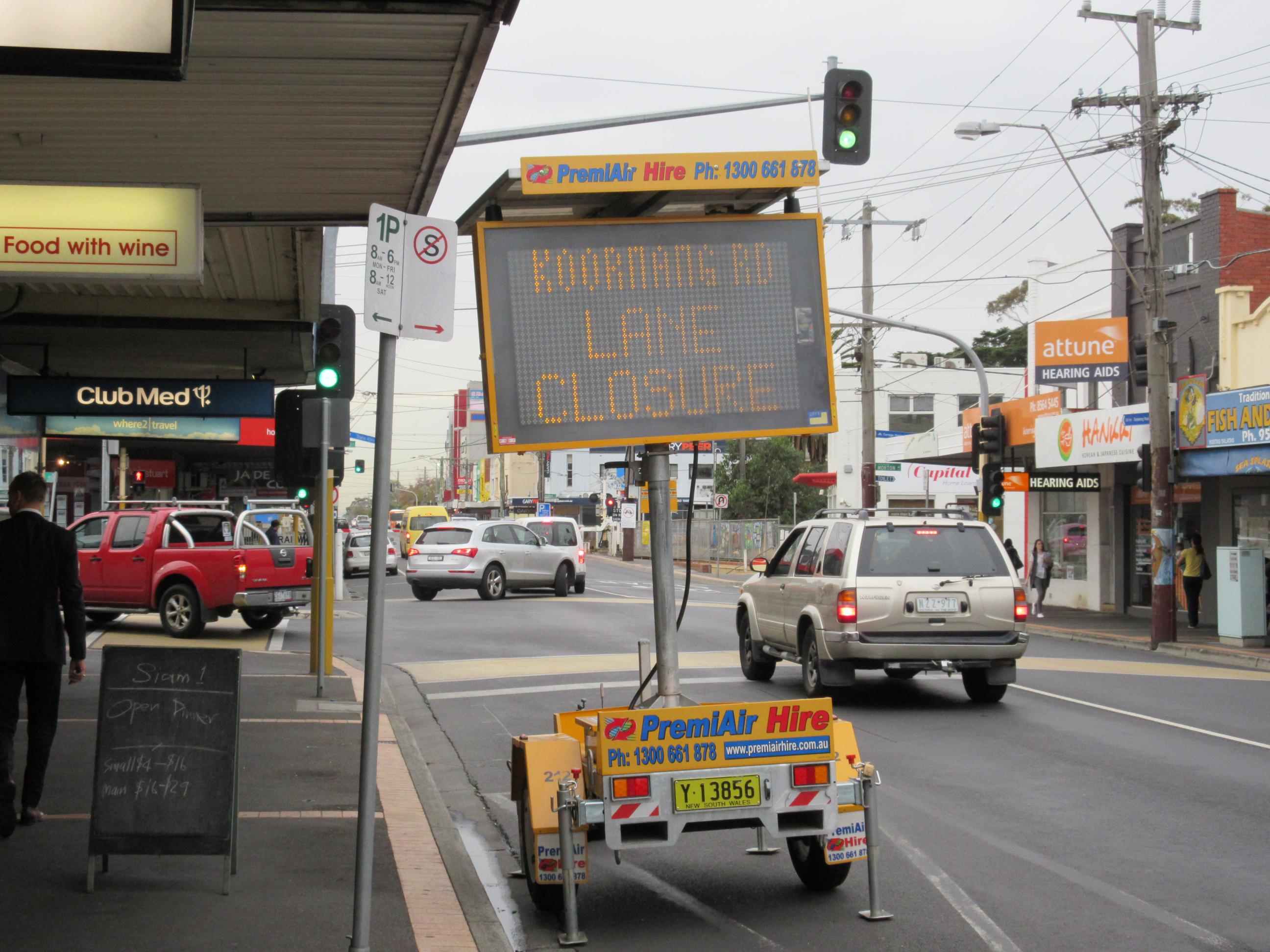
PS: here’s a photo we received in conjuction with a comment. It shows a trailer parked (in a No Standing Zone) as part of the LXRA operations and presumably without a permit. Yet, council in its responses to public questions claimed that only 5 permits had been granted for ground works. The trailer has been there for well over a week! Thus, how much faith, credibility, can residents place in any response they receive from council?

car

Once again the faction of Lipshutz, Hyams, Esakoff, Pilling and their newest recruit, Kelvin Ho, have successfully undermined open democratic processes in Glen Eira. In the following ‘debate’, we urge all readers to carefully consider the tenuousness, if not inanity of their arguments, the deliberate misleading and misrepresentation of the facts and what can only be seen as the self-serving motivation of their position. Years and years of appalling anti-community decisions are alive and well in Glen Eira!

ITEM 9.6 – LOCAL LAW AMENDMENT (MEETING PROCEDURES)

Lipshutz moved motion to accept recommendation. Seconded by Hyams.

LIPSHUTZ: began by saying that he chaired the Local Laws Committee and that they had met several times over the past year. Said that the motion is only to go out to public consultation. Said that the proposed amendment on Urgent Business was to facilitate councillors raising an issue that occurred between meetings. Conceded that the ‘most controversial’ proposal concerned public questions. Claimed that public questions ‘had become anachronistic’ because technology (ie webpages, email). Said that he spends many hours answering emails and getting ‘numerous phonecalls’. So ‘if you want to ask a question’ people can via their councillors. In his view ‘public questions have been abused’. ‘We have seen question after question from the same sort of people’ who ask ‘multiple questions on the same things simply to embarrass the council’.  Said that ‘the question could have been asked of a councillor’ and they would ‘have been given an answer’. So the amendment wants to move back the time for submission of public questions to 12 pm of the day preceding the council meeting. Also changing ‘should not exceed 150 words’ to ‘must not exceed 150 words’. He doesn’t want the situation ‘where one person dominates’ so they are limiting this to 2 questions. If people ask more then they won’t be read out. Further, ‘if you really want to know what the answer is, come to the council meeting’. ‘If you’re not here at the council meeting’ they will not be read out but will be answered but ‘will not be part of the minutes’. This is ‘important’ because people just want things in the minutes and ‘have no interest in coming to council meetings’.  ‘If you want it in the minutes, come here and hear us’. On right of reply, the amendment proposes to remove the clause about it having to be in writing. ‘As long as councillors have notice’ a reply can be made. They don’t want to be ‘caught by surprise. We know when someone is going to say something’.  Was sure that there would be ‘some people who do not agree’ with these changes but they can have their say and ‘we will consider’ the views.

HYAMS: said that he was ‘reasonably sure’ that in the past public questions were submitted under aliases. Currently questions come in on the day so can be taken on notice which means that people come to council meetings to hear the answers only to find that they have been taken on notice and no answer given on the night – ‘so having it a day earlier there is a better chance’ that the questions won’t be taken on notice. Also when questions come in on the day there are officers and councillors ‘running around trying to do the research’ to answer the questions.

DELAHUNTY: said she doesn’t agree with all the proposed amendments but will not oppose the motion because it is basically setting up the process for ‘further input’. Thought that the changes ‘limit the ability to participate’ for residents and it ‘almost distances’ council from ‘ratepayers’ by attempting to put in ‘more controls, less talking, less engagement, less interaction’. ‘Local government is about being the closest to the people’. Lipshutz talked about emails and phone calls from residents asking questions, so putting in these conditions is in fact ‘making it more inconsistent’ by making it harder for residents to communicate with council. When people write emails to councillors ‘we don’t say that’s enough’, you’ve asked your two questions, so why should this apply here? Wanted ‘consistent principles’ applied. Council ‘should embrace’ being more ‘interactive with the public’. Didn’t think that the proposed changes ‘embrace best practice’.

HO: said he was ‘happy to listen to any issues’ that residents raised and that he would be every second Tuesday of the month in the Carnegie shopping centre and people could talk to him between 10-12.

SOUNNESS: supported the motion to let people have their say on the amendments. Said that people had told him they were dissatisfied with the local law and one of the previous issues was about ‘frisbee’ was ‘an issue of the local law’ as well as how the ‘meeting procedure works’. He has had ‘strong conversations’ with people on this as well.

LOBO: said that ‘we need uniformity’ with other councils. There should be one law for all councils and ‘not let’ councillors ‘twist and turn what is good’. ‘The local law has to be spoken by the people’. They should be able to ‘speak in the gallery’ and not be restricted to 150 words. ‘Residents should get an opportunity to stand up and ask questions’.

MAGEE: said that councillors are available 365 days a year to the community and 24 hours on the phone, via email. They are ‘available at any stage’. Claimed that in his 8 years there have only been ‘a handful’ of questions that needed to ‘be asked at a council meeting’. He understood the part about 150 words, but he also gets emails of ‘3 to 4 pages’ and he answers. When letters come in to the mayor and councillors, then the mayor answers on ‘behalf of all councillors’.  Said that you ‘can’t have one local law’ because they cover ‘everything from dogs to footpaths’ and every council is different. Also silly to say that people should come to council meetings to ‘voice their opinion’. People have ‘voiced their opinion for hundreds of years’ and if this was permitted with the skyrail issue then the meeting would have ‘gone to 2 or 3 or maybe 4 o’clock’ in the morning. It ‘is easier if questions are taken on notice because the answer’ is mostly the same. There is plenty of opportunity for residents to ‘speak’ with councillors ‘one on one’ or via email.  Coming to a council meeting and asking a question so that it goes into the minutes you ‘have to wonder why those questions are being asked’. Said that ‘every question’ will be answered but ‘it is not up to council to sit here and have 3 or 4 hundred’ questions answered ‘one by one’.  Like Hyams said, councillors are ‘chasing answers’ to sometimes 7 very ‘detailed’ questions. ‘Those questions could have come in 3 weeks earlier’ but ‘they come in at the last minute and expect an answer’. Said that ‘we would never ever try to stifle debate or the opportunity for questions’ but ‘it’s got to be reasonable’. Said that public questions ‘tend to be about a range of things’ and he believes that they should be ‘about the agenda’. Everything ‘else can come through as a question, a letter, as an email’ to councillors.  He ‘never shirks’ his responsibility in answering questions.

ESAKOFF: agreed with speakers. Said that ‘public questions have been abused’ and that some years ago a question came in from an empty ‘block of land’ as the address, so ‘it does happen’. ‘We are available pretty much 24/7’.  Said that on some days she gets lots of calls and on other days it might only be one. As for questions on the agenda, well people could have rung councillors ‘right up to 7.30 and asked us’ rather than waiting until the end of the meeting to get the answer.

DELAHUNTY: moved a very long amendment which included: NOTICE OF MOTION; PUBLIC PARTICIPATION; PUBLIC ADDRESSING COUNCIL; QUESTIONS FROM PUBLIC WITHOUT NOTICE. Lobo seconded.

DELAHUNTY: said that there had been a report prepared on ‘best practice’ in September 2013. Said that Glen Eira was ‘the only council in Victoria not to have the ability to raise a notice of motion’. Her motion isn’t about changing the local law ‘immediately’ but is seeking public input. A notice of motion doesn’t ‘take away the ability’ in any shape or form for a request for a report. It doesn’t stop councillors from researching whatever they want, but it does give ‘your elected representatives’ what other councillors have got. Said that ‘you may hear arguments’ about political motivations. She is ‘seeking standards’ and giving residents the opportunity to bring issues ‘to the fore’. ‘It gives us the ability to put something on the agenda without the faint ability to put something on the agenda’ where ‘we have to actually wait for 2 meeting cycles’. Now they have to call for a report, have a discussion, ‘use officers’ time’ when ‘we know what it is that we’ve researched anyway’. ‘we’re all adults, we’re all capable of getting a grasp on issues’.  Officers’ time means ‘ratepayers’ money’. This doesn’t happen in other councils and ‘the sky has not fallen in’. Arguments about political purposes is totally wrong – ‘it has nothing to do with political purposes’. ‘It shows a complete disrespect for your elected representatives and disrespect for the public’.  Wanted more public participation since ‘local government should be engaging, should be closest to the people’. Questions without notice from the public is like what Esakoff said about receiving phone calls and emails everyday, ‘so why shouldn’t this be another forum where those questions can be answered?’ Said that with questions without notice from the public this would ‘echo’ what other councils are doing and also what Glen Eira keeps saying to government about ‘wanting to be the closest to the community’.  Said she remembered the resolution about skyrail where council said ‘it is not fair that residents do not get to voice their opinion to their elected representatives in a group forum’ and this is ‘the exact same thing that happens here’. ‘It is not fair that residents come into this chamber’ and can’t voice their opinion or ask questions in the same way that they can on the phone and via email. ‘It is inconsistent’ that you can do this via phone and not in chamber.

LOBO: said that ‘local laws can be created as a web’ by ‘spiders’ and when ‘the spider is the author of the local law it doesn’t apply to the people’. ‘our local law has been represented by the same councillors every year’. In a democracy there should be ‘sharing’ amongst councillors and to a ‘lay person’ so ‘we don’t have clauses that can be taken against someone who is not liked’. Was not sure if this is ‘democracy’ and people should check over the last ten years how voting has been taken in council. ‘The power should be with the gallery and not with us’. ‘we are here to represent the grassroots’ and if ‘we can’t do this then councils should be closed’.

LIPSHUTZ: said that Delahunty ‘sees the world through rose coloured glasses’. Asked the CEO if what Delahunty said about Glen Eira being the only council without a notice of motion whether this is ‘true or false’.

CEO: said that ‘I need to check for absolute accuracy’ but she understands that ‘there are other councils who do not have notice of motion’ or if they do have this, then ‘they have particular rules around how and when those particular notices of motion can be used’.

LIPSHUTZ: in ‘theory’ notice of motion is good and ‘in theory every councillor should be able to raise notice of motion’. ‘In practice it doesn’t work’. People do use it for ‘political purposes’. Councillors are Liberal, Labor and others and people have political views and that’s ‘all right’.

DELAHUNTY: point of order on relevance.

LIPSHUTZ: said it was ‘relevant’.

Delahunty again raised the point of order and asked Pilling to ‘rule on the point of order’ and that Lipshutz should be ‘silent’ until the point of order is ruled upon.

PILLING: asked Lipshutz ‘to stay on the subject’.

LIPSHUTZ: ‘it is a political issue and the fact is’ that ‘any councillor’ can use this for ‘personal reasons one after the other and hijack the meeting’. In Kingston and Monash there were notices of motion ‘one after the other’ and they ‘stayed up to 3am in the morning’.It can be used to hijack meetings’ and even though ‘we might like to think’ it won’t happen, ‘it does happen’. Also when people raise the notice of motion there is ‘no background to it’ and ‘without real research’. He brought up the issue of a ‘councillor wanting to close the mulch heap’ and he ‘came along with his own data’. ‘It was false but he did convince the majority of councillors at the time that he was correct’ but only ‘later was it discovered that it was false’. If they had had ‘guidance and a report from the officers’ and ‘had the research we would have made the right decision’.  Requests for a report are a ‘better way forward’ because ‘we then get the research’.  Lobo talks about ‘democracy’ and ‘we have what’s called an election’ and ‘councillors are elected to make decisions’. ‘That doesn’t mean we make decisions without consulting’. What ‘we don’t want’ is for councillors to ‘sit around this table and the meeting is hijacked by questions from the public or by councillors’.  Delahunty laughed and Lipshutz then said ‘I don’t think it is very funny and I ask’ the mayor to tell her to ‘behave herself’.  More laughter from Delahunty and the gallery. Councillors make decisions on planning and other things that ‘affect people’s lives’ and they have to ‘make those decisions fairly and squarely’. They can’t do that because a ‘councillor or councillors decide they want to have a personal agenda’ and they want to ‘move something which is in their party political or personal interests’.  On public questions the ‘same people invariably are asking the same questions’. You don’t see large numbers of people coming along to ask questions. Every councillor is available. ‘It is very easy to get a group of people to come together to hijack a meeting and make sure this council is not workable’.

HYAMS: accepted Delahunty saying that she wasn’t against the motion but that that was a ‘pre-emptive’ move for her motion.

DELAHUNTY: point of order that ‘that is improper’.

PILLING: asked Hyams to speak to the topic

HYAMS: public consultation is ‘reasonable’ but ‘when you think something is not going to definitely work’ then you shouldn’t put it out to public consultation and Delahunty’s amendment ‘is in that category’.  ‘We don’t need notice of motion. We have better ways of doing things’ like requests for reports. It’s better that officer reports come to council even if we ‘don’t follow officer advice’ as with the example from Lipshutz’s mulch heap where ‘we didn’t follow officer advice and possibly we should have’.  All very well for Delahunty to say that ‘we’re all adults’ but sometimes ‘we don’t know what we don’t know’ so officer reports are important.  Repeated the example of Marrickville council who voted to boycott Israeli products and then had to rescind the motion when they realised their computer systems were reliant on Israeli products. There’s always room for improvement but ‘the way we have it now’ is better because other councils that have notice of motion don’t have requests for reports. In the past people had to write their public questions down before the meeting started and the vast majority were then taken on notice for answers. So this means ‘how do you unask a question’ or stop someone from asking a question if ‘they’ve got the microphone?’ People would get ‘frustrated’ because they’ve sat there throughout the meeting only to ask a question that wouldn’t be allowed or get it on notice of motion later. The amendments are ‘trying to make sure’ that unless there is a ‘massive deluge all questions get answered’. Said that this issue isn’t ‘anywhere near’ what skyrail is. Also all recommendations from the Local Laws advisory committee ‘had to come to a council meeting’.

SOUNNESS: ‘My name is Thomas and I’m here to represent you!!!!’.  Said the motion is about ‘how you and us communicate’. On notice of motion he ‘hadn’t made up’ his mind as yet because that could be a case of making up his mind before due process. Couldn’t see why notice of motion couldn’t sit alongside request for a report. Strong opinion from community and this is what council should be ‘considering or not considering’ so this is an ‘opportunity’ to get feedback and ‘see what the community wants’ then council can ‘debate’ the issue. ‘Until we have the evidence in front of us’ he didn’t think that they can make the decision about whether something is right or wrong. Even if the motion fails people can ‘still write in’ and say they want notice of motion and the other things. And ‘councillors are encouraged not to have a closed mind on things that are put forward’. Originally he was ‘mildly against’ notice of motion and now ‘I am mildly for it’. Thought that the ‘community should be given the opportunity to consider another way of communicating’ with council.

HYAMS: asked the CEO for her understanding of Winky-pop and whether this applied to things like the local law

CEO: said that her ‘understanding’ is that the Winky-pop decisions ‘relates to actions in terms of administrative decisions’ and delegations and ‘powers of the council rather than the types of discussions we are contemplating this evening’.

DELAHUNTY: wanted clarification from Pilling as to whether or not Lipshutz said that a meeting is ‘hijacked’ if a councillor uses notice of motion

PILLING: said his ‘recollection’ was that ‘issues can be raised by councillors’ to ‘score points’.

DELAHUNTY: asked Hyams whether he ‘was aware’ that her amendment allows for notice of motion’ must be given 6 business days before the meeting’ so that discussion can take place in assemblies. Also asked asked Hyams if something goes out for consultation that he doesn’t think is a good idea and people say it is a good idea whether he would ‘reject that’?

HYAMS: said he didn’t think ‘I said’ that there wouldn’t be time to discuss the notice of motion. On Delahunty’s second question ‘I can’t answer that’ because it is ‘hypothetical’.

MAGEE: on public questions said that this isn’t something that he would ‘probably support’ because if there were 150 people wanting to ask questions then ‘that would make our council unworkable’. But he would support a ‘time frame before council meeting’ which was informal and direct questions from the gallery. Thought that ‘during a council meeting is very problematic’. He will ‘reserve’ judgement until he hears ‘from the public’ but he thinks that if the ‘majority ‘ want to ask questions at a council meeting ‘I may still vote against that’. ‘I can only do what I believe is right’. The ‘business of council is very important’. They run a $150 million dollar business and ‘operates 24 hours a day’ and the council meetings are to ‘conduct the business of council’. ‘Answering questions from the public, that happens 365 days a year’. However, ‘I would welcome that interaction before a council meeting’. On notice of motion that has ‘raised it head’ countless times and there are good reasons for it as well as ‘opposition’ and ‘it can be misused’. ‘If you think that’s a way of getting things through without all the information coming out, why wouldn’t you do that?’ With an officer’s report you ‘get all the pros and cons, the costs’.

AMENDMENT PUT TO VOTE AND LOST

VOTING FOR AMENDMENT – DELAHUNTY, LOBO, SOUNNESS, MAGEE

VOTING AGAINST – LIPSHUTZ, HYAMS, ESAKOFF, PILLING, HO
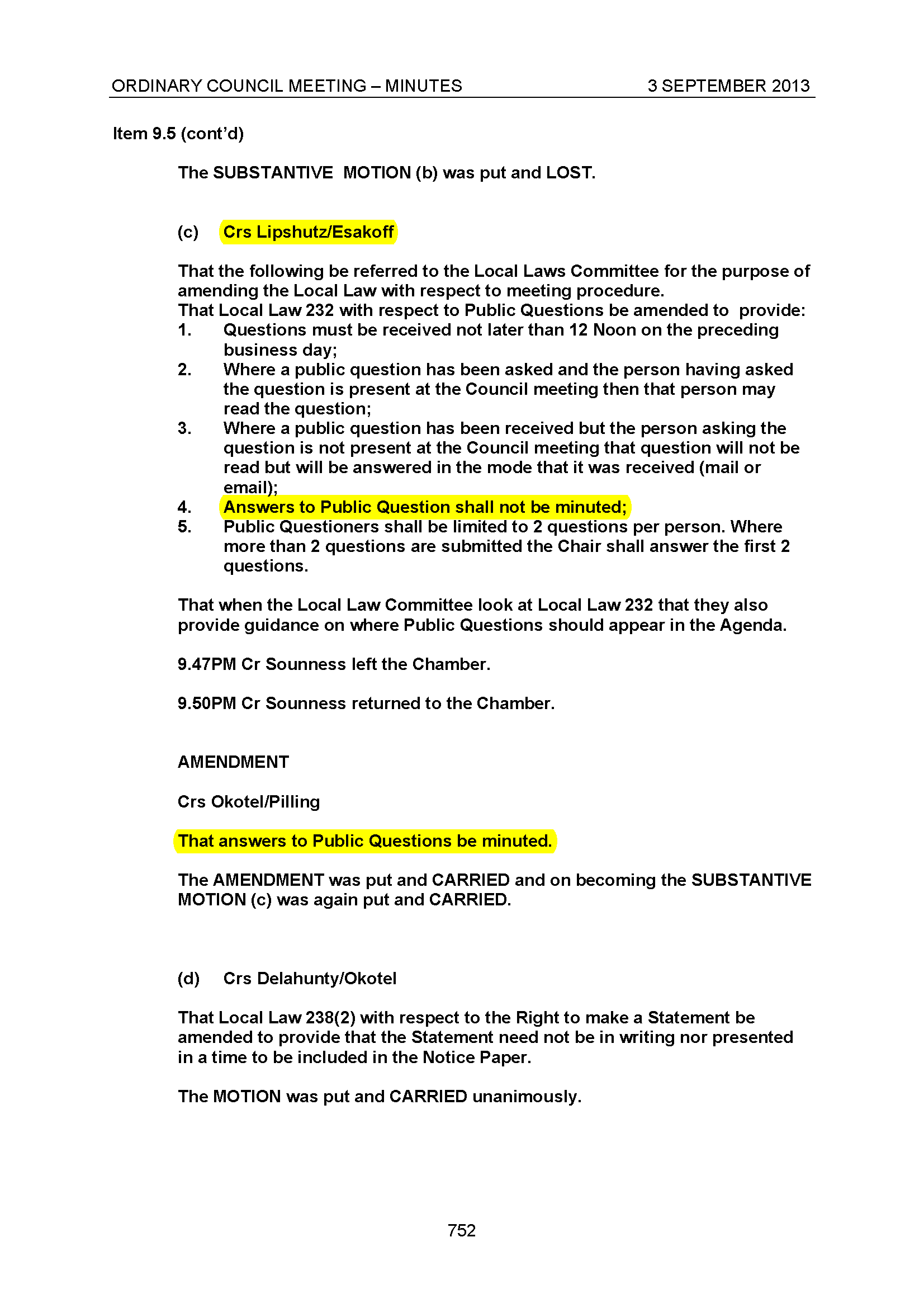
PS: Not for the first time has Lipshutz and his cronies attempted to thwart what most reasonable people would consider to be open and transparent government. Below is an image from the 2013 minutes where the groundwork for the current agenda item was laid. Please note:

  • The mover and seconder of the motion
  • How the current proposed changes to the Local Law contradicts the council resolution from that time (ie all questions answered shall be minuted. The current version implies that only those ‘read’ out will be minuted!)
  • Since this September 2013 meeting, the Local Laws Advisory committee has only met on 3 occasions – 9th April 2014; 3rd December 2014; 18th May 2015. The 2015 members of this committee were – Lipshutz, Hyams, Okotel and Lobo! Need we say more? Thus 3 meetings in two and a half years to come up with this nonsense!
  • We refer readers to our post of the time in order to assess councillors’ comments – see: https://gleneira.wordpress.com/2013/09/06/public-questions-whittling-away/

Pages from September03-2013-MINUTES

After years and years of promising to amend the Local Law there is finally an agenda item that proposes to further erode residents’ democratic rights and to make it even harder to get answers out of council. Submissions will be called for so we urge all residents to take particular notice of what is proposed and to think carefully what this will mean for transparency and accountability in Glen Eira.

Most of the changes focus on the right to ask public questions. Here is what the arch conservatives want –

  • Agenda items are posted online on Friday after 12pm. Public questions can currently be emailed to council by 12pm of the day of the council meeting (ie Tuesday). The proposal is to reduce this deadline by 24 hours (ie Monday 12pm). Even if the argument is that officers require more time to answer questions, surely this impediment can be overcome simply by publishing the agenda well before Friday afternoon so that residents can read the agenda and get their questions in earlier? Plenty of other councils publish their agenda a week prior to the formal council meeting –(Bayside, Stonnington for example).
  • Any question that is now over 150 words WILL NOT BE ACCEPTED. Previously the wording was ‘should be 150 words’ and to the best of our knowledge, no question was rejected which contained more than 150 words. Whilst some may argue that good questions should be able to be submitted below this number, there surely are occasions when detail is required and questions exceed 150 words? What this also means is that questions over 150 words will NOT BE RECORDED IN THE MINUTES. Another blow to accountability!
  • No more than 2 questions will be accepted from a single resident and they HAVE TO BE PRESENT IN THE CHAMBER FOR THEIR QUESTIONS TO BE READ OUT! Again, we are not sure whether this means that if the person is not present their questions will be recorded in the minutes. All we’re told is that the question will be answered by ‘mail or email’. We suspect that they won’t become part of the official record since another part of the proposals states that ‘The minutes will record questions read…’
  • Even the quarterly report will now only record those question read out and not the number asked!

What is extraordinary about this report is that not a single word of justification for any of the recommended changes is provided.  Why council (or rather the stacked Local Laws committee) considers any of these changes necessary and beneficial is anyone’s guess. We have no doubt that these changes are to the detriment of open and accountable government – rather ironic we feel when the state government is currently reviewing the Local Government Act with the stated intention of improving governance! We also remind readers that Delahunty is on this advisory committee!

Thus for all the promises of amending the Local Law in terms of the ‘unauthorised sporting groups’ (aka the Frisbee affair) and basic questions of Notice of Motion, that this is all that the Local Laws committee could come up with after years and years of ‘consideration’ is a disgrace. It is even more disgraceful that not a single word of justification is provided in the Corporate Counsel’s report as to why such changes are deemed to be necessary and why the new CEO has permitted such a report to even go out as the official record! All this means is the further erosion of good governance in Glen Eira and the resolve to diminish public participation even further.

NEWS FLASH: KELVIN HO IS COUNCILLOR ELECT

Motion to accept moved by Hyams and seconded by Lipshutz.

HYAMS: started off by saying that one of the ‘requirements’ for councils is to regularly review their planning schemes and this was last done in 2010/11. People then told council that they ‘wanted mandatory heights’, ‘transition zones’, and ‘better protection of neighbourhood character’.  Council therefore ‘implemented neighbourhood character overlays’, plus the new zones ‘had height limits’. In regards to Commercial zones then VCAT ‘disagrees’ with officers who believe that ‘our policies should protect’ against ‘this type of height that VCAT has been allowing’. Said ‘I don’t have a lot of faith in VCAT’ but they make the decisions and this is ‘binding’ so it’s ‘something that we need to look at’ in order to give Commercial zones ‘greater protection’ in regard to heights. The government is now looking at the residential zones, so ‘it is good’ that the discussion paper ‘doesn’t focus directly on those’ because ‘whatever we decide’ can be over-ridden by the government. Stated that the original Plan Melbourne talked about 60% of development going into established suburbs, but with the new Plan Melbourne Refresh the figure is no 70% of development in established suburbs so that means ‘cramming more dwellings into established suburbs’.  He hoped therefore that the ‘protections that we do have aren’t diminished by Plan Melbourne Refresh’.

Claimed that ‘community consultation’ is very important and that ‘what the community tells us’ from the review ‘will guide us’. Went through the various scheduled meetings and the themes of the discussion paper. Said that council would  collate all the information and then send it off to the Minister in August. Changes ‘will require a formal planning scheme amendment’ so this will ‘need to go through a lengthy process’ of consultation, planning panels and then council’s position sent off to the Minister. So even if ‘we all agree’ about height limits in commercial zones, and other things, it will still depend on the Minister.

LIPSHUTZ: planning schemes are ‘integral’ because it ‘certainly affects everyone’ so it is ‘important that the community be involved’.  Agreed with Hyams that it’s important that people are involved and they come to the meetings and ‘present their views’ because they can then ‘go to the government’ and say that ‘we’ve listened to the community; we actually know what the community wants’. Said it’s not 9 councillors saying this is what we like, but the ‘community saying this is what we require’. With the new zones people were saying that there is now development that ‘wasn’t allowed before’ well, ‘no one can build anything now that they could not before’. People can ‘twitter’ as much as they like and use other social media but ‘at the end of the day’ it’s ‘so important’ that people come ‘to these meetings and put your views’. Thought that the ‘zones are working well, but they can be improved’. Problem is VCAT because ‘they allow one thing in’ and the ‘next development comes along’ and they say ‘it is a street that is changing, therefore we will allow a second one’ and this ‘opens the floodgates’. Welcomed the review and wanted community ‘answers’ to take to the government’.

MAGEE: said he welcomed the review and that he wrote to the Planning Minister ‘last year asking for various types of reviews’ especially on the commercial zones and imposing overlays. ‘We had already commenced those discussions with the Minister’. So it is good that the ‘MInister is now formally requesting us to do what we were asking the Minister to let us do’. Said that ‘we can change our planning scheme, we can change our zones’ but this ‘won’t make one iota of difference’ if the Minister doesn’t also review VCAT. VCAT must ‘apply’ the planning scheme and shouldn’t be able ‘just to consider’ it. So council ‘can do all this work’ which they have done in 2002 and in 2010 and the ‘community told us’ what they wanted. ‘We knew street by street’ what people wanted through the minimal change areas. This was then changed into the new zones and ‘there were still problems’ because those problems are due to VCAT. Perfect example is Claire Street, McKinnon where there was a ‘totally inappropriate’ application. The ‘applicant lost at VCAT and came back to us a few months later’ with a new application which is ‘very little difference’. ‘So if there is no clear guidance from the Minister to VCAT’ then this planning scheme review is just ‘window dressing’. ‘It looks good, it sounds good, we’re all happy’ until the first council rejection goes to VCAT and ‘they disregard our planning scheme’. ‘You’re in the hands of an individual at VCAT’. Welcomes community input and ‘that will be what this council puts forward’ but unless the Minister looks at VCAT then ‘I worry that we are doing all this for no reason’.

ESAKOFF: said she was looking forward to community views and that ‘it is hard to imagine that anyone would want more’ development. Thinks that people will say that they want ‘less development’. Said she remembers community forums in 2002 where people were ‘horrified’ at the thought of 3 storey shop-top housing.  For Council ‘to put forward what our community says’ is ‘going to be a difficult one’ because for ‘us to go back with a lesser footprint if you like’ that what is there now, ‘we know where that is going to be put’ and ‘it won’t be accepted’. ‘Anything other than more won’t be accepted’.  Hoped that she was wrong in this forecast. What the community has got to say is ‘important’ because they might come up with ‘ideas’ that council ‘has yet to hear’ so this is ‘well worth listening to’.

SOUNNESS: said he’s got some experience in planning elsewhere where height and density is combined in other states. Victoria is different and complex and hard for people to understand. Said that the themes are good and people should respond not with planning language but with ‘your vernacular’. Thought that the 3rd theme on environmental sustainability was ‘vital’.  Said he’s got a major concern about climate, and how ‘we adapt and manage’ these changes.  Temperature increases mean less water and impacts on farming and food production.

LOBO: said he would try not to be ‘controversial’. Said he forecasts that the zones could ‘remain the same’ but people will have the opportunity to voice ‘their concerns’ and ‘what they have lost and hopefully what they will not lose in the future’. Said that the repeated ‘sentence’ that you can’t do now what you could do before’ is true, but the ‘zones’ have given ‘authority to builders to open up the floodgates’. Council can’t stop this or stop VCAT. So council is insisting on ‘democracy for Skyrail’ and ‘in this case we may have overlooked the democracy of asking the residents to comment’.

PILLING: said that Carnegie and Bentleigh East were ‘the real hotspots’ where residents ‘are concerned’ as well as the activity centres. ‘This is a chance for residents to get involved’. Thought this would be a ‘really valuable exercise’.

HYAMS: commented on the consultation on the zones and the consultation on Skyrail that Lobo referred to. The zones ‘were a direct translation’ from minimal change and housing diversity areas. The difference was that ‘in each of those zones we actually put more restrictions on what could be built’ and put on mandatory heights and increased setbacks. ‘So we actually did provide better protection right throughout Glen Eira’ and that’s why ‘we didn’t feel it was necessary to consult because’ it was basically a ‘transition’ and they were only ‘implementing the findings of the previous consultation’ where people wanted height limits and transition zones which ‘came with the’ new residential zones. But with Skyrail the government is ‘proposing to put in something that completely changes the neighbourhood amenity’.  Didn’t think there was ‘any valid comparison’ between the two examples. Urged people to ‘take advantage of the opportunity’ to comment and let council know ‘what they are thinking’. Said there’s a ‘tension’ between the need to ‘preserve neighbourhood character and residential amenity’ and to cater for a ‘substantial population growth’. This is what they tried to achieve with the zones by directing growth to transport corridors, ‘closer to shops so there would be less driving’. Not everyone’s going to ‘get what they want’ but important that people have a say.

MOTION PUT AND PASSED UNANIMOUSLY

NOTE: DELAHUNTY WAS ABSENT

We’ve uploaded the Planning Scheme Review Discussion Paper HERE.

Please peruse and we welcome your (initial) views.

At the first council meeting of the year, Lipshutz and Delahunty moved this motion – “Issues a Notice of Decision to Grant a Permit for Application No. GE/PP-28482/2015 allowing the construction of buildings and carrying out of works, use of the land at 2-4 Princes Street for a Place of Assembly associated with the Synagogue at 574 Inkerman Road and reduction of the car parking requirement in accordance with the following Conditions….”. The permit was granted, allowing events to occur weekdays until 11pm as well as increasing the number of ‘celebrations’ to 400 patrons in conjunction with normal prayer services. There were 16 objections.

Our concern is not with the application itself but whether Lipshutz should have declared a conflict of interest and removed himself from the chamber. It’s not the first time that the question of conflict of interest raises its ugly head in relation to Lipshutz. We have had numerous instances of his failure to declare what most reasonable people would perceive as either a ‘direct’ or ‘indirect’ conflict of interest. Some examples to refresh people’s memory:

  • numerous items on the racecourse where both Esakoff and Hyams declared conflicts, yet Lipshutz stated that because he wasn’t a ‘member’ of the MRC he had no conflict of interest!
  • in discussions on a petition where he, Hyams and Esakoff were named, yet he and the other two voted not to accept the petition
  • the famous ‘how-to-vote-cards’ episode and the permit granted to Emmy Monash
  • of course the famous Whiteside dummy spit over a permit for a property in Inkerman Road associated with the Gutnicks and where public open space was ceded to the applicant. Lipshutz’s ‘response’ was to label Whiteside as ‘anti-semitic’. (http://www.theage.com.au/victoria/why-bother-asks-former-glen-eira-mayor-20121022-281jw.html)

But in 2008 he saw fit to declare a conflict on an application for a mere two double storey townhouses in Daley St., Bentleigh  – “Cr Lipshutz declared an Interest in this item as he knows the applicant and works with him on matters of communal interest.” (Minutes of 26th February 2008)

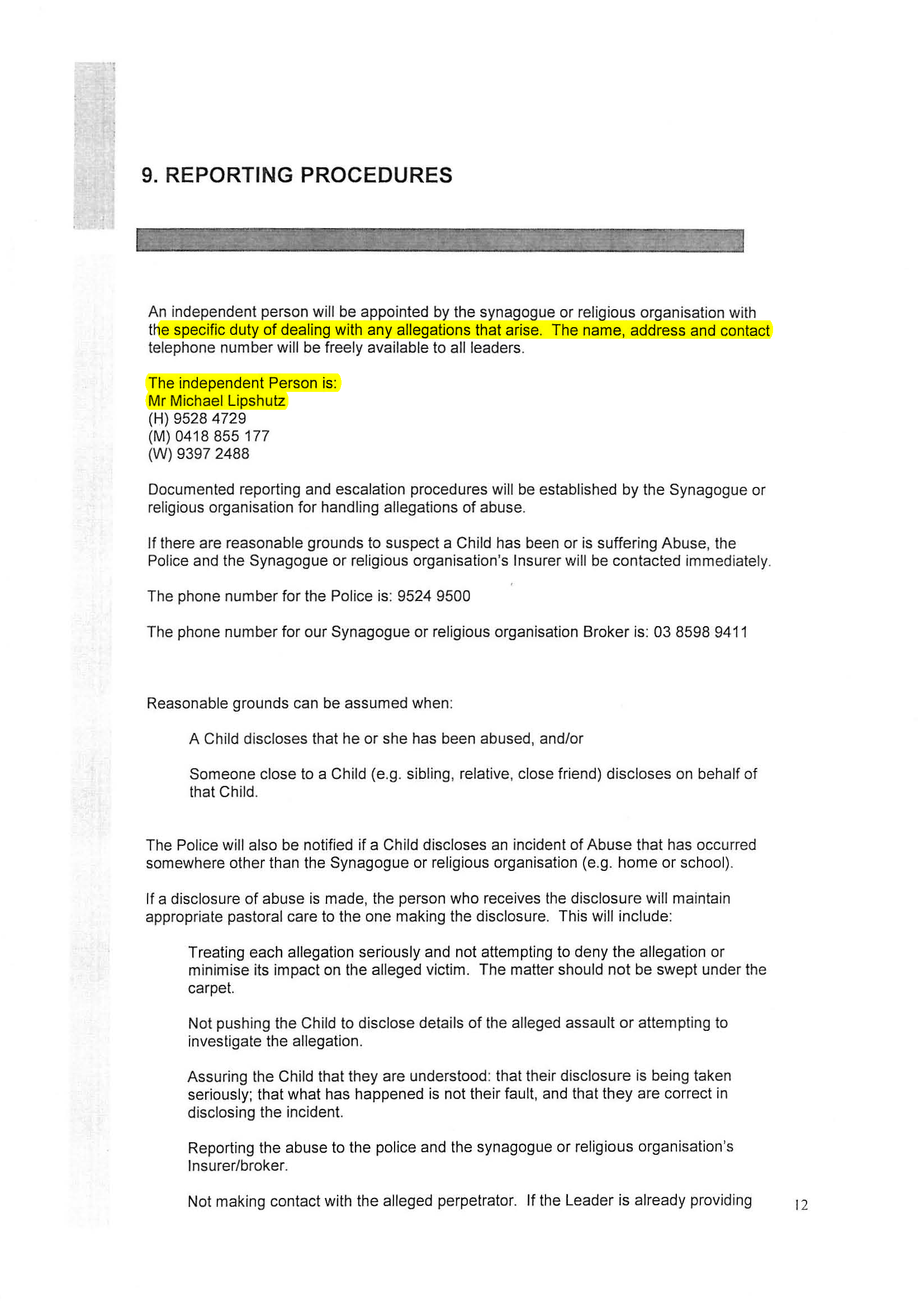
Thus ‘communal interest’ and ‘knows the applicant’ was enough back in 2008 to declare a conflict. What about currently? The image below comes from Page 12 of a document that originates from the applicant for the permit referred to in the opening paragraph. We have also uploaded the full document.  (HERE).(Source for the following: http://www.caulfieldshule.com.au/about-us/admin/policies/item/95-child-protection-policy.html)Pages from Child_Protection_PolicyThe ombudsman has made it absolutely clear that the public’s ‘perception’ of a conflict is a legitimate concern for any public official as it reduces trust in both the official and the status of local government. Lipshutz did not state at any time that he was the ‘independent member’ for this particular congregation. No records of assembly minutes reported that he had declared any conflicts. No other councillor uttered a word. Perhaps they didn’t know. If that is the case, we believe that it was incumbent on Lipshutz to let them know! How many more times will this councillor ignore the advice of the ombudsman and the constraints of the Local Government Act? And how many more times will councillors allow him to get away with such actions?

Council’s Local Law (yes, the one we’ve been waiting to see ‘revised’ for the past 4 years) states: –Where a question is deemed inappropriate by the Chairperson, the Chief Executive Officer or designated officer shall read to the meeting only the name and suburb of the person and the ground under sub-clause 232(2)(j) on which the question was ruled inappropriate.

This means that the actual question will not be revealed! Unfortunately for council they did publish one question (see below) that was deemed ‘inappropriate’. The alleged ‘justification’ cites Section 232 (j)(iv), which reads –

refers to a matter which would, if answered, breach any provision of the Information Privacy Act 2000 or the confidentiality provisions of the Local Government Act 1989

Pages from 031516-minutes

A very strong rumour is making the rounds that Okotel has resigned from Glen Eira Council to pursue her hoped for parliamentary career. We are confident that readers will have a view as to her contribution to this municipality in the three plus years she served as a councillor.

On another issue, last night saw the unanimous vote on the Sounness moved motion regarding ‘noise pollution’ emanating from the Caulfield Racecourse and their ‘music events’. Interestingly, Sounness’ motion was in part for council to ‘liaise with Stonnington’. Subsequent events reveal in glorious technicolor the difference between Glen Eira City Council and Stonnington City Council. The latter has no issue with alerting community groups as to the upcoming events. In Glen Eira, there is silence. Thus residents have to find out for themselves, or from their neighbouring contacts.

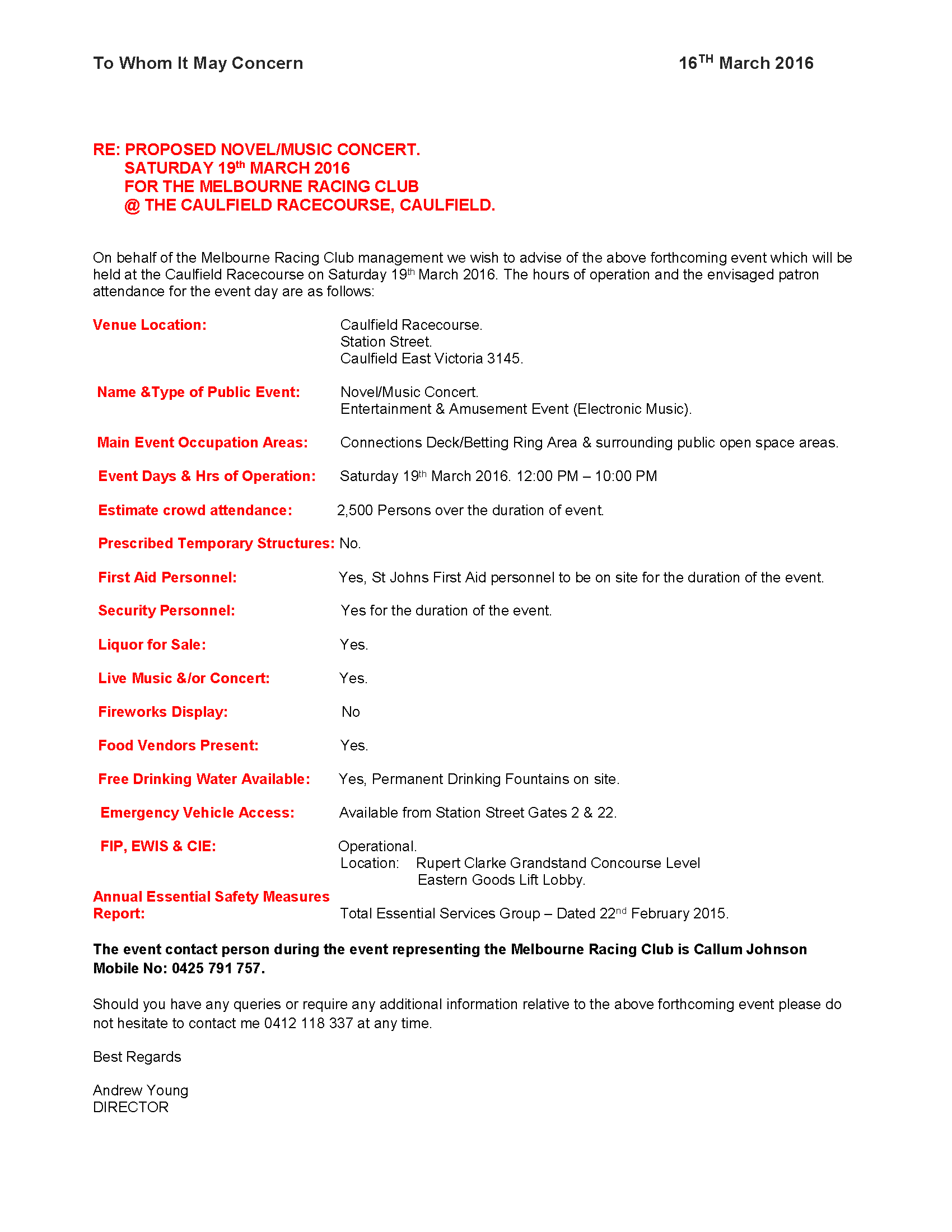
Below is the email sent from the MRC’s ‘consultants’ to Glen Eira officers. We have also uploaded their flyer for this event. Questions galore need answering – what will council do to ensure this event is within EPA noise guidelines? Will officers be attending? Will council ensure that traffic wardens are available at 10pm so that attendees can leave the grounds in an orderly fashion? Will they be pursuing this issue with the Minister, the police, the Trustees, or as per normal, keep passing the buck onto everyone else?

From: Dartmoor Consulting Group [mailto:a.young@tpg.com.au]

Sent: Wednesday, 16 March 2016 11:07 AM

To: John Bordignon; shane.cashman@police.vic.gov.au;

SEMRCommunityResilienceCommanders@mfb.vic.gov.au; Keith Franklyn; Ron Torres

Subject: RE: PUBLIC EVENT NOTIFICATION FOR THE CAULFIELD RACECOURSE – NOVEL CONCERT – SATURDAY 19 MARCH 2016

To Whom It May Concern,

Please find attached relevant details pertaining to the above forthcoming public event to be conducted at the Caulfield Racecourse on Saturday 19th March 2016.

Should you have any queries or require any additional information in relation to the scheduled event prior to or during please don?t hesitate to contact me directly at your convenience.

Best Regards

Andrew Young

DIRECTOR

DARTMOOR CONSULTING GROUP PTY LTD

Public Event Compliance/Management Consultants

Project Facilitators

Private Building Surveyors

Postal Address: P.O.BOX 165 : GLEN IRIS VICTORIA : 3146 AUSTRALIA.

Mobile Number: 0412 118 337

Email Address:

a.young@tpg.com.au

PUBLIC EVENT NOTIFICATION  NOVEL CONCERT -  SATURDAY 19 MARCH 2016 @ CAULFIELD RACECOURSE.-3_Page_1

« Previous PageNext Page »