We are committed to facilitating genuine debate within Glen Eira. Your views on planning, environment, open space, CEO and councillor performance matter.
Council has finally released its draft Housing Strategy. The proposals will impact hundreds upon hundreds (if not thousands) of residents – without the necessary justification or evidence. Why do we think so?
The various documents state over and over again that Glen Eira has the land CAPACITY to meet our projected housing needs of roughly 13,000 net new dwellings by 2036. If this is the case, then why do we need to rezone and facilitate more and more development?
Much of the data provided is highly tenuous and conflicts with both Victoria in Future prognostications, as well as the Bureau of Statistics data.
The assumption that building more and more will reduce prices is a fallacy and there is plenty of published evidence that would refute, or at least challenge this claim.
Council has an Urban Forest Strategy, a declining tree canopy, and a Climate Emergency policy, yet paradoxically is prepared to reduce setbacks, remove mandatory garden and parking requirements, and tellingly, instead of attempting to reduce the height island effect, council is prepared to reduce permeability so that more dwellings can occupy certain sites.
Our conclusion is that this Housing Strategy is Amendment C184 in disguise – except that it will now extend to all of the municipality instead of only Bentleigh and Carnegie.
The important detail is presented below.
What the above implies about the potential zoning and schedule changes are:
Currently land zoned NRZ has a 50% site coverage, a 25% permeability requirement and a 4 metre rear setback. The above screen dump makes it clear that the new NRZ zone will in all probability become 60% site coverage, 20% permeability, and a removal of the 4 metre setback entirely.
The current GRZ zoning allows an 11 metre height maximum plus various setbacks for the upper second and third level of the buildings. There is also a mandatory garden requirement of 25% to 35% depending on the size of the property. Again, council is proposing to remove this so once again we can have more development on the site. Rear setbacks are also likely to go.
Council has provided the following map that is now the Framework Plan. Surely far more detail could have been provided such as clear differentiation of colours rather than what is shown as gradations of pink. Why not clear blues, greens, yellows that stand out? Or would this reveal too much to residents?
From this map it would appear that all Neighbourhood Centres zoned GRZ will have the mandatory garden requirement removed. Please consider the above map carefully and try to decipher whether you will be impacted by these changes.
There is much, much, more that could be said about this and council’s overall approach to consultation. 4 weeks is not enough to plough through 589 pages on the housing strategy itself. Consultation requires more than a ‘survey’ that in the past has not asked the right questions. Nor is it appropriate that council publishes a 1000 page agenda several days before vital decisions are to be made. How many more times will it be necessary to remind this council that the ombudsman recommended at least 5 working days for the publication of agendas?
We urge all residents to contact their councillors and to lobby hard for the rejection of this Housing Strategy!
Council has published its submission to the inquiry on the current Planning & Environment Act, 1987 in today’s agenda. Whilst we agree with many of the comments, there are several major issues where council’s response is far from adequate or valid.
First, the ‘good points’.
Yes, there should be specific attention paid to the environment and sustainability
Yes, housing affordability is an issue, though most things are out of council’s control
Yes, heritage is important and there should be a fast tracking process for interim protections
Now for the ‘questionable’ responses!
SOCIAL/AFFORDABLE HOUSING
Here’s what council has to say in regard to providing social/affordable housing –
Council has a policy requiring a minimum of five percent affordable housing on rezoned sites. Ideally, this should be extended to higher density development proposals and adopted at a state level.
By way of comparison, readers should note what Yarra Council as one single example only, has done with its percentages on social/affordable housing. In its 2019 Housing Strategy, Yarra states:
Yarra has worked with a number of site owners to provide at least 10% affordable housing. At theformer GTV9 site, Richmond, affordable housing will represent at least 10% of the total number of new apartment dwellings. At the former Gasworks site, Fitzroy North a range of dwelling types will cater for a variety of housing needs including the provision of up to 20% affordable housing. Council will continue to seek additional affordable housing for our very low, low and moderate income community. (page 18)
Why Glen Eira should be ‘satisfied’ with a meagre 5%, when other councils are seeking up to 20% is the central question here. When we are so ‘committed’ to the need for social housing, then why has council been willing to settle for 5% on such massive developments at Caulfield Village over 2000+ apartments, and soon East Village, with at least 3000 dwellings on the cards. Further, why limit the creation of social housing only to those areas that will be ‘rezoned’ – presumably sites listed as Comprehensive Development Zones, or Priority Development Zones, etc. There have been plenty of developments on straight forward MUZ, or C1Z sites, that are well over 100 apartments.
Maybe, the answer is very simple. Requiring too much from developers in terms of social/affordable housing, will simply be another impediment to development that council is not willing to put in place!
MANDATORY APARTMENT SIZES
A little background first. According to the 2016 census, Glen Eira has just under 9% of single bedroom dwellings and just under 30% of its dwellings that contain 2 bedrooms. That equates to well over a third of all our dwellings. Yet we have 50.1% of our population listed as families with children. This number is very likely to have increased by 2021 and is the cohort which according to common sense requires space. Further exacerbating the issue, is the lack of open space in the municipality.
Given these above stats, then the issue of space becomes vital – especially in this COVID world where more and more people are likely to remain working from home.
Over the years, there has been report after report (especially from the City of Melbourne, and The Age) revealing the dog boxes that have been going up. Many single bedroom apartments were under 20 square metres, and 2 bedroom apartments, less than 50 square metres.
So what is Glen Eira’s response to the question of whether there should be mandatory, minimum apartment sizes? Here’s what was stated:
Apartment sizes are already discretionary. This enables consideration to be given to the quality of the space in terms of flexible furniture layouts, circulation and good natural lighting. Smaller apartments are more affordable and policy and controls that aim to improve the quality of the space may be more useful than mandating a minimum size. Well designed smaller housing accommodates more people in well connected areas, close to shops and services, and offers an affordable housing option. The quality of the space is more important than mandating a minimum size. Mandating a minimum size may contribute to making affordable housing even more elusive than it already is.
We will leave it to readers to interpret the above and decide the real reasons for council’s opposition to mandatory sizes.
Last night’s council meeting included another first – the refusal to allow a councillor his requested time extension. This occurred on the ‘debate’ for progressing the multi-storey car parks in Bentleigh and Elsternwick to the next stage – ie design, background reports, feasibility studies etc.
Zyngier rose to speak against the motion to proceed. He spoke for his 3 allotted minutes and then requested a time extension of 6 minutes. Magee replied that he would consider another 3 minutes first and then see how far Zyngier had got with his statements. The motion to allow the three minute extension was put and voted down. Those opposing the time extension were: Esakoff, Cade, Parasol, and Zmood. Given that Pilling and Athanasopolous were absent, these councillors constituted the majority.
Only Zhang later in the ‘debate’ commented how disappointing it was that this occurred.
It is indeed another sad day for Glen Eira when a councillor is denied his right to speak for more than 3 minutes. To the best of our knowledge, this has not occurred previously. Whatever Zyngier had wanted to say is not the issue. Nor is the final voting the issue. What is the issue, is how politics has come to play a major role in many council decisions and this applies to both sides!
Since none of the above 4 councillors provided reasons for their decision to disallow Zyngier his requested time, we have no idea why they voted the way they did. Simply not good enough.
On another matter, it seems that McKenzie has adopted the Paul Burke method of reading out public questions as fast as she possibly can in a steady monotone, making it difficult to follow the intricacies of the question for those listening or viewing. This was not the case 6 months ago!
There can be no excuse for what is proposed for council’s Community Engagement Strategy. The vote on Tuesday night will seek to endorse a strategy that has been rejected by a council resolution on the 23rd February 2021. This resolution still stands!
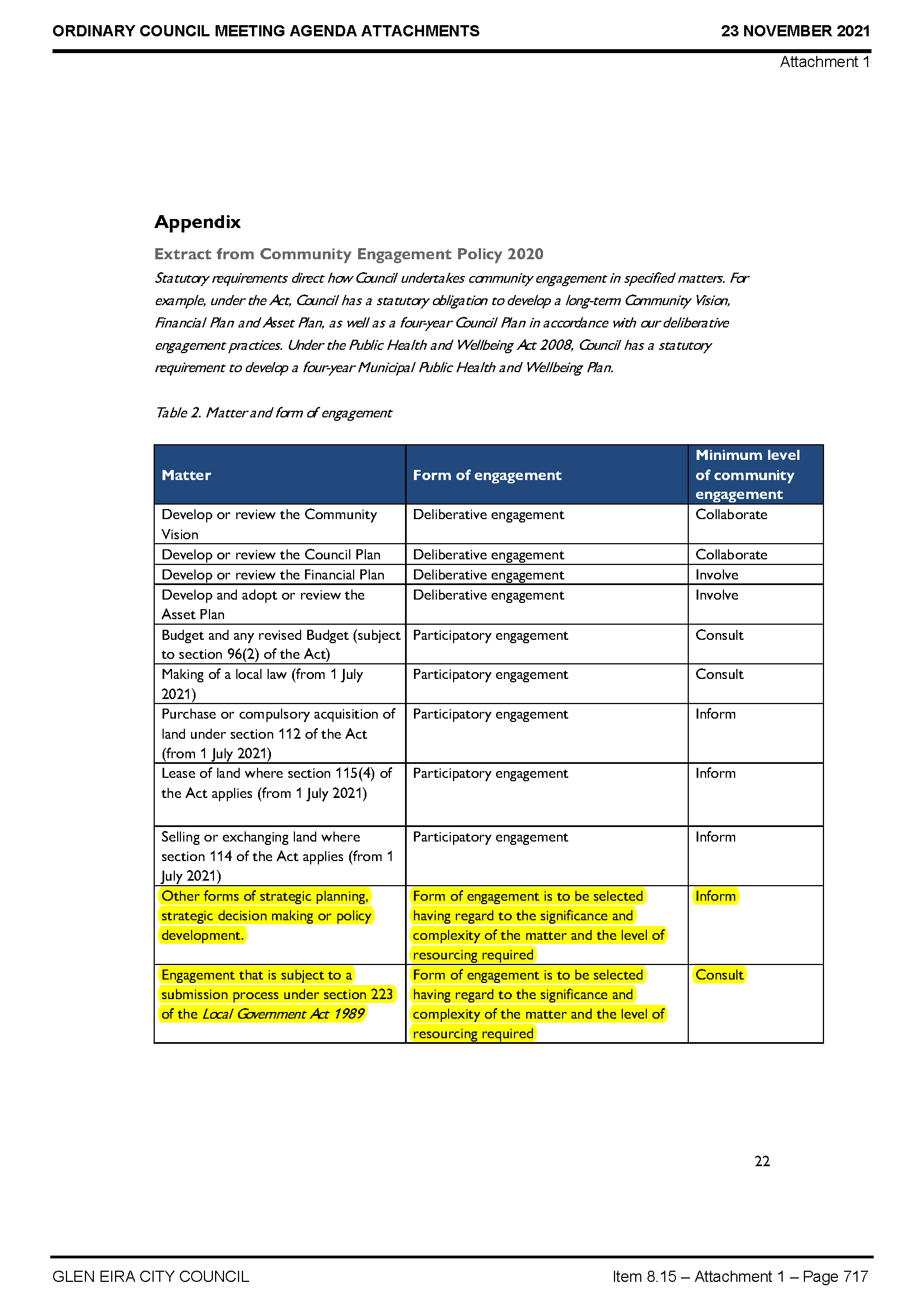
Council’s presentation for this item is deliberately false, inaccurate, and devious. First off, we are told that the attachment represents the endorsed Community Engagement Policy from 2020. Here is the (false) presented version . Please note the highlighted sections at the bottom of the table.
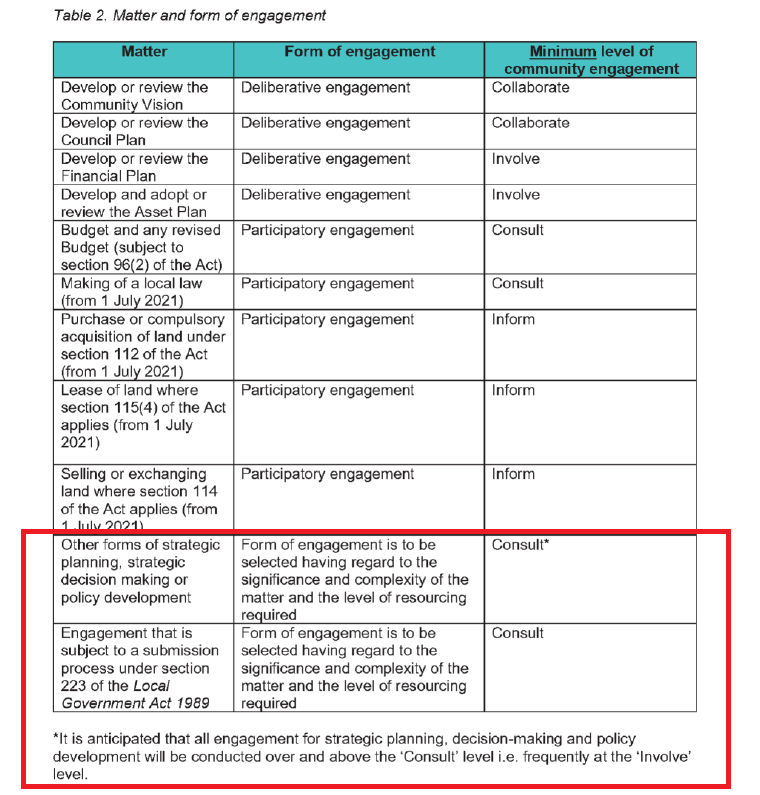
On the 15th December 2020 the draft contained the following. Again, please note the highlighted sections and compare with what is now suggested as the 2020 policy.
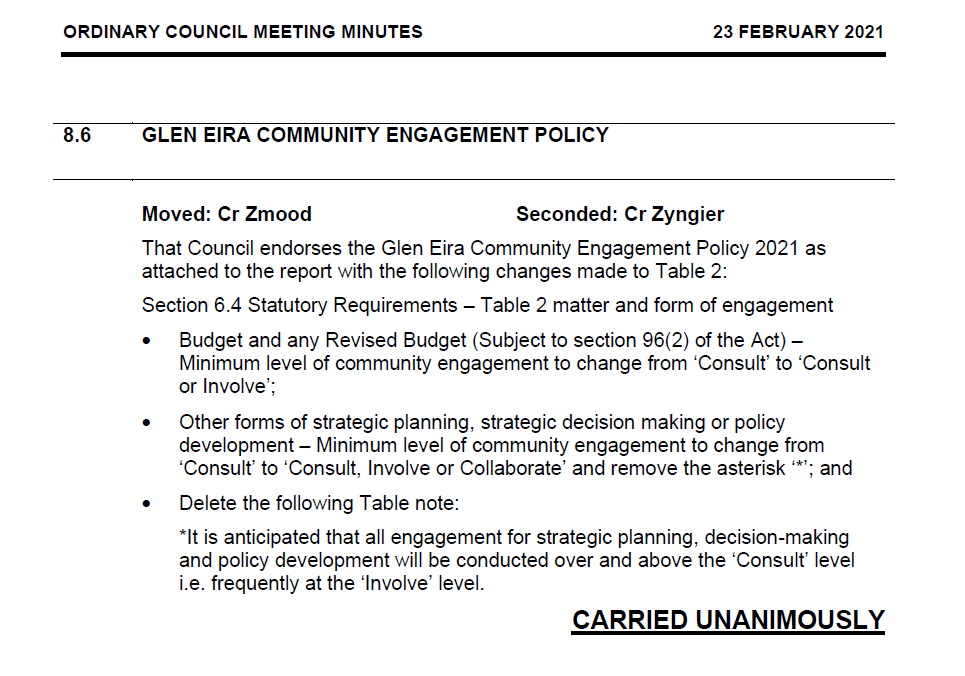
Following public consultation, councillors voted on the 23rd February 2021 as follows:
COMMENTS
It is simply staggering that council should attempt to present such false information and in doing so, over-ride a clear councillor resolution. Secondly, if this is passed then it achieves a reduction in community input to the most important aspects of council’s operation – ie strategic planning and policy development. As we’ve stated in earlier posts, Glen Eira compared to other councils is determined to limit resident participation as much as possible. ‘Inform’ and ‘Consult’ are the lowest rung of the engagement ladder according to these councils and the IAPP principles. (see: https://gleneira.blog/2021/01/07/consultation-2-2/. But what is even more damning is our allegation that this is deliberate and an attempt to bypass and ignore a councillor resolution as well as limiting community participation. It is unconscionable!!!!
Council’s agenda is out and once again we despair at the predetermined outcomes that this administration enforces upon its residents. Included in the agenda are the Built Form Frameworks (BFFs) for Caulfield South, Caulfield North and Bentleigh East, as well as the Community Engagement Strategy.
Readers should note the following:
The Community Engagement Strategy promises that residents will be provided with feedback on how their views influenced the final council proposal/decision. In relation to the BFF’s this is entirely missing. So much for the ‘engagement strategy’ and its empty promises.
The report on the community consultation for the BFFs failed to include the actual comments. What we basically get are ‘summaries’. Given the importance of these strategic plans, and how many residents will be impacted, surely a comprehensive and detailed analysis of all responses is warranted? Of course, readers might like to think back to the actual questions that were asked as part of this ‘consultation’ and how sub-standard they were! (See: https://gleneira.blog/2021/05/12/is-this-fair-dinkum-consultation/ for our ‘review’ of the consultation)
The BFFs remain unchanged from the previous versions as far as we can tell. Interestingly, the accompanying draft Design & Development Overlay, is only for Caulfield South. Why? No explanation is given as to why Bentleigh East and Caulfield North are ignored. Is council simply testing the water at this stage? What is the expected time frame for the DDO’s for the remaining two centres?
Most importantly, any planning for activity centres has as its major objective to ensure that there is capacity to meet the forecast population growth. Not one single statistic on population and dwelling growth is provided in any of these frameworks!!!! Hence, we cannot find any strategic justification as to why 6 storeys is appropriate, compared to 10 storeys or even 15 storeys if this is the logic behind these plans! In our view, the link between projected population growth and dwellings required has not been established. That is the role of a Housing Strategy. But of course, council is rushing everything through PRIOR to the creation of a Housing Strategy!!!!!
Even more damning is the fact that Council is still relying heavily on its City Plan. We remind readers that this document argues that 5 storeys is the optimum discretionary level for commercially zoned sites in these centres. Yet we are confronted with BFFs that totally ignore this and recommend higher levels. What’s the point of having a policy that is continually ignored?
There is much, much more that could be said in regards to these BFFs and the Engagement Strategy. We will provide a more detailed analysis in the next few days.
There are several agenda items for the upcoming Wednesday night council meeting which deserve residents’ close attention. The major focus for two of the items is on heritage, whilst the third item contains comments that apply to planning in general throughout Glen Eira.
What each of these items has in common can be summarised as follows:
A history of neglect and dereliction of duty by council on heritage for well over 15 years. Given that we have had, and still have certain councillors with extended time on council, the blame for such inaction must fall upon them.
Scant concern for existing heritage overlays and the resolve to initiate controls via planning scheme amendments to ensure greater protection for these sites and precincts.
In Glen Eira, development potential usurps heritage protection. In fact, this applies equally to the State Government and VCAT.
With the third agenda item (ie submission on the Gov’s Land Use Frameworks) we have the explicit and unequivocal admission that the introduction of the residential zones in 2013 were abysmally implemented. Even worse, is the admission that what council is now proposing is in fact contrary to what the approved structure plans for Bentleigh, Carnegie and Elsternwick propose.
We will go through the above and elaborate in order.
HERITAGE AMENDMENT C214glen
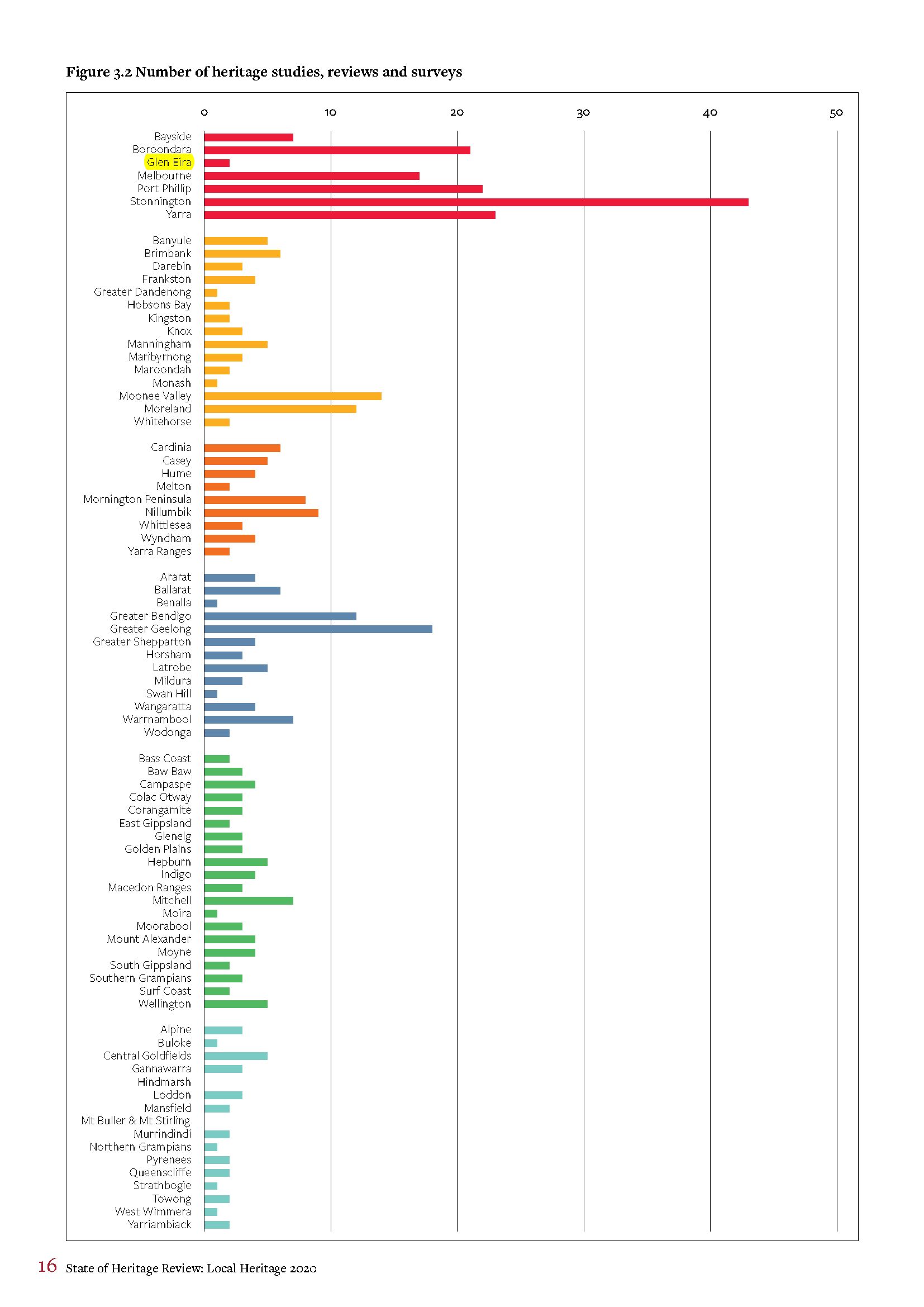
Included in the Panel Report for this proposed amendment, we find data collated by the Heritage Council’s review for all municipalities in the state. These are produced below. Please note:
How badly Glen Eira compares with other inner metropolitan councils
How little has been achieved over the years on heritage, despite the fact that in the 2016 Planning Scheme Review, residents were promised a complete review of the ENTIRE municipality. This has now morphed into individual precincts and suburbs. The promise of 2016 has not been done, which leaves hundreds of properties at the mercy of developers.
The Panel Report, and the officer’s report makes it absolutely clear that the issue of whether or not a site is suitable for heritage protection has nothing whatsoever to do with:
Objections
Financial costs
State of building, or
Potential development
This therefore raises innumerable questions as to why council did not utter a single word when the Minister refused to incorporate several heritage precincts in Elsternwick that were evaluated by Heritage experts as being worthy of inclusion into the proposed heritage overlays. The published excuse was that there was no current ‘development pressure’. Council has also used this ‘excuse’ when considering applying for interim heritage overlays. The above Planning Panel report invalidates these excuses and also brings into question why the Minister, in refusing to include these heritage precincts, has in fact acted against his own Planning Practice Notes!
NEERIM ROAD, MURRUMBEENA APPLICATION
This is an application for 7 storeys, and 88 student apartments, and on a site which has recently gained a heritage overlay. There were 115 objections. Previously the site was earmarked for a 9 storey building, which was refused by council. At the subsequent VCAT hearing, the developer reduced the application to 7 storeys. VCAT also refused the granting of a permit, largely on heritage grounds and insufficient setbacks. This latest application argues that the previous VCAT directions have now been attended to via the new plans.
Whilst this latest application receives the nod for a permit, we find the reasons for this view to once again show how pro development this planning department is. The report completely ignores to mention the following:
Less than half of the proposed dwellings are more than 20 square metres! Some are in the range of 16, 17, and 18 square metres in size. Readers might remember the furore created by the City of Melbourne’s report that student apartments should have a minimum size of at least 50 square metres in order to be truly ‘liveable’. The Minister had his chance to implement minimum size guidelines with his ‘Better Apartments’ guidelines, but failed to do so. Glen Eira’s submission to this endeavour stated: While setting minimum apartment sizes is encouraged in principle, this should be considered against the impact it may have on construction costs and consequently, housing affordability. If a correlation genuinely exists between the two, setting an apartment standard may not be ideal.
Whilst both City Futures and Heritage stated that the height was still a concern, the report concluded: While Council’s Heritage Advisor does not consider that the proposal has gone far enough to address the specific heritage elements in this centre, it is considered on balance that the proposal has suitably addressed the requirements of the Heritage Overlay, has moderated the bulk and form to a sufficient degree which was a key issue in the VCAT decision for the 2019 Student Housing Proposal and provides for the retention and restoration of the façade of the original building.
It is clear that when it comes to heritage, this council prefers development. We have already seen the granting of a permit for 12 storeys of student accommodation in Derby Road, Caulfield East on a heritage site, and the demolition of several other heritage properties throughout Glen Eira.
If and when this latest application goes to VCAT, we are not optimistic as to the final decision. Why? Because the arguments presented at the previous VCAT hearing remain. Of course, these comments made by the member were not included in the council officer’s report. We quote from this earlier decision:
Unfortunately, there is no structure plan for this activity centre to assist us in considering the built form outcomes for this site. Council has adopted a new City Plan (February 2020). The plan sets out a 4-storey preferred height for those parts of the activity centre to be included within the Heritage Overlay and a 5-storey height for land facing Melbourne Street. The City Plan shows four levels for the front part of 430 Neerim Road and five levels to the rear. The Tribunal in 348-354 Hawthorn Road Pty Ltd Ltd v Glen Eira CC [2020] VCAT 1211 accepted that the City Plan may be the council’s current broad thinking about activity centres in general, but we give it no weight as a tool to assess building height, relative to the urban design tests of the planning scheme as set by both the State and local policy frameworks. While we agree with these comments, we consider that there is an expectation of development within this activity centre of up to five storeys, noting that there are developments of this scale already present in the activity centre
The council submission acknowledges that the local policies do not prescribe particular heights or densities for the neighbourhood centre and that density, mass and scale of residential development needs to be assessed according to the location, physical size, scale and character of the neighbourhood centre.
there is nothing in the planning scheme to indicate that a uniform height is sought for buildings in this centre, or any other neighbourhood centre.
COUNCIL SUBMISSION TO GOV – LAND USE FRAMEWORKS
Whilst this submission is a vast improvement on previous council efforts, given that there are overt criticisms made of the policy, plus the call for more specific explanation and verified data, the overall response includes several paragraphs that should be noted by residents. The following is in response to the State Gov’s proposal that neighbourhood activity centres be required to accommodate medium to high density development along a range of 800 metres.
Direction 5 – Prioritise housing growth in areas with access to jobs, services andgood public transport
This Direction refers to opportunities for new medium and higher density housing to beconsidered within an 800 metre walkable catchment of activity centres. This is notsupported. Many of Glen Eira activity centres are linear and relate better to a 400 metrewalkable distance at the most. A radial measurement is not appropriate and opportunitiesfor new housing should be considered at the local level, through structure plans, where thecommunity is involved.
What we have here is the complete disavowel of the residential zones that were introduced in 2013. They were ‘radial’ in countless residential streets. All council did was draw a circle on a map with a radius of 400m. Most of our activity centres and their respective zoning still has not altered, meaning that countless residential streets currently have at least 2 and often 3 different zones. 8 years later we are being told that this is ‘inappropriate’.
Worse still is the admission that a 400 metre ‘walkable distance’ is the best option. If so, then why do our current interim structure plans work on the principle of 800m? Does this mean that the structure plans for Bentleigh, Elsternwick and Carnegie will be consigned to the dustbin of history – as they should? How much money has this cost thus far and to what effect?
All of the above illustrates fully what an absolute mess planning is in Glen Eira. Heritage is ‘expendable’ when it competes with development; structure planning for all of our neighbourhood centres remains in the ‘never-never’ and contrition from the likes of Hyams, Magee, Athanasopolous, Delahunty, Lipshutz, and Esakoff, and Pilling, for allowing such incompetence for years and years, is not forthcoming. Our hope is that with a new crop of councillors, perhaps residents can finally achieve the sort of council that does act in the best interests of its community.
Below we feature some of the public questions which were submitted for the last council meeting. As per usual, residents received ‘responses’ rather than ‘answers’.
QUESTION: Council recently abandoned the Bentleigh and Carnegie structure plan due to thelack of a housing strategy and yet on tonight’s meeting agenda is the Glen Huntlystructure plan (item 8.4). Should not Council wait to vote on Glen Huntly structureplan until after the completion of the housing strategy?
RESPONSE: The development of a Housing Strategy before the adoption of this structure plan is not necessary for this centre. While Glen Huntly will provide for additional housing,the structure plan is primarily focussed on the commercial core. This is quitedifferent to Council’s other structure plans in Bentleigh, Carnegie and Elsternwickwhich also include large residential areas.
As a Major Activity Centre, there is an expectation that this centre will change inalignment with State Government Policy. The structure plan seeks to get on the frontfoot and manage the height and form of buildings that we expect following theremoval of the level crossings
The preparation of the draft Housing Strategy will give appropriate consideration tothe role of Glen Huntly as part of its development.
COMMENT(S) –
The response given is literally baffling for several reasons:
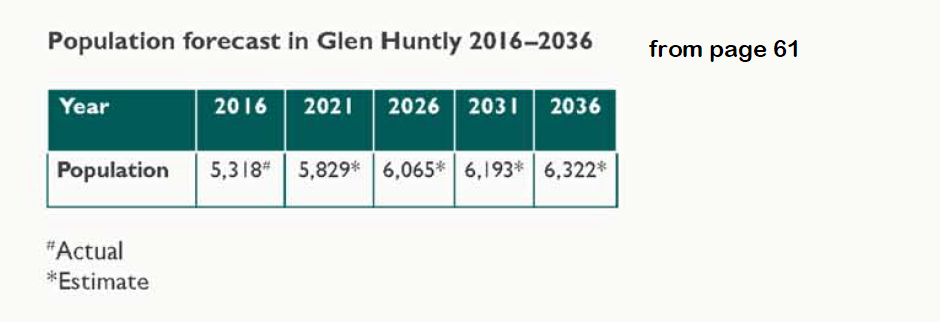
When buildings of 5, 6, and 8 storeys are proposed, then upper floors will inevitably consist of apartments. To therefore argue that this structure plan is only concentrating on the commercial sector and hence a housing strategy is unnecessary flies in the face of all common sense. How many apartments these sites can contain is surely an essential consideration in meeting the forecast population growth and the accompanying housing needs for Glen Huntly. Remember, the population growth according to council’s own published data is a mere 1000 over a 15 year period from 2021 to 2036. That’s the role of a housing strategy. To determine need for each activity centre, and the entire municipality, and then to apportion this requisite growth across the entire municipality. To pre-empt such analysis is not planning. It is simply assigning huge sectors of Glen Eira to unsustainable overdevelopment.
QUESTION 2
QUESTION: Following extensive resident feedback and inaction from Council, in 2015 the Minister for Planning compelled Council to undertake a Planning Scheme Review with a focus on controls for activity centres. In 2019 as part of the Planning Scheme Amendment C184, Council Officers belatedly highlighted the need for a Housing Strategy advising that the C184 amendment was not underpinned by an adopted municipal-wide plan. While Council failed to progress a Housing Strategy in 2019, it subsequently aborted Amendment C184 in 2021 in the absence of a clear strategic justification including a Housing Strategy. Based on advice from Officer’s, the Structure Plan controls for Bentleigh is now scheduled to be completed in 2024, some nine years after the Minister’s direction which is appalling.
Given this long history, why then have Council Officers recommended the adoption of aStructure Plan for Glen Huntly without a Housing Strategy?
Given that the response to this question consists primarily of a verbatim repetition to the first question, we have only included the opening two paragraphs of the response.
RESPONSE:It is noted that there are some inaccuracies and selective representation of facts in your opening preamble. Despite this, the answer to your question regarding the adoption for a Structure Plan in advance of the completion of the Housing Strategy is as follows :
Council began preparation of the Glen Huntly Structure Plan in mid 2019 in response to the announcement of the Government’s intention to progress level crossing removals in the area. The level crossing removals are expected to bring about a renewed focus and opportunity for change in Glen Huntly once complete. The preparation of a structure plan would assist guiding the height and form of future development, recognising its role as a Major Activity Centre, as designated by the State Government.
COMMENT: If council does not agree with the comments made by the resident, then why not provide a full rebuff of those comments? How about explaining, itemising, and justifying the claim that there are ‘inaccuracies’ contained in the question? As far as we know, the resident was 100% correct in his claims!
More importantly, we now have to consider the entire argument as to why a housing strategy is not required prior to the adoption of the structure plan because, it is claimed, the focus is primarily on the commercial areas. Then why, did the council officer state in his report of the 16th March, 2021 (when Amendment C184 was abandoned/rejected) the following:
A housing strategy would also enable Council to introduce more tailored built form controlsfor its commercial and mixed use zones within activity centres, based on a betterunderstanding of where and how growth will occur across the rest of the municipality
The housing strategy would provide Council with a municipal-wide framework for density, based on demographic and character analysis and inform all of Council’s strategic planning activities.(Page 116 of the agenda)
Doesn’t the above contradict what Council is currently stating? And doesn’t it illustrate perfectly the role of a housing strategy that needs to be completed before the adoption of structure planning? Council can’t have it both ways. Consistency, and dare we say, complete transparency, has never been this council’s strong point!
The agenda for next THURSDAY’S council meeting is now out and features Version 3 of the Glen Huntly Structure Plan. Readers will remember that the first draft went out for consultation in mid 2020 where council wanted 10, 8 and 6 storeys for many sectors. Following consultation, the 10 storey site at the supermarket was reduced to 8, with several other reductions. This was rejected by councillors in September 2020 with the arguments that 8 storeys in the second smallest suburb in Glen Eira, and with the densest population was a step too far. So now we have version 3, which to be blunt, is another pathetic planning document that is without strategic justification, without due consideration to residents’ views, and which will deny residents any say in what is approved.
The newly proposed changes are literally miniscule – a few nominated heritage properties to the west, and some in the commercial eastern side. Basically, this new version remains very much the same document as before – heights, to the greatest extent, remain the same as do setbacks. Thus, if councillors saw fit to reject this earlier draft, we see no reason as to why this ‘newer’ version should gain their approval!
The following paragraphs go through the proposed plan and highlight what we believe is so erroneous and constitutes poor planning.
What can be gleaned from the officer’s report and the draft structure plan itself:
This structure plan will be adopted BEFORE a Housing Strategy is completed and any permanent controls will only see the light of day AFTER the Bentleigh, Carnegie and Elsternwick structure plans have been done. Given that Elsternwick is stated as blowing out to 2023, that means that the Glen Huntly structure plan will have no statutory weight (ie.being included in the Planning Scheme) for years to come. This represents nothing more than another example of putting the cart before the horse!
There is currently no Heritage Overlay that exists for the proposed sites. This again, means that there is nothing available to stop a developer coming in and demolishing what council now believes is heritage worthy. Given the long process for having amendments included in the planning scheme, again we are looking at least another 2 years if not more, before any constraints are placed on developers – we quote: No changes to heritage overlays are proposed at this time. They will be pursued as part of a Planning Scheme Amendment at a later date
What is implied throughout this report is that the surrounding residential areas of Glen Huntly will be looked at down the track and this will cover the ‘study area’ for potential rezonings. As a Major Activity Centre, this will invariably mean that many sites now zoned GRZ (3 storeys) have the potential to be increased to RGZ (four storeys), plus the fact that the size of the activity centre will undoubtedly expand. We see no other way to interpret the following: again, we quote from the structure plan itself (page 17) – a review of the boundary of the activity centre as required AND page 26 – the whole activity centre study area is considered a potential housing opportunity area. Council will undertake a housing strategy to determine the scope for residential change across our city. This will include assessment of residential land within the study area of the Glen Huntly major activity centre.
OVERSHADOWING/SUNLIGHT
Glen Huntly is a Major Activity Centre (MAC) in the same way that Bentleigh, Elsternwick and Carnegie are. The only difference is that it is far smaller (roughly 1 square km) but far, far denser (ie 63 people per hectare, compared to Bentleigh’s 38.92, Carnegie’s 54.51 and Elsternwick’s 44.73. But far more worse is that currently, Glen Huntly has 35% of its land mass zoned as appropriate for 3 storey dwellings. Many of these immediately abut the commercial and mixed use zones that the structure plan is considering. Given this proximity to increased heights of 8 and 6 storeys in some sections, we are completely flabbergasted as to why the proposed overshadowing requirements are different to what was thought appropriate for Bentleigh and Carnegie via the rejected Amendment C184.
Bentleigh and Carnegie were privileged to have overshadowing requirements that were form 10am to 3pm on September 21 AND 11am to 2pm for various precincts on June 22st – ie the winter solstice. Poor old Glen Huntly does not get anything for the winter solstice and only from 10am to 2pm for the September calculation. The officer’s report tells us – The shadow analysis was prepared for the September equinox from 10AM to 2PM. We also get these ridiculous statements from the officer’s report (page 138 of the agenda) –
The southern footpath of Glenhuntly Road in the Central Retail Precinct is not inshadow from 11AM to 2PM on the spring equinox.
75 per cent of private open space is in sunlight for 5 hours on the spring equinox.
What happens to the southern footpath at 3pm? 4pm? How much is in shadow? What impact will this have on residents sitting drinking their coffees on the footpath? And what on earth does 75% of private open space mean? Which open space? Have consultants surveyed and done shadow diagrams for all of the ‘private open space’ in Glen Huntly? And if we take this statement at face value,does it mean that 25% of ‘private open space’ is in shadow and for how long?
PODIUM HEIGHTS & SETBACKS
When it comes to these two components of planning, Glen Huntly again comes off a second best compared to the proposed Bentleigh & Carnegie structure plans envisaged by Amendment C184. For large swathes of land in Bentleigh/Carnegie their street podium heights were designated as 2 and 3 storey. In Glen Huntly, it is somehow fitting that these podium heights can be up to 15 metres (4 storeys) in 2 large precincts. And this is when the current sites along Glen Huntly road are predominantly 2 storeys in height! Why? Readers should peruse page 24 of the draft to see the full details.
The same applies to setbacks. Compared to the far greater setbacks imposed in Bentleigh & Carnegie, Glen Huntly is supposed to be content with a majority of 4 metre setback opposed to the standard 5 metres in these other MACS. The higher the building, then Glen Huntly is again worse off! Why?
HERITAGE
As we’ve stated, council has belatedly undertaken some heritage inspections of sites and come up with proposals for heritage inclusion. Yet even on this level, there is some major discrepancy between what Glen Huntly is afforded and what is stated for Bentleigh & Carnegie. The officer’s report tells us – When the Built Form Framework was prepared, shopfronts along the Central Retail Precinct were treated as “character” areas. As such, no changes are proposed to the height limits or setbacks of the Central Retail Precinct as a result of the heritage assessment.
So we have the ludicrous situation where various sites in the Eastern Retail section designated as heritage – commercial/Mixed Use precinct – will be allowed to have 5 storeys (discretionary) and those in Bentleigh and Carnegie were seen as suitable for only 4 storeys.
Even worse, is that we again have council policy such as the City Plan, and which is referred to in the draft structure plan, that is totally ignored. The City Plan speaks of ‘shop top (heritage) as being suitable for 4 storeys. But this goes out the window with this plan for Glen Huntly!
HOUSING NEED
Council keeps repeating its mantra of the need for 18000 net new dwellings by 2036 throughout Glen Eira. When the population stats for Glen Huntly itself are produced we find:
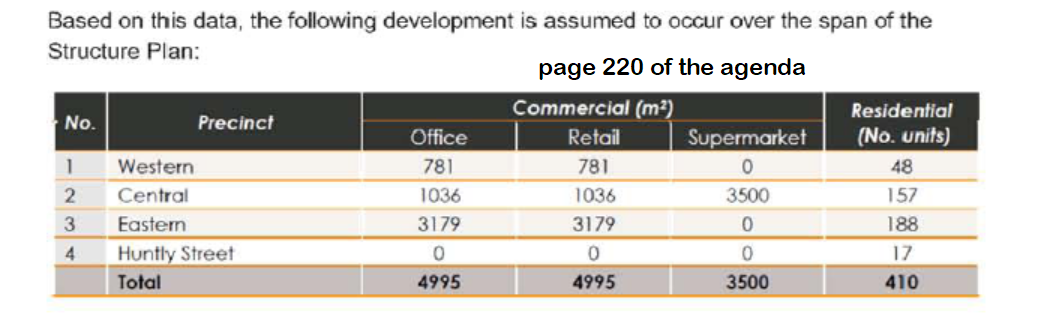
Even if we accept these projections (which of course take no account of COVID), we find that in a 20 year period, the population growth in Glen Huntly will increase by a mere 1000. Plus in the period from 2021 to 2036 the increase will be 500 over a 15 year duration. Thus, if these projections are correct and only another 500 people will come to Glen Huntly, why do we need 8 storey and 6 storey buildings, that together are suggested by consultants to result in the addition of 410 net new dwellings. That is on a 50% uptake, so feasibly, the uptake could be even more if the housing market improves. Over various census results, the number of people per dwelling has averaged at 2 and a bit. This is forecast to continue by the ABS. So, 2 people per dwelling with a 500 increase in population should only require at best 250 net new dwellings!!!
Finally a comment or two on the ‘aesthetics’ of the document itself, and these comments pertain to much of what is produced by council.
The actual size of the full structure plan is 73 pages. Of these 73 pages we have 39% that are nothing more than either full page pretty pictures, or sketches that reveal absolutely nothing. For example: not one of these sketches present realistic images of an 8 storey building!
Jargon, generalisations, vague assertions, and platitudes reign supreme. Perhaps someone can inform us what this actually means? – Encourage pedestrian permeability (page 18). Will we now be aiming for ‘porous people’?!!!!!
Much of what is in this draft document is evasive and scant explanation and justification is provided to residents. In a democracy, where transparency and accountability are crucial, Glen Eira Council continues to fail dismally.
We urge all readers to write and ring councillors and inform them why the process, the lack of further consultation, and the outcomes if approved are not in the community’s best interest and as happened in September 2020, this draft plan should again be relegated to the dust bin of history!
At last night’s council meeting there was a motion put up by Esakoff and seconded by Magee under the category of Urgent Business. The motion was that council undertake certain actions in regard to Minister Wynne’s introduction of planning legislation without first consulting residents and councils. The motion was passed unanimously.
Whilst we applaud council for this first step in finally registering some public discontent with the processes of planning in the State, we also have to wonder why the final motion departed in some major elements from what Port Phillip will move tonight. Here is the proposed motion from Port Phillip –
Whilst much of this motion is practically a verbatim repetition of the Port Phillip one, there are some major and disconcerting changes. Given that we are told that ten councils are now supposedly working in unison, surely a joint motion/statement signed by all, would have far greater impact than a single council presenting its own version and working alone?
Here are some of the differences between the Port Phillip version and Glen Eira’s resolution –
No demand for a report back to council. Thus the matter is left in abeyance and in the domain of officers alone. Transparency is again lost.
Port Phillip requests a ‘collective’ letter. Glen Eira insists on an individual letter.
Glen Eira can only bring itself to ‘strongly voices its concern’ about consultation, whilst Port Phillip ’strongly supports the community having a central role’ in planning.
Glen Eira sees the community voice only as an ‘integral consideration’ rather than Port Phillip’s view that it is ‘central’
These changes and others, in our view, go way beyond an argument about semantics and linguistic nuance. They should be read as sign posts to how Glen Eira views its residents, how it views collaborating fully with other councils, and how the planning in Glen Eira remains destined to be out of kilter with other municipalities. When we have a council that refuses to see its residents as ‘central’ to planning decisions; when it refuses to align itself with the values of other councils and instead basically opts to work alone, then we are in deep trouble. There is absolutely nothing in the Port Phillip motion that shouldn’t be endorsed fully. Ask yourselves, why our council was unable to do this?
In the regular VCAT Watch there is one report on the decision for 219-229 Balaclava Road, Caulfield North. Readers will remember that this was originally an application for 9 storeys and then amended to 7 storeys. Councillors voted for a permit for 5 storeys and the developer appealed this condition. A permit was granted for 7 storeys. (See: https://www.austlii.edu.au/cgi-bin/viewdoc/au/cases/vic/VCAT/2021/867.html for the full decision).
Not only does this decision have major ramifications for all of our neighbourhood centres, it also raises questions about:
The level of ‘representation’ that council produces before VCAT
The ‘cherry picking’ aspects of the VCAT Watch reports
The failure to provide detailed ‘refusal’ grounds that will stand up – which of course raises the question of who writes these ‘refusals’ and are they deliberately destined for ‘failure’?
The uselessness of council’s much vaunted City Plan
The continued inability to get anything of value into the Planning Scheme after nearly 6 years!
Raises questions about when anything is likely to be done about the rest of our neighbourhood centres such as Ormond, McKinnon, Patterson, Gardenvale, etc.
Whilst some of the following comments from the VCAT member who made the decision are laughable, this still does not excuse council’s lack of timely strategic planning and the performance of its VCAT representative. As it currently stands, our Planning Scheme has enough holes for developers to drive a truck through. This has been the case for the past decade at least.
Please read the following carefully:
In the absence of specific height controls that have been adopted into the Glen Eira Planning Scheme, or which can otherwise be said to be seriously entertained, an attempt to apply a uniform height limit to a number of neighbourhood centres based purely on their position in a hierarchy, is not the appropriate approach.
The final key component of the relevant strategic context is the recent strategic work being undertaken by the Glen EiraCity Council to introduce built form controls, that will provide greater guidance for decision makers, such as myself. This strategic work includes the Glen EiraCity Plan, February 2020 and a Built Form Framework for the Caulfield Park Neighbourhood Activity Centre, both of which I am told identify the review site as being suitable for a five storey development. However, the Council also submits, at paragraphs 83 and 85 of its written submissions, that it does not place any weight on either of these documents, for the purposes of informing my decision making regarding an appropriate building height for the review site in this proceeding. That is due to the very early stages of the creation of both documents and their potential future insertion into the Glen EiraPlanning Scheme, as well as the absence of a built form analysis from the Glen Eira City Plan. I have no reason to depart from the Council’s submissions in this proceeding, that no weight should be placed on either of these documents.
The removal of the very top level (level 6) will have a very negligible impact on views from the surrounding context, and indeed will have no impact on the extent of scale that will be visible from many parts of the surrounding public realm, due to the extent to which the top level is recessed from the level below, and thus obscured from view. The removal of level 5 will produce a slightly lower setback tower form, but will not significantly change the extent of scale or prominence of the overall building. The Council has failed to persuade me that the slightly reduced scale achieved by deleting levels 5 and 6 will produce any appreciable or necessary relief from building scale, in this activity centre context.
That this proposed building on the review site will be taller than other buildings that can currently be viewed from Caulfield Park does not make the proposed height inappropriate. Rather, it simply reinforces the proximity that this component of Caulfield Park has to an activity centre. Any user of Caulfield Park that wishes to experience a more pleasant environment has many options to move away from this direct interface with the activity centre, to locations where views to the proposed building on the review site will be difficult owing to the intervention of canopy trees. On this basis I consider that the proposed development will not have an unreasonable built form impact or presence on the adjacent Caulfield Park.
While the Council has a section in their written submissions headed ‘off-site amenity impacts’ the written submissions fail to identify any potential impacts, nor any surrounding land that might be impacted. Further, in response to my questions, Mr Berzins failed to identify any potential amenity impact on any adjacent property.
In respect of each of these matters, I accept and adopt the evidence of Mr Bastone and Mr Blades, that the proposed levels five and six do not result in any unreasonable off-site amenity impacts, and provide an appropriate level of internal amenity for future residents. In respect of the relevant internal amenity considerations, the apartments on levels 5 and 6 would provide similar, if not higher, internal amenity outcomes for future residents, as compared to the apartments approved on the lower levels of the proposed building. That is, there is nothing in the design of the apartments on levels 5 & 6 that cause them to be singled out for criticism, on the basis of the relevant internal amenity considerations. On this basis I must conclude that an internal amenity assessment cannot be a reason for the contested permit condition.




 Glen Eira Debates