GE Governance


We must congratulate council for finally placing a document in the public domain which clearly reveals the shortcomings of its processes and performance on community consultation, plus highlighting the entire mess that is Advisory Committees. The ‘evidence’ we are referring to comes in the form of the Community Consultation Advisory Committee Meeting ‘minutes’ from the current agenda items.

The opening paragraph reads: The Committee noted the final printed version of the Glen Eira Community Plan. Committee members agreed that the final printed version was a high quality document and that its layout and design appropriately highlighted Council services and community needs”.

COMMENT: We find it strange that the phrase “final printed version” is repeated twice and that “high quality” would seem to largely pertain to “layout and design”. This sounds very much like the “awards” that council wins for its Annual Report. That is, nothing about CONTENT, but all about the bells and whistles of presentation. The Community Plan itself is therefore not endorsed as ‘high quality’ – merely its format, and overall look. Not exactly providing us with the full ring of confidence! We also remind readers that one of the community reps on this very committee felt compelled to put in her own submission on the community plan. Again, hardly a ringing endorsement of “high quality” if a committee member comes up with ‘recommendations’ for improvement!

Then comes the real nitty gritty – the admission that not everything is perfect. Note this sentence – “The Committee suggested that the following improvements could be incorporated into future Council community planning processes”. The suggested ‘improvements’ are:

  • “Council to adopt a longer community planning process to provide more time for the development of the community plan”. Does this mean that the plan was rushed? That time given to integrate community feedback was insufficient and deficient?
  • “Ensure future plans articulate links between consultation outcomes and actions contained within plans”. Implied criticism perhaps that what residents had to say was basically ignored? That the action plan had no logical connection with community aspirations – that it was set in concrete from the beginning?
  • “Improve induction processes for community representatives joining Council Committees, specifically, indicating that decisions are made by consensus in the Committee and that the Committee is advisory only to Council.” A really fascinating sentence in that we have to ask: does this apply only to the Consultation Committee or all Advisory Committees? If, on the one hand it applies to all committees, then we are in the territory of hypocrisy, lack of due process, inconsistency, and plain old humbug. What does consensus mean? And why is this possibly only applied to the consultation committee? In the same agenda there are the minutes for the Arts & Culture Advisory Committee. Motions, including names of movers and seconders, plus whether the motion is carried is included for this committee as well as the Community Grants Committee. The Environment Committee, which also happens to have community reps DOES NOT include formal motions but ‘Recommendations”. The names of mover and seconder are provided (and they are invariably councillors), but no outcome as to voting is recorded. Instead, we have an item curiously labelled ‘action’. Our conclusion can only be that where committees have community representatives on them there is NO FORMAL MOTION AND VOTE RECORDED. Only those committees which consist exclusively of councillors and officers are afforded this right. Of course such committees are a closed shop so the formalities of a motion and vote are permitted What this highlights for us is the failure of this council and its councillors to ensure two basic democratic rights – community reps on all committees and more importantly, that community reps have full voting rights. It also makes a sham of the minutes themselves when we see no consistency between the reporting formats for each committee. The minutes can and have been doctored at will. There is absolutely no logical and valid reason why formal votes should be taken at some committees and not at others. Furthermore, it is incumbent that specific terms of reference are set for each committee (we have been unable to find such terms for the consultation committee) and that definitive processes are set down for the tabling of minutes. These are all matters that must be included in the Local Law meeting procedures.
  • We must concede that our favourite recommendation for improvement is: “Committee minutes to be distributed to all members of the Committee prior to adoption by Council.” In other words, it is pretty obvious that committee members did not get to see (and therefore) comment on the minutes before they appeared in council agendas! Officers were the arbiters of what appeared in these minutes not, we presume councillors, and most certainly not, community reps!

It now remains for things to be set right via the total amendment of the Local Law.

We repeat what we have previously stated. If these councillors are really interested in transparency and accountability and proper community consultation, then the following must happen:

  • All advisory committees to come under the umbrella of the Meeting Procedures of the Local Law
  • All advisory committees (with the exception of Audit Committee) include community reps
  • All advisory committee minutes be consistent in reporting, format, and voting procedures
  • Community reps have voting rights on such committees

Without such changes community consultation will remain the sham it currently is and which has finally been conceded by these minutes. Over to you councillors!
The amended Local Government Act has now come into effect. In our humble view it is a mess, a piece of legislation that the Monty Python’s of this world would have a fine time in lampooning. We will highlight only one aspect of the new legislation.

In their infinite wisdom legislators have decided that a Probity Auditor is necessary to investigate THE PROCESSES involved in any complaints of bullying, sexual harassment against a CEO. Please note – the probity auditor will not investigate the actual complaint, just how it was handled. But it gets even worse! At the 11th hour legislators decided to introduce an amendment which gave the CEO the power to declare complaints as “vexatious and frivolous”. So what we have is the ludicrous situation where the person complained about can decide whether the complaint is bona fide or merely vexatious.

Given that some Labor members then raised the perfectly logical argument that this in effect would constitute a conflict of interest, Minister Guy and later Minister Powell argued that this could be overcome by the CEO delegating this function to one of his/her underlings!!! This should work a treat in Glen Eira no doubt.

For those who would appreciate a good laugh (or cry) we’ve uploaded the sections from HANSARD which deal with this issue. We have to seriously question where plain old common sense has disappeared and why bureaucrats are increasingly becoming a protected species thanks to both Liberal and Labor governments.

Thursday night (8pm) will see the first meeting of this council. The agenda items make for interesting reading.

  • Council has generally left the frontispiece on its Agenda and Minute papers for Special Council Meetings blank apart from the date and logo. Not this time! There’s a nice little subliminal ‘message’ reading – “The primary object of a Council is to endeavour to achieve the best outcomes for the local community having regard to the long term and cumulative effects of decisions.” s3c(1) Local Government Act”.
  • Councillors, apart from signing the Oath of Office will also be “invited” to sign the Code of Conduct.
  • There are also 4 options in relation to the Mayoral election – 1. Vote for a 1 year term for Mayor and Deputy Mayor; 2. Vote for a 2 year term for Mayor and Deputy Mayor; 3. Defer till next Ordinary council meeting or (4) Defer until no later than 30th November.
  • There’s also a notice about Councillor Expenses policy and remuneration.

We’ve done a quick search to determine how other councils may be approaching the first meeting of the new councils. Whilst not too many agendas are up as yet on other councils’ websites, we have located the following – none of which make any mention of the election of Mayors, nor of the ‘offer’ to sign the Councillor Code of Conduct. Most councils appear to be taking the sensible option and allowing a couple of weeks for councillors to come together and work out who will nominate, and how they will each vote. (See: Port Phillip, Boroondara, as examples).

The outcomes of Thursday night’s meeting will reveal much about the new dynamics and the power structures within Council. Meanwhile, the administration is still up to its old tricks we feel.

In less than 48 hours the electorate will be voting. The calls for change have been loud and clear from many candidates. We sincerely hope that the new council will signal the beginning of a new era  – one of respect for the community and processes of governance that are scrupulously fair, transparent and accountable. The acid test for all councillors will come in the first few months. Residents will then have the opportunity to gauge whether they have been sold empty promises or whether words will finally be matched with action.

We set out below what we believe must eventuate in order for real and lasting change to occur. These are not prioritised in any special order – apart from the first item regarding Meeting Procedures. We welcome your comments and any additions you might like to make to this list of ‘must do’s’.

THE LOCAL LAW AND MEETING PROCEDURES

The entire Local Law needs immediate and speedy amendment. It must include:

  • Notices of motion
  • Rescission provisions
  • Dissenting from Chair
  • Councillor questions without notice
  • Rights of reply without notice
  • Agendas to be set in consultation with Mayor and one other councillor
  • Advisory committees incorporated into meeting procedures with full agendas and minutes published
  • All advisory committees (apart from Audit) to have community representation and to be open to the public
  • Officer reports tabled at advisory committee meetings to be included in minutes of such meetings
  • Public questions at start of council meetings
  • Current ‘harassment’ provision removed from public question exclusion criteria
  • Residents provided with 20 minutes to ask verbal questions of individual councillor, officer, or Council without notice at each Council Meeting
  • Removal of Clause 326 (‘organised’ sporting groups)
  • Petitions to be submitted by ward councillors and vetted by ward councillors. Once accepted then obligatory that the petition is forwarded on to relevant department for further action and responded to within the next 2 ordinary council meetings.
  • Guidelines/policy created to limit the overuse of ‘confidentiality’ ( ie. secrecy)

DELEGATIONS

How and what authority is delegated to officers requires careful consideration. We suggest:

  • Councillor ‘call-in’ for all planning applications (ie. if one councillor decides that the decision should be made by council rather than officers, then this application will go to a full council meeting)
  • Planning applications to automatically go to council when 5 objections are submitted
  • Sporting allocations to be decided by Council resolution

PLANNING & MISCELLANEOUS

  • The development of structure plans for major activity centres
  • Creation of Parking Precinct Plans for all Housing Diversity Areas
  • Insistence on removal of training from Caulfield Racecourse in accordance with 2009 agreement
  • Revamping, with full consultation, Local Area Traffic Management Plans and adherence to those plans
  • Reworking of the Community Plan that fully incorporates and addresses resident concerns
  • Tendering decisions to be tabled at council and to include selection criteria, officers responsible, final grades for each tender
  • Website that includes capital works program including information on: progress, cost to council, grants from government, projected completion date and final completion date
  • Delegated planning committee reports to feature in every council meeting and to include ‘user satisfaction surveys’
  • Audio/video recordings of council meetings to be placed on the web, or available to residents upon request
  • Revamping of Audit Committee including advertising of external membership for all incumbents
  • No councillor to serve more than 2 consecutive years on Audit Committee
  • Councillors be provided with ‘portfolios’ as part of their responsibility
  • Councillors decision to have their email accounts treated as confidential to be strictly enforced
  • Officers to be named in all reports (ie authors, and who is ultimately responsible)
  • Immediate full review of the Planning Scheme and updating of all policy documents. This is to be done with intensive, full community consultation and the establishment of a resident/councillor/officer working party which will report fully and regularly to Council
  • Publication of grant applications – their success and/or failure
  • Regular ward meetings and/or the establishment of Village Committees. Council to respond promptly and fully to issues raised
  • No development which increases or intensifies dwellings per lot to be issued with residential parking permits anywhere in the municipality
  • Cost benefit analysis to accompany all Officer reports for major projects
  • Maximum open space levies for all developments in municipality
  • Revenue from above to be used to only acquire open space
  • All councillor Requests for Report to be tabled at ordinary Council Meetings

Councillor/Staff Code of Conduct

  • The Staff Code of Conduct be publicly available on website
  • Staff/councillor conflict to automatically go to mediation as first step
  • Removal of ‘gagging’ strictures in the Councillor Code of Conduct

This is a long list but essentially all these ‘reforms’ deal with governance and transparency. That has been the root cause of the ills which have plagued this council for over a decade. The final point we wish to make is that we also believe it is imperative that the CEO position be advertised and that ALL councillors be part of the selection process. What do you think?

Why bother, asks former Glen Eira mayor

Date October 23, 2012

Melissa Fyfe

HELEN Whiteside considers herself a normal sort of person. She’s political, no doubt – a paid-up Liberal Party member. But her time as Glen Eira mayor left her so disillusioned she wonders why an average community member would bother running for council.

With council elections winding up this week, Mrs Whiteside is calling on residents to scrutinise candidates carefully. As for the troubled Glen Eira councillors – some of whom were sacked in 2005 and are standing for re-election – they all deserve to be thrown out, she says.

Glen Eira – which covers suburbs such as Caulfield, Bentleigh and Elsternwick – consistently outperforms other councils on community satisfaction.

But in the past four years the council has faced the Ombudsman’s scrutiny over 10 separate issues, one Ombudsman’s report revealing Councillor Frank Penhalluriack’s alleged bullying behaviour and failure to declare conflicts of interest, and a critical assessment from the local government watchdog, the third since 1998.

Mrs Whiteside, a popular mayor, resigned in 2010. The council suppressed her letter of resignation. She told The Age she resigned because she felt some councillors were not declaring conflicts of interest and were set against chief executive Andrew Newton, wasting at least $30,000 on extra legal advice during the renegotiation of his contract.

Now that every sitting councillor except one is standing for re-election, the former mayor says residents should think carefully. ”Integrity is fundamental to being a councillor,” she says. ”Transparency, accountability and being objective. I believe councillors should make decisions for the long-term best interests of the entire community.

And her former colleagues? ”I don’t think they should be re-elected,” she says.

Mrs Whiteside said she was particularly disturbed about the 2010 decision to relinquish public open space to the Chabad House synagogue extension at 441-496 Inkerman Street, St Kilda East. She alleged Cr Michael Lipshutz had a conflict of interest because of an association with the synagogue’s benefactor, Jewish community leader Joseph Gutnick.

Mr Lipshutz said Mrs Whiteside’s revival of this matter was ”anti-Semitism of the worst kind. She is saying that because I am Jewish I am not fair-minded … I have no association with (Mr Gutnick) whatsoever,” he said. (Greens Cr Neil Pilling also voted to hand over the park.)

Mr Lipshutz said Mrs Whiteside was a ”failed councillor and a hopeless mayor who divided the council”.

Since the last election in 2008, councillors have had several brushes with the state’s integrity agencies and the court system. This year chief executive Mr Newton filed a bullying claim against Cr Penhalluriack. The hardware store owner refused anti-bullying training and is fighting councillor misconduct allegations at the Victorian Civil and Administrative Tribunal.

In a 2010 investigation, Chief Municipal Inspector David Wolf found insufficient evidence to prosecute any councillor, but uncovered councillor behaviour ”at odds” with the council’s objectives and ”underlying issues with regard to transparency and accountability”.

When drafting the chief executive’s contract in 2010, councillors inserted a clause requesting he notify them of any inquiries from the state’s integrity agencies. Mr Wolf found the illegal clause existed in an early draft, but no one owned up to putting it there. ”Despite all the talks and presentations the councillors get on governance, it is still not getting through,” a council source told The Age.

The Glen Eira city council elections are this Saturday.

Read more: http://www.theage.com.au/victoria/why-bother-asks-former-glen-eira-mayor-20121022-281jw.html#ixzz2A28kbFJ2

++++++++++++++++++++++++++

First frisbees, now fitness

23 Oct 12 @  12:01am by Donna Carton

KILLJOY bureaucrats who pulled the plug on a weekly frisbee game have now told a teen fitness group they can’t play tag in the local park.

Not-for-profit group Humans Vs Zombies was told their tag games were “unsuitable” for Virginia Park Bentleigh.

They had requested permission to take about 30 kids there for a game in which “humans” chase “zombies” with foam dart blasters. o

Humans Vs Zombies Victoria secretary Anthony Osborne said the group’s objective was to get young people “outside, exercising and interacting socially, rather than home behind a computer.”

“We are looking to partner with councils’ youth services and park management as well as grant and funding bodies,” Mr Osborne said.

“We are also looking for parks.”

Some councils have been positive but Glen Eira and Manningham have refused.

Glen Eira council is still reeling from the negative publicity it received after a group of young frisbee players said they were told they needed a permit to play in Caulfield Park.

Councillors have now vowed to review the local law concerning park permits and clarify the definition of “organised sport.”

Council public relations chief Paul Burke told the Leader the council hadn’t recieved Humans vs Zombies’ request – nor any applications “from Clingons, Romulans, Daleks or Goths.”

++++++++++++++++++++++++


Council is where the sun should shine

2012PRINT EDITION: 23 Oct 2012

Mathew Dunckley

I love a good local council story.

There is something about the grand council chamber which suspends usual standards and leads to pitched battles over potholes.

The gravity of municipal level matters has a certain charm. A personal favourite was the Melbourne municipality that banned cricket teams from hitting sixes. Another Melbourne council threatened to use DNA tracing on dog poo on the beach to find offenders. The publicity seems to have been a deterrent. But the whiff of small-time CSI speaks volumes about local concerns.

Then there are the numerous dust-ups and petty personal political intrigues that have always filled local papers. Perhaps this is why people regard councils as sometimes annoying, sometimes amusing, and, often, irrelevant.

They shouldn’t be regarded this way. In the post-Kennett amalgamation era, Victorian councils are serious entities managing large amounts of public money. In total the 79 councils manage $55 billion worth of assets and spend close to $5 billion a year. They are worthy of scrutiny.

Right now, Victoria is enjoying its four-yearly council campaign carnival, complete with the sight of John Elliott running in the Melbourne lord mayoralty race.

All up more than 2000 hopefuls have put their hats in the ring to contest seats on Victorian councils.

Reporting on councils often falls to local papers.

As a young (or should that be younger) journalist at Leader Newspapers, I had the pleasure of covering Glen Eira Council in Melbourne’s south-east.

Every suburban journalist covers council, but not everyone gets Glen Eira. Councillors were at each others throats (sometimes literally), the chief executive was at war with the councillors, and there was a myriad more misdeeds and mischief.

The council was managing an annual budget of about $100 million a year, but after months of chaos, it was investigated and sacked.

Chalk one up to the local paper, eh? But it was not that simple. As part of the investigation I was required to front municipal inspectors, swear an oath and answer questions. The penalties for refusing to appear, to swear the oath or to answer the questions were thousands of dollars in fines or prison. There is nothing small-time about those powers. The inspectors wanted me to identify sources. I refused, citing my code of ethics. After some scoffing remarks about journalistic ethics, the inspectors made it clear they did not accept my reasons and recommended to the minister that further action be considered against me.

I happened upon that minister at a Christmas party later that year. I offered to do dishes or mow lawns to stay out of the clink. She indicated she did not think putting journalists in prison was a good idea. Lucky me.

Victorian Premier Ted Baillieu’s so-called shield laws should have fixed this problem.

Such laws, taking shape around the country, give journalists a legal right to refuse to divulge their sources. But Baillieu’s pledge went only as far as court cases and he has refused to go any further.

That means Victoria has carved out protection for journalists when dealing with a number of public institutions including council inspectors. Victoria argues it is following other states’ example, but I can’t understand why you would craft shield laws and consciously leave out local government.

Councillors and council workers who leak to journalists almost always commit a breach of the Local Government Act. They risk career-ending prosecutions, fines and even jail for talking to journalists. They warrant protection. Yet, somehow, the right of journalists to protect sources when covering local government is ranked as less important than those covering other levels of government, or crime.

Local government decisions  directly affect everyday lives. And as every corruption commission in the country (Victoria’s is not yet established) will tell you, councils are fertile ground for misdeeds.

Inhibiting the ability of local press to cover councils is poor policy.

Baillieu’s attempt to improve the system looks almost as worthy of ridicule as the genetic profiling of dog turds, and equally unable to be polished.

Source: http://afr.com/p/opinion/council_is_where_the_sun_should_vtYMZ9f1triCf9riXuj6KL


Magee was taken ill just before the start of the council meeting and hence was an ‘apology’. We wish him a speedy recovery.

LIPSHUTZ – moved that the minutes of the Local Laws committee be deferred until next council meeting. Pilling seconded. Reason was the the minutes in the agenda weren’t ‘as full as they should be’ and that they didn’t reflect what occured, so more ‘fulsome’ minutes are required. Did say that the committee has been looking at Local Law 326 (organised sport). Said that there had been plenty of press coverage on the frisbee story and that they’d been told that kids had ‘been fined’. That then became a ‘story not that they were fined but that they would have to get an allocation’. Said he asked officers what happened and they told him that a complaint had been made that about ’30 or 40′ people were playing with ‘football boots’ across cricket pitches. A ranger investigated and found that this wasn’t true – there wasn’t any football boots and nothing about cricket pitches. In the end ‘Yoav Silverstein contacted Council’ to ask about an allocation. ‘He was told that a one off allocation cost $120 or a 6 month allocation cost $300’. Said that this is the same for eveyrone if they wanted a barbecue. Said that the ‘whole purpose’ of allocations was to provide ‘certainty’ and paying ‘means they have priority’ but it ‘doesn’t mean’ that if kids want to play frisbee they need an allocation. Claimed that there had been a ‘total blowup by the press’. Said that the ‘truth is that no-one was warned off…..welcome to play….no fine….. Went on to say that the law should be reviewed and the reason it hasn’t been dealt with as yet is because ‘our corporate counsel has been involved idn other matters’ such as the VCAT ‘which has kept her quite busy’. In the next council the ‘whole local law will be reviewed’ which is ‘far better’ than doing it piecemeal and so ‘do the whole local law as one’. assured everyone that no permit is required if they want to play ‘catchy’, football. ‘but if you are an organised sport’ then you do need a permit. Went on to say that council has ‘reasonable laws reasonably enforced’ and in this instance the law has been ‘enforced reasonably’ and ‘no-one has been fined’.

PENHALLURIACK – said he was pleased that no one was fined. Said that this issue with the local law 326 had been going on for quite a whiile. Said that Mr Varvodic was fined and then the fine withdrawn and they organised a permit. The definition of ‘organised’ has been something that he’s tried to get the Local Law Committee to look at for a long time and clarify because ‘it’s fine for Cr Lipshutz to say reasonable laws reasonably enforced but sometimes the law is not reasonable’ . Said a law is only ‘reasonable’ when it can be understood by the public. this law can’t be easily interpreted. Said he doesn’t know what ‘organised’ means any more than Lipshutz does. Said he was pleased that the ‘ex-chairman (Lipshutz)’ of the Local Laws Committee was ‘now going to be working on it’ because ‘it is long overdue’.

HYAMS – when the Local Laws Committee gets together in the new council he hoped that ‘they would get around to looking at the Alcohol free area’ in Bentleigh as ‘has been agreed they should’.

TANG: said that the meeting discussed the Tree register and there was discussion about how the laws could be enforced and there were ‘sub-issues’ that should be ‘captured in any subsequent minutes’. Admitted that the issue of organised sport has been around from even before he was on council – schleppers football team – but they were more ‘frequent’. Didn’t think this was about one individual but how to interpret what ‘organised sport’ means. Problems not about the law but ‘how you interpret it’.

LIPSHUTZ: Agreed with Tang that it was a ‘definitional problem’ and that the Local Laws Committee ‘would deal with that’. Said that he didn’t believe it was ‘coincidence’ that the issue has come up ‘two weeks’ before the election in order to ’embarrass council’ and that the reports in the media are ‘totally wrong’ and that journalists should have made ‘proper enquiry’ when the ‘allegation is simply not true’.

Public questions

At least 15 questions that we know of were declared invalid on the excuse of the electoral act and hence were not read out, much less answered. This is reprehensible since none of the questions had anything to do with ‘electoral matters’ – in short, it was another instance of avoiding accountability and responding to residents’ concerns. Even those questions which were responded to, failed to answer the question asked, or basically indulged in semantics and dissembling.

Question 1: asked if Council’s submission on the Planned Zoning Reforms would be made public. The answer stated that the ‘submission’ was already available on council’s website. Untrue and incorrect. What is available on council’s website is not the actual submission, but the Akehurst ‘report’ which was tabled at council on the 4th September 2012! The public has not seen what went in to the department! So much for transparency and answering public questions honestly!

Question 3 – asked for the results of the ‘monitoring’ of Frisbee games in Caulfield Park. The response said that there’s a “regular gathering’ in Caulfield Park by people playing ‘what appears to be’ Frisbee!

Question 4 – asked about the traffic management plans for major events at Caulfield Racecourse saying that for the past 3 events this had been substandard – either they notices went out too late, or they were incorrect. Wanted to know what Council had done about this. The response went into the need for traffic management plans to be provided and that in September Council had received from the MRC the plan for the spring racing carnival. It said that residents would be notified ‘at least 2 weeks’ prior to the events. The MRC provided notice after the 2 week deadline so that they ‘didn’t meet’ the requirements and ‘council will be drawing this to the attention of the MRC’. Big deal we say! The second part of the question remains unanswered, and as with the Camping and Caravan show, council has done nothing but a little tap on the wrist!

At this point Penhalluriack rose and said that he notified Hyams about the situation on Saturday morning – and wanted to ask Burke if any officer had gone out to ‘look at the barriers’. Also said that ‘this seems to be a consistent complaint’ from residents living in the area.

Hyams then said that this wasn’t the time to ask officers questions because that should have been done at Item 11.3 of the agenda!

Penhalluriack then said that he hadn’t ‘had the time to formalise my own response’ to the public question and that he was commenting on the answer that had been given. Since he told Hyams about this on Saturday morning he’d ‘like to think that council went out and did something about it’ because the barriers ‘were in the wrong place’ and the ‘wrong times’

Question 5 – asked about the now out of date Road Safety Strategy and why even the old one isn’t on the website and when the latest one will be prepared. The response was that the 2007-2012 strategy ‘was at an end’ and that a new one was ‘being developed’ and that when the new one is adopted it will be up on the website. Terrific! We didn’t know that ‘strategies’ disappear into the ether!

Question 6 asked about ‘advocacy’ for rail separation and whether council would table the documents related to its ‘advocacy’. The response was merely a listing of ‘submissions’ to various departments, and meetings attended by officers and councillors. Residents are obviously not going to get a look at these ‘submissions’, nor reports back from most of these meetings!

BURKE THEN STATED THAT ‘A NUMBER OF QUESTIONS ‘HAVE BEEN RULED OUT OF ORDER BY THE CHAIR AS THEY ARE NOT IN COMPLIANCE WITH COUNCIL’S CARETAKER POLICY’ REGARDING ‘ELECTORAL MATTERS’!!!!! CENSORSHIP REIGNS SUPREME ONCE AGAIN! 

PS: we’ve just broken another record – 1,335 hits for the day!

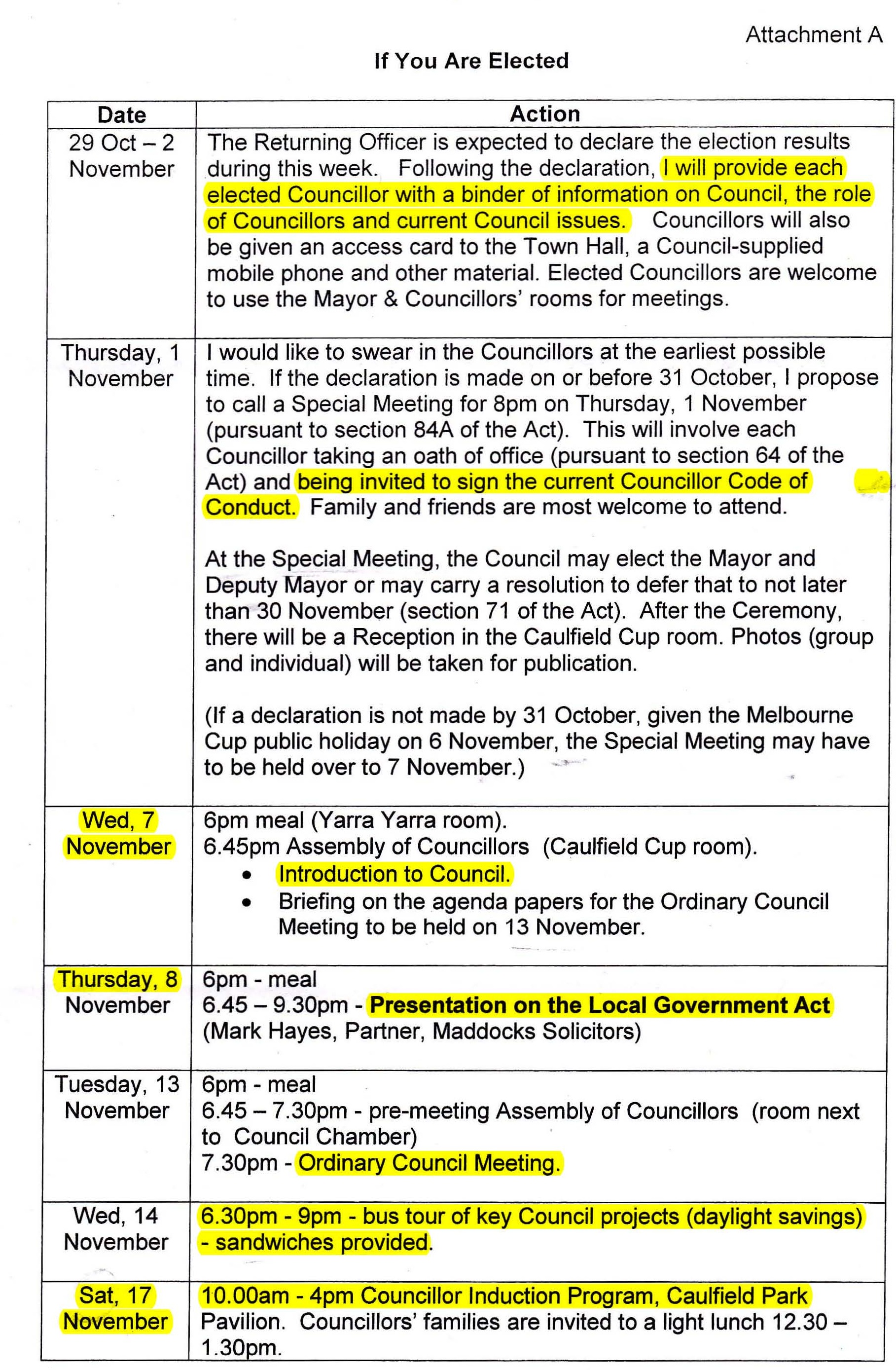
Each candidate has received a personal letter from Andrew Newton informing them of the legal requirements if they are successful in becoming a councillor – ie. return of register of interests, etc. More importantly it contains a proposed schedule and the outline of an ‘induction’ program. We are of the opinion that this document also lays out the blueprint for stamping the administration’s authority and control on councillors.

Below is the proposed timeline. Important sections are highlighted. We draw readers’ attention to the following:

  • The ‘invitation’ to sign the CURRENT councillors’ Code of Conduct on day one! There is no requirement in the Act for councillors to sign any such document! By signing councillors bind themselves prior to any discussion and possible amendment. Councillors also have three months to sign any Oath of Office. The legislation also requires that the Code of Conduct be ‘reviewed’ within one year of an election. Bayside starts its ‘review’ in February!
  • The only ‘induction’ that councillors receive prior to the first Ordinary Council Meeting is a ‘folder’, part of one Assembly of Councillors, and then a nearly 3 hour ‘presentation’ on the Local Government Act from Maddocks. Then it’s off to make decisions! We imagine that at this first council meeting many important items will appear on the agenda for decision by a potential bunch of neophytes.
  • Then we have the almost primary school flavour of the ‘kiddy tour’ (with sandwiches). Gesac, Duncan McKinnon, Caulfield Pavilion, are sure to feature prominently! Still no real ‘discussion’ or oversight of such things as community plan, council plan, local law, etc. Once again, Bayside conducts their ‘grand tour’ on the 16th March.
  • Only on the 17th November, AFTER THE FIRST COUNCIL MEETING, is there an extended ‘induction’ period of 6 hours. Too late we cry!

For comparison we’ve also uploaded the full Bayside Program. Whilst we remain dubious as to the purpose of the little ‘one on one chats’ with individual councillors, we also note the specific reference to COUNCILLOR ONLY MEETINGS THAT ARE SCHEDULED in their program. The other point of course is the fact that Bayside sees no problems in publishing such material unlike Glen Eira.

Here is the Glen Eira ‘program’ –

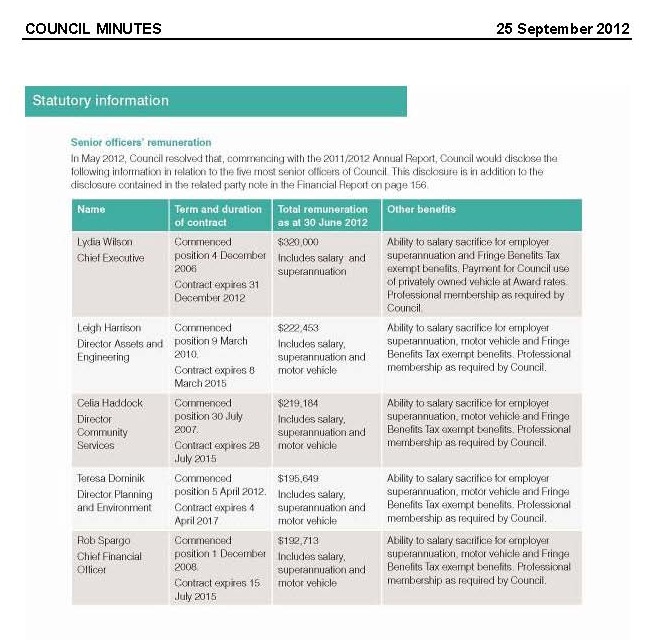
Below is one page from the Manningham City Council Draft Annual Report itemising the specific salaries for their Directors. As we’ve noted in the past, Glen Eira has 5 Directors each sitting on over $230,000 as per last year’s figures. We invite readers to note the differences in pay scales and also to ask why Glen Eira residents who pay these salaries are not privy to the same detailed information that is evident from the chart presented below.


Carrying out Council resolutions in a timely fashion is obviously not high on Glen Eira Council’s priority list. Dissembling, distortions, and straight out fibbing characterise much of what has been going on – especially in regard to public questions and their deliberately deceptive answers! The latest outrage involves the establishment of an Alcohol Free Zone in Centre Road, Bentleigh.

The following public question was asked on Monday night –

“Why has Bentleigh’s shopping strip not received the same attention as Caulfield Race Days in establishing an Alcohol Free Zone and when is Council due to consider such controls around Bentleigh’s Centre Road?”

The Mayor read Council’s response. He said:

“It would be unfortunate for the reputation of the Bentleigh Shopping Centre if people were to infer that the shopping centre suffers the same extent of problems with alcohol affected persons that the area around the Caulfield Racecourse suffers on the twenty or so race days per year that are held there. There is no comparison between the two sites. Council’s Local Law Advisory Committee is looking at the matter following it being raised by the former President of the Bentleigh Traders Association.”

We’ve done a bit of checking and find that at the Council Meeting of 12th October 2010, the following resolution was passed –

“Crs Hyams/Magee

‘As moved, except that in relation to Item M of the Minutes of the Local Laws Advisory Committee meeting that the Local Laws Advisory Committee drafts an amendment to the Local Law to provide for the provision of an alcohol free zone in the Centre Road Bentleigh shopping strip. The amendment is to prohibit the drinking of alcoholic beverages in the shopping centre apart from within areas owned or controlled by licensed premises and is to be enforceable by the Police 

The AMENDMENT was put and CARRIED and on becoming the SUBSTANTIVE MOTION was again put and CARRIED.” 

This amendment was the result of a Local Laws Advisory Committee Meeting of the 13th September 2010 which included the following: “Alcohol Free Zones: Discussed issue associated with declaring and enforcing such zones. Determined police should be requested to utilise their move-on powers”.

Glen Eira Debates at the time reported on the ‘debate’ for the amendment. We then wrote: “Hyams moved an amendment to the Local Law Review committee’s recommendations that Centre Rd be considered for potential naming as an ‘Alcohol Free Zone’. This was opposed by Lipshutz with the argument that we don’t need it; that the police don’t want more work, they will do nothing to enforce it and hence the job will fall on the already overworked council officers. The amendment was eventually passed with the acknowledgement that council isn’t committing itself to anything but that by putting it on the agenda for future discussions all options are left open. (October 13th, 2010)


COMMENT:  

  • What’s the point of passing resolutions if they are never carried out? There is no equivocation in this resolution. The ‘order’ was to prepare an Amendment. This has never come to Council!
  • How can Hyams now read and thereby endorse this response to Monday night’s public question when he in fact moved the Amendment 2 years ago?
  • Why has the Local Laws committee been so derelict in both the frequency of meetings, and more importantly, providing minutes for (all) of those meetings?
  • Why should discussion on a public safety issue be allowed to drag on for over 2 years?
  • It couldn’t simply be could it, that this administration is opposed to introducing an Alcohol Ban and therefore certain councillors once again fall meekly into line?

From Monday night’s Council Meeting.

QUESTIONS TO OFFICERS

PENHALLURIACK: “I ask Mr Burke when allocations are likely to be made for the Koornang Park oval for the 2013 football season, and similarly for the main oval at Princes Park.   Further, are the Caulfield Bears F.C. and the Ajax Seniors F.C. being considered for ground allocations at these grounds for the 2013 season?  Finally will councillors be advised of the details of your considerations well in advance of the allocations being made, and given an opportunity to contribute from their local knowledge and experience in these matters before your decision is confirmed to the successful clubs.”

BURKE: Read out a prepared answer. He began by saying that 3 weeks ago there was a report to council about ground allocations for winter and that this involved over 200 teams and that ‘allocations need to be managed as a whole’ and that because of ground conditions ‘this may involve changes for a season’ and sometimes with ‘short notice….summer season is just getting underway’ and the winter allocations will be looked at in ‘late February 2013’. So, winter allocations ‘aren’t being considered at this time’ then ‘it follows’ that these clubs that Penhalluriack mentioned are also not being considered now. Allocations are ‘managed by the Recreation Department’ and ‘councillors have been advised on several occasions’ that the system used in Glen Eira is followed by other councils. He then went on and said that the Local Government Act ‘prohibits councillors’ from directing officers in carrying out their duties but that ‘there are no prohibitions on councillors commenting on’ anything and that ‘such comments will be welcomed’.

PENHALLURIACK: began with ‘the greatest respect to Mr Burke, he didn’t answer the question’ since he had asked for dates and that Burke had ‘skirted around the issues’ and included ‘generalities’ and that ‘he has not answered the question’.

HYAMS: said that Burke did say that allocations would be done in late February.

BURKE: ‘For the record I object to the term ‘skirting around’.

« Previous PageNext Page »