GE Governance


Elsternwick structure plan

Mr SOUTHWICK (Caulfield)

My adjournment today is to the Minister for Planning, and the action I seek is that the minister immediately defer any decisions on the Glen Eira council structure plan, which will see massive overdevelopment, particularly within the areas of Elsternwick, until such time as residents are properly consulted.

Today I tabled a petition from 1300 residents around the Elsternwick precinct. Many of them live in homes of heritage value. Some of those homes date back to the late 1880s. They are very, very concerned about the overdevelopment that is happening throughout my electorate of Caulfield. This master plan which the Glen Eira council is proposing could certainly see loss of character and amenity and massive overdevelopment, which would see some single –storey homes being completely taken over by large towers in the area.

These residents need to be consulted, and we certainly want to make sure that we do not take up the squeeze that is being left behind from the protection that the Bentleigh residents have had in the overall precinct. We know that there is development need for housing, but Caulfield should not bear the brunt of that. The master plan sees a 20 per cent increase in population and we do not want to squeeze all of that into areas like Elsternwick.

The Liberals’ plan has already been stated. We will reintroduce a two -dwelling limit on neighbourhood residential zones, reduce height limits in neighbourhood residential zones and bring back the 9 –metre discretionary height limit in general residential zones. Certainly this would make a huge difference to many of those residents that I am talking about. But we do not want to see this rushed through. We have got an election in November, and we think that the residents should have the opportunity for proper consultation, not rush things through quickly before the election so people do not have the ability to have proper consultation. We saw the attempted rush through of the Ormond sky tower, and certainly we had to intervene in the upper house with that. We have seen Bethlehem Hospital propose 16 storeys in Kooyong Road. We are seeing massive overdevelopment through Caulfield. Enough is enough, and we are asking the Minister for Planning on this occasion to step in and make sure no decisions are made whatsoever until such time as the issues about excessive height and issues with car parking, traffic and general congestion in our area are fully explored and residents are properly consulted and protected when it comes to living in the great suburbs of Elsternwick, Caulfield and the broader City of Glen Eira.
How much does it cost ratepayers to go through a practice day hearing, then a compulsory conference and then a 2 day full hearing (classified as ‘major case hearing’) at VCAT – only to lose? Could the loss have been avoided?

We believe it certainly could have if:

  • Council had not sat on its backside for 15 years and instead worked to amend its planning scheme
  • If representation at VCAT was based on sound argument and ‘evidence’
  • If council’s and especially councillors’ solution to every application was not to merely lop off a storey or two and reduce the number of dwellings
  • If there was ‘cohesion’ between the traffic department, the planning department and councillors

The case involved an application for a 5 storey development at 9 Royal Avenue, Glen Huntly. Councillors in their wisdom granted a permit for 4 storeys, 16 units and a reduction in both visitor and shop parking. At VCAT, following all the above ‘conferences’ between developer and council, the developer won. He got his 5 storeys and most of the conditions imposed by council were tossed out! This of course means that councillors’ record remains intact! Every single time that we know of, when councillors have reduced the height and the matter has ended up at VCAT, the developer has won. They simply do not learn! The solution has never been to reduce height. The answer has always been to amend the planning scheme – to introduce controls that have some punch. For this pro-development council, such actions are anathema. Residents then literally pay the cost in both monetary terms and in the destruction of residential amenity.

For those interested in reading the decision it is available at – http://www8.austlii.edu.au/cgi-bin/viewdoc/au/cases/vic/VCAT//2018/891.html

Apart from the usual commentary such as no height limit constraints, no overlays, no structure plans, etc. the member also made these important comments that go to the heart of council’s ‘quality’ in defending its position at VCAT.

I understand the provision of one or two visitor parking spaces rather than three spaces was supported by the Council’s professional planning and traffic engineering officers…..I am satisfied the provision of one visitor parking space is acceptable

clause 52.06 does not specify the dimensions of car stacker spaces……If the Council considers that a width of 2.6 metres is necessary, it should present expert traffic evidence and examples to support this proposition;   The Hercules car stacker system has been on the market for a decade and if the dimensions are unworkable, it would be known in the industry and probably would have been remedied by this time;

There is no statutory basis for the Council’s insistence on the wider dimension

Glen Huntly is included in Plan Melbourne’s vision as a Major Activity Centre – despite the fact that council has always treated it as a ‘neighbourhood centre’. Yet, we are still waiting for any comment on council’s plans for this suburb. In the meantime, developers will continue to have a field day it seems!

The agenda for tonight’s council meeting features an item on council delegations. We are told that the reason this item was withdrawn from the previous council meeting was because there was the need to resolve an administrative error in the attachment. One can hardly call major changes to what appeared in last month’s agenda as merely ‘administrative’. The reasons for these changes are not explained. Could it simply be that councillors have again been put in their place and the power of officers retained and enforced?

Some background is important here. Scores of other councils in their delegations set hard and fast rules for when applications are to go to a full council decision, or will be determined by officers alone. Whitehorse for instance states clearly that officers can only decide an application if there are 5 or less objections. Otherwise it goes to a full council meeting. Hobson’s Bay specifies 7 objections. Boroondara cites between 1 and 5 objections plus this significant clause –

3-storey or 3+ storey dwelling/s or 3-storey or 3+ storey residential buildings within the General Residential Zone (excluding residentially-zoned land located within the boundaries of an activity centre);  

Buildings that exceed the applicable preferred maximum overall building height described in Design and Development Overlay Schedule 17 (DDO17);

In last month’s agenda the withdrawn item included such specifications. This latest version has reverted to what has always been council’s position – ie no quantitative clarification of when an application goes to a full council meeting for decision. Why the change? And can residents ever hope to receive a full and honest explanation?

There are plenty of other issues with these delegations and they are not new. Some councils have the equivalent of Glen Eira’s Delegated Planning Committee where councillors sit on these panels. In Glen Eira, the DCP consists entirely of officers and no minutes are ever published. Councillors are effectively side-lined. Considering that officers make approximately 95-98% of all planning decisions, this endows them with enormous power but without the necessary transparency and accountability.

We have for years bemoaned the fact that in Glen Eira there is no ‘councillor call-in’. In other councils, any councillor may determine (some with other councillor endorsements) for an application to be brought to council. This simply does not exist in Glen Eira. Again a very useful omission to safeguard officer’s autonomy and power. For the record, here is a list of a few councils who do provide for councillor call in via their delegations –

Ballarat

Bayside

Boroondara

Darebin

Kingston

Manningham

Melbourne

Melton

Moorabool

Monash

Yarra

We do not expect councillors to determine every single application. That would be unworkable. What we do expect is that when councillors see the need, for whatever reason, that they be granted the legal right to determine the outcome and for there to be a record of their decision making which is published. The way things stand in Glen Eira, councillors are nothing more than an inconvenient impediment to bureaucratic rule and must be kept in their place. This approach, plus all the other processes employed by this council, is the antithesis of what good governance and transparency demands.

Month after month the constant refrain from council in regard to its open space levy is –

All multi-unit developers pay a uniform 5.7 per cent of the value of the land (or give Council 5.7 per cent of the area of the land).

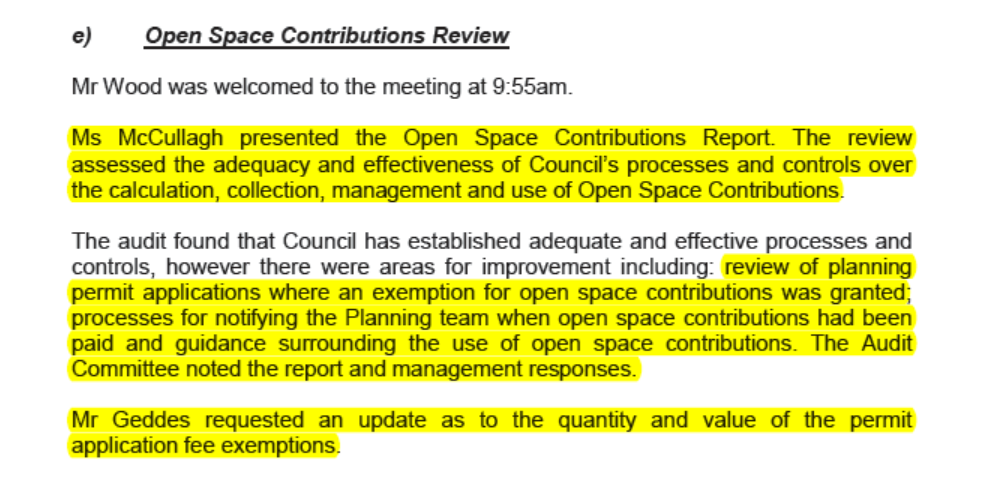
Apparently this is NOT the case as revealed in the minutes of the Audit Committee. We quote:

Clearly, not ‘ALL MULTI-UNIT DEVELOPERS’ pay their fair share, or in fact may pay anything at all! Questions thus abound:

  • Why aren’t all levies collected?
  • On what grounds were levies waived?
  • Who made these decisions and were they empowered to do so?
  • How many thousands (if not tens of thousands) has council lost since the introduction of the 5.7% levy?
  • How many developers did not pay and who were they?
  • Does the open space fund really have $11m in the kitty as claimed or is this more ‘creative accounting’?

For all the talk of a down turn in the construction industry, Glen Eira is well and truly maintaining its record rate of development. The table below is compiled from today’s ABS released figures on building approvals for the current financial year – up to and including May. That means 11 months worth of approvals. Again we note:

  • Glen Eira leading the pack
  • Victoria in Future predictions well and truly outstripped – ie 13,000 by 2031. At this rate, this figure will be reached by 2020/21
  • None of these figures take into account the additional 4,500 (‘preliminary’ numbers) set for Caulfield Village and Virginia Estate

There is absolutely no strategic justification for council’s current plans to double the size of activity centres and to impose 12 storey height limits, plus rezoning hundreds upon hundreds of sites that will be earmarked for higher height limits.

We’ve uploaded the latest ABS figures HERE

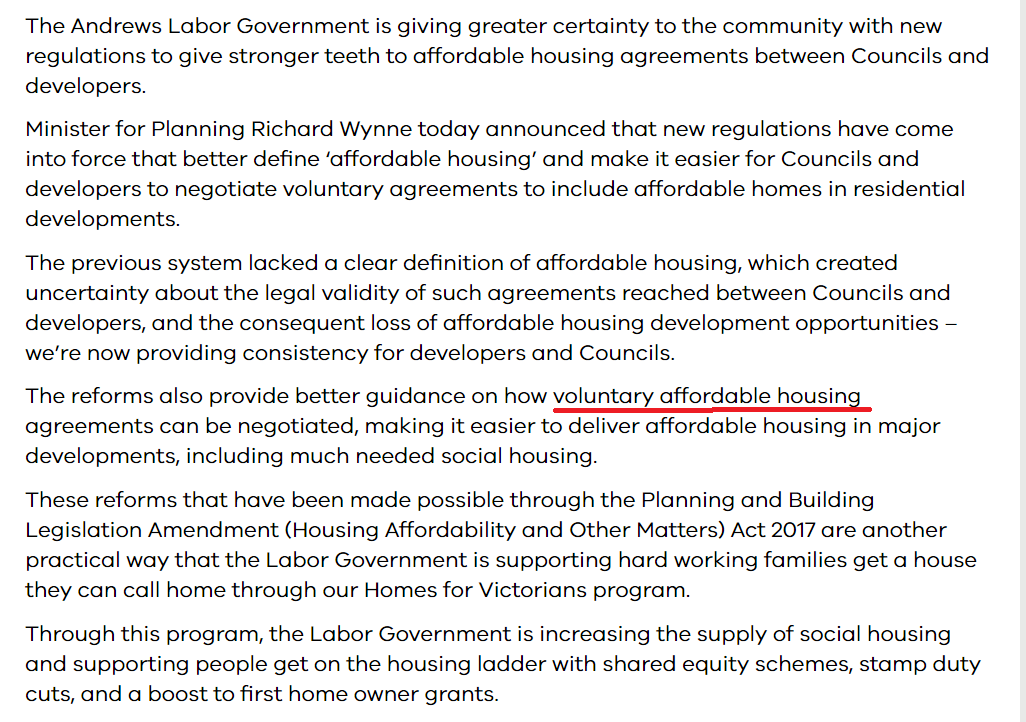
The roll out of legislation after legislation that purports to achieve major reforms in planning continues with Wynne’s latest effort on affordable/social housing. As with the Objector’s Act, the Garden requirements, and the Local Government Review, this latest effort is laughable. Here’s the hyped up media release –

Nothing is mandatory. Nothing forces the developer into any private arrangement with councils. If voluntary, then it will all depend on the dollars the developer sees as coming his way. For example: 12 storeys in Elsternwick and Carnegie is council’s ‘gift’ to the developer in exchange for 20 or perhaps 30 apartments set aside for social housing?

All Wynne has done with this latest legislation is to spell out the income levels that would classify individuals as ‘low’ or ‘average’ income earners and hence make them eligible for ‘affordable/social housing’. It goes nowhere in forcing councils and developers to set aside a reasonable percentage of land within developments to ensure that such housing becomes available.

By way of contrast, this extract from a recent article by ‘The Conversation’ shows what is being done overseas. There is much that could have been achieved if the will was really there.

There are now more than 500 inclusionary planning schemes operating in municipalities across the US. Some require developers to include affordable housing as part of development in a particular zone (usually a fixed percentage of units or floor space).

For example inclusionary planning programs in the city of San Francisco, California (population of around 830,000) generate around 150–250 affordable units per year (around 12% of the city’s total supply).

Other schemes allow variations to planning rules in return for affordable housing. These variations might permit additional density in certain areas or waive certain requirements that would normally apply or expedite the development assessment process.

Other schemes require financial contributions from developers to offset the impact of a project on affordable housing demand or supply.

These programs provide a way for governments to ensure affordable housing for lower income residents even in rapidly gentrifying neighbourhoods.

(source: https://theconversation.com/england-expects-40-of-new-housing-developments-will-be-affordable-why-cant-australia-94581)

For those interested in reading the actual legislation and what it states, we’ve uploaded the relevant documents HERE and HERE

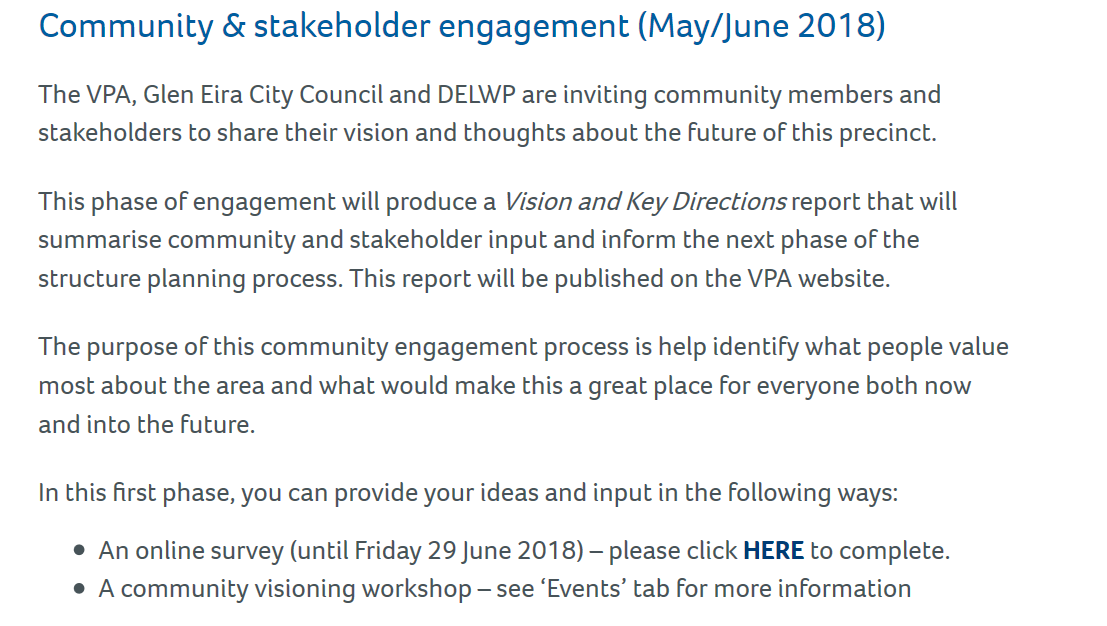
The VPA (and Council) has finally released its version of Stage 1 of ‘community consultation’ on the Caulfield Station structure planning with this neat little blurb and a ‘survey’. (See: https://vpa.vic.gov.au/caulfield-station-precinct-vision-survey/

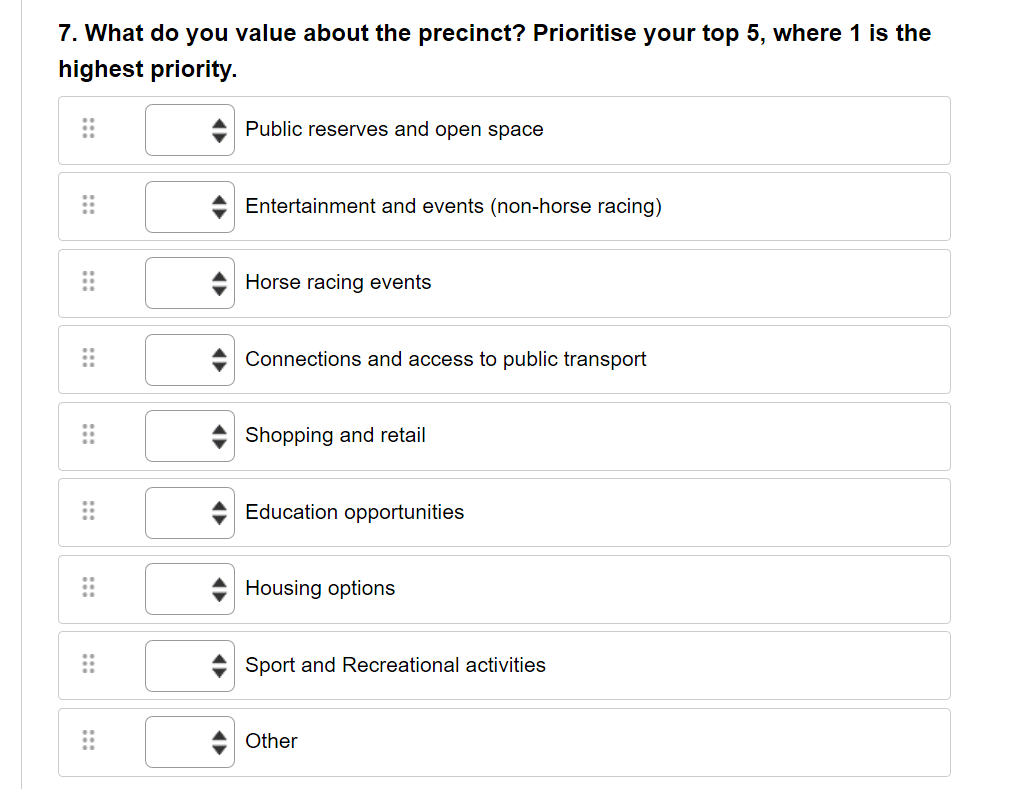
It would seem that the norm now for government and council is to fall back on meaningless jargon (ie ‘Vision’) and surveys that are highly questionable. Our view is that surveys are fine – but only AFTER residents know exactly what they are dealing with. What are the parameters that have been set? What is the proposed land use? Before any ‘survey’ results can be truly meaningful then residents need to know exactly what are the options? We fear that this process will simply mirror what has already happened with Bentleigh, Carnegie & Elsternwick – albeit on a much grander scale!

Here’s part of the ‘survey’. We ask readers to consider its merit.

PS – FROM TODAY’S HANSARD

Caulfield electorate

Mr SOUTHWICK (Caulfield)

(12:00)

My question is for the Minister for Planning. I raise an issue on behalf of 1300 local petition signatories who are outraged by the Elsternwick rezoning master plan, which will increase the local population by over 20 per cent with no consideration of the impacts on amenity, infrastructure and traffic congestion. Residents are also confused at the seemingly different rules for different electorates whereby the areas of Bentleigh and Carnegie are benefiting from interim height controls as low as four to five storeys whereas sections of  Elsternwick have no current height limits and could face up to 20 –storey apartments complexes.

The current Elsternwick rezoning plan is entirely inconsistent and incompatible with the local area. Can the minister provide an answer to concerned Elsternwick residents as to why are there are these inconsistencies whereby one electorate, the marginal seat of Bentleigh, is being benefited in comparison with another electorate, my electorate of Caulfield?

If anyone needs further proof of what an unmitigated disaster planning is in Victoria the events of the past week prove this in spades. Wynne has certainly outdone himself this time in gazetting Amendment C143 on the 15th May, without any consultation, without any forewarning, and handing more and more advantage to developers and complicit councils which we label Glen Eira as.

Amendment C143 has basically diluted the much vaunted ‘garden requirement’ – especially for areas zoned as General Residential (GRZ). When this amendment was introduced in March 2017, garden areas were mandatory and proclaimed that dwellings in both NRZ and GRZ had to set aside, 25%, 30% and 35% of the site depending on their respective size. Each garden area was supposed to be at ground level, not to include any ‘covered’ areas, and there was no scope for councils to ignore this. On the 15th May all this changed. What we have now is depicted in the following image taken from the amendment

Please note the following:

  • Councils now have the option to include in their schedules an ‘exclusion’. That means that if they so desire then the garden requirement need not apply to any proposed development. Further, if the site is designated as ‘medium density’ then it may also be excluded. We note that according to council’s draft structure plans and the Urban Design guidelines Garden townhouses and Urban townhouses are defined as ‘medium density’ and given the ridiculous label of 2 to 3 storeys. That can only mean that all these areas will be rezoned to GRZ and hence may be excluded from the requirement to provide any ‘garden area’.
  • Land under the eaves is now to be included in any garden area calculation.
  • Garden areas now do not need to be at ground level – they can be calculated via balcony size and whatever is under a balcony that projects out from the building is also included in the garden area calculation.
  • Sheds of up to 10 square metres can now also be included in the required calculation. If the site happens to be 420 square metres, then 25% should be ‘garden area’. That means 105 square metres. Thus if a shed is built, it can occupy 10% of the previously designated garden area.
  • Pergolas are now also acceptable – even if they have louvred shutters that at various time could form an ‘enclosed’ area. And who will supervise that these louvres remain open all the time?
  • The most interesting aspect is again the possibility that everything included in an approved structure plan can also be excluded from having a mandatory garden area. In Glen Eira where we estimate 90% of the municipality will become ‘activity centres’ according to council’s published ‘study area’ borders, that could mean that only a small proportion of land will be required to meet the garden area clause.

Making matters worse is that VCAT has finally started hearing cases post the introduction of Amendment C110. In two recent decisions, labeled as ‘red dot’, one respective member had this to say:

The Tribunal’s finding regarding the MGAR (minimum garden area requirement) is that the areas underneath the eaves and extended roofline of the proposal are excluded from the calculation of the ‘garden area’ because they are not ‘uncovered outdoor areas’; and because they are ‘roofed areas’ within the ordinary meaning of those terms.  (Source: http://www8.austlii.edu.au/cgi-bin/viewdoc/au/cases/vic/VCAT/2018/646.html)

Both decisions came to the same conclusion on MGAR. But not a week later, Wynne gazetted his Amendment C143 which contradicted these decisions! Where does that leave us? What are the legal ramifications? How much further will Wynne go to accommodate developers and reduce residential amenity for communities? And the $64 question?– which way will council jump? Will they introduce some nifty clause into their amendments which remove the need for garden areas in the GRZ? Will they continue to plough on in their unjustified endeavours to expand activity centres and facilitate more and more development – in the face of huge community opposition? How many more attempts to bypass the community via applying under section 20(4) of the Planning & Environment Act will we have to endure? When will this group of 9 councillors have the guts to stand up and say ‘enough is enough’?

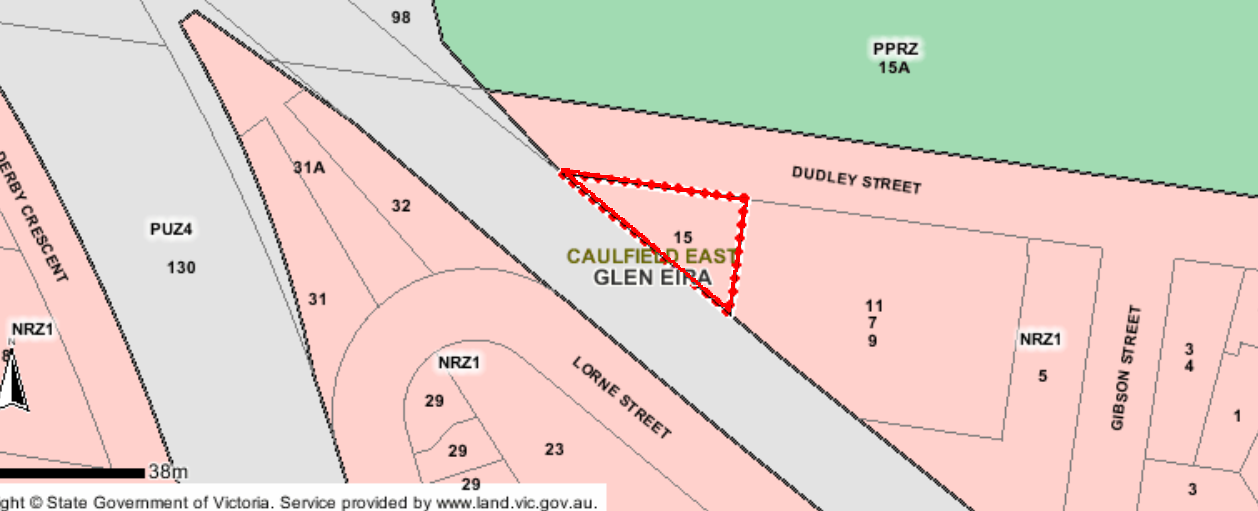
To what extent is council’s planning department in cahoots with developers? A recent application renders this question very, very relevant. The application is for an 8 storey student accommodation building  in Dudley Street, Caulfield East. The proposal is to house 104 students, a shop at ground level and a car parking waiver of 31 spaces. The application is currently being advertised.

All well and good – perhaps. Except that:

  • The site is zoned as Neighbourhood Residential – ie a MANDATORY HEIGHT LIMIT OF 9 METRES OR 2 STOREYS
  • The site is NOT PART of the Phoenix precinct which is (partly) geared towards accommodating student housing.

Yet, this application is now being advertised. Why? Why hasn’t it been refused outright given the above? Secondly, why when the developer admits to ‘pre-application’ meetings with the planning department has council allowed this application to reach this stage of advertising instead of refusing it outright under delegation? Doesn’t the planning department know its own zoning or its own planning scheme?

Regardless of whether Dudley street should have been rezoned eons ago given that there is now 5 storey buildings in this street, the fact remains that it hasn’t been rezoned. So what conclusions can we draw from this? It is clear that council and the VPA intends to expand the Phoenix Precinct. That residents of the area can expect more and more high rise development. This however does not excuse the planning department’s failure to enforce the current planning scheme or to insist that the ‘errors’ contained in the application are removed. For instance: we are repeatedly told that the site is in ‘housing diversity’ area. It is NOT. We are also repeatedly told that the site is part of the Phoenix precinct. It is NOT. Time and again council’s officer reports tell us that it is the current planning scheme that matters and that council’s draft structure plans therefore play no part in the decision making since they are not approved parts of the planning scheme. Surely the same should apply to this application? The fact that it hasn’t, that the developer has been allowed to get away with blue murder, raises fundamental questions about governance, ‘favouritism’, the sheer competence of the planning department and of course, council’s hidden agendas!

We’ve uploaded the current zoning (below)  that clearly shows the NRZ status of the land –

It will be fascinating to see the officer’s report (if we get one) and the rationalising that will undoubtedly attempt to excuse the inexcusable. What is at stake here is the community’s faith in the integrity and objectivity of planning in Glen Eira.

The two tables presented below are from the latest ABS building approvals. (uploaded HERE) The first table features the total number of building permits granted per year for the past 6 years and 9 months – ie until March 2018. Glen Eira is still ahead of the pack in unit development, plus the fact that Stonnington is a special example – ie three times the commercial zoning that Glen Eira has, whilst Port Phillip is in a league of its own with over 15% of its land mass designated as ‘capital city zone’ plus its large quotient of commercial zoning plus tourism. Monash is double the size of Glen Eira and has double the number of houses built compared to Glen Eira. Boroondara is also well ahead of Glen Eira in the number of houses versus apartments erected in that municipality.

So, once you add in the following, then the ‘damage’ done to Glen Eira is evident:

  • Small size of municipality
  • Least amount of open space
  • High population density and increasing
  • Dwellings per hectare
  • Lack of any traffic plans
  • No developer contributions for drainage, community infrastructure, parking waivers
  • Small commercial zoning which means development is occurring in local streets (approx 3% compared to Stonnington’s 8%)
  • Money squandered on open space ‘improvements’ instead of the purchase of more and more open space
  • No local environmental or water policy in the planning scheme
  • No local policy regarding tree protection in the planning scheme – and a mooted ‘significant tree register’ which will probably total only about 150 trees. This won’t go far enough by a long shot to halt the rampant moonscaping that has been plaguing Glen Eira for decades.
  • Most importantly, these figures make a mockery of council’s prognostications. Our supposed 13000 net new dwellings by 2031 will be here within the next few years – especially with a mooted 4500 net new dwellings for East Village and precinct 3 for Caulfield Village. Thus, why are hundreds upon hundreds of properties being rezoned? Why are activity centres being doubled in size? And why oh why does council refuse to address and answer these fundamental questions?

« Previous PageNext Page »