 AND
AND
March 11, 2015
AND
March 4, 2015
On the 25th February 2015, both sides of politics passed this motion in parliament.
That in accordance with standing order 11.01, there be tabled in the Council, by 12 noon on Wednesday, 11 March 2015, a copy of the report prepared for the Minister for Planning by the Residential Zones Standing Advisory Committee concerning draft amendment C125 relating to the city of Bayside.
Amendment C125 relates in part to Bayside’s attempt to basically overturn the Residential Growth Zones in its municipality. We will refrain from commenting on the performance of this Standing Advisory Committee thus far and its previous recommendations concerning Kingston, Moreland, Moonee Valley and so on. What is of interest in the debate are the comments representing all sides of politics.
We also suggest that when reading the following, readers keep in mind what occurred in Glen Eira – that is: secrecy, no consultation, and deliberate obfuscation in response to various public questions.
MR DAVIS (Southern Metropolitan)…… This is about the shape of our suburbs. This about residential amenity. I put on record as a general principle my belief that there is great scope for transit-orientated developments with a focus on higher density in and around transport nodes, but it must be done in a way that brings the community with the proposals. It needs to have full community consultation, and councils and the community need to be working in harmony to see developments like that accepted and brought forward. They must be designed in a way that is sympathetic to the community.
This motion is a narrow one. It seeks to make public that report by the panel. I can indicate that the opposition will make some further decisions when we see that report, but it is clear that amendment C125 and the proposals around it need some significant further work. The panel report is a key document that should be in the public domain to inform public debate, and for that reason this motion is in the public interest.
Ms DUNN (Eastern Metropolitan)—In short, the Greens certainly support this motion. We support open and transparent government and of course we support the release of the planning panel report in relation to amendment C125 to the Bayside planning scheme. What is important in relation to this is what the community thinks about the nature and shape of their suburbs. It involves the character, amenity and built form of the area, and certainly planning scheme amendments provide ample opportunity for those matters to be picked up through design and development overlays and schedules attached to the planning scheme.
The planning panel report will provide an opportunity to see how those consultations went. It will be interesting to understand the length and breadth of the contributions and how many people had an opportunity to participate. The reality is that this is about the shape and nature of our suburbs and of Melbourne, so it is important that communities share that journey when we are talking about matters as important as planning scheme amendments and the difference between general residential zones and residential growth zones. Certainly the Greens support the release of this planning panel report, and we look forward to seeing what is contained within it.
Mr SOMYUREK (Minister for Small Business, Innovation and Trade)—The Residential Zones Standing Advisory Committee has prepared its report on amendment C125 to the Bayside planning scheme and has submitted it to the department for assessment. The Minister for Planning will shortly be briefed on the recommendations of the independent committee for his review. Once a decision has been made by the Minister for Planning the report will be released. It is in no-one’s interests to prolong the debate, and the Minister for Planning requires suitable time to assess the independent committee’s recommendations without interference. If the committee report is released prior to a decision being made, proponents and the community will continue to make submissions on the substantive matter and the panel report. This does not add to the quality or timeliness of the decision-making.
There is a clear and transparent process for consideration of these proposed amendments, and it is important that this process is honoured. While it is at the minister’s discretion as to whether to release the committee report, I can confirm that the minister will release the report once he has been briefed and a decision has been made.
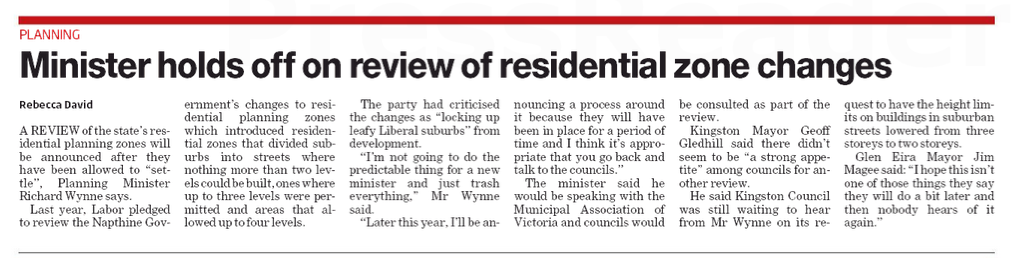
This government is committed to clear and transparent decision-making that takes into account the views of the community. We were very concerned about the mismanagement of the process for the rollout of the new zones and will be undertaking a full review.
Motion agreed to.
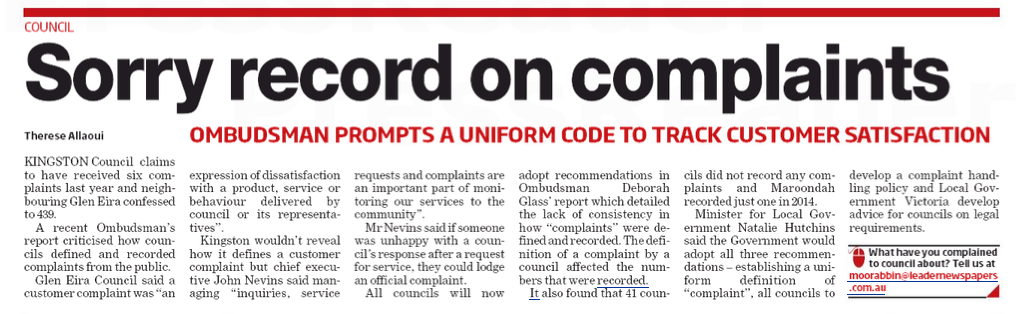
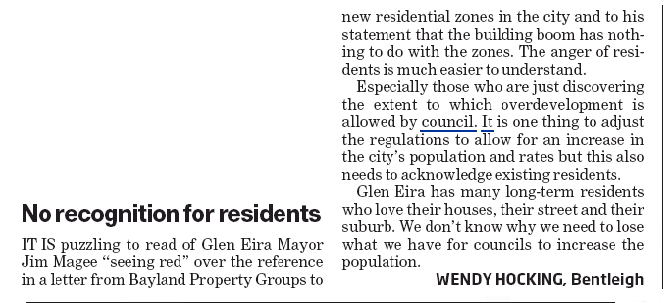
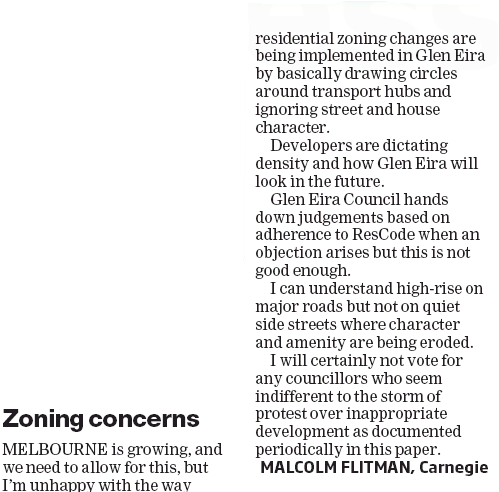
PS: From this week’s Leader ‘Letter to the Editor’.
March 2, 2015
Apologies for another long post!
At last council meeting councillors voted to abandon Amendment C124 which proposed to rezone a disused industrial site in Clairmont Avenue to General Residential Zone 3 (ie three storey height limit). This was undoubtedly the ‘right’ decision, but it also raises innumerable questions regarding:
We will go through each of the above points in turn.
Due Diligence
Most of the arguments for rejecting the proposed amendment were known right from the start – ie traffic concerns, predominantly Neighbourhood Residential Zone area, lack of transport nearby or shopping strips. In the 6 months that it took to receive permission to advertise the amendment, receive submissions, go to a directions hearing and then a Panel Hearing, none of these factors CHANGED. So why did ratepayers have to fork out thousands and thousands of dollars for a panel, plus staff time, to propose something that was eventually overturned by councillors? Did councillors perform due diligence right from the start and investigate the area, and the proposed amendment thoroughly for themselves? If they did, then why didn’t they reject the proposed amendment much earlier in the process? Or was it that residents of Clairmont Avenue actually got together and started serious lobbying of councillors?
In the discussion for this item, (see below) several councillors made mention of the fact that they had received numerous calls from residents. We congratulate residents, but our argument remains constant. Councillor decisions should not be based on the number of complainants but on the facts of the matter. If all the arguments that appeared at the last minute and lead to the abandonment of the proposal were there right from the start, then the amendment should never have been entertained. It should have been rejected outright last July. It wasn’t, and so ratepayers find themselves funding another useless exercise in double-speak and bureaucratic bungling. Nor does this entire episode cover councillors in glory. For instance: why didn’t they listen to residents right from the beginning? Why did they merely blindly follow officer recommendations – not once, but twice, only to baulk at the final decision?
The Officer Report
Selective editing of important documents is not new to Glen Eira City Council. Unlike countless other councils, Panel Reports are rarely included (in full) in tabled minutes or agendas. Residents either have to physically go down to council to ‘inspect’ or wait until the Department places them up on their website. More worrying is that when decisions are made to adopt, reject, or amend, what is left out is often more telling than what is stated. There is much in this Planning Panel Report (uploaded in full HERE) that does not get a mention in the council minutes. Most of what is omitted is of course what council would like to keep out of the public domain. For example:
The Panel agrees that the application of the NRZ would be largely appropriate if it were not for the fact that that zone makes no proper allowance for development of redundant larger sites such as the subject site. (page 11) In other words, the current planning scheme is inadequate to deal with the two storey height limit imposed in NRZ for large sites.
And there’s more, including this explicit criticism of the ‘reformed’ zones –
While it might be possible for a multi‐unit development to be developed on the subject site by subdividing the land in advance of construction, in my view this would not be a practical approach to development of the site, especially if the development involved dwellings on more than one level. The provisions of the NRZ may well be have been designed to place stringent limits on the intensification of housing on prevailing standard sized house lots, but the absence of any provisions recognising the possible presence of larger sites within that zone with potential for redevelopment is a strange omission.
Accordingly, I agree with the Council that it is not reasonable in terms of making efficient use of the land for residential purposes to include the land in the NRZ. The GRZ3 is an appropriate choice – a zone specifically designed for in‐fill sites.
Conclusion? The Panel’s agreement to the rezoning of the land to GRZ3 is largely based on the fact that the current planning scheme has so many ‘omissions’, and is so inadequate to deal with this issue, that the only feasible solution is a GRZ3 zoning. The officer’s report naturally omitted this important paragraph and only included the final paragraph shown in the above quote.
What’s even more disconcerting is that the Panel has to recommend that Council to get off its backside and do something about traffic and parking issues in the street as well as ensuring that permits are adhered to.
The Panel noted the reasonably large amount on street parking occurring in the street at 4:15pm on the day of its inspection (more than 17 spaces were occupied) and that vehicles were being driven away around that time by persons apparently leaving work for the day. The Panel requested that Council particularly address this issue raised by submitters.
At the Hearing, Ms Pascoe advised that the Council’s engineers were aware of the parking and traffic issues in the street. She said that they were partly caused by the panel beating and motor repair businesses now operating on the site which have no planning permission. Enforcement proceedings have been initiated.
Again, this was not mentioned in the officer report! Nor was there any mention of the fact that the ‘accuracy’ of the applicant’s Traffic Report was seriously queried by Council’s Traffic Department. Yet, the amendment was still drafted and presented to councillors without spelling this out.
Finally, presented below is the ‘discussion’ on this item. We ask readers to pay careful attention to the various commendations of residents and keep in mind that ‘populist’ decisions do not equate with councillors performing due diligence and making sure they are fully acquainted with all the facts of the matter. Otherwise more and more money will be wasted on such enterprises whilst the real culprit, the planning scheme, remains untouched and unrevisited!
The Council ‘Discussion’
Hyams moved motion to abandon amendment and to notify applicant that council would be prepared to support an amendment to rezone to Neighbourhood Residential Zone. Seconded by Lobo.
HYAMS: said that there was ‘little doubt’ that the area should be rezoned for residential but the ‘question’ is whether this be NRZ or GRZ3. Said he would have liked to vote on the NRZ zoning now but ‘legal advice’ told him that they couldn’t do this without first abandoning the exhibited amendment and coming up with a new one. The choice is therefore to adopt ‘as proposed for GRZ3’ or to abandon. So ‘after consulting with residents’ he is prepared to ‘try and get a better result next time’ with a new amendment. He’s read the panel report, seen the site and talked with residents and thinks that GRZ is ‘inappropriate’ since it’s already a ‘narrow and busy street’ with a nearby school and an aged care facility that got approval for more beds up to 100+. There’s the questions then of whether the street ‘can handle’ all this traffic. GRZ zones are also ‘generally near shops and public transport’ and this doesn’t apply here. Once a GRZ zone is declared then it ‘limits our ability’ to control ‘what goes there’. Said it would be ‘ridiculous’ to limit ‘such a large block to 2 dwellings’ as applies in the NRZ but ‘that can be overcome through subdivision’. Thought there could be 8 blocks. Residents weren’t happy with the industrial zone because of ‘the noise that comes out of that’ but that they hope to get this right.
LOBO: said this is ‘most certainly not appropriate for our residents’ . Said that he and residents are ‘appalled that we are continuously giving in to the wishes of developers’. Said it is ‘shocking to see the opportunist’ wanting to ‘reap the benefit’ without ‘any concern for the residents’. Said that the spate of development has ‘drowned everyone including the best swimmers’. Residents told him last Sunday’ that they hadn’t got any letter from council inviting them to the panel hearing and the panel report then noted that no objector showed up. The aged care facility will see ‘another 101 residents’ and parking will be bad and bottlenecks for parents dropping kids off at school. ‘3 schools in the vicinity’. ‘The panel is out of touch with reality’ and that ‘they have no clue whatsoever compared to councillors’.
MAGEE interrupted and asked Lobo to ‘speak directly’ to the motion and to ‘leave the rhetoric and the stories out’.
LOBO: repeated the problems with the aged care facility and that the street is used as a thoroughfare through to Nepean Highway. Urged councillors to abandon amendment as this would ‘give a breather to the residents whom we are supposed to represent’.
MAGEE retorted that he thought that is what councillors do.
LIPSHUTZ: asked Torres about notice of the amendment. Torres responded that there was an ‘exhibition period’ and that residents ‘were informed of the amendment’. Also that it was the Planning Panel which notified submitters of their option to attend the hearings. Said that submitters did participate in the ‘directions hearing’ but that at the actual panel hearing ‘submitters chose not to attend’.
LIPSHUTZ: he ‘took umbrage’ at Lobo’s comments about council and developers. Said that ‘there is nothing wrong with profit’ and that the developer purchased this industrial site and now want to make a profit and that ‘this is a good thing’ because ‘that’s how we grow our society’. Besides, this developer hasn’t even put in a proposal yet so Lobo is ‘jumping the gun just a little’. At first he thought that there was ‘nothing wrong’ with the draft amendment. He then ‘went down the street’ and because it is a ‘narrow street’ and because of the nursing home a NRZ is the ‘preferred way to go’. ‘It’s not because of greed’ and councillors make decisions on what they ‘think is right’. They don’t ‘always do what residents want’ because ‘we are elected to make decisions’. They wouldn’t be doing ‘residents any favours at all’ if all they listened to was the ‘loudest’ voice. Said that ‘it’s all right to play the gallery’ but in the end councillors have to be ‘responsible’. Councillors have to ‘make the right decisions’ and if residents don’t agree then ‘that’s fine’ and residents can ‘vote us out’. In this instance applying a GRZ3 is not ‘appropriate’ because it will ‘allow too much development in this area’.
PILLING: agreed that Lobo’s comments ‘are inappropriate’ because ‘they misrepresent the process today’. His comments are ‘unnecessary, unfair and unwarranted’. Plus they ‘give the gallery the wrong view as well’. Thought that this was a ‘line ball decision’ since the panel recommended the GRZ3 zoning. The zones give a buffer area between RGZ, GRZ and NRZ which is normal across the municipality and he supports the motion because ‘there are special circumstances to this site’. He ‘appreciated’ all the calls from residents and even though he didn’t agree with all the comments he does agree that GRZ zones are generally close to transport hubs and this isn’t. So this is ‘probably on the perimeter of where a GRZ’ zone should be. So ‘it’s a line ball decision’ but he will support the motion.
ESAKOFF: agreed with Pilling and Lipshutz’s response to Lobo’s comments. Said that councillors had ‘received a lot of feedback’ from residents and that they had visited and ‘know the street pretty well now’. Street is small, ‘narrow and not close to public transport’. This area ‘is very different’ to other GRZ areas. Street is busy with nursing home, school, childcare, and ‘used by the staff who work along the highway’. Rezoning this to GRZ would ‘turn this busy street into an unsustainable one’. Hence it should be ‘zoned neighbourhood residential’.
DELAHUNTY: found it hard to accept Lipshutz saying that profit progresses society since ‘we stand here as a non-profit’ organisation that is in a ‘governance role’ is how ‘we progress society’ plus ‘other ways’ too. Because council doesn’t have the profit motive, that’s ‘how we ensure’ that decisions made are ‘transparent’ and ‘in the best interests of all the parties’. Thanked the residents who had ‘got themselves incredibly informed’ about ‘what was happening to their area’ and how they ‘imparted knowledge’ onto others and ‘helped us make this decision’. Said ‘there had been a volume of calls’ and she thanked residents. Supported abandonment and thought there were more ‘sophisticated’ ways of dealing with the area.
SOUNNESS: didn’t think it was a ‘bad amendment’ and that the ‘factors that speak for it are quite sound’ and a ‘couple of factors’ against. In favour was a major highway ‘right next to it’ and people drive cars. Didn’t think that traffic is ‘a big problem’ and on the narrow road, ‘there are other narrow roads’ in the municipality. Main problem was ‘transitioning story’. If transitioning from a ‘commercial 2 zone’ to a general residential to ‘something that’s got no height limit’ to something that ‘does have a height limit’. He ‘didn’t see the need for that transition to take place there’ since it’s all a ‘theoretical construct’. All in all, this amendment ‘has got too much growth that didn’t seem warranted’. Also didn’t ‘like the distance from public transport’. The application seems ‘reasonable’ and he has spent an hour in a recently opened coffee shop that seemed to be ‘doing gang busters’ so the ‘place is ready for urban renewal’. He looked forward to see this happening in a ‘measured way’.
OKOTEL: said that rezoning from industrial to residential is ‘far more appropriate’ use of the land. But having a general residential zone ‘might signal’ to the developer that council is ‘entertaining’ the idea of ‘more intense development’ for the site ‘which wouldn’t be appropriate’ because of the ‘existence of many one storey dwellings’ and the other factors that councillors have outlined. With the nursing home they ‘anticipate that traffic will increase quite a lot’. ‘Hoped that the developer takes up’ council’s ‘recommendation’ that this be rezoned to Neighbourhood Residential Zone and she ‘looks forward to that in the future’.
MOTION PUT AND CARRIED UNANIMOUSLY
As a postscript, we should mention that when it was decided to sent the amendment off to a panel, the ‘discussion’ took less than 2 minutes. Only Sounness who moved the motion spoke and basically said that he felt that the officer’s comments had largely ‘addressed’ resident concerns. No other councillor spoke to the motion and it was passed unanimously! Amazing, that in the space of three months there should be such a change of heart and such ‘garrulousness’ when previously there was utter silence from the vast majority of our elected representatives!
February 17, 2015
On July 3rd 2013, Hyams uttered these incredible words in regard to the Alma Club development application – ‘council’s role is not to necessarily represent the people’. Perhaps Hyams needs to revisit the Local Government Act, where part of its objectives for local councils is the injunction to act ‘as a representative government!’ Not for the first time was the gallery assailed with the double-speak of ‘quasi-judicial’ functions and ‘planning law’ and the inference that all planning decisions and processes are therefore objective and strictly ‘neutral’. Council’s published ‘information’ on planning objections enshrines this notion of ‘impartiality’ when it states – Planners must act impartially as an assessor of an application.
So, we are left with the conundrum of – who does council really represent? The answer is clear in this screen dump!
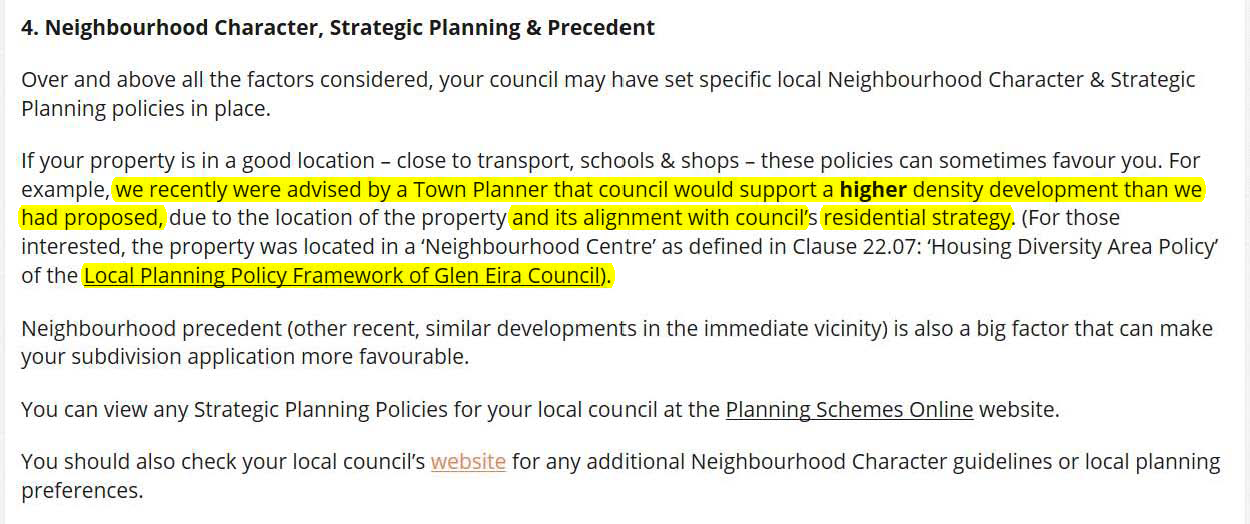 Source: http://pillarandpost.com.au/topics/neighbourhood-character/
February 12, 2015
We’ve received the following letter of complaint that was sent to Council. As with most things connected with the racecourse and the MRC, residential amenity appears to be the last thing to worry either the Melbourne Racing Club, or for that matter, Council.
We have been asked to remove the sender’s name.
Dear sir,
I have been driven to write to you about the continual flouting of local law by the Melbourne Racing Club at Caulfield Racecourse with respect to illegal noise levels. These are illegal by virtue of the excessive volume that penetrates inside residential dwellings yet some distance from the racecourse itself – never mind those in the immediate vicinity (according to a resident of Fitzgibbon Crescent, for example. Name can be supplied upon request).
Although there are many examples on a relatively regular basis, today the racecourse rented out its premises to the “I dream all day” music event (rave/festival). The incessant bass pounded all day penetrating our home and garden. We were unable to relax the whole day. The children were unable to sleep. Now, don’t misunderstand, I LOVE electronic dance music, and attend the odd festival myself – but these are not held in a residential suburb. When I went to inspect the source of the noise, the walls of the racecourse along Station Street, cladded with corrugated iron, were reverberating from the amazing volume of sound.The noise level was entirely inappropriate for the residential surrounds of the racecourse (surrounded as it is on all sides by family homes), and was undoubtedly beyond any legal limit. It penetrated throughout my home far away in Eskdale Road. It went on and on all day with no respite.
Other events that the racecourse holds for its own profit at the expense of residents resulting in shattered neighbourhood amenity include funfairs with blaring music in the Western car-park adjacent to Kambrook road despite the residential nature of the area. That noise also goes all day and overwhelms us inside our dwellings as well as outside in our gardens.
While investigating these issues, it is vital that you ensure that the racecourse also respects local law regarding sound levels with respect to the incessant droning of the race commentators every Saturday. Residents have a right to peaceful amenity without the incessant droning of the commentator over the PA system at unacceptable levels. After all, if it is legal and acceptable for the racecourse to broadcast its ‘soundtrack’ such that it is heard clearly in surrounding dwellings, then it is just as legal for surrounding dwellings to broadcast their own soundtrack at the same levels which will be clearly heard at the racecourse! Not something decent residents do, but that doesn’t seem to matter a jot to the racing club which treats residents with contempt.
I respectfully request that you take the matter further with the Melbourne Racing Club, and please keep me informed of any developments in this area.
Yours
xxxxxxxxx
February 10, 2015
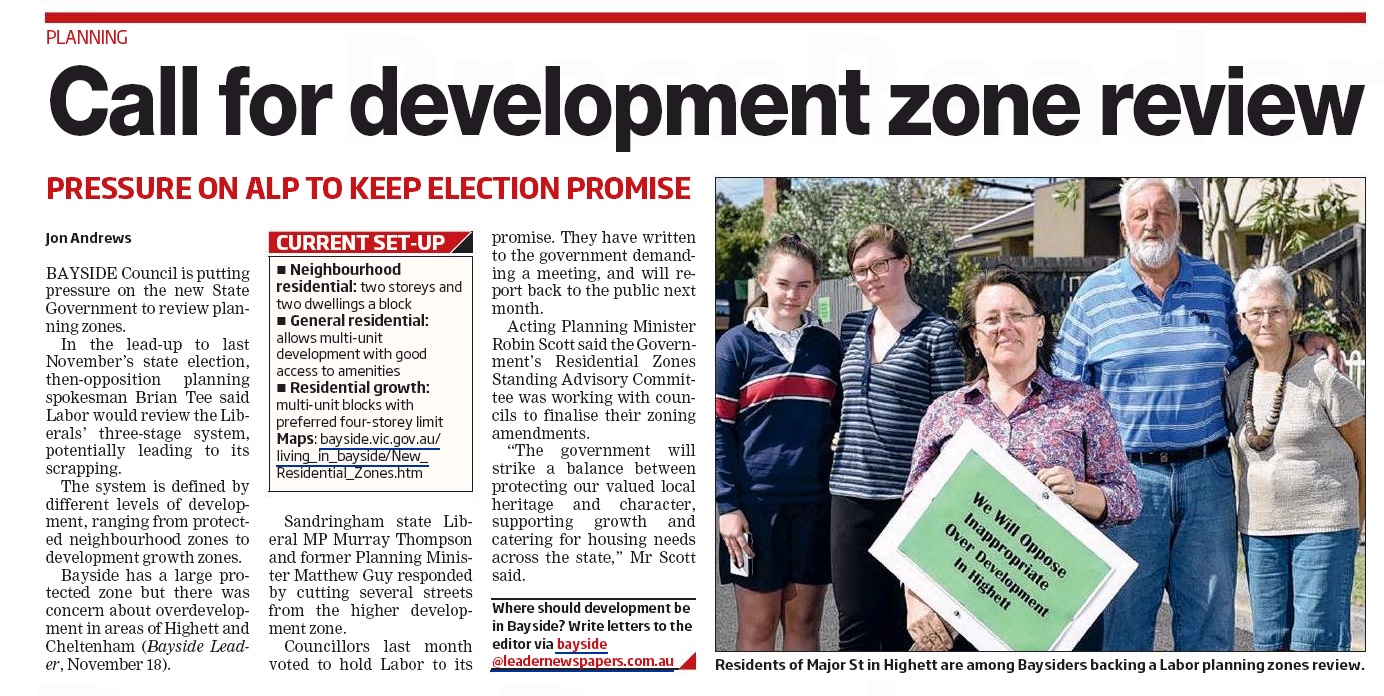 The Glen Eira Council approach –
Crs Okotel/Hyams
That a report be prepared detailing how the state government intends to review planning zones and how this might impact Glen Eira.
The MOTION was put and CARRIED unanimously.
The Bayside approach –
That Council:
February 5, 2015
On Tuesday night a public question was asked regarding what our councillor representatives on the Racecourse Reserve Trustees were doing to ensure that the Auditor General recommendations were being fully implemented. Council’s response to this question is quite literally astounding. What is even more astounding is that not one councillor had the courage to stand up and either query this response or, to disassociate him/herself from this nonsense.
The response is in direct conflict with the Auditor General’s report in all facets. Either the Auditor General does not know what he is talking about, or council does not have a clue as to its responsibilities to the community and to proper governance. Here are some quotes from the AG Report –
The management of the reserve was vested in a group of trustees who represented the government, the Melbourne Racing Club (MRC) and the local municipality—Glen Eira City Council. (page vii)
Under the Crown grant, 15 trustees are appointed by the Governor in Council to manage the reserve—six each representing government and the Melbourne Racing Club (MRC) and three representing Glen Eira City Council. (page ix)
More recently, the government and Glen Eira council trustee representatives have recognised that governance standards in line with contemporary practice should be introduced. (page xii)
The land was permanently reserved in the 19th century for three purposes—a racecourse, public recreation ground and public park. Management of the reserve is vested in 15 trustees—six government nominees, six Melbourne Racing Club (MRC) nominees and three council nominees representing the local municipality, Glen Eira City Council. (page 1)
Within the trust, there have been differing views about how these competing uses can be reconciled. More recently, this has created tensions between trustees representing the Melbourne Racing Club (MRC) and those representing the government and Glen Eira City Council. (page 26)
The make-up of the trust enables MRC, Glen Eira City Council and state government views to be considered as part of its decision-making processes. Until recently, however, members of the local community had no direct means of engaging with trustees on matters of importance to them. They had to rely on council representatives to present their views. (page 28)
Each and every one of these Auditor General statements establishes that Lipshutz, Hyams and Esakoff are REPRESENTATIVES of Glen Eira Council and therefore the local community. They are ‘directed’ by Council in the interests of the local community.
Yet, the response to the public question denies this obligation, and flies in the face of not only the Auditor General’s report, but community views and expectations. If Hyams, Lipshutz, and Esakoff do NOT represent the community via council, then they should be sacked immediately or have the good grace to resign forthwith.
Here is the question and the official Council ‘response’ – it cannot be deemed an ‘answer’!
“In September the Victorian Auditor General published the report on the Management and Oversight of the Caulfield Racecourse Reserve. I attach copy 3B of page 38 “Access and signage issues at the reserve” and I ask you to note that there are 22 out of 24 indicators of inadequate access. Please tell me what instructions our councillor members of the C.R.R.T., Cr Esakoff, Cr Hyams and Cr Lipshutz are being given at council to overcome this undesirable situation as the VAG in Clause 6 Page 39 recommended the need to “upgrade public access and improve signage at all entry access points and within the reserve to a standard that improves safety and encourages increased community use.”
The Mayor read Council’s response. He said:
“Although three councillors are trustees of the Caulfield Racecourse Reserve, they serve as trustees in their own rights, not as representatives or delegates of Council, and therefore, Council does not instruct them.”
February 1, 2015
Item 9.2 – 1 Wahgoo Road, Carnegie – Heritage Protection
This item raises heaps of issues as to the value that council places on heritage. The property is Frogmore in Carnegie. The site has no heritage listing dating back to the 1996 Council assessment. The latest ‘review’ recommends Heritage listing via an overlay. The large site has been bought by Jewish Care and residents fear that demolition of the building would consequently ensue.
Officer reports are there to provide ‘guidance’ and ‘advice’ and ultimately we suggest, to proffer specific and clear recommendations. In this instance the recommendation is for ‘council to decide’. Perhaps, well and good, if the report is fair, unbiased, and comprehensive. We don’t believe that this is the case in this instance.
Basically, two ‘options’ are provided. But, it is in the wording of these options, that all semblance of objective, fair appraisal, is missing.
Recommendation ‘A’ reads –
One option would be to act on the recent reassessment and initiate a planning scheme amendment process to include the property in the heritage overlay.
Council would need to ask the Minister for Planning to place interim protection over the site. Given the previous assessment that heritage was not appropriate, no objections being raised for many years and that a new owner has acted in good faith on the basis of existing controls, there is no assurance that the Minister would grant such an interim control.
If interim controls were approved, the Council would need to exhibit an amendment to apply a heritage overlay. Submissions could be made for or against. The matter would go to an independent panel which could consider all submissions. Again, given the original process and that the owner has acted in good faith on Council’s decision not to place a heritage overlay, there is no assurance that the panel would support the amendment. Any amendment would need to be approved by the Minister. The process would take approximately 18 months.
COMMENT
Recommendation ‘B’ states –
Option B: Not re-open the heritage issue at a municipal level but abide by whatever decision is made by the Heritage Council.
The heritage process of 1996 – 2003 considered all properties in Glen Eira. It placed 3,893 properties under heritage controls. It was a very public process with many stages of consultation. It provided opportunities for views to be put for or against heritage classification of any property in the municipality. The views being expressed now might more appropriately have been expressed during the seven year process and been taken into account and determined then or in the eleven years since then.
It is reasonable for prospective purchasers to act on the basis of the Council’s planning scheme, especially given that the heritage status of every property in the municipality had been considered and had been decided. It would be unreasonable to change the rules after the purchaser had acted in good faith and committed significant funds.
COMMENT
The suggested wording of the ultimate motions also require comment. Here is what an Option ‘B’ resolution would contain –
That Council:
(a) note the heritage process over the period 1996 to 2003 which provided the appropriate opportunity to put views for or against the heritage status of 1Wahgoo Road, Carnegie;
(b) note that the current owner of the property has acted in good faith and committedsignificant funds on the basis of Council’s planning scheme; and
(c) forwards the attached consultant report to the Heritage Council and agrees toabide by the Heritage Council’s decision in this matter.
In our view parts (a) and (b) of this motion are inappropriate and entirely irrelevant. If anything, they undermine to a great extent the ‘neutrality’ of any potential Heritage Council decision and thus potentially sway the argument in favour of rejection. We also wonder whether the 1996 policy was simply an early version of Amendment C87, where sites for Significant Character Overlays were all selected by officers with no allowable input by councillors or residents!
There are many other comments scattered throughout this report that need to be questioned. The most glaring concerns the fact that Frogmore is not ‘visible’ from Wahgoo Road. This is an argument for not having a Heritage listing. Funnily enough many of the the most prized Heritage properties in Glen Eira are also not ‘visible’ from the main road – Ripponlea being the perfect example.
January 15, 2015
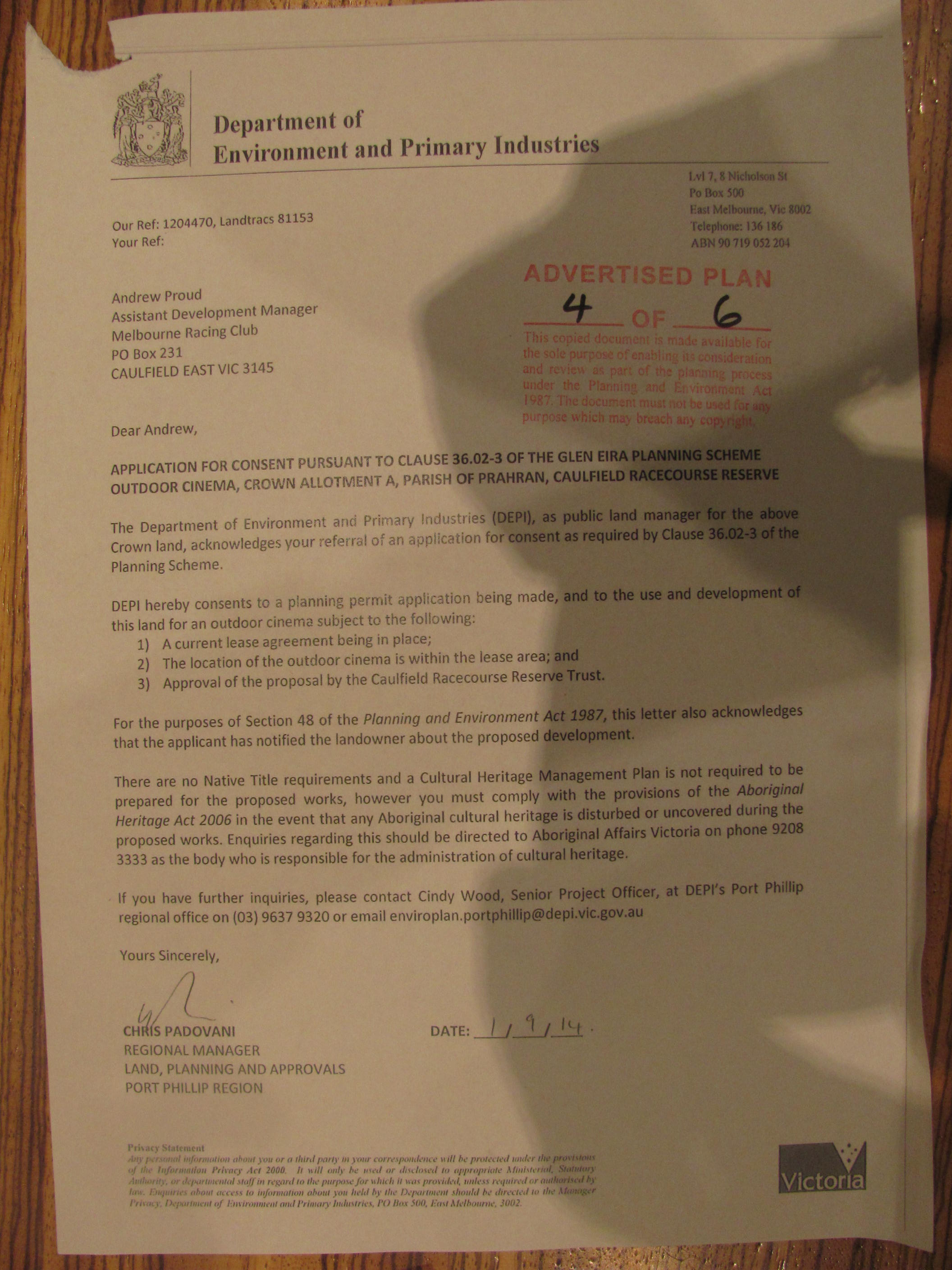
The Melbourne Racing Club has asked Glen Eira Council for permission to run the summer cinema at Caulfield Racecourse.
It would be located between the racecourse administration building and the racetrack and cater for up to 500 people a session.
Consultants have lodged a planning permit application and details include:
— A mobile 7m high by 11m movie screen on the back of a flat deck truck which would be parked in position each screening night;
— Guests to view movies from the lawns between dusk and 1am;
— Parking to be provided in the Guineas carpark;
— Food and beverages to be available to buy and users to bring or buy picnic meals.
The consultants’ report describes the outdoor cinema as a “unique entertainment experience”.
Melbourne has a number of outdoor cinemas, among them the Moonlight cinema at the Royal Botanic Gardens, December — March; and Ben & Jerry’s open air Cinemas at St Kilda’s South Beach Reserve, November-December.
The MRC wants a permit to run its outdoor cinema between November and March, with an option to use the land for an outdoor cinema throughout the year.
MRC spokesman Jake Norton said ticket prices had not yet been decided.
“No. The concept, if the application is successful, would not be rolled out until next summer. Given that timing, as well as the fact that the application has yet to be approved, practical plans around ticketing, event logistics, dates and times, the product itself, content, associated food and beverage offering etc are still some way off,’’ Mr Norton said.
Glen Eira Council granted the MRC a permit for a permanent $3 million super screen at Caulfield Racecourse last year.
That screen displays race day activities including live video feeds, race replays, race day information and sponsor information.
++++++
COMMENT
The following sentences are taken directly from the formal application. We urge readers to carefully note the hyperbole, the spin, and what this could mean for residents. Most importantly, we have to again question what has happened to the so called ‘agreement’ between Council and the MRC and the role of the Minister and the Department in this entire episode. The standout issues as far as we can see are –
Here are the quotes:
Access to and parking at the racecourse is available with minimal impact to the community
The proposed outdoor cinema makes use of an entertainment facility that would otherwise lie idle during the proposed hours of operation.
Melbourne Racing Club is the custodian of a range of land holdings associated with and including the Caulfield Racecourse. The land holdings are a combination of freehold and Crown Land. The site which is the subject of this application is known as 31 Station Street and is contained within Crown Land referred to as Allotment A as Caulfield, Parish of Prahran.
The (Glen Eira) MESS notes at clause 21.01-2 that Caulfield Racecourse and Monash University are facilities of metropolitan significance and both are of major importance to the local economy. Further, Clause 21.02-1 Key influences – Advantages and Opportunities, recognises Caulfield Racecourse as a landmark and regional facility that contributes to the attraction and ‘liveability’ of the municipality.
Clause 21.06-2 identifies the objectives and strategies in relation to Business within the municipality, including:
It is submitted that the proposal will achieve the following key imperatives of the SPPF by:
With the event proposed at the northern end of the subject site, patrons are within walking sitance of the Caulfield Railway Station interchange (with train, tram and bus services available). The Guineas car park which adjoins the proposed event location will also be available to patrons who choose to drive.
…..any overflow parking requirements can be provided by Melbourne Racing Club’s numerous other car parks.
January 12, 2015
In Glen Eira contracts awarded under tender are invariably decided behind closed doors via the in camera provisions of council meetings. Residents are not even always provided with information as to the outcome of these tenders. Not only does Glen Eira not provide any information on WHY and HOW the tenders are awarded, nor why company ‘A’ was successful as opposed to company ‘B’, but the performance criteria themselves are kept secret, the officers involved are secret, and the voting is secret.
We’ve reported previously on how other councils go about their tender decisions. Many publish full accounts of the companies involved; the scores they achieved against the criteria, and the individuals involved. Further, these are published in full in council agendas and minutes. Glen Eira maintains its cloak of secrecy.
This recent tender from Monash council caught our eye for several reasons. Readers should note the following:
We have uploaded the full report HERE
 Glen Eira Debates