GE Governance


Whilst hundreds of thousands of dollars are expended on current legal battles over GESAC, we have to ask how professional, how vigilant, how qualified, and how effective the Pools Steering Committee was in actually overseeing the whole project.

The committee was supposed to meet on a monthly basis. Not until the change in the Local Government Act when ‘assemblies’ had to be reported upon were any minutes tabled at council meetings. The first such set of minutes were dated the 29th September 2010. Since then, only 13 sets of minutes have been made public and several of these monthly meetings appear to have disappeared or simply did not take place. Hardly satisfactory when you are dealing with a $50 to $60 million dollar project. 13 meetings in 2 years on the biggest project ever undertaken is simply astounding. Yet, Lipshutz kept assuring residents how ‘on top’ of things Council was. With the current ongoing legal wrangles we can only raise an eyebrow and ask if being ‘on top’ of things should have involved heaps of more meetings and good management.

Even worse is that the Council designated Senior Project Engineer (Raj Gopalakrishnan) has never been listed as an attendee at these meetings. The supposedly regular attendees should have been – councillors (Lipshutz, Esakoff, Magee); Mark Judge (General Manager, Major Projects); Martin Snell (Major Projects Manager) and council directors such as Peter Waite and Andrew Newton.

Below is the attendance record for all of these published minutes. Hardly a convincing performance we would say, especially from Magee. Of the 13 meetings Magee was absent for 6 and didn’t make it to one site inspection. Snell also covered himself in glory by missing 5, and Judge was a no show on 3 occasions. Hardly surprising we say that Council is now in court and haggling over what went wrong with GESAC.


9th February 2012 – Magee absent

1st December 2011 – all present

3rd November 2011 – Snell absent

5th October 2011 – Snell absent

8th September 2011 – all present

8th August 2011 – Magee absent

7th July 2011 – Magee, Newton, Waite all absent

2nd June 2011 – Waite absent

24th March 2011 – “Magee did not attend site inspection”

25th January 2011 – Magee, Judge, Snell absent

20th December 2010 – Magee, Judge absent

27th October 2010 – Newton, Judge, Snell absent

29th September 2010 – Magee, Snell absent


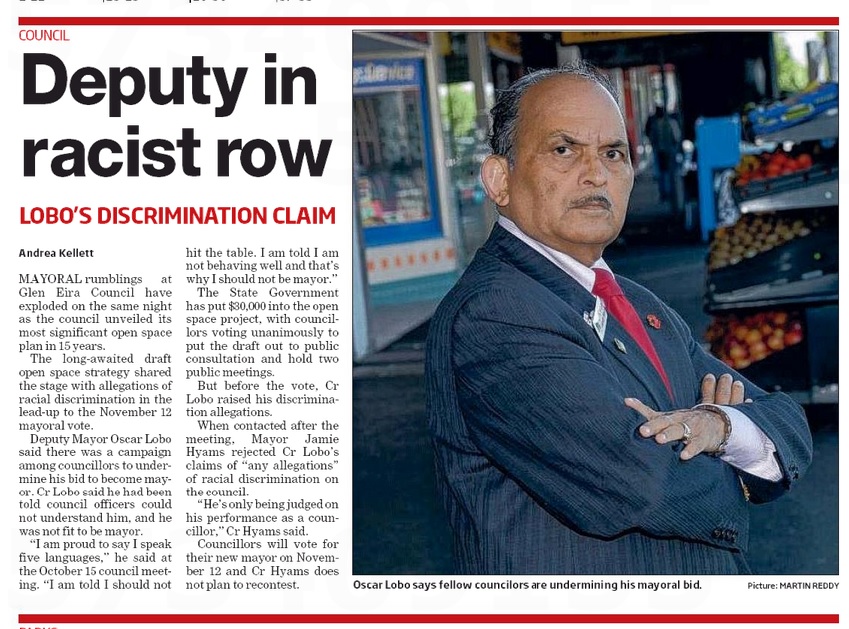
leader

Several crucial facts have not been included in this Leader article.

  • Lobo’s outburst had nothing to do with the Open Space Strategy but everything to do with the Community Consultation Committee and its nomination of 4 community reps. Readers should note that Delahunty is chair of this committee and it includes Hyams, Lobo and Esakoff as the other councillors.
  • Lobo was the only councillor to vote against the recommendation to accept the nominees. He questioned the process and the decision saying that councillors should be exercising their ‘conscience’ and ‘loyalty to residents’.
  • Lobo claimed that since the committee’s formation in 2009 there was no process involved which ‘showed transparency and democracy’ since ‘there’s nothing in writing’.
  • Lobo wanted the report to go ‘back to the drawing board’.
  • Council re-advertised its call for community reps following the applications by 4 residents. The spin was that council wanted a ‘broader’ representation.  Esakoff moved the motion to accept, claiming that these 4 new people were ‘most appropriate’ and represented a ‘broad spectrum’.
  • Lobo also revealed that one of the arguments for not appointing an individual from the first round of applications was that he would be using the committee for ‘election purposes’ in 2016!!!!!! We assume this was a reference to Newton Gatoff.
  • Without pre-judging the performance of these 4 new community reps we have to ask: were they ‘requested’ to apply and if so, by whom? Were the original group of applicants rejected because they were perceived to be knowledgeable on council affairs and would question too much?

It is just on a year since there were council elections. Time for a ‘performance appraisal’! Below is a record of the voting patterns of councillors for the most important issues that have come up in the last year – minus the Notice of Motion, public questions, 2nd round of Tree register etc. which we’ve commented on recently. We welcome readers’ assessments – keeping in mind the election promises of each of these individuals. Please note that we have not included all the numerous items which resulted in ‘unanimous’ decisions – some of which were extremely important – ie selling off land to the MRC for a pittance; blithely accepting Amendments, financial reports, service reports, and so on.


ISSUE

VOTING FOR

VOTING AGAINST

HYAMS as Mayor Eskoff, Hyams, Lipshutz, Lobo, Okotel Pilling, Magee, Delahunty, Sounness


12 Storey – Dandenong Rd Esakoff alternate motion 8 storeys, 97 dwellings


Esakoff, Delahunty, Okotel, Hyams (used casting vote) Lipshutz, Magee, Sounness, Pilling
7-9 Hawthorn Road, Caulfield North Emmy Monash – Lipshutz motion of reduced setback – conflict of interest claims


Lipshutz, Esakoff, Hyams, Lobo, Okotel (pilling absent) Delahunty, Magee, Sounness
Armadale club (extension of liquor area/drinking)


Lipshutz, Esakoff, Hyams, Okotel, Magee, Sounness Delahunty, Lobo
STORM WATER HARVESTING – BOYD Park – ‘minimal’ and return money to government


Okotel, Esakoff, Hyams, Lobo, Lipshutz Magee, Sounness, Delahunty
GESAC extra car parking – Gardener’s Rd Okotel, Lipshutz, hyams, Eskoff, ,agee, Lobo, Delahunty


Sounness
8 storeys, Glen Huntly rd. Lipshutz moved amendment for 6 storeys


Lipshutz, Hyams, Esakoff, Pilling, Sounness, Okotel Lobo, Magee, Delahunty
4 storeys Glen Huntly Rd. Lobo moved to refuse. Defeated. New motion for 3 storeys by Pilling and seconded by Lipshutz


Lipshutz, Pilling, Magee, Hyams, Esakoff, Sounness, Okotel, Lobo, Delahunty
James St – 3 storey. Esakoff Pilling moved to reduce by one unit to 8


Esakoff, Pilling, Hyams, Sounness, Okotel, Lipshutz Delahunty, Lobo, magee
First go at tree register –  only local law


Pilling, Delahunty, Sounness, Lobo, magee, Hyams Okotel, Esakoff, Lipshutz
Accepting petition on  Councillor Trustee appointments Lobo, Delahunty, Magee Lipshutz, Hyams,Pilling,Esakoff, Sounness, Okotel
Centenary Park car park and redevelopment (first round) Delahunty, Hyams, Lipshutz, Esakoff, Magee, Lobo,Okotel


Pilling, Sounness


Readers may remember that at the second last council meeting Cr Delahunty was not satisfied with an answer to a public question and asked that the question be responded to adequately either directly to the resident or via herself.   From the resident’s latest public question, it is clear that in the space of three weeks no further communication had been entered into! Below is the question and council’s ‘new’ response. Please note the implications of what is being stated, namely:

  • Glen Eira Council’s policies and/or strategies are indeed ‘flexible’ beasts, able to be changed, altered, ignored, or simply not adhered to whenever suits
  • The above may occur without full council approval
  • Decision makers on what will change and when, is left strictly in the hands of those ‘faceless’ and unaccountable administrators

Here’s the question and the response:

“The response given to my public question (24 Sep 2013), apart from being demonstrably wrong on most points, was not relevant to my question, so I am resubmitting in the hope of getting accurate information from either Councillor Delahunty (who said at the last meeting she would make inquiries), other councillors, or the administration. Earlier this year, after rows of exotic trees were planted in Marara Road Reserve, which is designated for native plantings, the council explained that the 1988 written strategy had been superseded.

1. If the 1998 strategy is superseded then where is this decision recorded, and

2. who made the decision, and

3. why was the strategy superseded, and

4. when was the strategy superseded?”

The Mayor read Council’s response. He said:

“I refer you to the answer given to your Public Question at the 24 September 2013 Council Meeting and add the following:

The 1998 Open Space Strategy has provided Council with a strategic framework to guide its approach to open space. Council has been able to implement many of its recommendations. The strategy has not been superseded.

From time to time changes and developments happen or issues come to light that create the need to change, modify or amend a specific part of a wider guiding strategy. This happened in the case of the specific matter you refer to.

The reasons for recently planting exotics in the reserve are outlined in response to your 24 September 2013 Public Question.”

No further utterance from any councillor when this was read out. We can only assume that silence is consent and that appropriate governance does not concern those sitting in chamber!

A long, but important post on the Tree Register saga, so apologies. The following should be borne in mind:

  • At least ten years in the making and still no satisfactory resolution
  • Residents and councillors are totally excluded from the processes that are about to be implemented. Thus full control and decision making power resides exclusively with unnamed and unaccountable officers.
  • The suggested Tree Register has slowly morphed into only applying to private property when its original intention was to include both public and private land as enunciated in the Community Plan. Of course, no public consultation has occurred to validate this surreptitious ‘transition’.
  • Glen Eira has a Street Tree Policy, which is primarily concerned with what to plant and where.
  • Glen Eira does not have a Tree Maintenance Policy – only a Tree Removal Policy
  • Glen Eira does not have any policy whatsoever that can assure residents that trees are not the victims of greedy developers or poor maintenance.

All of the above coalesce in the again UNNAMED OFFICER’S REPORT for Tuesday. The report is largely a verbatim repetition of the document that appeared in February 2013. This time however, pretending to be ‘seeking guidance’ by proffering 4 totally skewed and misleading ‘arguments’. All are heavily weighted to achieve only one outcome – that which has already been pre-determined. We will go through each one of these spurious arguments by quoting directly from the officer’s report and then commenting.

Given around 1,200 planning applications per year, many being for residential development, it is estimated that over 200 valued existing trees are protected each year. Removal of a tree contrary to a planning permit is a breach of the Planning and Environment Act which can attract court penalties far in excess of any breach of a local law. Penalties of between $5,000 to $20,000 are relatively common.

COMMENT

Here’s some terrific bluff and bluster but what this doesn’t tell us is:

  • What protection is there against any owner who decides to CUT DOWN a tree on his property not at a subsequent planning application stage, but at the perhaps initial SUBDIVISION stage?
  • What happens if the property is landbanked for years and years, no application goes in, and then suddenly a tree is gone? Or what if one year and one day after an application has gone in, the tree is removed?
  • How many prosecutions has council actually followed through on?
  • How many fines have been issued (and paid) in the last ten years?
  • How many ‘valued’ trees  on public or private land have been added in the past ten years?
  • How many trees have been removed from public parks and streets WITHOUT a full arborist’s report?
  • How many healthy trees have been planted on streets and then removed within months in order to aid and abet the installation of a carriageway in a new development?
  • What if any notice is provided to residents about the intended removal of park and street trees – especially when this is done en masse?

The ResCode mechanism is that any tree removed within 12 months of a town planning application being lodged must be assessed as though the “removed” tree is still in place. This has proven to be somewhat of a defacto tree retention control because it has effectively removed any advantage a developer could gain from moonscaping. This means that any town planning application for medium density dwellings needs to consider existing trees/vegetation.

COMMENT

We love the first sentence for its sheer inanity! The TREE IS GONE – end of story! For a developer the risk of being prosecuted by a pro development council is minimal. Secondly, even if there was some action taken, the advantage of being able to squeeze another unit, worth maybe $400000 – $500000 onto a property compared with a paltry fine of even $20,000 is a total no brainer!

We repeat our message from an earlier post that included photograph after photograph of moonscaped properties – bereft of any vegetation including trees. Only one property still retained a palm tree in the corner of the site. All other developments resembled the Sahara Desert. And yet council has the gall to claim that it is successful in preventing rampant moonscaping!

The problem is that the Planning Scheme is designed to regulate matters which are unlikely to change over the short to medium term (eg buildings) whereas trees grow, become senescent, may become hazardous and die. Over time, the Planning Scheme will include trees which need, for safety reasons, to be removed. To reflect that in the Scheme would require a full Planning Scheme Amendment process in each case which would be cumbersome.

COMMENT

Never, but never put anything into a Planning Scheme because that becomes far too binding and gives residents the legal potential to object to council decisions. Via a Local Law, which provides no leeway for resident objections, this little obstacle is overcome!

So, after much manoeuvring we’re left with the obvious solution – proposal D which reads –

A Local Law but only over Classified Trees

This option also uses a Local Law which covers only those trees which the Council has included on a Classified Tree Register. The Register would include those trees which the Council had assessed and considered were important to protect. The owner would have the opportunity to challenge whether the tree would be included in the Register or not. Once included, a permit would be required to lop or remove the tree.

COMMENT

This represents the heart of the issue. It is officers only who will decide on what is ‘valuable’. No outside interference from residents or councillors permitted. No ‘suggestions’ for trees on public land. No objection rights for resident neighbours – only developers. Residents won’t even know when a tree will be gone. The chain saws will come out one morning and poof – gone with the wind! No notice, no explanation, no objection rights, and only profit for the developer.

Given this current state of affairs it is worth pointing out the radically different approach taken by countless other councils. Some have vegetation overlays in their planning schemes; some have opted to  include the requirement for a permit within these planning schemes. Those that have the need for permits only as part of a Local Law at least request residents to nominate trees on both public and private land and residents are given full notification and objection rights if a decision is made to cut down a tree. Many make their policies and laws applicable not only to a tree register which might consist of only 100 to 200 trees, but to any tree earmarked for removal. Here are some examples:

http://www.portphillip.vic.gov.au/tree_protection.htm

http://www.boroondara.vic.gov.au/our-city/trees/significant-treeshttp://www.kingston.vic.gov.au/Planning-and-Building/Significant-Tree-Register

http://www.bayside.vic.gov.au/environment_trees.htm

http://www.frankston.vic.gov.au/Environment/Trees/Register_of_Significant_Trees_on_Public_Land/index.aspx

http://www.yarracity.vic.gov.au/environment/trees/significant-tree-register/http://www.darebin.vic.gov.au/Files/Item_8.4_Appendix_A_-_Report_to_Council_on_17_September_2012.pdf

http://www.banyule.vic.gov.au/Council/Environment-and-Sustainabilty/Trees-and-Plants/Significant-Tree-Register

http://www.greaterdandenong.com/document/23514/trees

http://www.melbourne.vic.gov.au/Sustainability/UrbanForest/ExceptionalTrees/Pages/AssessmentInfo.aspx

http://www.mvcc.vic.gov.au/planning-and-building/long-term-planning-in-moonee-valley/significant-trees.aspx)

THE PROPOSED LOCAL LAW

We make the following observations on the draft Local Law:

  • The appeal process consists of officers and ‘independent’ arborists. No councillors of course and no need for a council resolution or public documentation to support any decision making. All is to be left in the ‘capable’ hands of administrators. There is not even the requirement that results of such appeals be placed in the public domain, or that any documentation sees the light of day. Again in stark contrast to what happens at other councils such as Bayside.

Last but definitely not least, we remind readers of the previously stated opinions of Lipshutz, and Esakoff. Okotel also voted against having a Tree Register in February. We will now see whether consistency is their strong point, since the circumstances have not changed and the anti arguments certainly have not changed. Maybe they will cut their losses and think that a minimalist Tree Register of only 50 or so trees, or even 100 trees is better than letting the public in on anything. So the question is: Will they become turncoats and vote for a register, or will they introduce some nice little pre-orchestrated amendment? Here’s what they said way back in February (from our post of the time) –

ESAKOFF: didn’t support ‘tree protection’ and that people in general ‘do appreciate the value of trees’ and that people don’t remove trees ‘without good reason’ ( such as property damage, or dangerous). Thought that people ‘should have the right of choice’ over their own property and shouldn’t have to pay to get a permit to prune, or ‘being forced’ to hire an arborist to ‘report on whether they should be allowed to prune’. Accepted that there are a ‘range of views’ and that some people would feel that ‘they are over-governed’ and to introduce a tree register ‘will only cement that view’. Existing mechanisms include town planning, so that if there is a significant tree then town planning conditions are ‘put in place to protect them’. There are also ‘large penalties’ for ‘breach of those conditions’. Other safeguards are landscape plans, 4 metre setbacks and open space requirements which means that more trees can be planted. ‘There are enough hoops to jump through’ without adding to them.

LIPSHUTZ: said this has been up to council a ‘number of times’ and council has changed its mind a few times. Doesn’t support a tree register for the reasons basically outlined by Esakoff. Said that his worry is that ‘I don’t trust the arborist’…’I don’t trust the people who make the heritage decisions’. He sees heritage advisors saying it’s heritage but ‘I see nothing heritage about it’….’it’s in the eyes of the beholder’ since there’s ‘no scientific way of saying this is heritage or this is a significant tree’. Said that laws exist. Reflected on his personal trees but ‘over the last 20 years’ they’ve gone because they were ‘ordinary specimens and they’ve been replaced’, Now he’s got ‘nicer’ and ‘better trees’….It was my choice to do that’. Doesn’t want people telling him ‘this is the way to do it’. Local laws committee has ‘investigated’ this and ‘gone a fair way down the track’. In the end it’s about ‘making a decision on your tree’. Didn’t believe it’s ‘our’ role to ‘implement this law which infringes on our rights’.

OKOTEL: talked about the expense of this and trees on private property that can’t be removed. There will be ‘ongoing costs…..increased red tape’ and ‘continuous discussion’ about what is or is not a significant tree. She thought that residents ‘are more than sensible enough to know’ what’s a good tree and ‘what’s appropriate to maintain’ and ‘to make those decisions for themselves’.
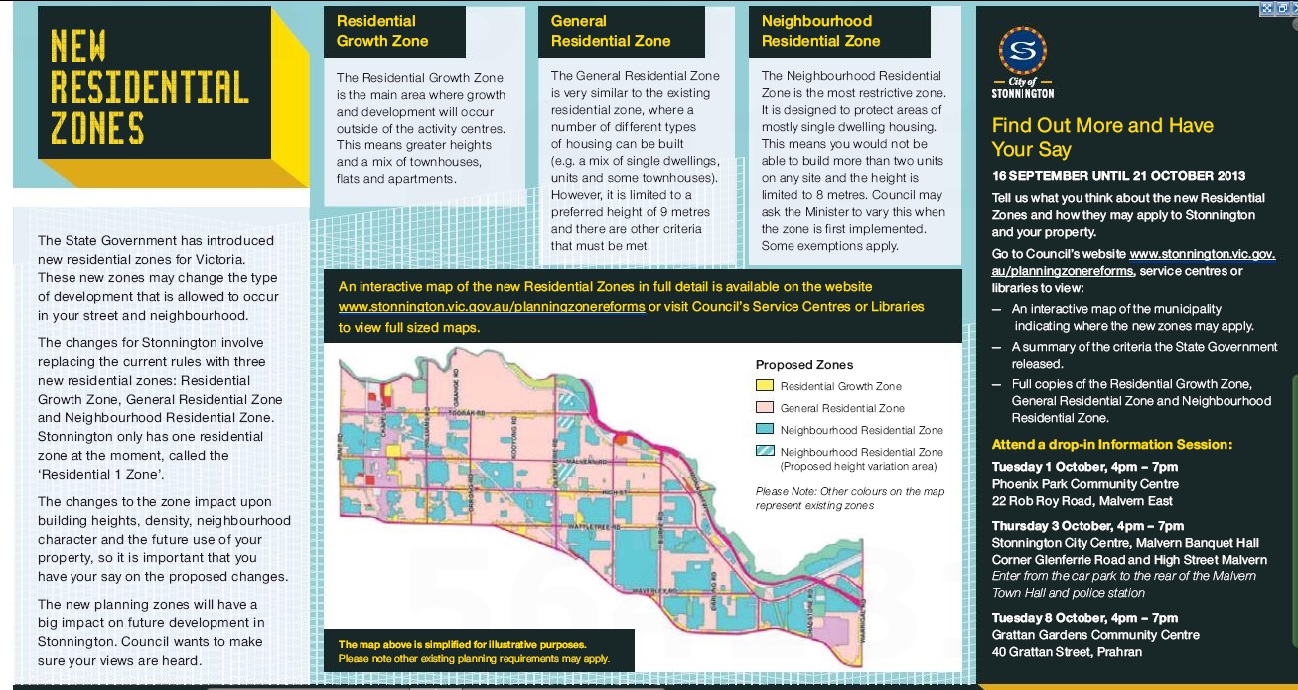
The secrecy, lack of information dissemination, and complete stuff ups continue unabated in Glen Eira City Council. We have learnt that there is now a new, gazetted amendment (c112) for the schedules to the new residential zones. Of course, there is nothing on council’s website and the department’s website gives no information as of Friday 11th October. However, the amendment was gazetted on October 3rd and came into operation on that day.

We do know that once again it is the Minister who is the ‘responsible authority’ and that the amendment is only ‘transitional’ – whatever that might mean! Yet it raises questions galore:

  • Why should there be another amendment just 9 days after the gazetting of Amendment c110? What stuff ups have there been – both on the part of council and the department and Minister? But, being generous, perhaps these new schedules represent a modicum of ‘improvement’? Is so, then why wasn’t this thought of before the zones were rushed through with such indecent haste?
  • When was council thinking of telling the public anything? or given recent history, was this a forlorn hope to begin with?
  • What does this whole continuing saga tell us about planning in Glen Eira? When will adhoc, piecemeal strategic planning be weeded out? When will professional competence be a top priority?
  • Since this is now labelled amendment c112, there are many more surprises in store for residents given the gap between c101 and c112.

Here is the gazetted announcement. Make of it what you will!

Planning and Environment Act 1987

GLEN EIRA PLANNING SCHEME

Notice of Approval of Amendment

Amendment C112

The Minister for Planning has approved Amendment C112 to the Glen Eira Planning Scheme.

The Amendment comes into operation on the date this notice is published in the Government Gazette.

The Amendment introduces transitional provisions to Schedules 1, 2 and 3 to the General Residential Zone and Schedule 1 to the Residential Growth Zone.

A copy of the Amendment can be inspected, free of charge, at the Department of Transport, Planning and Local Infrastructure website at http://www.dpcd.vic.gov.au/planning/publicinspection and free of charge, during office hours, at the offices of the City of Glen Eira, Corner Glen Eira Road and Hawthorn Road, Caulfield.

JOHN PHILLIPSDirectorPlanning and Building SystemsDepartment of Transport, Planning and Local Infrastructure

PS: The mystery is solved! After much hunting and detective work we’ve located the text of the illusive Amendment. It does not ‘improve’ one single thing except to state that if a developer applies for an extension to his permit then the current schedules do not apply. Given council’s penchant for granting time extensions willy nilly, and of course not keeping any meaningful records of such extensions, then all continues to favour the applicant. Landbanking can still continue unabated it would seem. This latest Amendment in no way exonerates anyone from the accusation of sloppy and shoddy work. One would think that when something as important as the residential zones are concerned every single word would have been gone over with a fine tooth comb and gaps filled in. It should not take another Amendment 9 days later to correct what wasn’t there in the first place.

Here’s the wording: Schedule 2 to clause 32.08 to the General Residential Zone does not apply to an application
to construct a dwelling or residential building made before the approval date of the planning scheme amendment that introduced this schedule into the planning scheme. The requirements of clause 54 as they apply to clause 54.03-2 or of clause 55 as they to clause 55.03-2 as in force immediately before the said approved date continue to apply.
Despite the provisions of Schedule 2 to Clause 32.08, these do not apply to an application under section 69 of the Act to extend a permit to construct or extend a development.

PS: More grist to the mill comes from Whitehorse City Council on the residential zones. In the extract below this council makes it absolutely clear why CURRENT ANALYSIS is required in order to obtain maximum benefit from the new zones. They are currently undertaking full community consultation on: Housing and Neighborhood Review; Drafting new Urban Design Guidelines and reviewing the Whitehorse Housing Study. Only then, will they embark on shaping the residential zones. We repeat – when is the last time that Glen Eira undertook any analysis, any genuine consultation? Here’s what Whitehorse has to say. The full explanation is available at: http://www.whitehorse.vic.gov.au/hanc.review.html

Why do we need the Whitehorse Housing and Neighbourhood Character Review 2013?

Council currently has two main studies that guide decisions on housing development:

  • The Whitehorse Neighbourhood Character Study 2003
  • The Whitehorse Housing Study 2003

Both documents were prepared some time ago, and there have been changes both in terms of the housing development which taken place since the studies were prepared, and the needs of the residential community into the future.

Council faces changes in its future housing demand, with a trend towards smaller household sizes, a more diverse mix of household compositions and backgrounds, and an ageing population. The number of households to be accommodated is expected to grow.

The review seeks to ensure that Whitehorse can cater for these changing needs, while still ensuring the City’s preferred future neighbourhood character can be maintained and enhanced. It is also important that the new strategies and corresponding controls (including designating substantial, incremental and minimal change areas) reflect changes that have occurred over the past 10 years and provide opportunities to meet the future needs of Whitehorse residents.

There have also been a number of developments within some of Whitehorse’s smaller shopping centres, referred to as Neighbourhood Activity Centres. To provide greater direction in determining the form of development which may be suitable for these locations, draft Urban Design Guidelines have been prepared for most centres

+++++++++++++++++++++++++


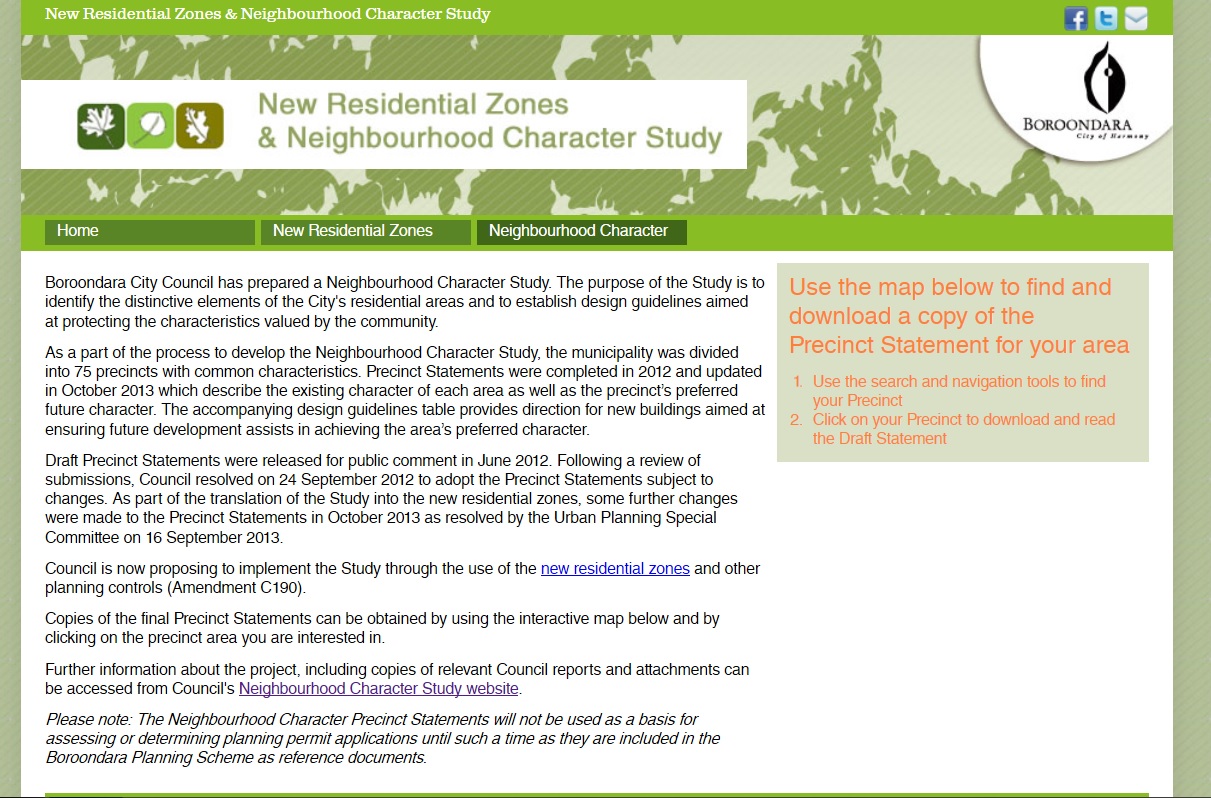
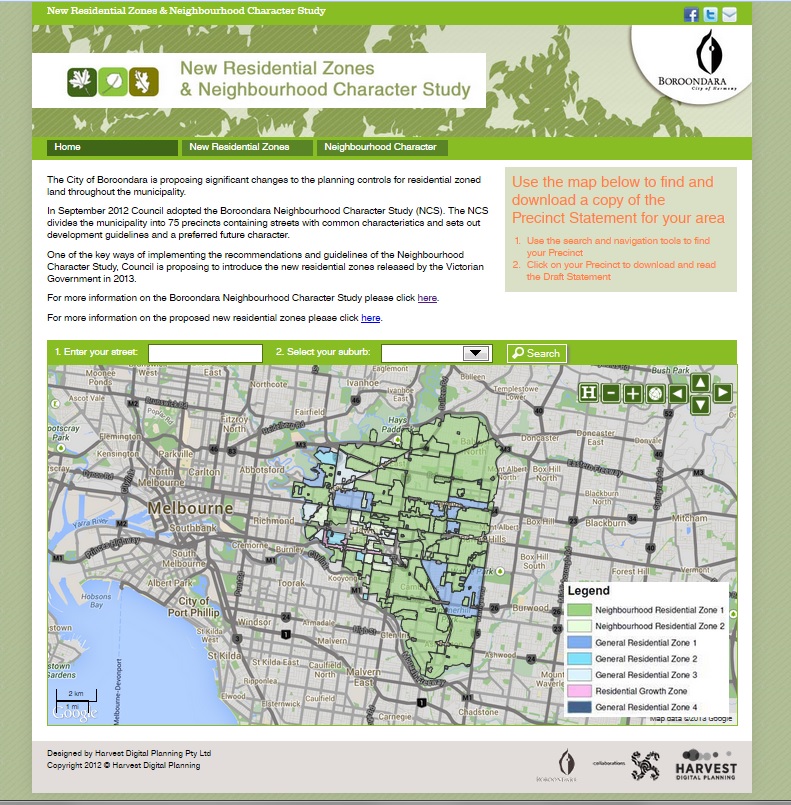
The contrast between Glen Eira Council’s secrecy, lack of up-to-date planning, and total disregard for residents is becoming more and more evident when compared to what lengths other councils are going to in order to both INFORM and CONSULT with their residents on the residential zones. Below we feature two screen dumps from the Boroondara Council’s website on the issue. Please note that their draft document is:

  • Going out to full consultation
  • Is based on years of local analysis (Neighbourhood Character Study) and research where their municipality was divided up into 75 individual precincts. The document was only finalised as recently as this month. When did Glen Eira last perform such a study that covered the entire municipality?
  • The expense and technological wizardry that Boroondara has gone to should be applauded. Residents are able to use the ‘interactive’ maps to locate their homes and immediately see the proposed zoning, and the statements on ‘preferred character’ for that area, as well as the related schedules. Glen Eira in all its documents has no ‘preferred character’ statements for ANY of their zones – that would only handicap future development if actually expressed in black and white.
  • We’ve already noted the schedules and how vastly different they are to the Glen Eira ones in an earlier post.

The Boroondara effort can be viewed in detail at: http://www.boroondara.characterstudy.com.au/

boroondara

boroondara2

The Local Government Act requires that if a council intends to advertise its CEO position then that must be done 6 months prior to the termination of the current CEO’s contract. Newton’s contract expires in early April 2014. As far as we know, council has not placed another miniscule advertisement in The Age, nor have they made any public announcement on their website. We can only conclude, since the 6 month deadline has passed, that once again this group of councillors have decided to renew Newton’s contract without advertising his position. What we don’t know is whether they have handed Newton another 2, 3, or the maximum 5 year contract.

That will make it contract after contract that has never been advertised; contract after contract where we, the salary paying public, have no idea of Key Performance Indicators, no idea of the voting figures, and no idea of how Newton measures up against any standards. All we ever get is the party line that he is doing a good job so why look elsewhere. The simple answer to this is: how do you know that someone else might not do a better job if you don’t even bother to look and test the waters? In our view, no position anywhere should be for life. More importantly, best practice dictates that there is a ‘time limit’ for CEO’s in any major organisation. Newton has been there since 199/2000. During this time his rule has been mired with controversy after controversy; legal threats; and let’s not forget the sacking of council. We know of no other council that has had to endure 3 formal Municipal Inspector Investigations, and heaven knows, how many ombudsman official and ‘unofficial’ investigations. Coincidence? Perhaps, but possibly also a reflection on the one constant throughout this entire time – Newton.

More importantly from residents’ points of view, under his stewardship, every vestige of real transparency and accountability has been eroded and reduced to nothing – secrecy and a culture of ‘we are right’ over-rides every facet of good governance. Oh, we acknowledge the puerile argument that officers do not vote and that it is councillors who make resolutions. However, what pressures are brought to bear? What tainted information is provided upon which to base such decisions? And why on why are certain councillors continually voting en bloc for the vast majority of Newton’s anti community recommendations?

Several years ago, 586 residents signed a petition requesting that councillors advertise the CEO position in order simply to ‘test the waters’ and see who else is available. We remind readers that Esakoff, Hyams and Lipshutz voted against the acceptance of such a petition – a first, we believe in Glen Eira – and hence emblematic of the undemocratic culture that now rules Glen Eira Council.

According to today’s Leader article, the Alma Club site development is now ‘settled’ when resident objectors agreed to new amended plans put in by Monark Pty Ltd. The upshot is that instead of 75 units, there will now be 69, and one townhouse has been ‘downgraded’ to 2 storeys. The other ‘win’ is that instead of the original intention of 4 visitor parking spots, there will now be a ‘generous’ 10 spots (Even under the abysmal ResCode standards, the number should be a minimum of 14).

‘Mediation’ in this instance is far from an appropriate term when one considers:

  • The huge financial pockets of Monark as opposed to residents
  • The potential costs of a 3 or 4 day hearing at VCAT when residents would feel obliged to hire their own barristers, planners, urban designers etc. The costs involved are prohibitive for any group of residents faced with opposing a Goliath such as Monark.
  • The real failure of council to support residents via its planning scheme and the absolute, total, failure to introduce schedules into the new residential zones which would not allow something like this to ever happen again.

How far removed this council is from residents and how little thought and effort has gone into ensuring the protection of residents’ amenity, is encapsulated by the alleged remarks of Hyams. The Leader article reports him as stating: We’re pleased that the parties have worked together to achieve an outcome that’s satisfactory to everyone’.  When a financial gun is held to your head that’s not our idea of a ‘satisfactory’ outcome! One of the objectors in fact retorts with this alleged comment: It (the outcome) gives some benefit to the neighbouring residents but it’s still not an ideal solution for the site’.

We remind readers that:

  • Council had the opportunity to purchase this site in an area deficient in open space for the bargain basement cost of $3 million. The decision not to purchase never went to a council meeting, and was not noted as being discussed in assemblies. Someone, other than the full crop of councillors made this decision. So much for good governance and transparency.
  • There is nothing in the old planning scheme or the new residential zones which will prevent a repeat of such events. Glen Eira has kept its options open when it comes to the size of lots, even if they happen to be in minimal change.
  • We also do not accept for one moment council’s claim that it was the Minister for Planning who ‘decided’ unilaterally and arbitrarily to remove the minimal change zoning from this land. Given all the huge developments that Guy has not interfered with, it is inconceivable we believe that he would involve himself in something so paltry as a 7000sq metre piece of land – unless he was consistently urged to do so!

Any resident who believes that this council has done its utmost to protect our suburbs is living in a fool’s paradise. The best, and most recent example of this comes with a comparison to the Kingston draft residential zones where they have included 10 specific schedules into their Neighbourhood Residential 1 Zones – following months of consultation of course!. Glen Eira could only manage 2 with no limitation on subdivisions or the number of dwellings that could then be erected. Kingston’s objectives are to negate this cramming of countless units onto a single block of land. Here are their schedules on this. Without such limitations, the Alma Club scenario can, and will be repeated countless times in the very near future. Any block of sizeable land under this regime represents an open invitation to developers.

Here’s what Kingston have done:

“Rather than rely on the default of two dwellings per allotment a series of schedules be developed which provide for the following outcome:

Schedule No.

Lot size

 No. of Dwellings

1

Under 500m2 and/or recently developed greenfield areas

1

2

500m2 – 899m2

2

3

900m2 – 1199m2

3

4

1200m2 -1499m2

4

5

1500m2 – 1799m2

5

6

1800m2 – 2099m2

6

7

2100m2 – 2399m2

7

8

2400m2 – 2699m2

8

9

2700m2 – 2999m2

9

10

3000m2 or above

10

But Kingston don’t stop there. There is also a nice little dig at Glen Eira –

The approach taken by the City of Glen Eira in its approved Amendment is to first rely on a subdivision application of larger lots in the Neighbourhood Residential Zone and then additional development application(s). Such a City of Kingston approach is considered time consuming and costly for the land owner(s). Further by needing to instigate a subdivision application first, it is likely to create an increased potential number of disputes between neighbours due to the lack of clarity about the eventual development outcome and as a consequence create additional constraints on resources and discontent with planning processes.

The approach recommended for Kingston will allow Council through its strategic planning to have a much clearly understanding of ‘development capacity’ across its areas zoned Neighbourhood Residential.

In our view, it is precisely this lack of ‘clarity’ which is the desired objective of Glen Eira Council. Like everything else, when nothing is set in concrete, then all is permitted. When the policy is to evaluate on a ‘case by case’ basis, then chaos and inept planning is the inevitable outcome.

Finally, to return to our erstwhile Mayor, we remind readers that on one of his pre-election promises there was this noble sentiment – Take advantage of the new government planning zones to achieve maximum protection from overdevelopment for our neighbourhoods.

Need we say any more?

PS: WE NEGLECTED TO MENTION THE FOLLOWING KINGSTON INITIATIVES THAT LEAVE GLEN EIRA FOR DEAD –

  • Glen Eira has 25% permeability quota, but only for its equivalent to minimal change. Kingston has decided that 40% is required and not just in its minimal change areas but also for its Growth Zones. In these latter zones there is the stipulation of 30% permeability requirement for each of its 3 Residential Growth Zones
  • Also incorporated into this amendment is the Open Space Levy of 5% across the board and 8% for businesses. Glen Eira is still stuck on 0.25% for some areas. Even if the new Open Space Levy is recommended, it will take another amendment to make this law. That could be years down the track as Hyams likes to tell people. In the meantime developers will continue to get away with paying nothing or a mere pittance.
  • And last but not least there is this commitment from Kingston which is unheard of in Glen Eira –Although the Advisory Note indicates that Councils with existing Local Planning Policies could immediately begin a Planning Scheme Amendment and potentially seek the Minister for Planning’s consent to exempt public notice, this approach has not been followed by Council. The Council has chosen to ensure that community feedback on how the reforms are best implemented in Kingston is sought. The Planning Scheme Amendment is also to include community consultation.

    As a consequence of the consultation period which ran from the 17 June – 26 July 2013, a total of 153 submissions were received. A detailed briefing on the submissions was provided to Councillors on the 5 August 2013 and copies of all submissions have been made available to Councillors.

    Council has maintained the view that it is important that this initiative is broadly promoted across the Kingston Community and opportunities for the community to participate in firstly understanding the reforms (Stage 1) and secondly commenting on the Planning Scheme Amendment which introduces the reforms is provided (Stage 2).

stonnington

« Previous PageNext Page »