
Let Council know what you think of this by attending their zoom session tonight at 6.30pm. The link is: https://www.haveyoursaygleneira.com.au/GlenHuntly
July 15, 2020
Let Council know what you think of this by attending their zoom session tonight at 6.30pm. The link is: https://www.haveyoursaygleneira.com.au/GlenHuntly
July 3, 2020
With each step in this process it is becoming clearer and clearer that the Virginia Estate project is Council’s gift to the developers with very little consideration to local residents and the wider community.
Admittedly the Panel report largely supports everything that the developers wanted. This however does not obviate councillors’ responsibility to their constituents in fighting tooth and nail for a far more equitable outcome. The officer’s recommendations fail to do so and we certainly have little confidence that these 9 councillors will have the gumption to oppose the final recommendations!
Here’s a brief summary of council’s proposed concessions:
There are a myriad of questions that residents should be asking of their councillors, namely:
As stated previously, we do not expect that our very compliant councillors will reject the officer’s recommendations. We will undoubtedly get more scape goating about government, about population growth, about ‘consensus’, whilst the missing ingredient in all of this discussion will be the tremendous impact on East Bentleigh residents and the municipality as a whole.
June 28, 2020
In another jam packed agenda for Tuesday night, the council tradition of ignoring resident views continues. Here is a brief overview of the important items.
THE BUDGET & SRP
Given the number of submissions put forward by residents on the budget and the Strategic Resource Plan (SRP) it is unbelievable that the budget does not include one single word in response to these submissions. The only acknowledgement of what residents said comes in the SRP in a paragraph that typically says nothing. We quote:
While there were three formal submissions received for the Strategic Resource Plan 2020-2021 to 2029-2030, twenty submissions received for the 2020-21 Draft Annual Budget also made reference to a number of matters in the Strategic Resource Plan. These included level of proposed borrowings and strategic projects contained within the long term capital works program. No formal submissions were received for the Draft Community Plan Commitments 2020-2021.
Once again we have a council that refuses to alter any aspect of its budget in response to resident feedback. Several submitters urged council to increase its allocated spending given the declaration of a climate emergency. Totally ignored! But this has not stopped council from:
When residents have taken the time and trouble to sift through volumes of pages and figures, the least any council should be prepared to do is respond directly to these comments and provide solid justification as to why the suggestions have been ignored, adapted, or even incorporated into the final budget! In Glen Eira, there is no such thing as changing what has already been determined as a result of community feedback. The legal requirements are met and that is it!
CARNEGIE POOL DESIGN
Despite the fact that the vast majority of feedback on the initial concept designs repeatedly stated that a de facto GESAC was not wanted, Council has again ignored these views. The ‘promise’ is that the size presented in the plans: Remains within the footprint, size and structure as the existing pool
We certainly query the veracity of this statement as depicted in the following images. How on earth council can claim that the ‘footprint’ will be identical to what currently exists is simply mind boggling when the following is compared:
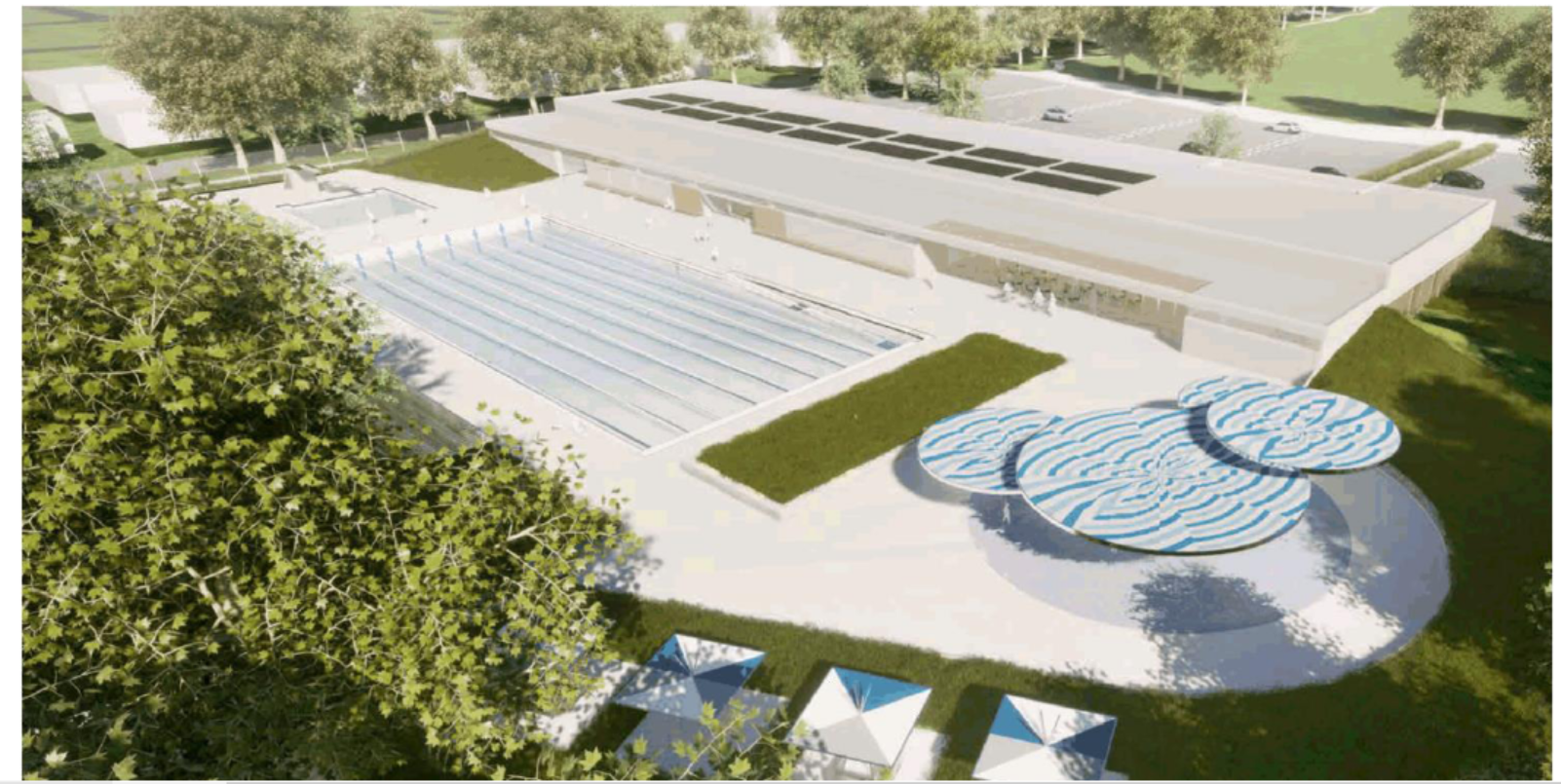
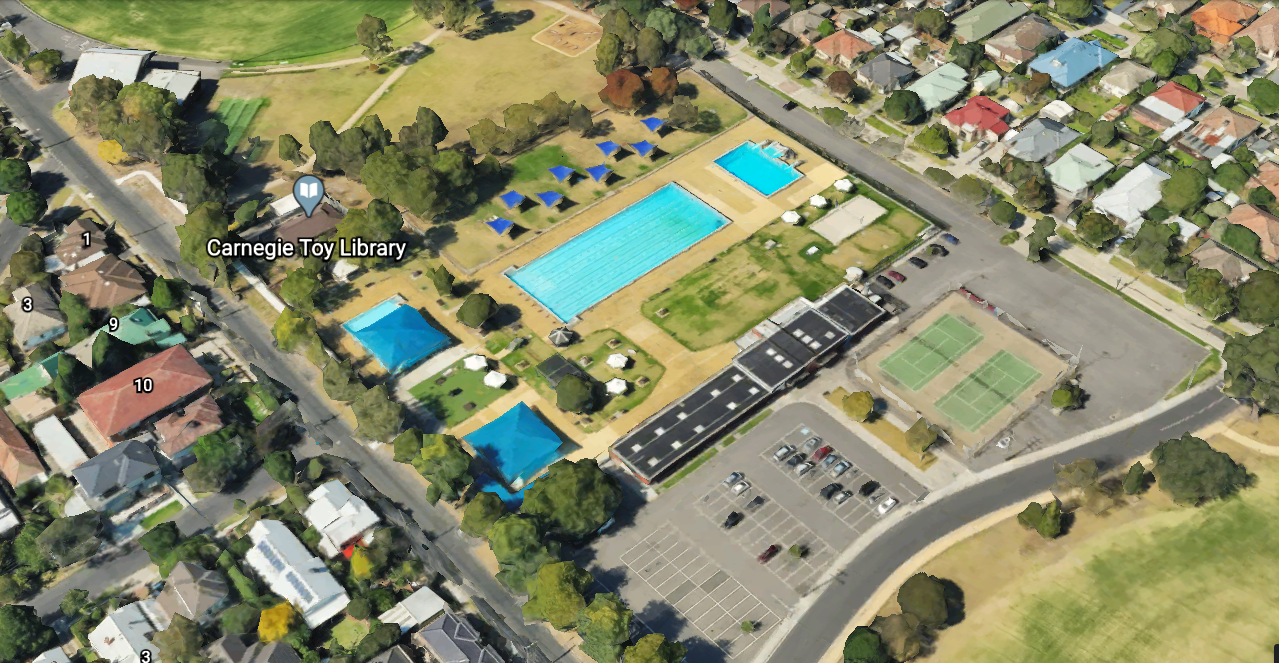
There are many other questionable statements. For example:
In terms of a Business Case we find this comment: The findings of this review will be presented in full to Councillors in July. Does this mean that councillors have not as yet even clapped eyes on the business justification to spend at least $51M? Will this business case ever make it into the public domain? And how on earth can any design be progressed when the financial evidence is not available? Another example of putting the cart before the horse!
There’s also this:
The traffic and parking report includes future scenarios which have been modelled around the proposed closure of Moira Avenue. Councillors have not made a final decision on closing Moira Avenue yet and an additional community consultation will be conducted in relation to the proposed road closure at a separate time next financial year
Surely the question regarding the possible closure of Moira Avenue should come before any designs are put out for consultation? This smacks of the Inkerman Road bicyle path fiasco where decisions are made to plough ahead prior to a full, objective assessment of all the data.
We are simply reminded of what happened at GESAC with its abysmal planning that required the expenditure of several more millions to turn open space into more car parks (3 times). The Mile End traffic report and its claims for sufficient car parking down the track warrants very careful scrutiny.
All in all, it would appear to be more of the same in Glen Eira City Council. Namely, pretend you are really consulting in order to ‘prove’ all the decisions that have already been made!
June 14, 2020
Evidence keeps piling up as to the machinations that this council undertakes in the name of ‘community consultation’ – especially in relation to structure planning. The latest example is the draft Glen Huntly Structure Plan.
Tuesday night’s ‘debate’ on whether or not to accept the draft was stage managed to perfection. With Silver absent this created the potential for a tied 4-4 vote on whether to proceed with consultation or to reject the draft plan. The final vote was 5 to 3 to exhibit with Hyams, Esakoff and Sztrajt voting against exhibition and Magee, Athanasopolous, Cade, Delahunty and Davey voting to go ahead.
Not for the first time Magee outdid himself. Anyone listening to his comments would surely have come away with the view that he was opposed to exhibition. But no! He VOTED FOR, in spite of all such comments as: Council has to be ‘very very careful’; Glen Huntly is ‘charming’; there already are ‘lot of flats a lot of units’; to grow futher ‘ would be detrimental to that strip if the structure plan was implemented the way it is currently written’ and finally ‘let’s make sure we save Glen Huntly so that in 10 or 15 years time Glen Huntly looks like Glen Huntly’. Had Magee voted against, as his comments implied, then Esakoff would have had the deciding vote and the draft would have been knocked back. As we said, stage managed to perfection!
But that’s not all. Consultation is now going ahead and the questions asked of residents could not be any more vague and useless. Here are the pertinent questions after the usual demographic options such as sex, age, connection with Glen Huntly. Direct questions on the draft structure plans itself are:
What do you like about the draft Plan?
Are there opportunities for change?
Do you have any other feedback?
How did you hear about the draft Structure Plan and the opportunity to provide feedback? Please select all that apply.
Not once in the opening blurb are residents told:
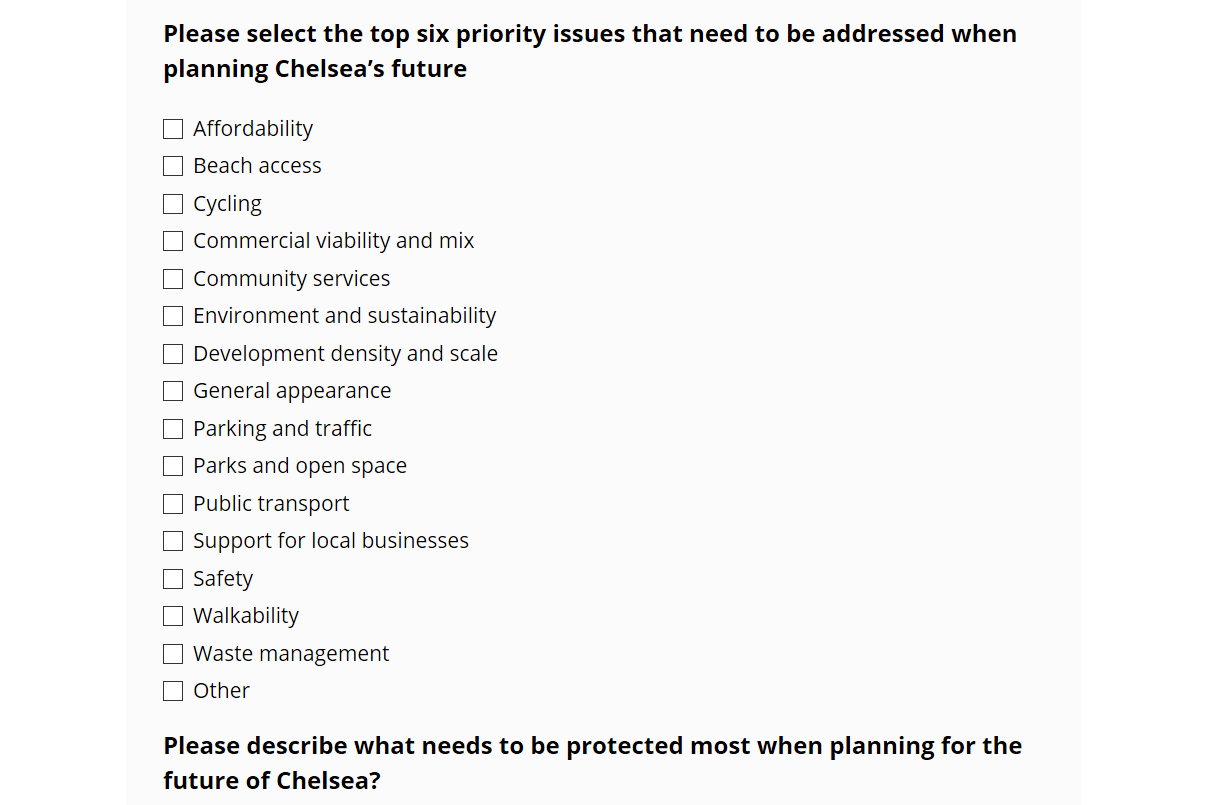
By way of contrast we provide the following example from a current consultation by Kingston. Whilst not brilliant, residents are at least provided with options that they can prioritise and comment upon. Also worth noting is that residents are specifically given the option of development density and scale plus the question: Please describe what need to be protected most when planning for the future of Chelsea! Questions that Glen Eira would not dare to ask because they know that the majority of residents are opposed to 10 storeys!
Countless other processes are missing whenever this council pretends to undertake community consultation. For instance:
This approach is consistent in all council’s ‘consultations’ and stands in stark contrast to the way that other councils go about involving their communities. Glen Eira does not have consultation worthy of that name. What we have is a carefully managed show where decisions are made behind closed doors and then the data or questions are skewed to find the ‘evidence’ that supports the predetermined decisions.
June 8, 2020
The following table taken directly from council’s latest version of the Open Space Strategy (OSS) says it all in terms of performance and how important this council views open space.
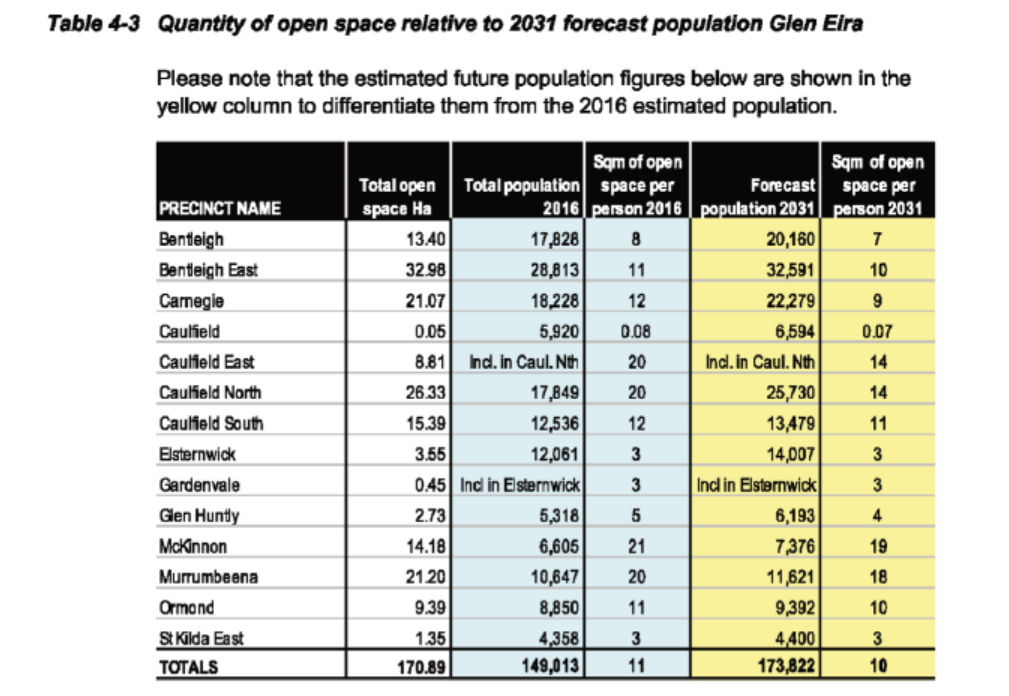
There are several things to note about this table:
Over the past 6 years council has ‘achieved’ the following:
Over the past ten and a half years, council has accumulated $52m in open space levies. It has spent just over $8M on acquiring properties as NEW open space. That is basically 15%. The rest has gone into ‘improvement’ of existing open space, despite the fact that this council has identified for the past 30 odd years the need for additional open space!
Here’s the table that documents council’s accrued levy contributions. The figures are taken directly from the 2014 and 2020 open space strategies, together with data from the monthly financial reports.
|
FINANCIAL YEAR |
REVENUE |
| 2009/10 | $1,663,000 |
| 2010/11 | $1,629,000 |
| 2011/12 | $2,230,000 |
| 2012/13 | $1,900,000 |
| 2013/14 | $2,581,000 |
| 2014/15 | $3,667,000 |
| 2015/16 | $5,865,000 |
| 2016/17 | $7,811,000 |
| 2017/18 | $10,348,000 |
| 2018/19 | $7,851,000 |
| 2019/20 (Jul-April) | $6,856,815 |
| TOTAL | $52,401,815 |
June 5, 2020
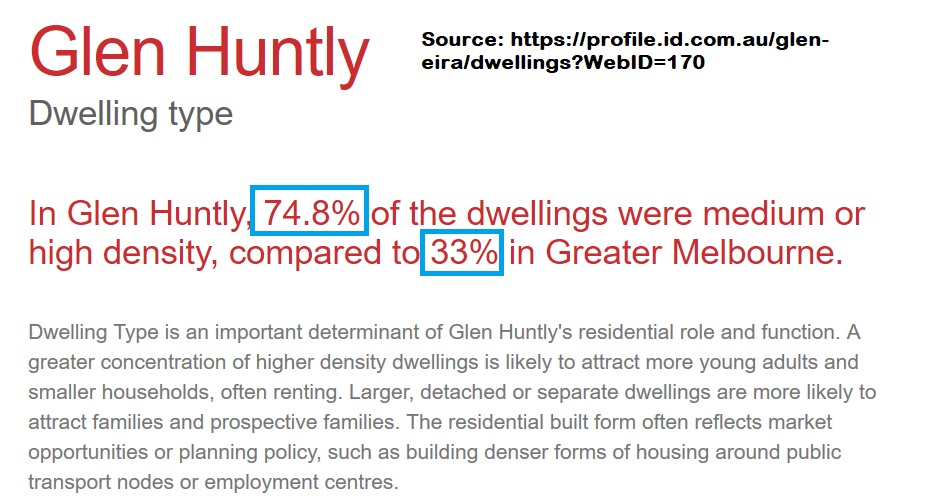
The central question for residents is: how much more development should a suburb like Glen Huntly have when it is already the most overdeveloped area in the municipality? Council uses profile.id. Here is what they conclude about Glen Huntly based on census figures. With Council’s proposed structure plan it can only get worse!
It is time that this council was called to account for its continued facilitation of more and more development. The latest example of what this means for residents is the draft Glen Huntly structure plan. This is far from a typical ‘structure plan’ in that:
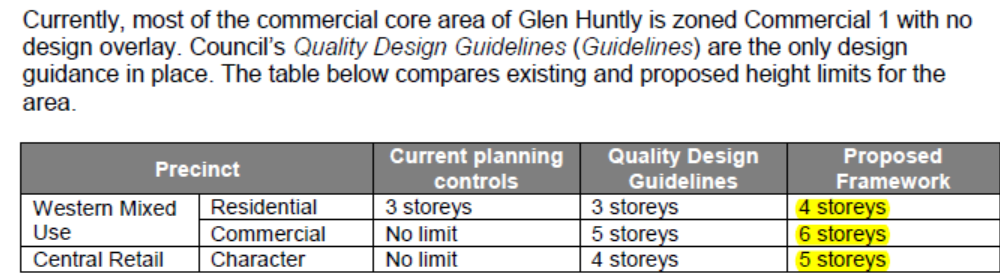
What we do know is that council’s much vaunted Quality Design Guidelines is not worth the paper it is written on and the latest City Plan isn’t much better. Whilst the Guidelines stated that the preferred heights for the commercial areas be 5 storeys, we now have council officers advocating for 6 storeys. What was 8 storeys now becomes 10 storeys. The following screen dumps reveal what is proposed (most are discretionary height limits too):

The final insult comes with the discretionary setbacks. Whilst the Bentleigh & Carnegie upper floor setbacks were reduced from 6 to 5 metres, we now have council recommendations for a majority of only 4 metre setbacks and in one precinct a front wall of up to 15 metres.
This is not ‘urban design’ – it is urban destruction in a suburb that is currently the most densely populated in the municipality. With this ‘structure plan’ it will only get worse.
Several things are very clear.
The tragedy of all this is that our councillors are failing spectacularly in fulfilling their roles – that is primarily to be COMMUNITY REPRESENTATIVES. Listening to the community is one thing. Acting on community wishes is another thing completely.
May 22, 2020
The vast majority of Glen Eira residents live in our neighbourhood centres. Yet it is these very centres which have no protection against overdevelopment in the commercial and mixed use areas. Making matters even worse, it is these areas which are now being exploited since the major activity centres are basically already built out and land is far more expensive. So, if any reader should happen to live in Ormond, McKinnon, East Bentleigh, South Caulfield, North Caulfield, Patterson, Alma ‘village’, Caulfield, Gardenvale etc. then they had better get used to having high rise dominate their landscapes.
Thus far we already have either applications or permits granted for the following:
Our neighbouring councils such as Bayside, Kingston, and even Boroondara have nothing of this for their neighbourhood centres. Our council however sees fit to delay and delay so that by the time anything of value is produced it is far too late to put a stop to such development. If these suburbs already contain 7, 8, or 9 storey buildings it becomes impossible to then argue that the height limit should be 3 or 4 storeys.
Making matters even worse is that residents have been lead up the garden path again by our councillors and administrators. The 2016 Planning Scheme Review consultation produced results which were unequivocal and which this administration acknowledged at the meeting in the auditorium. Our notes from this meeting included the following comments:
MCKENZIE: because we can’t do everything at once we want you to tell us where you think the relative priorities are….the order we should be tackling some of this’
TORRES: ‘key messages’ and ‘themes’…today we believe there is a strong need to develop structure plans for our activity centres…..’there is a growing call from the community in this environment to better manage development in our activity centres….. It’s not one size fits all….not every shopping centres is the same.….strong representation from residents from the Bentleigh area….there are calls for height limits in our other shopping centres…., SO WE BELIEVE THAT STRUCTURE PLANS CAN DELIVER THAT SHARED VISION
SMITH: structure plans mentioned at every workshop; 3 structure plans in the municipality within the next 5 years; we envisage that these will continue throughout our activity centres after that initial 5 years …….; preferred character statements will allow us to set out (what we want) for a precinct…..decvelopment controbutions scheme…..’a lot of that work has already been done’
FACILITATOR: opportunity to prioritise urban villages and your neighbourhood centres
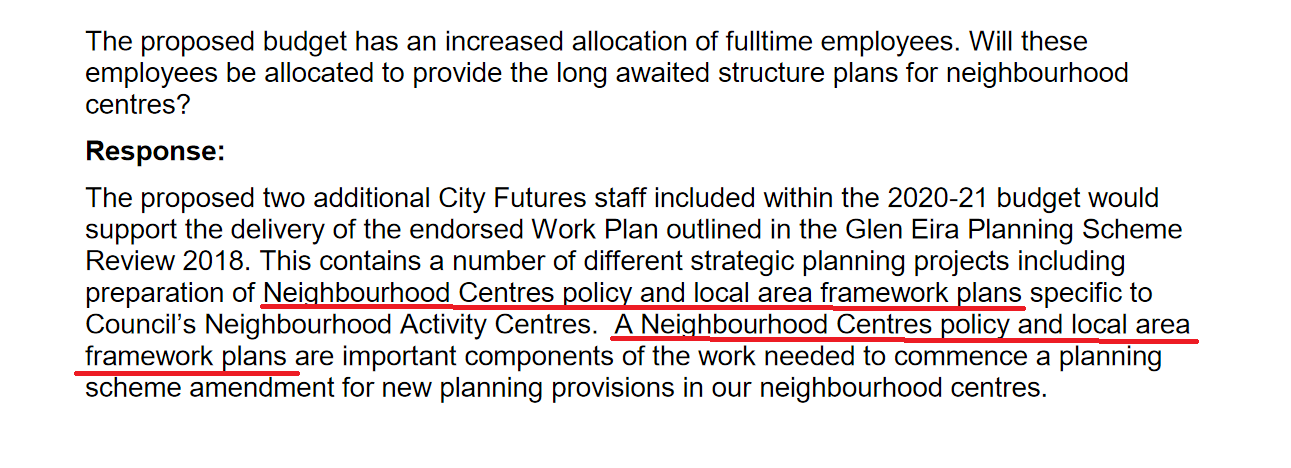
Structure planning for ALL ACTIVITY CENTRES was the message that came through loud and clear. That is no longer the case and hasn’t been since the 2018 Planning Scheme Review work plan. Instead of structure planning, our neighbourhood centres and local centres will only have ‘guidelines’ and possibly ‘urban design frameworks’.
At last council meeting a public question was asked about these neighbourhood centres and how work will be progressed. The language council used in response confirms once again what their intentions are. What is unacceptable of course is that this council refuses to come out in an open and transparent fashion and tell its ratepayers that THERE WILL NOT BE STRUCTURE PLANS for these areas. Instead it becomes a game of semantics, obfuscation, and deliberate deceit. Here’s the question and response.
 What is even more disconcerting about council’s intentions is that:
CONCLUSION
What we therefore have is a council determined to ignore public feedback and to allow our neighbourhood centres to become quasi major activity centres. Even worse is that this council refuses to be up front and commit to a clear statement that is truthful, accurate, and details exactly what is intended!
May 6, 2020
All councillors deserve an academy award for their performances last night. There was ‘passion’ with a capital P, so much in fact that at times it became cringe worthy. Residents really need to ask themselves – ‘what was actually achieved last night’ and did we witness anything other than another exercise in smoke and mirrors?
CLIMATE EMERGENCY
Davey did manage to get her most important motion up. This was to work on the Environmental Sustainable Policy (ESS) and to set a goal of cutting corporate emissions by 2025 and community emissions by 2030.
Sounds wonderful! But is it simply more of the same since nothing will happen for at least another 18 months given that there is no funding for anything new in the current budget! We are going to have to wait for the 2021/2 budget to see anything materialise and even then it could take months and months before any project is up and running. We did not get one single word about how much anything would cost nor which priority actions that will be pursued first down the track. It will all depend on the new ESS strategy and putting some money into the NEXT BUDGET!
Put simply, words and actions are miles apart. If we are indeed facing an ‘emergency’ then action is required NOW as it has been for years and years. We reiterate the following:
We also had the spectacle last night of Silver stating that he wasn’t happy with some of the wording of the recommendation(s) in the officer report. Fair enough! Then why didn’t he outline his misgivings and move a motion to amend the wording? Why pretend that abstaining (which was the flavour of last night) was not a vote against when the legislation clearly states: for the purpose of determining the result of a vote, a Councillor present at the meeting who does not vote is to be taken to have voted against the question [Local Government Act, 2020: Section 61:5(e)]
We also take issue with Sztrajt and his ‘passion’ on the importance of declaring a ‘climate emergency’. This will ‘send a message’ to all levels of government; it will inform the public, it will show how serious the community is and that Glen Eira is not the odd man out. Wonderful, except why isn’t this same passion applied to over-development and the ruin of our suburbs, especially the neighbourhood centres? Why can’t this same public statement be made on behalf of a community who don’t want our streets turned into high rise wind tunnels. Instead we get silence from the council lot!
The Budget
The spin doctors were really out in force on this item. Esakoff read out her version of the budget/SRP that contained no details whatsoever as to the plan to borrow $60 million. She merely used the term ‘borrowings’ once; nor did we get any summary of which services would be cut back. (For instance the massive reduction in library collection funding).
Not a single word from any councillor was directed to HOW MUCH our charges had increased. Yes, we were told 2% but that does not tally with what the actual numbers in the budget state – ie an average increase of between 12 and 15% on some major items.
And then there’s the rush to pass the budget, when councils have been given until August 31st to set their finances. How is it possible that council can state that it is currently unsure of the full financial impact of COVID and with the same breath draw up a budget that is so open to change? Or is this merely another tactic that council can later use when they delay project after project?
CONCLUSION
There is much, much more that needs to be said regarding last night’s meeting. What is very clear is that this council has no intention of changing its goals, its modus operandi, and its insistence on being as vague, and as uninformative as it possibly can be – both via the written and spoken word.
Yes, the legal requirements are met, but that is all that happens. Remember that this council has NEVER adopted any recommendations made by residents to its draft budgets. Once published everything is set in concrete unlike so many other councils who are now really seeking community responses to their planned projects and priorities.
For all the talk about ‘community’, Glen Eira councillors do not know the meaning of the word in our view. If they did, then the manner in which this council operates would be entirely different and far more transparent and accountable!
May 3, 2020
This post is not about whether councillors should declare a Climate Emergency or not. Rather it focuses on the officer’s report and asks readers to determine how objective such a report really is and whether this is merely another example of council’s attempt at public grandstanding whilst in reality doing nothing at all.
Once again we have a report that purports to present all the relevant information so that informed decision making by councillors may take place. This report is far from ‘informative’ or objective. The take home message from this report can only be MAINTAIN THE STATUS QUO!
Three options are proffered to councillors (see below)
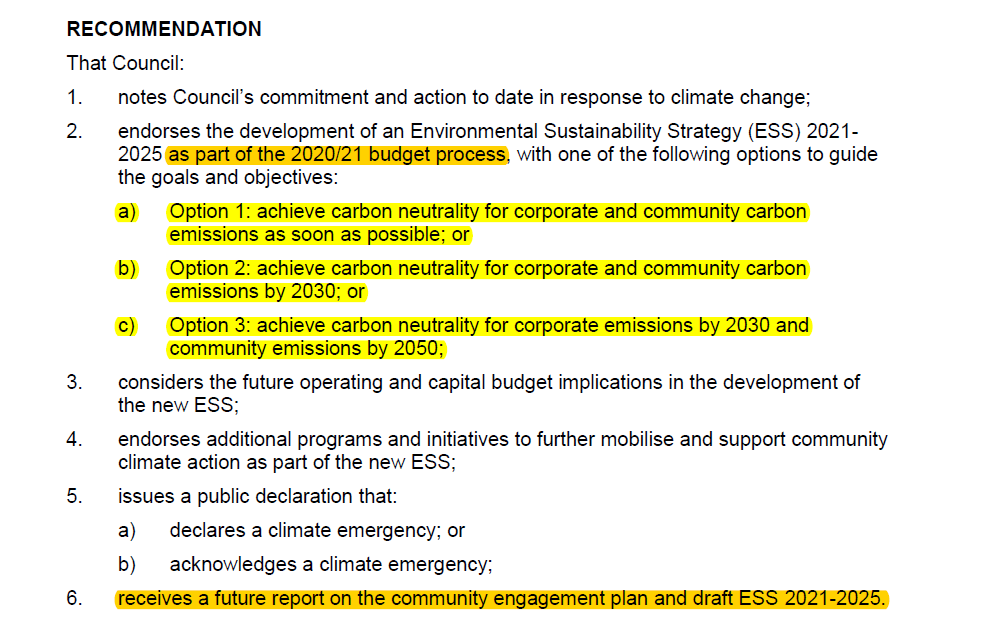
Option 1 is clearly the most proactive and given the fact that we are told that declaring a Climate Emergency requires ‘immediate’ action this would ostensibly be the option most appropriate. We even have Ms Krull’s response to Ahtanasopolous’ question of the 25 Feb council meeting where she said: Councils that declare a climate emergency must commit to strong and fast climate action and reduce their carbon emissions as fast as possible.
Yet sprinkled throughout this report we find statement after statement that debunks this ‘urgency’ and plays the cost card. For example: Increasing the Solar Savers program where council purchases the system and residents therefore have no up-front costs, we are told: This scheme will have a financial impact on Council’s budget as Council will need to fund the upfront cost for each household in the program.
And this approach goes on and on –
Committing to goals and initiatives in Options 1 and 2 will require significant additional staff resources and operating budget to fund new activities to reduce corporate and community carbon emissions.
Current operating and capital budgets do not include an allowance for activities that will need to be undertaken if Council determines to declare a climate emergency
No provision has been made in Council’s long term SRP for the substantial costs of the initiatives in Options 1 and 2. If these initiatives are included, Council would need to consider re-prioritisation of other projects to ensure long term financial sustainability of the SRP.
How ludicrous that within the same agenda we have the proposed 2020/21 budget and another item that would impact greatly on this budget but has not even been investigated and quantified. Surely the vote on any Climate Emergency declaration and its accompanying actions should precede any vote on the budget? Unless of course the objective is not to introduce anything new at this point in time and continue with the goal of achieving so very little by 2030 or 2050. A charade at its best we say!
Much of the report focuses on council’s ‘achievements’ in this domain of climate change. One such ‘achievement’ is touted as the annual planting of 2000 trees to combat the heat island effect. What we are not told of course is that according to the 2018/19 annual report 940 trees were lost (page 13). Seen from this angle, 2000 plantings become 1000! And we are still waiting of course for an ESD policy, a WSUD policy into the planning scheme and that old perennial of tree controls over private land (ie tree register). Oh, and an Urban Forest in the Booran Road park that remains under lock and key but is still counted as ‘open space’!
Finally, here is a list of Victorian councils that have declared a Climate Emergency (up to Feb 2020). Many of the accompanying proposed actions in these policies put Glen Eira to shame.
Ballarat City Council
Banyule City Council
Bass Coast Shire Council
Bayside City Council
Brimbank City Council
Cardinia City Council
Darebin City Council
Frankston City Council
Greater Dandenong City Council
Hepburn Shire Council
Hobsons Bay City Council
ndigo Shire Council
Kingston City Council
Manningham City Council
Maribyrnong City Council
Melbourne City Council
Moonee Valley City Council
Mount Alexander Shire Council
Moreland City Council
Mornington Peninsula Shire Council
Moyne Shire Council
Port Phillip City Council
Queenscliffe Borough
Surf Coast Shire Council
Warrnambool City Council
Yarra City Council
Yarra Ranges Council
As stated at the outset, we are not debating the issue of climate change and how council should address the challenges. We are far more concerned with how decisions can be authentic and valid when the requisite information is not provided, and budgets are to be decided that don’t include any possibility of funding real action in the immediate future. If this is the objective, then let’s see that declared instead of the continued camouflaging that is council’s modus operandi.
May 1, 2020
Council has released its draft budget and Strategic Resource Plan (SRP) for the next ten years. We can only marvel at the audacity that goes into these documents whilst simultaneously wondering how much credence should be given to any of the figures produced year to year. We acknowledge up front that budgets can and do change; that unforseen circumstances (ie COVID) play a role. However, when prognostications are out by 100% then questions need to be asked and those responsible for the figures should be held to account and judgement. More importantly, there is not one single word that seeks to explain or justify the unbelievably divergent figures!
Here are some examples comparing the figures provided in the 2019/20 Strategic Resource Plan (SRP) and what we are now presented with.
Carnegie Pool Redevelopment: Capital costs of $47.6M from 2020/21 to 2023/4 (Capital costs of $39M in 2019/20!)
Elsternwick Community Hub & Park: $47M (majority of spend in 2024/5 to 2027/8) In 2019 – $31.8M
Selwyn Street Cultural Precinct: $5.6M to be completed in 2023/4 (2019; $5.5M)
Stanley Street Multi-deck Carpark: $22.32M completed in 2023/4 (In 2019 17.3M)
Koornang Road Streetscape & Upgrade: $6.5M (majority of spend in 2025/6 to 2028/9) (2019 – $6.15)
Eat Street rotunda: $5.1M to be completed in 2021/2)(in 2019 $1.8M)
Bentleigh Library Upgrade: $6.3M to be completed in 2022/3 (In 2019 $3.5M)
Bleazby Street Carpark: $15.7M completed in 2023/4 (not listed in 2019 but Horsely Street was listed at $1.6M with majority of spend in 2029/30!)
Fair enough that prices have increased over the year. However, no sensible person will accept the massive increases suggested in the above comparison. So what does this tell us about council plans and what they are not revealing.
All of this can be summed up neatly with the following screen dumps from the 2019/20 version and the current draft SRP.
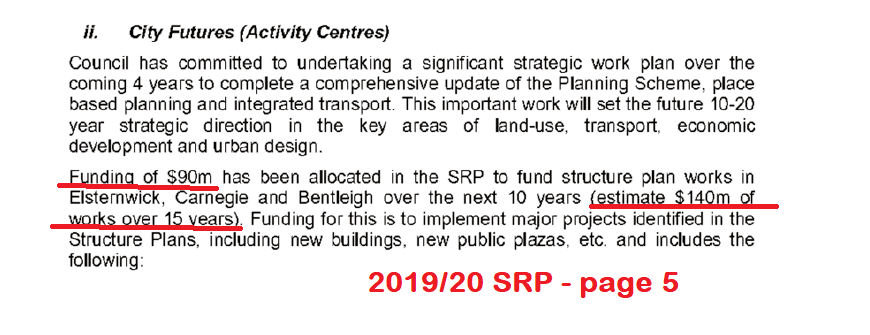
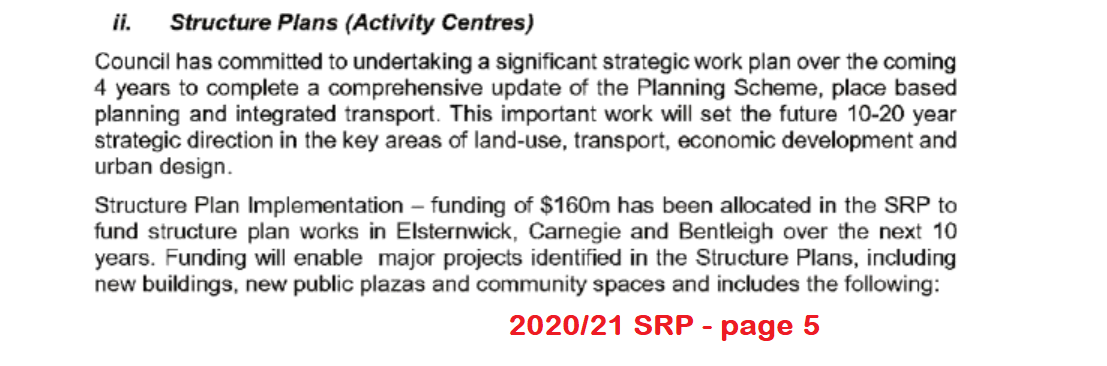 How and why on earth should forecast spending jump from $90 million to $160M or even from $140 million to $160M. Have residents really been consulted on whether this is what they want? Is it wise spending when so many people have lost their jobs and/or are in financial difficulties? Do we really need such massive infrastructure projects and borrowings that will keep us in hock for decades? Of course, this council never bothers to present a complete picture or to consult its residents. And as some residents have already asked – have any of our extremely well paid administrators and/or councillors taken a pay cut in the current COVID situation?
Adding more insult to injury, we find the following increases:
240L waste bin – $515 up from $441 last year
120L waste bin – $255 up from $220 last year
Child care
0-3 year olds: $140 per day up from $137 last year
3-5 year olds: $132 per day up from $129 last year
Pensioner rebate contribution – $29 last year was $36 and in 2016 was $59!!!!!
Staff EFT: FROM 860.19 TO 873.86 plus a 2.5% increase in wages!
We keep reading about council’s reduced income stream as a result of COVID, yet there is nothing in this budget or the SRP which indicates a tightening of the belt, a reduction in spending, and a reduction in grandiose contruction plans. Nor is there anything to indicate that council will increase the amount of open space so desperately lacking in this municipality.
 Glen Eira Debates